VOLUME II SLICE VII Arundel, Thomas to Athens (continued 12)
Reading edition
See J. Beloch, Campanien (2nd ed., Breslau, 1890), p. 379.
ATELLANAE FABULAE (“Atellan fables”), the name of a sort of popular comedy amongst the ancient Romans. The name is derived from Atella, an Oscan town in Campania; for this reason, and from their being also called Osci Ludi, it has been supposed that they were of Oscan origin and introduced at Rome after Campania had been deprived of its independence. It seems highly improbable that they were performed in the Oscan language. Mommsen, however, rejects their Oscan origin altogether; he regards them as purely Latin, the scene merely being laid at Atella to avoid causing offence by placing it at Rome or one of the Latin cities. These plays, or rather sketches, contained humorous descriptions of country as contrasted with town life, and found their subjects amongst the lower classes of the people. The subjects alone were decided upon before the performance began; the dialogue was improvised as it proceeded. The Atellanae contained certain stock characters, like the Italian harlequinades: Maccus (the fool), Bucco (fat-chaps), Pappus (daddy), Dossennus (sharper); monsters and bogeys like Manducus, Pytho, Lamia also made their appearance. The performers were the sons of Roman citizens, who did not lose their rights as citizens, and were allowed to serve in the army: professional actors were excluded. The simple prose dialogues were probably varied by songs in the rude Saturnian metre: the language was that of the common people, accompanied by lively gesticulation and movements. They were characterized by coarseness and obscenity. In the time of Sulla a literary form was given to the Atellanae by Pomponius of Bononia and Novius, who made them regular written comedies. Living persons seem to have been attacked, and even the doings of the gods and heroes of mythology burlesqued. From this time the Atellanae were used as after-pieces and performed by professional actors. In 46 B.C. they were ousted by the mimes, but regained popularity during the reign of Tiberius (chiefly owing to a certain Mummius), until they were definitely superseded by and merged in the mimes. They held their ground in the small towns and villages of Italy during the last days of the empire; they probably lingered on into the middle ages, and were the origin of the Italian Commedie dell’ arte.
The scanty fragments of Pomponius and Novius are collected in Ribbeck’s Comicorum Romanorum Reliquiae; see also Munk, De Fabulis Atellanis (1840); and art. Latin Literature.
ATESTE (mod. Este, q.v.), an ancient town of Venetia, at the southern foot of the Euganean hills, 43 ft. above sea-level; 22 m. S.W. of Patavium (Padua). The site was occupied in very early times, as the discoveries since 1882 show. Large cemeteries have been excavated, which show three different periods from the 8th century B.C. down to the Roman domination. In the first period (Italic) cremation burials closely approximating to the Villanova type are found; in the second1 (Venetian) the tombs are constructed of blocks of stone, and situlae (bronze buckets), sometimes decorated with elaborate designs, are frequently used to contain the cinerary urns; in the third (Gallic), which begins during the 4th century B.C., though cremation continues, the tombs are much poorer, the ossuaries being of badly baked rough clay, and show traces of Gallic influence, and characteristics of the La-Tène civilization. The many important objects found in these excavations are preserved in the local museum. See G. Ghirardini in Notizie degli Scavi; Monumenti dei Lincei, ii. (1893) 161 seq., vii. (1897) 5 seq., x. (1901) 5 seq.; Atti del Congresso Internazionale di Scienze Storiche (Rome, 1904), v. 279 seq. Inscriptions show that the national language asserted its existence even after Ateste came into the hands of the Romans. When this occurred is not known; boundary stones of 135 B.C. exist, which divide the territory of Ateste from that of Patavium and of Vicetia, showing that the former extended from the middle of the Euganean hills to the Atesis (mod. Adige, from which Ateste no doubt took its name, and on which it once stood). After the battle of Actium, Augustus settled veterans from various of his legions in this territory, Ateste being thenceforth spoken of as a colony. It appears to have furnished many recruits, especially for the cohortes urbanae. It appears but little in history, though its importance is vouched for by numerous inscriptions, the majority of which belong to the early Empire.
(T. As.)
1 This is by some authorities divided into two.
ATH, or Aath, an ancient town of the province of Hainaut, Belgium, situated on the left bank of the Dender. Pop. (1890) 9868; (1904) 11,201. Formerly it was fortified, but after the change in the defensive system of Belgium in 1858 the fortress was dismantled and its ramparts superseded by boulevards. Owing to a fire caused by lightning its fine church of St Julien, dating from the 14th century, which had escaped serious injury during many wars, was destroyed in 1817 (since rebuilt). This left the Tour Burbant as its sole relic of the middle ages. This tower formed part of the donjon of the fortress erected by Baldwin IV., count of Hainaut, about the year 1150. Near Ath is the fine castle of Beloeil, the ancient seat of the princely family of Ligne. Ath is famous for its gild of archers, whose butts are erected on the plain of the Esplanade in the centre of the town. The town militia has the privilege of being armed with bows and crossbows. Ath is also well known in Hainaut for its annual fête called le jour de ducasse—ducasse being the Walloon word for kermesse (fête). On this occasion a procession escorting figures of two giants, Goliath, called locally Goyasse, and Samson, forms the chief feature of the celebration. The emperor Joseph II. stopped it for its “idolatrous” character, but this act was one of the causes of the Brabant revolution of 1789. The procession, revived in 1790, was again stopped by the French republicans five years later, but was revived under the Empire, and has flourished ever since.
ATHABASCA (Athiapescow), or Elk, a river and lake Of the province of Alberta, Canada. The river rises in the Rocky Mountains near the Yellowhead Pass in 52° 10′ N. and 117° 10′ W., and flows north-east as far as Athabasca Landing, and thence north into Lake Athabasca. It is 740 m. long and has a number of important tributaries, including the McLeod, Pembina, Lesser Slave, which drains the lake of that name, and Clearwater. Athabasca lake is 195 m. long, west to east, from 20 to 32 m. wide has an area of 3085 sq. m., and is 690 ft. above the sea. It discharges its waters northward by Slave river and the Mackenzie system to the Arctic Ocean. On its north shore the country is high and rocky; on the south, sandy and barren. Shallow draught steamers navigate the lake and river, and Lesser Slave lake and river, with one interruption—at Grand Rapids near the mouth of the Clearwater river.
ATHALARIC (516-534), king of the Ostrogoths, grandson of Theodoric, became king of the Ostrogoths in Italy on his grandfather’s death (526). As he was only ten years old, the regency was assumed by his mother Amalasuntha (q.v.). The murmurs of the Gothic nobles procured for their young sovereign too early emancipation from the schoolroom. He drank heavily, and indulged in vicious excesses which ruined his constitution. He died on the 2nd of October 534.
ATHALIAH, in the Bible, the daughter of Ahab, and wife of Jehoram, king of Judah. After the death of Ahaziah, her son she usurped the throne and reigned for six years. She is said to have massacred all the members of the royal house of Judah (2 Kings xi. 1-3), but a similar atrocity is also ascribed to Jehu (2 Kings x. 12-14); with both notices contrast 2 Chron. xxi. 17. The sole survivor Joash was concealed in the temple by his aunt, Jehosheba, wife of the priest Jehoida (2 Chron. xxii. 11) These organized a revolution in favour of Joash, and caused Athaliah and her adherents to be put to death (2 Kings xi.; 2 Chron. xxii. 10-12, xxiii., xxiv. 7).
The story of Athaliah forms the subject of one of Racine’s best tragedies. It has been musically treated by Handel and Mendelssohn.
ATHAMAS, in Greek mythology, king of the Minyae in Boeotian Orchomenus, son of Aeolus, king of Thessaly, or of Minyas. His first wife was Nephele, the cloud-goddess, by whom he had two children, Phrixus and Helle (see Argonauts). Athamas and his second wife Ino were said to have incurred the wrath of Hera, because Ino had brought up Dionysus, the son of her sister Semele, as a girl, to save his life. Athamas went mad, and slew one of his sons, Learchus; Ino, to escape the pursuit of her frenzied husband, threw herself into the sea with her other son Melicertes. Both were afterwards worshipped as marine divinities, Ino as Leucothea, Melicertes as Palaemon (Odyssey v. 333). Athamas, with the guilt of his son’s murder upon him, was obliged to flee from Boeotia. He was ordered by the oracle to settle in a place where he should receive hospitality from wild beasts. This he found at Phthiotis in Thessaly, where he surprised some wolves eating sheep; on his approach they fled, leaving him the bones. Athamas, regarding this as the fulfilment of the oracle, settled there and married a third wife, Themisto. The spot was afterwards called the Athamanian plain (Apollodorus i. 9; Hyginus, Fab. 1-5; Ovid, Metam. iv. 416, Fasti, vi. 485; Valerius Flaccus i. 277).
According to a local legend, Athamas was king of Halos in Phthiotis from the first (Schol. on Apoll. Rhodius ii. 513). After his attempt on the life of Phrixus, which was supposed to have succeeded, the Phthiots were ordered to sacrifice him to Zeus Laphystius, in order to appease the anger of the gods. As he was on the point of being put to death, Cytissorus, a son of Phrixus, suddenly arrived from Aea with the news that Phrixus was still alive. Athamas’s life was thus saved, but the wrath of the gods was unappeased, and pursued the family. It was ordained that the eldest born of the race should not enter the council-chamber; if he did so, he was liable to be seized and sacrificed if detected (Herodotus vii. 197). The legend of Athamas is probably founded on a very old custom amongst the Minyae—the sacrifice of the first-born of the race of Athamas to Zeus Laphystius. The story formed the subject of lost tragedies by Aeschylus, Sophocles, Euripides and other Greek and Latin dramatists.
ATHANAGILD (d. 547) became king of the Visigoths (in Spain) in 534, having invoked the aid of the emperor Justinian for his revolt against his predecessor Agila. Athanagild, when himself king, vainly tried to oust his late allies from the footing which they had gained in Spain, nor were the Greeks finally expelled from Spain till seventy years later. Athanagild himself is chiefly remembered for the tragic fortunes of his daughters Brunechildis and Gavleswintha, who married two Frankish brother kings, Sigebert and Chilperic. Athanagild died (“peacefully,” as the annalist remarks) in 547.
ATHANARIC (d. 381), a ruler of the Visigoths from about 366 to 380. He bore the title not of king but of judge, a title which may be compared with that of ealdorman among the Anglo-Saxon invaders of Britain. Athanaric waged, from 367 to 369, an unsuccessful war with the emperor Valens, and the peace by which the war was ended was ratified by the Roman and Gothic rulers meeting on a barge in mid-stream of the Danube. Athanaric was a harsh and obstinate heathen, and his short reign was chiefly famous for his brutal persecution of his Christian fellow-countrymen. In 376 he was utterly defeated by the Huns, who a few years before had burst into Europe. The bulk of the Visigothic people sought refuge within the Empire in the region now known as Bulgaria, but Athanaric seems to have fled into Transylvania. Being attacked there by two Ostrogothic chiefs he also, in 381, sought the protection of the Roman emperor. Theodosius I. received him courteously, and he was profoundly impressed by the glories of Constantinople, but on the fifteenth day after his arrival he died, and was honoured by the emperor with a magnificent funeral.
ATHANASIUS (293-373), bishop of Alexandria and saint, one of the most illustrious defenders of the Christian faith, was born probably at Alexandria. Of his family and of his early education nothing can be said to be known. According to the legend, the boy is said to have once baptized some of his playmates and thereupon to have been taken into his house by Bishop Alexander, who recognized the validity of this proceeding. It is certain that Athanasius was young when he took orders, and that he must soon have entered into close relations with his bishop, whom, after the outbreak of the Arian controversy, he accompanied as archdeacon to the council of Nicaea. In the sessions and discussions of the council he could take no part; but in unofficial conferences he took sides vigorously, according to his own evidence, against the Arians, and was certainly not without influence. He had already, before the opening of the Council, defined his personal attitude towards the dogmatic problem in two essays, Against the Gentiles and On the Incarnation, without, however, any special relation to the Arian controversy.
The essay On the Incarnation is the locus classicus for the presentation of the teaching of the ancient church on the subject of salvation. In this the great idea that God himself had entered into humanity becomes dominant. The doom of death under which mankind had sighed since Adam’s fall could only then be averted, when the immortal Word of God (Λόγος) assumed a mortal body, and, by yielding this to death for the sake of all, abrogated once for all the law of death, of which the power had been spent on the body of the Lord. Thus was rendered possible the leading back of mankind to God, of which the sure pledge lies in the grace of the resurrection of Christ. Athanasius would hear of no questioning of this religious mystery. In the catchword Homousios, which had been added to the creed at Nicaea, he too recognized the best formula for the expression of the mystery, although in his own writings he made but sparing use of it. He was in fact less concerned with the formula than with the content. Arians and Semi-Arians seemed to him to be pagans, who worship the creature, instead of the God who created all things, since they teach two gods, one having no beginning, the other having a beginning in Time and therefore of the same nature as the heathen gods, since, like them, he is a creature. Athanasius has no terms for the definition of the Persons in the one “Divine” (τὸ θεῖον), which are in their substance one; and yet he is certain that this “Divine” is not mere abstraction, but something truly personal: “They are One,” so he wrote later in his Discourses against the Arians. “not as though the unity were torn into two parts, which outside the unity would be nothing, nor as though the unity bore two names, so that one and the same is at one time Father and then his own Son, as the heretic Sabellius imagined. But they are two, for the Father is Father, and the Son is not the same, but, again, the Son is Son, and not the Father himself. But their Nature (φύσις) is one, for the Begotten is not dissimilar (ἀνόμοιος) to the Begetter, but his image, and everything that is the Father’s is also the Son’s.”
Five months after the return from the council of Nicaea Bishop Alexander died; and on the 8th of February 326 Athanasius, at the age of thirty-three, became his successor. The first years of his episcopate were tranquil; then the storms in which the remainder of his life was passed began to gather round him. The council had by no means composed the divisions in the Church which the Arian controversy had provoked. Arius himself still lived, and his friend Eusebius of Nicomedia rapidly regained influence over the emperor Constantine. The result was a demand made by the emperor that Arius should be readmitted to communion. Athanasius stood firm, but many accusers soon rose up against one who was known to be under the frown of the imperial displeasure. He was charged with cruelty, even with sorcery and murder. It was reported that a bishop of the Meletian party (see Meletius) in the Thebaid, of the name of Arsenius, had been unlawfully put to death by him. He was easily able to clear himself of these charges; but the hatred of his enemies was not relaxed, and in the summer of 335 he was peremptorily ordered to appear at Tyre, where a council had been summoned to sit in judgment upon his conduct. There appeared plainly a predetermination to condemn him, and he fled from Tyre to Constantinople to appeal to the emperor himself. Refused at first a hearing, his perseverance was at length rewarded by the emperor’s assent to his reasonable request that his accusers should be brought face to face with him in the imperial presence. Accordingly the leaders of the council, the most conspicuous of whom were Eusebius of Nicomedia and his namesake of Caesarea, were summoned to Constantinople. Here they did not attempt to repeat their old charges, but found a more effective weapon to their hands in a new charge of a political kind—that Athanasius had threatened to stop the Alexandrian corn-ships bound for Constantinople. It is very difficult to understand how far there was truth in the persistent accusations made against the prince-bishop of Alexandria. Probably there was in the very greatness of his character and the extent of his popular influence a certain species of dominance which lent a colour of truth to some of the things said against him. On the present occasion his accusers succeeded at once in arousing the imperial jealousy. Without obtaining a hearing, he was banished at the end of 335 to Trèves in Gaul. This was the first banishment of Athanasius, which lasted about one year and a half. It was brought to a close by the death of Constantine, and the accession as emperor of the West of Constantine II., who, in June 337, allowed Athanasius to return to Alexandria.
He reached his see on the 23rd of November 337, and, as he himself has told us, “the people ran in crowds to see his face; the churches were full of rejoicing; thanksgivings were everywhere offered up; the ministers and clergy thought the day the happiest in their lives.” But this period of happiness was destined to be short-lived. His position as bishop of Alexandria placed him, not under his patron Constantine, but under Constantius, another son of the elder Constantine, who had succeeded to the throne of the East. He in his turn fell, as his father had done in later years, under the influence of Eusebius of Nicomedia, who in the latter half of 339 was transferred to the see of Constantinople, the new seat of the imperial court. A second expulsion of Athanasius was accordingly resolved upon. The old accusations against him were revived, and he was further charged with having set at naught the decision of a council. On the 18th of March 339 the exarch of Egypt suddenly confronted Athanasius with an imperial edict, by which he was deposed and a Cappadocian named Gregory was nominated bishop in his place. On the following day, after tumultuous scenes, Athanasius fled, and four days later Gregory was installed by the aid of the soldiery. On the first opportunity, Athanasius went to Rome, to “lay his case before the church.” A synod assembled at Rome in the autumn of 340, and the great council—probably that which met at Sardica in 342 or 343, where the Orientals refused to meet the representatives of the Western church—declared him guiltless. This decision, however, had no immediate effect in favour of Athanasius. Constantius continued for some time implacable, and the bold action of the Western bishops only incited the Arian party in Alexandria to fresh severities. But the death of the intruder Gregory, on the 26th of June 345, opened up a way of reconciliation. Constantius decided to yield to the importunity of his brother Constans, who had succeeded Constantine II. in the West; and the result was the restoration of Athanasius for the second time, on the 21st of October 346. Again he returned to Alexandria amid the enthusiastic demonstrations of the populace, which is described by Gregory of Nazianzus, in his panegyric on Athanasius, as streaming forth like “another Nile” to meet him afar off as he approached the city.
The six years of his residence in the West had given Athanasius the opportunity of displaying a momentous activity. He made long journeys in Italy, in Gaul, and as far as Belgium. Everywhere he laboured for the Nicene faith, and the impression made by his personality was so great that to hold fast the orthodox faith and to defend Athanasius were for many people one and the same thing. This was shown when, after the death of the emperor Constans, Constantius became sole ruler of East and West. With the help of counsellors more subtle than discerning, the emperor, with the object of uniting the various parties in the Church at any cost, sought for the most colourless possible formula of belief, which he hoped to persuade all the bishops to accept. As his efforts remained for years fruitless, he used force. “My will is your guiding-line,” he exclaimed in the summer of 355 to the bishops who had assembled at Milan in response to his orders. A series of his most defiant opponents had to go into banishment, Liberius of Rome, Hilarius of Poitiers and Hosius of Corduba, the last-named once the confidant of Constantine and the actual originator of the Homousios, and now nearly a hundred years old. At length came the turn of Athanasius, now almost the sole upholder of the banner of the Nicene creed in the East. Several attempts to expel him failed owing to the attitude of the populace. On the night of the 8th-9th of February 356, however, when the bishop was holding the Vigils, soldiers and police broke into the church of Theonas. Athanasius himself has described the scene for us: “I was seated upon my chair, the deacon was about to read the psalm, the people to answer, ‘For his mercy endureth for ever.’ The solemn act was interrupted; a panic arose.” The bishop, who was at first unwilling to save himself, until he knew that his faithful followers were in safety, succeeded in escaping, leaving the town and finding a hiding-place in the country. The solitudes of Upper Egypt, where numerous monasteries and hermitages had been planted, seem at this time to have been his chief shelter. In this case, benefit was repayed by benefit, for Athanasius during his episcopate had been a zealous promoter of asceticism and monachism. With Anthony the hermit and Pachomius the founder of monasteries, he had maintained personal relations, and the former he had commemorated in his Life of Anthony. During his exile his time was occupied in writing on behalf of his cause, and to this period belong some of his most important works, above all the great Orations or Discourses against the Arians, which furnish the best exposition of his theological principles.
During his absence the see of Alexandria was left without a pastor. It is true that George of Cappadocia had taken his place; but he could only maintain himself for a short while (February 357-October 358). The great majority of the population remained faithful to the exile. At length, in November 361, the way was opened to him for his return to his see by the death of Constantius. Julian, who succeeded to the imperial throne, professed himself indifferent to the contentions of the Church, and gave permission to the bishops exiled in the late reign to return home. Among others, Athanasius availed himself of this permission, and in February 362 once more seated himself upon his throne, amid the rejoicings of the people. He had begun his episcopal labours with renewed ardour, and assembled his bishops in Alexandria to decide various important questions, when an imperial mandate again—for the fourth time—drove him from his place of power. The faithful gathered around him weeping. “Be of good heart,” he said, “it is but a cloud: it will pass.” His forecast proved true; for within a few months Julian had closed his brief career of pagan revival. As early as September 363, Athanasius was able to travel to Jovian, the new emperor, who had sent him a letter praising his Christian fidelity and encouraging him to resume his work. He returned to Alexandria on the 20th of February 364. With the emperor he continued to maintain friendly relations; but the period of repose was short. In the spring of 365, after the accession of Valens to the throne, troubles again arose. Athanasius was once more compelled to seek safety from his persecutors in concealment (October 365), which lasted, however, only for four months. In February 366 he resumed his episcopal labours, in which he henceforth remained undisturbed. On the 2nd of May 373, having consecrated one of his presbyters as his successor, he died quietly in his own house.
Athanasius was a man of action, but he also knew how to use his pen for the furtherance of his cause. He left a large number of writings, which cannot of course be compared with those of an Origen, a Basil, or a Gregory of Nyssa. Athanasius was no systematic theologian. All his treatises are occasional pieces, born of controversy and intended for controversial ends. The interest in abstract exposition of clearly formulated theological ideas is everywhere subordinate to the polemical purpose. But all these writings are instinct with a living personal faith, and serve for the defence of the cause; for it was not about words that he was contending. Even those who do not sympathize with the cause which Athanasius steadfastly defended cannot but admire his magnanimous and heroic character. If he was imperious in temper and inflexible in his conception of the Christian faith, he possessed a great heart and a great intellect, inspired with an enthusiastic devotion to Christ. As a theologian, his main distinction was his zealous advocacy of the essential divinity of Christ. Christianity in its Arian conception would have evaporated in a new polytheism. To have set a dam against this process with the whole force of a mighty personality constitutes the importance of Athanasius in the world’s history. It is with good reason that the Church honours him as the “Great,” and as the “Father of Orthodoxy.”
The best edition of the works of Athanasius is the so-called Maurine edition of Bernard de Montfaucon in 3 vols. (Paris, 1698); this was enlarged in the 3rd edition by Giustiniani (4 vols., Padua, 1777), and is printed in this form in Migne’s Patrologia, vols. xxv.-xxviii. An English translation of selections, with excellent introductions to the several writings, was published by Archibald Robertson in the Library of the Nicene and Post-Nicene Fathers, second series, vol. 4 (Oxford and New York, 1892). There is no biography satisfactory from the modern point of view. Studies preliminary to such a biography began to be published by E. Schwartz in his essays, “Zur Geschichte des Athanasius” (in the Nachrichten der koniglichen Gesellschaft der Wissenschaften zu Göttingen, 1904, &c.). The life of Athanasius, however, is so completely intertwined with the history of his time that it is permissible to refer, for a knowledge of him, to the general descriptions which will be found at the close of the article Arius. Of the older literature, Tillemont’s Mémoires pour servir à l’histoire ecclésiastique des six premiers siècles, vols. vi. and viii., are still a mine of material for the historian. Of the newer literature the following deserve to be read:—Johann Adam Möhler, Athanasius der Grosse und die Kirche seiner Zeit, 2 vols. (2nd ed., Mainz, 1844); and Fr. Boehringer, “Arius und Athanasius,” Die Kirche Christi und ihre Zeugen, vol. i. part 2 (2nd ed., Stuttgart, 1874).
(G. K.)
ATHAPASCAN, a widely distributed linguistic stock of North American Indians, the chief tribes included being the Chippewyan, Navajo, Apache, Jicarilla, Lipan, Hupa and Wailaki. The Athapascan family is geographically divided into Northern, Pacific and Southern. The Northern division (Tinneh or Déné) is about Alaska, and the Yukon and Mackenzie rivers,—the eponymous “Athabasca” tribe living round Lake Athabasca, in the province of Alberta in Canada. The Pacific division covers a strip of territory, some 400 m. in length, from Oregon southwards into California. The Southern division includes Arizona and New Mexico, parts of Utah, Colorado, Kansas and Texas, and the northern part of Mexico. The typical tribes are those of the Northern division.
See Handbook of American Indians (Washington, 1907).
ATHARVA VEDA, the fourth book of the Vedas, the ancient scriptures of the Brahman religion. Like the other Vedas it is divided into Samhita, Brahmanas and Upanishads, representing the spiritual element and its magical and nationalistic development. The mantras or sayings composing the Samhita of the Atharva Veda differ from those of the other Vedas by being in the form of spells rather than prayers or hymns, and seem to indicate a stage of religion lower than that of the Rig Veda.
ATHEISM (from Gr. ἀ-, privative, and θεός, God), literally a system of belief which denies the existence of God. The term as generally used, however, is highly ambiguous. Its meaning varies (a) according to the various definitions of deity, and especially (b) according as it is (i.) deliberately adopted by a thinker as a description of his own theological standpoint, or (ii.) applied by one set of thinkers to their opponents. As to (a), it is obvious that atheism from the standpoint of the Christian is a very different conception as compared with atheism as understood by a Deist, a Positivist, a follower of Euhemerus or Herbert Spencer, or a Buddhist. But the ambiguities arising from the points of view described in (b) are much more difficult both intellectually and in their practical social issues. Thus history shows how readily the term has been used in the most haphazard manner to describe even the most trivial divergence of opinion concerning points of dogma. In other words, “atheism” has been used generally by the orthodox adherents of one religion, or even of a single sect, for all beliefs which are different or even differently expressed. It is in fact in these cases, like “heterodoxy,” a term of purely negative significance, and its intellectual value is of the slightest. The distinction between the terms “religion” and “magic” is, in a similar way, often due merely to rivalry between the adherents of two or more mutually exclusive religions brought together in the same community. When the psalmist declares that “the fool hath said in his heart, there is no God,” he probably does not refer to theoretical denial, but to a practical disbelief in God’s government of human affairs, shown in disobedience to moral laws. Socrates was charged with “not believing in the gods the city believes in.” The cry of the heathen populace in the Roman empire against the Christians was “Away with the atheists! To the lions with the Christians!” The ground for the charge was probably the lack of idolatry in all Christian worship. Spinoza, for whom God alone existed, was persecuted as an atheist. A common designation of Knox was “the atheist,” although it was to him “matter of satisfaction that our most holy religion is founded on faith, not on reason.”
In its most scientific and serious usage the term is applied to that state of mind which does not find deity (i.e. either one or many gods) in or above the physical universe. Thus it has been applied to certain primitive savages, who have been thought (e.g. by Lord Avebury in his Prehistoric Times) to have no religious belief; it is, however, the better opinion that there are no peoples who are entirely destitute of some rudimentary religious belief. In the second place, and most usually, it is applied to a purely intellectual, metaphysical disbelief in the existence of any god, or of anything supernatural. In this connexion it is usual to distinguish three types of atheism:—the dogmatic, which denies the existence of God positively; the sceptical, which distrusts the capacity of the human mind to discover the existence of God; and the critical, which doubts the validity of the theistic argument, the proofs for the existence of God. That the first type of atheism exists, in spite of the denials of those who favour the second or the third, may be proved by the utterances of men like Feuerbach, Flourens or Bradlaugh. “There is no God,” says Feuerbach, “it is clear as the sun and as evident as the day that there is no God, and still more that there can be none.” With greater passion Flourens declares “Our enemy is God. Hatred of God is the beginning of wisdom. If mankind would make true progress, it must be on the basis of atheism.” Bradlaugh maintained against Holyoake that he would fight until men respected the name “atheist.” The answer to dogmatic atheism, that it implies infinite knowledge, has been well stated in John Foster’s Essays, and restated by Chalmers in his Natural Theology, and its force is recognized in Holyoake’s careful qualification of the sense in which secularism accepts atheism, “always explaining the term atheist to mean ‘not seeing God’ visually or inferentially, never suffering it to be taken for anti-theism, that is, hating God, denying God—as hating implies personal knowledge as the ground of dislike, and denying implies infinite knowledge as the ground of disproof.” But dogmatic atheism is rare compared with the sceptical type, which is identical with agnosticism (q.v.) in so far as it denies the capacity of the mind of man to form any conception of God, but is different from it in so far as the agnostic merely holds his judgment in suspense, though, in practice, agnosticism is apt to result in an attitude towards religion which is hardly distinguishable from a passive and unaggressive atheism. The third or critical type may be illustrated by A Candid Examination of Theism by “Physicus” (G.J. Romanes), in which the writer endeavours to establish the weakness of the proofs for the existence of God, and to substitute for theism Spencer’s physical explanation of the universe, and yet admits how unsatisfying to himself the new position is. “When at times I think, as think at times I must, of the appalling contrast between the hallowed glory of that creed which once was mine, and the lonely mystery of existence as now I find it—at such times I shall ever feel it impossible to avoid the sharpest pang of which my nature is susceptible.”
Atheism has to meet the protest of the heart as well as the argument of the mind of mankind. It must be judged not only by theoretical but by practical arguments, in its relations either to the individual or to a society. Voltaire himself, speaking as a practical man rather than as a metaphysician, declared that if there were no God it would be necessary to invent one; and if the analysis is only carried far enough it will be found that those who deny the existence of God (in a conventional sense) are all the time setting up something in the nature of deity by way of an ideal of their own, while fighting over the meaning of a word or its conventional misapplication.
ATHELM (d. 923), English churchman, is said to have been a monk of Glastonbury before his elevation in 909 to the see of Wells, of which he was the first occupant. In 914 he became archbishop of Canterbury.
ATHELNEY, a slight eminence of small extent in the low level tract about the junction of the rivers Tone and Parrett in Somersetshire, England. It was formerly isolated by marshes and accessible only by boat or artificial causeway, and under these conditions it gained its historical fame as the retreat of King Alfred in 878-879 when he was unable to withstand the incursions of the Danes. After regaining his throne he founded a monastery here in gratitude for the retreat afforded him by the island; no traces of it exist above ground, but remains have been excavated. There was also found here, in 1693, the celebrated Alfred jewel, bearing his name, and preserved in the Ashmolean Museum at Oxford. An inscribed pillar commemorating the king was set up in 1801. The name of Athelney signifies the Isle of Princes (A.S. Æthelingaea). Athelney is a railway station on a branch of the Great Western line.
ATHENA (the Attic form of the Homeric Athene, also called Athenaia, Pallas Athene, Pallas), one of the most important goddesses in Greek mythology. With Zeus and Apollo, she forms a triad which represents the embodiment of all divine power. No satisfactory derivation of the name Athena has been given1; Pallas, at first an epithet, but after Pindar used by itself, may possibly be connected with παλλακή (“maiden”). Athena has been variously described as the pure aether, the storm-cloud, the dawn, the twilight; but there is little evidence that she was regarded as representing any of the physical powers of nature, and it is better to endeavour to form an idea of her character and attributes from a consideration of her cult-epithets and ritual. According to the legend, her father Zeus swallowed his wife Metis (“counsel”), when pregnant with Athena, since he had been warned that his children by her might prove stronger than himself and dethrone him. Hephaestus (or Prometheus) subsequently split open his head with a hatchet, and Athena sprang forth fully armed, uttering a loud shout of victory (Hesiod, Theogony, 886; Pindar, Olympia, vii. 35). In Crete she was said to have issued from a cloud burst asunder by Zeus. According to Roscher, the manner of her birth represents the storm-cloud split by lightning; Farnell (Cults of the Greek States, i. p. 285) sees in it an indication that, as the daughter of Metis, Athena was already invested with a mental and moral character, and explains the swallowing of Metis (for which compare the story of Cronus and his children) by the desire to attribute an extraordinary birth to one in whom masculine traits predominated. In another account (as Τριτογένεια) she is the daughter of the river Triton, to which various localities were assigned, and wherever there was a river (or lake) of that name, the inhabitants claimed that she was born there. It is probable that the name originated in Boeotia (C.O. Müller, Geschichten hellenischer Stamme, i. pp. 351-357; but see Macan on Herodotus, iv. 180), whence it was conveyed by colonists to Cyrene and thence to Libya, where there was a river Triton. Here some local divinity, a daughter of Poseidon, connected with the water and also of a warlike character, was identified by the colonists with their own Athena. In any case, it is fairly certain that Tritogeneia means “water-born,” although an old interpretation derived it from τριτώ, a supposed Boeotian word meaning “head,” which further points to the name having originated in Boeotia. Roscher suggests that the localization of her birthplace in the extreme west points to the western sea, the home of cloud and storm.
In Homer Athena already appears as the goddess of counsel, of war, of female arts and industries, and the protectress of Greek cities, this last aspect of her character being the most important and pronounced. Hence she is called πολιάς, πολιοῦχος, in many Greek states, and is frequently associated with Ζεὺς πολιεύς. The most celebrated festival of the city-goddess was the Panathenaea at Athens and other places. Other titles of kindred meaning are ἀρχηγέτις (“founder”) and παναχαἶς, the protectress of the Achaean league. At Athens she presided over the phratries or clans, and was known as ἀπατουρία and φρατρία, and sacrifice was offered to her at the festival Apaturia. The title μήτηρ, given her by the inhabitants of Elis, whose women, according to the legend, she had blessed with abundance of children, seems at variance with the generally-recognized conception of her as παρθένος; but μήτηρ may bear the same meaning as κουροτρόφος, the fosterer of the young, in harmony with her aspect as protectress of civic and family life. At Alalcomenae, near the Tritonian lake in Boeotia, she was ἀλαλκομενηἶς (“defender”). Her temple, which was pillaged by Sulla, contained an ivory image, which was said to have fallen from heaven. The inhabitants claimed that the goddess was born there and brought up by a local hero Alalcomeneus. Her images, called Palladia, which guarded the heights (cf. her epithets ἀκρία, κραναία), represented her with shield uplifted, brandishing her spear to keep off the foe. The cult of Athena Itonia, whose earliest seat appears to have, been amongst the Thessalians, who used her name as a battle-cry, made its way to Coronea in Boeotia, where her sanctuary was the seat of the Pamboeotian confederacy. The meaning of Itonia is obscure: Dümmler connects it with ἰτεῶνες, the “willow-beds” on the banks of the river Coralios (the river of the maiden, i.e. Athena); Jebb (on Bacchylides, fr. xi. 2) suggests a derivation from ίέναι, the goddess of the “onset.” At Thebes she was worshipped as Athena Onka or Onga, of equally uncertain derivation (possibly from ὄγκος, “a height”). Peculiar to Arcadia is the title Athena Alea, probably = “warder off of evil,” although others explain it as = “warmth,” and see in it an allusion to her physical nature as one of the powers of light. Farnell (Cults, p. 275) points out that at the same time she is certainly looked upon as in some way connected with the health-divinities, since in her temple she is grouped with Asclepius and Hygieia (see Hygieia).
She already appears as the goddess of counsel (πολύβουλος) in the Iliad and in Hesiod. The Attic bouleutae took the oath by Athena Boulaia; at Sparta she was ἀγοραία, presiding over the popular assemblies in the market-place; in Arcadia μηχανῖτις the discoverer of devices. The epithet προνοία (“forethought”) is due, according to Farnell, to a confusion with προναία, referring to a statue of the goddess standing “before a shrine,” and arose later (probably spreading from Delphi), some time after the Persian wars, in which she repelled a Persian attack on the temples “by divine forethought”; another legend attributes the name to her skill in assisting Leto at the birth of Apollo and Artemis. With this aspect of her character may be compared the Hesiodic legend, according to which she was the daughter of Metis. Her connexion with the trial of Orestes, the introduction of a milder form of punishment for justifiable homicide, and the institution of the court τὸ ἐπὶ Παλλαδίῴ, show the important part played by her in the development of legal ideas.
The protectress of cities was naturally also a goddess of war. As such she appears in Homer and Hesiod and in post-Homeric legend as the slayer of the Gorgon and taking part in the battle of the giants. On numerous monuments she is represented as ἀρεία, “the warlike,” νικηφόρος, “bringer of victory,” holding an image of Nike (q.v.) in her outstretched hand (for other similar epithets see Roscher’s Lexikon). She was also the goddess of the arts of war in general; στοιχεία, she who draws up the ranks for battle, ζωστηρία, she who girds herself for the fray. Martial music (cp. Ἀθήνη σάλπιγξ, “trumpet”) and the Pyrrhic dance, in which she herself is said to have taken part to commemorate the victory over the giants, and the building of war-ships were attributed to her. She instructed certain of her favourites in gymnastics and athletics, as a useful training for war. The epithets ἱππία, χαλινῖτις, δαμάσιππος, usually referred to her as goddess of war-horses, may perhaps be reminiscences of an older religion in which the horse was sacred to her. As a war-goddess, she is the embodiment of prudent and intelligent tactics, entirely different from Ares, the personification of brute force and rashness, who is fitly represented as suffering defeat at her hands. She is the patroness and protectress of those heroes who are distinguished for their prudence and caution, and in the Trojan War she sides with the more civilized Greeks.
The goddess of war develops into the goddess of peace and the pursuits connected with it. She is prominent as the promoter of agriculture in Attic legend. The Athenian hero Erechtheus (Erichthonius), originally an earth-god, is her foster-son, with whom she was honoured in the Erechtheum on the Acropolis. Her oldest priestesses, the dew-sisters—Aglauros, Herse, Pandrosos—signify the fertilization of the earth by the dew, and were probably at one time identified with Athena, as surnames of whom both Aglauros and Pandrosos are found. The story of the voluntary sacrifice of the Attic maiden Aglauros on behalf of her country in time of war (commemorated by the ephebi taking the oath of loyalty to their country in her temple), and of the leap of the three sisters over the Acropolis rock (see Erechtheus), probably points to an old human sacrifice. Athena also gave the Athenians the olive-tree, which was supposed to have sprung from the bare soil of the Acropolis, when smitten by her spear, close to the horse (or spring of water) produced by the trident of Poseidon, to which he appealed in support of his claim to the lordship of Athens. She is also connected with Poseidon in the legend of Erechtheus, not as being in any way akin to the former in nature or character, but as indicating the contest between an old and a new religion. This god, whose worship was introduced into Athens at a later date by the Ionian immigrants, was identified with Erechtheus-Erichthonius (for whose birth Athena was in a certain sense responsible), and thus was brought into connexion with the goddess, in order to effect a reconciliation of the two cults. Athena was said to have invented the plough, and to have taught men to tame horses and yoke oxen. Various arts were attributed to her—shipbuilding, the goldsmith’s craft, fulling, shoemaking and other branches of industry. As early as Homer she takes especial interest in the occupations of women; she makes Hera’s robe and her own peplus, and spinning and weaving are often called “the works of Athena.” The custom of offering a beautifully woven peplus at the Panathenaic festival is connected with her character as Ergane the goddess of industry.2 As patroness of the arts, she is associated with Hephaestus (one of her titles is Ἡφαιστία) and Prometheus, and in Boeotia she was regarded as the inventress of the flute. According to Pindar, she imitated on the flute the dismal wail of the two surviving Gorgons after the death of Medusa. The legend that Athena, observing in the water the distortion of her features caused by playing that instrument, flung it away, probably indicates that the Boeotians whom the Athenians regarded with contempt, used the flute in their worship of the Boeotian Athena. The story of the slaying of Medusa by Athena, in which there is no certain evidence that she played a direct part, explained by Roscher as the scattering of the storm-cloud, probably arose from the fact that she is represented as wearing the Gorgon’s head as a badge.
As in the case of Aphrodite and Apollo, Roscher in his Lexikon deduces all the characteristics of Athena from a single conception—that of the goddess of the storm or the thunder-cloud (for a discussion of such attempts see Farnell, Cults, i. pp. 3, 263). There seems little reason for regarding her as a nature-goddess at all, but rather as the presiding divinity of states and cities, of the arts and industries—in short, as the goddess of the whole intellectual side of human life.
Except at Athens, little is known of the ceremonies or festivals which attended her worship. There we have the following. (1) The ceremony of the Three Sacred Ploughs, by which the signal for seed-time was given, apparently dating from a period when agriculture was one of the chief occupations of her worshippers. (2) The Procharisteria at the end of winter, at which thanks were offered for the germination of the seed. (3) The Scirophoria, with a procession from the Acropolis to the village of Skiron, in the height of summer, the priests who were to entreat her to keep off the summer heat walking under the shade of parasols (σκίρον) held over them; others, however, connect the name with σκῖρος (“gypsum”), perhaps used for smearing the image of the goddess. (4) The Oschophoria, at the vintage season, with races among boys, and a procession, with songs in praise of Dionysus and Ariadne. (5) The Chalkeia (feast of smiths), at which the birth of Erechtheus and the invention of the plough were celebrated. (6) The Plynteria and Callynteria, at which her ancient image and peplus in the Erechtheum and the temple itself were cleaned, with a procession in which bunches of figs (frequently used in lustrations) were carried. (7) The Arrhephoria or Errephoria (perhaps = Ersephoria, “dew-bearing”), at which four girls, between seven and eleven years of age, selected from noble families, carried certain unknown sacred objects to and from the temple of Aphrodite “in the gardens” (see J.E. Harrison, Classical Review, April 1889). (8) The Panathenaea, at which the new robes for the image of he goddess were carried through the city, spread like a sail on a mast. The reliefs of the frieze of the cella of the Parthenon enable us to form an idea of the procession. Athletic games, open to all who traced their nationality to Athens, were part of this festival. Mention should also be made of the Argive ceremony, at which the xoanon (ancient wooden statue) of Athena was washed in the river Inachus, a symbol of her purification after the Gigantomachia.
The usual attributes of Athena were the helmet, the aegis, the round shield with the head of Medusa in the centre, the lance, an olive branch, the owl, the cock and the snake. Of these the aegis, usually explained as a storm-cloud, is probably intended as a battle-charm, like the Gorgon’s head on the shield and the faces on the shields of Chinese soldiers; the owl probably represents the form under which she was worshipped in primitive times, and subsequently became her favourite bird (the epithet γλαυκῶπις, meaning “keen-eyed” in Homer, may have originally signified “owl-faced”); the snake, a common companion of the earth deities, probably refers to her connexion with Erechtheus-Erichthonius.
As to artistic representations of the goddess, we have first the rude figure which seems to be a copy of the Palladium; secondly, the still rude, but otherwise more interesting, figures of her, as e.g. when accompanying heroes, on the early painted vases; and thirdly, the type of her as produced by Pheidias, from which little variation appears to have been made. Of his numerous statues of her, the three most celebrated were set up on the Acropolis. (1) Athena Parthenos, in the Parthenon. It was in ivory and gold, and 30 ft. high. She was represented standing, in a long tunic; on her head was a helmet, ornamented with sphinxes and griffins; on her breast was the aegis, fringed with serpents and the Gorgon’s head in centre. In her right hand was a Nike or winged victory, while her left held a spear, which rested on a shield on which were represented the battles of the Amazons with the giants. (2) A colossal statue said to have been formed from the spoils taken at Marathon, the so-called Athena Promachos. (3) Athena Lemnia, so called because it had been dedicated by the Athenian cleruchies in Lemnos. In this she was represented without arms, as a brilliant type of virgin beauty. The two last statues were of bronze. From the time of Pheidias calm earnestness, self-conscious might, and clearness of intellect were the main characteristics of the goddess. The eyes, slightly cast down, betoken an attitude of thoughtfulness; the forehead is clear and open; the mouth indicates firmness and resolution. The whole suggests a masculine rather than a feminine form.
From Greece the worship of Athena extended to Magna Graecia, where a number of temples were erected to her in various places. In Italy proper she was identified with Minerva (q.v.).
See articles in Pauly-Wissowa’s Realencyclopädie; W.H. Roscher’s Lexikon der Mythologie; Daremberg and Saglio’s Dictionnaire des antiquités (s.v. “Minerva”); L. Preller, Griechische Mythologie; W.H. Roscher, “Die Grundbedeutung der Athene,” in Nektar und Ambrosia (1883); F.A. Voigt, “Beiträge zur Mythologie des Ares und Athena,” in Leipziger Studien, iv. (1881); L.R. Farnell, The Cults of the Greek States, i. (1896); J.E. Harrison, Prolegomena to the Study of Greek Religion (1903), for the festivals especially; O. Gruppe, Griechische Mythologie, ii. (1907). In the article Greek Art, fig. 21 represents Athena in the act of striking a prostrate giant; fig. 38 a statuette of Athena Parthenos, a replica of the work of Pheidias.
(J. H. F.)
1 O. Gruppe (Griechische Mythologie, ii. p. 1194) thinks that it probably means “without mother’s milk,” either in an active or in a passive sense “not giving suck,” or “unsuckled,” in her character as the virgin goddess, or as springing from the head of Zeus. In support of this view he refers to Hesychius θήνιον γάλα and a passage in Athenagoras (Legatio pro Christianis, 17), where it is stated that Athena was sometimes called Ἀθηλᾶ or Ἀθήλη. For Pallas, he prefers the old etymology from πάλλω (to “shake”), rather in the sense of “earth-shaker” than “lance-brandisher.”
2 According to J.E. Harrison in Classical Review (June 1894), Athena Ergane is the goddess of the fruits of the field and the procreation of children.
ATHENAEUM, a name originally applied in ancient Greece (Ἀθήναιον) to buildings dedicated to Athena, and specially used as the designation of a temple in Athens, where poets and men of learning were accustomed to meet and read their productions. The academy for the promotion of learning which the emperor Hadrian built (about A.D. 135) at Rome, near the Forum, was also called the Athenaeum. Poets and orators still met and discussed there, but regular courses of instruction were given by a staff of professors in rhetoric, jurisprudence, grammar and philosophy. The institution, later called Schola Romana, continued in high repute till the 5th century. Similar academies were also founded in the provinces and at Constantinople by the emperor Theodosius II. In modern times the name has been applied to various academies, as those of Lyons and Marseilles, and the Dutch high schools; and it has become a very general designation for literary clubs. It is also familiar as the title of several literary periodicals, notably of the London literary weekly founded in 1828.
ATHENAEUS, of Naucratis in Egypt, Greek rhetorician and grammarian, flourished about the end of the 2nd and the beginning of the 3rd century A.D. Suidas only tells us that he lived “in the times of Marcus”; but the contempt with which he speaks of Commodus (died 192) shows that he survived that emperor. Athenaeus himself states that he was the author of a treatise on the thratta—a kind of fish mentioned by Archippus and other comic poets—and of a history of the Syrian kings, both of which works are lost. We still possess the Deipnosophistae, which may mean dinner-table philosophers or authorities on banquets, in fifteen books. The first two books, and parts of the third, eleventh and fifteenth, are only extant in epitome, but otherwise we seem to possess the work entire. It is an immense storehouse of miscellaneous information, chiefly on matters connected with the table, but also containing remarks on music, songs, dances, games, courtesans. It is full of quotations from writers whose works have not come down to us; nearly 800 writers and 2500 separate writings are referred to by Athenaeus; and he boasts of having read 800 plays of the Middle Comedy alone. The plan of the Deipnosophistae is exceedingly cumbrous, and is badly carried out. It professes to be an account given by the author to his friend Timocrates of a banquet held at the house of Laurentius (or Larentius), a scholar and wealthy patron of art. It is thus a dialogue within a dialogue, after the manner of Plato, but a conversation of sufficient length to occupy several days (though represented as taking place in one) could not be conveyed in a style similar to the short conversations of Socrates. Among the twenty-nine guests are Galen and Ulpian, but they are all probably fictitious personages, and the majority take no part in the conversation. If Ulpian is identical with the famous jurist, the Deipnosophistae must have been written after his death (228); but the jurist was murdered by the praetorian guards, whereas Ulpian in Athenaeus dies a natural death. The conversation ranges from the dishes before the guests to literary matters of every description, including points of grammar and criticism; and they are expected to bring with them extracts from the poets, which are read aloud and discussed at table. The whole is but a clumsy apparatus for displaying the varied and extensive reading of the author. As a work of art it can take but a low rank, but as a repertory of fragments and morsels of information it is invaluable.
Editio princeps, Aldine, 1524; Casaubon, 1597-1600; Schweighäuser, 1801-1807; Dindorf, 1827; Meineke, 1859-1867; Kaibel, 1887-1890; English translation by Yonge in Bohn’s Classical Library.
ATHENAGORAS, a Christian apologist of the 2nd century A.D., was, according to an emendator of the Paris Codex 451 of the 11th century, a native of Athens. The only sources of information regarding him are a short notice by Philip of Side, in Pamphylia (c. A.D. 420), and the inscription on his principal work. Philip—or rather the compiler who made excerpts from him—says that he was at the head of an Alexandrian school (the catechetical), that he lived in the time of Hadrian and Antoninus, to whom he addressed his Apology, and that Clement of Alexandria was his pupil; but these statements are more than doubtful. The inscription on the work describes it as the “Embassy of Athenagoras, the Athenian, a philosopher and a Christian concerning the Christians, to the Emperors Marcus Aurelius Antoninus and Lucius Aurelius Commodus, &c.” This statement has given rise to considerable discussion, but from it and internal evidence the date of the Apology (Πρεσβεία περὶ Χρίστιανῶν) may be fixed at about A.D. 177. Athenagoras is also the author of a discourse on the resurrection of the body, which is not authenticated otherwise than by the titles on the various manuscripts. In the Apology, after contrasting the judicial treatment of Christians with that of other accused persons, he refutes the accusations brought against the Christians of atheism, eating human flesh and licentiousness, and in doing so takes occasion to make a vigorous and skilful attack on pagan polytheism and mythology. The discourse on the resurrection answers objections to the doctrine, and attempts to prove its truth from considerations of God’s purpose in the creation of man, His justice and the nature of man himself. Athenagoras is a powerful and clear writer, who strives to comprehend his opponents’ views and is acquainted with the classical writers. He used the Apology of Justin, but hardly the works of Aristides or Tatian. His theology is strongly tinged with Platonism, and this may account for his falling into desuetude. His discussion of the Trinity has some points of speculative interest, but it is not sufficiently worked out; he regards the Son as the Reason or Wisdom of the Father, and the Spirit as a divine effluence. On some other points, as the nature of matter, the immortality of the soul and the principle of sin, his views are interesting.
Editions.—J.C. Th. Eg. de Otto, Corpus Apol. Christ. Saec. II. vol. vii. (Jena, 1857); E. Schwartz in Texte und Untersuchungen, iv. 2 (Leipzig, 1891).
Translations.—Humphreys (London, 1714); B.P. Pratten (Ante-Nic. Fathers, Edinburgh, 1867).
Literature.—A. Harnack, Gesch. der altchr. Litt. pp. 526-558, and similar works by O. Bardenhewer and A. Ehrhard; Herzog-Hauck, Realencyk.; G. Krüger, Early Chr. Lit. p. 130 (where additional literature is cited). In 1559 and 1612 appeared in French a work on True and Perfect Love, purporting to be a translation from the Greek of Athenagoras; it is a palpable forgery.
ATHENODORUS, the name of two Stoic philosophers of the 1st century B.C., who have frequently been confounded.
1. Athenodorus Cananites (c. 74 B.C.-A.D. 7), so called from his birthplace Canana near Tarsus (not Cana in Cilicia nor Canna in Lycaonia), was the son of one Sandon, whose name indicates Tarsian descent, not Jewish as many have held. He was a personal friend of Strabo, from whom we derive our knowledge of his life. He taught the young Octavian (afterwards Augustus) at Apollonia, and was a pupil of Posidonius at Rhodes. Subsequently he appears to have travelled in the East (Petra and Egypt) and to have made himself famous by lecturing in the great cities of the Mediterranean. Writing in 50 B.C., Cicero speaks of him with the highest respect (cf. Ep. ad. Att., xvi. 11. 4, 14. 4), a fact which enables us to fix the date of his birth as not later than about 74. His influence over Augustus was strong and lasting. He followed him to Rome in 44, and is said to have criticized him with the utmost candour, bidding him repeat the letters of the alphabet before acting on an angry impulse. In later years he was allowed by Augustus to return to Tarsus in order to remodel the constitution of the city after the degenerate democracy which had misgoverned it under Boethus. He succeeded (c. 15-10 B.C.) in setting up a timocratic oligarchy in the imperial interest (see Tarsus). Sir W.M. Ramsay is inclined to attribute to the influence of Athenodorus the striking resemblances which can be established between Seneca and Paul, the latter of whom must certainly have been acquainted with his teachings. According to Eusebius and Strabo he was a learned scientist for his day, and some attribute to him a history of Tarsus. He helped Cicero in the composition of the De Officiis. His works are not certainly known, and none are extant. (See Sir W.M. Ramsay in the Expositor, September 1906, pp. 268 ff.)
2. Athenodorus Cordylion, also of Tarsus, was keeper of the library at Pergamum, and was an old man in 47 B.C. In his enthusiasm for Stoicism he used to cut out from Stoic writings passages which seemed to him unsatisfactory. He also settled in Rome, where he died in the house of the younger Cato.
Among others of the name may be mentioned (3) Athenodorus of Teos, who played the cithara at the wedding of Alexander the Great and Statira at Susa (324 B.C.); (4) a Greek physician of the 1st century A.D., who wrote on epidemic diseases; and two sculptors, of whom (5) one executed the statues of Apollo and Zeus which the Spartans dedicated at Delphi after Aegospotami; and (6) the other was a son of Alexander of Rhodes, whom he helped in the Laocoon group.
ATHENRY, a market town of county Galway, Ireland, 14 m. inland (E.) from Galway on the Midland Great Western main line. Pop. (1901) 853. Its name is derived from Ath-na-riogh, the ford of kings; and it grew to importance after the Anglo-Norman invasion as the first town of the Burgs and Berminghams. The walls were erected in 1211 and the castle in 1238, and the remains of both are noteworthy. A Dominican monastery was founded with great magnificence by Myler de Bermingham in 1241, and was repaired by the Board of Works in 1893. Of the Franciscan monastery of 1464 little is left. The town returned two members to the Irish parliament from the time of Richard II. to the Union; but it never recovered from the wars of the Tudor period, culminating in a successful siege by Red Hugh O’Donnell in 1596.
ATHENS [Ἀθῆναι, Athenae, modern colloquial Greek Ἁθήνα], the capital of the kingdom of Greece, situated in 23° 44′ E. and 37° 58′ N., towards the southern end of the central and principal plain of Attica. The various theories with regard to the origin of the name are all somewhat unconvincing; it is conceivable that, with the other homonymous Greek towns, such as Athenae Diades in Euboea, Ἀθῆναι may be connected etymologically with ἄνθος, a flower (cf. Firenze, Florence); the patron goddess, Athena, was probably called after the place of her cult.
I. Topography and Antiquities
The Attic plain, τὸ πεδίον, slopes gently towards the coast of the Saronic Gulf on the south-west; on the east it is overlooked by Mount Hymettus (3369 ft.); on the north-east by Pentelicus or Brilessus (3635 ft.) from which, in ancient and modern times, an immense quantity of the finest marble has been quarried; on the north-west by Parnes (4636 ft.), a continuation of the Boeotian Cithaeron, and on the west by Aegaleus (1532 ft.), which descends abruptly to the bay of Salamis. In the centre of the plain extends from north-east to south-west a series of low heights, now known as Turcovuni, culminating towards the south in the sharply pointed Lycabettus (1112 ft.), now called Hagios Georgios from the monastery which crowns its summit. Lycabettus, the most prominent feature in the Athenian landscape, directly overhung the ancient city, but was not included in its walls; its peculiar shape rendered it unsuitable for fortification. The Turcovuni ridge, probably the ancient Anchesmus, separates the valley of the Cephisus on the north-west from that of its confluent, the Ilissus, which skirted the ancient city on the south-west. The Cephisus, rising in Pentelicus, enters the sea at New Phalerum; in summer it dwindles to an insignificant stream, while the Ilissus, descending from Hymettus, is totally dry, probably owing to the destruction of the ancient forests on both mountains, and the consequent denudation of the soil. Separated from Lycabettus by a depression to the south-west, through which flows a brook, now a covered drain (probably to be identified with the Eridanus), stands the remarkable oblong rocky mass of the Acropolis (512 ft.), rising precipitously on all sides except the western; its summit was partially levelled in prehistoric times, and the flat area was subsequently enlarged by further cutting and by means of retaining walls. Close to the Acropolis on the west is the lower rocky eminence of the Areopagus, Ἄρειος πάγος (377 ft.), the seat of the famous council; the name (see also Areopagus) has been connected with Ares, whose temple stood on the northern side of the hill, but is more probably derived from the Ἁραί or Eumenides, whose sanctuary was formed by a cleft in its north-eastern declivity. Farther west of the Acropolis are three elevations; to the north-west the so-called “Hill of the Nymphs” (341 ft.), on which the modern Observatory stands; to the west the Pnyx, the meeting-place of the Athenian democracy (351 ft.), and to the south-west the loftier Museum Hill (482 ft.), still crowned with the remains of the monument of Philópappus. A cavity, a little to the west of the Observatory Hill, is generally supposed to be the ancient Barathron or place of execution. To the south-east of the Acropolis, beyond the narrow valley of the Ilissus, is the hill Ardettus (436 ft.). The distance from the Acropolis to the nearest point of the sea coast at Phalerum is a little over 3 m.
The natural situation of Athens was such as to favour the growth of a powerful community. For the first requisites of a primitive settlement—food supply and defence—it afforded every advantage. The Attic plain, notwithstanding Influence of the geographical position. the lightness of the soil, furnished an adequate supply of cereals; olive and fig groves and vineyards were cultivated from the earliest times in the valley of the Cephisus, and pasturage for sheep and goats was abundant. The surrounding rampart of mountains was broken towards the north-east by an open tract stretching between Hymettus and Pentelicus towards Marathon, and was traversed by the passes of Decelea, Phylé and Daphné on the north and north-west, but the distance between these natural passages and the city was sufficient to obviate the danger of surprise by an invading land force. On the other hand Athens, like Corinth, Megara and Argos, was sufficiently far from the sea to enjoy security against the sudden descent of a hostile fleet. At the same time the relative proximity of three natural harbours, Peiraeus, Zea and Munychia, favoured the development of maritime commerce and of the sea power which formed the basis of Athenian hegemony. The climate is temperate, but liable to sudden changes; the mean temperature is 63°.1 F., the maximum (in July) 99°.01, the minimum (in January) 31°.55. The summer heat is moderated by the sea-breeze or by cool northerly winds from the mountains (especially in July and August). The clear, bracing air, according to ancient writers, fostered the intellectual and aesthetic character of the people and endowed them with mental and physical energy. For the architectural embellishment of the city the finest building material was procurable without difficulty and in abundance; Pentelicus forms a mass of white, transparent, blue-veined marble; another variety, somewhat similar in appearance, but generally of a bluer hue, was obtained from Hymettus. For ordinary purposes grey limestone was furnished by Lycabettus and the adjoining hills; limestone from the promontory of Acté (the so-called “poros” stone), and conglomerate, were also largely employed. For the ceramic art admirable material was at hand in the district north-west of the Acropolis. For sculpture and various architectural purposes white, fine-grained marble was brought from Paros and Naxos. The main drawback to the situation of the city lay in the insufficiency of its water-supply, which was supplemented by an aqueduct constructed in the time of the Peisistratids and by later water-courses dating from the Roman period. A great number of wells were also sunk and rain-water was stored in cisterns.
For the purposes of scientific topography observation of the natural features and outlines is followed by exact investigation of the architectural structures or remnants, a process demanding high technical competence, acute judgment and practical experience, as well as wide and accurate scholarship. The building material and the manner of its employment furnish evidence no less important than the character of the masonry, the design and Sources for Athenian topography. the modes of ornamentation. The testimony afforded by inscriptions is often of decisive importance, especially that of commemorative or votive tablets or of boundary-stones found in situ; the value of this evidence is, on the other hand, sometimes neutralized owing to the former removal of building material already used and its incorporation in later structures. Thus sepulchral inscriptions have been found on the Acropolis, though no burials took place there in ancient times. In the next place comes the evidence derived from the whole range of ancient literature and specially from descriptions of the city or its different localities. The earliest known description of Athens was that of Diodorus, ὁ περιηγτής, who lived in the second half of the 4th century B.C. Among his successors were Polemon of Ilium (beginning of 2nd century B.C.), whose great κοσμική περιήγησις gave a minute account of the votive offerings on the Acropolis and the tombs on the Sacred Way; and Heliodorus (second half of the 2nd century) who wrote fifteen volumes on the monuments of Athens. Of these and other works of the earliest topographers only some fragments remain. In the period between A.D. 143 and 159 Pausanias visited Athens at a time when the monuments of the great age were still in their perfection and the principal embellishments of the Roman period had already been completed. The first thirty chapters of his invaluable Description of Greece (περιήγησις τῆς Ἑλλάδος) are devoted to Athens, its ports and environs. Pausanias makes no claim to exhaustiveness; he selected what was best worth noticing (τὰ ἀξιολογώτατα). His account, drawn up from notes taken in the main from personal observation, possesses an especial importance for topographical research, owing to his method of describing each object in the order in which he saw it during the course of his walks. His accuracy, which has been called in question by some scholars, has been remarkably vindicated by recent excavations at Athens and elsewhere. The list of ancient topographers closes with Pausanias. The literature of succeeding centuries furnishes only isolated references; the more important are found in the scholia on Aristophanes, the lexicons of Hesychius, Photius and others, and the Etymologicum Magnum. The notices of Athens during the earlier middle ages are scanty in the extreme. In 1395 Niccola da Martoni, a pilgrim from the Holy Land, visited Athens and wrote a description of a portion of the city. Of the work of Cyriac of Ancona, written about 1450, only some fragments remain, which are well supplemented by the contemporaneous description of the capable observer known as the “Anonymous of Milan.” Two treatises in Greek by unknown writers belong to the same period. The Dutchman Joannes Meursius (1579-1639) wrote three disquisitions on Athenian topography. The conquest by Venice in 1687 led to the publication of several works in that city, including the descriptions of De la Rue and Fanelli and the maps of Coronelli and others. The systematic study of Athenian topography was begun in the 17th century by French residents at Athens, the consuls Giraud and Chataignier and the Capuchin monks. The visit of the French physician Jacques Spon and the Englishman, Sir George Wheler or Wheeler (1650-1723), fortunately took place before the catastrophe of the Parthenon in 1687; Spon’s Voyage d’Italie, de Dalmatie, de Grèce et du Levant, which contained the first scientific description of the ruins of Athens, appeared in 1678; Wheler’s Journey into Greece, in 1682. A period of British activity in research followed in the 18th century. The monumental work of James Stuart and Nicholas Revett, who spent three years at Athens (1751-1754), marked an epoch in the progress of Athenian topography and is still indispensable to its study, owing to the demolition of ancient buildings which began about the middle of the 18th century. To this period also belong the labours of Richard Pococke and Richard Dalton, Richard Chandler, E.D. Clarke and Edward Dodwell. The great work of W.M. Leake (Topography of Athens and the Demi, 2nd ed., 1841) brought the descriptive literature to an end and inaugurated the period of modern scientific research, in which German archaeologists have played a distinguished part.
Recent investigation has thrown a new and unexpected light on the art, the monuments and the topography of the ancient city. Numerous and costly excavations have been carried out by the Greek government and by native and foreign Recent research. scientific societies, while accidental discoveries have been frequently made during the building of the modern town. The museums, enriched by a constant inflow of works of art and inscriptions, have been carefully and scientifically arranged, and afford opportunities for systematic study denied to scholars of the past generation. Improved means of communication have enabled many acute observers to apply the test of scrutiny on the spot to theories and conclusions mainly based on literary evidence; five foreign schools of archaeology, directed by eminent scholars, lend valuable aid to students of all nationalities, and lectures are frequently delivered in the museums and on the more interesting and important sites. The native archaeologists of the present day hold a recognized position in the scientific work; the patriotic sentiment of former times, which prompted their zeal but occasionally warped their judgment, has been merged in devotion to science for its own sake, and the supervision of excavations, as well as the control of the art-collections, is now in highly competent hands. Athens has thus become a centre of learning, a meeting-place for scholars and a basis for research in every part of the Greek world. The attention of many students has naturally been concentrated on the ancient city, the birthplace of European art and literature, and a great development of investigation and discussion in the special domain of Athenian archaeology has given birth to a voluminous literature. Many theories hitherto universally accepted have been called in question or proved to be unsound: the views of Leake, for instance, have been challenged on various points, though many of his conclusions have been justified and confirmed. The supreme importance of a study of Greek antiquities on the spot, long understood by scholars in Europe and in America, has gradually come to be recognized in England, where a close attention to ancient texts, not always adequately supplemented by a course of local study and observation, formerly fostered a peculiarly conservative attitude in regard to the problems of Greek archaeology. Since the foundation of the German Institute in 1874, Athenian topography has to a large extent become a speciality of German scholars, among whom Wilhelm Dörpfeld occupies a pre-eminent position owing to his great architectural attainments and unrivalled local knowledge. Many of his bold and novel theories have provoked strenuous opposition, while others have met with general acceptance, except among scholars of the more conservative type.
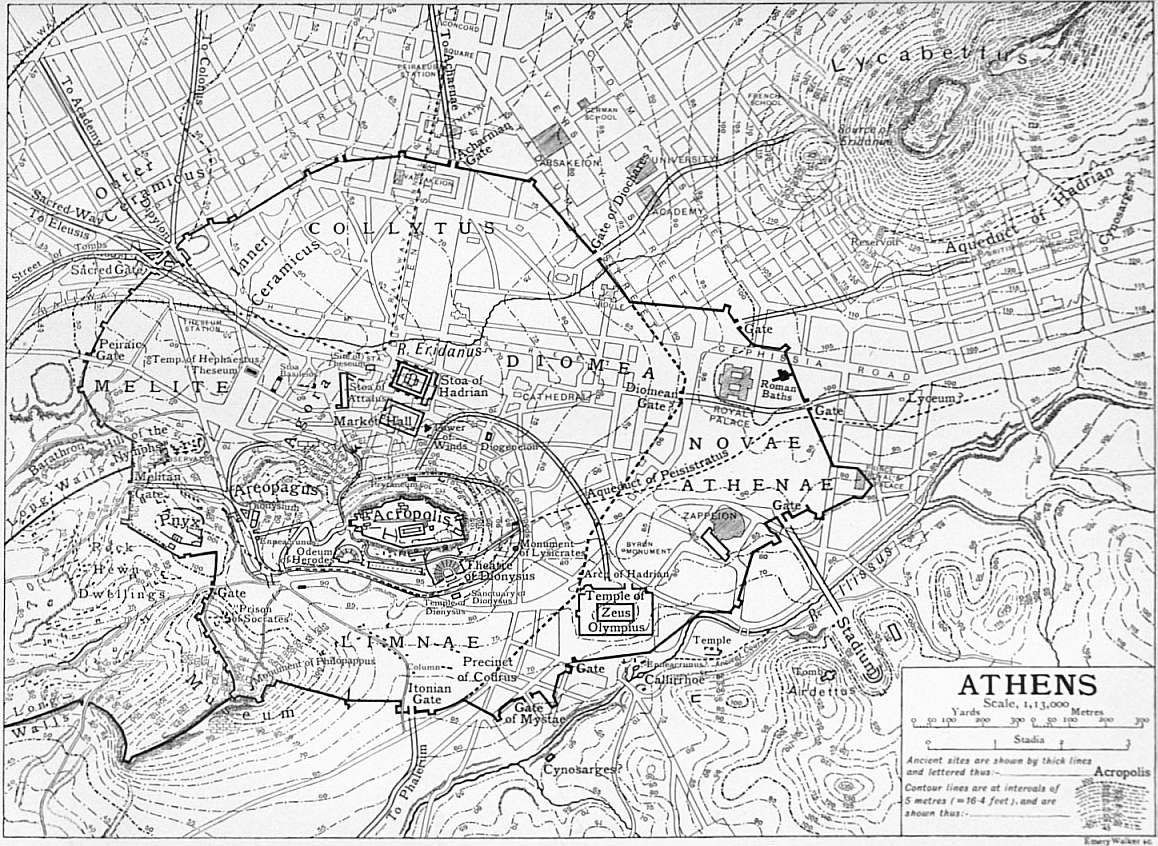
(Click to enlarge.)
Prehistoric Athens.—Numerous traces of the “Mycenaean” epoch have recently been brought to light in Athens and its neighbourhood. Among the monuments of this age discovered in the surrounding districts are the rock-hewn The early citadel. tombs of Spata, accidentally revealed by a landslip in 1877, and domed sepulchre at Menidí, near the ancient Acharnae, excavated by Lolling in 1879. Other “Mycenaean” landmarks have been laid bare at Eleusis, Thoricus, Halae and Aphidna. These structures, however, are of comparatively minor importance in point of dimensions and decoration; they were apparently designed as places of sepulture for local chieftains, whose domains were afterwards incorporated in the Athenian realm by the συνοικισμός (synoecism) attributed to Theseus. The situation of the Acropolis, dominating the surrounding plain and possessing easy communication with the sea, favoured the formation of a relatively powerful state—inferior, however, to Tiryns and Mycenae; the myths of Cecrops, Erechtheus and Theseus bear witness to the might of the princes who ruled in the Athenian citadel, and here we may naturally expect to find traces of massive fortifications resembling in some degree those of the great Argolid cities. Such in fact have been brought to light by the modern excavations on the Acropolis (1885-1889). Remains of primitive polygonal walls which undoubtedly surrounded the entire area have been found at various points a little within the circuit of the existing parapet. The best-preserved portions are at the eastern extremity, at the northern side near the ancient “royal” exit, and at the south-western angle. The course of the walls can be traced with a few interruptions along the southern side. On the northern side are the foundations of a primitive tower and other remains, apparently of dwelling-houses, one of which may have been the πυκινὸς δόμος Ἐρεχθῆος mentioned by Homer (Od. vii. 81). Among the foundations were discovered fragments of “Mycenaean” pottery. The various approaches to the citadel on the northern side—the rock-cut flight of steps north-east of the Erechtheum (q.v.), the stairs leading to the well Clepsydra, and the intermediate passage supposed to have furnished access to the Persians—are all to be attributed to the primitive epoch. Two pieces of polygonal wall, one beneath the bastion of Nike Apteros, the other in a direct line between the Roman gateway and the door of the Propylaea, are all that remain of the primitive defences of the main entrance.
These early fortifications of the Acropolis, ascribed to the primitive non-hellenic Pelasgi, must be distinguished from the Pelasgicum Or Pelargicum, which was in all probability an encircling wall, built round the base of the The Pelasgicum. citadel and furnished with nine gates from which it derived the name of Enneapylon. Such a wall would be required to protect the clusters of dwellings around the Acropolis as well as the springs issuing from the rock, while the gates opening in various directions would give access to the surrounding pastures and gardens. This view, which is that of E. Curtius, alone harmonizes with the statement of Herodotus (vi. 137) that the wall was “around” (περί) the Acropolis, and that of Thucydides (ii. 17) that it was “beneath” (ὑπό) the fortress. Thus it would appear that the citadel had an outer and an inner line of defence in prehistoric times. The space enclosed by the outer wall was left unoccupied after the Persian wars in deference to an oracular response apparently dictated by military considerations, the maintenance of an open zone being desirable for the defence of the citadel. A portion of the outer wall has been recognized in a piece of primitive masonry discovered near the Odeum of Herodes Atticus; other traces will probably come to light when the northern and eastern slopes of the Acropolis have been completely explored. Leake, whom Frazer follows, assumed the Pelasgicum to be a fortified space at the western end of the Acropolis; this view necessitates the assumption that the nine gates were built one within the other, but early antiquity furnishes no instance of such a construction; Dörpfeld believes it to have extended from the grotto of Pan to the sacred precinct of Asclepius. The well-known passage of Lucian (Piscator, 47) cannot be regarded as decisive for any of the theories advanced, as any portion of the old enceinte dismantled by the Persians may have retained the name in later times. The Pelasgic wall enclosed the spring Clepsydra, beneath the north-western corner of the Acropolis, which furnished a water-supply to the defenders of the fortress. The spring, to which a staircase leads down, was once more included in a bastion during the War of Independence by the Greek chief Odysseus.
To the “Pelasgic” era may perhaps be referred (with Curtius and Milchhöfer) the immense double terrace on the north-eastern slope of the Pnyx (395 ft. by 212), the upper portion of which is cut out of the rock, while the lower is The Pnyx. enclosed by a semicircular wall of massive masonry; the theory of these scholars, however, that the whole precinct was a sanctuary of the Pelasgian Zeus cannot be regarded as proved, nor is it easy to abandon the generally received view that this was the scene of the popular assemblies of later times, notwithstanding the apparent unsuitability of the ground and the insufficiency of room for a large multitude. These difficulties are met by the assumption that the semicircular masonry formed the base of a retaining-wall which rose to a considerable height, supporting a theatre-like structure capable of seating many thousand persons. The masonry may be attributed to the 5th century; the chiselling of the immense blocks is not “Cyclopean.” Projecting from the upper platform at the centre of the chord of the semicircular area is a cube of rock, 11 ft. square and 5 ft. high, approached on either side by a flight of steps leading to the top; this block, which Curtius supposes to have been the primitive altar of Zeus Ὕψιστος, may be safely identified with the orators’ bema, ὁ λίθος ἐν τῇ Πυκνί (Aristoph. Pax, 680). Plutarch’s statement that the Thirty Tyrants removed the bema so as to face the land instead of the sea is probably due to a misunderstanding. Other cubes of rock, apparently altars, exist in the neighbourhood. There can be little doubt that the Pnyx was the seat of an ancient cult; the meetings of the Ecclesia were of a religious character and were preceded by a sacrifice to Zeus Ἀγοραῖος; nor is it conceivable that, but for its sacred associations, a site would have been chosen so unsuitable for the purposes of a popular assembly as to need the addition of a costly artificial auditorium.
The Pnyx, the Hill of the Nymphs and the Museum Hill are covered with vestiges of early settlements which extend to a considerable distance towards the south-east in the direction of Phalerum. They consist of chambers of Rock-dwellings and tombs. various sizes, some of which were evidently human habitations, together with cisterns, channels, seats, steps, terraces and quadrangular tombs, all cut in the rock. This neighbourhood was held by Curtius to have been the site of the primeval rock city, κρανάα πόλις (Aristoph. Ach. 75), anterior to the occupation of the Acropolis and afterwards abandoned for the later settlement. It seems inconceivable, however, that any other site should have been preferred by the primitive settlers to the Acropolis, which offered the greatest advantages for defence; the Pnyx, owing to its proximity to the centres of civic life, can never have been deserted, and that portion which lay within the city walls must have been fully occupied when Athens was crowded during the Peloponnesian War. Some of the rock chambers originally intended for tombs were afterwards converted, perhaps under pressure of necessity, into habitations, as in the case of the so-called “Prison of Socrates,” which consists of three chambers horizontally excavated and a small round apartment of the “beehive” type. The remains on the Pnyx and its neighbourhood cannot all be assigned to one epoch, the prehistoric age. The dwellings do not correspond in size or details with the undoubtedly prehistoric abodes on the Acropolis. In view of the ancient law which forbade burial within the city, the tombs within the circuit of the city walls must either be earlier than the time of Themistocles or several centuries later; in the similar rock-tombs on the neighbouring slopes of the Acropolis and Areopagus both Mycenaean and Dipylon pottery have been found. But the numerous vertically excavated tombs outside the walls are of late date and belong for the most part to the Roman period.
The Areopagus is now a bare rock possessing few architectural traces. The legend of its occupation by the Amazons (Aeschylus, Eum. 681 seq.) may be taken as indicating its military importance for an attack on the Acropolis; the The Areopagus. Persians used it as a point d’appui for their assault. The seat of the old oligarchical council and court for homicide was probably on its eastern height. Here were the altar of Athena Areia and two stones, the λίθος Ὕβρεως, on which the accuser, and the λίθος Ἀναιδείας, on which the accused, took their stand. Beneath, at the north-eastern corner, is the cleft which formed the sanctuary of the Σεμναί, or Erinyes. There is no reason for disturbing the associations connected with this spot as the scene of St Paul’s address to the Athenians (E. Gardner, Anc. Athens, p. 505).
Hellenic Period.—While modern research has added considerably to our knowledge of prehistoric Athens, a still greater light has been thrown on the architecture and topography of the city in the earlier historic or “archaic” era, the subsequent age of Athenian greatness, and the period of decadence which set in with the Macedonian conquest; the first extends from the dawn of history to 480-479 B.C., when the city was destroyed by the Persians; the second, or classical, age closes in 322 B.C., when Athens lost its political independence after the Lamian War; the third, or Hellenistic, in 146 B.C., when the state fell under Roman protection. We must here group these important epochs together, as distinguished from the later period of Roman rule, and confine ourselves to a brief notice of their principal monuments and a record of the discoveries by which they have been illustrated in recent years.
The earliest settlement on the Acropolis was doubtless soon increased by groups of dwellings at its base, inhabited by the dependents of the princes who ruled in the stronghold. These habitations would naturally in the first instance The city in the “archaic” era. lie in close proximity to the western approach; after the building of the Pelasgicum they seem to have extended beyond its walls towards the south and south-west—towards the sea and the waters of the Ilissus. The district thus occupied sloped towards the sun and was sheltered by the Acropolis from the prevailing northerly winds. The Thesean synoecism led to the introduction of new cults and the foundation of new shrines partly on the Acropolis, partly in the inhabited district at its base both within and without the wall of the Pelasgicum. Some of the shrines in this region are mentioned by Thucydides in a passage which is of capital importance for the topography of the city at this period (ii. 15). By degrees the inhabited area began to comprise the open ground to the north-west, the nearer portion of the later Ceramicus, or “potters’ field” (afterwards divided by the walls of Themistocles into the Inner and Outer Ceramicus), and eventually extended to the north and east of the citadel, which, by the beginning of the 5th century B.C., had become the centre of a circular or wheel-shaped city, πόλιος τροχοειδέος ἄκρα κάρηνα (Oracle apud Herod, vii. 140). To this enlarged city was applied, probably about the second half of the 6th century, the special designation τὸ ἄστυ, which afterwards distinguished Athens from its port, the Peiracus; the Acropolis was already ἡ πόλις (Thucyd. ii. 15). The city is supposed to have been surrounded by a wall before the time of Solon, the existence of which may be deduced from Thucydides’ account of the assassination of Hipparchus (vi. 57), but no certain traces of such a wall have been discovered; the materials may have been removed to build the walls of Themistocles.
The centre of commercial and civic life of the older group of communities, as of the greater city of the classical age, was the Agora or market. Here were the various public buildings, which, when the power of the princes on The Agora. the citadel was transferred to the archons, formed the offices of the administrative magistracy. The site of the primitive Agora (ἀρχαία ἀγορά) was probably in the hollow between the Acropolis and the Pnyx, which formed a convenient meeting-place for the dwellers on the north and south sides of the fortress as well as for its inhabitants. In the time of the Peisistratids the Agora was enlarged so as to extend over the Inner Ceramicus on the north-west, apparently reaching the northern declivities of the Areopagus and the Acropolis on the south. After the Persian Wars the northern portion was used for commercial, the southern for political and ceremonial purposes. In the southern were the Orchestra, where the Dionysiac dances took place, and the famous statues of Harmodius and Aristogeiton by Antenor which were carried away by Xerxes; also the Metroum, or temple of the Mother of the Gods, the Bouleuterium, or council-chamber of the Five Hundred, the Prytaneum, the hearth of the combined communities, where the guests of the state dined, the temple of the Dioscuri, and the Tholus, or Skias, a circular stone-domed building in which the Prytaneis were maintained at the public expense; in the northern were the Leocorium, where Hipparchus was slain, the στοὰ βασιλική, the famous στοὰ ποικίλη, where Zeno taught, and other structures. The Agora was commonly described as the “Ceramicus,” and Pausanias gives it this name; of the numerous buildings which he saw here scarcely a trace remains; their position, for the most part, is largely conjectural, and the exact boundaries of the Agora itself are uncertain. What are perhaps the remains of the στοὰ βασιλική, in which the Archon Basileus held his court and the Areopagus Council sat in later times, were brought to light in the winter of 1897-1898, when excavations were carried out on the eastern slope of the “Theseum” hill. Here was found a rectangular structure resembling a temple, but with a side door to the north; it possessed a portico of six columns. The north slope of the Areopagus, where a number of early tombs were found, was also explored, and the limits of the Agora on the south and north-west were approximately ascertained. A portion of the main road leading from the Dipylon to the Agora was discovered.
In 1892 Dörpfeld began a series of excavations in the district between the Acropolis and the Pnyx with the object of determining the situation of the buildings described by Pausanias as existing in the neighbourhood of the The Enneacrunus. Agora, and more especially the position of the Enneacrunus fountain. The Enneacrunus has hitherto been generally identified with the spring Callirrhoe in the bed of the Ilissus, a little to the south-east of the Olympieum; it is apparently, though not explicitly, placed by Thucydides (ii. 15) in proximity to that building, as well as the temple of Dionysus ἐν λίμναις and other shrines, the temples of Zeus Olympius and of Ge and the Pythium, which he mentions as situated mainly to the south of the Acropolis. On the other hand, Pausanias (i. 14. 1), who never deviates without reason from the topographical order of his narrative, mentions the Enneacrunus in the midst of his description of certain buildings which were undoubtedly in the region of the Agora, and unless he is guilty of an unaccountable digression the Enneacrunus which he saw must have lain west of the Acropolis. It is now generally agreed that the Agora of classical times covered the low ground between the hill of the “Theseum,” the Areopagus and the Pnyx; and Pausanias, in the course of his description, appears to have reached its southern end. The excavations revealed a main road of surprisingly narrow dimensions winding up from the Agora to the Acropolis. A little to the south-west of the point where the road turns towards the Propylaca was found a large rock-cut cistern or reservoir which Dörpfeld identifies with the Enneacrunus. The reservoir is supplied by a conduit of 6th-century tiles connected with an early stone aqueduct, the course of which is traceable beneath the Dionysiac theatre and the royal garden in the direction of the Upper Ilissus. These elaborate waterworks were, according to Dörpfeld, constructed by the Peisistratids in order to increase the supply from the ancient spring Callirrhoe; the fountain was furnished with nine jets and henceforth known as Enneacrunus. This identification has been hotly contested by many scholars, and the question must still be regarded as undecided. An interesting confirmation of Dörpfeld’s view is furnished by the map of Guillet and Coronelli, published in 1672, in which the Enneacrunus is depicted as a well with a stream of running water in the neighbourhood of the Pnyx. The fact that spring water is not now found in this locality is by no means fatal to the theory; recent engineering investigations have shown that much of the surface water of the Attic plain has sunk to a lower level. In front of the reservoir is a small open space towards which several roads converge; close by is a triangular enclosure of polygonal masonry, in which were found various relics relating to the worship of Dionysus, a very ancient wine-press (ληνός) and the remains of a small temple. Built over this early precinct, which Dörpfeld identifies with the Dionysium ἐν λίμναις, or Lenaeum, is a basilica-shaped building of the Roman period, apparently sacred to Bacchus; in this was found an inscription containing the rules of the society of the Iobacchi. There is an obvious difficulty in assuming that λίμναι, in the sense of “marshes,” existed in this confined area, but stagnant pools may still be seen here in winter. Dörpfeld’s identification of the Dionysium, ἐν λίμναις cannot be regarded as proved; his view that another Pythium and another Olympieum existed in this neighbourhood is still less probable; but the inconclusiveness of these theories does not necessarily invalidate his identification of the Enneacrunus, with regard to the position of which the language of Thucydides is far from clear. Another enclosure, a little to the south, is proved by an inscription to have been a sanctuary of the hitherto unknown hero Amynos, with whose cult those of Asclepius and the hero Dexion were here associated; under the name Dexion, the poet Sophocles is said to have been worshipped after his death. The whole district adjoining the Areopagus was found to have been thickly built over; the small, mean dwelling-houses intersected by narrow, crooked lanes convey a vivid idea of the contrast between the modest private residences and the great public structures of the ancient city.