VOLUME II SLICE VII Arundel, Thomas to Athens (continued 4)
Reading edition
On the western edge of the Kashgar plains, the political boundary between Russia and China is defined by the meridional range of Sarikol. This range (known to the ancients as Taurus and in medieval times as Bolor) like many others of the Russo-Chinese boundary. most important great natural mountain divisions of the world, consists of two parallel chains, of which the western is the water-divide of the Pamirs, and the eastern (which has been known as the Kashgar or Kandar range) is split at intervals by lateral gorges to allow of the passage of the main drainage from the eastern Pamir slopes.
In western Asia we have learned the exact value of the mountain barrier which lies between Merv and Herat, and have mapped its connexion with the Elburz of Persia. We can now fully appreciate the factor in practical politics which Indian frontiers—Afghanistan, &c. that definite but somewhat irregular mountain system represents which connects the water-divide north of Herat with the southern abutment of the Hindu Kush, near Bamian. Every pass of importance is known and recorded; every route of significance has been explored and mapped; Afghanistan has assumed a new political entity by the demarcation of a boundary; the value of Herat and of the Pamirs as bases of aggression has been assessed, and the whole intervening space of mountain and plain thoroughly examined.
Although within the limits of western Asiatic states, still under Asiatic government and beyond the active influence of European interests, the material progress of the Eastern world has appeared to remain stationary, yet large accessions to Persia. geographical knowledge have at least been made, and in some instances a deeper knowledge of the surface of the country and modern conditions of life has led to the straightening of many crooked paths in history, and a better appreciation of the slow processes of advancing civilization. The steady advance of scientific inquiry into every corner of Persia, backed by the unceasing efforts of a new school of geographical explorers, has left nothing unexamined that can be subjected to superficial observation. The geographical map of the country is fairly complete, and with it much detailed information is now accessible regarding the coast and harbours of the Persian Gulf, the routes and passes of the interior, and the possibilities of commercial development by the construction of trade roads uniting the Caspian, the Karun, the Persian Gulf, and India, via Seistan. Persia has assumed a comprehensible position as a factor in future Eastern politics.
In Arabia progress has been slower, although the surveys carried out by Colonel Wahab in connexion with the boundary determined in the Aden hinterland added more exact geographical knowledge within a limited area. Little more is known Arabia. of the wide spaces of interior desert than has already been given to the world in the works of Sir Richard F. Burton, Wm. Gifford Palgrave and Sir Lewis Pelly amongst Englishmen, and Karsten Niebuhr, John Lewis Burckhardt, Visconte, Joseph Halévy and others, amongst foreign travellers. Charles Doughty and Wilfrid S. Blunt have visited and illustrated the district of Nejd, and described the waning glories of the Wahabi empire. But extended geographical knowledge does not point to any great practical issue. Commercial relations with Arabia remain much as they were in 1875.
In Asia Minor, Syria and Mesopotamia there is little to record of progress in material development beyond the promises held out by the Euphrates Valley railway concession to a Asia Minor, &c. German company. The exact information obtained by the researches of English surveyors in Palestine and beyond Jordan, or by the efforts of explorers in the regions that lie between the Mediterranean and the Caspian, have so far led rather to the elucidation of history than to fresh commercial enterprise or the possible increase of material wealth.
Asiatic Russia, especially eastern Siberia and Mongolia, have been brought within the sphere of Russian exploration, with results so surprising as to form an epoch in the history of Asia. Russia in Asia. Here there has been a development of the resources of the Old World which parallels the best records of the New.
The great central depression of the continent which reaches from the foot of the Pamir plateau on the west through the Tarim desert to Lop Nor and the Gobi has yielded up many interesting secrets. The remarkable phenomenon of the periodic Chinese Turkestan and Oxus basin. shifting of the Lop Nor system has been revealed by the researches of Sven Hedin, and the former existence of highly civilized centres of Buddhist art and industry in the now sand-strewn wastes of the Turkestan desert has been clearly demonstrated by the same great explorer and by Dr M.A. Stein. The depression westward of the Caspian and Aral basins, and the original connexion of these seas, have also come under the close investigation of Russian scientists, with the result that the theory of an ancient connexion between the Oxus and the Caspian has been displaced by the more recent hypothesis of an extension of the Caspian Sea eastwards into Trans-Caspian territory within the post-Pleiocene age. The discovery of shells (now living in the Caspian) at a distance of about 100 m. inland, at an altitude of 140 to 280 ft. above the present level of the Caspian, gives support to this hypothesis, which is further advanced by the ascertained nature of the Kara-kum sands, which appear to be a purely marine formation exhibiting no traces of fluviatile deposits which might be considered as delta deposits of the Oxus.
In the discussion of this problem we find the names of Baron A. Kaulbars, Annentkov, P.M. Lessar, and A.M. Konshin prominent. Further matter of interest in connexion with the Oxus basin was elucidated by the researches of L. Griesbach in connexion with the Russo-Afghan Boundary Commission. He reported the gradual formation of an anticlinal or ridge extending longitudinally through the great Balkh plain of Afghan Turkestan, which effectually shuts off the northern affluents of that basin from actual junction with the river. This evidence of a gradual process of upheaval still in action may throw some light on the physical (especially the climatic) changes which must have passed over that part of Asia since Balkh was the “mother of cities,” the great trade centre of Asia, and the plains of Balkh were green with cultivation. In the restoration of the outlines of ancient and medieval geography in Asia Sven Hedin’s discoveries of the actual remains of cities which have long been buried under the advancing waves of sand in the Takla Makan desert, cities which flourished in the comparatively recent period of Buddhist ascendancy in High Asia, is of the very highest interest, filling up a blank in the identification of sites mentioned by early geographers and illustrating more fully the course of old pilgrim routes.
With the completion of the surveys of Baluchistan and Makran much light has also been thrown on the ancient connexion between Baluchistan and Makran. east and west; and the final settlement of the southern boundaries of Afghanistan has led to the reopening of one at least of the old trade routes between Seistan and India.
Farther east no part of Asia has been brought under more careful investigation than the hydrography of the strange mountain wilderness that divides Tibet and Burma from China. In this field the researches of travellers already mentioned, Burma and China. combined with the more exact reconnaissance of native surveyors and of those exploring parties which have recently been working in the interests of commercial projects, have left little to future inquiry. We know now for certain that the great Tsanpo of Tibet and the Brahmaputra are one and the same river; that north of the point where the great countermarch of that river from east to west is effected are to be found the sources of the Salween, the Mekong, the Yang-tsze-kiang and the Hwang-ho, or Yellow river, in order, from west to east; and that south of it, thrust in between the extreme eastern edge of the Brahmaputra basin and the Salween, rise the dual sources of the Irrawaddy. From the water-divide which separates the most eastern affluent of the Brahmaputra, eastwards to the deep gorges which enclose the most westerly branch of the upper Yang-tsze-kiang (here running from north to south), is a short space of 100 m.; and within that space two mighty rivers, the Salween and the Mekong, send down their torrents to Burma and Siam. These three rivers flow parallel to each other for some 300 m., deep hidden in narrow and precipitous troughs, amidst some of the grandest scenery of Asia; spreading apart where the Yank-tsze takes its course eastwards, not far north of the parallel of 25°.
The comparatively restricted area which still remains for close investigation includes the most easterly sources of the Brahmaputra, the most northerly sources of the Irrawaddy, and some 300 m. of the course of the upper Salween.
Modern Boundary Demarcation.—The period from about 1880 has been an era of boundary-making in Asia, of defining the politico-geographical limits of empire, and of determining the responsibilities of government. Russia, Persia, Afghanistan, Baluchistan, India and China have all revised their borders, and with the revision the political relations between these countries have acquired a new and more assured basis. See also the articles on the different countries. We are not here concerned with understandings as to “spheres of influence,” or with arrangements such as the Anglo-Russian Convention of 1907 concerning Persia.
The advance of Russia to the Turkoman deserts and the Oxus demanded a definite boundary between her trans-Caspian conquests and the kingdom of Afghanistan. This was determined on the north-west by the Russo-Afghan Boundary Commission Southern boundary of Russia in Asia. of 1884-1886. A boundary was then fixed between the Hari Rud (the river of Herat) and the Oxus, which is almost entirely artificial in its construction. Zulfikar, where the boundary leaves the Hari Rud, is about 70 m. south of Sarakhs, and the most southerly point of the boundary (where it crosses the Kushk) is about 60 m. north of Herat. From the junction of the boundary with the Oxus at Khamiab about 150 m. above the crossing-point of the Russian Trans-Caspian railway at Charjui, the main channel of the Oxus river becomes the northern boundary of Afghanistan, separating that country from Russia, and so continues to its source in Victoria Lake of the Great Pamir. Beyond this point the Anglo-Russian Commission of 1895 demarcated a line to the snowfields and glaciers which overlook the Chinese border. Between the Russian Pamirs and Chinese Turkestan the rugged line of the Sarikol range intervenes, the actual dividing line being still indefinite. Beyond Kashgar the southern boundary of Siberia follows an irregular course to the north-east, partly defined by the Tian-shan and Alatau mountains, till it attains a northerly point in about 53° N. lat. marked by the Sayan range to the west of Irkutsk. It then deflects south-east till it touches the Kerulen affluent of the Amur river at a point which is shown in unofficial maps as about 117° 30′ E. long, and 49° 20′ N. lat. From here it follows this affluent to its junction with the Amur river, and the Amur river to its junction with the Usuri. It follows the Usuri to its head (its direction now being a little west of south), and finally strikes the Pacific coast on about 42° 30′ N. lat. at the mouth of the Tumen river 100 m. south of the Amur bay, at the head of which lies the Russian port of Vladivostok. At two points the Russian boundary nearly approaches that of provinces which are directly under British suzerainty. Where the Oxus river takes its great bend to the north from Ishkashim, the breadth of the Afghan territory intervening between that river and the main water-divide of the Hindu Kush is not more than 10 or 12 m.; and east of the Pamir extension of Afghanistan, where the Beyik Pass crosses the Sarikol range and drops into the Taghdumbash Pamir, there is but the narrow width of the Karachukar valley between the Sarikol and the Muztagh. Here, however, the boundary is again undefined. Eastwards of this the great Kashgar depression, which includes the Tarim desert, separates Russia from the vast sterile highlands of Tibet; and a continuous series of desert spaces of low elevation, marking the limits of a primeval inland sea from the Sarikol meridional watershed to the Khingan mountains on the western borders of Manchuria, divide her from the northern provinces of China. From the Khingan ranges to the Pacific, south of the Amur, stretch the rich districts of Manchuria, a province which connects Russia with the Korea by a series of valleys formed by the Sungari and its affluents—a land of hill and plain, forest and swamp, possessing a delightful climate, and vast undeveloped agricultural resources. Throughout this land of promise Russian influence was destroyed by Japan in the war of 1904. The possession of Port Arthur, and direct political control over Korea, place Japan in the dominant position as regards Manchuria.
Coincident with the demarcation of Russian boundaries in Turkestan was that of northern Afghanistan. From the Hari Rud on the west to the Sarikol mountains on the east her northern limits were set by the Boundary Commissions of 1884-1886 Afghan political boundaries. and of 1895 respectively. Her southern and eastern boundaries were further defined by a series of minor commissions, working on the basis of the Kabul agreement of 1893, which lasted for nearly four years, terminating with the Mohmand settlement at the close of an expedition in 1897.
The Pamir extension of Afghan territory to the north-east reaches to a point a little short of 75° E., from whence it follows the water-divide to the head of the Taghdumbash Pamir, and is thenceforward defined by the water-parting of the Hindu Kush. It leaves the Hindu Kush near the Dorah Pass at the head of one of the minor Chitral affluents, and passing south-west divides Kafiristan from Chitral and Bajour, separates the sections of the Mohmands who are within the respective spheres of Afghan and British sovereignty, and crosses the Peshawar-Kabul route at Lundi-Khana. It thus places a broad width of independent territory between the boundaries of British India (which have remained practically, though not absolutely, untouched) and Afghanistan; and this independent belt includes Swat, Bajour and a part of the Mohmand territory north of the Kabul river. The same principle of maintaining an intervening width of neutral territory between the two countries is definitely established throughout the eastern borders of Afghanistan, along the full length of which a definite boundary has been demarcated to the point where it touches the northern limits of Baluchistan on the Gomal river. From the Gomal Baluchistan itself becomes an intervening state between British India and Afghanistan, and the dividing line between Baluchistan and Afghanistan is laid down with all the precision employed on the more northerly sections of the demarcation.
Baluchistan can no longer be regarded as a distinct entity amongst Asiatic nations, such as Afghanistan undoubtedly is. Baluchistan independence demands qualification. There is British Baluchistan par excellence, and there is the rest of Baluchistan which exists in various degrees of independence, but Baluchistan. is everywhere subject to British control. British Baluchistan officially includes the districts of Peshin, Sibi and of Thal-Chotiali. As these districts had originally been Afghan, they were transferred to British authority by the treaty of Gandamak in 1879, although nominally they had been handed over to Kalat forty years previously. Now they form an official province of British Baluchistan within the Baluchistan Agency; and the agency extends from the Gomal to the Arabian Sea and the Persian frontier. Within this agency there are districts as independent as any in Afghanistan, but the political status of the province as a whole is almost precisely that of the native states of the Indian peninsula. The agent to the governor-general of India, with a staff of political assistants, practically exercises supreme control.
The increase of Russian influence on the northern Persian border and its extension southwards towards Seistan led to the appointment of a British consul at Kirman, the dominating Kirman. town of southern Khorasan, directly connected with Meshed on the north; and the acquisition of rights of administration of the Nushki district secured to Great Britain the trade between Seistan and Quetta by the new Helmund desert route.
While British India has so far avoided actual geographical contact with one great European power in Asia on the north and west, she has touched another on the east. The Mekong river which limits British interests in Burma limits also those Boundary between French territory and India. of France in Tongking. The eastern boundaries of Burma are not yet fully demarcated on the Chinese frontier. At a point level in latitude with Mogaung, near the northern termination of the Burmese railway system, this boundary is defined by the eastern watershed of the Nmaikha, the eastern of the two great northern affluents of the Irrawaddy. Then it follows an irregular course southwards to a position south-east of Bhamo in lat. 24°. It next defines the northern edge of the Shan States, and finally strikes the Mekong river in lat. 21° 45′ (approximately). From that point southwards the river becomes the boundary between the Shan States and Tongking for some 200 m., the channel of the river defining the limits of occupation (though not entirely of interest) between French and British subjects. Approximately on the parallel of 20° N. lat. the Burmese boundary leaves the Mekong to run westwards towards the Salween, and thereafter following the eastern watershed of the Salween basin it divides the Lower Burma provinces from Siam.
The following table shows the areas of territories in Asia Area and political division. (continental and insular) dependent on the various extra-Asiatic powers, and of those which are independent or nominally so:—
Territory Sq. m.
Russian 6,495,970
British 1,998,220
Dutch 586,980
French 247,580
U.S.A. 114,370
German 193
Turkish 681,980
Chinese 4,299,600
Japanese 161,110
Other independent territories 2,232,270
The total area of Asia, continental and insular, is therefore somewhat over 16,819,000 sq. m. (but various authorities differ considerably in their detailed estimates). The population may be set down roughly as 823,000,000, of which 330,000,000 inhabit Chinese territory, 302,000,000 British, and 25,000,000 Russian.
(T. H. H.*)
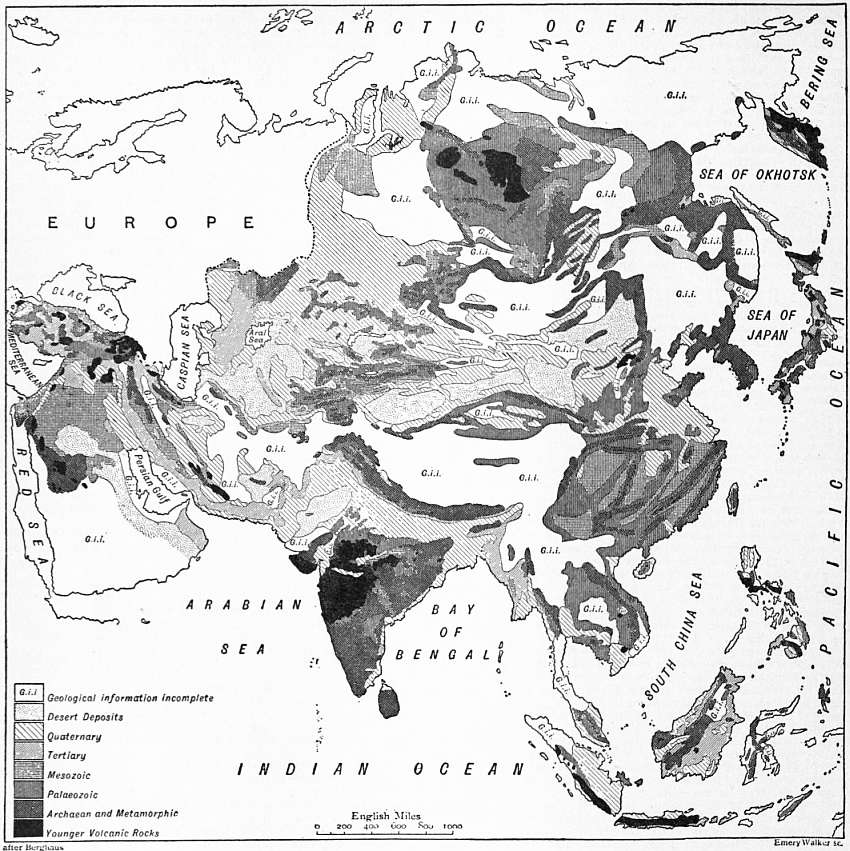
Geology
The geology of Asia is so complex and over wide areas so little known that it is difficult to give a connected account of either the structure or the development of the continent, and only the broader features can be dealt with here.
In the south, in Syria, Arabia and the peninsula of India, none but the oldest rocks are folded, and the Upper Palaeozoic, the Mesozoic and the Tertiary beds lie almost horizontally upon them. It is a region of quiescence or of faulting, but not of folding. North of this lies a broad belt in which the Mesozoic deposits and even the lower divisions of the Tertiary system are thrown into folds which extend in a series of arcs from west to east and now form the principal mountain ranges of central Asia. This belt includes Asia Minor, Persia, Afghanistan, Baluchistan, the Himalayas, the Tian-shan, and, although they are very different in direction, the Burmese ranges. The Kuen-lun, Nan-shan and the mountain ranges of southern China are, perhaps, of earlier date, but nevertheless they be in the same belt. It is not true that throughout the whole width of this zone the beds are folded. There are considerable tracts which are but little disturbed, but these tracts are enclosed within the arcs formed by the folds, and the zone taken as a whole is distinctly one of crumpling. North of the folded belt, and including the greater part of Siberia, Mongolia and northern China, lies another area which is, in general, free from any important folding of Mesozoic or Tertiary age. There are, it is true, mountain ranges which are formed of folded beds; but in many cases the direction of the chains is different from that of the folds, so that the ranges must owe their elevation to other causes; and the folds, moreover, are of ancient date, for the most part Archaean or Palaeozoic. The configuration of the region is largely due to faulting, trough-like or tray-like depressions being formed, and the intervening strips, which have not been depressed, standing up as mountain ridges. Over a large part of Siberia and in the north of China, even the Cambrian beds still lie as horizontally as they were first laid down. In the extreme north, in the Verkhoyansk range and in the mountains of the Taimyr peninsula, there are indications of another zone of folding of Mesozoic or later date, but our information concerning these ranges is very scanty. Besides the three chief regions into which the mainland is thus seen to be divided, attention should be drawn to the festoons of islands which border the eastern side of the continent, and which are undoubtedly due to causes similar to those which produced the folds of the folded belt.
Of all the Asiatic ranges the Himalayan is, geologically, the best known; and the evidence which it affords shows clearly that the folds to which it owes its elevation were produced by an overthrust from the north. It is, indeed, as if the high land of central Asia had been pushed southward against and over the unyielding mass formed by the old rocks of the Indian peninsula, and in the process the edges of the over-riding strata had been crumpled and folded. Overlooking all smaller details, we may consider Asia to consist of a northern mass and a southern mass, too rigid to crumple, but not too strong to fracture, and an intermediate belt of softer rock which was capable of folding. If then by the contraction of the earth’s interior the outer crust were forced to accommodate itself to a smaller nucleus, the central softer belt would yield by crumpling, the more rigid masses to the north and south, if they gave way at all, would yield by faulting. It is interesting to observe, as will be shown later, that during the Mesozoic era there was a land mass in the north of Asia and another in the south, and between them lay the sea in which ordinary marine sediments were deposited. The belt of folding does not precisely coincide with this central sea, but the correspondence is fairly close.
The present outline of the eastern coast and the nearly enclosed seas which lie between the islands and the mainland, are attributed by Richthofen chiefly to simple faulting.
Little is known of the early geological history of Asia beyond the fact that a large part of the continent was covered by the sea during the Cambrian and Ordovician periods. But there is positive evidence that much of the north and east of Asia has been land since the Palaeozoic era, and it has been conclusively proved that the peninsula of India has never been beneath the sea since the Carboniferous period at least. Between these ancient land masses lies an area in which marine deposits of Mesozoic age are well developed and which was evidently beneath the sea during the greater part of the Mesozoic era. The northern land mass has been named Angaraland by E. Suess; the southern, of which the Indian peninsula is but a fragment, is called Gondwanaland by Neumayr, Suess and others, while the intervening sea is the central Mediterranean sea of Neumayr and the Tethys of Suess. The greater part of western Asia, including the basin of the Obi, the drainage area of the Aral Sea, together with Afghanistan, Baluchistan, Persia and Arabia, was covered by the sea during the later stages of the Cretaceous period, but a considerable part of this region was probably dry land in Jurassic times.
The northern land mass begins in the north with the area which lies between the Yenisei and the Lena. Here the folded Archean rocks are overlaid by Cambrian and Ordovician beds, which still lie for the most part flat and undisturbed. Upon these rest patches of freshwater deposits containing numerous remains of plants. They consist chiefly of sandstone and conglomerate, but include workable seams of coal. Some of the deposits appear to be of Permian age, but others are probably Jurassic, and they are all included under the general name of the Angara series. Excepting in the extreme north, where marine Jurassic and Cretaceous fossils have been found, there is no evidence that this part of Siberia has been beneath the sea since the early part of the Palaeozoic era. Besides the plant beds extensive outflows of basic lava rest directly upon the Cambrian and Ordovician strata. The date of these eruptions is still uncertain, but they probably continued to a very recent period.
South and east of the Palaeozoic plateau is an extensive area consisting chiefly of Archean rocks, and including the greater part of Mongolia north of the Tian-shan. Here again there are no marine beds of Mesozoic or Tertiary age, while plant-bearing deposits belonging to the Angara series are known. Structurally, the folds of this region are of ancient date, but the area is crossed by a series of depressions formed by faults, and the intervening strips, which have not been depressed to the same extent, now stand up as mountain ranges. Farther south, in the Chinese provinces of Shansi and Shensi, the geological succession is similar in some respects to that of the Siberian Palaeozoic plateau, but the sequence is more complete. There is again a floor of folded Archean rocks overlaid by nearly horizontal strata of Lower Palaeozoic age, but these are followed by marine beds belonging to the Carboniferous period. From the Upper Carboniferous onward, however, no marine deposits are known; and, as in Siberia, plant bearing beds are met with. Southern China is very different in structure, consisting largely of folded mountain chains; but the geological succession is very similar, and excepting near the Tibetan and Burmese borders, there are no marine deposits of Mesozoic or Tertiary age.
Thus it appears that from the Arctic Ocean there stretches a broad area as far as the south of China, in which no marine deposits of later date than Carboniferous have yet been found, except in the extreme north. Freshwater and terrestrial deposits of Mesozoic age occur in many places, and the conclusion is irresistible that the greater part of this area has been land since the close of the Palaeozoic era. The Triassic deposits of the Verkhoyansk Range show that this land did not extend to the Bering Sea, while the marine Mesozoic deposits of Japan on the east, the western Tian-shan on the west and Tibet on the south give us some idea of its limits in other directions.
In the same way the entire absence of any marine fossils in the peninsula of India, excepting near its borders, and the presence of the terrestrial and freshwater deposits of the Gondwana series, representing the whole of the geological scale from the top of the Carboniferous to the top of the Jurassic, show that this region also has been land since the Carboniferous period. It was a portion of a great land mass which probably extended across the Indian Ocean and was at one time united with the south of Africa.
But these two land masses were not connected. Between India and China there is a broad belt in which marine deposits of Mesozoic and Tertiary age are well developed. Marine Tertiary beds occur in Burma; in the Himalayas and in south Tibet there is a nearly complete series of marine deposits from the Carboniferous to the Eocene; in Afghanistan the Mesozoic beds are in part marine and in part fluviatile. The sea in which these strata were deposited seems to have attained its greatest extension in Upper Cretaceous times when its waters spread over the whole of western Asia and even encroached slightly upon the Indian land. The Eocene sea however cannot have been much inferior in extent.
It was after the Eocene period that the main part of the elevation of the Himalayas took place, as is shown by the occurrence of nummulitic limestone at a height of 20,000 ft. The formation of this and of the other great mountain chains of central Asia resulted in the isolation of portions of the former central sea, and the same forces finally led to the elevation of the whole region and the union of the old continents of Angara and Gondwana. Gondwanaland, however, did not long survive, and the portion which lay between India and South Africa sank beneath the waves in Tertiary times.
Leaving out of consideration all evidence of more ancient volcanic activity, each of the three regions into which, as we have seen, the continent may be divided has been, during or since the Cretaceous period, the seat of great volcanic eruptions. In the southern region of unfolded beds are found the lavas of the “harras” of Arabia, and in India the extensive flows of the Deccan Trap. In the central folded belt lie the great volcanoes, now mostly extinct, of Asia Minor, Armenia, Persia and Baluchistan. In Burma also there is at least one extinct volcano. In the northern unfolded region great flows of basic lava lie directly upon the Cambrian and Ordovician beds of Siberia, but are certainly in part of Tertiary age. Similar flows on a smaller scale occur in Manchuria, Korea and northern China.
In all these cases, however, the eruptions have now almost ceased, and the great volcanoes of the present day lie in the islands off the eastern and south eastern coasts.
References—E. Suess, Das Antlitz der Erde (see, especially, vol. iii. part 1.); F.V. Richthofen, “Ueber Gestalt und Gliederung einer Grundlinie in der Morphologie Ost-Asiens,” Sitz. k. preuss. Akad. Wiss. (Berlin, 1900), pp. 888-925, and Geomorphologische Studien aus Ostasien, ibid., 1901, pp. 782-808, 1902, pp. 944-975, 1903, pp. 867-918.
(P. La.)
Climate.
Among the places on the globe where the temperature falls lowest are some in northern Asia; and among those where it rises highest are some in southern Asia. The mean temperature of the north coast of eastern Siberia is but a few degrees Temperature. above the zero of Fahrenheit; the lowest mean temperature anywhere observed is about 4° Fahr., at Melville Island, north of the American continent. The isothermals of mean annual temperature lie over northern Asia on curves tolerably regular in their outline, having their western branches in a somewhat higher latitude than their eastern; a reduction of 1° of latitude corresponds approximately—and irrespective of modifications due to elevation—to a rise of ½° Fahr., as far say as 30° N, where the mean temperature is about 75° Fahr. Farther south the increase is slower, and the highest mean temperature anywhere attained in southern Asia is not much above 82° Fahr.
The variations of temperature are very great in Siberia, amounting near the coast to more than 100° Fahr., between the mean of the hottest and coldest months, and to still more between the extreme temperatures of those months. In southern Asia, and particularly near the sea, the variation between the hottest and coldest monthly means is very much less, and under the equator it is reduced to about 5°. In Siberia the difference between the means of the hottest and coldest months is hardly anywhere less than 60° Fahr. On the Sea of Aral it is 80° Fahr., and at Astrakhan, on the Caspian, more than 50°. At Tiflis it is 45°. In northern China, at Peking, it is 55°, reduced to 30° at Canton, and to 20° at Manila. In northern India the greatest difference does not exceed 40°, and it falls off to about 15° at Calcutta and to about 10° or 12° at Bombay and Madras. The temperatures at the head of the Persian Gulf approximate to those of northern India, and those of Aden to Madras. At Singapore the range is less than 5°, and at Batavia in Java, and Galle in Ceylon, it is about the same. The extreme temperatures in Siberia may be considered to lie between 80° and 90° Fahr. for maxima, and between −40° and −70° Fahr. for minima. The extreme of heat near the Caspian and Aral Seas rises to nearly 100° Fahr., while that of cold falls to −20° Fahr. or lower. Compared with these figures, we find in southern Asia 110° or 112° Fahr. as a maximum hardly ever exceeded. The absolute minimum in northern India, in lat. 30°, hardly goes below 32°; at Calcutta it is about 40°, though the thermometer seldom falls to 50°. At Madras it rarely falls as low as 65°, or at Bombay below 60°. At Singapore and Batavia the thermometer very rarely falls below 70°, or rises above 90°. At Aden the minimum is a few degrees below 70°, the maximum not much exceeding 90°.
These figures sufficiently indicate the main characteristics of the air temperatures of Asia. Throughout its northern portion the winter is long and of extreme severity; and even down to the circle of 35° N. lat., the minimum temperature is almost as low as zero of Fahrenheit. The summers are hot, though short in the northern latitudes, the maximum of summer heat being comparatively little less than that observed in the tropical countries farther south. The moderating effect of the proximity of the ocean is felt in an important degree along the southern and eastern parts of Asia, where the land is broken up into islands or peninsulas. The great elevations above the sea-level of the central part of Asia, and of the table-lands of Afghanistan and Persia, tend to exaggerate the winter cold; while the sterility of the surface, due to the small rainfall over the same region, operates powerfully in the opposite direction in increasing the summer heat. In the summer a great accumulation of solar heat takes place on the dry surface soil, from which it cannot be released upwards by evaporation, as might be the case were the soil moist or covered with vegetation, nor can it be readily conveyed away downwards as happens on the ocean. In the winter similar consequences ensue, in a negative direction, from the prolonged loss of heat by radiation in the long and clear nights—an effect which is intensified wherever the surface is covered with snow, or the air little charged with vapour. In illustration of the very slow diffusion of heat in the solid crust of the earth, and as affording a further indication of the climate of northern Asia, reference may here be made to the frozen soil of Siberia, in the vicinity of Yakutsk. In this region the earth is frozen permanently to a depth of more than 380 ft. at which the temperature is still 5° or 6° Fahr. below the freezing point of water, the summer heat merely thawing the surface to a depth of about 3 ft. At a depth of 50 ft. the temperature is about 15 Fahr. below the freezing point. Under such conditions of the soil, the land, nevertheless, produces crops of wheat and other grain from fifteen to forty fold.
The very high summer temperatures of the area north of the tropic of Cancer are sufficiently accounted for, when compared with those observed south of the tropic, by the increased length of the day in the higher latitude, which more than compensates for the loss of heat due to the smaller mid-day altitude of the sun. The difference between the heating power of the sun’s rays at noon on the 21st of June, in latitude 20° and in latitude 45°, is only about 2%; while the accumulated heat received during the day, which is lengthened to 15½ hours in the higher latitude, is greater by about 11% than in the lower latitude, where the day consists only of 13¼ hours.
Although the foregoing account of the temperatures of Asia supplies the main outline of the observed phenomena, a very important modifying cause, of which more will be said hereafter, comes into operation over the whole of the tropical region, namely, the periodical summer rains. These tend very greatly to arrest the increase of the summer heat over the area where they prevail, and otherwise give it altogether peculiar characteristics.
The great summer heat, by expanding the air upwards, disturbs the level of the planes of equal pressure, and causes an outflow of the upper strata from the heated area. The winter cold produces an effect of just an opposite nature, and Pressure and Winds. causes an accumulation of air over the cold area. The diminution of barometric pressure which takes place all over Asia during the summer months, and the increase in the winter, are hence, no doubt, the results of the alternate heating and cooling of the air over the continent.
The necessary and immediate results of such periodical changes of pressure are winds, which, speaking generally, blow from the area of greatest to that of least pressure—subject, however, to certain modifications of direction, arising from the absolute motion of the whole body of the air due to the revolution of the earth on its axis from west to east. The south-westerly winds which prevail north of the equator during the hot half of the year, to which navigators have given the name of the south-west monsoon (the latter word being a corruption of the Indian name for season), arise from the great diminution of atmospheric pressure over Asia, which begins to be strongly marked with the great rise of temperature in April and May, and the simultaneous relatively higher pressure over the equator and the regions south of it. This diminution of pressure, which continues as the heat increases till it reaches its maximum in July soon after the solstice, is followed by the corresponding development of the south-west monsoon; and as the barometric pressure is gradually restored, and becomes equalized within the tropics soon after the equinox in October, with the general fall of temperature north of the equator, the south-west winds fall off, and are succeeded by a north-east monsoon, which is developed during the winter months by the relatively greater atmospheric pressure which then occurs over Asia, as compared with the equatorial region.
Although the succession of the periodical winds follows the progress of the seasons as just described, the changes in the wind’s direction everywhere take place under the operation of special local influences which often disguise the more general law, and make it difficult to trace. Thus the south-west monsoon begins in the Arabian Sea with west and north-westerly winds, which draw round as the year advances to south-west and fall back again in the autumn by north-west to north. In the Bay of Bengal the strength of the south-west monsoon is rather from the south and south-east, being succeeded by north-east winds after October, which give place to northerly and north-westerly winds as the year advances. Among the islands of the Malay Archipelago the force of the monsoons is much interrupted, and the position of this region on the equator otherwise modifies the directions of the prevailing winds. The southerly summer winds of the Asiatic seas between the equator and the tropic do not extend to the coasts of Java, and the south-easterly trade winds are there developed in the usual manner. The China Sea is fully exposed to both monsoons, the normal directions of which nearly coincide with the centre of the channel between the continent of Asia and the eastern islands.
The south-west monsoon does not generally extend, in its character of a south-west wind, over the land. The current of air flowing in from over the sea is gradually diverted towards the area of least pressure, and at the same time is dissipated and loses much of its original force. The winds which pass northward over India blow as south-easterly and easterly winds over the north-eastern part of the Gangetic plain, and as south winds up the Indus. They seem almost entirely to have exhausted their northward velocity by the time they have reached the northern extremity of the great Indian plain; they are not felt on the table-lands of Afghanistan, and hardly penetrate into the Indus basin or the ranges of the Himalaya, by which mountains, and those which branch off from them into the Malay peninsula, they are prevented from continuing their progress in the direction originally imparted to them.
Among the more remarkable phenomena of the hotter seas of Asia must be noticed the revolving storms or cyclones, which are of frequent occurrence in the hot months in the Indian Ocean and China Sea, in which last they are known under the name of typhoon. The cyclones of the Bay of Bengal appear to originate over the Andaman and Nicobar islands, and are commonly propagated in a north-westward direction, striking the east coast of the Indian peninsula at various points, and then often advancing with an easterly tendency over the land, and passing with extreme violence across the delta of the Ganges. They occur in all the hot months, from June to October, and more rarely in November, and appear to be originated by adverse currents from the north meeting those of the south-west monsoon. The cyclones of the China Sea also occur in the hot months of the year, but they advance from north-east to south-west, though occasionally from east to west; they originate near the island of Formosa, and extend to about the 10th degree of N. lat. They are thus developed in nearly the same latitudes and in the same months as those of the Indian Sea, though their progress is in a different direction. In both cases, however, the storms appear to advance towards the area of greatest heat. In these storms the wind invariably circulates from north by west through south to east.
The heated body of air carried from the Indian Ocean over southern Asia by the south-west monsoon comes up highly charged with watery vapour, and hence in a condition to release a large body of water as rain upon the land, whenever it is Rainfall. brought into circumstances which reduce its temperature in a notable degree. Such a reduction of temperature is brought about along the greater part of the coasts of India and of the Burmo-Siamese peninsula by the interruption of the wind current by continuous ranges of mountains, which force the mass of air to rise over them, whereby the air being rarefied, its specific capacity for heat is increased and its temperature falls, with a corresponding condensation of the vapour originally held in suspension.
This explanation of the principal efficient cause of the summer rains of south Asia is immediately based on an analysis of the complicated phenomena actually observed, and it serves to account for many apparent anomalies. The heaviest falls of rain occur along lines of mountain of some extent directly facing the vapour-bearing winds, as on the Western Ghats of India and the west coast of the Malay peninsula. The same results are found along the mountains at a distance from the sea, the heaviest rainfall known to occur anywhere in the world (not less than 600 in. in the year) being recorded on the Khasi range about 100 m. north-east of Calcutta, which presents an abrupt front to the progress of the moist winds flowing up from the Bay of Bengal. The cessation of the rains on the southern border of Baluchistan, west of Karachi, obviously arises from the projection of the south-east coast of Arabia, which limits the breadth of the south-west monsoon air current and the length of the coast-line directly exposed to it. The very small and irregular rainfall in Sind and along the Indus is to be accounted for by the want of any obstacle in the path of the vapour-bearing winds, which, therefore, carry the uncondensed rain up to the Punjab, where it falls on the outer ranges of the western Himalaya and of Afghanistan.
The diurnal mountain winds are very strongly marked on the Himalaya, where they probably are the most active agents in determining the precipitation of rain along the chain—the monsoon currents, as before stated, not penetrating among the mountains. The formation of dense banks of cloud in the afternoon, when the up wind is strongest, along the southern face of the snowy ranges of the Himalaya, is a regular daily phenomenon during the hotter months of the year, and heavy rain, accompanied by electrical discharges, is the frequent result of such condensation.
Too little is known of the greater part of Asia to admit of any more being said with reference to this part of the subject, than to mention a few facts bearing on the rainfall. In northern Asia there is a generally equal rainfall of 19 to 29 in. between the Volga and the Lena in Manchuria and northern China, rather more considerable increase in Korea, Siam and Japan. At Tiflis the yearly fall is 22 in.; on the Caspian about 7 or 8 in.; on the Sea of Aral 5 or 6 in. In south-western Siberia it is 12 or 14 in., diminishing as we proceed eastward to 6 or 7 in. at Barnaul, and to 5 or 6 in. at Urga in northern Mongolia. In eastern Siberia it is about 15 to 20 in. In China we find about 23 in. to be the fall at Peking; while at Canton, which lies nearly on the northern tropic and the region of the south-west monsoon is entered, the quantity is increased to 78 in. At Batavia in Java the fall is about 78 in.; at Singapore it is nearly 100 in. The quantity increases considerably on that part of the coast of the Malay peninsula which is not sheltered from the south-west by Sumatra. On the Tenasserim and Burmese coast falls of more than 200 in. are registered, and the quantity is here nowhere less than 75 or 80 in., which is about the average of the eastern part of the delta of the Ganges, Calcutta standing at about 64 in. On the hills that flank Bengal on the east the fall is very great. On the Khasi hills, at an elevation of about 4500 ft., the average of ten years is more than 550 in. As much as 150 in. has been measured in one month, and 610 in. in one year. On the west coast of the Indian peninsula the fall at the sea-level varies from about 75 to 100 in., and at certain elevations on the mountains more than 250 in. is commonly registered, with intermediate quantities at intervening localities. On the east coast the fall is far less, nowhere rising to 50 in., and towards the southern apex of the peninsula being reduced to 25 or 30 in. Ceylon shows from 60 to 80 in. As we recede from the coast the fall diminishes, till it is reduced to about 25 or 30 in. at the head of the Gangetic plain. The tract along the Indus to within 60 or 80 m. of the Himalaya is almost rainless, 6 or 8 in. being the fall in the southern portion of the Punjab. On the outer ranges of the Himalaya the yearly fall amounts to about 200 in. on the east in Sikkim, and gradually diminishes on the west, where north of the Punjab it is about 70 or 80 in. In the interior of the chain the rain is far less, and the quantity of precipitation is so small in Tibet that it can be hardly measured. It is to the greatly reduced fall of snow on the northern faces of the highest ranges of the Himalaya that is to be attributed the higher level of the snow-line, a phenomenon which was long a cause of discussion.
In Afghanistan, Persia, Asia Minor and Syria, winter and spring appear to be the chief seasons of condensation. In other parts of Asia the principal part of the rain falls between May and September, that is, in the hottest half of the year. In the islands under the equator the heaviest fall is between October and February.
(R. S.)
Flora and Fauna
The general assemblage of animals and plants found over northern Asia resembles greatly that found in the parts of Europe which are adjacent and have a similar climate. Siberia, north of the 50th parallel, has a climate not much differing from a similarly situated portion of Europe, though the winters are more severe and the summers hotter. The rainfall, though moderate, is still sufficient to maintain the supply of water in the great rivers that traverse the country to the Arctic Sea, and to support an abundant vegetation. A similar affinity exists between the life of the southern parts of Europe and that in the zone of Asia extending from the Mediterranean across to the Himalaya and northern China. This belt, which embraces Asia Minor, northern Persia, Afghanistan, and the southern slopes of the Himalaya, from its elevation has a temperate climate, and throughout it the rainfall is sufficient to maintain a vigorous vegetation, while the summers, though hot. and the winters, though severe, are not extreme. The plants and animals along it are found to have a marked similarity of character to those of south Europe, with which region the zone is virtually continuous.
The extremely dry and hot tracts which constitute an almost unbroken desert from Arabia, through south Persia and Baluchistan, to Sind, are characterized by considerable uniformity in the types of life, which closely approach to those of the neighbouring hot and dry regions of Africa. The region of the heavy periodical summer rains and high temperature, which comprises India, the Indo-Chinese peninsula, and southern China, as well as the western part of the Malay Archipelago, is also marked by much similarity in the plants and animals throughout its extent. The area between the southern border of Siberia and the margin of the temperate alpine zone of the Himalaya and north China, comprising what are commonly called central Asia, Turkestan, Mongolia and western Manchuria, is an almost rainless region, having winters of extreme severity and summers of intense heat. Its animals and plants have a special character suited to the peculiar climatal conditions, more closely allied to those of the adjacent northern Siberian tract than of the other bordering regions. The south-eastern parts of the Malay Archipelago have much in common with the Australian continent, to which they adjoin, though their affinities are chiefly Indian. North China and Japan also have many forms of life in common. Much still remains to be done in the exploration of China and eastern Asia; but it is known that many of the special forms of this region extend to the Himalaya, while others clearly indicate a connexion with North America.
The foregoing brief review of the principal territorial divisions according to which the forms of life are distributed in Asia, indicates how close is the dependence of this distribution on climatic conditions, and this will be made more apparent by a somewhat fuller account of the main features of the flora and fauna.
Flora.—The flora of the whole of northern Asia is in essentials the same as that of northern Europe, the differences being due rather to variations of species than of genera. The absence of Northern Asia. the oak and of all heaths east of the Ural may be noticed. Pines, larch, birch are the principal trees on the mountains; willow, alders and poplars on the lower ground. The northern limit of the pine in Siberia is about 70° N.
Along the warm temperate zone, from the Mediterranean to the Himalaya, extends a flora essentially European in character. Many European species reach the central Himalaya, though few are known in its eastern parts. The genera common to the Himalaya and Europe are much more abundant, and extend throughout the chain, and to all elevations. There is also a corresponding diffusion of Japanese and Chinese forms along this zone, these being most numerous in the eastern Himalaya, and less frequent in the west.
The truly tropical flora of the hotter and wetter regions of eastern India is continuous with that of the Malayan peninsula and islands, and extends along the lower ranges of the Himalaya, gradually becoming less marked and rising to lower elevations as we go westward, where the rainfall diminishes and the winter cold increases.
The vegetation of the higher and therefore cooler and less rainy ranges of the Himalaya has greater uniformity of character along the whole chain, and a closer general approach to European forms is maintained; an increased number of species is actually identical, among these being found, at the greatest elevations, many alpine plants believed to be identical with species of the north Arctic regions. On reaching the Tibetan plateau, with the increased dryness the flora assumes many features of the Siberian type. Many true Siberian species are found, and more Siberian genera. Some of the Siberian forms, thus brought into proximity with the Indian flora, extend to the rainy parts of the mountains, and even to the plains of upper India. Assemblages of marine plants form another remarkable feature of Tibet, these being frequently met with growing at elevations of 14,000 to 15,000 ft. above the sea, more especially in the vicinity of the many salt lakes of those regions.
The vegetation of the hot and dry region of the south-west of the continent consists largely of plants which are diffused over Africa, Baluchistan and Sind; many of these extend into the hotter parts of India, and not a few common Egyptian plants are to be met with in the Indian peninsula.
The whole number of species of plants indigenous in the region of south-eastern Asia, which includes India and the Malayan peninsula and islands, from about the 65th to the 105th meridian, was estimated by Sir J.D. Hooker at 12,000 to 15,000. Indian region. The principal orders, arranged according to their numerical importance, are as follows:—Leguminosae, Rubiaceae, Orchidaceae, Compositae, Gramineae, Euphorbiaceae, Acanthaceae, Cyperaceae and Labiatae. But within this region there is a very great variation between the vegetation of the more humid and the more arid regions, while the characteristics of the flora on the higher mountain ranges differ wholly from those of the plains. In short, we have a somewhat heterogeneous assemblage of tropical, temperate and alpine plants, as has been already briefly indicated, of which, however, the tropical are so far dominant as to give their character to the flora viewed as a whole. The Indian flora contains a more general and complete illustration of almost all the chief natural families of all parts of the world than any other country. Compositae are comparatively rare; so also Gramineae and Cyperaceae are in some places deficient, and Labiatae, Leguminosae and ferns in others. Euphorbiaceae and Scrophulariaceae and Orchidaceae are universally present, the last in specially large proportions.
The perennially humid regions of the Malayan peninsula and western portion of the archipelago are everywhere covered with dense forest, rendered difficult to traverse by the thorny cane, a palm of the genus Calamus, which has its greatest development in this part of Asia. The chief trees belong to the orders of Terebinthaceae, Sapindaceae, Meliaceae, Clusiaceae, Dipterocarpaceae, Ternstroemiaceae, Leguminosae, laurels, oaks and figs, with Dilleniaceae, Sapotaceae and nutmegs. Bamboos and palms, with Pandanus and Dracaena, are also abundant. A similar forest flora extends along the mountains of eastern India to the Himalaya, where it ascends to elevations varying from 6000 to 7000 ft. on the east to 3000 or 4000 ft. on the west.
The arboreous forms which least require the humid and equable heat of the more truly tropical and equatorial climates, and are best able to resist the high temperatures and excessive drought of the northern Indian hot months from April to June, are certain Leguminosae,. Bauhinia, Acacia, Butea and Dalbergia, Bombax, Skorea, Nauclea, Lagerstroemia, and Bignonia, a few bamboos and palms, with others which extend far beyond the tropic, and give a tropical aspect to the forest to the extreme northern border of the Indian plain.
Of the herbaceous vegetation of the more rainy regions may be noted the Orchidaceae, Orontiaceae, Scitamineae, with ferns and other Cryptogams, besides Gramineae and Cyperaceae. Among these some forms, as among the trees, extend much beyond the tropic and ascend into the temperate zones on the mountains, of which may be mentioned Begonia, Osbeckia, various Cyrtandraceae, Scitamineae, and a few epiphytical orchids.
Of the orders most largely developed in south India, and more sparingly elsewhere, may be named Aurantiaceae, Dipterocarpaceae, Balsaminaceae, Ebenaceae, Jasmineae, and Cyrtandraceae; but of these few contain as many as 100 peculiar Indian species. Nepenthes may be mentioned as a genus specially developed in the Malayan area, and extending from New Caledonia to Madagascar; it is found as far north as the Khasi hills, and in Ceylon, but does not appear on the Himalaya or in the peninsula of India. The Balsaminaceae may be named as being rare in the eastern region and very abundant in the peninsula. A distinct connexion between the flora of the peninsula and Ceylon and that of eastern tropical Africa is observable not only in the great similarity of many of the more truly tropical forms, and the identity of families and genera found in both regions, but in a more remarkable manner in the likeness of the mountain flora of this part of Africa to that of the peninsula, in which several species occur believed to be identical with Abyssinian forms. This connexion is further established by the absence from both areas of oaks, conifers and cycads, which, as regards the first two families, is a remarkable feature of the flora of the peninsula and Ceylon, as the mountains rise to elevations in which both of them are abundant to the north and east. With these facts it has to be noticed that many of the principal forms of the eastern flora are absent or comparatively rare in the peninsula and Ceylon.
The general physiognomy of the Indian flora is mainly determined by the conditions of humidity of climate. The impenetrable shady forests of the Malay peninsula and eastern Bengal, of the west coast of the Indian peninsula, and of Ceylon, offer a strong contrast to the more loosely-timbered districts of the drier regions of central India and the north-western Himalaya. The forest areas of India include the dense vegetation and luxuriant growth of the Tarai jungles at the foot of the eastern Himalaya, and wide stretches of loosely-timbered country which are a prevailing feature in the Central Provinces and parts of Madras. Where the lowlands are highly cultivated they are adorned with planted wood, and where they are cut off from rain they are nearly completely desert.
The higher mountains rise abruptly from the plains; on their slopes, clothed below almost exclusively with the more tropical forms, a vegetation of a warm temperate character, chiefly evergreen, soon begins to prevail, comprising Magnoliaceae, Ternstroemiaccae, subtropical Rosaceae, rhododendron, oak, Ilex, Symplocos, Lauraceae, Pinus longifolia, with mountain forms of truly tropical orders, palms, Pandanus, Musa, Vitis, Vernonia, and many others. On the east the vegetation of the Himalaya is most abundant and varied. The forest extends, with great luxuriance, to an elevation of 12,000 ft., above which the sub-alpine region may be said to begin, in which rhododendron scrub often covers the ground up to 13,000 or 14,000 ft. Only one pine is found below 8000 ft., above which several other Coniferae occur. Plantains, tree-ferns, bamboos, several Calami, and other palms, and Pandanus, are abundant at the lower levels. Between 4000 and 8000 ft. epiphytal orchids are very frequent, and reach even to 10,000 ft. Vegetation ascends on the drier and less snowy mountain slopes of Tibet to above 18,000 ft. On the west, with the drier climate, the forest is less luxuriant and dense, and the hill-sides and the valleys better cultivated. The warm mountain slopes are covered with Pinus longifolia, or with oaks and rhododendron, and the forest is not commonly dense below 8000 ft., excepting in some of the more secluded valleys at a low elevation. From 8000 to 12,000 ft., a thick forest of deciduous trees is almost universal, above which a sub-alpine region is reached, and vegetation as on the east continues up to 18,000 ft. or more. The more tropical forms of the east, such as the tree-ferns, do not reach west of Nepal. The cedar or deodar is hardly indigenous east of the sources of the Ganges, and at about the same point the forms of the west begin to be more abundant, increasing in number as we advance towards Afghanistan.
The cultivated plants of the Indian region include wheat, barley, rice and maize; various millets, Sorghum, Penicillaria, Panicum and Eleusine; many pulses, peas and beans; mustard and rape; ginger and turmeric; pepper and capsicum; several Cucurbitaceae; tobacco, Sesamum, poppy, Crotolaria and Cannabis; cotton, indigo and sugar; coffee and tea; oranges, lemons of many sorts; pomegranate, mango, figs, peaches, vines and plantains. The more common palms are Cocos, Phoenix and Borassus, supplying cocoa-nut and toddy. Indian agriculture combines the harvests of the tropical and temperate zones. North of the tropic the winter cold is sufficient to admit of the cultivation of almost all the cereals and vegetables of Europe, wheat being sown in November and reaped early in April. In this same region the summer heat and rain provide a thoroughly tropical climate, in which rice and other tropical cereals are freely raised, being as a rule sown early in July and reaped in September or October. In southern India, and the other parts of Asia and of the islands having a similar climate, the difference of the winter and summer half-years is not sufficient to admit of the proper cultivation of wheat or barley. The other cereals may be seen occasionally, where artificial irrigation is practised, in all stages of progress at all seasons of the year, though the operations of agriculture are, as a general rule, limited to the rainy months, when alone is the requisite supply of water commonly forthcoming.
The trees of India producing economically useful timber are comparatively few, owing to the want of durability of the wood, in the extremely hot and moist climate. The teak, Tectona grandis, supplies the finest timber. It is found in greatest perfection in the forests of the west coasts of Burma and the Indian peninsula, where the rainfall is heaviest, growing to a height of 100 or 150 ft., mixed with other trees and bamboos. The sal, Shorea robusta, a very durable wood, is most abundant along the skirts of the Himalaya from Assam to the Punjab, and is found in central India, to which the teak also extends. The sal grows to a large size, and is more gregarious than the teak. Of other useful woods found in the plains may be named the babool, Acacia; toon, Cedrela; and sissoo, Dalbergia. The only timber in ordinary use obtained from the Himalaya proper is the deodar, Cedrus deodara. Besides these are the sandalwood, Santalum, of southern India, and many sorts of bamboo found in all parts of the country. The cinchona has recently been introduced with complete success; and the mahogany of America reaches a large size, and gives promise of being grown for use as timber.
The flora of the rainless region of south-western Asia is continuous with the desert flora of northern and eastern Africa, and extends from the coast of Senegal to the meridian of 75° E., or from the great African desert to the border of the rainless tract Western Asia. along the Indus and the southern parts of the Punjab. It includes the peninsula of Arabia, the shores of the Persian Gulf, south Persia, and Afghanistan and Baluchistan. On the west its limit is in the Cape Verde Islands, and it is partially represented in Abyssinia.
The more common plants in the most characteristic part of this region in southern Arabia are Capparidaceae, Euphorbiaceae, and a few Leguminosae, a Reseda and Dipterygium; palms, Polygonaceae, ferns, and other cryptogams, are rare. The number of families relative to the area is very small, and the number of genera and species equally restricted, in very many cases a single species being the only representative of an order. The aspect of the vegetation is very peculiar, and is commonly determined by the predominance of some four or five species, the rest being either local or sparingly scattered over the area. The absence of the ordinary bright green colours of vegetation is another peculiarity of this flora, almost all the plants having glaucous or whitened stems. Foliage is reduced to a minimum, the moisture of the plant being stored up in massive or fleshy stems against the long-continued drought. Aridity has favoured the production of spines as a defence from external attack, sharp thorns are frequent, and asperities of various sorts predominate. Many species produce gums and resins, their stems being encrusted with the exudations, and pungency and aromatic odour is an almost universal quality of the plants of desert regions.
The cultivated plants of Arabia are much the same as those of northern India—wheat, barley, and the common Sorghum, with dates and lemons, cotton and indigo. To these must be added coffee, which is restricted to the slopes of the western hills. Among the more mountainous regions of the south-western part of Arabia, known as Arabia Felix, the summits of which rise to 6000 or 7000 ft., the rainfall is sufficient to develop a more luxuriant vegetation, and the valleys have a flora like that of similarly situated parts of southern Persia, and the less elevated parts of Afghanistan and Baluchistan, partaking of the characters of that of the hotter Mediterranean region. In these countries aromatic shrubs are abundant. Trees are rare, and almost restricted to Pistacia, Celtis and Dodonaea, with poplars, and the date palm. Prickly forms of Statice and Astragalus cover the dry hills. In the spring there is an abundant herbaceous vegetation, including many bulbous plants, with genera, if not species, identical with those of the Syrian region, some of which extend to the Himalaya.
The flora of the northern part of Afghanistan approximates to that of the contiguous western Himalaya. Quercus Ilex, the evergreen oak of southern Europe, is found in forests as far east as the Sutlej, accompanied with other European forms. In the higher parts of Afghanistan and Persia Boraginaceae and thistles abound; gigantic Umbelliferae, such as Ferula, Galbanum, Dorema, Bubon, Peucedanum, Prangos, and others, also characterize the same districts, and some of them extend into Tibet.
The flora of Asia Minor and northern Persia differs but little from that of the southern parts of Europe. The mountains are clothed, where the fall of rain is abundant, with forests of Quercus, Fagus, Ulmus, Acer, Carpinus and Corylus, and various Coniferae. Of these the only genus that is not found on the Himalaya is Fagus. Fruit trees of the plum tribe abound. The cultivated plants are those of southern Europe.
The vegetation of the Malayan Islands is for the most part that of the wetter and hotter region of India; but the greater uniformity of the temperature and humidity leads to the predominance of certain tropical forms not so conspicuous in India, Eastern Asia. while the proximity of the Australian continent has permitted the partial diffusion of Australian types which are not seen in India. The liquidambar and nutmeg may be noticed among the former, the first is one of the most conspicuous trees in java, on the mountains of the eastern part of which the casuarina, one of the characteristic forms of Australia, is also abundant. Rhododendrons occur in Borneo and Sumatra, descending to the level of the sea. On the mountains of Java there appears to be no truly alpine flora, Saxifraga is not found. In Borneo some of the temperate forms of Australia appear on the higher mountains. On the other islands similar characteristics are to be observed, Australian genera extending to the Philippines, and even to southern China.
The analysis of the Hong Kong flora indicates that about three-fifths of the species are common to the Indian region, and nearly all the remainder are either Chinese or local forms. The number of species common to southern China, Japan and northern Asia is small. The cultivated plants of China are, with a few exceptions, the same as those of India South China, therefore seems, botanically hardly distinct from the great Indian region, into which many Chinese forms penetrate, as before noticed. The flora of north China, which is akin to that of Japan, shows manifest relation to that of the neighbouring American continent, from which many temperate forms extend, reaching to the Himalaya, almost as far as Kashmir. Very little is known of the plants of the interior of northern China, but it seems probable that a complete botanical connexion is established between it and the temperate region of the Himalaya.
The vegetation of the dry region of central Asia is remarkable for the great relative number of Chenopodiaceae, Salicornia and other salt plants being common; Polygonaceae also are abundant, leafless forms being of frequent occurrence, which Central Asia. gives the vegetation a very remarkable aspect. Peculiar forms of Leguminosae also prevail, and these with many of the other plants of the southern and drier regions of Siberia, or of the colder regions of the desert tracts of Persia and Afghanistan, extend into Tibet, where the extreme drought and the hot (nearly vertical) sun combine to produce a summer climate not greatly differing from that of the plains of central Asia.
Fauna.—The zoological provinces of Asia correspond very closely with the botanical. The northern portion of Asia, as far south as the Himalaya, is not zoologically distinct from Europe, and these two areas, with the strip of Africa north of the Zoological Regions. Atlas, constitute the Palaearctic region of Dr. Sclater, whose zoological primary divisions of the earth have met with the general approval of naturalists. The south-eastern portion of Asia with the adjacent islands of Sumatra, Java, Borneo and the Philippines, form his Indian region. The extreme south-west part of the continent constitutes a separate zoological district, comprising Arabia, Palestine and southern Persia, and reaching, like the hot desert botanical tract, to Baluchistan and Sind, it belongs to what Dr. Sclater calls the Ethiopian region, which extends over Africa, south of the Atlas. Celebes, Papua, and the other islands east of Java beyond Wallace’s line fall within the Australian region.
Nearly all the mammals of Europe also occur in northern Asia, where however, the Palaearctic fauna is enriched by numerous additional species. The characteristic groups belong mostly to forms which are restricted to cold and temperate Mammals and birds. regions. Consequently the Quadrumana, or monkeys, are nearly unrepresented, a single species occurring in Japan, and one or two others in northern China and Tibet. Insectivorous bats are numerous, but the frugivorous division of this order is only represented by a single species in Japan. Carnivora are also numerous, particularly the frequenters of cold climates, such as bears, weasels, wolves and foxes. Of the Insectivora, numerous forms of moles, shrews and hedgehogs prevail. The Rodents are also well represented by various squirrels, mice, and hares. Characteristic forms ot this order in northern Asia are the marmots (Arctomys) and the pikas or tailless hares (Lagomys). The great order of Ungulata is represented by various forms of sheep, as many as ten or twelve wild species of Ovis being met with in the mountain chains of Asia, and more sparingly by several peculiar forms of antelope, such as the saiga (Saiga tatarica) and the Gazella gutturosa, or yellow sheep. Coming to the deer, we also meet with characteristic forms in northern Asia, especially those belonging to the typical genus Cervus. The musk deer (Moschus) is also quite restricted to northern Asia, and is one of its most peculiar types.
The ornithology ot northern Asia is even more closely allied to that of Europe than the mammal fauna. Nearly three fourths of the well-known species of Europe extend through Siberia into the islands of the Japanese empire. Here again, we have an absence of all tropical forms, and a great development of groups characteristic of cold and temperate regions. One of the most peculiar of these is the genus Phasianus, of which splendid birds all the species are restricted in their wild state to northern Asia. The still more magnificently clad gold pheasants (Thaumalea), and the eared pheasants (Crossoptilon) are also confined to certain districts in the mountains of north eastern Asia. Amongst the Passeres, such forms as the larks, stone chats, finches, linnets, and grosbeaks are well developed and exhibit many species.
The mammal fauna of the Indian region of Asia is much more highly developed than that of the Palaearctic. The Quadrumana are represented by several peculiar genera, amongst which are Semnopithecus, Hylobates and Simia. Two peculiar forms of the Lemurine group are also met with. Both the insectivorous and frugivorous divisions of the bats are well represented. Amongst the Insectivora very peculiar forms are found, such as Gymnura and Tupaia. The Carnivora are likewise numerous, and this region may be considered as the true home of the tiger, though this animal has wandered far north into the Palaearctic division of Asia. Other characteristic Carnivora are civets, various ichneumons, and the benturong (Arctictis). Two species of bears are likewise restricted to the Indian region. In the order of Rodents squirrels are very numerous and porcupines of two genera are met with. The Indian region is the home of the Indian elephant—one of the two sole remaining representatives of the order Proboscidea. Of the Ungulates, four species of rhinoceros and one of tapir are met with, besides several peculiar forms of the swine family. The Bovidae or hollow-horned ruminants, are represented by several genera of antelopes, and by species of true Bos—such as B. sondaicus, B. frontalis and B. bubalus. Deer are likewise numerous, and the peculiar group of chevrotains (Tragulus) is characteristic of the Indian region. Finally, this region affords us representatives of the order Edentata, in the shape of several species of Manis, or scaly ant-eater.
The assemblage of birds of the Indian region is one of the richest and most varied in the world, being surpassed only by that of tropical America. Nearly every order, except that of the Struthiones or ostriches, is well represented, and there are many peculiar genera not found elsewhere, such as Buceros, Harpactes, Lophophorus, Euplocamus, Pajo and Ceriornis. The Phasianidae (exclusive of true Phasianus) are highly characteristic ot this region, as are likewise certain genera of barbets (Megalaema), parrots (Palaeornis), and crows (Dendrocitta, Urocissa and Cissa). The family Eurylaemidae is entirely confined to this part of Asia.
The Ethiopian fauna plays but a subordinate part in Asia, intruding only into the south-western corner, and occupying the desert districts of Arabia and Syria, although some of the characteristic species reach still farther into Persia and Sind, and even into western India. The lion and the hunting leopard, which may be considered as in this epoch at least, Ethiopian types extend thus far, besides various species of jerboa and other desert-loving forms.
In the birds, the Ethiopian type is shown by the prevalence of larks and stone chats, and by the complete absence of the many peculiar genera of the Indian region.
The occurrence of mammals of the Marsupial order in the Molucca Islands and Celebes, while none have been found in the adjacent islands of Java and Borneo, lying on the west of Wallace’s line, or in the Indian region, shows that the margin of the Australian region has here been reached. The same conclusion is indicated by the absence from the Moluccas and Celebes of various other Mammals, Quadrumana, Carnivora, Insectivora and Ruminants, which abound in the western part of the Archipelago. Deer do not extend into New Guinea, in which island the genus Sus appears to have its eastern limit. A peculiar form of baboon, Cynopithecus, and the singular ruminant, Anoa, found in Celebes, seem to have no relation to Asiatic animals, and rather to be allied to those in Africa.
The birds of these islands present similar peculiarities. Those of the Indian region abruptly disappear at, and many Australian forms reach but do not pass, the line above spoken of. Species of birds akin to those of Africa also occur in Celebes.
Of the marine orders of Sirenia and Cetacea the Dugong, Halicore, is exclusively found in the Indian Ocean and a dolphin, Platanista, peculiar to the Ganges, ascends that river to a great distance from the sea.
Of the sea fishes of Asia, among the Acanthopterygii, or spiny-rayed fishes, the Percidae, or perches, are largely represented, the genus Serranus, which has only one species in Europe, is very numerous in Asia, and the forms are very large. Fishes. Other allied genera are abundant and extend from the Indian seas to eastern Africa. The Squamipennes, or scaly-finned fishes, are principally found in the seas of southern Asia, and especially near coral reefs. The Mullidae or red mullets are largely represented by genera differing from those of Europe. The Polynemidae, which range from the Atlantic through the Indian Ocean to the Pacific, supply animals from which isinglass is prepared; one of them, the mango fish, esteemed a great delicacy, inhabits the seas from the Bay of Bengal to Siam. The Sciaenidae extend from the Bay of Bengal to China, but are not known to the westward. The Stromateidae, or pomfrets, resemble the dory, a Mediterranean form, and extend to China and the Pacific. The sword fishes Xiphidae, the lancet fishes, Acanthuridae, and the scabbard fishes, Trichuridae, are distributed through the seas of south Asia. Mackerels of various genera abound, as well as gobies, blenniesm and mullets.
Among the Anacanthim, the cod family so well known in Europe shows but one or two species in the seas of south Asia, though the soles and allied fishes are numerous along the coasts. Of the Physostomi, the siluroids are abundant in the estuaries and muddy waters; the habits of some of these fishes are remarkable, such as that of the males carrying the ova in their mouths till the young are hatched. The small family of Scopelidae affords the gelatinous Harpodon, or bumalo. The gar-fish and flying fishes are numerous, extending into the seas of Europe. The Clupeidae or herrings, are most abundant, and anchovies, or sardines, are found in shoals, but at irregular and uncertain intervals. The marine eels, Muraenidae, are more numerous towards the Malay Archipelago than in the Indian seas. Forms of sea-horses (Hippocampus), pipe-fishes (Syngnathus), fife-fishes (Sclerodermus), and sun-fish, globe-fish, and other allied forms of Gymnodontes, are not uncommon.
Of the cartilaginous fishes, Chondropterygii, the true sharks and hammer-headed sharks, are numerous. The dog-fish also is found, one species extending from the Indian seas to the Cape of Good Hope. The saw-fishes, Pristidae, the electrical rays, Torpedinae, and ordinary rays and skates, are also found in considerable numbers.
The fresh waters of southern Asia are deficient in the typical forms of the Acanthopterygii, and are chiefly inhabited by carp, siluroids, simple or spined eels, and the walking and climbing fishes. The Siluridae attain their chief development in tropical regions. Only one Silurus is found in Europe, and the same species extends to southern Asia and Africa. The Salmonidae are entirely absent from the waters of southern Asia, though they exist in the rivers that flow into the Arctic Ocean and the neighbouring parts of the northern Pacific, extending perhaps to Formosa; and trout, though unknown in Indian rivers, are found beyond the watershed of the Indus, in the streams flowing into the Caspian. The Cyprinidae, or carp, are largely represented in southern Asia, and there grow to a size unknown in Europe; a Barbus in the Tigris has been taken of the weight of 300 ℔ The chief development of this family, both as to size and number of forms, is in the mountain regions with a temperate climate; the smaller species are found in the hotter regions and in the low-lying rivers. Of the Clupeidae, or herrings, numerous forms occur in Asiatic waters, ascending the rivers many hundred miles; one of the best-known of Indian fishes, the hilsa, is of this family. The sturgeons, which abound in the Black Sea and Caspian, and ascend the rivers that fall into them, are also found in Asiatic Russia, and an allied form extends to southern China. The walking or climbing fishes, which are peculiar to south-eastern Asia and Africa, are organized so as to be able to breathe when out of the water, and they are thus fitted to exist under conditions which would be fatal to other fishes, being suited to live in the regions of periodical drought and rain in which they are found.
The insects of all southern Asia, including India south of the Himalaya, China, Siam and the Malayan Islands, belong to one group; not only the genera, but even the species are often the same on the opposite sides of the Bay of Bengal. Insects. The connexion with Africa is marked by the occurrence of many genera common to Africa and India, and confined to those two regions, and similarities of form are not uncommon there in cases in which the genera are not peculiar. Of Coleopterous insects known to inhabit east Siberia, nearly one-third are found in western Europe. The European forms seem to extend to about 30° N., south of which the Indo-Malayan types are met with, Japan being of the Europeo-Asiatic group. The northern forms extend generally along the south coast of the Mediterranean up to the border of the great desert, and from the Levant to the Caspian.
Of the domesticated animals of Asia may first be mentioned the elephant. It does not breed in captivity, and is not found wild west of the Jumna river in northern India. The horse is produced, in the highest perfection in Arabia and the hot Domesticated animals. and dry countries of western Asia. Ponies are most esteemed from the wetter regions of the east, and the hilly tracts. Asses are abundant in most places, and two wild species occur. The horned cattle include the humped oxen and buffaloes of India, and the yak of Tibet. A hybrid between the yak and Indian cattle, called zo, is commonly reared in Tibet and the Himalaya. Sheep abound in the more temperate regions, and goats are universally met with; both of these animals are used as beasts of burden in the mountains of Tibet. The reindeer of northern Siberia call also for special notice; they are used for the saddle as well as for draught.
(R. S.)
Ethnology
Asia, including its outlying islands, has become the dwelling-place of all the great families into which the races of men have been divided. By far the largest area is occupied by the Mongolian group. These have yellow-brown skins, black Racial types. eyes and hair, flat noses and oblique eyes. They are short in stature, with little hair on the body and face. In general terms they extend, with modifications of character probably due to admixture with other types and to varying conditions of life, over the whole of northern Asia as far south as the plains bordering the Caspian Sea, including Tibet and China, and also over the Indo-Malayan peninsula and Archipelago, excepting Papua and some of the more eastern islands.
Next in numerical importance to the Mongolians are the races which have been called by Professor Huxley Melanochroic and Xanthochroic. The former includes the dark-haired people of southern Europe, and extends over North Africa, Asia Minor, Syria to south-western Asia, and through Arabia and Persia to India. The latter race includes the fair-haired people of northern Europe, and extends over nearly the same area as the Melanochroi, with which race it is greatly intermixed. The Xanthochroi have fair skins, blue eyes and light hair; and others have dark skins, eyes and hair, and are of a slighter frame. Together they constitute what were once called the Caucasian races. The Melanochroi are not considered by Huxley to be one of the primitive modifications of mankind, but rather to be the result of the admixture of the Xanthochroi with the Australoid type, next to be mentioned.
The third group is that of the Australoid type. Their hair is dark, generally soft, never woolly. The eyes and skin are dark, the beard often well developed, the nose broad and flat, the lips coarse, and jaws heavy. This race is believed to form the basis of the people of the Indian peninsula, and of some of the hill tribes of central India, to whom the name Dravidian has been given, and by its admixture with the Melanochroic group to have given rise to the ordinary population of the Indian provinces. It is also probable that the Australoid family extends into south Arabia and Egypt.
The last group, the Negroid, is represented by the races to which has been given the name of Negrito, from the small size of some of them. They are closely akin to the negroes of South Africa, and possess the characteristic dark skins, woolly but scanty beard and body hair, broad flat noses, and projecting lips of the African; and are diffused over the Andaman Islands, a part of the Malay peninsula, the Philippines, Papua, and some of the neighbouring islands. The Negritos appear to be derived from a mixture of the true Negro with the Australoid type.
The distribution of the Mongolian group in Asia offers no particular difficulty. There is complete present, and probably previous long-existing, geographical continuity in the area over which they are found. There is also considerable similarity Mongolians. of climate and other conditions throughout the northern half of Asia which they occupy. The extension of modified forms of the Mongolian type over the whole American continent may be mentioned as a remarkable circumstance connected with this branch of the human race.
The Mongolians of the northern half of Asia are almost entirely nomadic, hunters and shepherds or herdsmen. The least advanced of these, but far the most peaceful, are those that occupy Siberia. Farther south the best-known tribes are the Manchus, the Mongols proper, the Moguls and the Turks, all known under the name of Tatars, and to the ancients as Scythians, occupying from east to west the zone of Asia comprised between the 40th and 50th circles of N. lat. The Turks are Mahommedans; their tribes extend up the Oxus to the borders of Afghanistan and Persia, and to the Caspian, and under the name of Kirghiz into Russia, and their language is spoken over a large part of western Asia. Their letters are those of Persia. The Manchus and Mongols are chiefly Buddhist, with letters derived from the ancient Syriac. The Manchus are now said to be gradually falling under the influence of Chinese civilization, and to be losing their old nomadic habits, and even their peculiar language. The predatory habits of the Turkish, Mongolian and Manchu population of northern Asia, and their irruptions into other parts of the continent and into Europe, have produced very remarkable results in the history of the world.
The Chinese branch of the Mongolian family are a thoroughly settled people of agriculturists and traders. They are partially Buddhist, and have a peculiar monosyllabic, uninflected language, with writing consisting of symbols, which represent words, not letters.
The countries lying between India and the Mongolian are occupied by populations chiefly of the Mongolian and Chinese type, having languages fundamentally monosyllabic, but using letters derived from India, and adopting their religion, which is almost everywhere Buddhist, from the Indians. Of these may be named the Tibetans, the Burmese and the Siamese. Cochin-China is more nearly Chinese in all respects. It is known that to the Tibeto-Chinese modifications of the pure Mongolian type all the eastern Burmese tribes—Chins, Kachins, Shans, &c.—belong (as indeed do the Burmese themselves), and that a cognate race occupies the Himalaya to the eastern limits of Kashmir.
Some light has been thrown on the connexion between the Tibetan race and certain tribes of central India, the Bhils and Kols; and it seems more probable that these tribes are the remnants of a Mongolian race which first displaced a yet earlier Negroid population, and was then itself shouldered out by a Caucasian irruption, than that they entered India by any of the northern passages within historic times. Mongolian settlements have lately been found very much farther extended into the border countries of north-west India than has been hitherto recognized. The Mingals, who, conjointly with the Brahuis, occupy the hills south of Kalat to the limits of the Rajput province of Las Bela, claim Mongolian descent, and traces of a Mongolian colony have been found in Makran.
The Malays, who occupy the peninsula and most of the islands of the Archipelago called after them, are Mongols apparently modified by their very different climate, and by the maritime life Malays. forced upon them by the physical conditions of the region they inhabit. As they are now known to us, they have undergone a process of partial civilization, first at the hands of the Brahminical Indians, from whom they borrowed a religion, and to some extent literature and an alphabet, and subsequently from intercourse with the Arabs, which has led to the adoption of Mahommedanism by most of them.
The name of Aryan has been given to the races speaking languages derived from, or akin to, the ancient form of Sanskrit, who now occupy the temperate zone extending from the Mediterranean, across the highlands of Asia Minor, Persia and Afghanistan, to Aryans. India. The races speaking the languages akin to the ancient Assyrian, which are now mainly represented by Arabic, have been called Semitic, and occupy the countries south-west of Persia, including Syria and Arabia, besides extending into North Africa. Though the languages of these races are very different they cannot be regarded as physically distinct, and they are both without doubt branches of the Melanochroi, modified by admixture with the neighbouring races, the Mongols, the Australoids and the Xanthochroi.
The Aryans of India are probably the most settled and civilized of all Asiatic races. This type is found in its purest form in the north and north-west, while the mixed races and the population referred to the Australoid type predominate in the peninsula and southern India. The spoken languages of northern India are very various, differing one from another in the sort of degree that English differs from German, though all are thoroughly Sanskritic in their vocables, but with an absence of Sanskrit grammar that has given rise to considerable discussion. The languages of the south are Dravidian, not Sanskritic. The letters of both classes of languages, which also vary considerably, are all modifications of the ancient Pali, and probably derived from the Dravidians, not from the Aryans. They are written from left to right, exception being made of Urdu or Hindostani, the mixed language of the Mahommedan conquerors of northern India, the character used for writing which is the Persian. From the river Sutlej and the borders of the Sind desert, as far as Burma and to Ceylon, the religion of the great bulk of the people of India is Hindu or Brahminical, though the Mahommedans are often numerous, and in some places even in a majority. West of the Sutlej the population of Asia may be said to be wholly Mahommedan with the exception of certain relatively small areas in Asia Minor and Syria, where Christians predominate. The language of the Punjab does not differ very materially from that of Upper India. West of the Indus the dialects approach more to Persian, which language meets Arabic and Turki west of the Tigris, and along the Turkoman desert and the Caspian. Through the whole of this tract the letters are used which are common to Persian, Arabic and Turkish, written from right to left.
Considerable progress has been made in the classification of the various races which occupy the continent to the west of the great Mongolian region. The ancient Sacae, or Scyths, are recognized in the Aryan population, who may be found Racial distribution. in great numbers and in their purest form in the more inaccessible mountains and glens of the central highlands. These Tajiks (as they are usually called) form the underlying population of Persia, Baluchistan, Afghanistan and Badakshan, and their language (in the central districts of Asia) is found to contain words of Aryan or Sanskrit derivation which are not known in Persian. They have been for the most part dispossessed of their country by Turkish immigration and conquests, but they still retain their original intellectual superiority over the Turkish and other mixed tribes by which they are surrounded. Uzbegs and Kirghiz have but small affinity with the Mongol element of Asia. They are the representatives of those countless Turkish irruptions which have taken place through all history. Of the two divisions (Kara Kirghiz and Kassak Kirghiz) into which the Kirghiz tribes are divided by Russian authorities, the Kassak Kirghiz is the more closely allied to the Mongol type; the Kara Kirghiz, who are found principally in the valleys of the Tian-shan and Altai mountains, being unmistakably Turkish. The Kipchaks are only a Kirghiz clan. The language of the Kirghiz is Turki and their religion that of Mahomet. As a nomadic people they have great contempt for the Sarts, who represent the town dwellers of the tribe. The Kalmucks are a Buddhist and Mongolian people who originated in a confederacy of tribes dwelling in Dzungaria, migrated to Siberia, and settled on the Lower Volga. From thence they returned late in the 18th century to the reoccupation of their old ground in Kulja under the Chinese. The Turkoman is the purest form of the Turk element, and his language is the purest form of the Turkish tongue, which is represented at Constantinople by a comparatively mongrel, or mixed, dialect. Ethnographers have traced a connexion between the Turkoman of central Asia and the Teutonic races of Europe, based on a similarity of national customs and immemorial usage. Evidence of an original affinity between Turkoman and Rajput has also been found in the mutual possession by these races of a ruddy skin, so that as ethnographical inquiry advances the Turk appears to recede from his Mongolian affinities and to approach the Caucasian. Turks and Mongols alike were doubtless included under the term Scyth by the ancients, and as Tatars by more modern writers, insomuch that the Turkish dynasty at Delhi, founded by Baber, is usually termed the Mogul dynasty, although there can be no distinction traced between the terms Mogul and Mongol. The general results of recent inquiry into the ethnography of Afghanistan is to support the general correctness of Bellew’s theories of the origin of the Afghan races. The claim of the Durani Afghan to be a true Ben-i-Israel is certainly in no way weakened by any recent investigation. The influence of Greek culture in northern India is fully recognized, and the distribution of Greek colonies previous to Alexander’s time is attested by practical knowledge of the districts they were said to occupy. The habitat of the Nysaeana, and the identity of certain tribes of Kafiristan with the descendants of these pre-Alexandrian colonists from the west, are also well established. To this day hymns are unwittingly sung to Bacchus in the dales and glens of Kafiristan. The ethnographical status of the mixed tribes of the mountains that lie between Chitral and the Peshawar plains has been fairly well fixed by John Biddulph, and much patient inquiry in the vast fields of Baluchistan by Major Mockler, G.P. Tate and others has resulted in quite a new appreciation of the tribal origin of the great conglomeration of Baluch peoples.