VOLUME II SLICE III Apollodorus to Aral
Reading edition
Articles in This Slice
APOLLODORUS (Athenian painter) APPREHENSION
APOLLODORUS (Athenian grammarian) APPRENTICESHIP
APOLLODORUS (of Carystus) APPROPRIATION
APOLLODORUS (Greek architect) APPURTENANCES
APOLLONIA APRAKSIN, THEDOR MATVYEEVICH
APOLLONIUS (the Surly) APRICOT
APOLLONIUS (Greek rhetorician) APRIES
APOLLONIUS (the Sophist) APRIL
APOLLONIUS MOLON APRIL-FOOLS’ DAY
APOLLONIUS OF PERGA A PRIORI
APOLLONIUS OF RHODES APRON
APOLLONIUS OF TRALLES APSARAS
APOLLONIUS OF TYANA APSE
APOLLONIUS OF TYRE APSE and APSIDES
APOLLOS APSINES
APOLLYON APT
APOLOGETICS APTERA
APOLOGUE APTERAL
APOLOGY APTIAN
APONEUROSIS APULEIUS, LUCIUS
APOPHTHEGM APULIA
APOPHYGE APURÉ
APOPHYLLITE APURIMAC (river of Peru)
APOPHYSIS APURIMAC (department of Peru)
APOPLEXY APYREXIA
APOROSE ‛AQĪBA BEN JOSEPH
APOSIOPESIS AQUAE
APOSTASY AQUAE CUTILIAE
APOSTIL AQUAMARINE
APOSTLE AQUARELLE
APOSTLE SPOONS AQUARII
APOSTOLICAL CONSTITUTIONS AQUARIUM
APOSTOLIC CANONS AQUARIUS
APOSTOLIC FATHERS AQUATINT
APOSTOLICI AQUAVIVA, CLAUDIO
APOSTOLIC MAJESTY AQUEDUCT
APOSTOLIUS, MICHAEL AQUILA
APOSTROPHE AQUILA, CASPAR
APOTACTITES AQUILA, SERAFINO DELL’
APOTHECARY AQUILA (city of Italy)
APOTHEOSIS AQUILA (constellation)
APPALACHIAN MOUNTAINS AQUILA ROMANUS
APPANAGE AQUILEIA
APPAREL AQUILLIUS, MANIUS
APPARITIONS AQUINAS, THOMAS
APPARITOR AQUINO
APPEAL AQUITAINE
APPEARANCE ARABESQUE
APPENDICITIS ARABGIR
APPENDICULATA ARABIA
APPENDINI, FRANCESCO MARIA ARABIAN PHILOSOPHY
APPENZELL (canton of Switzerland) ARABIAN SEA
APPENZELL (city of Switzerland) ARABICI
APPERCEPTION ARABI PASHA
APPERLEY, CHARLES JAMES ARABISTAN
APPERT, BENJAMIN NICOLAS MARIE ARABS
APPIAN ARACAJÚ
APPIANI, ANDREA ARACATY
APPIA, VIA ARACHNE
APPIN ARACHNIDA
APPLAUSE ARAD
APPLE ARAEOSTYLE
APPLEBY ARAEOSYSTYLE
APPLETON, NATHAN ARAGO, DOMINIQUE FRANÇOIS JEAN
APPLETON (city of U.S.A.) ARAGON
APPOGGIATURA ARAGONITE
APPOINTMENT, POWER OF ARAGUA
APPOMATTOX COURT HOUSE ARAGUAYA
APPONYI, ALBERT ARAKAN
APPORTIONMENT ARAKCHEEV, ALEKSYEI ANDREEVICH
APPORTIONMENT BILL ARAL
APPRAISER
APOLLODORUS, an Athenian painter, who flourished at the end of the 5th century B.C. He is said to have introduced great improvements in perspective and chiaroscuro. What these were it is impossible to say: perspective cannot have been in his day at an advanced stage. Among his works were an Odysseus, a priest in prayer, and an Ajax struck by lightning.
APOLLODORUS, an Athenian grammarian, pupil of Aristarchus and Panaetius the Stoic, who lived about 140 B.C. He was a prolific and versatile writer. There is extant under his name a treatise on the gods and the heroic age, entitled Βιβλιοθἠκη, a valuable authority on ancient mythology. Modern critics are of opinion that, if genuine, it is an abridgment of a larger work by him (Περὶ θεῶν).
Edition, with commentary, by Heyne (1803); text by Wagner (1894) (Mythographi Graeci, vol. i. Teubner series). Amongst other works by him of which only fragments remain, collected in Müller, Fragmenta Historicorum Graecorum, may be mentioned: Χρονικά, a universal history from the fall of Troy to 144 B.C.; Περιήγησις, a gazetteer written in iambics; Περὶ Νεῶν, a work on the Homeric catalogue of ships; and a work on etymology (Έτυμολογίαι).
APOLLODORUS, of Carystus in Euboea, one of the most important writers of the New Attic comedy, who flourished at Athens between 300 and 260 B.C. He is to be distinguished from an older Apollodorus of Gela (342-290), also a writer of comedy, a contemporary of Menander. He wrote 47 comedies and obtained the prize five times. Terence borrowed his Hecyra and Phormio from the Έκυρά and Έπιδικαζόμενος of Apollodorus.
Fragments in Koch, Comicorum Atticorum Fragmenta, ii. (1884); see also Meineke, Historia Critica Comicorum Graecorum (1839).
APOLLODORUS, of Damascus, a famous Greek architect, who flourished during the 2nd century A.D. He was a favourite of Trajan, for whom he constructed the stone bridge over the Danube (A.D. 104-105). He also planned a gymnasium, a college, public baths, the Odeum and the Forum Trajanum, within the city of Rome; and the triumphal arches at Beneventum and Ancona. The Trajan column in the centre of the Forum is celebrated as being the first triumphal monument of the kind. On the accession of Hadrian, whom he had offended by ridiculing his performances as architect and artist, Apollodorus was banished, and, shortly afterwards, being charged with imaginary crimes, put to death (Dio Cassius lxix. 4). He also wrote a treatise on Siege Engines (Πολιορκητικά), which was dedicated to Hadrian.
APOLLONIA, the name of more than thirty cities of antiquity. The most important are the following: (1) An Illyrian city (known as Apollonia κατ᾽ Έπίδαμνον or πρὸς Έπιδάμνῳ) on the right bank of the Aous, founded by the Corinthians and Corcyraeans. It soon became a place of increasing commercial prosperity, as the most convenient link between Brundusium and northern Greece, and as one of the starting-points of the Via Egnatia. It was an important military post in the wars against Philip and during the civil wars of Pompey and Caesar, and towards the close of the Roman republic acquired fame as a seat of literature and philosophy. Here Augustus was being educated when the death of Caesar called him to Rome. It seems to have sunk with the rise of Aulon, and few remains of its ruins are to be found. The monastery of Pollina stands on a hill which probably is part of the site of the old city. (2) A Thracian city on the Black Sea (afterwards Sozopolis, and now Sizeboli), colonized by the Milesians, and famous for its colossal statue of Apollo by Calamis, which Lucullus removed to Rome.
APOLLONIUS, surnamed ὁ δύσκολος (“the Surly or Crabbed”), a celebrated grammarian of Alexandria, who lived in the reigns of Hadrian and Antoninus Pius. He spent the greater part of his life in his native city, where he died; he is also said to have visited Rome and attracted the attention of Antoninus. He was the founder of scientific grammar and is styled by Priscian grammaticorum princeps. Four of his works are extant: On Syntax, ed. Bekker, 1817; and three smaller treatises, on Pronouns, Conjunctions and Adverbs, ed. Schneider, 1878.
Grammatici Graeci, i. in Teubner series; Egger, Apollonius Dyscole (1854).
APOLLONIUS, surnamed ὁ μαλακός (“the Effeminate”), a Greek rhetorician of Alabanda in Caria, who flourished about 120 B.C. After studying under Menecles, chief of the Asiatic school of oratory, he settled in Rhodes, where he taught rhetoric, among his pupils being Mark Antony.
APOLLONIUS, surnamed “the Sophist,” of Alexandria, a famous grammarian, who probably lived towards the end of the 1st century A.D. He was the author of a Homeric lexicon (Λέξεις Όμηρικαί), the only work of the kind we possess. His chief authorities were Aristarchus and Apion’s Homeric glossary.
Edition by Villoison (1773), I. Bekker (1833); Leyde, De Apollonii Sophistae Lexico Homerico (1885); E.W.B. Nicholson on a newly discovered fragment in Classical Review (Nov. 1897).
APOLLONIUS MOLON (sometimes called simply Molon), a Greek rhetorician, who flourished about 70 B.C. He was a native of Alabanda, a pupil of Menecles, and settled at Rhodes. He twice visited Rome as an ambassador from Rhodes, and Cicero and Caesar took lessons from him. He endeavoured to moderate the florid Asiatic style and cultivated an “Atticizing” tendency. He wrote on Homer, and, according to Josephus, violently attacked the Jews.
See C. Müller, Fragmenta Historicorum Graecorum, iii.; E. Schürer, History of the Jewish People, iii. (Eng. tr. 1886).
APOLLONIUS OF PERGA [Pergaeus], Greek geometer of the Alexandrian school, was probably born some twenty-five years later than Archimedes, i.e. about 262 B.C. He flourished in the reigns of Ptolemy Euergetes and Ptolemy Philopator (247-205 B.C.). His treatise on Conics gained him the title of The Great Geometer, and is that by which his fame has been transmitted to modern times. All his numerous other treatises have perished, save one, and we have only their titles handed down, with general indications of their contents, by later writers, especially Pappus. After the Conics in eight Books had been written in a first edition, Apollonius brought out a second edition, considerably revised as regards Books i.-ii., at the instance of one Eudemus of Pergamum; the first three books were sent to Eudemus at intervals, as revised, and the later books were dedicated (after Eudemus’ death) to King Attalus I. (241-197 B.C.). Only four Books have survived in Greek; three more are extant in Arabic; the eighth has never been found. Although a fragment has been found of a Latin translation from the Arabic made in the 13th century, it was not until 1661 that a Latin translation of Books v.-vii. was available. This was made by Giovanni Alfonso Borelli and Abraham Ecchellensis from the free version in Arabic made in 983 by Abu ’l-Fath of Ispahan and preserved in a Florence MS. But the best Arabic translation is that made as regards Books i.-iv. by Hilal ibn Abi Hilal (d. about 883), and as regards Books v.-vii. by Tobit ben Korra (836-901). Halley used for his translation an Oxford MS. of this translation of Books v.-vii., but the best MS. (Bodl. 943) he only referred to in order to correct his translation, and it is still unpublished except for a fragment of Book v. published by L. Nix with German translation (Drugulin, Leipzig, 1889). Halley added in his edition (1710) a restoration of Book viii., in which he was guided by the fact that Pappus gives lemmas “to the seventh and eighth books” under that one heading, as well as by the statement of Apollonius himself that the use of the seventh book was illustrated by the problems solved in the eighth.
The degree of originality of the Conics can best be judged from Apollonius’ own prefaces. Books i.-iv. form an “elementary introduction,” i.e. contain the essential principles; the rest are specialized investigations in particular directions. For Books i.-iv. he claims only that the generation of the curves and their fundamental properties in Book i. are worked out more fully and generally than they were in earlier treatises, and that a number of theorems in Book iii. and the greater part of Book iv. are new. That he made the fullest use of his predecessors’ works, such as Euclid’s four Books on Conics, is clear from his allusions to Euclid, Conon and Nicoteles. The generality of treatment is indeed remarkable; he gives as the fundamental property of all the conics the equivalent of the Cartesian equation referred to oblique axes (consisting of a diameter and the tangent at its extremity) obtained by cutting an oblique circular cone in any manner, and the axes appear only as a particular case after he has shown that the property of the conic can be expressed in the same form with reference to any new diameter and the tangent at its extremity. It is clearly the form of the fundamental property (expressed in the terminology of the “application of areas”) which led him to call the curves for the first time by the names parabola, ellipse, hyperbola. Books v.-vii. are clearly original. Apollonius’ genius takes its highest flight in Book v., where he treats of normals as minimum and maximum straight lines drawn from given points to the curve (independently of tangent properties), discusses how many normals can be drawn from particular points, finds their feet by construction, and gives propositions determining the centre of curvature at any point and leading at once to the Cartesian equation of the evolute of any conic.
The other treatises of Apollonius mentioned by Pappus are—1st, Λόγου ἀποτομή, Cutting off a Ratio; 2nd, Χωρίου ἀποτομή, Cutting of an Area; 3rd, Διωρισμένη τομή, Determinate Section; 4th, Έπαφαί, Tangencies; 5th, Νεύσεις, Inclinations; 6th, Τόποι ἐπίπεδοι, Plane Loci. Each of these was divided into two books, and, with the Data, the Porisms and Surface-Loci of Euclid and the Conics of Apollonius were, according to Pappus, included in the body of the ancient analysis.
1st. De Rationis Sectione had for its subject the resolution of the following problem: Given two straight lines and a point in each, to draw through a third given point a straight line cutting the two fixed lines, so that the parts intercepted between the given points in them and the points of intersection with this third line may have a given ratio.
2nd. De Spatii Sectione discussed the similar problem which requires the rectangle contained by the two intercepts to be equal to a given rectangle.
An Arabic version of the first was found towards the end of the 17th century in the Bodleian library by Dr Edward Bernard, who began a translation of it; Halley finished it and published it along with a restoration of the second treatise in 1706.
3rd. De Sectione Determinata resolved the problem: Given two, three or four points on a straight line, to find another point on it such that its distances from the given points satisfy the condition that the square on one or the rectangle contained by two has to the square on the remaining one or the rectangle contained by the remaining two, or to the rectangle contained by the remaining one and another given straight line, a given ratio. Several restorations of the solution have been attempted, one by W. Snellius (Leiden, 1698), another by Alex. Anderson of Aberdeen, in the supplement to his Apollonius Redivivus (Paris, 1612), but by far the best is by Robert Simson, Opera quaedam reliqua (Glasgow, 1776).
4th. De Tactionibus embraced the following general problem: Given three things (points, straight lines or circles) in position, to describe a circle passing through the given points, and touching the given straight lines or circles. The most difficult case, and the most interesting from its historical associations, is when the three given things are circles. This problem, which is sometimes known as the Apollonian Problem, was proposed by Vieta in the 16th century to Adrianus Romanus, who gave a solution by means of a hyperbola. Vieta thereupon proposed a simpler construction, and restored the whole treatise of Apollonius in a small work, which he entitled Apollonius Gallus (Paris, 1600). A very full and interesting historical account of the problem is given in the preface to a small work of J.W. Camerer, entitled Apollonii Pergaei quae supersunt, ac maxime Lemmata Pappi in hos Libras, cum Observationibus, &c. (Gothae, 1795, 8vo).
5th. De Inclinationibus had for its object to insert a straight line of a given length, tending towards a given point, between two given (straight or circular) lines. Restorations have been given by Marino Ghetaldi, by Hugo d’Omerique (Geometrical Analysis, Cadiz, 1698), and (the best) by Samuel Horsley (1770).
6th. De Locis Planis is a collection of propositions relating to loci which are either straight lines or circles. Pappus gives somewhat full particulars of the propositions, and restorations were attempted by P. Fermat (Oeuvres, i., 1891, pp. 3-51), F. Schooten (Leiden, 1656) and, most successfully of all, by R. Simson (Glasgow, 1749).
Other works of Apollonius are referred to by ancient writers, viz. (1) Περὶ τοῦ πυρίου, On the Burning-Glass, where the focal properties of the parabola probably found a place; (2) Περὶ τοῦ κοχλίου, On the Cylindrical Helix (mentioned by Proclus); (3) a comparison of the dodecahedron and the icosahedron inscribed in the same sphere; (4) Ή καθόλου πραγματεία, perhaps a work on the general principles of mathematics in which were included Apollonius’ criticisms and suggestions for the improvement of Euclid’s Elements; (5) Ώκυτόκιον (quick bringing-to-birth), in which, according to Eutocius, he showed how to find closer limits for the value of π than the 31⁄7 and 310⁄71 of Archimedes; (6) an arithmetical work (as to which see Pappus) on a system of expressing large numbers in language closer to that of common life than that of Archimedes’ Sand-reckoner, and showing how to multiply such large numbers; (7) a great extension of the theory of irrationals expounded in Euclid, Book x., from binomial to multinomial and from ordered to unordered irrationals (see extracts from Pappus’ comm. on Eucl. x., preserved in Arabic and published by Woepcke, 1856). Lastly, in astronomy he is credited by Ptolemy with an explanation of the motion of the planets by a system of epicycles; he also made researches in the lunar theory, for which he is said to have been called Epsilon (ε).
The best editions of the works of Apollonius are the following: (1) Apollonii Pergaei Conicorum libri quatuor, ex versione Frederici Commandini (Bononiae, 1566), fol.; (2) Apollonii Pergaei Conicorum libri octo, et Sereni Antissensis de Sectione Cylindri et Coni libri duo (Oxoniae, 1710), fol. (this is the monumental edition of Edmund Halley); (3) the edition of the first four books of the Conics given in 1675 by Barrow; (4) Apollonii Pergaei de Sectione, Rationis libri duo: Accedunt ejusdem de Sectione Spatii libri duo Restituti: Praemittitur, &c., Opera et Studio Edmundi Halley (Oxoniae, 1706), 4to; (5) a German translation of the Conics by H. Balsam (Berlin, 1861); (6) the definitive Greek text of Heiberg (Apollonii Pergaei quae Graece exstant Opera, Leipzig, 1891-1893); (7) T.L. Heath, Apollonius, Treatise on Conic Sections (Cambridge, 1896); see also H.G. Zeuthen, Die Lehre van den Kegelschnitten im Altertum (Copenhagen, 1886 and 1902).
(T. L. H.)
APOLLONIUS OF RHODES (Rhodius), a Greek epic poet and grammarian, of Alexandria, who flourished under the Ptolemies Philopator and Epiphanes (222-181 B.C.). He was the pupil of Callimachus, with whom he subsequently quarrelled. In his youth he composed the work for which he is known—Argonautica, an epic in four books on the legend of the Argonauts. When he read it at Alexandria, it was rejected through the influence of Callimachus and his party. Disgusted with his failure, Apollonius withdrew to Rhodes, where he was very successful as a rhetorician, and a revised edition of his epic was well received. In recognition of his talents the Rhodians bestowed the freedom of their city upon him—the origin of his surname. Returning to Alexandria, he again recited his poem, this time with general applause. In 196, Ptolemy Epiphanes appointed him librarian of the Museum, which office he probably held until his death. As to the Argonautica, Longinus’ (De Sublim. p. 54, 19) and Quintilian’s (Instit, x. 1, 54) verdict of mediocrity seems hardly deserved; although it lacks the naturalness of Homer, it possesses a certain simplicity and contains some beautiful passages. There is a valuable collection of scholia. The work, highly esteemed by the Romans, was imitated by Virgil (Aeneid, iv.), Varro Atacinus, and Valerius Flaccus. Marianus (about A.D. 500) paraphrased it in iambic trimeters. Apollonius also wrote epigrams; grammatical and critical works; and Κτίσεις (the foundations of cities).
Editio Princeps (Florence, 1496); Merkel-Keil (with scholia, 1854); Seaton (1900). English translations: Verse, by Greene (1780); Fawkes (1780); Preston (1811); Way (1901); Prose by Coleridge (1889); see also Couat, La Poésie alexandrine; Susemihl, Geschichte der griech. Lit. in der alexandnnischen Zeit.
APOLLONIUS OF TRALLES (in Caria), a Greek sculptor, who flourished in the 2nd century B.C. With his brother Tauriscus, he executed the marble group known as the Farnese Bull, representing Zethus and Amphion tying the revengeful Dirce to the tail of a wild bull.
See Greek Art, pl. i. fig. 51.
APOLLONIUS OF TYANA, a Greek philosopher of the Neo-Pythagorean school, born a few years before the Christian era. He studied at Tarsus and in the temple of Asclepius at Aegae, where he devoted himself to the doctrines of Pythagoras and adopted the ascetic habit of life in its fullest sense. He travelled through Asia and visited Nineveh, Babylon and India, imbibing the oriental mysticism of magi, Brahmans and gymnosophists. The narrative of his travels given by his disciple Damis and reproduced by Philostratus is so full of the miraculous that many have regarded him as an imaginary character. On his return to Europe he was saluted as a magician, and received the greatest reverence from priests and people generally. He himself claimed only the power of foreseeing the future; yet in Rome it was said that he raised from death the body of a noble lady. In the halo of his mysterious power he passed through Greece, Italy and Spain. It was said that he was accused of treason both by Nero and by Domitian, but escaped by miraculous means. Finally he set up a school at Ephesus, where he died, apparently at the age of a hundred years. Philostratus keeps up the mystery of his hero’s life by saying, “Concerning the manner of his death, if he did die, the accounts are various.” The work of Philostratus composed at the instance of Julia, wife of Severus, is generally regarded as a religious work of fiction. It contains a number of obviously fictitious stories, through which, however, it is not impossible to discern the general character of the man. In the 3rd century, Hierocles (q.v.) endeavoured to prove that the doctrines and the life of Apollonius were more valuable than those of Christ, and, in modern times, Voltaire and Charles Blount (1654-1693), the English freethinker, have adopted a similar standpoint. Apart from this extravagant eulogy, it is absurd to regard Apollonius merely as a vulgar charlatan and miracle-monger. If we cut away the mass of mere fiction which Philostratus accumulated, we have left a highly imaginative, earnest reformer who laboured to infuse into the flaccid dialectic of paganism a saner spirit of practical morality.
See L. Dyer, Studies of the Gods in Greece (New York, 1891); A. Chassang, Le Merveilleux dans l’antiquité (1882); D.M. Tredwell, Sketch of the Life of Apollonius of Tyana (New York, 1886); F.C. Baur, Apollonius von Tyana und Christus, ed. Ed. Zeller (Leipzig, 1876,—an attempt to show that Philostratus’s story is merely a pagan counterblast to the New Testament history); J. Jessen, Apollonius v. Tyana und sein Biograph Philostratos (Hamburg, 1885); J. Göttsching, Apollonius von Tyana (Berlin, 1889); J.A. Froude, Short Studies, vol. iv.; G.R.S. Mead, Apollonius of Tyana (London, 1901); B.L. Gildersleeve, Essays and Studies (New York, 1890); Philostratus’s Life of Apollonius (Eng. trans. New York, 1905); O. de B. Priaulx, The Indian Travels of Apollonius (1873); F.W.G. Campbell, Apoll. of Tyana (1908); see also Neo-Pythagoreanism.
APOLLONIUS OF TYRE, a medieval tale supposed to be derived from a lost Greek original. The earliest mention of the story is in the Carmina (Bk. vi. 8, II. 5-6) of Venantius Fortunatus, in the second half of the 6th century, and the romance may well date from three centuries earlier. It bears a marked resemblance to the Antheia and Habrokomes of Xenophon of Ephesus. The story relates that King Antiochus, maintaining incestuous relations with his daughter, kept off her suitors by asking them a riddle, which they must solve on pain of losing their heads. Apollonius of Tyre solved the riddle, which had to do with Antiochus’s secret. He returned to Tyre, and, to escape the king’s vengeance, set sail in search of a place of refuge. In Cyrene he married the daughter of King Archistrates, and presently, on receiving news of the death of Antiochus, departed to take possession of the kingdom of Antioch, of which he was, for no clear reason, the heir. On the voyage his wife died, or rather seemed to die, in giving birth to a daughter, and the sailors demanded that she should be thrown overboard. Apollonius left his daughter, named Tarsia, at Tarsus in the care of guardians who proved false to their trust. Father, mother, and daughter were only reunited after fourteen years’ separation and many vicissitudes. The earliest Latin MS. of this tale, preserved at Florence, dates from the 9th or 10th century. The pagan features of the supposed original are by no means all destroyed. The ceremonies observed by Tarsia at her nurse’s grave, and the preparations for the burning of the body of Apollonius’s wife, are purely pagan. The riddles which Tarsia propounds to her father are obviously interpolated. They are taken from the Enigmata of Caelius Firmianus Symposius. The many inconsistencies of the story seem to be best explained by the supposition (E. Rohde, Der griechische Roman, 2nd ed., 1900, pp. 435 et seq.) that the Antiochus story was originally entirely separate from the story of Apollonius’s wanderings, and was clumsily tacked on by the Latin author. The romance kept its form through a vast number of medieval rearrangements, and there is little change in its outlines as set forth in the Shakespearian play of Pericles.
The Latin tale is preserved in about 100 MSS., and was printed by M. Velser (Augsburg, 1595), by J. Lapaume in Script. Erot. (Didot, Paris, 1856), and by A. Riese in the Bibl. Teubneriana (1871, new ed. 1893). The most widespread versions in the middle ages were those of Godfrey of Viterbo in his Pantheon (1185), where it is related as authentic history, and in the Gesta Romanorum (cap. 153), which formed the basis of the German folk-tale by H. Steinhöwel (Augsburg, 1471), the Dutch version (Delft, 1493), the French in Le Violier des histoires romaines (Paris, 1521), the English, by Laurence Twine (London, 1576, new ed. 1607), also of the Scandinavian, Czech, and Hungarian tales.
In England a translation was made as early as the 11th century (ed. B. Thorpe, 1834, and J. Zupitza in Archiv für neuere Sprachen, 1896); there is a Middle English metrical version (J.O. Halliwell, A New Boke about Shakespeare, 1850), by a poet who says he was vicar of Wimborne; John Gower uses the tale as an example of the seventh deadly sin in the eighth book of his Confessio Amantis; Robert Copland translated a prose romance of Kynge Apollyne of Thyre (Wynkyn de Worde, 1510) from the French; Pericles was entered at Stationers’ Hall in 1607, and was followed in the next year by George Wilkins’s novel, The Painfull Adventures of Pericles, Prynce of Tyre (ed. Tycho Mommsen, Oldenburg, 1857), and George Lillo drew his play Marina (1738) from the piece associated with Shakespeare; Orendel, by a Middle High German minnesinger, contains some of the episodes of Apollonius; Heinrich von Neustadt wrote a poem of 20,000 lines on Apollonius von Tyrland (c. 1400); the story was well known in Spanish, Libre de Apolonio (verse, c. 1200), and in J. de Timoneda’s Patrañuelo (1576); in French much of it was embodied in Jourdain de Blaives (13th cent.), and it also appears in Italian and medieval Greek. See A.H. Smyth, Shakespeare’s Pericles and Apollonius of Tyre (Philadelphia, 1898); Elimar Klebs, Die Erzahlung van A. aus Tyrus (Berlin, 1899); S. Singer, Apollonius van Tyrus (Halle, 1895).
APOLLOS (Άπολλώς; contracted from Apollonius), an Alexandrine Jew who after Paul’s first visit to Corinth worked there in a similar way (1 Cor. iii. 6). He was with Paul at a later date in Ephesus (1 Cor. xvi. 12). In 1 Cor. i. 10-12 we read of four parties in the Corinthian church, of which two attached themselves to Paul and Apollos respectively, using their names, though the “division” can hardly have been due to conflicting doctrines. (See Paul.) From Acts xviii. 24-28 we learn that he spoke and taught with power and success. He may have captivated his hearers by teaching “wisdom,” as P.W. Schmiedel suggests, in the allegorical style of Philo, and he was evidently a man of unusual magnetic force. There seems to be some contradiction between Acts xviii. 25 a b and Acts xviii. 25 c, 26 b c; and it has been suggested that these latter passages are subsequent accretions. Since Apollos was a Christian and “taught exactly,” he could hardly have been acquainted only with John’s baptism or have required to be taught Christianity more thoroughly by Aquila and Priscilla. Martin Luther regarded Apollos as the author of the Epistle to the Hebrews, and many scholars since have shared his view.
Jerome says that Apollos was so dissatisfied with the division at Corinth, that he retired into Crete with Zenas, a doctor of the law; and that the schism having been healed by Paul’s letter to the Corinthians, Apollos returned to the city, and became its bishop. Less probable traditions assign to him the bishopric of Duras, or of Iconium in Phrygia, or of Caesarea.
See the articles in the Encyclopaedia Biblica; Herzog-Hauck, Realencyklopadie; The Jewish Encyclopaedia; Hastings’ Dictionary of the Bible; and cf. Weizsäcker, Das apostolische Zeitalter; A.C. McGiffert, History of Christianity in the Apostolic Age.
APOLLYON, the “foul fiend” who assaulted Christian on his pilgrimage through the Valley of Humiliation in John Bunyan’s great allegory. The name (Gr. Άπολλύων), which means “destroyer” (ἀπολλύειν, to destroy), is taken from Rev. ix. 11, where it represents the Hebrew word Abaddon (lit. “place of destruction,” but here personified). The identification with the Asmodeus (q.v.) of Tobit iii. 8 is erroneous.
APOLOGETICS, in theology, the systematic statement of the grounds which Christians allege for belief in (at least) a supernatural revelation and a divine redemption (cf. e.g. Heb. i. 1-3). The majority of apologists in the past have further believed in an infallible Bible; but they admit this position can only be reached at a late stage in the argument. We should note, however, that even a liberal orthodoxy, while saying nothing about infallibility, is pledged to the essential authority of the Bible; it cannot e.g. simply ignore the Old Testament with F.E.D. Schleiermacher. Catholic apologetics must further give a central position to Church authority, which Roman Catholics explicitly define as infallible; but this position too is debated in a late section of their system. On the other hand, there may be a Christianity which seeks to extricate the “spiritual” from the “supernatural” (Arnold Toynbee, characterizing T.H. Green). It would only lead to confusion, however, if we called this method “apologetic.” Any single effort in apologetics may be termed “an apology.” More elaborate contrasts have been proposed between the two words, but are of little practical importance.
I. The Word itself.—In Greek, ἀπολογία is the defendant’s reply (personally, not through a lawyer) to the speech for the prosecution—κατηγορία. Sometimes defendants’ speeches passed into literature, e.g. Plato’s splendid version of the Apology of Socrates. Thus, in view of persecution or slander, the Christian church naturally produced literary “Apologies,” The word has never quite lost this connotation of standing on the defensive and rebutting criticism; e.g. Anselm’s Apologia contra insipientem Gaunilonem (c. 1100); or the Lutheran Apology for the Augsburg Confession (1531); or J.H. Newman’s Apologia pro vita sua (1864); or A.B. Bruce’s Apologetics; or Christianity Defensively Stated (1892). Of course, defence easily passes into counterattack, as when early apologists denounce Greek and Roman religion. Yet the purpose may be defence even then. And there is perhaps a reason of a deeper kind for holding Apologetics to the defensive. Christianity is a prophetic religion. Now a prophet does not argue; he declares what he feels to be God’s will. For himself, he rests, like the mystic, upon an immediate vision of truth; but he differs from most mystics in having a message for others; and—again unlike most mystics—he addresses the hearer’s conscience, which we might call (in one sense) the mystic element in every man—or better, perhaps, the prophetic. Can the positive grounds for a prophet’s message be analysed and stated in terms of argument? If so, apologetics is literally a science, and it is pedantry to claim the defensive and pretend to throw the onus probandi upon objectors. But, if not, then apologetics is a mere auxiliary, and is only “a science” in so far as it presents a conscious and systematic plea. Bruce’s title, and his programme of “succouring distressed faith,” imply the latter alternative; the moral appeal of Christianity, primary and essential; its confirmation by argument, secondary. The view has its difficulties; but it is hignly suggestive.
The word ἀπολογία is used by Origen (Contra Cel. ii. 65, v. 19) of the general Christian defence. But the introduction of the adjective “apologetic” and of the substantive “apologetics” is recent. They are serviceable as bracketing together (1) Natural Theology or Theism, (2) Christian Evidences—chiefly “miracles” and “prophecy”; or, on a more modern view, chiefly the character and personality of Christ. The lower usage of Apology (as expression of regret for a fault) has tipped many a sarcasm besides George III.’s on the occasion of Bishop Watson’s book, “I did not know that the Bible needed an apology!”
II. Apologetics in the Bible.—The Old Testament does not argue in support of its beliefs, unless when (chiefly in parts of the Wisdom literature) it seeks to rebut moral difficulties (cf. T.K. Cheyne, Job and Solomon; A.S. Peake, Problem of Suffering in the Old Testament, 1904). The New Testament reflects chiefly controversy with Jews. Great emphasis is laid upon alleged fulfilments—striking or fanciful, but very generally striking to that age—of Old Testament prophecy (Matt. especially; rather differently Ep. to Heb.). The miracles of Jesus are also canvassed. Jews do not deny their wonderful character, but attribute them to black art (Mark iii. 22 &c., &c.). On the other hand, Christians and Jews are pretty well agreed on natural theology; so the New Testament tends to take its theism for granted. However, Rom. i. 20 has had great influence on Christian theology (e.g. Thomas Aquinas) in leading it to base theism upon reason or argument. One apologetic contention, aimed at Gentile readers, is found among the motives of Acts. Christianity is not a lawless but an excellent law-abiding faith. So (it is alleged) rulers, both Jewish and Gentile, have often admitted (xviii. 14; xix. 37; xxiii. 9; xxvi. 32).
III. Early Christian.—When we leave the New Testament, apologetics becomes conspicuous until the political triumph of Christianity, and even somewhat later. The atmosphere is no longer Jewish but fully Greek. True there are, as always, Jewish controversialists. Justin Martyr writes a Dialogue with Trypho; Origen deals with many anti-Christian arguments borrowed by Celsus from a certain nameless Jew. Yet Greece was the sovereign power in all the world of ancient culture. And so Christianity was necessarily Hellenized, necessarily philosophized. One result was to bring natural theology into the forefront. A pure morality, belief in one God, hopes extending beyond death—these appealed to the age; the Church taught them as philosophically true and divinely revealed. But, further still, philosophy offered a vehicle which could be applied to the contents of Christianity. The Platonic or eclectic theism, which adopted the conception of the Logos, made a place for Christ in terms of philosophy within the Godhead. (John i. 1 may or may not be affected by Philo; it is almost or quite solitary in the N.T.) Similarly, the immortality of the soul may be maintained on Platonic or quasi-Platonic lines, as by St Athanasius (Contra Gentes, § 33)—a writer who repeatedly quotes the Alexandrian Book of Wisdom, in which Platonism and the Old Testament had already joined partnership. This phase of Platonism, however, was much more slowly adopted. The earlier apologists dispute the natural immortality of the soul; Athanasius himself, in De Incarnatione Dei, §§ 4, 5, tones down the teaching of Wisdom; and the somewhat eccentric writer Arnobius, a layman—from Justin Martyr downwards apologetics has always been largely in the hands of laymen—stands for what has recently been called “conditional immortality”—eternal life for the righteous, the children of God, alone.
Allied with this more empiricist stand-point is the assertion that Greek philosophy borrowed from Moses; but in studying the Fathers we constantly find that groundless assertion uttered in the same breath with the dominant Idealist view, according to which Greek philosophy was due to incomplete revelation from the divine Logos.
On purely defensive lines, early apologists rebut charges of cannibalism and sexual promiscuity; the Christians had to meet in secret, and the gossip of a rotten age drew malignant conclusions. They make counter attacks on polytheism as a folly and on the shamefulness of obscene myths. Here they are in line with non-Christian writers or culture-mockers like Lucian of Samosata; or graver spirits like Porphyry, who champions Neo-Platonism as a rival to Christianity, and does pioneer work in criticism by attacks on some of the Old Testament books. Turning to Christian evidence proper, we are struck with the continued prominence of the argument from prophecy. The Old Testament was an immense religious asset to the early church. Their enemies had nothing like it; and—the N.T. canon being as yet but half formed—the Old Testament was pushed into notice by dwelling on this imperfect “argument,” which grew more extravagant as the partial control exercised by Jewish learning disappeared. An argument from miracles is also urged, though with more reserve. Formally, every one in that age admitted the supernatural. The question was, whose supernatural? And how far did it carry you? Miracle could not be to a 3rd century writer what it was to W. Paley—a conclusive and well-nigh solitary proof. Other apologies are by Aristides (recently recovered in translation), Athenagoras (“elegant”), Eusebius of Caesarea, Cyril of Alexandria; in Latin by Minucius Felix, Tertullian (a masculine spirit and phrase-coiner like T. Carlyle, if bitterer still), Lactantius Firmianus, &c., &c.1
As Christianity wins the day, a new objection is raised to it. The age is full of troubles; Christianity is ruining the empire! Besides notices elsewhere, we find the charge specially dealt with by St Augustine and his friends. Paulus Orosius argues that the world has always been a vale of tears. Salvian contends that not the acceptance of Christianity, but the sins of the people are bringing trouble upon them; and he gives ugly evidence of the continued prevalence of vice. Most impressive of all was Augustine’s own contribution in The City of God. Powers created by worldliness and sin are crumbling, as they well may; “the city of God remaineth!” Whether he meant it so or not, the saint’s argument became a programme and an apologia for the imperializing of the Western Church under the leadership of Rome during the middle ages.
IV. Middle Ages.—From the point of view of apologetics, we may mass together the long stretch of history which covers the period between the disappearance and the re-appearance of free discussion. When emperors became converts, the church, so lately a victim and a pleader for liberty, readily learned to persecute. Under such conditions there is little scope for apologetics. Force kills argument and drives doubt below the smooth surface of a nominal conformity. But there were two influences beyond the bounds or beyond the power of the christianized empire. The Jew remained, as always, stubbornly unconvinced, and, as often, fond of slanders. Many of the principal medieval attempts in apologetics are directed chiefly against him, e.g. the Pugio Fidei of Raymond Martini (c. 1280), which became one of Pascal’s sources (see V. below), or Peter Abelard’s Dialogus inter Judaeum Philosophum et Christianum. And the Moslem came on the scenes bringing, as a gift for Christendom, fuller knowledge of classical, especially Aristotelian, texts. The Jews, less bitterly opposed to Mahommedanism than the Christians were, caught fire more rapidly, and in some cases served as an intermediate link or channel of communication. These two religions anticipated the discussion of the problem of faith and reason in the Christian church. According to the great Avicenna and Maimonides, faith and the highest reason are sure to coincide (see Arabian Philosophy). According to Ghazali, in his Destruction of Philosophers, the various schools of philosophy cancel each other; reason is bankrupt; faith is everything. (So nearly Jehuda Halevi.) According to Averroes, reason suffices, and faith, with (what he considers) its dreams of immortality and the like, is useful only for the ignorant masses. Christian theology, however, strikes out a line of its own. Moslems and Jews were applying Aristotelian philosophy to rigorously monotheistic faiths; Christianity had been encouraged by Platonism in teaching a trinity of divine persons, and Platonism of a certain order long dominated the middle ages as part of the Augustinian tradition. In sympathy with this Platonism, the medieval church began by assuming the entire mutual harmony of faith and reason. Such is the teaching, along different lines, alike of St Anselm and of Abelard. But, when increased knowledge of Aristotle’s texts (and of the commentaries) led to the victory of a supposed Aristotelianism over a supposed Platonism, Albertus Magnus, and his still more distinguished pupil Thomas Aquinas, mark certain doctrines as belonging to faith but not to reason. They adhere to the general position with exceptions (in the case of what had been considered Platonic doctrines). From the point of view of philosophy, this was a compromise. Faith and reason partly agree, partly diverge. The tendency of the later middle ages is to add to the number of the doctrines with which philosophy cannot deal. Thomas’s great rival, Duns Scotus, does this to a large extent, at times affirming “two truths.” The latter position, ascribed by the schoolmen to the Averroists, becomes dominant among the later Nominalists, William of Occam and his disciples, who withdraw all doctrines of faith from the sphere of reason. This was a second and a more audacious compromise. It is not exactly an attempt to base Christian faith on rational scepticism. It is a consistent policy of harbouring inconsistencies in the same mind. A statement may be true in philosophy and false in theology, or vice versa. To the standpoint of Aquinas, however, the Church of Rome (at least in regard to the basis of doctrine) has more and more returned. The councils of Trent and of the Vatican mark the Two Truths hypothesis as heretical, when they affirm that there is a natural knowledge of God and natural certainty of immortality. Along with this affirmation, the Church of Rome (if less decisively) has adopted the limitations of the Thomist theory by the condemnation of “Ontologism”; certain mysterious doctrines are beyond reason. This cautious compromise sanctioned by the Church does not represent the extremest reaction against nominalism. Even in the nominalistic epoch we have Raymond of Sabunde’s Natural Theology (according to the article in Herzog-Hauck, not the title of the oldest Paris MS., but found in later MSS. and almost all the printed editions) or Liber Creaturarum (c. 1435). The book is not what moderns (schooled unconsciously in post-Reformation developments of Thomist ideas) expect under the name of natural theology. It is an attempt once more to demonstrate all scholastic dogmas out of the book of creation or on principles of natural reason. At many points it follows Anselm closely, and, of course, very often “makes light work” of its task.
The Thomist compromise—or even the more sceptical view of “two truths”—has the merit of giving filling of a kind to the formula “supernatural revelation”—mysteries inaccessible to reason, beyond discovery and beyond comprehension. According to earlier views—repeatedly revived in Protestantism—revelation is just philosophy over again. Can the choice be fairly stated? If revelation is thought of as God’s personal word, and redemption as his personal deed, is it reasonable to view them either as open to a sort of scientific prediction or as capricious and unintelligible? Even in the middle ages there were not wanting those—the St Victors, Bonaventura—who sought to vindicate mystical if not moral redemption as the central thought of Christianity.
V. Earlier Modern Period.—It will be seen that apologetics by no means reissued unchanged from the long period of authority. The compromise of Aquinas, though not unchallenged, holds the field and that even with Protestants. G.W. Leibnitz devotes an introductory chapter in his Théodicée, 1710 (as against Pierre Bayle), to faith and reason. He is a good enough Lutheran to quote as a “mystery” the Eucharist no less than the Trinity, while he insists that truths above are not against reason. Stated thus baldly, has the distinction any meaning? The more celebrated and central thesis of the book—this finite universe, the best of all such that are possible—also restates positions of Augustine and Aquinas.
Before modern philosophy began its career, there was a great revival of ancient philosophy at the Renaissance; sometimes anti-Christian, sometimes pro-Christian. The latter furnishes apologies by Marsilio Ficino, Agostino Steuco, J.L. Vives.
Early in the modern period occurs the great name of Blaise Pascal (1623-1662). A staunch Roman Catholic, but belonging to a school of Augustinian enthusiasts (the Jansenists), whom the Church put down as heretics, he stands pretty much apart from the general currents. His Pensées, published posthumously, seems to have been meant for a systematic treatise, but it has come to us in fragments. Once again, a lay apologist! A layman’s work may have the advantage of originality or the drawback of imperfect knowledge. Pascal’s work exhibits both characters. It has the originality of rare genius, but it borrows its material (as industrious editors have shown) from very few sources—the Pugio Fidei, M. de Montaigne, P. Charron. Ideas as well as learning are largely Montaigne’s. The latter’s cheerful man-of-the-world scepticism is transfigured in Pascal to a deep distrust of human reason, in part, perhaps, from anti-Protestant motives. But this attitude, while not without parallels both earlier (Ghazali, Jehuda Halevi) and later (H.L. Mansel), has peculiarities in Pascal. It is fallen man whom he pursues with his fierce scorn; his view of man’s nature—intellect as well as character—is to be read in the light of his unflinching Augustinianism. Again, Pascal, unlike most apologists, belongs to the small company of saintly souls. This philosophical sceptic is full of humble joy in salvation, of deep love for the Saviour.
Another French Roman Catholic apologist, P.D. Huet (1630-1721)—within the conditions of his age a prodigy of learning (in apologetics see his Demonstratio Evangelica)—is not uninfluenced by Pascal (Traité de la faiblesse de l’esprit humaine).
As we might expect, Protestant lands are more busily occupied with apologetics. Intolerant reliance upon force presents greater difficulties to them; soon it grows quite obsolete. Benedict Spinoza, the eminent Jewish pantheist (1632-1677), to whom miracle is impossible, revelation a phrase, and who renews pioneer work in Old Testament criticism, finds at least a fair measure of liberty and comfort in Holland (his birth-land). Bayle, the historical sceptic, lectured and published his learned Dictionnaire (1696) at Rotterdam. From Holland, earlier, had proceeded an apologetic work by a man of European fame. Hugo Grotius’s De Veritate Christianae Religionis (1627) is partly the medieval tradition:—Oppose Mahommedans and Jews! It is partly practical:—Arm Christian sailors against religious danger! But in its cool spirit it forecasts the coming age, whose master is John Locke. His Reasonableness of Christianity (1695) is the thesis of “a whole century” of theologians. And his Essay on the Human Understanding (1690) is almost a Bible to men of education during the same period; its lightest word treasured. Locke does not break with the compromise of Aquinas. But he transfers attention from contents to proof. Reason proves that a revelation has been made-and then submits. Leibnitz has to supplement rather than correct Locke on this point.
In such an atmosphere, deism readily uttered its protest against mysterious revelation. Deism is, in fact, the Thomist natural theology (more clearly distinguished from dogmatic theology than in the middle ages, alike by Protestants and by the post-Tridentine Church of Rome) now dissolving partnership with dogmatic and starting in business for itself. Or it is the doctrine of unfallen man’s “natural state”—a doctrine intensified in Protestantism—separating itself from the theologians’ grave doctrine of sin. If Socinianism had challenged natural theology—Christ, according to it, was the prophet who first revealed the way to eternal life—it had glorified the natural powers of man; and the learning of the Arminian divines (friends of Grotius and Locke) had helped to modernize Christian apologetics upon rational lines. Deism now taught that reason, or “the light of nature,” was all-sufficient.
Not to dwell upon earlier continental “Deists” (mentioned by Viret as quoted first in Bayle’s Dictionary and again in the introduction to Leland’s View of the Deistical Writers), Lord Herbert of Cherbury (De Veritate, 1624; De Religione Gentilium, 1645?—according to J.G. Walch’s Bibliotheca Theologica (1757) not published complete until 1663) was universally understood as hinting conclusions hostile to Christianity (cf. also T. Hobbes, Leviathan, 1651, ch. xxxi.; Spinoza, Tractatus Theologico-Politicus, 1670, ch. xiv.). Professedly, Herbert’s contention merely is that non-Christians feeling after the “supreme God” and the law of righteousness must have a chance of salvation. Herbert was also epoch-making for the whole 18th century in teaching that priests had corrupted this primitive faith. During the 18th century deism spread widely, though its leaders were “irrepressible men like Toland, men of mediocre culture and ability like Anthony Collins, vulgar men like Chubb, irritated and disagreeable men like Matthew Tindal, who conformed that he might enjoy his Oxford fellowship and wrote anonymously that he might relieve his conscience” (A.M. Fairbairn). More distinguished sympathizers are Edward Gibbon, who has the deistic spirit, and David Hume, the historian and philosophical sceptic, who has at least the letter of the deistic creed (Dialogues Concerning Natural Religion), and who uses Pascal’s appeal to “faith” in a spirit of mockery (Essay on Miracles). In France the new school found powerful speaking-trumpets, especially Voltaire, the idol of his age—a great denier and scoffer, but always sincerely a believer in the God of reason—and the deeper but wilder spirit of J.J. Rousseau. Others in France developed still more startling conclusions from Locke’s principles, E.B. Condillac’s sensationalism—Locke’s philosophy purged of its more ideal if less logical elements—leading on to materialism in J.O. de la Mettrie; and at least one of the Encyclopedists (P.H. von Holbach) capped materialism with confessed atheism.
In Germany the parallel movement of “illumination” (H.S. Reimarus; J.S. Semler, pioneer in N.T. criticism; and a layman, the great Lessing) took the form of “rationalism” within the church—interpreting Bible texts by main force in a way which the age thought “enlightened” (H.E.G. Paulus, 1761-1851, &c.).
Among the innumerable English anti-deistic writers (see W. Law, The Case of Reason; R. Bentley, or “Phileleutherus Lipsiensis”; &c., &c.), three are of chief importance. Nathaniel Lardner (Arian, 1684-1768) stands in the front rank of the scholarship of his time, and uses his vast knowledge to maintain the genuineness of all books of the New Testament and the perfect accuracy of its history. Joseph Butler, a very original, careful and honest thinker, lifts controversy with deists from details to principles in his Analogy of Religion both Natural and Revealed to the Constitution and Course of Nature (1736). This title introduces us to a new conception. Deists and orthodox in those days agreed in recognizing not merely natural theology but natural religion—“essential religion,” Butler more than once styles it; the expression shows how near he stood intellectually to those he criticized. But morally he stood aloof. In part i.—on Natural Religion—he defends a moral or punishing Deity against the sentimental softness of the age. The God of Nature, whom deists confess does punish in time, if they will but look at the facts; why not in eternity? “Morality,” as others have confessed, is “the nature of things”! Not the Being of God is discussed—Butler will not waste words on triflers (as he thinks them) who deny that—but God’s character. Unfortunately (perhaps) Butler prefers to argue on admitted principles; holds much of his own moral belief in reserve; tries to reduce everything to a question of probable fact. If this hampers him in part i., the situation appears still worse in part ii., which is directly occupied with the defence of Christianity. Butler says nothing about incomprehensible mysteries, and protests that reason is the only ground we have to proceed upon. But by treating the atonement simply as revealed (and unexplained) matter of fact—in spite of some partial analogies in human experience, a thing essentially anomalous—Butler repeats, and applies to the moral contents of Christianity, what Aquinas said of its speculative doctrines. (Whether one calls the unknowable a revealed mystery or an unexplained and inexplicable fact makes little difference.) William Paley (1743-1805) borrows from many writers; he borrows Lardner’s learning and Butler’s “particular evidence for Christianity,” viz. miracles, prophecy and “history”; and he states his points with perfect clearness. No man ever filled a typical position more exactly than Paley. Eighteenth-century ethics—Hedonism, with a theological background. Empiricist Natural Theology—the argument from Design. Christian Evidences—the strong probability of the resurrection of Christ and the consequent authority of his teaching. Horae Paulinae—mutual confirmations of Acts and Epistles; better, though one-sided. When such exclusively “external” arguments are urged, the contents of Christianity go for next to nothing.
VI. Later Modern Period.—Towards the end of the 18th century a new epoch of reconstruction begins in the thought and life of civilization. The leader in speculative philosophy is Immanuel Kant, though he includes many agnostic elements, and draws the inference (which some things in the letter of Butler might seem to warrant) that the essence of Christianity is an ethical theism. While he thus created a new and more ethical “rationalism,” Kant’s many-sided influence, alike in philosophy and in theology, worked to further issues. He (and other Germans, but not G.W.F. Hegel) was represented in England in a fragmentary way by S.T. Coleridge (1772-1834), probably the most typical figure of his period—another layman. His general thought was that “rationalism” represents an uprising of the lower reason or “understanding” against the higher or true “reason.” The mysteries of theology are its best part—not alien to reason but of its substance, the “logos.” This is to upset the compromise of Aquinas and go back to a Christian platonism. Of course the difficulty revives again: If a philosophy, why supernaturally revealed? Thomas Arnold, criticizing Edward Hawkins, appeals rather to the atonement as deeper neglected truth. So in Scotland, Thomas Erskine and Thomas Chalmers—the latter in contradiction to his earlier position—hold that the doctrine of salvation, when translated into experience, furnishes “internal evidence”—a somewhat broader use of the phrase than when it applies merely to evidence of date or authorship drawn from the contents of a book. This gives a new and moral filling to the conception of “supernatural revelation” The attempt to work out either of the reactions against Thomism in new theological systems is pretty much confined to Germany. Hegel’s theological followers, of every shade and party, represent the first, and Schleiermacher’s the second. Schleiermacher rejects natural religion in favour of the positive religions, while the school of A. Ritschl and W. Herrmann reject natural theology outright in favour of revelation—a striking external parallel to early Socinianism. British and American divines, on the other hand, are slow to suspect that a new apologetic principle may mean a new system of apologetics, to say nothing of a new dogmatic. Among the evangelicals, for the most part, natural theology, far from being rejected, is not even modified, and certain doctrines continue to be described as incomprehensible mysteries. No Protestant, of course, can agree with Roman Catholic theology that (supernatural) faith is an obedient assent to church authority and the mysteries it dictates. To Protestantism, faith is personal trust. But the principle is hardly ever carried out to the end. Mysterious doctrines are ascribed by Protestants to scripture; so half of revelation is regarded as matter for blind assent, if another half is luminous in experience. The movement of German philosophy which led from Kant to Hegel has indeed found powerful British champions (T.H. Green, J. and E. Caird, &c.), but less churchly than Coleridge (or F.D. Maurice or B.F. Westcott), though churchly again in J.R. Illingworth and other contributors to Lux Mundi (1890). Before this wave of thought, H.L. Mansel tried (1858) to play Pascal’s game on Kantian principles, developing the sceptical side of Kant’s many-faceted mind. But as he protested against relying on the human conscience—the one element of positive conviction spared by Kant—his ingenuity found few admirers except H. Spencer, who claims him as justifying anti-Christian agnosticism. Butler’s tradition was more directly continued by J.H. Newman—with modifications on becoming a Roman Catholic in the light of the church’s decision in favour of Thomism. A.M. Fairbairn (Catholicism, Roman and Anglican, ch. v., and elsewhere) and E.A. Abbott (Philomythus, and elsewhere) suspect Newman of a sceptical leaven and extend the criticism to Butler’s doctrine of “probability.” Yet it seems plain that any theology, maintaining redemption as historical fact (and not merely ideal), must attach religious importance to conclusions which are technically probable rather than proven. If we transfer Christian evidence from the “historical” to the “philosophical” with H. Rashdall—we surely cut down Christianity to the limits of theism. And the inner mind of Butler has moral anchorage in the Analogy, quite as much as in the Sermons. It is in part ii. more than in part i. of his masterpiece that the light seems to grow dim. Another of the Oxford converts to Rome, W.G. Ward, made vigorous contributions to natural theology.
VII. Contents of Modern Apologetics.—Superficially regarded, philosophy ebbs and flows, whatever progress the debate may reveal to speculative insight. Old positions re-emerge from forgetfulness, and there is always a philosophy to back every “case.” More visible dangers arise for the apologist in the region of science, historical or physical. There the progress of truth, within whatever limits, is manifest. Essays and Reviews (1860) was a vehement announcement of scientific results—startling English conservatism awake for the first time. And in the scientific region the great apologetic classics, like Butler, are hopelessly out of date. The modern apologist must do ephemeral work—unless it should chance that he proves to be the skirmisher, pioneering for a modified dogmatic. He holds a watching brief. While he must beware of hasty speech, he has often to plead that new knowledge does not really threaten faith; or that it is not genuinely established knowledge at all; or else, that faith has mistaken its own grounds, and will gain strength by concentrating on its true field. The work is not always well done; but the Christian church needs it.
1. Apologetics and Philosophy.—The main part of this subject is discussed under Theism. Some notes may be added on special points, (a) Freewill is generally assumed on the Christian side (R.C. Church; Scottish philosophy; H. Lotze; J. Martineau; W.G. Ward. Not in a libertarian sense; Leibnitz. New and obscure issues raised by Kant). But there is no continuous tradition or steady trend of discussion. (b) Personal immortality is affirmed as philosophically certain by the Church of Rome and many Protestant writers. Others teach “conditional immortality.” Others base the hope on belief in the resurrection of Christ, (c) Theodicy—the tradition of Leibnitz is preserved (on libertarian lines) by Martineau (A Study of Religion, 1883). See also F.R. Tennant’s Origin and Propagation of Sin (1902)—sin a “bye-product” of a generally good evolution. Others find in the gospel of redemption the true theodicy. (d) The problem of Christian apologetic has been simplified in the past by the prevalence of the Christian ethics and temper even among many non-Christians (e.g. J.S. Mill). But hereafter it may not prove possible for the apologist to assume as unchallenged the Christian moral outlook. Germans have suspected an anti-Christian strain in Goethe; all the world knows of it in E. von Hartmann or F. Nietzsche.
2. Apologetics and Physical Science.—(a) Copernicanism has won its battles and the Church of Rome would fain have its error forgotten. The admission is now general that the Bible cannot be expected to use the language of scientific astronomy. Still, it is not certain that the shock of Copernicanism on supernatural Christianity is exhausted. (b) Geology has also won its battles, and few now try to harmonize it with Genesis. (c) Evolution came down from the clouds when C. Darwin and A.R. Wallace succeeded in displacing the naïf conception of special creation by belief in the origin of species out of other species through a process of natural law. This gave immense vogue to wider and vaguer theories of evolutionary process, notably to H. Spencer’s grandiose cosmic formula in terms of mechanism. Here the apologist has more to say. The special Darwinian hypothesis—natural “selection”—may or may not be true; it was at least a fruitful suggestion. If true, it need not be exhaustive. Again, evolution itself need not apply everywhere. We are offered a philosophical rather than a scientific speculation when E. Caird (Evolution of Religion, 1893) tries to vindicate Christianity as the highest working of nature—true just because evolved from lower religions. The Christian apologist indeed may himself seek, following John Fiske, to philosophize evolution as a restatement of natural theology—“one God, one law, one element and one far-off divine event”—and as at least pointing towards personal immortality. But if evolution is to be the whole truth regarding Christianity, we should have to surrender both supernatural revelation and divine redemption. And these, it may be strongly urged, contain the magic of Christianity. Losing them it might sink into a lifeless theory.
As far as pure science goes, the inference from science in favour of materialism has visibly lost much of its plausibility, and Protestant apologists would probably be prepared to accept in advance all verified discoveries as belonging to a different region from that of faith. Roman Catholic apologetic prefers to negotiate in detail.
3. Apologetics and History.—History brings us nearer the heart of the Christian position. (a) Old Testament criticism won startling victories towards the end of the 19th century. It blots out much supposed knowledge, but throws a vivid and interesting light on the reconstrued process of history. Most Protestants accept the general scheme of criticism; those who hang back make not a few concessions (e.g. J. Orr, Problem of the O.T., 1906). The Roman Catholic Church again prefers an attitude of reserve, (b) New Testament criticism raises even more delicate issues. Positively it may be affirmed that the recovered figure of the historical Jesus is the greatest asset in the possession of modern Christian theology and apologetics. The “Lives” of Christ, Roman Catholic and Protestant; “critical” (D.F. Strauss, A. Renan, &c., &c.) and “believing,” imply this at least. Negatively, “unchallenged historical certainties” are becoming few in number, or are disappearing altogether, through the industry of modern minds. True, the Tübingen criticism of F.C. Baur and his school—important as the first scientific attempt to conceive New Testament conditions and literature as a whole—has been abandoned. (A. Ritschl’s Entstehung der alt-katholischen Kirche, 2nd edition, 1857, was an especially telling reply.) The synoptic gospels are now treated with considerable respect. It is no longer suggested in responsible quarters that they are party documents sacrificing truth to “tendency.” But not all quarters are responsible; and in the effort to grasp scientifically, i.e. accurately, the amazing facts of Christ and primitive Christianity, every imaginable hypothesis is canvassed. Even the Roman Catholic Church produced the Abbé Loisy (though he undertakes to play off church certainties against historical uncertainties). Hitherto at least the fourth gospel has been the touchstone. The authorship of the epistles is in many cases a matter of subordinate importance; at least for Protestants or for those surrendering Bible infallibility, which Rome can hardly do. (c) New Testament history, The apologist must maintain (1) that Jesus of Nazareth is a real historical figure—a point well-nigh overlooked by Strauss, and denied by some modern advocates of a mythical theory; (2) that Jesus is knowable (not one “of whom we really know very little”—B. Jowett) in his teaching, example, character, historical personality; and that he is full of moral splendour. On the other hand, faith has no special interest in claiming that we can compose a biographical study of the development of Jesus. Certainly no early writer thought of providing material for such use. It is a common opinion in Germany that our material is in fact too scanty or too self-contradictory. Yet the fascination of the subject will always revive the attempt. If it succeeds, there will be a new line of communication along which that great personality will tell on men’s minds and hearts. If it fails—there are other channels; character can be known and trusted even when we are baffled by a thing necessarily so full of mystery as the development of a personality. Notably, the manifest non-consciousness of personal guilt in Jesus suggests to us his sinlessness. (3) Apologists maintain that Jesus “claimed” Messiahship. There are speculative constructions of gospel history which eliminate that claim; and no doubt apologetics could—with more or less difficulty—restate its position in a changed form if the paradox of to-day became accepted as historical fact to-morrow. The central apologetic thesis is the uniqueness of the “only-begotten”; it is here that “the supernatural” passes into the substance of Christian faith. But most probably the description of Jesus as thus unique will continue to be associated with the allegation—He told us so; he claimed Messiahship and “died for the claim.” (See preface to 5th ed. of Ecce Homo.) Nor did so superhuman a claim crush him, or deprive his soul of its balance. He imparted to the title a grander significance out of the riches of his personality. (4) In the light of this the “argument from prophecy” is reconstructed. It ceases to lay much stress upon coincidences between Old Testament predictions or “types” and events in Christ’s career. It becomes the assertion; historically, providentially, the expectation of a unique religious figure arose—“the” Messiah; and Jesus gave himself to be thought of as that great figure. (5) It is also claimed as certain that Jesus had marvellous powers of healing. More reserve is being shown towards the other or “nature” miracles. These latter, it may be remarked, are more unambiguously supernatural. But, if Jesus really cured leprosy or really restored the dead to life, we have miracle plainly enough in the region of healing. (6) For Jesus’ own resurrection several lines of evidence are alleged. (i.) All who believe that in any sense Christ rose again insist upon the impression which his personality made during life. It was he whose resurrection seemed credible! Some practically stop here; the apologist proceeds. (ii.) There is the report of the empty grave; historically, not easily waved aside. (iii.) We have New Testament reports of appearances of the risen Jesus; subjective? the mere clothing of the impression made by his personality during life? or objective? “telegrams” from heaven (Th. Keim)—“Veridical Hallucinations”? or something even more, throwing a ray of light perhaps on the state and powers of the happy dead? (iv.) There is the immense influence of Jesus Christ in history, associated with belief in him as the risen Son of God.
In view of the claims of Jesus, different possibilities arise, (i.) The evangelists impute to him a higher claim than he made. This may be called the rationalistic solution; with sympathy in Christ’s ethical teaching, there is relief at minimizing his great claim. So, brilliantly, Wellhausen’s Gospel commentaries and Introduction. (Mark fairly historical; other gospels’ fuller account of Christ’s teaching and claims unreliable.) (ii.) The claim was fraudulent (Reimarus; Renan, ed. 1; popular anti-Christian agitation). This is a counsel of despair. (iii.) He was an enthusiastic dreamer, expecting the world’s end. This the apologist will recognize as the most plausible hostile alternative. He may feel bound to admit an element of illusion in Christ’s vision’ of the future; but he will contend that the apocalyptic form did not destroy the spiritual content of Christ’s revelations—nay, that it was itself the vehicle of great truths. So he will argue as the essence of the matter that (iv.) he who has occupied Christ’s place in history, and won such reverence from the purest souls, was what he claimed to be, and that his many-sidedness comes to focus and harmony when we recognize him as the Christ of God and the Saviour of the world.
To a less extent, similar problems and alternatives arise in regard to the church:—Catholicism a compromise between Jewish Christianity and Pauline or Gentile Christianity (F.C. Baur, &c.); Catholicism the Hellenizing of Christianity (A. Ritschl, A. Harnack); the Catholic church for good and evil the creation of St Paul (P. Wernle, H. Weinel); the church supernaturally guided (R.C. apologetic; in a modified degree High Church apologetic); essential—not necessarily exclusive—truth of Paulinism, essential error in first principles of Catholicism (Protestant apologetic).
Literature.—Omitting the Christian fathers as remote from the present day, we recognize as works of genius Pascal’s Pensées and Butler’s Analogy, to which we might add J.R. Seeley’s Ecce Homo (1865). The philosophical, Platonist, or Idealist line of Christian defence is represented among recent writers by J.R. Illingworth [Anglican], in Personality, Human and Divine (1894), Divine Immanence (1898), Reason and Revelation (1902), who at times seems rather to presuppose the Thomist compromise, and A.M. Fairbairn [Congregationalist], in Place of Christ in Modern Theology (1893), Philosophy of the Christian Religion (1902). The appeal to ethical or Christian experience—“internal evidence”—is found especially in E.A. Abbott [Christianity supernatural and divine, but not miraculous], Through Nature to Christ (1877), The Kernel and the Husk (1886), The Spirit on the Waters (1897), &c., or A.B. Bruce, Chief End of Revelation (1881), The Miraculous Element in the Gospels (1886), Apologetics (1892), and other works; Bruce’s posthumous article, “Jesus” in Encyc. Bib., was understood by some as exchanging Christian orthodoxy for bare theism, but probably its tone of aloofness is due to the attempt to keep well within the limits of what the author considered pure scientific history. Scholarly and apologetic discussion on the gospels and life of Jesus is further represented by the writings of W. Sanday or (earlier) of J.B. Lightfoot. Much American work of merit on the character of Christ is headed by W. E Channing, and by H. Bushnell (in Nature and the Supernatural). For defence of Christ’s resurrection, reference may be made to H. Latham’s The Risen Lord and R. Mackintosh’s First Primer of Apologetics. For modification in light of recent scholarship of argument from prophecy, to Riehm’s Messianic Prophecy, Stanton’s Jewish and Christian Messiah, and Woods’s Hope of Israel. Roman Catholic apologetics—of necessity, Thomist—is well represented by Professor Schanz of Tübingen. The whole Ritschl movement is apologetic in spirit; best English account in A.E. Garvie’s Ritschlian Theology (1899). See also the chief church histories or histories of doctrine (Harnack; Loofs; Hagenbach; Shedd); A.S. Farrar’s Critical History of Free (i.e. anti-Christian) Thought (Bampton Lectures, 1862); R.C. Trench’s Introduction to Notes on the Miracles, and F.W. Macran’s English Apologetic Theology (1905). For the 18th century, G.V. Lechler’s Geschichte des englischen Deismus (1841); Mark Pattison in Essays and Reviews (1860); Leslie Stephen’s English Thought in 18th Century (agnostic); John Hunt, Religious Thought in England (3 vols., 1870-1873).
(R. Ma.)
1 While these writings are of great historical value, they do not, of course, represent the Christian argument as conceived to-day. The Church of Rome prefers medieval or modern statements of its position; Protestantism can use only modern statements.
APOLOGUE (from the Gr. ἀπόλογος, a statement or account), a short fable or allegorical story, meant to serve as a pleasant vehicle for some moral doctrine or to convey some useful lesson. One of the best known is that of Jotham in the Book of Judges (ix. 7-15); others are “The City Rat and Field Rat,” by Horace, “The Belly and its Members,” by the patrician Menenius Agrippa in the second book of Livy, and perhaps most famous of all, those of Aesop. The term is applied more particularly to a story in which the actors or speakers are taken from the brute creation or inanimate nature. An apologue is distinguished from a fable in that there is always some moral sense present, which there need not be in a fable. It is generally dramatic, and has been defined as “a satire in action.” It differs from a parable in several respects. A parable is equally an ingenious tale intended to correct manners, but it can be true, while an apologue, with its introduction of animals and plants, to which it lends our ideas and language and emotions, is necessarily devoid of real truth, and even of all probability. The parable reaches heights to which the apologue cannot aspire, for the points in which brutes and inanimate nature present analogies to man are principally those of his lower nature, and the lessons taught by the apologue seldom therefore reach beyond prudential morality, whereas the parable aims at representing the relations between man and God. It finds its framework in the world of nature as it actually is, and not in any grotesque parody of it, and it exhibits real and not fanciful analogies. The apologue seizes on that which man has in common with creatures below him, and the parable on that which he has in common with God. Still, in spite of the difference of moral level, Martin Luther thought so highly of apologues as counsellors of virtue that he edited and revised Aesop and wrote a characteristic preface to the volume. The origin of the apologue is extremely ancient and comes from the East, which is the natural fatherland of everything connected with allegory, metaphor and imagination. Veiled truth was often necessary in the East, particularly with the slaves, who dared not reveal their minds too openly. It is noteworthy that the two fathers of apologue in the West were slaves, namely Aesop and Phaedrus. La Fontaine in France; Gay and Dodsley in England; Gellert, Lessing and Hagedorn in Germany; Tomas de Iriarte in Spain, and Krilov in Russia, are leading modern writers of apologues. Length is not an essential matter in the definition of an apologue. Those of La Fontaine are often very short, as, for example, “Le Coque et la Perle.” On the other hand, in the romances of Reynard the Fox we have medieval apologues arranged in cycles, and attaining epical dimensions. An Italian fabulist, Corti, is said to have developed an apologue of “The Talking Animals” to the bulk of twenty-six cantos. La Motte, writing at a time when this species of literature was universally admired, attributes its popularity to the fact that it ménage et flatte l’amour-propre by inculcating virtue in an amusing manner without seeming to dictate or insist. This was the ordinary 18th-century view of the matter, but Rousseau contested the educational value of instruction given in this indirect form.
A work by P. Soullé, La Fontaine et ses devanciers (1866), is a history of the apologue from the earliest times until its final triumph in France.
APOLOGY (from Gr. ἀπολογία, defence), in its usual sense, an expression of regret for something which has been wrongfully said or done; a withdrawal or retraction of some charge or imputation which is false. In an action for libel, the fact that an apology has been promptly and fully made is a plea in mitigation of damages. The apology should have the same form of publicity as the original charge. If made publicly, the proper form is an advertisement in a newspaper; if made within the hearing of a few only, a letter of apology, which may be read to those who have heard what was said, should be sufficient. By the English Libel Act 1843, s. 2, it was enacted that in an action for libel contained in a newspaper it is a defence for the defendant to plead that the libel was inserted without actual malice and without gross negligence, and that before the commencement of the action and at the earliest opportunity afterwards he inserted in the newspaper a full apology for the libel, or, where the newspaper in which the libel appeared was published at intervals exceeding one week, he offered to publish the apology in any newspaper selected by the plaintiff. The apology must be full and must be printed in as conspicuous a place and manner as the libel was.
The word “apology” or “apologia” is also used in the sense of defence or vindication, the only meaning of the Greek ἀπολογία, especially of the defence of a doctrine or system, or of religious or other beliefs, &c., e.g. Justin Martyr’s Apology or J.H. Newman’s Apologia pro vita sua. (See Apologetics.)
APONEUROSIS (ἀπο, away, and νεῦρον, a sinew), in anatomy, a membrane separating muscles from each other.
APOPHTHEGM (from the ἀπόφθεγμα), a short and pointed utterance. The usual spelling up to Johnson’s day was apothegm, which Webster and Worcester still prefer; it indicates the pronunciation—i.e. “apothem”—better than the other, which, however, is more usual in England and follows the derivation. Such sententious remarks as “Knowledge is Power” are apophthegms. They become “proverbs” by age and acceptance. Plutarch made a famous collection in his Apophthegmata Laconica.
APOPHYGE (Gr. ἀποφυγή, a flying off), in architecture, the lowest part of the shaft of an Ionic or Corinthian column, or the highest member of its base if the column be considered as a whole. The apophyge is the inverted cavetto or concave sweep, on the upper edge of which the diminishing shaft rests.
APOPHYLLITE, a mineral often classed with the zeolites, since it behaves like these when heated before the blowpipe and has the same mode of occurrence; it differs, however, from the zeolites proper in containing no aluminium. It is a hydrous potassium and calcium silicate, H7KCa4(SiO3)8 + 4½(H2O). A small amount of fluorine is often present, and it is one of the few minerals in which ammonium has been detected. The temperature at which the water is expelled is higher than is usually the case with zeolites; none is given off below 200°, and only about half at 250°; this is slowly reabsorbed again from moist air, and is therefore regarded as water of crystallization, the remainder being water of constitution. When heated before the blowpipe, the mineral exfoliates, owing to loss of water, and on this account was named apophyllite by R.J. Haüy in 1806, from the Greek ἀπο, from, and φύλλον, a leaf.
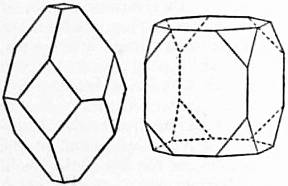
Fig. 1. Fig. 2.
Apophyllite always occurs as distinct crystals, which belong to the tetragonal system. The form is either a square prism terminated by the basal planes (fig. 2), or an acute pyramid (fig. 1). A prominent feature of the mineral is its perfect basal cleavage, on which the lustre is markedly pearly, presenting, in white crystals, somewhat the appearance of the eye of a fish after boiling, hence the old name fish-eye-stone or ichthyophthalmite for the mineral. On other surfaces the lustre is vitreous. The crystals are usually transparent and colourless, sometimes with a greenish or rose-red tint. Opaque white crystals of cubic habit have been called albine; xylochlore is an olive-green variety. The hardness is 4½, and the specific gravity 2.35.
The optical characters of the mineral are of special interest, and have been much studied. The sign of the double refraction may be either positive or negative, and some crystals are divided into optically biaxial sectors. The variety known as leucocyclite shows, when examined in convergent polarized light, a peculiar interference figure, the rings being alternately white and violet-black and not coloured as in a normal figure seen in white light.
Apophyllite is a mineral of secondary origin, commonly occurring, in association with other zeolites, in amygdaloidal cavities in basalt and melaphyre. Magnificent groups of greenish and colourless tabular crystals, the crystals several inches across, were found, with flesh-red stilbite, in the Deccan traps of the Western Gháts, near Bombay, during the construction of the Great Indian Peninsular railway. Groups of crystals of a beautiful pink colour have been found in the silver veins of Andreasberg in the Harz and of Guanaxuato in Mexico. Crystals of recent formation have been detected in the Roman remains at the hot springs of Plombières in France.
(L. J. S.)
APOPHYSIS (Gr. ἀπόφυσις, offshoot), a bony protuberance, in human physiology; also a botanical term for the swelling of the spore-case in certain mosses.
APOPLEXY (Gr. ἀποπληξία, from ἀποπλήσσειν, to strike down, to stun), the term employed by Galen to designate the “sudden loss of feeling and movement of the whole body, with the exception of respiration,” to which, after the time of Harvey, was added “and with the exception of the circulation.” Although the term is occasionally employed in medicine with other significations, yet in its general acceptation apoplexy may be defined as a sudden loss of consciousness, of sensibility, and of movement without any essential modification of the respiratory and circulatory functions occasioned by some brain disease. It was discovered that the majority of the cases of apoplexy were due to cerebral haemorrhage, and what looked like cerebral haemorrhage, red softening; and the idea for a long time prevailed that apoplexy and cerebral haemorrhage could be employed as synonymous terms, and that an individual who, in popular parlance, “had an apoplectic stroke,” had necessarily suffered from haemorrhage into his brain. A small haemorrhage may not, however, cause an apoplectic fit, nor is an apoplectic fit always caused by haemorrhage; it may be due to sudden blocking of a large vessel by a clot from a distant part (embolism), or by a sudden clotting of the blood in the vessel itself (thrombosis). Owing to the prevailing idea in former times that cerebral haemorrhage and apoplexy were synonymous terms, the word apoplexy was applied to haemorrhage into other organs than the brain; thus the terms pulmonary apoplexy, retinal apoplexy and splenic apoplexy were used.
The term “apoplexy” is now used in clinical medicine to denote that form of coma or deep state of unconsciousness which is due to sudden disturbance of the cerebral circulation occasioned by a local cause within the cranial cavity, as distinct from the loss of consciousness due to sudden failure of the heart’s action (syncope) or the coma of narcotic or alcoholic poisoning, of status epilepticus, of uraemia or of head injury.
The sudden coma of sunstroke and heat-stroke might be included, although owing to the suddenness with which a person may be struck down, the term heat apoplexy is frequently used, and, from an etymological point of view, quite justifiably. The older writers use the term simple apoplexy for a sudden attack which could not be explained by any visible disease. Again, congestive apoplexy was applied to those cases of coma where, at the autopsy, nothing was found to account for the coma and death except engorgement of the vessels of the brain and its membranes. In senile dementia and in general paralysis the brain is shrunken and the convolutions atrophied, the increased space in the ventricles and between the convolutions being filled up with the cerebro-spinal fluid. In these diseases apoplectic states may arise, terminating fatally; the excess of fluid found in such cases was formerly thought to be the cause of the symptoms, consequently the condition was called serous apoplexy. Such terms are no longer used, owing to the better knowledge of the pathology of brain disease.
Having thus narrowed down the application of the term “apoplexy,” we are in a position to consider its chief features, and the mechanism by which it is produced. Apoplexy may be rapidly fatal, but it is very seldom instantly fatal. The onset is usually sudden, and sometimes the individual may be struck down in an instant, senseless and motionless, “warranting those epithets, which the ancients applied to the victims of this disease, of attoniti and siderati, as if they were thunder-stricken or planet-struck” (Sir Thomas Watson). The attack, however, may be less sudden and, not infrequently, attended by a convulsion; while occasionally, in the condition termed ingravescent apoplexy, the coma is gradual in its onset, occupying hours in its development. Although unexpected, various warning symptoms, sometimes slight, sometimes pronounced, occur in the majority of cases. Such are, fulness in the head, headache, giddiness, noises in the ears, mental confusion, slight lapses of consciousness, numbness or tingling in the limbs. A characteristic apoplectic attack presents the following phenomena: the individual falls down suddenly and lies without sense or motion, except that his pulse keeps beating and his breathing continues. He appears to be in a deep sleep, from which he cannot be roused; the breathing is laboured and stertorous, and is accompanied with puffing out of the cheeks; the pulse may be beating more strongly than natural, and the face is often flushed and turgid. The reflexes are abolished. Although apoplexy may occur without paralysis, and paralysis without apoplexy, the two, owning the same cause, very frequently co-exist, or happen in immediate sequence and connexion; consequently there is in most cases definite evidence of paralysis affecting usually one side of the body in addition to the coma. Thus the pupils are unequal; there may be asymmetry of the face, or the limbs may be more rigid or flaccid on one side than on the other. These signs of localized disease enable a distinction to be made from the coma of narcotic poisoning and alcoholic intoxication. It must be borne in mind that a person smelling strongly of liquor and found lying in the street in a comatose state may be suffering from apoplexy, and the error of sending a dying man to a police cell may be avoided by this knowledge.
If the fit is only moderately severe, the reflexes soon return, and the patient may in a few hours show indications of returning consciousness by making some movements or opening his eyes when spoken to, although later it may be found that he is unable to speak, or may be paralysed or mentally afflicted (see Paralysis). In severe cases the coma deepens and the patient dies, usually from interference with the breathing, or, less commonly, from arrest of the heart’s action.
The mechanism by which apoplexy is produced has been a matter of much dispute; the condition was formerly ascribed to the pressure exerted by the clot on the rest of the brain, but there is no increase of intracranial pressure in an apoplectic fit occurring as a result of the sudden closure of a large vessel by embolism or thrombosis. Suddenness of the lesion appears to be, then, the essential element common to all cases of apoplexy from organic brain disease. It is the sudden shock to the delicate mechanism that produces the unconsciousness; but seeing that the coma is usually deeper and more prolonged in cerebral haemorrhage than when occasioned by vascular occlusion, and that an ingravescent apoplexy coma gradually develops and deepens as the amount of haemorrhage increases, we may presume that increase of intracranial pressure does play an important part in the degree and intensity of the coma caused by the rupture of a vessel. Apoplexy seldom occurs under forty years of age, but owing to the fact that disease of the cerebral vessels may exist at any age, from causes which are fully explained in the article Neuropathology, no period of life is exempt; consequently cases of true apoplexy are not wanting even in very young children. Recognizing that there are two causes of apoplexy in advanced life, viz. (1) sudden rupture of a diseased vessel usually associated with high arterial pressure, enlarged, powerfully acting heart and chronic renal disease, and (2) the sudden clotting of blood in a large diseased vessel favoured by a low arterial pressure due to a weak-acting heart, it is obvious that the character of the pulse forms a good guide to the diagnosis of the cause, the prevention and warding off of an attack, and the treatment of such should it occur.
Anything which tends directly or indirectly to increase arterial pressure within the cerebral blood-vessels may bring on an attack of cerebral haemorrhage; and although the identification of an apoplectic habit of body with a stout build, a short neck and florid complexion is now generally discredited, it being admitted that apoplexy occurs as frequently in thin and spare persons who present no such peculiarity of conformation, yet a plethoric habit of body, occasioned by immoderate eating or drinking associated with the gouty diathesis, leads to a general arterio-sclerosis and high arterial pressure. All conditions which can give rise to a local intracranial or a general bodily increase of the arterial pressure, i.e. severe exertion of body and mind, violent emotions, much stooping, overheated rooms, exposure to the sun, sudden shocks to the body, constipation and straining at stool, may, by suddenly increasing the strain on the wall of a diseased vessel, lead to its rupture.
The outlook of apoplexy is generally unfavourable in cases where the coma is profound; death may take place at different intervals after the onset. If the patient, after recovering from the initial coma, suffers with continual headache and lapses into a drowsy state, the result is likely to be serious; for such a condition probably indicates that an inflammatory change has taken place about the clot or in the area of softening.
Treatment.—The patient should be placed in the recumbent position with the head and shoulders slightly raised. He should be moved as little as possible from the place where the attack occurred. The medical man who is summoned will probably give the following directions: an ice-bag to be applied to the head; a few grains of calomel or a drop of croton oil in butter to be placed on the tongue, or an enema of castor oil to be administered. He may find it necessary to draw off the water with a catheter. The practice of blood-letting, once so common in this disease, is seldom resorted to, although in some cases, where there is very high arterial tension and a general state of plethora, it might be beneficial. Depletives are not employed where there is evidence of failure of the heart’s action; indeed the cautious administration of stimulants may be necessary, either subcutaneously or by the mouth (if there exist a power of swallowing), together with warm applications to the surface of the body; a water-bed may be required, and careful nursing, is essential to prevent complications, especially the formation of bedsores.
(F. W. Mo.)
APOROSE (from Gr. ἀ, without, and πόρος, passage), a biological term meaning imperforate, or not porous: there is a group of corals called Aporosa.
APOSIOPESIS (the Greek for “becoming silent”), a rhetorical device by which the speaker or writer stops short and leaves something unexpressed, but yet obvious, to be supplied by the imagination. The classical example is the threat, “Quos ego——!” of Neptune (in Virgil, Aen. i. 135).
APOSTASY (ἀπόστασις, in classical Greek a defection or revolt from a military commander), a term generally employed to describe a complete renunciation of the Christian faith, or even an exchange of one form of it for another, especially if the motive be unworthy. In the first centuries of the Christian era, apostasy was most commonly induced by persecution, and was indicated by some outward act, such as offering incense to a heathen deity or blaspheming the name of Christ.1 In the Roman Catholic Church the word is also applied to the renunciation of monastic vows (apostasis a monachatu), and to the abandonment of the clerical profession for the life of the world (apostasis a clericatu). Such defection was formerly often punished severely.
1 The readmission of such apostates to the church was a matter that occasioned serious controversy. The emperor Julian’s “Apostasy” is discussed under Julian.
APOSTIL, or Apostille (possibly connected with Lat. appositum, placed near), a marginal note made by a commentator.
APOSTLE (ἀπόστολος, one sent forth on a mission, an envoy, as in Is. xviii. 2; Symmachus, ἀποστέλλειν ἀποστόλους; Aquila, πρεσβευτάς), a technical term used in the New Testament and in Christian literature generally for a special envoy of Jesus Christ. How far it had any similar use in Judaism in Christ’s day is uncertain; but in the 4th century A.D., at any rate, it denoted responsible envoys from the central Jewish authority, especially for the collection of religious funds. In its first and simplest Christian form, the idea is present already in Mark iii. 14 f., where from the general circle of his disciples Jesus “made twelve (‘whom he also named apostles,’ Luke vi. 13, but doubtful in Mark), that they should be with him, and that he might from time to time send them forth (ἵνα ἀποστέλλῃ) to preach and to have authority to cast out demons.” Later on (vi. 6 ff.), in connexion with systematic preaching among the villages of Galilee, Jesus begins actually to “send forth” the twelve, two by two; and on their return from this mission (vi. 30) they are for the first time described as “apostles” or missionary envoys. Matthew (x. 1 ff.) blends the calling of the twelve with their actual sending forth, while Luke (vi. 13) makes Jesus himself call them “apostles” (for Luke’s usage cf. xi. 49, “prophets and apostles,” where Matthew, xxiii. 34, has “prophets and wise men and scribes”). But it is doubtful whether Jesus ever used the term for the Twelve, in relation to their temporary missions, any more than for the “seventy others” whom he “sent forth” later (Luke x. 1). Even the Fourth Gospel never so describes them. It simply has “a servant is not greater than his lord, neither an apostle (envoy) greater than he that sent him” (xiii. 16); and applies the idea of “mission” alike to Jesus (cf. Heb. iii. 1, “Jesus, the apostle ... of our profession”) and to his disciples, generally, as represented by the Twelve (xvii. 18, with 3, 6 ff.). But while ideally all Christ’s disciples were “sent” with the Father’s Name in charge, there were different degrees in which this applied in practice; and so we find “apostle” used in several senses, once it emerges as a technical term.
1. In the Apostolic age itself, “apostle” often denotes simply an “envoy,” commissioned by Jesus Christ to be a primary witness and preacher of the Messianic Kingdom. This wide sense was shown by Lightfoot (in his commentary on Galatians, 1865) to exist in the New Testament, e.g. in 1 Cor. xii. 28 f., Eph. iv. ii, Rom. xvi. 7; and his view has since been emphasized1 by the discovery of the Teaching of the Twelve Apostles (see Didache), with its itinerant order of “apostles,” who, together with “prophets” (cf. Eph. ii. 20, iii. 5) and “teachers,” constituted a charismatic and seemingly unordained ministry of the Word, in some part of the Church (in Syria?) during the early sub-apostolic age. Paul is our earliest witness, as just cited; also in 1 Cor. xv. 5 ff., where he seems to quote the language of Palestinian tradition, in saying that Christ “appeared to Cephas; then to the Twelve; then ... to James; then to the apostles one and all (τοῖς ἀποστόλοις πᾶσιν); and last of all ... to me also.” The appearance to “all the Apostles” must refer to the final commission given by the risen Christ to certain assembled disciples (Acts i. 6 ff., cf. Luke xxiv. 33), including not only the Twelve and the Lord’s brethren (i. 13 f.), but also some at least of the Seventy. Of this wider circle of witnesses, taken from among personal disciples during Jesus’s earthly ministry, we get a further glimpse in the election of one from their number to fill Judas’s place among the Twelve (i. 21 ff.), as the primary official witnesses of Messiah and his resurrection. Many of the 120 then present (Acts i. 15), and not only the two set forward for final choice, must have been personal disciples, who by the recent commission had been made “apostles.” Among such we may perhaps name Judas Barsabbas and Silas (Acts xv. 22, cf. i. 23), if not also Barnabas (1 Cor. ix. 6) and Andronicus and Junia (Rom. xvi. 7).
So far, then, we gather that the original Palestinian type of apostleship meant simply (a) personal mission from the risen Christ (cf. I Cor. ix. i), following on (b) some preliminary intercourse with Jesus in his earthly ministry. It was pre-eminence in the latter qualification that gave the Twelve their special status among apostles (Acts i. 26, ii. 14, vi. 2; in Acts generally they are simply “the apostles”). Conversely, it was Paul’s lack in this respect which lay at the root of his difficulties as an apostle.
It is possible, though not certain, that even those Judaizing missionaries at Corinth whom Paul styles “false-apostles” or, ironically, “the superlative apostles” (2 Cor. xi. 5, 13; xii. 11), rested part of their claim to superiority over Paul on (b), possibly even as having done service to Christ when on earth (2 Cor. xi. 18, 23). There is no sign in 2 Cor. that they laid claim to (a). If this be so, they were “Christ’s apostles” only indirectly, “through men” (as some had alleged touching Paul, cf. Gal. i. 1), i.e. as sent forth on mission work by certain Jerusalem leaders with letters of introduction (2 Cor. iii. 1; E. von Dobschutz, Problems der apost. Zeitalters, p. 106).
2. The Twelve.—When Jesus selected an inner circle of disciples for continuous training by personal intercourse, his choice of “twelve” had direct reference to the tribes of Israel (Matt. xix. 28; Luke xxii. 30). This gave them a symbolic or representative character as a closed body (cf. Rev. xxi. 14), marking them off as the primary religious authority (cf. Acts ii. 42, “the apostles’ teaching”) among the “disciples” or “brethren,” when these began to assume the form of a community or church. The relationship which other “apostles” had enjoyed with the Master had been uncertain; they had been his recognized intimates, and that as a body. Naturally, then, they took the lead, collectively—in form at least, though really the initiative lay with one or two of their own number, Peter in particular. The process of practical differentiation from their fellow apostles was furthered by the concentration of the Twelve, or at least of its most marked representatives, in Jerusalem, for a considerable period (Acts viii. 1, cf. xii. 1 ff.; an early tradition specifies twelve years). Other apostles soon went forth on their mission to “the cities of Israel” (cf. Acts ix. 31), and so exercised but little influence on the central policy of the Church. Hence their shadowy existence in the New Testament, though the actual wording of Matt. x. 5-42, read in the light of the Didachi, may help us to conceive their work in its main features.