VOLUME II SLICE III Apollodorus to Aral (continued 10)
Reading edition
ARABI PASHA (c. 1839- ), more correctly Ahmad ‛Arābī, to which in later years he added the epithet al-Misrī, “the Egyptian,” Egyptian soldier and revolutionary leader, was born in Lower Egypt in 1839 or 1840 of a fellah family. Having entered the army as a conscript he was made an officer by Said Pasha in 1862, and was employed in the transport department in the Abyssinian campaign of 1875 under Ismail Pasha. A charge of peculation, unproved, was made against him in connexion with this expedition and he was placed on half-pay. During this time he joined a secret society formed by Ali Rubi with the object of getting rid of Turkish officers from the Egyptian army. Arabi also attended lectures at the mosque El Azhar and acquired a reputation as an orator. In 1878 he was employed by Ismail in fomenting a disturbance against the ministry of Nubar, Rivers Wilson and de Blignières, and received in payment a wife from Ismail’s harem and the command of a regiment. This increased his influence with the secret society, which, under the feeble government of Tewfik Pasha and the Dual Control, began to agitate against Europeans. In all that followed Arabi was put forward as the leader of the discontented Egyptians; he was in reality little more than the mouthpiece and puppet of abler men such as Ali Rubi and Mahmud Sami. On the 1st of February 1881 Arabi and two other Egyptian colonels, summoned before a court-martial for acts of disobedience, were rescued by their soldiers, and the khedive was forced to dismiss his then minister of war in favour of Mahmud Sami. A military demonstration on the 8th of September 1881, led by Arabi, forced the khedive to increase the numbers and pay of the army, to substitute Sherif Pasha for Riaz Pasha as prime minister, and to convene an assembly of notables. Arabi became under-secretary for war at the beginning of 1882, but continued his intrigues. The assembly of notables claimed the right of voting the budget, and thus came into conflict with the foreign controllers who had been appointed to guard the interests of the bondholders in the management of the Egyptian finances. Sherif fell in February, Mahmud Sami became prime minister, and Arabi (created a pasha) minister of war. Arabi, after a brief fall from office, acquired a dictatorial power that alarmed the British government. British and French warships went to Alexandria at the beginning of June; on the 11th of that month rioting in that city led to the sacrifice of many European lives. Order could only be restored through the intervention of Arabi, who now adopted a more distinctly anti-European attitude. His arming of the forts at Alexandria was held to constitute a menace to the British fleet. On the refusal of France to co-operate, the British fleet bombarded the forts (11th July), and a British force, under Sir Garnet Wolseley, defeated Arabi on the 13th of September at Tel-el-Kebir. Arabi fled to Cairo where he surrendered, and was tried (3rd of December) for rebellion. In accordance with an understanding made with the British representative, Lord Dufferin, Arabi pleaded guilty, and sentence of death was immediately commuted to one of banishment for life to Ceylon. The same sentence was passed on Mahmud Sami and others. After Arabi’s exile had lasted for nearly twenty years, however, the khedive Abbas II. exercised his prerogative of mercy, and in May 1901 Arabi was permitted to return to Egypt. Arabi, as has been said, was rather the figurehead than the inspirer of the movement of 1881-1882; and was probably more honest, as he was certainly less intelligent, than those whose tool, in a large measure, he was. The movement which he represented in the eye of Europe, whatever the motives of its leaders, “was in its essence a genuine revolt against misgovernment,”1 and it was a dim recognition of this fact which led Arabi to style himself “the Egyptian.”
See Egypt: History; also the accounts of Arabi in Khedives and Pashas, by C.F. Moberly Bell (1884); and in Lord Cromer’s Modern Egypt (1908).
1 Lord Cromer in Egypt, No. 1, 1905, p. 2.
ARABISTAN (formerly Khuzistan), a province of Persia, bounded on the S. by the Persian Gulf, on the W. by Turkish territory, on the N. by Luristan and on the E. by the Bakhtiari district and Fars. It has its modern name, signifying “land of the Arabs,” from the Arabs who form the bulk of the population, and is subdivided into the districts of Muhamrah, Fellahiyeh (the old Dorak), Ram Hormuz (popularly known as Ramiz), Havizeh, Shushter and Dizful. It has a population of about 200,000 and pays a yearly revenue of about £30,000. The soil is very fertile, but since the dam over the Karun at Ahvaz was swept away and the numerous canals which diverted the waters of the river for irrigation became useless, a great part of the province is uncultivated, and most of the crops and produce depend for water on rainfall and wells. The climate is hot, and in the low-lying, swampy districts very unhealthy; the prevailing winds are north-west and south-east, the former hot and dry from the arid districts west of Mesopotamia, the latter bearing much moisture from the Persian Gulf and the Indian Ocean. The principal Arab tribes are the Kab (generally known as Chaab) and Beni Lam, the former mostly settled in towns and villages and by religion Shi’ites, the latter nomads and Sunnites. The staples of food are dates and fish in the south, elsewhere the produce of the herds and flocks and rice, wheat and barley. Other products are maize, cotton, silk and indigo, and the manufactures include carpets without pile, coarse woollens, cottons and silk nettings. Dyeing is extensively carried on in Dizful where most of the indigo is grown.
Khuzistan (meaning “the land of the Khuz”) was a part of the Biblical Elam, the classical Susiana, and appears in the great inscription of Darius as Uvaja.
ARABS, the name given to that branch of the Semitic race which from the earliest historic times inhabited the south-western portion of the Arabian peninsula. The name, to-day the collective term for the overwhelming majority of the surviving Semitic peoples, was originally restricted to the nomad tribes who ranged the north of the peninsula east of Palestine and the Syro-Arabian desert. In this narrow sense “Arab” is used in the Assyrian inscriptions, in the Old Testament and in the Minaean inscriptions. Before the Christian era it had come to include all the inhabitants of the peninsula. This, it is suggested, may have been due to the fact that the “Arabs” were the chief people near the Greek and Roman colonies in Syria and Mesopotamia. Classical writers use the term both in its local and general sense. The Arabs to-day occupy, besides Arabia, a part of Mesopotamia, the western shores of the Red Sea, the eastern coast of the Persian Gulf and the north of Africa. The finest type of the race is found in south Arabia among the Ariba Arabs, among the mountaineers of Hadramut and Yemen and among the Bedouin tribes roaming over the interior of central and northern Arabia. The Arabs of the coasts and those of Mesopotamia are hybrids, showing Turkish, Negroid and Hamitic crossings. The people of Syria and Palestine are hybrids of Arab, Phoenician and Jewish descent. The theory that early Arab settlements were made on the east coast of Africa as far as Sofala south of the Zambezi, is without foundation; the earliest Arab settlement on the east coast of Africa that can be proved is Magadoxo (Mukdishu) in the 10th century, and the ruined cities of Mashonaland, once supposed to be the remains of Arab settlements, are now known to be of medieval African origin. On the East African coast-lands Arab influence is still considerable. Traces of the Arab type are met with in Asia Minor, the Caucasus, western Persia and India, while the influence of the Arab language and civilization is found in Europe (Malta and Spain), China and Central Asia.
The Arabs are at once the most ancient as they in many ways are the purest surviving type of the true Semite. Certainly the inhabitants of Yemen are not, and in historic times never were, pure Semites. Somali and other Ethnology. elements, generally described under the collective racial name of Hamitic, are clearly traceable; but the inland Arabs still present the nearest approach to the primitive Semitic type. The origin of the Arab race can only be a matter of conjecture. From the remotest historic times it has been divided into two branches, which from their geographical position it is simplest to call the North Arabians and the South Arabians. Arabic and Jewish tradition trace the descent of the latter from Joktan (Arabic Kahtan) son of Heber, of the former from Ishmael. The South Arabians—the older branch—were settled in the south-western part of the peninsula centuries before the uprise of the Ishmaelites. These latter include not only Ishmael’s direct descendants through the twelve princes (Gen. xxv. 16), but the Edomites, Moabites, Ammonites, Midianites and other tribes. This ancient and undoubted division of the Arab race —roughly represented to-day by the universally adopted classification into Arabs proper and Bedouin Arabs (see Bedouins)-has caused much dispute among ethnologists. All authorities agree in declaring the race to be Semitic in the broadest ethnological signification of that term, but some thought they saw in this division of the race an indication of a dual origin. They asserted that the purer branch of the Arab family was represented by the sedentary Arabs who were of Hamitic (Biblical Cushite), i.e. African ancestry, and that the nomad Arabs were Arabs only by adoption, and were nearer akin to the true Semite as sons of Ishmael. Many arguments were adduced in support of this theory, (1) The unquestioned division in remote historic times of the Arab race, and the immemorial hostility between the two branches. (2) The concurrence of pre-Islamitic literature and records in representing the first settlement of the “pure” Arab as made in the extreme south-western part of the peninsula, near Aden. (3) The use of Himyar, “dusky” or “red” (suggesting African affinities), as the name sometimes for the ruling class, sometimes for the entire people. (4) The African affinities of the Himyaritic language. (5) The resemblance of the grammar of the Arabic now spoken by the “pure” Arabs, where it differs from that of the North, to the Abyssinian grammar. (6) The marked resemblance of the pre-Islamitic institutions of Yemen and its allied provinces-its monarchies, courts, armies and serfs—to the historical Africo-Egyptian type and even to modern Abyssinia. (7) The physique of the “pure” Arab, the shape and size of the head, the slenderness of the lower limbs, all suggesting an African rather than an Asiatic origin. (8) The habits of the people, viz. their sedentary rather than nomad occupations, their fondness for village life, for dancing, music and society, their cultivation of the soil, having more in common with African life than with that of the western Asiatic continent. (9) The extreme facility of marriage which exists in all classes of the southern Arabs with the African races, the fecundity of such unions and the slightness or even total absence of any caste feeling between the dusky “pure” Arab and the still darker African, pointing to a community of origin. And further arguments were found in the characteristics of the Bedouins, their pastoral and nomad tendencies; the peculiarities of their idiom allied to the Hebrew; their strong clan feeling, their continued resistance to anything like regal power or centralized organization.
Such, briefly, were the more important arguments; but latterly ethnologists are inclined to agree that there is little really to be said for the African ancestry theory and that the Arab race had its beginning in the deserts of south Arabia, that in short the true Arabs are aborigines.
Mahommedans call the centuries before the Prophet’s birth waqt-el jahilīya, “the time of ignorance,” but the fact is that the Arab world has in some respects never since reached so high a level as it had in those days which it suits Moslems to paint in dreary colours. Writing was a fine art and poetry flourished. Eloquence was an accomplishment all strove to acquire, and each year there were assemblies, lasting sometimes a month, which were devoted to contests of skill among the orators and poets, to listen to whose friendly rivalry tribesmen journeyed long distances. Last, that surest index of a people’s civilization—the treatment of women—contrasted very favourably with their position under the Koran. Women had rights and were respected. The veil and the harem system were unknown before Mahomet. According to Nöldeke the Nabataean inscriptions and coins show that women held a high social position in northern Arabia, owning large estates and trading independently. Polyandry and polygamy, it is true, were practised, but the right of divorce belonged to the woman as well as the man. Two kinds of marriage were celebrated. One was a purely personal contract, with no witnesses, the wife not leaving her home or passing under marital authority. The other was a formal marriage, the woman becoming subject to her husband by purchase or capture. Even captive women were not kept in slavery. Arabic wealth and culture had indeed thus early reached a stage which justified Professor Robertson Smith in writing, “In this period the name of Arab was associated to Western writers with ideas of effeminate indolence and peaceful opulence ... the golden age of Yemen.” But long before Mahomet’s time this early Arab predominance was at an end, possibly due in great measure to the loss of the caravan trade through the increase of shipping. The abandonment of great cities and the ruin of many tribes contributed to the apparent nationalization of the Arab peoples. Though the traditional jealousy and hostility of the two branches, the Yemenites and Maadites or Ishmaelites, remained, the Arab world had attained by the levelling process of common misfortune the superficial unity it presents to-day. The nation thus formed, never a nation in the strict sense of the word, was distinctively and thoroughly Semitic in character and language, and has remained unchanged to the present day. The sporadic brilliancy of the ancient Arab kingdoms gave place to a social and political lethargy, the continuation of which for many centuries made the uprise of Saracenic empires seem a miracle to a world ignorant of the Arab past. The Arab race up to Mahomet’s day had been in the main pagan. Monotheism, if it ever prevailed, early gave place to sun and star worship, or simple idolatry. Professor Robertson Smith suggests that totemism was the earliest form of Arabian idolatry, and that each tribe had its sacred animal. This he supports by the fact that some tribal names were derived from those of animals, and that animal-worship was not unknown in Arabia. What seems certain is that Arab religion was of a complex hybrid nature, not much to be wondered at when one remembers that Arabia was the asylum of many religious refugees, Zoroastrians, Jews, Christians. In the later pre-Islamitic times spirits, or jinns, as they were called, of which each tribe or family had its own, were worshipped, and there was but a vague idea of a Supreme Being. Images of the jinns to the number of 360, one for each day of the lunar year, were collected in the temple at Mecca, the chief seat of their worship. That worship was of a sanguinary nature. Human sacrifice was fairly frequent. Under the guise of religion female infanticide was a common practice. At Mecca the great object of worship was a plain black stone, and to it pilgrimages were made from every part of Arabia. This stone was so sacred to the Arabs that even Mahomet dared not dispense with it, and it remains the central object of sanctity in the Ka’ba to-day. The temples of the Sabaeans and the Minaeans were built east of their cities, a fact suggesting sun-worship, yet this is not believed to have been the cult of the Minaeans. Common to both was the worship of Attar, the male Ashtoreth.
With the appearance of Mahomet the Arabs took anew a place in the world’s history.
Physically the Arabs are one of the strongest and noblest races of the world. Baron de Larrey, surgeon-general to Napoleon on his expedition to Egypt and Syria, writes: “Their physical structure is in all respects Physique. more perfect than that of Europeans; their organs of sense exquisitely acute, their size above the average of men in general, their figure robust and elegant, their colour brown; their intelligence proportionate to their physical perfection and without doubt superior, other things being equal, to that of other nations.” The typical Arab face is of an oval form, lean-featured; the eyes a brilliant black, deep-set under bushy eyebrows; nose aquiline, forehead straight but not high. In body the Arab is muscular and long-limbed, but lean. Deformed individuals or dwarfs are rare among Arabs; nor, except leprosy, which is common, does any disease seem to be hereditary among them. They often suffer from ophthalmia, though not in the virulent Egyptian form. They are scrupulously clean in their persons, and take special care of their teeth, which are generally white and even. Simple and abstemious in their habits, they often reach an extreme yet healthy old age; nor is it common among them for the faculties of the mind to give way sooner than those of the body.
Thus, physically, they yield to few races, if any, of mankind; mentally, they surpass most, and are only kept back in the march of progress by the remarkable defect of organizing power and incapacity for combined action. Character. Lax and imperfect as are their forms of government, it is with impatience that even these are borne; of the four caliphs who alone reigned—if reign theirs could be called—in Arabia proper, three died a violent death; and of the Wahhabi princes, the most genuine representatives in later times of pure Arab rule, almost all have met the same fate. The Arab face, which is not unkindly, but never smiling, expresses that dignity and gravity which are typical of the race. While the Arab is always polite, good-natured, manly and brave, he is also revengeful, cruel, untruthful and superstitious. Of the Arab nature Burckhardt (other authorities, e.g. Barth and Rohlfs, are far less complimentary) wrote: “The Arab displays his manly character when he defends his guest at the peril of his own life, and submits to the reverses of fortune, to disappointment and distress, with the most patient resignation. He is distinguished from a Turk by the virtues of pity and gratitude. The Turk is cruel, the Arab of a more kind temper; he pities and supports the wretched, and never forgets the generosity shown to him even by an enemy.” The Arab will lie and cheat and swear false oaths, but once his word is pledged he may be trusted to the last. There are some oaths such as Wallah (by Allah) which mean nothing, but such an oath as the threefold one with wa, bi and ta as particles of swearing the meanest thief will not break. In temper, or at least in the manifestation of it, the Arab is studiously calm; and he rarely so much as raises his voice in a dispute. But this outward tranquillity covers feelings alike keen and permanent; and the remembrance of a rash jest or injurious word, uttered years before, leads only too often to that blood-revenge which is a sacred duty everywhere in Arabia.
There exist, however, marked tribal or almost semi-national diversities of character among the Arabs. Thus, the inhabitants of Hejaz are noted for courtesy and blamed for fickleness; those of Nejd are distinguished by their stern tenacity and dignity of deportment; the nations of Yemen are gentle and pliant, but revengeful; those of Hasa and Oman cheerful and fond of sport, though at the same time turbulent and unsteady. Anything approaching to a game is rare in Nejd, and in the Hejaz religion and the yearly occurrence of the pilgrim ceremonies almost exclude all public diversions; but in Yemen the well-known game of the “jerid,” or palm-stick, with dances and music is not rare. In Oman such amusements are still more frequent. Again in Yemen and Oman, coffee-houses, where people resort for conversation, and where public recitals, songs and other amusements are indulged in, stand open all day; while nothing of the sort is tolerated in Nejd. So too the ceremonies of circumcision or marriage are occasions of gaiety and pastime on the coast, but not in the central provinces.
An Arab town, or even village, except it be the merest hamlet, is invariably walled round; but seldom is a stronger material than dried earth used; the walls are occasionally flanked by towers of like construction. A dry ditch Manners and customs. often surrounds the whole. The streets are irregular and seldom parallel. The Arab, indeed, lacks an eye for the straight. The Arab carpenter cannot form a right angle; an Arab servant cannot place a cloth square on a table. The Ka’ba at Mecca has none of its sides or angles equal. The houses are of one or two storeys, rarely of three, with flat mud roofs, little windows and no external ornament. If the town be large, the expansion of one or two streets becomes a market-place, where are ranged a few shops of eatables, drugs, coffee, cottons or other goods. Many of these shops are kept by women. The chief mosque is always near the market-place; so is also the governor’s residence, which, except in size and in being more or less fortified Arab fashion, does not differ from a private house. Drainage is unthought of; but the extreme dryness of the air obviates the inconvenience and disease that under other skies could not fail to ensue, and which in the damper climates of the coast make themselves seriously felt. But the streets are roughly swept every day, each householder taking care of the roadway that lies before his own door. Whitewash and colour are occasionally used in Yemen, Hejaz and Oman; elsewhere a light ochre tint, the colour of the sun-dried bricks, predominates, and gives an Arab town the appearance at a distance of a large dust-heap in the centre of the bright green ring of gardens and palm-groves. Baked bricks are unknown in Arabia, and stone buildings are rare, especially in Nejd. Palm branches and the like, woven in wattles, form the dwellings, of the poorer classes in the southern districts. Many Arab towns possess watch-towers, like huge round factory chimneys in appearance, built of sun-dried bricks, and varying in height from 50 to 100 ft. or even more. Indeed, two of these constructions at the town of Birkat-el-Mauj, in Oman, are said to be each of 170 ft. in height, and that of Nezwah, in the same province, is reckoned at 140; but these are of stone.
The principal feature in the interior of an Arab house is the “kahwah” or coffee-room. It is a large apartment spread with mats, and sometimes furnished with carpets and a few cushions. At one end is a small furnace or fireplace for preparing coffee. In this room the men congregate; here guests are received, and even lodged; women rarely enter it, except at times when strangers are unlikely to be present. Some of these apartments are very spacious and supported by pillars; one wall is usually built transversely to the compass direction of the Ka’ba; it serves to facilitate the performance of prayer by those who may happen to be in the kahwah at the appointed times. The other rooms are ordinarily small.
The Arabs are proverbially hospitable. A stranger’s arrival is often the occasion of an amicable dispute among the wealthier inhabitants as to who shall have the privilege of receiving him. Arab cookery is of the simplest. Roughly-ground wheat cooked with butter; bread in thin cakes, prepared on a heated iron plate or against the walls of an open oven; a few vegetables, generally of the leguminous kinds; boiled mutton or camel’s flesh, among the wealthy; dates and fruits—this is the menu of an ordinary meal. Rice is eaten by the rich and fish is common on the coasts. Tea, introduced only a few decades back, is now largely drunk. A food of which the Arabs are fond is locusts boiled in salt and water and then dried in the sun. They taste like stale shrimps, but there is a great sale for them. Spices are freely employed; butter much too largely for a European taste.
After eating, the hands are always washed, soap or the ashes of an alkaline plant being used. A covered censer with burning incense is then passed round, and each guest perfumes his hands, face, and sometimes his clothes; this censer serves also on first receptions and whenever special honour is intended. In Yemen and Oman scented water often does duty for it. Coffee, without milk or sugar, but flavoured with an aromatic seed brought from India, is served to all. This, too, is done on the occasion of a first welcome, when the cups often make two or three successive rounds; but, in fact, coffee is made and drunk at any time, as frequently as the desire for it may suggest itself; and each time fresh grains are sifted, roasted, pounded and boiled—a very laborious process, and one that requires in the better sort of establishments a special servant or slave for the work. Arabs generally make but one solid meal a day—that of supper, soon after sunset. Even then they do not eat much, gluttony being rare among them, and even daintiness esteemed disgraceful. Wine, like other fermented drinks, is prohibited by the Koran, and is, in fact, very rarely taken, though the inhabitants of the mountains of Oman are said to indulge in it. On the coast spirits of the worst quality are sometimes procured; opium and hashish are sparingly indulged in. On the other hand, wherever Wahhābiism has left freedom of action, tobacco-smoking prevails; short pipes of clay, long pipes with large open bowls, or most frequently the water-pipe or “nar-ghileh,” being used. The tobacco smoked is generally strong and is either brought from the neighbourhood of Bagdad or grown in the country itself. The strongest quality is that of Oman; the leaf is broad and coarse, and retains its green colour even when dried; a few whiffs have been known to produce absolute stupor. The aversion of the Wahhābis to tobacco is well known; they entitle it “mukhzi” or “the shameful,” and its use is punished with blows, as the public use of wine would be elsewhere.
In dress much variety prevails. The loose cotton drawers girded at the waist, which in hot climates do duty for trousers, are not often worn, even by the upper classes, in Nejd or Yemama, where a kind of silk dressing-gown is Dress. thrown over the long shirt; frequently, too, a brown or black cloak distinguishes the wealthier citizen; his head-dress is a handkerchief fastened round the head by a band. But in Hejaz, Yemen and Oman, turbans are by no means uncommon; the ordinary colour is white; they are worn over one or more skullcaps. Trousers also form part of the dress in the two former of these districts; and a voluminous sash, in which a dagger or an inkstand is stuck, is wrapped round the waist. The poorer folk, however, and the villagers often content themselves with a broad piece of cloth round the loins, and another across the shoulders. In Oman trousers are rare, but over the shirt a long gown, of peculiar and somewhat close-fitting cut, dyed yellow, is often worn. The women in these provinces commonly put on loose drawers and some add veils to their head-dresses; they are over-fond of ornaments (gold and silver); their hair is generally arranged in a long plait hanging down behind. All men allow their beards and moustaches full growth, though this is usually scanty. Most Arabs shave their heads, and indeed all, strictly speaking, ought by Mahommedan custom to do so. An Arab seldom or never dyes his hair. Sandals are worn more often than shoes; none but the very poorest go barefoot.
Slavery is still, as of old times, a recognized institution throughout Arabia; and an illicit traffic in blacks is carried on along the coasts of the Persian Gulf and the Red Sea. The slaves themselves were obtained chiefly from the east Slavery. African coast districts down as far as Zanzibar, but this source of supply was practically closed by the end of the 19th century. Slaves are usually employed in Arabia as herdsmen or as domestic servants, rarely in agricultural work; they also form a considerable portion of the bodyguards with which Eastern greatness loves to surround itself. Like their countrymen elsewhere, they readily embrace the religion of their masters and become zealous Mahommedans. Arab custom enfranchises a slave who has accepted Islam at the end of seven years of bondage, and when that period has arrived, the master, instead of exacting from his slave the price of freedom, generally, on giving him his liberty, adds the requisite means for supporting himself and a family in comfort. Further, on every important occasion, such as a birth, circumcision, a marriage or a death, one or more of the household slaves are sure of acquiring their freedom. Hence Arabia has a considerable free black population; and these again, by inter-marriage with the whites around, have filled the land with a mulatto breed of every shade, till, in the eastern and southern provinces especially, a white skin is almost an exception. In Arabia no prejudice exists against negro alliances; no social or political line separates the African from the Arab. A negro may become a sheik, a kadi, an amir, or whatever his industry and his talents may render him capable of being. This is particularly so in Nejd, Yemen and Hadramut; in the Hejaz and the north a faint line of demarcation may be observed between the races.
The Arabs are good soldiers but poor generals. Personal courage, wonderful endurance of privation, fixity of purpose, and a contempt of death are qualities common to almost every race, tribe and clan that compose the Military qualities. Arab nation. In skirmishing and harassing they have few equals, while at close quarters they have often shown themselves capable of maintaining, armed with swords and spears alone, a desperate struggle against guns and bayonets, neither giving nor receiving quarter. Nor are they wholly ignorant of tactics, their armies, when engaged in regular war, being divided into centre and wings, with skirmishers in front and a reserve behind, often screened at the outset of the engagement by the camels of the expedition. These animals, kneeling and ranged in long parallel rows, form a sort of entrenchment, from behind which the soldiers of the main body fire their matchlocks, while the front divisions, opening out, act on either flank of the enemy. This arrangement of troops may be traced in Arab records as far back as the 5th century, and was often exemplified during the Wahhābi wars.
Arab women are scarcely less distinguished for their bravery than the men. Records of armed heroines occur frequently in the chronicles or myths of the pre-Islamitic time; and in authentic history the Battle of the Camel, 656 A.D., where Ayesha, the wife of Mahomet, headed the charge, is only the first of a number of instances in which Arab amazons have taken, sword in hand, no inconsiderable share in the wars and victories of Islam. Even now it is the custom for an Arab force to be always accompanied by some courageous maiden, who, mounted on a blackened camel, leads the onslaught, singing verses of encouragement for her own, of insult for the opposing tribe. Round her litter the fiercest of the battle rages, and her capture or death is the signal of utter rout; it is hers also to head the triumph after the victory of her clan.
There is little education, in the European sense of the word, in Arabia. Among the Bedouins there are no schools, and few, even of the most elementary character, in the towns or villages. Where they exist, little beyond the Education. mechanical reading of the Koran, and the equally mechanical learning of it by rote, is taught. On the other hand, Arab male-children, brought up from early years among the grown-up men of the house or tent, learn more from their own parents and at home than is common in other countries; reading and writing are in most instances thus acquired, or rather transmitted; besides such general principles of grammar and eloquence, often of poetry and history, as the elders themselves may be able to impart. To this family schooling too are due the good manners, politeness, and self-restraint that early distinguish Arab children. In the very few instances where a public school of a higher class exists, writing, grammar and rhetoric sum up its teachings. Law and theology, in the narrow sense that both these words have in the Islamitic system, are explained in afternoon lectures given in most mosques; and some verses of the Koran, with one of the accepted commentaries, that of Baidawi for example, form the basis of the instruction. Great attention is paid to accuracy of grammar and purity of diction throughout Arabia; yet something of a dialectic difference may be observed in the various districts. The purest Arabic, that which is as nearly as possible identical in the choice of words and in its inflections with the language of the Koran, is spoken in Nejd, and the best again of that in the province of Suder. Next in purity comes the Arabic of Shammar. Throughout the Hejaz in general, the language, though extremely elegant, is not equally correct; in el-Hasa, Bahrein and Oman it is decidedly influenced by the foreign element called Nabataean. In Yemen, as in other southern districts of the peninsula, Arabic merges insensibly into the Himyaritic or African dialect of Hadramut and Mahra. (See Semitic Languages.)
Bibliography.—Lieutenant Wellsted, Travels in Arabia (Lond., 1838); “Narrative of a Journey to the Ruins of Nakeb el Hajar” (Jour. R. Geog. Soc. vii. 20); Carsten Niebuhr. Travels through Arabia (transl. into English by Robert Heron, 2 vols., Edin., 1792); John Lewis Burckhardt, Travels in Arabia (2 vols., Lond., 1829); Notes on the Bedouins and Wahabis, (2 vols., Lond., 1830; in German, Weimar, 1831); C.J. Cruttenden, Journal of an Excursion to Sana’a, the Capital of Yemen (Bombay, 1838); A. Sprenger, Die alte Geographie Arabiens als Grundlage der Entwicklungsgeschichte des Semitismus (Berne, 1875); Sir Richard F. Burton, Personal Narrative of a Pilgrimage to El Medinah and Meccah (Lond., 1855); W. Robertson Smith, Kinship and Marriage in Early Arabia (Cambridge); E. Reclus, Les Arabes (Brussels, 1898); Lady Anne Blunt, A Pilgrimage to Nejd (2 vols., Lond., 1881); C.M. Doughty, Arabia Deserta (2 vols., 1888); Rev. S.M. Zwemer, Arabia: the Cradle of Islam (1900); Albrecht Zehme, Arabien und die Araber, seit hundert Jahren (1875).
ARACAJÚ, a city and seaport of Brazil, capital of the state of Sergipe, 170 m. N.N.E. of Bahia, on the river Cotinguiba, or Cotindiba, 6 m. from the coast. The municipality, of which it forms a part, had a population in 1890 of 16,336, about two-thirds of whom lived in the city itself. Aracajú is a badly built town on the right bank of the river at the base of a ridge of low sand-hills and has the usual features of an unprogressive provincial capital. Good limestone is quarried in its vicinity, and the country tributary to this port produces large quantities of sugar. Cotton is also grown, and the back country sends down hides and skins for shipment. The anchorage is good, but a dangerous bar at the mouth of the river prevents the entrance of vessels drawing more than 12 ft. The port is visited, therefore, only by the smaller steamers of the coastwise lines. The river is navigable as far as the town of Maroim, about 10 m. beyond Aracajú. The city was founded in 1855.
ARACATY, or Aracatí, a city and port of Brazil, in the state of Ceará, 75 m. S.E. of Fortaleza, on the river Jaguaribe, 8 m. from the sea. Pop. of the municipality (1890) 20,182, of whom about 12,000 belonged to the city. A dangerous bar at the mouth of the river permits the entrance only of the smaller coasting steamers, but the port is an important commercial centre, and exports considerable quantities of cotton, hides, maniçoba, rubber, fruit, and palm wax.
ARACHNE, in Greek mythology, the daughter of Idmon of Colophon in Lydia, a dyer in purple. She had acquired such skill in the art of weaving that she ventured to challenge Athena. While the goddess took as subjects her quarrel with Poseidon as to the naming and possession of Attica, and the warning examples of those who ventured to pit themselves against the immortals, Arachne depicted the metamorphoses of the gods and their amorous adventures. Her work was so perfect that Athena, enraged at being unable to find any blemish in it, tore it to pieces. Arachne hanged herself in despair; but the goddess out of pity loosened the rope, which became a cobweb, while Arachne herself was changed into a spider (Ovid, Metam. vi. 5-145). The story probably indicates the superiority of Asia over Greece in the textile arts.
ARACHNIDA, the zoological name given in 1815 by Lamarck (Gr. ἁράχνη, a spider) to a class which he instituted for the reception of the spiders, scorpions and mites, previously classified by Linnaeus in the order Aptera of his great group Insecta. Lamarck at the same time founded the class Crustacea for the lobsters, crabs and water-fleas, also until then included in the order Aptera of Linnaeus. Lamarck included the Thysanura and the Myriapoda in his class Arachnida. The Insecta of Linnaeus was a group exactly equivalent to the Arthropoda founded a hundred years later by Siebold and Stannius. It was thus reduced by Lamarck in area, and made to comprise only the six-legged, wing-bearing “Insecta.” For these Lamarck proposed the name Hexapoda; but that name has been little used, and they have retained to this day the title of the much larger Linnaean group, viz. Insecta. The position of the Arachnida in the great sub-phylum Arthropoda, according to recent anatomical and embryological researches, is explained in the article Arthropoda. The Arachnida form a distinct class or line of descent in the grade Euarthropoda, diverging (perhaps in common at the start with the Crustacea) from primitive Euarthropods, which gave rise also to the separate lines of descent known as the classes Diplopoda, Crustacea, Chilopoda and Hexapoda.
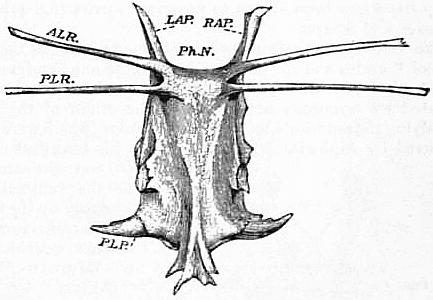
Fig. 1.—Entosternum, entosternite or plastron of Limulus polyphemus, Latr. Dorsal surface.
LAP, Left anterior process. RAP, Right anterior process. PhN, Pharyngeal notch. ALR, Anterior lateial rod or tendon. PLR, Posterior lateral rod or tendon. PLP, Posterior lateral process. Natural size.
(From Lankester, Q. J. Mic. Sci., N S vol. xxiv, 1884.)
Limulus an Arachnid.—Modern views as to the classification and affinities of the Arachnida have been determined by the demonstration that Limulus and the extinct Eurypterines (Pterygotus, &c.) are Arachnida; that is to say, are identical in the structure and relation of so many important parts with Scorpio, whilst differing in those respects from other Arthropoda, that it is impossible to suppose that the identity is due to homoplasy or convergence, and the conclusion must be accepted that the resemblances arise from close genetic relationship. The view that Limulus, the king-crab, is an Arachnid was maintained as long ago as 1829 by Strauss-Dürckheim (1), on the ground of its possession of an internal cartilaginous sternum—also possessed by the Arachnida (see figs. 1, 2, 3, 4, 5 and 6)—and of the similarity of the disposition of the six leg-like appendages around the mouth in the two cases (see figs. 45 and 63). The evidence of the exact equivalence of the segmentation and appendages of Limulus and Scorpio, and of a number of remarkable points of agreement in structure, was furnished by Ray Lankester in an article published in 1881 (“Limulus an Arachnid,” Quart. Journ. Micr. Sci. vol. xxi. N.S.), and in a series of subsequent memoirs, in which the structure of the entosternum, of the coxal glands, of the eyes, of the veno-pericardiac muscles, of the respiratory lamellae, and of other parts, was for the first time described, and in which the new facts discovered were shown uniformly to support the hypothesis that Limulus is an Arachnid. A list of these memoirs is given at the close of this article (2, 3, 4, 5 and 13). The Eurypterines (Gigantostraca) were included in the identification, although at that time they were supposed to possess only five pairs of anterior or prosomatic appendages. They have now been shown to possess six pairs (fig. 47), as do Limulus and Scorpio.
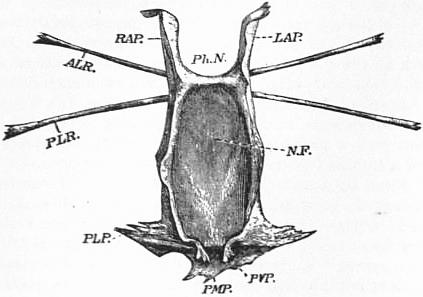
Fig. 2.—Ventral surface of the entosternum of Limulus polyphemus, Latr. Letters as in fig. 1 with the addition of NF, neural fossa protecting the aggregated ganglia of the central nervous system; PVP, left posterior ventral process; PMP, posterior median process. Natural size.
(From Lankester.)
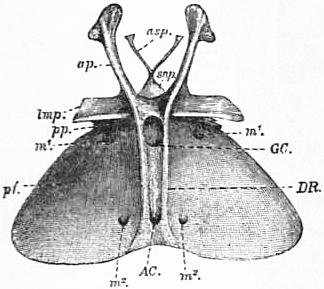
Fig. 3.—Entosternum of scorpion (Palamnaeus Indus, de Geer); dorsal surface.
asp, Paired anterior process of the sub-neural arch. snp, Sub-neural arch. ap, Anterior lateral process (same as RAP and LAP in fig. 1). lmp, Lateral median process (same as ALR and PLR of fig. 1). pp, Posterior process (same as PLP in fig. 1). pf, Posterior flap or diaphragm of Newport. m1 and m2, Perforations of the diaphragm for the passage of muscles. DR, The paired dorsal ridges. GC, Gastric canal or foramen. AC, Arterial canal or foramen.
(After Lankester, loc. cit.)
The various comparisons previously made between the structure of Limulus and the Eurypterines on the one hand, and that of a typical Arachnid, such as Scorpio, on the other, had been vitiated by erroneous notions as to the origin of the nerves supplying the anterior appendages of Limulus (which were finally removed by Alphonse Milne-Edwards in his beautiful memoir (6) on the structure of that animal), and secondly by the erroneous identification of the double sternal plates of Limulus, called “chilaria,” by Owen, with a pair of appendages (7). Once the identity of the chilaria with the pentagonal sternal plate of the scorpion is recognized—an identification first insisted on by Lankester—the whole series of segments and appendages in the two animals, Limulus and Scorpio, are seen to correspond most closely, segment for segment, with one another (see figs. 7 and 8). The structure of the prosomatic appendages or legs is also seen to present many significant points of agreement (see figures), but a curious discrepancy existed in the six-jointed structure of the limb in Limulus, which differed from the seven-jointed limb of Scorpio by the defect of one joint. R.I. Pocock of the British Museum has observed that in Limulus a marking exists on the fourth joint, which apparently indicates a previous division of this segment into two, and thus establishes the agreement of Limulus and Scorpio in this small feature of the number of segments in the legs (see fig. 11).
It is not desirable to occupy the limited space of this article by a full description of the limbs and segments of Limulus and Scorpio. The reader is referred to the complete series of figures here given, with their explanatory legends (figs 12, 13, 14, 15). Certain matters, however, require comment and explanation to render the comparison intelligible. The tergites, or chitinized dorsal halves of the body rings, are fused to form a “prosomatic carapace,” or carapace of the prosoma, in both Limulus and Scorpio (see figs. 7 and 8). This region corresponds in both cases to six somites, as indicated by the presence of six pairs of limbs. On the surface of the carapace there are in both animals a pair of central eyes with simple lens and a pair of lateral eye-tracts, which in Limulus consist of closely-aggregated simple eyes, forming a “compound” eye, whilst in Scorpio they present several separate small eyes. The microscopic structure of the central and the lateral eyes has been shown by Lankester and A.G. Bourne (5) to differ; but the lateral eyes of Scorpio were shown by them to be similar in structure to the lateral eyes of Limulus, and the central eyes of Scorpio to be identical in structure with the central eyes of Limulus (see below).
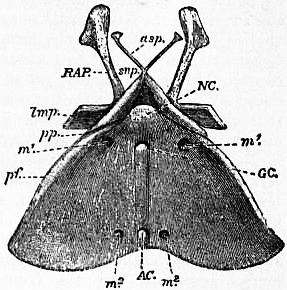
Fig. 4.—Ventral surface of the same entosternum as that drawn in fig. 3. Letters as in fig. 3 with the addition of NC, neural canal or foramen.
(After Lankester, loc. cit.)
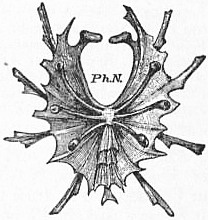
Fig. 5.—Entosternum of one of the mygalomorphous spiders; ventral surface. Ph.N., pharyngeal notch. The posterior median process with its repetition of triangular segments closely resembles the same process in Limulus.
(From Lankester, loc. cit.)
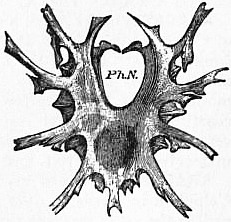
Fig. 6.—Dorsal surface of the same entosternum as that drawn in fig. 5. Ph.N., pharyngeal notch.
After Lankester, loc. cit.
Following the prosoma is a region consisting of six segments (figs. 14 and 15), each carrying a pair of plate-like appendages in both Limulus and Scorpio. This region is called the mesosoma. The tergites of this region and those of the following region, the metasoma, are fused to form a second or posterior carapace in Limulus, whilst remaining free in Scorpio. The first pair of foliaceous appendages in each animal is the genital operculum; beneath it are found the openings of the genital ducts. The second pair of mesosomatic appendages in Scorpio are known as the “pectens.” Each consists of an axis, bearing numerous blunt tooth-like processes arranged in a series. This is represented in Limulus by the first gill-bearing appendage. The leaves (some 150 in number) of the gill-book (see figure) correspond to the tooth-like processes of the pectens of Scorpio. The next four pairs of appendages (completing the mesosomatic series of six) consist, in both Scorpio and Limulus, of a base carrying each 130 to 150 blood-holding, leaf-like plates, lying on one another like the leaves of a book. Their minute structure is closely similar in the two cases; the leaf-like plates receive blood from the great sternal sinus, and serve as respiratory organs. The difference between the gill-books of Limulus and the lung-books of Scorpio depends on the fact that the latter are adapted to aerial respiration, while the former serve for aquatic respiration. The appendage carrying the gill-book stands out on the surface of the body in Limulus, and has other portions developed besides the gill-book and its base; it is fused with its fellow of the opposite side. On the other hand, in Scorpio, the gill-book-bearing appendage has sunk below the surface, forming a recess or chamber for itself, which communicates with the exterior by an oval or circular “stigma” (fig. 10, stg). That this in-sinking has taken place, and that the lung-books or in-sunken gill-books of Scorpio really represent appendages (that is to say, limbs or parapodia) is proved by their developmental history (see figs. 17 and 18). They appear at first as outstanding processes on the surface of the body.
The exact mode in which the in-sinking of superficial outstanding limbs, carrying gill-lamellae, has historically taken place has been a matter of much speculation. It was to be hoped that the specimen of the Silurian scorpion (Palaeophonus) from Scotland, showing the ventral surface of the mesosoma (fig. 49), would throw light on this matter; but the specimen recently carefully studied by the writer and Pocock reveals neither gill-bearing limbs nor stigmata. The probability appears to be against an actual introversion of the appendage and its lamellae, as was at one time suggested by Lankester. It is probable that such an in-sinking as is shown in the accompanying diagram has taken place (fig. 15); but we are yet in need of evidence as to the exact equivalence of margins, axis, &c., obtaining between the lung-book of Scorpio and the gill-book of Limulus. Zoologists are familiar with many instances (fishes, crustaceans) in which the protective walls of a water-breathing organ or gill-apparatus become converted into an air-breathing organ or lung, but there is no other case known of the conversion of gill processes themselves into air-breathing plates.
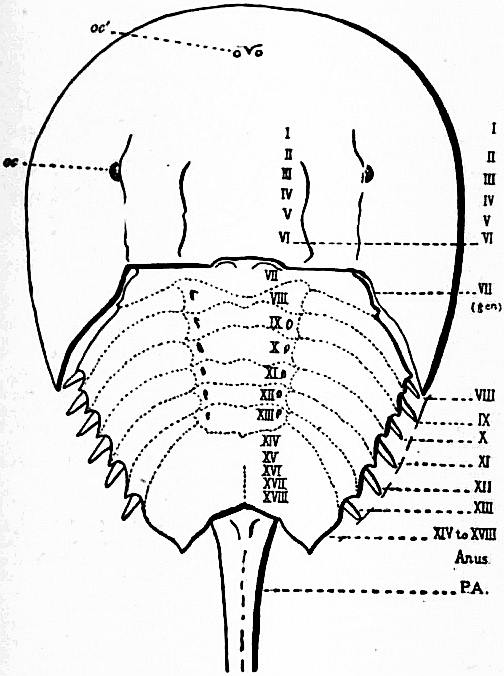
Fig. 7.—Diagram of the dorsal surface of Limulus polyphemus.
oc, Lateral compound eyes. oc′, Central monomeniscous eyes. PA, Post-anal spine. I to VI, The six appendage-bearing somites of the prosoma. VII, Usually considered to be the tergum of the genital somite, but suggested by Pocock to be that of the otherwise suppressed praegenital somite. VIII to XIII, The six somites of the mesosoma, each with a movable pleural spine and a pair of dorsal entopophysis or muscle-attaching ingrowths. XIV to XVIII, The confluent or unexpressed six somites of the metasoma.
[According to the system of numbering explained in the text, if VII is the tergum of the praegenital somite (as is probable) it should be labelled Prg without any number, and the somites VIII to XIII should be lettered 1 to 6, indicating that they are the six normal somites of the mesosoma; whilst XV to XVIII should be replaced by the numbers 7 to 12—an additional suppressed segment (making up the typical six) being reckoned to the metasomatic fusion.]
(From Lankester, Q.J. Micr Set. vol. xxi., 1881.)
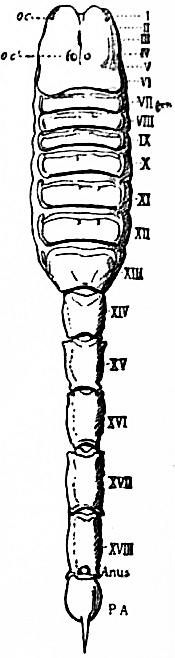
Fig. 8.—Diagram of the dorsal surface of a scorpion to compare with fig. 7. Letters and Roman numerals as in fig. 7, excepting that VII is here certainly the tergum of the first somite of the mesosoma—the genital somite—and is not a survival of the embryonic praegenital somite. The anus (not seen) is on the sternal surface.
(From Lankester, loc. cit.)
The identification of the lung-books of Scorpio with the gill-books of Limulus is practically settled by the existence of the pectens in Scorpio (fig. 14, VIII) on the second mesosomatic somite. There is no doubt that these are parapodial or limb appendages, carrying numerous imbricated secondary processes, and therefore comparable in essential structure to the leaf-bearing plates of the second mesosomatic somite of Limulus. They have remained unenclosed and projecting on the surface of the body, as once were the appendages of the four following somites. But they have lost their respiratory function. In non-aquatic life such an unprotected organ cannot subserve respiration. The “pectens” have become more firmly chitinized and probably somewhat altered in shape as compared with their condition in the aquatic ancestral scorpions. Their present function in scorpions is not ascertained. They are not specially sensitive under ordinary conditions, and may be touched or even pinched without causing any discomfort to the scorpion. It is probable that they acquire special sensibility at the breeding season and serve as “guides” in copulation. The shape of the legs and the absence of paired terminal claws in the Silurian Palaeophonus (see figs. 48 and 49) as compared with living scorpions (see fig. 10) show that the early scorpions were aquatic, and we may hope some day in better-preserved specimens than the two as yet discovered, to find the respiratory organs of those creatures in the condition of projecting appendages serving aquatic respiration somewhat as in Limulus, though not necessarily repeating the exact form of the broad plates of Limulus.
It is important to note that the series of lamellae of the lung-book and the gill-book correspond exactly in structure, the narrow, flat blood-space in the lamellae being interrupted by pillar-like junctions of the two surfaces in both cases (see Lankester (4)), and the free surfaces of the adjacent lamellae being covered with a very delicate chitinous cuticle which is drawn out into delicate hairs and processes. The elongated axis which opens at the stigma in Scorpio and which can be cleared of soft, surrounding tissues and coagulated blood so as to present the appearance of a limb axis carrying the book-like leaves of the lung is not really, as it would seem to be at first sight, the limb axis. That is necessarily a blood-holding structure and is obliterated and fused with soft tissues of the sternal region so that the lamellae cannot be detached and presented as standing out from it. The apparent axis or basal support of the scorpion’s lung-books shown in the figures, is a false or secondary axis and merely a part of the infolded surface which forms the air-chamber. The maceration of the soft parts of a scorpion preserved in weak spirit and the cleaning of the chitinized in-grown cuticle give rise to the false appearance of a limb axis carrying the lamellae. The margins of the lamellae of the scorpion’s lung-book, which are lowermost in the figures (fig. 15) and appear to be free, are really those which are attached to the blood-holding axis. The true free ends are those nearest the stigma.
Passing on now from the mesosoma we come in Scorpio to the metasoma of six segments, the first of which is broad whilst the rest are cylindrical. The last is perforated by the anus and carries the post-anal spine or sting. The somites of the metasoma carry no parapodia. In Limulus the metasoma is practically suppressed. In the allied extinct Eurypterines it is well developed, and resembles that of Scorpio. In the embryo Limulus (fig. 42) the six somites of the mesosoma are not fused to form a carapace at an early stage, and they are followed by three separately marked metasomatic somites; the other three somites of the metasoma have disappeared in Limulus, but are represented by the unsegmented prae-anal region. It is probable that we have in the metasoma of Limulus a case of the disappearance of once clearly demarcated somites. It would be possible to suppose, on the other hand, that new somites are only beginning to make their appearance here. The balance of various considerations is against the latter hypothesis. Following the metasoma in Limulus, we have as in Scorpio the post-anal spine—in this case not a sting, but a powerful and important organ of locomotion, serving to turn the animal over when it has fallen upon its back. The nature of the post-anal spine has been strangely misinterpreted by some writers. Owen (7) maintained that it represented a number of coalesced somites, regardless of its post-anal position and mode of development. The agreement of the grouping of the somites, of the form of the parapodia (appendages, limbs) in each region, of the position of the genital aperture and operculum, of the position and character of the eyes, and of the powerful post-anal spines not seen in other Arthropods, is very convincing as to the affinity of Limulus and Scorpio. Perhaps the most important general agreement of Scorpio compared with Limulus and the Eurypterines is the division of the body into the three regions (or tagmata)—prosoma, mesosoma and metasoma—each consisting of six segments, the prosoma having leg-like appendages, the mesosoma having foliaceous appendages, and the metasoma being destitute of appendages.
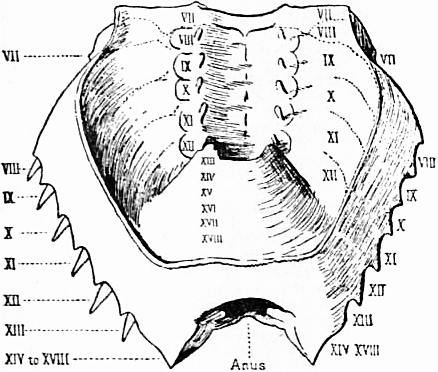
Fig. 9.—Ventral view of the posterior carapace or meso-metasomatic (opisthospmatic) fusion of Limulus polyphemus. The soft integument and limbs of the mesosoma have been removed as well as all the viscera and muscles, so that the inner surface of the terga of these somites with their entopophyses are seen. The unsegmented dense chitinous sternal plate of the metasoma (XIII to XVIII) is not removed. Letters as in fig. 7.
After Lankester, loc. cit.)
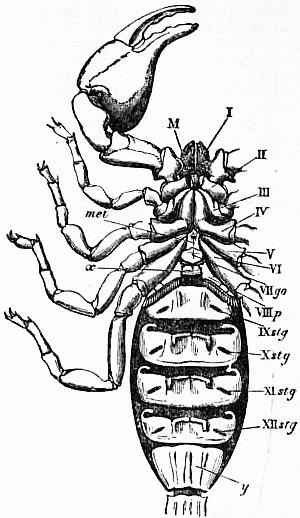
Fig. 10.—Ventral view of a scorpion, Palamnaeus indus, de Geer, to show the arrangement of the coxae of the limbs, the sternal elements, genital plate and pectens.
M, Mouth behind the oval median camerostome. I, The chelicerae. II, The chelae. III to VI, the four pairs of walking legs. VIIgo, The genital somite or first somite of the mesosoma with the genital operculum (a fused pair of limbs). VIIIp, The pectiniferous somite. IXstg to XIIstg, the four pulmonary somites. met, The pentagonal metasternite of the prosoma behind all the coxae. x, The sternum of the pectiniferous somite. y, The broad first somite of the metasoma.
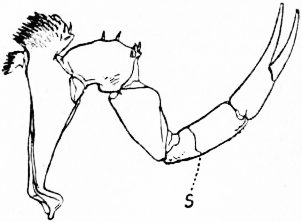
Fig. 11.—Third leg of Limulus polyphemus, showing the division of the fourth segment of the leg by a groove S into two, thus giving seven segments to the leg as in scorpion.
(From a drawing by Pocock.)
In 1893, some years after the identification of the somites of Limulus with those of Scorpio, thus indicated, had been published, zoologists were startled by the discovery by a Japanese zoologist, Kishinouye (8), of a seventh prosomatic somite in the embryo of Limulus longispina. This was seen in longitudinal sections, as shown in fig. 19. The simple identification of somite with somite in Limulus and Scorpio seemed to be threatened by this discovery. But in 1896 Dr August Brauer of Marburg (9) discovered in the embryo of Scorpio a seventh prosomatic somite (see VII PrG, figs. 17 and 18), or, if we please so to term it, a praegenital somite, hitherto unrecognized. In the case of Scorpio this segment is indicated in the embryo by the presence of a pair of rudimentary appendages, carried by a well-marked somite. As in Limulus, so in Scorpio, this unexpected somite and its appendages disappear in the course of development. In fact, more or less complete “excalation” of the somite takes place. Owing to its position it is convenient to term the somite which is excalated in Limulus and Scorpio “the praegenital somite.” It appears not improbable that the sternal plates wedged in between the last pair of legs in both Scorpio and Limulus, viz. the pentagonal sternite of Scorpio (fig. 10) and the chilaria of Limulus (see figs. 13 and 20), may in part represent in the adult the sternum of the excalated praegenital somite. This has not been demonstrated by an actual following out of the development, but the position of these pieces and the fact that they are (in Limulus) supplied by an independent segmental nerve, favours the view that they may comprise the sternal area of the vanished praegenital somite. This interpretation, however, of the “metasternites” of Limulus and Scorpio is opposed by the coexistence in Thelyphonus (figs. 55, 57 and 58) of a similar metasternite with a complete praegenital somite. H.J. Hansen (10) has recognized that the “praegenital somite” persists in a rudimentary condition, forming a “waist” to the series of somites in the Pedipalpi and Araneae. The present writer is of opinion that it will be found most convenient to treat this evanescent somite as something special, and not to attempt to reckon it to either the prosoma or the mesosoma. These will then remain as typically composed each of six appendage-bearing somites-the prosoma comprising in addition the ocular prosthomere.1 When the praegenital somite or traces of it are present it should not be called “the seventh prosomatic” or the “first mesosomatic,” but simply the “praegenital somite.” The first segment of the mesosoma of Scorpio and Limulus thus remains the first segment, and can be identified as such throughout the Eu-arachnida, carrying as it always does the genital apertures. But it is necessary to remember, in the light of recent discoveries, that the sixth prosomatic pair of appendages is carried on the seventh somite of the whole series, there being two prosthomeres or somites in front of the mouth, the first carrying the eyes, the second the chelicerae; also that the first mesosomatic or genital somite is not the seventh or even the eighth of the whole senes of somites which have been historically present, but is the ninth, owing to the presence or to the excalation of a praegenital somite. It seems that confusion and trouble will be best avoided by abstaining from the introduction of the non-evident somites, the ocular and the praegenital, into the numerical nomenclature of the component somites of the three great body regions. We shall, therefore, ignoring the ocular somite, speak of the first, second, third, fourth, fifth and sixth leg-bearing somites of the prosoma, and indicate the appendages by the Roman numerals, I, II, III, IV, V, VI, and whilst ignoring the praegenital somite we shall speak of the first, second, third, &c., somite of the mesosoma or opisthosoma (united mesosoma and metasoma) and indicate them by the Arabic numerals.
There are a number of other important points of structure besides those referring to the somites and appendages in which Limulus agrees with Scorpio or other Arachnida and differs from other Arthropoda. The chief of these are as follows:—
1. The Composition of the Head (that is to say, of the anterior part of the prosoma) with especial Reference to the Region in Front of the Mouth.—It appears (see Arthropoda) that there is embryological evidence of the existence of two somites in Arachnida which were originally post-oral, but have become prae-oral by adaptational shifting of the oral aperture. These forwardly-slipped somites are called “prosthomeres.” The first of these has, in Arachnids as in other Arthropods, its pair of appendages represented by the eyes. The second has for its pair of appendages the small pair of limbs which in all living Arachnids is either chelate or retrovert (as in spiders), and is known as the chelicerae. It is possible, as maintained by some writers (Patten and others), that the lobes of the cerebral nervous mass in Arachnids indicate a larger number of prosthomeres as having fused in this region, but there is no embryological evidence at present which justifies us in assuming the existence in Arachnids of more than two prosthomeres. The position of the chelicerae of Limulus and of the ganglionic nerve-masses from which they receive their nerve-supply, is closely similar to that of the same structures in Scorpio. The cerebral mass is in Limulus more easily separated by dissection as a median lobe distinct from the laterally-placed ganglia of the chelceral somite than is the case in Scorpio, but the relations are practically the same in the two forms. Formerly it was supposed that in Limulus both the chelicerae and the next following pair of appendages were prosthomerous, as in Crustacea, but the dissections of Alphonse Milne-Edwards (6) demonstrated the true limitations of the cerebrum, whilst embryological researches have done as much for Scorpio. Limulus thus agrees with Scorpio and differs from the Crustacea, in which there are three prosthomeres—one ocular and two carrying palpiform appendages. It is true that in the lower Crustacea (Apus, &c.) we have evidence of the gradual movement forward of the nerve-ganglia belonging to these palpiform appendages. But although in such lower Crustacea the nerve-ganglia of the third prosthomere have not fused with the anterior nerve-mass, there is no question as to the prae-oral position of two appendage-bearing somites in addition to the ocular prosthomere. The Crustacea have, in fact, three prosthomeres in the head and the Arachnida only two, and Limulus agrees with the Arachnida in this respect and differs from the Crustacea. The central nervous systems of Limulus and of Scorpio present closer agreement in structure than can be found when a Crustacean is compared with either. The wide divarication of the lateral cords in the prosoma and their connexion by transverse commissures, together with the “attraction” of ganglia to the prosomatic ganglion group which properly belong to hinder segments, are very nearly identical in the two animals. The form and disposition of the ganglion cells are also peculiar and closely similar in the two. (See Patten (42) for important observations on the neuromeres, &c., of Limulus and Scorpio.)
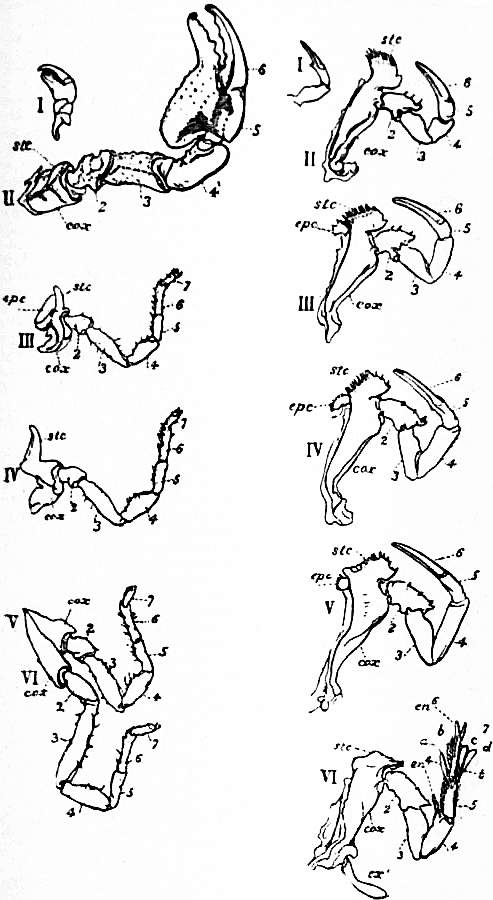
Fig. 12.—The prosomatic appendages of Limulus polyphemus (right) and Scorpio (left), Palamnaeus indus compared. The corresponding appendages are marked with the same Roman numeral. The Arabic numerals indicate the segments of the legs.
cox, Coxa or basal segment of the leg. stc, The sterno-coxal process or jaw-like up-growth of the coxa. epc, The articulated movable outgrowth of the coxa, called the epi-coxite (present only in III of the scorpion and III, IV and V of Limulus). ex1, The exopodite of the sixth limb of Limulus. a, b, c, d, Movable processes on the same leg (see for some suggestions on the morphology of this leg, Pocock in Quart. Journ. Micr. Sci. March 1901; see also fig. 50 below and explanation).
(From Lankester, loc. cit.)
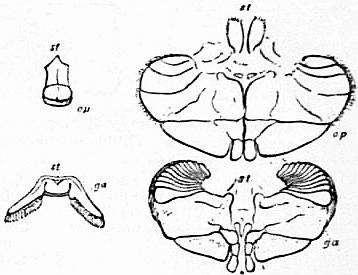
Fig. 13.—Diagrams of the metasternite st, with genital operculum op, and the first lamelligerous pair of appendages ga, with uniting sternal element st of Scorpio (left) and Limulus (right).
(From Lankester, loc. cit.)
2. The Minute Structure of the Central Eyes and of the Lateral Eyes.—Limulus agrees with Scorpio not only in having a pair of central eyes and also lateral eyes, but in the microscopic structure of those organs, which differs in the central and lateral eyes respectively. The central eyes are “simple eyes,” that is to say, have a single lens, and are hence called “monomeniscous.” The lateral eyes are in Limulus “compound eyes,” that is to say, consist of many lenses placed close together; beneath each lens is a complex of protoplasmic cells, in which the optic nerve terminates. Each such unit is termed an “ommatidium.” The lateral eyes of Scorpio consist of groups of separate small lenses each with its ommatidium, but they do not form a continuous compound eye as in Limulus. The ommatidium (soft structure beneath the lens-unit of a compound eye) is very simple in both Scorpio and Limulus. It consists of a single layer of cells, continuous with those which secrete the general chitinous covering of the prosoma. The cells of the ommatidium are a good deal larger than the neighbouring common cells of the epidermis. They secrete the knob-like lens (fig. 22). But they also receive the nerve fibres of the optic nerve. They are at the same time both optic nerve-end cells, that is to say, retina cells, and corneagen cells or secretors of the chitinous lens-like cornea. In Limulus (fig. 23) each ommatidium has a peculiar ganglion cell developed in a central position, whilst the ommatidium of the lateral eyelets of Scorpio shows small intermediate cells between the larger nerve-end cells. The structure of the lateral eye of Limulus was first described by Grenacher, and further and more accurately by Lankester and Bourne (5) and by Watase; that of Scorpio by Lankester and Bourne, who showed that the statements of von Graber were erroneous, and that the lateral eyes of Scorpio have a single cell-layered or “monostichous” ommatidium like that of Limulus. Watase has shown, in a very convincing way, how by deepening the pit-like set of cells beneath a simple lens the more complex ommatidia of the compound eyes of Crustacea and Hexapoda may be derived from such a condition as that presented in the lateral eyes of Limulus and Scorpio. (For details the reader is referred to Watase (11) and to Lankester and Bourne (5).) The structure of the central eyes of Scorpio and spiders and also of Limulus differs essentially from that of the lateral eyes in having two layers of cells (hence called diplostichous) beneath the lens, separated from one another by a membrane (figs. 24 and 25). The upper layer is the corneagen and secretes the lens, the lower is the retinal layer. The mass of soft cell-structures beneath a large lens of a central eye is called an “ommatoeum.” It shows in Scorpio and Limulus a tendency to segregate into minor groups or “ommatidia.” It is found that in embryological growth the retinal layer of the central eyes forms as a separate pouch, which is pushed in laterally beneath the corneagen layer from the epidermic cell layer. Hence it is in origin double, and consists of a true retinal layer and a post-retinal layer (fig. 24, B), though these are not separated by a membrane. Accordingly the diplostichous ommatoeum or soft tissue of the Arachnid’s central eye should strictly be called “triplostichous,” since the deep layer is itself doubled or folded. The retinal cells of both the lateral and central eyes of Limulus and Scorpio produce cuticular structures on their sides; each such piece is a rhabdomere and a number (five or ten) uniting form a rhabdom (fig. 26). In the specialized ommatidia of the compound eyes of Crustacea and Hexapods the rhabdom is an important structure.2 It is a very significant fact that the lateral and central eyes of Limulus and Scorpio not only agree each with each in regard to their monostichous and diplostichous structure, but also in the formation in both classes of eyes of rhabdomeres and rhabdoms in which the component pieces are five or a multiple of five (fig. 26). Whilst each unit of the lateral eye of Limulus has a rhabdom of ten3 pieces forming a star-like chitinous centre in section, each lateral eye of Scorpio has several rhabdoms of five or less rhabdomeres, indicating that the Limulus lateral eye-unit is more specialized than the detached lateral eyelet of Scorpio, so as to present a coincidence of one lens with one rhabdom. Numerous rhabdomeres (grouped as rhabdoms in Limulus) are found in the retinal layer of the central eyes also.
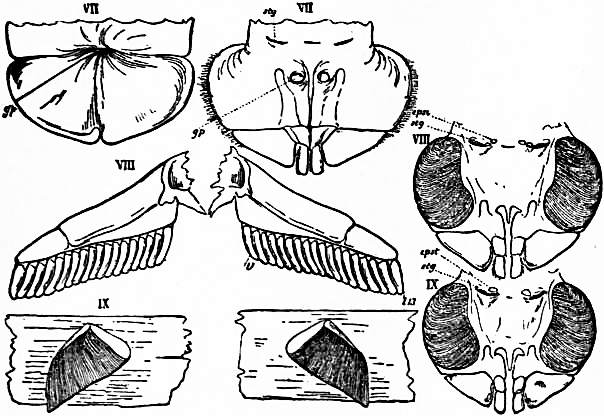
Fig. 14.—The first three pairs of mesosomatic appendages of Scorpio and Limulus compared.
VII, The genital operculum. VIII, The pectens of Scorpio and the first branchial plate of Limulus. IX, The first pair of lung-books of Scorpio and the second branchial plate of Limulus. gp, Genital pore. epst, Epistigmatic sclerite. stg, Stigma or orifice of the hollow tendons of the branchial plates of Limulus.
(After Lankester, loc. cit.)
Whilst Limulus agrees thus closely with Scorpio in regard to the eyes, it is to be noted that no Crustacean has structures corresponding to the peculiar diplostichous central eyes, though these occur again (with differences in detail) in Hexapoda. Possibly, however, an investigation of the development of the median eyes of some Crustacea (Apus, Palaemon) may prove them to be diplostichous in origin.
3. The so-called “Coxal Glands.”—In 1882 (Proc. Roy. Soc. No. 221) Lankester described under the name “coxal glands” a pair of brilliantly white oviform bodies lying in the Scorpion’s prosoma immediately above the coxae of the fifth and sixth pairs of legs (fig. 27). These bodies had been erroneously supposed by Newport (12) and other observers to be glandular outgrowths of the alimentary canal. They are really excretory glands, and communicate with the exterior by a very minute aperture on the posterior face of the coxa of the fifth limb on each side. When examined with the microscope, by means of the usual section method, they are seen to consist of a labyrinthine tube lined with peculiar cells, each cell having a deep vertically striated border on the surface farthest from the lumen, as is seen in the cells of some renal organs. The coils and branches of the tube are packed by connective tissue and blood spaces. A similar pair of coxal glands, lobate instead of ovoid in shape, was described by Lankester in Mygale, and it was also shown by him that the structures in Limulus called “brick-red glands” by Packard have the same structure and position as the coxal glands of Scorpio and Mygale. In Limulus these organs consist each of four horizontal lobes lying on the coxal margin of the second, third, fourth, and fifth prosomatic limbs, the four lobes being connected to one another by a transverse piece or stem (fig. 28). Microscopically their structure is the same in essentials as that of the coxal glands of Scorpio (13). Coxal glands have since been recognized and described in other Arachnida. In 1900 it was shown that the coxal gland of Limulus is provided with a very delicate thin-walled coiled duct which opens, even in the adult condition, by a minute pore on the coxa of the fifth leg (Patten and Hazen, 13A). Previously to this, Lankester’s pupil Gulland had shown (1885) that in the embryo the coxal gland is a comparatively simple tube, which opens to the exterior in this position and by its other extremity into a coelomic space. Similar observations were made by Laurie (17) in Lankester’s laboratory (1890) with regard to the early condition of the coxal gland of Scorpio, and by Bertkau (41) as to that of the spider Atypus. H.M. Bernard (13B) showed that the opening remains in the adult scorpion. In all the embryonic or permanent opening is on the coxa of the fifth pair of prosomatic limbs. Thus an organ newly discovered in Scorpio was found to have its counterpart in Limulus.
The name “coxal gland” needs to be carefully distinguished from “crural gland,” with which it is apt to be confused. The crural glands, which occur in many terrestrial Arthropods, are epidermal in origin and totally distinct from the coxal glands. The coxal glands of the Arachnida are structures of the same nature as the green glands of the higher Crustacea and the so-called “shell glands” of the Entomostraca. The latter open at the base of the fifth pair of limbs of the Crustacean, just as the coxal glands open on the coxal joint of the fifth pair of limbs of the Arachnid. Both belong to the category of “coelomoducts,” namely, tubular or funnel-like portions of the coelom opening to the exterior in pairs in each somite (potentially,) and usually persisting in only a few somites as either “urocoels” (renal organs) or “gonocoets” (genital tubes). In Peripatus they occur in every somite of the body. They have till recently been very generally identified with the nephridia of Chaetopod worms, but there is good reason for considering the true nephridia (typified by the nephridia of the earthworm) as a distinct class of organs (see Lankester in vol. ii. chap. in. of A Treatise on Zoology, 1900). The genital ducts of Arthropoda are, like the green glands, shell glands and coxal glands, to be regarded as coelomoducts (gonocoels). The coxal glands do not establish any special connexion between Limulus and Scorpio, since they also occur in the same somite in the lower Crustacea, but it is to be noted that the coxal glands of Limulus are in minute structure and probably in function more like those of Arachnids than those of Crustacea.
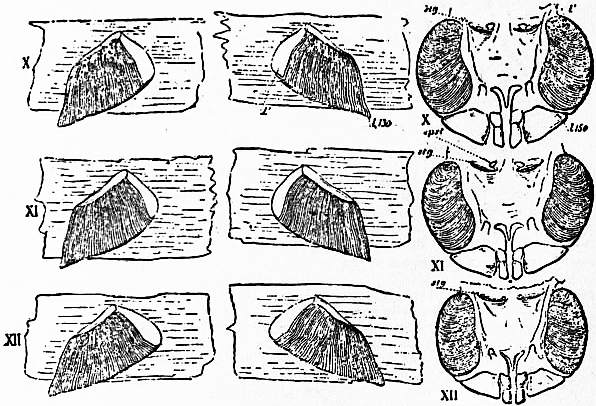
Fig. 15.—The remaining three pairs of mesosomatic appendages of Scorpio and Limulus. Letters as in fig. 14. l130 indicates that there are 130 lamellae in the scorpion’s lung-book, whilst l150 indicates that 150 similar lamellae are counted in the gill of Limulus.
(After Lankester, loc. cit.)
4. The Entosternites and their Minute Structure.—Strauss-Dürckheim (1) was the first to insist on the affinity between Limulus and the Arachnids, indicated by the presence of a free suspended entosternum or plastron or entosternite in both. We have figured here (figs. 1 to 6) the entosternites of Limulus, Scorpio and Mygale. Lankester some years ago made a special study of the histology (3) of these entosternites for the purpose of comparison, and also ascertained the relations of the very numerous muscles which are inserted into them (4). The entosternites are cartilaginous in texture, but they have neither the chemical character nor the microscopic structure of the hyaline cartilage of Vertebrates. They yield chitin in place of chondrin or gelatin—as does also the cartilage of the Cephalopod’s endoskeleton. In microscopic structure they all present the closest agreement with one another. We find a firm, homogeneous or sparsely fibrillated matrix in which are embedded nucleated cells (corpuscles of protoplasm) arranged in rows of three, six or eight, parallel with the adjacent lines of fibrillation.
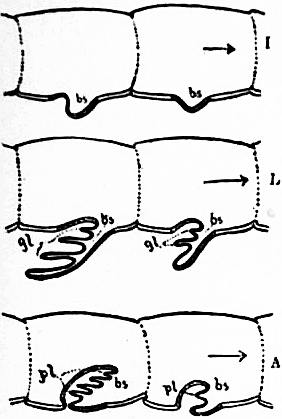
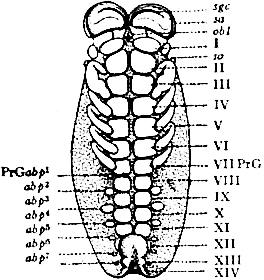
Fig. 16.—Diagram to show the way in which an outgrowing gill-process bearing blood-holding lamellae, may give rise, if the sternal body wall sinks inwards, to a lung-chamber with air-holding lamellae. I is the embryonic condition. bs, Blood sinus. L is the condition of outgrowth with gl, gill lamellae. A is the condition of in-sinking of the sternal surface and consequent enclosure of the lamelligerous surface of the appendage in a chamber with narrow orifice—the pulmonary air-holding chamber. pl, Pulmonary lamellae. bs, Blood sinus. (After Kingsley.) Fig. 17.—Embryo of scorpion, ventral view showing somites and appendages. sgc, Frontal groove. sa, Rudiment of lateral eyes. obl, Camerostome (upper lip). so, Sense-organ of Patten. PrGabp1, Rudiment of the appendage of the praegenital somite which disappears. abp2, Rudiment of the right half of the genital operculum. abp3, Rudiment of the right pecten. abp4 to abp7. Rudiments of the four appendages which carry the pulmonary lamellae. I to VI, Rudiments of the six limbs of the prosoma. VIIPrG, The evanescent praegenital somite. VIII, The first mesosomatic somite or genital somite. IX, The second mesosomatic somite or pectiniferous somite. X to XIII, The four pulmoniferous somites. XIV, The first metasomatic somite. (After Brauer, Zeitsch. wiss. Zool., vol. lix., 1895.)
A minute entosternite having the above-described structure is found in the Crustacean Apus between the bases of the mandibles, and also in the Decapoda in a similar position, but in no Crustacean does it attain to any size or importance. On the other hand, the entosternite of the Arachnida is a very large and important feature in the structure of the prosoma, and must play an important part in the economy of these organisms. In Limulus (figs. 1 and 2) it has as many as twenty-five pairs of muscles attached to it, coming to it from the bases of the surrounding limbs and from the dorsal carapace and from the pharynx. It consists of an oblong plate 2 in. in length and 1 in breadth, with a pair of tendinous outgrowths standing out from it at right angles on each side. It “floats” between the prosomatic nerve centres and the alimentary canal. In each somite of the mesosoma is a small, free entosternite having a similar position, but below or ventral to the nerve cords, and having a smaller number of muscles attached to it. The entosternite was probably in origin part of the fibrous connective tissue lying close to the integument of the sternal surface—giving attachment to muscles corresponding more or less to those at present attached to it. It became isolated and detached, why or with what advantage to the organism it is difficult to say, and at that period of Arachnidan development the great ventral nerve cords occupied a more lateral position than they do at present. We know that such a lateral position of the nerve cords preceded the median position in both Arthropoda and Chaetopoda. Subsequently to the floating off of the entosternite the approximation of the nerve cords took place in the prosoma, and thus they were able to take up a position below the entosternite. In the mesosoma the approximation had occurred before the entosternites were formed.
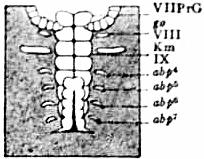
Fig. 18.—Portion of a similar embryo at a later stage of growth. The praegenital somite, VII PrG, is still present, but has lost its rudimentary appendages; go, the genital operculum, left half; Km, the left pecten; abp4 to abp7, the rudimentary appendages of the lung-sacs.
(After Brauer, loc. cit.)
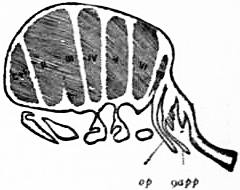
Fig. 19.—Section through an early embryo of Limulus longispina, showing seven transverse divisions in the region of the unsegmented anterior carapace. The seventh, VII, is anterior to the genital operculum, op, and is the cavity of the praegenital somite which is more or less completely suppressed in subsequent development, possibly indicated by the area marked VII in fig. 7 and by the great entopophyses of the prosomatic carapace.
(After Kishinouye, Journ. Sci. Coll. Japan, vol. v., 1892.)
In the scorpion (figs. 3 and 4) the entosternite has tough membrane-like outgrowths which connect it with the body-wall, both dorsally and ventrally forming an oblique diaphragm, cutting off the cavity of the prosoma from that of the mesosoma. It was described by Newport as “the diaphragm.” Only the central and horizontal parts of this structure correspond precisely to the entosternite of Limulus: the right and left anterior processes (marked ap in figs. 3 and 4, and RAP, LAP, in figs. 1 and 2) correspond in the two animals, and the median lateral process lmp of the scorpion represents the tendinous outgrowths ALR, PLR of Limulus. The scorpion’s entosternite gives rise to outgrowths, besides the great posterior flaps, pf, which form the diaphragm, unrepresented in Limulus. These are a ventral arch forming a neural canal through which the great nerve cords pass (figs. 3 and 4, snp), and further a dorsal gastric canal and arterial canal which transmit the alimentary tract and the dorsal artery respectively (figs. 3 and 4, GC, DR).
In Limulus small entosternites are found in each somite of the appendage-bearing mesosoma, and we find in Scorpio, in the only somite of the mesosoma which has a well-developed pair of appendages, that of the pectens, a small entosternite with ten pairs of muscles inserted into it. The supra-pectinal entosternite lies ventral to the nerve cords.
In Mygale (figs. 5 and 6) the form of the entosternite is more like that of Limulus than is that of Scorpio. The anterior notch Ph.N. is similar to that in Limulus, whilst the imbricate triangular pieces of the posterior median region resemble the similarly-placed structures of Limulus in a striking manner.
It must be confessed that we are singularly ignorant as to the functional significance of these remarkable organs—the entosternites. Their movement in an upward or downward direction in Limulus and Mygale must exert a pumping action on the blood contained in the dorsal arteries and the ventral veins respectively. In Scorpio the completion of the horizontal plate by oblique naps, so as to form an actual diaphragm shutting off the cavity of the prosoma from the rest of the body, possibly gives to the organs contained in the anterior chamber a physiological advantage in respect of the supply of arterial blood and its separation from the venous blood of the mesosoma. Possibly the movement of the diaphragm may determine the passage of air into or out of the lung-sacs. Muscular fibres connected with the suctorial pharynx are in Limulus inserted into the entosternite, and the activity of the two organs may be correlated.
5. The Blood and the Blood-vascular System.—The blood fluids of Limulus and Scorpio are very similar. Not only are the blood corpuscles of Limulus more like in form and granulation to those of Scorpio than to those of any Crustacean, but the fluid is in both animals strongly impregnated with the blue-coloured respiratory proteid, haemocyanin. This body occurs also in the blood of Crustacea and of Molluscs, but its abundance in both Limulus and Scorpio is very marked, and gives to the freshly-shed blood a strong indigo-blue tint.
Fig. 20.—View of the ventral surface of the mid-line of the prosomatic region of Limulus polyphemus. The coxae of the five pairs of limbs following the chelicerae were arranged in a series on each side between the mouth, M, and the metasternites, mets.
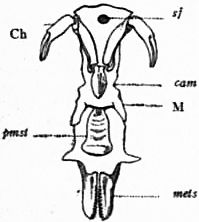
sf, The sub-frontal median sclerite. Ch, The chelicerae. cam, The camerostome or upper lip. M, The mouth. pmst, The promesosternal sclerite of chitinous plate, unpaired. mets, The right and left metasternites (corresponding to the similarly placed pentagonal sternite of Scorpio). Natural size.
(After Lankester.)
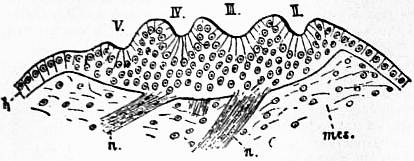
Fig. 2l.—Development of the lateral eyes of a scorpion. h, Epidermic cell-layer; mes, mesoblastic connective tissue; n, nerves; II, III, IV, V, depressions of the epidermis in each of which a cuticular lens will be formed.
(From Korschelt and Heider, after Laurie.)
Fig. 22.—Section through the lateral eye of Euscorpius italicus.
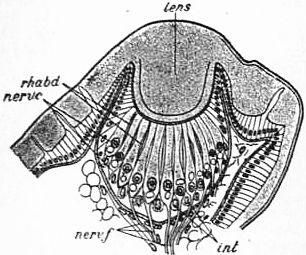
lens, Cuticular lens. nerv c, Retinal cells (nerve-end cells). rhabd, Rhabdomes. nerv f, Nerve fibres of the optic nerve. int, Intermediate cells (lying between the bases of the retinal cells).
(After Lankester and Bourne from Parker and Habwell’s Text book of Zoology, Macmillan & Co.)
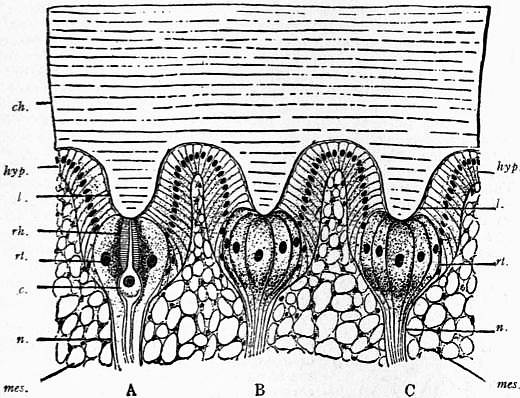
Fig. 23.—Section through a portion of the lateral eye of Limulus, showing three ommatidia—A, B and C. hyp, The epidermic cell-layer (so-called hypodermis), the cells of which increase in volume below each lens, l, and become nerve-end cells or retinula-cells, rt; in A, the letters rh point to a rhabdomere secreted by the cell rt; c, the peculiar central spherical cell; n, nerve fibres; mes, mesoblastic skeletal tissue; ch, chitinous cuticle.
(From Korschelt and Heider after Watase.)
The great dorsal contractile vessel or “heart” of Limulus is closely similar to that of Scorpio; its ostia or incurrent orifices are placed in the same somites as those of Scorpio, but there is one additional posterior pair. The origin of the paired arteries from the heart differs in Limulus from the arrangement obtaining in Scorpio, in that a pair of lateral commissural arteries exist in Limulus (as described by Alphonse Milne-Edwards (6)) leading to a suppression of the more primitive direct connexion of the four pairs of posterior lateral arteries and of the great median posterior arteries with the heart itself (fig. 29). The arterial system is very completely developed in both Limulus and Scorpio, branching repeatedly until minute arterioles are formed, not to be distinguished from true capillaries; these open into irregular swollen vessels which are the veins or venous sinuses. A very remarkable feature in Limulus, first described by Owen, is the close accompaniment of the prosomatic nerve centres and nerves by arteries, so close indeed that the great ganglion mass and its out-running nerves are actually sunk in or invested by arteries. The connexion is not so intimate in Scorpio, but is nevertheless a very close one, closer than we find in any other Arthropods in which the arterial system is well developed, e.g. the Myriapoda and some of the arthrostracous Crustacea. It seems that there is a primitive tendency in the Arthropoda for the arteries to accompany the nerve cords, and a “supra-spinal” artery—that is to say, an artery in close relation to the ventral nerve cords—has been described in several cases. On the other hand, in many Arthropods, especially those which possess tracheae, the arteries do not have a long course, but soon open into wide blood sinuses. Scorpio certainly comes nearer to Limulus in the high development of its arterial system, and the intimate relation of the anterior aorta and its branches to the nerve centres and great nerves, than does any other Arthropod.
An arrangement of great functional importance in regard to the venous system must now be described, which was shown in 1883 by Lankester to be common to Limulus and Scorpio. This arrangement has not hitherto been detected in any other class than the Arachnida, and if it should ultimately prove to be peculiar to that group, would have considerable weight as a proof of the close genetic affinity of Limulus and Scorpio.
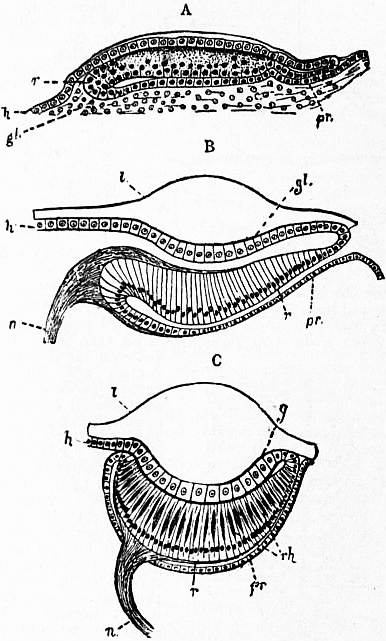
Fig. 24.—Diagrams of the development and adult structure of one of the paired central eyes of a scorpion.
A, Early condition before the lens is deposited, showing the folding of the epidermic cell-layer into three. B, Diagram showing the nature of this infolding. C, Section through the fully formed eye. h, Epidermic cell-layer. r, The retinal portion of the same which, owing to the infolding, lies between gl, the corneagen or lens-forming portion, and pr, the post-retinal or capsular portion or fold. l, Cuticular lens. g, Line separating lens from the lens-forming or corneagen cells of the epidermis. n, Nerve fibres. rh, Rhabdomeres.
[How the inversion of the nerve-end-cells and their connexion with the nerve-fibres is to be reconciled with the condition found in the adult, or with that of the monostichous eye, has not hitherto been explained.]
(From Korschelt and Heider.)
The great pericardial sinus is strongly developed in both animals. Its walls are fibrous and complete, and it holds a considerable volume of blood when the heart itself is contracted. Opening in pairs in each somite, right and left into the pericardial sinus are large veins, which bring the blood respectively from the gill-books and the lung-books to that chamber, whence it passes by the ostia into the heart. The blood is brought to the respiratory organs in both cases by a great venous collecting sinus having a ventral median position. In both animals the wall of the pericardial sinus is connected by vertical muscular bands to the wall of the ventral venous sinus (its lateral expansions around the lung-books in Scorpio) in each somite through which the pericardium passes. There are seven pairs of these veno-pericardiac vertical muscles in Scorpio, and eight in Limulus (see figs. 30, 31, 32). It is obvious that the contraction of these muscles must cause a depression of the floor of the pericardium and a rising of the roof of the ventral blood sinus, and a consequent increase of volume and flow of blood to each. Whether the pericardium and the ventral sinus are made to expand simultaneously or all the movement is made by one only of the surfaces concerned, must depend on conditions of tension. In any case it is clear that we have in these muscles an apparatus for causing the blood to flow differentially in increased volume into either the pericardium, through the veins leading from the respiratory organs, or from the body generally into the great sinuses which bring the blood to the respiratory organs. These muscles act so as to pump the blood through the respiratory organs.
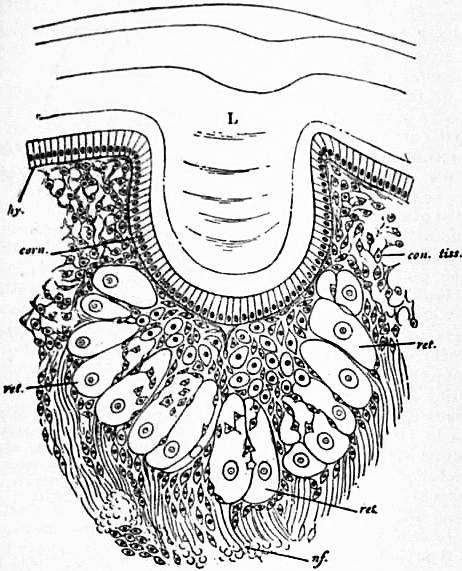
Fig. 25.—Section through one of the central eyes of a young Limulus.
L, Cuticular or corneous lens. hy, Epidermic cell-layer. corn, Its corneagen portion immediately underlying the lens. ret, Retinula cells. nf, Nerve fibres. con. tiss, Connective tissue (mesoblastic skeletal tissue).
(After Lankester and Bourne, Q. J. Mic. Sci., 1883.)
It is not surprising that with so highly developed an arterial system Limulus and Scorpio should have a highly developed mechanism for determining the flow of blood to the respiratory organs. That this is, so to speak, a need of animals with localized respiratory organs is seen by the existence of provisions serving a similar purpose in other animals, e.g. the branchial hearts of the Cephalopoda.
The veno-pericardiac muscles of Scorpio were seen and figured by Newport but not described by him. Those of Limulus were described and figured by Alphonse Milne-Edwards, but he called them merely “transparent ligaments,” and did not discover their muscular structure. They are figured and their importance for the first time recognized in the memoir on the muscular and skeletal systems of Limulus and Scorpio by Lankester, Beck and Bourne (4).
6. Alimentary Canal and Gastric Glands.—The alimentary canal in Scorpio, as in Limulus, is provided with a powerful suctorial pharynx, in the working of which extrinsic muscles take a part. The mouth is relatively smaller in Scorpio than in Limulus—in fact is minute, as it is in all the terrestrial Arachnida which suck the juices of either animals or plants. In both, the alimentary canal takes a straight course from the pharynx (which bends under it downwards and backwards towards the mouth in Limulus) to the anus, and is a simple, narrow, cylindrical tube (fig. 33). The only point in which the gut of Limulus resembles that of Scorpio rather than that of any of the Crustacea, is in possessing more than a single pair of ducts or lateral outgrowths connected with ramified gastric glands or gastric caeca. Limulus has two pairs of these, Scorpio as many as six pairs. The Crustacea never have more than one pair. The minute microscopic structure of the gastric glands in the two animals is practically identical. The functions of these gastric diverticula have never been carefully investigated. It is very probable that in Scorpio they do not serve merely to secrete a digestive fluid (shown in other Arthropoda to resemble the pancreatic fluid), but that they also become distended by the juices of the prey sucked in by the scorpion—as certainly must occur in the case of the simple unbranched gastric caeca of the spiders.
The most important difference which exists between the structure of Limulus and that of Scorpio is found in the hinder region of the alimentary canal. Scorpio is here provided with a single or double pair of renal excretory tubes, which have been identified by earlier authors with the Malpighian tubes of the Hexapod and Myriapod insects. Limulus is devoid of any such tubes. We shall revert to this subject below.
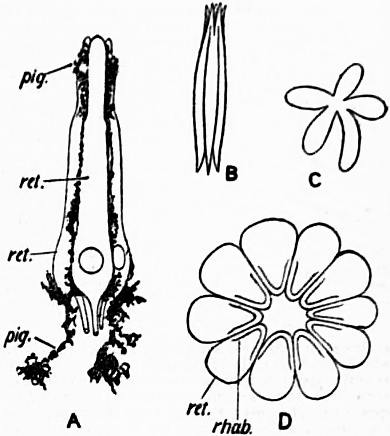
Fig. 26.
A, Diagram of a retinula of the central eye of a scorpion consisting of five retina-cells (ret), with adherent branched pigment cells (pig). B, Rhabdom of the same, consisting of five confluent rhabdomeres. C, Transverse section of the rhabdom of a retinula of the scorpion’s central eye, showing its five constituent rhabdomeres as rays of a star. D, Transverse section of a retinula of the lateral eye of Limulus, showing ten retinula cells (ret), each bearing a rhabdomere (rhab).
(After Lankester.)
Fig. 27.—Diagram showing the position of the coxal glands of a scorpion, Buthus australis, Lin., in relation to the legs, diaphragm (entosternal flap), and the gastric caeca.
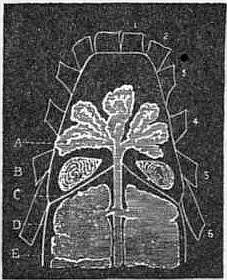
1 to 6, The bases of the six prosomatic limbs. A, prosomatic gastric gland (sometimes called salivary). B, Coxal gland. C, Diaphragm of Newport = fibrous flap of the entosternum. D, Mesosomatic gastric caeca (so-called liver). E, Alimentary canal.
(From Lankester, Q. J. Mic. Sci., vol. xxiv. N.S. p. 152.)
7. Ovaries and Spermaries: Gonocoels and Gonoducts.—The scorpion is remarkable for having the specialized portion of coelom from the walls of which egg-cells or sperm-cells are developed according to sex, in the form of a simple but extensive network. It is not a pair of simple tubes, nor of dendriform tubes, but a closed network. The same fact is true of Limulus, as was shown by Owen (7) in regard to the ovary, and by Benham (14) in regard to the testis. This is a very definite and remarkable agreement, since such a reticular gonocoel is not found in Crustacea (except in the male Apus). Moreover, there is a significant agreement in the character of the spermatozoa of Limulus and Scorpio. The Crustacea are—with the exception of the Cirrhipedia—remarkable for having stiff, motionless spermatozoids. In Limulus Lankester found (15) the spermatozoa to possess active flagelliform “tails,” and to resemble very closely those of Scorpio which, as are those of most terrestrial Arthropoda, are actively motile. This is a microscopic point of agreement, but is none the less significant.
In regard to the important structures concerned with the fertilization of the egg, Limulus and Scorpio differ entirely from one another. The eggs of Limulus are fertilized in the sea after they have been laid. Scorpio, being a terrestrial animal, fertilizes by copulation. The male possesses elaborate copulatory structures of a chitinous nature, and the eggs are fertilized in the female without even quitting the place where they are formed on the wall of the reticular gonocoel. The female scorpion is viviparous, and the young are produced in a highly developed condition as fully formed scorpions.
Fig. 28.—The right coxal gland of Limulus polyphemus, Latr.
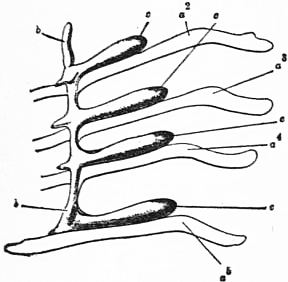
a2 to a5, Posterior borders of the chitinous bases of the coxae of the second, third, fourth and fifth prosomatic limbs. b, Longitudinal lobe or stolon of the coxal gland. c. Its four transverse lobes or outgrowths corresponding to the four coxae.
(From Lankester, loc. cit., after Packard.)
Differences between Limulus and Scorpio.—We have now passed in review the principal structural features in which Limulus agrees with Scorpio and differs from other Arthropoda. There remains for consideration the one important structural difference between the two animals. Limulus agrees with the majority of the Crustacea in being destitute of renal excretory caeca or tubes opening into the hinder part of the gut. Scorpio, on the other hand, in common with all air-breathing Arthropoda except Peripatus, possesses these tubules, which are often called Malpighian tubes. A great deal has been made of this difference by some writers. It has been considered by them as proving that Limulus, in spite of all its special agreements with Scorpio (which, however, have scarcely been appreciated by the writers in question), really belongs to the Crustacean line of descent, whilst Scorpio, by possessing Malpighian tubes, is declared to be unmistakably tied together with the other Arachnida to the tracheate Arthropods, the Hexapods, Diplopods, and Chilopods, which all possess Malpighian tubes.