VOLUME II SLICE III Apollodorus to Aral (continued 3)
Reading edition
Influence on History.—For a century the Appalachians were a barrier to the westward expansion of the English colonies; the continuity of the system, the bewildering multiplicity of its succeeding ridges, the tortuous courses and roughness of its transverse passes, a heavy forest and dense undergrowth all conspired to hold the settlers on the seaward-sloping plateaus and coastal plains. Only by way of the Hudson and Mohawk valleys, and round about the southern termination of the system were there easy routes to the interior of the country, and these were long closed by hostile aborigines and jealous French or Spanish colonists. In eastern Pennsylvania the Great Valley was accessible by reason of a broad gateway between the end of South Mountain and the Highlands, and here in the Lebanon Valley settled German Moravians, whose descendants even now retain the peculiar patois known as “Pennsylvania Dutch.” These were late comers to the New World forced to the frontier to find unclaimed lands. With their followers of both German and Scotch-Irish origin, they worked their way southward and soon occupied all of the Virginia Valley and the upper reaches of the Great Valley tributaries of the Tennessee. By 1755 the obstacle to westward expansion had been thus reduced by half; outposts of the English colonists had penetrated the Allegheny and Cumberland plateaus, threatening French monopoly in the transmontane region, and a conflict became inevitable. Making common cause against the French to determine the control of the Ohio valley, the unsuspected strength of the colonists was revealed, and the successful ending of the French and Indian War extended England’s territory to the Mississippi. To this strength the geographic isolation enforced by the Appalachian mountains had been a prime contributor. The confinement of the colonies between an ocean and a mountain wall led to the fullest occupation of the coastal border of the continent, which was possible under existing conditions of agriculture, conducing to a community of purpose, a political and commercial solidarity, which would not otherwise have been developed. As early as 1700 it was possible to ride from Portland, Maine, to southern Virginia, sleeping each night at some considerable village. In contrast to this complete industrial occupation, the French territory was held by a small and very scattered population, its extent and openness adding materially to the difficulties of a disputed tenure. Bearing the brunt of this contest as they did, the colonies were undergoing preparation for the subsequent struggle with the home government. Unsupported by shipping, the American armies fought toward the sea with the mountains at their back protecting them against Indians leagued with the British. The few settlements beyond the Great Valley were free for self-defence because debarred from general participation in the conflict by reason of their position.
See the separate articles on the states, and also the following references:—Topographic maps and Geologic Folios of the United States Geological Survey; Bailey Willis, “The Northern Appalachians,” and C.W. Hayes, “The Southern Appalachians,” both in National Geographic Monographs, vol. i.; and chaps, iii., iv. and v. of Miss E.C. Semple’s American History and its Geographic Conditions (Boston, 1903).
(A. C. Sp.)
APPANAGE, or Apanage (a French word from the late Lat. apanagium, formed from apanare, i.e. panem porrigere, to give bread, i.e. sustenance), in its original sense, the means of subsistence given by parents to their younger children as distinct from the rights secured to the eldest born by the custom of primogeniture. In its modern usage it is practically confined to the money endowment given to the younger children of reigning or mediatized houses in Germany and Austria, which reverts to the state or to the head of the family on the extinction of the line of the original grantee. In English history the system of appanages never played any great part, and the term is now properly applied only to the appanages of the crown: the duchy of Cornwall, assigned to the king’s eldest son at birth, or on his father’s accession to the crown, and the duchy of Lancaster. In the history of France, however, the appanage was a very important factor. The word denotes in very early French law the portion of lands or money given by fathers and mothers to their sons or daughters on marriage, and usually connotes a renunciation by the latter of any future inheritance; or it may denote the portion given by the eldest son to his brothers and sisters when he was sole inheritor. The word apanage is still employed in this sense in French official texts of some Customs; but it was in old public law that it received its definite meaning and importance. Under the kings of the third dynasty, the division of the kingdom among the sons of the dead monarch which had characterized the Merovingian and Carolingian dynasties, ceased. The eldest son alone succeeded to the crown; but at the same time a custom was established by which the king made territorial provision suitable to their rank for his other children or for his brothers and sisters; custom forbade their being left landless. Lands and lordships thus bestowed constituted the appanages, which interfered so greatly with the formation of ancient France. While the persevering policy of the Capets, which aimed at reuniting the great fiefs, duchies, countships, baronies, &c., to the domain of the crown, gradually reconstructed for their benefit a territorial sovereignty over France, the institution of the appanage periodically subtracted large portions from it. Louis XI., in particular, had to struggle against the appanaged nobles. The old law, however, never abolished this institution. The edict of Moulins (1566) maintained it, as one of the exceptions to the inalienability of the crown-lands; only it was then decided that daughters of France should be appanaged in money, or that if, in default of coin, lands were assigned to them, these lands should be redeemable by the crown in perpetuity. The efforts of the kings to minimize this evil, and of the old jurisprudence to deal with the matter, resulted in two expedients: (1) the reversion of the appanage to the crown was secured as far as possible, being declared inalienable and transmissible only to male descendants in the male line of the person appanaged; (2) originally the person appanaged had possessed all the rights of a duke or count—that is to say, in the middle ages nearly all the attributes of sovereignty; the more important of these attributes were now gradually reserved to the monarch, including public authority over the inhabitants of the appanage in all essential matters. However, it is evident from the letters of appanage, dated April 1771, in favour of the count of Provence, how many functions of public authority an appanaged person still held. The Constituent Assembly, by the law dated the 22nd of November 1790, decided that in future there should be no appanages in real estate, and that younger sons of monarchs, married and over twenty-five years of age, should be provided for by yearly grants (rentes apanagères) from the public funds. The laws of the 13th of August and the 21st of December 1790 revoked all the existing appanages, except those of the Luxembourg Palace and the Palais Royal. To each person hitherto appanaged an annual income of one million livres was assigned, and two millions for the brothers of the king. All this came to an end with the monarchy. Napoleon, by the sénatus-consulte of the 30th of January 1810, resolved to create appanages for the emperor’s princely descendants, such appanages to consist for the most part of lands on French soil. The fall of the empire again annulled this enactment. The last appanage known in France was that enjoyed by the house of Orleans. Having been re-established, or recognized as still existing, by the Restoration, it was formally confirmed by the law of the 15th of January 1825. On the accession of Louis Philippe it was united to the national property by the law of the 2nd of March 1832.
For appanages in ancient law see the Essai sur les apanages ou mémoires historiques de leur établissement, attributed to Du Vaucel, about 1780.
(J. P. E.)
APPAREL (from O. Fr. aparail, aparailler, mod. appareil, from Low Lat. adpariculare, to make fit or equal), equipment, outfit, things furnished for the proper performance of anything, now chiefly used of dress. The word is also applied to the “orphreys,” i.e. embroidered strips or borders, on ecclesiastical vestments.
APPARITIONS. An apparition, strictly speaking, is merely an appearance (Lat. apparere, to appear), the result of perception exercised on any stimulus of any of the senses. But in ordinary usage the word apparition denotes a perception (generally through the sense of sight) which cannot, as a rule, be shown to be occasioned by an object in external nature. We say “as a rule” because many so-called apparitions are merely illusions, i.e. misconstructions of the perceptive processes, as when a person in a bad light sees a number of small children leading a horse, and finds, on nearer approach, that he sees two men carrying bee-hives suspended from a pole. Again, Sir Walter Scott’s vision of Byron, then lately dead, proved to be a misconstruction of certain plaids and cloaks hanging in the hall at Abbotsford, or so Sir Walter declared. Had he not discovered the physical basis of this illusion (which, while it lasted, was an apparition, technically speaking), he and others might have thought that it was an apparition in the popular sense of the word, a ghost. In popular phraseology a ghost is understood to be a phantasm produced in some way by the spirit of a dead person, the impression being usually visual, though the ghost, or apparition, may also affect the sense of hearing (by words, knocks, whistles, groans and so forth), or the sense of touch, or of weight, as in the case of the “incubus.” In ordinary speech an apparition of a person not known to the percipient to be dead is called a wraith, in the Highland phrase, a spirit of the living. The terms ghost and wraith involve the hypothesis that the false perceptions are caused by spirits, a survival of the archaic animistic hypothesis (see Animism), an hypothesis as difficult to prove as to disprove. Apparitions, of course, are not confined to anthropomorphic phantasms; we hear of phantom coaches (sometimes seen, but more frequently heard), of phantom dogs, cats, horses, cattle, deer, and even of phantom houses.
Whatever may be the causes of these and other false perceptions,—most curious when the impression is shared by several witnesses,—they may best be considered under the head of hallucination (q.v.). Hallucinations may be pathological, i.e. the result of morbid conditions of brain or nerve, of disease, of fever, of insanity, of alcoholism, of the abuse of drugs. Again, they may be the result of dissociation, or may occur in the borderland of sleep or waking, and in this case they partake of the hallucinatory nature of dreams (q.v.). Again, hallucinations may, once or twice in a lifetime, come into the experience of the sane, the healthy, and, as far as any tests can be applied, of the wide-awake. In such instances the apparition (whether it take the form of a visual phantasm, of a recognized voice, of a touch, or what not) may be coincidental or non-coincidental. The phantasm is called coincidental if it represents a known and distant person who is later found to have been dying or in some other crisis at the moment of the percipient’s experience. When the false perception coincides with nothing of the sort, it is styled non-coincidental. Coincidental apparitions have been explained by the theory of telepathy (q.v.), one mind or brain impressing another in some unknown way so as to beget an hallucinatory apparition or phantasm. On the evidence, so far as it has been collected and analysed, it seems that the mind which, on the hypothesis, begets the hallucinations, usually does so without conscious effort (see Subliminal Self). There are, however, a few cases in which the experiment of begetting, in another, an hallucination from a distance, is said to have been experimentally and consciously made, with success.
If the telepathic theory of coincidental hallucinations be accepted, we have still to account for the much more common non-coincidental apparitions of the living who do not happen to be in any particular crisis. In these instances it cannot be demonstrated that telepathy has not been at work, as when a person is seen at a place which he thought of visiting, but did not visit. F.W. Myers even upheld a theory of psychorhagy, holding that the spirits of some persons have a way of manifesting themselves at a distance by a psychic invasion. This involves, as he remarked, paleolithic psychology, and the old savage doctrine of animism, rather than telepathy (see Myers, Human Personality). Of belief in coincidental hallucinations or wraiths among savages, records are scanty; the belief, however, is found among Maoris and Fuegians (see Lang, Making of Religions). The perception of apparitions of distant but actual scenes and occurrences is usually called clairvoyance (q.v.). The belief is also familiar under the name of second sight (see Second Sight), a term of Scots usage, though the belief in it, and the facts if accepted, are of world-wide diffusion. The apparitions may either represent actual persons and places, or may be symbolical, taking the form of phantasmic lights, coffins, skeletons, shrouds and so forth. Again, the appearances may either represent things, persons and occurrences of the past (see Retrocognition), or of the present (clairvoyance), or of the future (see Premonition). When the apparitions produce themselves in given rooms, houses or localities, and are exhibited to various persons at various times, the locality is popularly said to be haunted by spirits, that is, of the dead, on the animistic hypothesis (see Hauntings). Like the other alleged facts, these are of world-wide diffusion, or the belief in them is world-wide, and peculiar to no race, age, or period of culture. A haunted place is a centre of permanent possibilities of hallucinations, or is believed to be so. A distinct species of hauntings are those in which unexplained sounds and movements of objects, apparently untouched, occur. The German term Poltergeist (q.v.) has been given to the supposed cause of these occurrences where the cause is not ascertained to be sportive imposture. In the performances of modern spiritualists the Poltergeist appears, as it were, to be domesticated, and to come at the call of the medium.
An intermittent kind of ominous haunting attached, not to places, but to families, is that of the banshee (Celtic) or family death omen, such as the white bird of the Oxenhams, the Airlie drummer, the spectral rider of Clan Gilzean, the rappings of the Woodde family. These apparitions, with fairies and djinns (the Arab form of fairy), haunt the borderland between folk-lore and psychical research.
So far we have been concerned with spontaneous apparitions, or with the belief in them. Among induced apparitions may be reckoned the materialized forms of spiritual séances, which have a material basis of veils, false moustaches, wigs and the corpus vile of the medium. It is also possible that mere expectancy and suggestion induce hallucinatory perceptions among the members of the circle. That apparitions of a sort can be induced by hypnotic and posthypnotic suggestion is certain enough (see Hypnotism). Savages produce apparitions in similar ways by suggestion, accompanied by dances, fumigations, darkness, fasting, drugs, and whatever can affect the imaginations of the onlookers (see Magic). Both in savage and civilized life, some persons can provoke themselves into beholding apparitions usually fantastic, but occasionally coincidental, by sedulously staring into any clear deep water, a fragment of rock crystal, a piece of polished basalt or obsidian, a mirror, a ring, a sword blade, or a glass of sherry (see Crystal Gazing). Indeed any object, a wall, the palm of the hand, the shoulder-blade-bone of a sheep, may be, and has been used to this end (see Divination).
Almost all known apparitions may accommodate themselves to one or other of the categories given, whether they be pathological, coincidental or spontaneous, induced, permanently localized, or sporadic.
See generally, Spiritualism and Psychical Research.
(A. L.)
APPARITOR, or Apparator (Latin for a servant of a public official, from apparere, to attend in public), an attendant who executed the orders of a Roman magistrate; hence a beadle in a university, a pursuivant or herald; particularly, in English ecclesiastical courts, the official who serves the processes of the court and causes defendants to appear by summons.
APPEAL, in law. In the old English common law the term “appeal” was used to describe a process peculiar to English criminal procedure. It was a right of prosecution possessed as a personal privilege by a party individually aggrieved by a felony, a privilege of which the crown could not directly or indirectly deprive him, since he could use it alike when the prisoner was tried and acquitted, and when he was convicted and pardoned. It was chiefly known in practice as the privilege of the nearest relation of a murdered person. When in 1729 (after Colonel Oglethorpe’s inquiry and report on the London prisons) Banbridge and other gaolers were indicted for their treatment of prisoners, but were acquitted for deficiency of evidence, appeals for murder were freely brought by relatives of deceased prisoners. In the case of Slaughterford (1708) the accused was charged with murdering a woman whom he had seduced; the evidence was very imperfect, and he was acquitted on indictment. But public indignation being aroused by the atrocities alleged to have been perpetrated, an appeal was brought, and on conviction he was hanged, as his execution was a privilege belonging to the prosecutor, of which the crown could not deprive him by a pardon. In 1818 an appeal was ingeniously met by an offer of battle, since if the appellee were an able-bodied man he had the choice between combat or a jury (see Wager). This neutralizing of one obsolete and barbarous process by another called the attention of the legislature to the subject, and appeal in criminal cases, along with trial by battle, was abolished in 1819. The history of this appeal is fully dealt with in Pollock and Maitland, History of English Law, 1898.
In its usual modern sense the term appeal is applied to the proceeding by which the decision of a court of justice is brought for review before another tribunal of higher authority. In Roman jurisprudence it was used in this and in other significations; it was sometimes equivalent to prosecution, or the calling up of an accused person before a tribunal where the accuser appealed to the protection of the magistrate against injustice or oppression. The derivation from appellare (“call”) suggests that its earliest meaning was an urgent outcry or prayer against injustice. During the republic the magistrate was generally supreme within his sphere, and those who felt themselves outraged by injustice threw themselves on popular protection by provocatio, instead of looking to redress from a higher official authority. Under the empire different grades of jurisdiction were established, and the ultimate remedy was an appeal to the emperor; thus Paul, when brought before Festus, appealed unto Caesar. Such appeals were, however, not heard by the emperor in person but by a supreme judge representing him. In the Corpus Juris the appeal to the emperor is called indiscriminately appellatio and provocatio. A considerable portion of the 49th book of the Pandects is devoted to appeals; but little of the practical operation of the system is to be deduced from the propositions there brought together.
During the middle ages full scope was afforded for appeals from the lower to the higher authorities in the church. In matters ecclesiastical, including those matrimonial, testamentary and other departments, which the church ever tried to bring within the operation of the canon law, there were various grades of appeal, ending with the pope. The claims of the church to engross appeals in matters trenching on the temporal rights of princes led to continual conflicts between church and state, terminated in England at the reformation by the suppression in 1534 of appeals to Rome, which had previously been discouraged by legislation of Edward III. and Richard II.
In temporal, as distinct from spiritual matters, it became customary for ambitious sovereigns to encourage appeals from the courts of the crown vassals to themselves as represented by the supreme judges, and Charlemagne usually enjoys the credit of having set the example of this system of centralization by establishing missi dominici. It is not improbable that his claim was suggested or justified by the practice of the Roman empire, to the sovereignty whereof he claimed to be successor.
England.—When the royal authority in England grew strong as against that of the tenants in capite, the king’s courts in England were more effectively organized, and their net swept wider so as to draw within their cognizance matters previously adjudged in courts baron or courts leet or in the county court, and they acquired authority to supervise and review the decisions of the inferior and local courts, to control and limit their claims to exercise jurisdiction, and to transfer causes from the local to the royal courts. The machinery by which this process was usually effected, under the common law, was not by what is now known as appeal, but by the process of certiorari or writs of error or prohibition. Recourse was also had against the decisions of the royal courts by appeal to the great council of the king, or to parliament as a whole. The supremacy of the king’s courts over all causes, as well ecclesiastical as civil, has been completely established since the reign of Henry VIII., and they have effectually asserted the power to regulate and keep within their proper jurisdiction all other tribunals within the realm. Since that date the organization of judicial tribunals has gradually been changed and improved with the object (1) of creating a judicial hierarchy independent of executive control; (2) of ensuring that all decisions on questions of law shall be co-ordinated and rendered systematic by correction of the errors and vagaries of subordinate tribunals; and (3) of securing so far as possible uniformity in the judicial interpretation and administration of the law, by creating a supreme appellate tribunal to whose decisions all other tribunals are bound to conform. It would be undesirable to detail at length the history of appellate jurisdiction in England, involving as it would the discussion in great detail of the history and procedure of English law, and it may suffice to indicate the system of appeals as at present organized, beginning with the lowest courts.
Justices of the Peace.—The decisions of justices of the peace sitting as courts of summary jurisdiction are subject to review on questions of law only by the High Court of Justice. This review is in a sense consultative, because it is usually effected by means of a case voluntarily stated by the justices at the request of the aggrieved party, in which are set forth the facts as determined by the justices, the questions of law raised and their decision thereon, as to the correctness whereof the opinion of the High Court is invited. The procedure is equally open in criminal and civil matters brought before the justices. But when the justices decline to state a case for the opinion of the High Court, the latter, if review seems desirable, may order the justices to state a case. And the High Court has also power to control the action of justices by prohibiting them from acting in a case beyond their jurisdiction, ordering them to exercise jurisdiction where they have improperly declined (mandamus), or bringing up for review and quashing orders or convictions which they have made in excess of jurisdiction, or in cases in which interested or biassed justices have adjudicated (certiorari). None of these regulative processes exactly corresponds to what is popularly known as an appeal, but in effect if not in form an appeal is thus given.
There is also another form of appeal, in the fullest sense of the term, from the decision of justices sitting as a court of summary jurisdiction to the justices of the same county sitting in general or quarter sessions, or in the case of a borough to the recorder as judge of the borough court of quarter sessions. This form of appeal is in every case the creation of statute: and even in text-books it is hardly possible to find a really complete list of the matters in respect of which such appeal lies. But as regards criminal cases there is an approximately general rule, given by § 19 of the Summary Jurisdiction Act 1879, viz. that an appeal to quarter sessions lies from the conviction or order of a court of summary jurisdiction directing imprisonment without the option of a fine as a punishment for an offence, or for failing to do or to abstain from doing any act required to be done or left undone other than an order for the payment of money, or to find sureties or give security or to enter into a recognizance, or a conviction made on a plea of guilty or admission of the truth of the matter of complaint.
As a general rule, subject to particular statutory exceptions, appeals of this kind are by way of rehearing, i.e. the actor or prosecutor must before the appellate tribunal call his witnesses and prove his case just as if no previous hearing had taken place before the court appealed from (Pritchard, Quarter Sessions Practice, 2nd ed., 461). The only limit is that the appellant must confine himself to the grounds of appeal stated in the notice of appeal given by him.
Justices in Quarter Sessions.—This tribunal has under the commission of the peace and under statute power to refer questions of difficulty arising before it for decision to the High Court. The old mode of exercising this power was by sending on to assizes indictments raising difficult questions which had been presented at quarter sessions. The High Court has ex officio power to transfer such indictments where the nature of the case and the demands of justice call for such transfer. The quarter sessions had also power under statute on trying an indictment to refer to the court for crown cases reserved (Crown Cases Act 1848), abolished by the Criminal Appeal Act 1907, questions of law which had arisen at the trial, and in all civil cases the quarter sessions has power of its own volition and subject to no direct compulsion to consult the High Court on legal questions of difficulty which have arisen. Until 1894 this jurisdiction was regarded as consultative only. It was and is exercised by stating the facts, of which the court of quarter sessions is the sole judge, and indicating the questions of law arising on the facts, and the view of quarter sessions thereon, and inviting the opinion of the High Court. Under the Judicature Act 1894 cases stated in this way are now treated as “appeals” in the popular sense.
Inferior Courts of purely Civil Jurisdiction.—An appeal also lies as a general rule to the High Court from the judgment of a county court or of any inferior tribunal having civil jurisdiction.
(a) County Courts. Any party to an action or matter in a county court who is dissatisfied with the determination or direction of the judge in law or equity, or upon the admission or rejection of any evidence, may appeal against the decision in the following cases: (1) if the amount of claim or counter-claim in the proceeding exceeds £20; or (2) in all equity matters or cases in which an injunction has been given; or (3) in actions to recover possession of land where questions of title are involved (County Courts Act 1888, § 120). In the case of a claim below £20 no appeal lies except by the leave of the county court. The old practice of appeal by way of special case as in appeals from justices has been abolished, and the present procedure is by notice of motion (R.S.C. O. LIX. rr. 10-18).
These appeals are heard in the king’s bench division, except in the case of appeals from judgments of a county court sitting in the exercise of admiralty jurisdiction, which are heard by two or more judges sitting in the probate, divorce and admiralty division. The chancery division has never sat to hear “appeals” from a county court exercising equity jurisdiction; but at times, by prohibition or certiorari, has, in effect, reviewed or restrained excess of jurisdiction by county courts in equity matters.
The decision of the High Court on county court appeals is final unless an appeal to the court of appeal is brought by leave of that court or of the High Court (Judicature Act 1894, § 1, sub. sect. 5; Judicature Act 1873, § 45).
(b) Other inferior courts of civil jurisdiction. Appeals from the local courts of record which still survive in certain cities, towns and districts are in a somewhat anomalous position. The general rule is that, unless a statute regulates such appeal, it may be brought in the king’s bench division of the High Court on notice of motion in any case in which, before the Judicature Acts, the court of king’s bench could have reviewed the decision of the inferior court by writ of error. The history of this question is dealt with in Darlow v. Shuttleworth, 1902, 1 K.B. 721.
In the case of the mayor’s court of London, under the local and general statutes regulating that court, the appeal is usually to the king’s bench division, but where there is what is termed “error” on the face of the proceedings of the mayor’s court, the appeal lies direct to the court of appeal as successor of the court of exchequer chamber. Appeals from the Liverpool court of passage and from the chancery courts of the duchies of Lancaster and Durham lie by statute direct to the court of appeal.
High Court of Justice.—Until the Supreme Court of Judicature Acts of 1873 and 1875 came into operation, the superior courts in England were imperfectly co-ordinated both as to jurisdiction and appeals. The effect of these acts was to create a Supreme Court of Judicature divided into two main branches, the High Court of Justice, which is an appellate court with respect to the inferior courts already mentioned, and to certain other special courts and persons; and the court of appeal, which is mainly concerned with appeals from the High Court of Justice.
The High Court of Justice acts as an appellate court or court of consultation with reference to courts of summary jurisdiction or quarter sessions and to county courts and other inferior courts of civil jurisdiction in the cases already indicated. The three divisions of the court are somewhat differently placed with reference to appeals.
In the chancery division (made up, in 1908, of six single judge courts) no appeals are heard except from subordinate officials (masters) of the court, or an occasional interference by certiorari or prohibition with a county court.
In the probate, divorce and admiralty division, besides the supervision which may be exercised by a single judge over the subordinate officers of the court (registrars), divisional courts (of two judges) hear appeals from decisions of the county court in admiralty causes, and appeals from justices in cases between husband and wife under the Summary Jurisdiction (Married Women) Act 1895, as amended by the Licensing Act 1902. In the first of these cases the appeal is on law only as in the case of other county court appeals; in the second, the procedure is by rehearing, or reconsideration of the facts as minuted in the court appealed from, and of the law there applied to these facts.
The bulk of the appellate work of the High Court is conducted in the king’s bench division—which, as successor of the old court of king’s bench in the duties of custos morum of the realm, still retains supervisory power over all inferior courts in all cases in which that supervision has not been transferred to the other divisions of the High Court or to the court of appeal, or to the court of criminal appeal.
The king’s bench division exercises appellate jurisdiction in the following cases.
With respect to decisions of justices of the peace sitting at quarter sessions, or as a court of summary jurisdiction, except in the case above stated, the subject matter of appeal is for the most part of a criminal or quasi-criminal character, the civil jurisdiction of justices being comparatively limited. The appeal in such cases is as to matters of law only, the justices’ decision on facts not being subject to review.
In the case of the courts above named, the appeal is brought by writ of certiorari, where the jurisdiction of quarter sessions to give the judgment challenged is denied in toto, or in some cases by writ of habeas corpus, where the appellant is in custody under an order of the court appealed from (Judicature Act 1894, § 2). The best example of this is the right of a fugitive criminal committed for extradition to challenge the legality of the decision of the committing magistrate by writ of habeas corpus. Save in cases of want of jurisdiction or refusal to exercise it, no appeal lies from quarter sessions except by consent of the court appealed from, which states the facts as ascertained by the inferior court, and invites the review of the superior court upon the questions of law raised by the facts as found.
Decisions of justices sitting in the exercise of summary jurisdiction are subject to review by a special case in which the justices state the facts found by them and their decision on the points of law, and invite the review of the appellate court on these grounds. Such cases for appeal are usually stated by consent of the justices, but in the event of their refusal the appellate court may order that a case shall be stated.
Decisions of justices in the exercise of summary jurisdiction may also be challenged by writ of certiorari as having been wholly outside their jurisdiction; and in such proceeding the appellate tribunal may review the evidence taken below so far as to ascertain whether the justices have by an erroneous finding of fact enabled themselves to assume a jurisdiction which upon the true facts they did not possess.
Where the decision appealed from is in a criminal cause or matter the decision of the High Court is final. Where it is in a civil matter a further appeal also lies to the court of appeal by leave of the High Court or of the court of appeal (Judicature Act 1873, § 45).
Appeals in criminal cases tried on indictment, criminal information or coroner’s inquisition, stand on a different footing from other appeals.
For many years the question of criminal appeal in general had been a matter of great controversy. As early as 1844 a bill had been unsuccessfully introduced for the purpose of establishing appeal in criminal cases, and from that time up to 1906 nearly thirty bills were brought forward with the same object, but none succeeded in passing. In 1892 the question was referred to the council of judges and favourably reported upon by them. It may be remarked that England was practically the only civilized country in which there was no appeal in criminal cases. It is true there was an appeal on questions of law arising at the trial. But the procedure was intricate and technical, being either (1) by writ of error, issued by the consent of the attorney-general (expressed by his fiat), to review errors of law appearing in the record of the trial, or (2) by special case, stated by the judge presiding at the trial, with respect to a question of law raised at the trial. These appeals were heard by the king’s bench division. Meanwhile there had been a considerable development of public opinion in favour of the establishment of criminal appeal, a development undoubtedly hastened by the report of a committee of inquiry in the case of Adolf Beck (1904), showing clearly that the home office was not a satisfactory tribunal of final appeal. In 1906 the lord chancellor (Lord Loreburn) introduced another criminal appeal bill, which passed the House of Lords, but was dropped in the House of Commons after a first reading. The next year the act (Criminal Appeal Act 1907), which was ultimately carried, was introduced into the House of Commons. By this act a court is established consisting of the lord chief justice and eight judges of the king’s bench division, the jurisdiction of the court for crown cases reserved being transferred to the new court. The court to be duly constituted must consist of not less than three judges and of an uneven number of judges. The court may sit in two or more divisions if the lord chief justice so directs. Its sittings are held in London unless special directions are given by the lord chief justice that it shall sit at some other place. The opinion of the majority of those hearing the case determines any question before the court, and judgment is pronounced by the president (who is the lord chief justice or senior member present), unless in questions of law, when, if it is convenient that separate judgments should be pronounced by the members of the court, they may be so pronounced. The judgment of the court of criminal appeal is final, except where the decision involves a point of law of exceptional public importance, and a certificate must be obtained from the attorney-general to that effect. The court of criminal appeal is a superior court of record. An appeal may be made either against conviction or against sentence. A person convicted on indictment may appeal either on a question of law alone or of fact alone, or on a question of mixed law and fact. On a point of law a prisoner has an unqualified right of appeal, on a question of fact or of mixed law and fact there is a right of appeal only if leave be obtained from the court of criminal appeal or a certificate be granted by the judge who tried the prisoner that it is a fit case for appeal. The court is given a wide discretion as to whether a conviction may be sustained or set aside. The court may allow the appeal if they think that the verdict of the jury should be set aside because it is unreasonable, or because it cannot be supported having regard to the evidence, or that the judgment should be set aside on the ground of a wrong decision on any point of law, or that on any ground there was a miscarriage of justice. Power is given to the court to dismiss the appeal if they consider that no substantial miscarriage of justice has occurred, even though they are of opinion that the point raised in the appeal might be decided in favour of the appellant. The sentence passed at the trial may be quashed by the appeal court and such other sentence (whether more or less severe) warranted in law by the verdict substituted. Notice of appeal or notice of application for leave to appeal must be given within ten days of the date of conviction; where a conviction involves sentence of death or corporal punishment the sentence must not be executed until after the expiration of ten days, and, if notice of appeal is given, not until after the determination of the appeal or the final dismissal of the application for leave to appeal. The act gives the court power to order any witnesses who would have been compellable witnesses at the trial to attend and be examined before the court, and to receive the evidence, if tendered, of any witness who is a competent but not compellable witness. If any question arises on the appeal involving prolonged examination of documents or accounts or any scientific or local investigation, which the court thinks cannot be conveniently conducted before it, the matter may be referred to a special commissioner appointed by the court, and the court may act on the report of that commissioner if it thinks fit. An appellant is given the right to be present on the hearing of his appeal, if he desires it, except where the appeal is on some ground involving a question of law alone, but rules of court may provide for his presence in such a case, or the court may give him leave. The act requires shorthand notes to be taken of the proceedings at the trial of any person, who, if convicted, would have a right to appeal under the act. Nothing in the act affects the prerogative of mercy, and the home secretary may, if he thinks fit, at any time refer a case to the court of criminal appeal.
The Court of Appeal.—The court of appeal, constituted under the Judicature Acts, is one of the two permanent divisions of the Supreme Court of Judicature. As now constituted the court consists of ex officio members and five ordinary members, styled lords justices of appeal. The ex officio members are the lord chancellor, every person who has held that office, the lord chief justice, the master of the rolls, and the president of the probate, &c., division.
The ordinary business of the court is carried on by the lords justices under the presidency of the master of the rolls, who in 1881 ceased to be a judge of the High Court (Judicature Act 1881, § 2). The court usually sits in two divisions of three judges, but on occasion a third court can be formed, with the assistance of the other ex officio judges, in the absence of the ordinary judges from illness or public engagements, or to deal with arrears of business. The quorum for final appeals is three, for interlocutory appeals two judges.
The court of appeal has succeeded to the appellate authority exercised (1) in the case of equity and bankruptcy matters by the lord chancellor and the lords justices of appeal in chancery (Judicature Act 1873, § 18); (2) in the case of common law matters, by the court of exchequer chamber, as a court of error, and the superior courts of common law sitting to review the decisions of single judges of these courts sitting with or without a jury at first instance in civil actions; (3) in the case of divorce or probate causes by the full court of divorce (Judicature Act 1881, § 9); (4) in the case of admiralty causes by the king in council or the judicial committee of the privy council; (5) in the case of applications for new trials in jury actions by the king’s bench division (Judicature Act 1890, § 1).
The court never had jurisdiction to hear an appeal in any criminal cause or matter, but was able to review by writ of error decisions of the king’s bench division in such cases, unless the court for crown cases reserved had dealt with the question under the Crown Cases Act 1848. This procedure has been abolished by the Criminal Appeal Act 1907. Instances of procedure by writ of error were rare. Those best worth notice are the cases of the Tichborne claimant on his conviction of perjury, and the case of C. Bradlaugh on the sufficiency of the indictment against him for publishing the Fruits of Philosophy.
The appellate jurisdiction of the court as now exercised entitles the court to hear and determine (1) appeals from every judgment or decree of every division of the High Court in all civil cases in which such judgment is not declared final by statute; (2) applications for a new trial in civil cases tried in the king’s bench division by judge and jury which, until 1890, were dealt with by two or more judges in that division; (3) appeals in matters of civil practice and procedure from decisions of a single judge in chambers, which, until 1894, were dealt with in a divisional court or by a judge in open court; (4) appeals from the chancery courts of Durham (Palatine Court of Durham Act 1889) and Lancaster (act of 1890, c. 23) and the Liverpool court of passage (Anderson v. Dean, 1894, 2 Q.B. 222), and on error in a record of the mayor’s court of London (Le Blanche v. Heaton Telegram Co., 1876, 1 Ex.D. 408); and from county courts under the Agricultural Holdings Acts and Workmen’s Compensation Acts; (5) appeals on questions of law from decisions of the railway commissioners in England (Railway and Canal Traffic Act 1888).
The court of appeal also exercises the lunacy jurisdiction of the lord chancellor, but in regard to this the jurisdiction of the court is for the most part original and not appellate.
The jurisdiction of the court of appeal is excluded or limited in the following cases:—(1) judgments of the High Court—(a) where its jurisdiction is consultative only; (b) where there is an appeal to the High Court from an inferior court of civil jurisdiction; (c) where there is an appeal to the High Court from any court of person, unless in cases (b) and (c) leave be obtained of the court by which the order is made, or of the court of appeal; (2) orders of the High Court in registration and election cases except with the like leave; (3) orders made by consent of parties, or as to costs only which by law are left to the discretion of the court; (4) certain interlocutory orders mentioned in § 1 of the Supreme Court of Judicature (Procedure) Act 1894, except by leave of the judge appealed from or of the court of appeal (5) orders of the admiralty division in cases of prize, the appeal from which lies to His Majesty in Council; (6) where the decision of any court whose jurisdiction was transferred to the High Court is declared by statute to be final; (7) matters which from their nature were not appealable to any court before the Judicature Acts, or in which the court of appeal has no means of enforcing or executing its judgment. For example, it was held in the House of Lords, in Cox v. Hakes, 1890, 15 A.C. 506, that no appeal lies from the order of a judge discharging a prisoner under a writ of habeas corpus. “If,” said Lord Herschell, “the contention of the respondent is to prevail, the statute has effected a grave constitutional change”; and later, “if” the High Court “has inherited the combined powers of the courts whose functions were transferred to it, but none of them had any jurisdiction or authority to review a discharge by a competent court under a writ of habeas corpus, or to enforce the arrest of one thus freed from custody ... it seems to me to follow, that however wrong the court of appeal might think a discharge to have been, it would have been powerless to order a rearrest, or at least to enforce such an order.”
The procedure of the court of appeal is regulated by the rules of the Supreme Court. A distinction is drawn between appeals from a final judgment or order (which, unless the parties consent to a smaller quorum, must be heard by three judges) and an appeal from an interlocutory order (which may be determined by two judges of the court of appeal).
In the case of appeals from a final or interlocutory “judgment,” or from an order, including applications for a new trial, the appeal must be brought within three months from the time when the judgment or order is signed, entered or otherwise perfected, or in the case of refusal of an application from the date of refusal. The appeal is by notice of motion, which except in cases of application for a new trial, need not state the grounds of appeal. Fourteen clear days’ notice of the motion must be given by the appellant to the other party, the respondent.
In the case of appeals from an interlocutory order, or from a final order, or from an order made in any matter which is not an action, or from an order made in chambers, the appeal must be brought within fourteen days by motion, of which four clear days’ notice must be given by the appellant to all parties directly affected by the appeal. Controversies have arisen as to the meaning of the term “interlocutory,” which (in the absence of any authoritative definition) the court of appeal settles as they arise. The test most generally accepted is that a judgment or order is final if, as made, it finally disposes of the rights of the parties in a manner equally conclusive between them. The court may by special leave allow appeals of either class to be brought after the time above limited. The respondent may by proper notice bring a cross appeal against any portion of the judgment or order made below with which he is dissatisfied. The court has power to order the appellant to find security for the costs of an appeal, if special circumstances, such as insolvency or poverty or foreign domicile or the like, make the giving of security desirable. The court of appeal “rehears” the case. Under ordinary circumstances it does not permit a new case to be set up inconsistent with the case as presented below; and it is content with the judges’ notes, or a transcript of the evidence given below, and with a note or transcript of the judgment appealed from, but has power on special grounds to receive fresh evidence either viva voce or on affidavit. The court may call in for its assistance assessors who are experts on the matters of fact or science involved in the appeal, and usually does so in cases arising out of collisions at sea.
The court of appeal may make any order which it deems just as to the costs of the whole or any part of an appeal, except possibly in the case of certain appeals in matters on the crown side of the High Court, as to which some doubt still exists. In practice the costs follow the event, unless the court in a particular case makes an order to the contrary.
A decision of the court of appeal is final in appeals from the High Court in bankruptcy, unless leave be given to appeal to the House of Lords (§ 104, Bankruptcy Act 1883), and in divorce appeals, except where the decision either is upon the grant or refusal of a decree for dissolution or nullity of marriage, or for a declaration of legitimacy, or is upon any question of law on which the court gives leave to appeal (Supreme Court of Judicature Act 1881, § 9); but no further appeal to the House of Lords lies, even with leave of the court of appeal, on appeals from the High Court sitting as a court of appeal from county courts in bankruptcy. With these exceptions there is now a right of appeal from every order of the court of appeal to the House of Lords.
The House of Lords.—The House of Lords has for centuries been the court of last resort, and is still the final court of appeal from the chief courts in the United Kingdom. The origin of the appellate jurisdiction of the House of Lords was undoubtedly of that partly feudal and partly popular character already alluded to, which made the suitor seek from the high court of parliament the justice denied elsewhere in the baronial courts or by the king’s judges. The lords exercised the mixed function of jurymen and judges, and, as in judgments on impeachment, might be influenced by private or party considerations, debating and dividing on the question before the House. A revolution was silently accomplished, however, by which the function of reviewing the decisions of the courts fell entirely to the lawyers raised to the peerage, while the unprofessional lords only attended to give the sanction of a quorum to the proceedings, and the House has always had the right to invoke the assistance of the judges of the superior courts to advise on the questions of law raised by an appeal. The letters and memoirs, so late as Queen Anne’s reign, show that party or personal influence and persuasion were employed to procure votes on appeals, as they have been in later times on railway or other local bills. The last instance probably in which a strong division of opinion was manifested among the unprofessional lords was the celebrated Douglas cause in 1769, when the House was addressed by the dukes of Newcastle and Bedford, but was led by the authoritative opinion of Lord Mansfield on the effect of the evidence—an opinion which was treated rather as that of a political partisan than of a judge. The case of Daniel O’Connell and others, brought up on writ of error from the queen’s bench in Ireland in 1844, may be said to have finally established the precedent that the judgments of the House of Lords were to be given solely by the law lords. On that occasion there was a difference of opinion among the law lords themselves. The judgment of the majority of the House was strongly against the political feeling of the government and of the peers as a body, while the law lords who carried the decision had been appointed by previous governments opposed in politics to the existing cabinet. But all these temptations to a party vote by the unprofessional members were resisted.
By § 20 of the act of 1873, the appellate jurisdiction of the House of Lords (so far as it affects England) was abolished, but this section was repealed by the Appellate Jurisdiction Act 1876. Under that act and an amending act of 1887, the appellate business of the House of Lords is conducted solely by the law lords, though lay peers may still sit (Bradlaugh v. Clarke, 1882, 8 App. Cas. 354). No appeal may be heard or determined except in the presence of not less than three of the following persons:—(1) the lord chancellor; (2) the lords of appeal, four of whom are appointed under the act from among persons who hold, or have held, high judicial office, or, at the date of appointment, have been in practice for not less than fifteen years as barristers in England or Ireland, or as advocates in Scotland; (3) such peers of parliament as hold, or have held, high judicial office. By “high judicial office” is meant the office of lord chancellor of Great Britain or Ireland, lord of appeal in ordinary, paid judge of the judicial committee or member of that committee, or judge of one of the superior courts of Great Britain or Ireland.
An appeal lies to the House of Lords (1) from any order or judgment of the court of appeal in England except as above stated; (2) from a judgment or order of any court in Scotland or Ireland from which error or an appeal to the House of Lords lay by common law or statute immediately before the 1st of November 1876. No appeals are heard from the decision of courts in criminal cases. The House of Lords has an indirect power by standing orders to admit appeals from Scotland or Ireland which under former law or practice could not be admitted (Appellate Jurisdiction Act 1876, § 12). The procedure on appeals is regulated by standing orders of the House. The proceedings are commenced by petition of appeal, which must be lodged with the clerk of the parliaments within one year from the date of the last judgment it appealed from. Security for costs (£200) must be given by bond or lodgment of the money, unless dispensed with by the House on the ground of poverty (act of 1893). Each party lodges a printed case signed and certified by counsel, containing a resumé of the matters to be discussed and of the contentions for or against the allowance of the appeal. The hearing is before three or more law lords, who may call in nautical assessors in admiralty cases (acts of 1893 and 1894). It is not public in the full sense of the term, as persons not concerned in the appeal can attend only by consent of the House. The House pronounces the judgment which in the opinion of the majority of the law lords should have been pronounced below, and has jurisdiction in the case of all appeals to give or refuse costs to the successful party. The costs of the appeal if given are taxed by the officers of the House. The jurisdiction as to costs does not directly arise under any statute (see West Ham Guardians v. Bethnal Green Churchwardens, 1896, A.C. 477).
Appeals to the King in Council.—The decisions of ecclesiastical courts when acting within the limits of their jurisdiction, and the decisions of courts in the king’s dominions outside the United Kingdom, and of courts in foreign countries set up under the Foreign Jurisdiction Acts, cannot be dealt with by the House of Lords or any of the ordinary tribunals of any part of the United Kingdom. The power once claimed by the court of king’s bench in England to control the courts of Ireland has lapsed, and its power to intervene in colonial cases is limited to the grant of the writ of habeas corpus to a possession in which no court exists having power to issue that writ or one of like effect (Habeas Corpus Act 1862). As regards all British possessions, the appeal to the king in council is in its origin and nature like that of the provincials unto Caesar, and flows from the royal prerogative to admit appeals. With the growth of the British empire it has been found necessary to create a comparatively constant and stable tribunal to advise the king in the exercise of this prerogative. For this purpose the judicial committee of the privy council was created in 1833. In 1851, and again in 1870, it was reorganized, and by acts of 1876, 1887 and 1898 it received its present form. The committee consists of the president of the council, and of the following persons, if privy councillors—the lord chancellor and ex-chancellors of Great Britain and of Ireland, the four lords of appeal in ordinary, the lords justices of appeal in England or retired lords justices of appeal in England, and persons who hold or have held the office (a) of judge of the High Court of Justice or the court of appeal in England or Ireland, or of the court of session in Scotland; (b) any person who is or has been chief justice or a judge of the Supreme Court of Canada or of a superior court of any province of Canada, of any of the Australian states (except Fiji and Papua), or of New Zealand or the Cape of Good Hope or Natal. The number of persons of this class who may be members at once is limited to five (1895, c. 44); (c) provision is also made for the payment of two privy councillors who have been judges in India who attend the privy council.
Numerous as are the members of the committee, the quorum is three. One or more of the lords of appeal in ordinary usually attend at every hearing, but the composition of the committee is very fluctuating. Appeals from the British dominions abroad lie in criminal as well as civil matters. The right of appeal is regulated as to most possessions by order in council, and in some cases is limited by imperial or colonial statute. Appeals are on fact as well as on law, but the committee rarely if ever disturbs the concurrent judgments on facts of two colonial courts. In the case of admiralty appeals from colonial or consular courts, naval assessors may be called in. The committee also hears (with the aid of ecclesiastical assessors) appeals from ecclesiastical courts. The judgment of the committee is in the form of a report and advice to the king, which is read by one of the members sitting, and no indication is given as to whether the members present are unanimous. Effect is given to the advice by orders in council dismissing or allowing the appeal, and giving direction as to the payment of costs and as to the further proceedings to be taken in the colonial courts.
The procedure of the committee is on the same lines as that on appeals to the House of Lords; no well-arranged code of practice existed however up to the end of 1908, and new rules were then being proposed on the subject. The appeal is commenced by a petition of appeal, and by the giving of security for costs. In colonial appeals printed cases are lodged containing a summary of the contentions of the parties, and with this a printed copy of the record of the proceedings and documents used in the courts appealed from. The hearing is in the privy council chamber and is not public. When an appeal is called on, the counsel and parties are summoned into the chamber, and when the arguments are concluded they are requested to retire. The appeals to the king in council from colonial states having a federal constitution, like Canada and Australia, stand in an exceptional position. The act creating the Supreme Court of Canada purports to make the decision of that court final. But it is still the practice to admit by special leave a prerogative appeal from the court, and to entertain appeals from courts of the provinces of Canada direct to the king in council, without requiring them to go to the Supreme Court. The constitution of the Australian Commonwealth contemplates (§ 73) the possibility of restricting appeals to the king in council from the supreme courts of Australia, and sec. 74 forbids appeals to the king in council except by leave of the High Court of Australia from decision of that court on any question however arising as to the limits inter se of the constitutional powers of the commonwealth and those of any state or states, or as to the limits inter se of the constitutional powers of any two or more states. The exact effect of these enactments and of Australian legislation under § 73 is a matter of controversy.
Scotland.—In Scotland the ordinary appellate tribunal for decisions of inferior courts and of the lords ordinary is the court of session, which for appellate purposes sits in two divisions. Appeals from inferior tribunals in criminal cases go before the judges of the court of session sitting in the High Court of Justiciary. The court of session was in its original constitution a committee of parliament for the performance of its judicial functions, and an appeal to parliament was consequently anomalous. In the reign of Charles II., however, the courts grew so intolerably corrupt that a determined effort was made to have their judgments overturned, by an appeal which was strictly of the old character of a cry for protection against flagrant injustice. It was called a “protest for remeid of law,” and was inserted as one of the national claims in the Petition of Right at the revolution. The treaty of union is silent as to appeals, though definitely excluding the right of English courts to interfere with Scottish courts or cases. The House of Lords has since the Union acted without challenge as the final appellate tribunal for Scotland in civil causes; but has always declined jurisdiction in Scottish criminal cases.
Ireland.—The Supreme Court of Judicature (Ireland) Acts have remodelled the courts and appellate system of Ireland on the same lines as those of England. The High Court of Justice in Ireland now consists of two divisions only, the chancery division, which has little or no appellate functions, and the king’s bench division, which has for Ireland substantially the same power of reviewing and correcting the decisions of inferior courts as has the corresponding court in England. To this there is one exception, that appeals from a county court in Ireland may be heard on circuit by a single judge of assize. In Ireland there is also a court of appeal, created in 1877, whose jurisdiction and procedure follow the same lines as that of the English court of appeal.
France.—The court of last resort in France for all cases, whether civil or criminal (en matière criminelle, correctionnelle et de police), is the cour de cassation, which sits in Paris. It is a court of error for the review of all judgments of tribunals of last resort (except juges de paix in certain cases), and for the transfer of causes from one court to another when justice so demands, and to determine conflicts of jurisdiction (Law 1 Dec. 1790). Ordinarily it is confined to errors of law and procedure, but where evidence not available below is brought before the court, it may send the case back for retrial or give the appropriate final judgment, as in the case of Dreyfus (1906). It also hears appeals from courts martial.
Next to the cour de cassation are the courts of appeal, which have jurisdiction to hear appeals (1) in civil matters from courts of first instance, juges de paix, and where the amount in dispute exceeds £60 from commercial courts, tribunaux de commerce (Civil Proc. Code, arts. 443-475); (2) in criminal matters from tribunaux correctionnels (Com. Proc. Code, arts. 202-235). The appeal is both on fact and on law, and applies to interlocutory or preparatory as well as to final judgments.
Spain.—In Spain the jurisdiction and procedure with reference to appeals is on the same lines as in France. As regards civil matters it is regulated by title 21 of the Civil Procedure Code. The appeal to the supreme court is for the most part on questions of law (por infraccion de ley o de doctrina); but the court has also power to review judgments on materials not available at the first hearing (arts. 1796, 1801).
British India.—In British India complete and systematic provision is made for appeals both in civil and in criminal cases by the Procedure Codes (Civil of 1882, with subsequent amendments, and Criminal of 1898), and also to some extent by the charters of the high courts of Calcutta, Bombay and Madras (see Ilbert, Government of India, Oxford, 1898, p. 137). In addition, the decisions of subordinate tribunals may be revised by a superior tribunal proprio motu, or reviewed in a proper case by the tribunal which has given them; and provision is made for the consultation of a superior by an inferior tribunal in cases of legal difficulty. The policy of admitting so many appeals has been criticized. But with an enormous population which has no representative institutions it has been deemed wise to provide ample means of correcting judicial errors at the instance not only of the aggrieved person but also at the instance of the supervising judicial authorities, as a means of ensuring regularity and propriety in the conduct of judicial business by subordinate judges in out-of-the-way districts.
Civil Appeals.—(1) Except where otherwise expressly provided by the Civil Procedure Code, or by any other law for the time being in force, an appeal lies from the whole or part of any decree, whether made ex parte or inter partes, of a court exercising original jurisdiction (Civil Procedure Code, § 540). By “decree” is meant the final expression of an adjudication upon a right claimed or defence set up in a civil court, when such adjudication, so far as regards the court expressing it, decides the suit (§ 2). The appeal is both on facts and on law. The procedure on the appeal is prescribed by c. 41 of the Civil Procedure Code, and the directions of the code deal even with the language of the judgment on appeal and the matters to be stated therein. (2) Decrees passed on an appeal to any court in India subordinate to a High Court are as a general rule subject to appeal to the High Court on the grounds (a) that they are contrary to a specified law, or usage having the force of law; (b) that they have failed to determine some material issue of law, or usage having the force of law; (c) of substantial error or defect in procedure prescribed by the code or other law which might possibly have produced error or defect in the decision of the case upon the merits (§ 584). The procedure on these appeals is regulated by c. 42 of the Civil Procedure Code. (3) Appeals from orders which do not fall within the definition of decrees are allowed in the cases specified in § 588 of the code. The procedure with respect to these appeals is on the same lines as that on appeals against decrees (§ 590). Provision is made (by c. 44) for allowing appeals in forma pauperis after certain preliminary inquiries. In the High Courts appeals lie from the decision of one judge to two or more judges of the High Court, whose decision has effect as a judgment of the full court. Appeals, in civil cases, from the courts of India to the king in council are regulated by c. 45 of the Civil Procedure Code. The appealable amount is for most cases Rs. 10,000 or a claim or question as to property of like amount.
Besides the provisions stated as to appeals, Indian courts have power in certain contingencies to review their own decisions (§ 623). An inferior court may also refer cases of difficulty to the High Court on a statement of the facts as found in the referring court and of the opinion thereon of that Court (§§ 617-620); and in cases in which no appeal lies to the High Court, that court may call for the record of any case in which the court below appears to have acted without jurisdiction or failed to exercise its jurisdiction, or to have exercised its jurisdiction illegally or with material illegality (§ 622).
Criminal Matters.—Criminal jurisdiction in India is exercised by magistrates of the first, second and third class, by sessions courts, and the high or chief courts of the presidencies or provinces (Criminal Procedure Code of 1898). The higher judges in a district have the power of revising those decisions which are not absolutely summary of the judges of the classes below them in the same district; i.e. the sessions judge can revise the decisions of a first-class magistrate, and the High Court those of a sessions judge (§ 435). Inferior tribunals can also refer questions of law to the High Court (§§ 432, 433); and where a sentence of death is passed, or a sessions judge differs from the jury (§ 307), the matter must be referred to the High Court. On matters of reference or revision the parties have no right to be heard.
Provision is also made for appeals by c. 31 of the Code. Appeals from second- or third-class magistrates are dealt with by the district (first-class) magistrate (§ 407). Persons convicted on trial by assistant sessions judges or first-class magistrates, except in cases where the punishment is very small, have an appeal to the sessions judge (§§ 408, 413). A person convicted on trial by the sessions judge has an appeal to the High Court (§ 410), but where he has pleaded guilty the only point on which appeal is open is the legality or extent of sentence (§ 412). Special provision is made as to appeals by persons born in Europe (whether British subjects or not) and Americans (§§ 408, 415, and c. 33).
In criminal cases there is a right of appeal to the king in council in certain cases provided for by the charters of the chartered high courts (see Ilbert, Government of India, Oxford, 1898, p. 137).
An appeal also lies in certain cases from the courts of British officers in feudatory states of India to a high court in India, and from the courts of Aden and Zanzibar and British East Africa to the High Court of Bombay. Appeals do not lie from the courts of native states to British courts in India, though in some cases there is an appeal of a political rather than judicial nature from the judicial tribunals of feudatory states; e.g. in the case of Kathiawar (Hemchand Derchand v. Azam Sakarlal; 1906. L.R. A.C. 212).
Canada.—In Canada each province has the regulation of its own courts of justice. In Ontario the judiciary are organized, under the Provincial Judicature Acts, in much the same manner as in England; and the review of decisions of inferior courts (by appeal or other proceedings based on English practice) is in the hands of the High Court of Justice, subject to appeal to the provincial court of appeal. In Quebec the highest court (king’s bench), besides its original jurisdiction, has appellate jurisdiction over the superior court (see Quebec Civil Procedure Code, art. 1114 et seq.). The jurisdiction is exercised by writ of error or by appeal, according to the nature of the decision appealed from. The judges of the superior court have also, under art. 494, power to review before three judges decisions of a judge of that court or of a circuit court (arts. 494-504). Nova Scotia, New Brunswick, Manitoba and British Columbia have supreme courts with appellate authority over decisions of single judges of the court and over inferior tribunals in the province. Appeals lie from the highest courts of each province, in civil matters, to the Supreme Court of Canada, or to the king in council in cases falling within the orders in council applying to each province, but in criminal matters to the king in council. From the Supreme Court of Canada no appeal lies as of right to the king in council (Dominion Act 1875, 38 Vic. c. 11, § 47), and the royal prerogative of granting special leave to appeal is sparingly exercised. The principles on which the judicial committee acts in advising for or against the grant of special leave in civil case& are stated in Daily Telegraph Newspaper Co. v. M‘Laughlin, 1904, L.R. A.C. 776. It is, however, as before, quite common for appeals to be brought direct to the privy council from the provincial courts without resort to the Dominion court (see Wheeler, Privy Council Law, p. 955).
Australia.—Each of the states of the Australian Commonwealth has its own supreme court. The Commonwealth parliament constituted in 1903 a High Court for Australia, which, besides its original federal jurisdiction, is also a court of appeal from the supreme courts of the constitutional states, or from any state court from which an appeal lay to the king in council at the establishment of the Commonwealth. The jurisdiction of the court is defined by the Judiciary Act of 1903, by which it is created. The right of appeal is given both as to criminal and civil matters.
South Africa.—In Cape Colony and Natal the appellate courts are the supreme courts, subject to further appeal in certain cases to the king in council. The superior courts of Cape Colony are empowered to review the proceedings of all inferior courts in the colony and its dependencies in cases where no appeal lies. There was for a time an appeal from the High Court of Orange River Colony to the supreme court of the Transvaal, and from that court (whether acting for its own colony or on appeal from the Orange Colony), an appeal to the king in council. In other colonies the provisions as to appeal follow more or less closely the lines of English law and procedure as to appeals, and in all cases the ultimate appeal is to the king in council.
United States.—In the American courts the term “appeal” covers (1) a removal of a cause to a higher court for retrial on all the questions of law or fact involved, or (2) taking up points of law only by proceedings in error, for revision by a higher court. Decrees in admiralty, bankruptcy and equity, in the federal courts, are the subjects of an appeal; judgments in actions at law, of a writ of error. On an equity appeal the evidence taken at the original hearing is reported at length to the appellate court, and it has the right to review the conclusions of fact reached by the court below and come to different ones. This, however, is seldom done, the appeal being almost always decided on points of law based upon the conclusions of fact reached in the original hearing. In admiralty appeals the conclusions of fact reached by the trial court are specially set forth, and are final.
“Appeal” in many of the states is the general term for reviewing any judgment of an inferior court on assignments of error. It is also often used to signify a mode of reviewing proceedings of municipal bodies, affecting the interests of particular persons, e.g. in matters of licences or assessments.
In criminal prosecutions an appeal, or writ of error on points of law, is almost everywhere allowed by statute to the defendant, and often to the state. (United States v. Sanges, 144 United States Reports, 310; State v. Lee, 65 Connecticut Reports, 265.)
By the constitution of the United States the Supreme Court is vested with “appellate jurisdiction, both as to law and fact, with such exceptions, and under such regulations, as the Congress shall make.” This provision is held not to create but only to authorize the creation of the jurisdiction. In the words of Chancellor Kent, “If congress had not provided any rule to regulate the proceedings in appeal, the court could not exercise an appellate jurisdiction: and, if a rule be provided, the court could not depart from it.” In pursuance of this principle, the Supreme Court decided in Clarke v. Bazadone that a writ of error did not lie to that court from a court of the United States territory north-west of the Ohio, because the act had not authorized an appeal or writ of error from such a court (Commentaries, i. 324). The appellate jurisdiction of the court is now regulated by title 13 chap. ii. of the Revised Statutes of the United States (1873), §§ 690-710; and by the acts enumerated at p. 901 of the Revised Statutes, United States, 1873 to 1891. Under these statutes the Supreme Court may entertain appeals from the highest court of a state of the Union, but only (1) where the state court has decided against the validity of a treaty or statute of the United States, or of an authority exercised under the United States; (2) where a state court has affirmed the validity of a statute, or of an authority exercised which has been challenged on the ground of repugnance to the constitution, laws or treaties of the United States; (3) where the state court has decided against the existence of a title, right, privilege, or immunity claimed or set up under the constitution of, or under any statute, treaty, commission or authority of the United States.
The appeal from state courts is by writ of error, i.e. on law only; and applies as well in criminal as in civil cases. The Supreme Court will not act unless the federal question was raised in the court below (Chicago U.S. Mail Co. v. McGuire, 1904, 196, U.S. 128). The circuit court of appeals, established in 1891, deals with appeals from the district and circuit courts of the United States, except where other provision is made, e.g. where the jurisdiction of the court appealed from is in question; in prize causes and convictions of capital crimes (U.S. Statutes, 1801, c. 54. § 5); in cases involving the construction or application of the constitution; in cases arising in district or circuit courts involving the constitutional questions already stated as subject of appeal from state courts.
The review by the circuit court of appeals is effected by appeal or by writ of error, and its decision is final, with certain exceptions but with power to certify cases to the Supreme Court for instructions (1891, c. 511, § 6).
The Supreme Court hears appeals from the circuit court of appeals within the limits above stated, and appeals from the circuit and district courts in cases in which an appeal does not lie to the circuit court of appeals, and has power to issue a certiorari to transfer a case from the circuit court of Appeals.
(W. F. C.)
APPEARANCE (from Lat. apparere, to appear), in law, the coming into court of either of the parties to a suit; the formal act by which a defendant submits himself to the jurisdiction of the court. The defendant in an action in the High Court of England enters his appearance to the writ of summons by delivering, either at the central office of the Supreme Court, or a district registry, a written memorandum either giving his solicitor’s name or stating that he defends in person. He must also give notice to the plaintiff of his appearance, which ought, according to the time limited by the writ, to be within eight days after service; a defendant may, however, appear any time before judgment. The Rules of the Supreme Court, orders xii. and xiii., regulate the procedure with respect to the entering of an appearance, the giving of notice, the limit of time, the setting aside and the general effect of default of appearance. In county courts there is no appearance other than the coming into court of the parties to the suit. In criminal cases the accused appears in person. In civil cases infants appear by their guardians ad litem; lunatics by their committee; companies by a solicitor; friendly societies by the trustee or other officer appointed to sue or be sued on behalf thereof.
APPENDICITIS, the modern medical term for inflammation of that part of the intestine which is known as the “appendix.” Though not a new disease, there can be no doubt that it is far commoner than it used to be, though the explanation of this increased frequency is not yet forthcoming. Amongst the virulent micro-organisms associated with the disease no one specific germ has hitherto been found. It may be remarked that the theories that influenza, or the use of preserved foods, may be connected with the disease as cause and effect, have supporters. Sometimes the disease is due to the impaction of a pin, shot-corn, tooth-brush bristle, or fish-bone in the appendix, which has set up inflammation and ulceration. In many cases a patch of mortification with perforation of the appendix is caused by the presence of a hard faecal concretion, or “stercolith,” which from its size, shape and appearance has been mistaken by a casual observer for a date-stone or cherry-stone.
Apart from the fact of the more frequent occurrence of appendicitis, the disease is now better understood and more promptly recognized. It was formerly included under the term “perityphlitis”—that is, inflammation connected with the caecum or blind portion of the large intestine. But in the vast majority of cases the inflammation begins in the appendix, not in the intestine proper. It is apt to extend and set up a localized peritonitis, which in the worst cases may become general.
Appendicitis is more often met with in the young than the old, and in boys rather than girls; and in some families there is a strange predisposition towards it. It is often started by a chill, or by over-exertion, and sometimes the attack follows a blow or strain, or some other direct injury, after which the virulent micro-organisms seize on the mucous membrane and involve the appendix in acute inflammation.
The appendix is a narrow tube, about the size of a goose-quill, with an average length of 3 in. It terminates in a blunt point, and from its worm-like shape is called vermiformis. It is an appendage of the large intestine, into which it opens, and is regarded as the degenerate relic, surviving in man and other mammals, of an earlier form of intestine. Foreign bodies passing down the intestinal canal may find their way into the appendix and lodge there. Frequently the diseased appendix is found blocked by hard faeces or undigested particles of food, such as nuts, fibrous vegetable matter, and other imperfectly masticated substances; inflammation may occur, however, without the presence of any impacted material. The appendix may be twisted, bent, or otherwise strangulated, or its orifice may be blocked, so that the tube is distended with mucus which can find no outlet; or ulceration of tuberculous or malignant origin may occur. Inflammation started in the appendix is liable to spread to the peritoneum, and herein lies the gravity of the affection and the indication for treatment. The symptoms vary from “indigestion,” and slight pain and sickness, which pass off in a few short days, to an exceedingly violent illness, which may cause death in a few hours. Pain is usually first felt in the belly, low down on the right side or across the region of the navel; sometimes, however, it is diffuse, and at other times it is scarcely complained of. There is some fever, the temperature rising to 101° or 102° F., with nausea, and very likely with vomiting. The abdomen is tender to pressure, and the tenderness may be referred to the spot mentioned above. Some swelling may also be made out in that region. The attack may last for two, three or four days, and then subside. There are, however, other cases less well defined, in which the mischief pursues a latent course, producing little more than a vague abdominal uneasiness, until it suddenly advances into a violent stage. In some chronic cases the trouble continues, on and off, for months or even for years.
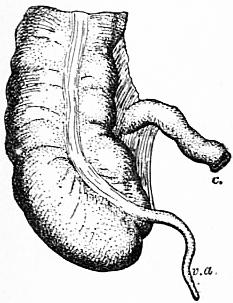
Large Intestine showing Vermiform Appendix (v.a.) and Caecum (c).
On paper it is easy to arrange cases of appendicitis into three classes—catarrhal, ulcerative and mortifying—but in actual practice this is neither desirable nor possible. Such classification is based upon the symptoms, and in appendicitis symptoms may be actually misleading. The three conditions to which the surgeon chiefly looks for guidance are the aspect of the patient, the rate of his pulse and the degree of fever as shown by the thermometer. But in certain cases of appendicitis, though the surgeon knows intuitively, or, at least, suspects, that the general condition is extremely serious, the patient looks fairly well and says that he is not in pain, his pulse-rate being but little quickened and his temperature being but slightly above normal. Nevertheless, when the surgeon has opened the belly in the appendix region, he finds the appendix swollen, perforated and mortified, and lying in a stinking abscess, whilst inflammation has already spread to the neighbouring coils of intestine. Unfortunately, the surgeon can no more tell what he is going to find at his operation in some of these cases than he can foretell the course which any particular case is going to run.
We may most usefully give here the symptoms as they are likely to be found in an ordinary case of appendicitis, and as they may be observed by one who is not a member of the medical profession, in a way that may prove helpful to him when circumstances have awakened his interest in the disease.
The case taken shall be that of a boy at school, for, as already stated, boys are more prone to the disease than girls. The boy has had, may be, occasional attacks of “indigestion” which have duly passed away under the influence of aperient medicines, and, being heated at play, he has sat down upon the cold ground. Or he has got wet through or over-tired during a long walk or ride. At any rate, his vital powers have been suddenly lowered, and the micro-organisms teeming in his bowel have seized upon the lining membrane of the appendix. He feels out of sorts, and if he manages to eat a meal he very likely vomits it soon after, for the whole nervous system of his abdomen is disturbed by the local inflammation. The act of vomiting gives slight relief, however, and probably he begins to complain of pains in his head as well as in his abdomen, and possibly he has an attack of shivering—the result of disturbance of his general nervous system. By this time he may be attacked with intense pain in the part of his abdomen a little above the middle of the right groin, and at that spot there may be a tenderness, and a feeling of resistance may be made out by the gentle pressure of the finger. In order to relax the pressure upon the tender area he probably lies with his right thigh slightly bent. By this time he may look ill, his face being slightly flushed, or pale and anxious. If the clinical thermometer is placed under his tongue, the index may rise a degree or two, perhaps several degrees, above normal, and his pulse may be quickened to 90 or 100 beats a minute. Perhaps it is a good deal quicker than this. Later, the skin of the lower part of the right side of the abdomen may be flushed or reddened.
This clinical picture leaves no room for doubt. The boy has an attack of acute septic inflammation of his appendix. Let it be that the symptoms have come on quickly, and that the affection is not more than ten or twelve hours old; no one can tell precisely what course the disease is going to run. It may be that with rest in bed, constant fomentations, and absolute starvation, the inflammation will subside; but it is just as likely that in spite of this judicious treatment the symptoms will go from bad to worse, and that a belated operation will fail to rescue the boy from a general peritonitis which may end fatally. But at present, so far as one can tell, the disease is still limited to the appendix. And what, at this moment, is the best line of treatment? Some practitioners would answer—“Let the acute attack settle down, and then, after a week or ten days, when everything is quiet, remove the appendix, for statistics show that when the operation is done in the quiet interval the results are extremely favourable, whilst if it is done in the acute stage the outlook is not so bright.” This is quite right. But one cannot be sure that the “quiet interval” will ever arrive. The case in question may be one of those which rapidly go on from bad to worse, and mortification and perforation of the appendix having taken place over some hard faecal concretion, general peritonitis is inevitable, with distension of the bowel and hopeless blood-poisoning. If it were certain that the attack of appendicitis would subside and become quiescent, it would be wise to wait. But it too often happens that the first attack is, indeed, the last. Acute appendicitis is one thing; relapsing appendicitis is another. The latter condition is very manageable.
Inasmuch, then, as it is impossible to know what direction the disease will take, whether to quiescence or to disaster, it is for the greatest good in the greatest number of cases that the inflamed appendix be removed by operation whilst the disease is still limited to the appendix. It is highly probable that if every available hospital surgeon were asked if he had ever had cause to regret having advised early operation in a case of appendicitis the answer would be “No”; on the other hand, every surgeon would be able to recall cases in which delay had been followed by disaster—which an early resort to operation would, in all probability, have prevented.
If the disease is going to assume the severe form, all the symptoms, as a rule, increase in severity. The facial expression becomes more anxious, and the accumulation of gas in the paralysed intestine causes an increase in the abdominal distension, so that the patient lies with his knees drawn up. The vomiting continues. The pulse quickens to 120 or 140 a minute, and the temperature rises, perhaps to 104° F. The swelling and tenderness increase on the right side of the abdomen, and if the abscess does not find escape externally it probably bursts into the general peritoneal cavity, and the patient becomes bathed in profuse sweat, the result of blood-poisoning. Death is likely to follow within two days, the result of blood-poisoning and exhaustion.
Catarrhal and Relapsing Appendicitis.—Some cases of appendicitis run a mild course, giving rise to no worse symptoms, perhaps, than those of “indigestion” and nausea, with a feeling of general discomfort in the abdomen, and, probably, some local tenderness. The attack may be preceded or accompanied by constipation. The administration of a mild aperient or an enema, rest, starvation and fomentation will probably put matters right again—at any rate for a time.
This form of the disease may be due to the presence of “bolted,” unchewed or indigestible food in that part of the large intestine into which the appendix opens. And these mild recurrent attacks may sometimes be got rid of altogether by having the teeth put in order, and by inducing the individual to choose his food with discretion, to chew it carefully, to take his meals regularly and to eat slowly.
Obviously, these attacks are very different from those of the acute septic form of the disease described above, though there is no telling that one of them may not develop into the acute form. Some of the mild attacks are due to a kink in the appendix, or to some other condition which temporarily prevents the secretions of the appendix from finding their way into the large intestine. Others of them are caused by a passing catarrhal inflammation of the lining of the appendix and have a distant resemblance to a recurring “sore throat.”
After undergoing one or two of these mild attacks the patient would be well advised to have his appendix removed when it has once more got into the “quiet stage.” Experience abundantly shows that the operation can then be performed with but slight disturbance of the patient, and with the smallest possible amount of risk. And until his vulnerable appendix has been removed he is never safe.
In the chronic form of the disease though the patient is never desperately ill he is never quite well. He has pains and discomfort in the abdomen, with slight tenderness and nausea, with “indigestion,” as he may call it. And as one can never tell when the smouldering inflammation may break out into conflagration, he is well advised to submit himself to operation without further delay. To carry about a diseased appendix is to run the constant risk of being laid up at a time most inconvenient, as when travelling or when staying in some place where skilled assistance is far distant or absolutely unobtainable. But having made up his mind that the appendix had better be removed, the patient can choose time, place and surgeon, and, having undergone a week’s careful training for the ordeal, can safely count on being back at work again in a month or six weeks’ time.