VOLUME II SLICE III Apollodorus to Aral (continued 5)
Reading edition
The ripening of the fruit of the apricot is accelerated by culture under glass, the trees being either planted out like peaches or grown in pots on the orchard-house system. They must be very gently excited, since they naturally bloom when the spring temperature is comparatively low. At first a maximum of 40° only must be permitted; after two or three weeks it may be raised to 45°, and later on to 50° and 55°, and thus continued till the trees are in flower, air being freely admitted, and the minimum or night temperature ranging from 40° to 45°. After the fruit is set the temperature should be gradually raised, being kept higher in clear weather than in dull. When the fruit has stoned, the temperature may be raised to 60° or 65° by day and 60° by night; and for ripening off it may be allowed to reach 70° or 80° by sun heat.
The Moorpark is one of the best and most useful sorts in cultivation, and should be planted for all general purposes; the Peach is a very similar variety, not quite identical; and the Hemskerk is also similar, but hardier. The Large Early, which ripens in the end of July and beginning of August, and the Kaisha, a sweet-kernelled variety, which ripens in the middle of August, are also to be recommended. For standard trees in favourable localities the Breda and Brussels may be added.
APRIES (Άπρίης), the name by which Herodotus (ii. 161) and Diodorus (i. 68) designate Uehabrē‛, Οὐαφρής (Pharaoh-Hophra), the fourth king (counting from Psammetichus I.) of the twenty-sixth Egyptian dynasty. He reigned from 589 to 570 B.C. See Egypt and Amasis.
APRIL, the second month of the ancient Roman, and the fourth of the modern calendar, containing thirty days. The derivation of the name is uncertain. The traditional etymology from Lat. aperire, “to open,” in allusion to its being the season when trees and flowers begin to “open,” is supported by comparison with the modern Greek use of ἅνοιξις (opening) for spring. This seems very possible, though, as all the Roman months were named in honour of divinities, and as April was sacred to Venus, the Festum Veneris et Fortunae Virilis being held on the first day, it has been suggested that Aprilis was originally her month Aphrilis, from her Greek name Aphrodite. Jacob Grimm suggests the name of a hypothetical god or hero, Aper or Aprus. On the fourth and the five following days, games (Ludi Megalenses) were celebrated in honour of Cybele; on the fifth there was the Festum Fortunae Publicae; on the tenth (?) games in the circus, and on the nineteenth equestrian combats, in honour of Ceres; on the twenty-first—which was regarded as the birthday of Rome—the Vinalia urbana, when the wine of the previous autumn was first tasted; on the twenty-fifth, the Robigalia, for the averting of mildew; and on the twenty-eighth and four following days, the riotous Floralia. The Anglo-Saxons called April Oster-monath or Eostur-monath, the period sacred to Eostre or Ostara, the pagan Saxon goddess of spring, from whose name is derived the modern Easter. St George’s day is the twenty-third of the month; and St Mark’s Eve, with its superstition that the ghosts of those who are doomed to die within the year will be seen to pass into the church, falls on the twenty-fourth. In China the symbolical ploughing of the earth by the emperor and princes of the blood takes place in their third month, which frequently corresponds to our April; and in Japan the feast of Dolls is celebrated in the same month. The “days of April” (journées d’avril) is a name appropriated in French history to a series of insurrections at Lyons, Paris and elsewhere, against the government of Louis Philippe in 1834, which led to violent repressive measures, and to a famous trial known as the procès d’avril.
See Chambers’s Book of Days; Grimm’s Geschichte der deutschen Sprache. Cap. “Monate”; also April-fools’ Day.
APRIL-FOOLS’ DAY, or All-Fools’ Day, the name given to the 1st of April in allusion to the custom of playing practical jokes on friends and neighbours on that day, or sending them on fools’ errands. The origin of this custom has been much disputed, and many ludicrous solutions have been suggested, e.g. that it is a farcical commemoration of Christ being sent from Annas to Caiaphas, from Caiaphas to Pilate, from Pilate to Herod, and from Herod back again to Pilate, the crucifixion having taken place about the 1st of April. What seems certain is that it is in some way or other a relic of those once universal festivities held at the vernal equinox, which, beginning on old New Year’s day, the 25th of March, ended on the 1st of April. This view gains support from the fact that the exact counterpart of April-fooling is found to have been an immemorial custom in India. The festival of the spring equinox is there termed the feast of Huli, the last day of which is the 31st of March, upon which the chief amusement is the befooling of people by sending them on fruitless errands. It has been plausibly suggested that Europe derived its April-fooling from the French. They were the first nation to adopt the reformed calendar, Charles IX. in 1564 decreeing that the year should begin with the 1st of January. Thus the New Year’s gifts and visits of felicitation which had been the feature of the 1st of April became associated with the first day of January, and those who disliked the change were fair butts for those wits who amused themselves by sending mock presents and paying calls of pretended ceremony on the 1st of April. Though the 1st of April appears to have been anciently observed in Great Britain as a general festival, it was apparently not until the beginning of the 18th century that the making of April-fools was a common custom. In Scotland the custom was known as “hunting the gowk,” i.e. the cuckoo, and April-fools were “April-gowks,” the cuckoo being there, as it is in most lands, a term of contempt. In France the person befooled is known as poisson d’avril. This has been explained from the association of ideas arising from the fact that in April the sun quits the zodiacal sign of the fish. A far more natural explanation would seem to be that the April fish would be a young fish and therefore easily caught.
A PRIORI (Lat. a, from, prior, prius, that which is before, precedes), (1) a phrase used popularly of a judgment based on general considerations in the absence of particular evidence; (2) a logical term first used, apparently, by Albert of Saxony (14th century), though the theory which it denotes is as old as Aristotle. In the order of human knowledge the particular facts of experience come first and are the basis of generalized laws or causes (the Scholastic notiora nobis); but in the order of nature the latter rank first as the self-existent, fundamental truths of existence (notiora naturae). Thus to Aristotle the a priori argument is from law or cause to effect, as opposed to what we call a posteriori (posterior, subsequent, derived), from effect to cause. Since Kant the two phrases have become purely adjectival (instead of adverbial) with a technical controversial sense, closely allied to the Aristotelian, in relation to knowledge and judgments generally. A priori is applied to judgments which are regarded as independent of experience, and belonging to the essence of thought; a posteriori to those which are derived from particular observations. The distinction is analogous to that between analysis and synthesis, deduction and induction (but there may be a synthesis of a priori judgments, cf. Kant’s “Synthetic Judgment a priori”). Round this distinction a rather barren controversy has raged, and almost all modern philosophers have labelled themselves either “Intuitionalist” (a priori) or “Empiricist” (a posteriori) according to the view they take of knowledge. In fact, however, the rival schools are generally arguing at cross purposes; there is a knowledge based on particulars, and also a knowledge of laws or causes. But the two work in different spheres, and are complementary. The observation of isolated particulars gives not necessity, but merely strong probability; necessity is purely intellectual or “transcendental.” If the empiricist denies the intellectual element in scientific knowledge, he must not claim absolute validity for his conclusions; but he may hold against the intuitionalist that absolute laws are impossible to the human intellect. On the other hand, pure a priori knowledge can be nothing more than form without content (e.g. formal logic, the laws of thought). The simple fact at the bottom of the controversy is that in all empirical knowledge there is an intellectual element, without which there is no correlation of empirical data, and every judgment, however simple, postulates a correlation of some sort if only that between the predicate and its contradictory.
APRON (a corruption arising from a wrong division of “a napron” into “an apron,” from the Fr. naperon, napperon, a diminutive of nappe, Lat. mappa, a napkin), an article of costume used to protect the front of the clothes. It forms part of the ceremonial dress of Freemasons. The “apron” worn by church dignitaries is a shortened cassock (q.v.). The word has many technical uses, as for the protecting slope in front of the sill of dock-gates, or at the foot of weirs.
APSARAS, in Hindu mythology, a female spirit of the clouds and waters. In the Rig-Veda there is one Apsaras, wife of Gandharva; in the later scriptures there are many Apsaras who act as the handmaidens of Indra and dance before his throne. They are able to change their form, and specially rule over the fortunes of gaming. One of their duties is to guide to paradise the heroes who fall in battle, whose wives they then become. They are distinguished as daivika (“divine”) or laukika (“worldly”).
APSE (Gr. ἁψίς, a fastening, especially the felloe of a wheel; Lat. absis), in architecture, a semicircular recess covered with a hemispherical vault. The term is applied also to the termination to the choir, transept or aisle of any church which is either semicircular or polygonal in plan, whether vaulted or covered with a timber roof; a church is said to be “apsidal” when it terminates in an apse.
The earliest example of an apse is found in the temple of Mars Ultor at Rome (2 B.C.), and it formed afterwards the favourite feature terminating the rear of any temple, and one which gave importance to the statue of the deity to whom the temple was dedicated. Its use by the Romans was not confined to the temples, as it is found in the palaces on the Palatine Hill, the great Thermae (Baths) and other monuments. In the civil basilicas the apse was screened off by columns, and constituted the court of justice. In the Ulpian (Trajan’s) Basilica the apses at each end were of such great dimensions as to come better under the definition of hemicycles (q.v.). In these apses the floor was raised, and had an altar placed in the centre of its chord, where sacrifices were made prior to the sittings. The only other two Roman basilicas in which the semicircular apse can still be traced are that commenced by Maxentius and completed by Constantine at Rome and the basilica at Trier (Trèves).
In the earliest Christian basilica, St Peter’s at Rome, built 330 A.D., the apse, 57 ft. in diameter, raised above the confessio or crypt, was placed at the west end of the church. This orientation was originally followed in the churches of St Paul and St Lawrence (S. Lorenzo fuori le Mura), both outside the walls of Rome, and is found in most of the churches at Rome. On the other hand, in the Byzantine church, the apse was built at the east end of the church.
During the reign of Justin the Second (A.D. 565-574), owing to a change in the liturgy, two more apses were added, one on each side of the central apse. These in the Greek Church were provided not to hold altars but for ceremonial purposes. One of the earliest examples is found in the church of St Nicholas at Myra of the 6th century, and the basilica erected in the great court of the temple at Baalbek shows the triple apse. The earliest example in Rome is found in the church of Sta Maria in Cosmedin (772-795), built probably by Greek craftsmen, who had been exiled by the Iconoclasts. Other triapsal choirs are found in the cathedral of Parenzo (542 A.D.), in St Mark’s, Venice, in Sta Fosca and the Duomo at Torcello, and in numerous examples throughout Italy and Germany. In central Syria there is one example only, at Kalat Seman, where the side apses were a later addition.
There is one important distinction to be drawn between the Byzantine and the Latin apses; they are both semicircular internally, but externally the former are nearly always polygonal. It follows, therefore, that in those churches in Italy where the apse is polygonal externally, it is a sign of direct Byzantine influence. This is found in St Mark’s, Venice; Sta Fosca, Torcello; Murano; nearly all the churches at Ravenna; and in the Crusaders’ churches throughout Syria.
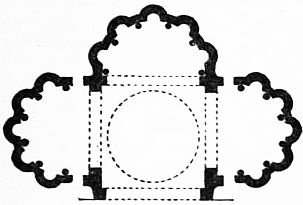
Apse of the White Monastery.
In the Coptic church in Egypt we find other characteristics; in the churches of the Red and White Monasteries, attributed to St Helena, an unusual depth is given to the apse, in the walls of which niches are sunk; in the church of St John at Antinoë there are no fewer than seven. Similar niches are found in the apses of St Mark’s, Venice, built in A.D. 828, it is said in imitation of St Mark’s in Alexandria, to receive the relics of St Mark brought over from there.
In a large number of the apses in the Coptic churches the seats round the apse with the bishop’s throne in the centre are still preserved; of these the best examples are at Abu Sargah, Al ‛Adra and Abu-s-Sifain. Unfortunately there are no remains of the fittings in the tribunes of the ancient Roman basilicas, but those in St Peter’s at Rome, which were probably copied from them, are recorded in drawings, there being two or three rows of stone seats with the papal throne in the centre. It is possible also that some may still exist in the other early Christian basilicas at Rome, but there have been so many changes that it is not possible to trace them. In the cathedral of Parenzo in Istria (A.D. 532-535), the hemicycle of marble seats for the clergy with the episcopal chair in the centre still exists. A similar arrangement is found in the apse of the church of the 6th century attached to the church of St Helena in the island of Paros, where there are eight steep grades of semicircular stone seats with the bishop’s chair in the centre. The aspect of the interior of this apse has in consequence very much the appearance of a Roman theatre. A third example, better known, exists at Torcello, with six concentric seats rising one above the other, and in the centre the episcopal chair with a flight of thirteen steps down in front of it.
In the basilica at Bethlehem, the east end of which was reconstructed probably in the 5th century, apses of similar dimensions to the eastern apse were built at the north and south end of the transept. The same disposition is found in the Coptic churches of the Red and White Monasteries just referred to, in the church of St Elias at Salonica (c. 1012), the cathedral of Echmiadzin in Armenia, at Vatopedi, Mt. Athos, and some other Byzantine churches. An early example in France exists in the church of Germigny-des-Prés on the Loire (806; rebuilt 1868), where the three apses are horseshoe on plan, and the same is found in the church at Oberzell in the island of Reichenau, Lake of Constance, except that the eastern apse there is square. Small examples also are found at Querqueville and at St Wandrille near Caudebec, both in Normandy, but the finest development takes place in the church of St Maria im Capitol at Cologne, where the aisles are carried round both the northern and southern apses. The same feature exists in the cathedral of Tournai in Belgium and the churches at Cambrai, Soissons and Valenciennes (the last destroyed at the Revolution) in France, and also in the cathedrals of Como and of Pisa in Italy. Without aisles, there are examples in the churches of the Apostles and of St Martin at Cologne; St Quirinus at Neuss; at Roermond; St Cross, Breslau; the cathedral of Bonn; and, at a later date, in the Marienkirche at Trier; S. Elizabeth at Marburg; the church of Sta Maria-del-Fiore at Florence; and the cathedral of Parma.
In consequence of a change made in the orientation of apses in the 6th or 7th century, others were subsequently added at the west end of existing churches, and this is considered to have been the case at Canterbury; but in the German churches sometimes apses were built from the first at both ends, such as are shown on the manuscript plan of St Gall, of the 9th century. Western apses exist at Gernrode; Drübeck; Huyseburg; the Obermünster of Regensburg; St Godehard in Hildesheim; the cathedrals of Worms and Trier; the Abbey church of Laach; the Minster at Bonn; and in St Pietro-in-Grado near Pisa.
The triapsal churches, to which we have referred, are those in which the side apses form the termination of the side aisles; but where there are transepts, the aisles are sometimes not continued beyond them, and the expansion of the transept to north and south gives more ample space for apses; of these there are many examples, as in the Abbey church of Laach in Germany; at Romsey; Christchurch, Hants; Gloucester, Ely, Norwich and Canterbury cathedrals, in England; and at St Georges de Boscherville in France; sometimes there being space for two apses on each side.
In the beginning of the 13th century in France, the apses became radiating chapels outside the choir aisle, henceforth known as the chevet. These radiating chapels would seem to have been suggested in Norwich and Canterbury cathedrals, but the feature is essentially a French one and in England is found only in Westminster Abbey, into which it was introduced by Henry III., to whom the chevets of Amiens, Beauvais and Reims were probably well known.
(R. P. S.)
APSE and APSIDES, in mechanics, either of the two points of an orbit which are nearest to and farthest from the centre of motion. They are called the lower or nearer, and the higher or more distant apsides respectively. The “line of apsides” is that which joins them, forming the major axis of the orbit.
APSINES of Gadara, a Greek rhetorician, who flourished during the 3rd century A.D. After studying at Smyrna, he taught at Athens, and gained such a reputation that he was raised to the consulship by the emperor Maximinus (235-238). He was the friend of Philostratus, the author of the Lives of the Sophists, who speaks of his wonderful memory and accuracy. Two rhetorical treatises by him are extant: Τέχνη ῥητορική, a handbook of rhetoric greatly interpolated, a considerable portion being taken from the Rhetoric of Longinus; and a smaller work, Περὶ ἐσχηματισμένων προβλημάτων, on Propositions maintained figuratively.
Editions by Bake, 1849; Spengel-Hammer in Rhetores Graeci, ii. (1894): see also Hammer, De Apsine Rhetore (1876); Volkmann, Rhetorik der Griechen und Romer (1885).
APT, a town of south-eastern France, in the department of Vaucluse, on the left bank of the Coulon, 41 m. E. of Avignon by rail. Pop. (1906) 4990. The town was formerly surrounded by massive ancient walls, but these have now been for the most part replaced by boulevards; many of its streets are narrow and irregular. The chief object of interest is the church of Sainte-Anne (once the cathedral), the building of which was begun about the year 1056 on the site of a much older edifice, but not completed until the latter half of the 17th century. Many Roman remains have been found in and near the town. A fine bridge, the Pont Julien, spanning the Coulon below the town, dates from the 2nd or 3rd century. A tribunal of first instance and a communal college are the chief public institutions. The chief manufactures are silk, confectionery and earthenware; and there is besides a considerable trade in fruit, grain and cattle. Apt was at one time the chief town of the Vulgientes, a Gallic tribe; it was destroyed by the Romans about 125 B.C. and restored by Julius Caesar, who conferred upon it the title Apta Julia; it was much injured by the Lombards and the Saracens, but its fortifications were rebuilt by the counts of Provence. The bishopric, founded in the 3rd century, was suppressed in 1790.
APTERA (Greek for “wingless”), a term in zoological classification applied by Linnaeus to various groups of wingless arthropods, including some of the insects, the centipedes, the millipedes, the Arachnida (scorpions, spiders, &c.) and the Crustacea. In modern zoology the term has become restricted to the lowest order of the class Hexapoda or true insects. This order includes the bristle-tails and the springtails.
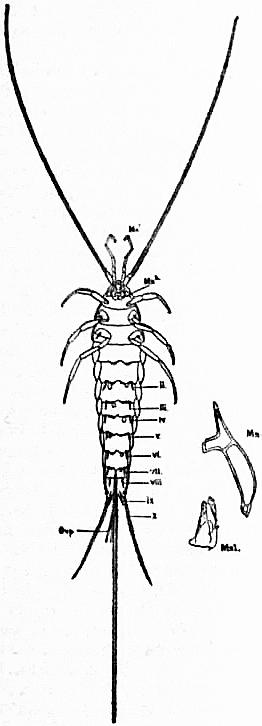
From Knowledge.
Fig. 1.—A typical Thysanuran (Machilus maritima). Female, ventral view.
Mx1, Mx2, 1st and 2nd maxillae. ii.-x., Appendages on 2nd to 10th abdominal segments. The eversible sacs on the abdominal segments are shown, some protruded and some retracted. Ovp, Ovipositor. Mn, Mandible, and Mxl, maxillula, dissected out of head.
Many wingless insects—such as lice, fleas and certain earwigs and cockroaches—are placed in various orders together with winged insects to which they show evident relationships. In such cases the absence of wings must be regarded as secondary—due to a parasitic or other special manner of life. But the bristle-tails and springtails, which form the modern order Aptera, are all without any trace of wings, and, on account of several remarkable archaic characters which they exhibit, there is reason for believing that they are primitively wingless—that they represent an early offshoot which sprang from the ancestral stock of the Hexapoda before organs of flight had been acquired by the class.
Characters.—In addition to the complete absence of wings and of metamorphosis, the Aptera are characterized by peculiar elongate mandibles (figs. 1, Mn.; 2, 4), with toothed apex and sub-apical grinding surface, like those of certain Crustacea; by the presence between the mandibles and maxillae of a pair of appendages (superlinguae or maxillulae), fig. 1, Mxl., which are absent or vestigial in all other insects; and, in most genera, by the presence in the adult of abdominal appendages used for locomotion, these latter varying in number from one to nine pairs. Among peculiarities of the internal organs the segmental arrangement of the ovaries in most members of the order is noteworthy. Many Aptera are covered with flattened scales like those of moths.
Classification.—The Aptera are divided into two divergent sub-orders, the Thysanura (q.v.) or bristle-tails, and the Collembola or springtails.
Thysanura.—The bristle-tails have an abdomen of eleven segments, the tenth usually carrying a pair of long many-jointed tail-feelers (cerci, fig. 1, x.); sometimes a median, jointed tail-appendage is also present. To these feelers the popular name is due. There may also be abdominal appendages—in the form of simple unjointed stylets (fig. 1, ii.-ix.), accompanied by paired eversible sacs, probably respiratory in function—on eight (or fewer) other abdominal segments. The head of a bristle-tail carries a pair of compound eyes and a pair of elongate many-jointed feelers.
The air-tube system is developed in varying degree in different bristle-tails, the number of pairs of spiracles being three (Campodea), nine (Machilis), ten (Lepisma), or eleven (Japyx).
Four families of Thysanura are usually recognized. In the Machilidae and Lepismidae (these two families are known as the Ectotrophi) the maxillae are like those of typical biting insects, and there is a median tail-bristle in addition to the paired cerci; while in the Campodeidae and Japygidae (which form the group Entotrophi) the jaws are apparently sunk in the head, through a deep inpushing at the mouth, and there is no median tail-bristle. The cerci in Japyx are not, as usual, jointed feelers, but strong, curved appendages forming a forceps as in earwigs.
Collembola.—In springtails, or Collembola, the jaws are sunk into the head, as in the entotrophous Thysanura; the head carries a pair of feelers with not more than six (usually four) segments, and there are eight (or fewer) distinct simple eyes on each side of the head (fig. 2, 1, 2). These are in some genera like the single elements (ommatidia) of a compound insect eye, in others like simple ocelli. The abdomen consists of six segments only. The first of these usually carries a ventral tube, furnished with paired eversible sacs which assist the insects in walking on smooth surfaces, and perhaps serve also as organs for breathing. From the researches of V. Willem it appears that the viscid fluid which causes the adherence of the ventral tube is secreted by a pair of glands in the head whose ducts open into a superficial groove leading from the second maxillae backward to the tube on the first abdominal segment. The third abdominal segment usually carries a pair of short appendages whose basal segments are fused together; this is the “catch” (fig. 2, 7), whose function is to hold in place the “spring,” which is formed by the fourth pair of abdominal appendages—also with fused basal segments. In most Collembola the spring appears to belong to the fifth abdominal somite, but Willem, by study of the muscles, has shown that it really belongs to the fourth. The fused basal segments of the appendages form the “manubrium” of the spring, which carries the two “dentes” (usually elongate and flexible), each with a “mucro” at its tip (fig. 2, 5). The fifth abdominal segment is the genital, and the sixth the anal somite.
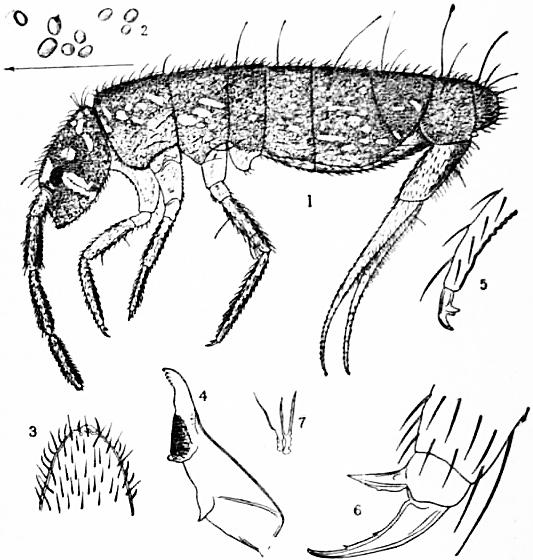
From Carpenter, Proc. R. Dub. Soc., vol. xi.
Fig. 2.—Structure of Collembola.
1. Isotoma hibernica. Side view. 2. ” Ocelli and post-antennal organ of right side. 3. ” Tip of terminal antennal segment with antennal organ. 4. ” Mandible. 5. ” Tip of left dens with mucro. Outer view. 6. ” Hind-foot with claws. × 240. 7. Entomobrya anomala. Catch.
The spring serves the Collembola which possess it as an efficient leaping-organ (see Springtail). But in some genera it is greatly reduced and in many quite vestigial.
Most springtails are without air-tubes, and breathe through the general cuticle of the body. But in one family (Sminthuridae) a spiracle, opening on either side between the head and the prothorax, leads to a branching system of air-tubes. The Sminthuridae are further characterized by the globular abdomen, which shows but little external trace of segmentation, and by the well-developed spring.
In the Entomobryidae the body is elongate and clearly segmented, but the dorsal region (tergum) of the prothorax is much reduced and the head downwardly directed; the spring is well developed. In the Achorutidae the head is forwardly directed, the tergum of the prothorax conspicuous, and the spring small or vestigial.
In many genera of springtails a curious post-antennal organ, consisting of sensory structures (often complex in form) surrounded by a firm ring, is to be noticed on the cuticle of the head between the eyes and the feelers. It may be of use as an organ of smell. Other sensory organs occur on the third and fourth antennal segments in the Achorutidae and Entomobryidae (fig. 2, 3).
Distribution and Habits.—The Aptera are probably the most widely distributed of all insects. Among the bristle-tails we find the genus Machilis, represented in Europe (including the Faeroe Islands) and in Chile; while Campodea lives high on the mountains and in the deepest caves. The springtails have even a wider distribution. The genus Isotoma, for example, has some of its numerous species in regions so remote as Alaska, Franz Josef Land, the Sandwich Islands, the South Orkneys, Graham Land, Kerguelen and South Victoria Land. As it is unlikely that these delicate insects could be transported across sea-channels, their wide and discontinuous range suggests both their great antiquity and the former existence of continental tracts over which they may have travelled to their present stations.
Springtails and bristle-tails live in damp concealed places—under stones or tree-bark, in moss, and in the decaying vegetable or animal matter which serves as food for most of them. Some species, however, eat fresh plant-tissues. A species of bristle-tail (Machilis maritima) and quite a number of springtails haunt the sea-coast at or below high-water mark. In such localities many thousands of individuals may sometimes be found associated together. The insect fauna of limestone caves both in Europe and North America is largely composed of Aptera, especially Collembola.
Geological History.—A supposed Thysanuran from the Silurian of New Brunswick has been described by G.F. Matthew, and another genus from the French Carboniferous by C. Brongniart. Not till the Tertiary do we find remains of Aptera in any quantity, species both of living and extinct genera being represented in the amber.
Development.—The embryonic development of several genera of Aptera, which has been carefully studied, will be more suitably described in comparison with that of other insects than here (see Hexapoda).
Bibliography.—The modern study of the Aptera may be said to date from the classical memoirs of T. Tullberg, “Sveriges Podurider,” in Kongl. Svensk Vetensk. Akad. Handl. x., 1872, and Sir J. Lubbock (Lord Avebury), “Monograph of the Collembola and Thysanura,” Ray Society, 1873. In these, full references to the older literature will be found. Subsequently our knowledge of the Thysanura has been markedly advanced by J.T. Oudemans, Bijdrage tot de Kennis den Thysanura en Collembola (Amsterdam, 1888); B. Grassi, who published between 1885 and 1889 a series of memoirs entitled “I progenitori dei Miriapodi e degli Insetti,” in the Atti Accad. di Scienz. Nat. Catania, and the Memor. R. Accad. dei Lincei; and V. Willem, whose “Recherches sur les Collemboles et les Thysanoures,” in Mem. Cour. Acad. Roy. Belgique, lviii., 1900, are indispensable to the student. In addition to this work of Willem, valuable anatomical papers on Collembola have been published by H.J. Hansen (Zool. Anz. xvi., 1893), J.W. Folsom (Bull. Mus. Comp. Anat. Harv. xxxv., 1899), C. Börner (Zool. Anz. xxiii., 1900), and K. Absolon (Zool. Anz. xxiii. and xxiv., 1900, 1901), the two latter writers having paid especial attention to the peculiar post-antennal and antennal sense-organs of springtails. Absolon has also written on the Collembola of caves. These writers, with H. Schött, C. Schäffer and others, have published many systematic papers on Collembola, as has F. Silvestri on Thysanura. British species are mentioned in Lubbock’s monograph; for recent additions see G.H. Carpenter and W. Evans (Proc. R. Phys. Soc. Edinb. xiv., 1899, and xv., 1903).
(G. H. C.)
APTERAL (from the Gr. ἄπτερος, wingless, ἀ-, privative and πτερός, a wing), an architectural term applied to amphiprostyle temples which have no columns on the sides; in the Ionic temple on the Acropolis at Athens known as Nike Apteros, the adjective is used, not as applying to the goddess of victory but to the absence of any peristyle on the sides.
APTIAN (Fr. Aptien, from Apt in Vaucluse, France), in geology, the term introduced in 1843 by A. d’Orbigny (Pal. France Crét. ii.) for the upper stage of the Lower Cretaceous rocks. In England it comprises the Lower Greensand and part of the Speeton beds; in France it is divided into two sub-stages, the lower, “Bedoulian,” of Bedoule in Provence, with Hoplites deshayesei and Ancyloceras Matheroni; and an upper, “Gargasian,” from Gargas near Apt, with Hoplites furcatus (Dufrenoyi) and Phylloceras Guettardi. To this stage belong the Toucasia limestone and Orbitolina marls of Spain; the Schrattenkalk (part) of the Alpine and Carpathian regions; and the Terebrirostra limestone of the same area. Parts of the Flysch of the eastern Alps, the Biancone of Lombardy, and argile scagliose of Emilia, are of Aptian age; so also are the “Trinity Beds” of North America. Deposits of bauxite occur in the Aptian hippurite limestone at Les Baux near Aries, and in the Pyrenees. The Aptian rocks are generally clays, marls and green glauconitic sands with occasional limestones. (See Greensand and Cretaceous.)
APULEIUS, LUCIUS, Platonic philosopher and rhetorician, was born at Madaura in Numidia about A.D. 125. As the son of one of the principal officials, he received an excellent education, first at Carthage and subsequently at Athens. After leaving Athens he undertook a long course of travel, especially in the East, principally with the view of obtaining initiation into religious mysteries. Having practised for some time as an advocate at Rome, he returned to Africa. On a journey to Alexandria he fell sick at Oea (Tripoli), where he made the acquaintance of a rich widow, Aemilia Pudentilla, whom he subsequently married. The members of her family disapproved of the marriage, and indicted Apuleius on a charge of having gained her affections by magical arts. He easily established his innocence, and his spirited, highly entertaining, but inordinately long defence (Apologia or De Magia) before the proconsul Claudius Maximus is our principal authority for his biography. From allusions in his subsequent writings, and the mention of him by St. Augustine, we gather that the remainder of his prosperous life was devoted to literature and philosophy. At Carthage he was elected provincial priest of the imperial cult, in which capacity he occupied a prominent position in the provincial council, had the duty of collecting and managing the funds for the temples of the cult, and the superintendence of the games in the amphitheatre. He lectured on philosophy and rhetoric, like the Greek sophists, apparently with success, since statues were erected in his honour at Carthage and elsewhere. The year of his death is not known.
The work on which the fame of Apuleius principally rests has little claim to originality. The Metamorphoses or Golden Ass (the latter title seems not to be the author’s own, but to have been bestowed in compliment, just as the Libri Rerum Quotidianarum of Gaius were called Aurei) was founded on a narrative in the Metamorphoses of Lucius of Patrae, a work extant in the time of Photius. From Photius’s account (impugned, however, by Wieland and Courier), this book would seem to have consisted of a collection of marvellous stories, related in an inartistic fashion, and in perfect good faith. The literary capabilities of this particular narrative attracted the attention of Apuleius’s contemporary, Lucian, who proceeded to work it up in his own manner, adhering, as Photius seems to indicate, very closely to the original, but giving it a comic and satiric turn. Apuleius followed this rifacimento, making it, however, the groundwork of an elaborate romance, interspersed with numerous episodes, of which the beautiful story of Cupid and Psyche is the most celebrated, and altering the dénouement to suit the religious revival of which he was an apostle.
The adventures of the youthful hero in the form of an ass are much the same in both romances, but in Apuleius he is restored to human shape by the aid of Isis, into whose mysteries he is initiated, and finally becomes her priestess. The book is a remarkable illustration of the contemporary reaction against a period of scepticism, of the general appetite for miracle and magic, and of the influx of oriental and Egyptian ideas into the old theology. It is also composed with a well-marked literary aim, defined by Kretzschmann as the emulation of the Greek sophists, and the transplantation of their tours de force into the Latin language. Nothing, indeed, is more characteristic of Apuleius than his versatility, unless it be his ostentation and self-confidence in the display of it. The dignified, the ludicrous, the voluptuous, the horrible, succeed each other with bewildering rapidity; fancy and feeling are everywhere apparent, but not less so affectation, meretricious ornament, and that effort to say everything finely which prevents anything being said well. The Latinity has a strong African colouring, and is crammed with obsolete words, agreeably to the taste of the time. When these defects are mitigated or overlooked, the Golden Ass will be pronounced a most successful work, invaluable as an illustration of ancient manners, and full of entertainment from beginning to end. The most famous and poetically beautiful portion is the episode of Cupid and Psyche, adapted from a popular legend of which traces are found in most fairy mythologies, which explains the seeming incongruity of its being placed in the mouth of an old hag. The allegorical purport he has infused into it is his own, and entirely in the spirit of the Platonic philosophy. Don Quixote’s adventure with the wine-skins, and Gil Blas’s captivity among the robbers, are palpably borrowed from Apuleius; and several of the humorous episodes, probably current as popular stories long before his time, reappear in Boccaccio.
Of Apuleius’s other writings, the Apology has been already mentioned. The Florida (probably meaning simply “anthology,” without any reference to style) consists of a collection of excerpts from his declamations, ingenious but highly affected, and in general perfect examples of the sophistical art of saying nothing with emphasis. They deal with the most varied subjects, and are intended to exemplify the author’s versatility. The pleasing little tract On the God of Socrates expounds the Platonic doctrine of beneficent daemons, an intermediate class between gods and men. Two books on Plato (De Platone et Ejus Dogmate) treat of his life, and his physical and ethical philosophy; a third, treating of logic, is generally considered spurious. The De Mundo is an adaptation of the Περὶ κόσμόυ wrongly attributed to Aristotle. Apuleius informs us that he had also composed numerous poems in almost all possible styles, and several works on natural history, some in Greek. In the preparation of these he seems to have attended more closely to actual anatomical research than was customary with ancient naturalists. Some other works—dealing with theology, the properties of herbs, medical remedies and physiognomy, are wrongly attributed to him.
The character of Apuleius, as delineated by himself, is attractive; he appears vehement and passionate, but devoid of rancour; enterprising, munificent, genial and an enthusiast for the beautiful and good. His vanity and love of display are conspicuous, but are extenuated by a genuine thirst for knowledge and a surprising versatility of attainments. He prided himself on his proficiency in both Greek and Latin. His place in letters is accidentally more important than his genius strictly entitles him to hold. He is the only extant example in Latin literature of an accomplished sophist in the good sense of the term. The loss of other ancient romances has secured him a peculiar influence on modern fiction; while his chronological position in a transitional period renders him at once the evening star of the Platonic, and the morning star of the Neo-Platonic philosophy.
Bibliography.—Complete works: Editio princeps, ed. Andreas (1469); Oudendorp (1786-1823); Hildebrand (1842); Helm (1905 et seq.); P. Thomas (vol. iii. 1908). Metamorphoses, Eyssenhardt (1869), van der Vliet (1897). Psyche et Cupido, Jahn-Michaelis (1883); Beck (1902). Apologia, I. Casaubon (1594); Krüger (1864); (with the Florida), van der Vliet (1900). Florida, Krüger (1883). De Deo Socratis, Buckley (1844), Lütjohann (1878). De Platone et ejus Dogmate, Goldbacher (1876) (including De Mundo and De Deo Socratis). For the relation between Lucian’s Ὄνος and the Metamorphoses of Apuleius, see Rohde, Über Lucians Schrift Λούκιος (1869), and Burger, De Lucio Patrensi (1887). On the style of Apuleius consult Kretzschmann, De Latinitate L. Apulei (1865), and Koziol, Der Stil des A. (1872). There is a complete English translation of the works of Apuleius in Bohn’s Classical Library. The translations and imitations of the Golden Ass in modern languages are numerous: in English, by Adlington, 1566 and later eds. (reissued in the Tudor translations and Temple Classics), Taylor (1822) (including the philosophical works), Head (1851). Of the Cupid and Psyche episode there are recent translations by Robert Bridges (1895) (in verse), Stuttaford (1903); and it is beautifully introduced by Walter Pater into his Marius the Epicurean. This episode has afforded the subject of a drama to Thomas Heywood, and of narrative poems to Shakerley Marmion, Mrs. Tighe, and William Morris (in the Earthly Paradise).
APULIA (sometimes Appulia in manuscripts but never in inscriptions), the district inhabited in ancient times by the Apuli. Strictly a Samnite tribe (see Samnites) settled round Mount Garganus on the east coast of Italy (Strabo vi. 3. 11), the Apuli mingled with the Iapygian tribes of that part of the coast (Dauni, Peucetii, Poediculi) who, like the Messapii, had come from Illyria, so that the name Apulia reached down to the border of the ancient Calabria. Almost the only monument of Samnite speech from the district is the famous Tabula Bantina from Bantia, a small city just inside the Peucetian part of Apulia, on the Lucanian border. This inscription is one of the latest and in some ways the most important monument of Oscan, though showing what appear to be some southern peculiarities (see Osca Lingua). Its date is almost certainly between 118 and 90 B.C., and it shows that Latin had not even then spread over the district (cf. Lucania). Far older than this are some coins from Ausculum and Teate (later known as Teanum Apulum), of which the earliest belong to the 4th century B.C. Roman or Latin colonies were few, Luceria (planted 314 B.C.) in the north and Brundisium (soon after 268) being the chief. (See R.S. Conway, Italic Dialects, xxviii.-xxx. pp. 15 f.; and Mommsen’s introduction to the opening sections of C.I.L. ix.)
(R. S. C.)
The wars of the 4th and 3rd centuries B.C. brought a great part of the pastures of the Apulian plain into the hands of the Roman state, and a tax was paid on every head of cattle and every sheep, at first to the tax farmer and later to the imperial procurator. It was under the Romans that the system of migration for the flocks reached its full development, and the practice is still continued; the sheep-tracks (tratturi), 350 ft. wide, leading from the mountains of the Abruzzi to the plain of Apulia date in the main at least from the Roman period, and are mentioned in inscriptions. The plain, however, which once served as winter grazing ground for a million sheep, now gives pasture to about one-half of that number.1 The shepherds, who were slaves, often gave considerable trouble; we hear that some 7000 of them, who had made the whole country unsafe, were condemned to death in 185 B.C. (Livy xxxix. 29). Sheep-farming on a large scale was no doubt detrimental to the interests of the towns. We hear of repeated risings, for the last time in the Social War. Even in the 4th century B.C. the then chief town of Apulia, Teate or Teanum Apulum (see above), suffered in this way. Luceria subsequently took its place, largely owing to its military importance; but under the Empire it was succeeded by Canusium.
The road system of Apulia, which touched all the important towns, consisted of three main lines, the Via Appia (see Appia, Via), the Via Traiana, and the coast road, running more or less parallel in an east-south-east direction. The first (the southernmost), coming east from Beneventum, entered Apulia at the Pons Aufidi, and ran through Venusia to Tarentum, and thence, turning north-east, to Brundusium. The second, coming north-east from Beneventum, turned east at Aecae, and ran through Herdoniae, Canusium, Butuntum, Barium and Gnathia (Gnatia) to Brundusium. There was also a short cut from Butuntum to Gnathia through Caelia, keeping inland. The third parallel line ran to the north of the Via Traiana, in continuation of the road along the north-east coast of Picenum and Samnium; it entered Apulia near Larinum (whence a branch ran south to Bovianum Undecimanorum), and thence, keeping in the plain to the south of the Mons Garganus, rejoined the coast at Sipontum, where it received a branch road from the Via Traiana at Aecae, passing through Luceria and Arpi. It then passed through Barduli (where it was joined by a road from Canusium by way of Cannae) to Barium, where it joined the Via Traiana. From Barium a road probably ran direct to Caelia, and thence south-south-east to join the Via Appia some 25 m. north-west of Tarentum.
Barium was an important harbour, though less so than Brundusium and Tarentum, which, however, belonged to Calabria in the Roman sense. Apulia, with Calabria, formed the second region of Augustus, though we once find Calabria treated as a part of the third region, Lucania (C.I.L. ix. 2213). The Hannibalic and later wars had, Strabo tells us, destroyed the former prosperity of the country; in imperial times we hear little or nothing of it. Both were governed by a corrector from the time of Constantine onwards, but in 668 the Lombards conquered Calabria and Apulia, and it was then that the former name was transferred to Bruttium, the meaning of the latter being extended to include Calabria also. In the 10th century the greater part of this territory was recovered by the Byzantine emperors, whose governor was called Καταπανός, a name which, under the corrupt form Capitanata, belonged to the province of Foggia till 1861. It was conquered by the Normans under William Bras-de-fer, who took the title of comes Apuliae in 1042; it was raised to a dukedom with Calabria by Robert Guiscard in 1059, and united to the Sicilian monarchy in 1127. Many of the important towns possess fine Romanesque cathedrals, constructed under the Normans and the Hohenstaufen rulers. It shared the subsequent fate of Sicily, becoming a part of the kingdom of the Two Sicilies in 1734, and being united with Italy in 1861.
Modern Apulia comprises the three provinces of Foggia, Bari and Lecce (the latter corresponding roughly with the ancient Calabria, which, however, extended somewhat farther north inland), and is often known as Le Puglie; it Modern Apulia. stretches from Monte Gargano to the south-east extremity of Italy, with an area of 7376 sq. m.; it is bounded on the north and east by the Adriatic, on the south-east by the Gulf of Taranto, on the south by Basilicata and on the west by Campania and the Abruzzi. The three provinces correspond to the three natural divisions into which it falls. That of Foggia, though it has mountains on the west and south-west boundary, and the Monte Gargano at its north-east extremity, is in the main a great plain called the Tavoliere (chessboard) di Puglia, with considerable lagoons on its north and east coast. That of Bari, east-south-east of Foggia and divided from it by the Ofanto (Aufidus), the only considerable river of Apulia, 104 m. long, is a hilly district with a coast strip along which are the majority of the towns—the lack of villages is especially noticeable; in the circondario of Barletta, the north-east portion of the province, there are only eleven communes, with a total population of 335,934. That of Lecce, to the east-south-east again, is a low flat limestone terrace.
The industries of Apulia are mainly pastoral or agricultural. Besides sheep, a considerable number of horses, cattle and swine are bred; while despite the lack of water, which is the great need of modern Apulia (in 1906 arrangements were made for a great aqueduct, to supply the three provinces from the headwaters of the Sele), cultivation is actively carried on, especially in the province of Bari, where grain, wine, olives, almonds, lemons, oranges, tobacco, &c., are produced in abundance, and the export of olive oil is attaining considerable importance. The salt works of Margherita di Savoia produce large quantities of salt, and nitre is extracted near Molfetta.
Railway communications are fairly good, the main line from Bologna to Brindisi passing through the whole length of Apulia, by way of Foggia and Bari, and having branches from Foggia (the main railway centre of Apulia) to Benevento and Caserta, to Manfredonia, to Lucera and to Rocchetta S. Antonio (and thence to either Avellino, Potenza or Gioia del Colle), from Ofantino to Margherita di Savoia, from Barletta to Spinazzola (between Rocchetta S. Antonio and Gioia del Colle), from Bari to Putignano, and via Gioia del Colle to Taranto, and from Brindisi to Taranto, and to Lecce and Otranto; besides which, there is a steam tramway from Barletta to Bari via Andria.
The most important harbours of Apulia are Brindisi, Bari, Taranto, Barletta, Molfetta and Gallipoli. The export of olive oil to foreign countries from the province of Lecce in 1905 amounted to 1048 tons, as against 3395 in 1901; but that to home ports increased from 7077 to 9025 tons in the same period. The production of wine was 358,953 tons in 1905 as against 203,995 tons in 1901 (an exceptionally bad year) and 284,156 tons in 1902. Of this 211,872 tons were forwarded by rail and sea, in the proportion of five to two respectively, the rest being used for home consumption and as a reserve. The cultivation of oriental tobacco is extending in the province (see Consular Report, No. 3672, July 1906).
The population of the province of Foggia was 425,450 (1901) as against 322,755 in 1871, the chief towns being Foggia (53,151), Cerignola (34,195), S. Severo (30,040), Monte S. Angelo (21,870), S. Marco in Lamis (17,309), Lucera (17,515); that of Bari, 827,698 (1901) as against 604,540 in 1871, the chief towns being Bari (77,478), Andria (49,569), Barletta (42,022), Corato (41,573), Molfetta (40,135), Trani (31,800), Bisceglie (30,885), Bitonto (30,617), Canosa (24,169), Ruvo (23,776), Terlizzi (23,232), Altamura(22,729), Monopoli (22,545), Gioia del Colle (21,721); that of Lecce, 706,520 (1901) as against 493,594 in 1871, the chief towns being Taranto (60,733), Lecce (32,687), Brindisi (25,317), Martina Franca (25,007), Ostuni (22,997), Francavilla Fontana (20,422), Ceglie Messapica (16,867), Nardo (14,387), Galatina (14,071), Gallipoli (13,552), Manduria (13,113).
(T. As.)
1 The migration was made compulsory by Alphonso I. in 1442, and remained so until 1865. Since that time the tratturi have been to some extent absorbed by private proprietors.
APURÉ, a river of western Venezuela, formed by the confluence of the Sarare and Uribante at 6° 45′ N. lat. and 71° W. long., and flowing eastward across the Venezuelan llanos to a junction with the Orinoco at about 7° 40′ N. lat. and 66° 45′ W. long. Its drainage area includes the slopes of both the Colombian and Venezuelan Andes. It has a sluggish course across the llanos for about 300 m., and is navigable throughout its length. Its principal tributaries are the Caparro, Portuguesa and Guarico on the north, and the Caucagua on the south. Its lateral channels on the south mingle with those of the Arauca for many miles, forming an extensive district subject to annual inundations.
APURIMAC, a river of central Peru, rising in the Laguna de Villafra in the western Cordilleras, 7 m. from Caylloma, a village in the department of Arequipa, and less than 100 m. from the Pacific coast. It flows first north-easterly, then north-westerly past Cuzco to the mouth of the Perené tributary, thence east and north to its junction with the Ucayali at 10° 41′ S. lat., and 73° 34′ W. long. It is known as the Apurimac only down to the mouth of the Mantaro tributary, 11° 45′ S. lat. and 1325 ft. above sea-level. Thence to the mouth of the Perene (984 ft.) it is known as the Ené, and from that point to its junction with the Ucayali (859 ft.) as the Tambo.
APURIMAC, an interior department of southern Peru, bounded N. by the department of Ayacucho, E. by Cuzco, S. and W. by Cuzco and Ayacucho. Area, 8187 sq. m.; pop. (1896) 177,387. The department was created in 1873 and comprises five provinces. Its physical features and productions are very similar to those of Ayacucho (q.v.), with the exception that sugar-cane is cultivated with noteworthy success in the low valley of the province of Abancay. The capital, Abancay, 110 m. south-west of Cuzco, which is only a village in size but is rich in historical associations and Andahuaylas, in the north-west part of the department, are its principal towns.
APYREXIA (Gr. ἀπυρεξία, from ἀ-, privative, πυρέσσειν, to be in a fever, πῦρ, fire, fever), in pathology, the normal interval or period of intermission in a fever.
‛AQĪBA BEN JOSEPH (c. 50-132), Jewish Palestinian rabbi, of the circle known as tana (q.v.). It is almost impossible to separate the true from the false in the numerous traditions respecting his life. He became the chief teacher in the rabbinical school of Jaffa, where, it is said, he had 24,000 scholars. Whatever their number, it seems certain that among them was the celebrated Rabbi Meir, and that through him and others ‛Aqība exerted a great influence on the development of the doctrines embodied in the Mishnah. He sided with Bar Cochebas in the last Jewish revolt against Rome, recognized him as the Messiah, and acted as his sword-bearer. Being taken prisoner by the Romans under Julius Severus, he was flayed alive with circumstances of great cruelty, and met his fate, according to tradition, with marvellous steadfastness and composure. He is said by some to have been a hundred and twenty years old at the time of his death. He is one of the ten Jewish martyrs whose names occur in a penitential prayer still used in the synagogue service. ‛Aqība was among the first to systematize the Jewish tradition, and he paved the way for the compilation of the Mishnah. From his school emanated the Greek translation of the scriptures by Aquila.
AQUAE (Lat. for “waters”), a name given by the Romans to sites where mineral springs issued from the earth. Over a hundred can be identified, some declaring by their modern names their ancient use: Aix-les-Bains in Savoy (Aquae Sabaudicae), Aix-en-Provence (Aquae Sextiae), Aix-la-Chapelle or Aachen (Aquae Grani), &c. Only two occur in Britain: Aquae Sulis—less correctly Aquae Solis—at Bath in Somerset, which was famous, and Buxton (called Aquae simply), which seems to have been far less important. Aquae Sulis was occupied by the Romans almost as soon as they entered the island in A.D. 43, and flourished till the end of the Roman period. It was frequented by soldiers quartered in Britain, by the Britons, and by visitors from north Gaul, and its name was known in Italy, though patients probably seldom travelled so far. Like most mineral springs known to the ancients, it was under the protection of a local deity, the Celtic Sul, whom the Romans equated with their Minerva. Stately remains of its baths and temple have been found at various times, especially in 1790 and 1878-1895, and may still be seen there.
AQUAE CUTILIAE, a mineral spring in Italy, near the modern Cittaducale, 9 m. E. of Rieti. The lake near it was supposed by classical writers to be the central point of Italy, and was renowned for its floating islands, which, as in other cases, were formed from the partial petrification of plants by the mineral substances contained in the water. Considerable remains of baths may still be seen there—they were apparently resorted to by both Vespasian and Titus in their last illnesses, for both died there.
AQUAMARINE (Lat. aqua marina, “water of the sea”), a transparent variety of beryl (q.v.), having a delicate blue or bluish-green colour, suggestive of the tint of sea-water. It occurs at most localities which yield ordinary beryl, some of the finest coming from Russia. The gem-gravels of Ceylon contain aquamarine. Clear yellow beryl, such as occurs in Brazil, is sometimes called aquamarine chrysolite. When corundum presents the bluish tint of typical aquamarine, it is often termed Oriental aquamarine.
AQUARELLE (from Ital. acquarella, water-colour), a form of painting with thin water-colour or ink.
AQUARII, a name given to the Christians who substituted water for wine in the Eucharist. They were not a sect, for we find the practice widely in vogue at an early time, even among the orthodox. In Greek they were called Hydroparastatae, or those who offer water. Theodosius, in his persecuting edict of 382, classes them as a special sect with the Manicheans, who also eschewed wine. See Eucharist.
AQUARIUM (plural aquaria), the name given to a receptacle for a marine flora and fauna. Until comparatively recently, aquaria were little more than domestic toys, or show-places of a popular character, but they have now not only assumed a profound scientific importance for the convenient study of anatomical and physiological problems in marine botany and zoology, but have also attained an economic value, as offering the best opportunities for that study of the habits and environment of marketable food-fish without which no steps for the improvement of sea-fisheries can be safely taken. The numerous “zoological stations” which have sprung up, chiefly in Europe and the United States, but also in the British colonies and Japan, often endeavour to unite these two aims, and have in many cases become centres of experimental work in problems relating to fisheries, as well as in less directly practical subjects. Of these stations, the oldest and the most important is that at Naples, which, though designed for purely scientific objects, also encourages popular study by means of a public aquarium. The following account (1902) of this station by Dr W. Giesbrecht, a member of the staff, will serve to show the methods and aims, and the complex and expensive equipment, of a modern aquarium:—
“The zoological station at Naples is an institution for the advancement of biological science—that is, of comparative anatomy, zoology, botany, physiology. It serves this end by providing the biologist with the various objects of his study and the necessary appliances; it is not a teaching institution. The station was founded by Dr Anton Dohrn, and opened in the spring of 1874; it is the oldest and largest of all biological stations, of which there are now about thirty in existence. Its two buildings are situated near the seashore in the western town park (Villa Nazionale) of Naples. The older and larger one, 33 metres long, 24 m. deep, 16 m. high, contains on the ground floor the aquarium, which is open to the public. On the first floor there is, facing south, the principal library, ornamented with fresco paintings, and, facing north, a large hall containing twelve working tables, several smaller rooms and the secretarial offices. On the second floor is the physiological laboratory, and on the third floor the small library, a hall with several working tables, and the dark rooms used in developing photographs. The ground floor of the smaller building, which was finished in 1887, contains the rooms in which the animals are delivered, sorted and preserved, and the fishing tackle kept, together with the workshop of the engineer; on the first and second floors are workrooms, amongst others the botanical laboratory; on the third floor are store-rooms. In the basement of both buildings, which is continued underneath the court, there are sea-water cisterns and filters, engines and store-rooms. The materials for study which the station offers to the biologist are specimens of marine animals and plants which abound in the western part of the Mediterranean, and especially in the Gulf of Naples. To obtain these, two screw-steamers and several rowing boats are required, which are moored in the harbour of Mergellina, situated close by. The larger steamer, ‘Johannes Müller’ (15 m. long, 2½ m. wide, 1 m. draught), which can steam eight to ten English miles per hour, is provided with a steam dredge working to a depth of eighty fathoms. From the small steamer, ‘Frank Balfour,’ and the rowing boats, the fishing is done by means of tow-nets. Besides these there are fishermen and others who daily supply living material for study. The plankton (small floating animals) is distributed in the morning, other animals as required. The animals brought in by the fishermen are at once distributed amongst the biologists, whereas the material brought up by the dredges is placed in flat revolving wooden vessels, so as to give the smaller animals time to come out of their hiding-places. The students who work in the station have the first claim on specimens of plants and animals; but specimens are also supplied to museums, laboratories and schools, and to individuals engaged in original research elsewhere. Up to the present time about 4000 such parcels have been despatched, and not infrequently live specimens of animals are sent to distant places. This side of the work has been of very great value to science. The principal appliances for study with which the station provides the biologist are workrooms furnished with the apparatus and chemicals necessary for anatomical research and physiological experiments and tanks. Every student receives a tank for his own special use. The large tanks of the principal aquarium are also at his disposal for purposes of observation and experiment if necessary.
“The water in the tanks is kept fresh by continual circulation, and is thus charged with the oxygen necessary to the life of the organisms. It is not pumped into the tanks directly from the sea, but from three large cisterns (containing 300 cubic metres), to which it again returns from the tanks. The water wasted or evaporated during this process is replaced by new water pumped into the cisterns directly from the sea. The water flows from the large cisterns into a smaller cistern, from which it is distributed by means of an electric pump through vulcanite or lead pipes to the various tanks. The water with which the tanks on the upper floors are filled is first pumped into large wooden tanks placed beneath the roof, thence it flows, under almost constant pressure, into the tanks. The water circulated in this manner contains by far the largest number of such animals as are capable of living in captivity in good condition. Some of them even increase at an undesirable rate, and it sometimes happens that young Mytilus or Ciona stop up the pipes; in laying these, therefore, due regard must be had to the arrangements for cleaning. For the cultivation of very delicate animals it is necessary to keep the water absolutely free from harmful bacteria; for this purpose large sand-filters have lately been placed in the system, through which the water passes after leaving the cisterns. Each of the smaller cisterns, which are fixed in the workrooms, consist of two water-tanks, placed one above the other; their frames are of wrought iron and the walls generally of glass. Vessels containing minute animals can be placed between these two tanks, receiving their water through a siphon from the upper tank; the water afterwards flows away into the lower tank.
“The twenty-six tanks of the public aquarium (the largest of which contains 112 cubic metres of water) have stone walls, the front portion alone being made of glass. As the tanks hold a very large number of animals in proportion to the quantity of water, they require to be well aerated. The pipes through which the water is conducted are therefore placed above the surface of the water, and the fresh supply is driven through them under strong pressure. A large quantity of air in the form of fine bubbles is thus taken to the bottom of the tank and distributed through the entire mass of water. Should the organisms which it is desired to keep alive be very minute, there is a danger of their being washed away by the circulating water. To obviate this, either the water which flows away is passed through a strainer, or the water is not changed at all, air being driven through it by means of an apparatus put into motion by the drinking-water supply.
“The library contains about 9000 volumes, which students use with the help of a slip catalogue, arranged according to authors. The station has published at intervals since 1879 two periodicals treating of the organisms of the Mediterranean. One is Fauna und Flora des Golfes van Neapel, the other Mittheilungen aus der zoologischen Station zu Neapel. The former consists of monographs in which special groups of animals and plants are most exhaustively treated and the Mediterranean species portrayed according to life in natural colours; up to the present time twenty-one zoological and five botanical monographs have appeared, making altogether 1200 4to sheets with about 400 plates. Of the Mittheilungen, which contain smaller articles on organisms of the Mediterranean, fourteen volumes in 8vo have been published. The station also publishes a Zoologischer Jahresbericht, which at first treated of the entire field of zoology, but since 1886 has been confined principally to comparative anatomy and ontogeny; it appears eight to nine months after the end of the year reported. The Guide to the Aquarium, with its descriptions and numerous pictures, is meant to give the lay visitor an idea of the marine animal world.
“There are about forty officials, amongst them six zoologists, one physiologist, one secretary, two draughtsmen, one engineer. The station is a private institution, open to biologists of all nations under the following conditions: there are agreements with the governments of Austria, Baden, Bavaria, Belgium, Hamburg, Holland, Hesse, Italy, Prussia, Russia, Saxony, Switzerland, Hungary, Württemberg, the province of Naples, and the universities of Cambridge, Oxford, Strassburg, Columbia College (New York), and the British Association for the Advancement of Science, the Smithsonian Institution, and a society of women in the United States of North America (formerly also with Bulgaria, Rumania, Spain, the Academy of Sciences in Berlin, Williams College, University of Pennsylvania), by virtue of which the governments and corporate bodies named have the right, on payment of £100 per annum, to send a worker to the station; this places at his disposal a ‘table’ or workplace, furnished with all the necessary appliances and materials as set down in the agreement. At present there are agreements for thirty-three tables, and since the foundation of the station nearly 1200 biologists have worked there. The current expenses are paid out of the table-rents, the entrance fees to the public aquarium, and an annual subvention paid by the German empire.”
In England a station on similar lines, but on a smaller scale, is maintained at Plymouth by the Marine Biological Association of the United Kingdom, with the help of subsidies from the government and the Fishmongers’ Company.
Little difficulty is experienced in maintaining, breeding and rearing fresh-water animals in captivity, but for many various reasons it is only by unremitting attention and foresight that most marine animals can be kept even alive in aquaria, and very few indeed can be maintained in a condition healthy enough to breed. Much experience, however, has been gained of late years at considerable expense, both in England and abroad. In starting a marine aquarium of whatever size, it should be obvious that the first consideration must be a supply of the purest possible water, as free as may be, not only from land-drainage and sewage, but also from such suspended matters as chalk, fine sand or mud. This is most ideally and economically secured by placing the station a few feet above high-water mark, in as sheltered a position as possible, on a rocky coast, pumping from the sea to a large reservoir above the station, and allowing the water to circulate gently thence through the tanks by gravity (Banyuls). At an inland aquarium (Berlin, Hamburg), given pure water in the first instance, excellent if less complete results may nevertheless, be obtained. The next consideration is the method by which oxygen is to be supplied to the organisms in the aquarium. Of the two methods hitherto in use, that of pumping a jet of air into tanks otherwise stagnant or nearly so (Brighton), while supplying sufficient oxygen, has so many other disadvantages, that it has not been employed regularly in any of the more modern aquaria. It is, however, still useful in aerating quite small bodies of water in which hardy and minute organisms can be isolated and kept under control. In the other method, now in general use, a fine jet of water under pressure falls on to the surface of the tank; this carries down with it a more than sufficient air-supply, analysis showing in some cases a higher percentage of oxygen in aquarium water than in the open sea.
The water supply is best effected by gravity from reservoirs placed above the tanks, but may be also achieved by direct pumping from low reservoirs or from the sea to the tanks. Provided that an unlimited supply of pure water can be obtained cheaply, the overflow from the tanks is best run to waste; but in aquaria less fortunately placed, it returns to a storage low-level reservoir, from which it is again pumped, thus circulating round and round (Naples, Plymouth). The storage reservoirs should be in all cases very large in comparison with the bulk of water in circulation; if practicable, they should be excavated in rock, and lined with the best cement. Thera is no reason why they should not be shallow, exposed to light and air, and cultivated as rock-pools by the introduction of seaweeds and small animals, but they must then be screened from rain, cold and dust. The pumps used in circulation will be less likely to kill minute animals if of the plunger or ram type, rather than rotary, and should be of gun-metal or one of the new bronze-alloys which take a patina in salt water. For the circulating pipes many materials have been tried. Vulcanite is not only expensive and brittle, but has other disadvantages; common iron pipes, coated internally with cement or asphalt or glazed internally, with all unions and joints cemented, have been used with more or less success. Probably best of all is common lead piping, the joints being served with red-lead; water should be circulated through such pipes till they become coated with insoluble carbonate, for some time before animals are put into the tanks. For small installations glass may be used, the joints being made with marine glue or other suitable cement.
In building the tanks themselves, regard must be had to their special purposes. If intended for show-tanks for popular admiration, or for the study of large animals, they must be large with a plate-glass front; for ordinary scientific work small tanks with all sides opaque are preferable from every point of view. According to their character, size and position, fixed tanks may be of brickwork, masonry or rock, coated in each case with cement; asphalting the sides offers no particular advantages, and often gives rise to great trouble and expense. All materials, and especially the cements, must be of the finest quality procurable. For smaller and movable tanks, slate slabs bolted or screwed together have some disadvantages, notably those of expense, weight and brittleness, but are often used. Better, cheaper and lighter, if less permanent, are tanks of wood bolted together, pitched internally. Glass bell-jars, useful in particular cases, should generally have their sides darkened, except when required for observation. Provision should always be made for cleaning every part of the tanks, pipes and reservoirs; all rock-work in tanks should therefore be removable. As regards the lighting of fixed tanks, it should always be directly from above. In all tanks with glass sides, whether large or small, as much light as possible should be kept from entering through the glass; otherwise, with a side-light, many animals become restless, and wear themselves out against the glass, affected by even so little light as comes through an opposite tank.
In cases where distance from the sea or other causes make it impracticable to allow the overflow from the tanks to run to waste, special precautions must be taken to keep the water pure. Chemically speaking, the chief character of the water in an aquarium circulation, when compared with that of the open sea, lies in the excessive quantity of nitrogen present in various forms, and the reduced alkalinity; these two being probably connected. The excess of nitrogen is referable to dead animals, to waste food and to the excreta of the living organisms. The first two of these sources of contamination may be reduced by care and cleanliness, and by the maintenance of a flow of water sufficient to prevent the excessive accumulation of sediment in the tanks. The following experiment shows the rapid rise of nitrogen if unchecked. A tank with a considerable fauna was isolated from the general circulation and aerated by four air-jets, except during hours 124-166 of the experiment; column I. shows per 100,000 the nitrogen estimated as ammonia, column II. the total inorganic nitrogen:—
I. II.
Sea-water at source of original supply 0.001 0.003
Aquarium water in tank at commencement of experiment 0.012 0.400
After 22½ hours 0.020 · ·
” 75 ” 0.025 1.200
” 93 ” 0.019 · ·
” 121½ ” 0.012 · ·
” 141 ” 0.015 2.200
” 165 ” 0.025 · ·
” 169 ” 0.025 · ·
” 189 ” 0.012 · ·
During this time the alkalinity was reduced to the equivalent of 30 mg. CaCO3 per litre, ocean water having an alkalinity equivalent to 50-55 mg. per litre. It has been suggested that the organic nitrogen becomes oxidized into nitrous, then into nitric acid, which lowers the carbonate values. A great deal of reduction of this nitrogenous contamination can be effected by filtration, a method first introduced successfully at Hamburg, where a most thriving aquarium has been maintained by the local Zoological Society for many years on the circulation principle, new water being added only to compensate for waste and evaporation. The filters consist of open double boxes, the inner having a bottom of perforated slate on which rests rough gravel; on the latter is fine gravel, then coarse, and finally fine sand. Filtration may be either upwards or downwards through the inner box to the outer. Such filters, intercalated between tanks and reservoir, have been shown by analysis to stop a very large proportion of nitrogenous matter. It is doubtful whether aquarium water will not always show an excess of nitrogenous compounds, but they must be kept down in every way possible. In small tanks, well lighted, seaweeds can be got to flourish in a way that has not been found practicable in large tanks with a circulation; these, with Lamellibranchs and small Crustacea as scavengers, will be found useful in this connexion. Slight or occasional circulation should be employed here also, to remove the film of dust and other matters, which otherwise covers the surface of the water and prevents due oxygenation.
In such small tanks for domestic use the fauna must be practically limited to bottom-living animals, but for purposes of research it is often desired to keep alive larval and other surface-swimming animals (plankton). In this case a further difficulty is presented, that of helping to suspend the animals in the water, and thus to avoid the exhaustion and death which soon follow their unaided efforts to keep off the bottom; this duty is effected in nature by specific gravity, tide and surface current. In order to deal with this difficulty a simple but efficient apparatus has been devised by Mr E.T. Browne; a “plunger,” generally a glass plate or filter funnel, moves slowly up and down in a bell-jar or other small tank, with a period of rest between each stroke; the motive power is obtained through a simple bucket-and-siphon arrangement worked by the overflow from other tanks. This apparatus (first used at the Plymouth Laboratory of the Marine Biological Association in 1897, and since introduced into similar institutions), by causing slight eddies in the water, keeps the floating fauna in suspension, and has proved very successful in rearing larvae and in similar work.
(G. H. Fo.)
AQUARIUS (the “Water-bearer” or “Cup-bearer”), in astronomy, the eleventh sign of the zodiac (q.v.), situated between Capricornus and Pisces. Its symbol is , representing part of a stream of water, probably in allusion to the fact that when the sun is in this part of the heavens (January, February) the weather is rainy. It is also a constellation mentioned by Eudoxus (4th century B.C.) and Aratus (3rd century B.C.); Ptolemy catalogued forty-five stars, Tycho Brahe forty-one, Hevelius forty-seven. ζ Aquarii is a well-defined binary, having both components of the fourth magnitude; it is probably of long period.

AQUATINT (Lat. aqua, water, and tincta, dyed), a kind of etching (q.v.) which imitates washes with a brush. There are many ways of preparing a plate for aquatint, the following being recommended by P.G. Hamerton. Have three different solutions of rosin in rectified alcohol, making them of various degrees of strength, but always thin enough to be quite fluid, the weakest solution being almost colourless. First pour the strongest solution on the plate. When it dries it will produce a granulation; and you may now bite as in ordinary etching for your darker tones, stopping out what the acid is not to operate upon, or you may use a brush charged with acid, perchloride of iron being a very good mordant for the purpose. After cleaning the plate, you proceed with the weaker solutions in the same way, the weakest giving the finest granulation for skies, distances, &c. The process requires a good deal of stopping-out, and some burnishing, scraping, &c., at last. Aquatint may be effectively used in combination with line etching, and still more harmoniously with soft ground etching in which the line imitates that of the lead pencil.
AQUAVIVA, CLAUDIO (1542-1615), fifth general of the Jesuits, the youngest son of the duke d’Altri, was born at Naples. He joined the Jesuits at Rome in 1567, and his high administrative gifts marked him out for the highest posts. He was soon nominated provincial of Naples and then of Rome; and during this office he offered to join the Jesuit mission to England that set out under Robert Parsons (q.v.) in the spring of 1580. The following year, being then only thirty-seven years old, he was elected, by a large majority, general of the society in succession to Mercurian, to the great surprise of Gregory XIII.; but the extraordinary political ability he displayed, and the vast increase that came to the Society during his long generalate, abundantly justified the votes of the electors. He, together with Lainez, may be regarded as the real founder of the Society as it is known to history. A born ruler, he secured all authority in his own hands, and insisted that those who prided themselves on their obedience should act up to the profession. In his first letter “On the happy increase of the Society” (25th of July 1581), he treats of the necessary qualifications for superiors, and points out that government should be directed not by the maxims of human wisdom but by those of supernatural prudence. He successfully quelled a revolt among the Spanish Jesuits, which was supported by Philip II., and he made use in this matter of Parsons. A more difficult task was the management of Sixtus V., who was hostile to the Society. By consummate tact and boldness Aquaviva succeeded in playing the king against the pope, and Sixtus against Philip. For prudential reasons, he silenced Mariana, whose doctrine on tyrannicide had produced deep indignation in France; and he also appears to have discountenanced the action of the French Jesuits in favour of the League, and was thus able to secure solid advantages when Henry IV. overcame the confederacy. To him is due the Jesuit system of education in the book Ratio atque institutio studiorum (Rome, 1586). But the Dominicans denounced it to the Inquisition, and it was condemned both in Spain and in Rome, on account of some opinions concerning the Thomist doctrines of the divine physical premotion in secondary causes and predestination. The incriminated chapters were withdrawn in the edition of 1591. In the fierce disputes that arose between the Jesuit theologians and the Dominicans on the subject of grace, Aquaviva managed, under Clement VIII. and Paul V., to save his party from a condemnation that at one time seemed probable. He died at Rome on the 31st of January 1615, leaving the Society numbering 13,000 members in 550 houses and 15 provinces. The subsequent influence exercised by the Jesuits, in their golden age, was largely due to the far-seeing policy of Aquaviva, who is undoubtedly the greatest general that has governed the Society.
(E. Tn.)
AQUEDUCT (Lat. aqua, water, and ducere, to lead; Gr. ὑδραγωγεῖον, ὑδραγώγιον, ὑπόνομος), a term properly including artificial works of every kind by means of which water is conveyed from one place to another, but generally used in a more limited sense. It is, in fact, rarely employed except in cases where the work is of considerable magnitude and importance, and where the water flows naturally by gravitation. The most important purpose for which aqueducts are constructed is that of conveying pure water, from sources more or less distant, to large masses of population. Aqueducts are either below ground, on the surface, or raised on walls either solid or pierced with arches; to the last the term is often confined in popular language. The choice of method naturally depends on the contour of the country.
I. Ancient Aqueducts.—In Egypt, Babylonia and Assyria—flat countries traversed by big rivers and subject to floods—water was supplied by means of open canals with large basins. In Persia devices of all kinds were adopted according Phoenician. to the nature of the country. In relation to the achievements of Greece and Rome, the Phoenicians are the most important among pre-classical engineers. In Cyprus water was supplied to temples by rock-cut subterranean conduits carried across intervening valleys in siphons. Such conduits have been found near Citium, Amathus, &c. (Cesnola, Cyprus, pp. 187, 341). In Syria the most striking of Phoenician waterworks is the well of Ras-el-Ain near Tyre, which consisted of four strong octagonal towers through which rises to a height of 18 to 20 ft. the water from four deep artesian wells. The water thus accumulated was carried off in conduits to reservoirs near the shore, and thence in vessels or skins to the island. The aqueduct across to the island is, of course, of Roman work.
It is not possible in all cases to find a satisfactory date for the numerous conduits which have supplied Jerusalem; some probably go back to the times of the kings of Judah. The principal reservoir consists of the three Pools of Jerusalem. Solomon which supplied the old aqueduct; the highest is about 20 ft. above the middle one and 40 above the lowest. These pools collected the water from Ain Saleh and other springs, and sent it to the city by two conduits. The higher of these— probably the older—was partly a rock-cut canal, partly carried on masonry; the siphon-pipe system was adopted across the lower ground near Rachel’s Tomb, where the pipe (15 in. wide) is formed of large pierced stones embedded in rubble masonry. The lower conduit is still complete; it winds so much as to be altogether some 20 m. long. Near the Birket-es-Sultan it passes over the valley of Hinnom on nine low arches and reaches the city on the hill above the Tyropeon valley. It enters the Haram enclosure at the Gate of the Chain (Bāb es-Silsila), outside which is a basin 84 ft. by 42 by 24 deep. It is interesting to note in the case of the underground tunnel which brought water from the Virgin’s Fountain to the pool of Siloam, that the two boring parties had no certain means of keeping the line; there is evidence that they had to make shafts to discover their position, and that ultimately the parties almost passed one another. Though the direct distance is 1100 ft., the length of the conduit is over 1700 ft. Perrot and Chipiez incline to attribute the Pools of Solomon to the Asmonaeans, followed by Roman governors, whereas the earlier tunnels of the Kedron and Tyropeon valley may be Punic-Jewish (see also Palest. Explor. Fund Mem., “Jerusalem,” pp. 346-365). Besides these conduits excavation has discovered traces of many other cisterns, tunnels and conduits of various kinds. Many of them point to periods of great prosperity and engineering enterprise which gave to the city a water-supply far superior to that which exists at present.
See the publications of the Palestine Exploration Fund; A.S. Murray’s Handbook to Syria and Palestine (1903), pp. 63-67; Perrot and Chipiez, History of Art in Sardinia, Judaea, &c. (Eng. trans., 1890), pp. 321 ff.; other authorities quoted under Jerusalem.
The earliest attempts in Europe to solve the problems of water-supply were made by the Greeks, who perhaps derived their ideas from the Phoenicians. It has generally been held, partly on the strength of a passage in Strabo Greek (v. 3. 8, p. 235), and partly owing to the comparative unimportance of the remains discovered, that the Greek works were altogether inferior to the Roman. Research in the Greek towns of Asia Minor, together with a juster appreciation of the remains as a whole, must be held to modify this view. Among the earliest examples of Greek work are the tunnels or emissaria which drained Lake Copais in Boeotia; these, though not strictly aqueducts, were undoubtedly the precursors of such works, consisting as they did of subterranean tunnels (ὑπόνομοι) with vertical shafts (φρεατίαι), sixteen of which are still recognizable, the deepest being about 150 ft. They may be compared with that described by Polybius as conveying water from Taurus to Hecatompylos, and with numerous other remains in Asia Minor, Syria, Phoenicia and Palmyra. Popular legend ascribed them to Cadmus, just as Argos referred the irrigation of its lands to Danaüs. They are undoubtedly of great antiquity.
The insufficiency of water, supplied by natural springs and cisterns hewn in the rock, which in an early age had satisfied the small communities of Greece, had become a pressing public question by the time of the Tyrants, of whom Polycrates of Samos and Peisistratus of Athens were distinguished for their wisdom and enterprise in this respect. The former obtained the services of Eupalinus, an engineer celebrated for the skill with which he had carried out the works for the water-supply of Megara (see Athen. Mittheil. xxv., 1900, 23) under the direction of the Tyrant Theagenes (c. 625 B.C.). At Samos the difficulty lay in a hill which rose between the town and the water source. Through this hill Eupalinus cut a tunnel 8 ft. broad, 8 ft. high and 4200 ft. long, building within the tunnel a channel 3 ft. broad and 11 ells deep. The water, flowing by an accurately reckoned declivity, and all along open to the fresh air, was received at the lower end by a conduit of masonry, and so led into the town, where it supplied fountains, pipes, baths, cloacae, &c., and ultimately passed into the harbour (Herod, iii. 60). In Athens, under the rule of the Peisistratids (c. 560-510 B.C.), a similarly extensive, if less difficult, series of works was completed to bring water from the neighbouring hills to supplement the inadequate supply from the springs. From Hymettus were two conduits passing under the bed of the Ilissus, most of the course being cut in the rock. Pentelicus, richer in water, supplied another conduit, which can still be traced from the modern village of Chalandri by the air shafts built several feet above the ground, and at a distance apart of 130-160 ft.; the diameter of these shafts is 4-5 ft., and the number of them still preserved is about sixty. Tributary channels conveyed into the main stream the waters of the district through which it passed. Outside Athens, those two conduits met in a large reservoir, from which the water was distributed by a ramification of underground channels throughout the city. These latter channels vary in form, being partly round, partly square, and generally walled with stone; the chief one is sufficiently large for two men to pass in it. The precise location of the reservoir depends on the value of Dr Wilhelm Dörpfeld’s theory as to the site of the Enneacrunus of Thucydides and Pausanias (see Athens: Topography and Antiquity). Dörpfeld places it south-west of the Acropolis, where there is a cistern connected with an aqueduct which passed under the theatre of Dionysus and on towards the Ilissus (see map under Athens). Others have placed it south of the Olympieum in the Ilissus bed. Beside these works water was brought from Pentelicus in an underground conduit begun by the emperor Hadrian and completed by Antoninus Pius. This aqueduct is still in use, having been repaired in 1869.
In Sicily, the works by which Empedocles, it is said, brought the water into the town of Selinus, are no longer visible; but it is probable that, like those of Syracuse, they consisted chiefly of tunnels and pipes laid under the ground. Syracuse was supplied by two aqueducts, one of which the Athenians destroyed (Thuc. vi. 100). One was fed by an affluent (the mod. Buttigliara) of the Anapus (mod. Anapo); it carried the water up to the top of Epipolae, where the channel was open, and thence down to the city and finally into the harbour. The other also ascends to the top of Epipolae, skirts the city on the north, and then proceeds along the coast. Its course is marked by rectangular shafts (spiragli) at the bottom of which water is still visible.
An example of what appears to have been the earliest form of aqueduct in Greece was discovered in the island of Cos beside the fountain Burinna (mod. Fountain of Hippocrates) on Mount Oromedon. It consists of a bell-shaped chamber, built underground in the hill-side, to receive the water of the spring and keep it cool; a shaft from the top of the chamber supplied fresh air. From this reservoir the water was led by a subterranean channel, 114 ft. long and 6½ ft. high.
(J. M. M.)
In comparing Greek and Roman aqueducts, many writers have enlarged on the greatness of the latter as an example of Roman contempt for natural obstacles, or even of Roman ignorance of the laws of nature. Now, in the Roman. first place, the Romans were not unacquainted with the law that water finds its own level (see Pliny, Hist. Nat. xxxi. 57, “subit altitudinem exortus sui”), and took full advantage of it in the construction of lofty fountains and the supplying of the upper floors of houses. That they built aqueducts across valleys in preference to carrying pipes underground was due simply to economy. Pipes had to be made of lead which was weak, or of bronze which was expensive; and the Romans were not sufficiently expert in the casting of large pipes which would stand a very great pressure to employ them for the whole course of a great aqueduct. Secondly, the water was so extremely hard that it was important that the channels should be readily accessible for repair as well as for the detection of leakage.1 Moreover, as we shall see, the Roman aqueducts did not, in fact, preserve a straight line regardless of the configuration of the country. A striking example is the aqueduct of Nemausus (Nîmes), the springs of which are some 10 m. from the town, though the actual distance traversed is about 25. Other devices, such as changing the level and then modifying the slope, and siphon arrangements of various kinds, were adopted (as in the aqueduct at Aspendus).
Sextus Julius Frontinus, appointed curator aquarum in A.D. 97, mentions in his treatise de aquaeductibus urbis Romae (on the aqueducts of the city of Rome) nine aqueducts as being in use in his time (the lengths of the aqueducts as given here follow his measurements). These are: (1) Aqua Appia, which took its rise between the 6th and 7th milestones of the Via Collatina, and measured from its source to the Porta Trigemina 11 Roman miles, of which all but about 300 ft. were below ground. It appears to have been the first important enterprise of the kind at Rome, and was the work of the censor Appius Claudius Caecus, from whom it derived its name. The date of its construction was 312 B.C. (2) Anio Vetus, constructed in 272-269 B.C. by the censor Manius Curius Dentatus. From its source near Tivoli, on the left side of the Anio, it flowed some 43 m.,2 of which only 1100 ft. was above ground. At the distance of 2 m. from Rome (Frontinus, i. 21), it parted into two courses, one of which led to the horti Asiniani, and was thence distributed; while the other (rectus ductus) led by the temple of Spes to the Porta Esquilina. (3) Aqua Marcia, reconstructed in 1869-1870 under the name of Acqua Pia or Marcia-Pia after Pius IX. (though from Tivoli to Rome the modern aqueduct takes an entirely different course), rising on the left side of the Via Valeria near the 36th milestone. It traversed 61¾ m., of which 54¼ were underground, and for the remaining distance was carried partly on substructions and partly on arches. It was the work of the praetor Quintus Marcius Rex (144-140 B.C.), not of Ancus Marcius, the fourth king of Rome, as Pliny (N.H. xxxi. 3) fancied, and took its name from its constructor. Its waters were celebrated for their coolness and excellent quality. Its volume was largely increased by Augustus, who added to it the Aqua Augusta; and it was repaired and restored by Titus, Septimus Severus, Caracalla and Diocletian. (4) Aqua Tepula, from its source (now known as Sorgente Preziosa) in the district of Tusculum, to Rome, was some 11 m. in length. The first portion of its course must have been almost entirely subterranean and is not now traceable. For the last 6½ m. it ran on the same series of arches that carried the Aqua Marcia, but at a higher level. It was the work of the censors Cn. Servilius Caepio and L. Cassius Longinus, and was completed in the year 125 B.C. Its water is warm (about 63° Fahr.) and not of the best quality. (5) The Aqua Julia, from a source 2 m. from that of the Tepula, joined its course at the 10th milestone of the Via Latina. The combined stream, after a distance of 4 m., was received in a reservoir, and then once more divided into two channels. The entire length of the Julia was 15½ m. It was constructed in the year 33 B.C. by M. Vipsanius Agrippa, who also built the (6) Aqua Virgo which, from its origin at a copious spring in a marsh on the Via Collatina, measured 14 m. in length; it was conveyed in a channel, partly under and partly above ground. It was begun in the year 33 B.C. and was celebrated for the excellence of its waters. It was restored to use by Pius V. in 1570. (7) Aqua Alsietina or Augusta, the source of which is the Lacus Alsietinus (mod. Lago di Martignano), to the north of Rome, was over 22 m. in length, of which 358 paces were on arches. It was the work of Augustus, probably with the object of furnishing water for his naumachia (a basin for sham sea-fights), and not for drinking purposes. Its course is unknown, as no remains of it exist, but an inscription relating to it is given in Notizie d. Scant (1887), p. 182. (8, 9) The Aqua Claudia and Anio Novus were two aqueducts begun by Caligula in A.D. 38 and completed by Claudius in A.D. 52. The springs of the former belonged to the same group as those of the Marcia, and were situated near the 38th milestone of the Via Sublacensis, not far from its divergence from the Via Valeria, while the original intake of the latter from the river Anio was 4 m. farther along the same road. As the water was thick it was collected in a purifying tank, and 4 m. below, a branch stream, the Rivus Herculaneus, was added to it. According to Frontinus, over 10 m. of the course of the Claudia and nearly 9½ of that of the Anio Novus were above ground. Seven miles out of Rome they united and ran from that point into Rome, following a natural isthmus formed by a lava stream from the Alban volcano, upon a line of arches, which still forms one of the most conspicuous features of the Campagna. The original inscription of Claudius (A.D. 52) on the Porta Maggiore, by which the Aqua Claudia and Anio Novus crossed the Via Praenestina and the Via Labicana, gives the length of the Aqua Claudia as 45 m., and that of the Anio Novus as 62 m. Frontinus, on the other hand, gives 46.406 m. (i.e. about 43 English miles) and 58.700 m. (i.e. about 54 English miles). Albertini (Mélanges de l’École Française, 1906, 305) explains the difference as due to the fact that Frontinus was calculating the length of the Claudia from the farthest spring, the Fons Albudinus, and that of the Anio Novus from the new intake constructed by Trajan in one of the three lakes constructed by Nero for the adornment of his villa above Subiaco. Two other inscriptions on the Porta Maggiore record restorations by Vespasian in A.D. 70, and by Titus in A.D. 80. That the aqueducts should be spoken of as vetustate dilapsi so soon after their construction is not a little surprising, and may be attributed either to hasty construction in order to complete them by a fixed date, or to jobbery by the imperial freedmen who under Claudius were especially powerful, or to the fact that a line of arches intended originally in all probability for the Aqua Claudia alone was made to carry the Anio Novus as well.