VOLUME II SLICE III Apollodorus to Aral (continued 6)
Reading edition
The size of the channels (specus) of the principal aqueducts varies considerably at different points of their course. The Anio Novus has the largest of them all, measuring 3 to 4 ft. wide and 9 ft. high to the top of the roof, which is pointed. They are lined with hard cement (opus signinum) containing fragments of broken brick. Those aqueducts of which the most conspicuous remains exist in the neighbourhood of Rome are the four from the upper valley of the Anio, the two which took their supply and their name from the river itself, and the Marcia and the Claudia, which originated from the same group of springs, in the floor of the Anio valley 6 m. below Subiaco. Those of the Anio Vetus, which travelled at a considerably lower level than the other three, are the least conspicuous, while the Claudia and Anio Novus as a rule kept close together, the latter at the highest level of all. The ruins of bridges and substructions in the Anio valley down to Tivoli, though comparatively little known, are of great importance. In all the aqueducts the original construction of the bridges was in opus quadratum (masonry), while the substructions are in brick-faced concrete; but the bridges are as a rule strengthened (and often several times) with reinforcing walls of concrete faced with opus reticulatum or brickwork. Below Tivoli, where the Anio leaves its narrow valley, the aqueducts sweep round towards the Alban hills, and pass through some very difficult country between Tivoli and Gallicano, alternately crossing ravines, some of which are as much as 300 ft. deep, and tunnelling through hills.3
The engineering skill displayed is remarkable, and one wonders what instruments were employed—probably the so-called chorobates, an improvement upon the ordinary water-level (Vitruvius viii. 6), though this would be slow and complicated. The optical properties of glass lenses were, however, unknown to the ancients, and the dioptra, or angle measure, was considered by Vitruvius less trustworthy than the chorobates for the planning of aqueducts (cf. E. Hultsch, s.v. in Pauly-Wissowa, Real-encyclopädie). The aqueducts as a rule were carried on separate bridges, though all four united at the Ponte Lupo, a huge structure, which after the addition of all the four, and with the inclusion of all the later strengthening walls that were found necessary in course of time, measures 105 ft. in height, 508 in length, and 46 in thickness at the bottom, without including the buttresses. From Gallicano onwards the course of these four aqueducts follows the lower slopes of the Alban Hills. Previous writers on the subject have been unable to determine their course, which is largely subterranean; but it can be followed step by step with the indications given by the presence of the calcareous deposit which was thrown out at the putei or shafts (which were, as a rule, placed at intervals of 240 ft., as were the cippi) when the specus was cleaned; and remains of bridges, though less important, owing to the less difficult character of the country, are not entirely absent (cf. the works by T. Ashby cited in bibliography).4 Near the 7th milestone of the Via Latina at Le Capanelle, the Aqua Claudia and Anio Novus emerge from their underground course, and run into Rome upon the long series of arches already mentioned, passing over the Porta Maggiore. The Claudia sent off an important branch from the Porta Maggiore over the Caclian to the Palatine, but the main aqueduct soon reached its termination. A mile farther on the Aqua Marcia also, owing to the gradual slope of the ground towards Rome, begins to be supported on arches, which were also used to carry the Aqua Tepula and the Aqua Julia (of the two latter, before their junction with the Marcia, no remains exist above ground, but inscribed cippi of the last named and its underground channel have been found at Le Capanelle, and cippi also close to its springs, which are a little way above Grottaferrata at Gli Squarciarelli). The Anio Vetus followed the same line, but kept underground (as was natural at the early period at which it was constructed) until the immediate neighbourhood of Rome, near the locality known as “ad Spem veterem” (from a temple of Spes, of which no remains are known) close to the Porta Maggiore. At this point, besides the aqueducts named, the Aqua Appia, as we are told by Frontinus, entered the city, and received an important branch, the Appia Augusta. No remains of either have been discovered outside the city.
The Aqua Alexandrina must also have entered the city here, though its channel, which lay at some depth below ground, has not been discovered. Considerable remains of its brick aqueducts exist in the district between the Via Praenestina and the Via Labicana.
Of the two aqueducts on the right bank of the Tiber, the Alsietina, as we have said, has no remains at all, while those of the Traiana are not of great importance. The line of the aqueducts was marked by cippi, inscribed (in the case of the Anio Vetus, Marcia, Tepula, Julia and Virgo—those of the Claudia and Anio Novus are uninscribed, and those of the Traiana are differently worded) with the name of the aqueduct, the distance from the next cippus (generally 240 ft.) and the number, counting from Rome (not from the springs). These boundary stones were erected in pairs, to mark off the strip of land 30 ft. in width reserved for the aqueduct, and for the road or path which generally followed it. The shafts (putei) often stood, but not necessarily, at the same points as the cippi.
To these nine must be added the two following, constructed after Frontinus’s time: (10) Aqua Traiana, from springs to the north-west of the Lacus Sabatinus (Lago di Bracciano), constructed by Trajan in A.D. 109, about 36½ English miles in length. It was restored by Paul V. in 1611, who made use of and largely transformed the remains of the ancient aqueduct; he allowed some of the inferior water of the lake to flow into the channel, and it is thus no longer used for drinking. (11) Aqua Alexandrina, rising about 14 English miles from Rome, between the Via Praenestina and the Via Labicana, the work of Alexander Severus (A.D. 226). The springs now supply the modern Acqua Felice, constructed by Sixtus V. in 1585, but the course of the latter is mainly subterranean and not identical with that of the former.
Plate I.
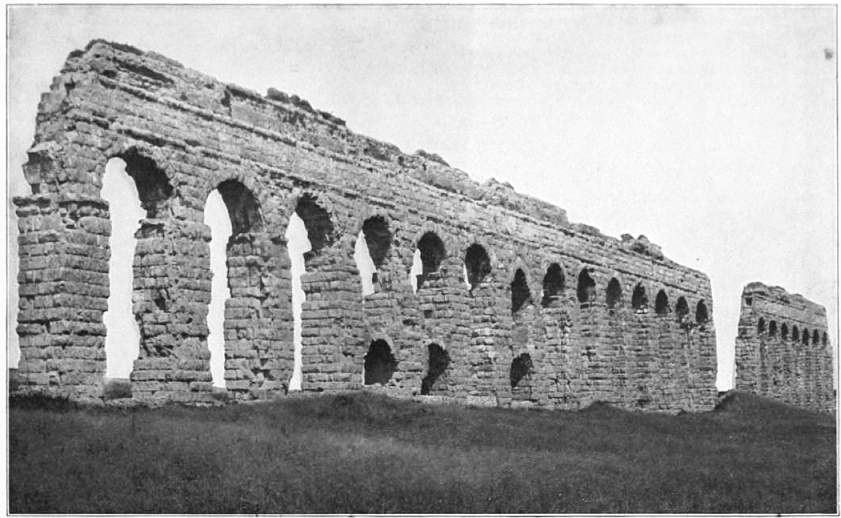
Photo, Altnari.
AQUA CLAUDIA, ROME.
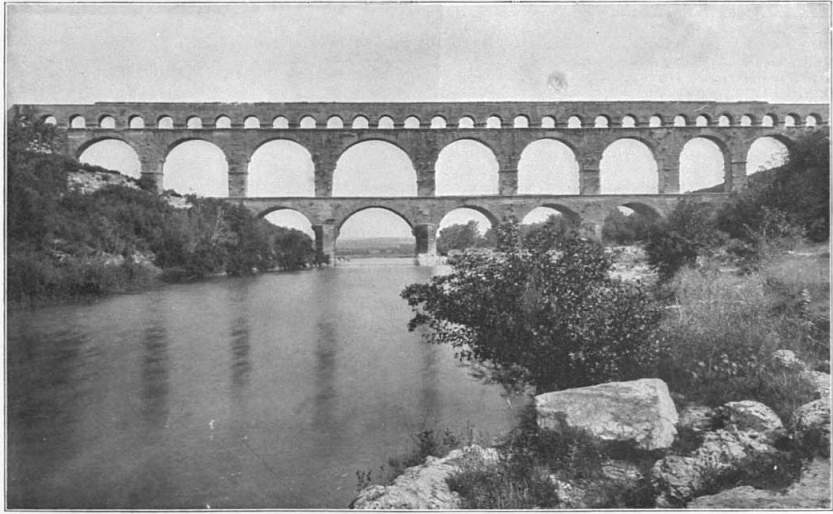
Photo, Neurdein.
PONT DU CARD, NÎMES (NEMAUSUS).
Plate II.
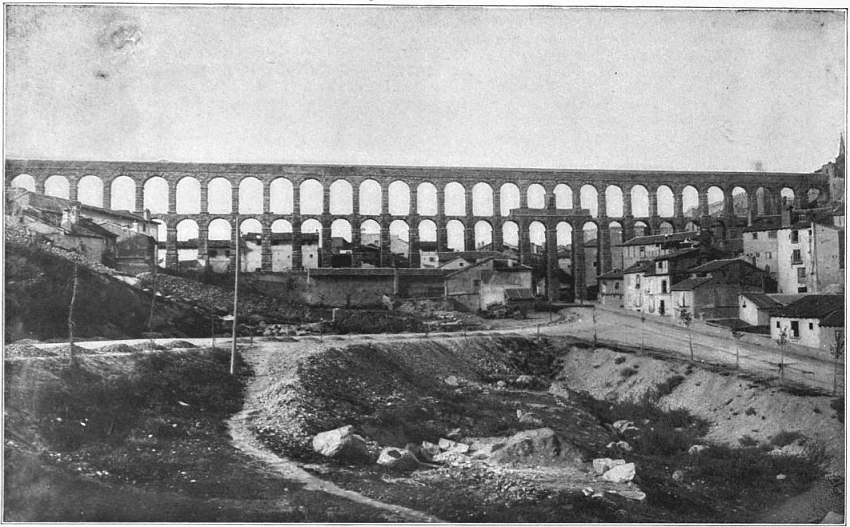
Photo, Laureat y Cia.
ROMAN AQUEDUCT AT SEGOVIA.
Photo, Brogi. PISCINA MIRABILIS AT BAIAE. AQUEDUCT OF ROQUEFAVOUR, MARSEILLES. Early nineteenth century. Photo, Dr T. Ashby. AQUA MARCIA, ROME.
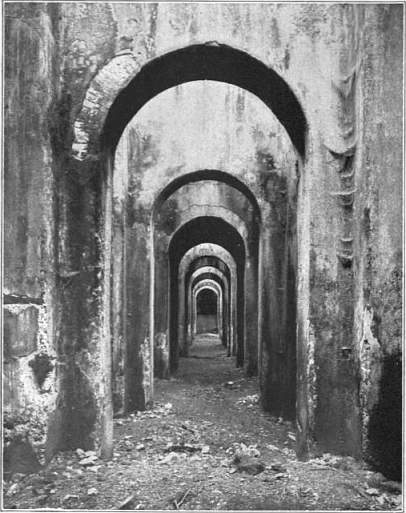
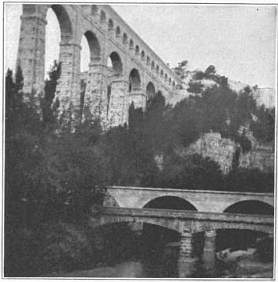
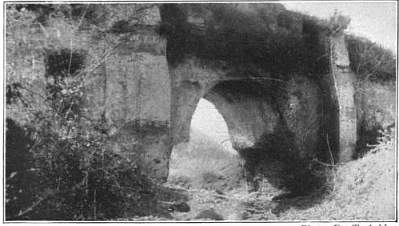
It is agreed that these eleven are all that were constructed. Procopius speaks of fourteen (and the Regionary catalogues mention others), but this number includes branch conduits. All the aqueducts ended in the city in huge castella or reservoirs for the purpose of distribution. Vitruvius recommends the division of these into three parts—one for the supply of fountains, &c., one for the public baths and one for private consumers. In the Piazza Vittorio Emmanuele at Rome there are still to be seen the remains of a large ornamental fountain built probably for the Aqua Julia by Domitian or Alexander Severus (Jordan-Hülsen, Topographie, i. 3350). Besides these main castella there were also many minor castella in various parts of the city for sub-distribution. To allow the water to purify itself before being distributed in the city, filtering and settling tanks (piscinae limariae) were built outside the walls. These piscinae were covered in with a vaulted roof, and were sometimes on a very large scale, as in the example still preserved at Fermo, which consists of two stories, each having three oblong basins communicating with each other; or the Piscina Mirabilis at Baiae, which is covered in by a vaulted roof, supported on forty-eight pillars and perforated to permit the escape of foul air. Two stairs lead by forty steps to the bottom of the reservoir. In the middle of the basin is a sinking to collect the deposit of the water. The walls and pillars are coated with a stucco so hard as to resist a tool.
The oversight of aqueducts was placed, in the times of the republic, under the aediles, who were not, however, the constructors of them; of the four aqueducts built during this period, three are the work of censors, one (the Marcia) of a praetor. Under the empire this task devolved on special officials styled Curatores Aquarum, instituted by Augustus, who, as he himself says, “rivos aquarum omnium refecit” (inscription on the arch by which the Aqua Marcia crossed the Via Tiburtina).
(T. As.)
Among the aqueducts outside Italy, constructed in Roman times and existing still, the most remarkable are: (1) the aqueduct at Nîmes (Nemausus), erected probably by Vipsanius Agrippa in the time of Augustus, which rose to 160 ft. The Pont du Card, as this aqueduct is now called, consists of three tiers of arches across the valley of the river Gardon. In the lowest tier are six arches, of which one has a span of 75 ft., the others each 60 ft. In the second tier are eleven arches, each with a span of 75 ft. In the third tier are thirty-five smaller arches which carried the specus. As a bridge, the Pont du Gard has no rival for lightness and boldness of design among the existing remains of works of this class carried out in Roman times. (2) The aqueduct bridges at Segovia (Merckel, Ingenieurtechnik, pp. 566-568), Tarragona (ibid. 565-566), and Merida in Spain, the former being 2400 ft. long, with 109 arches of fine masonry, in two tiers, and reaching the height of 102 ft. The bridge at Tarragona is 876 ft. long and 83 ft. high. (3) At Mainz are the ruins of an aqueduct 7000 yds. long, about half of which is carried on from 500 to 600 pillars (Archaeological Journal, xlvii., 1890, pp. 211-214). This aqueduct was built by the XIVth legion and was for the use of the camp, not for the townspeople. For the similar aqueduct at Luynes see Arch. Journ. xlv. (1888), pp. 235-237. Similar witnesses of Roman occupation are to be seen in Dacia, Africa (see especially under Carthage), Greece and Asia Minor. (4) The aqueduct at Jouy-aux-Arches, near Metz, which originally extended across the Moselle, here very broad, conveyed to the city an abundance of excellent water from Gorze. From a large reservoir at the source of the aqueduct the water passed along subterranean channels built of hewn stone, and sufficiently spacious for a man to walk in them upright. Similar channels received the water after it had crossed the Moselle by this bridge, at the distance of about 6 m. from Metz, and conveyed it to the city. The bridge consisted of only one row of arches nearly 60 ft. high. The middle arches have given way under the force of the water, but the others are still perfectly solid. This aqueduct is probably to be attributed to the latter half of the 4th century A.D. It is for the use of the town; hence its size. (5) One of the principal bridges of the aqueduct of Antioch in Syria is 700 ft. long, and at the deepest point 200 ft. high. The lower part consists almost entirely of solid wall, and the upper part of a series of arches with very massive pillars. The masonry and design are rude. The water supply was drawn from several springs at a place called Beit el-Ma (anc. Daphne) about 4 or 5 m. from Antioch. From these separate springs the water was conducted by channels of hewn stone into a main channel, similarly constructed, which traversed the rest of the distance, being carried across streams and valleys by means of arches or bridges. (6) At the village of Moris, about an hour’s distance north-west from the town of Mytilene, is the bridge of an aqueduct, carried by massive pillars built of large hewn blocks of grey marble, and connected by means of three rows of arches, of which the uppermost is of brick. The bridge extended about 500 ft. in length, and at the deepest point was from 70 to 80 ft. high. Judged by the masonry and the graceful design, it has been thought to be a work of the age of Augustus. Remains of this aqueduct are to be seen at Larisson Lamarousia, an hour’s distance from Moris, and at St Demetri, two hours and a half from Ayasos, on the road to Vasilika.
The whole subject of the ancient and medieval aqueducts of Asia Minor has been considered in great detail by G. Weber (“Wasserleitungen in kleinasiatischen Städten,” in the Jahrbuch des kaiserl. deutsch. archäolog. Instit. xix., 1904; see also earlier articles in Jahrbuch, 1892, Asia Minor. 1899). The aqueducts examined are those at Pergamum, Laodicea and Smyrna (in the earlier articles), and those at Metropolis (Ionia), Tralles (Aidin), Antioch-on-Maeander, Aphrodisias, Trapezopolis, Hierapolis, Apamea Cibotus and Antioch in Pisidia. In most of these cases it is difficult or even impossible to decide whether the work is Hellenistic or Roman; to the Romans Weber inclines to attribute, e.g. those at Metropolis, Tralles (perhaps), Aphrodisias; to the Greeks, e.g. those at Antioch-on-Maeander and Antioch in Pisidia. Since, therefore, a detailed description of these remains does not provide material for any satisfactory generalizations as to the distinctive features of Hellenistic and Roman work, it will be sufficient here to mention a few of the more interesting discoveries.
In the case of Metropolis, the aqueduct in the valley of the Astraeus consisted of an arcade about 13 to 16 ft. high. Nearer to the town in the hills there are distinct traces of a canal with brick walls. It is clear that the water could not have served more than the lower parts of the town, the acropolis of which is nearly 200 ft. above the level of the conduit. In the case of Tralles the water was supplied by a high pressure conduit and distributed from the acropolis, where there are the remains of a basin (13 ft. by 10) arched over with brick. The ancient aqueduct is to be distinguished from a later, probably Byzantine, canal conduit, the course of which avoids the deeper depressions, crossed by the old aqueduct. Of the Antioch-on-Maeander aqueduct only a few clay-pipes remain, and the same is true of the aqueduct which was built by Carminius in the 2nd century A.D. to supply the community when reinforced by the amalgamation of Plarasa and Tauropolis; two of its basins are still distinguishable, but the two water-towers which are still standing belong to a later Byzantine structure. Trapezopolis was supplied from Mt. Salbacus (Baba Dagh): some twenty stone-pipes have been found built into a low wall which varies from 3¼ to about 5 ft. wide. Of the pillars which carried the conduit-pipe to Antioch in Pisidia, nineteen are still standing. Each arch consists of eleven keystones; no cement was used. The conduit, which was high-pressure, ends in a distributing tower and reservoir.
(J. M. M.)
II. Medieval.—The aqueduct near Spoleto, which now serves also as a bridge, is deserving of notice as an early instance of the use of the pointed arch, belonging as it does to the 7th or 8th century. It has ten arches, remarkable for the elegance of their design and the airy lightness of their proportions, each over 66 ft. in span, and about 300 ft. in height.
The aqueduct of Pyrgos, near Constantinople, is a remarkable example of works of this class carried out in the later times of the Roman empire, and consisted of two branches. From this circumstance it was called Egri Kemer Constantinople. (“the Crooked Aqueduct”), to distinguish it from the Long Aqueduct, situated near the source of the waters. One of the branches extends 670 ft. in length, and is 106 ft. in height at the deepest part. It is composed of three tiers of arches, those in each row increasing in width from the bottom to the top—an arrangement very properly introduced with the view of saving materials without diminishing the strength of the work. The two upper rows consisted of arches of semicircles, the lower of Gothic arches; and this circumstance leads to the belief that the date of the structure is about the 10th century. The breadth of the building at the base was 21 ft., and it diminished with a regular batter on each side to the top, where it was only 11 ft. The base also was protected by strong buttresses or counterforts, erected against each of the pillars. The other branch of the aqueduct was 300 ft. long, and consisted of twelve semicircular arches. This aqueduct serves to convey to Constantinople the waters of the valley of Belgrad, one of the principal sources from which the city is supplied. These are situated on the heights of Mount Haemus, the extremity of the Balkan Mountains, which overhangs the Black Sea. The water rises about 15 m. from the city, and between 3 and 4 m. west of the village of Belgrad, in three sources, which run in three deep and very confined valleys. These unite a little below the village, and then are collected into a large reservoir. After flowing a mile or two from this reservoir, the waters are augmented by two other streams, and conveyed by a channel of stone to the Crooked Aqueduct. From this they are conveyed to another which is the Long Aqueduct; and then, with various accessions, into a third, termed the Aqueduct of Justinian. From this they enter a vaulted conduit, which skirts the hills on the left side of the valley, and crosses a broad valley 2 m. below the Aqueduct of Justinian, by means of an aqueduct, with two tiers of arches of a very beautiful construction. The conduit then proceeds onward in a circuitous route, till it reaches the reservoir of Egri Kapu, situated just without and on the walls of the city. From this the water is conducted to the various quarters of the city, and also to the reservoir of St Sophia, which supplies the seraglio of the grand signior. The Long Aqueduct (Usun Kemer) is more imposing by its extent than the Crooked one, but is far inferior in the regularity of design and disposition of the materials. It is evidently a work of the Turks. It consists of two tiers of arches, the lower being forty-eight in number, and the upper fifty. The whole length was about 2200 ft., and the height 80 ft. The aqueduct of Justinian (Muallak Kemer or “Hanging Aqueduct”) is without doubt one of the finest monuments which remain to us of the middle ages. It consists of two tiers of large pointed arches, pierced transversely. Those of the lower story have 55 ft. of span, the upper ones 40 ft. The piers are supported by strong buttresses, and at different heights they have little arches passing through them laterally, which relieve the deadness of the solid pillar. The length of this aqueduct is 720 ft. and the height 108 ft. This aqueduct has been attributed both to Constantine I. and to Justinian, the latter being perhaps the more probable.
Besides the waters of Belgrad, Constantinople was supplied from several other principal sources, one of which took its rise on the heights of the same mountains, 3 or 4 m. east of Belgrad. This was conveyed in a similar manner by an arched channel elevated, when it was necessary, on aqueduct bridges, till it reached the northern parts of the city. It was in the course of this aqueduct that the contrivance of the souterasi or hydraulic obelisks, described by Andréossy (on his voyage to the Black Sea, the account of the Thracian Bosporus), was constructed, which excited some attention, as being an improvement on the method of conducting water by aqueduct bridges. “The souterasi,” says Andréossy, “are masses of masonry, having generally the form of a truncated pyramid or an Egyptian obelisk. To form a conduit with souterasi, we choose sources of water, the level of which is several feet higher than the reservoir by which it is to be distributed over the city. We bring the water from its sources in subterranean canals, slightly declining until we come to the borders of a valley or broken ground. We there raise on each side a souterasi, to which we adapt vertically leaden pipes of determinate diameters, placed parallel to the two opposite sides of the building. These pipes are disjoined at the upper part of the obelisk, which forms a sort of basin, with which the pipes are connected. The one permits the water to rise to the level from whence it had descended; by the other, the water descends from this level to the foot of the souterasi, where it enters another canal underground, which conducts it to a second and to a third souterasi, where it rises and again descends, as at the last station. Here a reservoir receives it and distributes it in different directions by orifices of which the discharge is known.” Again he says, “it requires but little attention to perceive that this system of conducting tubes is nothing but a series of siphons open at their upper part, and communicating with each other. The expense of a conduit by souterasi is estimated at only one-fifth of that of an aqueduct with arcades.” There seems to be really no advantage in these pyramids, further than as they serve the purpose of discharging the air which collects in the pipes. They are in themselves an evident obstruction, and the water would flow more freely without any interruption of the kind. In regard to the leaden pipes, again, they would have required, with so little head pressure as is stated, to be used of very extraordinary dimensions to pass the same quantity of water as was discharged along the arched conduits (see also works quoted under Constantinople). The other principal source from which Constantinople is supplied, is from the high grounds 6 or 8 m. west of the town, from which it is conducted by conduits and arches, in the same manner as the others. The supply drawn from all these sources, as detailed by Andréossy, amounted to 400,000 cubic ft. per day.
(A. S. M.; J. M. M.)
III. Modern Construction.—Where towns are favourably situated the aqueduct may be very short and its cost bear a relatively small proportion to the total outlay upon a scheme of water supply, but where distant sources have to be relied upon Aqueducts and water supply. the cost of the aqueduct becomes one of the most important features in the scheme, and the quantity of water obtainable must be considerable to justify the outlay. Hence it is that only very large towns can undertake the responsibility for this expenditure. In Great Britain it has in all large schemes become a condition that, when a town is permitted to go outside its own watershed, it shall, subject to a priority of a certain number of gallons per day per head of its own inhabitants, allow local authorities, any part of whose district is within a certain number of miles of the aqueduct, to take a supply on reasonable terms. The first case in which this principle was adopted on a large scale was the Thirlmere scheme sanctioned by parliament in 1879, for augmenting the supply of Manchester. The previous supply was derived from a source only about 15 m. distant, and the cost of the aqueduct, chiefly cast-iron pipes, was insignificant compared with the cost of the impounding reservoirs. But Thirlmere is 96 m. distant from the service reservoir near Manchester, and the cost of the aqueduct was more than 90% of the total cost. As a supply of about 50,000,000 gallons a day is available the outlay was justifiable, and the water is in fact very cheaply obtained. Liverpool derives a supply of about 40,000,000 gallons a day from the river Vyrnwy in North Wales, 68 m. distant, and Birmingham has constructed works for impounding water in Radnorshire, and conveying it a distance of 74 m., the supply being about 75,000,000 gallons a day. In the year 1899 an act of parliament was passed authorizing the towns of Derby, Leicester, Sheffield and Nottingham, jointly to obtain a supply of water from the head waters of the river Derwent in Derbyshire. Leicester is 60 m. distant from this source, and its share of the supply is about 10,000,000 gallons a day. For more than half the distance, however, the aqueduct is common to Derby and Nottingham, which together are entitled to about 16,000,000 gallons a day, and the expense to Leicester is correspondingly reduced. These are the most important cases of long aqueducts in England, and all are subsequent to 1879. It is obvious, therefore, how greatly the design and construction of the aqueduct have grown in importance, and what care must be Exercised in order that the supply upon which such large populations depend may not be interrupted, and that the country through which such large volumes of water are conveyed may not be flooded in consequence of the failure of any of the works.
Practically only two types of aqueduct are used in England. The one is built of concrete, brickwork, &c., the other of cast-iron (or, in special circumstances, steel) pipes. In the former type the water surface coincides with the Construction. hydraulic gradient, and the conditions are those of an artificial river; the aqueduct must therefore be carefully graded throughout, so that the fall available between source and termination may be economically distributed. This condition requires that the ground in which the work is built shall be at the proper elevation; if at any point this is not the case, the aqueduct must be carried on a substructure built up to the required level. Such large structures are, however, extremely expensive, and require elaborate devices for maintaining water-tightness against the expansion and contraction of the masonry due to changes of temperature. They are now only used where their length is very short, as in cases where mountain streams have to be crossed, and even these short lengths are avoided by some engineers, who arrange that the aqueduct shall pass, wherever practicable, under the streams. Where wide valleys interrupt the course of the built aqueduct, or where the absence of high ground prevents the adoption of that type at any part of the route, the cast-iron pipes hereafter referred to are used.
The built aqueduct may be either in tunnel, or cut-and-cover, the latter term denoting the process of cutting the trench, building the floor, side-walls, and roof, and covering with earth, the surface of the ground being restored Masonry aqueducts. as before. For works conveying water for domestic supply, the aqueduct is in these days, in England, always covered. Where, as is usually the case, the water is derived from a tract of mountainous country, the tunnel work is sometimes very heavy. In the case of the Thirlmere aqueduct, out of the first 13 m. the length of the tunnelled portions is 8 m., the longest tunnel being 3 m. in length. Conditions of time, and the character of the rock, usually require the use of machinery for driving, at any rate in the case of the longer tunnels. For the comparatively small tunnels required for aqueducts, two percussion drilling machines are usually mounted on a carriage, the motive power being derived from compressed air sent up the tunnel in pipes. The holes when driven are charged with explosives and fired. In the Thirlmere tunnels, driven through very hard Lower Silurian strata, the progress was about 13 yds. a week at each face, work being carried on continuously day and night for six days a week. Where the character of the country through which the aqueduct passes is much the same as that from which the supply is derived, the tunnels need not be lined with concrete, &c., more than is absolutely necessary for retaining the water and supporting weak places in the rock; the floor, however, is nearly always so treated. The lining, whether in tunnel or cut-and-cover, may be either of concrete, or brickwork, or of concrete faced with brickwork. To ensure the impermeability of work constructed with these materials is in practice somewhat difficult, and no matter how much care is taken by those supervising the workmen, and even by the workmen themselves, it is impossible to guarantee entire freedom from trouble in this respect. With a wall only about 15 in. thick, any neglect is certain to make the work permeable; frequently the labourers do not distribute the broken stone and fine material of the concrete uniformly, and no matter how excellent the design, the quality of materials, &c., a leak is sure to occur at such places (unless, indeed, the pressure of the outside water is superior and an inflow occurs). A further cause of trouble lies in the water which flows from the strata on to the concrete, and washes away some of the cement upon which the work depends for its watertightness, before it has time to set. For this reason it is advisable to put in the floor before, and not after, the sidewalls and arch have been built, otherwise the only outlet for the water in the strata is through the ground on which the floor has to be laid. Each length of about 20 ft. should be completely constructed before the next is begun, the water then having an easy exit at the leading end. Manholes, by which the aqueduct can be entered, are usually placed in the roof at convenient intervals; thus, in the case of the Thirlmere aqueduct, they occur at every quarter of a mile.
In some parts of America aqueducts are frequently constructed of wood, being then termed flumes. These are probably more extensively used in California than in any other part of the world, for conveying large quantities of water Timber aqueducts. which is required for hydraulic mining, for irrigation, for the supply of towns and for transporting timber. The flumes are frequently carried along precipitous mountain slopes, and across valleys, supported on trestles. In Fresno county, California, there is a flume 52 m. in length for transporting timber from the Sierra Nevada Mountains to the plain below; it has a rectangular V-shaped section, 3 ft. 7 in. wide at the top, and 21 in. deep vertically. The boards which form the sides are 1¼ in. thick, and some of the trestlework is 130 ft. high. The steepest grade occurs where there is a fall of 730 ft. in a length of 3000 ft. About 9,000,000 ft. of timber were used in the construction. At San Diego there is a flume 35 m. long for irrigation and domestic supply, the capacity being 50 ft. per second; it has 315 trestle bridges (the longest of which is that across Los Coches Creek, 1794 ft. in length and 65 ft. in height) and 8 tunnels, and the cost was $900,000. The great bench flume of the Highline canal, Colorado, is 2640 ft. in length, 28 ft. wide, and 7 ft. deep; the gradient is 5.28 ft. per mile, and the discharge 1184 ft. per second.
As previously stated, the type of aqueduct built of concrete, &c., can only be adopted where the ground is sufficiently elevated to carry it, and where the quantity of water to be conveyed makes it more economical than piping. Where the falling contour Aqueduct in iron piping. is interrupted by valleys too wide for a masonry structure above the surface of the ground, the detached portions of the built aqueduct must be connected by rows of pipes laid beneath, and following the main undulations of, the surface. In such cases the built aqueduct terminates in a chamber of sufficient size to enclose the mouths of the several pipes, which, thus charged, carry the water under the valley up to a corresponding chamber on the farther hillside from which the built aqueduct again carries on the supply. These connecting pipes are sometimes called siphons, although they have nothing whatever to do with the principle of a siphon, the water simply flowing into the pipe at one end and out at the other under the influence of gravity, and the pressure of the atmosphere being no element in the case. The pipes are almost always made of cast-iron, except in such cases as the lower part of some siphons, where the pressure is very great, or where they are for use abroad, when considerations of weight are of importance, and when they are made of rolled steel with riveted or welded seams. It is frequently necessary to lay them in deep cuttings, in which case cast-iron is much better adapted for sustaining a heavy weight of earth than the thinner steel, though the latter is more adapted to resist internal pressure. Mr D. Clarke (Trans. Am. Soc. C.E. vol. xxxviii. p. 93) gives some particulars of a riveted steel pipe 24 m. long, 33 to 42 in. diameter, varying in thickness from 0.22 in. to 0.375 in. After a length of 9 m. had been laid, and the trench refilled, it was found that the crown of the pipe had been flattened by an amount varying from ½ in. to 4 in. Steel pipes suffer more from corrosion than those made of cast-iron, and as the metal attacked is much thinner the strength is more seriously reduced. These considerations have prevented any general change from cast-iron to steel.
Mr. Clemens Herschel has made some interesting remarks (Proc. Inst. C.E. vol. cxv. p. 162) as to the circumstances in which steel pipes have been found preferable to cast-iron. He says that it had been demonstrated by practice that cast-iron cannot compete with wrought-iron or steel pipes in the states west of the Rocky Mountains, on the Pacific slope. This is due to the absence of coal and iron ore in these states, and to the weight of the imported cast-iron pipes compared with steel pipes of equal capacity and strength. The works of the East Jersey Water Company for the supply of Newark, N.J., include a riveted steel conduit 48 in. in diameter and 21 m. long. This conduit is designed to resist only the pressure due to the hydraulic gradient, in contradistinction to that which would be due to the hydrostatic head, this arrangement saving 40% in the weight and cost of the pipes. For the supply of Rochester, N.Y., there is a riveted steel conduit 36 in. in diameter and 20 m. long; and for Allegheny City, Pennsylvania, there is a steel conduit 5 ft. in diameter and nearly 10 m. long. The works for bringing the water from La Vigne and Verneuil to Paris include a steel main 5 ft. in diameter between St. Cloud and Paris.
Cast-iron pipes rarely exceed 48 in. in diameter, and even this diameter is only practicable where the pressure of the water is low. In the Thirlmere aqueduct the greatest pressure is nearly 180 ℔ on the square inch, the pipes where this occurs being 40 in. in diameter and 1¾ in. thick. These large pipes, which are usually made in lengths of 12 ft., are generally cast with a socket at one end for receiving the spigot end of the next pipe, the annular space being run with lead, which is prevented from flowing into the interior of the pipe by a spring ring subsequently removed; the surface of the lead is then caulked all round the outside of the pipe. A wrought-iron ring is sometimes shrunk on the outer rim of the socket, previously turned to receive it, in order to strengthen it against the wedging action of the caulking tool. Sometimes the pipes are cast as plain tubes and joined with double collars, which are run with lead as in the last case. The reason for adopting the latter type is that the stresses set up in the thicker metal of the socket by unequal cooling are thereby avoided, a very usual place for pipes to crack under pressure being at the back of the socket. The method of turning and boring a portion, slightly tapered, of spigot and socket so as to ensure a watertight junction by close annular metallic contact, is not suitable for large pipes, though very convenient for smaller diameters in even ground. Spherical joints are sometimes used where a line of main has to be laid under a large river or estuary, and where, therefore, the pipes must be jointed before being lowered into the previously dredged trench. This was the case at the Willamette river, Portland, Oregon, where a length of 2000 ft. was required. The pipes are of cast-iron 28 in. in diameter, 1½ in. thick, and 17 ft. long. The spigots were turned to a spherical surface of 20 in. radius outside, the inside of the sockets being of a radius 3⁄8 in. greater. After the insertion of the spigot into the socket, a ring, 3 in. deep, turned inside to correspond with the socket, was bolted to the latter, the annular space then being run with lead. These pipes were laid on an inclined cradle, one end of which rested on the bed of the river and the other on a barge where the jointing was done; as the pipes were jointed the barge was carefully advanced, thus trailing the pipes into the trench (Trans. Am. Soc. C.E. vol. xxxiii. p. 257). As may be conjectured from the pressure which they have to stand, very great care has to be taken in the manufacture and handling of cast-iron pipes of large diameter, a care which must be unfailing from the time of casting until they are jointed in their final position in the ground. They are cast vertically, socket downwards, so that the densest metal may be at the weakest part, and it is advisable to allow an extra head of metal of about 12 in., which is subsequently cut off in a lathe. An inspector representing the purchaser watches every detail of the manufacture, and if, after being measured in every part and weighed, they are found satisfactory they are proved with internal fluid pressure, oil being preferable to water for this purpose. While under pressure, they are rapped from end to end with a hand hammer of about 5 ℔ in weight, in order to discover defects. The wrought-iron rings are then, if required, shrunk on to the sockets, and the pipes, after being made hot in a stove, are dipped vertically in a composition of pitch and oil, in order to preserve them from corrosion. All these operations are performed under cover. A record should be kept of the history of the pipe from the time it is cast to the time it is laid and jointed in the ground, giving the date, number, diameter, length, thickness, and proof pressure, with the name of the pipe-jointer whose work closes the record. Such a history sometimes enables the cause (which is often very obscure) of a burst in a pipe to be ascertained, the position of every pipe being recorded.
Cast-iron pipes, even when dipped in the composition referred to, suffer considerably from corrosion caused by the water, especially soft water, flowing through them. One pipe may be found in as good a condition as when made, while the next may be covered with nodules of rust. The effect of the rust is twofold; it reduces the area of the pipe, and also, in consequence of the resistance offered by the rough surface, retards the velocity of the water. These two results, expecially the latter, may seriously diminish the capability of discharge, and they should always be allowed for in deciding the diameter. Automatic scrapers are sometimes used with good results, but it is better to be independent of them as long as possible. In one case the discharge of pipes, 40 in. in diameter, was found after a period of about twelve years to have diminished at the rate of about 1% per year; in another case, where the water was soft and where the pipes were 40 in. in diameter, the discharge was diminished by 7% in ten years. An account of the state of two cast-iron mains supplying Boston with water is given in the Trans. Am. Soc. C.E. vol. xxxv. p. 241. These pipes, which were laid in 1877, are 48 in. in diameter and 1800 ft. long. When they were examined in 1894-1895, it was estimated that the tubercles of rust covered nearly one-third of the interior surfaces, the bottom of the pipe being more encrusted than the sides and top. They had central points of attachment to the iron, at which no doubt the coating was defective, and from them the tubercles spread over the surface of the surrounding coating. In this case they were removed by hand, and the coating of the pipes was not injured in the process. Cast-iron pipes must not be laid in contact with cinders from a blast furnace with which roads are sometimes made, because these corrode the metal. Mr Russell Aitken (Proc. Inst. C.E. vol. cxv. p. 93) found in India that cast-iron pipes buried in the soil rapidly corroded, owing to the presence of nitric acid secreted by bacteria which attacked the iron. The large cast-iron pipes conveying the water from the Tansa reservoir to Bombay are laid above the surface of the ground. Cast-iron pipes of these large diameters have not been in existence sufficiently long to enable their life to be predicted. A main, 40 in. in diameter, conveying soft water, after being in existence fifty years at Manchester, was apparently as good as ever. In 1867 Mr J.B. Francis found that no apparent deterioration had taken place in a cast-iron main, 8 in. diameter, which was laid in the year 1828, a period of thirty-nine years (Trans. Soc. Am. C.E. vol. i. p. 26). These two instances are probably not exceptional.
Pipes in England are usually laid with not less than 2 ft. 6 in. of cover, in order that the water may not be frozen in a severe winter. Where they are laid in deep cutting they should be partly surrounded with concrete, so that they Methods of laying. may not be fractured by the weight of earth above them. Angles are turned by means of special bend pipes, the curves being made of as large a radius as convenient. In the case of the Thirlmere aqueduct, double socketed castings about 12 in. long (exclusive of the sockets) were used, the sockets being inclined to each other at the required angle. They were made to various angles, and for any particular curve several would be used connected by straight pipes 3 ft. long. As special castings are nearly double the price of the regular pipes, the cost was much diminished by making them as short as possible, while a curve, made up of the slight angles used, offered practically no more impediment to the flow of water in consequence of its polygonal form, than would be the case had special bend pipes been used. In all cases of curves on a line of pipes under internal fluid pressure, there exists a resultant force tending to displace the pipes. When the curve is in a horizontal plane and the pipes are buried in the ground, the side of the pipe trench offers sufficient resistance to this force. Where, however, the pipes are above ground, or when the curve is in a vertical plane, it is necessary to anchor them in position. In the case of the Tansa aqueduct to Bombay, there is a curve of 500 ft. radius near Bassein Creek. At this point the hydrostatic head is about 250 ft., and the engineer, Mr Clerke, mentions that a tendency to an outward movement of the line of pipes was observed. At the siphon under Kurla Creek the curves on the approaches as originally laid down were sharp, the hydrostatic head being there about 210 ft.; here the outward movement was so marked that it was considered advisable to realign the approaches with easier curves (Proc. Inst. C.E. vol. cxv. p. 34). In the case of the Thirlmere aqueduct the greatest hydrostatic pressure, 410 ft., occurs at the bridge over the river Lune, where the pipes are 40 in. in diameter, and in descending from the bridge make reverse angles of 31½°. The displacing force at each of these angles amounts to 54 tons, and as the design includes five lines of pipes, it is obvious that the anchoring arrangements must be very efficient. The steel straps used for anchoring these and all other bends were curved to fit as closely as possible the castings to be anchored. Naturally the metal was not in perfect contact, but when the pipes were charged the disappearance of all the slight inequalities showed that the straps were fulfilling their intended purpose. At every summit on a line of pipes one or more valves must be placed in order to allow the escape of air, and they must also be provided on long level stretches, and at changes of gradient where the depth of the point of change below the hydraulic gradient is less than that at both sides, causing what may be called a virtual summit. It is better to have too many than too few, as accumulations of air may cause an enormous diminution in the quantity of water delivered. In all depressions discharge valves should be placed for emptying the pipes when desired, and for letting off the sediment which accumulates at such points. Automatic valves are frequently placed at suitable distances for cutting off the supply in case of a burst. At the inlet mouth of the pipe they may depend for their action on the sudden lowering of the water (due to a burst in the pipe) in the chamber from which they draw their supply, causing a float to sink and set the closing arrangement in motion. Those on the line of main are started by the increased velocity in the water, caused by the burst on the pipe at a lower level. The water, when thus accelerated, is able to move a disk hung in the pipe at the end of a lever and weighted so as to resist the normal velocity; this lever releases a catch, and a door is then gradually revolved by weights until it entirely closes the pipe. Reflux valves on the ascending leg of a siphon prevent water from flowing back in case of a burst below them; they have doors hung on hinges, opening only in the normal direction of flow. Due allowance must be made, in the amount of head allotted to a pipe, for any head which may be absorbed by such mechanical arrangements as those described where they offer opposition to the flow of the water. These large mains require most careful and gradual filling with water, and constant attention must be given to the air-valves to see that the gutta-percha balls do not wedge themselves in the openings. A large mass of water, having a considerable velocity, may cause a great many bursts by water-ramming, due to the admission of the water at too great a speed. In places where iron is absent and timber plentiful, as in some parts of America, pipes, even of large diameter and in the most important cases, are sometimes made of wooden staves hooped with iron. A description of two of these will be found below.
The Thirlmere Aqueduct is capable of conveying 50,000,000 gallons a day from Thirlmere, in the English lake district, to Manchester. The total length of 96 m. is made up of 14 m. of tunnels, 37 m. of cut-and-cover, and 45 m. of cast-iron Thirlmere. pipes, five rows of the latter being required. The tunnels where lined, and the cut-and-cover, are formed of concrete, and are 7 ft. in height and width, the usual thickness of the concrete being 15 in. The inclination is 20 in. per mile. The floor is flat from side to side, and the side-walls are 5 ft. high to the springing of the arch, which has a rise of 2 ft. The water from the lake is received in a circular well 65 ft. deep and 40 ft. in diameter, at the bottom of which there is a ring of wire-gauze strainers. Wherever the concrete aqueduct is intersected by valleys, cast-iron pipes are laid; in the first instance only two of the five rows 40 in. in diameter were laid, the city not requiring its supply to be augmented by more than 20,000,000 gallons a day, but in 1907 it was decided to lay a third line. All the elaborate arrangements described above for stopping the water in case of a burst have been employed, and have perfectly fulfilled their duties in the few cases in which they have been called into action. The water is received in a service reservoir at Prestwich, near Manchester, from which it is supplied to the city. The supply from this source was begun in 1894. The total cost of the complete scheme may be taken at about £5,000,000, of which rather under £3,000,000 had been spent up to the date of the opening, at which time only one line of pipes had been laid.
The Vyrnwy Aqueduct was sanctioned by parliament in 1880 for the supply of Liverpool from North Wales, the quantity of water obtainable being at least 40,000,000 gallons a day. A tower built in the artificial lake from which the supply is Vyrnwy. derived, contains the inlet and arrangements for straining the water. The aqueduct is 68 m. in length, and for nearly the whole distance will consist of three lines of cast-iron pipes, two of which, varying in diameter from 42 in. to 39 in., are now in use. As the total fall between Vyrnwy and the termination at Prescot reservoirs is about 550 ft., arrangements had to be made to ensure that no part of the aqueduct be subjected to a greater pressure than is required for the actual discharge. Balancing reservoirs have therefore been constructed at five points on the line, advantage being taken of high ground where available, so that the total pressure is broken up into sections. At one of these points, where the ground level is 110 ft. below the hydraulic gradient, a circular tower is built, making a most imposing architectural feature in the landscape. At the crossing of the river Weaver, 100 ft. wide and 15 ft. deep, the three pipes, here made of steel, were connected together laterally, floated into position, and sunk into a dredged trench prepared to receive them. Under the river Mersey the pipes are carried in a tunnel, from which, during construction, the water was excluded by compressed air.
Denver Aqueduct.—The supply to Denver City, initiated by the Citizens Water Company in 1889, is derived from the Platte river, rising in the Rocky Mountains. The first aqueduct constructed is rather over 20 m. in length, of which a Denver. length of 16½ m. is made of wooden stave pipe, 30 in. in diameter. The maximum pressure is that due to 185 ft. of water; the average cost of the wooden pipe was $1.36½ per foot, and the capability of discharge 8,400,000 gallons a day. Within a year of the completion of the first conduit, it became evident that another of still greater capacity was required. This was completed in April 1893; it is 34 in. in diameter and will deliver 16,000,000 gallons a day. By increasing the head upon the first pipe, the combined discharge is 30,000,000 gallons a day. An incident in obtaining a temporary supply, without waiting for the completion of the second pipe, was the construction of two wooden pipes, 13 in. in diameter, crossing a stream with a span of 104 ft., and having no support other than that derived from their arched form. One end of the arch is 24½ ft. above the other end, and, when filled with water, the deflection with eight men on it was only 7⁄8 of an inch. A somewhat similar arch, 60 ft. span, occurs on the 34-in. pipe where it crosses a canal. Schuyler points out (Trans. Am. Soc. C.E. vol. xxxi. p. 148) that the fact that the entire water supply of a city of 150,000 inhabitants is conveyed in wooden mains, is so radical a departure from all precedents, that it is deserving of more than a passing notice. He says that it is manifestly and unreservedly successful, and has achieved an enormous saving in cost. The sum saved by the use of wooden, in preference to cast-iron pipes, is estimated at $1,100,000. It is perhaps necessary to state that the pipe is buried in the ground in the same way as metal pipes. The edges of the staves are dressed to the radius with a minute tongue 1⁄16 in. high on one edge of each stave, but with no corresponding groove in the next stave; its object is to ensure a close joint when the bands are tightened up. Leaks seldom or never occur along the longitudinal seams, but the end shrinkage caused troublesome joint leaks. The shrinkage in California redwood, which had seasoned 60 to 90 days before milling, was frequently as much as 3 in. in the 20 staves that formed the 34-in. pipe, and the space so formed had to be filled by a special closing stave. Metallic tongues, ¾ in. deep, are inserted at the ends of abutting staves, in a straight saw cut. The bands, which are of mild steel, have a head at one end and a nut and washer at the other; the ends are brought together on a wrought-iron shoe, against which the nut and washer set. The staves forming the lower half of the pipe are placed on an outside, and the top staves on an inside, mould. While the bands are being adjusted the pipe is rounded out to bring the staves out full, and the staves are carefully driven home on to the abutting staves. The spacing of the bands depends on circumstances, but is about 150 bands per 100 ft. With low heads the limit of spacing was fixed at 17 in. The outer surface of the pipe, when charged, shows moisture oozing slightly over the entire surface. This condition Schuyler considers an ideal one for perfect preservation, and the staves were kept as thin as possible to ensure its occurrence. Samples taken from pipes in use from three to nine years are quite sound, and it is concluded that the wood will last as long as cast-iron if the pipe is kept constantly charged. The bands are the only perishable portion, and their life is taken at from fifteen to twenty years. Other portions of the second conduit for a length of nearly 3 m. were formed of concrete piping, 38 in. diameter, formed on a mould in the trench, the thickness being 2½ to 3 in. So successful an instance of the use of wooden piping on a large scale is sure to lead to a large development of this type of aqueduct in districts where timber is plentiful and iron absent.
Pioneer Aqueduct, Utah.—The construction of the Pioneer Aqueduct, Utah, was begun in 1896 by the Pioneer Electric Power Company, near the city of Ogden, 35 m. north of Salt Lake City. The storage reservoir, from which it draws Pioneer, Utah. its water, will coyer an area of 2000 acres, and contain about 15,000 million gallons of water. The aqueduct is a pipe 6 ft. in diameter, and of a total length of 6 m.; for a distance of rather more than 5 m. it is formed of wooden staves, the remainder, where the head exceeds 117 ft., being of steel. It is laid in a trench and covered to a depth of 3 ft. The greatest pressure on the steel pipe is 200 ℔ per sq. in., and the thickness varies from 3⁄8 to 11⁄16 in. The pipe was constructed according to the usual practice of marine boiler-work for high pressures, and each section, about 9 ft. long, was dipped in asphalt for an hour. These sections were supported on timber blocking, placed from 5 to 9 ft. apart, and consisting of three to six pieces of 6 × 6 in. timbers laid one on the top of the other; they were then riveted together in the ordinary way. The wooden stave-pipe is of the type successfully used in the Western States for many years, but its diameter is believed to be unequalled for any but short lengths. There were thirty-two staves in the circle, 2 in. in thickness, and about 20 ft. long, hooped with round steel rods 5⁄8 in. in diameter, each hoop being in two pieces. The pipe is supported at intervals of 8 ft. by sills 6 × 8 in. and 8 ft. long. The flow through it is 250 cubic ft. per second.
The Santa Ana Canal was constructed for irrigation purposes in California, and is designed to carry 240 cub. ft. of water per second (Trans. Am. Soc. C.E. vol. xxxiii. p. 99). The cross section of the flumes shows an elliptical bottom and Santa Ana. straight sides consisting of wooden staves held together by iron and steel ribs. The width and depth are each 5 ft. 6 in., the intended depth of water being 5 ft. The staves are held by T-iron supports resting on wooden sills spaced 8 ft. apart, and are compressed together by a framework. They were caulked with oakum, on the top of which, to a third of the total depth, hot asphalt was run. The use of nails was altogether avoided except in parts of the framework, it being noticed that decay usually starts at nail-holes. It was found possible to make the flume absolutely watertight, and in case of repair being necessary at any part the framework is easily taken to pieces so that new staves can be inserted. The water in the flume has a velocity of 9.6 ft. per second. The Warm Springs, Deep, and Morton cañons on the line are crossed by wooden stave pipes 52 in. in diameter, bound with round steel rods, and laid above the surface of the ground. The work is planned for two rows of pipes, each capable of carrying 123 cub. ft. per second; of these one so far has been laid. The lengths of the pipes at each of the three cañons are 551, 964 and 756 ft. respectively, and the maximum head at any place is 160 ft. The pipes are not painted, and it has been suggested that they would suffer in their exposed position in case of a bush fire, a contingency to which, of course, flumes are also liable.
Aqueducts of New York.—There are three aqueducts in New York—the Old Croton Aqueduct (1837-1843), the Bronx River Conduit (1880-1885), and the New Croton Aqueduct (1884-1893), discharging respectively 95, 28, and 302 million U.S. New York. gallons a day; their combined delivery is therefore 425 million gallons a day. The Old Croton Aqueduct is about 41 m. in length, and was constructed as a masonry conduit, except at the Harlem and Manhattan valleys, where two lines of 36-in. pipe were used. The inclination of the former is at the rate of about 13 in. per mile. The area of the cross-section is 53.34 sq. ft., the height is 8½ ft., and the greatest width 7 ft. 5 in.; the roof is semicircular, the floor segmental, and the sides have a batter on the face of ½ in. per foot. The sides and invert are of concrete, faced with 4 in. of brickwork, the roof being entirely of brickwork. There is a bridge over the Harlem river 1450 ft. in length, consisting of fifteen semicircular arches; its soffit is 100 ft. above high water, and its cost was $963,427. The construction of the New Croton Aqueduct was begun in 1885, and the works were sufficiently advanced by the 15th of July 1890 to allow the supply to be begun. The lengths of the various parts of the aqueduct are as follows:—
Miles.
Tunnel 29.75
Cut-and-cover 1.12
Cast-iron pipes, 48 in. diameter, 8 rows. 2.38
——
Croton Inlet to Central Park. 33.25
====
The length of tunnel under pressure (circular form) is 7.17 m., and that not under pressure (horse-shoe form) 23.70 m. The maximum pressure in the former is 55 ℔ per sq. in. The width and height of the horse-shoe form are each 13 ft. 7 in., and the diameter of the circular form (with the exception of two short lengths) is 12 ft. 3 in. The reason for constructing the aqueduct in tunnel for so long a distance was the enhanced value of the low-lying ground near the old aqueduct. The tunnel deviates from a straight line only for the purpose of intersecting a few transverse valleys at which it could be emptied. For 25 m. the gradient is 0.7 foot per mile; the tunnel is then depressed below the hydraulic gradient, the maximum depth being at the Harlem river, where it is 300 ft. below high water. The depth of the tunnel varies from 50 to 500 ft. from the surface of the ground. Forty-two shafts were sunk to facilitate driving, and in four cases where the surface of the ground is below the hydraulic gradient these are closed by watertight covers. The whole of the tunnel is lined with brickwork from 1 to 2 ft. in thickness, the voids behind the lining being filled with rubble-in-mortar. The entry to the old and new aqueducts is controlled by a gatehouse of elaborate and massive design, and the pipes which take up the supply at the end of the tunnel are also commanded by a gate-house. The aqueduct, where it passes under the Harlem river, is worthy of special notice. As it approaches the river it has a considerable fall, and eventually ends in a vertical shaft 12 ft. 3 in. in diameter (where the water has a fall of 174 ft.), from the bottom of which, at a depth of 300 ft. below high-water level, the tunnel under the river starts. The latter is circular in form, the diameter being 10 ft. 6 in., and the length is 1300 ft.; it terminates at the bottom of another vertical shaft also 12 ft. 3 in. in diameter. The depth of this shaft, measured from the floor of the lower tunnel to that of the upper tunnel leading away from it, is 321 ft.; it is continued up to the surface of the ground, though closed by double watertight covers a little above the level of the upper tunnel. Adjoining this shaft is another shaft of equal diameter, by means of which the water can be pumped out, and there is also a communication with the river above high-water level, so that the higher parts can be emptied by gravitation. The cost of the Old Croton Aqueduct was $11,500,000; that of the new aqueduct is not far short of $20,000,000.
The Nadrai Aqueduct Bridge, in India, opened at the end of 1889, is the largest structure of its kind in existence. It was built to carry the water of the Lower Ganges canal over the Kali Naddi, in connexion with the irrigation canals of the north-west provinces. Nadrai. In the year 1888-1889 this canal had 564 m. of main line, with 2050 m. of minor distributaries, and irrigated 519,022 acres of crops. The new bridge replaces one of much smaller size (five spans of 35 ft.), which was completely destroyed by a high flood in July 1885. It gives the river a waterway of 21,000 sq. ft., and the canal a waterway of 1040 sq. ft., the latter representing a discharge of 4100 cub. ft. per second. Its length is 1310 ft., and it is carried on fifteen arches having a span of 60 ft. The width between the faces of the arches is 149 ft. The foundations below the river-bed have a depth of 52 ft., and the total height of the structure is 88 ft. It cost 44½ lakhs of rupees, and occupied four years in building. The foundations consist of 268 circular brick cylinders, and the fifteen spans are arranged in three groups, divided by abutment piers; the latter are founded on a double row of 12-ft. cylinders, and the intermediate piers on a single row of 20-ft. cylinders, all the cylinders being hearted with hydraulic lime concrete filled in with skips. This aqueduct-bridge has a very fine appearance, owing to its massive proportions and design.
(E. P. H.*)
Authorities.—For ancient aqueducts in general: Curt Merckel, Die Ingenieurtechnik im Alterthum (Berlin, 1899); ch. vi. contains a very full account from the earliest Assyrian aqueducts onwards, with illustrations, measurements and an excellent bibliography. For Greek aqueducts see E. Curtius, “Über städtische Wasserbauten der Hellenen,” in Archaeologische Zeitung (1847); G. Weber (as above); papers in Athen. Mittheil. (Samos), 1877, (Enneacrunus) 1892, 1893, 1894, 1905, and articles on Athens, Pergamum, &c. For Roman aqueducts: R. Lanciani, “I Commentari di Frontino intorno le acque e gli acquedotti,” in Memorie dei Lincei, serie iii. vol. iv. (Rome, 1880), 215 sqq., and separately; C. Herschel, The Two Books on the Water Supply of the City of Rome of Sextus Julius Frontinus (Boston, 1899); T. Ashby in Classical Review (1902), 336, and articles in The Builder; cf. also the maps to T. Ashby’s “Classical Topography of the Roman Campagna,” in Papers of the British School at Rome, i., in., iv. (in progress).
For modern aqueducts, see Rickman’s Life of Telford (1838); Schramke’s New York Croton Aqueduct; Second Annual Report of the Department of Public Works of the City of New York in 1872; Report of the Aqueduct Commissioners (1887-1895), and The Water Supply of the City of New York (1896), by Wegmann; Mémoires sur les eaux de Paris, presentés par le Préfet de la Seine au Conseil Municipal (1854 and 1858); Recherches statistiques sur les sources du bassin de la Seine, par M. Belgrand, Ingénieur en chef des ponts et chaussées (1854); “Descriptions of Mechanical Arrangements of the Manchester Waterworks,” by John Frederic Bateman, F.R.S., Engineer-in-chief, from the Minutes of Proceedings of the Institution of Mechanical Engineers (1866); The Glasgow Waterworks, by James M. Gale, Member Inst. C.E. (1863 and 1864); The Report of the Royal Commission on Water Supply, and the Minutes of Evidence (1867 and 1868). For accounts of other aqueducts, see the Transactions of the Societies of Engineers in the different countries, and the Engineering Journals.
1 There have been found at Caerwent, in Monmouthshire, clear traces of wooden pipes (internal diameter about 2 in.) which must have carried drinking-water, and almost certainly a pressure supply from the surrounding hills. Some patches of lead also have been found obviously nailed on to the pipes at points where they had burst (see Archaeologia, 1908).
2 This distance will not agree with the length given on some of the cippi (Lanciani, Bull. Com., 1899, 38).
3 The course of the Aqua Claudia was considerably shortened by the cutting of a tunnel 3 m. long under the Monte Affliano in the time of Domitian (T. Ashby, in Papers of the British School at Rome, iii, 133).
4 About 3 m. south-east of this point the presence of large quantities of deposit and a sudden fall in the level of the channels seems to indicate the existence of settling tanks, of which no actual traces can be seen.
AQUILA Άκύλας, (1) a Jew from Rome, who with his wife Prisca or Priscilla had settled in Corinth, where Paul stayed with them (Acts xviii. 2,3). They became Christians and fellow-workers with Paul, to whom they seem to have shown their devotion in some special way (Rom. xvi. 3, 4). (2) A native of Pontus, celebrated for a very literal and accurate translation of the Old Testament into Greek. Epiphanius (De Pond. et Mens. c. 15) preserves a tradition that he was a kinsman of the emperor Hadrian, who employed him in rebuilding Jerusalem (Aelia Capitolina, q.v.), and that he was converted to Christianity, but, on being reproved for practising pagan astrology, apostatized to Judaism. He is said also to have been a disciple of Rabbi ’Aqiba (d. A.D. 132), and seems to be referred to in Jewish writings as עקילס. Aquila’s version is said to have been used in place of the Septuagint in the synagogues. The Christians generally disliked it, alleging without due grounds that it rendered the Messianic passages incorrectly, but Jerome and Origen speak in its praise. Origen incorporated it in his Hexapla.
It was thought that this was the only copy extant, but in 1897 fragments of two codices were brought to the Cambridge University Library. These have been published—the fragments containing 1 Kings xx. 7-17; 2 Kings xxiii. 12-27 by F.C. Burkitt in 1897, those containing parts of Psalms xc.-ciii. by C. Taylor in 1899. See F.C. Burkitt’s article in the Jewish Encyclopaedia.
AQUILA, CASPAR [Kaspar Adler] (1488-1560), German reformer, was born at Augsburg on the 7th of August 1488, educated there and at Ulm (1502), in Italy (he met Erasmus in Rome), at Bern (1508), Leipzig (1510) and Wittenberg (1513). According to his son, he entered the ministry in August 1514, at Bern. He was for some time a military chaplain. In 1516 he became pastor of Jenga, near Augsburg. Openly proclaiming his adhesion to Luther’s doctrine, he was imprisoned for half a year (1520 or 1522) at Dillingen, by order of the bishop of Augsburg; a death sentence was commuted to banishment through the influence of Isabella, wife of Christian II. of Denmark and sister of Charles V. Returning to Wittenberg he met Luther, acted as tutor to the sons of Franz von Sickingen at Ebernburg, taught Hebrew at Wittenberg, and aided Luther in his version of the Old Testament. The dates and particulars of his career are uncertain till 1527, when he became pastor at Saalfeld, and in 1528, superintendent. His vehement opposition to the Augsburg Interim (1548) led him to take temporary shelter at Rudolstadt with Catherine, countess of Schwarzburg. In 1550 he was appointed dean of the Collegiatstift in Schmalkalden. Here he had a controversy with Andreas Osiander. Restored to Saalfeld, not without opposition, in 1552, he remained there, still engaged in controversy, till his death on the 12th of November 1560. He was twice married, and left four sons. He published numerous sermons, a few Old Testament expositions and some controversial tracts.
See G. Kawerau, in A. Hauck’s Realencyklopadie (1896); Allgemeine deutsche Biog. (1875); Lives by J. Avenarius (1718); J.G. Hillinger (1731); Chr. Schlegel (1737); Fr. Gensler (1816).
AQUILA, SERAFINO DELL’ (1466-1500), Italian poet and improvisatore, was born in 1466 at the town of Aquila, from which he took his name, and died in the year 1500. He spent several years at the courts of Cardinal Sforza and Ferdinand, duke of Calabria; but his principal patrons were the Borgias at Rome, from whom he received many favours. Aquila seems to have aimed at an imitation of Dante and Petrarch; and his poems, which were extravagantly praised during the author’s lifetime, are occasionally of considerable merit. His reputation was in great measure due to his remarkable skill as an improvisatore and musician. His works were printed at Venice in 1502, and there have been several subsequent editions.
AQUILA, a city of the Abruzzi, Italy, the capital of the province of Aquila, and the seat of an archbishop, 2360 ft. above sea-level, 50 m. directly N.E. of Rome, and 145 m. by rail. Pop. (1901) town, 18,494; commune, 21,261. It lies on a hill in the wide valley of the Aterno, surrounded by mountains on all sides, the Gran Sasso d’Italia being conspicuous on the north-east. It is a favourite summer resort of the Italians, but is cold and windy in winter. In the highest part of the town is the massive citadel, erected by the Spanish viceroy Don Pedro de Toledo in 1534. The church of S. Bernardino di Siena (1472) has a fine Renaissance façade by Nicolò Filotesio (commonly called Cola dell’ Amatrice), and contains the monumental tomb of the saint, decorated with beautiful sculptures, and executed by Silvestro Ariscola in 1480. The church of S. Maria di Collemaggio, just outside the town, has a very fine Romanesque façade of simple design (1270-1280) in red and white marble, with three finely decorated portals and a rose-window above each. The two side doors are also fine. The interior contains the mausoleum of Pope Celestine V. (d. 1296) erected in 1517. Many smaller churches in the town have similar façades (S. Giusta, S. Silvestro, &c.). The town also contains some fine palaces: the municipality has a museum, with a collection of Roman inscriptions and some illuminated service books. The Palazzi Dragonetti and Persichetti contain private collections of pictures. Outside the town is the Fontana delle novantanove cannelle, a fountain with ninety-nine jets distributed along three walls, constructed in 1272. Aquila has some trade in lace and saffron, and possesses other smaller industries. It was a university town in the middle ages, but most of its chairs have now been suppressed.
Aquila was founded by Conrad, son of the emperor Frederick II., about 1250, as a bulwark against the power of the papacy. It was destroyed by Manfred in 1259, but soon rebuilt by Charles I. of Anjou. Its walls were completed in 1316; and it maintained itself as an almost independent republic until it was subdued in 1521 by the Spaniards, who had become masters of the kingdom of Naples in 1503. It was twice sacked by the French in 1799.
See V. Bindi, Monumenti storici ed artistici degli Abruzzi (Naples, 1889), pp. 771 seq.
AQUILA, in astronomy, the “Eagle,” sometimes named the “Vulture,” a constellation of the northern hemisphere, mentioned by Eudoxus (4th cent. B.C.) and Aratus (3rd cent. B.C.). Ptolemy catalogued nineteen stars jointly in this constellation and in the constellation Antinous, which was named in the reign of the emperor Hadrian (A.D. 117-138), but sometimes, and wrongly, attributed to Tycho Brahe, who catalogued twelve stars in Aquila and seven in Antinous; Hevelius determined twenty-three stars in the first, and nineteen in the second. The most brilliant star of this constellation, α-Aquilae or Altair, has a parallax of 0.23″, and consequently is about eight times as bright as the sun; η-Aquilae is a short-period variable, while Nova Aquilae is a “temporary” or “new” star, discovered by Mrs Fleming of Harvard in 1899.
AQUILA ROMANUS, a Latin grammarian who flourished in the second half of the 3rd century A.D. He was the author of an extant treatise De Figuris Sententiarum et Elocutionis, written as an instalment of a complete rhetorical handbook for the use of a young and eager correspondent. While recommending Demosthenes and Cicero as models, he takes his own examples almost exclusively from Cicero. His treatise is really adapted from that by Alexander, son of Numenius, as is expressly stated by Julius Rufinianus, who brought out a supplementary treatise, augmented by material from other sources. Aquila’s style is harsh and careless, and the Latin is inferior.
Halm, Rhetores Latini minores (1863); Wensch, De Aquila Romano (1861).
AQUILEIA, an ancient town of Italy, at the head of the Adriatic at the edge of the lagoons, about 6 m. from the sea, on the river Natiso (mod. Natisone), the course of which has changed somewhat since Roman times. It was founded by the Romans in 181 B.C. as a frontier fortress on the north-east, not far from the site where, two years before, Gaulish invaders had attempted to settle. The colony was led by two men of consular and one of praetorian rank, and 3000 pedites formed the bulk of the settlers. It was probably connected by road with Bononia in 175 B.C.; and subsequently with Genua in 148 B.C. by the Via Postumia, which ran through Cremona, Bedriacum and Altinum, joining the first-mentioned road at Concordia, while the construction of the Via Popilia from Ariminum to Ad Portum near Altinum in 132 B.C. improved the communications still further. In 169 B.C., 1500 more families were settled there as a reinforcement to the garrison. The discovery of the goldfields near the modern Klagenfurt in 150 B.C. (Strabo iv. 208) brought it into notice, and it soon became a place of importance, not only owing to its strategic position, but as a centre of trade, especially in agricultural products. It also had, in later times at least, considerable brickfields. It was originally a Latin colony, but became a municipium probably in 90 B.C. The customs boundary of Italy was close by in Cicero’s day. It was plundered by the Iapydes under Augustus, but, in the period of peace which followed, was able to develop its resources. Augustus visited it during the Pannonian wars in 12-10 B.C. and it was the birthplace of Tiberius’s son by Julia, in the latter year. It was the starting-point of several important roads leading to the north-eastern portion of the empire—the road (Via Iulia Augusta) by Iulium Carnicum to Veldidena (mod. Wilten, near Innsbruck), from which branched off the road into Noricum, leading by Virunum (Klagenfurt) to Lauricum (Lorch) on the Danube, the road into Pannonia, leading to Emona (Laibach)1 and Sirmium (Mitrowitz), the road to Tarsatica (near Fiume) and Siscia (Sissek), and that to Tergeste (Trieste) and the Istrian coast.
In the war against the Marcomanni in A.D. 167, the town was hard pressed; the fortifications had fallen into disrepair during the long peace. In A.D. 238, when the town took the side of the senate against the emperor Maximinus, they were hastily restored, and proved of sufficient strength to resist for several months, until Maximinus himself was assassinated. The 4th century marks, however, the greatest importance of Aquileia; it became a naval station and, probably, the seat of the corrector Venetiarum et Histriae; a mint was established here, the coins of which are very numerous, and the bishop obtained the rank of patriarch. An imperial palace was constructed here, in which the emperors after the time of Diocletian frequently resided; and the city often played a part in the struggles between the rulers of the 4th century. At the end of the century, Ausonius enumerated it as the ninth among the great cities of the world, placing Rome, Mediolanum and Capua before it, and called it “moenibus et portu celeberrima.” In A.D. 452, however, it was destroyed by Attila, though it continued to exist until the Lombard invasion of A.D. 568. After this the patriarchate was transferred to Grado. In 606 the diocese was divided into two parts, and the patriarchate of Aquileia, protected by the Lombards, was revived, that of Grado being protected by the exarch of Ravenna and later by the doges of Venice. In 1027 and 1044 Patriarch Poppo of Aquileia entered and sacked Grado, and, though the pope reconfirmed the patriarch of the latter in his dignities, the town never recovered, though it continued to be the seat of the patriarchate until its formal transference to Venice in 1450. The seat of the patriarchate of Aquileia had been transferred to Udine in 1238, but returned in 1420 when Venice annexed the territory of Udine. It was finally suppressed in 1751, and the sees of Udine and Gorizia (Görz) established in its stead. Its buildings served as stone quarries for centuries, and no edifices of the Roman period remain above ground. Excavations have revealed one street and the north-west angle of the town walls, while the local museum contains over 2000 inscriptions, besides statues and other antiquities. The cathedral, a flat-roofed basilica, was erected by Patriarch Poppo in 1031 on the site of an earlier church, and rebuilt about 1379 in the Gothic style by Patriarch Marquad. The narthex and baptistery belong to an earlier period. Of the palace of the patriarchs only two isolated columns remain standing. The modern village (pop. 2300) is rendered unhealthy by rice-fields.
See T.W. Jackson, Dalmatia, Istria and the Quarnero (Oxford, 1887), iii. 377 seq.; H. Maionica, Aquileia zur Romerzeit (Görz, 1881), Fundkarte van Aquileia (Görz, 1893), “Inschriften in Grado” (Roman inscriptions removed thither from Aquileia) in Jahreshefte des Österr. Arch. Instituts, i. (1898), Beiblatt, 83, 125.
(T. As.)
1 This road is described in detail by O. Cuntz in Jahreshefte des Österr. Arch. Inst. v. (1902), Beiblatt, pp. 139 seq.
AQUILLIUS, MANIUS, Roman general, consul in 101 B.C. He successfully put down a revolt of the slaves under Athenion in Sicily. After his return, being accused of extortion, he was acquitted on account of his military services, although there was little doubt of his guilt. In 88 he acted as legate against Mithradates the Great, by whom he was defeated and taken prisoner. Mithradates treated him with great cruelty, and is said to have put him to death by pouring molten gold down his throat.
Diodorus Siculus xxxvi. 3; Appian, Mithrid. ii. 17. 21; Vell. Paterculus ii. 18; Cicero, Verres, iii. 54, De Officiis, ii. 14, Tusc. v. 5.
AQUINAS, THOMAS [Thomas of Aquin or Aquino], (c. 1227-1274), scholastic philosopher, known as Doctor Angelicus, Doctor Universalis, was of noble descent, and nearly allied to several of the royal houses of Europe. He was born in 1225 or 1227, at Roccasecca, the castle of his father Landulf, count of Aquino, in the territories of Naples. Having received his elementary education at the monastery of Monte Cassino, he studied for six years at the university of Naples, leaving it in his sixteenth year. While there he probably came under the influence of the Dominicans, who were doing their utmost to enlist within their ranks the ablest young scholars of the age, for in spite of the opposition of his family, which was overcome only by the intervention of Pope Innocent IV., he assumed the habit of St Dominic in his seventeenth year.
His superiors, seeing his great aptitude for theological study, sent him to the Dominican school in Cologne, where Albertus Magnus was lecturing on philosophy and theology. In 1245 Albertus was called to Paris, and there Aquinas followed him, and remained with him for three years, at the end of which he graduated as bachelor of theology. In 1248 he returned to Cologne with Albertus, and was appointed second lecturer and magister studentium. This year may be taken as the beginning of his literary activity and public life. Before he left Paris he had thrown himself with ardour into the controversy raging between the university and the Friar-Preachers respecting the liberty of teaching, resisting both by speeches and pamphlets the authorities of the university; and when the dispute was referred to the pope, the youthful Aquinas was chosen to defend his order, which he did with such success as to overcome the arguments of Guillaume de St Amour, the champion of the university, and one of the most celebrated men of the day. In 1257, along with his friend Bonaventura, he was created doctor of theology, and began to give courses of lectures upon this subject in Paris, and also in Rome and other towns in Italy. From this time onwards his life was one of incessant toil; he was continually engaged in the active service of his order, was frequently travelling upon long and tedious journeys, and was constantly consulted on affairs of state by the reigning pontiff.
In 1263 we find him at the chapter of the Dominican order held in London. In 1268 he was lecturing now in Rome and now in Bologna, all the while engaged in the public business of the church. In 1271 he was again in Paris, lecturing to the students, managing the affairs of the church and consulted by the king, Louis VIII., his kinsman, on affairs of state. In 1272 the commands of the chief of his order and the request of King Charles brought him back to the professor’s chair at Naples. All this time he was preaching every day, writing homilies, disputations, lectures, and finding time to work hard at his great work the Summa Theologiae. Such rewards as the church could bestow had been offered to him. He refused the archbishopric of Naples and the abbacy of Monte Cassino. In January 1274 he was summoned by Pope Gregory X. to attend the council convened at Lyons, to investigate and if possible settle the differences between the Greek and Latin churches. Though suffering from illness, he at once set out on the journey; finding his strength failing on the way, he was carried to the Cistercian monastery of Fossa Nuova, in the diocese of Terracina, where, after a lingering illness of seven weeks, he died on the 7th of March 1274, Dante (Purg. xx. 69) asserts that he was poisoned by order of Charles of Anjou. Villani (ix. 218) quotes the belief, and the Anonimo Fiorentino describes the crime and its motive. But Muratori, reproducing the account given by one of Thomas’s friends, gives no hint of foul play. Aquinas was canonized in 1323 by Pope John XXII., and in 1567 Pius V. ranked the festival of St Thomas with those of the four great Latin fathers, Ambrose, Augustine, Jerome and Gregory. No theologian save Augustine has had an equal influence on the theological thought and language of the Western Church, a fact which was strongly emphasized by Leo XIII. (q.v.) in his Encyclical of August 4, 1879, which directed the clergy to take the teachings of Aquinas as the basis of their theological position. In 1880 he was declared patron of all Roman Catholic educational establishments. In a monastery at Naples, near the cathedral of St Januarius, is still shown a cell in which he is said to have lived.
The writings of Thomas are of great importance for philosophy as well as for theology, for by nature and education he is the spirit of scholasticism incarnate. The principles on which his system rested were these. He held that there were two sources of knowledge—the mysteries of Christian faith and the truths of human reason. The distinction between these two was made emphatic by Aquinas, who is at pains, especially in his treatise Contra Gentiles, to make it plain that each is a distinct fountain of knowledge, but that revelation is the more important of the two. Revelation is a source of knowledge, rather than the manifestation in the world of a divine life, and its chief characteristic is that it presents men with mysteries, which are to be believed even when they cannot be understood. Revelation is not Scripture alone, for Scripture taken by itself does not correspond exactly with his description; nor is it church tradition alone, for church tradition must so far rest on Scripture. Revelation is a divine source of knowledge, of which Scripture and church tradition are the channels; and he who would rightly understand theology must familiarize himself with Scripture, the teachings of the fathers, and the decisions of councils, in such a way as to be able to make part of himself, as it were, those channels along which this divine knowledge flowed. Aquinas’s conception of reason is in some way parallel with his conception of revelation. Reason is in his idea not the individual reason, but the fountain of natural truth, whose chief channels are the various systems of heathen philosophy, and more especially the thoughts of Plato and the methods of Aristotle. Reason and revelation are separate sources of knowledge; and man can put himself in possession of each, because he can bring himself into relation to the church on the one hand, and the system of philosophy, or more strictly Aristotle, on the other. The conception will be made clearer when it is remembered that Aquinas, taught by the mysterious author of the writings of the pseudo-Dionysius, who so marvellously influenced medieval writers, sometimes spoke of a natural revelation, or of reason as a source of truths in themselves mysterious, and was always accustomed to say that reason as well as revelation contained two kinds of knowledge. The first kind lay quite beyond the power of man to receive it, the second was within man’s reach. In reason, as in revelation, man can only attain to the lower kind of knowledge; there is a higher kind which we may not hope to reach.
But while reason and revelation are two distinct sources of truths, the truths are not contradictory; for in the last resort they rest on one absolute truth—they come from the one source of knowledge, God, the Absolute One. Hence arises the compatibility of philosophy and theology which was the fundamental axiom of scholasticism, and the possibility of a Summa Theologiae, which is a Summa Philosophiae as well. All the many writings of Thomas are preparatory to his great work the Summa Theologiae, and show us the progress of his mind training for this his life work. In the Summa Catholicae Fidei contra Gentiles he shows how a Christian theology is the sum and crown of all science. This work is in its design apologetic, and is meant to bring within the range of Christian thought all that is of value in Mahommedan science. He carefully establishes the necessity of revelation as a source of knowledge, not merely because it aids us in comprehending in a somewhat better way the truths already furnished by reason, as some of the Arabian philosophers and Maimonides had acknowledged, but because it is the absolute source of our knowledge of the mysteries of the Christian faith; and then he lays down the relations to be observed between reason and revelation, between philosophy and theology. This work, Contra Gentiles, may be taken as an elaborate exposition of the method of Aquinas. That method, however, implied a careful study and comprehension of the results which accrued to man from reason and revelation, and a thorough grasp of all that had been done by man in relation to those two sources of human knowledge; and so, in his preliminary writings, Thomas proceeds to master the two provinces. The results of revelation he found in the Holy Scriptures and in the writings of the fathers and the great theologians of the church; and his method was to proceed backwards. He began with Peter of Lombardy (who had reduced to theological order, in his famous book on the Sentences, the various authoritative statements of the church upon doctrine) in his In Quatuor Sententiarum P. Lombardi libros. Then came his deliverances upon undecided points in theology, in his XII. Quodlibeta Disputata, and his Quaestiones Disputatae. His Catena Aurea next appeared, which, under the form of a commentary on the Gospels, was really an exhaustive summary of the theological teaching of the greatest of the church fathers. This side of his preparation was finished by a close study of Scripture, the results of which are contained in his commentaries, In omnes Epistolas Dim Apostoli Expositio, his Super Isaiam et Jeremiam, and his In Psalmos. Turning now to the other side, we have evidence, not only from tradition but from his writings, that he was acquainted with Plato and the mystical Platonists; but he had the sagacity to perceive that Aristotle was the great representative of philosophy, and that his writings contained the best results and method which the natural reason had as yet attained to. Accordingly Aquinas prepared himself on this side by commentaries on Aristotle’s De Interpretatione, on his Posterior Analytics, on the Metaphysics, the Physics, the De Anima, and on Aristotle’s other psychological and physical writings, each commentary having for its aim to lay hold of the material and grasp the method contained and employed in each treatise. Fortified by this exhaustive preparation, Aquinas began his Summa Theologiae, which he intended to be the sum of all known learning, arranged according to the best method, and subordinate to the dictates of the church. Practically it came to be the theological dicta of the church, explained according to the philosophy of Aristotle and his Arabian commentators. The Summa is divided into three great parts, which shortly may be said to treat of God, Man and the God-Man. The first and the second parts are wholly the work of Aquinas, but of the third part only the first ninety quaestiones are his; the rest of it was finished in accordance with his designs. The first book, after a short introduction upon the nature of theology as understood by Aquinas, proceeds in 119 questions to discuss the nature, attributes and relations of God; and this is not done as in a modern work on theology, but the questions raised in the physics of Aristotle find a place alongside of the statements of Scripture, while all subjects in any way related to the central theme are brought into the discourse. The second part is divided into two, which are quoted as Prima Secundae and Secunda Secundae. This second part has often been described as ethic, but this is scarcely true. The subject is man, treated as Aristotle does, according to his τέλος, and so Aquinas discusses all the ethical, psychological and theological questions which arise; but any theological discussion upon man must be mainly ethical, and so a great proportion of the first part, and almost the whole of the second, has to do with ethical questions. In his ethical discussions (a full account of which is given under Ethics) Aquinas distinguishes theological from natural virtues and vices; the theological virtues are faith, hope and charity; the natural, justice, prudence and the like. The theological virtues are founded on faith, in opposition to the natural, which are founded on reason; and as faith with Aquinas is always belief in a proposition, not trust in a personal Saviour, conformably with his idea that revelation is a new knowledge rather than a new life, the relation of unbelief to virtue is very strictly and narrowly laid down and enforced. The third part of the Summa is also divided into two parts, but by accident rather than by design. Aquinas died ere he had finished his great work, and what has been added to complete the scheme is appended as a Supplementum Tertiae Partis. In this third part Aquinas discusses the person, office and work of Christ, and had begun to discuss the sacraments, when death put an end to his labours.
The purely philosophical theories of Aquinas are explained in the article Scholasticism. In connexion with the problem of universals, he held that the diversity of individuals depends on the quantitative division of matter (materia signata), and in this way he attracted the criticism of the Scotists, who pointed out that this very matter is individual and determinate, and, therefore, itself requires explanation. In general, Aquinas maintained in different senses the real existence of universals ante rem, in re and post rem.
The best modern edition of the works of Aquinas is that prepared at the expense of Leo XIII. (Rome, 1882-1903). The Abbé Migne published a very useful edition of the Summa Theologiae, in four 8vo vols., as an appendix to his Patrologiae Cursus Completus; English editions, J. Rickaby (London, 1872), J.M. Ashley (London, 1888). See Acta Sanct., vii. Martii; A. Touron, La Vie de St Thomas d’Aquin, avec un exposé de sa doctrine et de ses ouvrages (Paris, 1737); Karl Werner, Der Heilige Thomas van Aquino (1858); and R.B. Vaughan, St Thomas of Aquin, his Life and Labours (London, 1872): other lives by P. Cavanagh (London, 1890); E. Desmousseaux de Giuré (Paris, 1888); M. Didot (Louvain, 1894). For the philosophy of Aquinas, see Albert Stöckl, Geschichte der Philosophie des Mittelalters, ii.; B. Hauréau, De la philosophie scolastique, vol. ii.; J. Frohschammer, Die Philos. d. Th. van A. (Leipzig, 1889); K. Prantl, Geschichte d. Logik, vol. iii.; C.M. Schneider, Natur, Vernunft, Gott (Regensburg, 1883), Das Wissen Gottes nach d. Lehre des Th. v. A. (4 vols. Regensburg, 1884-1886), Die socialistische Staatsidee beleuchtet durch Th. v. A. (Paderborn, 1894); A. Harnack, Hist, of Dogma (trans. Wm. Gilchrist, London, 1899); Ueberweg’s History of Philosophy, vol. i. See also H.C. O’Neill, New Things and Old in St Thomas Aquinas (1909), with biography.