VOLUME II SLICE II Anjar to Apollo (continued 6)
Reading edition
Were the race-characters constant in degree or even in kind, the classification of races would be easy; but this is not so. Every division of mankind presents in every character wide deviations from a standard. Thus the Negro race, well marked as it may seem at the first glance, proves on closer examination to include several shades of complexion and features, in some districts varying far from the accepted Negro type; while the examination of a series of native American tribes shows that, notwithstanding their asserted uniformity of type, they differ in stature, colour, features and proportions of skull. (See Prichard, Nat. Hist. of Man; Waitz, Anthropology, part i. sec. 5.) Detailed anthropological research, indeed, more and more justifies Blumenbach’s words, that “innumerable varieties of mankind run into one another by insensible degrees.” This state of things, due partly to mixture and crossing of races, and partly to independent variation of types, makes the attempt to arrange the whole human species within exactly bounded divisions an apparently hopeless task. It does not follow, however, that the attempt to distinguish special races should be given up, for there at least exist several definable types, each of which so far prevails in a certain population as to be taken as its standard. L.A.J. Quetelet’s plan of defining such types will probably meet with general acceptance as the scientific method proper to this branch of anthropology. It consists in the determination of the standard or typical “mean man” (homme moyen) of a population, with reference to any particular quality, such as stature, weight, complexion, &c. In the case of stature, this would be done by measuring a sufficient number of men, and counting how many of them belong to each height on the scale. If it be thus ascertained, as it might be in an English district, that the 5 ft. 7 in. men form the most numerous group, while the 5 ft. 6 in. and 5 ft. 8 in. men are less in number, and the 5 ft. 5 in. and 5 ft. 9 in. still fewer, and so on until the extremely small number of extremely short or tall individuals of 5 ft. or 7 ft. is reached, it will thus be ascertained that the stature of the mean or typical man is to be taken as 5 ft. 7 in. The method is thus that of selecting as the standard the most numerous group, on both sides of which the groups decrease in number as they vary in type. Such classification may show the existence of two or more types, in a community, as, for instance, the population of a Californian settlement made up of Whites and Chinese might show two predominant groups (one of 5 ft. 8 in., the other of 5 ft. 4 in.) corresponding to these two racial types. It need hardly be said that this method of determining the mean type of a race, as being that of its really existing and most numerous class, is altogether superior to the mere calculation of an average, which may actually be represented by comparatively few individuals, and those the exceptional ones. For instance, the average stature of the mixed European and Chinese population just referred to might be 5 ft. 6 in.—a worthless and indeed misleading result. (For particulars of Quetelet’s method, see his Physique sociale (1869), and Anthropométrie (1871).)
Classifications of man have been numerous, and though, regarded as systems, most of them are unsatisfactory, yet they have been of great value in systematizing knowledge, and are all more or less based on indisputable distinctions. J.F. Blumenbach’s division, though published as long ago as 1781, has had the greatest influence. He reckons five races, viz. Caucasian, Mongolian, Ethiopian, American, Malay. The ill-chosen name of Caucasian, invented by Blumenbach in allusion to a South Caucasian skull of specially typical proportions, and applied by him to the so-called white races, is still current; it brings into one race peoples such as the Arabs and Swedes, although these are scarcely less different than the Americans and Malays, who are set down as two distinct races. Again, two of the best-marked varieties of mankind are the Australians and the Bushmen, neither of whom, however, seems to have a natural place in Blumenbach’s series. The yet simpler classification by Cuvier into Caucasian, Mongol and Negro corresponds in some measure with a division by mere complexion into white, yellow and black races; but neither this threefold division, nor the ancient classification into Semitic, Hamitic and Japhetic nations can be regarded as separating the human types either justly or sufficiently (see Prichard, Natural History of Man, sec. 15; Waitz, Anthropology, vol. i. part i. sec. 5). Schemes which set up a larger number of distinct races, such as the eleven of Pickering, the fifteen of Bory de St Vincent and the sixteen of Desmoulins, have the advantage of finding niches for most well-defined human varieties; but no modern naturalist would be likely to adopt any one of these as it stands. In criticism of Pickering’s system, it is sufficient to point out that he divides the white nations into two races, entitled the Arab and the Abyssinian (Pickering, Races of Man, ch. i.). Agassiz, Nott, Crawfurd and others who have assumed a much larger number of races or species of man, are not considered to have satisfactorily defined a corresponding number of distinguishable types. On the whole, Huxley’s division probably approaches more nearly than any other to such a tentative classification as may be accepted in definition of the principal varieties of mankind, regarded from a zoological point of view, though anthropologists may be disposed to erect into separate races several of his widely-differing sub-races. He distinguishes four principal types of mankind, the Australioid, Negroid, Mongoloid and Xanthochroic (“fair whites”), adding a fifth variety, the Melanochroic (“dark whites”).
In determining whether the races of mankind are to be classed as varieties of one species, it is important to decide whether every two races can unite to produce fertile offspring. It is settled by experience that the most numerous and well-known crossed races, such as the Mulattos, descended from Europeans and Negroes—the Mestizos, from Europeans and American indigenes—the Zambos, from these American indigenes and Negroes, &c., are permanently fertile. They practically constitute sub-races, with a general blending of the characters of the two parents, and only differing from fully-established races in more or less tendency to revert to one or other of the original types. It has been argued, on the other hand, that not all such mixed breeds are permanent, and especially that the cross between Europeans and Australian indigenes is almost sterile; but this assertion, when examined with the care demanded by its bearing on the general question of hybridity, has distinctly broken down. On the whole, the general evidence favours the opinion that any two races may combine to produce a new sub-race, which again may combine with any other variety. Thus, if the existence of a small number of distinct races of mankind be taken as a starting-point, it is obvious that their crossing would produce an indefinite number of secondary varieties, such as the population of the world actually presents. The working out in detail of the problem, how far the differences among complex nations, such as those of Europe, may have been brought about by hybridity, is still, however, a task of almost hopeless intricacy. Among the boldest attempts to account for distinctly-marked populations as resulting from the intermixture of two races, are Huxley’s view that the Hottentots are hybrid between the Bushmen and the Negroes, and his more important suggestion, that the Melanochroic peoples of southern Europe are of mixed Xanthochroic and Australioid stock.
The problem of ascertaining how the small number of races, distinct enough to be called primary, can have assumed their different types, has been for years the most disputed field of anthropology, the battle-ground of the rival schools of monogenists and polygenists. The one has claimed all mankind to be descended from one original stock, and generally from a single pair; the other has contended for the several primary races being separate species of independent origin. The great problem of the monogenist theory is to explain by what course of variation the so different races of man have arisen from a single stock. In ancient times little difficulty was felt in this, authorities such as Aristotle and Vitruvius seeing in climate and circumstance the natural cause of racial differences, the Ethiopian having been blackened by the tropical sun, &c. Later and closer observations, however, have shown such influences to be, at any rate, far slighter in amount and slower in operation than was once supposed. A. de Quatrefages brings forward (Unité de l’espèce humaine) his strongest arguments for the variability of races under change of climate, &c. (action du milieu), instancing the asserted alteration in complexion, constitution and character of Negroes in America, and Englishmen in America and Australia. But although the reality of some such modification is not disputed, especially as to stature and constitution, its amount is not enough to upset the counter-proposition of the remarkable permanence of type displayed by races, ages after they have been transported to climates extremely different from that of their former home. Moreover, physically different peoples, such as the Bushmen and Negroes in Africa, show no signs of approximation under the influence of the same climate; while, on the other hand, the coast tribes of Tierra del Fuego and forest tribes of tropical Brazil continue to resemble one another, in spite of extreme differences of climate and food. Darwin is moderate in his estimation of the changes produced on races of man by climate and mode of life within the range of history (Descent of Man, part i. ch. 4 and 7). The slightness and slowness of variation in human races having become known, a great difficulty of the monogenist theory was seen to lie in the apparent shortness of the Biblical chronology. Inasmuch as several well-marked races of mankind, such as the Egyptian, Phoenician, Ethiopian, &c., were much the same three or four thousand years ago as now, their variation from a single stock in the course of any like period could hardly be accounted for without a miracle. This difficulty the polygenist theory escaped, and in consequence it gained ground. Modern views have however tended to restore, though under a new aspect, the doctrine of a single human stock. The fact that man has existed during a vast period of time makes it more easy to assume the continuance of very slow natural variation as having differentiated even the white man and the Negro among the descendants of a common progenitor. On the other hand it does not follow necessarily from a theory of evolution of species that mankind must have descended from a single stock, for the hypothesis of development admits of the argument, that several simian species may have culminated in several races of man. The general tendency of the development theory, however, is against constituting separate species where the differences are moderate enough to be accounted for as due to variation from a single type. Darwin’s summing-up of the evidence as to unity of type throughout the races of mankind is as distinctly a monogenist argument as those of Blumenbach, Prichard or Quatrefages—
“Although the existing races of man differ in many respects, as in colour, hair, shape of skull, proportions of the body, &c., yet, if their whole organization be taken into consideration, they are found to resemble each other closely in a multitude of points. Many of these points are of so unimportant, or of so singular a nature, that it is extremely improbable that they should have been independently acquired by aboriginally distinct species or races. The same remark holds good with equal or greater force with respect to the numerous points of mental similarity between the most distinct races of man.... Now, when naturalists observe a close agreement in numerous small details of habits, tastes and dispositions between two or more domestic races, or between nearly allied natural forms, they use this fact as an argument that all are descended from a common progenitor who was thus endowed; and, consequently, that all should be classed under the same species. The same argument may be applied with much force to the races of man.”—(Darwin, Descent of Man, part i. ch. 7.)
The main difficulty of the monogenist school has ever been to explain how races which have remained comparatively fixed in type during the long period of history, such as the white man and the Negro, should, in even a far longer period, have passed by variation from a common original. To meet this A.R. Wallace suggests that the remotely ancient representatives of the human species, being as yet animals too low in mind to have developed those arts of maintenance and social ordinances by which man holds his own against influences from climate and circumstance, were in their then wild state much more plastic than now to external nature; so that “natural selection” and other causes met with but feeble resistance in forming the permanent varieties or races of man, whose complexion and structure still remained fixed in their descendants (see Wallace, Contributions to the Theory of Natural Selection, p. 319). On the whole, it may be asserted that the doctrine of the unity of mankind stands on a firmer basis than in previous ages. It would be premature to judge how far the problem of the origin of races may be capable of exact solution; but the experience gained since 1871 countenances Darwin’s prophecy that before long the dispute between the monogenists and the polygenists would die a silent and unobserved death.
IV. Antiquity of Man.—Until the 10th century man’s first appearance on earth was treated on a historical basis as matter of record. It is true that the schemes drawn up by chronologists differed widely, as was natural, considering the variety and inconsistency of their documentary data. On the whole, the scheme of Archbishop Usher, who computed that the earth and man were created in 4004 B.C., was the most popular (see Chronology). It is no longer necessary, however, to discuss these chronologies. Geology has made it manifest that our earth must have been the seat of vegetable and animal life for an immense period of time; while the first appearance of man, though comparatively recent, is positively so remote, that an estimate between twenty and a hundred thousand years may fairly be taken as a minimum. This geological claim for a vast antiquity of the human race is supported by the similar claims of prehistoric archaeology and the science of culture, the evidence of all three departments of inquiry being intimately connected, and in perfect harmony.
Human bones and objects of human manufacture have been found in such geological relation to the remains of fossil species of elephant, rhinoceros, hyena, bear, &c., as to lead to the distinct inference that man already existed at a remote period in localities where these mammalia are now and have long been extinct. The not quite conclusive researches of Tournal and Christol in limestone caverns of the south of France date back to 1828. About the same time P.C. Schmerling of Liége was exploring the ossiferous caverns of the valley of the Meuse, and satisfied himself that the men whose bones he found beneath the stalagmite floors, together with bones cut and flints shaped by human workmanship, had inhabited this Belgian district at the same time with the cave-bear and several other extinct animals whose bones were imbedded with them (Recherches sur les ossements fossiles découverts dans les cavernes de la province de Liége (Liége, 1833-1834)). This evidence, however, met with little acceptance among scientific men. Nor, at first, was more credit given to the discovery by M. Boucher de Perthes, about 1841, of rude flint hatchets in a sand-bed containing remains of mammoth and rhinoceros at Menchecourt near Abbeville, which first find was followed by others in the same district (see Boucher de Perthes, De l’Industrie primitive, ou les arts à leur origine (1846); Antiquités celtiques et antédiluviennes (Paris, 1847), &c.). Between 1850 and 1860 French and English geologists were induced to examine into the facts, and found irresistible the evidence that man existed and used rude implements of chipped flint during the Quaternary or Drift period. Further investigations were then made, and overlooked results of older ones reviewed. In describing Kent’s Cavern (q.v.) near Torquay, R.A.C. Godwin-Austen had maintained, as early as 1840 (Proc. Geo. Soc. London, vol. iii. p. 286), that the human bones and worked flints had been deposited indiscriminately together with the remains of fossil elephant, rhinoceros, &c. Certain caves and rock-shelters in the province of Dordogne, in central France, were examined by a French and an English archaeologist, Edouard Lartet and Henry Christy, the remains discovered showing the former prevalence of the reindeer in this region, at that time inhabited by savages, whose bone and stone implements indicate a habit of life similar to that of the Eskimos. Moreover, the co-existence of man with a fauna now extinct or confined to other districts was brought to yet clearer demonstration by the discovery in these caves of certain drawings and carvings of the animals done by the ancient inhabitants themselves, such as a group of reindeer on a piece of reindeer horn, and a sketch of a mammoth, showing the elephant’s long hair, on a piece of a mammoth’s tusk from La Madeleine (Lartet and Christy, Reliquiae Aquitanicae, ed. by T.R. Jones (London, 1865), &c.).
This and other evidence (which is considered in more detail in the article Archaeology) is now generally accepted by geologists as carrying back the existence of man into the period of the post-glacial drift, in what is now called the Quaternary period, an antiquity at least of tens of thousands of years. Again, certain inferences have been tentatively made from the depth of mud, earth, peat, &c., which has accumulated above relics of human art imbedded in ancient times. Among these is the argument from the numerous borings made in the alluvium of the Nile valley to a depth of 60 ft., where down to the lowest level fragments of burnt brick and pottery were always found, showing that people advanced enough in the arts to bake brick and pottery have inhabited the valley during the long period required for the Nile inundations to deposit 60 ft. of mud, at a rate probably not averaging more than a few inches in a century. Another argument is that of Professor von Morlot, based on a railway section through a conical accumulation of gravel and alluvium, which the torrent of the Tinière has gradually built up where it enters the Lake of Geneva near Villeneuve. Here three layers of vegetable soil appear, proved by the objects imbedded in them to have been the successive surface soils in two prehistoric periods and in the Roman period, but now lying 4, 10 and 19 ft. underground. On this it is computed that if 4 ft. of soil were formed in the 1500 years since the Roman period, we must go 5000 years farther back for the date of the earliest human inhabitants. Calculations of this kind, loose as they are, deserve attention.
The interval between the Quaternary or Drift period and the period of historical antiquity is to some extent bridged over by relics of various intermediate civilizations, e.g. the Lake-dwellings (q.v.) of Switzerland, mostly of the lower grades, and in some cases reaching back to remote dates. And further evidence of man’s antiquity is afforded by the kitchen-middens or shell-heaps (q.v.), especially those in Denmark. Danish peat-mosses again show the existence of man at a time when the Scotch fir was abundant; at a later period the firs were succeeded by oaks, which have again been almost superseded by beeches, a succession of changes which indicate a considerable lapse of time.
Lastly, chronicles and documentary records, taken in connexion with archaeological relics of the historical period, carry back into distant ages the starting-point of actual history, behind which lies the evidently vast period only known by inferences from the relations of languages and the stages of development of civilization. The most recent work of Egyptologists proves a systematic civilization to have existed in the valley of the Nile at least 6000 to 7000 years ago (see Chronology).
It was formerly held that the early state of society was one of comparatively high culture, and thus there was no hesitation in assigning the origin of man to a time but little beyond the range of historical records and monuments. But the researches of anthropologists in recent years have proved that the civilization of man has been gradually developed from an original stone-age culture, such as characterizes modern savage life. To the 6000 years to which ancient civilization dates back must be added a vast period during which the knowledge, arts and institutions of such a civilization as that of ancient Egypt attained the high level evidenced by the earliest records. The evidence of comparative philology supports the necessity for an enormous time allowance. Thus, Hebrew and Arabic are closely related languages, neither of them the original of the other, but both sprung from some parent language more ancient than either. When, therefore, the Hebrew records have carried back to the most ancient admissible date the existence of the Hebrew language, this date must have been long preceded by that of the extinct parent language of the whole Semitic family; while this again was no doubt the descendant of languages slowly shaping themselves through ages into this peculiar type. Yet more striking is the evidence of the Indo-European (formerly called Aryan) family of languages. The Hindus, Medes, Persians, Greeks, Romans, Germans, Celts and Slavs make their appearance at more or less remote dates as nations separate in language as in history. Nevertheless, it is now acknowledged that at some far remoter time, before these nations were divided from the parent stock, and distributed over Asia and Europe, a single barbaric people stood as physical and political representative of the nascent Aryan race, speaking a now extinct Aryan language, from which, by a series of modifications not to be estimated as possible within many thousands of years, there arose languages which have been mutually unintelligible since the dawn of history, and between which it was only possible for an age of advanced philology to trace the fundamental relationship.
From the combination of these considerations, it will be seen that the farthest date to which documentary or other records extend is now generally regarded by anthropologists as but the earliest distinctly visible point of the historic period, beyond which stretches back a vast indefinite series of prehistoric ages.
V. Language.—In examining how the science of language bears on the general problems of anthropology, it is not necessary to discuss at length the critical questions which arise, the principal of which are considered elsewhere (see Language). Philology is especially appealed to by anthropologists as contributing to the following lines of argument. A primary mental similarity of all branches of the human race is evidenced by their common faculty of speech, while at the same time secondary diversities of race-character and history are marked by difference of grammatical structure and of vocabularies. The existence of groups or families of allied languages, each group being evidently descended from a single language, affords one of the principal aids in classifying nations and races. The adoption by one language of words originally belonging to another, proving as it does the fact of intercourse between two races, and even to some extent indicating the results of such intercourse, affords a valuable clue through obscure regions of the history of civilization.
Communication by gesture-signs, between persons unable to converse in vocal language, is an effective system of expression common to all mankind. Thus, the signs used to ask a deaf and dumb child about his meals and lessons, or to communicate with a savage met in the desert about game or enemies, belong to codes of gesture-signals identical in principle, and to a great extent independent both of nationality and education; there is even a natural syntax, or order of succession, in such gesture-signs. To these gestures let there be added the use of the interjectional cries, such as oh! ugh! hey! and imitative sounds to represent the cat’s mew, the click of a trigger, the clap or thud of a blow, &c. The total result of this combination of gesture and significant sound will be a general system of expression, imperfect but serviceable, and naturally intelligible to all mankind without distinction of race. Nor is such a system of communication only theoretically conceivable; it is, and always has been, in practical operation between people ignorant of one another’s language, and as such is largely used in the intercourse of savage tribes. It is true that to some extent these means of utterance are common to the lower animals, the power of expressing emotion by cries and tones extending far down in the scale of animal life, while rudimentary gesture-signs are made by various mammals and birds. Still, the lower animals make no approach to the human system of natural utterance by gesture-signs and emotional-imitative sounds, while the practical identity of this human system among races physically so unlike as the Englishman and the native of the Australian bush indicates extreme closeness of mental similarity throughout the human species.
When, however, the Englishman and the Australian speak each in his native tongue, only such words as belong to the interjectional and imitative classes will be naturally intelligible, and as it were instinctive to both. Thus the savage, uttering the sound waow! as an explanation of surprise and warning, might be answered by the white man with the not less evidently significant sh! of silence, and the two speakers would be on common ground when the native indicated by the name bwirri his cudgel, flung whirring through the air at a flock of birds, or when the native described as a jakkal-yakkal the bird called by the foreigner a cockatoo. With these, and other very limited classes of natural words, however, resemblance in vocabulary practically ceases. The Australian and English languages each consist mainly of a series of words having no apparent connexion with the ideas they signify, and differing utterly; of course, accidental coincidences and borrowed words must be excluded from such comparisons. It would be easy to enumerate other languages of the world, such as Basque, Turkish, Hebrew, Malay, Mexican, all devoid of traceable resemblance to Australian and English, and to one another. There is, moreover, extreme difference in the grammatical structure both of words and sentences in various languages. The question then arises, how far the employment of different vocabularies, and that to a great extent on different grammatical principles, is compatible with similarity of the speakers’ minds, or how far does diversity of speech indicate diversity of mental nature? The obvious answer is, that the power of using words as signs to express thoughts with which their sound does not directly connect them, in fact as arbitrary symbols, is the highest grade of the special human faculty in language, the presence of which binds together all races of mankind in substantial mental unity. The measure of this unity is, that any child of any race can be brought up to speak the language of any other race.
Under the present standard of evidence in comparing languages and tracing allied groups to a common origin, the crude speculations as to a single primeval language of mankind, which formerly occupied so much attention, are acknowledged to be worthless. Increased knowledge and accuracy of method have as yet only left the way open to the most widely divergent suppositions. For all that known dialects prove to the contrary, on the one hand, there may have been one primitive language, from which the descendant languages have varied so widely, that neither their words nor their formation now indicate their unity in long past ages, while, on the other hand, the primitive tongues of mankind may have been numerous, and the extreme unlikeness of such languages as Basque, Chinese, Peruvian, Hottentot and Sanskrit may arise from absolute independence of origin.
The language spoken by any tribe or nation is not of itself absolute evidence as to its race-affinities. This is clearly shown in extreme cases. Thus the Jews in Europe have almost lost the use of Hebrew, but speak as their vernacular the language of their adopted nation, whatever it may be; even the Jewish-German dialect, though consisting so largely of Hebrew words, is philologically German, as any sentence shows: “Ich hab noch hoiom lo geachelt,” “I have not yet eaten to-day.” The mixture of the Israelites in Europe by marriage with other nations is probably much greater than is acknowledged by them; yet, on the whole, the race has been preserved with extraordinary strictness, as its physical characteristics sufficiently show. Language thus here fails conspicuously as a test of race and even of national history. Not much less conclusive is the case of the predominantly Negro populations of the West India Islands, who, nevertheless, speak as their native tongues dialects of English or French, in which the number of intermingled native African words is very scanty: “Dem hitti netti na ini watra bikasi dem de fisiman,” “They cast a net into the water, because they were fishermen.” (Surinam Negro-Eng.) “Bef pas ca jamain lasse poter cônes li,” “Le boeuf n’est jamais las de porter ses cornes.” (Haitian Negro-Fr.) If it be objected that the linguistic conditions of these two races are more artificial than has been usual in the history of the world, less extreme cases may be seen in countries where the ordinary results of conquest-colonization have taken place. The Mestizos, who form so large a fraction of the population of modern Mexico, numbering several millions, afford a convenient test in this respect, inasmuch as their intermediate complexion separates them from both their ancestral races, the Spaniard, and the chocolate-brown indigenous Aztec or other Mexican. The mother-tongue of this mixed race is Spanish, with an infusion of Mexican words; and a large proportion cannot speak any native dialect. In most or all nations of mankind, crossing or intermarriage of races has thus taken place between the conquering invader and the conquered native, so that the language spoken by the nation may represent the results of conquest as much or more than of ancestry. The supersession of the Celtic Cornish by English, and of the Slavonic Old-Prussian by German, are but examples of a process which has for untold ages been supplanting native dialects, whose very names have mostly disappeared. On the other hand, the language of the warlike invader or peaceful immigrant may yield, in a few generations, to the tongue of the mass of the population, as the Northman’s was replaced by French, and modern German gives way to English in the United States. Judging, then, by the extirpation and adoption of languages within the range of history, it is obvious that to classify mankind into, races, Aryan, Semitic, Turanian, Polynesian, Kaffir, &c., on the mere evidence of language, is intrinsically unsound.
VI. Development of Civilization.—The conditions of man at the lowest and highest known levels of culture are separated by a vast interval; but this interval is so nearly filled by known intermediate stages, that the line of continuity between the lowest savagery and the highest civilization is unbroken at any critical point.
An examination of the details of savage life shows not only that there is an immeasurable difference between the rudest man and the highest lower animal, but also that the least cultured savages have themselves advanced far beyond the lowest intellectual and moral state at which human tribes can be conceived as capable of existing, when placed under favourable circumstances of warm climate, abundant food, and security from too severe destructive influences. The Australian black-fellow or the forest Indian of Brazil, who may be taken as examples of the lowest modern savage, had, before contact with whites, attained to rudimentary stages in many of the characteristic functions of civilized life. His language, expressing thoughts by conventional articulate sounds, is the same in essential principle as the most cultivated philosophic dialect, only less exact and copious. His weapons, tools and other appliances such as the hammer, hatchet, spear, knife, awl, thread, net, canoe, &c., are the evident rudimentary analogues of what still remains in use among Europeans. His structures, such as the hut, fence, stockade, earthwork, &c., may be poor and clumsy, but they are of the same nature as our own. In the simple arts of broiling and roasting meat, the use of hides and furs for covering, the plaiting of mats and baskets, the devices of hunting, trapping and fishing, the pleasure taken in personal ornament, the touches of artistic decoration on objects of daily use, the savage differs in degree but not in kind from the civilized man. The domestic and social affections, the kindly care of the young and the old, some acknowledgment of marital and parental obligation, the duty of mutual defence in the tribe, the authority of the elders, and general respect to traditional custom as the regulator of life and duty, are more or less well marked in every savage tribe which is not disorganized and falling to pieces. Lastly, there is usually to be discerned amongst such lower races a belief in unseen powers pervading the universe, this belief shaping itself into an animistic or spiritualistic theology, mostly resulting in some kind of worship. If, again, high savage or low barbaric types be selected, as among the North American Indians, Polynesians, and Kaffirs of South Africa, the same elements of culture appear, but at a more advanced stage, namely, a more full and accurate language, more knowledge of the laws of nature, more serviceable implements, more perfect industrial processes, more definite and fixed social order and frame of government, more systematic and philosophic schemes of religion and a more elaborate and ceremonial worship. At intervals new arts and ideas appear, such as agriculture and pasturage, the manufacture of pottery, the use of metal implements and the device of record and communication by picture writing. Along such stages of improvement and invention the bridge is fairly made between savage and barbaric culture; and this once attained to, the remainder of the series of stages of civilization lies within the range of common knowledge.
The teaching of history, during the three to four thousand years of which contemporary chronicles have been preserved, is that civilization is gradually developed in the course of ages by enlargement and increased precision of knowledge, invention and improvement of arts, and the progression of social and political habits and institutions towards general well-being. That processes of development similar to these were in prehistoric times effective to raise culture from the savage to the barbaric level, two considerations especially tend to prove. First, there are numerous points in the culture even of rude races which are not explicable otherwise than on the theory of development. Thus, though difficult or superfluous arts may easily be lost, it is hard to imagine the abandonment of contrivances of practical daily utility, where little skill is required and materials are easily accessible. Had the Australians or New Zealanders, for instance, ever possessed the potter’s art, they could hardly have forgotten it. The inference that these tribes represent the stage of culture before the invention of pottery is confirmed by the absence of buried fragments of pottery in the districts they inhabit. The same races who were found making thread by the laborious process of twisting with the hand, would hardly have disused, if they had ever possessed, so simple a labour-saving device as the spindle, which consists merely of a small stick weighted at one end; the spindle may, accordingly, be regarded as an instrument invented somewhere between the lowest and highest savage levels (Tylor, Early Hist. of Mankind, p. 193). Again, many devices of civilization bear unmistakable marks of derivation from a lower source; thus the ancient Egyptian and Assyrian harps, which differ from ours in having no front pillar, appear certainly to owe this remarkable defect to having grown up through intermediate forms from the simple strung bow, the still used type of the most primitive stringed instrument. In this way the history of numeral words furnishes actual proof of that independent intellectual progress among savage tribes which some writers have rashly denied. Such words as hand, hands, foot, man, &c., are used as numerals signifying 5, 10, 15, 20, &c., among many savage and barbaric peoples; thus Polynesian lima, i.e. “hand,” means 5; Zulu tatisitupa, i.e. “taking the thumb,” means 6; Greenlandish arfersanek-pingasut, i.e. “on the other foot three,” means 18; Tamanac tevin itoto, i.e. “one man,” means 20, &c., &c. The existence of such expressions demonstrates that the people who use them had originally no spoken names for these numbers, but once merely counted them by gesture on their fingers and toes in low savage fashion, till they obtained higher numerals by the inventive process of describing in words these counting-gestures. Second, the process of “survival in culture” has caused the preservation in each stage of society of phenomena, belonging to an earlier period, but kept up by force of custom into the later, thus supplying evidence of the modern condition being derived from the ancient. Thus the mitre over an English bishop’s coat-of-arms is a survival which indicates him as the successor of bishops who actually wore mitres, while armorial bearings themselves, and the whole craft of heraldry, are survivals bearing record of a state of warfare and social order whence our present state was by vast modification evolved. Evidence of this class, proving the derivation of modern civilization, not only from ancient barbarism, but beyond this, from primeval savagery, is immensely plentiful, especially in rites and ceremonies, where the survival of ancient habits is peculiarly favoured. Thus the modern Hindu, though using civilized means for lighting his household fires, retains the savage “fire-drill” for obtaining fire by friction of wood when what he considers pure or sacred fire has to be produced for sacrificial purposes; while in Europe into modern times the same primitive process has been kept up in producing the sacred and magical “need-fire,” which was lighted to deliver cattle from a murrain. Again, the funeral offerings of food, clothing, weapons, &c., to the dead are absolutely intelligible and purposeful among savage races, who believe that the souls of the departed are ethereal beings capable of consuming food, and of receiving and using the souls or phantoms of any objects sacrificed for their use. The primitive philosophy to which these conceptions belong has to a great degree been discredited by modern science; yet the clear survivals of such ancient and savage rites may still be seen in Europe, where the Bretons leave the remains of the All Souls’ supper on the table for the ghosts of the dead kinsfolk to partake of, and Russian peasants set out cakes for the ancestral manes on the ledge which supports the holy pictures, and make dough ladders to assist the ghosts of the dead to ascend out of their graves and start on their journey for the future world; while other provision for the same spiritual journey is made when the coin is still put in the hand of the corpse at an Irish wake. In like manner magic still exists in the civilized world as a survival from the savage and barbaric times to which it originally belongs, and in which is found the natural source and proper home of utterly savage practices still carried on by ignorant peasants in Great Britain, such as taking omens from the cries of animals, or bewitching an enemy by sticking full of pins and hanging up to shrivel in the smoke an image or other object, that similar destruction may fall on the hated person represented by the symbol (Tylor, Primitive Culture, ch. i., iii., iv., xi., xii.; Early Hist. of Man, ch. vi.).
The comparative science of civilization thus not only generalizes the data of history, but supplements its information by laying down the lines of development along which the lowest prehistoric culture has gradually risen to the highest modern level. Among the most clearly marked of these lines is that which follows the succession of the Stone, Bronze, and Iron Ages (see Archaeology). The Stone Age represents the early condition of mankind in general, and has remained in savage districts up to modern times, while the introduction of metals need not at once supersede the use of the old stone hatchets and arrows, which have often long continued in dwindling survival by the side of the new bronze and even iron ones. The Bronze Age had its most important place among ancient nations of Asia and Europe, and among them was only succeeded after many centuries by the Iron Age; while in other districts, such as Polynesia and Central and South Africa, and America (except Mexico and Peru), the native tribes were moved directly from the Stone to the Iron Age without passing through the Bronze Age at all. Although the three divisions of savage, barbaric, and civilized man do not correspond at all perfectly with the Stone, Bronze, and Iron Ages, this classification of civilization has proved of extraordinary value in arranging in their proper order of culture the nations of the Old World.
Another great line of progress has been followed by tribes passing from the primitive state of the wild hunter, fisher and fruit-gatherer to that of the settled tiller of the soil, for to this change of habit may be plainly in great part traced the expansion of industrial arts and the creation of higher social and political institutions. These, again, have followed their proper lines along the course of time. Among such is the immense legal development by which the primitive law of personal vengeance passed gradually away, leaving but a few surviving relics in the modern civilized world, and being replaced by the higher doctrine that crime is an offence against society, to be repressed for the public good. Another vast social change has been that from the patriarchal condition, in which the unit is the family under the despotic rule of its head, to the systems in which individuals make up a society whose government is centralized in a chief or king. In the growth of systematic civilization, the art of writing has had an influence so intense, that of all tests to distinguish the barbaric from the civilized state, none is so generally effective as this, whether they have but the failing link with the past which mere memory furnishes, or can have recourse to written records of past history and written constitutions of present order. Lastly, still following the main lines of human culture, the primitive germs of religious institutions have to be traced in the childish faith and rude rites of savage life, and thence followed in their expansion into the vast systems administered by patriarchs and priests, henceforth taking under their charge the precepts of morality, and enforcing them under divine sanction, while also exercising in political life an authority beside or above the civil law.
The state of culture reached by Quaternary man is evidenced by the stone implements in the drift-gravels, and other relics of human art in the cave deposits. His drawings on bone or tusk found in the caves show no mean artistic power, as appears by the three specimens copied in the Plate. That representing two deer (fig. 6) was found so early as 1852 in the breccia of a limestone cave on the Charente, and its importance recognized in a remarkable letter by Prosper Merimée, as at once historically ancient and geologically modern (Congrès d’anthropologie et d’archéologie préhistoriques, Copenhagen (1869), p. 128). The other two are the famous mammoth from the cave of La Madeleine, on which the woolly mane and huge tusks of Elephas primigenius are boldly drawn (fig. 7); and the group of man and horses (fig. 8). There has been found one other contemporary portrait of man, where a hunter is shown stalking an aurochs.
That the men of the Quaternary period knew the savage art of producing fire by friction, and roasted the flesh on which they mainly subsisted, is proved by the fragments of charcoal found in the cave deposits, where also occur bone awls and needles, which indicate the wearing of skin clothing, like that of the modern Australians and Fuegians. Their bone lance-heads and dart-points were comparable to those of northern and southern savages. Particular attention has to be given to the stone implements used by these earliest known of mankind. The division of tribes in the stone implement stage into two classes, the Palaeolithic or Old Stone Age, and the Neolithic or New Stone Age, according to their proficiency in this most important art furnishes in some respects the best means of determining their rank in general culture.
In order to put this argument clearly before the reader, a few selected implements are figured in the Plate. The group in fig. 9 contains tools and weapons of the Neolithic period such as are dug up on European soil; they are evident relics of ancient populations who used them till replaced by metal. The stone hatchets are symmetrically shaped and edged by grinding, while the cutting flakes, scrapers, spear and arrow heads are of high finish. Direct knowledge of the tribes who made them is scanty, but implements so similar in make and design having been in use in North and South America until modern times, it may be assumed for purposes of classification that the Neolithic peoples of the New World were at a similar barbarous level in industrial arts, social organization, moral and religious ideas. Such comparison, though needing caution and reserve, at once proved of great value to anthropology. When, however, there came to light from the drift-gravels and limestone caves of Europe the Palaeolithic implements, of which some types are shown in the group (fig. 10), the difficult problem presented itself, what degree of general culture these rude implements belonged to. On mere inspection, their rudeness, their unsuitability for being hafted, and the absence of shaping and edging by the grindstone, mark their inferiority to the Neolithic implements. Their immensely greater antiquity was proved by their geological position and their association with a long extinct fauna, and they were not, like the Neoliths, recognizable as corresponding closely to the implements used by modern tribes. There was at first a tendency to consider the Palaeoliths as the work of men ruder than savages, if, indeed, their makers were to be accounted human at all. Since then, however, the problem has passed into a more manageable state. Stone implements, more or less approaching the European Palaeolithic type, were found in Africa from Egypt southwards, where in such parts as Somaliland and Cape Colony they lie about on the ground, as though they had been the rough tools and weapons of the rude inhabitants of the land at no very distant period. The group in fig. 11 in the Plate shows the usual Somaliland types. These facts tended to remove the mystery from Palaeolithic man, though too little is known of the ruder ancient tribes of Africa to furnish a definition of the state of culture which might have co-existed with the use of Palaeolithic implements. Information to this purpose, however, can now be furnished from a more outlying region. This is Tasmania, where as in the adjacent continent of Australia, the survival of marsupial animals indicates long isolation from the rest of the world. Here, till far on into the 19th century, the Englishmen could watch the natives striking off flakes of stone, trimming them to convenient shape for grasping them in the hand, and edging them by taking off successive chips on one face only. The group in fig. 12 shows ordinary Tasmanian forms, two of them being finer tools for scraping and grooving. (For further details reference may be made to H. Ling Roth, The Tasmanians, (2nd ed., 1899); R. Brough Smyth, Aborigines of Victoria (1878), vol. ii.; Papers and Proceedings of Royal Society of Tasmania; and papers by the present writer in Journal of the Anthropological Institute.) The Tasmanians, when they came in contact with the European explorers and settlers, were not the broken outcasts they afterwards became. They were a savage people, perhaps the lowest in culture of any known, but leading a normal, self-supporting, and not unhappy life, which had probably changed little during untold ages. The accounts, imperfect as they are, which have been preserved of their arts, beliefs and habits, thus present a picture of the arts, beliefs and habits of tribes whose place in the Stone Age was a grade lower than that of Palaeolithic man of the Quaternary period.
Plate
Fig. 1. Fig. 2. Fig. 3. Fig. 4. Fig. 5.
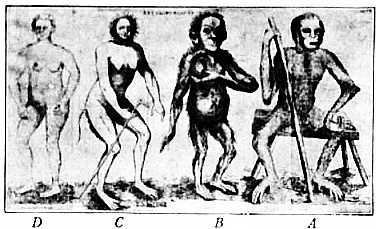
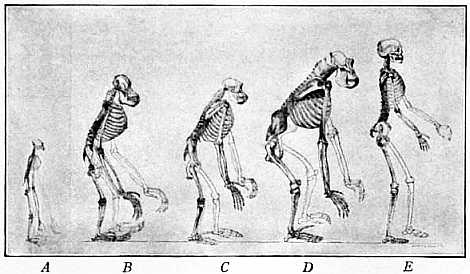
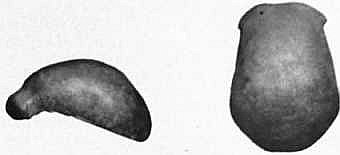
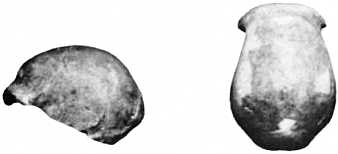
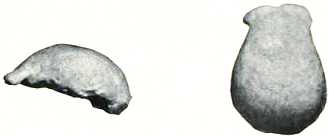
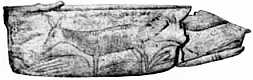
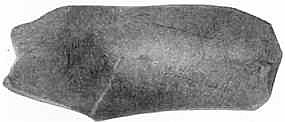
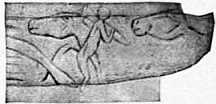
Fig. 6. Fig. 7. Fig. 8.
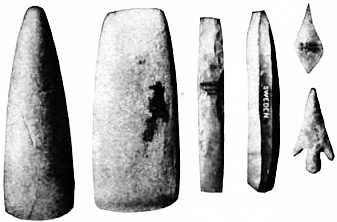
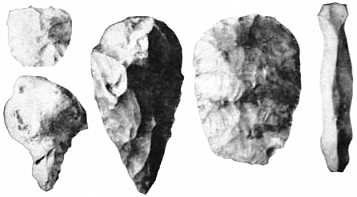
Fig. 9. Fig. 10.
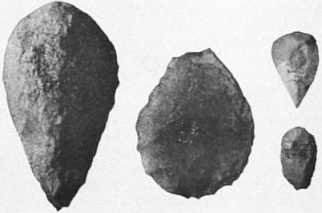
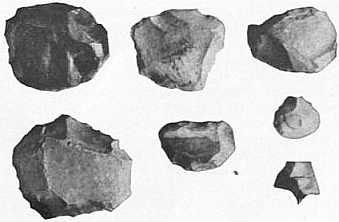
Fig. 11. Fig. 12.
The Tasmanian stone implements, figured in the Plate, show their own use when it is noticed that the rude chipping forms a good hand-grip above, and an effective edge for chopping, sawing, and cutting below. But the absence of the long-shaped implements, so characteristic of the Neolithic and Palaeolithic series, and serviceable as picks, hatchets, and chisels, shows remarkable limitation in the mind of these savages, who made a broad, hand-grasped knife their tool of all work to cut, saw, and chop with. Their weapons were the wooden club or waddy notched to the grasp, and spears of sticks, often crooked but well balanced, with points sharpened by tool or fire, and sometimes jagged. No spear thrower or bow and arrow was known. The Tasmanian savages were crafty warriors and kangaroo-hunters, and the women climbed the highest trees by notching, in quest of opossums. Shell-fish and crabs were taken, and seals knocked on the head with clubs, but neither fish-hook nor fishing-net was known, and indeed swimming fish were taboo as food. Meat and vegetable food, such as fern-root, was broiled over the fire, but boiling in a vessel was unknown. The fire was produced by the ordinary savage fire-drill. Ignorant of agriculture, with no dwellings but rough huts or breakwinds of sticks and bark, without dogs or other domestic animals, these savages, until the coming of civilized man, roamed after food within their tribal bounds. Logs and clumsy floats of bark and grass enabled them to cross water under favourable circumstances. They had clothing of skins rudely stitched together with bark thread, and they were decorated with simple necklaces of kangaroo teeth, shells and berries. Among their simple arts, plaiting and basket-work was one in which they approached the civilized level. The pictorial art of the Tasmanians was poor and childish, quite below that of the Palaeolithic men of Europe. The Tasmanians spoke a fairly copious agglutinating language, well marked as to parts of speech, syntax and inflexion. Numeration was at a low level, based on counting fingers on one hand only, so that the word for man (puggana) stood also for the number 5. The religion of the Tasmanians, when cleared from ideas apparently learnt from the whites, was a simple form of animism based on the shadow (warrawa) being the soul or spirit. The strongest belief of the natives was in the power of the ghosts of the dead, so that they carried the bones of relatives to secure themselves from harm, and they fancied the forest swarming with malignant demons. They placed weapons near the grave for the dead friend’s soul to use, and drove out disease from the sick by exorcising the ghost which was supposed to have caused it. Of greater special spirits of Nature we find something vaguely mentioned. The earliest recorders of the native social life set down such features as their previous experience of rude civilized life had made them judges of. They notice the self-denying affection of the mothers, and the hard treatment of the wives by the husbands, polygamy and the shifting marriage unions. But when we meet with a casual remark as to the tendency of the Tasmanians to take wives from other tribes than their own, it seems likely that they had some custom of exogamy which the foreigners did not understand. Meagre as is the information preserved of the arts, thoughts, and customs of these survivors from the lower Stone Age, it is of value as furnishing even a temporary and tentative means of working out the development of culture on a basis not of conjecture but of fact.
Conclusion.—To-day anthropology is grappling with the heavy task of systematizing the vast stores of knowledge to which the key was found by Boucher de Perthes, by Lartet, Christy and their successors. There have been recently no discoveries to rival in novelty those which followed the exploration of the bone-caves and drift-gravels, and which effected an instant revolution in all accepted theories of man’s antiquity, substituting for a chronology of centuries a vague computation of hundreds of thousands of years. The existence of man in remote geological time cannot now be questioned, but, despite much effort made in likely localities, no bones, with the exception of those of the much-discussed Pithecanthropus, have been found which can be regarded as definitely bridging the gulf between man and the lower creation. It seems as if anthropology had in this direction reached the limits of its discoveries. Far different are the prospects in other directions where the work of co-ordinating the material and facts collected promises to throw much light on the history of civilization. Anthropological researches undertaken all over the globe have shown the necessity of abandoning the old theory that a similarity of customs and superstitions, of arts and crafts, justifies the assumption of a remote relationship, if not an identity of origin, between races. It is now certain that there has ever been an inherent tendency in man, allowing for difference of climate and material surroundings, to develop culture by the same stages and in the same way. American man, for example, need not necessarily owe the minutest portion of his mental, religious, social or industrial development to remote contact with Asia or Europe, though he were proved to possess identical usages. An example in point is that of pyramid-building. No ethnical relationship can ever have existed between the Aztecs and the Egyptians; yet each race developed the idea of the pyramid tomb through that psychological similarity which is as much a characteristic of the species man as is his physique.
Bibliography.—J.C. Prichard, Natural History of Man (London, 1843); T.H. Huxley, Man’s Place in Nature (London, 1863); and “Geographical Distribution of Chief Modifications of Mankind,” in Journal Ethnological Society for 1870; E.B. Tylor, Early History of Man (London, 1865), Primitive Culture (London, 1871), and Anthropology (London, 1881); A. de Quatrefages, Histoire générale des races humaines (Paris, 1889), Human Species (Eng. trans., 1879); Lord Avebury, Prehistoric Times (1865, 6th ed. 1900) and Origin of Civilization (1870, 6th ed. 1902), Theo. Waitz, Anthropologie der Naturvolker (1859-1871), E.H. Haeckel, Anthropogenie (Leipzig, 1874-1891), Eng. trans., 1879; O. Peschel, Volkerkunde (Leipzig, 1874-1897); P. Topinard, L’Anthropologie (Paris, 1876); Éleménts d’anthropologie générale (Paris, 1885); D.G. Brinton, Races and Peoples (1890); A.H. Keane, Ethnology (1896), and Man: Past and Present (1899); G. Sergi, The Mediterranean Race (Eng. ed., 1889); F. Ratzel, History of Mankind (Eng. trans., 1897); G. de Mortillet, Le Préhistorique (Paris, 1882); A.C. Haddon, Study of Man (1897); J. Deniker, The Races of Man (London, 1900); W.Z. Ripley, The Races of Europe (1900, with long bibliography); The Journal of the Anthropological Institute of Great Britain; Revue d’anthropologie (Paris); Zeitschrift für Ethnologie (Berlin). See also bibliographies under separate ethnological headings (Australia, Africa, Arabs, America, &c.).
(E. B. T.)
ANTHROPOMETRY (Gr. ἄνθρωπος, man, and μέτρον, measure), the name given by the French savant, Alphonse Bertillon (b. 1853), to a system of identification (q.v.) depending on the unchanging character of certain measurements of parts of the human frame. He found by patient inquiry that several physical features and the dimensions of certain bones or bony structures in the body remain practically constant during adult life. He concluded from this that when these measurements were made and recorded systematically every single individual would be found to be perfectly distinguishable from others. The system was soon adapted to police methods, as the immense value of being able to fix a person’s identity was fully realized, both in preventing false personation and in bringing home to any one charged with an offence his responsibility for previous wrongdoing. “Bertillonage,” as it was called, became widely popular, and after its introduction into France in 1883, where it was soon credited with highly gratifying results, was applied to the administration of justice in most civilized countries. England followed tardily, and it was not until 1894 that an investigation of the methods used and results obtained was made by a special committee sent to Paris for the purpose. It reported favourably, especially on the use of the measurements for primary classification, but recommended also the adoption in part of a system of “finger prints” as suggested by Francis Galton, and already practised in Bengal.
M. Bertillon selected the following five measurements as the basis of his system: (1) head length; (2) head breadth; (3) length of middle finger; (4) of left foot, and (5) of cubit or forearm from the elbow to the extremity of the middle finger. Each principal heading was further subdivided into three classes of “small,” “medium” and “large,” and as an increased guarantee height, length of little finger, and the colour of the eye were also recorded. From this great mass of details, soon represented in Paris by the collection of some 100,000 cards, it was possible, proceeding by exhaustion, to sift and sort down the cards till a small bundle of half a dozen produced the combined facts of the measurements of the individual last sought. The whole of the information is easily contained in one cabinet of very ordinary dimensions, and most ingeniously contrived so as to make the most of the space and facilitate the search. The whole of the record is independent of names, and the final identification is by means of the photograph which lies with the individual’s card of measurements.
Anthropometry, however, gradually fell into disfavour, and it has been generally supplanted by the superior system of finger prints (q.v.). Bertillonage exhibited certain defects which were first brought to light in Bengal. The objections raised were (1) the costliness of the instruments employed and their liability to get out of order; (2) the need for specially instructed measurers, men of superior education; (3) the errors that frequently crept in when carrying out the processes and were all but irremediable. Measures inaccurately taken, or wrongly read off, could seldom, if ever, be corrected, and these persistent errors defeated all chance of successful search. The process was slow, as it was necessary to repeat it three times so as to arrive at a mean result. In Bengal measurements were already abandoned by 1897, when the finger print system was adopted throughout British India. Three years later England followed suit; and as the result of a fresh inquiry ordered by the Home Office, finger prints were alone relied upon for identification.
Authorities.—Lombroso, Antropometria di 400 delinquenti (1872); Roberts, Manual of Anthropometry (1878); Ferri, Studi comparati di antropometria (2 vols., 1881-1882); Lombroso, Rughe anomale speciali ai criminali (1890); Bertillon, Instructions signalétiques pour l’identification anthropométrique (1893); Livi, Anthropometria (Milan, 1900); Fürst, Indextabellen zum anthropometrischen Gebrauch (Jena, 1902); Report of Home Office Committee on the Best Means of Identifying Habitual Criminals (1893-1894).
(A. G.)
ANTHROPOMORPHISM (Gr. ἄνθρωπος, man, μορφή, form), the attribution (a) of a human body, or (b) of human qualities generally, to God or the gods. The word anthropomorphism is a modern coinage (possibly from 18th century French). The New English Dictionary is misled by the 1866 reprint of Paul Bayne on Ephesians when it quotes “anthropomorphist” as 17th century English. Seventeenth century editions print “anthropomorphits,” i.e. anthropomorphites, in sense (a). The older abstract term is “anthropopathy,” literally “attributing human feelings,” in sense (b).
Early religion, among its many objects of worship, includes beasts (see Animal-Worship), considered, in the more refined theology of the later Greeks and Romans, as metamorphoses of the great gods. Similarly we find “therianthropic” forms—half animal, half human—in Egypt or Assyria-Babylonia. In contrast with these, it is considered one of the glories of the Olympian mythology of Greece that it believed in happy manlike beings (though exempt from death, and using special rarefied foods, &c.), and celebrated them in statues of the most exquisite art. Israel shows us animal images, doubtless of a ruder sort, when Yahweh is worshipped in the northern kingdom under the image of a steer. (Some scholars think the title “mighty one of Jacob,” Psalm cxxxii., 2, 5, et al., ריבא as if from רבא is really “steer” ריבא “of Jacob.”) But the higher religion of Israel inclined to morality more than to art, and forbade image worship altogether. This prepared the way for the conception of God as an immaterial Spirit. True mythical anthropomorphisms occur in early parts of the Old Testament (e.g. Genesis iii. 8, cf. vi. 2), though in the majority of Old Testament passages such expressions are merely verbal (e.g. Isaiah lix. 1). In the Christian Church (and again in early Mahommedanism) simple minds believed in the corporeal nature of God. Gibbon and other writers quote from John Cassian the tale of the poor monk, who, being convinced of his error, burst into tears, exclaiming, “You have taken away my God! I have none now whom I can worship!” According to a fragment of Origen (on Genesis i. 26), Melito of Sardis shared this belief. Many have thought Melito’s work, περἰ ἐνσωμάτου θεοῦ, must have been a treatise on the Incarnation; but it is hard to think that Origen could blunder so. Epiphanius tells of Audaeus of Mesopotamia and his followers, Puritan sectaries in the 4th century, who were orthodox except for this belief and for Quartodecimanism (see Easter). Tertullian, who is sometimes called an anthropomorphist, stood for the Stoical doctrine, that all reality, even the divine, is in a sense material.
The reaction against anthropomorphism begins in Greek philosophy with the satirical spirit of Xenophanes (540 B.C.), who puts the case as broadly as any. The “greatest God” resembles man “neither in form nor in mind.” In Judaism—unless we should refer to the prophets’ polemic against images—a reaction is due to the introduction of the codified law. God seemed to grow more remote. The old sacred name Yahweh is never pronounced; even “God” is avoided for allusive titles like “heaven” or “place.” Still, amid all this, the God of Judaism remains a personal, almost a limited, being. In Philo we see Jewish scruples uniting with others drawn from Greek philosophy. For, though the quarrel with popular anthropomorphism was patched up, and the gods of the Pantheon were described by Stoics and Epicureans as manlike in form, philosophy nevertheless tended to highly abstract conceptions of supreme, or real, deity. Philo followed out the line of this tradition in teaching that God cannot be named. How much exactly he meant is disputed. The same inheritance of Greek philosophy appears in the Christian fathers, especially Origen. He names and condemns the “anthropomorphites,” who ascribe a human body to God (on Romans i., sub fin.; Rufinus’ Latin version). In Arabian philosophy the reaction sought to deny that God had any attributes. And, under the influence of Mahommedan Aristotelianism, the same paralysing speculation found entrance among the learned Jews of Spain (see Maimonides).
Till modern times the philosophical reaction was not carried out with full vigour. Spinoza (Ethics, i. 15 and 17), representing here as elsewhere both a Jewish inheritance and a philosophical, but advancing further, sweeps away all community between God and man. So later J.G. Fichte and Matthew Arnold (“a magnified and non-natural man”),—strangely, in view of their strong belief in an objective moral order. For the use of the word “anthropomorphic,” or kindred forms, in this new spirit of condemnation for all conceptions of God as manlike—sense (b) noted above—see J.J. Rousseau in Émile iv. (cited by Littré),— Nous sommes pour la plupart de vrais anthropomorphites. Rousseau is here speaking of the language of Christian theology,—a divine Spirit: divine Persons. At the present day this usage is universal. What it means on the lips of pantheists is plain. But when theists charge one another with “anthropomorphism,” in order to rebuke what they deem unduly manlike conceptions of God, they stand on slippery ground. All theism implies the assertion of kinship between man, especially in his moral being, and God. As a brilliant theologian, B. Duhm, has said, physiomorphism is the enemy of Christian faith, not anthropomorphism.
The latest extension of the word, proposed in the interests of philosophy or psychology, uses it of the principle according to which man is said to interpret all things (not God merely) through himself. Common-sense intuitionalism would deny that man does this, attributing to him immediate knowledge of reality. And idealism in all its forms would say that man, interpreting through his reason, does rightly, and reaches truth. Even here then the use of the word is not colourless. It implies blame. It is the symptom of a philosophy which confines knowledge within narrow limits, and which, when held by Christians (e.g. Peter Browne, or H.L. Mansel), believes only in an “analogical” knowledge of God.
(R. Ma.)
ANTI, or Campa, a tribe of South American Indians of Arawakan stock, inhabiting the forests of the upper Ucayali basin, east of Cuzco, on the eastern side of the Andes, south Peru. The Antis, who gave their name to the eastern province of Antisuyu, have always been notorious for ferocity and cannibalism. They are of fine physique and generally good-looking. Their dress is a robe with holes for the head and arms. Their long hair hangs down over the shoulders, and round their necks a toucan beak or a bunch of feathers is worn as an ornament.
ANTIBES, a seaport town in the French department of the Alpes-Maritimes (formerly in that of the Var, but transferred after the Alpes-Maritimes department was formed in 1860 out of the county of Nice). Pop. (1906) of the town, 5730; of the commune, 11,753. It is 12½ m. by rail S.W. of Nice, and is situated on the E. side of the Garoupe peninsula. It was formerly fortified, but all the ramparts (save the Fort Carré, built by Vauban) have now been demolished, and a new town is rising on their site. There is a tolerable harbour, with a considerable fishing industry. The principal exports are dried fruits, salt fish and oil. Much perfume distilling is done here, as the surrounding country produces an abundance of flowers. Antibes is the ancient Antipolis. It is said to have been founded before the Christian era (perhaps about 340 B.C.) by colonists from Marseilles, and is mentioned by Strabo. It was the seat of a bishopric from the 5th century to 1244, when the see was transferred to Grasse.
(W. A. B. C.)
ANTICHRIST (ἀντίχριστος). The earliest mention of the name Antichrist, which was probably first coined in Christian eschatological literature, is in the Epistles of St John (I. ii. 18, 22, iv. 3; II. 7), and it has since come into universal use. The conception, paraphrased in this word, of a mighty ruler who will appear at the end of time, and whose essence will be enmity to God (Dan. xi. 36; cf. 2 Thess. ii. 4; ἀντικείμενος), is older, and traceable to Jewish eschatology. Its origin is to be sought in the first place in the prophecy of Daniel, written at the beginning of the Maccabean period. The historical figure who served as a model for the “Antichrist” was Antiochus IV. Epiphanes, the persecutor of the Jews, and he has impressed indelible traits upon the conception. Since then ever-recurring characteristics of this figure (cf. especially Dan xi. 40, &c.) are, that he would appear as a mighty ruler at the head of gigantic armies, that he would destroy three rulers (the three horns, Dan. vii. 8, 24), persecute the saints (vii. 25), rule for three and a half years (vii. 25, &c.), and subject the temple of God to a horrible devastation (βδέλυγμα τῆς ἐρημὠσεως). When the end of the world foretold by Daniel did not take place, but the book of Daniel retained its validity as a sacred scripture which foretold future things, the personality of the tyrant who was God’s enemy disengaged itself from that of Antiochus IV., and became merely a figure of prophecy, which was applied now to one and now to another historical phenomenon. Thus for the author of the Psalms of Solomon (c. 60 B.C.), Pompey, who destroyed the independent rule of the Maccabees and stormed Jerusalem, was the Adversary of God (cf. ii. 26, &c.); so too the tyrant whom the Ascension of Moses (c. A.D. 30) expects at the end of all things, possesses, besides the traits of Antiochus IV., those of Herod the Great. A further influence on the development of the eschatological imagination of the Jews was exercised by such a figure as that of the emperor Caligula (A.D. 37-41), who is known to have given the order, never carried out, to erect his statue in the temple of Jerusalem. In the little Jewish Apocalypse, the existence of which is assumed by many scholars, which in Mark xiii. and Matt. xxiv. is combined with the words of Christ to form the great eschatological discourse, the prophecy of the “abomination of desolation” (Mark xiii. 14 et seq.) may have originated in this episode of Jewish history. Later Jewish and Christian writers of Apocalypses saw in Nero the tyrant of the end of time. The author of the Syriac Apocalypse of Baruch (or his source), cap. 36-40, speaks in quite general terms of the last ruler of the end of time. In 4 Ezra v. 6 also is found the allusion: regnabit quem non sperant.
The roots of this eschatological fancy are to be sought perhaps still deeper in a purely mythological and speculative expectation of a battle at the end of days between God and the devil, which has no reference whatever to historical occurrences. This idea has its original source in the apocalypses of Iran, for these are based upon the conflict between Ahura-Mazda (Auramazda, Ormazd) and Angro-Mainyush (Ahriman) and its consummation at the end of the world. This Iranian dualism is proved to have penetrated into the late Jewish eschatology from the beginning of the 1st century before Christ, and did so probably still earlier. Thus the opposition between God and the devil already plays a part in the Jewish groundwork of the Testaments of the Patriarchs, which was perhaps composed at the end of the period of the Maccabees. In this the name of the devil appears, besides the usual form (σατανᾶς, διάβολος), especially as Belial (Beliar, probably, from Ps. xviii. 4, where the rivers of Belial are spoken of, originally a god of the underworld), a name which also plays a part in the Antichrist tradition. In the Ascension of Moses we already hear, at the beginning of the description of the latter time (x. 1): “And then will God’s rule be made manifest over all his creatures, then will the devil have an end” (cf. Matt. xii. 28; Luke xi. 20; John xii. 31, xiv. 30, xvi. 11).1 This conception of the strife of God with the devil was further interwoven, before its introduction into the Antichrist myth, with another idea of different origin, namely, the myth derived from the Babylonian religion, of the battle of the supreme God (Marduk) with the dragon of chaos (Tiamat), originally a myth of the origin of things which, later perhaps, was changed into an eschatological one, again under Iranian influence.2 Thus it comes that the devil, the opponent of God, appears in the end often also in the form of a terrible dragon-monster; this appears most clearly in Rev. xii. Now it is possible that the whole conception of Antichrist has its final roots in this already complicated myth, that the form of the mighty adversary of God is but the equivalent in human form of the devil or of the dragon of chaos. In any case, however, this myth has exercised a formative influence on the conception of Antichrist. For only thus can we explain how his figure acquires numerous superhuman and ghostly traits, which cannot be explained by any particular historical phenomenon on which it may have been based. Thus the figure of Antiochus IV. has already become superhuman, when in Dan. viii. 10, it is said that the little horn “waxed great, even to the host of heaven; and cast down some of the host and of the stars to the ground.” Similarly Pompey, in the second psalm of Solomon, is obviously represented as the dragon of chaos, and his figure exalted into myth. Without this assumption of a continual infusion of mythological conceptions, we cannot understand the figure of Antichrist. Finally, it must be mentioned that Antichrist receives, at least in the later sources, the name originally proper to the devil himself.3
From the Jews, Christianity took over the idea. It is present quite unaltered in certain passages, specifically traceable to Judaism, e.g. (Rev. xi.). “The Beast that ascendeth out of the bottomless pit” and, surrounded by a mighty host of nations, slays the “two witnesses” in Jerusalem, is the entirely superhuman Jewish conception of Antichrist. Even if the beast (ch. xiii.), which rises from the sea at the summons of the devil, be interpreted as the Roman empire, and, specially, as any particular Roman ruler, yet the original form of the malevolent tyrant of the latter time is completely preserved.
A fundamental change of the whole idea from the specifically Christian point of view, then, is signified by the conclusion of ch. ii. of the Second Epistle to the Thessalonians.4 There can, of course, be no doubt as to the identity of the “man of sin, the son of perdition” here described with the dominating figure of Jewish eschatology (cf. ii. 3 &c., ὁ ἄνθρωπος τῆς ἀνομίας, i.e. Beliar (?), ὁ ἀντικείμενος—the allusion that follows to Dan xi. 36). But Antichrist here appears as a tempter, who works by signs and wonders (ii. 9) and seeks to obtain divine honours; it is further signified that this “man of sin” will obtain credence, more especially among the Jews, because they have not accepted the truth. The conception, moreover, has become almost more superhuman than ever (cf. ii. 4, “showing himself that he is God”). The destruction of the Adversary is drawn from Isaiah xi. 4, where it is said of the Messiah: “with the breath of his lips shall he slay the wicked.”5 The idea that Antichrist was to establish himself in the temple of Jerusalem (ii. 4) is very enigmatical, and has not yet been explained. The “abomination of desolation” has naturally had its influence upon it; possibly also the experience of the time of Caligula (see above). Remarkable also is the allusion to a power which still retards the revelation of Antichrist (2 Thess. ii. 6 &c., τὸ κατέχον; ὁ κατέχων), an allusion which, in the tradition of the Fathers of the church, came to be universally, and probably correctly, referred to the Roman empire. In this then consists the significant turn given by St Paul in the Second Epistle to the Thessalonians to the whole conception, namely, in the substitution for the tyrant of the latter time who should persecute the Jewish people, of a pseudo-Messianic figure, who, establishing himself in the temple of God, should find credence and a following precisely among the Jews. And while the originally Jewish idea led straight to the conception, set forth in Revelation, of the Roman empire or its ruler as Antichrist, here, on the contrary, it is probably the Roman empire that is the power which still retards the reign of Antichrist. With this, the expectation of such an event at last separates itself from any connexion with historical fact, and becomes purely ideal. In this process of transformation of the idea, which has become of importance for the history of the world, is revealed probably the genius of Paul, or at any rate, that of the young Christianity which was breaking its ties with Judaism and establishing itself in the world of the Roman empire.
This version of the figure of Antichrist, who may now really for the first time be described by this name, appears to have been at once widely accepted in Christendom. The idea that the Jews would believe in Antichrist, as punishment for not having believed in the true Christ, seems to be expressed by the author of the fourth gospel (v. 43). The conception of Antichrist as a perverter of men, leads naturally to his connexion with false doctrine (1 John ii. 18, 22; iv. 3; 2 John 7). The Teaching of the Apostles (xvi. 4) describes his form in the same way as 2 Thessalonians (καὶ τότε φαινήσεται ὁ κοσμοπλάνος ὡς υἱὸς θεοῦ καὶ ποιεῖ σημεῖα καὶ τέρατα). In the late Christian Sibylline fragment (iii. 63 &c.) also, “Beliar” appears above all as a worker of wonders, this figure having possibly been influenced by that of Simon Magus. Finally the author of the Apocalypse of St John also has made use of the new conception of Antichrist as a wonder-worker and seducer, and has set his figure beside that of the “first” Beast which was for him the actual embodiment of Antichrist (xiii. II &c.). Since this second Beast could not appear along with the first as a power demanding worship and directly playing the part of Antichrist, he made out of him the false prophet (xvi. 13, xix. 20, xx. 10) who seduces the inhabitants of the earth to worship the first Beast, and probably interpreted this figure as applying to the Roman provincial priesthood.6
But this version of the idea of Antichrist, hostile to the Jews and better expressing the relation of Christianity to the Roman empire, was prevented from obtaining an absolute ascendancy in Christian tradition by the rise of the belief in the ultimate return of Nero, and by the absorption of this outcome of pagan superstition into the Jewish-Christian apocalyptic conceptions. It is known that soon after the death of Nero rumours were current that he was not dead. This report soon took the more concrete form that he had fled to the Parthians and would return thence to take vengeance on Rome. This expectation led to the appearance of several pretenders who posed as Nero; and as late as A.D. 100 many still held the belief that Nero yet lived.7 This idea of Nero’s return was in the first instance taken up by the Jewish apocalyptic writers. While the Jewish author of the fourth Sibylline book (c. A.D. 80) still only refers simply to the heathen belief, the author of the (Jewish?) original of the 17th chapter of the Apocalypse of St John expects the return of Nero with the Parthians to take vengeance on Rome, because she had shed the blood of the Saints (destruction of Jerusalem!). In the fifth Sibylline book, which, with the exception of verses 1-51, was mainly composed by a Jewish writer at the close of the first century, the return of Nero plays a great part. Three times the author recurs to this theme, 137-154; 214-227; 361-385. He sees in the coming again of Nero, whose figure he endows with supernatural and daemonic characteristics, a judgment of God, in whose hand the revivified Nero becomes a rod of chastisement. Later, the figure of Nero redivivus became, more especially in Christian thought, entirely confused with that of Antichrist. The less it became possible, as time went on, to believe that Nero yet lived and would return as a living ruler, the greater was the tendency for his figure to develop into one wholly infernal and daemonic. The relation to the Parthians is also gradually lost sight of; and from being the adversary of Rome, Nero becomes the adversary of God and of Christ. This is the version of the expectation of Nero’s second coming preserved in the form given to the prophecy, under Domitian, by the collaborator in the Apocalypse of John (xiii., xvii.). Nero is here the beast that returns from the bottomless pit, “that was, and is not, and yet is”; the head “as it were wounded to death” that lives again; the gruesome similitude of the Lamb that was slain, and his adversary in the final struggle. The number of the Beast, 666, points certainly to Nero (ןורנ רסק = 666, or ורנ רסק = 616). In the little apocalypse of the Ascensio Jesaiae (iii. 13b-iv. 18), which dates perhaps from the second, perhaps only from the first, decade of the third century,8 it is said that Beliar, the king of this world, would descend from the firmament in the human form of Nero. In the same way, in Sibyll. v. 28-34, Nero and Antichrist are absolutely identical (mostly obscure reminiscences, Sib. viii. 68 &c., 140 &c., 151 &c.). Then the Nero-legend gradually fades away. But Victorinus of Pettau, who wrote during the persecution under Diocletian, still knows the relation of the Apocalypse to the legend of Nero; and Commodian, whose Carmen Apologeticum was perhaps not written until the beginning of the 4th century, knows two Antichrist-figures, of which he still identifies the first with Nero redivivus.
In proportion as the figure of Nero again ceased to dominate the imagination of the faithful, the wholly unhistorical, unpolitical and anti-Jewish conception of Antichrist, which based itself more especially on 2 Thess. ii., gained the upper hand, having usually become associated with the description of the universal conflagration of the world which had also originated in the Iranian eschatology. On the strength of exegetical combinations, and with the assistance of various traditions, it was developed even in its details, which it thenceforth maintained practically unchanged. In this form it is in great part present in the eschatological portions of the Adv. Haereses of Irenaeus, and in the de Antichristo and commentary on Daniel of Hippolytus. In times of political excitement, during the following centuries, men appealed again and again to the prophecy of Antichrist. Then the foreground scenery of the prophecies was shifted; special prophecies, having reference to contemporary events, are pushed to the front, but in the background remains standing, with scarcely a change, the prophecy of Antichrist that is bound up with no particular time. Thus at the beginning of the Testamentum Domini, edited by Rahmani, there is an apocalypse, possibly of the time of Decius, though it has been worked over (Harnack, Chronol. der altchrist. Litt. ii. 514 &c.) In the third century, the period of Aurelianus and Gallienus, with its wild warfare of Romans and Persians, and of Roman pretenders one with another, seems especially to have aroused the spirit of prophecy. To this period belongs the Jewish apocalypse of Elijah (ed. Buttenwieser), of which the Antichrist is possibly Odaenathus of Palmyra, while Sibyll. xiii., a Christian writing of this period, glorifies this very prince. It is possible that at this time also the Sibylline fragment (iii. 63 &c.) and the Christian recension of the two first Sibylline books were written.9 To this time possibly belongs also a recension of the Coptic apocalypse of Elijah, edited by Steindorff (Texte und Untersuchungen, N. F. ii. 3). To the 4th century belongs, according to Kamper (Die deutsche Kaiseridee, 1896, p. 18) and Sackur (Texte und Forschungen, 1898, p. 114 &c.), the first nucleus of the “Tiburtine” Sibyl, very celebrated in the middle ages, with its prophecy of the return of Constans, and its dream, which later on exercised so much influence, that after ruling over the whole world he would go to Jerusalem and lay down his crown upon Golgotha. To the 4th century also perhaps belongs a series of apocalyptic pieces and homilies which have been handed down under the name of Ephraem. At the beginning of the Mahommedan period, then, we meet with the most influential and the most curious of these prophetic books, the Pseudo-Methodius,10 which prophesied of the emperor who would awake from his sleep and conquer Islam. From the Pseudo-Methodius are derived innumerable Byzantine prophecies (cf. especially Vassiliev, Anecdota Graeco-Byzantina) which follow the fortunes of the Byzantine emperors and their governments. A prophecy in verse, adorned with pictures, which is ascribed to Leo VI. the Philosopher (Migne, Patr. Gracca, cvii. p. 1121 &c.), tells of the downfall of the house of the Comneni and sings of the emperor of the future who would one day awake from death and go forth from the cave in which he had lain. Thus the prophecy of the sleeping emperor of the future is very closely connected with the Antichrist tradition. There is extant a Daniel prophecy which, in the time of the Latin empire, foretells the restoration of the Greek rule.11 In the East, too, Antichrist prophecies were extraordinarily flourishing during the period of the rise of Islam and of the Crusades. To these belong the apocalypses in Arabic, Ethiopian and perhaps also in Syrian, preserved in the so-called Liber Clementis discipuli S. Petri (Petri apostoli apocalypsis per Clementem), the late Syrian apocalypse of Ezra (Bousset, Antichrist, 45 &c.), the Coptic (14th) vision of Daniel (in the appendix to Woide’s edition of the Codex Alexandrinus; Oxford, 1799), the Ethiopian Wisdom of the Sibyl, which is closely related to the Tiburtine Sibyl (see Basset, Apocryphes éthiopiennes, x.); in the last mentioned of these sources long series of Islamic rulers are foretold before the final time of Antichrist. Jewish apocalypse also awakes to fresh developments in the Mahommedan period, and shows a close relationship with the Christian Antichrist literature. One of the most interesting apocalypses is the Jewish History of Daniel, handed down in Persian.12
This whole type of prophecy reached the West above all through the Pseudo-Methodius, which was soon translated into Latin. Especially influential, too, in this respect was the letter which the monk Adso in 954 wrote to Queen Gerberga, De ortu et tempere Antichristi. The old Tiburtine Sibylla went through edition after edition, in each case being altered so as to apply to the government of the monarch who happened to be ruling at the time. Then in the West the period arrived in which eschatology, and above all the expectation of the coming of Antichrist, exercised a great influence on the world’s history. This period, as is well known, was inaugurated, at the end of the 12th century, by the apocalyptic writings of the abbot Joachim of Floris. Soon the word Antichrist re-echoed from all sides in the embittered controversies of the West. The pope bestowed this title upon the emperor, the emperor upon the pope, the Guelphs on the Ghibellines and the Ghibellines on the Guelphs. In the contests between the rival powers and courts of the period, the prophecy of Antichrist played a political part. It gave motives to art, to lyrical, epic and dramatic poetry.13 Among the visionary Franciscans, enthusiastic adherents of Joachim’s prophecies, arose above all the conviction that the pope was Antichrist, or at least his precursor. From the Franciscans, influenced by Abbot Joachim, the lines of connexion are clearly traceable with Milic of Kremsier (Libellus de Antichristo) and Matthias of Janow. For Wycliffe and his adherent John Purvey (probably the author of the Commentarius in Apocalypsin ante centum annos editus, edited in 1528 by Luther), as on the other hand for Hus, the conviction that the papacy is essentially Antichrist is absolute. Finally, if Luther advanced in his contest with the papacy with greater and greater energy, he did so because he was borne on by the conviction that the pope in Rome was Antichrist. And if in the Augustana. the expression of this conviction was suppressed for political reasons, in the Articles of Schmalkalden, drawn up by him, Luther propounded it in the most uncompromising fashion. This sentence was for him an articulus stantis et cadentis ecclesiae. To write the history of the idea of Antichrist in the last centuries of the middle ages, would be almost to write that of the middle ages themselves.
Authorities.—See, for the progress of the idea in Jewish and New Testament times, the modern commentaries on Revelation and the 2nd Epistle to the Thessalonians; Bousset, Antichrist (1895), and the article “Antichrist” in the Encyclop. Biblica; R.H. Charles, Ascension of Isaiah, Introduction, li.-lxxiii. For the history of the legend of Nero, see J. Geffcken, Nachrichten der Göttinger Gesellschaft der Wisscnschaft (1899), p. 446 &c.; Th. Zahn, Zeitschrift für kirchliche Wissenschaft und kirchliches Leben (1886), p. 337 &c.; Bousset, Kritisch-exegetisches Kommentar zur Offenbarung Johannis, cap. 17, and the article “Sibyllen” in Herzog-Hauck, Realencyklopadie für Theologie und Kirche (3rd ed.), xviii. 265 &c.; Nordmeyer, Der Tod Neros in der Legende, a Festschrift of the Gymnasium of Moos. For the later history of the legend, see Bousset, Antichrist, where will be found a more detailed discussion of nearly all the sources named; Bousset, “Beiträge zur Geschichte der Eschatologie,” in Zeitschrift für Kirchengeschichte, xx. 2, and especially xx. 3, on the later Byzantine prophecies; Vassiliev, Anecdota Graeco-Byzantina, i. (Moscow, 1893), which gives the texts of a series of Byzantine prophecies; E. Sackur, Sibyllinische Texte und Forschungen (1898), containing (i) Pseudo-Methodius, Latin text, (2) Epistola Adsonis, (3) the Tiburtine Sibylla; V. Istrin, The Apocalypse of Methodius of Patara and the Apocryphal Visions of Daniel in Byzantine and Slavo-Russian Literature, Russian (Moscow, 1897); J. Kampers, Die deutsche Kaiseridee in Prophetie und Sage (Munich, 1896), and “Alexander der Grosse und die Idee des Weltimperiums,” in H. Grauert’s Studien und Darstellungen aus dem Gebiet der Geschichte, vol. i. 2-3 (Freiburg, 1901); E. Wadstein, Die eschatologische Ideengruppe, Antichrist, Weltsabbat, Weltende und Welgericht (Leipzig, 1896), which contains excellent material for the history of the idea in the West during the middle ages; W. Meyer, “Ludus de Antichristo,” in Sitzberichl der Münchener Akad. (Phil. hist. Klasse 1882, H. i.); Kropatschek, Das Schriftprincip der lutherischen Kirche, i. 247 &c. (Leipzig, 1904); H. Preuss, Die Vorstellungen vom Antichrist im späteren Mittelalter, bei Luther u. i. d. Konfessionellen Polemik (Leipzig, 1906).
(W. Bo.)
1 See further, Bousset, Religion des Judentums, ed. ii. pp. 289 &c., 381 &c., 585 &c.
2 See Gunkel, Schöpfung und Chaos (1893).
3 It is, of course, uncertain whether this phenomenon already occurs in 2 Cor. vi. 15, since here Belial might still be Satan; cf. however, Ascensio Jesaiae iv. 2 &c.; Sibyll. iii. 63 &c., ii. 167 &c.
4 It is not necessary to decide whether the epistle is by St Paul or by a pupil of Paul, although the former seems to the present writer to be by far the more probable, in spite of the brilliant attack on the genuineness of the epistle by Wrede in Texte und Übersetzungen, N.F. ix. 2.
5 Cf. 2 Thess. ii. 8; the Targum also, in its comment on the passage of Isaiah, applies “the wicked” to Antichrist.
6 See Bousset, Kommentar zur Offenbarung Johannis, on these passages.
7 Ibid. ch. xvii.: and Charles, Ascension of Isaiah, lvii. sq.
8 Harnack, Chronologie der altchristlichen Literatur, i. 573
9 See Bousset, in Herzog-Hauck, Realencyklop. für Theologie und Kirsche (ed. 3), xviii. 273 &c.
10 Latin text by Sackur, cf. op. cit. 1 &c.; Greek text by V. Istrin.
11 See Bousset, Zeitschrift für Kirchengeschichte, xx. p. 289 &c.
12 Published in Merx, Archiv zur Erforschung des Alten Testament.
13 See especially the Ludus de Antichristo, ed. W. Meyer.
ANTICLIMAX (i.e. the opposite to “climax”), in rhetoric, an abrupt declension (either deliberate or unintended) on the part of a speaker or writer from the dignity of idea which he appeared to be aiming at; as in the following well-known distich:—
“The great Dalhousie, he, the god of war, Lieutenant-colonel to the earl of Mar.”
An anticlimax can be intentionally employed only for a jocular or satiric purpose. It frequently partakes of the nature of antithesis, as—
“Die and endow a college or a cat.”
It is often difficult to distinguish between “anticlimax” and “bathos”; but the former is more decidedly a relative term. A whole speech may never rise above the level of bathos; but a climax of greater or less elevation is the necessary antecedent of an anticlimax.
ANTICOSTI, an island of the province of Quebec, Canada, situated in the Gulf of St Lawrence, between 49° and 50° N., and between 61° 40′ and 64° 30′ W., with a length of 135 m. and a breadth of 30 m. Population 250, consisting chiefly of the keepers of the numerous lighthouses erected by the Canadian government. The coast is dangerous, and the only two harbours, Ellis Bay and Fox Bay, are very indifferent. Anticosti was sighted by Jacques Cartier in 1534, and named Assomption. In 1763 it was ceded by France to Britain, and in 1774 became part of Canada. Wild animals, especially bears, are numerous, but prior to 1896 the fish and game had been almost exterminated by indiscriminate slaughter. In that year Anticosti and the shore fisheries were leased to M. Menier, the French chocolate manufacturer, who converted the island into a game preserve, and attempted to develop its resources of lumber, peat and minerals.
See Logan, Geological Survey of Canada, Report of Progress from its Commencement to 1863 (Montreal, 1863-1865); E. Billings, Geological Survey of Canada: Catalogue of the Silurian Fossils of Anticosti (Montreal, 1866); J. Schmitt, Anticosti (Paris, 1904).
ANTICYCLONE (i.e. opposite to a cyclone), an atmospheric system in which there is a descending movement of the air and a relative increase in barometric pressure over the part of the earth’s surface affected by it. At the surface the air tends to flow outwards in all directions from the central area of high pressure, and is deflected on account of the earth’s rotation (see FErrel’s Law) so as to give a spiral movement in the direction of the hands of a watch face upwards in the northern hemisphere, against that direction in the southern hemisphere. Since the air in an anticyclone is descending, it becomes warmed and dried, and therefore transmits radiation freely whether from the sun to the earth or from the earth into space. Hence in winter anticyclonic weather is characterized by clear air with periods of frost, causing fogs in towns and low-lying damp areas, and in summer by still cloudless days with gentle variable airs and fine weather.
ANTICYRA, the ancient name of three cities of Greece, (1) (Mod. Aspraspitia), in Phocis, on the bay of Anticyra, in the Corinthian gulf; some remains are still visible. It was a town of considerable importance in ancient times; was destroyed by Philip of Macedon; recovered its prosperity; and was captured by T. Quinctius Flamininus in 198 B.C. The city was famous for its black hellebore, a herb which was regarded as a cure for insanity. This circumstance gave rise to a number of proverbial expressions, like Άντικύρας σε δεῖ or “naviget Anticyram,” and to frequent allusions in the Greek and Latin writers. Hellebore was likewise considered beneficial in cases of gout and epilepsy. (2) In Thessaly, on the right bank of the river Spercheus, near its mouth. (3) In Locris, on the north side of the entrance to the Corinthian gulf, near Naupactus.