VOLUME II SLICE II Anjar to Apollo (continued 10)
Reading edition
ANVIL (from Anglo-Saxon anfilt or onfilti, either that on which something is “welded” or “folded,” cf. German falzen, to fold, or connected with other Teutonic forms of the word, cf. German amboss, in which case the final syllable is from “beat,” and the meaning is “that on which something is beaten”), a mass of iron on which material is supported while being shaped under the hammer (see Forging). The common blacksmith’s anvil is made of wrought iron, often in America of cast iron, with a smooth working face of hardened steel. It has at one end a projecting conical beak or bick for use in hammering curved pieces of metal; occasionally the other end is also provided with a bick, which is then partly rectangular in section. There is also a square hole in the face, into which tools, such as the anvil-cutter or chisel, can be dropped, cutting edge uppermost. For power hammers the anvil proper is supported on an anvil block which is of great massiveness, sometimes weighing over 200 tons for a 12-ton hammer, and this again rests on a strong foundation of timber and masonry or concrete. In anatomy the term anvil is applied to one of the bones of the middle ear, the incus, which is articulated with the malleus.
ANVILLE, JEAN BAPTISTE BOURGUIGNON D’ (1697-1782), perhaps the greatest geographical author of the 18th century, was born at Paris on the 11th of July 1697. His passion for geographical research displayed itself from early years: at the age of twelve he was already amusing himself by drawing maps for Latin authors. Later, his friendship with the antiquarian, Abbé Longuerue, greatly aided his studies. His first serious map, that of Ancient Greece, was published when he was fifteen, and at the age of twenty-two he was appointed one of the king’s geographers, and began to attract the attention of the first authorities. D’Anville’s studies embraced everything of geographical nature in the world’s literature, as far as he could master it: for this purpose he not only searched ancient and modern historians, travellers and narrators of every description, but also poets, orators and philosophers. One of his cherished objects was to reform geography by putting an end to the blind copying of older maps, by testing the commonly accepted positions of places through a rigorous examination of all the descriptive authority, and by excluding from cartography every name inadequately supported. Vast spaces, which had before been covered with countries and cities, were thus suddenly reduced almost to a blank.
D’Anville was at first employed in the humbler task of illustrating by maps the works of different travellers, such as Marchais, Charlevoix, Labat and Duhalde. For the history of China by the last-named writer he was employed to make an atlas, which was published separately at the Hague in 1737. In 1735 and 1736 he brought out two treatises on the figure of the earth; but these attempts to solve geometrical problems by literary material were, to a great extent, refuted by Maupertuis’ measurements of a degree within the polar circle. D’Anville’s historical method was more successful in his 1743 map of Italy, which first indicated numerous errors in the mapping of that country, and was accompanied by a valuable memoir (a novelty in such work), showing in full the sources of the design. A trigonometrical survey which Benedict XIV. soon after had made in the papal states strikingly confirmed the French geographer’s results. In his later years d’Anville did yeoman service for ancient and medieval geography, accomplishing something like a revolution in the former; mapping afresh all the chief countries of the pre-Christian civilizations (especially Egypt), and by his Mémoire et abrégé de géographie ancienne et générale and his États formés en Europe après la chute de l’empire romain en occident (1771) rendering his labours still more generally useful. In 1754, at the age of fifty-seven, he became a member of the Académie des Inscriptions et Belles Lettres, whose transactions he enriched with many papers. In 1775 he received the only place in the Académie des Sciences which is allotted to geography; and in the same year he was appointed, without solicitation, first geographer to the king. His last employment consisted in arranging his collection of maps, plans and geographical materials. It was the most extensive in Europe, and had been purchased by the king, who, however, left him the use of it during his life. This task performed, he sank into a total imbecility both of mind and body, which continued for two years, till his death in January 1782.
D’Anville’s published memoirs and dissertations amounted to 78, and his maps to 211. A complete edition of his works was announced in 1806 by de Manne in 6 vols. quarto, only two of which had appeared when the editor died in 1832. See Dacier’s Éloge de d’Anville (Paris, 1802). Besides the separate works noticed above, d’Anville’s maps executed for Rollin’s Histoire ancienne and Histoire romaine, and his Traité des mesures anciennes et modernes (1769), deserve special notice.
ANWARI [Auhad-uddin Ali Anwari], Persian poet, was born in Khorasan early in the 12th century. He enjoyed the especial favour of the sultan Sinjar, whom he attended in all his warlike expeditions. On one occasion, when the sultan was besieging the fortress of Hazarasp, a fierce poetical conflict was maintained between Anwari and his rival Rashidi, who was within the beleaguered castle, by means of verses fastened to arrows. Anwari died at Balkh towards the end of the 12th century. The Diwan, or collection of his poems, consists of a series of long poems, and a number of simpler lyrics. His longest piece, The Tears of Khorassan, was translated into English verse by Captain Kirkpatrick (see also Persia. Literature).
ANWEILER, or Annweiler, a town of Germany, in the Bavarian Palatinate, on the Queich, 8 m. west of Landau, and on the railway from that place to Zweibrücken. Pop. 3700. It is romantically situated in the part of the Haardt called the Pfälzer Schweiz (Palatinate Switzerland), and is surrounded by high hills which yield a famous red sandstone. On the Sonnenberg (1600 ft.) lie the ruins of the castle of Trifels, in which Richard Coeur de Lion was imprisoned in 1193. The industries include cloth-weaving, tanning, dyeing and saw mills. There is also a considerable trade in wine.
ANZENGRUBER, LUDWIG (1839-1889), Austrian dramatist and novelist, was born at Vienna on the 29th of November 1839. He was educated at the Realschule of his native town, and then entered a bookseller’s shop; from 1860 to 1867 he was an actor, without, however, displaying any marked talent, although his stage experience later stood him in good stead. In 1869 he became a clerk in the Viennese police department, but having in the following year made a success with his anti-clerical drama, Der Pfarrer von Kirchfeld, he gave up his appointment and devoted himself entirely to literature. He died at Vienna on the both of December 1889. Anzengruber was exceedingly fertile in ideas, and wrote a great many plays. They are mostly of Austrian peasant life, and although somewhat melancholy in tone are interspersed with bright and witty scenes. Among the best known are Der Meineidbauer (1871), Die Kreuzelschreiber (1872), Der G’wissenswurm (1874), Hand und Herz (1875), Doppelselbstmord (1875), Das vierte Gebot (1877), and Der Fleck auf der Ehr’ (1889). Anzengruber also published a novel of considerable merit, Der Schandfleck (1876; remodelled 1884); and various short stories and tales of village life collected under the title Wolken und Sunn’schein (1888).
Anzengruber’s collected works, with a biography, were published in 10 vols. in 1890 (3rd ed. 1897); his correspondence has been edited by A. Bettelheim (1902). See A. Bettelheim, L. Anzengruber (1890); L. Rosner, Erinnerungen an L. Anzengruber (1890): H. Sittenberger, Studien zur Dramaturgie der Gegenwart (1899); S. Friedmann, L. Anzengruber (1902).
ANZIN, a town of northern France, in the department of Nord, on the Scheldt, 1½ m. N.W. of Valenciennes, of which it is a suburb. Pop. (1906) 14,077. Anzin is the centre of important coal-mines of the Valenciennes basin belonging to the Anzin Company, the formation of which dates to 1717. The metallurgical industries of the place are extensive, and include iron and copper founding and the manufacture of steam-engines, machinery, chain-cables and a great variety of heavy iron goods. There are also glass-works and breweries.
AONIA, a district of ancient Boeotia, containing the mountains Helicon and Cithaeron, and thus sacred to the Muses, who are called by Pope the “Aonian maids.”
AORIST (from Gr. ἀόριστος, indefinite), the name given in Greek grammar to certain past tenses of verbs (first aorist, second aorist).
AOSTA (anc. Augusta Praetoria Salassorum), a town and episcopal see of Piedmont, Italy, in the province of Turin, 80 m. N.N.W. by rail of the town of Turin, and 48 m. direct, situated 1910 ft. above sea-level, at the confluence of the Buthier and the Dora Baltea, and at the junction of the Great and Little St Bernard routes. Pop. (1901) 7875. The cathedral, reconstructed in the 11th century (to which one of its campanili and some architectural details belong), was much altered in the 14th and 17th; it has a rich treasury including an ivory diptych of 406 with a representation of Honorius. The church of St Ours, founded in 425, and rebuilt in the 12th century, has good cloisters (1133); the 15th-century priory is picturesque. The castle of Bramafam (11th century) is interesting. Cretinism is common in the district.
After the fall of the Roman empire the valley of Aosta fell into the hands of the Burgundian kings; and after many changes of masters, it came under the rule of Count Humbert I. of Savoy (Biancamano) in 1032. The privilege of holding the assembly of the states-general was granted to the inhabitants in 1189. An executive council was nominated from this body in 1536, and continued to exist until 1802. After the restoration of the rule of Savoy it was reconstituted and formally recognized by Charles Albert, king of Sardinia, at the birth of his grandson Prince Amedeo, who was created duke of Aosta. Aosta was the birthplace of Anselm. For ancient remains see Augusta Praetoria Salassorum.
APACHE (apparently from the Zuni name, = “enemy,” given to the Navaho Indians), a tribe of North American Indians of Athapascan stock. The Apaches formerly ranged over south-eastern Arizona and south-western Mexico. The chief divisions of the Apaches were the Arivaipa, Chiricahua, Coyotero, Faraone Gileno, Llanero, Mescalero, Mimbreno, Mogollon, Naisha, Tchikun and Tchishi. They were a powerful and warlike tribe, constantly at enmity with the whites. The final surrender of the tribe took place in 1886, when the Chiricahuas, the division involved, were deported to Florida and Alabama, where they underwent military imprisonment. The Apaches are now in reservations in Arizona, New Mexico and Oklahoma, and number between 5000 and 6000.
For details see Handbook of American Indians, ed. F.W. Hodge, (Washington, 1907); also Indians, North American.
APALACHEE (apparently a Choctaw name, = “people on the other side”), a tribe of North American Indians of Muskhogean stock. They have been known since the 16th century, and formerly ranged the country around Apalachee Bay, Florida. About 1600 the Spanish Franciscans founded a successful mission among them, but early in the 18th century the tribe suffered defeat at the hands of the British, the mission churches were burnt, the priests killed, and the tribe practically annihilated, more than one thousand of them being sold as slaves.
See Handbook of American Indians, ed. F.W. Hodge (Washington, 1907).
APALACHICOLA, a city, port of entry, and the county-seat of Franklin county, Florida, U.S.A., in the N.W. part of the state, on Apalachicola Bay and at the mouth of the Apalachicola river. Pop. (1890) 2727; (1900) 3077, of whom 1589 were of negro descent; (1905, state census) 3244. It is served by the Apalachicola Northern railway (to Chattahoochee, Florida), and by river steamers which afford connexion with railways at Carrabelle about 25 m. distant, at Chatahoochee (or River Junction), and at Columbus and Bainbridge, Georgia, and by ocean-going vessels with American and foreign ports. The city has a monument (1900) to John Gorrie (1803-1855), a physician who discovered the cold-air process of refrigeration in 1849 (and patented an ice-machine in 1850), as the result of experiments to lower the temperatures of fever patients. The bay is well protected by St Vincent, Flag, Sand, and St George’s islands; and the shipping of lumber, naval stores and cotton, which reach the city by way of the river, forms the principal industry. Before the development of railways in the Gulf states, Apalachicola was one of the principal centres of trade in the southern states, ranking third among the Gulf ports in 1835. In 1907 the Federal government projected a channel across the harbour bar 100 ft. wide and 10 ft. deep and a channel 150 ft. wide and 18 ft. deep for Link Channel and the West Pass. In 1907 the exports were valued at $317,838; the imports were insignificant. The value of the total domestic and foreign commerce of the port for the year ending on the 30th of June 1907 was estimated at $1,240,000 (76,000 tons). The fishery products, including oysters, tarpon, sturgeon, caviare and sponges, are also important.
APAMEA, the name of several towns in western Asia.
1. A treasure city and stud-depot of the Seleucid kings in the valley of the Orontes. It was so named by Seleucus Nicator, after Apama, his wife. Destroyed by Chosroes in the 7th century A.D. it was partially rebuilt and known as Famia by the Arabs; and overthrown by an earthquake in 1152. It kept its importance down to the time of the Crusades. The acropolis hill is now occupied by the ruins of Kalat el-Mudik.
See R.F. Burton and T. Drake, Unexplored Syria; E. Sachau, Reise in Syrien, 1883.
2. A city in Phrygia, founded by Antiochus Soter (from whose mother, Apama, it received its name), near, but on lower ground than, Celaenae. It was situated where the Marsyas leaves the hills to join the Maeander, and it became a seat of Seleucid power, and a centre of Graeco-Roman and Graeco-Hebrew civilization and commerce. There Antiochus the Great collected the army with which he met the Romans at Magnesia, and there two years later the treaty between Rome and the Seleucid realm was signed. After Antiochus’ departure for the East, Apamea lapsed to the Pergamenian kingdom and thence to Rome in 133, but it was resold to Mithradates V., who held it till 120. After the Mithradatic wars it became and remained a great centre for trade, largely carried on by resident Italians and by Jews. In 84 Sulla made it the seat of a conventus of the Asian province, and it long claimed primacy among Phrygian cities. Its decline dates from the local disorganization of the empire in the 3rd century A.D.; and though a bishopric, it was not an important military or commercial centre in Byzantine times. The Turks took it first in 1070, and from the 13th century onwards it was always in Moslem hands. For a long period it was one of the greatest cities of Asia Minor, commanding the Maeander road; but when the trade routes were diverted to Constantinople it rapidly declined, and its ruin was completed by an earthquake. A Jewish tradition, possibly arising from a name Cibotus (ark), which the town bore, identified a neighbouring mountain with Ararat. The famous “Noah” coins of the emperor Philip commemorate this belief. The site is now partly occupied by Dineir (q.v., sometimes locally known also as Geiklar, “the gazelles,” perhaps from a tradition of the Persian hunting-park, seen by Xenophon at Celaenae), which is connected with Smyrna by railway; there are considerable remains, including a great number of important Graeco-Roman inscriptions.
See W.M. Ramsay, Cities and Bishoprics of Phrygia, vol. ii.; G. Weber, Dineir-Celènes (1892); D.G. Hogarth in Journ, Hell. Studies (1888); O. Hirschfeld in Trans. Berlin Academy (1875).
(D. G. H.)
3. A town on the left bank of the Euphrates, at the end of a bridge of boats (zeugma); the Til-Barsip of the Assyrian inscriptions, now Birejik (q.v.).
4. The earlier Myrlea of Bithynia, now Mudania (q.v.), the port of Brusa. The name was given it by Prusias I., who rebuilt it.
5. A city mentioned by Stephanus and Pliny as situated near the Tigris, the identification of which is still uncertain.
6. A Greek city in Parthia, near Rhagae.
APARRI, a town of the province of Cagayán, Luzon, Philippine Islands, on the Grande de Cagayán river near, its mouth, about 55 m. N. of Tuguegarao, the capital. Pop. (1903) 18,252. The valley is one of the largest tobacco-producing sections in the Philippines; and the town has a considerable coastwise trade. Here, too, is a meteorological station.
APATITE, a widely distributed mineral, which, when found in large masses, is of considerable economic value as a phosphate. As a mineral species it was first recognized by A.G. Werner in 1786 and named by him from the Greek ἀπατᾶν, to deceive, because it had previously been mistaken for other minerals, such as beryl, tourmaline, chrysolite, amethyst, &c. Although long known to consist mainly of calcium phosphate, it was not until 1827 that G. Rose found that fluorine or chlorine is an essential constituent. Two chemical varieties of apatite are to be distinguished, namely a fluor-apatite, (CaF)Ca4P3O12, and a chlor-apatite, (CaCl)Ca4P3O12: the former, which is much the commoner, contains 42.3% of phosphorus pentoxide (P2O5) and 3.8% fluorine, and the latter 4.10 P2O5 and 6.8% chlorine. Fluorine and chlorine replace each other in indefinite proportions, and they may also be in part replaced by hydroxyl, so that the general formula becomes [Ca (F, Cl, OH)] Ca4P3O12, in which the univalent group Ca(F, Cl, OH) takes the place of one hydrogen atom in orthophosphoric acid H3PO4. The formula is sometimes written in the form 3Ca3(PO4)2 + CaF2. Mangan-apatite is a variety in which calcium is largely replaced by manganese (up to 10% MnO). Cerium, didymium, yttrium, &c., oxides may also sometimes be present, in amounts up to 5%.
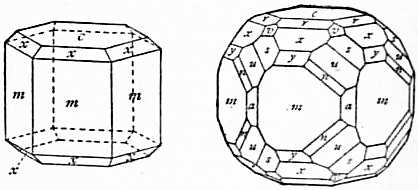
Fig. 1. Fig. 2.
Apatite frequently occurs as beautifully developed crystals, sometimes a foot or more in length, belonging to that division of the hexagonal system in which there is pyramidal hemi-hedrism. In this type of symmetry, of which apatite is the best example, there is only one plane of symmetry, which is perpendicular to the hexad axis. The arrangement of the pyramidal faces n and u in fig. 2 show the hemihedral character and absence of the full number of planes and axes of symmetry. Fig. 2 represents a highly modified crystal from St Gotthard; a more common form is shown in fig. 1, which is bounded by the hexagonal prism m, hexagonal bipyramid x and basal pinacoid c.
In its general appearance, apatite exhibits wide variations. Crystals may be colourless and transparent or white and opaque, but are often coloured, usually some shade of green or brown, occasionally violet, sky-blue, yellow, &c. The lustre is vitreous, inclining to sub-resinous. There is an imperfect cleavage parallel to the basal pinacoid, and the fracture is conchoidal. Hardness 5, specific gravity 3.2.
Yellowish-green prismatic crystals from Jumilla in Murcia in Spain have long been known under the name asparagus-stone. Lazurapatite is a sky-blue variety found as crystals with lapis-lazuli in Siberia; and moroxite is the name given to dull greenish-blue crystals from Norway and Canada. Francolite, from Wheal Franco, near Tavistock in Devonshire, and also from several Cornish mines, occurs as crystallized stalactitic masses. In addition to these crystallized varieties, there are massive varieties, fibrous, concretionary, stalactitic, or earthy in form, which are included together under the name phosphorite (q.v.), and it is these massive varieties, together with various rock-phosphates (phosphatic nodules, coprolites, guano, &c.) which are of such great economic importance: crystallized apatite is mined for phosphates only in Norway and Canada.
With regard to its mode of occurrence, apatite is found under a variety of conditions. In igneous rocks of all kinds it is invariably present in small amounts as minute acicular crystals, and was one of the first constituents of the rock to crystallize out from the magma. The extensive deposits of chlor-apatite near Kragerö and Bamle, near Brevik, in southern Norway, are in connexion with gabbro, the felspar of which has been altered, by emanations containing chlorine, to scapolite, and titanium minerals have been developed. The apatite occurring in connexion with granite and veins of tin-stone is, on the other hand, a fluor-apatite, and, like the other fluorine-bearing minerals characteristic of tin-veins, doubtless owes its origin to the emanations of tin fluoride which gave rise to the tin-ore. Special mention may be here made of the beautiful violet crystals of fluor-apatite which occur in the veins of tin-ore in the Erzgebirge, and of the brilliant bluish-green crystals encrusting cavities in the granite of Luxullian in Cornwall. Another common mode of occurrence of apatite is in metamorphic crystalline rocks, especially in crystalline limestones: in eastern Canada extensive beds of apatite occur in the limestones associated with the Laurentian gneisses. Still another mode of occurrence is presented by beautifully developed and transparent crystals found with crystals of felspar and quartz lining the crevices in the gneiss of the Alps. Crystallized apatite is also occasionally found in metalliferous veins, other than those of tin, and in beds of iron ore; whilst if the massive varieties (phosphorite) be considered many other modes of occurrence might be cited.
(L. J. S.)
APATURIA (Άπατούρια), an ancient Greek festival held annually by all the Ionian towns except Ephesus and Colophon (Herodotus i. 147). At Athens it took place in the month of Pyanepsion (October to November), and lasted three days, on which occasion the various phratries (i.e. clans) of Attica met to discuss their affairs. The name is a slightly modified form of ἀπατόρια = ἀμαπατόρια, ὁμοπατόρια, the festival of “common relationship.” The ancient etymology associated it with ἀπάτη (deceit), a legend existing that the festival originated in 1100 B.C. in commemoration of a single combat between a certain Melanthus, representing King Thymoetes of Attica, and King Xanthus of Boeotia, in which Melanthus successfully threw his adversary off his guard by crying that a man in a black goat’s skin (identified with Dionysus) was helping him (Schol. Aristophanes, Acharnians, 146). On the first day of the festival, called Dorpia or Dorpeia, banquets were held towards evening at the meeting-place of the phratries or in the private houses of members. On the second, Anarrhysis (from ἀναρρύειν, to draw back the victim’s head), a sacrifice of oxen was offered at the public cost to Zeus Phratrius and Athena. On the third day, Cureotis (κουρεῶτις), children born since the last festival were presented by their fathers or guardians to the assembled phratores, and, after an oath had been taken as to their legitimacy and the sacrifice of a goat or a sheep, their names were inscribed in the register. The name κουρεῶτις is derived either from κοῦρος, that is, the day of the young, or less probably from κείρω, because on this occasion young people cut their hair and offered it to the gods. The victim was called μεῖον. On this day also it was the custom for boys still at school to declaim pieces of poetry, and to receive prizes (Plato, Timaeus, 21 B). According to Hesychius these three days of the festival were followed by a fourth, called ἐπίβδα, but this is merely a general term for the day after any festival.
APE (Old Eng. apa; Dutch aap; Old Ger. affo; Welsh epa; Old Bohemian op; a word of uncertain origin, possibly an imitation of the animal’s chatter), the generic English name, till the 16th century, for animals of the monkey tribe, and still used specifically for the tailless, manlike representatives of the order Primates (q.v.). The word is now generally a synonym for “monkey,” but the common verb for both (as transferred figuratively to human beings) is “to ape,” i.e. to imitate.
APELDOORN, a town in the province of Gelderland, Holland, and a junction station 26½ m. by rail W. of Amersfoort. It is connected by canal north and south with Zwolle and Zutphen respectively. Pop. (1900) 25,834. The neighbourhood of Apeldoorn is very picturesque and well wooded. The Protestant church was restored after a fire in 1890. Close by is the favourite country-seat of the royal family of Holland called the Loo. It was originally a hunting-lodge of the dukes of Gelderland, but in its present form dates chiefly from the time of the Stadtholder William III., king of England. Apeldoorn possesses large paper-mills.
APELLA, the official title of the popular assembly at Sparta, corresponding to the ecclesia in most other Greek states. Every full citizen who had completed his thirtieth year was entitled to attend the meetings, which, according to Lycurgus’s ordinance, must be held at the time of each full moon within the boundaries of Sparta. They had in all probability taken place originally in the Agora, but were later transferred to the neighbouring building known as the Skias (Paus. iii. 12. 10). The presiding officers were at first the kings, but in historical times the ephors, and the voting was conducted by shouts; if the president was doubtful as to the majority of voices, a division was taken and the votes were counted. Lycurgus had ordained that the apella must simply accept or reject the proposals submitted to it, and though this regulation fell into neglect, it was practically restored by the law of Theopompus and Polydorus which empowered the kings and elders to set aside any “crooked” decision of the people (Plut. Lycurg. 6). In later times, too, the actual debate was almost, if not wholly, confined to the kings, elders, ephors and perhaps the other magistrates. The apella voted on peace and war, treaties and foreign policy in general: it decided which of the kings should conduct a campaign and settled questions of disputed succession to the throne: it elected elders, ephors and other magistrates, emancipated helots and perhaps voted on legal proposals. There is a single reference (Xen. Hell. iii. 3. 8) to a “small assembly” (ἡ μικρὰ καλουμένη ἐκκλησία) at Sparta, but nothing is known as to its nature or competence. The term apella does not occur in extant Spartan inscriptions, though two decrees of Gythium belonging to the Roman period refer to the μεγάλαι ἀπέλλαι (Le Bas-Foucart, Voyage archéologique, ii., Nos. 242a, 243).
See G. Gilbert, Constitutional Antiquities of Sparta and Athens (Eng, trans., 1895), pp. 49 ff.; Studien zur altspartanischen Geschichte (Göttingen, 1872), pp. 131 ff.; G.F. Schömann, Antiquities of Greece: The State (Eng. trans., 1880), pp. 234 ff.; De ecdesiis Lacedaemoniorum (Griefswald, 1836) [= Opusc. academ. i. pp. 87 ff.]; C.O. Müller, History and Antiquities of the Doric Race (Eng. trans., 2nd ed. 1839), book iii. ch. 5, §§ 8-10; G. Busolt, Die griechischen Staats- und Rechtsaltertümer, 1887 (in Iwan Müller’s Handbuch der klassischen Altertumsiuissenschaft, iv. 1), § 90; Griechische Geschichte (2nd ed.), i. p. 552 ff.
(M. N. T.)
APELLES, probably the greatest painter of antiquity. He lived from the time of Philip of Macedon till after the death of Alexander. He was of Ionian origin, but after he had attained some celebrity he became a student at the celebrated school of Sicyon, where he worked under Pamphilus. He thus combined the Dorian thoroughness with the Ionic grace. Attracted to the court of Philip, he painted him and the young Alexander with such success that he became the recognized court painter of Macedon, and his picture of Alexander holding a thunderbolt ranked with the Alexander with the spear of the sculptor Lysippus. Other works of Apelles had a great reputation in antiquity, such as the portraits of the Macedonians Clitus, Archelaus and Antigonus, the procession of the high priest of Artemis at Ephesus, Artemis amid a chorus of maidens, a great allegorical picture representing Calumny, and the noted painting representing Aphrodite rising out of the sea. Of none of these works have we any copy, unless indeed we may consider a painting of Alexander as Zeus in the house of the Vettii at Pompeii as a reminiscence of his work; but some of the Italian artists of the Renaissance repeated the subjects, in a vain hope of giving some notion of the composition of them.
Few things are more hopeless than the attempt to realize the style of a painter whose works have vanished. But a great wealth of stories, true or invented, clung to Apelles in antiquity; and modern archaeologists have naturally tried to discover what they indicate. We are told, for example, that he attached great value to the drawing of outlines, practising every day. The tale is well known of his visit to Protogenes, and the rivalry of the two masters as to which could draw the finest and steadiest line. The power of drawing such lines is conspicuous in the decoration of red-figured vases of Athens. Apelles is said to have treated his rival with generosity, for he increased the value of his pictures by spreading a report that he meant to buy them and sell them as his own. Apelles allowed the superiority of some of his contemporaries in particular matters: according to Pliny he admired the dispositio of Melanthius, i.e. the way in which he spaced his figures, and the mensurae of Asclepiodorus, who must have been a great master of symmetry and proportion. It was especially in that undefinable quality “grace” that Apelles excelled. He probably used but a small variety of colours, and avoided elaborate perspective: simplicity of design, beauty of line and charm of expression were his chief merits. When the naturalism of some of his works is praised— for example, the hand of his Alexander is said to have stood out from the picture—we must remember that this is the merit always ascribed by ignorant critics to works which they admire. In fact the age of Alexander was one of notable idealism, and probably Apelles succeeded in a marked degree in imparting to his figures a beauty beyond nature.
Apelles was also noted for improvements which he introduced in technique. He had a dark glaze, called by Pliny atramentum, which served both to preserve his paintings and to soften their colour. There can be little doubt that he was one of the most bold and progressive, of artists.
(P. G.)
APELLICON, a wealthy native of Teos, afterwards an Athenian citizen, a famous book collector. He not only spent large sums in the acquisition of his library, but stole original documents from the archives of Athens and other cities of Greece. Being detected, he fled in order to escape punishment, but returned when Athenion (or Aristion), a bitter opponent of the Romans, had made himself tyrant of the city with the aid of Mithradates. Athenion sent him with some troops to Delos, to plunder the treasures of the temple, but he showed little military capacity. He was surprised by the Romans under the command of Orobius (or Orbius), and only saved his life by flight. He died a little later, probably in 84 B.C.
Apellicon’s chief pursuit was the collection of rare and important books. He purchased from the family of Neleus of Skepsis in the Troad manuscripts of the works of Aristotle and Theophrastus (including their libraries), which had been given to Neleus by Theophrastus himself, whose pupil Neleus had been. They had been concealed in a cellar to prevent their falling into the hands of the book-collecting princes of Pergamum, and were in a very dilapidated condition. Apellicon filled in the lacunae, and brought out a new, but faulty, edition. In 84 Sulla removed Apellicon’s library to Rome (Strabo xiii. p. 609; Plutarch, Sulla, 26). Here the MSS. were handed over to the grammarian Tyrannion, who took copies of them, on the basis of which the peripatetic philosopher Andronicus of Rhodes prepared an edition of Aristotle’s works. Apellicon’s library contained a remarkable old copy of the Iliad. He is said to have published a biography of Aristotle, in which the calumnies of other biographers were refuted.
APENNINES (Gr. Άπέννινος, Lat. Appenninus—in both cases used in the singular), a range of mountains traversing the entire peninsula of Italy, and forming, as it were, the backbone of the country. The name is probably derived from the Celtic pen, a mountain top: it originally belonged to the northern portion of the chain, from the Maritime Alps to Ancona; and Polybius is probably the first writer who applied it to the whole chain, making, indeed, no distinction between the Apennines and the Maritime Alps, and extending the former name as far as Marseilles. Classical authors do not differentiate the various parts of the chain, but use the name as a general name for the whole. The total length is some 800 m. and the maximum width 70 to 80 m.
Divisions.—Modern geographers divide the range into three parts, northern, central and southern.
1. The northern Apennines are generally distinguished (though there is no real solution of continuity) from the Maritime Alps at the Bocchetta dell’ Altare, some 5 m. W. of Savona on the high road to Turin.1 They again are divided into three parts— the Ligurian, Tuscan and Umbrian Apennines. The Ligurian Apennines extend as far as the pass of La Cisa in the upper valley of the Magra (anc. Macra) above Spezia; at first they follow the curve of the Gulf of Genoa, and then run east-south-east parallel to the coast. On the north and north-east lie the broad plains of Piedmont and Lombardy, traversed by the Po, the chief tributaries of which from the Ligurian Apennines are the Scrivia (Olumbria), Trebbia (Trebia) and Taro (Tarus). The Tanaro (Tanarus), though largely fed by tributaries from the Ligurian Apennines, itself rises in the Maritime Alps, while the rivers on the south and south-west of the range are short and unimportant. The south side of the range rises steeply from the sea, leaving practically no coast strip: its slopes are sheltered and therefore fertile and highly cultivated, and the coast towns are favourite winter resorts (see Riviera). The highest point (the Monte Bue) reaches 5915 ft. The range is crossed by several railways—the line from Savona to Turin (with a branch at Ceva for Acqui), that from Genoa to Ovada and Acqui, the main lines from Genoa to Novi, the junction for Turin and Milan (both of which2 pass under the Monte dei Giovi, the ancient Mons loventius, by which the ancient Via Postumia ran from Genua to Dertona), and that from Spezia to Parma under the pass of La Cisa.3 All these traverse the ridge by long tunnels—that on the new line from Genoa to Honco is upwards of 5 m. in length.
The Tuscan Apennines extend from the pass of La Cisa to the sources of the Tiber. The main chain continues to run in an east-south-east direction, but traverses the peninsula, the west coast meanwhile turning almost due south. From the northern slopes many rivers and streams run north and north-north-east into the Po, the Secchia (Secia) and Panaro (Scultenna) being among the most important, while farther east most of the rivers are tributaries of the Reno (anc. Rhenus). Other small streams, e.g. the Ronco (Bedesis) and Montone (Utis), which flow into the sea together east of Ravenna, were also tributaries of the Po; and the Savio (Sapis) and the Rubicon seem to be the only streams from this side of the Tuscan Apennines that ran directly into the sea in Roman days. From the south-west side of the main range the Arno (q.v.) and Serchio run into the Mediterranean. This section of the Apennines is crossed by two railways, from Pistoia to Bologna and from Florence to Faenza, and by several good high roads, of which the direct road from Florence to Bologna over the Futa pass is of Roman origin; and certain places in it are favourite summer resorts. The highest point of the chain is Monte Cimone (7103 ft.). The so-called Alpi Apuane (the Apuani were an ancient people of Liguria), a detached chain south-west of the valley of the Serchio, rise to a maximum height of 6100 ft. They contain the famous marble quarries of Carrara. The greater part of Tuscany, however, is taken up by lower hills, which form no part of the Apennines, being divided from the main chain by the valleys of the Arno, Chiana (Clanis) and Paglia (Pallia), Towards the west they are rich in minerals and chemicals, which the Apennines proper do not produce.
The Umbrian Apennines extend from the sources of the Tiber to (or perhaps rather beyond) the pass of Scheggia near Cagli, where the ancient Via Flaminia crosses the range. The highest point is the Monte Nerone (5010 ft.). The chief river is the Tiber itself: the others, among which the Foglia (Pisaurus), Metauro (Metaurus) and Esino4 may be mentioned, run north-east into the Adriatic, which is some 30 m. from the highest points of the chain. This portion of the range is crossed near its southern termination by a railway from Foligno to Ancona (which at Fabriano has a branch to Macerata and Porto Civitanova, on the Adriatic coast railway), which may perhaps be conveniently regarded as its boundary.5 By some geographers, indeed, it is treated as a part of the central Apennines.
2. The central Apennines are the most extensive portion of the chain, and stretch as far as the valley of the Sangro (Sangrus). To the north are the Monti Sibillini, the highest point of which is the Monte Vettore (8128 ft.). Farther south three parallel chains may be traced, the westernmost of which (the Monti Sabini) culminates to the south in the Monte Viglio (7075 ft.), the central chain in the Monte Terminillo (7260 ft.), and farther south in the Monte Velino (8160 ft.), and the eastern in the Gran Sasso d’Italia (9560 ft.), the highest summit of the Apennines, and the Maiella group (Monte Amaro, 9170 ft.). Between the western and central ranges are the plain of Rieti, the valley of the Salto (Himella), and the Lago Fucino; while between the central and eastern ranges are the valleys of Aquila and Sulmona. The chief rivers on the west are the Nera (Nar), with its tributaries the Velino (Velinus) and Salto, and the Anio, both of which fall into the Tiber. On the east there is at first a succession of small rivers which flow into the Adriatic, from which the highest points of the chain are some 25 m. distant, such as the Potenza (Flosis), Chienti (Cluentus), Tenna (Tinna), Tronto (Truentus), Tordino (Helvinus), Vomano (Vomanus), &c. The Pescara (Aternus), which receives the Aterno from the north-west and the Gizio from the south-east, is more important; and so is the Sangro.
The central Apennines are crossed by the railway from Rome to Castelammare Adriatico via Avezzano and Sulmona: the railway from Orte to Terni (and thence to Foligno) follows the Nera valley; while from Terni a line ascends to the plain of Rieti, and thence crosses the central chain to Aquila, whence it follows the valley of the Aterno to Sulmona. In ancient times the Via Salaria, Via Caecilia and Via Valeria-Claudia all ran from Rome to the Adriatic coast. The volcanic mountains of the province of Rome are separated from the Apennines by the Tiber valley, and the Monti Lepini, or Volscian mountains, by the valleys of the Sacco and Liri.
3. In the southern Apennines, to the south of the Sangro valley, the three parallel chains are broken up into smaller groups; among them may be named the Matese, the highest point of which is the Monte Miletto (6725 ft.). The chief rivers on the south-west are the Liri or Garigliano (anc. Liris) with its tributary the Sacco (Trerus), the Volturno (Volturnus), Sebeto (Sabatus), Sarno (Sarnus), on the north the Trigno (Trinius), Biferno (Tifernus), and Fortore (Frento). The promontory of Monte Gargano, on the east, is completely isolated, and so are the volcanic groups near Naples. The district is traversed from north-west to south-east by the railway from Sulmona to Benevento and on to Avellino, and from south-west to north-east by the railways from Caianello via Isernia to Campobasso and Termoli, from Caserta to Benevento and Foggia, and from Nocera and Avellino to Rocchetta S. Antonio, the junction for Foggia, Spinazzola (for Barletta, Bari, and Taranto) and Potenza. Roman roads followed the same lines as the railways: the Via Appia ran from Capua to Benevento, whence the older road went to Venosa and Taranto and so to Brindisi, while the Via Traiana ran nearly to Foggia and thence to Bari.
The valley of the Ofanto (Aufidus), which runs into the Adriatic close to Barletta, marks the northern termination of the first range of the Lucanian Apennines (now Basilicata), which runs from east to west, while south of the valleys of the Sele (on the west) and Basiento (on the east)-which form the line followed by the railway from Battipaglia via Potenza to Metaponto—the second range begins to run due north and south as far as the plain of Sibari (Sybaris). The highest point is the Monte Pollino (7325 ft.). The chief rivers are the Sele (Silarus)—joined by the Negro (Tanager) and Calore (Calor)— on the west, and the Bradano (Bradanus), Basiento (Casuentus), Agri (Aciris), Sinni (Siris) on the east, which flow into the gulf of Taranto; to the south of the last-named river there are only unimportant streams flowing into the sea east and west, inasmuch as here the width of the peninsula diminishes to some 40 m. The railway running south from Sicignano to Lagonegro, ascending the valley of the Negro, is planned to extend to Cosenza, along the line followed by the ancient Via Popilia, which beyond Cosenza reached the west coast at Terina and thence followed it to Reggio. The Via Herculia, a branch of the Via Traiana, ran from Aequum Tuticum to the ancient Nerulum. At the narrowest point the plain of Sibari, through which the rivers Coscile (Sybaris) and Crati (Crathis) flow to the sea, occurs on the east coast, extending halfway across the peninsula. Here the limestone Apennines proper cease and the granite mountains of Calabria (anc. Bruttii) begin. The first group extends as far as the isthmus formed by the gulfs of S. Eufemia and Squillace; it is known as the Sila, and the highest point reached is 6330 ft. (the Botte Donato). The forests which covered it in ancient times supplied the Greeks and Sicilians with timber for shipbuilding. The railway from S. Eufemia to Catanzaro and Catanzaro Marina crosses the isthmus, and an ancient road may have run from Squillace to Monteleone. The second group extends to the south end of the Italian peninsula, culminating in the Aspromonte (6420 ft.) to the east of Reggio di Calabria. In both groups the rivers are quite unimportant.
Character.-The Apennines are to some extent clothed with forests, though these were probably more extensive in classical times (Pliny mentions especially pine, oak and beech woods, Hist. Nat. xvi. 177); they have indeed been greatly reduced in comparatively modern times by indiscriminate timber-felling, and though serious attempts at reafforestation have been made by the government, much remains to be done. They also furnish considerable summer pastures, especially in the Abruzzi: Pliny (Hist. Nat. xi. 240) praises the cheese of the Apennines. In the forests wolves were frequent, and still are found, the flocks being protected against them by large sheep-dogs; bears, however, which were known in Roman times, have almost entirely disappeared. Nor are the wild goats called rotae, spoken of by Varro (R. R. II. i. 5), which may have been either chamois or steinbock, to be found. Brigandage appears to have been prevalent in Roman times in the remoter parts of the Apennines, as it was until recently: an inscription found near the Furlo pass was set up in A.D. 246 by an evocatus Augusti (a member of a picked corps) on special police duty with a detachment of twenty men from the Ravenna fleet (G. Henzen in Römische Mitteilungen, 1887, 14). Snow lies on the highest peaks of the Apennines for almost the whole year. The range produces no minerals, but there are a considerable number of good mineral springs, some of which are thermal (such as Bagni di Lucca, Monte Catini, Monsummano, Porretta, Telese, &c.), while others are cool (such as Nocera, Sangemini, Cinciano, &c.), the water of which is both drunk on the spot and sold as table water elsewhere.
(T. As.)
Geology.—The Apennines are the continuation of the Alpine chain, but the individual zones of the Alps cannot be traced into the Apennines. The zone of the Brianconnais (see Alps) may be followed as far as the Gulf of Genoa, but scarcely beyond, unless it is represented by the Trias and older beds of the Apuan Alps. The inner zone of crystalline and schistose rocks which forms the main chain of the Alps, is absent in the Apennines except towards the southern end. The Apennines, indeed, consist almost entirely of Mesozoic and Tertiary beds, like the outer zones of the Alps. Remnants of a former inner zone of more ancient rocks may be seen in the Apuan Alps, in the islands off the Tuscan coast; in the Catena Metallifera, Cape Circeo and the island of Zannone, as well as in the Calabrian peninsula. These remnants lie at a comparatively low level, and excepting the Apuan Alps and the Calabrian peninsula they do not now form any part of the Apennine chain. But that in Tertiary times there was a high interior zone of crystalline rocks is indicated by the character of the Eocene beds in the southern Apennines. These are formed to a large extent of thick conglomerates which are full of pebbles and boulders of granite and schist. Many of the boulders are of considerable size and they are often still angular. There is now no crystalline region from which they could reach their present position; and this and other considerations have led the followers of E. Suess to conclude that even in Tertiary times a large land mass consisting of ancient rocks occupied the space which is now covered by the southern portion of the Tyrrhenian Sea. This old land mass has been called Tyrrhenis, and probably extended from Sicily into Latium and as far west as Sardinia. On the Italian border of this land there was raised a mountain chain with an inner crystalline zone and an outer zone of Mesozoic and Tertiary beds. Subsequent faulting has caused the subsidence of the greater part of Tyrrhenis, including nearly the whole of the inner zone of the mountain chain, and has left only the outer zones standing as the present Apennines.
Be this as it may, the Apennines, excepting in Calabria, are formed chiefly of Triassic, Jurassic, Cretaceous, Eocene and Miocene beds. In the south the deposits, from the Trias to the middle Eocene, consist mainly of limestones, and were laid down, with a few slight interruptions, upon a quietly subsiding sea-floor. In the later part of the Eocene period began the folding which gave rise to the existing chain. The sea grew shallow, the deposits became conglomeratic and shaly, volcanic eruptions began, and the present folds of the Apennines were initiated. The folding and consequent elevation went on until the close of the Miocene period when a considerable subsidence took place and the Pliocene sea overspread the lower portions of the range. Subsequent elevation, without folding, has raised these Pliocene deposits to a considerable height—in some cases over 3000 ft. and they now lie almost undisturbed upon the older folded beds. This last elevation led to the formation of numerous lakes which are now filled up by Pleistocene deposits. Both volcanic eruptions and movements of elevation and depression continue to the present day on the shores of the Tyrrhenian Sea. In the northern Apennines the elevation of the sea floor appears to have begun at an earlier period, for the Upper Cretaceous of that part of the chain consists largely of sandstones and conglomerates. In Calabria the chain consists chiefly of crystalline and schistose rocks; it is the Mesozoic and Tertiary zone which has here been sunk beneath the sea. Similar rocks are found beneath the Trias farther north, in some of the valleys of Basilicata. Glaciers no longer exist in the Apennines, but Post-Pliocene moraines have been observed in Basilicata.
References.—G. de Lorenzo, “Studi di geologia nell’ Appennino Meridionale,” Atti d. R. Accad. d. Sci, Fis. e Mat., Napoli, ser. 2, vol. viii., no. 7 (1896); F. Sacco, “L’ Appennino settentrionale,” Boll. Soc. geol. Ital. (1893-1899).
(P. La.)
1 The ancient Via Aemilia, built in 109 B.C., led over this pass, but originally turned east to Dertona (mod. Tortona).
2 There are two separate lines from Sampierdarena to Ronco.
3 This pass was also traversed by a nameless Roman road.
4 This river (anc. Aesis) was the boundary of Italy proper in the 3rd and 2nd centuries B.C.
5 The Monte Conero, to the south of Ancona, was originally an island of the Pliocene sea.
APENRADE, a town of Germany in the Prussian province of Schleswig, beautifully situated on the Apenrade Fjord, an arm of the Little Belt, 38 m. N. of the town of Schleswig. Pop. (1900) 5952. It is connected by a branch line with the main railway of Schleswig, and possesses a good harbour, which affords shelter for a large carrying trade. Fishing, shipbuilding and various small factories provide occupation for the population. The town is a bathing resort, as is Elisenlund close by.
APERTURE (from Lat. aperire, to open), an opening. In optics, it is that portion of the diameter of an object-glass or mirror through which light can pass free from obstruction. It is equal to the actual diameter of the cylinder of rays admitted by a telescope.
APEX, the Latin word (pl. apices) for the top, tip or peak of anything. A diminutive “apiculus” is used in botany.
APHANITE, a name given (from the Gr. ἀφανής, invisible) to certain dark-coloured igneous rocks which are so fine-grained that their component minerals are not detected by the unaided eye. They consist essentially of plagioclase felspar, with hornblende or augite, and may contain also biotite, quartz and a limited amount of orthoclase. Although a few authorities still recognize the aphanites as a distinct class, most systematic petrologists, at the present time, have discarded it, and regard these rocks as merely structural facies of other species. Those which contain hornblende are uniform, fine-grained diorites, vogesites, &c., while when pyroxene predominates they are ascribed to the dolerites, quartz-dolerites, &c. Hence, any rock which is compact, crystalline and fine grained, is frequently said to be aphanitic, without implying exactly to which of the principal rock groups it really belongs.
APHASIA1 (from Gr. α, privative, and φάσις, speech), a term which means literally inability to speak, and is used to denote various defects in the comprehension and expression of both spoken and written language which result from lesions of the brain. Aphasic disorders may be classed in two groups:—first, receptive or sensory aphasia, which comprises (a) inability to understand spoken language (auditory aphasia), and (b) inability to read (visual aphasia, or alexia); second, emissive or motor aphasia, under which category are included (a) inability to speak (motor vocal aphasia, or aphemia), and (b) inability to write (motor graphic aphasia, or agraphia). It has been shown that each of these defects is produced by destruction of a special region of the cortex of the brain. These regions, which are termed the speech centres, are, in right-handed people, situated in the left cerebral hemisphere; this is the reason why aphasia is so commonly associated with paralysis of the right side of the body.
A study of the acquisition of the faculty of speech throws light upon the education of the speech centres, and helps to elucidate their physiological interaction and the phenomena of aphasia. The auditory speech centre is the first to show signs of functional activity, for within a few months of birth the child begins to understand spoken language. Some months later the motor vocal speech centre begins to functionate. The memories of the auditory word images which are stored up in the auditory speech centre play a most important part in the process of learning to speak. The child born deaf grows up mute. The visual speech centre comes into activity when the child is taught to read. Again, when he learns to write and thus begins to educate his graphic centre, he is constantly calling upon his visual speech centre for the visual images of the words he wishes to produce. From these remarks it will be seen that there is a very intimate association between the auditory speech centre and the motor vocal speech centre, also between the visual speech centre and the graphic centre.
Auditory Aphasia.—The auditory speech centre is situated in the posterior part of the first and second temporo-sphenoidal convolutions on the left side of the brain. Destruction of this centre causes “auditory aphasia.” Hearing is unimpaired but spoken language is quite unintelligible. The subject of auditory aphasia may be compared to an individual who is listening to a foreign language of which he does not understand a word. Word deafness, a term often used as synonymous with auditory aphasia, is misleading and should be abandoned. Auditory aphasia commonly interferes with vocal expression, for the majority of people when they speak do so by recalling the auditory memories of words stored up in the auditory speech centre. Amnesia verbalis is employed to designate failure to call up in the memory the images of words which are needed for purposes of vocal expression or silent thought.
Visual Aphasia or Alexia.—The visual speech centre, which is located in the left angular gyrus, is connected with the two centres for vision which are situated one in either occipital lobe. Destruction of the visual speech centre produces visual aphasia or alexia. Word blindness, sometimes used as the equivalent of visual aphasia, is, like word deafness, a misleading term. The individual is not blind, he sees the words and letters perfectly, but they appear to him as unintelligible cyphers. When the visual speech centre is destroyed, the memories of the visual images of words are obliterated and interference with writing, a consequence of amnesia verbalis, results. On the other hand, when the lesion is situated deeply in the occipital lobe, and does not implicate the cortex, but merely cuts off the connexions of the angular gyrus with both visual centres, agraphia is not produced, for the visual word centre and its connexion with the graphic centre are still intact (pure, or sub-cortical word blindness).
Motor Vocal Aphasia or Aphemia.—The centre for motor vocal speech is situated in the posterior part of the third left frontal convolution and extends on to the foot of the left ascending frontal convolution (Broca’s convolution). Complete destruction of this region produces loss of speech, although it often happens that a few words, such as “yes” and “no,” and, it may be, emotional exclamations such as “Oh! dear!” and the like are retained. The utterance of unintelligible sounds is still possible, however, and there is neither defective voice production (aphonia) nor paralysis of the mechanism of articulation. The individual can recall the auditory and visual images of the words which he wishes to use, but his memory for the complicated, co-ordinated movements which he acquired in the process of learning to speak, and which are necessary for vocal expression, has been blotted out. In the great majority of cases of motor vocal aphasia there is associated agraphia, a circumstance which is perhaps to be accounted for by the proximity of the graphic centre. When the lesion is situated below the cortex of Broca’s convolution but destroys the fibres which pass from it towards the internal capsule, agraphia is not produced (sub-cortical or pure motor vocal aphasia). Destruction of the auditory speech centre is, as we have seen, commonly accompanied by more or less interference with vocal speech, a consequence of amnesia verbalis.
Agraphia.—Discussion still rages as to the presence of a special writing centre. Those who favour the separate existence of a graphic centre locate it in the second left frontal convolution. It may be that the want of unanimity as to the graphic centre is to be explained by an anatomical relationship so close between the graphic centre and that for the fine movement of the hand that a lesion in this situation which produces agraphia must at the same time cause a paralysis of the hand. Destruction of the visual speech centre by obliterating the visual memories of words (amnesia verbalis) produces agraphia. Further, several instances are on record in which agraphia has followed destruction of the commissure between the visual speech centre and the graphic centre. As already mentioned, agraphia is very often associated with motor vocal aphasia.
A number of aphasic defects are met with in addition to those already mentioned. Thus paraphasia is a condition in which the patient makes use of words other than those he intends. He may mix up his words so that his conversation is quite unintelligible. In the most pronounced forms he gabbles away, employing unrecognizable sounds in place of words (jargon and gibberish aphasia). Paragraphia is a similar defect which occurs in writing. Both paraphasia and paragraphia may be produced by partial lesions of the sensory speech centres or of the commissures which connect these with the motor centres. Object blindness (syn. mind-blindness) refers to an inability to recognize an object or its uses by the aid of sight alone. The probable explanation would seem to be that the ordinary centre for vision has been isolated from the other sensory centres with which it is connected. Not uncommonly there is associated visual aphasia. Optic aphasia was introduced to designate a somewhat similar state in which, although the uses of an object are recognized, the patient cannot name it at sight, yet, if it is of such a nature that it appeals directly to one of the other senses, he may at once be able to name it. Tactile aphasia, is a rare defect in which there exists an inability to recognize an object by touch alone although the qualities which, under normal circumstances, suffice for its detection can be accurately described. Amusia, or loss of the musical faculty, may occur in association with or independent of aphasia. There is reason for believing that special receptive and emissive centres exist for the musical sense exactly analogous to those for speech.
The speech centres are all supplied by the left middle cerebral artery. When this artery is blocked close to its origin by an embolus or thrombus, total aphasia results. It may be, however, that only one of the smaller branches of the artery is obstructed, and, according to the region of the brain to which this branch is distributed, one or more of the speech centres may be destroyed. Occlusion of the left posterior cerebral artery causes extensive softening of the occipital lobe and produces pure word blindness. Further, a tumour, abscess, haemorrhage or meningitis may be so situated as to damage or destroy the individual speech centres or their connecting commissures. The amount of recovery to be expected in any given case depends upon the nature, situation and extent of the lesion, and upon the age of the patient. Even after complete destruction of the speech centres, perfect recovery may take place, for the centres in the right hemisphere of the brain are capable of education. This is only possible in young individuals. In the great majority of instances the nature of the lesion is such as to render futile all treatment directed towards its removal. In suitable cases, however, the education of the right side of the brain may be very greatly assisted by an intelligent application of scientific methods.
Bibliography.—Broca, Bulletin de la Société anatomique (1861); Wernicke, Der Aphasische Symptomen-complex (Breslau, 1874); Kussmaul, Ziemssen’s Cyclopaedia, vol. xiv. p. 759; Wyllie, The Disorders of Speech (1895); Elder, Aphasia and the Cerebral Speech Mechanism (1897); Collins, The Faculty of Speech (1897); Bastian, Aphasia and other Speech Defects (1898); Byrom Bramwell, “Will-making and Aphasia,” British Medical Journal (1897); “The Morison Lectures on Aphasia,” The Lancet (1906). See also the works of Charcot, Hughlings Jackson, Dejerine, Lichtheim, Pitres, Grasset, Ross, Broadbent, Mills, Bateman, Mirallié, Exner, Marie and others.
(J. B. T.)
1 In 1906 Pierre Marie of Paris expressed views (La Semaine medicale, May 23 and October 17, and elsewhere) upon the question of aphasia which have given rise to much animated controversy, since they are in many respects at complete variance with the classical conception which has been represented in the present article. Marie holds that Broca’s convolution plays no special role in the function of speech. He admits that a lesion in the region of the lenticular nucleus is followed by inability to speak, but this defect is, in his opinion, to be regarded as an anarthria. He further admits the production of sensory aphasia—the aphasia of Wernicke, as he prefers to call it after its discoverer—by lesions which destroy the angular and supramarginal gyri, and the upper two temporo-sphenoidal convolutions, but he regards the essential foundation of sensory aphasia as a diminution of intelligence. There are, in his opinion, no sensory images of language. Motor aphasia is, he believes, nothing more than a combination of sensory aphasia and anarthria. These conclusions have been vigorously attacked, more especially by Dejerine of Paris (La Presse medicale, July 1906 and elsewhere).
APHELION (from Gr. ἀπό, from, and ᾔλιος, sun), in astronomy, that point of the orbit of a planet at which it is most distant from the sun. Apogee, Apocentre, Aposaturnium, &c. are terms applied to those points of the orbit of a body moving around a centre of force—as the Earth, Saturn, &c.—at which it is farthest from the central body.
APHEMIA (from Gr. ἀ, without, and φήμη, speech), in pathology, the loss of the power of speech (see Aphasia).
APHIDES (pl. of Aphis), minute insects, also known as “plant-lice,” “blight,” and “green-fly,” belonging to the homopterous division of the order Hemiptera, with long antennae and legs, two-jointed, two-clawed tarsi, and usually a pair of abdominal tubes through which a waxy secretion is exuded. These tubes were formerly supposed to secrete the sweet substance known as “honey-dew” so much sought after by ants; but this is now known to come from the alimentary canal. Both winged and wingless forms of both sexes occur, and the wings when present are normal in number, that is to say two pairs. Apart from their importance from the economic standpoint, Aphides are chiefly remarkable for the phenomena connected with the propagation of the species. The following brief summary of what takes place in the plant-louse of the rose (Aphis rosae), may be regarded as typical of the family, though exceptions occur in other species: Eggs produced in the autumn by fertilized females remain on the plant through the winter and hatching in the spring give rise to female individuals which may be winged or wingless. From these females are born parthenogenetically, that is to say without the intervention of males, and by a process that has been compared to internal budding, large numbers of young resembling their parents in every particular except size, which themselves reproduce their kind in the same way. This process continues throughout the summer, generation after generation being produced until the number of descendants from a single individual of the spring-hatched brood may amount to very many thousands. In the autumn winged males appear, union between the sexes takes place and the females lay the fertilized eggs which are destined to carry the species through the cold months of winter. If, however, the food-plant is grown in a conservatory where protection against cold is afforded, the aphides may go on reproducing agamogenetically without cessation for many years together. Not the least interesting features connected with this strange life-history are the facts that the young may be born by the oviparous or viviparous methods and either gamogenetically or agamogenetically, and may develop into winged forms or remain wingless, and that the males only appear in any number at the close of the season. Although the factors which determine these phenomena are not clearly understood, it is believed that the appearance of the males is connected with the increasing cold of autumn and the growing scarcity of food, and that the birth of winged females is similarly associated with decrease in the quantity or vitiation of the quality of the nourishment imbibed. Sometimes the winged females migrate from the plant they were born on to start fresh colonies on others often of quite a different kind. Thus the apple blight (Aphis mali) after producing many generations of apterous females on its typical food-plant gives rise to winged forms which fly away and settle upon grass or corn-stalks.
Closely related to the typical aphides is Phylloxera vastatrix, the insect which causes enormous loss by attacking the leaves and roots of vines. Its life-history is somewhat similar to that of Aphis rosae summarized above. In the autumn a single fertile egg is laid by apterous females in a crevice of the bark of the vine where it is protected during the winter. From this egg in the spring emerges an apterous female who makes a gall in the new leaf and lays therein a large number of eggs. Some of the apterous young that are hatched from these form fresh galls and continue to multiply in the leaves, others descend to the root of the plant, becoming what are known as root-forms. These, like the parent form of spring, reproduce parthenogenetically, giving rise to generation after generation of egg-laying individuals. In the course of the summer, from some of these eggs are hatched females which acquire wings and lay eggs from which wingless males and females are born. From the union of the sexes comes the fertile egg from which the parent form of spring is hatched.
See generally G.B. Buckton, British Aphides (Ray Soc. 1876-1883); also Economic Entomology.
(R. I. P.)
APHORISM (from the Gr. ἀφορίζειν, to define), literally a distinction or a definition, a term used to describe a principle expressed tersely in a few telling words or any general truth conveyed in a short and pithy sentence, in such a way that when once heard it is unlikely to pass from the memory. The name was first used in the Aphorisms of Hippocrates, a long series of propositions concerning the symptoms and diagnosis of disease and the art of healing and medicine. The term came to be applied later to other sententious statements of physical science, and later still to statements of all kinds of principles. Care must be taken not to confound aphorisms with axioms. Aphorisms came into being as the result of experience, whereas axioms are self-evident truths, requiring no proof, and appertain to pure reason. Aphorisms have been especially used in dealing with subjects to which no methodical or scientific treatment was applied till late, such as art, agriculture, medicine, jurisprudence and politics. The Aphorisms of Hippocrates form far the most celebrated as well as the earliest collection of the kind, and it may be interesting to quote a few examples. “Old men support abstinence well: people of a ripe age less well: young folk badly, and children less well than all the rest, particularly those of them who are very lively.” “Those who are very fat by nature are more exposed to die suddenly than those who are thin.” “Those who eject foaming blood, eject it from the lung.” “When two illnesses arrive at the same time, the stronger silences the weaker.” The first aphorism, perhaps the best known of all, which serves as a kind of introduction to the book, runs as follows:—“Life is short, art is long, opportunity fugitive, experimenting dangerous, reasoning difficult: it is necessary not only to do oneself what is right, but also to be seconded by the patient, by those who attend him, by external circumstances.” Another famous collection of aphorisms is that of the school of Salerno in Latin verse, in which Joannes de Meditano, one of the most celebrated doctors of the school of medicine of Salerno, has summed up the precepts of this school. The book was dedicated to a king of England. It is a disputed point as to which king, some authorities dating the publication as at 1066, others assigning a later date. The dedication gives the following excellent advice:—
“Anglorum regi scribit schola tota Salernae. Si vis incolumem, si vis te reddere sanum, Curas tolle graves: irasci crede profanum: Parce mero: coenato parum; non sit tibi vanum Surgere post epulas: somnum fuge meridianum: Ne mictum retine, nec comprime fortiter anum: Haec bene si serves, tu longo tempore vives.”
Another collection of aphorisms, also medical and also in Latin, is that of the Dutchman Hermann Boerhaave, published at Leiden in the year 1709; it gives a terse summary of the medical knowledge prevailing at the time, and is of great interest to the student of the history of medicine.
APHRAATES (a Greek form of the Persian name Aphrahaṭ or Pharhadh), a Syriac writer belonging to the middle of the 4th century A.D., who composed a series of twenty-three expositions or homilies on points of Christian doctrine and practice. The first ten were written in 337, the following twelve in 344, and the last in 345.1 The author was early known as ḥakkīmā phārsāyā (“the Persian sage”), was a subject of Sapor II., and was probably of heathen parentage and himself a convert from heathenism. He seems at some time in his life to have assumed the name of Jacob, and is so entitled in the colophon to a MS. of A.D. 512 which contains twelve of his homilies. Hence he was already by Gennadius of Marseilles (before 496) confused with Jacob, bishop of Nisibis; and the ancient Armenian version of nineteen of the homilies has been published under this latter name. But (1) Jacob of Nisibis, who attended the council of Nicaea, died in 338; and (2) our author, being a Persian subject, cannot have lived at Nisibis, which became Persian only by Jovian’s treaty of 363. That his name was Aphrahat or Pharhadh we learn from comparatively late writers—Bar Bahlul (10th century), Elias of Nisibis (11th), Bar-Hebraeus, and ‘Abhd-īshō’. George, bishop of the Arabs, writing in A.D. 714 to a friend who had sent him a series of questions about the “Persian sage,” confesses ignorance of his name, home and rank, but infers from his homilies that he was a monk, and of high esteem among the clergy. The fact that in 344 he was selected to draw up a circular letter from a council of bishops and other clergy to the churches of Seleucia and Ctesiphon and elsewhere—included in our collection as homily 14—is held by Dr W. Wright and others to prove that he was a bishop. According to a marginal note in a 14th-century MS. (B.M. Orient. 1017), he was “bishop of Mar Mattai,” a famous monastery near Mosul, but it is unlikely that this institution existed so early. The homilies of Aphraates are intended to form, as Professor Burkitt has shown, “a full and ordered exposition of the Christian faith.” The standpoint is that of the Syriac-speaking church, before it was touched by the Arian controversy. Beginning with faith as the foundation, the writer proceeds to build up the Structure of doctrine and duty. The first ten homilies, which form one division completed in 337, are without polemical reference; their subjects are faith, love, fasting, prayer, wars (a somewhat mysterious setting forth of the conflict between Rome and Persia under the imagery of Daniel), the sons of the covenant (monks or ascetics), penitents, the resurrection, humility, pastors. Those numbered 11-22, written in 344, are almost all directed against the Jews; the subjects are circumcision, passover, the sabbath, persuasion (the encyclical letter referred to above), distinction of meats, the substitution of the Gentiles for the Jews, that Christ is the Son of God, virginity and holiness, whether the Jews have been finally rejected or are yet to be restored, provision for the poor, persecution, death and the last times. The 23rd homily, on the “grape kernel” (Is. lxv. 8), written in 344, forms an appendix on the Messianic fulfilment of prophecy, together with a treatment of the chronology from Adam to Christ. Aphraates impresses a reader favourably by his moral earnestness, his guilelessness, his moderation in controversy, the simplicity of his style and language, his saturation with the ideas and words of Scripture. On the other hand, he is full of cumbrous repetition, he lacks precision in argument and is prone to digression, his quotations from Scripture are often inappropriate, and he is greatly influenced by Jewish exegesis. He is particularly fond of arguments about numbers. How wholly he and his surroundings were untouched by the Arian conflict may be judged from the 17th homily—“that Christ is the Son of God.” He argues that, as the name “God” or “Son of God” was given in the O.T. to men who were worthy, and as God does not withhold from men a share in His attributes—such as sovereignty and fatherhood—it was fitting that Christ who has wrought salvation for mankind should obtain this highest name. From the frequency of his quotations, Aphraates is a specially important witness to the form in which the Gospels were read in the Syriac church in his day; Zahn and others have shown that he—mainly at least—used the Diatessaron. Finally, he bears important contemporary witness to the sufferings of the Christian church in Persia under Sapor (Shapur) II. as well as the moral evils which had infected the church, to the sympathy of Persian Christians with the cause of the Roman empire, to the condition of early monastic institutions, to the practice of the Syriac church in regard to Easter, &c.
Editions by W. Wright (London, 1869), and J. Parisot (with Latin translation, Paris, 1894); the ancient Armenian version of 19 homilies edited, translated into Latin, and annotated by Antonelli (Rome, 1756). Besides translations of particular homilies by G. Bickell and E.W. Budge, the whole have been translated by G. Bert (Leipzig, 1888). Cf. also C.J.F. Sasse, Proleg, in Aphr. Sapientis Persae sermones homileticos (Leipzig, 1879); J. Forget, De Vita et Scriptis Aphraatis (Louvain, 1882); F.C. Burkitt, Early Eastern Christianity (London, 1904); J. Labourt, Le Christianisme dans l’empire perse (Paris, 1904); J. Zahn, Forschungen I.; “Aphraates and the Diatessaron,” vol. ii. pp. 180-186 of Burkitt’s Evangelion Da-Mepharreshe (Cambridge, 1904); articles on “Aphraates and Monasticism,” by R.H. Connolly and Burkitt in Journal of Theological Studies (1905) pp. 522-539; (1906) pp. 10-15.
(N. M.)
1 Hom. 1-22 begin with the letters of the Syriac alphabet in succession. Their present order in the Syriac MSS. is therefore right. The ancient Armenian version, published by Antonelli in 1756, has only 19 of the homilies, and those in a somewhat different order.
APHRODITE,1 the Greek goddess of love and beauty, counterpart of the Roman Venus. Although her myth and cult were essentially Semitic, she soon became Hellenized and was admitted to a place among the deities of Olympus. Some mythologists hold that there already existed in the Greek system an earlier goddess of love, of similar attributes, who was absorbed by the Asiatic importation; and one writer (A. Enmann) goes so far as to deny the oriental origin of Aphrodite altogether. It is therefore necessary first to examine the nature and characteristics of her Eastern prototype, and then to see how far they reappear in the Greek Aphrodite.
Among the Semitic peoples (with the notable exception of the Hebrews) a supreme female deity was worshipped under different names—the Assyrian Ishtar, the Phoenician Ashtoreth (Astarte), the Syrian Atargatis (Derketo), the Babylonian Belit (Mylitta), the Arabian Ilat (Al-ilat). The article “Aphrodite” in Roscher’s Lexikon der Mythologie is based upon the theory that all these were originally moon-goddesses, on which assumption all their functions are explained. This view, however, has not met with general acceptance, on the ground that, in Semitic mythology, the moon is always a male divinity; and that the full moon and crescent, found as attributes of Astarte, are due to a misinterpretation of the sun’s disk and cow’s horns of Isis, the result of the dependence of Syrian religious art upon Egypt. On the other hand, there is some evidence in ancient authorities (Herodian v. 6, 10; Lucian, De Dea Syria, 4) that Astarte and the moon were considered identical.
This oriental Aphrodite was worshipped as the bestower of all animal and vegetable fruitfulness, and under this aspect especially as a goddess of women. This worship was degraded by repulsive practices (e.g. religious prostitution, self-mutilation), which subsequently made their way to centres of Phoenician influence, such as Corinth and Mount Eryx in Sicily. In this connexion may be mentioned the idea of a divinity, half male, half female, uniting in itself the active and passive functions of creation, a symbol of luxuriant growth and productivity. Such was the bearded Aphrodite of Cyprus, called Aphrodites by Aristophanes according to Macrobius, who mentions a statue of the androgynous divinity in his Saturnalia (iii. 8. 2; see also Hermaphroditus). The moon, by its connexion with menstruation, and as the cause of the fertilizing dew, was regarded as exercising an influence over the entire animal and vegetable creation.
The Eastern Aphrodite was closely related to the sea and the element of moisture; in fact, some consider that she made her first appearance on Greek soil rather as a marine divinity than as a nature goddess. According to Syrian ideas, as a fish goddess, she represented the fructifying power of water. At Ascalon there was a lake full of fish near the temple of Atargatis-Derketo, into which she was said to have been thrown together with her son Ichthys (fish) as a punishment for her arrogance, and to have been devoured by fishes; according to another version, ashamed of her amour with a beautiful youth, which resulted in the birth of Semiramis, she attempted to drown herself, but was changed into a fish with human face (see Atargatis). At Hierapolis (Bambyce) there was a pool with an altar in the middle, sacred to the goddess, where a festival was held, at which her images were carried into the water. Her connexion with the sea is explained by the influence of the moon on the tides, and the idea that the moon, like the sun and the stars, came up from the ocean.
The oriental Aphrodite is connected with the lower world, and came to be looked upon as one of its divinities. Thus, Ishtar descends to the kingdom of Ilat the queen of the dead, to find the means of restoring her favourite Tammuz (Adon, Adonis) to life. During her stay all animal and vegetable productivity ceases, to begin again with her return to earth—a clear indication of the conception of her as a goddess of fertility. This legend, which strikingly resembles that of Persephone, probably refers to the decay of vegetation in winter, and the reawakening of nature in spring (cf. Hyacinthus). The lunar theory connects it with the disappearance of the moon at the time of change or during an eclipse.
Another aspect of her character is that of a warlike goddess, armed with spear or bow, sometimes wearing a mural crown, as sovereign lady and protectress of the locality where she was worshipped. The spear and arrows are identified with the beams of the sun and moon.
The attributes of the goddess were the ram, the he-goat, the dove, certain fish, the cypress, myrtle and pomegranate, the animals being symbolical of fertility, the plants remedies against sterility.
The worship of Aphrodite at an early date was introduced into Cyprus, Cythera and Crete by Phoenician colonists, whence it spread over the whole of Greece, and as far west as Italy and Sicily. In Crete she has been identified with Ariadne, who, according to one version of her story, was put ashore in Cyprus, where she died and was buried in a grove called after the name of Ariadne-Aphrodite (L.R. Farnell, Cults of the Greek States, ii. p. 663). Cyprus was regarded as her true home by the Greeks, and Cythera was one of the oldest seats of her worship (cf. her titles Cytherea, Cypris, Paphia, Amathusia, Idalia—the last three from places in Cyprus). In both these islands there lingered a definite tradition of a connexion with the cult of the oriental Aphrodite Urania, an epithet which will be referred to later. The oriental features of her worship as practised at Corinth are due to its early commercial relations with Asia Minor; the fame of her temple worship on Mount Eryx spread to Carthage, Rome and Latium.
In the Iliad, Aphrodite is the daughter of Zeus and Dione, a name by which she herself is sometimes called. This has been supposed to point to a confusion between Aphrodite and Hebe, the daughter of Zeus and Hera, Dione being an Epirot name for the last-named goddess. In the Odyssey, she is the wife of Hephaestus, her place being taken in the Iliad by Charis, the personification of grace and divine skill, possibly supplanted by Aphrodite, the goddess of love and beauty. Her amour with Ares, by whom she became the mother of Harmonia, the wife of Cadmus, is famous (Od. viii. 266). From her relations with these acknowledged Hellenic divinites it is argued that there once existed a primitive Greek goddess of love. This view is examined in detail and rejected by Farnell (Cults, ii. pp. 619-626).
It is admitted that few traces remain of direct relations of the Greek goddess to the moon, although such possibly survive in the epithets πασιφαής, ἀστερία, οὐρανία. It is suggested that this is due to the fact that, at the time of the adoption of the oriental goddess, the Greeks already possessed lunar divinities in Hecate, Selene, Artemis. But, although her connexion with the moon has practically disappeared, in all other aspects a development from the Semitic divinity is clearly manifest.
Aphrodite as the goddess of all fruitfulness in the animal and vegetable world is especially prominent. In the Homeric hymn to Aphrodite she is described as ruling over all living things on earth, in the air, and in the water, even the gods being subject to her influence. She is the goddess of gardens, especially worshipped in spring and near lowlands and marshes, favourable to the growth of vegetation. As such in Crete she is called Antheia (“the flower-goddess”), at Athens ἐν κήποις (“in the gardens”), and ἐν καλάμοις (“in the reed-beds”) or ἐν ἔλει (“in the marsh”) at Samos. Her character as a goddess of vegetation is clearly shown in the cult and ritual of Adonis (q.v.; also Farnell, ii. p. 644) and Attis (q.v.). In the animal world she is the goddess of sexual impulse; amongst men, of birth, marriage, and family life. To this aspect may be referred the names Genetyllis (“bringing about birth”), Arma (ἄρω, “to join,” i.e., in marriage, cf. Harmonia), Nymphia (“bridal goddess”), Kourotrophos (“rearer of boys”). Aphrodite Apaturus (see G.M. Hirst in Journal of Hellenic Studies, xxiii., 1903) refers to her connexion with the clan and the festival Apaturia, at which children were admitted to the phratria. It is pointed out by Farnell that this cult of Aphrodite, as the patroness of married life, is probably a native development of the Greek religion, the oriental legends representing her by no means as an upholder of the purer relations of man and woman. As the goddess of the grosser form of love she inspires both men and women with passion (ἐπιστροφία, “turning them to” thoughts of love), or the reverse (ἀποστροφία, “turning them away”). Upon her male favourites (Paris, Theseus) she bestows the fatal gift of seductive beauty, which generally leads to disastrous results in the case of the woman (Helen, Ariadne). As μηχανῖτις (“contriver”) she acts as an intermediary for bringing lovers together, a similar idea being expressed in πρᾶξις (of “success” in love, or=creatrix). The two epithets ἀνδροφόνος (“man-slayer”) and σώσανδρα (“man-preserver”) find an illustration in the pseudo-Plautine (in the Mercator) address to Astarte, who is described as the life and death, the saviour and destroyer of men and gods. It was natural that a personality invested with such charms should be regarded as the ideal of womanly beauty, but it is remarkable that the only probable instance in which she appears as such is as Aphrodite μορφώ (“form”) at Sparta (O. Gruppe suggests the meaning “ghost,” C. Tumpel the “dark one,” referring to Aphrodite’s connexion with the lower world). The function of Aphrodite as the patroness of courtesans represents the most degraded form of her worship as the goddess of love, and is certainly of Phoenician or Eastern origin. In Corinth there were more than a thousand of these ἱερόδουλοι (“temple slaves”), and wealthy men made it a point of honour to dedicate their most beautiful slaves to the service of the goddess.
Like her oriental prototype, the Greek Aphrodite was closely connected with the sea. Thus, in the Hesiodic account of her birth, she is represented as sprung from the foam which gathered round the mutilated member of Uranus, and her name has been explained by reference to this. Further proof may be found in many of her titles—ἀναδυομένη (“rising from the sea”), εὔπλοια (“giver of prosperous voyages”), γαληναία (“goddess of fair weather”), κατασκοπία (“she who keeps a look-out from the heights”)—in the attribute of the dolphin, and the veneration in which she was held by seafarers. Aphrodite Aineias, the protectress of the Trojan hero, is probably also another form of the maritime goddess of the East (see E. Worner, article “Aineias” in Roscher’s Lexikon, and Farnell, ii. p. 638), which originated in the Troad, where Aphrodite Aineias may have been identical with the earth-goddess Cybele. The title ἔφιππος is connected with the legend of Aeneas, who is said to have dedicated to his mother a statue that represented her on horseback. Remembering the importance of the horse in the cult of the sea-god Poseidon, it is natural to associate it with Aphrodite as the sea-goddess, although it may be explained with reference to her character as a goddess of vegetation, the horse being an embodiment of the corn-spirit (see J.G. Frazer, The Golden Bough, ii., 1900, p. 281).
Like Ishtar, Aphrodite was connected with the lower world. Thus, at Delphi there was an image of Aphrodite ἐπιτυμβία (“Aphrodite of the tomb”), to which the dead were summoned to receive libations; the epithets τυμβώρυχος (“grave-digger”), μυχία (“goddess of the depths”), μελαινίς (“the dark one”), the grave of Ariadne-Aphrodite at Amathus, and the myth of Adonis, point in the same direction.
The cult of the armed Aphrodite probably belongs to the earlier period of her worship in Greece, and down to the latest period of Greek history she retained this character in some of the Greek states. The cult is found not only where oriental influence was strongest, but in places remote from it, such as Sparta, where she was known by the name of Areia (“the warlike”), and there are numerous references in the Anthology to an Aphrodite armed with helmet and spear. It is possible that the frequent association of Aphrodite with Ares is to be explained by an armed Aphrodite early worshipped at Thebes, the most ancient seat of the worship of Ares.
The most distinctively oriental title of the Greek Aphrodite is Urania, the Semitic “queen of the heavens.” It has been explained by reference to the lunar character of the goddess, but more probably signifies “she whose seat is in heaven,” whence she exercises her sway over the whole world—earth, sea, and air alike. Her cult was first established in Cythera, probably in connexion with the purple trade, and at Athens it is associated with the legendary Porphyrion, the purple king. At Thebes, Harmonia (who has been identified with Aphrodite herself) dedicated three statues, of Aphrodite Urania, Pandemos, and Apostrophia. A few words must be added on the second of these titles. There is no doubt that Pandemos was originally an extension of the idea of the goddess of family and city life to include the whole people, the political community. Hence the name was supposed to go back to the time of Theseus, the reputed author of the reorganization of Attica and its demes. Aphrodite Pandemos was held in equal regard with Urania; she was called σεμνή (“holy”), and was served by priestesses upon whom strict chastity was enjoined. In time, however, the meaning of the term underwent a change, probably due to the philosophers and moralists, by whom a radical distinction was drawn between Aphrodite Urania and Pandemos. According to Plato (Symposium, 180), there are two Aphrodites, “the elder, having no mother, who is called the heavenly Aphrodite—she is the daughter of Uranus; the younger, who is the daughter of Zeus and Dione—her we call common.” The same distinction is found in Xenophon’s Symposium (viii. 9), although the author is doubtful whether there are two goddesses, or whether Urania and Pandemos are two names for the same goddess, just as Zeus, although one and the same, has many titles; but in any case, he says, the ritual of Urania is purer, more serious, than that of Pandemos. The same idea is expressed in the statement (quoted by Athenaeus, 569d, from Nicander of Colophon) that after Solon’s time courtesans were put under the protection of Aphrodite Pandemos. But there is no doubt that the cult of Aphrodite was on the whole as pure as that of any other divinities, and although a distinction may have existed in later times between the goddess of legal marriage and the goddess of free love, these titles do not express the idea. Aphrodite Urania was represented in Greek art on a swan, a tortoise or a globe; Aphrodite Pandemos as riding on a goat, symbolical of wantonness. (For the legend of Theseus and Aphrodite hepitagia, “on the goat,” see Farnell, Cults, ii. p. 633.)
To her oriental attributes the following may be added: the sparrow and hare (productivity), the wry-neck (as a love-charm, of which Aphrodite was considered the inventor), the swan and dolphin (as a marine divinity), the tortoise (explained by Plutarch as a symbol of domesticity, but connected by Gruppe with the marine deity), the rose, the poppy, and the lime tree.
In ancient art Aphrodite was at first represented clothed, sometimes seated, but more frequently standing; then naked, rising from the sea, or after the bath. Finally, all idea of the divine vanished, and the artists merely presented her as the type of a beautiful woman, with oval face, full of grace and charm, languishing eyes, and laughing mouth, which replaced the dignified severity and repose of the older forms. The most famous of her statues in ancient times was that at Cnidus, the work of Praxiteles, which was imitated on the coins of that town, and subsequently reproduced in various copies, such as the Vatican and Munich. Of existing statues the most famous is the Aphrodite of Melos (Venus of Milo), now in the Louvre, which was found on the island in 1820 amongst the ruins of the theatre; the Capitoline Venus at Rome and the Venus of Capua, represented as a goddess of victory (these two exhibit a lofty conception of the goddess); the Medicean Venus at Florence, found in the porticus of Octavia at Rome and (probably wrongly) attributed to Cleomenes; the Venus stooping in the bath, in the Vatican; and the Callipygos at Naples, a specimen of the most sensual type.
For the oriental Aphrodite, see E. Meyer, article “Astarte” in W.H. Roscher’s Lexikon der Mythologie, and Wolf Baudissin, articles “Astarte” and “Atargatis” in Herzog-Hauck’s Realencyklopadie für protestantische Theologie; for the Greek, articles m Roscher’s Lexikon and Pauly-Wissowa’s Realencyclopadie; L. Preller, Griechische Mythologie (4th ed. by C. Robert); L.R. Farnell, Cults of the Greek States, ii. (1896); O. Gruppe, Griechische Mythologie und Religionsgeschichte, ii. (1906); L. Dyer, The Gods in Greece (1891); A. Enmann, Kypros und der Ursprung des Aphrodite-Kults (1886). W.H. Engel, Kypros, ii. (1841), and J.B. Lajard, Recherches sur le culte de Venus (1837), may still be consulted with advantage. For Aphrodite in art see J.J. Bernoulli, Aphrodite (1873); W.J. Stillman, Venus and Apollo in Painting and Sculpture (1897). In the article Greek Art, figs. 71 (pl. v.) and 77 (pi. vi.) represent Aphrodite of Cridus and Melos respectively.
(J. H. F.)
1 No satisfactory etymology of the name has been given; although the first part is usually referred to ἀφρός (“the sea foam”), it is equally probable that it is of Eastern origin. F. Homoll (Jahrbücher für classische Philologie, cxxv., 1882) explains it as a corruption of Ashtoreth; for other derivations see O. Gruppe, Griechische Mythologie, ii. p. 1348, note 2.
APHTHONIUS, of Antioch, Greek sophist and rhetorician, flourished in the second half of the 4th century A.D., or even later. Nothing is known of his life, except that he was a friend of Libanius and of a certain Eutropius, perhaps the author of the epitome of Roman history. We possess by him Προγυμνάσματα, a text-book on the elements of rhetoric, with exercises for the use of the young before they entered the regular rhetorical schools. They apparently formed an introduction to the Τέχνη of Hermogenes. His style is pure and simple, and ancient critics praise his “Atticism.” The book maintained its popularity as late as the 17th century, especially in Germany. A collection of forty fables by Aphthonius, after the style of Aesop, is also extant.
Spengel, Rhetores Graeci, ii.; Finckh, Aphthonii Progytnnasmata (1865); Hoppichler, De Theone, Hermogene, Aphthonioque Pro-gymnasmatum Scriptoribus (1884); edition of the fables by Furia (1810).
APHTHONIUS, AELIUS FESTUS, Latin grammarian, possibly of African origin, lived in the 4th century A.D. He wrote a metrical handbook in four books, which has been incorporated by Marius Victorinus in his system of grammar.
Keil, Gratnmatici Latini, vi.; Schultz, Quibus Auctoribus Aelius Festus Aphthonius usus sit (1885).
APICIUS, the name of three celebrated Roman epicures. The second of these, M. Gavius Apicius, who lived under Tiberius, is the most famous (Seneca, Consol. ad Helviam, 10). He invented various cakes and sauces, and is said to have written on cookery. The extant De Re Coquinaria (ed. Schuch, 1874), a collection of receipts, ascribed to one Caelius Apicius, is founded on Greek originals, and belongs to the 3rd century A.D. It is probable that the real title was Caelii Apicius, Apicius being the name of the work (cp. Taciti Agricola), and De Re Coquinaria a sub-title.
APICULTURE (from Lat. apis, a bee), bee-keeping (see Bee). So also other compounds of api-. Apiarium or apiary, a bee-house or hive, is used figuratively by old writers for a place of industry, e.g. a college.
APION, Greek grammarian and commentator on Homer, born at Oasis in Libya, flourished in the first half of the 1st century A.D. He studied at Alexandria, and headed a deputation sent to Caligula (in 38) by the Alexandrians to complain of the Jews: his charges were answered by Josephus in his Contra Apionem. He settled at Rome—it is uncertain when—and taught rhetoric till the reign of Claudius. Apion was a man of great industry and learning, but extremely vain. He wrote several works, which are lost. The well-known story of Androclus and the lion, preserved in Aulus Gellius, is from his Αἰγυπτιακὰ; fragments of his Γλῶσσαι Όμηρικαὶ are printed in the Etymologicum Gudianum, ed. Sturz, 1818.