VOLUME II SLICE II Anjar to Apollo (continued 5)
Reading edition
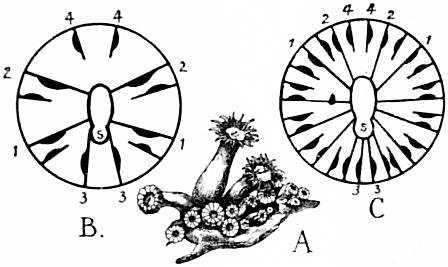
Fig. 12.
A, Zoanthid colony, showing the expanded zooids. B, Diagram showing the arrangement of mesenteries in a young Zoanthid. C, Diagram showing the arrangement of mesenteries in an adult Zoanthid. 1, 2, 3, 4, Edwardsian mesenteries.
As far as the anatomy of the zooid is concerned, the majority of the stony or madreporarian corals agree exactly with the soft-bodied Actinians, such as Actinia equina, both in the number and arrangement of the adult mesenteries and in the order of development of the first cycle. The few exceptions will be dealt with later, but it may be stated here that even in these the first cycle of six couples of mesenteries is always formed, and in all the cases which have been examined the course of development described above is followed. There are, however, several groups of Zoantharia in which the mesenterial arrangement of the adult differs widely from that just described. But it is possible to refer all these cases with more or less certainty to the Edwardsian type.
The order Zoanthidea comprises a number of soft-bodied Zoantharians generally encrusted with sand. Externally they resemble ordinary sea-anemones, but there is only one ciliated groove, the sulcus, in the stomodaeum, and the mesenteries are arranged on a peculiar pattern. The first twelve mesenteries are disposed in couples, and do not differ from those of Actinia except in size. The mesenterial pairs I, II and III are attached to the stomodaeum, and are called macromesenteries (fig. 12, B), but IV, V and VI are much shorter, and are called micromesenteries. The subsequent development is peculiar to the group. New mesenteries are formed only in the sulco-lateral exocoeles. They are formed in couples, each couple consisting of a macromesentery and a micromesentery, disposed so that the former is nearest to the sulcar directives. The derivation of the Zoanthidea from an Edwardsia form is sufficiently obvious.
The order Cerianthidea comprises a few soft-bodied Zoantharians with rounded aboral extremities pierced by pores. They have two circlets of tentacles, a labial and a marginal, and there is only one ciliated groove in the stomodaeum, which appears to be the sulculus. The mesenteries are numerous, and the longitudinal muscles, though distinguishable, are so feebly developed that there are no muscle-banners. The larval forms of the type genus Cerianthus float freely in the sea, and were once considered to belong to a separate genus, Arachnactis. In this larva four pairs of mesenteries having the typical Edwardsian arrangement are developed, but the fifth and sixth pairs, instead of forming couples with the first and second, arise in the sulcar chamber, the fifth pair inside the fourth, and the sixth pair inside the fifth. New mesenteries are continually added in the sulcar chamber, the seventh pair within the sixth, the eighth pair within the seventh, and so on (fig. 13). In the Cerianthidea, as in the Zoanthidea, much as the adult arrangement of mesenteries differs from that of Actinia, the derivation from an Edwardsia stock is obvious.
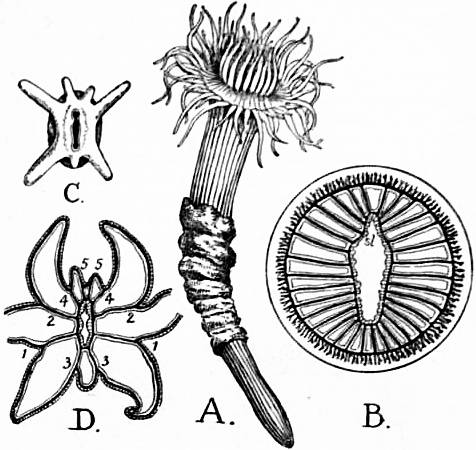
Fig. 13.
A, Cerianthus solitarius (after A. Andres). B, Transverse section of the stomodaeum, showing the sulculus, sl, and the arrangement of the mesenteries. C, Oral aspect of Arachnactis brachiolata, the larva of Cerianthus, with seven tentacles. D, Transverse section of an older larva. The numerals indicate the order of development of the mesenteries.
The order Antipathidea is a well-defined group whose affinities are more obscure. The type form, Antipathes dichotoma (fig. 14), forms arborescent colonies consisting of numerous zooids arranged in a single series along one surface of a branched horny axis. Each zooid has six tentacles; the stomodaeum is elongate, but the sulcus and sulculus are very feebly represented. There are ten mesenteries in which the musculature is so little developed as to be almost indistinguishable. The sulcar and sulcular pairs of mesenteries are short, the sulco-lateral and sulculo-lateral pairs are a little longer, but the two transverse are very large and are the only mesenteries which bear gonads. As the development of the Antipathidea is unknown, it is impossible to say what is the sequence of the mesenterial development, but in Leiopathes glaberrima, a genus with twelve mesenteries, there are distinct indications of an Edwardsia stage.
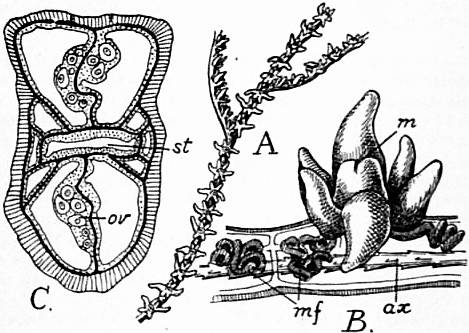
Fig. 14.
A, Portion of a colony of Antipathes dichotoma. B, Single zooid and axis of the same magnified. m, Mouth; mf mesenterial filament; ax, axis. C, Transverse section through the oral cone of Antipathella minor, st, Stomodaeum; ov, ovary.
There are, in addition to these groups, several genera of Actinians whose mesenterial arrangement differs from the normal type. Of these perhaps the most interesting is Gonactinia prolifera (fig. 11, B), with eight macromesenteries arranged on the Edwardsian plan. Two pairs of micromesenteries form couples with the first and second Edwardsian pairs, and in addition there is a couple of micromesenteries in each of the sulculo-lateral exocoeles. Only the first and second pairs of Edwardsian macromesenteries are fertile, i.e. bear gonads.
The remaining forms, the Actiniidea, are divisible into the Malacactiniae, or soft-bodied sea-anemones, which have already been described sufficiently in the course of this article, and the Scleractiniae (= Madreporaria) or true corals.
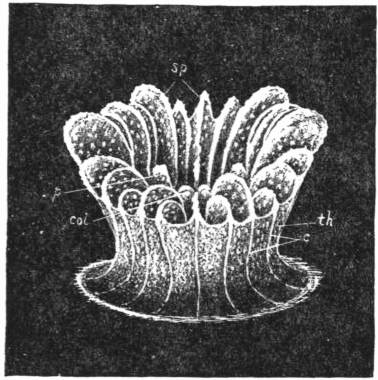
Fig. 15.—Corallum of Caryophyllia; semi-diagrammatic. th, Theca; c, costae; sp, septa; p, palus; col, columella.
All recent corals, as has already been said, conform so closely to the anatomy of normal Actinians that they cannot be classified apart from them, except that they are distinguished by the possession of a calcareous skeleton. This skeleton is largely composed of a number of radiating plates or septa, and it differs both in origin and structure from the calcareous skeleton of all Alcyonaria except Heliopora. It is formed, not from fused spicules, but as a secretion of a special layer of cells derived from the basal ectoderm, and known as calicoblasts. The skeleton or corallum of a typical solitary coral—the common Devonshire cup-coral Caryophyllia smithii (fig. 15) is a good example—exhibits the followings parts:—(1) The basal plate, between the zooid and the surface of attachment. (2) The septa, radial plates of calcite reaching from the periphery nearly or quite to the centre of the coral-cup or calicle. (3) The theca or wall, which in many corals is not an independent structure, but is formed by the conjoined thickened peripheral ends of the septa. (4) The columella, a structure which occupies the centre of the calicle, and may arise from the basal plate, when it is called essential, or may be formed by union of trabecular offsets of the septa, when it is called unessential. (5) The costae, longitudinal ribs or rows of spines on the outer surface of the theca. True costae always correspond to the septa, and are in fact the peripheral edges of the latter. (6) Epitheca, an offset of the basal plate which surrounds the base of the theca in a ring-like manner, and in some corals may take the place of a true theca. (7) Pali, spinous or blade-like upgrowths from the bottom of the calicle, which project between the inner edges of certain septa and the columella. In addition to these parts the following structures may exist in corals:— Dissepiments are oblique calcareous partitions, stretching from septum to septum, and closing the interseptal chambers below. The whole system of dissepiments in any given calicle is often called endotheca. Synapticulae are calcareous bars uniting adjacent septa. Tabulae are stout horizontal partitions traversing the centre of the calicle and dividing it into as many superimposed chambers. The septa in recent corals always bear a definite relation to the mesenteries, being found either in every entocoele or in every entocoele and exocoele. Hence in corals in which there is only a single cycle of mesenteries the septa are correspondingly few in number; where several cycles of mesenteries are present the septa are correspondingly numerous. In some cases—e.g. in some species of Madrepora—only two septa are fully developed, the remainder being very feebly represented.
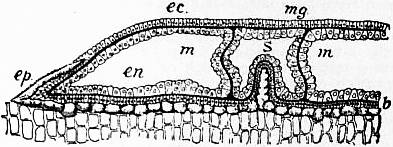
Fig. 16.—Tangential section of a larva of Astroides calicularis which has fixed itself on a piece of cork. ec, Ectoderm; en, endoderm; mg, mesogloea; m, m, mesenteries; s, septum; b, basal plate formed of ellipsoids of carbonate of lime secreted by the basal ectoderm; ep, epitheca. (After von Koch.)
Though the corallum appears to live within the zooid, it is morphologically external to it, as is best shown by its developmental history. The larvae of corals are free swimming ciliated forms known as planulae, and they do not acquire a corallum until they fix themselves. A ring-shaped plate of calcite, secreted by the ectoderm, is then formed, lying between the embryo and the surface of attachment. As the mesenteries are formed, the endoderm of the basal disk lying above the basal plate is raised up in the form of radiating folds. There may be six of these folds, one in each entocoele of the primary cycle of mesenteries, or there may be twelve, one in each exocoele and entocoele. The ectoderm beneath each fold becomes detached from the surface of the basal plate, and both it and the mesogloea are folded conformably with the endoderm. The cells forming the limbs of the ectodermic folds secrete nodules of calcite, and these, fusing together, give rise to six (or twelve) vertical radial plates or septa. As growth proceeds new septa are formed simultaneously with the new couples of secondary mesenteries. In some corals, in which all the septa are entocoelic, each new system is embraced by a mesenteric couple; in others, in which the septa are both entocoelic and exocoelic, three septa are formed in every chamber between two primary mesenterial couples, one in the entocoele of the newly formed mesenterial couple of the secondary cycle, and one in each exocoele between a primary and a secondary couple. These latter are in turn embraced by the couples of the tertiary cycle of mesenteries, and new septa are formed in the exocoeles on either side of them, and so forth.
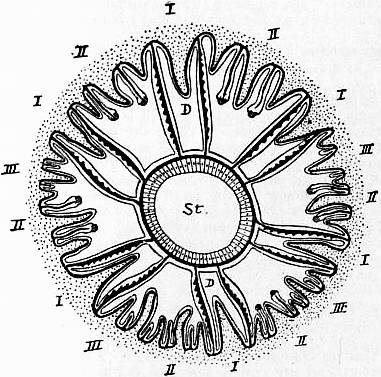
Fig. 17.—Transverse section through a zooid of Cladocora. The corallum shaded with dots, the mesogloea represented by a thick line. Thirty-two septa are present, six in the entocoeles of the primary cycle of mesenteries, I; six in the entocoeles of the secondary cycle of mesenteries, II; four in the entocoeles of the tertiary cycle of mesenteries, III, only four pairs of the latter being developed; and sixteen in the entocoeles between the mesenterial pairs. D, D, Directive mesenteries; st, stomodaeum. (After Duerden.)
It is evident from an inspection of figs. 16 and 17 that every septum is covered by a fold of endoderm, mesogloea, and ectoderm, and is in fact pushed into the cavity of the zooid from without. The zooid then is, as it were, moulded upon the corallum. When fully extended, the upper part of the zooid projects for some distance out of the calicle, and its wall is reflected for some distance over the lip of the latter, forming a fold of soft tissue extending to a greater or less distance over the theca, and containing in most cases a cavity continuous over the lip of the calicle with the coelenteron. This fold of tissue is known as the edge-zone In some corals the septa are solid imperforate plates of calcite, and their peripheral ends are either firmly welded together, or are united by interstitial pieces so as to form imperforate theca. In others the peripheral ends of the septa are united only by bars or trabeculae, so that the theca is perforate, and in many such perforate corals the septa themselves are pierced by numerous perforations. In the former, which have been called aporose corals, the only communication between the cavity of the edge-zone and the general cavity of the zooid is by way of the lip of the calicle; in the latter, or perforate corals, the theca is permeated by numerous branching and anastomosing canals lined by endoderm, which place the cavity of the edge-zone in communication with the general cavity of the zooid.
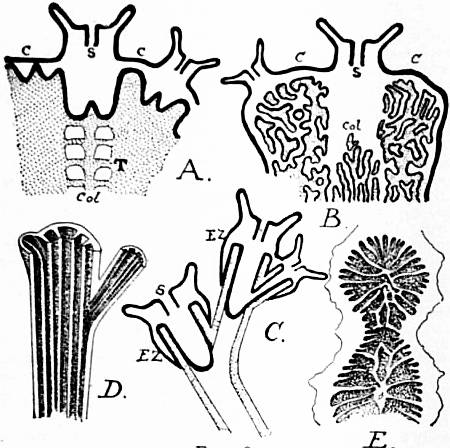
Fig. 18.
A, Schematic longitudinal section through a zooid and bud of Stylophora digitata. In A, B, and C the thick black lines represent the soft tissues; the corallum is dotted. s, Stomodaeum; c, c, coenosarc; col, columella, T tabulae. B, Similar section through a single zooid and bud of Astroides calicularis. C, Similar section through three corallites of Lophohelia prolifera. ez, Edge-zone. D, Diagram illustrating the process of budding by unequal division. E, Section through a dividing calicle of Mussa, showing the union of two septa in the plane of division and the origin of new septa at right angles to them. (C original; the rest after von Koch.)
A large number of corals, both aporose and perforate, are colonial. The colonies are produced by either budding or division. In the former case the young daughter zooid, with its corallum, arises wholly outside the cavity of the parent zooid, and the component parts of the young corallum, septa, theca, columella, &c., are formed anew in every individual produced. In division a vertical constriction divides a zooid into two equal or unequal parts, and the several parts of the two corals thus produced are severally derived from the corresponding parts of the dividing corallum. In colonial corals a bud is always formed from the edge-zone, and this bud develops into a new zooid with its corallum. The cavity of the bud in an aporose coral (fig. 18, A, C) does not communicate directly with that of the parent form, but through the medium of the edge-zone. As growth proceeds, and parent and bud become separated farther from one another, the edge-zone forms a sheet of soft tissue, bridging over the space between the two, and resting upon projecting spines of the corallum. This sheet of tissue is called the coenosarc. Its lower surface is clothed with a layer of calicoblasts which continue to secrete carbonate of lime, giving rise to a secondary deposit which more or less fills up the spaces between the individual coralla, and is distinguished as coenenchyme. This coenenchyme may be scanty, or may be so abundant that the individual corallites produced by budding seem to be immersed in it. Budding takes place in an analogous manner in perforate corals (fig. 18, B), but the presence of the canal system in the perforate theca leads to a modification of the process. Buds arise from the edge-zone which already communicate with the cavity of the zooid by the canals. As the buds develop the canal system becomes much extended, and calcareous tissue is deposited between the network of canals, the confluent edge-zones of mother zooid and bud forming a coenosarc. As the process continues a number of calicles are formed, imbedded in a spongy tissue in which the canals ramify, and it is impossible to say where the theca of one corallite ends and that of another begins. In the formation of colonies by division a constriction at right angles to the long axis of the mouth involves first the mouth, then the peristome, and finally the calyx itself, so that the previously single corallite becomes divided into two (fig. 18, E). After division the corallites continue to grow upwards, and their zooids may remain united by a bridge of soft tissue or coenosarc. But in some cases, as they grow farther apart, this continuity is broken, each corallite has its own edge-zone, and internal continuity is also broken by the formation of dissepiments within each calicle, all organic connexion between the two zooids being eventually lost. Massive meandrine corals are produced by continual repetition of a process of incomplete division, involving the mouth and to some extent the peristome: the calyx, however, does not divide, but elongates to form a characteristic meandrine channel containing several zooid mouths.
Corals have been divided into Aporosa and Perforata, according as the theca and septa are compact and solid, or are perforated by pores containing canals lined by endoderm. The division is in many respects convenient for descriptive purposes, but recent researches show that it does not accurately represent the relationships of the different families. Various attempts have been made to classify corals according to the arrangement of the septa, the characters of the theca, the microscopic structure of the corallum, and the anatomy of the soft parts. The last-named method has proved little more than that there is a remarkable similarity between the zooids of all recent corals, the differences which have been brought to light being for the most part secondary and valueless for classificatory purposes. On the other hand, the study of the anatomy and development of the zooids has thrown much light upon the manner in which the corallum is formed, and it is now possible to infer the structure of the soft parts from a microscopical examination of the septa, theca, &c., with the result that unexpected relationships have been shown to exist between corals previously supposed to stand far apart. This has been particularly the case with the group of Palaeozoic corals formerly classed together as Rugosa. In many of these so-called rugose forms the septa have a characteristic arrangement, differing from that of recent corals chiefly in the fact that they show a tetrameral instead of a hexameral symmetry. Thus in the family Stauridae there are four chief septa whose inner ends unite in the middle of the calicle to form a false columella, and in the Zaphrentidae there are many instances of an arrangement, such as that depicted in fig. 19, which represents the septal arrangement of Streptelasma corniculum from the lower Silurian. In this coral the calicle is divided into quadrants by four principal septa, the main septum, counter septum, and two alar septa. The remaining septa are so disposed that in the quadrants abutting on the chief septum they converge towards that septum, whilst in the other quadrants they converge towards the alar septa. The secondary septa show a regular gradation in size, and, assuming that the smallest were the most recently formed, it will be noticed that in the chief quadrants the youngest septa lie nearest to the main septum; in the other quadrants the youngest septa lie nearest to the alar septa. This arrangement, however, is by no means characteristic even of the Zaphrentidae, and in the family Cyathophyllidae most of the genera exhibit a radial symmetry in which no trace of the bilateral arrangement described above is recognizable, and indeed in the genus Cyathophyllum itself a radial arrangement is the rule. The connexion between the Cyathophyllidae and modern Astraeidae is shown by Moseleya latistellata, a living reef-building coral from Torres Strait. The general structure of this coral leaves no doubt that it is closely allied to the Astraeidae, but in the young calicles a tetrameral symmetry is indicated by the presence of four large septa placed at right angles to one another. Again, in the family Amphiastraeidae there is commonly a single septum much larger than the rest, and it has been shown that in the young calicles, e.g. of Thecidiosmilia, two septa, corresponding to the main- and counter-septa of Streptelasma, are first formed, then two alar septa, and afterwards the remaining septa, the latter taking on a generally radial arrangement, though the original bilaterality is marked by the preponderance of the main septum. As the microscopic character of the corallum of these extinct forms agrees with that of recent corals, it may be assumed that the anatomy of the soft parts also was similar, and the tetrameral arrangement, when present, may obviously be referred to a stage when only the first two pairs of Edwardsian mesenteries were present and septa were formed in the intervals between them.
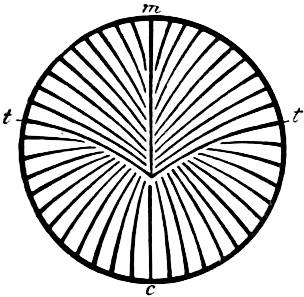
Fig. 19.—Diagram of the arrangement of the septa in a Zaphrentid coral. m, Main septum; c, counter septum; t, t, alar septa.
Space forbids a discussion of the proposals to classify corals after the minute structure of their coralla, but it will suffice to say that it has been shown that the septa of all corals are built up of a number of curved bars called trabeculae, each of which is composed of a number of nodes. In many secondary corals (Cyclolites, Thamnastraea) the trabeculae are so far separate that the individual bars are easily recognizable, and each looks something like a bamboo owing to the thickening of the two ends of each node. The trabeculae are united together by these thickened internodes, and the result is a fenestrated septum, which in older septa may become solid and aporose by continual deposit of calcite in the fenestrae. Each node of a trabecula may be simple, i.e. have only one centre of calcification, or may be compound. The septa of modern perforate corals are shown to have a structure nearly identical with that of the secondary forms, but the trabeculae and their nodes are only apparent on microscopical examination. The aporose corals, too, have a practically identical structure, their compactness being due to the union of the trabeculae throughout their entire lengths instead of at intervals, as in the Perforata. Further, the trabeculae may be evenly spaced throughout the septum, or may be grouped together, and this feature is probably of value in estimating the affinities of corals. (For an account of coral formations see Coral-Reefs.)
In the present state of our knowledge the Zoantharia in which a primary cycle of six couples of mesenteries is (or may be inferred to be) completed by the addition of two pairs to the eight Edwardsian mesenteries, and succeeding cycles are formed in the exocoeles of the pre-existing mesenterial cycles, may be classed in an order Actiniidea, and this may be divided into the suborders Malacactiniae, comprising the soft-bodied Actinians, such as Actinia, Sagartia, Bunodes, &c., and the Scleractiniae, comprising the corals. The Scleractiniae may best be divided into groups of families which appear to be most closely related to one another, but it should not be forgotten that there is great reason to believe that many if not most of the extinct corals must have differed from modern Actiniidea in mesenterial characters, and may have only possessed Edwardsian mesenteries, or even have possessed only four mesenteries, in this respect showing close affinities to the Stauromedusae. Moreover, there are some modern corals in which the secondary cycle of mesenteries departs from the Actinian plan. For example, J.E. Duerden has shown that in Porites the ordinary zooids possess only six couples of mesenteries arranged on the Actinian plan. But some zooids grow to a larger size and develop a number of additional mesenteries, which arise either in the sulcar or the sulcular entocoele, much in the same manner as in Cerianthus. Bearing this in mind, the following arrangement may be taken to represent the most recent knowledge of coral structure:—
Group A.
Family I. Zaphrentidae.—Solitary Palaeozoic corals with an epithecal wall. Septa numerous, arranged pinnately with regard to four principal septa. Tabulae present. One or more pits or fossulae present in the calicle. Typical genera—Zaphrentis, Raf. Amplexus, M. Edw. and H. Streptelasma, Hall. Omphyma, Raf.
Family 2. Turbinolidae.—Solitary, rarely colonial corals, with radially arranged septa and without tabulae. Typical genera— Flabellum, Lesson. Turbinolia, M. Edw. and H. Caryophyllia, Lamarck. Sphenotrochus, Moseley, &c.
Family 3. Amphiastraeidae.—Mainly colonial, rarely solitary corals, with radial septa, but bilateral arrangement indicated by persistence of a main septum. Typical genera—Amphiastraea, Étallon. Thecidiosmilia.
Family 4. Stylinidae.—Colonial corals allied to the Amphiastraeidae, but with radially symmetrical septa arranged in cycles. Typical genera—Stylina, Lamarck (Jurassic). Convexastraea, D’Orb. (Jurassic). Isastraea, M. Edw. and H.(Jurassic). Ogilvie refers the modern genus Galaxea to this family.
Group B.
Family 5. Oculinidae.—Branching or massive aporose corals, the calices projecting above the level of a compact coenenchyme formed from the coenosarc which covers the exterior of the corallum. Typical genera—Lophohelia, M. Edw. and H. Oculina, M. Edw. and H.
Family 6. Pocilloporidae.—Colonial branching aporose corals, with small calices sunk in the coenenchyme. Tabulae present, and two larger septa, an axial and abaxial, are always present, with traces of ten smaller septa. Typical genera—Pocillopora, Lamarck. Seriatopora, Lamarck.
Family 7. Madreporidae.—Colonial branching or palmate perforate corals, with abundant trabecular coenenchyme. Theca porous; septa compact and reduced in number. Typical genera— Madrepora, Linn. Turbinaria, Oken. Montipora, Quoy and G.
Family 8. Poritidae.—Incrusting or massive colonial perforate corals; calices usually in contact by their edges, sometimes disjunct and immersed in coenenchyme. Theca and septa perforate. Typical genera—Porites, M. Edw. and H. Goniopora, Quoy and G. Rhodaraea, M. Edw. and H.
Group C.
Family 9. Cyathophyllidae.—Solitary and colonial aporose corals. Tabulae and vesicular endotheca present. Septa numerous, generally radial, seldom pinnate. Typical genera—Cyathophyllum, Goldfuss (Devonian and Carboniferous). Moseleya, Quelch (recent).
Family 10. Astraeidae.—Aporpse, mainly colonial corals, massive, branching, or maeandroid. Septa radial; dissepiments present; an epitheca surrounds the base of massive or maeandroid forms, but only surrounds individual corallites in simple or branching forms. Typical genera—Goniastraea, M. Edw. and H. Heliastraea, M. Edw. and H. Maeandrina, Lam. Coeloria, M. Edw. and H. Favia, Oken.
Family 11. Fungidae.—Solitary and colonial corals, with numerous radial septa united by synapticulae. Typical genera— Lophoseris, M. Edw. and H. Thamnastraea, Le Sauvage. Leptophyllia, Reuss (Jurassic and Cretaceous). Fungia, Dana. Siderastraea, Blainv.
Group D.
Family 12. Eupsammidae.—Solitary or colonial perforate corals, branching, massive, or encrusting. Septa radial; the primary septa usually compact, the remainder perforate. Theca perforate. Synapticula present in some genera. Typical genera—Stephanophyllia, Michelin. Eupsammia, M. Edw. and H. Astroides, Blainv. Rhodopsammia, M. Edw. and H. Dendrophyllia, M. Edw. and H.
Group E.
Family 13. Cystiphyllidae.—Solitary corals with rudimentary septa, and the calicle filled with vesicular endotheca. Genera—Cystiphyllum, Lonsdale (Silurian and Devonian). Goniophyllum, M. Edw. and H. (In this Silurian genus the calyx is provided with a movable operculum, consisting of four paired triangular pieces, the bases of each being attached to the sides of the calyx, and their apices meeting in the middle when the operculum is closed). Calcecla, Lam. (In this Devonian genus there is a single semicircular operculum furnished with a stout median septum and numerous feebly developed secondary septa. The calyx is triangular in section, pointed below, and the operculum is attached to it by hinge-like teeth.)
Authorities.—The following list contains only the names of the more important and more general works on the structure and classification of corals and on coral reefs. For a fuller bibliography the works marked with an asterisk should be consulted: * A. Andres, Fauna und Flora des Golfes von Neapel, ix. (1884); H.M. Bernard, “Catalogue of Madreporarian Corals” in Brit. Museum, ii. (1896), iii. (1897); * G.C. Bourne, “Anthozoa,” in E. Ray Lankester’s Treatise on Zoology, vol. ii. (London, 1900); G. Brook, “Challenger Reports,” Zoology, xxxii. (1899) (Antipatharia); “Cat. Madrep. Corals,” Brit. Museum, i. (1893); D.C. Danielssen, “Report Norwegian North Atlantic Exploring Expedition,” Zoology, xix. (1890); J.E. Duerden, “Some Results on the Morphology and Development of Recent and Fossil Corals,” Rep. Brit. Association, 1903, pp. 684-685; “The Morphology of the Madreporaria,” Biol. Bullet, vii. pp. 79-104; P.M. Duncan, Journ. Linnean Soc. xviii. (1885); P.H. Gosse, Actinologia britannica (London, 1860); O. and R. Hertwig, Die Actinien (Jena, 1879); R. Hertwig, “Challenger Reports,” Zoology, vi. (1882) and xxvi. (1888); * C.B. Klunzinger, Die Korallthiere des Rothen Meeres (Berlin, 1877); * G. von Koch, Fauna und Flora des Golfes van Neapel, xv. (1887); Mitth. Zool. Stat. Neapel, ii. (1882) and xii. (1897); Palaeontographica, xxix. (1883); (also many papers in the Morphol. Jahrbuch from 1878 to 1898); F. Koby, “Polypiers jurassiques de la Suisse,” Mem. Soc. Palaeont. Suisse, vii.-xvi. (1880-1889); A. von Kölliker, “Die Pennatuliden,” Abh. d. Senck. Naturf. Gesell. vii.; * “Challenger Reports,” Zoology, i. Pennatulidae (1880); Koren and Danielssen, Norske Nordhaus Exped., Alcyonida (1887); H. de Lacaze-Duthiers, Hist. nat. du corail (Paris, 1864); H. Milne-Edwards and J. Haime, Hist. nat. des coralliaires (Paris, 1857); H.N. Moseley, “Challenger Reports,” Zoology, ii. (1881); H.A. Nicholson, Palaeozoic Tabulate Corals (Edinburgh, 1879); M.M. Ogilvie, Phil. Transactions, clxxxvii. (1896); E. Pratz, Palaeontographica, xxix. (1882); J.J. Quelch, “Challenger Reports,” Zoology, xvi. (1886); * P.S. Wright and Th. Studer, “Challenger Reports,” Zoology, xxxi. (1889).
(G. C. B.)
ANTHRACENE (from the Greek ἄνθραξ, coal), C14H10, a hydrocarbon obtained from the fraction of the coal-tar distillate boiling between 270° and 400° C. This high boiling fraction is allowed to stand for some days, when it partially solidifies. It is then separated in a centrifugal machine, the low melting-point impurities are removed by means of hot water, and the residue is finally hot-pressed. The crude anthracene cake is purified by treatment with the higher pyridine bases, the operation being carried out in large steam-jacketed boilers. The whole mass dissolves on heating, and the anthracene crystallizes out on cooling. The crystallized anthracene is then removed by a centrifugal separator and the process of solution in the pyridine bases is repeated. Finally the anthracene is purified by sublimation.
Many synthetical processes for the preparation of anthracene and its derivatives are known. It is formed by the condensation of acetylene tetrabromide with benzene in the presence of aluminium chloride:—

and similarly from methylene dibromide and benzene, and also when benzyl chloride is heated with aluminium chloride to 200° C. By condensing ortho-brombenzyl bromide with sodium, C.L. Jackson and J.F. White (Ber., 1879, 12, p. 1965) obtained dihydro-anthracene

Anthracene has also been obtained by heating ortho-tolylphenyl ketone with zinc dust

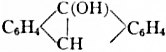
Anthracene crystallizes in colourless monoclinic tables which show a fine blue fluorescence. It melts at 213° C. and boils at 351° C. It is insoluble in water, sparingly soluble in alcohol and ether, but readily soluble in hot benzene. It unites with picric acid to form a picrate, C14H10·C6H2(NO2)3·OH, which crystallizes in needles, melting at 138° C. On exposure to sunlight a solution of anthracene in benzene or xylene deposits para-anthracene (C14H10)2, which melts at 244° C. and passes back into the ordinary form. Chlorine and bromine form both addition and substitution products with anthracene; the addition product, anthracene dichloride, C14H10Cl2, being formed when chlorine is passed into a cold solution of anthracene in carbon bisulphide. On treatment with potash, it forms the substitution product, monochlor-anthracene, C14H9Cl. Nitro-anthracenes are not as yet known. The mono-oxyanthracenes (anthrols), C14H9OH or (α) and (β) resemble the phenols, whilst (γ) (anthranol) is a reduction product of anthraquinone. β-anthrol and anthranol give the corresponding amino compounds (anthramines) when heated with ammonia.
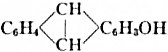
Numerous sulphonic acids of anthracene are known, a monosulphonic acid being obtained with dilute sulphuric acid, whilst concentrated sulphuric acid produces mixtures of the anthracene disulphonic acids. By the action of sodium amalgam on an alcoholic solution of anthracene, an anthracene dihydride, C14H12, is obtained, whilst by the use of stronger reducing agents, such as hydriodic acid and amorphous phosphorus, hydrides of composition C14H16 and C14H24 are produced.
Methyl and phenyl anthracenes are known; phenyl anthranol (phthalidin) being somewhat closely related to the phenolphthaleins (q.v.). Oxidizing agents convert anthracene into anthraquinone (q.v.); the production of this substance by oxidizing anthracene in glacial acetic acid solution, with chromic acid, is the usual method employed for the estimation of anthracene.
ANTHRACITE (Gr. ἄνθραξ, coal), a term applied to those varieties of coal which do not give off tarry or other hydrocarbon vapours when heated below their point of ignition; or, in other words, which burn with a smokeless and nearly non-luminous flame. Other terms having the same meaning are, “stone coal” (not to be confounded with the German Steinkohle) or “blind coal” in Scotland, and “Kilkenny coal” in Ireland. The imperfect anthracite of north Devon, which however is only used as a pigment, is known as culm, the same term being used in geological classification to distinguish the strata in which it is found, and similar strata in the Rhenish hill countries which are known as the Culm Measures. In America, culm is used as an equivalent for waste or slack in anthracite mining.
Physically, anthracite differs from ordinary bituminous coal by its greater hardness, higher density, 1.3-1.4, and lustre, the latter being often semi-metallic with a somewhat brownish reflection. It is also free from included soft or fibrous notches and does not soil the fingers when rubbed. Structurally it shows some alteration by the development of secondary divisional planes and fissures so that the original stratification lines are not always easily seen. The thermal conductivity is also higher, a lump of anthracite feeling perceptibly colder when held in the warm hand than a similar lump of bituminous coal at the same temperature. The chemical composition of some typical anthracites is given in the article Coal.
Anthracite may be considered to be a transition stage between ordinary bituminous coal and graphite, produced by the more or less complete elimination of the volatile constituents of the former; and it is found most abundantly in areas that have been subjected to considerable earth-movements, such as the flanks of great mountain ranges. The largest and most important anthracite region, that of the north-eastern portion of the Pennsylvania coal-field, is a good example of this; the highly contorted strata of the Appalachian region produce anthracite exclusively, while in the western portion of the same basin on the Ohio and its tributaries, where the strata are undisturbed, free-burning and coking coals, rich in volatile matter, prevail. In the same way the anthracite region of South Wales is confined to the contorted portion west of Swansea and Llanelly, the central and eastern portions producing steam, coking and house coals.
Anthracites of newer, tertiary or cretaceous age, are found in the Crow’s Nest part of the Rocky Mountains in Canada, and at various points in the Andes in Peru.
The principal use of anthracite is as a smokeless fuel. In the eastern United States, it is largely employed as domestic fuel, usually in close stoves or furnaces, as well as for steam purposes, since, unlike that from South Wales, it does not decrepitate when heated, or at least not to the same extent. For proper use, however, it is necessary that the fuel should be supplied in pieces as nearly uniform in size as possible, a condition that has led to the development of the breaker which is so characteristic a feature in American anthracite mining (see Coal). The large coal as raised from the mine is passed through breakers with toothed rolls to reduce the lumps to smaller pieces, which are separated into different sizes by a system of graduated sieves, placed in descending order. Each size can be perfectly well burnt alone on an appropriate grate, if kept free from larger or smaller admixtures. The common American classification is as follows:—
Lump, steamboat, egg and stove coals, the latter in two or three sizes, all three being above 1½ in. size on round-hole screens.
Chestnut below 1½ inch above 7⁄8 inch.
Pea ” 7⁄8 ” ” 9⁄16 ”
Buckwheat ” 9⁄16 ” ” 3⁄8 ”
Rice ” 3⁄8 ” ” 3⁄16 ”
Barley ” 3⁄16 ” ” 3⁄32 ”
From the pea size downwards the principal use is for steam purposes. In South Wales a less elaborate classification is adopted; but great care is exercised in hand-picking and cleaning the coal from included particles of pyrites in the higher qualities known as best malting coals, which are used for kiln-drying malt and hops.
Formerly, anthracite was largely used, both in America and South Wales, as blast-furnace fuel for iron smelting, but for this purpose it has been largely superseded by coke in the former country and entirely in the latter. An important application has, however, been developed in the extended use of internal combustion motors driven by the so-called “mixed,” “poor,” “semi-water” or “Dowson gas” produced by the gasification of anthracite with air and a small proportion of steam. This is probably the most economical method of obtaining power known; with an engine as small as 15 horse-power the expenditure of fuel is at the rate of only 1 ℔ per horse-power hour, and with larger engines it is proportionately less. Large quantities of anthracite for power purposes are now exported from South Wales to France, Switzerland and parts of Germany.
(H. B.)
ANTHRACOTHERIUM (“coal-animal,” so called from the fact of the remains first described having been obtained from the Tertiary lignite-beds of Europe), a genus of extinct artiodactyle ungulate mammals, characterized by having 44 teeth, with five semi-crescentic cusps on the crowns of the upper molars. In many respects, especially the form of the lower jaw, Anthracotherium, which is of Oligocene and Miocene age in Europe, and typifies the family Anthracotheriidae, is allied to the hippopotamus, of which it is probably an ancestral form. The European A. magnum was as large as the last-mentioned animal, but there were several smaller species and the genus also occurs in Egypt, India and North America. (See Artiodactyla.)
ANTHRAQUINONE, C14H8O2, an important derivative of anthracene, first prepared in 1834 by A. Laurent. It is prepared commercially from anthracene by stirring a sludge of anthracene and water in horizontal cylinders with a mixture of sodium bichromate and caustic soda. This suspension is then run through a conical mill in order to remove all grit, the cones of the mill fitting so tightly that water cannot pass through unless the mill is running; the speed of the mill when working is about 3000 revolutions per minute. After this treatment, the mixture is run into lead-lined vats and treated with sulphuric acid, steam is blown through the mixture in order to bring it to the boil, and the anthracene is rapidly oxidized to anthraquinone. When the oxidation is complete, the anthraquinone is separated in a filter press, washed and heated to 120° C. with commercial oil of vitriol, using about 2½ parts of vitriol to 1 of anthraquinone. It is then removed to lead-lined tanks and again washed with water and dried; the product obtained contains about 95% of anthraquinone. It may be purified by sublimation. Various synthetic processes have been used for the preparation of anthraquinone. A. Behr and W.A. v. Dorp (Ber., 1874, 7, p. 578) obtained orthobenzoyl benzoic acid by heating phthalic anhydride with benzene in the presence of aluminium chloride. This compound on heating with phosphoric anhydride loses water and yields anthraquinone,

It may be prepared in a similar manner by heating phthalyl chloride with benzene in the presence of aluminium chloride. Dioxy- and tetraoxy-anthraquinones are obtained when meta-oxy- and dimeta-dioxy-benzoic acids are heated with concentrated sulphuric acid.
Anthraquinone crystallizes in yellow needles or prisms, which melt at 277° C. It is soluble in hot benzene, sublimes easily, and is very stable towards oxidizing agents. On the other hand, it is readily attacked by reducing agents. With zinc dust in presence of caustic soda it yields the secondary alcohol oxan-thranol, C6H4 : CO·CHOH : C6H4, with tin and hydrochloric acid, the phenolic compound anthranol, C6H4 : CO·C(OH) : C6H4; and with hydriodic acid at 150° C. or on distillation with zinc dust, the hydrocarbon anthracene, C14H10. When fused with caustic potash, it gives benzoic acid. It behaves more as a ketone than as a quinone, since with hydroxylamine it yields an oxime, and on reduction with zinc dust and caustic soda it yields a secondary alcohol, whilst it cannot be reduced by means of sulphurous acid. Various sulphonic acids of anthraquinone are known, as well as oxy-derivatives, for the preparation and properties of which see Alizarin.
ANTHRAX (the Greek for “coal,” or “carbuncle,” so called by the ancients because they regarded it as burning like coal; cf. the French equivalent charbon; also known as fièvre charbonneuse, Milzbrand, splenic fever, and malignant pustule), an acute, specific, infectious, virulent disease, caused by the Bacillus anthracis, in animals, chiefly cattle, sheep and horses, and frequently occurring in workers in the wool or hair, as well as in those handling the hides or carcases, of beasts which have been affected.
Animals.—As affecting wild as well as domesticated animals and man, anthrax has been widely diffused in one or more of its forms, over the surface of the globe. It at times decimates the reindeer herds in Lapland and the Polar regions, and is only too well known in the tropics and in temperate latitudes. It has been observed and described in Russia, Siberia, Central Asia, China, Cochin-China, Egypt, West Indies, Peru, Paraguay, Brazil, Mexico, and other parts of North and South America, in Australia, and on different parts of the African continent, while for other European countries the writings which have been published with regard to its nature, its peculiar characteristics, and the injury it inflicts are innumerable. Countries in which are extensive marshes, or the subsoil of which is tenacious or impermeable, are usually those most frequently and seriously visited. Thus there have been regions notorious for its prevalence, such as the marshes of Sologne, Dombes and Bresse in France; certain parts of Germany, Hungary and Poland; in Spain the half-submerged valleys and the maritime coasts of Catalonia, as well as the Romagna and other marshy districts of Italy; while it is epizootic, and even panzootic, in the swampy regions of Esthonia, Livonia, Courland, and especially of Siberia, where it is known as the Sibirskaja jaswa (Siberian boil-plague). The records of anthrax go back to a very ancient date. It is supposed to be the murrain of Exodus. Classical writers allude to anthrax as if it were the only cattle disease worthy of mention (see Virgil, Georg. iii.). It figures largely in the history of the early and middle ages as a devastating pestilence attacking animals, and through them mankind; the oldest Anglo-Saxon manuscripts contain many fantastic recipes, leechdoms, charms and incantations for the prevention or cure of the “blacan blezene” (black blain) and the relief of the “elfshot” creatures. In the 18th and 19th centuries it sometimes spread like an epizootic over the whole of Europe, from Siberia to France. It was in this malady that disease-producing germs (bacteria) were first discovered, in 1840, by Pollender of Wipperfürth, and, independently, by veterinary surgeon Brauell of Dorpat, and their real character afterwards verified by C.J. Davaine (1812-1882) of Alfort in 1863; and it was in their experiments with this disease that Toussaint, Pasteur and J.B. Chauveau first showed how to make the morbific poison its own antidote. (See Vivisection.)
The symptoms vary with the species of animal, the mode of infection, and the seat of the primary lesion, internal or external. In all its forms anthrax is an inoculable disease, transmission being surely and promptly effected by this means, and it may be conveyed to nearly all animals by inoculation of a wound of the skin or through the digestive organs. Cattle, sheep and horses nearly always owe their infection to spores or bacilli ingested with their food or water, and pigs usually contract the disease by eating the flesh of animals dead of anthrax.
Internal anthrax, of cattle and sheep, exhibits no premonitory symptoms that can be relied on. Generally the first indication of an outbreak is the sudden death of one or more of the herd or flock. Animals which do not die at once may be noticed to stagger and tremble; the breathing becomes hurried and the pulse very rapid, while the heart beats violently; the internal temperature of the body is high, 104° to 106° F.; blood oozes from the nose, mouth and anus, the visible mucous membranes are dusky or almost black. The animal becomes weak and listless, the temperature falls and death supervenes in a few hours, being immediately preceded by delirium, convulsions or coma. While death is usually rapid or sudden when the malady is general, constituting what is designated splenic apoplexy, internal anthrax in cattle is not invariably fatal. In some cases the animal rallies from a first attack and gradually recovers.
In the external or localized form, marked by the formation of carbuncles before general infection takes place, death may not occur for several days. The carbuncles may appear in any part of the body, being preceded or accompanied by fever. They are developed in the subcutaneous connective tissue where this is loose and plentiful, in the interstices of the muscles, lymphatic glands, in the mucous membranes of the mouth and tongue (glossanthrax of cattle), pharynx and larynx (anthrax angina of horses and pigs), and the rectum. They begin as small circumscribed swellings which are warm, slightly painful and oedematous. In from two to eight hours they attain a considerable size, are cold, painless and gangrenous, and when they are incised a quantity of a blood-stained gelatinous exudate escapes. When the swellings have attained certain proportions symptoms of general infection appear, and, running their course with great rapidity, cause death in a few hours. Anthrax of the horse usually begins as an affection of the throat or bowel. In the former there is rapid obstructive oedema of the mucous membrane of the pharynx and larynx with swelling of the throat and neck, fever, salivation, difficulty in swallowing, noisy breathing, frothy discharge from the nose and threatening suffocation. General invasion soon ensues, and the horse may die in from four to sixteen hours. The intestinal form is marked by high temperature, great prostration, small thready pulse, tumultuous action of the heart, laboured breathing and symptoms of abdominal pain with straining and diarrhoea. When moved the horse staggers and trembles. Profuse sweating, a falling temperature and cyanotic mucous membranes indicate the approach of a fatal termination.
In splenic fever or splenic apoplexy, the most marked alterations observed after death are—the effects of rapid decomposition, evidenced by the foul odour, disengagement of gas beneath the skin and in the tissues and cavities of the body, yellow or yellowish-red gelatinous exudation into and between the muscles, effusion of citron or rust-coloured fluid in various cavities, extravasations of blood and local congestions throughout the body, the blood in the vessels generally being very dark and tar-like. The most notable feature, however, in the majority of cases is the enormous enlargement of the spleen, which is engorged with blood to such an extent that it often ruptures, while its tissue is changed into a violet or black fluid mass.
The bacillus of anthrax, under certain conditions, retains its vitality for a long time, and rapidly grows when it finds a suitable field in which to develop, its mode of multiplication being by scission and the formation of spores, and depending, to a great extent at least, on the presence of oxygen. The morbid action of the bacillus is indeed said to be due to its affinity for oxygen; by depriving the red corpuscles of the blood of that most essential gas, it renders the vital fluid unfit to sustain life. Albert Hoffa and others assert that the fatal lesions are produced by the poisonous action of the toxins formed by the bacilli and not by the blocking up of the minute blood-vessels, or the abstraction of oxygen from the blood by the bacilli.
It was by the cultivation of this micro-organism, or attenuation of the virus, that Pasteur was enabled to produce a prophylactic remedy for anthrax. His discovery was first made with regard to the cholera of fowls, a most destructive disorder which annually carries off great numbers of poultry. Pasteur produced his inoculation material by the cultivation of the bacilli at a temperature of 42° C. in oxygen. Two vaccines are required. The first or weak vaccine is obtained by incubating a bouillon culture for twenty-four days at 42° C., and the second or less attenuated vaccine by incubating a bouillon culture, at the same temperature, for twelve days. Pasteur’s method of protective inoculation comprises two inoculations with an interval of twelve days between them. Immunity, established in about fifteen days after the injection of the second vaccine, lasts from nine months to a year.
Toussaint had, previous to Pasteur, attenuated the virus of anthrax by the action of heat; and Chauveau subsequently corroborated by numerous experiments the value of Toussaint’s method, demonstrating that, according to the degree of heat to which the virus is subjected, so is its inocuousness when transferred to a healthy creature. In outbreaks of anthrax on farms where many animals are exposed to infection immediate temporary protection can be conferred by the injection of anthrax serum.
Human Beings.—For many years cases of sudden death had been observed to occur from time to time among healthy men engaged in woollen manufactories, particularly in the work of sorting or combing wool. In some instances death appeared to be due to the direct inoculation of some poisonous material into the body, for a form of malignant pustule was observed upon the skin; but, on the other hand, in not a few cases without any external manifestation, symptoms of blood-poisoning, often proving rapidly fatal, suggested the probability of other channels for the introduction of the disease. In 1880 the occurrence of several such cases among woolsorters at Bradford, reported by Dr J.H. Bell of that town, led to an official inquiry in England by the Local Government Board, and an elaborate investigation into the pathology of what was then called “woolsorters’ disease” was at the same time conducted at the Brown Institution, London, by Professor W.S. Greenfield. Among the results of this inquiry it was ascertained: (1) that the disease appeared to be identical with that occurring among sheep and cattle; (2) that in the blood and tissues of the body was found in abundance, as in the disease in animals, the Bacillus anthracis, and (3) that the skins, hair, wool, &c., of animals dying of anthrax retain this infecting organism, which, under certain conditions, finds ready access to the bodies of the workers.
Two well-marked forms of this disease in man are recognized, “external anthrax” and “internal anthrax.” In external anthrax the infecting agent is accidentally inoculated into some portion of skin, the seat of a slight abrasion, often the hand, arm or face. A minute swelling soon appears at the part, and develops into a vesicle containing serum or bloody matter, and varying in size, but seldom larger than a shilling. This vesicle speedily bursts and leaves an ulcerated or sloughing surface, round about which are numerous smaller vesicles which undergo similar changes, and the whole affected part becomes hard and tender, while the surrounding surface participates in the inflammatory action, and the neighbouring lymphatic glands are also inflamed. This condition, termed “malignant pustule,” is frequently accompanied with severe constitutional disturbance, in the form of fever, delirium, perspirations, together with great prostration and a tendency to death from septicaemia, although on the other hand recovery is not uncommon. It was repeatedly found that the matter taken from the vesicle during the progress of the disease, as well as the blood in the body after death, contained the Bacillus anthracis, and when inoculated into small animals produced rapid death, with all the symptoms and post-mortem appearances characteristic of che disease as known to affect them.
In internal anthrax there is no visible local manifestation of the disease, and the spores or bacilli appear to gain access to the system from the air charged with them, as in rooms where the contaminated wool or hair is unpacked, or again during the process of sorting. The symptoms usually observed are those of rapid physical prostration, with a small pulse, somewhat lowered temperature (rarely fever), and quickened breathing. Examination of the chest reveals inflammation of the lungs and pleura. In some cases death takes place by collapse in less than one day, while in others the fatal issue is postponed for three or four days, and is preceded by symptoms of blood-poisoning, including rigors, perspirations, extreme exhaustion, &c. In some cases of internal anthrax the symptoms are more intestinal than pulmonary, and consist in severe exhausting diarrhoea, with vomiting and rapid sinking. Recovery from the internal variety, although not unknown, is more rare than from the external, and its most striking phenomena are its sudden onset in the midst of apparent health, the rapid development of physical prostration, and its tendency to a fatal termination despite treatment. The post-mortem appearances in internal anthrax are such as are usually observed in septicaemia, but in addition evidence of extensive inflammation of the lungs, pleura and bronchial glands has in most cases been met with. The blood and other fluids and the diseased tissues are found loaded with the Bacillus anthracis.
Treatment in this disease appears to be of but little avail, except as regards the external form, where the malignant pustule may be excised or dealt with early by strong caustics to destroy the affected textures. For the relief of the general constitutional symptoms, quinine, stimulants and strong nourishment appear to be the only available means. An anti-anthrax serum has also been tried. As preventive measures in woollen manufactories, the disinfection of suspicious material, or the wetting of it before handling, is recommended as lessening the risk to the workers.
(J. Mac.)
ANTHROPOID APES, or Manlike Apes, the name given to the family of the Simiidae, because, of all the ape-world, they most closely resemble man. This family includes four kinds, the gibbons of S.E. Asia, the orangs of Borneo and Sumatra, the gorillas of W. Equatorial Africa, and the chimpanzees of W. and Central Equatorial Africa. Each of these apes resembles man most in some one physical characteristic: the gibbons in the formation of the teeth, the orangs in the brain-structure, the gorillas in size, and the chimpanzees in the sigmoid flexure of the spine. In general structure they all closely resemble human beings, as in the absence of tails; in their semi-erect position (resting on finger-tips or knuckles); in the shape of vertebral column, sternum and pelvis; in the adaptation of the arms for turning the palm uppermost at will; in the possession of a long vermiform appendix to the short caecum of the intestine; in the size of the cerebral hemispheres and the complexity of their convolutions. They differ in certain respects, as in the proportion of the limbs, in the bony development of the eyebrow ridges, and in the opposable great toe, which fits the foot to be a climbing and grasping organ.
Man differs from them in the absence of a hairy coat; in the development of a large lobule to the external ear; in his fully erect attitude; in his flattened foot with the non-opposable great toe; in the straight limb-bones; in the wider pelvis; in the marked sigmoid flexure of his spine; in the perfection of the muscular movements of the arm; in the delicacy of hand; in the smallness of the canine teeth and other dental peculiarities; in the development of a chin; and in the small size of his jaws compared to the relatively great size of the cranium. Together with man and the baboons, the anthropoid apes form the group known to science as Catarhini, those, that is, possessing a narrow nasal septum, and are thus easily distinguishable from the flat-nosed monkeys or Platyrhini. The anthropoid apes are arboreal and confined to the Old World. They are of special interest from the important place assigned to them in the arguments of Darwin and the Evolutionists. It is generally admitted now that no fundamental anatomical difference can be proved to exist between these higher apes and man, but it is equally agreed that none probably of the Simiidae is in the direct line of human ancestry. There is a great gap to be bridged between the highest anthropoid and the lowest man, and much importance has been attached to the discovery of an extinct primate, Pithecanthropus (q.v.), which has been regarded as the “missing link.”
See Huxley’s Man’s Place in Nature (1863); Robt. Hartmann’s Anthropoid Apes (1883; London, 1885); A.H. Keane’s Ethnology (1896); Darwin’s Descent of Man (1871; pop. ed., 1901); Haeckel’s Anthropogeny (Leipzig, 1874, 1903; Paris, 1877; Eng. ed., 1883); W.H. Flower and Rich. Lydekker, Mammals Living and Extinct (London, 1891).
ANTHROPOLOGY (Gr. ἄνθρωπος man, and λόγος, theory or science), the science which, in its strictest sense, has as its object the study of man as a unit in the animal kingdom. It is distinguished from ethnology, which is devoted to the study of man as a racial unit, and from ethnography, which deals with the distribution of the races formed by the aggregation of such units. To anthropology, however, in its more general sense as the natural history of man, ethnology and ethnography may both be considered to belong, being related as parts to a whole.
Various other sciences, in conformity with the above definition, must be regarded as subsidiary to anthropology, which yet hold their own independent places in the field of knowledge. Thus anatomy and physiology display the structure and functions of the human body, while psychology investigates the operations of the human mind. Philology deals with the general principles of language, as well as with the relations between the languages of particular races and nations. Ethics or moral science treats of man’s duty or rules of conduct toward his fellow-men. Sociology and the science of culture are concerned with the origin and development of arts and sciences, opinions, beliefs, customs, laws and institutions generally among mankind within historic time; while beyond the historical limit the study is continued by inferences from relics of early ages and remote districts, to interpret which is the task of prehistoric archaeology and geology.
I. Man’s Place in Nature.—In 1843 Dr J.C. Prichard, who perhaps of all others merits the title of founder of modern anthropology, wrote in his Natural History of Man:—
“The organized world presents no contrasts and resemblances more remarkable than those which we discover on comparing mankind with the inferior tribes. That creatures should exist so nearly approaching to each other in all the particulars of their physical structure, and yet differing so immeasurably in their endowments and capabilities, would be a fact hard to believe, if it were not manifest to our observation. The differences are everywhere striking: the resemblances are less obvious in the fulness of their extent, and they are never contemplated without wonder by those who, in the study of anatomy and physiology, are first made aware how near is man in his physical constitution to the brutes. In all the principles of his internal structure, in the composition and functions of his parts, man is but an animal. The lord of the earth, who contemplates the eternal order of the universe, and aspires to communion with its invisible Maker, is a being composed of the same materials, and framed on the same principles, as the creatures which he has tamed to be the servile instruments of his will, or slays for his daily food. The points of resemblance are innumerable; they extend to the most recondite arrangements of that mechanism which maintains instrumentally the physical life of the body, which brings forward its early development and admits, after a given period, its decay, and by means of which is prepared a succession of similar beings destined to perpetuate the race.”
The acknowledgment of man’s structural similarity with the anthropomorphous species nearest approaching him, viz.: the higher or anthropoid apes, had long before Prichard’s day been made by Linnaeus, who in his Systema Naturae (1735) grouped them together as the highest order of Mammalia, to which he gave the name of Primates. The Amoenitates Academicae (vol. vi., Leiden, 1764), published under the auspices of Linnaeus, contains a remarkable picture which illustrates a discourse by his disciple Hoppius, and is here reproduced (see Plate, fig. 1). In this picture, which shows the crudeness of the zoological notions current in the 18th century as to both men and apes, there are set in a row four figures: (a) a recognizable orang-utan, sitting and holding a staff; (b) a chimpanzee, absurdly humanized as to head, hands, and feet; (c) a hairy woman, with a tail a foot long; (d) another woman, more completely coated with hair. The great Swedish naturalist was possibly justified in treating the two latter creatures as quasi-human, for they seem to be grotesque exaggerations of such tailed and hairy human beings as really, though rarely, occur, and are apt to be exhibited as monstrosities (see Bastian and Hartmann, Zeitschrift für Ethnologie, Index, “Geschwänzte Menschen”; Gould and Pile, Anomalies and Curiosities of Medicine, 1897). To Linnaeus, however, they represented normal anthropomorpha or man-like creatures, vouched for by visitors to remote parts of the world. This opinion of the Swedish naturalist seems to have been little noticed in Great Britain till it was taken up by the learned but credulous Scottish judge, Lord Monboddo (see his Origin and Progress of Language, 1774, &c.; Antient Metaphysics, 1778). He had not heard of the tailed men till he met with them in the work of Linnaeus, with whom he entered into correspondence, with the result that he enlarged his range of mankind with races of sub-human type. One was founded on the description by the Swedish sailor Niklas Köping of the ferocious men with long tails inhabiting the Nicobar Islands. Another comprised the orang-utans of Sumatra, who were said to take men captive and set them to work as slaves. One of these apes, it was related, served as a sailor on board a Jamaica ship, and used to wait on the captain. These are stories which seem to carry their own explanation. When the Nicobar Islands were taken over by the British government two centuries later, the native warriors were still wearing their peculiar loin-cloth hanging behind in a most tail-like manner (E.H. Man, Journal Anthropological Institute, vol. xv. p. 442). As for the story of the orang-utan cabin boy, this may even be verbally true, it being borne in mind that in the Malay languages the term orang-utan, “man of the forest,” was originally used for inland forest natives and other rude men, rather than for the miyas apes to which it has come to be generally applied by Europeans. The speculations as to primitive man connected with these stories diverted the British public, headed by Dr Johnson, who said that Monboddo was “as jealous of his tail as a squirrel.” Linnaeus’s primarily zoological classification of man did not, however, suit the philosophical opinion of the time, which responded more readily to the systems represented by Buffon, and later by Cuvier, in which the human mind and soul formed an impassable wall of partition between him and other mammalia, so that the definition of man’s position in the animal world was treated as not belonging to zoology, but to metaphysics and theology. It has to be borne in mind that Linnaeus, plainly as he recognized the likeness of the higher simian and the human types, does not seem to have entertained the thought of accounting for this similarity by common descent. It satisfied his mind to consider it as belonging to the system of nature, as indeed remained the case with a greater anatomist of the following century, Richard Owen. The present drawing, which under the authority of Linnaeus shows an anthropomorphic series from which the normal type of man, the Homo sapiens, is conspicuously absent, brings zoological similarity into view without suggesting kinship to account for it. There are few ideas more ingrained in ancient and low civilization than that of relationship by descent between the lower animals and man. Savage and barbaric religions recognize it, and the mythology of the world has hardly a more universal theme. But in educated Europe such ideas had long been superseded by the influence of theology and philosophy, with which they seemed too incompatible. In the 19th century, however, Lamarck’s theory of the development of new species by habit and circumstance led through Wallace and Darwin to the doctrines of the hereditary transmission of acquired characters, the survival of the fittest, and natural selection. Thenceforward it was impossible to exclude a theory of descent of man from ancestral beings whom zoological similarity connects also, though by lines of descent not at all clearly defined, with ancestors of the anthropomorphic apes. In one form or another such a theory of human descent has in our time become part of an accepted framework of zoology, if not as a demonstrable truth, at any rate as a working hypothesis which has no effective rival.
The new development from Linnaeus’s zoological scheme which has thus ensued appears in Huxley’s diagram of simian and human skeletons (fig. 2, (a) gibbon; (b) orang; (c) chimpanzee; (d) gorilla; (e) man). Evidently suggested by the Linnean picture, this is brought up to the modern level of zoology, and continued on to man, forming an introduction to his zoological history hardly to be surpassed. Some of the main points it illustrates may be briefly stated here, the reader being referred for further information to Huxley’s Essays. In tracing the osteological characters of apes and man through this series, the general system of the skeletons, and the close correspondence in number and arrangement of vertebrae and ribs, as well as in the teeth, go far towards justifying the opinion of hereditary connexion. At the same time, the comparison brings into view differences in human structure adapted to man’s pre-eminent mode of life, though hardly to be accounted its chief causes. It may be seen how the arrangement of limbs suited for going on all-fours belongs rather to the apes than to man, and walking on the soles of the feet rather to man than the apes. The two modes of progression overlap in human life, but the child’s tendency when learning is to rest on the soles of the feet and the palms of the hands, unlike the apes, which support themselves on the sides of the feet and the bent knuckles of the hands. With regard to climbing, the long stretch of arm and the grasp with both hands and feet contribute to the arboreal life of the apes, contrasting with what seem the mere remains of the climbing habit to be found even among forest savages. On the whole, man’s locomotive limbs are not so much specialized to particular purposes, as generalized into adaptation to many ends. As to the mechanical conditions of the human body, the upright posture has always been recognized as the chief. To it contributes the balance of the skull on the cervical vertebrae, while the human form of the pelvis provides the necessary support to the intestines in the standing attitude. The marked curvature of the vertebral column, by breaking the shock to the neck and head in running and leaping, likewise favours the erect position. The lowest coccygeal vertebrae of man remain as a rudimentary tail. While it is evident that high importance must be attached to the adaptation of the human body to the life of diversified intelligence and occupation he has to lead, this must not be treated as though it were the principal element of the superiority of man, whose comparison with all lower genera of mammals must be mainly directed to the intellectual organ, the brain. Comparison of the brains of vertebrate animals (see Brain) brings into view the immense difference between the small, smooth brain of a fish or bird and the large and convoluted organ in man. In man, both size and complexity contribute to the increased area of the cortex or outer layer of the brain, which has been fully ascertained to be the seat of the mysterious processes by which sensation furnishes the groundwork of thought. Schäfer (Textbook of Physiology, vol. ii. p. 697) thus defines it: “The cerebral cortex is the seat of the intellectual functions, of intelligent sensation or consciousness, of ideation, of volition, and of memory.”
The relations between man and ape are most readily stated in comparison with the gorilla, as on the whole the most anthropomorphous ape. In the general proportions of the body and limbs there is a marked difference between the gorilla and man. The gorilla’s brain-case is smaller, its trunk larger, its lower limbs shorter, its upper limbs longer in proportion than those of man. The differences between a gorilla’s skull and a man’s are truly immense. In the gorilla, the face, formed largely by the massive jaw-bones, predominates over the brain-case or cranium; in the man these proportions are reversed. In man the occipital foramen, through which passes the spinal cord, is placed just behind the centre of the base of the skull, which is thus evenly balanced in the erect posture, whereas the gorilla, which goes habitually on all fours, and whose skull is inclined forward, in accordance with this posture has the foramen farther back. In man the surface of the skull is comparatively smooth, and the brow-ridges project but little, while in the gorilla these ridges overhang the cavernous orbits like penthouse roofs. The absolute capacity of the cranium of the gorilla is far less than that of man; the smallest adult human cranium hardly measuring less than 63 cub. in., while the largest gorilla cranium measured had a content of only 34½ cub. in. The largest proportional size of the facial bones, and the great projection of the jaws, confer on the gorilla’s skull its small facial angle and brutal character, while its teeth differ from man’s in relative size and number of fangs. Comparing the lengths of the extremities, it is seen that the gorilla’s arm is of enormous length, in fact about one-sixth longer than the spine, whereas a man’s arm is one-fifth shorter than the spine; both hand and foot are proportionally much longer in the gorilla than in man; the leg does not so much differ. The vertebral column of the gorilla differs from that of man in its curvature and other characters, as also does the conformation of its narrow pelvis. The hand of the gorilla corresponds essentially as to bones and muscles with that of man, but is clumsier and heavier; its thumb is “opposable” like a human thumb, that is, it can easily meet with its extremity the extremities of the other fingers, thus possessing a character which does much to make the human hand so admirable an instrument; but the gorilla’s thumb is proportionately shorter than man’s. The foot of the higher apes, though often spoken of as a hand, is anatomically not such, but a prehensile foot. It has been argued by Sir Richard Owen and others that the position of the great toe converts the foot of the higher apes into a hand, an extremely important distinction from man; but against this Professor T.H. Huxley maintained that it has the characteristic structure of a foot with a very movable great toe. The external unlikeness of the apes to man depends much on their hairiness, but this and some other characteristics have no great zoological value. No doubt the difference between man and the apes depends, of all things, on the relative size and organization of the brain. While similar as to their general arrangement to the human brain, those of the higher apes, such as the chimpanzee, are much less complex in their convolutions, as well as much less in both absolute and relative weight—the weight of a gorilla’s brain hardly exceeding 20 oz., and a man’s brain hardly weighing less thin 32 oz., although the gorilla is considerably the larger animal of the two.
These anatomical distinctions are undoubtedly of great moment, and it is an interesting question whether they suffice to place man in a zoological order by himself. It is plain that some eminent zoologists, regarding man as absolutely differing as to mind and spirit from any other animal, have had their discrimination of mere bodily differences unconsciously sharpened, and have been led to give differences, such as in the brain or even the foot of the apes and man, somewhat more importance than if they had merely distinguished two species of apes. Many naturalists hold the opinion that the anatomical differences which separate the gorilla or chimpanzee from man are in some respects less than those which separate these man-like apes from apes lower in the scale. Yet all authorities class both the higher and lower apes in the same order. This is Huxley’s argument, some prominent points of which are the following: As regards the proportion of limbs, the hylobates or gibbon is as much longer in the arms than the gorilla as the gorilla is than the man, while on the other hand, it is as much longer in the legs than the man as the man is than the gorilla. As to the vertebral column and pelvis, the lower apes differ from the gorilla as much as, or more than, it differs from man. As to the capacity of the cranium, men differ from one another so extremely that the largest known human skull holds nearly twice the measure of the smallest, a larger proportion than that in which man surpasses the gorilla; while, with proper allowance for difference of size of the various species, it appears that some of the lower apes fall nearly as much below the higher apes. The projection of the muzzle, which gives the character of brutality to the gorilla as distinguished from the man, is yet further exaggerated in the lemurs, as is also the backward position of the occipital foramen. In characters of such importance as the structure of the hand and foot, the lower apes diverge extremely from the gorilla; thus the thumb ceases to be opposable in the American monkeys, and in the marmosets is directed forwards, and armed with a curved claw like the other digits, the great toe in these latter being insignificant in proportion. The same argument can be extended to other points of anatomical structure, and, what is of more consequence, it appears true of the brain. A series of the apes, arranged from lower to higher orders, shows gradations from a brain little higher that that of a rat, to a brain like a small and imperfect imitation of a man’s; and the greatest structural break in the series lies not between man and the man-like apes, but between the apes and monkeys on one side, and the lemurs on the other. On these grounds Huxley, restoring in principle the Linnean classification, desired to include man in the order of Primates. This order he divided into seven families: first, the Anthropini, consisting of man only; second, the Catarhini or Old World apes; third, the Platyrhini, all New World apes, except the marmosets; fourth, the Arclopithecini, or marmosets; fifth, the Lemurini, or lemurs; sixth and seventh, the Cheiromyini and Galeopithecini.
It is in assigning to man his place in nature on psychological grounds that the greater difficulty arises. Huxley acknowledged an immeasurable and practically infinite divergence, ending in the present enormous psychological gulf between ape and man. It is difficult to account for this intellectual chasm as due to some minor structural difference. The opinion is deeply rooted in modern as in ancient thought, that only a distinctively human element of the highest import can account for the severance between man and the highest animal below him. Differences in the mechanical organs, such as the perfection of the human hand as an instrument, or the adaptability of the human voice to the expression of human thought, are indeed of great value. But they have not of themselves such value, that to endow an ape with the hand and vocal organs of a man would be likely to raise it through any large part of the interval that now separates it from humanity. Much more is to be said for the view that man’s larger and more highly organized brain accounts for those mental powers in which he so absolutely surpasses the brutes.
The distinction does not seem to lie principally in the range and delicacy of direct sensation, as may be judged from such well-known facts as man’s inferiority to the eagle in sight, or to the dog in scent. At the same time, it seems that the human sensory organs may have in various respects acuteness beyond those of other creatures. But, beyond a doubt, man possesses, and in some way possesses by virtue of his superior brain, a power of co-ordinating the impressions of his senses, which enables him to understand the world he lives in, and by understanding to use, resist, and even in a measure rule it. No human art shows the nature of this human attribute more clearly than does language. Man shares with the mammalia and birds the direct expression of the feelings by emotional tones and interjectional cries; the parrot’s power of articulate utterance almost equals his own; and, by association of ideas in some measure, some of the lower animals have even learnt to recognize words he utters. But, to use words in themselves unmeaning, as symbols by which to conduct and convey the complex intellectual processes in which mental conceptions are suggested, compared, combined, and even analysed, and new ones created— this is a faculty which is scarcely to be traced in any lower animal. The view that this, with other mental processes, is a function of the brain, is remarkably corroborated by modern investigation of the disease of aphasia, where the power of thinking remains, but the power is lost of recalling the word corresponding to the thought, and this mental defect is found to accompany a diseased state of a particular locality of the brain (see Aphasia). This may stand among the most perfect of the many evidences that, in Professor Bain’s words, “the brain is the principal, though not the sole organ of mind.” As the brains of the vertebrate animals form an ascending scale, more and more approaching man’s in their arrangement, the fact here finds its explanation, that lower animals perform mental processes corresponding in their nature to our own, though of generally less power and complexity. The full evidence of this correspondence will be found in such works as Brehm’s Thierleben; and some of the salient points are set forth by Charles Darwin, in the chapter on “Mental Powers,” in his Descent of Man. Such are the similar effects of terror on man and the lower animals, causing the muscled to tremble, the heart to palpitate, the sphincters to be relaxed, and the hair to stand on end. The phenomena of memory, as to both persons and places, is strong in animals, as is manifest by their recognition of their masters, and their returning at once to habits of which, though disused for many years, their brain has not lost the stored-up impressions. Such facts as that dogs “hunt in dreams,” make it likely that their minds are not only sensible to actual events, present and past, but can, like our minds, combine revived sensations into ideal scenes in which they are actors,—that is to say, they have the faculty of imagination. As for the reasoning powers in animals, the accounts of monkeys learning by experience to break eggs carefully, and pick off bits of shell, so as not to lose the contents, or of the way in which rats or martens after a while can no longer be caught by the same kind of trap, with innumerable similar facts, show in the plainest way that the reason of animals goes so far as to form by new experience a new hypothesis of cause and effect which will henceforth guide their actions. The employment of mechanical instruments, of which instances of monkeys using sticks and stones furnish the only rudimentary traces among the lower animals, is one of the often-quoted distinctive powers of man. With this comes the whole vast and ever-widening range of inventive and adaptive art, where the uniform hereditary instinct of the cell-forming bee and the nest-building bird is supplanted by multiform processes and constructions, often at first rude and clumsy in comparison to those of the lower instinct, but carried on by the faculty of improvement and new invention into ever higher stages. “From the moment,” writes A.R. Wallace (Natural Selection), “when the first skin was used as a covering, when the first rude spear was formed to assist in the chase, when fire was first used to cook his food, when the first seed was sown or shoot planted, a grand revolution was effected in nature, a revolution which in all the previous ages of the earth’s history had had no parallel; for a being had arisen who was no longer necessarily subject to change with the changing universe,—a being who was in some degree superior to nature, inasmuch as he knew how to control and regulate her action, and could keep himself in harmony with her, not by a change in body, but by an advance of mind.”
As to the lower instincts tending directly to self-preservation, it is acknowledged on all hands that man has them in a less developed state than other animals; in fact, the natural defencelessness of the human being, and the long-continued care and teaching of the young by the elders, are among the commonest themes of moral discourse. Parental tenderness and care for the young are strongly marked among the lower animals, though so inferior in scope and duration to the human qualities; and the same may be said of the mutual forbearance and defence which bind together in a rudimentary social bond the families and herds of animals. Philosophy seeking knowledge for its own sake; morality, manifested in the sense of truth, right, and virtue; and religion, the belief in and communion with superhuman powers ruling and pervading the universe, are human characters, of which it is instructive to trace, if possible, the earliest symptoms in the lower animals, but which can there show at most only faint and rudimentary signs of their wondrous development in mankind. That the tracing of physical and even intellectual continuity between the lower animals and our own race, does not necessarily lead the anthropologist to lower the rank of man in the scale of nature, may be shown by citing A.R. Wallace. Man, he considers, is to be placed “apart, as not only the head and culminating point of the grand series of organic nature, but as in some degree a new and distinct order of being.”
To regard the intellectual functions of the brain and nervous system as alone to be considered in the psychological comparison of man with the lower animals, is a view satisfactory to those thinkers who hold materialistic views. According to this school, man is a machine, no doubt the most complex and wonderfully adapted of all known machines, but still neither more nor less than an instrument whose energy is provided by force from without, and which, when set in action, performs the various operations for which its structure fits it, namely, to live, move, feel, and think. This view, however, always has been strongly opposed by those who accept on theological grounds a spiritualistic doctrine, or what is, perhaps, more usual, a theory which combines spiritualism and materialism in the doctrine of a composite nature in man, animal as to the body and in some measure as to the mind, spiritual as to the soul. It may be useful, as an illustration of one opinion on this subject, to continue here the citation of Dr Prichard’s comparison between man and the lower animals:—
“If it be inquired in what the still more remarkable difference consists, it is by no means easy to reply. By some it will be said that man, while similar in the organization of his body to the lower tribes, is distinguished from them by the possession of an immaterial soul, a principle capable of conscious feeling, of intellect and thought. To many persons it will appear paradoxical to ascribe the endowment of a soul to the inferior tribes in the creation, yet it is difficult to discover a valid argument that limits the possession of an immaterial principle to man. The phenomena of feeling, of desire and aversion, of love and hatred, of fear and revenge, and the perception of external relations manifested in the life of brutes, imply, not only through the analogy which they display to the human faculties, but likewise from all that we can learn or conjecture of their particular nature, the superadded existence of a principle distinct from the mere mechanism of material bodies. That such a principle must exist in all beings capable of sensation, or of anything analogous to human passions and feelings, will hardly be denied by those who perceive the force of arguments which metaphysically demonstrate the immaterial nature of the mind. There may be no rational grounds for the ancient dogma that the souls of the lower animals were imperishable, like the soul of man: this is, however, a problem which we are not called upon to discuss; and we may venture to conjecture that there may be immaterial essences of divers kinds, and endowed with various attributes and capabilities. But the real nature of these unseen principles eludes our research: they are only known to us by their external manifestations. These manifestations are the various powers and capabilities, or rather the habitudes of action, which characterize the different orders of being, diversified according to their several destinations.”
Dr Prichard here puts forward distinctly the time-honoured doctrine which refers the mental faculties to the operation of the soul. The view maintained by a distinguished comparative anatomist, Professor St George Mivart, in his Genesis of Species, ch. xii., may fairly follow. “Man, according to the old scholastic definition, is ‘a rational animal’ (animal rationale), and his animality is distinct in nature from his rationality, though inseparably joined, during life, in one common personality. Man’s animal body must have had a different source from that of the spiritual soul which informs it, owing to the distinctness of the two orders to which those two existences severally belong.” The two extracts just given, however, significant in themselves, fail to render an account of the view of the human constitution which would probably, among the theological and scholastic leaders of public opinion, count the largest weight of adherence. According to this view, not only life but thought are functions of the animal system, in which man excels all other animals as to height of organization: but beyond this, man embodies an immaterial and immortal spiritual principle which no lower creature possesses, and which makes the resemblance of the apes to him but a mocking simulance. To pronounce any absolute decision on these conflicting doctrines is foreign to our present purpose, which is to show that all of them count among their adherents men of high rank in science.
II. Origin of Man.—Opinion as to the genesis of man is divided between the theories of creation and evolution. In both schools, the ancient doctrine of the contemporaneous appearance on earth of all species of animals having been abandoned under the positive evidence of geology, it is admitted that the animal kingdom, past and present, includes a vast series of successive forms, whose appearances and disappearances have taken place at intervals during an immense lapse of ages. The line of inquiry has thus been directed to ascertaining what formative relation subsists among these species and genera, the last link of the argument reaching to the relation between man and the lower creatures preceding him in time. On both the theories here concerned it would be admitted, in the words of Agassiz (Principles of Zoology, pp. 205-206), that “there is a manifest progress in the succession of beings on the surface of the earth. This progress consists in an increasing similarity of the living fauna, and, among the vertebrates especially, in their increasing resemblance to man.” Agassiz continues, however, in terms characteristic of the creationist school: “But this connexion is not the consequence of a direct lineage between the faunas of different ages. There is nothing like parental descent connecting them. The fishes of the Palaeozoic age are in no respect the ancestors of the reptiles of the Secondary age, nor does man descend from the mammals which preceded him in the Tertiary age. The link by which they are connected is of a higher and immaterial nature; and their connexion is to be sought in the view of the Creator himself, whose aim in forming the earth, in allowing it to undergo the successive changes which geology has pointed out, and in creating successively all the different types of animals which have passed away, was to introduce man upon the surface of our globe. Man is the end towards which all the animal creation has tended from the first appearance of the first Palaeozoic fishes.” The evolutionist, on the contrary (see Evolution), maintains that different successive species of animals are in fact connected by parental descent, having become modified in the course of successive generations. The result of Charles Darwin’s application of this theory to man may be given in his own words (Descent of Man, part i. ch. 6):—
“The Catarhine and Platyrhine monkeys agree in a multitude of characters, as is shown by their unquestionably belonging to one and the same order. The many characters which they possess in common can hardly have been independently acquired by so many distinct species; so that these characters must have been inherited. But an ancient form which possessed many characters common to the Catarhine and Platyrhine monkeys, and others in an intermediate condition, and some few perhaps distinct from those now present in either group, would undoubtedly have been ranked, if seen by a naturalist, as an ape or a monkey. And as man under a genealogical point of view belongs to the Catarhine or Old World stock, we must conclude, however much the conclusion may revolt our pride, that our early progenitors would have been properly thus designated. But we must not fall into the error of supposing that the early progenitor of the whole Simian stock, including man, was identical with, or even closely resembled, any existing ape or monkey.”
The problem of the origin of man cannot be properly discussed apart from the full problem of the origin of species. The homologies between man and other animals which both schools try to account for; the explanation of the intervals, with apparent want of intermediate forms, which seem to the creationists so absolute a separation between species; the evidence of useless “rudimentary organs,” such as in man the external shell of the ear, and the muscle which enables some individuals to twitch their ears, which rudimentary parts the evolutionists claim to be only explicable as relics of an earlier specific condition,—these, which are the main points of the argument on the origin of man, belong to general biology. The philosophical principles which underlie the two theories stand for the most part in strong contrast, the theory of evolution tending toward the supposition of ordinary causes, such as “natural selection,” producing modifications in species, whether by gradual accumulation or more sudden leaps, while the theory of creation has recourse to acts of supernatural intervention (see the duke of Argyll, Reign of Law, ch. v.). St George Mivart (Genesis of Species) propounded a theory of a natural evolution of man as to his body, combined with a supernatural creation as to his soul; but this attempt to meet the difficulties on both sides seems to have satisfied neither.
The wide acceptance of the Darwinian theory, as applied to the descent of man, has naturally roused anticipation that geological research, which provides evidence of the animal life of incalculably greater antiquity, would furnish fossil remains of some comparatively recent being intermediate between the anthropomorphic and the anthropic types. This expectation has hardly been fulfilled, but of late years the notion of a variety of the human race, geologically ancient, differing from any known in historic times, and with characters approaching the simian, has been supported by further discoveries. To bring this to the reader’s notice, top and side views of three skulls, as placed together in the human development series in the Oxford University Museum, are represented in the plate, for the purpose of showing the great size of the orbital ridges, which the reader may contrast with his own by a touch with his fingers on his forehead. The first (fig. 3) is the famous Neanderthal skull from near Düsseldorf, described by Schaafhausen in Müller’s Archiv, 1858; Huxley in Lyell, Antiquity of Man, p. 86, and in Man’s Place in Nature. The second (fig. 4) is the skull from the cavern of Spy in Belgium (de Puydt and Lohest, Compte rendu du Congrès de Namur, 1886). The foreheads of these two skulls have an ape-like form, obvious on comparison with the simian skulls of the gorilla and other apes, and visible even in the small-scale figures in the Plate, fig. 2. Among modern tribes of mankind the forehead of the Australian aborigines makes the nearest approach to this type, as was pointed out by Huxley. This brief description will serve to show the importance of a later discovery. At Trinil, in Java, in an equatorial region where, if anywhere, a being intermediate between the higher apes and man would seem likely to be found, Dr Eugene Dubois in 1891-1892 excavated from a bed, considered by him to be of Sivalik formation (Pliocene), a thighbone which competent anatomists decide to be human, and a remarkably depressed calvaria or skull-cap (fig. 5), bearing a certain resemblance in its proportions to the corresponding part of the simian skull. These remains were referred by their discoverer to an animal intermediate between man and ape, to which he gave the name of Pithecanthropus erectus (q.v.), but the interesting discussions on the subject have shown divergence of opinion among anatomists. At any rate, classing the Trinil skull as human, it may be described as tending towards the simian type more than any other known.
III. Races of Mankind.—The classification of mankind into a number of permanent varieties or races, rests on grounds which are within limits not only obvious but definite. Whether from a popular or a scientific point of view, it would be admitted that a Negro, a Chinese, and an Australian belong to three such permanent varieties of men, all plainly distinguishable from one another and from any European. Moreover, such a division takes for granted the idea which is involved in the word race, that each of these varieties is due to special ancestry, each race thus representing an ancient breed or stock, however these breeds or stocks may have had their origin. The anthropological classification of mankind is thus zoological in its nature, like that of the varieties or species of any other animal group, and the characters on which it is based are in great measure physical, though intellectual and traditional peculiarities, such as moral habit and language, furnish important aid. Among the best-marked race-characters are the colour of the skin, eyes and hair; and the structure and arrangement of the latter. Stature is by no means a general criterion of race, and it would not, for instance, be difficult to choose groups of Englishmen, Kaffirs, and North American Indians, whose mean height should hardly differ. Yet in many cases it is a valuable means of distinction, as between the tall Patagonians and the stunted Fuegians, and even as a help in minuter problems, such as separating the Teutonic and Celtic ancestry in the population of England (see Beddoe, “Stature and Bulk of Man in the British Isles,” in Mem. Anthrop. Soc. London, vol. iii.) Proportions of the limbs, compared in length with the trunk, have been claimed as constituting peculiarities of African and American races; and other anatomical points, such as the conformation of the pelvis, have speciality. But inferences of this class have hardly attained to sufficient certainty and generality to be set down in the form of rules. The conformation of the skull is second only to the colour of the skin as a criterion for the distinction of race; and the position of the jaws is recognized as important, races being described as prognathous when the jaws project far, as in the Australian or Negro, in contradistinction to the orthognathous type, which is that of the ordinary well-shaped European skull. On this distinction in great measure depends the celebrated “facial angle,” measured by Camper as a test of low and high races; but this angle is objectionable as resulting partly from the development of the forehead and partly from the position of the jaws. The capacity of the cranium is estimated in cubic measure by filling it with sand, &c., with the general result that the civilized white man is found to have a larger brain than the barbarian or savage. Classification of races on cranial measurements has long been attempted by eminent anatomists, and in certain cases great reliance may be placed on such measurements. Thus the skulls of an Australian and a Negro would be generally distinguished by their narrowness and the projection of the jaw from that of any Englishman; but the Australian skull would usually differ perceptibly from the Negroid in its upright sides and strong orbital ridges. The relation of height to breadth may also furnish a valuable test; but it is acknowledged by all experienced craniologists, that the shape of the skull may vary so much within the same tribe, and even the same family, that it must be used with extreme caution, and if possible only in conjunction with other criteria of race. The general contour of the face, in part dependent on the form of the skull, varies much in different races, among whom it is loosely defined as oval, lozenge-shaped, pentagonal, &c. Of particular features, some of the most marked contrasts to European types are seen in the oblique Chinese eyes, the broad-set Kamchadale cheeks, the pointed Arab chin, the snub Kirghiz nose, the fleshy protuberant Negro lips, and the broad Kalmuck ear. Taken altogether, the features have a typical character which popular observation seizes with some degree of correctness, as in the recognition of the Jewish countenance in a European city.