VOLUME II SLICE II Anjar to Apollo (continued 3)
Reading edition
De Witt’s report being thus of the nature of an unpublished state paper, although it contributed to its author’s reputation, did not contribute to advance the exact knowledge of the subject; and the author to whom the credit must be given of first showing how to calculate the value of an annuity on correct principles is Edmund Halley. He gave the first approximately correct mortality table (deduced from the records of the numbers of deaths and baptisms in the city of Breslau), and showed how it might be employed to calculate the value of an annuity on the life of a nominee of any age (see Phil. Trans. 1693; Ass. Mag. vol. xviii.).
Previously to Halley’s time, and apparently for many years subsequently, all dealings with life annuities were based upon mere conjectural estimates. The earliest known reference to any estimate of the value of life annuities rose out of the requirements of the Falcidian law, which (40 B.C.) was adopted in the Roman empire, and which declared that a testator should not give more than three-fourths of his property in legacies, so that at least one-fourth must go to his legal representatives. It is easy to see how it would occasionally become necessary, while this law was in force, to value life annuities charged upon a testator’s estate. Aemilius Macer (A.D. 230) states that the method which had been in common use at that time was as follows:—From the earliest age until 30 take 30 years’ purchase, and for each age after 30 deduct 1 year. It is obvious that no consideration of compound interest can have entered into this estimate; and it is easy to see that it is equivalent to assuming that all persons who attain the age of 30 will certainly live to the age of 60, and then certainly die. Compared with this estimate, that which was propounded by the praetorian prefect Ulpian was a great improvement. His table is as follows:—
Age. Years’ Purchase. Age. Years’ Purchase.
Birth to 20 30 45 to 46 14
20 ” 25 28 46 ” 47 13
25 ” 30 25 47 ” 48 12
30 ” 35 22 48 ” 49 11
35 ” 40 20 49 ” 50 10
40 ” 41 19 50 ” 55 9
41 ” 42 18 55 ” 60 7
42 ” 43 17 60 and upwards 5
43 ” 44 16
44 ” 45 15
Here also we have no reason to suppose that the element of interest was taken into consideration; and the assumption, that between the ages of 40 and 50 each addition of a year to the nominee’s age diminishes the value of the annuity by one year’s purchase, is equivalent to assuming that there is no probability of the nominee dying between the ages of 40 and 50. Considered, however, simply as a table of the average duration of life, the values are fairly accurate. At all events, no more correct estimate appears to have been arrived at until the close of the 17th century.
The mathematics of annuities has been very fully treated in Demoivre’s Treatise on Annuities (1725); Simpson’s Doctrine of Annuities and Reversions (1742); P. Gray, Tables and Formulae; Baily’s Doctrine of Life Annuities; there are also innumerable compilations of Valuation Tables and Interest Tables, by means of which the value of an annuity at any age and any rate of interest may be found. See also the article Interest, and especially that on Insurance.
Commutation tables, aptly so named in 1840 by Augustus De Morgan (see his paper “On the Calculation of Single Life Contingencies,” Assurance Magazine, xii. 328), show the proportion in which a benefit due at one age ought to be changed, so as to retain the same value and be due at another age. The earliest known specimen of a commutation table is contained in William Dale’s Introduction to the Study of the Doctrine of Annuities, published in 1772. A full account of this work is given by F. Hendriks in the second number of the Assurance Magazine, pp. 15-17. William Morgan’s Treatise on Assurances, 1779, also contains a commutation table. Morgan gives the table as furnishing a convenient means of checking the correctness of the values of annuities found by the ordinary process. It may be assumed that he was aware that the table might be used for the direct calculation of annuities; but he appears to have been ignorant of its other uses.
The first author who fully developed the powers of the table was John Nicholas Tetens, a native of Schleswig, who in 1785, while professor of philosophy and mathematics at Kiel, published in the German language an Introduction to the Calculation of Life Annuities and Assurances. This work appears to have been quite unknown in England until F. Hendriks gave, in the first number of the Assurance Magazine, pp. 1-20 (Sept. 1850), an account of it, with a translation of the passages describing the construction and use of the commutation table, and a sketch of the author’s life and writings, to which we refer the reader who desires fuller information. It may be mentioned here that Tetens also gave only a specimen table, apparently not imagining that persons using his work would find it extremely useful to have a series of commutation tables, calculated and printed ready for use.
The use of the commutation table was independently developed in England-apparently between the years 1788 and 1811— by George Barrett, of Petworth, Sussex, who was the son of a yeoman farmer, and was himself a village schoolmaster, and afterwards farm steward or bailiff. It has been usual to consider Barrett as the originator in England of the method of calculating the values of annuities by means of a commutation table, and this method is accordingly sometimes called Barrett’s method. (It is also called the commutation method and the columnar method.) Barrett’s method of calculating annuities was explained by him to Francis Baily in the year 1811, and was first made known to the world in a paper written by the latter and read before the Royal Society in 1812.
By what has been universally considered an unfortunate error of judgment, this paper was not recommended by the council of the Royal Society to be printed, but it was given by Baily as an appendix to the second issue (in 1813) of his work on life annuities and assurances. Barrett had calculated extensive tables, and with Baily’s aid attempted to get them published by subscription, but without success; and the only printed tables calculated according to his manner, besides the specimen tables given by Baily, are the tables contained in Babbage’s Comparative View of the various Institutions for the Assurance of Lives, 1826.
In the year 1825 Griffith Davies published his Tables of Life Contingencies, a work which contains, among others, two tables, which are confessedly derived from Baily’s explanation of Barrett’s tables.
Those who desire to pursue the subject further can refer to the appendix to Baily’s Life Annuities and Assurances, De Morgan’s paper “On the Calculation of Single Life Contingencies,” Assurance Magazine, xii. 348-349; Gray’s Tables and Formulae chap. viii.; the preface to Davies’s Treatise on Annuities; also Hendriks’s papers in the Assurance Magazine, No. 1, p. 1, and No. 2, p. 12; and in particular De Morgan’s “Account of a Correspondence between Mr George Barrett and Mr Francis Baily,” in the Assurance Magazine, vol. iv. p. 185.
The principal commutation tables published in England are contained in the following works:—David Jones, Value of Annuities and Reversionary Payments, issued in parts by the Useful Knowledge Society, completed in 1843; Jenkin Jones, New Rate of Mortality, 1843; G. Davies, Treatise on Annuities, 1825 (issued 1855); David Chisholm, Commutation Tables, 1858; Nelson’s Contributions to Vital Statistics, 1857; Jardine Henry, Government Life Annuity Commutation Tables, 1866 and 1873; Institute of Actuaries Life Tables, 1872; R.P. Hardy, Valuation Tables, 1873; and Dr William Farr’s contributions to the sixth (1844), twelfth (1849), and twentieth (1857) Reports of the Registrar General in England (English Tables, I. 2), and to the English Life Table, 1864.
The theory of annuities may be further studied in the discussions in the English Journal of the Institute of Actuaries. The institute was founded in the year 1848, the first sessional meeting being held in January 1849. Its establishment has contributed in various ways to promote the study of the theory of life contingencies. Among these may be specified the following:—Before it was formed, students of the subject worked for the most part alone, and without any concert; and when any person had made an improvement in the theory, it had little chance of becoming publicly known unless he wrote a formal treatise on the whole subject. But the formation of the institute led to much greater interchange of opinion among actuaries, and afforded them a ready means of making known to their professional associates any improvements, real or supposed, that they thought they had made. Again, the discussions which follow the reading of papers before the institute have often served, first, to bring out into bold relief differences of opinion that were previously unsuspected, and afterwards to soften down those differences,—to correct extreme opinions in every direction, and to bring about a greater agreement of opinion on many important subjects. In no way, probably, have the objects of the institute been so effectually advanced as by the publication of its Journal. The first number of this work, which was originally called the Assurance Magazine, appeared in September 1850, and it has been continued quarterly down to the present time. It was originated by the public spirit of two well-known actuaries (Mr Charles Jellicoe and Mr Samuel Brown), and was adopted as the organ of the Institute of Actuaries in the year 1852, and called the Assurance Magazine and Journal of the Institute of Actuaries, Mr Jellicoe continuing to be the editor,—a post he held until the year 1867, when he was succeeded by Mr T.B. Sprague (who contributed to the 9th edition of this Encyclopaedia an elaborate article on “Annuities,” on which the above account is based). The name was again changed in 1866, the words “Assurance Magazine” being dropped; but in the following year it was considered desirable to resume these, for the purpose of showing the continuity of the publication, and it is now called the Journal of the Institute of Actuaries and Assurance Magazine. This work contains not only the papers read before the institute (to which have been appended of late years short abstracts of the discussions on them), and many original papers which were unsuitable for reading, together with correspondence, but also reprints of many papers published elsewhere, which from various causes had become difficult of access to the ordinary reader, among which may be specified various papers which originally appeared in the Philosophical Transactions, the Philosophical Magazine, the Mechanics’ Magazine, and the Companion to the Almanac; also translations of various papers from the French, German, and Danish. Among the useful objects which the continuous publication of the Journal of the institute has served, we may specify in particular two:—that any supposed improvement in the theory was effectually submitted to the criticisms of the whole actuarial profession, and its real value speedily discovered; and that any real improvement, whether great or small, being placed on record, successive writers have been able, one after the other, to take it up and develop it, each commencing where the previous one had left off.
ANNULAR, ANNULATE, &c. (Lat. annulus, a ring), ringed. “Annulate” is used in botany and zoology in connexion with certain plants, worms, &c. (see Annelida), either marked with rings or composed of ring-like segments. The word “annulated” is also used in, heraldry and architecture. An annulated cross is one with the points ending in an “annulet” (an heraldic ring, supposed to be taken from a coat of mail), while the annulet in architecture is a small fillet round a column, which encircles the lower part of the Doric capital immediately above the neck or trachelium. The word “annulus” (for “ring”) is itself used technically in geometry, astronomy, &c., and the adjective “annular” corresponds. An annular space is that between an inner and outer ring. The annular finger is the ring finger. An annular eclipse is an eclipse of the sun in which the visible part of the latter completely encircles the dark body of the moon; for this to happen, the centres of the sun and moon, and the point on the earth where the observer is situated, must be collinear. Certain nebulae having the form of a ring are also called “annular.”
ANNUNCIATION, the announcement made by the angel Gabriel to the Virgin Mary of the incarnation of Christ (Luke i, 26-38). The Feast of the Annunciation in the Christian Church is celebrated on the 25th of March. The first authentic allusions to it are in a canon, of the council of Toledo (656), and another of the council of Constantinople “in Trullo” (692), forbidding the celebration of all festivals in Lent, excepting the Lord’s day and the Feast of the Annunciation. An earlier origin has been claimed for it on the ground that it is mentioned in sermons of Athanasius and of Gregory Thaumaturgus, but both of these documents are now admitted to be spurious. A synod held at Worcester, England (1240), forbade all servile work on this feast day. See further Lady Day.
ANNUNZIO, GABRIELE D’ (1863- ), Italian novelist and poet, of Dalmatian extraction, was born at Pescara (Abruzzi) in 1863. The first years of his youth were spent in the freedom of the open fields; at sixteen he was sent to school in Tuscany. While still at school he published a small volume of verses called Primo Vere (1879), in which, side by side with some almost brutal imitations of Lorenzo Stecchetti, the then fashionable poet of Postuma, were some translations from the Latin, distinguished by such agile grace that Giuseppe Chiarini on reading them brought the unknown youth before the public in an enthusiastic article. The young poet then went to Rome, where he was received as one of their own by the Cronaca Bizantina group (see Carducci). Here he published Canto Nuovo (1882), Terra Vergine (1882), L’ Intermezzo di Rime (1883), Il Libro delle Vergini (1884), and the greater part of the short stories that were afterwards collected under the general title of San Pantaleone (1886). In Canto Nuovo we have admirable poems full of pulsating youth and the promise of power, some descriptive of the sea and some of the Abruzzi landscape, commented on and completed in prose by Terra Vergine, the latter a collection of short stories dealing in radiant language with the peasant life of the author’s native province. With the Intermezzo di Rime we have the beginning of d’Annunzio’s second and characteristic manner. His conception of style was new, and he chose to express all the most subtle vibrations of voluptuous life. Both style and contents began to startle his critics; some who had greeted him as an enfant prodige—Chiarini amongst others—rejected him as a perverter of public morals, whilst others hailed him as one bringing a current of fresh air and the impulse of a new vitality into the somewhat prim, lifeless work hitherto produced.
Meanwhile the Review of Angelo Sommaruga perished in the midst of scandal, and his group of young authors found itself dispersed. Some entered the teaching career and were lost to literature, others threw themselves into journalism. Gabriele d’Annunzio took this latter course, and joined the staff of the Tribuna. For this paper, under the pseudonym of “Duca Minimo,” he did some of his most brilliant work, and the articles he wrote during that period of originality and exuberance would well repay being collected. To this period of greater maturity and deeper culture belongs Il Libro d’ Isotta (1886), a love poem, in which for the first time he drew inspiration adapted to modern sentiments and passions from the rich colours of the Renaissance. Il Libro d’ Isotta is interesting also, because in it we find most of the germs of his future work, just as in Intermezzo melico and in certain ballads and sonnets we find descriptions and emotions which later went to form the aesthetic contents of Il Piacere, Il Trionfo della Morte, and Elegie Romane (1892).
D’ Annunzio’s first novel Il Piacere (1889)—translated into English as The Child of Pleasure—was followed in 1891 by L’ Innocente (The Intruder), and in 1892 by Giovanni Episcopo. These three novels created a profound impression. L’ Innocente, admirably translated into French by Georges Herelle, brought its author the notice and applause of foreign critics. His next work, Il Trionfo della Morte (The Triumph of Death) (1894), was followed at a short distance by La Vergini della Roccio (1896) and Il Fuoco (1900), which in its descriptions of Venice is perhaps the most ardent glorification of a city existing in any language.
D’ Annunzio’s poetic work of this period, in most respects his finest, is represented by Il Poema Paradisiaco (1893), the Odi Navali (1893), a superb attempt at civic poetry, and Laudi (1900).
A later phase of d’ Annunzio’s work is his dramatic production, represented by Il Sogno di un mattino di primavera (1897), a lyrical fantasia in one act; his Cilia Morta (1898), written for Sarah Bernhardt, which is certainly among the most daring and original of modern tragedies, and the only one which by its unity, persistent purpose, and sense of fate seems to continue in a measure the traditions of the Greek theatre. In 1898 he wrote his Sogno di un Pomeriggio d’ Autunno and La Gioconda; in the succeeding year La Gloria, an attempt at contemporary political tragedy which met with no success, probably through the audacity of the personal and political allusions in some of its scenes; and then Francesca da Rimini (1901), a perfect reconstruction of medieval atmosphere and emotion, magnificent in style, and declared by one of the most authoritative Italian critics—Edoardo Boutet—to be the first real although not perfect tragedy which has ever been given to the Italian theatre.
The work of d’ Annunzio, although by many of the younger generation injudiciously and extravagantly admired, is almost the most important literary work given to Italy since the days when the great classics welded her varying dialects into a fixed language. The psychological inspiration of his novels has come to him from many sources—French, Russian, Scandinavian, German—and in much of his earlier work there is little fundamental originality. His creative power is intense and searching, but narrow and personal; his heroes and heroines are little more than one same type monotonously facing a different problem at a different phase of life. But the faultlessness of his style and the wealth of his language have been approached by none of his contemporaries, whom his genius has somewhat paralysed. In his later work, when he begins drawing his inspiration from the traditions of bygone Italy in her glorious centuries, a current of real life seems to run through the veins of his personages. And the lasting merit of d’Annunzio, his real value to the literature of his country, consists precisely in that he opened up the closed mine of its former life as a source of inspiration for the present and of hope for the future, and created a language, neither pompous nor vulgar, drawn from every source and district suited to the requirements of modern thought, yet absolutely classical, borrowed from none, and, independently of the thought it may be used to express, a thing of intrinsic beauty. As his sight became clearer and his purpose strengthened, as exaggerations, affectations, and moods dropped away from his conceptions, his work became more and more typical Latin work, upheld by the ideal of an Italian Renaissance.
ANOA, the native name of the small wild buffalo of Celebes, Bos (Bubalus) depressicornis, which stands but little over a yard at the shoulder, and is the most diminutive of all wild cattle. It is nearly allied to the larger Asiatic buffaloes, showing the same reversal of the direction of the hair on the back. The horns are peculiar for their upright direction and comparative straightness, although they have the same triangular section as in other buffaloes. White spots are sometimes present below the eyes, and there may be white markings on the legs and back; and the absence or presence of these white markings may be indicative of distinct races. The horns of the cows are very small. The nearest allies of the anoa appear to be certain extinct buffaloes, of which the remains are found in the Siwalik Hills of northern India. In habits the animal appears to resemble the Indian buffalo.
ANODYNE (from Gr. ἀν-, privative, and ὀδύνη, pain), a cause which relieves pain. The term is commonly applied to medicines which lessen the sensibility of the brain or nervous system, such as morphia, &c.
ANOINTING, or greasing with oil, fat, or melted butter, a process employed ritually in all religions and among all races, civilized or savage, partly as a mode of ridding persons and things of dangerous influences and diseases, especially of the demons (Persian drug, Greek κῆρες, Armenian dev) which are or cause those diseases; and partly as a means of introducing into things and persons a sacramental or divine influence, a holy emanation, spirit or power. The riddance of an evil influence is often synonymous with the introduction of the good principle, and therefore it is best to consider first the use of anointing in consecrations.
The Australian natives believed that the virtues of one killed could be transferred to survivors if the latter rubbed themselves with his caul-fat. So the Arabs of East Africa anoint themselves with lion’s fat in order to gain courage and inspire the animals with awe of themselves. Such rites are often associated with the actual eating of the victim whose virtues are coveted. Human fat is a powerful charm all over the world; for, as R. Smith points out, after the blood the fat was peculiarly the vehicle and seat of life. This is why fat of a victim was smeared on a sacred stone, not only in acts of homage paid to it, but in the actual consecration thereof. In such cases the influence of the god, communicated to the victim, passed with the unguent into the stone. But the divinity could by anointing be transferred into men no less than into stones; and from immemorial antiquity, among the Jews as among other races, kings were anointed or greased, doubtless with the fat of the victims which, like the blood, was too holy to be eaten by the common votaries.
Butter made from the milk of the cow, the most sacred of animals, is used for anointing in the Hindu religion. A newly-built house is smeared with it, so are demoniacs, care being taken to smear the latter downwards from head to foot.
In the Christian religion, especially where animal sacrifices, together with the cult of totem or holy animals, have been given up, it is usual to hallow the oil used in ritual anointings with special prayers and exorcisms; oil from the lamps lit before the altar has a peculiar virtue of its own, perhaps because it can be burned to give light, and disappears to heaven in doing so. In any case oil has ever been regarded as the aptest symbol and vehicle of the holy and illuminating spirit. For this reason the catechumens are anointed with holy oil both before and after baptism; the one act (of eastern origin) assists the expulsion of the evil spirits, the other (of western origin), taken in conjunction with imposition of hands, conveys the spirit and retains it in the person of the baptized. In the postbaptismal anointing the oil was applied to the organs of sense, to the head, heart, and midriff. Such ritual use of oil as a σφραγίς or seal may have been suggested in old religions by the practice of keeping wine fresh in jars and amphorae by pouring on a top layer of oil; for the spoiling of wine was attributed to the action of demons of corruption, against whom many ancient formulae of aversion or exorcism still exist.
The holy oil, chrism, or μύρον, as the Easterns call it, was prepared and consecrated on Maundy Thursday, and in the Gelasian sacramentary the formula used runs thus: “Send forth, O Lord, we beseech thee, thy Holy Spirit the Paraclete from heaven into this fatness of oil, which thou hast deigned to bring forth out of the green wood for the refreshing of mind and body; and through thy holy benediction may it be for all who anoint with it, taste it, touch it, a safeguard of mind and body, of soul and spirit, for the expulsion of all pains, of every infirmity, of every sickness of mind and body. For with the same thou hast anointed priests, kings, and prophets and martyrs with this thy chrism, perfected by thee, O Lord, blessed, abiding within our bowels in the name of our Lord Jesus Christ.”
In various churches the dead are anointed with holy oil, to guard them against the vampires or ghouls which ever threaten to take possession of dead bodies and live in them. In the Armenian church, as formerly in many Greek churches, a cross is not holy until the Spirit has been formally led into it by means of prayer and anointing with holy oil. A new church is anointed at its four corners, and also the altar round which it is built; similarly tombs, church gongs, and all other instruments and utensils dedicated to cultual uses. In churches of the Greek rite a little of the old year’s chrism is left in the jar to communicate its sanctity to that of the new.
(F. C. C.)
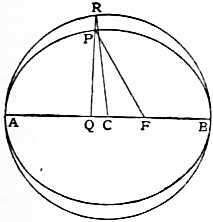
ANOMALY (from Gr. ἀνωμαλία, unevenness, derived from ἀν-, privative, and ὁμαλός, even), a deviation from the common rule. In astronomy the word denotes the angular distance of a body from the pericentre of the orbit in which it is moving. Let AB be the major axis of the orbit, B the pericentre, F the focus or centre of motion, P the position of the body. The anomaly is then the angle BFP which the radius vector makes with the major axis. This is the actual or true anomaly. Mean anomaly is the anomaly which the body would have if it moved from the pericentre around F with a uniform angular motion such that its revolution would be completed in its actual time (see Orbit). Eccentric anomaly is defined thus:— Draw the circumscribing circle of the elliptic orbit around the centre C of the orbit. Drop the perpendicular RPQ through P, the position of the planet, upon the major axis. Join CR; the angle CRQ is then the eccentric anomaly.
In the ancient astronomy the anomaly was taken as the angular distance of the planet from the point of the farthest recession from the earth.
Kepler’s Problem, namely, that of finding the co-ordinates of a planet at a given time, which is equivalent—given the mean anomaly—to that of determining the true anomaly, was solved approximately by Kepler, and more completely by Wallis, Newton and others.
The anomalistic revolution of a planet or other heavenly body is the revolution between two consecutive passages through the pericentre. Starting from the pericentre, it is completed on the return to the pericentre. If the pericentre is fixed, this is an actual revolution; but if it moves the anomalistic revolution is greater or less than a complete circumference.
An Anomalistic year is the time (365 days, 6 hours, 13 minutes, 48 seconds) in which the earth (and similarly for any other planet) passes from perihelion to perihelion, or from any given value of the anomaly to the same again. Owing to the precession of the equinoxes it is longer than a tropical or sidereal year by 25 minutes and 2.3 seconds. An Anomalistic month is the time in which the moon passes from perigee to perigee, &c.
For the mathematics of Kepler’s problem see E.W. Brown, Lunar Theory (Cambridge 1896), or the work of Watson or of Bauschinger on Theoretical Astronomy.
ANORTHITE, an important mineral of the felspar group, being one of the end members of the plagioclase (q.v.) series. It is a calcium and aluminium silicate, CaAl2Si2O3, and crystallizes in the anorthic system. Like all the felspars, it possesses two cleavages, one perfect and the other less so, here inclined to one another at an angle of 85° 50′. The colour is white, greyish or reddish, and the crystals are transparent to translucent. The hardness is 6-6½, and the specific gravity 2·75.
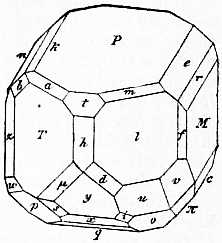
Anorthite is an essential constituent of many basic igneous rocks, such as gabbro and basalt, also of some meteoric stones. The best developed crystals are those which accompany mica, augite, sanidine, &c., in the ejected blocks of metamorphosed limestone from Monte Somma, the ancient portion of Mount Vesuvius; these are perfectly colourless and transparent, and are bounded by numerous brilliant faces. Distinctly developed crystals are also met with in the basalts of Japan, but are usually rare at other localities.
The name anorthite was given to the Vesuvian mineral by G. Rose in 1823, on account of its anorthic crystallization. The species had, however, been earlier described by the comte de Bournon under the name indianite, this name being applied to a greyish or reddish granular mineral forming the matrix of corundum from the Carnatic in India. Several unimportant varieties have been distinguished.
(L. J. S.)
ANQUETIL, LOUIS PIERRE (1723-1808), French historian, was born in Paris, on the 21st of February 1723. He entered the congregation of Sainte-Geneviève, where he took holy orders and became professor of theology and literature. Later, he became director of the seminary at Reims, where he wrote his Histoire civile et politique de Reims (3 vols., 1756-1757), perhaps his best work. He was then director of the college of Senlis, where he composed his Esprit de la Ligue ou histoire politique des troubles de la Fronde pendant le XVIe et le XVIIe siècles (1767). During the Reign of Terror he was imprisoned at St Lazare; there he began his Précis de l’histoire universelle, afterwards published in nine volumes. On the establishment of the national institute he was elected a member of the second group (moral and political sciences), and was soon afterwards employed in the office of the ministry of foreign affairs, profiting by his experience to write his Motifs des guerres et des traités de paix sous Louis XIV., Louis XV, et Louis XVI. He is said to have been asked by Napoleon to write his Histoire de France (14 vols., 1805), a mediocre compilation at second or third hand, with the assistance of de Mézeray and of Paul François Velly (1709-1759). This work, nevertheless, passed through numerous editions, and by it his name is remembered. He died on the 6th of September 1808.
ANQUETIL, DUPERRON, ABRAHAM HYACINTHE (1731-1805), French orientalist, brother of Louis Pierre Anquetil, the historian, was born in Paris on the 7th of December 1731. He was educated for the priesthood in Paris and Utrecht, but his taste for Hebrew, Arabic, Persian, and other languages of the East developed into a passion, and he discontinued his theological course to devote himself entirely to them. His diligent attendance at the Royal Library attracted the attention of the keeper of the manuscripts, the Abbé Sallier, whose influence procured for him a small salary as student of the oriental languages. He had lighted on some fragments of the Vendidad Sade, and formed the project of a voyage to India to discover the works of Zoroaster. With this end in view he enlisted as a private soldier, on the 2nd of November 1754, in the Indian expedition which was about to start from the port of L’Orient. His friends procured his discharge, and he was granted a free passage, a seat at the captain’s table, and a salary, the amount of which was to be fixed by the governor of the French settlement in India. After a passage of six months, Anquetil landed, on the 10th of August 1755, at Pondicherry. Here he remained a short time to master modern Persian, and then hastened to Chandernagore to acquire Sanskrit. Just then war was declared between France and England; Chandernagore was taken, and Anquetil returned to Pondicherry by land. He found one of his brothers at Pondicherry, and embarked with him for Surat; but, with a view of exploring the country, he landed at Mahé and proceeded on foot. At Surat he succeeded, by perseverance and address in his intercourse with the native priests, in acquiring a sufficient knowledge of the Zend and Pahlavi languages to translate the liturgy called the Vendidad Sade and some other works. Thence he proposed going to Benares, to study the language, antiquities, and sacred laws of the Hindus; but the capture of Pondicherry obliged him to quit India. Returning to Europe in an English vessel, he spent some time in London and Oxford, and then set out for France. He arrived in Paris on the 14th of March 1762 in possession of one hundred and eighty oriental manuscripts, besides other curiosities. The Abbé Barthélemy procured for him a pension, with the appointment of interpreter of oriental languages at the Royal Library. In 1763 he was elected an associate of the Academy of Inscriptions, and began to arrange for the publication of the materials he had collected during his eastern travels. In 1771 he published his Zend-Avesta (3 vols.), containing collections from the sacred writings of the fire-worshippers, a life of Zoroaster, and fragments of works ascribed to him. In 1778 he published at Amsterdam his Législation orientate, in which he endeavoured to prove that the nature of oriental despotism had been greatly misrepresented. His Recherches historiques et géographiques sur l’Inde appeared in 1786, and formed part of Thieffenthaler’s Geography of India. The Revolution seems to have greatly affected him. During that period he abandoned society, and lived in voluntary poverty on a few pence a day. In 1798 he published L’Inde en rapport avec l’Europe (Hamburg, 2 vols.), which contained much invective against the English, and numerous misrepresentations. In 1802-1804 he published a Latin translation (2 vols.) from the Persian of the Oupnek’hat or Upanishada. It is a curious mixture of Latin, Greek, Persian, Arabic, and Sanskrit. He died in Paris on the 17th of January 1805.
See Biographie universelle; Sir William Jones, Works (vol. x., 1807); and the Miscellanies of the Philobiblon Society (vol. iii., 1856-1857). For a list of his scattered writings see Quérard, La France littéraire.
ANSA (from Lat. ansa, a handle), in astronomy, one of the apparent ends of the rings of Saturn as seen in perspective from the earth: so-called because, in the earlier telescopes, they looked like handles projecting from the planet. In anatomy the word is applied to nervous structures which resemble loops. In archaeology it is used for the engraved and ornamented handle of a vase, which has often survived when the vase itself, being less durable, has disappeared.
ANSBACH, or Anspach, originally Onolzbach, a town of Germany, in the kingdom of Bavaria, on the Rezat, 27 m. by rail S.W. of Nuremberg, and 90 m. N. of Munich. Pop. (1900) 17,555. It contains a palace, once the residence of the margraves of Anspach, with fine gardens, several churches, the finest of which are those dedicated to St John, containing the vault of the former margraves, and St Gumbert; a gymnasium; a picture gallery; a municipal museum and a special technical school. Ansbach possesses monuments to the poets August, Count von Platen-Hallermund, and Johann Peter Uz, who were born here, and to Kaspar Hauser, who died here. The chief manufactures are machinery, toys, woollen, cotton, and half-silk stuffs, embroideries, earthenware, tobacco, cutlery and playing cards. There is considerable trade in grain, wool and flax. In 1791 the last margrave of Anspach sold his principality to Frederick William II., king of Prussia; it was transferred by Napoleon to Bavaria in 1806, an act which was confirmed by the congress of Vienna in 1815.
ANSDELL, RICHARD (1815-1885), English painter, was born in Liverpool, and first exhibited at the Royal Academy in 1840. He was a painter of genre, chiefly animal and sporting pictures, and he became very popular, being elected A.R.A. in 1861 and R.A. in 1870. His “Stag at Bay” (1846), “The Combat” (1847), and “Battle of the Standard” (1848), represent his best work, in which he showed himself a notable follower of Landseer.
ANSELM (c. 1033-1109), archbishop of Canterbury, was born at Aosta in Piedmont. His family was accounted noble, and was possessed of considerable property. Gundulph, his father, was by birth a Lombard, and seems to have been a man of harsh and violent temper; his mother, Ermenberga, was a prudent and virtuous woman, from whose careful religious training the young Anselm derived much benefit. At the age of fifteen he desired to enter a convent, but he could not obtain his father’s consent. Disappointment brought on an illness, on his recovery from which he seems for a time to have given up his studies, and to have plunged into the gay life of the world. During this time his mother died, and his father’s harshness became unbearable. He left home, and with only one attendant crossed the Alps, and wandered through Burgundy and France. Attracted by the fame of his countryman, Lanfranc, then prior of Bec, he entered Normandy, and, after spending some time at Avranches, settled at the monastery of Bec. There, at the age of twenty-seven, he became a monk; three years later, when Lanfranc was promoted to the abbacy of Caen, he was elected prior. This office he held for fifteen years, and then, in 1078, on the death of Herlwin, the warrior monk who had founded the monastery, he was made abbot. Under his rule Bec became the first seat of learning in Europe, a result due not more to his intellectual powers than to the great moral influence of his noble character and kindly discipline. It was during these quiet years at Bec that Anselm wrote his first philosophical and religious works, the dialogues on Truth and Freewill, and the two celebrated treatises, the Monologion and Proslogion.
Meanwhile the convent had been growing in wealth, as well as in reputation, and had acquired considerable property in England, which it became the duty of Anselm occasionally to visit. By his mildness of temper and unswerving rectitude, he so endeared himself to the English that he was looked upon and desired as the natural successor to Lanfranc, then archbishop of Canterbury. But on the death of that great man, the ruling sovereign, William Rufus, seized the possessions and revenues of the see, and made no new appointment. About four years after, in 1092, on the invitation of Hugh, earl of Chester, Anselm with some reluctance, for he feared to be made archbishop, crossed to England. He was detained by business for nearly four months, and when about to return, was refused permission by the king. In the following year William fell ill, and thought his death was at hand. Eager to make atonement for his sin with regard to the archbishopric, he nominated Anselm to the vacant see, and after a great struggle compelled him to accept the pastoral staff of office. After obtaining dispensation from his duties in Normandy, Anselm was consecrated in 1093. He demanded of the king, as the conditions of his retaining office, that he should give up all the possessions of the see, accept his spiritual counsel, and acknowledge Urban as pope in opposition to the anti-pope, Clement. He only obtained a partial consent to the first of these, and the last involved him in a serious difficulty with the king. It was a rule of the church that the consecration of metropolitans could not be completed without their receiving the pallium from the hands of the pope. Anselm, accordingly, insisted that he must proceed to Rome to receive the pall. But William would not permit this; he had not acknowledged Urban, and he maintained his right to prevent any pope being acknowledged by an English subject without his permission. A great council of churchmen and nobles, held to settle the matter, advised Anselm to submit to the king, but failed to overcome his mild and patient firmness. The matter was postponed, and William meanwhile privately sent messengers to Rome, who acknowledged Urban and prevailed on him to send a legate to the king bearing the archiepiscopal pall. A partial reconciliation was then effected, and the matter of the pall was compromised. It was not given by the king, but was laid on the altar at Canterbury, whence Anselm took it.
Little more than a year after, fresh trouble arose with the king, and Anselm resolved to proceed to Rome and seek the counsel of his spiritual father. With great difficulty he obtained a reluctant permission to leave, and in October 1097 he set out for Rome. William immediately seized on the revenues of the see, and retained them to his death. Anselm was received with high honour by Urban, and at a great council held at Bari, he was put forward to defend the doctrine of the procession of the Holy Ghost against the representatives of the Greek Church. But Urban was too politic to embroil himself with the king of England, and Anselm found that he could obtain no substantial result. He withdrew from Rome, and spent some time at the little village of Schiavi, where he finished his treatise on the atonement, Cur Deus homo, and then retired to Lyons.
In 1100 William was killed, and Henry, his successor, at once recalled Anselm. But Henry demanded that he should again receive from him in person investiture in his office of archbishop, thus making the dignity entirely dependent on the royal authority. Now, the papal rule in the matter was plain; all homage and lay investiture were strictly prohibited. Anselm represented this to the king; but Henry would not relinquish a privilege possessed by his predecessors, and proposed that the matter should be laid before the Holy See. The answer of the pope reaffirmed the law as to investiture. A second embassy was sent, with a similar result. Henry, however, remained firm, and at last, in 1103, Anselm and an envoy from the king set out for Rome. The pope, Paschal, reaffirmed strongly the rule of investiture, and passed sentence of excommunication against all who had infringed the law, except Henry. Practically this left matters as they were, and Anselm, who had received a message forbidding him to return to England unless on the king’s terms, withdrew to Lyons, where he waited to see if Paschal would not take stronger measures. At last, in 1105, he resolved himself to excommunicate Henry. His intention was made known to the king through his sister, and it seriously alarmed him, for it was a critical period in his affairs. A meeting was arranged, and a reconciliation between them effected. In 1106 Anselm crossed to England, with power from the pope to remove the sentence of excommunication from the illegally invested churchmen. In 1107 the long dispute as to investiture was finally ended by the king resigning his formal rights. The remaining two years of Anselm’s life were spent in the duties of his archbishopric. He died on the 21st of April 1109. He was canonized in 1494 by Alexander VI.
Anselm may, with some justice, be considered the first scholastic philosopher and theologian. His only great predecessor, Scotus Erigena, had more of the speculative and mystical element than is consistent with a schoolman; but in Anselm are found that recognition of the relation of reason to revealed truth, and that attempt to elaborate a rational system of faith, which form the special characteristics of scholastic thought. His constant endeavour is to render the contents of the Christian consciousness clear to reason, and to develop the intelligible truths interwoven with the Christian belief. The necessary preliminary for this is the possession of the Christian consciousness. “He who does not believe will not experience; and he who has not experienced will not understand.” That faith must precede knowledge is reiterated by him. ”Negue enim quaero intelligere ut credam, sed credo ut intelligam. Nam et hoc credo, quia, nisi credidero, non intelligam.” (“Nor do I seek to understand that I may believe, but I believe that I may understand. For this too I believe, that unless I first believe, I shall not understand.”) But after the faith is held fast, the attempt must be made to demonstrate by reason the truth of what we believe. It is wrong not to do so. ”Negligentiae mihi esse videtur, si, postquam confirmati sumus in fide, non studemus quod credimus, intelligere.” (“I hold it to be a failure in duty if after we have become steadfast in the faith we do not strive to understand what we believe.”) To such an extent does he carry this demand for rational explanation that, at times, it seems as if he claimed for unassisted intelligence the power of penetrating even to the mysteries of the Christian faith. On the whole, however, the qualified statement is his real view; merely rational proofs are always, he affirms, to be tested by Scripture. (Cur Deus homo, i. 2 and 38; De Fide Trin. 2.)
The groundwork of his theory of knowledge is contained in the tract De Veritate, in which, from the consideration of truth as in knowledge, in willing, and in things, he rises to the affirmation of an absolute truth, in which all other truth participates. This absolute truth is God himself, who is therefore the ultimate ground or principle both of things and of thought. The notion of God comes thus into the foreground of the system; before all things it is necessary that it should be made clear to reason, that it should be demonstrated to have real existence. This demonstration is the substance of the Monologion and Proslogion. In the first of these the proof rests on the ordinary grounds of realism, and coincides to some extent with the earlier theory of Augustine, though it is carried out with singular boldness and fulness. Things, he says, are called good in a variety of ways and degrees; this would be impossible if there were not some absolute standard, some good in itself, in which all relative goods participate. Similarly with such predicates as great, just; they involve a certain greatness and justice. The very existence of things is impossible without some one Being, by whom they are. This absolute Being, this goodness, justice, greatness, is God. Anselm was not thoroughly satisfied with this reasoning; it started from a posteriori grounds, and contained several converging lines of proof. He desired to have some one short demonstration. Such a demonstration he presented in the Proslogion; it is his celebrated ontological proof. God is that being than whom none greater can be conceived. Now, if that than which nothing greater can be conceived existed only in the intellect, it would not be the absolutely greatest, for we could add to it existence in reality. It follows, then, that the being than whom nothing greater can be conceived, i.e. God, necessarily has real existence. This reasoning, in which Anselm partially anticipated the Cartesian philosophers, has rarely seemed satisfactory. It was opposed at the time by the monk Gaunilo, in his Liber pro Insipiente, on the ground that we cannot pass from idea to reality. The same criticism is made by several of the later schoolmen, among others by Aquinas, and is in substance what Kant advances against all ontological proof. Anselm replied to the objections of Gaunilo in his Liber Apologeticus. The existence of God being thus held proved, he proceeds to state the rational grounds of the Christian doctrines of creation and of the Trinity. With reference to this last, he says we cannot know God from himself, but only after the analogy of his creatures; and the special analogy used is the self-consciousness of man, its peculiar double nature, with the necessary elements, memory and intelligence, representing the relation of the Father to the Son. The mutual love of these two, proceeding from the relation they hold to one another, symbolizes the Holy Spirit. The further theological doctrines of man, original sin, free will, are developed, partly in the Monologion, partly in other mixed treatises. Finally, in his greatest work, Cur Deus homo, he undertakes to make plain, even to infidels, the rational necessity of the Christian mystery of the atonement. The theory rests on three positions: that satisfaction is necessary on account of God’s honour and justice; that such satisfaction can be given only by the peculiar personality of the God-man; that such satisfaction is really given by the voluntary death of this infinitely valuable person. The demonstration is, in brief, this. All the actions of men are due to the furtherance of God’s glory; if, then, there be sin, i.e. if God’s honour be wounded, man of himself can give no satisfaction. But the justice of God demands satisfaction; and as an insult to infinite honour is in itself infinite, the satisfaction must be infinite, i.e. it must outweigh all that is not God. Such a penalty can only be paid by God himself, and, as a penalty for man, must be paid under the form of man. Satisfaction is only possible through the God-man. Now this God-man, as sinless, is exempt from the punishment of sin; His passion is therefore voluntary, not given as due. The merit of it is therefore infinite; God’s justice is thus appeased, and His mercy may extend to man. This theory has exercised immense influence on the form of church doctrine. It is certainly an advance on the older patristic theory, in so far as it substitutes for a contest between God and Satan, a contest between the goodness and justice of God; but it puts the whole relation on a merely legal footing, gives it no ethical bearing, and neglects altogether the consciousness of the individual to be redeemed. In this respect it contrasts unfavourably with the later theory of Abelard.
Anselm’s speculations did not receive, in the middle ages, the respect and attention justly their due. This was probably due to their unsystematic character, for they are generally tracts or dialogues on detached questions, not elaborate treatises like the great works of Albert, Aquinas, and Erigena. They have, however, a freshness and philosophical vigour, which more than makes up for their want of system, and which raises them far above the level of most scholastic writings.
Bibliography.—The main sources for the history of St Anselm and his times are Eadmer’s Vita Anselmi and his Historia Novorum, edited by M. Rule in Rolls Series (London, 1884); the best modern work is by Père Ragey, Histoire de Saint Anselme (Paris, 1890), and Saint Anselme professeur (Paris, 1890). Other appreciations are by A. Mohler, Anselm Erzbischof von Canterbury (Regensburg, 1839; Eng. trans. by H. Rymer, London, 1842); F.R. Hasse, Anselm von Canterbury (2 vols., Leipzig, 1842-1853); C. de Rémusat, S. Anseime de Cantorbéry (Paris, 1853, new ed. 1868); R.W. Church, St Anselm, first published in Sunday Library (London, 1870; often reprinted); Martin Rule, Life and Times of St Anselm (London, 1883).
Works: The best edition of St Anselm’s complete works is that of Dom Gerberon (Paris, 1675); reprinted with many notes in 1712; incorporated by J. Migne in his Patrologia Latina, tomi clviii.-clix. (Paris. 1853-1854). Migne’s reprint contains many errors. The Cur Deus homo may be best studied in the editions published by D. Nutt (London, 1885) and by Griffith (1898). The Mariale, or poems in honour of the Blessed Virgin, has been carefully edited by P. Ragey (Tournai, 1885); the Monologion and Proslogion, by C.E. Ubaghs (Louvain, 1854; Eng. trans. by S.N. Deane, Chicago, 1903); the Meditationes, many of which are wrongly attributed to Anselm, have been frequently reprinted, and were included in Methuen’s Library of Devotion (London, 1903).
The best criticism of Anselm’s philosophical works is by J.M. Rigg (London, 1896), and Domet de Verges (Grands Philosophes series, Paris, 1901). For a complete bibliography, see A. Vacant’s Dictionnaire de théologie.
ANSELM, of Laon (d. 1117), French theologian, was born of very humble parents at Laon before the middle of the 11th century. He is said to have studied under St Anselm at Bec. About 1076 he taught with great success at Paris, where, as the associate of William of Champeaux, he upheld the realistic side of the scholastic controversy. Later he removed to his native place, where his school for theology and exegetics rapidly became the most famous in Europe. He died in 1117. His greatest work, an interlinear gloss on the Scriptures, was one of the great authorities of the middle ages. It has been frequently reprinted. Other commentaries apparently by him have been ascribed to various writers, principally to the great Anselm. A list of them, with notice of Anselm’s life, is contained in the Histoire littéraire de la France, x. 170-189.
The works are collected in Migne’s Patrologia Latina, tome 162; some unpublished Sententiae were edited by G. Lefèvre (Milan, 1894), on which see Hauréau in the Journal des savants for 1895.
ANSELME (Father Anselme of the Virgin Mary) (1625-1694), French genealogist, was born in Paris in 1625. As a layman his name was Pierre Guibours. He entered the order of the barefooted Augustinians on the 31st of March 1644, and it was in their monastery (called the Couvent des Petits Pères, near the church of Notre-Dame des Victoires) that he died, on the 17th of January 1694. He devoted his entire life to genealogical studies. In 1663 he published Le Palais de l’honneur, which besides giving the genealogy of the houses of Lorraine and Savoy, is a complete treatise on heraldry, and in 1664 Le Palais de la gloire, dealing with the genealogy of various illustrious French and European families. These books made friends for him, the most intimate among whom, Honoré Caille, seigneur du Fourny (1630-1713), persuaded him to publish his Histoire généalogique de la maison royale de France, et des grands officiers de la couronne (1674, 2 vols. 4); after Father Anselme’s death, Honoré Caille collected his papers, and brought out a new edition of this highly important work in 1712. The task was taken up and continued by two other friars of the Couvent des Petits Pères, Father Ange de Sainte-Rosalie (François Raffard, 1655-1726), and Father Simplicien (Paul Lucas, 1683-1759), who published the first and second volumes of the third edition in 1726. This edition consists of nine volumes folio; it is a genealogical and chronological history of the royal house of France, of the peers, of the great officers of the crown and of the king’s household, and of the ancient barons of the kingdom. The notes were generally compiled from original documents, references to which are usually given, so that they remain useful to the present day. The work of Father Anselme, his collaborators and successors, is even more important for the history of France than is Dugdale’s Baronage of England for the history of England.
(C. B.*)
ANSON, GEORGE ANSON, Baron (1697-1762), British admiral, was born on the 23rd of April 1697. He was the son of William Anson of Shugborough in Staffordshire, and his wife Isabella Carrier, who was the sister-in-law of Lord Chancellor Macclesfield, a relationship which proved very useful to the future admiral. George Anson entered the navy in February 1712, and by rapid steps became lieutenant in 1716, commander in 1722, and post-captain in 1724. In this rank he served twice on the North American station as captain of the “Scarborough” and the “Squirrel” from 1724 to 1730 and from 1733 to 1735. In 1737 he was appointed to the “Centurion,” 60, on the eve of war with Spain, and when hostilities had begun he was chosen to command as commodore the squadron which was sent to attack her possessions in South America in 1740. The original scheme was ambitious, and was not carried out. Anson’s squadron, which sailed later than had been intended, and was very ill-fitted, consisted of six ships, which were reduced by successive disasters to his flagship the “Centurion.” The lateness of the season forced him to round Cape Horn in very stormy weather, and the navigating instruments of the time did not allow of exact observation. Two of his vessels failed to round the Horn, another, the “Wager,” was wrecked in the Golfo de Pañas on the coast of Chile. By the time Anson reached the island of Juan Fernandez in June 1741, his six ships had been reduced to three, while the strength of his crews had fallen from 961 to 335. In the absence of any effective Spanish force on the coast he was able to harass the enemy, and to capture the town of Paita on the 13th-15th of November 1741. The steady diminution of his crew by sickness, and the worn-out state of his remaining consorts, compelled him at last to collect all the survivors in the “Centurion.” He rested at the island of Tinian, and then made his way to Macao in November 1742. After considerable difficulties with the Chinese, he sailed again with his one remaining vessel to cruise for one of the richly laden galleons which conducted the trade between Mexico and the Philippines. The indomitable perseverance he had shown during one of the most arduous voyages in the history of sea adventure was rewarded by the capture of an immensely rich prize, the “Nuestra Señora de Covadonga,” which was met off Cape Espiritu Santo on the 20th of June 1743. Anson took his prize back to Macao, sold her cargo to the Chinese, keeping the specie, and sailed for England, which he reached by the Cape of Good Hope on the 15th of June 1744. The prize-money earned by the capture of the galleon had made him a rich man for life, and under the influence of irritation caused by the refusal of the admiralty to confirm a captain’s commission he had given to one of his officers, Anson refused the rank of rear-admiral, and was prepared to leave the service. His fame would stand nearly as high as it does if he had done so, but he would be a far less important figure in the history of the navy. By the world at large he is known as the commander of the voyage of circumnavigation, in which success was won by indomitable perseverance, unshaken firmness, and infinite resource. But he was also the severe and capable administrator who during years of hard work at the admiralty did more than any other to raise the navy from the state of corruption and indiscipline into which it had fallen during the first half of the eighteenth century. Great anger had been caused in the country by the condition of the fleet as revealed in the first part of the war with France and Spain, between 1739 and 1747. The need for reform was strongly felt, and the politicians of the day were conscious that it would not be safe to neglect the popular demand for it. In 1745 the duke of Bedford, the new first lord, invited Anson to join the admiralty with the rank of rear-admiral of the white. As subordinate under the duke, or Lord Sandwich, and as first lord himself, Anson was at the admiralty with one short break from 1745 till his death in 1762. His chiefs in the earlier years left him to take the initiative in all measures of reform, and supported him in their own interest. After 1751 he was himself first lord, except for a short time in 1756 and 1757. At his suggestion, or with his advice, the naval administration was thoroughly overhauled. The dockyards were brought into far better order, and though corruption was not banished, it was much reduced. The navy board was compelled to render accounts, a duty it had long neglected. A system of regulating promotion to flag rank, which has been in the main followed ever since, was introduced. The Navy Discipline Act was revised in 1749, and remained unaltered till 1865. Courts martial were put on a sound footing. Inspections of the fleet and the dockyards were established, and the corps of Marines was created in 1755. The progressive improvement which raised the navy to the high state of efficiency it attained in later years dates from Anson’s presence at the admiralty. In 1747 he, without ceasing to be a member of the board, commanded the Channel fleet which on the 3rd of May scattered a large French convoy bound to the East, and West Indies, in an action off Cape Finisterre. Several men-of-war and armed French Indiamen were taken, but the overwhelming superiority of Anson’s fleet (fourteen men-of-war, to six men-of-war and four Indiamen) in the number and weight of ships deprives the action of any strong claim to be considered remarkable. In society Anson seems to have been cold and taciturn. The sneers of Horace Walpole, and the savage attack of Smollett in The Adventures of an Atom, are animated by personal or political spite. Yet they would not have accused him of defects from which he was notoriously free. In political life he may sometimes have given too ready assent to the wishes of powerful politicians. He married the daughter of Lord Chancellor Hardwicke on the 27th of April 1748. There were no children of the marriage. His title of Baron Anson of Soberton was given him in 1747, but became extinct on his death. The title of Viscount Anson was, however, created in 1806 in favour of his great-nephew, the grandson of his sister Janetta and Mr Sambrook Adams, whose father had assumed the name and arms of Anson. The earldom of Lichfield was conferred on the family in the next generation. A fine portrait of the admiral by Reynolds is in the possession of the earl of Lichfield, and there are copies in the National Portrait Gallery and at Greenwich. Anson’s promotions in flag rank were: rear-admiral in 1745, vice-admiral in 1746, and admiral in 1748. In 1749 he became vice-admiral of Great Britain, and in 1761 admiral of the fleet. He died on the 6th of June 1762.
A life of Lord Anson, inaccurate in some details but valuable and interesting, was published by Sir John Barrow in 1839. The standard account of his voyage round the world is that by his chaplain Richard Walter, 1748, often reprinted. A share in the work has been claimed on dubious grounds for Benjamin Robins, the mathematician. Another and much inferior account was published in 1745 by Pascoe Thomas, the schoolmaster of the “Centurion.”
(D. H.)
ANSON, SIR WILLIAM REYNELL, Bart. (1843- ), English jurist, was born on the 14th of November 1843, at Walberton, Sussex, son of the second baronet. Educated at Eton and Balliol College, Oxford, he took a first class in the final classical schools in 1866, and was elected to a fellowship of All Souls in the following year. In 1869 he was called to the bar, and went the home circuit until 1873, when he succeeded to the baronetcy. In 1874 he became Vinerian reader in English law at Oxford, a post which he held until he became, in 1881, warden of All Souls College. He identified himself both with local and university interests; he became an alderman of the city of Oxford in 1892, chairman of quarter sessions for the county in 1894, was vice-chancellor of the university in 1898-1899, and chancellor of the diocese of Oxford in 1899. In that year he was returned, without opposition, as M.P. for the university in the Liberal Unionist interest, and consequently resigned the vice-chancellorship. In parliament he preserved an active interest in education, being a member of the newly created consultative committee of the Board of Education in 1900, and in 1902 he became parliamentary secretary. He took an active part in the foundation of a school of law at Oxford, and his volumes on The Principles of the English Law of Contract, (1884, 11th ed. 1906), and on The Law and Custom of the Constitution in two parts, “The Parliament” and “The Crown” (1886-1892. 3rd ed. 1907, pt. i. vol. ii.), are standard works.
ANSONIA, a city of New Haven county, Connecticut, U.S.A., coextensive with the township of the same name, on the Naugatuck river, immediately N. of Derby and about 12 m. N.W. of New Haven. It is served by the New York, New Haven & Hartford railway, and by interurban electric lines running N., S. and E. Pop. (1900) 12,681, of whom 4296 were foreign born; (1910 census) 13,152. Land area about 5.4 sq. m. The city has extensive manufactures of heavy machinery, electric supplies, brass and copper products and silk goods. In 1905 the capital invested in manufacturing was $7,625,864, and the value of the products was $19,132,455. Ansonia, Derby and Shelton form one of the most important industrial communities in the state. The city, settled in 1840 and named in honour of the merchant and philanthropist, Anson Green Phelps (1781-1853), was originally a part of the township of Derby; it was chartered as a borough in 1864 and as a city in 1893, when the township of Ansonia, which had been incorporated in 1889, and the city were consolidated.
ANSTED, DAVID THOMAS (1814-1880), English geologist, was born in London on the 5th of February 1814. He was educated at Jesus College, Cambridge, and after taking his degree of M.A. in 1839 was elected to a fellowship of the college. Inspired by the teachings of Adam Sedgwick, his attention was given to geology, and in 1840 he was elected professor of geology in King’s College, London, a post which he held until 1853. Meanwhile he became a fellow of the Royal Society in 1844, and from that date until 1847 he was vice-secretary of the Geological Society and edited its Quarterly Journal. The practical side of geology now came to occupy his chief attention, and he visited various parts of Europe and the British Islands as a consulting geologist and mining engineer. He was also in 1868 and for many years examiner in physical geography to the science and art department. He died at Melton near Woodbridge, on the 13th of May 1880.
Publications.—Geology, Introductory, Descriptive and Practical (2 vols., 1844); The Ionian Islands (1863); The Applications of Geology to the Arts and Manufactures (1865); Physical Geography (1867); Water and Water Supply (Surface Water) (1878); and The Channel Islands (with R.G. Latham) (1862).
ANSTEY, CHRISTOPHER (1724-1805), English poet, was the son of the rector of Brinkley, Cambridgeshire, where he was born on the 31st of October 1724. He was educated at Eton and King’s College, Cambridge, where he distinguished himself for his Latin verses. He became a fellow of his college (1745); but the degree of M.A. was withheld from him, owing to the offence caused by a speech made by him beginning: “Doctores sine doctrina, magistri artium sine artibus, et baccalaurei baculo potius quam lauro digni.” In 1754 he succeeded to the family estates and left Cambridge; and two years later he married the daughter of Felix Calvert of Albury Hall, Herts. For some time Anstey published nothing of any note, though he cultivated letters as well as his estates. Some visits to Bath, however, where later, in 1770, he made his permanent home, resulted in 1766 in his famous rhymed letters, The New Bath Guide or Memoirs of the B ... r ... d [Blunderhead] Family ..., which had immediate success, and was enthusiastically praised for its original kind of humour by Walpole and Gray. The Election Ball, in Poetical Letters from Mr Inkle at Bath to his Wife at Gloucester (1776) sustained the reputation won by the Guide. Anstey’s other productions in verse and prose are now forgotten. He died on the 3rd of August 1805. His Poetical Works were collected in 1808 (2 vols.) by the author’s son John (d. 1819), himself author of The Pleader’s Guide (1796), in the same vein with the New Bath Guide.
ANSTRUTHER (locally pronounced Anster), a seaport of Fifeshire, Scotland. It comprises the royal and police burghs of Anstruther Easter (pop. 1190), Anstruther Wester (501) and Kilrenny (2542), and lies 9 m. S.S.E. of St Andrews, having a station on the North British railway company’s branch line from Thornton Junction to St Andrews. The chief industries include coast and deep-sea fisheries, shipbuilding, tanning, the making of cod-liver oil and fish-curing. The harbour was completed in 1877 at a cost of £80,000. The two Anstruthers are divided only by a small stream called Dreel Burn. James Melville (1556-1614), nephew of the more celebrated reformer, Andrew Melville, who was minister of Kilrenny, has given in his Diary a graphic account of the arrival at Anstruther of a weatherbound ship of the Armada, and the tradition of the intermixture of Spanish and Fifeshire blood still prevails in the district. Anstruther fair supplied William Tennant (1784-1848), who was born and buried in the town, with the subject of his poem of “Anster Fair.” Sir James Lumsden, a soldier of fortune under Gustavus Adolphus, who distinguished himself in the Thirty Years’ War, was born in the parish of Kilrenny about 1598. David Martin (1737-1798), the painter and engraver; Thomas Chalmers (1780-1847), the great divine; and John Goodsir (1814-1867), the anatomist, were natives of Anstruther. Little more than a mile to the west lies the royal and police burgh of Pittenweem (Gaelic, “the hollow of the cave”), a quaint old fishing town (pop. 1863), with the remains of a priory. About 2 m. still farther westwards is the fishing town of St Monans or Abercromby (pop. 1898), with a fine old Gothic church, picturesquely perched on the rocky shore. These fisher towns on the eastern and south-eastern coasts of Fifeshire furnish artists with endless subjects. Archibald Constable (1774-1827), Sir Walter Scott’s publisher, was born in the parish of Carnbee, about 3 m. to the north of Pittenweem. The two Anstruthers, Kilrenny and Pittenweem unite with St Andrews, Cupar and Crail, in sending one member to parliament.
ANSWER (derived from and, against, and the same root as swear), originally a solemn assertion in opposition to some one or something, and thus generally any counter-statement or defence, a reply to a question or objection, or a correct solution of a problem. In English law, the “answer” in pleadings was, previous to the Judicature Acts 1873-1875, the statement of defence, especially as regards the facts and not the law. Its place is now taken by a “statement of defence.” “Answer” is the term still applied in divorce proceedings to the reply of the respondent (see Pleading). The famous Latin Responsa Prudentum (“answers of the learned”) were the accumulated views of many successive generations of Roman lawyers, a body of legal opinion which gradually became authoritative. In music an “answer” is the technical name in counterpoint for the repetition by one part or instrument of a theme proposed by another.
ANT (O. Eng. aémete, from Teutonic a, privative, and maitan, cut or bite off, i.e. “the biter off”; aémete in Middle English became differentiated in dialect use to amete, then amte, and so ant, and also to emete, whence the synonym “emmet,” now only used provincially, “ant” being the general literary form). The fact that the name of the ant has come down in English from a thousand years ago shows that this class of insects impressed the old inhabitants of England as they impressed the Hebrews and Greeks. The social instincts and industrious habits of ants have always made them favourite objects of study, and a vast amount of literature has accumulated on the subject of their structure and their modes of life.
Characters.—An ant is easily recognized both by the casual observer and by the student of insects. Ants form a distinct and natural family (Formicidae) of the great order Hymenoptera, to which bees, wasps and sawflies also belong. The insects of this order have mandibles adapted for biting, and two pairs of membranous wings are usually present; the first abdominal segment (propodeum) becomes closely associated with the fore-body (thorax), of which it appears to form a part. In all ants the second (apparently the first) abdominal segment is very markedly constricted at its front and hind edges, so that it forms a “node” at the base of the hind-body (fig. 1), and in many ants the third abdominal segment is similarly “nodular” in form (fig. 3, b, c). It is this peculiar “waist” that catches the eye of the observer, and makes the insects so easy of recognition. Another conspicuous and well-known feature of ants is the wingless condition of the “workers,” as the specialized females, with undeveloped ovaries, which form the largest proportion of the population of ant-communities, are called. Such “workers” are essential to the formation of a social community of Hymenoptera, and their wingless condition among the ants shows that their specialization has been carried further in this family than among the wasps and bees. Further, while among wasps and bees we find some solitary and some social genera, the ants as a family are social, though some aberrant species are dependent on the workers of other ants. It is interesting and suggestive that in a few families of digging Hymenoptera (such as the Mutillidae), allied to the ants, the females are wingless. The perfect female or “queen” ants (figs. 1, 1, 3, a) often cast their wings (fig. 3, b) after the nuptial flight; in a few species the females, and in still fewer the males, never develop wings. (For the so-called “white ants,” which belong to an order far removed from the Hymenoptera, see Termite.)
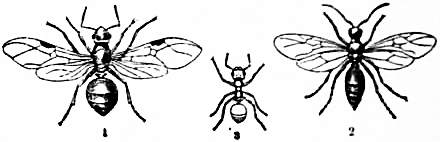
Fig. 1.—Wood Ant (Formica rufa). 1, Queen; 2, male; 3, worker.
Structure.—The head of an ant carries a pair of elbowed feelers, each consisting of a minute basal and an elongate second segment, forming the stalk or “scape,” while from eight to eleven short segments make up the terminal “flagellum.” These segments are abundantly supplied with elongate tooth-like projections connected with nerve-endings probably olfactory in function. The brain is well developed and its “mushroom-bodies” are exceptionally large. The mandibles, which are frequently used for carrying various objects, are situated well to the outside of the maxillae, so that they can be opened and shut without interfering with the latter. The peculiar form and arrangement of the anterior abdominal segments have already been described. The fourth abdominal segment is often very large, and forms the greater part of the hind-body; this segment is markedly constricted at its basal (forward) end, where it is embraced by the small third segment. In many of those ants whose third abdominal segment forms a second “node,” the basal dorsal region of the fourth segment is traversed by a large number of very fine transverse striations; over these the sharp hinder edge of the third segment can be scraped to and fro, and the result is a stridulating organ which gives rise to a note of very high pitch. For the appreciation of the sounds made by these stridulators, the ants are furnished with delicate organs of hearing (chordotonal organs) in the head, in the three thoracic and two of the abdominal segments and in the shins of the legs.
The hinder abdominal segments and the stings of the queens and workers resemble those of other stinging Hymenoptera. But there are several subfamilies of ants whose females have the lancets of the sting useless for piercing, although the poison-glands are functional, their secretion being ejected by the insect, when occasion may arise, from the greatly enlarged reservoir, the reduced sting acting as a squirt.
Nests.—The nests of different kinds of ants are constructed in very different situations; many species (Lasius, for example) make underground nests; galleries and chambers being hollowed out in the soil, and opening by small holes on the surface, or protected above by a large stone. The wood ant (Formica rufa, fig. 1) piles up a heap of leaves, twigs and other vegetable refuse, so arranged as to form an orderly series of galleries, though the structure appears at first sight a chaotic heap. Species of Camponotus and many other ants tunnel in wood. In tropical countries ants sometimes make their nests in the hollow thorns of trees or on leaves; species with this habit are believed to make a return to the tree for the shelter that it affords by protecting it from the ravages of other insects, including their own leaf-cutting relations.
Early Stages.—The larvae of ants (fig. 3, e) are legless and helpless maggots with very small heads (fig. 3, f), into whose mouths the requisite food has to be forced by the assiduous “nurse” workers. The maggots are tended by these nurses with the greatest care, and carried to those parts of the nest most favourable for their health and growth. When fully grown, the maggot spins an oval silken cocoon within which it pupates (fig. 3, g). These cocoons, which may often be seen carried between the mandibles of the workers, are the “ants’ eggs” prized as food for fish and pheasants. The workers of a Ceylonese ant (Oecophylla smaragdina) are stated by D. Sharp to hold the maggots between their mandibles and induce them to spin together the leaves of trees from which they form their shelters, as the adult ants have no silk-producing organs.
Origin of Societies.—Ant-colonies are founded either by a single female or by several in association. The foundress of the nest lays eggs and at first feeds and rears the larvae, the earliest of which develop into workers. C. Janet observed that in a nest of Lasius alienus, established by a single female, the first workers emerged from their cocoons on the 102nd day. These workers then take on themselves the labour of the colony, some collecting food, which they transfer to their comrades within the nest whose duty is to tend and feed the larvae. The foundress-queen is now waited on by the workers, who supply her with food and spare her all cares of work, so that henceforth she may devote her whole energies to egg-laying. The population of the colony increases fast, and a well-grown nest contains several “queens” and males, besides a large number of workers. One of the most interesting features of ant-societies is the dimorphism or polymorphism that may often be seen among the workers, the same species being represented by two or more forms. Thus the British “wood ant” (Formica rufa) has a smaller and a larger race of workers (“minor” and “major” forms), while in Ponera we find a blind race of workers and another race provided with eyes, and in Atta, Eciton and other genera, four or five forms of workers are produced, the largest of which, with huge heads and elongate trenchant mandibles, are known as the “soldier” caste. The development of such diversely-formed insects as the offspring of the unmodified females which show none of their peculiarities raises many points of difficulty for students in heredity. It is thought that the differences are, in part at least, due to differences in the nature of the food supplied to larvae, which are apparently all alike. But the ovaries of worker ants are in some cases sufficiently developed for the production of eggs, which may give rise parthenogenetically to male, queen or worker offspring.
Food.—Different kinds of ants vary greatly in the substances which they use for food. Honey forms the staple nourishment of many ants, some of the workers seeking nectar from flowers, working it up into honey within their stomachs and regurgitating it so as to feed their comrades within the nest, who, in their turn, pass it on to the grubs. A curious specialization of certain workers in connexion with the transference of honey has been demonstrated by H.C. McCook in the American genus Myrmecocystus, and by later observers in Australian and African species of Plagiolepis and allied genera. The workers in question remain within the nest, suspended by their feet, and serve as living honey-pots for the colony, becoming so distended by the supplies of honey poured into their mouths by their foraging comrades that their abdomens become sub-globular, the pale intersegmental membrane being tightly stretched between the widely-separated dark sclerites. The “nurse” workers in the nest can then draw their supplies from these “honey-pots.” Very many ants live by preying upon various insects, such as the British “red ants” with well-developed stings (Myrmica rubra), and the notorious “driver ants” of Africa and America, the old-world species of which belong to Dorylus and allied genera, and the new-world species to Eciton (fig. 2, 2, 3). In these ants the difference between the large, heavy, winged males and females, and the small, long-legged, active workers, is so great, that various forms of the same species have been often referred to distinct genera; in Eciton, for example, the female has a single petiolate abdominal segment, the worker two. The workers of these ants range over the country in large armies, killing and carrying off all the insects and spiders that they find and sometimes attacking vertebrates. They have been known to enter human dwellings, removing all the verminous insects contained therein. These driver ants shelter in temporary nests made in hollow trees or similar situations, where the insects may be seen, according to T. Belt, “clustered together in a dense mass like a great swarm of bees hanging from the roof.”
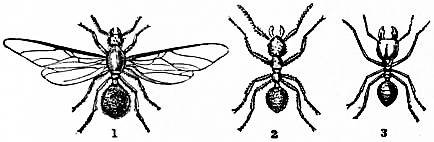
Fig. 2.—Leaf-cutting and Foraging Ants. 1. Atta cephalus; 2. Eciton drepanophora; 3. Eciton erratica.
The harvesting habits of certain ants have long been known, the subterranean store-houses of Mediterranean species of Aphaenogaster having been described by J.T. Moggridge and A. Forel, and the complex industries of the Texan Pogonomyrmex barbatus by H.C. McCook and W.M. Wheeler. The colonies of Aphaenogaster occupy nests extending over an area of fifty to a hundred square yards several feet below the surface of the ground. Into these underground chambers the ants carry seeds of grasses and other plants of which they accumulate large stores. The species of Pogonomyrmex strip the husks from the seeds and carry them out of the nest, making a refuse heap near the entrance. The seeds are harvested from various grasses, especially from Aristida oligantha, a species known as “ant rice,” which often grows in quantity close to the site selected for the nest, but the statement that the ants deliberately sow this grass is an error, due, according to Wheeler, to the sprouting of germinating seeds which the ants have turned out of their store-chambers.
Perhaps no ants have such remarkable habits as those of the genus Atta,—the leaf-cutting ants of tropical America (fig. 2, 1). There are several forms of worker in these species, some with enormous heads, which remain in the underground nests, while their smaller comrades scour the country in search of suitable trees, which they ascend, biting off small circular pieces from the leaves, and carrying them off to the nests. Their labour often results in the complete defoliation of the tree. The tracks along which the ants carry the leaves to their nests are often in part subterranean. H.C. McCook describes an almost straight tunnel, nearly 450 ft. long, made by Atta fervens.
Within the nest, the leaves are cut into very minute fragments and gathered into small spherical heaps forming a spongy mass, which—according to the researches of A. Möller—serves as the substratum for a special fungus (Rozites gongylophora), the staple food of the ants. The insects cultivate their fungus, weeding out mould and bacterial growths, and causing the appearance, on the surface of their “mushroom garden,” of numerous small white bodies formed by swollen ends of the fungus hyphae. When the fungus is grown elsewhere than in the ants’ nest it produces gonidia instead of the white masses on which the ants feed, hence it seems that these masses are indeed produced as the result of some unknown cultural process. Other genera of South American ants—Apterostigma and Cyphomyrmex—make similar fungal cultivations, but they use wood, grain or dung as the substratum instead of leaf fragments. Each kind of ant is so addicted to its own particular fungal food that it refuses disdainfully, even when hungry, the produce of an alien nest.
Guests of Ants.—Many ants feed largely and some almost entirely on the saccharine secretions of other insects, the best known of which are the Aphides (plant-lice or “green-fly”). This consideration leads us to one of the most remarkable and fascinating features of ant-communities—the presence in the nests of insects and other small arthropods, which are tended and cared for by the ants as their “guests,” rendering to the ants in return the sweet food which they desire. The relation between ants and aphids has often been compared to that between men and milch cattle. Sir J. Lubbock (Lord Avebury) states that the common British yellow ants (Lasius flavus) collect flocks of root-feeding aphids in their underground nests, protect them, build earthen shelters over them, and take the greatest care of their eggs. Other ants, such as the British black garden species (L. niger), go after the aphids that frequent the shoots of plants. Many species of aphid migrate from one plant to another at certain stages in their life-cycle when their numbers have very largely increased, and F.M. Webster has observed ants, foreseeing this emigration, to carry aphids from apple trees to grasses. It has been shown by M. Büsgen that the sweet secretion (honey-dew) of the aphids is not derived, as generally believed, from the paired cornicles on the fifth abdominal segment, but from the intestine, whence it exudes in drops and is swallowed by the ants.
Besides the aphids, other insects, such as scale insects (Coccidae), caterpillars of blue butterflies (Lycaenidae), and numerous beetles, furnish the ants with nutrient secretions. The number of species of beetles that inhabit ants’ nests is almost incredibly large, and most of these are never found elsewhere, being blind, helpless and dependent on the ants’ care for protection and food; these beetles belong for the most part to the families Pselaphidae, Paussidae and Staphylinidae. Spring-tails and bristle-tails (order Aptera) of several species also frequent ants’ nests. While some of these “guest” insects produce secretions that furnish the ants with food, some seem to be useless inmates of the nest, obtaining food from the ants and giving nothing in return. Others again play the part of thieves in the ant society; C. Janet observed a small bristle-tail (Lepismima) to lurk beneath the heads of two Lasius workers, while one passed food to the other, in order to steal the drop of nourishment and to make off with it. The same naturalist describes the association with Lasius of small mites (Antennophorus) which are carried about by the worker ants, one of which may have a mite beneath her mouth, and another on either side of her abdomen. On patting their carrier or some passing ant, the mites are supplied with food, no service being rendered by them in return for the ants’ care. Perhaps the ants derive from these seemingly useless guests the same satisfaction as we obtain by keeping pet animals. Recent advance in our knowledge of the guests and associates of ants is due principally to E. Wasmann, who has compiled a list of nearly 1500 species of insects, arachnids and crustaceans, inhabiting ants’ nests. The warmth, shelter and abundant food in the nests, due both to the fresh supplies brought in by the ants and to the large amount of waste matter that accumulates, must prove strongly attractive to the various “guests.” Some of the inmates of ants’ nests are here for the purpose of preying upon the ants or their larvae, so that we find all kinds of relations between the owners of the nests and their companions, from mutual benefit to active hostility.
Among these associations or guests other species of ants are not wanting. For example, a minute species (Solenopsis fugax) lives in a compound nest with various species of Formica, forming narrow galleries which open into the larger galleries of its host. The Solenopsis can make its way into the territory of the Formica to steal the larvae which serve it as food, but the Formica is too large to pursue the thief when it returns to its own galleries.
Slaves.—Several species of ants are found in association with another species which stands to them in the relation of slave to master. Formica sanguinea is a well-known European slave-making ant that inhabits England; its workers raid the nests of F. fusca and other species, and carry off to their own nests pupae from which workers are developed that live contentedly as slaves of their captors. F. sanguinea can live either with or without slaves, but another European ant (Polyergus rufescens) is so dependent on its slaves—various species of Formica—that its workers are themselves unable to feed the larvae. The remarkable genus Anergates has no workers, and its wingless males and females are served by communities of Tetramorium cespitum (fig. 3).
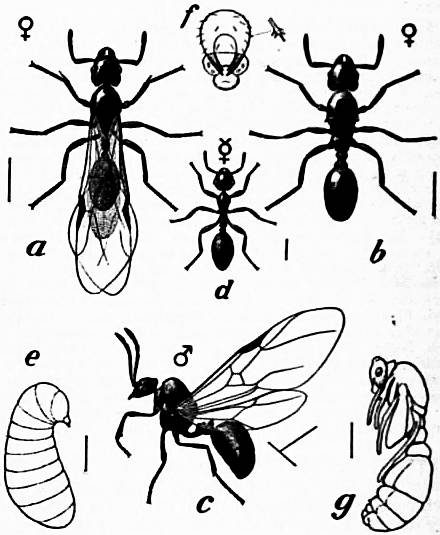
Fig. 3.—Ant, Tetramorium cespitum (Linn.), a, Female; b, female after loss of wings; c, male; d, worker; e, larva; g, pupa; f, head of larva more highly magnified. After Marlatt, Bull. 4 (n.s.) Div. Ent. U.S. Dept. Agriculture.
Senses and Intelligence of Ants.—That ants possess highly developed senses and the power of communicating with one another has long been known to students of their habits; the researches of P. Huber and Sir J. Lubbock (Lord Avebury) on these subjects are familiar to all naturalists. The insects are guided by light, being very sensitive to ultra-violet rays, and also by scent and hearing. Recent experiments by A.M. Fielde show that an ant follows her own old track by a scent exercised by the tenth segment of the feeler, recognizes other inmates of her nest by a sense of smell resident in the eleventh segment, is guided to the eggs, maggots and pupae, which she has to tend, by sensation through the eighth and ninth segments, and appreciates the general smell of the nest itself by means of organs in the twelfth segment. Lubbock’s experiments of inducing ants to seek objects that had been removed show that they are guided by scent rather than by sight, and that any disturbance of their surroundings often causes great uncertainty in their actions. Ants invite one another to work, or ask for food from one another, by means of pats with the feelers; and they respond to the solicitations of their guest—beetles or mites, who ask for food by patting the ants with their feet. In all probability the actions of ants are for the most part instinctive or reflex, and some observers, such as A. Bethe, deny them all claim to psychical qualities. But it seems impossible to doubt that in many cases ants behave in a manner that must be considered intelligent, that they can learn by experience and that they possess memory. Lubbock goes so far as to conclude the account of his experiments with the remark that “It is difficult altogether to deny them the gift of reason ... their mental powers differ from those of men, not so much in kind as in degree.” Wasmann considers that ants are neither miniature human beings nor mere reflex automata, and most students of their habits will probably accept this intermediate position as the most satisfactory. C.L. Morgan sums up a discussion on Lubbock’s experiments in which the ants failed to utilize particles of earth for bridge-making, with the suggestive remark that “What these valuable experiments seem to show is that the ant, probably the most intelligent of all insects, has no claim to be regarded as a rational being.” Nevertheless, ants can teach “rational beings” many valuable lessons.
Bibliography.—The literature on ants is so vast that it is only possible to refer the reader to a few of the most important works on the family. Pierre Huber’s Traité des moeurs des fourmis indigènes (Genève, 1810) is the most famous of the older memoirs. H.W. Bates, A Naturalist on the Amazons; T. Belt, A Naturalist in Nicaragua; H.C. McCook, Agricultural Ant of Texas (Philadelphia, 1880); and A. Moller’s paper in Botan. Mitt, aus den Tropen, (1893), contain classical observations on American species. Sir J. Lubbock’s (Lord Avebury) Ants, Bees and Wasps (London 1882), dealing with British and European species, has been followed by numerous important papers by A. Forel and C. Emery in various Swiss and German periodicals, and especially by C. Janet in his Êtudes sur les fourmis, les guêpes et les abeilles (Paris, &c., 1893-1904). Forel (Ann. Soc. Ent. Belg. xlvii., 1893, Journ. Bomnay N.H. Soc. 1900-1903, and Biologia Cent. Americana) and Emery (Zool. Jahrb. Syst. viii., 1896) have written on the classification of the Formicidae. Among recent American writers on habit may be mentioned W.M. Wheeler (American Naturalist, 1900-1902) and A.M. Fielde (Proc. Acad. Sci. Philadelphia, 1901); E. Wasmann (Kritisches Verzeichniss der myrmecophilen und termitophilen Arthropoden, Berlin, 1894, and 3me Congrès Intern. Zool. 1895) is the great authority on ant-guests and associates. D. Sharp’s general account of ants in the Cambridge Nat. Hist. (vol. vi., 1898) is excellent. For discussions on intelligence see A. Bethe, Journ. f. d. ges. Physiol. lxx. (1898); Wasmann, Die psychischen Fahigkeiten der Ameisen (Stuttgart, 1899); C. Ll. Morgan, Animal Behaviour (London, 1900.)
(G. H. C.)
ANTAE (a Lat. plural word, possibly from ante, before), an architectural term given to slightly projecting pilaster strips which terminate the winged walls of the naos of a Greek temple. They owe their origin to the vertical posts of timber employed in the primitive palaces or temples of Greece, as at Tiryns and in the Heraeum at Olympia, to carry the roof timbers, as no reliance could be placed on the walls built with unburnt brick or in rubble masonry with clay mortar. When between these winged walls there are columns to carry the architrave, so as to form a porch, the latter is said to be in-antis. (See Temple.)
ANTAEUS, in Greek mythology, a giant of Libya, the son of Poseidon and Gaea. He compelled all strangers passing through the country to wrestle with him, and as, when thrown, he derived fresh strength from each successive contact with his mother earth, he proved invincible. With the skulls of those whom he had slain he built a temple to his father. Heracles, in combat with him, discovered the source of his strength, and lifting him up from the earth crushed him to death (Apollodorus ii. 5; Hyginus, Fab. 31). The struggle between Antaeus and Heracles is a favourite subject in ancient sculpture.
ANTALCIDAS, Spartan soldier and diplomatist. In 393 (or 392 B.C.) he was sent to Tiribazus, satrap of Sardis, to undermine the friendly relations then existing between Athens and Persia by offering to recognize Persian claims to the whole of Asia Minor. The Athenians sent an embassy under Conon to counteract his efforts. Tiribazus, who was favourable to Sparta, threw Conon into prison, but Artaxerxes II. (Mnemon) disapproved and recalled his satrap. In 388 Antalcidas, then commander of the Spartan fleet, accompanied Tiribazus to the Persian court, and secured the active assistance of Persia against Athens. The success of his naval operations in the neighbourhood of the Hellespont was such that Athens was glad to accept terms of peace (the “Peace of Antalcidas”), by which (1) the whole of Asia Minor, with the islands of Clazomenae and Cyprus, was recognized as subject to Persia, (2) all other Greek cities—so far as they were not under Persian rule—were to be independent, except Lemnos, Imbros and Scyros, which were to belong, as formerly, to the Athenians. The terms were announced to the Greek envoys at Sardis in the winter 387-386, and were finally accepted by Sparta in 386. Antalcidas continued in favour with Artaxerxes, until the annihilation of Spartan supremacy at Leuctra diminished his influence. A final mission to Persia, probably in 367, was a failure, and Antalcidas, deeply chagrined and fearful of the consequences, is said to have starved himself to death. (See Sparta.)