VOLUME II SLICE II Anjar to Apollo (continued 4)
Reading edition
ANTANÀNARÌVO, i.e. “town of a thousand” (Fr. spelling Tananarive), the capital of Madagascar, situated centrally as regards the length of the island, but only about 90 m. distant from the eastern coast, in 18° 55′ S., 47° 30′ E. It is 135 m. W.S.W. of Tamatave, the principal seaport of the island, with which it is connected by railway, and for about 60 m. along the coast lagoons, a service of small steamers. The city occupies a commanding position, being chiefly built on the summit and slopes of a long and narrow rocky ridge, which extends north and south for about 2½ m., dividing to the north in a Y-shape, and rising at its highest point to 690 ft. above the extensive rice plain to the west, which is itself 4060 ft. above sea-level. For long only the principal village of the Hova chiefs, Antananarivo advanced in importance as those chiefs made themselves sovereigns of the greater part of Madagascar, until it became a town of some 80,000 inhabitants. Until 1869 all buildings within the city proper were of wood or rush, but even then it possessed several timber palaces of considerable size, the largest being 120 ft. high. These crown the summit of the central portion of the ridge; and the largest palace, with its lofty roof and towers, is the most conspicuous object from every point of view. Since the introduction of stone and brick, the whole city has been rebuilt and now contains numerous structures of some architectural pretension, the royal palaces, the houses formerly belonging to the prime minister and nobles, the French residency, the Anglican and Roman Catholic cathedrals, several stone churches, as well as others of brick, colleges, schools, hospitals, courts of justice and other government buildings, and hundreds of good dwelling-houses. Since the French conquest in 1895 good roads have been constructed throughout the city, broad flights of steps connect places too steep for the formation of carriage roads, and the central space, called Andohalo, has become a handsome place, with walks and terraces, flower-beds and trees. A small park has been laid out near the residency, and the planting of trees and the formation of gardens in various parts of the city give it a bright and attractive appearance. Water is obtained from springs at the foot of the hill, but it is proposed to bring an abundant supply from the river Ikopa, which skirts the capital to the south and west. The population, including that of the suburbs, is 69,000 (1907). The city is guarded by two forts built on hills to the east and south-west respectively. Including an Anglican and a Roman Catholic cathedral, there are about fifty churches in the city and its suburbs, as well as a Mahommedan mosque.
(J. Si.*)
‘ANTARA IBN SHADDĀD, Arabian poet and warrior of the 6th century, was famous both for his poetry and his adventurous life. His chief poem is contained in the Mo‘allakât. The account of his life forms the basis of a long and extravagant romance. His father Shaddād was a soldier, his mother Zabūba a negro slave. Neglected at first, he soon claimed attention and respect for himself, and by his remarkable personal qualities and courage in battle he gained his freedom and the acknowledgment of his father. He took part in the great war between the related tribes of Abs and Dhubyān, which began over a contest of horses and was named after them the war of Dāhis and Ghabrā. He died in a fight against the tribe of Ṭai. His poems, which are chiefly concerned with fighting or with his love for Abla, are published in W. Ahlwardt’s The Diwans of the six ancient Arabic Poets (London, 1870); they have also been published separately at Beirût (1888). As regards their genuineness, cf. W. Ahlwardt’s Bemerkungen uber die Aechtheit der alten arabichen Gedichte (Greifswald, 1872), pp. 50 ff. The Romance of ‘Antar (Sîrat ‘Antar ibn Shaddād) is a work which was long handed down by oral tradition only, has grown to immense proportions and has been published in 32 vols. at Cairo, 1307 (A.D. 1889), and in 10 vols. at Beirût, 1871. It was partly translated by Terrick Hamilton under the title ‘Antar, a Bedoueen Romance (4 vols., London, 1820).
For an account of the poet and his works see H. Thorbeckes, Antarah, ein vorislamischer Dichter (Leipzig, 1867), and cf. the Book of Songs (see Abulfaraj), vol. vii. pp. 148-153.
(G. W. T.)
ANTARCTIC (Gr. ἀντί, opposite, and ἄρκτος, the Bear, the northern constellation of Ursa Major), the epithet applied to the region (including both the ocean and the lands) round the South Pole. The Antarctic circle is drawn at 66° 30′ S., but polar conditions of climate, &c., extend considerably north of the area thus enclosed. (See Polar Regions.)
ANTEATER, a term applied to several mammals, but (zoologically at any rate) specially indicating the tropical American anteaters of the family Myrmecophagidae (see Edentata). The typical and largest representative of the group is the great anteater or ant-bear (Myrmecophaga jubata), an animal measuring 4 ft. in length without the tail, and 2 ft. in height at the shoulder. Its prevailing colour is grey, with a broad black band, bordered with white, commencing on the chest, and passing obliquely over the shoulder, diminishing gradually in breadth as it approaches the loins, where it ends in a point. It is extensively distributed in the tropical parts of South and Central America, frequenting low swampy savannas, along the banks of rivers, and the depths of the humid forests, but is nowhere abundant. Its food consists mainly of termites, to obtain which it opens their nests with its powerful sharp anterior claws, and as the insects swarm to the damaged part of their dwelling, it draws them into its mouth by means of its long, flexible, rapidly moving tongue covered with glutinous saliva. The great anteater is terrestrial in habits, not burrowing underground like armadillos. Though generally an inoffensive animal, when attacked it can defend itself vigorously and effectively with its sabre-like anterior claws. The female produces a single young at a birth. The tamandua anteaters, as typified by Tamandua (or Uroleptes) tetradactyla, are much smaller than the great anteater, and differ essentially from it in their habits, being mainly arboreal. They inhabit the dense primeval forests of South and Central America. The usual colour is yellowish-white, with a broad black lateral band, covering nearly the whole of the side of the body.
The little or two-toed anteater (Cyclopes or Cycloturus didactylus) is a native of the hottest parts of South and Central America, and about the size of a rat, of a general yellowish colour, and exclusively arboreal in its habits. The name scaly anteater is applied to the pangolin (q.v.); the banded anteater (Myrmecobius fasciatus) is a marsupial, and the spiny anteater (Echidna) is one of the monotremes (see Marsupialia and Monotremata).
ANTE-CHAPEL, the term given to that portion of a chapel which lies on the western side of the choir screen. In some of the colleges at Oxford and Cambridge the ante-chapel is carried north and south across the west end of the chapel, constituting a western transept or narthex. This model, based on Merton College chapel (13th century), of which only chancel and transept were built though a nave was projected, was followed at Wadham, New and Magdalen Colleges, Oxford, in the new chapel of St John’s College, Cambridge, and in Eton College. In Jesus College, Cambridge, the transept and a short nave constitute the ante-chapel; in Clare College an octagonal vestibule serves the same purpose; and in Christ’s, Trinity and King’s Colleges, Cambridge, the ante-chapel is a portion of the main chapel, divided off from the chancel by the choir screen.
ANTE-CHOIR, the term given to the space enclosed in a church between the outer gate or railing of the rood screen and the door of the screen; sometimes there is only one rail, gate or door, but in Westminster Abbey it is equal in depth to one bay of the nave. The ante-choir is also called the “fore choir.”
ANTE-FIXAE (from Lat. antefigere, to fasten before), the vertical blocks which terminate the covering tiles of the roof of a Greek temple; as spaced they take the place of the cymatium and form a cresting along the sides of the temple. The face of the ante-fixae was richly carved with the anthemion (q.v.) ornament.
ANTELOPE, a zoological name which, so far as can be determined, appears to trace its origin, through the Latin, to Pantholops, the old Coptic, and Antholops, the late Greek name of the fabled unicorn. Its adoption by the languages of Europe cannot apparently be traced farther back than the 4th century of our era, at which date it was employed to designate an imaginary animal living on the banks of the Euphrates. By the earlier English naturalists, and afterwards by Buffon, it was, however, applied to the Indian blackbuck, which is thus entitled to rank as the antelope. It follows that the subfamily typified by this species, in which are included the gazelles, is the one to which alone the term antelopes should be applied if it were employed in a restricted and definable sense.
Although most people have a general vague idea of what constitutes an “antelope,” yet the group of animals thus designated is one that does not admit of accurate limitations or definition. Some, for instance, may consider that the chamois and the so-called white goat of the Rocky Mountains are entitled to be included in the group; but this is not the view held by the authors of the Book of Antelopes referred to below; and, as a matter of fact, the term is only a vague designation for a number of more or less distinct groups of hollow-horned ruminants which do not come under the designation of cattle, sheep or goats; and in reality there ought to be a distinct English group-name for each subfamily into which “antelopes” are subdivided.
The great majority of antelopes, exclusive of the doubtful chamois group (which, however, will be included in the present article), are African, although the gazelles are to a considerable extent an Asiatic group. They include ruminants varying in size from a hare to an ox; and comprise about 150 species, although this number is subject to considerable variation according to personal views as to the limitations of species and races. No true antelopes are American, the prongbuck (Antilocapra), which is commonly called “antelope” in the United States, representing a distinct group; while, as already mentioned, the Rocky Mountain or white goat stands on the borderland between antelopes and goats.
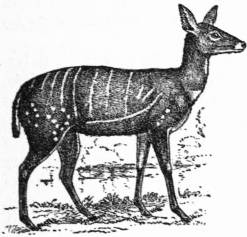
Fig. 1.—Female Bushbuck (Tragelaphus scriptus).
The first group, or Tragelaphinae, is represented by the African elands (Taurotragus), bongo (Boöcercus), kudus (Strepsiceros) and bushbucks or harnessed antelopes (Tragelaphus), and the Indian nilgai (Boselaphus). Except in the bongo and elands, horns are present only in the males, and these are angulated and generally spirally twisted, and without rings. The muzzle is naked, small glands are present on the face below the eyes, and the tail is comparatively long. The colours are often brilliant; white spots and stripes being prevalent. The harnessed antelopes, or bushbucks, are closely allied to the kudus, from which they chiefly differ by the spiral formed by the horns generally having fewer turns. They include some of the most brilliantly coloured of all antelopes; the ornamentation taking the form of vertical white lines and rows of spots. Usually the sexes differ in colour. Whereas most of the species have hoofs of normal shape, in some, such as the nakong, or situtunga (Tragelaphus spekei), these are greatly elongated, in order to be suited for walking in soft mud, and these have accordingly been separated as Limnotragus. The last-named species spends most of its time in water, where it may be observed not infrequently among the reeds with all but its head and horns submerged. The true or smaller bushbucks, represented by the widely spread Tragelaphus scriptus, with several local races (fig. 1) are sometimes separated as Sylvicapra, leaving the genus Tragelaphus to be represented by the larger T. angasi and its relatives. The genus Strepsiceros is represented by the true or great kudu (S. capensis or S. strepsiceros), fig. 2, ranging from the Cape to Somaliland, and the smaller S. imberbis of North-East Africa, which has no throat-fringe. The large and brightly coloured bongo (Boöcercus euryceros) of the equatorial forest-districts serves in some respects to connect the bushbucks with the elands, having horns in both sexes, and a tufted tail, but a brilliant orange coat with vertical white stripes. Still larger are the elands, of which the typical Taurotragus oryx of the Cape is uniformly sandy-coloured, although stripes appear in the more northern T. o. livingstonei, while the black-necked eland (T. derbianus) of Senegambia and the Bahr-el-Ghazal district is a larger and more brilliantly coloured animal. The small horns and bluish-grey colour of the adult bulls serve to distinguish the Indian nilgai (q.v.), Boselaphus tragocamdus, from the other members of the subfamily.
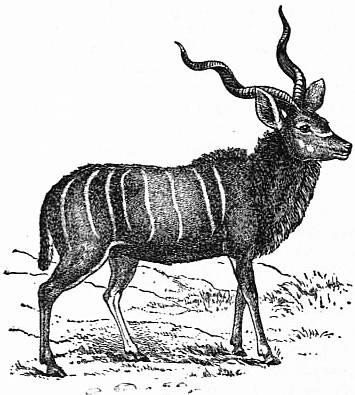
Fig. 2.—Male Kudu (Strepsicero capensis).
The second group, which is mainly African, but also represented in Syria, is that of the Hippotraginae, typified by the sable antelope (Hippotragus niger) and roan antelope (H. equinus), but also including the oryxes (Oryx) and addax. These are for the most part large antelopes, with long cylindrical horns, which are present in both sexes, hairy muzzles, no face-glands, long tufted tails and tall thick molars of the ox-type. In Hippotragus the stout and thickly ringed horns rise vertically from a ridge above the eyes at an obtuse angle to the plane of the lower part of the face, and then sweep backwards in a bold curve; while there are tufts of long white hairs near the eyes. The sable antelope is a southern species in which both sexes are black or blackish when adult, while the lighter-coloured and larger roan antelope has a much wider distribution. The South African blauwbok (H. leucophaeus) is extinct. In the addax (Addax nasomaculatus), which is a distinct species common to North Africa and Syria, the ringed horns form an open spiral ascending in the plane of the face, and there is long, shaggy, dark hair on the fore-quarters in winter. The various species of oryx differ from Hippotragus by the absence of the white eye-tufts, and by the horns sloping backwards in the plane of the face. In the South African gemsbuck (Oryx gazella), fig. 3, the East African beisa or true oryx (O. beisa), and the white Arabian (O. beatrix) the horns are straight, but in the North African white oryx or algazel (O. leucoryx or O. algazal) they are scimitar-shaped, the colour of this species being white and pale chestnut (see Addax, Oryx, and Sable Antelope).
The third subfamily is the Antilopinae, the members of which have a much wider geographical range than either of the foregoing groups. The subfamily is characterized by the narrow crowns of the molars, which are similar to those of sheep, and the hairy muzzle. Generally there are face-glands below the eyes; and the tail is moderate or short. Pits are present in the forehead of the skull, and the horns are ringed for part of their length, with a compressed base, their form being often lyrate, but sometimes spiral. Lateral hoofs are generally present.
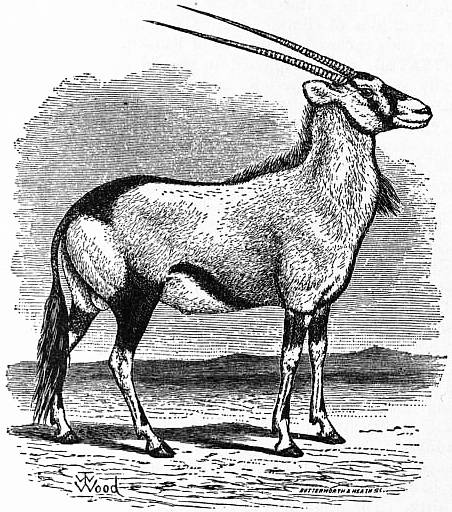
Fig. 3.—Gemsbuck, or Cape Oryx (Oryx gazella).
Gazelles (Gazella), which form by far the largest genus of the subfamily, are inhabitants of open and frequently more or less desert districts. They are mostly of a sandy colour, with dark and light markings on the face, and often a dark band on the flanks. The horns are more or less lyrate, and generally developed in both sexes; there are frequently brushes of hair on the knees. Gazelles may be divided into groups. The one to which the North African G. dorcas belongs is characterized by the presence of lyrate or sub-lyrate horns in both sexes, and by the white of the buttocks not extending on to the haunches. Nearly allied is the group including the Indian G. bennetti and the Arabian G. arabica, in which the horns have a somewhat S-shaped curvature in profile. In the group represented by the African G. granti, G. thomsoni, G. mohr, &c., the white of the buttocks often sends a prolongation on to the flanks, the horns are long and the size is large. Lastly, the Central Asian G. gutturosa, G. subgutturosa and G. picticaudata form a group in which the females are hornless and the face-markings inconspicuous or wanting.
The South African springbuck (Antidorcas euchore) is nearly related to the gazelles, from which it is distinguished by the presence on the middle line of the loins of an evertible pouch, lined with long white hairs capable of erection. It has also one premolar tooth less in the lower jaw. Formerly these beautiful antelopes existed in countless numbers on the plains of South Africa, and were in the habit of migrating in droves which completely filled entire valleys. Now they are comparatively rare.
The dibatag or Clarke’s gazelle (Ammodorcas clarkei), of Somaliland, forms a kind of connecting link between the true gazelles and the gerenuk, this being especially shown in the skull. The face has the ordinary gazelle-markings; but the rather short horns—which are wanting in the female—have a peculiar upward and forward curvature, unlike that obtaining in the gazelles and somewhat resembling that of the reedbuck. The neck is longer and more slender than in ordinary gazelles, and the tail is likewise relatively long. Although local, these animals are fairly common in the interior of Somaliland, where they are known by the name of dibatag. In running, the head and neck are thrown backwards, while the tail is turned forwards over the back.
The East African gerenuk (q.v.), or Waller’s gazelle (Lithocranius walleri), of which two races have been named, is a very remarkable ruminant, distinguished not only by its exceedingly elongated neck and limbs, but also by the peculiar hooked form of the very massive horns of the bucks, the dense structure and straight profile of the skull, and the extreme slenderness of the lower jaw.
A still more aberrant gazelle is a small North-East African species known as the beira (Dorcatragus melanotis), with very short horns, large hoofs and a general appearance recalling that of some of the members of the subfamily Neotraginae, although in other respects gazelle-like. The blackbuck (Antilope cervicapra or A. bezoartica) of India, a species taking its name from the deep black coat assumed by the adult bucks, and easily recognized by the graceful, spirally twisted horns ornamenting the heads of that sex, is now the sole representative of the genus Antilope, formerly taken to embrace the whole of the true antelopes. Large face-glands are characteristic of the species, which inhabits the open plains of India in large herds. They leap high in the air, like the springbuck, when on the move.
With the palla (q.v.), or impala (Aepyceros melampus), we reach an exclusively African genus, characterized by the lyrate horns of the bucks, the absence of lateral hoofs, and the presence of a pair of glands with black tufts of hair on the hind-feet.
The sheep-like saiga (q.v.), Saiga tatarica, of the Kirghiz steppes stands apart from all other antelopes by its curiously puffed and trunk-like nose, which can be wrinkled up when the animal is feeding and has the nostrils opening downwards. More or less nearly related to the saiga is the chiru (q.v.), Pantholops hodgsoni of Tibet, characterized by the long upright black horns of the bucks, and the less convex nose, in which the nostrils open anteriorly instead of downwards.
The Neotraginae (or Nanotraginae) form an exclusively African group of small-sized antelopes divided into several, for the most part nearly related, genera. Almost the only characters they possess in common are the short and spike-like horns of the bucks, which are ringed at the base, with smooth tips, and the large size of the face-gland, which opens by a circular aperture. Neotragus is represented by the pigmy royal antelope (N. pygmaeus) of Guinea; Hylarnus includes one species from Cameroon and a second from the Semliki forest; while Nesotragus comprises the East African suni antelopes, N. moschatus and N. livingstonianus. All three might, however, well be included in Neotragus. The royal antelope is the smallest of the Bovidae.
The steinbok (Rhaphiceros campestris) and the grysbok (R. melanotis) are the best-known representatives of a group characterized by the vertical direction of the horns and the small gland-pit in the skull; lateral hoofs being absent in the first-named and present in the second. A bare gland-patch behind the ear serves to distinguish the oribis or ourebis, as typified by Oribia montana of the Cape; lateral hoofs being present and the face-pit large.
From all the preceding the tiny dik-diks (Madoqua) of North-East Africa differ by their hairy noses, expanded in some species into short trunks; while the widely spread klipspringer (q.v.), Oreotragus saltator, with its several local races, is unfailingly distinguishable by its rounded blunt hoofs and thick, brittle, golden-flecked hair.
In some respects connecting the last group with the Cervicaprinae is the rhebok, or vaal-rhebok (Pelea capreolus), a grey antelope of the size of a roebuck, with small upright horns in the bucks recalling those of the last group, and small lateral hoofs, but no face-glands. In size and several structural features it approximates to the more typical Cervicaprinae, as represented by the reedbuck (Cervicapra), and the waterbucks and kobs (Cobus or Kobus), all of which are likewise African. These are medium-sized or large antelopes with naked muzzles, narrow sheep-like upper molars, fairly long tails, rudimentary or no face-glands, and pits in the frontal bones of the skull. Reedbuck (q.v.), or rietbok (Cervicapra), are foxy-red antelopes ranging in size from a fallow-deer to a roe, with thick bushy tails, forwardly curving black horns, and a bare patch of glandular skin behind each ear. They keep to open country near water. The waterbuck (q.v.), Cobus, on the other hand, actually seek refuge from pursuit in the water. They have heavily fringed necks, tufted tails, long lyrate horns in the bucks (fig. 4) but no glandular ear-patches. The true waterbuck (C. ellipsiprymnus), and the defassa or sing-sing (C. defassa), are the two largest species, equal in size to red deer, and grey or reddish in colour. Of the smaller forms or kobs, C. maria and C. leucotis of the swamps of the White Nile are characterized by the black coats of the adult bucks; the West African C. cob, and its East African representative C. thomasi, are wholly red antelopes of the size of roedeer; the lichi or lechwe (C. lichi) is characterized by its long horns, black fore-legs and superior size; while the puku (C. vardoni), which is also a swamp-loving species from South-Central Africa, differs from the three preceding species by the fore-legs being uniformly foxy.
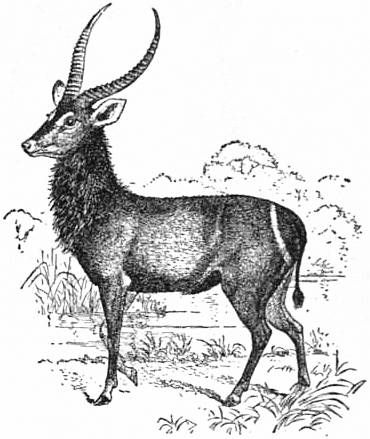
Fig. 4.—Waterbuck (Cobus ellipsiprymnus).
The duikers, or duikerboks (Cephalophus), of Africa, which range in size from a large hare to a fallow-deer, typify the subfamily Cephalophinae, characterized by the spike-like horns of the bucks, the elongated aperture of the face-glands, the naked muzzle, the relatively short tail, and the square-crowned upper molars; lateral hoofs being present. In the duikers themselves the single pair of horns is set in the midst of a tuft of long hairs, and the face-gland opens in a long naked line on the side of the face above the muzzle. The group is represented in India by the chousingha or four-horned antelope (Tetraceros quadricornis), generally distinguished by the feature from which it takes its name (see Duiker).
The last section of the true antelopes is the Bubalinae, represented by the hartebeest (q.v.), Bubalis, blesbok and sassaby (Damaliscus), and the gnu (q.v.) or wildebeest (Connochaetes, also called Catoblepas), all being African with the exception of one or two hartebeests which range into Syria. All these are large and generally more or less uniformly coloured antelopes with horns in both sexes, long and more or less hairy tails, high withers, small face-glands, naked muzzles, tall, narrow upper molars, and the absence of pits in the frontal bones. The long face, high crest for the horns, which are ringed, lyrate and more or less strongly angulated, and the moderately long tail, are the distinctive features of the hartebeests. They are large red antelopes (fig. 5), often with black markings on the face and limbs. In Damaliscus, which includes, among many other species, the blesbok and bontebok (D. albifrons and D. pygargus) and the sassaby or bastard hartebeest (D. lunatus), the face is shorter, and the horns straighter and set on a less elevated crest. The colour, too, of these antelopes tends in many cases to purple, with white markings. From the hartebeest the gnus (fig. 6) differ by their smooth and outwardly or downwardly directed horns, broad bristly muzzles, heavy manes and long horse-like tails. There are two chief types, the white-tailed gnu or black wildebeest (Connochaetes gnu) of South Africa, now nearly extinct (fig. 6), and the brindled gnu, or blue wildebeest (C. taurinus), which, with some local variation, has a large range in South and East Africa.
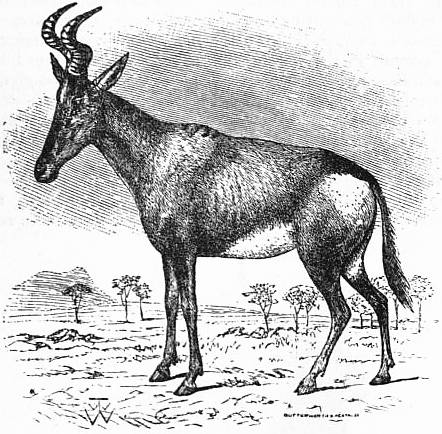
Fig. 5.—Cape Hartebeest (Bubalis cama).
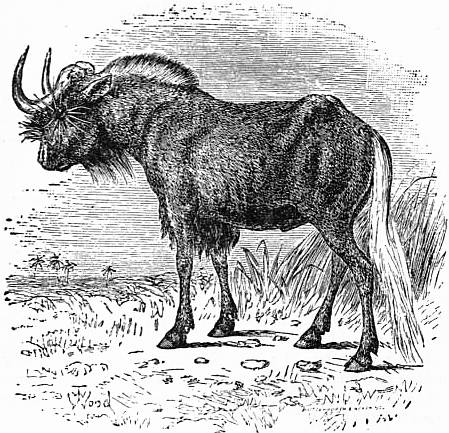
Fig. 6.—White-tailed Gnu, or Black Wildebeest (Connochaetes gnu).
In concluding this survey of living antelopes, reference may be made to the subfamily Rupicaprinae (typified by the European chamois), the members of which, as already stated, are in some respects intermediate between antelopes and goats. They are all small or medium-sized mountain ruminants, for the most part European and Asiatic, but with one North American representative. They are heavily built ruminants, with horns of nearly equal size in both sexes, short tapering tails, large hoofs, narrow goat-like upper molars, and usually small face-glands. The horns are generally rather small, upright, ringed at the base, and more or less curved backwards, but in the takin they are gnu-like. The group is represented by the European chamois or gemse (Rupicapra tragus or R. rupicapra), broadly distinguished by its well-known hook-like horns, and the Asiatic gorals (Urotragus) and serows (Nemorhaedus), which are represented by numerous species ranging from Tibet, the Himalaya, and China, to the Malay Peninsula and islands, being in the two latter areas the sole representatives of both antelopes and goats. In the structure of its horns the North American white Rocky Mountain goat (Oreamnus) is very like a serow, from which it differs by its extremely short cannon-bones. In the latter respect this ruminant resembles the takin (Budorcas) of Tibet, which, as already mentioned, has horns recalling those of the white-tailed gnu. Possibly the Arctic musk-ox (Ovibos) may be connected with the takin by means of certain extinct ruminants, such as the North American Pleistocene Euceratherium and the European Pliocene Criotherium (see Chamois, Goral, Serow, Rocky Mountain Goat and Takin).
Extinct Antelopes.—Only a few lines can be devoted to extinct antelopes, the earliest of which apparently date from the European Miocene. An antelope from the Lower Pliocene of Northern India known as Bubalis, or Damaliscus, palaeindicus indicates the occurrence of the hartebeest group in that country. Cobus also occurs in the same formation, as does likewise Hippotragus. Palaeoryx from the corresponding horizon in Greece and Samos is to some extent intermediate between Hippotragus and Oryx. Gazelles are common in the Miocene and Pliocene of both Europe and Asia. Elands and kudus appear to have been represented in India during the Pliocene; the European Palaeoreas of the same age seems to be intermediate between the two, while Protragelaphus is evidently another European representative of the group. Helicophora is another spiral-horned European Pliocene antelope, but of somewhat doubtful affinity; the same being the case with the large Criotherium of the Samos Pliocene, in which the short horns are curiously twisted. As already stated, there is a possibility of this latter ruminant being allied both to the takin and the musk-ox. Palaeotragus and Tragoceros, of the Lower Pliocene of Greece, at one time regarded as antelopes, are now known to be ancestors of the okapi.
For antelopes in general, see P.L. Sclater and O. Thomas, The Book of Antelopes (4 vols., London, 1894-1900).
(R. L.*)
ANTEMNAE (Lat. ante amnem, sc. Anienem; Varro, Ling. Lat. v. 28), an ancient village of Latium, situated on the W. of the Via Salaria, 2 m. N. of Rome, where the Anio falls into the Tiber. It is said to have been conquered by Romulus after the rape of the Sabine women, and to have assisted the Tarquins. Certainly it soon lost its independence, and in Strabo’s time was a mere village. The site is one of great strength, and is now occupied by a fort, in the construction of which traces of the outer walls and of huts, and several wells and a cistern, all belonging to the primitive village, were discovered, and also the remains of a villa of the end of the Republic.
See T. Ashby in Papers of the British School at Rome, iii. 14.
ANTENOR, an Athenian sculptor, of the latter part of the 6th century B.C. He was the author of the group of the tyrannicides Harmodius and Aristogeiton, set up by the Athenians on the expulsion of the Peisistratidae, and carried away to Persia by Xerxes. A basis with the signature of Antenor, son of Eumares, has been shown to belong to one of the dedicated female figures of archaic style which have been found on the Acropolis of Athens.
See Greek Art; and E.A. Gardner’s Handbook of Greek Sculpture, i. p. 182.
ANTENOR, in Greek legend, one of the wisest of the Trojan elders and counsellors. He advised his fellow-townsmen to send Helen back to her husband, and showed himself not unfriendly to the Greeks and an advocate of peace. In the later story, according to Dares and Dictys, he was said to have treacherously opened the gates of Troy to the enemy; in return for which, at the general sack of the city, his house, distinguished by a panther’s skin at the door, was spared by the victors. Afterwards, according to various versions of the legend, he either rebuilt a city on the site of Troy, or settled at Cyrene, or became the founder of Patavium.
Homer, Iliad, iii. 148, vii. 347; Horace, Epp. i. 2. 9; Livy i. 1; Pindar, Pythia, v. 83; Virgil, Aen. i. 242.
ANTEQUERA (the ancient Anticaria), a town of southern Spain, in the province of Málaga; on the Bobadilla-Granada railway. Pop. (1900) 31,609. Antequera overlooks the fertile valley bounded on the S. by the Sierra de los Torcales, and on the N. by the river Guadalhorce. It occupies a commanding position, while the remains of its walls, and of a fine Moorish castle on a rock that overhangs the town, show how admirably its natural defences were supplemented by art. Besides several interesting churches and palaces, it contains a fine arch, erected in 1595 in honour of Philip II., and partly constructed of inscribed Roman masonry. In the eastern suburbs there is one of the largest grave-mounds in Spain, said to be of prehistoric date, and with subterranean chambers excavated to a depth of 65 ft. The Peña de los Enamorados, or “Lovers’ Peak,” is a conspicuous crag which owes its name to the romantic legend adapted by Robert Southey (1774-1843) in his Laila and Manuel. Woollen fabrics are manufactured, and the sugar industry established in 1890 employs several thousand hands; but the majority of the inhabitants are occupied by the trade in grain, fruit, wine and oil. Marble is quarried; and at El Torcal, 6 m. south, there is a very curious labyrinth of red marble rocks. Antequera was captured from the Moors in 1410, and became until 1492 one of the most important outposts of the Christian power in Spain.
See C. Fernandez, Historia de Antequera, desde su fondacion (Malaga, 1842).
ANTEROS, pope for some weeks at the end of the year 235. He died on the 3rd of January 236. His original epitaph was discovered in the Catacombs.
ANTHELION (late Gr. ἀνθήλιος, opposite the sun), the luminous ring or halo sometimes seen in Alpine or polar regions surrounding the shadow of the head of an observer cast upon a bank of cloud or mist. The halo diminishes in brightness from the centre outwards, and is probably due to the diffraction of light. Under favourable conditions four concentric rings may be seen round the shadow of the observer’s head, the outermost, which seldom appears, having an angular radius of 40°.
ANTHEM, derived from the Gr. ἀντίφωνα, through the Saxon antefn, a word which originally had the same meaning as antiphony (q.v.). It is now, however, generally restricted to a form of church music, particularly in the service of the Church of England, in which it is appointed by the rubrics to follow the third collect at both morning and evening prayer, “in choirs and places where they sing.” It is just as usual in this place to have an ordinary hymn as an anthem, which is a more elaborate composition than the congregational hymns. Several anthems are included in the English coronation service. The words are selected from Holy Scripture or in some cases from the Liturgy, and the music is generally more elaborate and varied than that of psalm or hymn tunes. Anthems may be written for solo voices only, for the full choir, or for both, and according to this distinction are called respectively Verse, Full, and Full with Verse. Though the anthem of the Church of England is analogous to the motet of the Roman Catholic and Lutheran Churches, both being written for a trained choir and not for the congregation, it is as a musical form essentially English in its origin and development. The English school of musicians has from the first devoted its chief attention to this form, and scarcely a composer of any note can be named who has not written several good anthems. Tallis, Tye, Byrd, and Farrant in the 16th century; Orlando Gibbons, Blow, and Purcell in the 17th, and Croft, Boyce, James Kent, James Nares, Benjamin Cooke, and Samuel Arnold in the 18th were famous composers of anthems, and in more recent times the names are too numerous to mention.
ANTHEMION (from the Gr. ἀνθέμιον, a flower), the conventional design of flower or leaf forms which was largely employed by the Greeks to decorate (1) the fronts of ante-fixae, (2) the upper portion of the stele or vertical tombstones, (3) the necking of the Ionic columns of the Erechtheum and its continuation as a decorative frieze on the walls of the same, and (4) the cymatium of a cornice. Though generally known as the honeysuckle ornament, from its resemblance to that flower, its origin will be found in the flower of the acanthus plant.
ANTHEMIUS, Greek mathematician and architect, who produced, under the patronage of Justinian (A.D. 532), the original and daring plans for the church of St Sophia in Constantinople, which strikingly displayed at once his knowledge and his ignorance. He was one of five brothers—the sons of Stephanus, a physician of Tralles—who were all more or less eminent in their respective departments. Dioscorus followed his father’s profession in his native place; Alexander became at Rome one of the most celebrated medical men of his time; Olympius was deeply versed in Roman jurisprudence; and Metrodorus was one of the distinguished grammarians of the great Eastern capital. It is related of Anthemius that, having a quarrel with his next-door neighbour Zeno, he annoyed him in two ways. First, he made a number of leathern tubes the ends of which he contrived to fix among the joists and flooring of a fine upper-room in which Zeno entertained his friends, and then subjected it to a miniature earthquake by sending steam through the tubes. Secondly, he simulated thunder and lightning, the latter by flashing in Zeno’s eyes an intolerable light from a slightly hollowed mirror. Certain it is that he wrote a treatise on burning-glasses. A fragment of this was published under the title Περὶ παραδόξων μηχανημάτων by L. Dupuy in 1777, and also appeared in 1786 in the forty-second volume of the Hist. de l’Acad. des Inscr.; A. Westermann gave a revised edition of it in his Παραδοξογράφοι (Scriptores rerum mirabilium Graeci), 1839. In the course of constructions for surfaces to reflect to one and the same point (1) all rays in whatever direction passing through another point, (2) a set of parallel rays, Anthemius assumes a property of an ellipse not found in Apollonius (the equality of the angles subtended at a focus by two tangents drawn from a point), and (having given the focus and a double ordinate) he uses the focus and directrix to obtain any number of points on a parabola—the first instance on record of the practical use of the directrix.
On Anthemius generally, see Procopius, De Aedific. i. 1; Agathias, Hist. v. 6-9; Gibbon’s Decline and Fall, cap. xl.
(T. L. H.)
ANTHESTERIA, one of the four Athenian festivals in honour of Dionysus, held annually for three days (11th-13th) in the month of Anthesterion (February-March). The object of the festival was to celebrate the maturing of the wine stored at the previous vintage, and the beginning of spring. On the first day, called Pithoigia (opening of the casks), libations were offered from the newly opened casks to the god of wine, all the household, including servants and slaves, joining in the festivities. The rooms and the drinking vessels in them were adorned with spring flowers, as were also the children over three years of age. The second day, named Choës (feast of beakers), was a time of merrymaking. The people dressed themselves gaily, some in the disguise of the mythical personages in the suite of Dionysus, and paid a round of visits to their acquaintances. Drinking clubs met to drink off matches, the winner being he who drained his cup most rapidly. Others poured libations on the tombs of deceased relatives. On the part of the state this day was the occasion of a peculiarly solemn and secret ceremony in one of the sanctuaries of Dionysus in the Lenaeum, which for the rest of the year was closed. The basilissa (or basilinna), wife of the archon basileus for the time, went through a ceremony of marriage to the wine god, in which she was assisted by fourteen Athenian matrons, called geraerae, chosen by the basileus and sworn to secrecy. The days on which the Pithoigia and Choës were celebrated were both regarded as ἀποφράδες (nefasti) and μιαραί (“defiled”), necessitating expiatory libations; on them the souls of the dead came up from the underworld and walked abroad; people chewed leaves of whitethorn and besmeared their doors with tar to protect themselves from evil. But at least in private circles the festive character of the ceremonies predominated. The third day was named Chytri (feast of pots, from χύτρος, a pot), a festival of the dead. Cooked pulse was offered to Hermes, in his capacity of a god of the lower world, and to the souls of the dead. Although no performances were allowed at the theatre, a sort of rehearsal took place, at which the players for the ensuing dramatic festival were selected.
The name Anthesteria, according to the account of it given above, is usually connected with ἄνθος (“flower,” or the “bloom” of the grape), but A.W. Verrall (Journal of Hellenic Studies, xx., 1900, p. 115) explains it as a feast of “revocation” (from ἀναθέσσασθαι, to “pray back” or “up”), at which the ghosts of the dead were recalled to the land of the living (cp. the Roman mundus patet). J.E. Harrison (ibid. 100, 109, and Prolegomena), regarding the Anthesteria as primarily a festival of all souls, the object of which was the expulsion of ancestral ghosts by means of placation, explains πιθοιγία as the feast of the opening of the graves (πίθος meaning a large urn used for burial purposes), χόες as the day of libations, and χύτροι as the day of the grave-holes (not “pots,” which is χύτροι), in point of time really anterior to the πιθοιγία. E. Rohde and M.P. Nilsson, however, take the χύτροι to mean “water vessels,” and connect the ceremony with the Hydrophoria, a libation festival to propitiate the dead who had perished in the flood of Deucalion.
See F. Hiller von Gartringen in Pauly-Wissowa’s Realencyclopadie (s.v.); J. Girard in Daremberg and Saglio, Dictionnaire des antiquités (s.v. “Dionysia”); and F.A. Voigt in Roscher’s Lexikon der Mythologie (s.v. “Dionysos”); J.E. Harrison, Prolegomena to the Study of Greek Religion (1903); M.P. Nilsson, Studia de Dionysiis Atticis (1900) and Griechische Feste (1906); G.F. Schömann, Griechische Alterthümer, ii. (ed. J.H. Lipsius, 1902), p. 516; A. Mommsen, Feste der Stadt Athen (1898); E. Rohde, Psyche (4th ed., 1907), p. 237.
ANTHIM THE IBERIAN, a notable figure in the ecclesiastical history of Rumania. A Georgian by birth, he came to Rumania early in the second half of the 17th century, as a simple monk. He became bishop of Râmnicu in 1705, and in 1708 archbishop of Walachia. Taking a leading part in the political movements of the time, he came into conflict with the newly appointed Greek hospodars, and was exiled to Rumelia. But on his crossing the Danube in 1716 he was thrown into the water and drowned, as it is alleged, at the instigation of the prince of Walachia. He was a man of great talents and spoke and wrote many Oriental and European languages. Though a foreigner, he soon acquired a thorough knowledge of Rumanian, and was instrumental in helping to introduce that language into the church as its official language. He was a master printer and an artist of the first order. He cut the wood blocks for the books which he printed in Tirgovishtea, Râmnicu, Snagov and Bucharest. He was also the first to introduce Oriental founts of type into Rumania, and he printed there the first Arabic missal for the Christians of the East (Râmnicu, 1702). He also trained Georgians in the art of printing, and cut the type with which under his pupil Mihail Ishtvanovitch they printed the first Georgian Gospels (Tiflis, 1709). A man of great oratorical power, Anthim delivered a series of sermons (Didahii), and some of his pastoral letters are models of style and of language as well as of exact and beautiful printing. He also completed a whole corpus of lectionaries, missals, gospels, &c.
See M. Gaster, Chrestomathie roumaine (1881), and “Gesch. d. rumänischen Litteratur,” in Grober, Grundriss d. rom. Philologie, vol. ii. (1899); and E. Picot, Notice sur Anthim d’Ivir (Paris, 1886).
(M. G.)
ANTHOLOGY. The term “anthology,” literally denoting a garland or collection of flowers, is figuratively applied to any selection of literary beauties, and especially to that great body of fugitive poetry, comprehending about 4500 pieces, by upwards of 300 writers, which is commonly known as the Greek Anthology.
Literary History of the Greek Anthology.—The art of occasional poetry had been cultivated in Greece from an early period,—less, however, as the vehicle of personal feeling, than as the recognized commemoration of remarkable individuals or events, on sepulchral monuments and votive offerings: Such compositions were termed epigrams, i.e. inscriptions. The modern use of the word is a departure from the original sense, which simply indicated that the composition was intended to be engraved or inscribed. Such a composition must necessarily be brief, and the restraints attendant upon its publication concurred with the simplicity of Greek taste in prescribing conciseness of expression, pregnancy of meaning, purity of diction and singleness of thought, as the indispensable conditions of excellence in the epigrammatic style. The term was soon extended to any piece by which these conditions were fulfilled. The transition from the monumental to the purely literary character of the epigram was favoured by the exhaustion of more lofty forms of poetry, the general increase, from the general diffusion of culture, of accomplished writers and tasteful readers, but, above all, by the changed political circumstances of the times, which induced many who would otherwise have engaged in public affairs to addict themselves to literary pursuits. These causes came into full operation during the Alexandrian era, in which we find every description of epigrammatic composition perfectly developed. About 60 B.C., the sophist and poet, Meleager of Gadara, undertook to combine the choicest effusions of his predecessors into a single body of fugitive poetry. Collections of monumental inscriptions, or of poems on particular subjects, had previously been formed by Polemon Periegetes and others; but Meleager first gave the principle a comprehensive application. His selection, compiled from forty-six of his predecessors, and including numerous contributions of his own, was entitled The Garland (Στέφανος); and in an introductory poem each poet is compared to some flower, fancifully deemed appropriate to his genius. The arrangement of his collection was alphabetical, according to the initial letter of each epigram.
In the age of the emperor Tiberius (or Trajan, according to others) the work of Meleager was continued by another epigrammatist, Philippus of Thessalonica, who first employed the term anthology. His collection, which included the compositions of thirteen writers subsequent to Meleager, was also arranged alphabetically, and contained an introductory poem. It was of inferior quality to Meleager’s. Somewhat later, under Hadrian, another supplement was formed by the sophist Diogenianus of Heracleia (2nd century A.D.), and Strato of Sardis compiled his elegant but tainted Μοῦσα Παιδική (Musa Puerilis) from his productions and those of earlier writers. No further collection from various sources is recorded until the time of Justinian, when epigrammatic writing, especially of an amatory character, experienced a great revival at the hands of Agathias of Myrina, the historian, Paulus Silentiarius, and their circle. Their ingenious but mannered productions were collected by Agathias into a new anthology, entitled The Circle (Κύκλος); it was the first to be divided into books, and arranged with reference to the subjects of the pieces.
These and other collections made during the middle ages are now lost. The partial incorporation of them into a single body, classified according to the contents in 15 books, was the work of a certain Constantinus Cephalas, whose name alone is preserved in the single MS. of his compilation extant, but who probably lived during the temporary revival of letters under Constantine Porphyrogenitus, at the beginning of the 10th century. He appears to have merely made excerpts from the existing anthologies, with the addition of selections from Lucillius, Palladas, and other epigrammatists, whose compositions had been published separately. His arrangement, to which we shall have to recur, is founded on a principle of classification, and nearly corresponds to that adopted by Agathias. His principle of selection is unknown; it is only certain that while he omitted much that he should have retained, he has preserved much that would otherwise have perished. The extent of our obligations may be ascertained by a comparison between his anthology and that of the next editor, the monk Maximus Planudes (A.D. 1320), who has not merely grievously mutilated the anthology of Cephalas by omissions, but has disfigured it by interpolating verses of his own. We are, however, indebted to him for the preservation of the epigrams on works of art, which seem to have been accidentally omitted from our only transcript of Cephalas.
The Planudean (in seven books) was the only recension of the anthology known at the revival of classical literature, and was first published at Florence, by Janus Lascaris, in 1494. It long continued to be the only accessible collection, for although the Palatine MS., the sole extant copy of the anthology of Cephalas, was discovered in the Palatine library at Heidelberg, and copied by Saumaise (Salmasius) in 1606, it was not published until 1776, when it was included in Brunck’s Analecta Veterum Poetarum Graecorum. The MS. itself had frequently changed its quarters. In 1623, having been taken in the sack of Heidelberg in the Thirty Years’ War, it was sent with the rest of the Palatine Library to Rome as a present from Maximilian I. of Bavaria to Gregory XV., who had it divided into two parts, the first of which was by far the larger; thence it was taken to Paris in 1797. In 1816 it went back to Heidelberg, but in an incomplete state, the second part remaining at Paris. It is now represented at Heidelberg by a photographic facsimile. Brunck’s edition was superseded by the standard one of Friedrich Jacobs (1794-1814, 13 vols.), the text of which was reprinted in a more convenient form in 1813-1817, and occupies three pocket volumes in the Tauchnitz series of the classics. The best edition for general purposes is perhaps that of Dubner in Didot’s Bibliotheca (1864-1872), which contains the Palatine Anthology, the epigrams of the Planudean Anthology not comprised in the former, an appendix of pieces derived from other sources, copious notes selected from all quarters, a literal Latin prose translation by Boissonade, Bothe, and Lapaume and the metrical Latin versions of Hugo Grotius. A third volume, edited by E. Cougny, was published in 1890. The best edition of the Planudean Anthology is the splendid one by van Bosch and van Lennep (1795-1822). There is also a complete edition of the text by Stadlmuller in the Teubner series.
Arrangement.—The Palatine MS., the archetype of the present text, was transcribed by different persons at different times, and the actual arrangement of the collection does not correspond with that signalized in the index. It is as follows: Book 1. Christian epigrams; 2. Christodorus’s description of certain statues; 3. Inscriptions in the temple at Cyzicus; 4. The prefaces of Meleager, Philippus, and Agathias to their respective collections; 5. Amatory epigrams; 6. Votive inscriptions; 7. Epitaphs; 8. The epigrams of Gregory of Nazianzus; 9. Rhetorical and illustrative epigrams; 10. Ethical pieces; 11. Humorous and convivial; 12. Strata’s Musa Puerilis; 13. Metrical curiosities; 14. Puzzles, enigmas, oracles; 15. Miscellanies. The epigrams on works of art, as already stated, are missing from the Codex Palatinus, and must be sought in an appendix of epigrams only occurring in the Planudean Anthology. The epigrams hitherto recovered from ancient monuments and similar sources form appendices in the second and third volumes of Dübner’s edition.
Style and Value.—One of the principal claims of the Anthology to attention is derived from its continuity, its existence as a living and growing body of poetry throughout all the vicissitudes of Greek civilization. More ambitious descriptions of composition speedily ran their course, and having attained their complete development became extinct or at best lingered only in feeble or conventional imitations. The humbler strains of the epigrammatic muse, on the other hand, remained ever fresh and animated, ever in intimate union with the spirit of the generation that gave them birth. To peruse the entire collection, accordingly, is as it were to assist at the disinterment of an ancient city, where generation has succeeded generation on the same site, and each stratum of soil enshrines the vestiges of a distinct epoch, but where all epochs, nevertheless, combine to constitute an organic whole, and the transition from one to the other is hardly perceptible. Four stages may be indicated:—1. The Hellenic proper, of which Simonides of Ceos (c. 556-469 B.C.), the author of most of the sepulchral inscriptions on those who fell in the Persian wars, is the characteristic representative. This is characterized by a simple dignity of phrase, which to a modern taste almost verges upon baldness, by a crystalline transparency of diction, and by an absolute fidelity to the original conception of the epigram. Nearly all the pieces of this era are actual bona fide inscriptions or addresses to real personages, whether living or deceased; narratives, literary exercises, and sports of fancy are exceedingly rare. 2. The epigram received a great development in its second or Alexandrian era, when its range was so extended as to include anecdote, satire, and amorous longing; when epitaphs and votive inscriptions were composed on imaginary persons and things, and men of taste successfully attempted the same subjects in mutual emulation, or sat down to compose verses as displays of their ingenuity. The result was a great gain in richness of style and general interest, counterbalanced by a falling off in purity of diction and sincerity of treatment. The modification—a perfectly legitimate one, the resources of the old style being exhausted—had its real source in the transformation of political life, but may be said to commence with and to find its best representative in the playful and elegant Leonidas of Tarentum, a contemporary of Pyrrhus, and to close with Antipater of Sidon, about 140 B.C. (or later). It should be noticed, however, that Callimachus, one of the most distinguished of the Alexandrian poets, affects the sternest simplicity in his epigrams, and copies the austerity of Simonides with as much success as an imitator can expect. 3. By a slight additional modification in the same direction, the Alexandrian passes into what, for the sake of preserving the parallelism with eras of Greek prose literature, we may call the Roman style, although the peculiarities of its principal representative are decidedly Oriental. Meleager of Gadara was a Syrian; his taste was less severe, and his temperament more fervent than those of his Greek predecessors; his pieces are usually erotic, and their glowing imagery sometimes reminds us of the Song of Solomon. The luxuriance of his fancy occasionally betrays him into far-fetched conceits, and the lavishness of his epithets is only redeemed by their exquisite felicity. Yet his effusions are manifestly the offspring of genuine feeling, and his epitaph on himself indicates a great advance on the exclusiveness of antique Greek patriotism, and is perhaps the first clear enunciation of the spirit of universal humanity characteristic of the later Stoic philosophy. His gaiety and licentiousness are imitated and exaggerated by his somewhat later contemporary, the Epicurean Philodemus, perhaps the liveliest of all the epigrammatists; his fancy reappears with diminished brilliancy in Philodemus’s contemporary, Zonas, in Crinagoras, who wrote under Augustus, and in Marcus Argentarius, of uncertain date; his peculiar gorgeousness of colouring remains entirely his own. At a later period of the empire another genre, hitherto comparatively in abeyance, was developed, the satirical. Lucillius, who flourished under Nero, and Lucian, more renowned in other fields of literature, display a remarkable talent for shrewd, caustic epigram, frequently embodying moral reflexions of great cogency, often lashing vice and folly with signal effect, but not seldom indulging in mere trivialities, or deformed by scoffs at personal blemishes. This style of composition is not properly Greek, but Roman; it answers to the modern definition of epigram, and has hence attained a celebrity in excess of its deserts. It is remarkable, however, as an almost solitary example of direct Latin influence on Greek literature. The same style obtains with Palladas, an Alexandrian grammarian of the 4th century, the last of the strictly classical epigrammatists, and the first to be guilty of downright bad taste. His better pieces, however, are characterized by an austere ethical impressiveness, and his literary position is very interesting as that of an indignant but despairing opponent of Christianity. 4. The fourth or Byzantine style of epigrammatic composition was cultivated by the beaux-esprits of the court of Justinian. To a great extent this is merely imitative, but the circumstances of the period operated so as to produce a species of originality. The peculiarly ornate and recherché diction of Agathias and his compeers is not a merit in itself, but, applied for the first time, it has the effect of revivifying an old form, and many of their new locutions are actual enrichments of the language. The writers, moreover, were men of genuine poetical feeling, ingenious in invention, and capable of expressing emotion with energy and liveliness; the colouring of their pieces is sometimes highly dramatic.
It would be hard to exaggerate the substantial value of the Anthology, whether as a storehouse of facts bearing on antique manners, customs and ideas, or as one among the influences which have contributed to mould the literature of the modern world. The multitudinous votive inscriptions, serious and sportive, connote the phases of Greek religious sentiment, from pious awe to irreverent familiarity and sarcastic scepticism; the moral tone of the nation at various periods is mirrored with corresponding fidelity; the sepulchral inscriptions admit us into the inmost sanctuary of family affection, and reveal a depth and tenderness of feeling beyond the province of the historian to depict, which we should not have surmised even from the dramatists; the general tendency of the collection is to display antiquity on its most human side, and to mitigate those contrasts with the modern world which more ambitious modes of composition force into relief. The constant reference to the details of private life renders the Anthology an inexhaustible treasury for the student of archaeology; art, industry and costume receive their fullest illustration from its pages. Its influence on European literatures will be appreciated in proportion to the inquirer’s knowledge of each. The further his researches extend, the greater will be his astonishment at the extent to which the Anthology has been laid under contribution for thoughts which have become household words in all cultivated languages, and at the beneficial effect of the imitation of its brevity, simplicity, and absolute verbal accuracy upon the undisciplined luxuriance of modern genius.
Translations, Imitations, &c.—The best versions of the Anthology ever made are the Latin renderings of select epigrams by Hugo Grotius. They have not been printed separately, but will be found in Bosch and Lennep’s edition of the Planudean Anthology, in the Didot edition, and in Dr Wellesley’s Anthologia Polyglotta. The number of more or less professed imitations in modern languages is infinite, that of actual translations less considerable. French and Italian, indeed, are ill adapted to this purpose, from their incapacity of approximating to the form of the original, and their poets have usually contented themselves with paraphrases or imitations, often exceedingly felicitous. F.D. Dehèque’s French prose translation, however (1863), is most excellent and valuable. The German language alone admits of the preservation of the original metre—a circumstance advantageous to the German translators, Herder and Jacobs, who have not, however, compensated the loss inevitably consequent upon a change of idiom by any added beauties of their own. Though unfitted to reproduce the precise form, the English language, from its superior terseness, is better adapted to preserve the spirit of the original than the German; and the comparative ill success of many English translators must be chiefly attributed to the extremely low standard of fidelity and brevity observed by them. Bland, Merivale, and their associates (1806-1813), are often intolerably diffuse and feeble, from want, not of ability, but of taking pains. Archdeacon Wrangham’s too rare versions are much more spirited; and John Sterling’s translations of the inscriptions of Simonides deserve high praise. Professor Wilson (Blackwood’s Magazine, 1833-1835) collected and commented upon the labours of these and other translators, with his accustomed critical insight and exuberant geniality, but damaged his essay by burdening it with the indifferent attempts of William Hay. In 1849 Dr Wellesley, principal of New Inn Hall, Oxford, published his Anthologia Polyglotta, a most valuable collection of the best translations and imitations in all languages, with the original text. In this appeared some admirable versions by Goldwin Smith and Dean Merivale, which, with the other English renderings extant at the time, will be found accompanying the literal prose translation of the Public School Selections, executed by the Rev. George Burges for Bohn’s Classical Library (1854). This is a useful volume, but the editor’s notes are worthless. In 1864 Major R.G. Macgregor published an almost complete translation of the Anthology, a work whose stupendous industry and fidelity almost redeem the general mediocrity of the execution. Idylls and Epigrams, by R. Garnett (1869, reprinted 1892 in the Cameo series), includes about 140 translations or imitations, with some original compositions in the same style. Recent translations (selections) are: J.W. Mackail, Select Epigrams from the Greek Anthology (with text, introduction, notes, and prose translation), 1890, revised 1906, a most charming volume; Graham R. Tomson (Mrs Marriott Watson), Selections from the Greek Anthology (1889); W.H.D. Rouse, Echo of Greek Song (1899); L.C. Perry, From the Garden of Hellas (New York, 1891); W.R. Paton, Love Epigrams (1898). An agreeable little volume on the Anthology, by Lord Neaves, is one of Collins’s series of Ancient Classics for Modern Readers. The earl of Cromer, with all the cares of Egyptian administration upon him, found time to translate and publish an elegant volume of selections (1903). Two critical contributions to the subject should be noticed, the Rev. James Davies’s essay on Epigrams in the Quarterly Review (vol. cxvii.), especially valuable for its lucid illustration of the distinction between Greek and Latin epigram; and the brilliant disquisition in J.A. Symonds’s Studies of the Greek Poets (1873; 3rd ed., 1893).
Latin Anthology.—The Latin Anthology is the appellation bestowed upon a collection of fugitive Latin verse, from the age of Ennius to about A.D. 1000, formed by Peter Burmann the Younger. Nothing corresponding to the Greek anthology is known to have existed among the Romans, though professional epigrammatists like Martial published their volumes on their own account, and detached sayings were excerpted from authors like Ennius and Publius Syrus, while the Priapeïa were probably but one among many collections on special subjects. The first general collection of scattered pieces made by a modern scholar was Scaliger’s Catalecta veterum Poetarum (1573), succeeded by the more ample one of Pithoeus, Epigrammata et Poemata e Codicibus et Lapidibus collecta (1590). Numerous additions, principally from inscriptions, continued to be made, and in 1759-1773 Burmann digested the whole into his Anthologia veterum Latinorum Epigrammatum et Poematum. This, occasionally reprinted, was the standard edition until 1869, when Alexander Riese commenced a new and more critical recension, from which many pieces improperly inserted by Burmann are rejected, and his classified arrangement is discarded for one according to the sources whence the poems have been derived. The first volume contains those found in MSS., in the order of the importance of these documents; those furnished by inscriptions following. The first volume (in two parts) appeared in 1869-1870, a second edition of the first part in 1894, and the second volume, Carmina Epigraphica (in two parts), in 1895-1897, edited by F. Bücheler. An Anthologiae Latinae Supplementa, in the same series, followed. Having been formed by scholars actuated by no aesthetic principles of selection, but solely intent on preserving everything they could find, the Latin anthology is much more heterogeneous than the Greek, and unspeakably inferior. The really beautiful poems of Petronius and Apuleius are more properly inserted in the collected editions of their writings, and more than half the remainder consists of the frigid conceits of pedantic professional exercises of grammarians of a very late period of the empire, relieved by an occasional gem, such as the apostrophe of the dying Hadrian to his spirit, or the epithalamium of Gallienus. The collection is also, for the most part, too recent in date, and too exclusively literary in character, to add much to our knowledge of classical antiquity. The epitaphs are interesting, but the genuineness of many of them is very questionable.
(R. G.)
ANTHON, CHARLES (1797-1867), American classical scholar, was born in New York city on the 19th of November 1797. After graduating with honours at Columbia College in 1815, he began the study of law, and in 1819 was admitted to the bar, but never practised. In 1820 he was appointed assistant professor of Greek and Latin in his old college, full professor ten years later, and at the same time headmaster of the grammar school attached to the college, which post he held until 1864. He died at New York on the 29th of July 1867. He produced for use in colleges and schools a large number of classical works, which enjoyed great popularity, although his editions of classical authors were by no means in favour with schoolmasters, owing to the large amount of assistance, especially translations, contained in the notes.
ANTHONY, SAINT, the first Christian monk, was born in Egypt about 250. At the age of twenty he began to practise an ascetical life in the neighbourhood of his native place, and after fifteen years of this life he withdrew into solitude to a mountain by the Nile, called Pispir, now Der el Memun, opposite Arsinoë in the Fayum. Here he lived strictly enclosed in an old fort for twenty years. At last in the early years of the 4th century he emerged from his retreat and set himself to organize the monastic life of the crowds of monks who had followed him and taken up their abode in the caves around him. After a time, again in pursuit of more complete solitude, he withdrew to the mountain by the Red Sea, where now stands the monastery that bears his name (Der Mar Antonios). Here he died about the middle of the 4th century. His Life states that on two occasions he went to Alexandria, to strengthen the Christians in the Diocletian persecution and to preach against Arianism. Anthony is recognized as the first Christian monk and the first organizer and father of Christian monachism (see Monasticism). Certain letters and sermons are attributed to him, but their authenticity is more than doubtful. The monastic rule which bears his name was not written by him, but was compiled out of these writings and out of discourses and utterances put into his mouth in the Life and the Apophthegmata Patrum. According to this rule live a number of Coptic Syrian and Armenian monks to this day. The chief source of information about St Anthony is the Life, attributed to St Athanasius. This attribution, as also the historical character of the book, and even the very existence of St Anthony, were questioned and denied by the sceptical criticism of thirty years ago; but such doubts are no longer entertained by critical scholars.
The Greek Vita is among the works of St Athanasius; the almost contemporary Latin translation is among Rosweyd’s Vitae Patrum (Migne, Patrol. Lat. lxxiii.); an English translation is in the Athanasius volume of the “Nicene and Post-Nicene Library.” Accounts of St Anthony are given by Card. Newman, Church of the Fathers (Historical Sketches) and Alban Butler, Lives of the Saints (Jan. 17). Discussions of the historical and critical questions raised will be found in E.C. Butler’s Lausiac History of Palladius (1898, 1904), Part I. pp. 197, 215-228; Part II. pp. ix.-xii.
(E. C. B.)
ANTHONY OF PADUA, SAINT (1195-1231), the most celebrated of the followers of Saint Francis of Assisi, was born at Lisbon on the 15th of August 1195. In his fifteenth year he entered the Augustinian order, and subsequently joined the Franciscans in 1220. He wished to devote himself to missionary labours in North Africa, but the ship in which he sailed was cast by a storm on the coast of Sicily, whence he made his way to Italy. He taught theology at Bologna, Toulouse, Montpellier and Padua, and won a great reputation as a preacher throughout Italy. He was the leader of the rigorous party in the Franciscan order against the mitigations introduced by the general Elias. His death took place at the convent of Ara Coeli, near Padua, on the 13th of June 1231. He was canonized by Gregory IX. in the following year, and his festival is kept on the 13th of June. He is regarded as the patron saint of Padua and of Portugal, and is appealed to by devout clients for finding lost objects. The meagre accounts of his life which we possess have been supplemented by numerous popular legends, which represent him as a continuous worker of miracles, and describe his marvellous eloquence by pictures of fishes leaping out of the water to hear him. There are many confraternities established in his honour throughout Christendom, and the number of “pious” biographies devoted to him would fill many volumes.
The most trustworthy modern works are by A. Lepître, St Antoine de Padoue (Paris, 1902, in Les Saints series: good bibliography; Eng. trans. by Edith Guest, London, 1902), and by Léopold de Chérancé, St Antoine de Padoue (Paris, 1895; Eng. trans., London, 1896). His works, consisting of sermons and a mystical commentary on the Bible, were published in an appendix to those of St Francis, in the Annales Minorum of Luke Wadding (Antwerp, 1623), and are also reproduced by Horoy, Medii aevi bibliotheca patristica (1880, vi. pp. 555 et sqq.); see art. “Antonius von Padua” in Herzog-Hauck, Realencyklopadie.
ANTHONY, SUSAN BROWNELL (1820-1906), American reformer, was born at Adams, Massachusetts, on the 15th of February 1820, the daughter of Quakers. Soon after her birth, her family moved to the state of New York, and after 1845 she lived in Rochester. She received her early education in a school maintained by her father for his own and neighbours’ children, and from the time she was seventeen until she was thirty-two she taught in various schools. In the decade preceding the outbreak of the Civil War she took a prominent part in the anti-slavery and temperance movements in New York, organizing in 1852 the first woman’s state temperance society in America, and in 1856 becoming the agent for New York state of the American Anti-slavery Society. After 1854 she devoted herself almost exclusively to the agitation for woman’s rights, and became recognized as one of the ablest and most zealous advocates, both as a public speaker and as a writer, of the complete legal equality of the two sexes. From 1868 to 1870 she was the proprietor of a weekly paper, The Revolution, published in New York, edited by Mrs Elizabeth Cady Stanton, and having for its motto, “The true republic—men, their rights and nothing more; women, their rights and nothing less.” She was vice-president-at-large of the National Woman’s Suffrage Association from the date of its organization in 1869 until 1892, when she became president. For casting a vote in the presidential election of 1872, as, she asserted, the Fourteenth Amendment to the Federal Constitution entitled her to do, she was arrested and fined $100, but she never paid the fine. In collaboration with Mrs Elizabeth Cady Stanton, Mrs Matilda Joslyn Gage, and Mrs Ida Husted Harper, she published The History of Woman Suffrage (4 vols., New York, 1884-1887). She died at Rochester, New York, on the 13th of March 1906.
See Mrs Ida Husted Harper’s Life and Work of Susan B. Anthony (3 vols., Indianapolis, 1898-1908).
ANTHOZOA (i.e. “flower-animals”), the zoological name for a class of marine polyps forming “coral” (q.v.). Although corals have been familiar objects since the days of antiquity, and the variety known as the precious red coral has been for a long time an article of commerce in the Mediterranean, it was only in the 18th century that their true nature and structure came to be understood. By the ancients and the earlier naturalists of the Christian era they were regarded either as petrifactions or as plants, and many supposed that they occupied a position midway between minerals and plants. The discovery of the animal nature of red coral is due to J.A. de Peyssonel, a native of Marseilles, who obtained living specimens from the coral fishers on the coast of Barbary and kept them alive in aquaria. He was thus able to see that the so-called “flowers of coral” were in fact nothing else than minute polyps resembling sea-anemones. His discovery, made in 1727, was rejected by the Academy of Sciences of France, but eventually found acceptance at the hands of the Royal Society of London, and was published by that body in 1751. The structure and classification of polyps, however, were at that time very imperfectly understood, and it was fully a century before the true anatomical characters and systematic position of corals were placed on a secure basis.
The hard calcareous substance to which the name coral is applied is the supporting skeleton of certain members of the Anthozoa, one of the classes of the phylum Coelentera. The most familiar Anthozoan is the common sea-anemone, Actinia equina, L., and it will serve, although it does not form a skeleton or corallum, as a good example of the structure of a typical Anthozoan polyp or zooid. The individual animal or zooid of Actinia equina has the form of a column fixed by one extremity, called the base, to a rock or other object, and bearing at the opposite extremity a crown of tentacles. The tentacles surround an area known as the peristome, in the middle of which there is an elongated mouth-opening surrounded by tumid lips. The mouth does not open directly into the general cavity of the body, as is the case in a hydrozoan polyp, but into a short tube called the stomodaeum, which in its turn opens below into the general body-cavity or coelenteron. In Actinia and its allies, and most generally, though not invariably, in Anthozoa, the stomodaeum is not circular, but is compressed from side to side so as to be oval or slit-like in transverse section. At each end of the oval there is a groove lined by specially long vibratile cilia. These grooves are known as the sulcus and sulculus, and will be more particularly described hereafter. The elongation of the mouth and stomodaeum confer a bilateral symmetry on the body of the zooid, which is extended to other organs of the body. In Actinia, as in all Anthozoan zooids, the coelenteron is not a simple cavity, as in a Hydroid, but is divided by a number of radial folds or curtains of soft tissue into a corresponding number of radial chambers. These radial folds are known as mesenteries, and their position and relations may be understood by reference to figs. 1 and 2. Each mesentery is attached by its upper margin to the peristome, by its outer margin to the body-wall, and by its lower margin to the basal disk. A certain number of mesenteries, known as complete mesenteries, are attached by the upper parts of their internal margins to the stomodaeum, but below this level their edges hang in the coelenteron. Other mesenteries, called incomplete, are not attached to the stomodaeum, and their internal margins are free from the peristome to the basal disk. The lower part of the free edge of every mesentery, whether complete or incomplete, is thrown into numerous puckers or folds, and is furnished with a glandular thickening known as a mesenterial filament. The reproductive organs or gonads are borne on the mesenteries, the germinal cells being derived from the inner layer or endoderm.
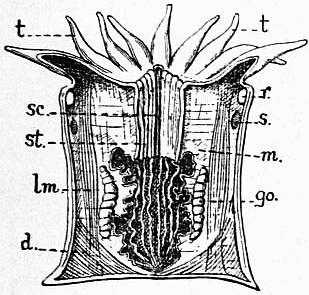
Fig. 1. Diagrammatic longitudinal section of an Anthozoan zooid.
m, Mesentery. t, Tentacles. st, Stomodaeum. sc, Sulcus. r, Rotteken’s muscle. s, Stoma. lm, Longitudinal muscle. d, Diagonal Muscle. go, Gonads.
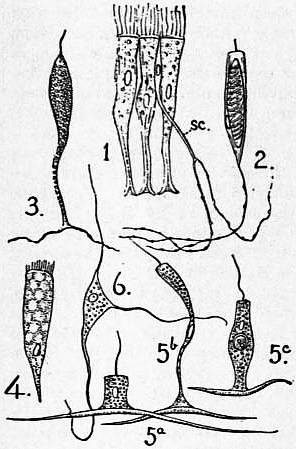
Fig. 2.—1, Portion of epithelium from the tentacle of an Actinian, showing three supporting cells and one sense cell (sc); 2, a cnidoblast with enclosed nematocyst from the same specimen; 3 and 4 two forms of gland cell from the stomodaeum; 5a, 5b, epithelio-muscular cells from the tentacle in different states of contraction; 5c, an epithelio-muscular cell from the endoderm, containing a symbiotic zooxanthella; 6, a ganglion cell from the ectoderm of the peristome. (After O. and R. Hertwig.)
In common with all Coelenterate animals, the walls of the columnar body and also the tentacles and peristome of Actinia are composed of three layers of tissue. The external layer, or ectoderm, is made up of cells, and contains also muscular and nervous elements. The preponderating elements of the ectodermic layer are elongated columnar cells, each containing a nucleus, and bearing cilia at their free extremities. Packed in among these are gland cells, sense cells, and cnidoblasts. The last-named are specially numerous on the tentacles and on some other regions of the body, and produce the well-known “thread cells,” or nematocysts, so characteristic of the Coelentera. The inner layer or endoderm is also a cellular layer, and is chiefly made up of columnar cells, each bearing a cilium at its free extremity and terminating internally in a long muscular fibre. Such cells, made up of epithelial and muscular components, are known as epithelio-muscular or myo-epithelial cells. In Actinians the epithelio-muscular cells of the endoderm are crowded with yellow spherical bodies, which are unicellular plants or Algae, living symbiotically in the tissues of the zooid. The endoderm contains in addition gland cells and nervous elements. The middle layer or mesogloea is not originally a cellular layer, but a gelatinoid structureless substance, secreted by the two cellular layers. In the course of development, however, cells from the ectoderm and endoderm may migrate into it. In Actinia equina the mesogloea consists of fine fibres imbedded in a homogeneous matrix, and between the fibres are minute branched or spindle-shaped cells. For further details of the structure of Actinians, the reader should consult the work of O. and R. Hertwig.
The Anthozoa are divisible into two sub-classes, sharply marked off from one another by definite anatomical characters. These are the Alcyonaria and the Zoantharia. To the first-named belong the precious red coral and its allies, the sea-fans or Gorgoniae, to the second belong the white or Madreporarian corals.
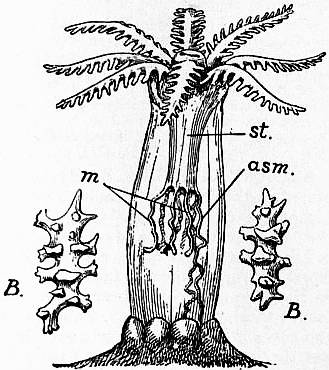
Fig. 3.—An expanded Alcyonarian zooid, showing the mouth surrounded by eight pinnate tentacles. st, Stomodaeum in the the centre of the transparent body; m, mesenteries; asm, asulcar mesenteries; B, spicules, enlarged.
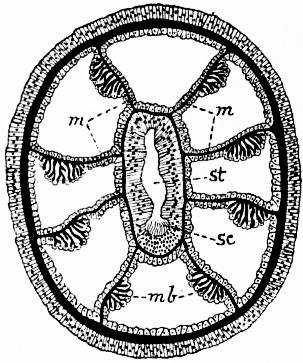
Fig. 4.—Transverse section of an Alcyonarian zooid mm, Mesenteries; mb, muscle banners; sc, sulcus; st, stomodaeum.
Alcyonaria.—In this sub-class the zooid has very constant anatomical characters, differing in some important respects from the Actinian zooid, which has been taken as a type. There is only one ciliated groove, the sulcus, in the stomodaeum. There are always eight tentacles, which are hollow and fringed on their sides, with hollow projections or pinnae; and always eight mesenteries, all of which are complete, i.e. inserted on the stomodaeum. The mesenteries are provided with well-developed longitudinal retractor muscles, supported on longitudinal folds or plaits of the mesogloea, so that in cross-section they have a branched appearance. These muscle-banners, as they are called, have a highly characteristic arrangement; they are all situated on those faces of the mesenteries which look towards the sulcus. (fig. 4). Each mesentery has a filament; but two of them, namely, the pair farthest from the sulcus, are longer than the rest, and have a different form of filament. It has been shown that these asulcar filaments are derived from the ectoderm, the remainder from the endoderm. The only exceptions to this structure are found in the arrested or modified zooids, which occur in many of the colonial Alcyonaria. In these the tentacles are stunted or suppressed and the mesenteries are ill-developed, but the sulcus is unusually large and has long cilia. Such modified zooids are called siphonozooids, their function being to drive currents of fluid through the canal-systems of the colonies to which they belong. With very few exceptions a calcareous skeleton is present in all Alcyonaria; it usually consists of spicules of carbonate of lime, each spicule being formed within an ectodermic cell (fig. 3, B). Most commonly the spicule-forming cells pass out of the ectoderm and are imbedded in the mesogloea, where they may remain separate from one another or may be fused together to form a strong mass. In addition to the spicular skeleton an organic horny skeleton is frequently present, either in the form of a horny external investment (Cornularia), or an internal axis (Gorgonia), or it may form a matrix in which spicules are imbedded (Keroeides, Meistodes).
Nearly all the Alcyonaria are colonial. Four solitary species have been described, viz. Haimea funebris and H. hyalina, Hartea elegans, and Monoxenia Darwinii; but it is doubtful whether these are not the young forms of colonies. For the present the solitary forms may be placed in a grade, Protal-cyonacea, and the colonial forms may be grouped in another grade, Synalcyonacea. Every Alcyonarian colony is developed by budding from a single parent zooid. The buds are not direct outgrowths of the body-wall, but are formed on the courses of hollow out growths of the base or body-wall, called solenia. These form a more or less complicated canal system, lined by endoderm, and communicating with the cavities of the zooids. The most simple form of budding is found in the genus Cornularia, in which the mother zooid gives off from its base one or more simple radiciform outgrowths. Each outgrowth contains a single tube or solenium, and at a longer or shorter distance from the mother zooid a daughter zooid is formed as a bud. This gives off new outgrowths, and these, branching and anastomosing with one another, may form a network, adhering to stones, corals, or other objects, from which zooids arise at intervals. In Clavularia and its allies each outgrowth contains several solenia, and the outgrowths may take the form of flat expansions, composed of a number of solenial tubes felted together to form a lamellar surface of attachment. Such outgrowths are called stolons, and a stolon may be simple, i.e. contain only one solenium, as in Cornularia, or may be complex and built up of many solenia, as in Clavularia. Further complications arise when the lower walls of the mother zooid become thickened and interpenetrated with solenia, from which buds are developed, so that lobose, tufted, or branched colonies are formed. The chief orders of the Synalcyonacea are founded upon the different architectural features of colonies produced by different modes of budding. We recognize six orders—the Stolonifera, Alcyonacea, Pseudaxonia, Axifera, Stelechotokea, and Cornothecalia.
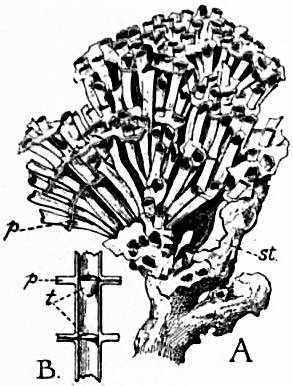
Fig. 5.
A. Skeleton of a young colony of Tubipora purpurea. st, Stolon; p, platform. B. Diagrammatic longitudinal section of a corallite, showing two platforms, p and cup-shaped tabulae, t. (After S.J. Hickson.)
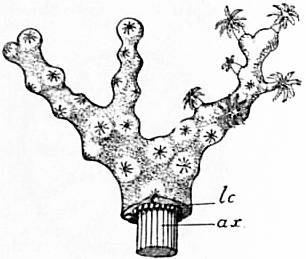
Fig. 6.—Portion of a colony of Coralinum rubrum, showing expanded and contracted zooids. In the lower part of the figure the cortex has been cut away to show the axis, ax, and the longitudinal canals, lc, surrounding it.
In the order Stolonirera the zooids spring at intervals from branching or lamellar stolons, and are usually free from one another, except at their bases, but in some cases horizontal solenia arising at various heights from the body-wall may place the more distal portions of the zooids in communication with one another. In the genus Tubipora these horizontal solenia unite to form a series of horizontal platforms (fig. 5). The order comprises the families Cornulamdae, Syringopordae, Tubipondae, and Favositidae. In the first-named, the zooids are united only by their bases and the skeleton consists of loose spicules. In the Tubipondae the spicules of the proximal part of the body-wall are fused together to form a firm tube, the corallite, into which the distal part of the zooid can be retracted. The corallites are connected at intervals by horizontal platforms containing solenia, and at the level of each platform the cavity of the corallite is divided by a transverse calcareous partition, either flat or cup-shaped, called a tabula. Formerly all corals in which tabulae are present were classed together as Tabulata, but Tubipora is an undoubted Alcyonarian with a lamellar stolon, and the structure of the fossil genus Syringopora, which has vertical corallites united by horizontal solenia, clearly shows its affinity to Tubipora. The Favositidae, a fossil family from the Silurian and Devonian, have a massive corallum composed of numerous polygonal corallites closely packed together. The cavities of adjacent corallites communicate by means of numerous perforations, which appear to represent solenia, and numerous transverse tabulae are also present. In Favosites hemisphaerica a number of radial spines, projecting into the cavity of the corallite, give it the appearance of a madreporarian coral.
In the order Alcyonacea the colony consists of bunches of elongate cylindrical zooids, whose proximal portions are united by solenia and compacted, by fusion of their own walls and those of the solenia, into a fleshy mass called the coenenchyma. Thus the coenenchyma forms a stem, sometimes branched, from the surface of which the free portions of the zooids project. The skeleton of the Alcyonacea consists of separate calcareous spicules, which are often, especially in the Nephthyidae, so abundant and so closely interlocked as to form a tolerably firm and hard armour. The order comprises the families Xeniidae, Alcyonidae and Nephthyidae. Alcyonium digitatum, a pink digitate form popularly known as “dead men’s fingers,” is common in 10-20 fathoms of water off the English coasts.
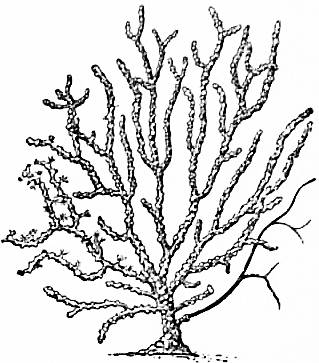
Fig. 7.—The sea-fan (Gorgonia cavolinii).
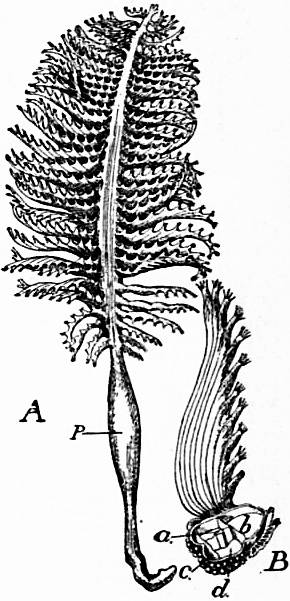
Fig. 8.
A. Colony of Pennatula phosphorea from the metarachidial aspect. p, The peduncle. B. Section of the rachis bearing a single pinna, a, Axis; b, metarachidial; c, prorachidial; d, pararachidial stem canals.
In the order Pseudaxonia the colonies are upright and branched, consisting of a number of short zooids whose proximal ends are imbedded in a coenenchyma containing numerous ramifying solenia and spicules. The coenenchyma is further differentiated into a medullary portion and a cortex. The latter contains the proximal moieties of the zooids and numerous but separate spicules. The medullary portion is densely crowded with spicules of different shape from those in the cortex, and in some forms the spicules are cemented together to form a hard supporting axis. There are four families of Pseudaxonia—the Briareidae, Sclerogorgidae, Melitodidae, and Corallidae. In the first-named the medulla is penetrated by solenia and forms an indistinct axis; in the remainder the medulla is devoid of solenia, and in the Melitodidae and Corallidae it forms a dense axis, which in the Melitodidae consists of alternate calcareous and horny joints. The precious red coral of commerce, Corallium rubrum (fig. 6), a member of the family Corallidae, is found at depths varying from 15 to 120 fathoms the Mediterranean Sea, chiefly on the African coast. It owes its commercial value to the beauty of its hard red calcareous axis which in life is covered by a cortex in which the proximal moieties of the zooids are imbedded. Corallium rubrum has been the subject of a beautifully-illustrated memoir by de Lacaze-Duthiers, which should be consulted for details of anatomy.
The Axifera comprise those corals that have a horny or calcified axis, which in position corresponds to the axis of the Pscudaxonia, but, unlike it, is never formed of fused spicules; the most familiar example is the pink sea-fan, Gorgonia cavolinii, which is found in abundance in 10-25 fathoms of water off the English coasts (fig. 7). In this order the axis is formed as an ingrowth of the ectoderm of the base of the mother zooid of the colony, the cavity of the ingrowth being filled by a horny substance secreted by the ectoderm. In Gorgonia the axis remains horny throughout life, but in many forms it is further strengthened by a deposit of calcareous matter In the family Isidinae the axis consists of alternate segments of horny and calcareous substance, the latter being amorphous. The order contains six families—the Dasygorgidae, Isidae, Primnoidae, Muriceidae, Plexauridae, and Gorgoniaae.
In the order Stelechotokea the colony consists of a stem formed by a greatly-elongated mother zooid, and the daughter zooids are borne as lateral buds on the stem. In the section Asiphonacea the colonies are upright and branched, springing from membranous or ramifying stolons. They resemble and are closely allied to certain families of the Cornulariidae, differing from them only in mode of budding and in the dispostion of the daughter zooids round a central, much-elongated mother zooid. The section contains two families, the Telestidae and the Coelogorgidae. The second section comprises the Pennatulacea or sea-pens, which are remarkable from the fact that the colony is not fixed by the base to a rock or other object, but is imbedded in sand or mud by the proximal portion of the stem known as the peduncle. In the typical genus, Pennatula (fig. 8), the colony looks like a feather having a stem divisible into an upper moiety or rachis, bearing lateral central leaflets (pinnae), and a lower peduncle, which is sterile and imbedded in sand or mud. The stem represents a greatly enlarged and elongated mother zooid. It is divided longitudinally by a partition separating a so-called “ventral” or prorachidial canal from a so-called “dorsal” or metarachidial canal. A rod-like supporting axis of peculiar texture is developed in the longitudinal partition, and a longitudinal canal is hollowed out on either side of the axis in the substance of the longitudinal partition, so that there are four stem-canals in all. The prorachidial and metarachidial aspects of the rachis are sterile, but the sides or pararachides bear numerous daughter zooids of two kinds—(1) fully-formed autozooids, (2) small stunted siphonozooids. The pinnae are formed by the elongated autozooids, whose proximal portions are fused together to form a leaf-like expansion, from the upper edge of which the distal extremities of the zooids project. The siphonozooids are very numerous and lie between the bases at the pinnae on the pararachides; they extend also on the prorachidial and metarachidial surfaces. The calcareous skeleton of the Pennatulacea consists of scattered spicules, but in one species, Protocaulon molle, spicules are absent. Although of great interest the Pennatulacea do not form an enduring skeleton or “coral,” and need not be considered in detail in this place.
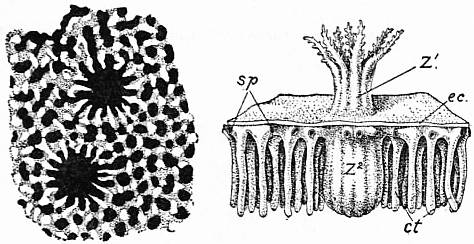
Fig. 9.
A, Portion of the surface of a colony of Heliopora coerulea magnified, showing two calices and the surrounding coenenchymal tubes. B, Single zooid with the adjacent soft tissues as seen after removal of the skeleton by decalcification. Z1, the distal, and Z2, the proximal or intracalicular portion of the zooid; ec, ectoderm; ct, coenenchymal tubes; sp, superficial network of solenia.
The order Coenothecalia is represented by a single living species, Heliopora coerulea, which differs from all recent Alcyonaria in the fact that its skeleton is not composed of spicules, but is formed as a secretion from a layer of cells called calicoblasts, which originate from the ectoderm. The corallum of Heliopora is of a blue colour, and has the form of broad, upright, lobed, or digitate masses flattened from side to side. The surfaces are pitted all over with perforations of two kinds, viz. larger star-shaped cavities, called calices, in which the zooids are lodged, and very numerous smaller round or polygonal apertures, which in life contain as many short unbranched tubes, known as the coenenchymal tubes (fig. 9, A). The walls of the calices and coenenchymal tubes are formed of flat plates of calcite, which are so disposed that the walls of one tube enter into the composition of the walls of adjacent tubes, and the walls of the calices are formed by the walls of adjacent coenenchymal tubes. Thus the architecture of the Helioporid colony differs entirely from such forms as Tubipora or Favosites, in which each corallite has its own distinct and proper wall. The cavities both of the calices and coenenchymal tubes of Heliopora are closed below by horizontal partitions or tabulae, hence the genus was formerly included in the group Tabulata, and was supposed to belong to the madreporarian corals, both because of its lamellar skeleton, which resembles that of a Madrepore, and because each calicle has from twelve to fifteen radial partitions or septa projecting into its cavity. The structure of the zooid of Heliopora, however, is that of a typical Alcyonarian, and the septa have only a resemblance to, but no real homology with, the similarly named structures in madreporarian corals. Heliopora coerulea is found between tide-marks on the shore platforms of coral islands. The order was more abundantly represented in Palaeozoic times by the Heliolitidae from the Upper and Lower Silurian and the Devonian, and by the Thecidae from the Wenlock limestone. In Heliolites porosus the colonies had the form of spheroidal masses; the calices were furnished with twelve pseudosepta, and the coenenchymal tubes were more or less regularly hexagonal.
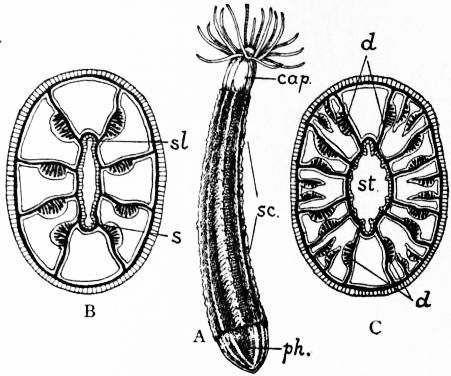
Fig. 10.
A, Edwardsia claparedii (after A. Andres). Cap, capitulum; sc, scapus; ph, physa. B, Transverse section of the same, showing the arrangement of the mesenteries, s, Sulcus; sl, sulculus. C, Transverse section of Halcampa. d, d, Directive mesenteries; st, stomodaeum.
Zoantharia.—In this sub-class the arrangement of the mesenteries is subject to a great deal of variation, but all the types hitherto observed may be referred to a common plan, illustrated by the living genus Edwardsia (fig. 10, A, B). This is a small solitary Zoantharian which lives embedded in sand. Its body is divisible into three portions, an upper capitulum bearing the mouth and tentacles, a median scapus covered by a friable cuticle, and a terminal physa which is rounded. Both capitulum and physa can be retracted within the scapus. There are from sixteen to thirty-two simple tentacles, but only eight mesenteries, all of which are complete. The stomodaeum is compressed laterally, and is furnished with two longitudinal grooves, a sulcus and a sulculus. The arrangement of the muscle-banners on the mesenteries is characteristic. On six of the mesenteries the muscle-banners have the same position as in the Alcyonaria, namely, on the sulcar faces; but in the two remaining mesenteries, namely, those which are attached on either side of the sulcus, the muscle-banners are on the opposite or sulcular faces. It is not known whether all the eight mesenteries of Edwardsia are developed simultaneously or not, but in the youngest form which has been studied all the eight mesenteries were present, but only two of them, namely the sulco-laterals, bore mesenterial filaments, and so it is presumed that they are the first pair to be developed. In the common sea-anemone, Actinia equina (which has already been quoted as a type of Anthozoan structure), the mesenteries are numerous and are arranged in cycles. The mesenteries of the first cycle are complete (i.e. are attached to the stomodaeum), are twelve in number, and arranged in couples, distinguishable by the position of the muscle-banners. In the four couples of mesenteries which are attached to the sides of the elongated stomodaeum the muscle-banners of each couple are turned towards one another, but in the sulcar and sulcular couples, known as the directive mesenteries, the muscle-banners are on the outer faces of the mesenteries, and so are turned away from one another (see fig. 10, C). The space enclosed between two mesenteries of the same couple is called an entocoele; the space enclosed between two mesenteries of adjacent couples is called an exocoele. The second cycle of mesenteries consists of six couples, each formed in an exocoele of the primary cycle, and in each couple the muscle-banners are vis-à-vis. The third cycle comprises twelve couples, each formed in an exocoele between the primary and secondary couples and so on, it being a general rule (subject, however, to exceptions) that new mesenterial couples are always formed in the exocoeles, and not in the entocoeles.
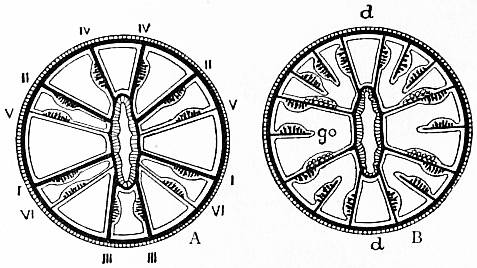
Fig. 11.—A, Diagram showing the sequence of mesenterial development in an Actinian. B, Diagrammatic transverse section of Gonactinia prolifera.
While the mesenterial couples belonging to the second and each successive cycle are formed simultaneously, those of the first cycle are formed in successive pairs, each member of a pair being placed on opposite sides of the stomodaeum. Hence the arrangement in six couples is a secondary and not a primary feature. In most Actinians the mesenteries appear in the following order:—At the time when the stomodaeum is formed, a single pair of mesenteries, marked I, I in the diagram (fig. 11, A), makes its appearance, dividing the coelenteric cavity into a smaller sulcar and a large sulcular chamber. The muscle-banners of this pair are placed on the sulcar faces of the mesenteries. Next, a pair of mesenteries, marked II, II in the diagram, is developed in the sulcular chamber, its muscle-banners facing the same way as those of I, I. The third pair is formed in the sulcar chamber, in close connexion with the sulcus, and in this case the muscle-banners are on the sulcular faces. The fourth pair, having its muscle-banners on the sulcar faces, is developed at the opposite extremity of the stomodaeum in close connexion with the sulculus. There are now eight mesenteries present, having exactly the same arrangement as in Edwardsia. A pause in the development follows, during which no new mesenteries are formed, and then the six-rayed symmetry characteristic of a normal Actinian zooid is completed by the formation of the mesenteries V, V in the lateral chambers, and VI, VI in the sulco-lateral chambers, their muscle-banners being so disposed that they form couples respectively with II, II and I, I. In Actinia equina the Edwardsia stage is arrived at somewhat differently. The mesenteries second in order of formation form the sulcular directives, those fourth in order of formation form with the fifth the sulculo-lateral couples of the adult.