VOLUME II SLICE II Anjar to Apollo (continued 2)
Reading edition
In December, the archduke Charles visited Anne at Windsor and was welcomed as the king of Spain. In 1704 Anne acquiesced in the resignation of Lord Nottingham, the leader of the high Tory party. In the same year the great victory of Blenheim further consolidated the power of the Whigs and increased the influence of Marlborough, upon whom Anne now conferred the manor of Woodstock. Nevertheless, she declared in November to the duchess that whenever things leaned towards the Whigs, “I shall think the church is beginning to be in danger.” Next year she supported the election of the Whig speaker, John Smith, but long resisted the influence and claims of the Junto, as the Whig leaders, Somers, Halifax, Orford, Wharton and Sunderland, were named. In October she was obliged to appoint Cowper, a Whig, lord chancellor, with all the ecclesiastical patronage belonging to the office. Marlborough’s successive victories, and especially the factious conduct of the Tories, who in November 1705 moved in parliament that the electress Sophia should be invited to England, drove Anne farther to the side of the Whigs. But she opposed for some time the inclusion in the government of Sunderland, whom she especially disliked, only consenting at Marlborough’s intercession in December 1706, when various other offices and rewards were bestowed upon Whigs, and Nottingham with other Tories was removed from the council. She yielded, after a struggle, also to the appointment of Whigs to bishoprics, the most mortifying submission of all. In 1708 she was forced to dismiss Harley, who, with the aid of Mrs Masham, had been intriguing against the government and projecting the creation of a third party. Abigail Hill, Mrs Masham, a cousin of the duchess of Marlborough, had been introduced by the latter as a poor relation into Anne’s service, while still princess of Denmark. The queen found relief in the quiet and respectful demeanour of her attendant, and gradually came to prefer her society to that of the termagant and tempestuous duchess. Abigail, however, soon ventured to talk “business,” and in the summer of 1707 the duchess discovered to her indignation that her protégée had already undermined her influence with the queen and had become the medium of Harley’s intrigue. The strength of the Whigs at this time and the necessities of the war caused the retirement of Harley, but he remained Anne’s secret adviser and supporter against the faction, urging upon her “the dangers to the crown as well as to the church and monarchy itself from their counsels and actions,”9 while the duchess never regained her former influence. The inclusion in the cabinet of Somers, whom she especially disliked as the hostile critic of Prince George’s admiralty administration, was the subject of another prolonged struggle, ending again in the queen’s submission after a futile appeal to Marlborough in October 1708, to which she brought herself only to avoid a motion from the Whigs for the removal of the prince, then actually on his deathbed. His death on the 28th of October was felt deeply by the queen, and opened the way for the inclusion of more Whigs. But no reconciliation with the duchess took place, and in 1709 a further dispute led to an angry correspondence, the queen finally informing the duchess of the termination of their friendship, and the latter drawing up a long narrative of her services, which she forwarded to Anne together with suitable passages on the subject of friendship and charity transcribed from the Prayer Book, the Whole Duty of Man and from Jeremy Taylor.10 Next year Anne’s desire to give a regiment to Hill, Mrs Masham’s brother, led to another ineffectual attempt in retaliation to displace the new favourite, and the queen showed her antagonism to the Whig administration on the occasion of the prosecution of Sacheverell. She was present at his trial and was publicly acclaimed by the mob as his supporter, while the Tory divine was consoled immediately on the expiration of his sentence with the living of St Andrew’s, Holborn. Subsequently the duchess, in a final interview which she had forced upon the queen, found her tears and reproaches unavailing. In her anger she had told the queen she wished for no answer, and she was now met by a stony and exasperating silence, broken only by the words constantly repeated, “You desired no answer and you shall have none.”
The fall of the Whigs, now no longer necessary on account of the successful issue of the war, to accomplish which Harley had long been preparing and intriguing, followed; and their attempt to prolong hostilities from party motives failed. A friend of Harley, the duke of Shrewsbury, was first appointed to office, and subsequently the great body of the Whigs were displaced by Tories, Harley being made chancellor of the exchequer and Henry St John secretary of state. The queen was rejoiced at being freed from what she called a long captivity, and the new parliament was returned with a Tory majority. On the 17th of January 1711, in spite of Marlborough’s efforts to ward off the blow, the duchess was compelled to give up her key of office. The queen was now able once more to indulge in her favourite patronage of the church, and by her influence an act was passed in 1712 for building fifty new churches in London. Later, in 1714, she approved of the Schism Bill. She gave strong support to Harley, now earl of Oxford and lord treasurer, in the intrigues and negotiations for peace. Owing to the alliance between the Tory Lord Nottingham and the Whigs, on the condition of the support by the latter of the bill against occasional conformity passed in December 1711, the defeated Whigs maintained a majority in the Lords, who declared against any peace which left Spain to the Bourbons. To break down this opposition Marlborough was dismissed on the 31st from all his employments, while the House of Lords was “swamped” by Anne’s creation of twelve peers,11 including Mrs Masham’s husband. The queen’s conduct was generally approved, for the nation was now violently adverse to the Whigs and war party; and the peace of Utrecht was finally signed on the 31st of March 1713, and proclaimed on the 5th of May in London.
As the queen’s reign drew to its close, rumours were rife on the great subject of the succession to the throne. Various Jacobite appointments excited suspicion. Both Oxford and Bolingbroke were in communication with the Pretender’s party, and on the 27th of July Oxford, who had gradually lost influence and quarrelled with Bolingbroke, resigned, leaving the supreme power in the hands of the latter. Anne herself had a natural feeling for her brother, and had shown great solicitude concerning his treatment when a price had been set on his head at the time of the Scottish expedition in 1708. On the 3rd of March 1714 James wrote to Anne, Oxford and Bolingbroke, urging the necessity of taking steps to secure his succession, and promising, on the condition of his recognition, to make no further attempts against the queen’s government; and in April a report was circulated in Holland that Anne had secretly determined to associate James with her in the government. The wish expressed by the Whigs, that a member of the electoral family should be invited to England, had already aroused the queen’s indignation in 1708; and now, in 1714, a writ of summons for the electoral prince as duke of Cambridge having been obtained, Anne forbade the Hanoverian envoy, Baron Schütz, her presence, and declared all who supported the project her enemies; while to a memorial on the same subject from the electress Sophia and her grandson in May, Anne replied in an angry letter, which is said to have caused the death of the electress on the 5th of June, requesting them not to trouble the peace of her realm or diminish her authority.
These demonstrations, however, were the outcome not of any returning partiality for her own family, but of her intense dislike, in which she resembled Queen Elizabeth, of any “successor,” “it being a thing I cannot bear to have any successor here though but for a week”; and in spite of some appearances to the contrary, it is certain that religion and political wisdom kept Anne firm to the Protestant succession.12 She had maintained a friendly correspondence with the court of Hanover since 1705, and in 1706 had bestowed the Garter on the electoral prince and created him duke of Cambridge; while the Regency Act provided for the declaration of the legal heir to the crown by the council immediately on the queen’s death, and a further enactment naturalized the electress and her issue. In 1708, on the occasion of the Scottish expedition, notwithstanding her solicitude for his safety, she had styled James in her speech closing the session of parliament as “a popish pretender bred up in the principles of the most arbitrary government.” The duchess of Marlborough stated in 1713 that all the time she had known “that thing” (as she now called the queen), “she had never heard her speak a favourable word of him.”13 No answer appears to have been sent to James’s letter in 1714; on the contrary, a proclamation was issued (June 23) for his apprehension in case of his arrival in England. On the 27th of April Anne gave a solemn assurance of her fidelity to the Hanoverian succession to Sir William Dawes, archbishop of York; in June she sent Lord Clarendon to Hanover to satisfy the elector.
The sudden illness and death of the queen now frustrated any schemes which Bolingbroke, or others might have been contemplating. On the 27th, the day of Oxford’s resignation, the discussions concerning his successor detained the council sitting in the queen’s presence till two o’clock in the morning, and on retiring Anne was instantly seized with fatal illness. Her adherence to William in 1688 had been a principal cause of the success of the Revolution, and now the final act of her life was to secure the Revolution settlement and the Protestant succession. During a last moment of returning consciousness, and by the advice of the whole council, who had been joined on their own initiative by the Whig dukes Argyll and Somerset, she placed the lord treasurer’s staff in the hands of the Whig duke of Shrewsbury, and measures were immediately taken for assuring the succession of the elector. Her death took place on the 1st of August, and the security felt by the public, and perhaps the sense of perils escaped by the termination of the queen’s life, were shown by a considerable rise in the national stocks. She was buried on the south side of Henry VII.’s chapel in Westminster Abbey, in the same tomb as her husband and children. The elector of Hanover, George Louis, son of the electress Sophia (daughter of Elizabeth, daughter of James I.), peacefully succeeded to the throne as George I. (q.v.).
According to her physician Arbuthnot, Anne’s life was shortened by the “scene of contention among her servants. I believe sleep was never more welcome to a weary traveller than death was to her.” By character and temperament unfitted to stand alone, her life had been unhappy and tragical from its isolation. Separated in early years from her parents and sister, her one great friendship had proved only baneful and ensnaring. Marriage had only brought a mournful series of infant funerals. Constant ill-health and suffering had darkened her career. The claims of family attachment, of religion, of duty, of patriotism and of interest, had dragged her in opposite directions, and her whole life had been a prey to jealousies and factions which closed around her at her accession to the throne, and surged to their height when she lay on her deathbed. The modern theory of the relations between the sovereign and the parties, by which the former identifies himself with the faction for the time in power while maintaining his detachment from all, had not then been invented; and Anne, like her Hanoverian successors, maintained the struggle, though without success, to rule independently finding support in Harley. During the first year of her reign she made known that she was “resolved not to follow the example of her predecessor in making use of a few of her subjects to oppress the rest. She will be queen of all her subjects, and would have all the parties and distinctions of former reigns ended and buried in hers.”14 Her motive for getting rid of the Whigs was not any real dislike of their administration, but the wish to escape from the domination of the party,15 and on the advent to power of the Tories she carefully left some Whigs in their employments, with the aim of breaking up the party system and acting upon what was called “a moderate scheme.” She attended debates in the Lords and endeavoured to influence votes. Her struggles to free herself from the influence of factions only involved her deeper; she was always under the domination of some person or some party, and she could not rise above them and show herself the leader of the nation like Elizabeth.
Anne was a women of small ability, of dull mind, and of that kind of obstinacy which accompanies weakness of character. According to the duchess she had “a certain knack of sticking to what had been dictated to her to a degree often very disagreeable, and without the least sign of understanding or judgment.”16 “I desire you would not have so ill an opinion of me,” Anne writes to Oxford, “as to think when I have determined anything in my mind I will alter it.”17 Burnet considered that “she laid down the splendour of a court too much,” which was “as it were abandoned.” She dined alone after her husband’s death, but it was reported by no means abstemiously, the royal family being characterized in the lines:—
“King William thinks all. Queen Mary talks all, Prince George drinks all, And Princess Anne eats all.”18
She took no interest in the art, the drama or the literature of her day. But she possessed the homely virtues; she was deeply religious, attached to the Church of England and concerned for the efficiency of the ministry. One of the first acts of her reign was a proclamation against vice, and Lord Chesterfield regretted the strict morality of her court. Instances abound of her kindness and consideration for others. Her moderation towards the Jacobites in Scotland, after the Pretender’s expedition in 1708, was much praised by Saint Simon. She showed great forbearance and generosity towards the duchess of Marlborough in the face of unexampled provocation, and her character was unduly disparaged by the latter, who with her violent and coarse nature could not understand the queen’s self-restraint in sorrow, and describes her as “very hard” and as “not apt to cry.” According to her small ability she served the state well, and was zealous and conscientious in the fulfilment of public duties, in which may be included touching for the king’s evil, which she revived. Marlborough testifies to her energy in finding money for the war. She surrendered 10,000 pounds a year for public purposes, and in 1706 she presented 30,000 pounds to the officers and soldiers who had lost their horses. Her contemporaries almost unanimously record her excellence and womanly virtues; and by Dean Swift, no mild critic, she is invariably spoken of with respect, and named in his will as of “ever glorious, immortal and truly pious memory, the real nursing-mother of her kingdoms.” She deserves her appellation of “Good Queen Anne,” and notwithstanding her failings must be included among the chief authors and upholders of the great Revolution settlement. Her person was described by Spanheim, the Prussian ambassador, as handsome though inclining to stoutness, with black hair, blue eyes and good features, and of grave aspect.
Anne’s husband, Prince George (1653-1708), was the second son of Frederick III., king of Denmark. Before marrying Anne he had been a candidate for the throne of Poland. He was created earl of Kendal and duke of Cumberland in 1689. Some censure, which was directed against the prince in his capacity as lord high admiral, was terminated by his death. In religion George remained a Lutheran, and in general his qualities tended to make him a good husband rather than a soldier or a statesman.
Bibliography.—Dict. of Nat. Biography (Dr A.W. Ward); A. Strickland, Lives of the Queens of England (1852), somewhat uncritical; an excellent account written by Spanheim for the king of Prussia, printed in the Eng. Hist. Rev. ii. 757; histories of Stanhope, Lecky, Ranke, Macaulay, Boyes, Burnet, Wyon, and Somerville; F.E. Morris, The Age of Anne (London, 1877); Correspondence and Diary of Lord Clarendon (1828); Hatton Correspondence (Camden Soc., 1878); Evelyn’s Diary; Sir J. Dalrymple’s Memoirs (1790); N. Luttrell’s Brief Hist. Relation (1857); Wentworth Papers (1883); W. Coxe, Mem. of the Duke of Marlborough (1847); Conduct of the Dowager Duchess of Marlborough (1742); Ralph, The other Side of the Question (1742); Private Correspondence of Sarah Duchess of Marlborough (1838); A. T, Thomson, Mem. of the Duchess and the Court of Queen Anne (1839); J.S. Clarke’s Life of James II. (1816); J. Macpherson’s Original Papers (1775); Swift’s Some Considerations upon the Consequences from the Death of the Queen, An Inquiry into the Behaviour of the Queen’s last Ministry, Hist. of the Four Last Years of Queen Anne, and Journals and Letters; The Lockhart Papers (1817), i.; F. Salomon, Geschichte des letzten Ministeriums Konigin Annas (1894); Marchmont Papers, iii. (1831); W. Sichel Life of Bolingbroke (1901-1902); Mem. of Thomas Earl of Ailesbury (Roxburghe Club, 1890); Eng. Hist. Rev. i. 470, 756, viii. 740; Royal Hut. Soc. Trans. N.S. xiv. 69; Col. of State Papers; Treasury; Hist. MSS. Comm. Series, MSS. of Duke of Portland, including the Harley Papers, Duke of Buccleugh at Montagu House, Lord Kenyan, Marq. of Bath at Longleat; Various Collections, ii. 146, Duke Of Rutland at Belvoir, 7th Rep. app., and H.M. the King (Stuart Papers, i.); Stowe MSS. in Brit. Museum; Sir J. Mackintosh’s Transcripts, Add. MSS. in Brit. Museum, 34, 487-526; Edinburgh Rev., October 1835, p. 1; Notes and Queries, vii. ser. iii. 178, viii. ser. i. 72, xii. 368, ix, ser. iv. 282, xi, 254; C. Hodgson, An Account of the Augmentation of Small Livings by the Bounty of Queen Anne (1845); Observations of the Governors of Queen Anne’s Bounty (1867); Somers Tracts, xii. xiii. (1814-1815); H. Paul, Queen Anne (London, 1907).
(P. C. Y.)
1 See also Hist. MSS. Comm., MSS. of Duke of Rutland at Belvoir, ii. 109.
2 Dalrymple’s Memoirs, ii. 175.
3 Dalrymple’s Memoirs, ii. 249.
4 Lord Ailesbury’s Memoirs, 293.
5 Macpherson i. 241; Clarke’s Life of James II., ii. 476. The letter, which is only printed in fragments, is not in Anne’s style, and if genuine was probably dictated by the Churchills.
6 Luttrell ii. 366, 376.
7 Macpherson i. 257; Clarke’s James II., ii. 559. See also Shrewsbury’s anonymous correbpondent in Hist. MSS. Comm. Ser.; MSS. Duke of Buccleugh at Montagu House, ii. 169.
8 Macaulay iv. 799 note
9 Swift’s Mem. on the Change of the Ministry.
10 Conduct of the Duchess of Marlborough, p. 225.
11 For their names see Hume and Smollett’s Hist. (Hughes, 1854) viil. 110.
12 See also Hist. MSS. Comm. Ser. Rep. vii. App. 246b.
13 Ibid. Portland MSS. v. 338.
14 Sir J. Leveson-Gower to Lord Rutland, Hist. MSS. Comm., Duke of Rutland’s MSS. ii. 173.
15 See Bolingbroke’s Letter to Sir W. Wyndham.
16 Private Correspondence, ii. 120.
17 Hist. MSS. Comm., MSS. of Marq. of Bath at Longleat, i. 237.
18 Notes and Queries, xi. 254.
ANNE (1693-1740), empress of Russia, second daughter of Tsar Ivan V., Peter the Great’s imbecile brother, and Praskovia Saltuikova. Her girlhood was passed at Ismailovo near Moscow, with her mother, an ignorant, bigoted tsaritsa of the old school, who neglected and even hated her daughters. Peter acted as a second father to the Ivanovs, as Praskovia and her family were called. In 1710 he married Anne to Frederick William, duke of Courland, who died of surfeit on his journey home from St Petersburg. The reluctant young widow was ordered to proceed on her way to Mittau to take over the government of Courland, with the Russian resident, Count Peter Bestuzhev, as her adviser. He was subsequently her lover, till supplanted by Biren (q.v.). Anne’s residence at Mittau was embittered by the utter inadequacy of her revenue, which she keenly felt. It was therefore with joy that she at once accepted the Russian crown, as the next heir, after the death of Peter II. (January 30, 1730), when it was offered to her by the members of the supreme privy council, even going so far as to subscribe previously nine articles which would have reduced her from an absolute to a very limited monarch. On the 26th of February she made her public entry into Moscow under strict surveillance. On the 8th of March a coup d’état, engineered by a party of her personal friends, overthrew the supreme privy council and she was hailed as autocrat. Her government, on the whole, was prudent, beneficial and even glorious; but it was undoubtedly severe and became at last universally unpopular. This was due in the main to the outrageous insolence of her all-powerful favourite Biren, who hated the Russian nobility and trampled upon them mercilessly. Fortunately, Biren was sufficiently prudent not to meddle with foreign affairs or with the army, and these departments in the able hands of two other foreigners, who thoroughly identified themselves with Russia, Andrei Osterman (q.v.) and Burkhardt Münnich (q.v.) did great things in the reign of Anne. The chief political events of the period were the War of the Polish Succession and the second1 Crimean War. The former was caused by the reappearance of Stanislaus Leszczynski as a candidate for the Polish throne after the death of Augustus II. (February 1, 1733). The interests of Russia would not permit her to recognize a candidate dependent directly on France and indirectly upon Sweden and Turkey, all three powers being at that time opposed to Russia’s “system.” She accordingly united with Austria to support the candidature of the late king’s son, Augustus of Saxony. So far as Russia was concerned, the War of the Polish Succession was quickly over. Much more important was the Crimean War of 1736-39. This war marks the beginning of that systematic struggle on the part of Russia to recover her natural and legitimate southern boundaries. It lasted four years and a half, and cost her a hundred thousand men and millions of roubles; and though invariably successful, she had to be content with the acquisition of a single city (Azov) with a small district at the mouth of the Don. Yet more had been gained than was immediately apparent. In the first place, this was the only war hitherto waged by Russia against Turkey which had not ended in crushing disaster. Münnich had at least dissipated the illusion of Ottoman invincibility, and taught the Russian soldier that 100,000 janissaries and spahis were no match, in a fair field, for half that number of grenadiers and hussars. In the second place the Tatar hordes had been well nigh exterminated. In the third place Russia’s signal and unexpected successes in the Steppe had immensely increased her prestige on the continent. “This court begins to have a great deal to say in the affairs of Europe,” remarked the English minister, Sir Claudius Rondeau, a year later.
The last days of Anne were absorbed by the endeavour to strengthen the position of the heir to the throne, the baby cesarevich Ivan, afterwards Ivan VI., the son of the empress’s niece, Anna Leopoldovna, against the superior claims of her cousin the cesarevna Elizabeth. The empress herself died three months later (28th of October 1740). Her last act was to appoint Biren regent during the infancy of her great-nephew.
Anne was a grim, sullen woman, frankly sensual, but as well-meaning as ignorance and vindictiveness would allow her to be. But she had much natural good sense, was a true friend and, in her more cheerful moments, an amiable companion. Lady Rondeau’s portrait of the empress shows her to the best advantage. She is described as a large woman, towering above all the cavaliers of her court, but very well shaped for her size, easy and graceful in her person, of a majestic bearing, but with an awfulness in her countenance which revolted those who disliked her.
See R. Nisbet Bain, The Pupils of Peter the Great (London, 1897); Letters from a lady who resided some years in Russia (i.e. Lady Rondeau) (London, 1775); Christoph Hermann Manstein, Mémoires sur la Russie (Amsterdam, 1771; English edition, London, 1856); Gerhard Anton von Haiem, Lebensschreibung des Feldm. B.C. Grafen von Münnich (Oldenburg, 1803); Claudius Rondeau, Diplomatic Despatches from Russia, 1728-1739 (St Petersburg, 1889-1892).
(R. N. B.)
1 Vasily Golitsuin’s expedition under the regency of Sophia was the first Crimean War (1687-89).
ANNE OF BRITTANY (1477-1514), daughter of Francis II., duke of Brittany, and Marguerite de Foix. She was scarcely twelve years old when she succeeded her father as duchess on the 9th of September 1488. Charles VIII. aimed at establishing his authority over her; Alain d’Albret wished to marry her; Jean de Rohan claimed the duchy; and her guardian, the marshal de Rieux, was soon in open revolt against his sovereign. In 1489 the French army invaded Brittany. In order to protect her independence, Anne concluded an alliance with Maximilian of Austria, and soon married him by proxy (December 1489). But Maximilian was incapable of defending her, and in 1491 the young duchess found herself compelled to treat with Charles VIII. and to marry him. The two sovereigns made a reciprocal arrangement as to their rights and pretensions to the crown of Brittany, but in the event of Charles predeceasing her, Anne undertook to marry the heir to the throne. Nevertheless, in 1492, after the conspiracy of Jean de Rohan, who had endeavoured to hand over the duchy to the king of England, Charles VIII. confirmed the privileges of Brittany, and in particular guaranteed to the Bretons the right of paying only those taxes to which the assembly of estates consented, After the death of Charles VIII. in 1498, without any children, Anne exercised the sovereignty in Brittany, and in January 1499 she married Louis XII., who had just repudiated Joan of France. The marriage contract was ostensibly directed in favour of the independence of Brittany, for it declared that Brittany should revert to the second son or to the eldest daughter of the two sovereigns, and, failing issue, to the natural heirs of the duchess. Until her death Anne occupied herself personally with the administration of the duchy. In 1504 she caused the treaty of Blois to be concluded, which assured the hand of her daughter, Claude of France, to Charles of Austria (the future emperor, Charles V.), and promised him the possession of Brittany, Burgundy and the county of Blois. But this unpopular treaty was broken, and the queen had to consent to the betrothal of Claude to Francis of Angoulême, who in 1515 became king of France as Francis I. Thus the definitive reunion of Brittany and France was prepared.
See A. de la Borderie, Choix de documents inédits sur le règne de la duchesse Anne en Bretagne (Rennes, 1866 and 1902)—extracts from the Mémoires de la Société Archéologique du département d’Ille-et-Vilaine, vols. iv. and vi. (1866 and 1868); Leroux de Lincy, Vie de la reine Anne de Bretagne (1860-1861); A. Dupuy, La Reunion de la Bretagne à la France (1880); A. de la Borderie, La Bretagne aux derniers siècles du may en âge (1893), and La Bretagne aux temps modernes (1894).
(H. Se.)
ANNE OF CLEVES (1515-1557), fourth wife of Henry VIII., king of England, daughter of John, duke of Cleves, and Mary, only daughter of William, duke of Juliers, was born on the 22nd of September 1515. Her father was the leader of the German Protestants, and the princess, after the death of Jane Seymour, was regarded by Cromwell as a suitable wife for Henry VIII. She had been brought up in a narrow retirement, could speak no language but her own, had no looks, no accomplishments and no dowry, her only recommendations being her proficiency in needlework, and her meek and gentle temper. Nevertheless her picture, painted by Holbein by the king’s command (now in the Louvre, a modern copy at Windsor), pleased Henry and the marriage was arranged, the treaty being signed on the 24th of September 1539. The princess landed at Deal on the 27th of December; Henry met her at Rochester on the 1st of January 1540, and was so much abashed at her appearance as to forget to present the gift he had brought for her, but nevertheless controlled himself sufficiently to treat her with courtesy. The next day he expressed openly his dissatisfaction at her looks; “she was no better than a Flanders mare.” The attempt to prove a pre-contract with the son of the duke of Lorraine broke down, and Henry was forced to resign himself to the sacrifice. On the wedding morning, however, the 6th of January 1540, he declared that no earthly thing would have induced him to marry her but the fear of driving the duke of Cleves into the arms of the emperor. Shortly afterwards Henry had reason to regret the policy which had identified him so closely with the German Protestantism, and denied reconciliation with the emperor. Cromwell’s fall was the result, and the chief obstacle to the repudiation of his wife being thus removed, Henry declared the marriage had not been and could not be consummated; and did not scruple to cast doubts on his wife’s honour. On the 9th of July the marriage was declared null and void by convocation, and an act of parliament to the same effect was passed immediately. Henry soon afterwards married Catherine Howard. On first hearing of the king’s intentions, Anne swooned away, but on recovering, while declaring her case a very hard and sorrowful one from the great love which she bore to the king, acquiesced quietly in the arrangements made for her by Henry, by which she received lands to the value of £4000 a year, renounced the title of queen for that of the king’s sister, and undertook not to leave the kingdom. In a letter to her brother, drawn up by Gardiner by the king’s direction, she acknowledged the unreality of the marriage and the king’s kindness and generosity. Anne spent the rest of her life happily in England at Richmond or Bletchingley, occasionally visiting the court, and being described as joyous as ever, and wearing new dresses every day! An attempt to procure her reinstalment on the disgrace of Catherine Howard failed, and there was no foundation for the report that she had given birth to a child of which Henry was the reputed father. She was present at the marriage of Henry with Catherine Parr and at the coronation of Mary. She died on the 28th of July 1557 at Chelsea, and was buried in Westminster Abbey.
See Lives of the Queens of England, by A. Strickland, iii. (1851); The Wives of Henry VIII., by M. Hume (1905); Henry VIII., by A.F. Pollard (1905); Four Original Documents relating to the Marriage of Henry VIII. to Anne of Cleves, ed. by E. and G. Goldsmid (1886); for the pseudo Anne of Cleves see Allgemeine deutsche Biographie, i. 467.
(P. C. Y.)
ANNE OF DENMARK (1574-1619), queen of James I. of England and VI. of Scotland, daughter of King Frederick II. of Denmark and Norway and of Sophia, daughter of Ulric III., duke of Mecklenburg, was born on the 12th of December 1574. On the 20th of August 1589, in spite of Queen Elizabeth’s opposition, she was married by proxy to King James, without dower, the alliance, however, settling definitely the Scottish claims to the Orkney and Shetland Islands. Her voyage to Scotland was interrupted by a violent storm—for the raising of which several Danish and Scottish witches were burned or executed—which drove her on the coast of Norway, whither the impatient James came to meet her, the marriage taking place at Opslo (now Christiania) on the 23rd of November. The royal couple, after visiting Denmark, arrived in Scotland in May 1590. The position of queen consort to a Scottish king was a difficult and perilous one, and Anne was attacked in connexion with various scandals and deeds of violence, her share in which, however, is supported by no evidence. The birth of an heir to the throne (Prince Henry) in 1504 strengthened her position and influence; but the young prince, much to her indignation, was immediately withdrawn from her care and entrusted to the keeping of the earl and countess of Mar at Stirling Castle; in 1595 James gave a written command, forbidding them in case of his death to give up the prince to the queen till he reached the age of eighteen. The king’s intention was, no doubt, to secure himself and the prince against the unruly nobles, though the queen’s Roman Catholic tendencies were probably another reason for his decision. Brought up a Lutheran, and fond of pleasure, she had shown no liking for Scottish Calvinism, and soon incurred rebukes on account of her religion, “vanity,” absence from church, “night waking and balling.” She had become secretly inclined to Roman Catholicism, and attended mass with the king’s connivance. On the death of Queen Elizabeth, on the 24th of March 1603, James preceded her to London. Anne took advantage of his absence to demand possession of the prince, and, on the “flat refusal” of the countess of Mar, fell into a passion, the violence of which occasioned a miscarriage and endangered her life. In June she followed the king to England (after distributing all her effects in Edinburgh among her ladies) with the prince and the coffin containing the body of her dead infant, and reached Windsor on the 2nd of July, where amidst other forms of good fortune she entered into the possession of Queen Elizabeth’s 6000 dresses.
On the 24th of July Anne was crowned with the king, when her refusal to take the sacrament according to the Anglican use created some sensation. She communicated on one occasion subsequently and attended Anglican service occasionally; but she received consecrated objects from Pope Clement VIII., continued to hear mass, and, according to Galluzzi, supported the schemes for the conversion of the prince of Wales and of England, and for the prince’s marriage with a Roman Catholic princess, which collapsed on his death in 1612. She was claimed as a convert by the Jesuits.1 Nevertheless on her deathbed, when she was attended by the archbishop of Canterbury and the bishop of London, she used expressions which were construed as a declaration of Protestantism. Notwithstanding religious differences she lived in great harmony and affection with the king, latterly, however, residing mostly apart. She helped to raise Buckingham to power in the place of Somerset, maintained friendly relations with him, and approved of his guidance and control of the king. In spite of her birth and family she was at first favourably inclined to Spain, disapproved of her daughter Elizabeth’s marriage with the elector palatine, and supported the Spanish marriages for her sons, but subsequently veered round towards France. She used all her influence in favour of the unfortunate Raleigh, answering his petition to her for protection with a personal letter of appeal to Buckingham to save his life. “She carrieth no sway in state matters,” however, it was said of her in 1605, “and, praeter rem uxoriam, hath no great reach in other affairs.” “She does not mix herself up in affairs, though the king tells her anything she chooses to ask, and loves and esteems her.”2 Her interest in state matters was only occasional, and secondary to the pre-occupations of court festivities, masks, progresses, dresses, jewels, which she much enjoyed; the court being, says Wilson—whose severity cannot entirely suppress his admiration—“a continued maskarado, where she and her ladies, like so many nymphs or Nereides, appeared ... to the ravishment of the beholders,” and “made the night more glorious than the day.” Occasionally she even joined in the king’s sports, though here her only recorded exploit was her accidental shooting of James’s “most principal and special hound,” Jewel. Her extravagant expenditure, returned by Salisbury in 1605 at more than £50,000 and by Chamberlain at her death at more than £84,000, was unfavourably contrasted with the economy of Queen Elizabeth; in spite of large allowances and grants of estates which included Oatlands, Greenwich House and Nonsuch, it greatly exceeded her income, her debts in 1616 being reckoned at nearly £10,000, while her jewelry and her plate were valued at her death at nearly half a million. Anne died after a long illness on the 2nd of March 1619, and was buried in Westminster Abbey. She was generally regretted. The severe Wilson, while rebuking her gaieties, allows that she was “a good woman,” and that her character would stand the most prying investigation. She was intelligent and tactful, a faithful wife, a devoted mother and a staunch friend. Besides several children who died in infancy she had Henry, prince of Wales, who died in 1612, Charles, afterwards King Charles I., and Elizabeth, electress palatine and queen of Bohemia.
Bibliography.—See Dr A.W. Ward’s article in the Dict, of Nat. Biography, with authorities; Lives of the Queens of England, by A. Strickland (1844), vii.; “Life and Reign of King James I.,” by A. Wilson, in History of England (1706); Istoria del Granducato di Toscana, by R. Galluzzi (1781), lib. vi. cap. ii.; Cal. of State Papers—Domestic and Venetian; Hist. MSS. Comm. Series, MSS, of Marq. of Salisbury, iii. 420, 438, 454, ix. 54; Harleian MSS. 5176, art. 22, 293, art. 106. Also see bibliography to the article on James I.
(P. C. Y.)
1 Fasti S. J., by P. Joannis Drews (pub. 1723), p. 160.
2 Cal. of St. Pap.—Venetian, x. 513.
ANNE OF FRANCE (1460-1522), dame de Beaujeu, was the eldest daughter of Louis XI. and Charlotte of Savoy. Louis XI. betrothed her at first to Nicholas of Anjou, and afterwards offered her hand successively to Charles the Bold, to the duke of Brittany, and even to his own brother, Charles of France. Finally she married Pierre de Beaujeu, a younger brother of the duke of Bourbon. Before his death Louis XI. entrusted to Pierre de Beaujeu and Anne the entire charge of his son, Charles VIII., a lad of thirteen; and from 1483 to 1492 the Beaujeus exercised a virtual regency. Anne was a true daughter of Louis XI. Energetic, obstinate, cunning and unscrupulous, she inherited, too, her father’s avarice and rapacity. Although they made some concessions, the Beaujeus succeeded in maintaining the results of the previous reign, and in triumphing over the feudal intrigues and coalitions, as was seen from the meeting of the estates general in 1484, and the results of the “Mad War” (1485) and the war with Brittany (1488); and in spite of the efforts of Maximilian of Austria they concluded the marriage of Charles VIII. and Anne, duchess of Brittany (1491). But a short time afterwards the king disengaged himself completely from their tutelage, to the great detriment of the kingdom. In 1488 Pierre de Beaujeu had succeeded to the Bourbonnais, the last great fief of France. He died in 1503, but Anne survived him twenty years. From her establishments at Moulins and Chantelle in the Bourbonnais she continued henceforth vigorously to defend the Bourbon cause against the royal family. Anne’s only daughter, Suzanne, had married in 1505 her cousin, Charles of Bourbon, count of Montpensier, the future constable; and the question of the succession of Suzanne, who died in 1521, was the determining factor of the treason of the constable de Bourbon (1523). Anne had died some months before, on the 14th of November 1522.
See P. Pelicier, Essai sur le gouvernement de la Dame de Beaujeu (Chartres, 1882).
(J. I.)
ANNEALING, HARDENING AND TEMPERING. Annealing (from the prefix an, and the old English aélan, to burn or bake; the meaning has probably also been modified from the French nieler, to enamel black on gold or silver, from the med. Lat. nigellare, to make black; cf. niello) is a process of treating a metal or alloy by heat with the object of imparting to it a certain condition of ductility, extensibility, or a certain grade of softness or hardness, with all that is involved in and follows from those conditions. The effect may be mechanical only, or a chemical change may take place also. Sometimes the causes are obvious, in other cases they are more or less obscure. But of the actual facts, and the immense importance of this operation as well as of the related ones of tempering and hardening in shop processes, there is no question.
When the treatment is of a mechanical character only, there can be no reasonable doubt that the common belief is correct, namely, that the metallic crystals or fibres undergo a molecular rearrangement of some kind. When it is of a chemical character, the process is one of cementation, due to the occlusion of gases in the molecules of the metals.
Numerous examples of annealing due to molecular rearrangement might be selected from the extensive range of workshop operations. The following are a few only:—when a boiler-maker bends the edges of a plate of steel or iron by hammer blows (flanging), he does so in successive stages (heats), at each of which the plate has to be reheated, with inevitable cooling down during the time work is being done upon it. The result is that the plate becomes brittle over the parts which have been subjected to this treatment; and this brittleness is not uniformly distributed, but is localized, and is a source of weakness, inducing a liability to crack. If, however, the plate when finished is raised to a full red heat, and allowed to cool down away from access of cool air, as in a furnace, or underneath wood ashes, it resumes its old ductility. The plate has been annealed, and is as safe as it was before it was flanged. Again, when a sheet of thin metal is forced to assume a shape very widely different from its original plane aspect, as by hammering, or by drawing out in a press—a cartridge case being a familiar example—it is necessary to anneal it several times during the progress of the operation. Without such annealing it would never arrive at the final stage desired, but would become torn asunder by the extension of its metallic fibres. Cutting tools are made of steel having sufficient carbon to afford capacity for hardening. Before the process is performed, the condition in which the carbon is present renders the steel so hard and tough as to render the preliminary turning or shaping necessary in many cases (e.g. in milling cutters) a tedious operation. To lessen this labour, the steel is first annealed. In this case it is brought to a low red heat, and allowed to cool away from the air. It can then be machined with comparative ease and be subsequently hardened or tempered. When a metallic structure has endured long service a state of fatigue results. Annealing is, where practicable, resorted to in order to restore the original strength. A familiar illustration is that of chains which are specially liable to succumb to constant overstrain if continued for only a year or two. This is so well known that the practice is regularly adopted of annealing the chains at regular intervals. They are put into a clear hot furnace and raised to a low red heat, continued for a few hours, and then allowed to cool down in the furnace after the withdrawal of the source of heat. Before the annealing the fracture of a link would be more crystalline than afterwards.
In these examples, and others of which these are typical, two conditions are essential, one being the grade of temperature, the other the cooling. The temperature must never be so high as to cause the metal to become overheated, with risk of burning, nor so low as to prevent the penetration of the substance with a good volume of heat. It must also be continued for sufficient time. More than this cannot be said. Each particular piece of work requires its own treatment and period, and nothing but experience of similar work will help the craftsman. The cooling must always be gradual, such as that which results from removing the source of heat, as by drawing a furnace fire, or covering with non-conducting substances.
The chemical kind of annealing is specifically that employed in the manufacture of malleable cast iron. In this process, castings are made of white iron,—a brittle quality which has its carbon wholly in the combined state. These castings, when subjected to heat for a period of ten days or a fortnight, in closed boxes, in the presence of substances containing oxygen, become highly ductile. This change is due to the absorption of the carbon by the oxygen in the cementing material, a comparatively pure soft iron being left behind. The result is that the originally hard, brittle castings after this treatment may be cut with a knife, and be bent double and twisted into spirals without fracturing.
The distinction between hardening and tempering is one of degree only, and both are of an opposite character to annealing. Hardening, in the shop sense, signifies the making of a piece of steel about as hard as it can be made—“glass hard”—while tempering indicates some stage in an infinite range between the fully hardened and the annealed or softened condition. As a matter of convenience only, hardening is usually a stage in the work of tempering. It is easier to harden first, and “let down” to the temper required, than to secure the exact heat for tempering by raising the material to it. This is partly due to the long established practice of estimating temperature by colour tints; but this is being rapidly invaded by new methods in which the temper heat is obtained in furnaces provided with pyrometers, by means of which exact heat regulation is readily secured, and in which the heating up is done gradually. Such furnaces are used for hardening balls for bearings, cams, small toothed wheels and similar work, as well as for tempering springs, milling cutters and other kinds of cutting tools. But for the cutting tools having single edges, as used in engineers’ shops, the colour test is still generally retained.
In the practice of hardening and tempering tools by colour, experience is the only safe guide. Colour tints vary with degrees of light; steels of different brands require different treatment in regard to temperature and quenching; and steels even of identical chemical composition do not always behave alike when tempered. Every fresh brand of steel has, therefore, to be treated at first in a tentative and experimental fashion in order to secure the best possible results. The larger the masses of steel, and the greater the disparity in dimensions of adjacent parts, the greater is the risk of cracking and distortion. Excessive length and the presence of keen angles increase the difficulties of hardening. The following points have to be observed in the work of hardening and tempering.
A grade of steel must be selected of suitable quality for the purpose for which it has to be used. There are a number of such grades, ranging from about 1½ to ½% content of carbon, and each having its special utility. Overheating must be avoided, as that burns the steel and injures or ruins it. A safe rule is never to heat any grade of steel to a temperature higher than that at which experience proves it will take the temper required. Heating must be regular and thorough throughout, and must therefore be slowly done when dealing with thick masses. Contact with sulphurous fuel must be avoided. Baths of molten alloys of lead and tin are used when very exact temperatures are required, and when articles have thick and thin parts adjacent. But the gas furnaces have the same advantages in a more handy form. Quenching is done in water, oil, or in various hardening mixtures, and sometimes in solids. Rain water is the principal hardening agent, but various saline compounds are often added to intensify its action. Water that has been long in use is preferred to fresh. Water is generally used cold, but in many cases it is warmed to about 80° F., as for milling cutters and taps, warmed water being less liable to crack the cutters than cold. Oil is preferred to water for small springs, for guns and for many cutters. Mercury hardens most intensely, because it does not evaporate, and so does lead or wax for the same reason; water evaporates, and in the spheroidal state, as steam, leaves contact with the steel. This is the reason why long and large objects are moved vertically about in the water during quenching, to bring them into contact with fresh cold water.
There is a good deal of mystery affected by many of the hardeners, who are very particular about the composition of their baths, various oils and salts being used in an infinity of combinations. Many of these are the result of long and successful experience, some are of the nature of “fads.” A change of bath may involve injury to the steel. The most difficult articles to harden are springs, milling cutters, taps, reamers. It would be easy to give scores of hardening compositions.
Hardening is performed the more efficiently the more rapidly the quenching is done. In the case of thick objects, however, especially milling cutters, there is risk of cracking, due to the difference of temperature on the outside and in the central body of metal. Rapid hardening is impracticable in such objects. This is the cause of the distortion of long taps and reamers, and of their cracking, and explains why their teeth are often protected with soft soap and other substances.
The presence of the body of heat in a tool is taken advantage of in the work of tempering. The tool, say a chisel, is dipped, a length of 2 in. or more being thus hardened and blackened. It is then removed, and a small area rubbed rapidly with a bit of grindstone, observations being made of the changing tints which gradually appear as the heat is communicated from the hot shank to the cooled end. The heat becomes equalized, and at the same time the approximate temperature for quenching for temper is estimated by the appearance of a certain tint; at that instant the article is plunged and allowed to remain until quite cold. For every different class of tool a different tint is required.
“Blazing off” is a particular method of hardening applied to small springs. The springs are heated and plunged in oils, fats, or tallow, which is burned off previous to cooling in air, or in the ashes of the forge, or in oil, or water usually. They are hardened, reheated and tempered, and the tempering by blazing off is repeated for heavy springs. The practice varies almost infinitely with dimensions, quality of steel, and purpose to which the springs have to be applied.
The range of temper for most cutting tools lies between a pale straw or yellow, and a light purple or plum colour. The corresponding range of temperatures is about 430° F. to 530° F., respectively. “Spring temper” is higher, from dark purple to blue, or 550° F. to 630° F. In many fine tools the range of temperature possible between good and poor results lies within from 5° to 10° F.
There is another kind of hardening which is of a superficial character only—“case hardening.” It is employed in cases where toughness has to be combined with durability of surface. It is a cementation process, practised on wrought iron and mild steel, and applied to the link motions of engines, to many pins and studs, eyes of levers, &c. The articles are hermetically luted in an iron box, packed with nitrogenous and saline substances such as potash, bone dust, leather cuttings, and salt. The box is placed in a furnace, and allowed to remain for periods of from twelve to thirty-six hours, during which period the surface of the metal, to a depth of 1⁄32 to 1⁄16 in., is penetrated by the cementing materials, and converted into steel. The work is then thrown into water and quenched.
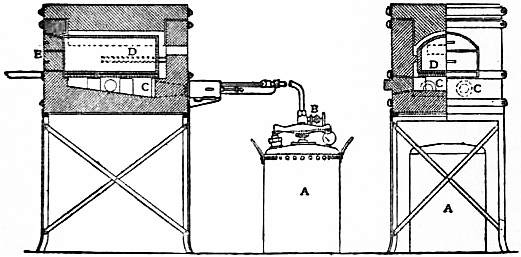
Fig. 1.—Automatic Oil Muffle Furnace.
A muffle furnace, employed for annealing, hardening and tempering is shown in fig. 1; the heat being obtained by means of petroleum, which is contained in the tank A, and is kept under pressure by pumping at intervals with the wooden handle, so that when the valve B is opened the oil is vaporized by passing through a heating coil at the furnace entrance, and when ignited burns fiercely as a gas flame. This passes into the furnace through the two holes, C, C, and plays under and up around the muffle D, standing on a fireclay slab. The doorway is closed by two fireclay blocks at E. A temperature of over 2000° F. can be obtained in furnaces of this class, and the heat is of course under perfect control.
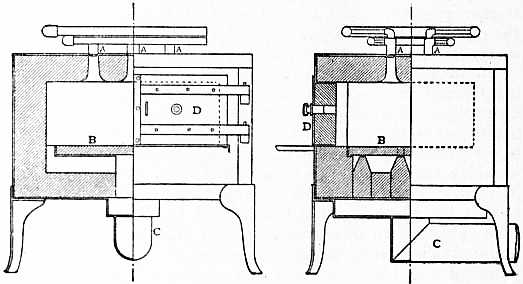
Fig. 2.—Reverbatory Furnace.
A reverberatory type of gas furnace, shown in fig. 2, differs from the oil furnace in having the flames brought down through the roof, by pipes A, A, A, playing on work laid on the fireclay slab B, thence passing under this and out through the elbow-pipe C. The hinged doors, D, give a full opening to the interior of the furnace. It will be noticed in both these furnaces (by Messrs Fletcher, Russell & Co., Ltd.) that the iron casing is a mere shell, enclosing very thick firebrick linings, to retain the heat effectively.
(J. G. H.)
ANNECY, the chief town of the department of Haute Savoie in France. Pop. (1906) 10,763. It is situated at a height of 1470 ft., at the northern end of the lake of Annecy, and is 25 m. by rail N.E. of Aix les Bains. The surrounding country presents many scenes of beauty. The town itself is a pleasant residence, and contains a 16th century cathedral church, an 18th century bishop’s palace, a 14th-16th century castle (formerly the residence of the counts of the Genevois), and the reconstructed convent of the Visitation, wherein now reposes the body of St François de Sales (born at the castle of Sales, close by, in 1567; died at Lyons in 1622), who held the see from 1602 to 1622. There is also a public library, with 20,000 volumes, and various scientific collections, and a public garden, with a statue of the chemist Berthollet (1748-1822), who was born not far off. The bishop’s see of Geneva was transferred hither in 1535, after the Reformation, but suppressed in 1801, though revived in 1822. There are factories of linen and cotton goods, and of felt hats, paper mills, and a celebrated bell foundry at Annecy le Vieux. This last-named place existed in Roman times. Annecy itself was in the 10th century the capital of the counts of the Genevois, from whom it passed in 1401 to the counts of Savoy, and became French in 1860 on the annexation of Savoy.
The Lake of Annecy is about 9 m. in length by 2 m. in breadth, its surface being 1465 ft. above the level of the sea. It discharges its waters, by means of the Thioux canal, into the Fier, a tributary of the Rhone.
(W. A. B. C.)
ANNELIDA, a name derived from J.B.P. Lamarck’s term Annélides, now used to denote a major phylum or division of coelomate invertebrate animals. Annelids are segmented worms, and differ from the Arthropoda (q.v.), which they closely resemble in many respects, by the possession of a portion of the coelom traversed by the alimentary canal. In the latter respect, and in the fact that they frequently develop by a metamorphosis, they approach the Mollusca (q.v.), but they differ from that group notably in the occurrence of metameric segmentation affecting many of the systems of organs. The body-wall is highly muscular and, except in a few probably specialized cases, possesses chitinous spines, the setae, which are secreted by the ectoderm and are embedded in pits of the skin. They possess a modified anterior end, frequently with special sense organs, forming a head, a segmented nervous system, consisting of a pair of anterior, dorsally-placed ganglia, a ring surrounding the alimentary canal, and a double ventral ganglionated chain, a definite vascular system, an excretory system consisting of nephridia, and paired generative organs formed from the coelomic epithelium. They are divided as follows: (1) Haplodrili (q.v.) or Archiannelida; (2) Chaetopoda (q.v.); (3) Myzostomida (q.v.), probably degenerate Polychaeta; (4) Hirudinea (see Chaetopoda and Leech); (5) Echiuroidea (q.v.).
(P. C. M.)
ANNET, PETER (1693-1769), English deist, is said to have been born at Liverpool. A schoolmaster by profession, he became prominent owing to his attacks on orthodox theologians, and his membership of a semi-theological debating society, the Robin Hood Society, which met at the “Robin Hood and Little John” in Butcher Row. To him has been attributed a work called A History of the Man after God’s own Heart (1761), intended to show that George II. was insulted by a current comparison with David. The book is said to have inspired Voltaire’s Saul. It is also attributed to one John Noorthouck (Noorthook). In 1763 he was condemned for blasphemous libel in his paper called the Free Enquirer (nine numbers only). After his release he kept a small school in Lambeth, one of his pupils being James Stephen (1758-1832), who became master in Chancery. Annet died on the 18th of January 1769. He stands between the earlier philosophic deists and the later propagandists of Paine’s school, and “seems to have been the first freethought lecturer” (J.M. Robertson); his essays (A Collection of the Tracts of a certain Free Enquirer, 1739-1745) are forcible but lack refinement. He invented a system of shorthand (2nd ed., with a copy of verses by Joseph Priestley).
ANNEXATION (Lat. ad, to, and nexus, joining), in international law, the act by which a state adds territory to its dominions; the term is also used generally as a synonym for acquisition. The assumption of a protectorate over another state, or of a sphere of influence, is not strictly annexation, the latter implying the complete displacement in the annexed territory of the government or state by which it was previously ruled. Annexation may be the consequence of a voluntary cession from one state to another, or of conversion from a protectorate or sphere of influence, or of mere occupation in uncivilized regions, or of conquest. The cession of Alsace-Lorraine to Germany by France, although brought about by the war of 1870, was for the purposes of international law a voluntary cession. Under the treaty of the 17th of December 1885, between the French republic and the queen of Madagascar, a French protectorate was established over this island. In 1896 this protectorate was converted by France into an annexation, and Madagascar then became “French territory.” The formal annexation of Bosnia-Herzegovina by Austria (Oct. 5, 1908) was an unauthorized conversion of an “occupation” authorized by the Treaty of Berlin (1878), which had, however, for years operated as a de facto annexation. A recent case of conquest was that effected by the South African War of 1899-1902, in which the Transvaal republic and the Orange Free State were extinguished, first de facto by occupation of the whole of their territory, and then de jure by terms of surrender entered into by the Boer generals acting as a government.
By annexation, as between civilized peoples, the annexing state takes over the whole succession with the rights and obligations attaching to the ceded territory, subject only to any modifying conditions contained in the treaty of cession. These, however, are binding only as between the parties to them. In the case of the annexation of the territories of the Transvaal republic and Orange Free State, a rather complicated situation arose out of the facts, on the one hand, that the ceding states closed their own existence and left no recourse to third parties against the previous ruling authority, and, on the other, that, having no means owing to the de facto British occupation, of raising money by taxation, the dispossessed governments raised money by selling certain securities, more especially a large holding of shares in the South African Railway Company, to neutral purchasers. The British government repudiated these sales as having been made by a government which the British government had already displaced. The question of at what point, in a war of conquest, the state succession becomes operative is one of great delicacy. As early as the 6th of January 1900, the high commissioner at Cape Town issued a proclamation giving notice that H.M. government would “not recognize as valid or effectual” any conveyance, transfer or transmission of any property made by the government of the Transvaal republic or Orange Free State subsequently to the 10th of October 1899, the date of the commencement of the war. A proclamation forbidding transactions with a state which might still be capable of maintaining its independence could obviously bind only those subject to the authority of the state issuing it. Like paper blockades (see Blockade) and fictitious occupations of territory, such premature proclamations are viewed by international jurists as not being jure gentium. The proclamation was succeeded, on the 9th of March 1900, by another of the high commissioner at Cape Town, reiterating the notice, but confining it to “lands, railways, mines or mining rights.” And on the 1st of September 1900 Lord Roberts proclaimed at Pretoria the annexation of the territories of the Transvaal republic to the British dominions. That the war continued for nearly two years after this proclamation shows how fictitious the claim of annexation was. The difficulty which arose out of the transfer of the South African Railway shares held by the Transvaal government was satisfactorily terminated by the purchase by the British government of the total capital of the company from the different groups of shareholders (see on this case, Sir Thomas Barclay, Law Quarterly Review, July 1905; and Professor Westlake, in the same Review, October 1905).
In a judgment of the judicial committee of the privy council in 1899 (Coote v. Sprigg, A.C. 572), Lord Chancellor Halsbury made an important distinction as regards the obligations of state succession. The case in question was a claim of title against the crown, represented by the government of Cape Colony. It was made by persons holding a concession of certain rights in eastern Pondoland from a native chief. Before the grantees had taken up their grant by acts of possession, Pondoland was annexed to Cape Colony. The colonial government refused to recognize the grant on different grounds, the chief of them being that the concession conferred no legal rights before the annexation and therefore could confer none afterwards, a sufficiently good ground in itself. The judicial committee, however, rested its decision chiefly on the allegation that the acquisition of the territory was an act of state and that “no municipal court had authority to enforce such an obligation” as the duty of the new government to respect existing titles. “It is no answer,” said Lord Halsbury, “to say that by the ordinary principles of international law private property is respected by the sovereign which accepts the cession and assumes the duties and legal obligations of the former sovereign with respect to such private property within the ceded territory. All that can be meant by such a proposition is that according to the well-understood rules of international law a change of sovereignty by cession ought not to affect private property, but no municipal tribunal has authority to enforce such an obligation. And if there is either an express or a well-understood bargain between the ceding potentate and the government to which the cession is made that private property shall be respected, that is only a bargain which can be enforced by sovereign against sovereign in the ordinary course of diplomatic pressure.” In an editorial note on this case the Law Quarterly Review of Jan. 1900 (p. 1), dissenting from the view of the judicial committee that “no municipal tribunal has authority to enforce such an obligation,” the writer observes that “we can read this only as meant to lay down that, on the annexation of territory even by peaceable cession, there is a total abeyance of justice until the will of the annexing power is expressly made known; and that, although the will of that power is commonly to respect existing private rights, there is no rule or presumption to that effect of which any court must or indeed can take notice.” So construed the doctrine is not only contrary to international law, but according to so authoritative an exponent of the common law as Sir F. Pollock, there is no warrant for it in English common law.
An interesting point of American constitutional law has arisen out of the cession of the Philippines to the United States, through the fact that the federal constitution does not lend itself to the exercise by the federal congress of unlimited powers, such as are vested in the British parliament. The sole authority for the powers of the federal congress is a written constitution with defined powers. Anything done in excess of those powers is null and void. The Supreme Court of the United States, on the other hand, has declared that, by the constitution, a government is ordained and established “for the United States of America” and not for countries outside their limits (Ross’s Case, 140 U.S. 453, 464), and that no such power to legislate for annexed territories as that vested in the British crown in council is enjoyed by the president of the United States (Field v. Clark, 143 U.S. 649, 692). Every detail connected with the administration of the territories acquired from Spain under the treaty of Paris (December 10, 1898) has given rise to minute discussion.
See Carman F. Randolph, Law and Policy of Annexation (New York and London, 1901); Charles Henry Butler, Treaty-making Power of the United States (New York, 1902), vol. i. p. 79 et seq.
(T. Ba.)
ANNICERIS, a Greek philosopher of the Cyrenaic school. There is no certain information as to his date, but from the statement that he was a disciple of Paraebates it seems likely that he was a contemporary of Alexander the Great. A follower of Aristippus, he denied that pleasure is the general end of human life. To each separate action there is a particular end, namely the pleasure which actually results from it. Secondly, pleasure is not merely the negation of pain, inasmuch as death ends all pain and yet cannot be regarded as pleasure. There is, however, an absolute pleasure in certain virtues such as belong to the love of country, parents and friends. In these relations a man will have pleasure, even though it may result in painful and even fatal consequences. Friendship is not merely for the satisfaction of our needs, but is in itself a source of pleasure. He maintains further, in opposition to most of the Cyrenaic school, that wisdom or prudence alone is an insufficient guarantee against error. The wise man is he who has acquired a habit of wise action; human wisdom is liable to lapses at any moment. Diogenes Laertius says that Anniceris ransomed Plato from Dionysius, tyrant of Syracuse, for twenty minas. If we are right in placing Anniceris in the latter half of the 4th century, it is clear that the reference here is to an earlier Anniceris, who, according to Aelian, was a celebrated charioteer.
ANNING, MARY (1799-1847), English fossil-collector, the daughter of Richard Anning, a cabinet-maker, was born at Lyme Regis in May 1799. Her father was one of the earliest collectors and dealers in fossils, obtained chiefly from the Lower Lias in that famous locality. When but a child in 1811 she discovered the first specimen of Ichthyosaurus which was brought into scientific notice; in 1821 she found remains of a new saurian, the Plesiosaurus and in 1828 she procured, for the first time in England, remains of a pterodactyl (Dimorphodon). She died on the 9th of March 1847.
ANNISTON, a city and the county seat of Calhoun county, Alabama, U.S.A., in the north-eastern part of the state, about 63 m. E. by N. of Birmingham. Pop. (1890) 9998; (1900), 9695, of whom 3669 were of negro descent; (1910 census) 12,794. Anniston is served by the Southern, the Seaboard Air Line, and the Louisville & Nashville railways. The city is situated on the slope of Blue Mountain, a chain of the Blue Ridge, and is a health resort. It is the seat of the Noble Institute (for girls), established in 1886 by Samuel Noble (1834-1888), a wealthy iron-founder, and of the Alabama Presbyterian College for Men (1905). There are vast quantities of iron ore in the vicinity of the city, the Coosa coal-fields being only 25 m. distant. Anniston is an important manufacturing city, the principal industries being the manufacture of iron, steel and cotton. In 1905 the city’s factory products were valued at $2,525,455. An iron furnace was established on the site of Anniston during the Civil War, but it was destroyed by the federal troops in 1865; and in 1872 it was rebuilt on a much larger scale. The city was founded in 1872 as a private enterprise, by the Woodstock Iron Company, organized by Samuel Noble and Gen. Daniel Tyler (1799-1882); but it was not opened for general settlement until twelve years later. It was chartered as a city in 1879.
ANNO, or Hanno, SAINT (c. 1010-1075), archbishop of Cologne, belonged to a Swabian family, and was educated at Bamberg. He became confessor to the emperor Henry III., who appointed him archbishop of Cologne in 1056. He took a prominent part in the government of Germany during the minority of King Henry IV., and was the leader of the party which in 1062 seized the person of Henry, and deprived his mother, the empress Agnes, of power. For a short time Anno exercised the chief authority in the kingdom, but he was soon obliged to share this with Adalbert, archbishop of Bremen, retaining for himself the supervision of Henry’s education and the title of magister. The office of chancellor of the kingdom of Italy was at this period regarded as an appanage of the archbishopric of Cologne, and this was probably the reason why Anno had a considerable share in settling the papal dispute in 1064. He declared Alexander II. to be the rightful pope at a synod held at Mantua in May 1064, and took other steps to secure his recognition. Returning to Germany, he found the chief power in the hands of Adalbert, and as he was disliked by the young king, he left the court but returned and regained some of his former influence when Adalbert fell from power in 1066. He succeeded in putting down a rising against his authority in Cologne in 1074, and it was reported he had allied himself with William the Conqueror, king of England, against the emperor. Having cleared himself of this charge, Anno took no further part in public business, and died at Cologne on the 4th of December 1075. He was buried in the monastery of Siegburg and was canonized in 1183 by Pope Lucius III. He was a founder of monasteries and a builder of churches, advocated clerical celibacy and was a strict disciplinarian. He was a man of great energy and ability, whose action in recognizing Alexander II. was of the utmost consequence for Henry IV. and for Germany.
There is a Vita Annonis, written about 1100, by a monk of Siegburg, but this is of slight value. It appears in the Monumenta Germaniae historica: Scriptores, Bd. xi. (Hanover and Berlin, 1826-1892). There is an “Epistola ad monachos Malmundarienses” by Anno in the Neues Archiv der Gesellschaft für altere deutsche Geschichtskunde, Bd. xiv. (Hanover, 1876 seq.). See also the Annolied, or Incerti poetae Teutonici rhythmus de S. Annone, written about 1180, and edited by J. Kehrein (Frankfort, 1865); Th. Lindner, Anno II. der Heilige, Erzbischof von Koln (Leipzig, 1869).
ANNOBON, or Anno Bom, an island in the Gulf of Guinea, in 1° 24′ S. and 5° 35′ E., belonging to Spain. It is 110 m. S.W. of St Thomas. Its length is about 4 m., its breadth 2, and its area 6¾ sq. m. Rising in some parts nearly 3000 ft. above the sea, it presents a succession of beautiful valleys and steep mountains, covered with rich woods and luxuriant vegetation. The inhabitants, some 3000 in number, are negroes and profess belief in the Roman Catholic faith. The chief town and residence of the governor is called St Antony (San Antonio de Praia). The roadstead is tolerably safe, and passing vessels take advantage of it in order to obtain water and fresh provisions, of which Annobon contains an abundant supply. The island was discovered by the Portuguese on the 1st of January 1473, from which circumstance it received its name (= New Year). Annobon, together with Fernando Po, was ceded to Spain by the Portuguese in 1778. The islanders revolted against their new masters and a state of anarchy ensued, leading, it is averred, to an arrangement by which the island was administered by a body of five natives, each of whom held the office of governor during the period that elapsed till ten ships touched at the island. In the latter part of the 19th century the authority of Spain was re-established.
ANNONA (from Lat. annus, year), in Roman mythology, the personification of the produce of the year. She is represented in works of art, often together with Ceres, with a cornucopia (horn of plenty) in her arm, and a ship’s prow in the background, indicating the transport of grain over the sea. She frequently occurs on coins of the empire, standing between a modius (corn-measure) and the prow of a galley, with ears of corn in one hand and a cornucopia in the other; sometimes she holds a rudder or an anchor. The Latin word itself has various meanings: (1) the produce of the year’s harvest; (2) all means of subsistence, especially grain stored in the public granaries for provisioning the city; (3) the market-price of commodities, especially corn; (4) a direct tax in kind, levied in republican times in several provinces, chiefly employed in imperial times for distribution amongst officials and the support of the soldiery.
In order to ensure a supply of corn sufficient to enable it to be sold at a very low price, it was procured in large quantities from Umbria, Etruria and Sicily. Almost down to the times of the empire, the care of the corn-supply formed part of the aedile’s duties, although in 440 B.C. (if the statement in Livy iv. 12, 13 is correct, which is doubtful) the senate appointed a special officer, called praefectus annonae, with greatly extended powers. As a consequence of the second Punic War, Roman agriculture was at a standstill; accordingly, recourse was had to Sicily and Sardinia (the first two Roman provinces) in order to keep up the supply of corn; a tax of one-tenth was imposed on it, and its export to any country except Italy forbidden. The price at which the corn was sold was always moderate; the corn law of Gracchus (123 B.C.) made it absurdly low, and Clodius (58 B.C.) bestowed it gratuitously. The number of the recipients of this free gift grew so enormously, that both Caesar and Augustus were obliged to reduce it. From the time of Augustus to the end of the empire the number of those who were entitled to receive a monthly allowance of corn on presenting a ticket was 200,000. In the 3rd century, bread formed the dole. A praefectus annonae was appointed by Augustus to superintend the corn-supply; he was assisted by a large staff in Rome and the provinces, and had jurisdiction in all matters connected with the corn-market. The office lasted till the latest times of the empire.
ANNONAY, a town of south-eastern France, in the north of the department of Ardèche, 50 m. S. of Lyons by the Paris-Lyons railway. Pop. (1906) 15,403. Annonay is built on the hill overlooking the meeting of the deep gorges of the Déôme and the Cance, the waters of which supply power to the factories of the town. By means of a dam across the Ternay, an affluent of the Déôme, to the north-west of the town, a reservoir is provided, in which an additional supply of water, for both industrial and domestic purposes, is stored. At Annonay there is an obelisk in honour of the brothers Montgolfier, inventors of the balloon, who were natives of the place. A tribunal of commerce, a board of trade-arbitrators, a branch of the Bank of France, and chambers of commerce and of arts and manufactures are among the public institutions. Annonay is the principal industrial centre of its department, the chief manufactures being those of leather, especially for gloves, paper, silk and silk goods, and flour. Chemical manures, glue, gelatine, brushes, chocolate and candles are also produced.
ANNOY (like the French ennui, a word traced by etymologists to a Lat. phrase, in odio esse, to be “in hatred” or hateful of someone), to vex or affect with irritation. In the sense of “nuisance,” the noun “annoyance,” apart from its obvious meaning, is found in the English “Jury of Annoyance” appointed by an act of 1754 to report upon obstructions in the highways.
ANNUITY (from Lat. annus, a year), a periodical payment, made annually, or at more frequent intervals, either for a fixed term of years, or during the continuance of a given life, or a combination of lives. In technical language an annuity is said to be payable for an assigned status, this being a general word chosen in preference to such words as “time,” “term” or “period,” because it may include more readily either a term of years certain, or a life or combination of lives. The magnitude of the annuity is the sum to be paid (and received) in the course of each year. Thus, if £100 is to be received each year by a person, he is said to have “an annuity of £100.” If the payments are made half-yearly, it is sometimes said that he has “a half-yearly annuity of £100”; but to avoid ambiguity, it is more commonly said he has an annuity of £100, payable by half-yearly instalments. The former expression, if clearly understood, is preferable on account of its brevity. So we may have quarterly, monthly, weekly, daily annuities, when the annuity is payable by quarterly, monthly, weekly or daily instalments. An annuity is considered as accruing during each instant of the status for which it is enjoyed, although it is only payable at fixed intervals. If the enjoyment of an annuity is postponed until after the lapse of a certain number of years, the annuity is said to be deferred. If an annuity, instead of being payable at the end of each year, half-year, &c., is payable in advance, it is called an annuity-due.
If an annuity is payable for a term of years independent of any contingency, it is called an annuity certain; if it is to continue for ever, it is called a perpetuity; and if in the latter case it is not to commence until after a term of years, it is called a deferred perpetuity. An annuity depending on the continuance of an assigned life or lives, is sometimes called a life annuity; but more commonly the simple term “annuity” is understood to mean a life annuity, unless the contrary is stated. A life annuity, to cease in any event after a certain term of years, is called a temporary annuity. The holder of an annuity is called an annuitant, and the person on whose life the annuity depends is called the nominee.
If not otherwise stated, it is always understood that an annuity is payable yearly, and that the annual payment (or rent, as it is sometimes called) is £1. It is, however, customary to consider the annual payment to be, not £1, but simply 1, the reader supplying whatever monetary unit he pleases, whether pound, dollar, franc, Thaler, &c.
The annuity is the totality of the payments to be made (and received), and is so understood by all writers on the subject; but some have also used the word to denote an individual payment (or rent), speaking, for instance, of the first or second year’s annuity,—a practice which is calculated to introduce confusion and should therefore be carefully avoided.
Instances of perpetuities are the dividends upon the public stocks in England, France and some other countries. Thus, although it is usual to speak of £100 consols, the reality is the yearly dividend which the government pays by quarterly instalments. The practice of the French in this, as in many other matters, is more logical. In speaking of their public funds (rentes) they do not mention the ideal capital sum, but speak of the annuity or annual payment that is received by the public creditor. Other instances of perpetuities are the incomes derived from the debenture stocks of railway companies, also the feu-duties commonly payable on house property in Scotland. The number of years’ purchase which the perpetual annuities granted by a government or a railway company realize in the open market, forms a very simple test of the credit of the various governments or railways.
Terminable Annuities are employed in the system of British public finance as a means of reducing the National Debt (q.v.). This result is attained by substituting for a perpetual annual charge (or one lasting until the capital which it represents can be paid off en bloc), an annual charge of a larger amount, but lasting for a short term. The latter is so calculated as to pay off, during its existence, the capital which it replaces, with interest at an assumed or agreed rate, and under specified conditions. The practical effect of the substitution of a terminable annuity for an obligation of longer currency is to bind the present generation of citizens to increase its own obligations in the present and near future in order to diminish those of its successors. This end might be attained in other ways; for instance, by setting aside out of revenue a fixed annual sum for the purchase and cancellation of debt (Pitt’s method, in intention), or by fixing the annual debt charge at a figure sufficient to provide a margin for reduction of the principal of the debt beyond the amount required for interest (Sir Stafford Northcote’s method), or by providing an annual surplus of revenue over expenditure (the “Old Sinking Fund”), available for the same purpose. All these methods have been tried in the course of British financial history, and the second and third of them are still employed; but on the whole the method of terminable annuities has been the one preferred by chancellors of the exchequer and by parliament.
Terminable annuities, as employed by the British government, fall under two heads:—(a) Those issued to, or held by private persons; (b) those held by government departments or by funds under government control. The important difference between these two classes is that an annuity under (a), once created, cannot be modified except with the holder’s consent, i.e. is practically unalterable without a breach of public faith; whereas an annuity under (b) can, if necessary, be altered by interdepartmental arrangement under the authority of parliament. Thus annuities of class (a) fulfil most perfectly the object of the system as explained above; while those of class (b) have the advantage that in times of emergency their operation can be suspended without any inconvenience or breach of faith, with the result that the resources of government can on such occasions be materially increased, apart from any additional taxation. For this purpose it is only necessary to retain as a charge on the income of the year a sum equal to the (smaller) perpetual charge which was originally replaced by the (larger) terminable charge, whereupon the difference between the two amounts is temporarily released, while ultimately the increased charge is extended for a period equal to that for which it is suspended. Annuities of class (a) were first instituted in 1808, but are at present mainly regulated by an act of 1829. They may be granted either for a specified life, or two lives, or for an arbitrary term of years; and the consideration for them may take the form either of cash or of government stock, the latter being cancelled when the annuity is set up. Annuities (b) held by government departments date from 1863. They have been created in exchange for permanent debt surrendered for cancellation, the principal operations having been effected in 1863, 1867, 1870, 1874, 1883 and 1899. Annuities of this class do not affect the public at all, except of course in their effect on the market for government securities. They are merely financial operations between the government, in its capacity as the banker of savings banks and other funds, and itself, in the capacity of custodian of the national finances. Savings bank depositors are not concerned with the manner in which government invests their money, their rights being confined to the receipt of interest and the repayment of deposits upon specified conditions. The case is, however, different as regards forty millions of consols (included in the above figures), belonging to suitors in chancery, which were cancelled and replaced by a terminable annuity in 1883. As the liability to the suitors in that case was for a specified amount of stock, special arrangements were made to ensure the ultimate replacement of the precise amount of stock cancelled.
Annuity Calculations.—The mathematical theory of life annuities is based upon a knowledge of the rate of mortality among mankind in general, or among the particular class of persons on whose lives the annuities depend. It involves a mathematical treatment too complicated to be dealt with fully in this place, and in practice it has been reduced to the form of tables, which vary in different places, but which are easily accessible. The history of the subject may, however, be sketched. Abraham Demoivre, in his Annuities on Lives, propounded a very simple law of mortality which is to the effect that, out of 86 children born alive, 1 will die every year until the last dies between the ages of 85 and 86. This law agreed sufficiently well at the middle ages of life with the mortality deduced from the best observations of his time; but, as observations became more exact, the approximation was found to be not sufficiently close. This was particularly the case when it was desired to obtain the value of joint life, contingent or other complicated benefits. Therefore Demoivre’s law is entirely devoid of practical utility. No simple formula has yet been discovered that will represent the rate of mortality with sufficient accuracy.
The rate of mortality at each age is, therefore, in practice usually determined by a series of figures deduced from observation; and the value of an annuity at any age is found from these numbers by means of a series of arithmetical calculations. The mortality table here given is an example of modern use.
The first writer who is known to have attempted to obtain, on correct mathematical principles, the value of a life annuity, was Jan De Witt, grand pensionary of Holland and West Friesland. Our knowledge of his writings on the subject is derived from two papers contributed by Frederick Hendriks to the Assurance Magazine, vol. ii. p. 222, and vol. in. p. 93. The former of these contains a translation of De Witt’s report upon the value of life annuities, which was prepared in consequence of the resolution passed by the states-general, on the 25th of April 1671, to negotiate funds by life annuities, and which was distributed to the members on the 30th of July 1671. The latter contains the translation of a number of letters addressed by De Witt to Burgomaster Johan Hudde, bearing dates from September 1670 to October 1671. The existence of De Witt’s report was well known among his contemporaries, and Hendriks collected a number of extracts from various authors referring to it; but the report is not contained in any collection of his works extant, and had been entirely lost for 180 years, until Hendriks discovered it among the state archives of Holland in company with the letters to Hudde. It is a document of extreme interest, and (notwithstanding some inaccuracies in the reasoning) of very great merit, more especially considering that it was the very first document on the subject that was ever written.
Table of Mortality—Hm, Healthy Lives—Male.
Number Living and Dying at each Age, out of 10,000 entering at Age 10.
Age. Living. Dying. Age. Living. Dying.
10 10,000 79 54 6791 129
11 9,921 0 55 6662 153
12 9,921 40 56 6509 150
13 9,881 35 57 6359 152
14 9,846 40 58 6207 156
15 9,806 22 59 6051 153
16 9,784 0 60 5898 184
17 9,784 41 61 5714 186
18 9,743 59 62 5528 191
19 9,684 68 63 5337 200
20 9,616 56 64 5137 206
21 9,560 67 65 4931 215
22 9,493 59 66 4716 220
23 9,434 73 67 4496 220
24 9,361 64 68 4276 237
25 9,297 48 69 4039 246
26 9,249 64 70 3793 213
27 9,185 60 71 3580 222
28 9,125 71 72 3358 268
29 9,054 67 73 3090 243
30 8,987 74 74 2847 300
31 8,913 65 75 2547 241
32 8,848 74 76 2306 245
33 8,774 73 77 2061 224
34 8,701 76 78 1837 226
35 8,625 71 79 1611 219
36 8,554 75 80 1392 196
37 8,479 81 81 1196 191
38 8,398 87 82 1005 173
39 8,311 88 83 832 172
40 8,223 81 84 660 119
41 8,142 85 85 541 117
42 8,057 87 86 424 92
43 7,970 84 87 332 72
44 7,886 93 88 260 74
45 7,793 97 89 186 36
46 7,696 96 90 150 34
47 7,600 107 91 116 36
48 7,493 106 92 80 36
49 7,387 113 93 44 29
50 7,274 120 94 15 0
51 7,154 124 95 15 5
52 7,030 120 96 10 10
53 6,910 119
It appears that it had long been the practice in Holland for life annuities to be granted to nominees of any age, in the constant proportion of double the rate of interest allowed on stock; that is to say, if the towns were borrowing money at 6%, they would be willing to grant a life annuity at 12%, and so on. De Witt states that “annuities have been sold, even in the present century, first at six years’ purchase, then at seven and eight; and that the majority of all life annuities now current at the country’s expense were obtained at nine years’ purchase”; but that the price had been increased in the course of a few years from eleven years’ purchase to twelve, and from twelve to fourteen. He also states that the rate of interest had been successively reduced from 6¼ to 5%, and then to 4%. The principal object of his report is to prove that, taking interest at 4%, a life annuity was worth at least sixteen years’ purchase; and, in fact, that an annuitant purchasing an annuity for the life of a young and healthy nominee at sixteen years’ purchase, made an excellent bargain. It may be mentioned that he argues that it is more to the advantage, both of the country and of the private investor, that the public loans should be raised by way of grant of life annuities rather than perpetual annuities. It appears conclusively from De Witt’s correspondence with Hudde, that the rate of mortality assumed as the basis of his calculations was deduced from careful examination of the mortality that had actually prevailed among the nominees on whose lives annuities had been granted in former years. De Witt appears to have come to the conclusion that the probability of death is the same in any half-year from the age of 3 to 53 inclusive; that in the next ten years, from 53 to 63, the probability is greater in the ratio of 3 to 2; that in the next ten years, from 63 to 73, it is greater in the ratio of 2 to 1; and in the next seven years, from 73 to 80, it is greater in the ratio of 3 to 1; and he places the limit of human life at 80. If a mortality table of the usual form is deduced from these suppositions, out of 212 persons alive at the age of 3, 2 will die every year up to 53, 3 in each of the ten years from 53 to 63, 4 in each of the next ten years from 63 to 73, and 6 in each of the next seven years from 73 to 80, when all will be dead.
De Witt calculates the value of an annuity in the following way. Assume that annuities on 10,000 lives each ten years of age, which satisfy the Hm mortality table, have been purchased. Of these nominees 79 will die before attaining the age of 11, and no annuity payment will be made in respect of them; none will die between the ages of 11 and 12, so that annuities will be paid for one year on 9921 lives; 40 attain the age of 12 and die before 13, so that two payments will be made with respect to these lives. Reasoning in this way we see that the annuities on 35 of the nominees will be payable for three years; on 40 for four years, and so on. Proceeding thus to the end of the table, 15 nominees attain the age of 95, 5 of whom die before the age of 96, so that 85 payments will be paid in respect of these 5 lives. Of the survivors all die before attaining the age of 97, so that the annuities on these lives will be payable for 86 years. Having previously calculated a table of the values of annuities certain for every number of years up to 86, the value of all the annuities on the 10,000 nominees will be found by taking 40 times the value of an annuity for 2 years, 35 times the value of an annuity for 3 years, and so on—the last term being the value of 10 annuities for 86 years—and adding them together; and the value of an annuity on one of the nominees will then be found by dividing by 10,000. Before leaving the subject of De Witt, we may mention that we find in the correspondence a distinct suggestion of the law of mortality that bears the name of Demoivre. In De Witt’s letter, dated the 27th of October 1671 (Ass. Mag. vol. iii. p. 107), he speaks of a “provisional hypothesis” suggested by Hudde, that out of 80 young lives (who, from the context, may be taken as of the age 6) about 1 dies annually. In strictness, therefore, the law in question might be more correctly termed Hudde’s than Demoivre’s.