THREE LOVES.
Reading edition
From “Emma.”
Costumes.
Emma. Short dress of muslin, sprigged with a blue flower, trimmed with sapphire blue velvet, under sleeves of ruched net, sapphire velvet in the hair.
Harriet. Black silk pelerine, with long ends; white cambric dress; bonnet of white sarsnet, tied with pale rose-coloured ribbons; coral necklace.
Mr Knightley. Buff-coloured coat, with dark velvet collar, high stock; frilled shirt front; short waistcoat of deep blue; cream-coloured breeches.
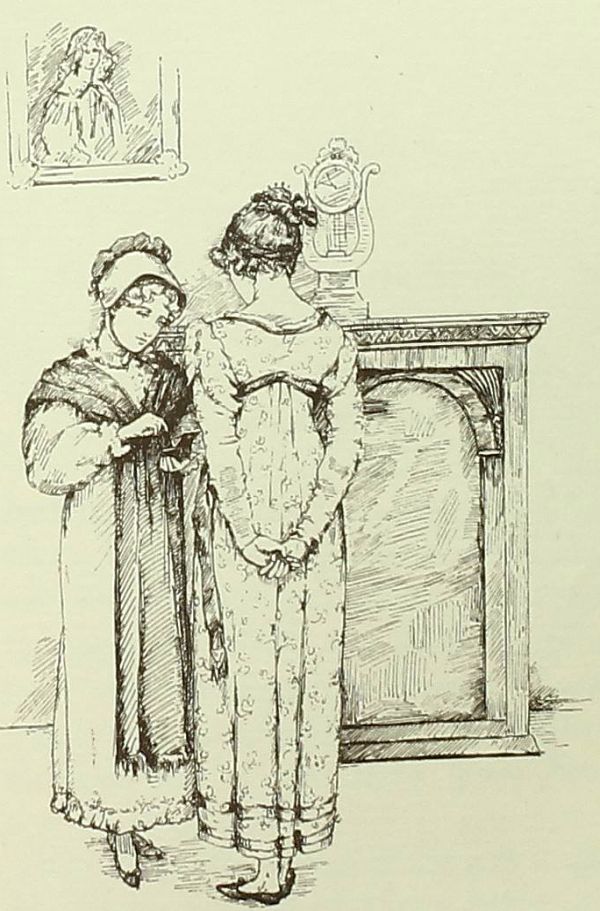
Emma and Harriet.
THREE LOVES.
Characters.
Emma Woodhouse, Harriet Smith, Mr Knightley.
N.B.—“Emma Woodhouse, handsome, clever and rich, with a comfortable home and happy disposition, seemed to unite some of the best blessings of existence, and had lived nearly twenty-one years in the world with very little to distress or vex her. She was the youngest of the two daughters of a most affectionate, indulgent father; and had, in consequence of her sister’s (Isabella) marriage, been mistress of his house from a very early period.
The real evils, indeed, of Emma’s situation were the power of having rather too much her own way, and a disposition to think a little too well of herself.”—Emma, Chap. I.
“Mr Knightley, a sensible man about seven or eight-and-thirty, was not only a very old and intimate friend of the family, but particularly connected with it as the elder brother of Isabella’s husband. He lived about a mile from Hartfield, was a frequent visitor, and always welcome.... Mr Knightley had a cheerful manner, which always did him (Mr Woodhouse) good.... Mr Knightley, in fact, was one of the few people who could see faults in Emma Woodhouse, and the only one who ever told her of them.”—Emma, Chap. I.
“Harriet Smith was the natural daughter of somebody. Somebody had placed her several years back at Mrs Goddard’s school, and somebody had lately raised her from the condition of scholar to that of parlour boarder. This was all that was generally known of her history.... She was a very pretty girl, and her beauty happened to be of a sort which Emma particularly admired.... She was short, plump, and fair, with a fine bloom, blue eyes, light hair, regular features, and a look of great sweetness.... She (Emma) was not struck by anything remarkably clever in Miss Smith’s conversation, but she found her altogether engaging—not inconveniently shy, nor unwilling to talk—and yet so far from pushing, showing so proper and becoming a deference, seeming so pleasantly grateful for being admitted to Hartfield, and so artlessly impressed by the appearance of everything in so superior a style to what she had been used to, that she must have good sense and deserve encouragement. Encouragement should be given.... She would notice her. She would improve her ... and introduce her into good society; she would form her opinions and manners.... As a walking companion, Emma had very early foreseen how useful she might find her ... and a Harriet Smith, therefore, one whom she could summon at any time to a walk, would be a valuable addition to her privileges. But in every respect, as she saw more of her, she approved her, and was confirmed in all her kind designs.”—Emma, Chaps. III. and IV.
Scene—The morning-room at Hartfield. It is comfortably furnished. No special properties are required except a centre table with two chairs on either side of it; a work frame near one of the chairs, a window at the back, and a fireplace with a lighted fire. Enter Emma, with an open letter in her hand.
Emma. I can scarcely believe it. Jane Fairfax engaged to Frank Churchill! Engaged to her all the winter—secretly engaged before either of them came to Highbury. And I have encouraged my poor friend, Harriet Smith, to think well of him, so she will be a second time the dupe of my misconceptions and flattery. It seems like a fatality. No sooner do I conceive the idea of arranging a suitable marriage for her, than the man whom I choose deliberately engages himself to another. I ought to have felt only too thankful to have her forget the insufferable Mr Elton so soon after his marriage, instead of trying to rouse her affections for Frank Churchill. But what right had he to come among us with affection and faith engaged, and with manners so very disengaged? How could he tell that he might not be making me in love with him? I cannot deny, indeed, that there was a time, in the early period of our acquaintance, when I was very much pleased with his attentions, when I was very much disposed to be attached to him—nay, was attached—and how it came to cease is perhaps the wonder.
Harriet (outside). Miss Woodhouse, are you within, and will you see me?
Emma. Harriet! (folding the letter hastily and putting it away). Yes, yes, pray come in. (Enter Harriet, who curtseys at the door.) You know I am always glad to see you, Harriet. (Aside.) I wonder if she has heard the news. She looks dejected.
Harriet (with a small parcel in her hand). Miss Woodhouse, dear Miss Woodhouse, you are always good to me. A great deal too good—but if you are at leisure, I have something that I should like to tell you; a sort of confession to make, and then, you know, it will be over.
Emma (sighs, aside). Poor Harriet.
Harriet. It is my duty, and I am sure it is my wish, to have no reserves with you on this subject. As I am, happily, quite an altered creature in one respect, it is very fit that you should have the satisfaction of knowing it. I do not want to say more than is necessary. I am too much ashamed of having given way as I have done, and I daresay you understand me.
Emma. I think I do, my poor Harriet—I hope I do; but it is all my fault—all my fault.
Harriet. Oh! Miss Woodhouse, do not say such a thing! How could I so long a time be fancying myself—It seems like madness, I can see nothing at all extraordinary in him now.
Emma (aside). To whom is she alluding—Mr Elton or Frank Churchill? One never can tell.
Harriet. I do not care whether I meet him or not, except that of the two I had rather not see him; and, indeed, I would go any distance round to avoid him. But I do not envy Mrs Elton in the least.
Emma (aside). Ah! it’s Mr Elton, not Frank Churchill.
Harriet. She is very charming, I dare say, and all that, but I think her very ill-tempered and disagreeable. However, I assure you, Miss Woodhouse, I wish her no evil. No; let them be ever so happy together, it will not give me another moment’s pang; and, to convince you that I have been speaking truth, I am now going to destroy—what I ought to have destroyed long ago—what I ought never to have kept: I know that very well—However, now I will destroy it all; and it is my particular wish to do it in your presence, that you may see how rational I am grown (sighs). Cannot you guess what this parcel holds?
Emma. Not the least in the world. Did he ever give you anything?
Harriet. No, I cannot call them gifts; but they are things that I have valued very much (holding out the parcel to Emma).
Emma (taking it and reading). “Most precious treasures.” Harriet, are you sure you would wish me to see these treasures?
Harriet. Yes, please, dear Miss Woodhouse.
Emma (undoing the parcel, which is wrapped up in several pieces of paper and lined with cotton wool). A piece of court plaister!!!
Harriet. Now, you must recollect.
Emma. No, indeed, I do not.
Harriet. Dear me! I should not have thought it possible you could forget what passed in this very room about court plaister, one of the very last times we ever met in it. It was a very few days before I had my sore throat—I think the very evening before. Do not you remember his cutting his finger with your new penknife, and your recommending court plaister? But, as you had none about you, and knew I had, you desired me to supply him. So I took mine out and cut him a piece, but in my agitation I cut it a great deal too large, and he had to make it smaller, and kept playing some time with what was left before he gave it back to me. And so then, in my nonsense, I could not help making a treasure of it; so I put it by, never to be used, and looked at it now and then as a great treat.
Emma (putting her hands before her face). My dearest Harriet! you make me more ashamed of myself than I can bear. Remember it? Aye, I remember it all now; all except your saving this relic; I knew nothing of that till this moment; but the cutting the finger, and my recommending court plaister and saying I had none about me—Oh! my sins! my sins!—And I had plenty all the while in my pocket! One of my senseless tricks! I deserve to be under a continual blush all the rest of my life.—Well (sitting down), go on, what else?
Harriet. And had you really some at hand yourself? I am sure I never suspected it. You did it so naturally.
Emma. And so you actually put this piece of court plaister by for his sake. (Aside), Lord bless me! when should I ever have thought of putting by in cotton a piece of court plaister that anybody had been fingering. I shall never be equal to this.
Harriet. There is something still more valuable—I mean that has been more valuable because it is what did really once belong to him, which the court plaister never did? It is in the same box wrapped up in another piece of silver paper.
Emma (unfolding a very small roll). I am quite anxious to see this superior treasure, Harriet. What is it?—The end of an old pencil! the part without any lead!! What is this, Harriet?
Harriet. That was really his. Do not you remember one morning?—No, I daresay you do not—but one morning—I forget exactly the day, but perhaps it was the Wednesday or Tuesday before that evening, he wanted to make a memorandum in his pocket-book; it was about spruce beer. Mr Knightley (hanging her head) had been telling him something about brewing spruce beer, and he wanted to put it down; but when he took out his pencil, there was so little lead that he soon cut it all away and it would not do, so you lent him another, and this was left upon the table as good for nothing. But I kept my eye upon it, and as soon as I dared, caught it up, and never parted with it again from that moment.
Emma. I do remember it. I perfectly remember it—talking of spruce beer. Oh! yes, Mr Knightley and I both saying we liked it, and Mr Elton’s seeming resolved to learn to like it too. I perfectly remember it—Stop; Mr Knightley was standing just here, was not he? I have an idea he was standing just here.
Harriet (confused). I do not know. I cannot recollect. It is very odd—but I cannot recollect where Mr Knightley was standing. Mr Elton was sitting here, I remember, much about where I am.
Emma. Well, go on.
Harriet. Oh! that is all. I have nothing more to show you, or to say, except that I am now going to throw them both behind the fire, and I wish you to see me do it.
Emma. My poor dear Harriet! and have you actually found happiness in treasuring up these things?
Harriet (sighing). Yes, simpleton as I was!—but I am quite ashamed of it now, and wish I could forget as easily as I can burn them. It was so wrong of me, you know, to keep any remembrance after he was married, and when I had conceived so deep, so reverential a regard for another. I knew it was, but I had not resolution enough to part with them.
Emma. But, Harriet, is it necessary to burn the court plaister? I have not a word to say for the bit of old pencil, but the court plaister might be useful.
Harriet. I shall be happier to burn it. It has a disagreeable look to me. I must get rid of everything. I must not keep it now. It is not right towards him who is so superior in every way, so infinitely superior. (Emma groans.) These are no longer treasures. There they go (throwing them into the fire), and there is an end, thank Heaven! of Mr Elton. (Turning cheerfully to Emma.) Ah! I feel happier now—much happier! But, oh! Miss Woodhouse, is not this the oddest news that ever was?
Emma (perplexed). What news do you mean?
Harriet. Why, about Jane Fairfax. Did you ever hear anything so strange? Oh! you need not be afraid of owning it to me, for Mr Weston has told me himself. I met him just now. He told me it was to be a great secret; and therefore I should not think of mentioning it to anybody but you, but he said you knew it.
Emma (still perplexed). What did Mr Weston tell you?
Harriet. Oh! he told me all about it; that Jane Fairfax and Mr Frank Churchill are to be married, and that they have been privately engaged to one another this long while. How very odd.
Emma (staring). You know all about it?
Harriet. Yes! Had you any idea of his being in love with her?—you perhaps might (hanging her head)—you who can see into everybody’s heart; but nobody else—
Emma. Upon my word, I begin to doubt my having any such talent. Can you seriously ask me, Harriet, whether I imagined him attached to another woman at the very time that I was—tacitly, if not openly—encouraging you to give way to your own feelings? I never had the slightest suspicion, till within the last hour, of Mr Frank Churchill’s having the least regard for Jane Fairfax. You may be very sure that, if I had, I should have cautioned you accordingly.
Harriet (in astonishment). Me! why should you caution me? You do not think I care about Mr Frank Churchill?
Emma (laughing uneasily). I am delighted to hear you speak so stoutly on the subject. But you do not mean to deny that there was a time—and not very distant either—when you gave me reason to understand that you did care about him.
Harriet. Him!—never, never. Dear Miss Woodhouse, how could you so mistake me? (turning away distressed.)
Emma. Harriet, what do you mean? (A pause.) Good heaven! what do you mean? Mistake you! am I to suppose—?
Harriet (with her back to Emma). I should not have thought it possible that you could have misunderstood me! I know we agreed never to name him—but, considering how infinitely superior he is to everybody else, I should not have thought it possible that I could be supposed to mean any other person. Mr Frank Churchill, indeed! I do not know who would ever look at him in the company of the other. And that you should have been so mistaken is amazing.
Emma (collecting herself resolutely). Harriet, let us understand each other now, without the possibility of further mistake. (With great effort.) Are you speaking—of Mr Knightley?
Harriet. To be sure I am. I never could have an idea of anybody else—and so I thought you knew. When we talked about him, it was as clear as possible.
Emma (with forced calmness). Not quite, for all that you then said appeared to me to relate to a different person. I could almost assert that you named Mr Frank Churchill.
Harriet. Oh! Miss Woodhouse, never—never.
Emma. Well, I am sure the service Mr Frank Churchill had rendered you, in protecting you from the gipsies, was spoken of.
Harriet. Miss Woodhouse! how you do forget!
Emma. My dear Harriet, I perfectly remember the substance of what I said on the occasion. I told you that I did not wonder at your attachment; that, considering the service he had rendered you, it was extremely natural:—and you agreed to it, expressing yourself very warmly as to your sense of that service, and mentioning even what your sensations had been in seeing him come forward to your rescue. The impression of it is strong on my memory.
Harriet. Oh! dear! now I recollect what you mean; but I was thinking of something very different at the time. It was not the gipsies.—It was not Mr Frank Churchill that I meant. No—(with some elevation)—I was thinking of a much more precious circumstance—of Mr Knightley’s coming and asking me to dance, when Mr Elton would not stand up with me, and when there was no other partner in the room. That was the kind action; that was the noble benevolence and generosity; that was the service which made me begin to feel how superior he was to any other being upon earth.
Emma (with emotion). Good God! this has been a most unfortunate—most deplorable mistake! What is to be done?
Harriet (timidly). You would not have encouraged me, then, if you had understood me. At least, however, I cannot be worse off than I should have been if Mr Churchill had been the person; and now—it is possible—for you see, that supposing—that if—strange as it may appear—But you know they were your own words, that more wonderful things had happened; matches of greater disparity had taken place than between Mr Frank Churchill and me; and, therefore, it seems as if such a thing even as this may have occurred before; and if I should be so fortunate, beyond expression, as to—if Mr Knightley should really—if he does not mind the disparity, I hope, dear Miss Woodhouse, you will not set yourself against it, and try and put difficulties in the way. But you are too good for that, I am sure.
Emma. Have you any idea of Mr Knightley’s returning your affection?
Harriet (modestly, but not fearfully). Yes, I must say I have.
Emma (aside). Good God! is it possible—is it possible that I have been so blind even to the state of my own heart? I see it all now. Every moment of this day brings a fresh surprise, and every surprise is a matter of humiliation to me. How improperly have I been acting by Harriet! How inconsiderate, how irrational, how unfeeling has been my conduct! What blindness, what madness has led me on?
Harriet. Miss Woodhouse, speak to me. Why is it so much worse for me to be in love with Mr Knightley than with Mr Frank Churchill? Everyone thought you were in love with Mr Churchill. I thought so too, but did not like to say it.
Emma. My dear Harriet (rousing herself), it is the suddenness of this revelation which has bewildered me. But come, tell me all about it. What makes you so hopeful in the conviction of Mr Knightley’s regard for you?
Harriet. Oh! it has been so marked. I have been conscious of a difference in his behaviour ever since that dance. Oh! Miss Woodhouse, how nobly he behaved to me when Mr Elton refused to stand up with me, and he spoke so beautifully that I was not afraid of him, and when I spoke to him he listened so attentively, as if he quite enjoyed what I said.
Emma (aside). I remember he told me that on that occasion he had found her much superior to his expectation. (Aloud.) Well, Harriet, go on.
Harriet. From that evening, or at least from the time of your encouraging me to think of him (for though you meant Mr Churchill, I always meant Mr Knightley, and thought you meant him too), he has had quite a different manner towards me—a manner of kindness and sweetness. Latterly I have been more and more aware of it. When we have been all walking together, he has so often come and walked by me, and talked so very delightfully! He seemed to want to be acquainted with me.
Emma. Yes, Harriet, you are right; he has told me so himself.
Harriet. There, you see! And he has praised me so kindly several times, I would rather not repeat what he said. But the two latest occurrences, the two of strongest promise to me—you witnessed yourself. The first was his walking with me apart from the others in the lime-walk at Donwell when he gave the strawberry party, and he took pains, I am convinced, to draw me from the rest to himself, and at first he talked to me in a more particular way than he had ever done before—in a very particular way indeed (hanging her head). He seemed to be almost asking me whether my affections were engaged. But as soon as you appeared likely to join us, he changed the subject, and began talking of farming. The second is his having sat talking with me here for nearly half an hour on the very last morning of his being at Hartfield—though, when he first came in, he had said that he could not stay five minutes, and he told me during our conversation that though he must go to London, it was very much against his inclinations that he left home at all.
Emma (aside). That is more than he acknowledged to me.
Harriet. Therefore, dear Miss Woodhouse, do you not think that I have some reason to hope? I never should have presumed to think of it at first, but for you—you told me to observe him carefully and let his behaviour be the rule of mine—and so I have.—But now I seem to feel that I may deserve him; and that if he does choose me, it will not be anything so very wonderful after all.
Emma (turning away to hide her bitter feelings). Harriet, I will only venture to declare that Mr Knightley is the last man in the world who would intentionally give any woman the idea of his feeling for her more than he really does.
Harriet (clasping her hands). Dear, dear Miss Woodhouse, I knew you would give me hope. You are always so good, so encouraging.
Emma (bending over her work). Harriet, look out of the window;—is not that Mr Knightley walking in the shrubbery with my father?
Harriet. It cannot be—for he was not to return for another week. (Goes to window.) Oh! Miss Woodhouse, you are right, it is Mr Knightley, and he and Mr Woodhouse are both entering the house. Oh! dear, I must go, I am too agitated to encounter him; I could not compose myself—I had better go.—May I go, Miss Woodhouse?
Emma. If you wish it, Harriet—go by all means. Good-bye.
Harriet (curtseying hurriedly). Thank you, dear Miss Woodhouse, a thousand thousand times. (Exit.)
Emma. Oh! God! that I had never seen her! Mr Knightley in love with Harriet Smith? Such an elevation on her side! such a debasement on his! Yet it is far, very far from impossible. Is it a new circumstance for a man of first-rate abilities to be captivated by very inferior powers? Is it new for one, perhaps too busy to seek, to be the prize of a girl who would seek him? Is it new for anything in this world to be unequal, inconsistent, or incongruous. Mr Knightley and Harriet Smith! Oh! that I had never brought her forward!—that I had left her where I ought, where he himself had once told me I ought!—Had I not, with a folly which no tongue can express, prevented her marrying the farmer, Mr Martin, who would have made her happy and respectable in a line of life to which she ought to belong—all would be well—all would be safe (sitting to her work and bending down over it as Mr Knightley enters).
Knightley. Emma, I have just met Harriet Smith, who told me you were alone, so I have left Mr Woodhouse comfortably by the fire in the study, and I have ventured upstairs unannounced.
Emma (rising and giving her hand). You are returned sooner than we hoped,—you bring good news from London?
Knightley (sighs). My brother and his wife are well, so are the children (pause—he sits).
Emma. You had a pleasant ride, I trust?
Knightley. Very——(pause).
Emma (aside). He neither looks nor speaks cheerfully. Has he communicated his plans to his brother, and been pained by their reception?
Knightley. Your father is looking well—better than when I left for London.
Emma. Yes (a pause—she bends over her work, and he looks at her anxiously. She continues aside).—Perhaps he wishes to speak to me of his attachment to Harriet, and is watching for encouragement to begin—but I am not equal to lead the way to such a subject—he must do it all himself—yet I cannot bear this silence,—with him, it is most unnatural. I must say something. (Aloud, with a smile.) You have some news to hear, now you are come back, that will rather surprise you.
Knightley (quietly, and looking at her). Have I? of what nature?
Emma. Oh! the best nature in the world—a wedding.
Knightley (after waiting a moment as if to be sure she intended to say no more). If you mean Miss Fairfax and Frank Churchill, I have heard that already.
Emma. Why, how is it possible? is every one in this secret?
Knightley. I had a few lines on parish business from Mr Weston this morning, and at the end he gave me a brief account of what had happened. That news was the cause of my early return.
Emma. You probably have been less surprised than any of us, for you had your suspicions, I have not forgotten that you once tried to give me caution. I wish I had attended to it—but (with a sinking voice and a heavy sigh) I seemed to have been doomed to blindness—(a pause—Knightley then lays his hand on hers and takes it kindly. Emma looks at him in surprise).
Knightley (speaking low). Time, my dearest Emma, time will heal the wound. Your own excellent sense; your exertions for your father’s sake; I know you will not allow yourself—(presses her hand). I speak from feelings of the warmest friendship——indignation (rising suddenly). Abominable scoundrel! (Returning and bending over the table.) He will soon be gone. They will soon be in Yorkshire. I am sorry for her, for she deserves a better fate.
Emma. My dear friend, you are very kind, but you are mistaken, and I must set you right. I am not in want of that sort of compassion. My blindness to what was going on led me to act by them in a way that I must always be ashamed of, and I was very foolishly tempted to say things of her to him which may well lay me open to unpleasant conjectures, but I have no other reason to regret that I was not in the secret earlier.
Knightley (looking eagerly at her). Emma, are you indeed...? (Checking himself.) No, no, I understand you—forgive me—I am pleased that you can say even so much. He is no object of regret, indeed! and it will not be very long, I hope, before that becomes the acknowledgment of more than your reason. Fortunate that your affections were not further entangled! I could never, I confess, from your manners, assure myself as to the degree of what you felt. I could only be certain that there was a preference, and a preference which I never believed him to deserve. He is a disgrace to the name of man. And is he to be rewarded with that sweet young woman? Jane, Jane, you will be a miserable creature.
Emma. Mr Knightley, I am in a very extraordinary situation. I cannot let you continue in your error; and yet, perhaps, since my manners gave such an impression, I have as much reason to be ashamed of confessing that I never have been at all attached to the person we are speaking of, as it might be natural for a woman to feel in confessing exactly the reverse. But I never have. (A pause.) I have very little to say for my own conduct. I was tempted by his attentions, and allowed myself to appear pleased—an old story, probably—a common case—and no more than has happened to hundreds of my sex before. Many circumstances assisted the temptation. But, let me swell out the causes ever so ingeniously, they all centre in this at last—my vanity was flattered and I allowed his attentions; but, in short, I was somehow or other safe from him.
Knightley. Hm! well, I have never had a high opinion of Frank Churchill. I can suppose, however, that I may have underrated him; my acquaintance with him has been but trifling, and even if I have not underrated him hitherto, he may yet turn out well. With such a woman he has a chance. I have no motive for wishing him ill, and for her sake, whose happiness will be involved in his good character and conduct, I shall certainly wish him well.
Emma. I have no doubt of their being happy together. I believe them to be very mutually and very sincerely attached.
Knightley (with energy). He is a most fortunate man. So early in life—at three-and-twenty—a period when, if a man chooses a wife, he generally chooses ill. At three-and-twenty to have drawn such a prize! what years of felicity that man, in all human calculation, has before him! Frank Churchill is, indeed, the favourite of fortune. He meets with a young woman at a watering-place, gains her affection, cannot even weary her by negligent treatment, and had he and all his family sought round the world for a perfect wife for him, they could not have found her superior. His aunt is in the way,—his aunt dies. He has only to speak. His friends are eager to promote his happiness. He has used everybody ill, and they are all delighted to forgive him. He is a fortunate man, indeed!
Emma. You speak as if you envied him.
Knightley. I do envy him, Emma. In one respect he is the object of my envy.
Emma (aside). He means in the right to choose where he pleases. He compares Frank Churchill to himself, Jane Fairfax to Harriet.
Knightley. You will not ask me what is the point of envy. You are determined, I see, to have no curiosity. You are wise—but I cannot be wise. Emma, I must tell you what you will not ask, though I may wish it unsaid the next moment.
Emma (eagerly). Oh! then, don’t speak it, don’t speak it—take a little time, consider, do not commit yourself.
Knightley (stiffly). Thank you.
Emma (aside). Oh, I have given him pain! He is wishing to confide in me, to consult me; perhaps I might assist his resolution, or reconcile him to it.
Knightley. I fear I must be going now; good-bye. (Puts out his hand as he rises.)
Emma (detaining it). No—do not go—I stopped you ungraciously just now, Mr Knightley, and, I am afraid, gave you pain. But if you have any wish to speak openly to me as a friend, or to ask my opinion of anything that you may have in contemplation—as a friend, indeed, you may command me. I will hear whatever you like. I will tell you exactly what I think.
Knightley. As a friend! Emma, that I fear is a word—No, I have no wish. Stay, yes, why should I hesitate? I have gone too far already for concealment. Emma, I accept your offer, extraordinary as it may seem, I accept it, and refer myself to you as a friend (looking earnestly into her eyes). Tell me, then, have I no chance of ever succeeding?
Emma (overcome). Good Heaven!
Knightley. My dearest Emma, for dearest you will always be, whatever the event of this hour’s conversation, my dearest, most beloved Emma—tell me at once. Say “No” if it is to be said. You are silent (with animation), absolutely silent! at present I ask no more.
(Emma sinks into a chair, covering up her face with her hands.)
Knightley. I cannot make speeches, Emma. If I loved you less, I might be able to talk about it more. But you know what I am. You hear nothing but truth from me. I have blamed you and lectured you, and you have borne it as no other woman in England would have borne it. Bear with the truths I would tell you now, dearest Emma, as well as you have borne with them. God knows, I have been a very indifferent lover. Look up, Emma, my dearest, look at me—(she does so). Say that you understand me.—Say you understand my feelings—and will return them if you can. At present I ask only to hear, once to hear your voice.
Emma (faintly). Mr Knightley, what can I say? How can I say it? When you first spoke, believe me, I had no idea, no thought of what you wished to say. How inconsistent must my conduct have appeared in refusing to hear you one moment, and soliciting your confidence the next—yet could I have dared to hope that you would speak to me as you have done, I should through very shame have silenced you for ever.
Knightley. My dearest, best beloved Emma! I too had little thought when first I entered here to try my influence. Jealousy of Frank Churchill drove me from the country. I went to London to learn to be indifferent; but I had gone to the wrong place. There was too much domestic happiness in my brother’s house; but I stayed on, however, vigorously, day after day, till this very morning’s post conveyed the history of Jane Fairfax. Then, with the gladness which must be felt, nay, which I did not scruple to feel, was there so much fond solicitude, so much keen anxiety for you, that I could stay no longer. I rode home at once and walked up here to see how this sweetest and best of all creatures, faultless in spite of all her faults, bore the discovery. I found you agitated and low; Frank Churchill was a villain. I heard you declare that you had never loved him. Frank Churchill’s character was not so desperate; and now, tell me that you are my own Emma by hand and word.
Emma (putting her hands in his). Mr Knightley, I am your own Emma, by word and hand.
Knightley (bending over Emma’s hands). “Mr Knightley,” you always called me “Mr Knightley,” and from habit it has not so very formal a sound, and yet it is formal. I want you to call me something else, but I do not know what.
Emma. I remember once calling you “George” in one of my amiable fits, about ten years ago. I did it because I thought it might offend you; but, as you made no objection, I never did it again.
Knightley. And cannot you call me “George” now?
Emma. Impossible! I never can call you anything but “Mr Knightley.” I will not promise even to equal the elegant terseness of Mrs Elton by calling you Mr K——. But I will promise to call you once by your Christian name. I do not say when, but perhaps you may guess where;—in the building in which N. takes M. for better, for worse.
Knightley (with emotion). My Emma.
[Exeunt.
End of Scene.