A STRAWBERRY PICNIC.
Reading edition
Duologue between Mrs Elton and Mr Knightley.
From “Emma,” Vol. II., Chap. XLII.
Costumes.
Mrs Elton. A dress of dove-coloured sarsanet with a ruche of the same round the bottom of skirt; puffings of cream net round the neck; narrow cherry-coloured ribbon round the bodice and down the front of the skirt; fancy straw hat with cream feathers and cherry-coloured ribbons; pale pink shawl to harmonise with ribbons.
Mr Knightley. Buff-coloured coat, with dark velvet collar, high stock; frilled shirt front; short waistcoat of deep blue; cream-coloured breeches.
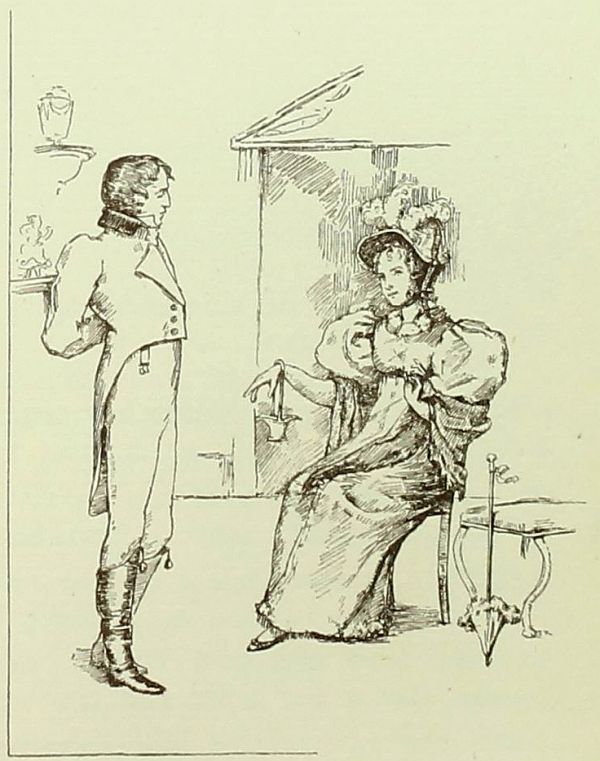
Mrs Elton and Mr Knightley.
A STRAWBERRY PICNIC.
Characters.
Mrs Elton and Mr Knightley.
N.B.—“Mrs Elton was first seen in church.... Emma had feelings, less of curiosity than of pride or propriety, to make her resolve on not being the last to pay her respects.... She (Emma) was almost sure that for a young woman, a stranger, a bride, there was too much ease.... and a quarter of an hour quite convinced her that Mrs Elton was a vain woman, extremely well satisfied with herself and thinking much of her own importance.... Emma was not required, by any subsequent discovery, to retract her ill opinion of Mrs Elton. Her observation had been pretty correct—such as Mrs Elton appeared to her on this second interview, such she appeared whenever they met again—self-important, presuming, familiar, ignorant, and ill-bred.”—Emma, Vol. II., Chap. XXXII. “You might not see one in a hundred, with gentleman so plainly written as in Mr Knightley.” ... “Mr Knightley’s downright, decided, commanding sort of manner, though it suits him very well: his figure, and look and situation in life seem to allow it; but if any young man were to set about copying him, he would not be sufferable.”—Emma, Vol. I., Chap. IV.
Scene—A parlour in Mrs Weston’s house.
Properties required:—A small table L.C.; a chair L. of it; a writing table in front of a window up R.; a door R.; other chairs and sofas; a general air of comfort and refinement. Enter Mrs Elton—who soon sits with her back to the door.
Mrs Elton. Provoking! Everything contrives for my annoyance; first, I agree to meet Mr Elton here, and Mrs Weston is out, and I am forced to wait alone. Then this exploring party that I had set my heart upon is obliged to be put off through a lame horse, then——(enter Mr Knightley). Ah! you have found me out at last in my seclusion? (turns and sees Knightley.) Oh! Knightley, it is you. I have been waiting in this room this age for my lord and master, who promised to meet me here and pay his respects to Mrs Weston, and as she was out, I was, of course, forced to wait alone. But now that you are come——
Knightley (stiffly.) I gathered from Mrs Weston’s excellent maid that she was from home, and merely came in to write a note of importance. I did not know you were here, or should not have intruded myself upon you.
Mrs Elton. Why do you speak of intrusion? I am delighted, and although I cannot approve of a husband keeping his wife waiting at any time, still I must make allowances for Mr Elton; for he really is engaged from morning to night—there is no end of people’s coming to him on some pretence or other. The magistrates and overseers and churchwardens are always wanting his opinion. They seem not able to do anything without him. “Upon my word, Mr E.,” I often say, “rather you than I. I do not know what would become of my crayons and my instrument if I had half so many applicants.” Bad enough as it is, for I absolutely neglect them both to an unpardonable degree. But is it not most vexatious, Knightley? and such weather for exploring.
Knightley. Pardon me, I do not quite follow you.
Mrs Elton. Oh! have you not heard of our lame carriage-horse? Everything has been put off,—the exploring party to Box Hill.
Knightley. Oh! yes; very annoying, to be sure; but these things will happen, you know, Mrs Elton.
Mrs Elton. I know; but when the first disappointment occurred, through Mr and Mrs Suckling not being able to visit Highbury until the autumn, I said, why should we not explore to Box Hill though the Sucklings did not come? We could go there again in the autumn with them. And so, as you know, my suggestion was immediately taken up; and everything was so charmingly arranged—why, I had even settled with Mrs Weston as to pigeon pies and cold lamb, when, all at once, everything is thrown into uncertainty. It may be weeks before the horse is usable, and, therefore, no preparations can be ventured upon. What are we to do? The delays and disappointments are quite odious. The year will wear away at this rate, and nothing done. Before this time last year we had delightful exploring parties from Maple Grove to King’s Weston, and—
Knightley (lightly). You had better explore to Donwell. That may be done without horses. Come and eat my strawberries. They are ripening fast.
Mrs E. (impulsively). Oh! I should like it of all things! Donwell, I know, is famous for its strawberry beds. You may depend upon me; I certainly will come; name your day, and I will come; you will allow me to bring Jane Fairfax.
Knightley. I cannot name a day, till I have spoken to some others whom I would wish to meet you.
Mrs Elton. Oh! leave all that to me, only give me carte blanche—I am lady Patroness, you know—It is my party—I will bring friends with me.
Knightley. I hope you will bring Elton, but I will not trouble you to give any other invitations.
Mrs Elton. Oh! now you are looking very sly—but consider—you need not be afraid of delegating power to me. Married women, you know, may be safely authorised. It is my party—leave it all to me. I will invite your guests.
Knightley. No, Mrs Elton, no. There is but one married woman in the world whom I can ever allow to invite what guests she pleases to Donwell, and that one is—
Mrs Elton (mortified). Mrs Weston, I suppose.
Knightley. No—Mrs Knightley, and till she is in being, I will manage such matters myself.
Mrs Elton (satisfied to have no one preferred to herself). Ah! you are an odd creature; you are a humorist, and may say what you like—quite a humorist. Well, I shall bring Jane with me—Jane Fairfax and her aunt—the rest I leave to you,—I have no objections at all to meeting the Hartfield family. Don’t scruple—I know you are attached to them.
Knightley. You certainly will meet them if I can prevail; and I shall call on Miss Bates on my way home.
Mrs Elton. That is quite unnecessary; I see Jane every day;—but, as you like. It is to be a morning scheme, you know, Knightley; quite a simple thing. I shall wear a large bonnet, and bring one of my little baskets hanging on my arm—here—probably this basket—with pink ribbons. Nothing can be more simple, you see. And Jane will have such another. There is to be no form or parade—a sort of gipsy party. We are to walk about your gardens and gather the strawberries ourselves, or sit under the trees; and whatever else you like to provide, it is to be all out of doors—a table spread in the shade, you know. Everything as natural and simple as possible. Is not that your idea?
Knightley. Not quite. My idea of the simple and the natural will be to have the table spread in the dining-room. The nature and simplicity of gentlemen and ladies with their servants and furniture, I think, is best observed by meals within doors. When you are tired of eating strawberries in the garden, there shall be cold meat in the house.
Mrs Elton. Well, as you please; only don’t have a great set-out—by-the-bye, can I or my housekeeper be of any use to you with our opinion? Pray be sincere, Knightley. If you wish me to talk to Mrs Hodges or to inspect anything—
Knightley. I have not the least wish for it, thank you.
Mrs Elton. Well!—but if any difficulties should arise; my housekeeper is extremely clever—
Knightley. I will answer for it, mine thinks herself full as clever, and would spurn anybody’s assistance.
Mrs Elton. I wish we had a donkey. The thing would be for us all to come on donkeys—Jane, Miss Bates, and me, and my caro sposo walking by my side. I really must talk to him about purchasing a donkey. In a country life I conceive it to be a sort of necessary; for, let a woman have ever so many resources, it is not possible for her to be always shut up at home; and very long walks you know—in summer there is dust, and in winter there is dirt—
Knightley. You will not find either between Donwell and Highbury.—Donwell lane is never dusty, and now it is perfectly dry. Come on a donkey, however, if you prefer it—you can borrow Mrs Cole’s. I would wish everything to be as much to your taste as possible.
Mrs Elton. That I am sure you would. Indeed, I do you justice, my good friend. Under that peculiar sort of dry, blunt manner, I know you have the warmest heart. As I tell Mr E.—you are a thorough humorist. Yes, believe me, Knightley, I am fully sensible of your attention to me in the whole of this scheme. You have hit upon the very thing to please me.
Knightley. Do not mention it, I pray; but, if you will allow me, I will now write my note to Mrs Weston. It is of importance. (Bows and goes to writing table.)
Mrs Elton. Oh! don’t mind me. I have a thousand pleasant things to think of now. Oh! by-the-bye, don’t forget to include Mr and Mrs Weston in your invitations. Do not leave them out: that would be unpardonably amiss—and Mrs Weston’s step-son, Frank Churchill, you must invite him (aside). All this is really most charming. Wright shall do my hair in the simplest fashion. She shall dress it like a shepherdess of the last century, and my gown shall be all white. I look well in white, at least that foolish Elton has often told me so; besides, it is so rural and simple. Nobody can think less of dress than I do; but upon such an occasion as this, when everybody’s eyes will be upon me, and in compliment to Knightley, who is giving this picnic party chiefly to do me honour, I would not wish to be inferior to others.
Knightley (rising from the writing table). And now, my letter written, I will bid you good-day, and shall soon hope to settle the day for our strawberry feast.
Mrs Elton. Must you be going, really? I cannot imagine what is become of Mr Elton. He should have been here ages ago. He promised to come to me as soon as he could disengage himself from his appointment at “The Crown.” They are all shut up with him at a meeting—a regular meeting, you know—Weston and Cole are there too; but one is apt to speak only of those who lead, and I fancy Mr E. or yourself have everything your own way here. By-the-bye, Knightley, how is it you are not at the meeting?
Knightley. For the simple reason that the meeting you speak of is not until to-morrow.
Mrs Elton. Ah! surely you are mistaken—the meeting is certainly to-day. I do believe this is the most troublesome parish that ever was. We never heard of such things at Maple Grove. Mr E. was certainly under the impression the meeting was to-day, and depend upon it, he was so vexed at finding out his mistake, that he has forgotten entirely his appointment with me here, and my conjugal obedience is merely time and patience thrown away. How provoking! Knightley, you must offer me your arm and escort me some little way; as far as Miss Bates, and there we can settle the precise day our charming exploring Party to Donwell shall take place.
Knightley (offering his arm.) With pleasure. I will ask Miss Bates if she and Miss Fairfax will be of the party, but the day must be fixed for the convenience of Mr Woodhouse, whom I am most anxious to receive at my house.
Mrs Elton. Oh! Out of the question. Mr Woodhouse is far too great an invalid. You will not prevail upon him to come at all.
Knightley. I still hope to do so, with his daughter’s assistance. (Exeunt Mr Knightley and Mrs Elton.)
Mrs Elton (outside). Oh! if Emma Woodhouse wishes it, poor Mr Woodhouse will have to come.
End of Scene.