LITERARY TASTES.
Reading edition
Duologue between Catherine Morland and Isabella Thorpe.
From “Northanger Abbey.”
Costumes.
Isabella is wearing a pelisse of lilac-coloured sarsanet, trimmed with white swansdown; a French cambric frock fastened down the front with small round pearl buttons, and with a border of gold-coloured embroidery round the skirt, which is of walking length. The bodice is cut low, a muslin chemisette with high collar and frill being worn to cover the neck.
The hat of straw or white beaver is tied under the chin by a tan-coloured ribbon, which passes over the crown; a tuft of white ostrich feathers on the left side; tan gloves and tan shoes.
Catherine wears a large natural-coloured straw hat, with jonguille green ribbon and white feathers. A dress of cambric muslin spotted with pale yellow flowers, short full sleeves, and a primrose-coloured shawl; white or tan gloves.
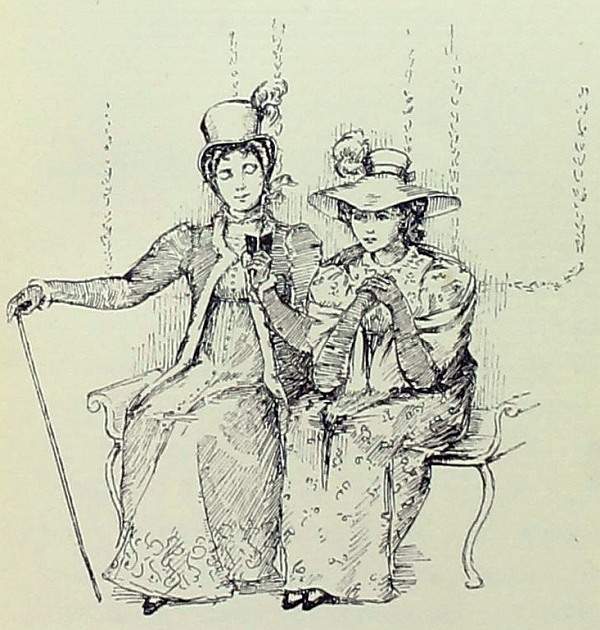
Isabella Thorpe and Catherine Morland.
LITERARY TASTES.
Characters.
Isabella Thorpe and Catherine Morland.
N.B.—“The progress of the friendship between Catherine and Isabella was quick as its beginning had been warm; and they passed so rapidly through every gradation of increasing tenderness, that there was shortly no fresh proof of it to be given to their friends or themselves. They called each other by their Christian name, were always arm-in-arm when they walked, pinned up each other’s train for the dance, and were not to be divided in the set; and, if a rainy morning deprived them of other enjoyments, they were still resolute in meeting, in defiance of wet and dirt, and shut themselves up to read novels.... The following conversation, which took place between the two friends in the Pump-room one morning, after an acquaintance of eight or nine days, is given as a specimen of their very warm attachment, and of the delicacy, discretion, originality of thought, and literary taste which marked the reasonableness of that attachment.”—Northanger Abbey, Chap. V. and VI.
Scene—Part of the Pump-room at Bath.
Properties required:—A sofa R.C.; a small table L., with the visitors’ book upon it. Door L. A window up R.C. Enter Isabella Thorpe. Having to wait a few moments, she shows every sign of impatience. Enter Catherine Morland.
Isabella (rising suddenly). My dearest creature! what can have made you so late? (They embrace.) I have been waiting for you at least this age.
Catherine (surprised). Have you, indeed? I am very sorry for it, but really I thought I was in very good time (pointing to her watch or a time-piece); it is but just one. I hope you have not been here long?
Isabella. Oh! these ten ages at least. I am sure I have been here this half-hour; but now, let us sit down and enjoy ourselves. (They sit on the sofa.) I have a hundred things to say to you. In the first place, I was so afraid it would rain this morning, just as I wanted to set off; it looked very showery, and that would have thrown me into agonies! Do you know, I saw the prettiest hat you can imagine in a shop window in Milsom Street just now—very like yours, only with coquelicot ribands instead of green; I quite longed for it. But, my dearest Catherine, what have you been doing with yourself this morning? Have you gone on with “Udolpho”?
Catherine. Yes, I have been reading it ever since I awoke, and I am got to the black veil.
Isabella. Are you, indeed? How delightful! Oh! I would not tell you what is behind the black veil for the world! Are you not wild to know?
Catherine. Oh! yes, quite, what can it be? But do not tell me—I would not be told upon any account. I know it must be a skeleton, I am sure it is Laurentina’s skeleton. Oh! I am delighted with the book! I should like to spend my whole life in reading it, I assure you; if it had not been to meet you, I would not have come away from it for all the world.
Isabella (embracing Catherine impulsively). Dear creature! how much I am obliged to you; and when you have finished “Udolpho” we will read the Italian together; and I have made out a list of ten or twelve more of the same kind for you.
Catherine. Have you, indeed! How glad I am! What are they all?
Isabella (rising). I will read you their names directly; here they are in my pocket-book—(takes out a small pocket-book from her reticule and reads), “Castle of Wolfenbach,” “Clermont,” “Mysterious Warnings,” “Necromancer of the Black Forest,” “Midnight Bell,” “Orphan of the Rhine,” and “Horrid Mysteries”—(shutting the book). There! those will last us some time.
Catherine. Yes—pretty well, but are they all horrid? are you sure that they are all horrid?
Isabella (leaning on the sofa, R. end). Yes, quite sure; for a particular friend of mine—a Miss Andrews, a sweet girl, one of the sweetest creatures in the world, has read every one of them. I wish you knew Miss Andrews, you would be delighted with her. She is netting herself the sweetest cloak you can conceive. I think her as beautiful as an angel, and I am so vexed with the men for not admiring her! I scold them all amazingly about it.
Catherine. Scold them! Do you scold them for not admiring her?
Isabella. Yes, that I do. There is nothing I would not do for those who are really my friends. I have no notion of loving people by halves; it is not my nature. My attachments are always excessively strong. I told Captain Hunt, at one of our assemblies this winter, that if he was to tease me all night, I would not dance with him unless he would allow Miss Andrews to be as beautiful as an angel. The men think us incapable of real friendship, you know, and I am determined to show them the difference. Now, if I were to hear anybody speak slightingly of you (embrace) I should fire up in a moment; but that is not at all likely, for you are just the kind of girl to be a great favourite with the men.
Catherine (hanging her head and turning away). Oh! dear! how can you say so?
Isabella. Oh! I know you very well, you have so much animation, which is exactly what Miss Andrews wants; for I must confess there is something amazingly insipid about her. (Sitting down again.) Oh! I must tell you, that just after we parted yesterday I saw a young man looking at you so earnestly.
Catherine (turning away still more).
Isabella. I am sure he is in love with you.
Catherine. Oh! Isabella!
Isabella (laughing). It is very true, upon my honour. But I see how it is; you are indifferent to everybody’s admiration except that of one gentleman, who shall be nameless. (Suddenly serious.) Nay, I cannot blame you, your feelings are easily understood (rising); where the heart is really attached, I know very well how little one can be pleased with the attentions of anybody else (walking to R.); everything is so insipid, so uninteresting, that does not relate to the beloved object; I can perfectly comprehend your feelings.
Catherine. But you should not persuade me that I think so very much about Mr Tilney, for perhaps I may never see him again.
Isabella. Not see him again! (embracing) my dearest creature, do not talk of it. I am sure you would be miserable if you thought so.
Catherine (smiling). No, indeed, I should not. I do not pretend to say that I was not very much pleased with him; but while I have “Udolpho” to read, I feel as if nobody could make me miserable. Oh! the dreadful black veil! My dear Isabella, I am sure there must be Laurentina’s skeleton behind it.
Isabella (taking Catherine’s arm and walking up and down). It is so odd to me that you should never have read “Udolpho” before; but I suppose Mrs Morland objects to novels.
Catherine. No, she does not. She very often reads “Sir Charles Grandison” herself; but new books do not fall in our way.
Isabella. “Sir Charles Grandison”! that is an amazing horrid book, is it not? I remember Miss Andrews could not get through the first volume.
Catherine. It is not like “Udolpho” at all, but yet I think it is very entertaining.
Isabella. Do you, indeed? You surprise me; I thought it had not been readable (stopping short). But, my dearest Catherine, have you settled what to wear on your head to-night? I am determined, at all events, to be dressed exactly like you. The men take notice of that sometimes, you know.
Catherine (innocently). But it does not signify if they do.
Isabella. Signify! Oh! Heavens! I make it a rule never to mind what they say. They are very often amazingly impertinent if you do not treat them with spirit, and make them keep their distance.
Catherine. Are they? Well, I never observed that. They always behave very well to me.
Isabella. Oh! They give themselves such airs. They are the most conceited creatures in the world, and think themselves of so much importance. By the bye, though I have thought of it a hundred times, I have always forgot to ask you what is your favourite complexion in a man. Do you like them best dark or fair?
Catherine. I hardly know. I never much thought about it. Something between both, I think; brown—not fair and not very dark.
Isabella. Very well, Catherine. That is exactly he. I have not forgot your description of Mr Tilney—“A brown skin, with dark eyes and rather dark hair.” Well, my taste is different; I prefer light eyes; and as to complexion—do you know—I like a sallow better than any other. But you must not betray me, if you should ever meet with one of your acquaintance answering that description.
Catherine (impulsively). Betray you! what do you mean?
Isabella. Nay, do not distress me—I believe I have said too much already. Pray, let us drop the subject.
Catherine. My dearest Isabella, certainly, if you wish it. (Aside as Isabella walks towards the door.) I wonder if it is Laurentina’s skeleton. Oh! it must be Laurentina’s skeleton.
Isabella (coming suddenly back to Catherine, but looking over her shoulder towards the door). For Heaven’s sake let us move away from this end of the room. Do you know, there are two odious young men who have been staring at me this half hour? They really put me quite out of countenance. Let us go and look at the arrivals in the visiting book. They will hardly follow us there. (They walk to the book. While Isabella examines the book, Catherine watches the proceedings off L. door.) They are not coming this way, are they? I hope they are not so impertinent as to follow us. Pray let me know if they are coming. I am determined I will not look up.
Catherine (at door, with unaffected pleasure). You need no longer be uneasy; the gentlemen have just left the Pump-room.
Isabella (turning hastily round). And which way are they gone? One of them was a very good-looking young man.
Catherine (going to the window). They are going towards the Churchyard.
Isabella (hastily). Well, I am amazingly glad I have got rid of them; and now, what say you to going to Edgar’s Buildings with me and looking at my new hat? You said you should like to see it.
Catherine. With pleasure—only—perhaps we may overtake the two young men.
Isabella. Oh! never mind that. If we make haste, we shall pass by them presently, and I am dying to show you my hat (taking Catherine’s hand and drawing her towards the door.)
Catherine (holding back). But if we only wait a few minutes there will be no danger of our seeing them at all.
Isabella (with great dignity, still holding Catherine’s hand). I shall not pay them any such compliment, I assure you. I have no notion of treating men with such respect. That is the way to spoil them. Come—and see my new hat. (Exeunt Catherine and Isabella, hurriedly, by the door.)
Curtain.