THE SETTLEMENT QUESTION.
Reading edition
Duologue between Mr and Mrs John Dashwood.
From “Sense and Sensibility,” Vol. I., chap. II.
Costumes.
Mrs D. Black dress with a Spanish vest trimmed with narrow black velvet; pointed ends in front, finished with black tassels. Skirt trimmed with black ermine velvet to match white ermine opera tippet.
Mr D. In grey and black.
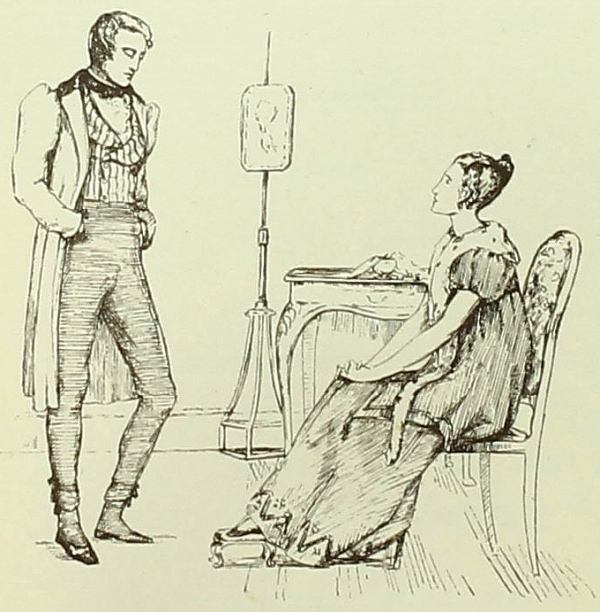
Mr and Mrs John Dashwood.
THE SETTLEMENT QUESTION.
(A Conversation.)
Characters.
Mr and Mrs John Dashwood.
Scene—The morning room at Norlands. It is a comfortably furnished room.
Properties required:—Door R. Window C. Tables R. and L. Chairs on either side. Books and a work basket with household mending in it.
N.B.—“He (Mr John Dashwood) was not an ill-disposed young man, unless to be rather cold-hearted, and rather selfish is to be ill-disposed; but he was, in general, well respected, for he conducted himself with propriety in the discharge of his ordinary duties. Had he married a more amiable woman, he might have been still more respectable than he was; he might even have been made amiable himself, for he was very young when he married, and very fond of his wife. But Mrs Dashwood was a strong caricature of himself; more narrow-minded and selfish.”—Sense and Sensibility, Chap. I.
Enter Mrs John Dashwood, Door R. She is in mourning.
Mrs D. (going to the window and arranging the curtains.) A comfortably appointed house—a little shabby, perhaps—but with judicious alterations here and there, I do not doubt of making it very fit and habitable for Mr Dashwood and myself. (Sitting to her work.) Yet I wish my father-in-law had not died here, and thus put me to the inconvenience of offering a home to his widow and three daughters till they have found a suitable house of their own. I think I made it palpably clear to them that their stay could only be considered in the light of a visit, by arriving with dear little Harry and our attendants as soon as the funeral was over. The house was my husband’s from the moment of his father’s decease, and no one could dispute my right to come. But such is the indelicacy and selfishness of our mother-in-law, that unless my husband finds her a home elsewhere, she and her daughters will consider they may remain here for ever. I hope Mr Dashwood will see that they are soon settled, and then I can take up my proper position at Norlands.
Enter Mr John Dashwood. He, too, is in mourning.
Mr D. My dear, if you are at leisure I should like to speak with you about the promise I made to my late lamented father upon his death-bed respecting the future of my step-mother and three sisters.
Mrs D. The very thing I was thinking of myself.
Mr D. I am happy to see we are in such accord. The case is this. My present income, which is not inconsiderable, will now be increased by four thousand a-year, and the prospect has determined me to behave with generosity. I therefore propose to give them three thousand pounds.
Mrs D. (with horror). Three thousand pounds!
Mr D. Yes. It will be liberal and handsome. I can spare so considerable a sum with little inconvenience, and it would be enough to make them completely easy.
Mrs D. But, my dear Mr Dashwood, pray consider. To take three thousand pounds from the fortune of our dear little boy would be impoverishing him to the most dreadful degree. I beg you to think again on the subject. How can you answer it to yourself to rob your child, your only child too, of so large a sum? and what possible claims can the Miss Dashwoods, who are related to you only by half blood, which I consider as no relationship at all, have on your generosity to so large an amount? It is very well known that no affection is ever supposed to exist between the children of any man by different marriages; and why are you to ruin yourself and our poor little Harry, by giving away all your money to your half sisters?
Mr D. It was my father’s last request to me, that I should assist his widow and daughters.
Mrs D. He did not know what he was talking of, I dare say. Ten to one but he was light-headed at the time. Had he been in his right senses, he could not have thought of such a thing as begging you to give away half your fortune from your own child.
Mr D. He did not stipulate for any particular sum, my dear Fanny; he only requested me, in general terms, to assist them, and make their situation more comfortable than it was in his power to do. Perhaps it would have been as well if he had left it wholly to myself. He could hardly suppose I should neglect them. But—as he required the promise, I could not do less than give it—at least, I thought so at the time. The promise, therefore, was given, and must be performed. Something must be done for them whenever they leave Norland and settle in a new home.
Mrs D. Well, then, let something be done for them; but that something need not be three thousand pounds. Consider, that when the money is once parted with, it never can return. Your sisters will marry, and it will be gone for ever,—if, indeed, it could ever be restored to our poor little boy.
Mr D. (gravely). Why, to be sure, that would make a difference. The time may come when Harry will regret that so large a sum was parted with. If he should have a numerous family, for instance, it would be a very convenient addition.
Mrs D. To be sure it would.
Mr D. Perhaps, then, it would be better for all parties if the sum were diminished one half. Five hundred pounds would be a prodigious increase to their fortune.
Mrs D. Oh! beyond anything great! What brother on earth would do half so much for his sisters, even if really his sisters! And as it is—only half blood! But you have such a generous spirit!
Mr D. I would not wish to do anything mean; one had rather, on such occasions, do too much than too little. No one, at least, can think I have not done enough for them. Even themselves, they can hardly expect more.
Mrs D. There is no knowing what they may expect. But we are not to think of their expectations; the question is, what you can afford to do.
Mr D. Certainly; and I think I can afford to give them five hundred pounds a-piece. As it is, without any addition of mine, they will each have above three thousand pounds on their mother’s death—a very comfortable fortune for any young woman.
Mrs D. To be sure it is; and, indeed, it strikes me that they can want no addition at all. They will have ten thousand pounds divided amongst them. If they marry they will be sure of doing well, and if they do not, they will live very comfortably together on the interest of ten thousand pounds.
Mr D. That is very true, and, therefore, I do not know whether, upon the whole, it would not be more advisable to do something for their mother while she lives, rather than for them—something of the annuity kind I mean. My sisters would feel the good effects of it as well as herself. A hundred a year would make them all perfectly comfortable.
Mrs D. (hesitating). To be sure it is better than parting with fifteen hundred pounds at once; but then, if Mrs Dashwood should live fifteen years, we shall be completely taken in.
Mr D. Fifteen years! my dear Fanny, her life cannot be worth half that purchase.
Mrs D. Certainly not, but if you observe, people always live for ever when there is any annuity to be paid them; and she is very stout, and healthy, and hardly forty. An annuity is a very serious business; it comes over and over every year, and there is no getting rid of it. You are not aware of what you are doing. I have known a great deal of the trouble of annuities, for my mother was clogged with the payment of three to old superannuated servants by my father’s will, and it is amazing how disagreeable she found it. Twice every year these annuities were to be paid; and then there was the trouble of getting it to them: and then one of them was said to have died, and afterwards it turned out to be no such thing. My mother was quite sick of it. Her income was not her own she said, with such perpetual claims upon it; and it was the more unkind in my father, because otherwise, the money would have been entirely at my mother’s disposal without any restriction whatever. It has given me such an abhorrence of annuities, that I am sure I would not pin myself down to the payment of one for all the world.
Mr D. It is certainly an unpleasant thing to have those kind of yearly drains on one’s income. One’s fortune, as your mother justly says, is not one’s own. To be tied down to the regular payment of such a sum, on every rent day, is by no means desirable; it takes away one’s independence.
Mrs D. Undoubtedly; and, after all, you have no thanks for it, they think themselves secure; you do no more than what is expected, and it raises no gratitude at all. If I were you, whatever I did should be done at my own discretion entirely. I would not bind myself to allow them anything yearly. It may be very inconvenient some years to spare a hundred, or even fifty, pounds from our own expenses.
Mr D. I believe you are right, my love; it will be better that there should be no annuity in the case. Whatever I may give them occasionally will be of far greater assistance than a yearly allowance, because they would only enlarge their style of living if they felt sure of a larger income, and would not be sixpence the richer for it at the end of the year. It will certainly be much the best way. A present of fifty pounds now and then will prevent their ever being distressed for money, and will, I think, be amply discharging my promise to my father.
Mrs D. To be sure it will. Indeed, to say the truth, I am convinced within myself that your father had no idea of your giving them any money at all. The assistance he thought of, I dare say, was only such as might be reasonably expected of you; for instance, such as looking out for a comfortable small house for them, helping them to move their things, and sending them presents of fish and game, and so forth, whenever they are in season. I’ll lay my life that he meant nothing further; indeed, it would be very strange and unreasonable if he did. Do but consider, my dear Mr Dashwood, how excessively comfortable your step-mother and her daughters may live on the interest of seven thousand pounds, besides the thousand pounds belonging to each of the girls, which brings them in fifty pounds a year a-piece, and of course they will pay their mother for their board out of it. Altogether they will have five hundred a year amongst them; and what on earth can four women want for more than that? They will live so cheap! Their housekeeping will be nothing at all. They will have no carriage, no horses, and hardly any servants; they will keep no company, and can have no expenses of any kind! Only conceive how comfortable they will be! Five hundred a year! I am sure I cannot imagine how they will spend half of it; and as for your giving them more, it is quite absurd to think of it. They will be much more able to give you something.
Mr D. Upon my word, I believe you are perfectly right. My father certainly could mean nothing more by his request to me than what you say. I clearly understand it now, and I will strictly fulfil my engagement by such acts of assistance and kindness to them as you have described. When my step-mother removes into another house my services shall be readily given to accommodate her as far as I can. Some little present of furniture, too, may be acceptable then.
Mrs D. Certainly; but, however, one thing must be considered,—that though the furniture goes with this house, and is therefore our own, your father left all the china, linen, and plate to your step-mother. Her house will therefore be almost completely fitted up as soon as she takes it.
Mr D. That is a material consideration, undoubtedly; a valuable legacy, indeed! And some of the plate would have been a very pleasant addition to our own stock here.
Mrs D. Yes, and the set of breakfast china is twice as handsome as ours; a great deal too handsome, in my opinion, for any place they can ever afford to live in. But, however, so it is. Your father thought only of them, and I must say this, that you owe no particular gratitude to him, nor attention to his wishes; for we very well know, that if he could he would have left almost everything in the world to them.
Mr D. My love, I am convinced of the truth of what you say. It will not only be absolutely unnecessary, but highly indecorous to do more. (Looking at his watch.) Eleven o’clock; the carriage should be here. My step-mother has not been out of doors since my father’s funeral, and I ordered the carriage to take her and my sisters for a drive.
Mrs D. (rising and putting away her work). My dear Mr Dashwood. No! Here I must be firm. It is quite an unnecessary luxury, which they must sooner or later relinquish; and if they are indulged in carriage exercise now, how can they ever be expected to conform to the new mode of life attendant on their reduced circumstances? It is a cruelty, not a kindness, on your part to suggest such a thing. However, rather than that Wilkins should have troubled to harness the horses in vain, I will take little Harry out with me. The air will do him all the good in the world, and you can easily explain to your mother and sisters that it is incumbent upon me to drive round the estate in order to learn a little of its extent and capacity. You can tell them they shall go out another day.
Mr D. My dear Fanny, you are right, your judgment of such matters can never be at fault. Perhaps I was over-hospitable.
Mrs D. (emphatically). My dear Mr Dashwood, of that there is no doubt.
[Exeunt Mr and Mrs Dashwood.
End of Scene.