THE READING OF JANE FAIRFAX’S LETTER.
Reading edition
Duologue between Miss Bates and Emma.
From “Emma,” Vol. I., Chap. XIX.
Costumes.
Emma. Long curricle coat of jonquil green china silk, lined with fawn-coloured sarsanet: white cambric dress, the bodice with wrap fronts, crossing on the bosom and fastening at the middle of the back. Opera tippet (boa of white swansdown). A cap of “tiara” form of nut-brown silk, trimmed with pointed green leaves and tied under the chin with nut-brown ribbons; large muff of white swansdown.
Miss Bates. Dress of grey or dark brown silk striped with black; chemisette of thick white muslin; apron of black satin; broad ribbon of myrtle green tied round the head in a bow at the top, a black ostrich tip fastened in the ribbon with an antique pebble brooch; an eye-glass fastened round the neck by a long black ribbon.
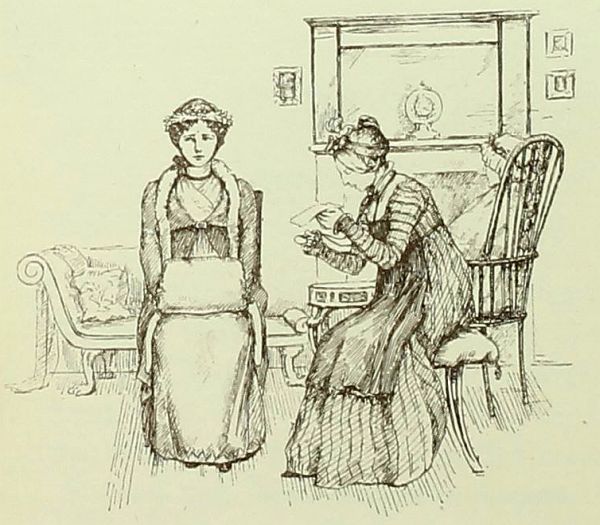
Miss Bates and Emma.
THE READING OF JANE FAIRFAX’S LETTER.
Characters.
Miss Bates, Mrs Bates, Emma Woodhouse.
N.B.—“After these came a second set, among the most come-at-able of whom were Mrs and Miss Bates ... almost always at the service of an invitation from Hartfield, and who were fetched and carried home so often that Mr Woodhouse thought it no hardship for either James or the horses. Had it taken place only once a year it would have been a grievance. Mrs Bates, the widow of a former Vicar of Highbury, was a very old lady, almost past everything but tea and quadrille. She lived with her single daughter in a very small way, and was considered with all the regard and respect which a harmless old lady, under such untoward circumstances, can excite. Her daughter enjoyed a most uncommon degree of popularity for a woman neither young, handsome, rich, nor married. Miss Bates stood in the very worst predicament in the world for having much of the public favour, and she had no intellectual superiority to make atonement to herself, or frighten those who might hate her, into outward respect. She had never boasted either beauty or cleverness. Her youth had passed without distinction, and her middle life was devoted to the care of a failing mother, and the endeavour to make a small income go as far as possible, and yet she was a happy woman, and a woman whom no one named without good-will. It was her own universal good-will and contented temper which worked such wonders. She loved everybody, was interested in everybody’s happiness, quick-sighted to everybody’s merits, thought herself a most fortunate creature, and surrounded with blessings in such an excellent mother, and so many good neighbours and friends, and a home that wanted for nothing. The simplicity and cheerfulness of her nature, her contented and grateful spirit, were a recommendation to everybody, and a mine of felicity to herself. She was a great talker upon little matters, full of trivial communications and harmless gossip.... These were the ladies whom Emma found herself very frequently able to collect; and happy was she, for her father’s sake, in the power; though, as far as she herself was concerned, it was no remedy for the absence of Mrs Weston (her former governess and best friend). The quiet gossipings of such women made her feel that every evening so spent was indeed one of the long evenings she had fearfully anticipated.”—Emma, Chap. III.
Scene—Mrs Bates’ Parlour.
Properties required:—One table L.C., with Jane Fairfax’s letter on it under reticule; two chairs on either side of the table; another table up R., with a cake upon it, and a knife to cut it; another table up L.; in front of a cheerful fire, “a grandfather’s chair” left of the table, with its back turned to the audience, in which Mrs Bates is discovered sitting. In order to bring Mrs Bates on the stage without being seen, a screen must be placed before the chair, and when Mrs Bates is seated so as to be almost completely hidden from the audience during the whole of the scene, Miss Bates must enter, draw back the screen, and say in a loud voice to her mother.
Miss Bates. So kind of Mrs Cole to call upon us so early in the day, and so interested in Jane’s letter. She was indeed, ma’am. How pleased you will be to see dear Jane again. You must not think anything more of her illness. There is nothing to be alarmed at in the least. She says so herself in her letter; you remember, I read it to you—Jane’s letter. (Miss Woodhouse’s voice heard outside.)
Emma (outside). Are Mrs and Miss Bates within this morning?
Miss Bates. Bless me, here is Miss Woodhouse. (Runs to door.) Oh! come up, Miss Woodhouse, pray come up. (Runs to Mrs Bates.) Ma’am, ma’am, Miss Woodhouse is so kind as to be calling on us. (Runs to door.) Oh, Miss Woodhouse, mind the step—so very treacherous. (Enter Emma, who curtseys first at the door, then to Mrs Bates.) And have you walked? All the way? I trust your shoes are not wet or damp. (Runs back to Mrs Bates after offering chair R. of L.C. table, in which Emma sits.) Miss Woodhouse has walked, ma’am, all the way—so kind. And how is dear Mr Woodhouse? I trust he is well; my mother so enjoyed her evening with him when we were all away at Mrs Weston’s, a great deal of chat and backgammon. Tea was made downstairs—biscuits and baked apples; and wine before she came away; amazing luck in some of her throws. Are you seated comfortably? Pray is that chair quite?—yes? Let me offer you some sweet-cake (runs to table R. and cuts piece of cake). Mrs Cole has just been here; just called in for ten minutes, and was so good as to sit an hour with us. She is but just gone, and she took a piece of cake and was so kind as to say she liked it very much; therefore I hope, Miss Woodhouse, you will do me the favour to eat a piece, too. (Emma takes a piece of cake and eats.)
Miss Bates (raising her voice and going to her mother). Ma’am, Miss Woodhouse has taken a piece of sweet-cake—(to Emma). Mrs Cole was so kind as to sit some time with us, talking of my niece Jane; for as soon as she came in, she began inquiring after her—Jane is so very great a favourite there. Whenever she is with us, Mrs Cole does not know how to show her kindness enough, and I must say that Jane deserves it as much as anybody can. And so she began inquiring after her directly, saying—“I know you cannot have heard from Jane lately, because it is not her time for writing.” And when I immediately said—“But indeed we have, we had a letter this very morning,” I do not know that I ever saw anybody more surprised. “Have you, upon your honour?” said she, “well, that is quite unexpected. Do let me hear what she says.”
Emma (politely). Have you heard from Miss Jane Fairfax so lately? I am extremely happy: I hope she is well?
Miss Bates. Thank you. You are so kind! (hunting about for the letter). Dear! dear! where can the letter be? I had it but a moment ago.
Emma (aside). How provoking: I thought I had timed my visit so as to escape a letter from Jane Fairfax.
Miss Bates. Ah! here it is. I was sure it could not be far off; but I had put my huswife upon it, you see, without being aware, and so it was quite hid, but I had it in my hand so very lately that I was almost sure it must be on the table. I was reading it to Mrs Cole, and, since she went away, I was reading it again to my mother, for it is such a pleasure to her—a letter from Jane—that she can never hear it often enough, so I knew it could not be far off; and here it is, only just under my huswife. And since you are so kind as to wish to hear what she says; but, first of all, I really must, in justice to Jane, apologise for her writing so short a letter, only two pages, you see, hardly two, and in general she fills the whole paper, and crosses half.
Emma (aside). For that at least I am thankful.
Miss Bates. My mother often wonders that I can make it out so well. She often says, when the letter is first opened, “Well, Hetty, now I think you will be put to it to make out all that checker-work,” and then I tell her, I am sure she would contrive to make it out herself, if she had nobody to do it for her, every word of it—I am sure she would pore over it till she had made out every word. And indeed, though my mother’s eyes are not good as they were, she can see amazingly well still, thank God! with the help of spectacles. It is such a blessing! My mother’s are really very good indeed. Jane often says, when she is here, “I am sure, grandmamma, you must have had very strong eyes to see as you do, and so much fine work as you have done too!—I only wish my eyes may last me as well.”
Emma. Miss Fairfax writes such an excellent hand—it is in itself like fine embroidery.
Miss Bates. You are extremely kind, you who are such a judge, and write so beautifully yourself. I am sure there is nobody’s praise that could give us so much pleasure as Miss Woodhouse’s. My mother does not hear; she is a little deaf, you know. I must tell her—(speaking loudly)—Ma’am, do you hear what Miss Woodhouse is so obliging to say about Jane’s handwriting?
Mrs Bates. Eh?
Miss Bates. Miss Woodhouse says Jane’s handwriting is like fine embroidery.
Mrs Bates. What, my dear?
Emma (aside). This is very trying.
Miss Bates (louder). Miss Woodhouse is so very kind as to say that Jane’s handwriting is like fine embroidery.
Mrs Bates. Oh!
Miss Bates (to Emma). My mother’s deafness is very trifling, you see, just nothing at all. By only raising my voice and saying anything, two or three times over, she is sure to hear; but then she is used to my voice. But it is remarkable that she should always hear Jane better than she does me; Jane speaks so distinct! However, she will not find her grandmamma at all deafer than she was two years ago, which is saying a great deal, at my mother’s time of life, and it really is full two years, you know, since she was here. We never were so long without seeing her before, and as I was telling Mrs Cole, we shall hardly know how to make enough of her now.
Emma. Are you expecting Miss Fairfax here soon?
Miss Bates. Oh, yes! next week!
Emma. Indeed! that must be a very great pleasure.
Miss Bates. Thank you. You are very kind. Yes, next week. Everybody is so surprised; and everybody says the same obliging things. I am sure she will be as happy to see her friends at Highbury as they can be to see her. Yes, Friday or Saturday; she cannot say which, because Colonel Campbell will be wanting the carriage himself one of those days. So very good of them to send her the whole way! But they always do, you know. Oh! yes, Friday or Saturday next. That is what she writes about. That is the reason of her writing out of rule, as we call it; for, in the common course, we should not have heard from her before next Tuesday or Wednesday.
Emma. Yes, so I imagined—I was afraid there could be little chance of my hearing anything of Miss Fairfax to-day.
Miss Bates. So obliging of you! No, we should not have heard, if it had not been for this particular circumstance, of her being to come here so soon. My mother is so delighted! for she is to be three months with us at least. Three months, she says so, positively, as I am going to have the pleasure of reading to you. The case is, you see, the Campbells are going to Ireland. Mrs Dixon (Colonel and Mrs Campbell’s daughter, to whom Jane was companion before her marriage), has persuaded her father and mother to come over and see her directly. They had not intended to go over till the summer, but she is so impatient to see them again; for till she married, last October, she was never away from them so much as a week, which must make it very strange to be—in different kingdoms, I was going to say, but, however, different countries, and so she wrote a very urgent letter to her mother, or her father—I declare I do not know which it was, but we shall see presently in Jane’s letter—wrote in Mr Dixon’s name as well as her own, to press their coming over directly; and they would give them the meeting in Dublin, and take them back to their country seat, Baly-Craig—a beautiful place, I fancy. Jane has heard a great deal of its beauty—from Mr Dixon, I mean—I do not know that she ever heard about it from anybody else,—but it was very natural, you know, that he should like to speak of his own place while he was paying his addresses,—and as Jane used to be very often walking out with them—for Colonel and Mrs Campbell were very particular about their daughter’s not walking out often with only Mr Dixon, for which I do not at all blame them: of course she heard everything he might be telling Miss Campbell about his own home in Ireland; and I think she wrote us word that he had shown them some drawings of the place, views that he had taken himself. He is a most amiable, charming young man, I believe. Jane was quite longing to go to Ireland from his account of things.
Emma. You must feel it very fortunate that Miss Fairfax should be allowed to come to you at such a time. Considering the very particular friendship between her and Mrs Dixon, you could hardly have expected her to be excused from accompanying Colonel and Mrs Campbell.
Miss Bates. Very true, very true indeed. The very thing we have always been rather afraid of; for we should not like to have her at such a distance from us, for months together, not able to come if anything was to happen; but you see everything turns out for the best. They want her (Mr and Mrs Dixon) excessively to come over with Colonel and Mrs Campbell, quite depend upon it; nothing can be more kind or pressing than their joint invitation, Jane says, as you will hear presently. Mr Dixon does not seem in the least backward in any attention. He is a most charming young man. Ever since the service he rendered Jane at Weymouth, when they were out in that party on the water, and she, by the sudden whirling round of something or other among the sails, would have been dashed into the sea at once, and actually was all but gone, if he had not, with the greatest presence of mind, caught hold of her habit,—I can never think of it without trembling!—but ever since we had the history of that day, I have been so fond of Mr Dixon.
Emma. But, in spite of all her friends’ urgencies and her own wish to see Ireland, Miss Fairfax prefers devoting the time to you and Mrs Bates.
Miss Bates. Yes, entirely her own doing, entirely her own choice; and Colonel and Mrs Campbell think she does quite right—just what they should recommend; and, indeed, they particularly wish her to try her native air, as she has not been quite so well as usual lately.
Emma. I am concerned to hear of it. I think they judge wisely, but Mrs Dixon must be very much disappointed. Mrs Dixon, I understand, is very charming, but has no remarkable degree of personal beauty,—is not by any means to be compared to Miss Fairfax.
Miss Bates. Oh! Miss Woodhouse, how very kind! how very obliging! I must tell my mother (turning towards Mrs Bates, who is asleep). Ma’am, did you hear Miss Woodhouse’s amiable compliments (turning to Emma). Ah! she is asleep; never mind, I will tell her when you are gone—Oh! no—Certainly not—there is no comparison between them—Miss Campbell always was absolutely plain, but extremely elegant and amiable.
Emma. Yes, that of course.
Miss Bates. Jane caught a bad cold, poor thing! so long ago as the 7th of November (as I am going to read to you), and has never been well since. A long time, is it not, for a cold to hang upon her? She never mentioned it before, because she would not alarm us. Just like her! So considerate! But, however, she is so far from well that her kind friends the Campbells think that she had better come home and try an air that always agrees with her, and they have no doubt that three or four months at Highbury will entirely cure her; and it is certainly a great deal better that she should come here than go to Ireland if she is unwell. Nobody could nurse her as we should do.
Emma. It appears to me the most desirable arrangement in the world.
Miss Bates. And so she is to come to us next Friday or Saturday, and the Campbells leave town on their way to Holyhead the Monday following, as you will find from Jane’s letter. So sudden! you may guess, dear Miss Woodhouse, what a flurry it has thrown me in! If it was not for the drawback of her illness—but I am afraid we must expect to see her grown thin and looking very poorly. I must tell you what an unlucky thing happened to me as to that. I always make a point of reading Jane’s letters through to myself first before I read them aloud to my mother, you know, for fear of there being anything in them to distress her. Jane desired me to do it, so I always do; and so I began to-day with my usual caution: but no sooner did I come to the mention of her being unwell, than I burst out, quite frightened, with “Bless me! poor Jane is ill”—which my mother, being on the watch, heard distinctly, and was sadly alarmed at. However, when I read on, I found it was not near so bad as I fancied at first; and I make so light of it now to her, that she does not think much about it: but I cannot imagine how I could be so off my guard! If Jane does not get well soon, we will call in Mr Perry. The expense shall not be thought of; and though he is so liberal and so fond of Jane, that I dare say he would not mean to charge anything for attendance, we would not suffer it to be so, you know. He has a wife and family to maintain, and is not to be giving away his time. Well now, I have just given you a hint of what Jane writes about. We will turn to her letter, and I am sure she tells her own story a great deal better than I can tell it for her (turning to the letter).
Emma (rising abruptly). I am afraid I must be running away. My father will be expecting me. I had no intention, I thought I had no power, of staying more than five minutes when I first entered the house. I merely called, because I would not pass the door without enquiring after Mrs Bates; but I have been so pleasantly detained! And now I must wish you and Mrs Bates good morning. (Curtsies and exit.)
Miss Bates (during Miss Woodhouse’s speech.) Dear Miss Woodhouse, so soon—must you really go; so kind of you to come. Jane’s letter so short, only two pages—will not take one minute to read—pray mind the step outside. Allow me. (Exeunt Miss Bates and Emma.)
Mrs Bates coughs and picks up her ball of wool. Re-enter Miss Bates.
Miss Bates. Ma’am, Miss Woodhouse assures me it is quite dry under foot. I am sure you would enjoy a little walk up the road with me (helping her mother up and leading her out of the room, talking all the time); and I will tell you what Miss Woodhouse was so obliging as to say about Jane’s beauty as we go—though perhaps it is hardly the thing to repeat to everybody. She says that Mrs Dixon (exeunt Mrs and Miss Bates. Miss Bates’ voice fading away little by little outside) has no remarkable degree of beauty, and is not by any means to be compared with our Jane—so kind of her, is it not? Ma’am, ma’am, mind that step—no, not by any means to be compared with our Jane.
End of Scene.