LADY CATHERINE’S VISIT.
Reading edition
From “Pride and Prejudice,” Vol. I., Chap. XXIX.
Costumes.
Lady Catherine. Large hat trimmed with white feathers, and violet silk handkerchief, worn over a ruched cap. Dress of cinnamon brown satin; the bodice cut V-shaped in front; a high ruche of white muslin round the neck; open front of bodice being frilled with white lace. Pelisse of deep violet cloth. Silver-headed black stick; long-handled eyeglass.
Elizabeth. Dress of white Indian muslin—the bodice made high in front and gathered in the centre of the bosom into a long gold brooch. A Spencer waist trimmed round back and down the sides with a frill of the muslin, sleeves tied with pale green ribbon. Pale green ribbon girdle.
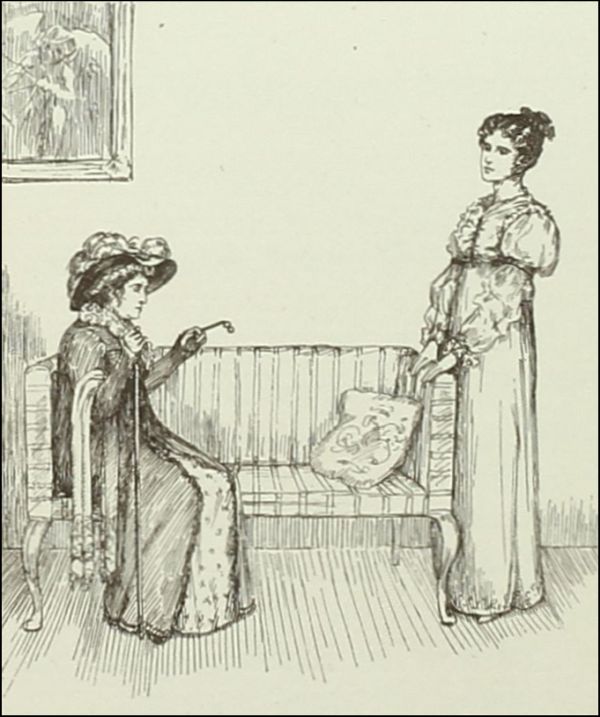
Lady Catherine and Elizabeth Bennet.
LADY CATHERINE’S VISIT.
Characters.
Lady Catherine de Burgh, Elizabeth Bennet.
N.B.—“Elizabeth’s courage did not fail her. She had heard nothing of Lady Catherine that spoke her awful from any extraordinary talents or miraculous virtue, and the mere stateliness of money and rank she thought she could witness without trepidation.... Her air was not conciliating, nor was her manner of receiving them ... such as to make her visitors forget their inferior rank. She was not rendered formidable by silence; but whatever she said was spoken in so authoritative a tone as marked her self-importance ... delivering her opinion on every subject in so decisive a manner as proved that she was not used to have her judgment controverted.”—Pride and Prejudice, Vol I., Chap. XXIX.
“There was a mixture of sweetness and archness in her (Elizabeth’s) manner which made it difficult for her to affront anybody, and Darcy had never been so bewitched by any woman as he was by her.”—Vol. I., Chap. X.
(Elizabeth.) “There is a stubbornness about me that never can bear to be frightened at the will of others. My courage always rises with every attempt to intimidate me.”—Pride and Prejudice, Vol. I., Chap. XXXI.
Scene—The morning-room at Longbourn. The furniture is comfortable, but a little shabby; it also wears a faded look of gaudiness, and is arranged in a stiff and formal manner.
Properties required:—If possible a long French window at the back for Lady Catherine to enter. If not practicable a door to the L. with a screen in front of it, behind which the window must be imagined. Door R.
Elizabeth. So all is settled peaceably and amicably in this turbulent family of ours. Dear Jane has attained her wish at last, and is engaged to Mr Bingley, and Lydia is married. Lydia, who caused us so much unspeakable misery but a few weeks back, by eloping with Mr Wickham, is married, and the Bennets are now acknowledged to be the luckiest family in the world, though only a little while before we were generally proved to be marked out by misfortune.
How quickly and easily all this has been arranged, and by whom? By Mr Darcy, whose character I once so misjudged, whose proposal of marriage I treated with such scorn, but whom now my heart tells me I sincerely love and esteem. To-morrow he is to come to see us with Bingley. Bingley will have eyes for none but Jane. Will Mr Darcy be satisfied to spend the time with me, or will he have too keen a remembrance of my refusal when he was staying with Lady Catherine at Rosings? Good heaven! were she to know what passed between us, what would her feelings be.
Going to the window. I thought I heard the sound of a carriage. Who can it be? It is too early for visitors, and, besides, I know neither the servant nor the livery. The horses are post, too. Good Heaven! it is Lady Catherine de Burgh. What can she want here? She has seen me, and evidently means to come in through the window. (Enter Lady Catherine de Burgh, C. through the French window or from behind the screen. She bows stiffly to Elizabeth, who curtseys.)
Lady C. (sitting). I hope you are well, Miss Bennet.
Elizabeth. Thank you, very well. Allow me to call my mother.
Lady C. No, I thank you. It is you I have come all this way to see.
Elizabeth (surprised). I am greatly honoured.
Lady C. You have a very small park here.
Elizabeth (smiling). It is certainly not to compare with Rosings, but, I assure you, it is quite large enough for our use.
Lady C. (snifs). This must be a most inconvenient sitting-room for the evening in summer; the windows are full west.
Elizabeth. We only sit here in the morning. (Aside.) Heaven! how could I think her like her nephew.
Lady C. You can be at no loss, Miss Bennet, to understand the reason of my journey hither. Your own heart, your own conscience must tell you why I come.
Elizabeth (with unaffected astonishment). Indeed, you are mistaken, madam, I have not been at all able to account for the honour of seeing you here.
Lady C. (angrily). Miss Bennet, you ought to know I am not to be trifled with. But, however insincere you may choose to be, you shall not find me so. My character has ever been celebrated for its sincerity and frankness, and in a cause of such moment as this I shall certainly not depart from it. A report of a most alarming nature reached me two days ago. I was told that not only your elder sister was on the point of being most advantageously married, but that you, that Miss Elizabeth Bennet, would, in all likelihood, be soon afterwards united to my nephew—my own nephew—Mr Darcy. Though I knew it must be a scandalous falsehood—though I would not injure him so much as to suppose the truth of it possible, I instantly resolved on setting off for this place, that I might make my sentiments known to you.
Elizabeth (surprised and angry). If you believed it impossible to be true, I wonder you took the trouble of coming so far. What could your ladyship propose by it?
Lady C. At once to insist upon having such a report universally contradicted.
Elizabeth (coolly). Your coming to Longbourn to see me will be rather a confirmation of it; if, indeed, such a report is in existence.
Lady C. If! do you then pretend to be ignorant of it? Has it not been industriously circulated by yourselves. Do you not know that such a report is spread abroad?
Elizabeth. I never heard that it was.
Lady C. And can you likewise declare that there is no foundation for it?
Elizabeth. I do not pretend to possess equal frankness with your ladyship. You may ask questions, which I shall not choose to answer.
Lady C. This is not to be borne! Miss Bennet, I insist on being satisfied. Has he, has my nephew, made you an offer of marriage?
Elizabeth. Your ladyship has declared it to be impossible.
Lady C. It ought to be so; it must be so, while he retains the use of his reason. But your arts and allurements may, in a moment of infatuation, have made him forget what he owes to himself and to all his family. You may have drawn him in.
Elizabeth. If I have, I shall be the last person to confess it.
Lady C. Miss Bennet, do you know who I am? I have not been accustomed to such language as this. I am almost the nearest relation he has in the world, and am entitled to know all his dearest concerns.
Elizabeth. But you are not entitled to know mine; nor will such behaviour as this ever induce me to be explicit.
Lady C. Let me be rightly understood. This match, to which you have the presumption to aspire, can never take place. No, never; Mr Darcy is engaged to my daughter. Now what have you to say?
Elizabeth (quietly). Only this, that if it is so, you can have no reason to suppose he will make an offer to me.
Lady C. The engagement between them is of a peculiar kind. From their infancy they have been intended for each other. It was the favourite wish of his mother as well as of hers. While in their cradles, we planned the union, and now, at the moment when the wishes of both sisters would be accomplished, is their marriage to be prevented by a young woman of inferior birth, of no importance in the world, and wholly unallied to the family! Do you pay no regard to the wishes of his friends—to his tacit engagement with Miss de Burgh? Are you lost to every feeling of propriety and delicacy? Have you not heard me say that from his earliest hours he was destined for his cousin?
Elizabeth. Yes! and I had heard it before. But what is that to me? If there is no other objection to my marrying your nephew, I shall certainly not be kept from it by knowing that his mother and aunt wished him to marry Miss de Burgh. You both did as much as you could, in planning the marriage; its completion depended on others. If Mr Darcy is neither by honour nor inclination confined to his cousin, why is not he to make another choice? And if I am that choice, why may not I accept him?
Lady C. Because honour, decorum, prudence—nay, interest, forbid it. Yes, Miss Bennet, interest; for do not expect to be noticed by any of his family or friends if you wilfully act against the inclinations of all. You will be censured, slighted, and despised by everyone connected with him. Your alliance will be a disgrace; your name will never be mentioned by any of us.
Elizabeth. These are heavy misfortunes indeed. But the wife of Mr Darcy must have such extraordinary sources of happiness necessarily attached to her situation that she could, upon the whole, have no cause to repine.
Lady C. Obstinate, headstrong girl! I am ashamed of you!—But you are to understand me, Miss Bennet; I came here with the determined resolution of carrying my purpose, nor will I be dissuaded from it. I have not been used to submit to any person’s whims. I have not been in the habit of brooking disappointment.
Elizabeth. That will make your ladyship’s situation at present more pitiable, but it will have no effect on me.
Lady C. I will not be interrupted! Hear me in silence. My daughter and my nephew are formed for each other. They are descended, on the maternal side, from the same noble line; and on the father’s, from respectable, honourable, and ancient, though untitled families. Their fortune on both sides is splendid. They are destined for each other by the voice of every member of their respective houses; and what is to divide them?—the upstart pretensions of a young woman without family, connections, or fortune! Is this to be endured? But it must not, shall not be! If you were sensible of your own good, you would not wish to quit the sphere in which you have been brought up.
Elizabeth. In marrying your nephew, I should not consider myself as quitting that sphere. He is a gentleman; I am a gentleman’s daughter: so far we are equal.
Lady C. True, you are a gentleman’s daughter; but who was your mother? Who are your uncles and aunts? Do not imagine me ignorant of their condition.
Elizabeth. Whatever my connections may be, if your nephew does not object to them, they can be nothing to you.
Lady C. Tell me, once for all, are you engaged to him?
Elizabeth (after slight deliberation). I am not.
Lady C. (pleased). Ah! and will you promise me never to enter into such an engagement?
Elizabeth. I will make no promise of the kind.
Lady C. Miss Bennet, I am shocked and astonished. I expected to find a more reasonable young woman. But do not deceive yourself into a belief that I will ever recede. I shall not go away till you have given me the assurance I require.
Elizabeth. And I certainly never shall give it. I am not to be intimidated into anything so wholly unreasonable. Your ladyship wants Mr Darcy to marry your daughter; but would my giving you your wished-for promise make their marriage at all more probable? supposing him to be attached to me, would my refusing to accept his hand make him wish to bestow it on his cousin? Allow me to say, Lady Catherine, that the arguments with which you have supported this extraordinary application have been as frivolous as the application was ill-judged. You have widely mistaken my character if you think I can be worked on by such persuasions as these. How far your nephew might approve of your interference in his affairs I cannot tell, but you have certainly no right to concern yourself in mine. I must beg, therefore, to be importuned no further on the subject.
Lady C. Not so hasty, if you please. I have by no means done. To all the objections I have already urged, I have still another to add. I am no stranger to the particulars of your youngest sister’s infamous elopement. I know it all; that the young man’s marrying her was a patched-up business—at the expense of your father and uncle. And is such a girl to be my nephew’s sister? Heaven and earth!—of what are you thinking?
Elizabeth (rising angrily). You can now have nothing further to say. You have insulted me in every possible method. I must beg to be allowed to leave you. (Curtseys.)
Lady C. (rising, highly incensed). Stay, Miss Bennet. You have no regard then for the honour and credit of my nephew! Unfeeling, selfish girl! do you not consider that a connection with you must disgrace him in the eyes of everybody.
Elizabeth. Lady Catherine, I have nothing further to say—you know my sentiments.
Lady C. You are then resolved to have him?
Elizabeth. I have said no such thing. I am only resolved to act in that manner which will, in my own opinion, constitute my happiness, without reference to you, or to any person so wholly unconnected with me.
Lady C. It is well! You refuse then to oblige me. You refuse to obey the claims of duty, honour, and gratitude. You are determined to ruin him in the opinion of all his friends, and make him the contempt of the world.
Elizabeth. Neither duty, nor honour, nor gratitude, has any possible claim on me in the present instance. No principle of either would be violated by my marriage with Mr Darcy. And with regard to the resentment of his family or the indignation of the world, if the former were excited by his marrying me, it would not give me one moment’s concern—and the world in general would have too much sense to join in the scorn.
Lady C. And this is your real opinion! This is your final resolve! Very well, I shall now know how to act. Do not imagine, Miss Bennet, that your ambition will ever be gratified. I came to try you. I hoped to find you reasonable; but depend upon it, I will carry my point.
Elizabeth. Good-day to you, Lady Catherine.
Lady C. (at the window or screen). I take no leave of you, Miss Bennet. I send no compliments to your mother. You deserve no such attention. I am most seriously displeased. (Exit Lady Catherine.)
Elizabeth. I could tell her truthfully I am not engaged to Mr Darcy, but she little guessed the rest. Yet I do not think he can be quite indifferent to me, or surely she would not have taken the trouble—If he comes to-morrow with Bingley, as he arranged, I shall dare to hope (sighs happily). Perhaps I, too, may learn to think the Bennet family lucky in spite of Lady Catherine de Burgh.
[Exit.
End of Scene.
PRINTED BY TURNBULL AND SPEARS, EDINBURGH.