Volume 5 — WHOLESALE, COMMISSION, AND STORAGE ACCOUNTS
Reading edition
WHOLESALE BUSINESS
In this section complete methods of bookkeeping as practiced in wholesale houses are demonstrated. Numerous modern methods that are readily adaptable to other lines of business are illustrated and explained in detail.
DIVIDING THE LEDGER
1. There are many advantages in dividing the ledger into sections. The subdivisions most commonly used are purchase ledger, sales ledger, and general ledger. Such divisions greatly facilitate posting and reduce the chances of error. While it is advisable in most cases to use a separate book for each division, the three ledgers may be combined in one book by setting aside a section for each. This practice is not recommended except where the number of accounts is small, when general and purchase ledgers or purchase and sales ledgers may be combined. The division of the ledger into three sections does not necessitate radical changes, either in form or method of handling, in the other books.
2. Purchase Ledger. The purchase ledger contains only accounts with those from whom we are making purchases. The balances of the accounts in this ledger will be on the credit side and represent a liability. The total balance of the purchase ledger is the amount we owe on open accounts. If, for example, our purchases on account during a stated period amount to $964.50, and the amount paid on account by us is $320.30, we still owe $644.20. If the work is correct the combined balances of all open accounts in the purchase ledger will exactly equal this amount.
123. Sales Ledger. The sales ledger contains only accounts with customers to whom goods are sold on account. The balances of the accounts in the sales ledger will be on the debit side and represent an asset. The total balance of the sales ledger is the amount that our customers owe us on open accounts. Suppose that a business is started with no open accounts receivable—during a stated period the sales on account amount to $1,427.75, and the total payments received on account are $965.50—the amount still outstanding is $462.25, and this amount should exactly equal the combined balances of all the open accounts in the sales ledger.
The sales ledger is sometimes subdivided into two or more parts. The divisions may be City and Country or they may be according to the letters of the alphabet—as A-K, L-Z, etc.
4. Accounts in Both Ledgers. Occasionally one from whom we are purchasing goods will also be a customer. For reasons which will appear later, accounts should, in these cases, be opened in both the purchase ledger and the sales ledger. When settlement of such an account is made, the necessary adjusting entries are made through the journal.
5. General Ledger. The general ledger contains the investment accounts of the proprietor or partners, and all real, representative, and nominal accounts. Accounts with the purchase and sales ledgers are also kept in this ledger. These are controlling accounts which represent at all times the total balances of the purchase and sales ledgers.
When statements of the other ledgers have been made and proved correct, a trial balance of the general ledger is made.
CONTROLLING ACCOUNTS
6. A controlling account is one which exhibits a summary of all of the accounts in a ledger, or of all accounts of the same class.
The sales account, with which the student has been made acquainted, exhibits net sales, while a sales controlling account exhibits a summary of all accounts in the sales ledger. The debits to the sales controlling account represent the total debits to customers' accounts as shown by the sales book or the journal. The credits to the sales controlling account represent the total credits to customers as shown by the cash book and the journal. This account is variously styled 13Sales Ledger Account, Accounts Receivable Account, or Sales Controlling Account.
A purchase controlling account exhibits a summary of all accounts in the purchase ledger. It is called a Purchase Ledger Account, Accounts Payable Account, or Purchase Controlling Account.
These controlling accounts are kept in the general ledger and show at all times the totals of accounts receivable and accounts payable, without the necessity of listing the individual balances. At the end of the month statements of the balances of the accounts in purchase and sales ledgers are made, and the totals of these balances must agree with the balances of the controlling accounts.
The operation of these controlling accounts demonstrates one of the most apparent advantages of the division of the ledger. If an error is made in posting to an account in the sales ledger it is discovered as soon as the statement of the sales ledger is made, and can be located without referring to purchase or general ledger accounts. Without the ledger division and the use of controlling accounts, there would be nothing to assist in locating an error in the trial balance in any particular section of the ledger.
ORDER BLANKS
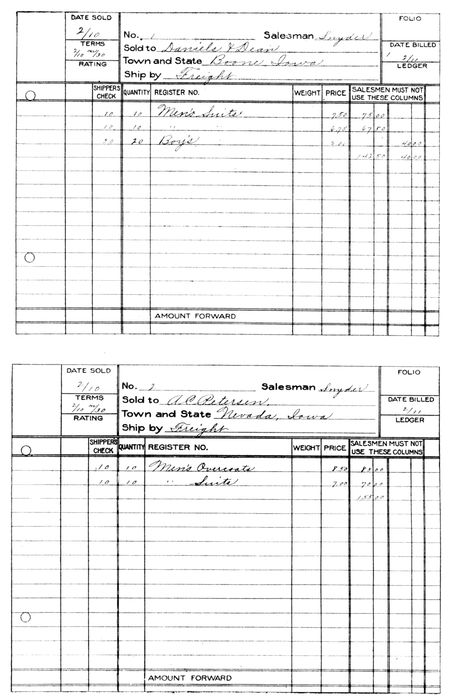
7. In a wholesale business it is customary to have all orders entered on specially ruled order blanks of a uniform size. These orders are filed in a binder designed for the purpose, which takes the place of the old style order book.
These order blanks are furnished to salesmen who send in their orders on them. When an order is received direct from the customer it, also, is transcribed on one of these blanks so that all order records will be uniform. One very appreciable advantage in the use of this loose sheet system of order blanks is that all unfilled orders are kept in a binder by themselves.
8. Filling Orders. Each day the orders to be filled should be placed in a temporary binder or holder and sent to the warehouse. The packer will check quantities shipped and return the order, together with the shipping receipt from the railroad or express company, to the bookkeeping department.
The amounts are extended, and the invoice is made out from this order blank. The sale is next recorded in the sales book. Instead 14of entering each item in the sales book the totals for each department are entered in the proper column. Each sale is numbered in the sales book as illustrated and the same number is placed on the order. These orders are then filed in the binder for filled orders in exact numerical order, which brings them also in the order of the dates of shipment.
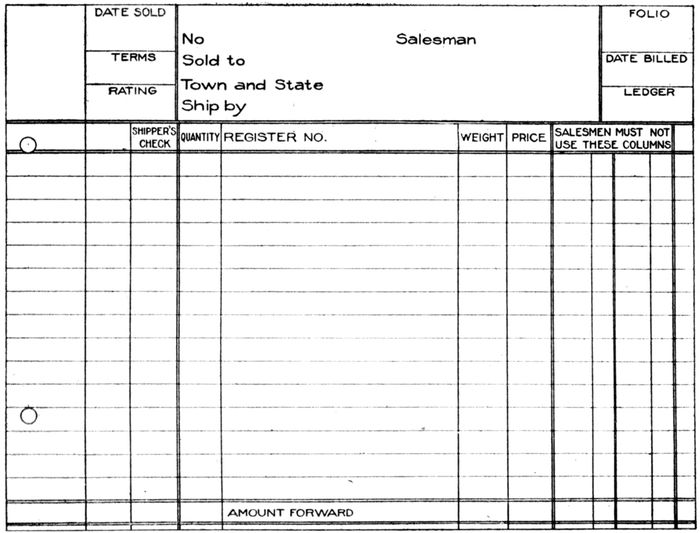
Order Blank
SALES BOOK
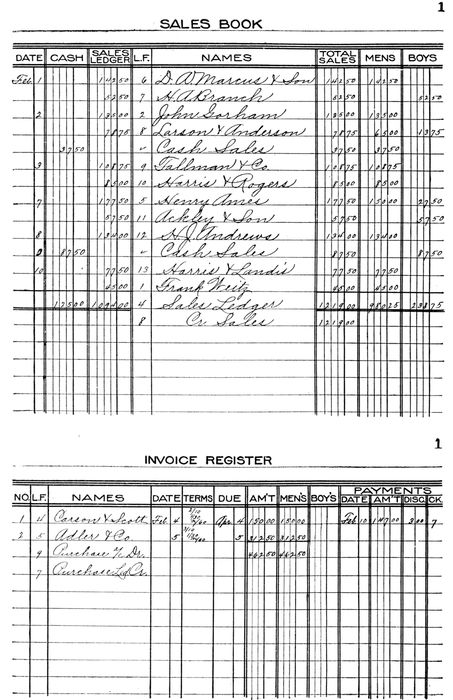
9. The sales book used in this set exhibits some features not heretofore shown. At the right are three columns for the distribution of sales. At the left, in addition to columns for number, date, and folio, are two columns headed cash and sales ledger. All cash sales are entered in the cash column, and all sales on account are entered in the sales ledger column. At the end of the week or month the total of the sales ledger column is posted to the debit of the sales ledger account in the general ledger, while the totals of the sales columns at the right are posted to the credit of the sales account in the general ledger.
15
INVOICE REGISTER
10. A form of purchase book, which also combines an invoice register, is shown in this set. Unlike the forms of purchase book with which the student has been made familiar, this invoice register gives full particulars as to terms, discount, when due, and when and how paid.
The combined footings of the two department columns must of course agree with the footing of the amount column. At the end of the month the total of the amount column is posted to the credit of purchase ledger account in the general ledger, and the totals of the department columns are posted to the debit of the purchase account in the general ledger.
The details of payment are kept in the invoice register as a memorandum only. This provides a convenient record of unpaid invoices, showing when each is due.
CASH BOOK
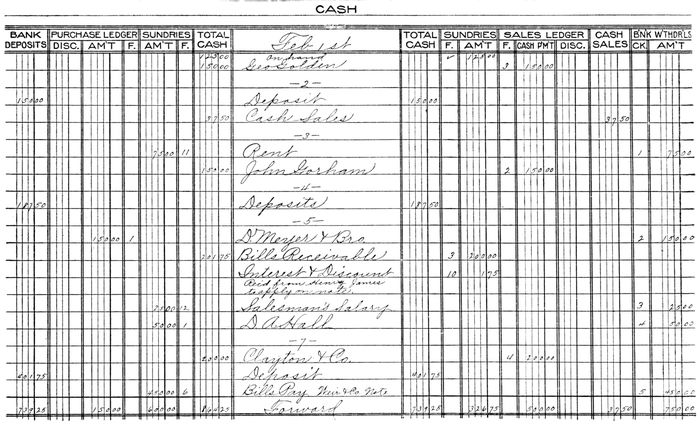
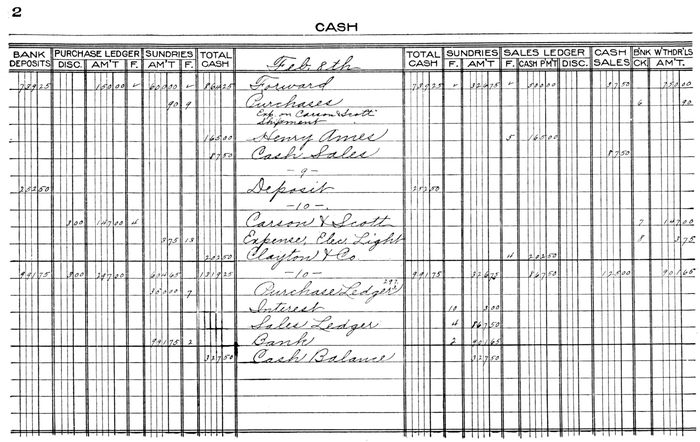
11. In this set we introduce a columnar cash book which also serves as a journal for cash transaction and is known as a cash journal. The principal advantage of a columnar book lies in the opportunity to introduce columns with special headings for accounts to which entries are frequent. Not only does this permit of carrying footings to the end of the month with one posting to the ledger account, but it provides a convenient classification of receipts and expenditures with a complete segregation of items of a given class.
In the form illustrated, columns are provided on the debit side for cash, purchase ledger (subdivided for discount and amount), bank deposits, and sundries; on the credit side, cash, sales ledger (subdivided for discount and amount), cash sales, bank withdrawals, and sundries. At first glance it might appear that this form is a departure from the regular form of cash book, but it should be remembered that the cash columns are the only ones having anything to do with the cash account. A cash receipt is entered in the cash debit column, but the amount is credited to its source through the proper credit column; thus a payment received on account is debited to cash and credited through the sales ledger column. A deposit is credited to cash and debited to bank deposits; the payment of a purchase ledger 16account by check is credited to bank withdrawals, and debited to purchase ledger account.
The discount columns are memorandum columns only, the net cash being entered in the amount columns under purchase and sales ledger. These columns are included that the total payment may be posted to personal accounts in purchase or sales ledger. The totals of these columns are to be posted to discount and interest columns at the end of the month.
The total amount to be posted to the debit of the purchase ledger account and to the credit of sales ledger account is made up of the totals of the discount and amount columns.
The sundries columns are provided for all entries for which there are no special columns and are used principally for transactions affecting general ledger accounts. These columns are sometimes used for ordinary journal entries not involving an exchange of cash, but their use for this purpose is strongly advised against. The cash book should be used exclusively for recording cash transactions. When columnar purchase, sales, and cash books are used, the journal is only needed for adjusting and closing entries, and for this purpose it is best to provide an ordinary two-column journal.
SUBDIVISION OF EXPENSE ACCOUNT
12. In every business there are several classes of expense and it is very useful to know the exact amount of each class. When all expenses are charged under one head, it is impossible to determine without considerable checking, whether or not any particular class of expense is more than it should be. It is customary, therefore, to subdivide expense and to open accounts in the ledger for different classes of expense. Some subdivisions in common use are rent (paid), insurance, taxes, interest and discount, in freight, out freight, salaries, labor, fuel, office supplies, telegraph and telephone, postage, general expense, etc. The exact subdivisions used must of necessity be governed by the nature of the business. For instance, the item of telegraph and telephone charges may be of importance in one business, while in another, the number of such charges would be so small that a separate account is not warranted.
17
PETTY CASH VOUCHER
13. A form of envelope voucher for petty cash is illustrated. A strong manilla envelope in what is known as size #10 takes the place of the petty cash book. It is ruled for a record of payments, and a receipt for each payment is placed in the envelope. At the bottom is a space for a distribution of the amounts to the proper accounts. When the petty cash fund is depleted—or at stated intervals—a check is drawn for the amount expended and it is charged through the cash book, leaving petty cash intact. The amount of the petty cash fund is considered as cash on hand, and the voucher envelope accounts for any part of the fund not actually in the cash drawer. Petty cash should be used sparingly, as it is intended only for small expense items when it is inconvenient to give a check. When the books are closed, the petty cash expenditures may be charged through the cash book as cash payments, instead of drawing a check.
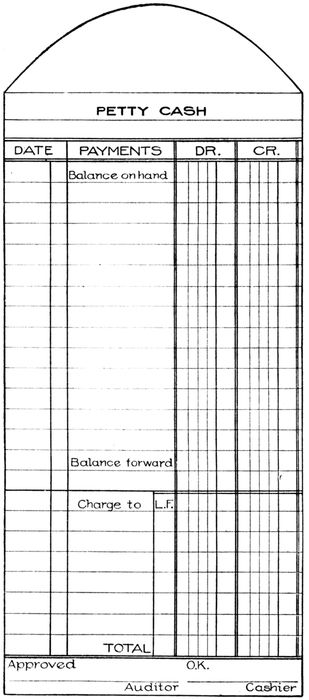
Petty Cash Voucher
18
TREATMENT OF PROTESTED PAPER
14. When a note, draft, or check is protested, the bank will charge us with the protest fee in addition to the face of the paper. The total amount must then be charged to the one from whom the paper was received. Suppose the check of Jones & Laughlin for $100.00 goes to protest and is returned to us with a protest fee of $2.50—the entry will be:
Jones & Laughlin $102.50
Bank $102.50
Check No. 16 given to First Nat.
Bank to cover J. & L. check for
$100.00, protest fee $2.50.
SAMPLE TRANSACTIONS
15. D. A. Hall is engaged in the business of a wholesale dealer in men's and boys' clothing. On Feb. 1st. his balance sheet is as follows:
Balance Sheet, Feb. 1st, 1909.
Assets
Cash
In Bank $1,765.20
In Office 125.00
Total Cash $1,890.20
Accounts and Bills Receivable
Bills Receivable 850.00
Henry James, Due
Feb. 5 350.00
David Traver & Co., Due
Feb. 15 500.00
Accounts Receivable 1,124.00
Frank Weitz 234.00
John Gorham 150.00
George Golden 300.00
Clayton & Co. 275.00
Henry Ames 165.00
Total Accounts and Bills Rec. 1,974.00
19Inventory
Men's clothing $2,240.00
Boys' " 1,200.00
Total Inventory $3,440.00
Total Assets $7,304.20
Liabilities
Accounts and Bills Payable
Bills Payable 650.00
Henry Weir & Co., Due
Feb. 7 450.00
A. Stein & Co., Due
March 1 200.00
Accounts Payable 675.00
D. Meyer & Bro. 150.00
Altman & Sons 350.00
Garson & Co. 175.00
Total Accounts and Bills
Payable 1,325.00
Total Liabilities 1,325.00
Present Worth 5,979.20
The following transactions are entered on the books:
—Feb. 1st—
Sold to D. A. Marcus & Son
10 overcoats 7.50 75.00
10 men's suits 6.75 67.50 142.50
—1st—
Sold to H. A. Branch
15 boys' suits 3.50 52.50
—1st—
Rec'd from Geo. Golden
Cash on account 150.00
—2nd—
Deposited in 1st Nat. Bank 150.00
20—2nd—
Sold to John Gorham
10 men's suits 7.00 70.00
10 men's suits 6.50 65.00 $135.00
—2nd—
Sold to Larson & Anderson
5 boys' suits 2.75 13.75
10 men's suits 6.50 65.00 78.75
—2nd—
Sold for cash
Men's clothing 37.50
—3rd—
Sold to Tallman & Co.
15 men's overcoats 7.25 108.75
—3rd—
Paid 1 month's rent, Ck.
No. 1 75.00
—3rd—
Received from John Gorham
Cash on account 150.00
—4th—
Bought from Carson & Scott
36 men's corduroy coats 3.00 108.00
12 men's corduroy coats 3.50 42.00 150.00
Terms 2/10, 1/30, n/60
—4th—
Deposited in 1st Nat. Bank 187.50
—4th—
Sold to Harris & Rogers
12 men's corduroy coats 3.75 45.00
5 overcoats 8.00 40.00 85.00
—4th—
Received from Frank Weitz
Note at 30 days, 6% 234.00
21—5th—
Sent to D. Meyer & Bro. Ck.
No. 2 $150.00
—5th—
Received from Henry James
Cash to apply on note 200.00
Cash for interest 1.75 $201.75
New note 30 days, 6% 150.00
—5th—
Bought from Adler & Co.
50 men's suits 6.25 312.50
Terms 3/10, 1/30, n/60
—5th—
Paid salesman's salary Ck.
No. 3 25.00
—5th—
Drew for personal use Ck.
No. 4 50.00
—7th—
Sold to Henry Ames
20 men's suits 7.50 150.00
10 boy's suits 2.75 27.50 177.50
—7th—
Sold to Ackley & Son
10 boy's overcoats 3.00 30.00
10 boy's suits 2.75 27.50 57.50
—7th—
Received from Clayton & Co.
Check to apply on acct. 200.00
—7th—
Deposited in 1st Nat. Bank 401.75
—7th—
Paid our note to H. Weir & Co.
Check No. 5 450.00
22—8th—
Sold to H. J. Andrews
10 men's overcoats 8.00 80.00
12 men's corduroy coats 4.50 54.00 $134.00
—8th—
Paid express on shipment from
Carson & Scott, Ck. No. 6 .90
—8th—
Received from Henry Ames
Cash on account 165.00
—8th—
Sold for cash
1 job lot boy's clothing 87.50
—9th—
Deposited in 1st Nat. Bank 252.50
—9th—
Received from bank, check of
Clayton & Co., protested
for non-payment.
Amount of check 200.00
Protest fees 2.50
—10th—
Sold to Harris & Landis
10 men's overcoats 7.75 77.50
—10th—
Sold to Frank Weitz
12 men's corduroy coats 3.75 45.00
—10th—
Paid Carson & Scott
Check No. 7 147.00
Discount 2% 3.00
—10th—
Paid electric light bill
Check No. 8 3.75
23—10th—
Received from Clayton & Co.
Cash to redeem protested
check $202.50
—10th—
Inventory at close of business,
Feb. 10
Men's clothing 1,898.75
Boy's clothing 1,247.75
Journal entries are to be made to get the accounts, as shown on Feb. 1st, recorded on the books. The transactions are properly entered in journal, cash book, sales book, and invoice register, and posted to ledger. The accounts in the general ledger are closed into trading, and profit and loss—the net profit is credited to proprietor's account—a trial balance is taken after the ledger is closed, and a balance sheet is made. Statements are prepared from sales and purchase ledgers, which agree with the balances of their controlling accounts. All accounts in the general ledger are properly ruled and balances carried forward.
24
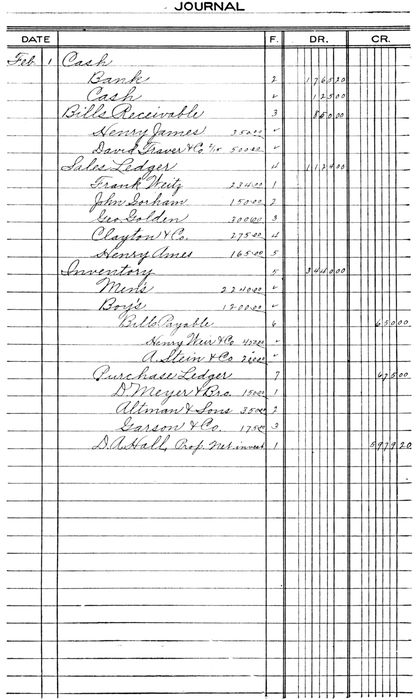
Opening Entry in Journal
25
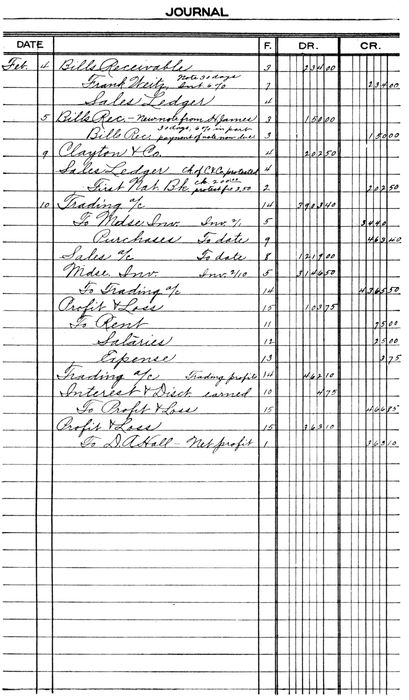
Adjusting Journal Entries
26
Sales Book and Invoice Register
SCENE IN SOUTH WATER STREET, WHERE THE COMMISSION HOUSES OF CHICAGO'S GREAT PRODUCE MARKETS ARE LOCATED
27
Columnar Cash Journal
28
Columnar Cash Journal
29
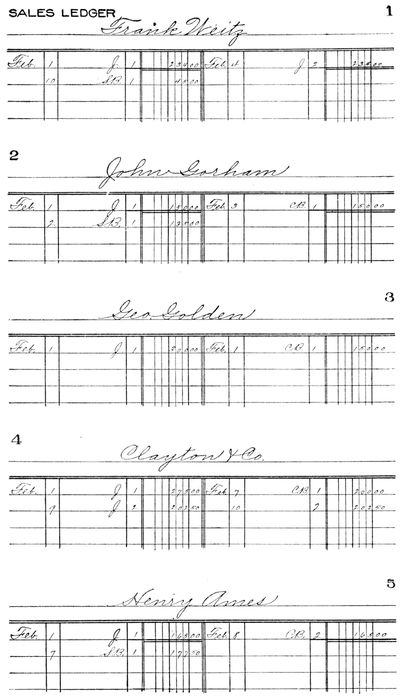
Sales Ledger
30
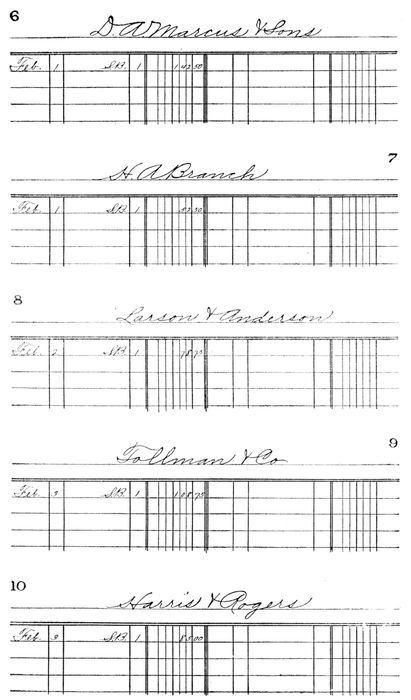
Sales Ledger
31
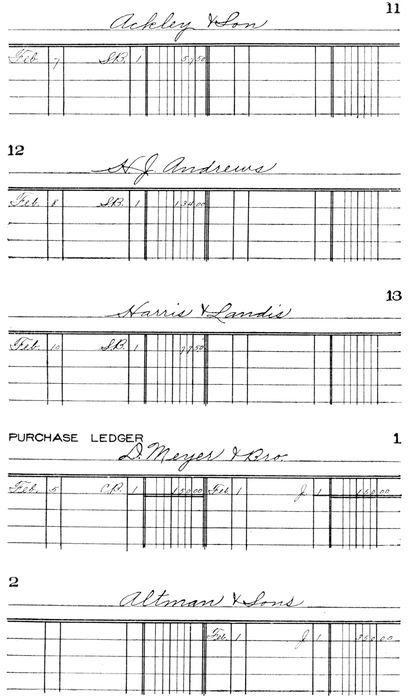
Sales and Purchase Ledgers
32
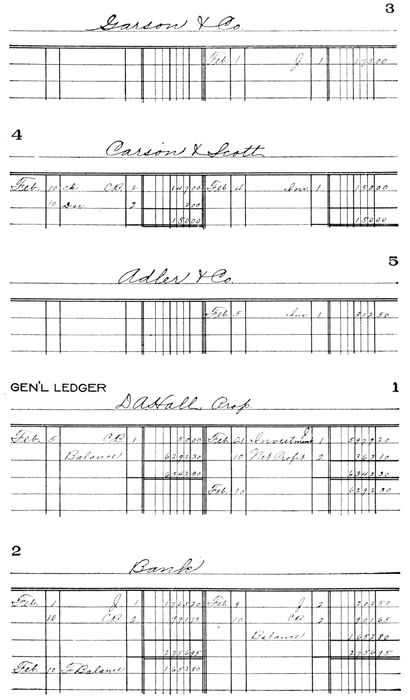
Purchase and General Ledgers
33
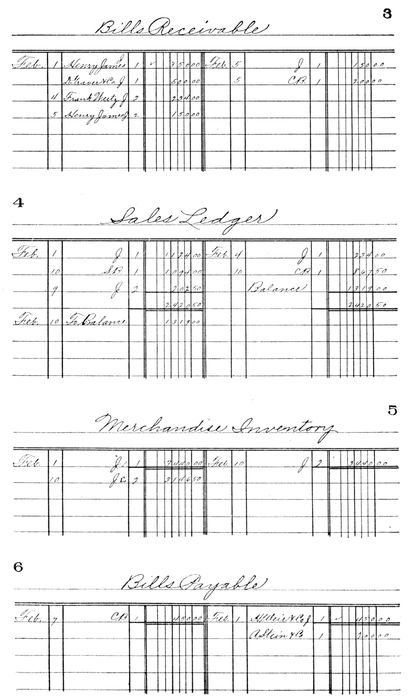
General Ledger
34
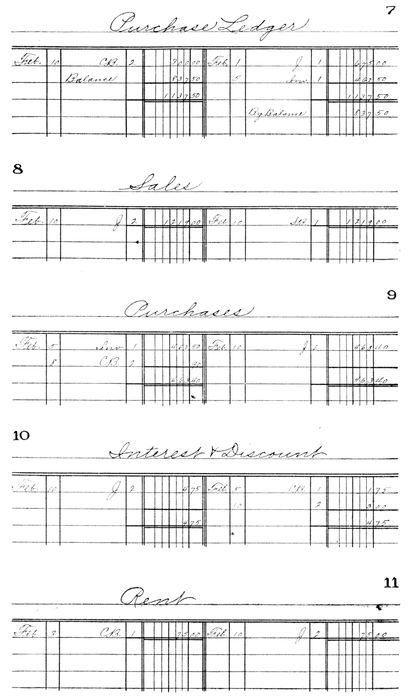
General Ledger
35
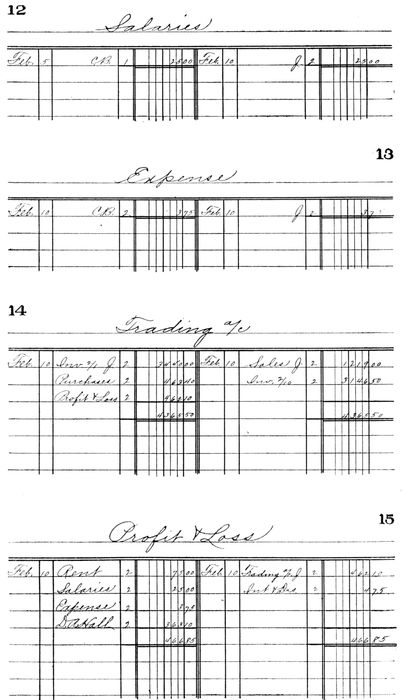
General Ledger
36
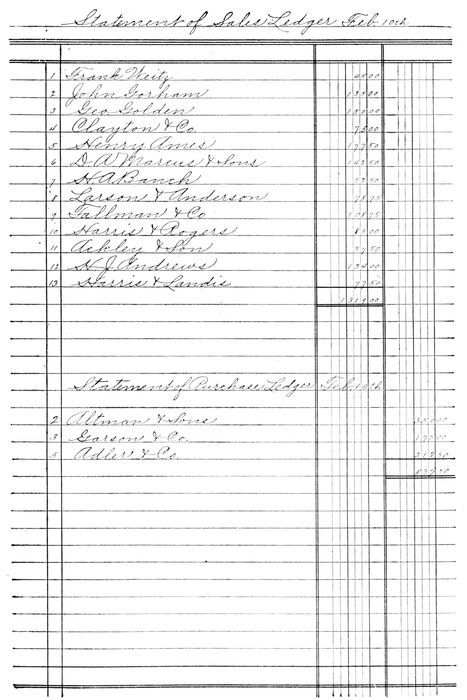
Statement of Sales and Purchase Ledger
37
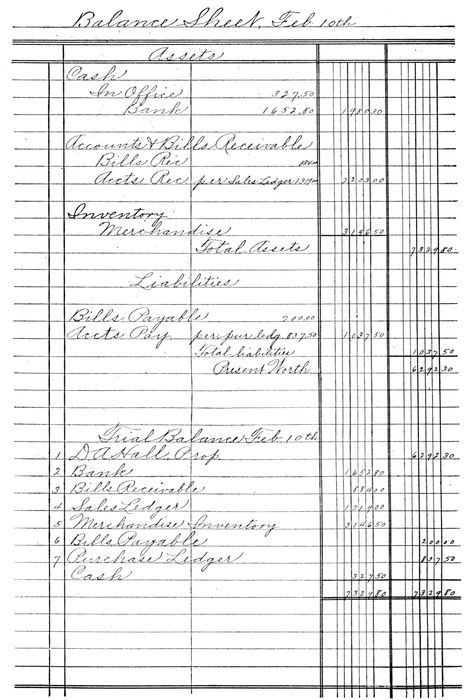
Balance Sheet and Trial Balance of General Ledger
38
EXERCISES
16. The following transactions are recorded on the books of Parker and Hoadley, Omaha, Neb., wholesale dealers in tea and coffee. In recording these transactions use is made of the books and forms illustrated in this section.
January 2nd, 1909
A partnership is formed on this date between K. J. Parker and D. C. Hoadley for the purpose of conducting a wholesale tea and coffee business, in the name of Parker & Hoadley, the principal place of business to be Omaha, Neb. Parker invests $3,000.00 cash. Hoadley invests $2,000.00 cash. It is agreed that profits are to be shared on the basis of capital invested, capital to draw interest at 6%, and interest at 6% to be paid on withdrawals. The books are to be closed monthly and the profits divided between the partners. Hoadley is to assume the entire responsibility for the conduct and management of the business, for which he is to receive a salary of $150.00 per month, payable in installments of $75.00 on the 15th and 31st of each month.
Deposited in Western National Bank $5,000.00.
Withdrew from bank, Ck. No. 1 petty cash $25.00.
Bought from Leggitt & Co., New York, 30 chests Japan tea, 1,455# at .37½, 20 chests Oolong tea, 972# at .40; terms net 30, 2/10, f. o. b. N. Y.
Bought from Laughlin & Co., Chicago, 20 sacks Rio coffee, 1,020# at .22½, 20 sacks Java coffee, 985# at .25; 20 sacks Mocha coffee, 970# at .25; terms net 30, 2/10, f. o. b. Omaha.
Paid rent of store 1 month to James Roberts, Ck. No. 2, $60.00.
—3rd—
Sold to Ames & Johnson, 92 12th St., on account, 3 chests Japan tea, 149# at .48; sack Rio coffee, 50# at .28; 1 sack Java coffee, 52# at .32.
Sold to Landis & Snow, So. Omaha, on account, 2 chests Oolong tea, 101# at .52; 1 sack Mocha coffee, 47# at .32; 2 sacks Rio coffee, 98# at .28.
Sold to J. C. Peters & Son, 267 Roberts St., 3 chests Oolong tea, 146# at .52, 5 sacks Rio coffee, 252# at .48.
39 Bought for cash from Harris & Co., 1 office desk and chair $45.00, gave Ck. No. 3 in payment.
—4th—
Paid freight on coffee from New York by Ck. No. 4, 12.93.
Sold to Wright & Noble, 146 7th St., 2 sacks Java coffee, 99# at .32; 2 sacks Mocha coffee, 101# at .32.
Sold to Horgis & Co., 84 Jackson St., 5 chests Japan tea, 248# at .48.
Sold to Winters & James, 92 Hastings St., 4 chests Japan tea, 201# at .48; 3 chests Oolong tea, 138# at .52; 2 sacks Java coffee, 97# at .32.
Sold for cash 1 sack Rio coffee, 47# at .28; 1 chest Japan tea, 45# at .48.
—5th—
Sold to Cobb & Willet, 892 Park Av., 2 chests Japan tea, 92# at .48; 1 chest Oolong tea, 47# at .52; 1 sack Rio coffee, 44# at .28; 1 sack Java coffee, 45# at .32; 1 sack Mocha coffee, 43# at .32.
Sold to Young & Criger, 62 Watson St., 5 sacks Mocha coffee, 205# at .32; 3 chests Oolong tea, 127# at .52.
Bought from Japan Importing Co., San Francisco, 60 chests Japan tea, 2,700# at .36, f. o. b. Omaha, net cash; gave our note at 10 days without interest in payment.
Paid account of Leggitt & Co., less 2% discount, Ck. No. 5.
—6th—
Ames & Johnson paid their account, less 2% cash discount.
Deposited cash received to date.
Sold to Wade & Francis, 92 Bluff St., 10 chests Japan tea, 448# at .48.
Paid for telegram—petty cash—.40.
Received check from Landis & Snow in full settlement of their account.
Sold to J. C. Peters & Son, 5 sacks Java coffee, 231# at .32.
Sold for cash 3 sacks Rio coffee, 127# at .28; 2 sacks Mocha coffee, 89# at .32; 3 sacks Japan tea, 131# at .48.
—8th—
Deposited cash on hand, also check of Landis & Snow.
40 Sold to Ames & Johnson, 2 sacks Mocha coffee, 91# at .32; 2 chests Oolong tea, 87# at .52.
Sold to Wright & Noble, 3 chests Japan tea, 129# at .48; 1 chest Oolong tea, 42# at .52.
Paid for fuel by check No. 6 to Rogers Coal Co., 12.00.
Paid clerk's salary, check No. 7, 10.00.
Paid for labor, check No. 8, 16.50.
—9th—
Sold to Watkins & Fish, 64 Prairie Av., 5 chests Oolong tea, 207# at .52.
Bought from Western Grocer Co., Chicago, 50 chests Oolong tea, 418# at .39; 20 sacks Rio coffee, 876# at .22¼; 10 sacks Java coffee, 434# at .25; 15 sacks Mocha coffee, 653# at .25; terms 30 days net, 2/10, f. o. b. Omaha.
Received from Wright & Noble cash in payment of our bill of Jan. 4th, less 2% cash discount.
—10th—
Received from bank, check of Landis & Snow protested for non-payment, protest fees added 1.90.
Sent Laughlin & Co. our check No. 9 in payment of account
—11th—
Sold to Raymond H. Moss, 182 Spring St., 5 chests Japan tea, 217# at .48; 5 sacks Rio coffee, 214# at .28.
Sold to Watkins & Fish, 10 sacks Mocha coffee, 424# at .32.
Cobb & Willet paid their account in full, deducting 2% for cash.
—12th—
Deposited cash on hand.
Sold to Cobb & Willet, 5 chests Japan tea, 213# at .48.
Sold for cash, 2 sacks Rio coffee, 88# at .28.
—13th—
Paid our note to Japan Importing Co., check No. 10.
Paid sundry office expenses from petty cash 3.60.
Sold to Wade & Francis 3 sacks Rio coffee, 123# at .28; 2 sacks Mocha coffee, 86# at .32.
Paid clerk's salary, ck. No. 11, 10.00.
Paid for labor, ck. No. 12, 16.50.
41 —15th—
Paid ½ month's salary to D. C. Hoadley, ck. No. 13, 75.00.
1st. Balance cash, first charging petty cash expenditures as a cash payment.
2nd. Post purchase book, sales book, journal, and cash book.
3rd. Take a trial balance.
4th. Credit interest to partner's accounts.
5th. Take an inventory of stock on hand. The records show quantities purchased and quantities sold. When the same goods have been purchased at different prices, use the last price paid in figuring inventory.
6th. Close accounts into trading and profit and loss accounts.
7th. Distribute net profits to partners' capital accounts.
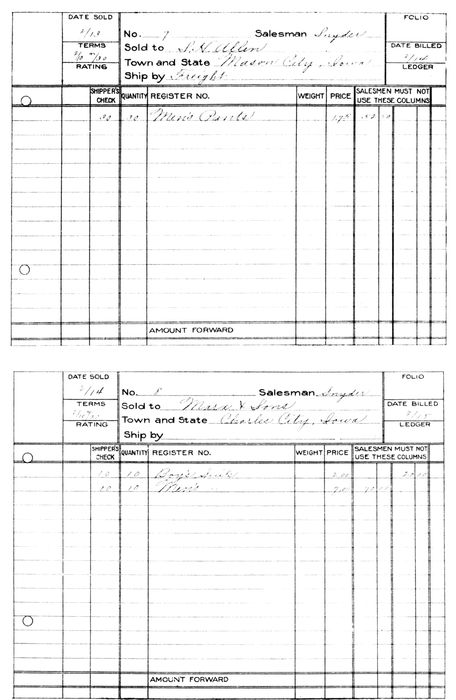
COMBINED ORDER AND SALES RECORD
17. Instead of keeping separate order and sales books, both records may be combined on one blank. This is accomplished by the use of order blanks provided with columns for the distribution of sales to the different departments. Before the order is filled these blanks are handled in the same manner as those without distribution columns. When filled, the amounts are extended in the proper columns and the invoice made. The orders are then filed in a binder, each day's orders being kept together, and postings made direct to customers' accounts. The footings are carried forward to the end of the month and totals posted to sales accounts. The original orders thus become a loose leaf sales book.
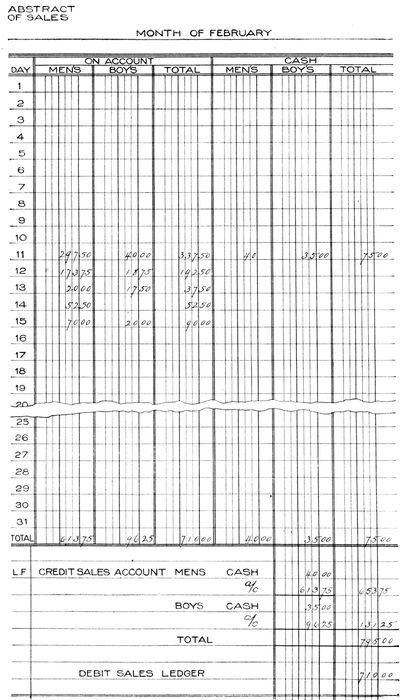
ABSTRACT OF SALES
18. When the order blank is used as a sales record, making a sales book with a record of a single sale to a sheet, it is somewhat inconvenient to determine from the footings the total sales for the day. This information is of considerable value, as a knowledge of what is being done from day to day is of importance to the principals of a business. Such a record is provided for by an abstract of sales on a separate sheet. This abstract should show total sales for each day, both cash and on account, divided by departments.
The blank may be made the same size as the order blanks, and filed in the sales binder at the beginning of the month. Sales are 42recorded daily and footings carried forward to the end of the month, when the totals may be posted direct to the credit of the sales account in the general ledger. The totals of sales on account will be posted to the debit of the sales controlling account in the general ledger.
OUT FREIGHT
19. The proper treatment of freight paid on outgoing shipments is an important question in accounting. When goods are sold at delivered prices, the freight paid is one of the items of expense in selling the goods, and when the books are closed the account will be closed into profit and loss. However, in a wholesale business, freight is sometimes paid as an accommodation to the customer when the goods have been sold at f. o. b. prices. Although the amount should be added to the invoice it should not be credited to the sales account as this would be taking credit for a fictitious trading profit. Such an item should be made a special charge against the customer by means of a journal entry.
Customer Dr.
Out Freight Cr.
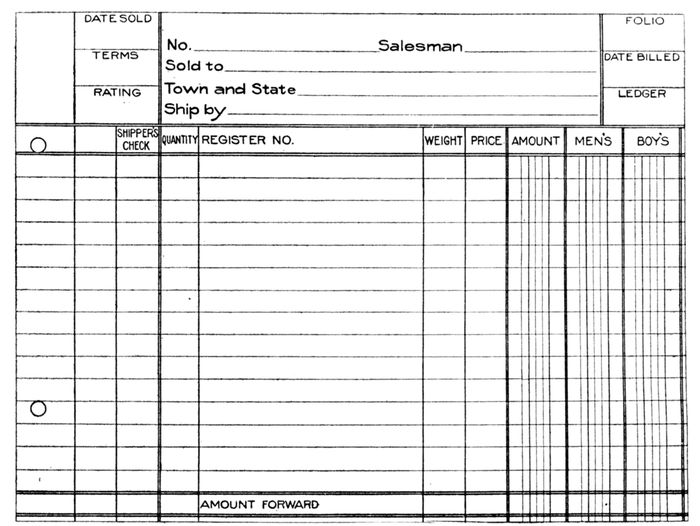
Combined Order and Sales Record
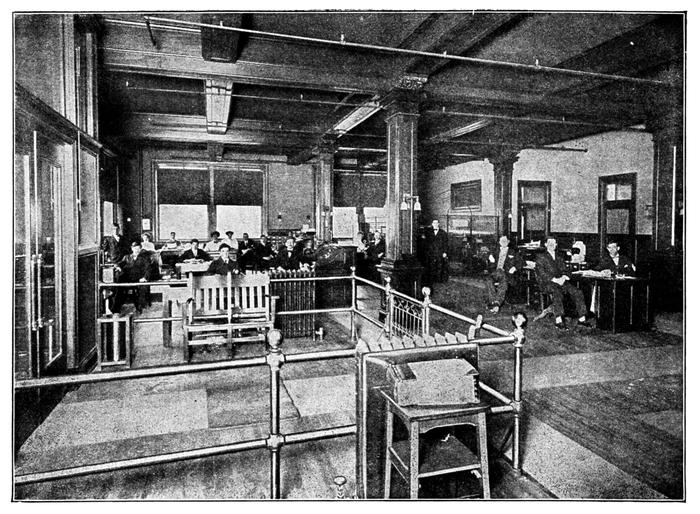
THE GENERAL OFFICES OF THE SAMUEL C. TATUM CO., CINCINNATI, OHIO
43
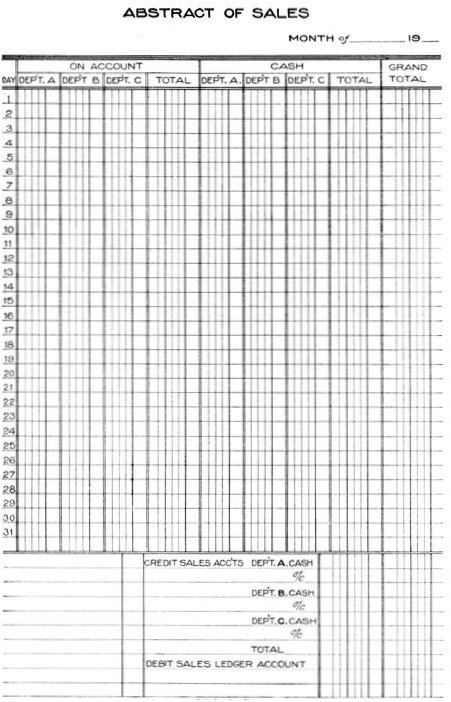
Abstract of Sales by Departments
44
SALES EXPENSE
20. In a wholesale or manufacturing business it is very desirable that the exact cost of selling goods be known. Broadly, this cost is covered under the general head of sales expense, but this is usually divided into several classes of expenditures. The segregation of the various items of sales expense is desirable for the purpose of determining the percentage of each. The items which properly belong in sales expense depend somewhat on the nature of the business. For example, traveling expenses are usually a direct sales expense, but in some businesses they may be chargeable to the cost of purchases. The items entering into sales expense of the average business are: advertising, salaries of salesmen, traveling expenses of salesmen, commissions paid on sales, cost of packing and shipping, out freight.
21. Advertising. This account should be charged with all expenditures for publicity such as newspaper, magazine, street car, and bill board advertising, cost of printing catalogs, booklets, and circulars. Where there is any reason for so doing, the cost of the different classes of advertising can, of course, be kept in separate accounts. The aim and object of advertising being to increase the sale of goods, it is properly considered an item of sales expense.
22. Salaries of Salesmen. This account is charged with all salaries paid to salesmen whether traveling or working in the house. Commissions and bonuses are sometimes included in this account, but it is usually considered best to keep them in separate accounts.
23. Traveling Expenses of Salesmen. This account is charged with all legitimate traveling expenses of salesmen, the specific items included depending largely on the nature of the business. For example, in some businesses a liberal allowance is made for the entertainment of customers, while in others this item is never allowed. In any business the traveling expense account requires careful scrutiny. Salesmen should be required to furnish an itemized statement or voucher of expenses at stated intervals. For convenience, this should be made on a form specially provided for the purpose. One of the most convenient and popular expense vouchers is in the form of a book of a convenient pocket size, with a page for each day of the week and a summary of the week's expenses on the last page.
24. Packing and Shipping. This account is charged with the 45entire cost of packing goods for shipment. It includes such items as wages of shipping clerk and his assistants, crates, lumber, boxes, and all other packing materials.
TRIAL BALANCE BOOK
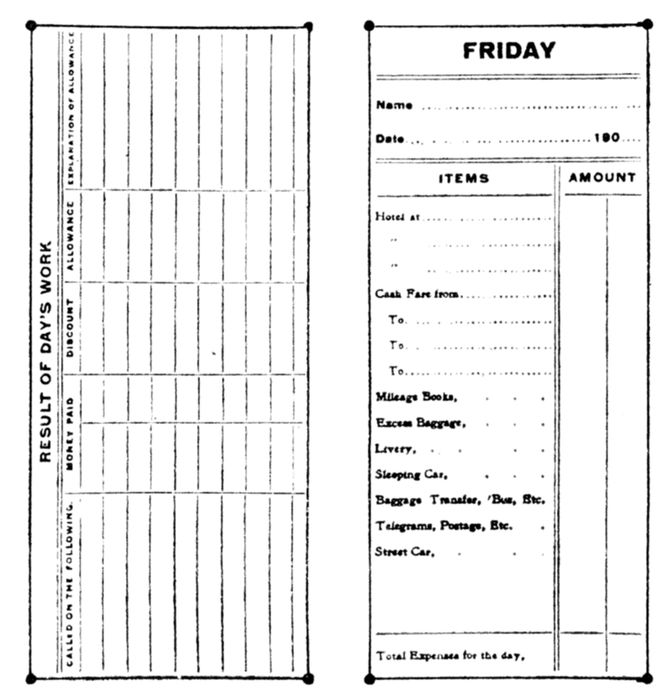
Traveler's Expense Book
25. To save rewriting the names of the accounts each month, a trial balance book can be used to good advantage. These books are made to accommodate six trial balances on a double page, and are sometimes made with alternate short leaves so that twelve trial balances may be made with one writing of the names. When the trial balance book is used, care must be exercised in providing space for the addition of new accounts in each section. Where separate sales and purchase ledgers are used, it is best to provide a trial balance book for each ledger.
THE CHECK REGISTER
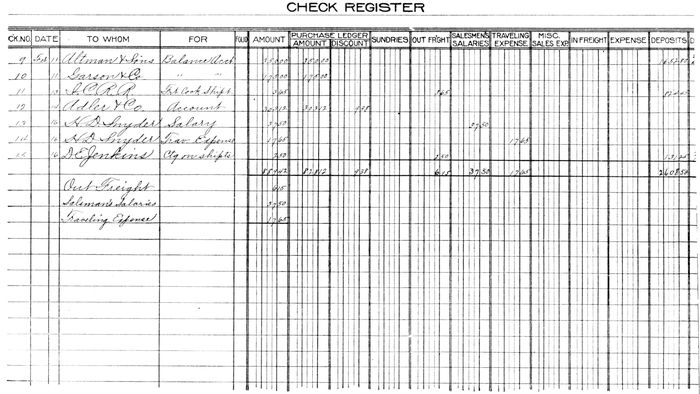
26. Large check books are cumbersome to handle and necessitating the expenditure of much needless labor. Their use is rapidly giving way in modern offices to the check register. The check register has several distinct advantages. It exhibits, in compact form, a record of all checks issued and can also be arranged to show deposits and balance in the bank. Distribution columns can be provided with headings for the different expenditure accounts, which makes of the check register a cash expenditure book. The form should be varied to suit the business in which it is to be used. A typical form is illustrated on page 37.
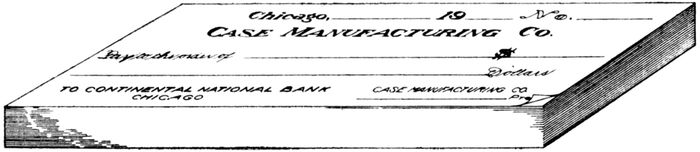
27. Checks in Pads. When the check register is used it is the usual custom to have checks put up in pads. After the check is written, it is registered and numbered to correspond to the register number. With the use of padded checks, it is not necessary for the clerk who writes the check to know anything about the bank balance.
46
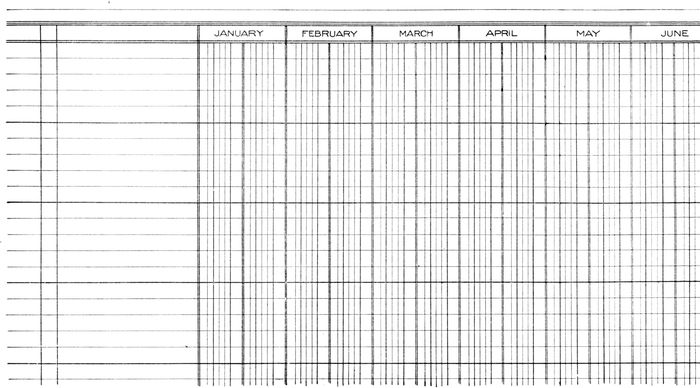
Trial Balance Book
47
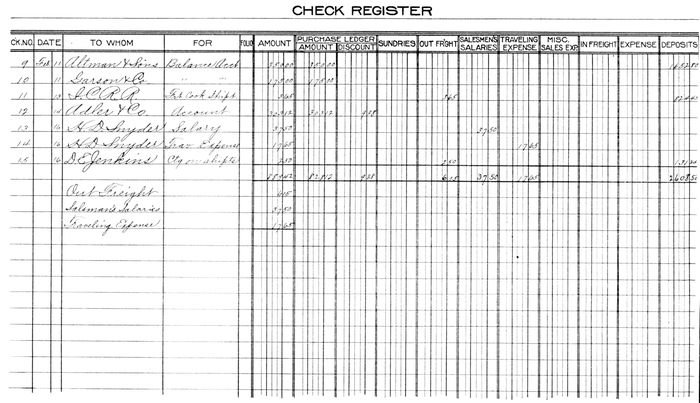
Check Register Combined with Cash Expenditure Book
48
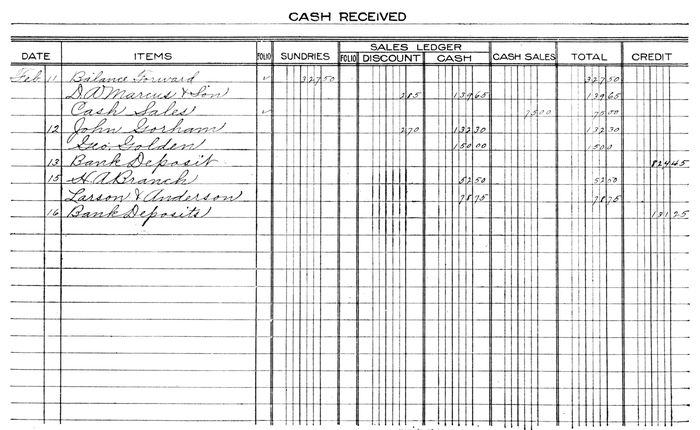
Cash Received Book
49
Checks in Pads
CASH RECEIVED BOOK
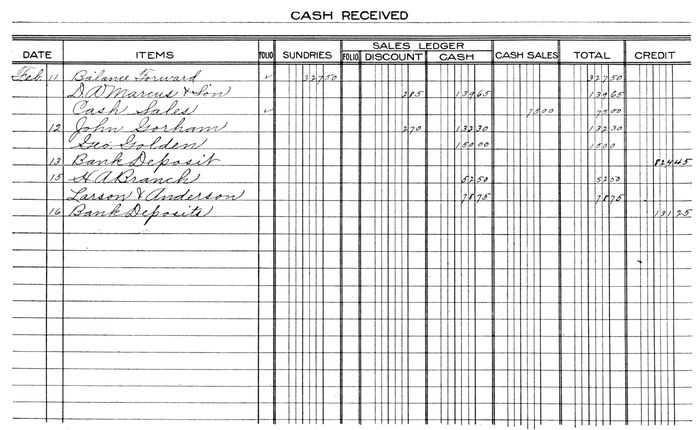
28. A cash book specially ruled for a record of cash received is used to supplement the check register or cash expenditure book. Columns are provided for the different classes of receipts, with one credit column. It is assumed that all cash received is deposited, payments being made exclusively by check. This does not refer to petty cash expenditures which should be kept in a petty cash book or on envelope vouchers.
SAMPLE TRANSACTIONS
29. The following transactions illustrate the use of the special blanks and books described.
D. A. Hall employs H. D. Snyder as traveling salesman for the purpose of increasing his business, agreeing to pay him a salary of $150.00 per month and expenses. He commences work on Feb. 11th. The amounts in the ledgers stand as shown in the last model set illustrated and these transactions are recorded:
—Feb. 11th.—
Paid Altman & Sons
To balance account
Ck. No. 9 $350.00
—11th—
Paid Garson & Co.
To balance account
Ck. No. 10 175.00
50
—11th—
Sold to Daniels & Dean, Boone, Ia.
10 men's suits $7.50 $75.00
10 men's suits 6.75 67.50
20 boys' suits 2.00 40.00
182.50
Terms 2/10 N/30
—11th—
Sold to A. C. Petersen, Nevada, Ia.
10 men's overcoats 8.50 85.00
10 men's suits 7.00 70.00
155.00
Terms 2/10 N/30
—11th—
Received from D. A. Marcus & Son
Cash 139.65
Discount 2% 2.85
—11th—
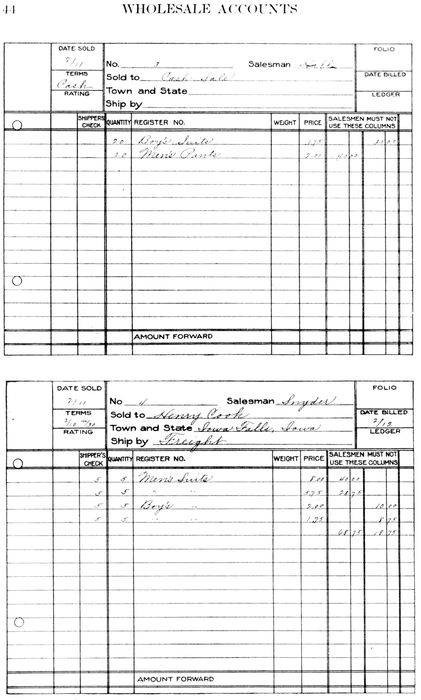
Sold for cash
20 boys' suits 1.75 35.00
20 men's pants 2.00 40.00
—12th—
Received from John Gorham
Cash 132.30
Discount 2% 2.70
—12th—
Sold to Henry Cook, Iowa Falls, Ia.
5 men's suits 8.00 40.00
5 men's suits 5.75 28.75
5 boys' suits 2.00 10.00
5 boys' suits 1.75 8.75
87.50
Terms 2/10, N/30
—12th—
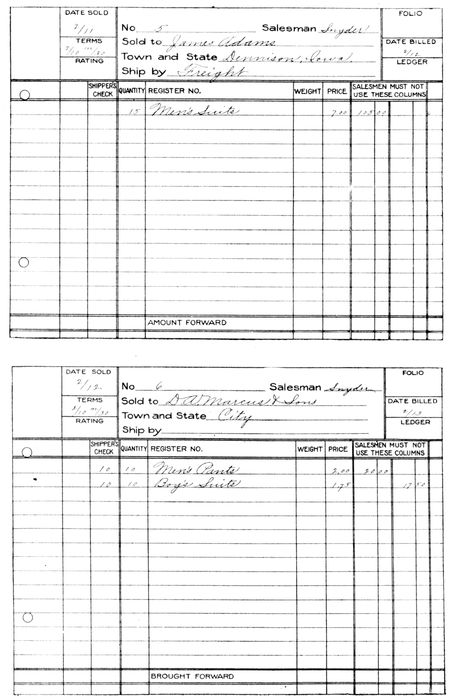
Sold to James Adams, Dennison, Ia.
15 men's suits 7.00 105.00
Terms 2/10, N/30
51
—12th—
Received from Geo. Golden
Cash $150.00
—13th—
Sold to D. A. Marcus & Sons
10 men's pants 2.00 20.00
10 boys' suits 1.75 17.50
37.50
Terms 2/10, N/30
—13th—
Paid freight on shipment to
Henry Cook
Ck. No. 11 3.65
Charge to Cook
—13th—
Deposited cash 824.45
—13th—
Sold to S. H. Allen, Mason City, Ia.
30 men's pants 1.75 52.50
Terms 2/10, N/20
—14th—
Paid Adler & Co.
Ck. No. 12 303.12
Discount 9.38
—15th—
Sold to Marx & Sons, Charles City, Ia.
10 boys' suits 2.00 20.00
10 men's suits 7.00 70.00
Terms 2/10, N/30 90.00
—15th—
Received from H. A. Branch
Cash 52.50
—15th—
Received from Larson & Anderson
Cash 78.75
52
—16th—
Paid H. D. Snyder
1 week's salary $37.50
Ck. No. 13
—16th—
Paid H. D. Snyder
Traveling expenses 17.65
Ck. No. 14
—16th—
Deposited cash on hand 131.25
—16th—
Paid D. E. Jenkins
For cartage on shipments 2.50
Ck. No. 15
EXERCISE
1. Prepare a trial balance of the ledger as it would appear after posting these transactions.
2. Assuming that gross trading profits average the same per cent of selling prices as in former transactions of this business house, find approximate inventory at close of business Feb. 16th.
3. Prepare trading and profit and loss account, based on this inventory.
53
Order and Sales Records
54
Order and Sales Records
55
Order and Sales Records
56
Order and Sales Records
57
Departmental Abstract of Sales
58
Cash Received Book
ONE OF THE ELECTRICAL MANUFACTURING PLANTS OF THE FAIRBANKS-MORSE COMPANY
59
Check Register and Cash Expenditure Book
60
COMMISSION AND BROKERAGE BUSINESS
30. Commission or brokerage is the business of buying and selling goods for another. The commission merchant or broker acts in the capacity of agent, charging a stated per cent or commission for his services.
Certain commodities are sold on the market at the best prices obtainable, the prices depending upon the condition of the market—the supply and demand. Since it would be both inconvenient and unprofitable for each seller to accompany his own wares to market, he avails himself of the services of the commission merchant. The class of goods most largely dealt in by commission merchants is farm produce, shipped to the cities by both producers and country dealers.
The practice of shipping produce to the broker to be sold on commission is gradually falling into disuse. As the business is now conducted, the commission merchant buys the produce outright and takes his own chances of making a profit, and thus his business becomes also that of a wholesaler.
MERCHANDISE BROKER
31. Certain classes of merchandise are marketed through the medium of brokers styling themselves merchandise brokers. Their business is usually transacted on a larger scale than that of the ordinary commission merchant. The merchandise broker sells in large quantities—as salt by the car load.
The distinction between the commission merchant and the broker lies in the fact that the commission merchant has the goods to be sold actually in his possession, while the broker acts as agent for the purchase and sale of goods which he does not actually handle.
MANUFACTURER'S AGENT
32. One distinct class of brokers is the sales agent or manufacturer's agent. He is a broker who sells goods for the manufacturer, usually by sample. As a rule the manufacturer sets the prices and determines the terms of credit. The goods are sold in the name of the manufacturer who carries the accounts on his books, paying the agent a commission for his services. In some cases, however, the manufacturer's agent maintains his own warehouse, issues a warehouse receipt for the goods which are shipped to him, and even 61advances money to the manufacturer. He then becomes virtually a commission merchant. He holds the goods as security for the money advanced, and, when sold, collects the money and remits the balance of the net proceeds the same as the ordinary commission merchant.
SHIPMENTS
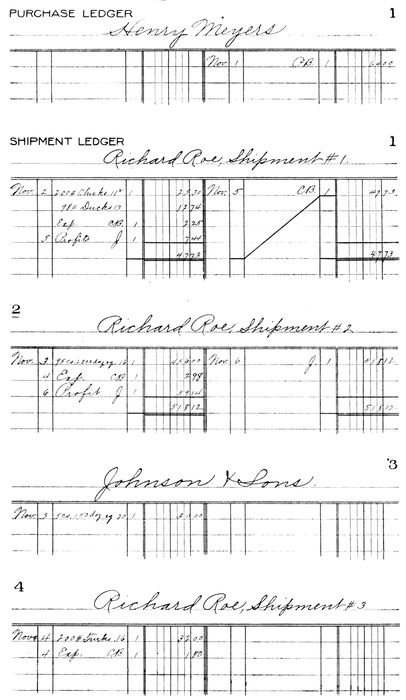
33. When a principal sends goods to a commission merchant or broker to be sold on commission, it is called a shipment. As soon as the goods are sent, an account is opened with the shipment, and the shipment is designated by the name of the consignee, a number, or the name of the place—as Shipment to Richard Roe. If more than one shipment is made to a commission merchant an account should be opened for each one in order that the gain or loss can be determined for individual shipments. The separate accounts should be designated by number—as Richard Roe, shipment No. 2.
The shipment, when made, is entered in the same way as a sale, and the items are charged at cost price. The account is also charged with any expense incurred on account of the shipment. When the Account Sales is received, the account is credited with the net proceeds. It now shows either a profit or a loss which is transferred by a journal entry to an account called Profit and Loss on Shipments. This account is, in turn, closed into profit and loss when the books are closed.
If at the time of closing the books there are any outstanding shipments on which Account Sales have not been received, the debit balances represent assets the same as inventory of merchandise on hand.
34. Agents' or Factors' Account. If the Account Sales, when received, is accompanied by a remittance to cover net proceeds, cash is debited and the shipment account credited for the amount. When a remittance is not received with the Account Sales, the shipment account is credited with net proceeds and the amount is charged to a new account opened in the name of the consignee as Agent or Bailee or Factor—as Richard Roe, Agent, or Richard Roe, Bailee, which is treated as a personal account. This does not mean that Richard Roe is a debtor in the ordinary sense of the term, but that he holds funds in trust; and in case of his failure, the shipper could 62recover full value instead of being obliged to accept his pro rata share of the assets.
A CONSIGNMENT
35. When a broker receives a shipment of goods to be sold on commission, it is known as a consignment. He opens a memorandum account by entering a list of the goods, but without extending any amounts. He has not purchased the goods, but simply holds them for sale as agent of the shipper. If there are any charges against the consignment, as freight, cartage, or storage charges, an account is opened in the name of the consignor. The title would be John Doe's Consignment, and if more than one consignment is received from John Doe a separate account is opened for each. This account is debited for all charges, and as sales are made they are credited to the account. When all of the goods have been sold, the broker renders the consignor a statement, known as an Account Sales, showing sales, expenses, and net proceeds.
If, when the books are closed, there are on hand any consignments, or parts of consignments, unsold, the consignment accounts are left open and represent either assets or liabilities. If expenses have been debited and no sales credited, the account will show a debit balance representing an asset. If sales have been credited in excess of the expense charges, the credit balance will represent a liability. When an Account Sales has been rendered, the account will balance, the net proceeds having been either remitted or credited to the consignor.
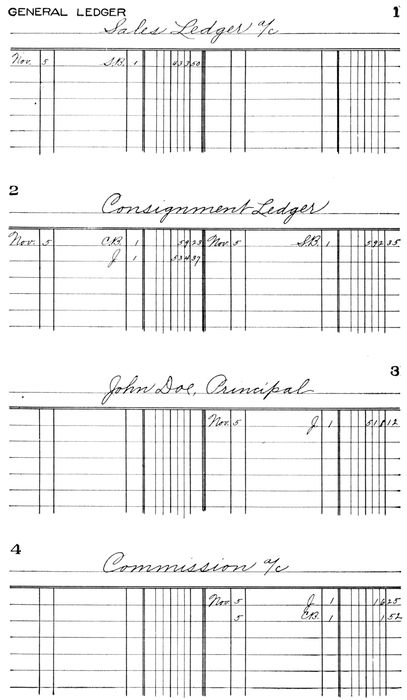
36. Principal's Account. If the broker remits the net proceeds at the time of rendering the Account Sales, he debits the consignment and credits cash, or bills payable as the case may be. But if he renders an Account Sales without remitting, he opens an account with the consignor, as John Doe, Principal, or John Doe, Bailor, and credits the account with the net proceeds, debiting the consignment account. The title of the account shows that he is not an ordinary debtor to John Doe, but that the amount of the credit represents funds belonging to John Doe and held in trust by the broker. In case of his failure the account of John Doe, Principal, would have to be paid before the claims of ordinary creditors.
6337. Commission Account. All sums received by the broker for services rendered in connection with the sale of goods for a shipper are credited to a commission account. When the books are closed this account is closed into profit and loss.
PRODUCE SHIPPER'S BOOKS
38. The most common branch of the commission business is that of shipping and selling produce. The books used vary somewhat from those used by a manufacturer's agent selling to jobbers, but the principles are the same.
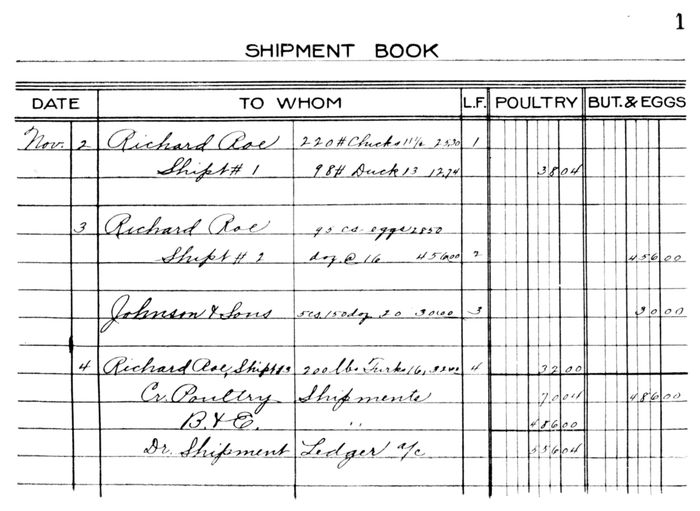
Two Column Shipment Book
Sometimes the same man conducts both the business of shipper and broker, buying certain goods which he in turn ships to other brokers to be sold for his account. In the produce commission business, however, the shipper is usually a buyer, located in the country, who buys produce from the farmer and ships to a commission merchant in the city.
The books required by the shipper are purchase book, shipment book, shipment ledger, cash book, journal, and general ledger.
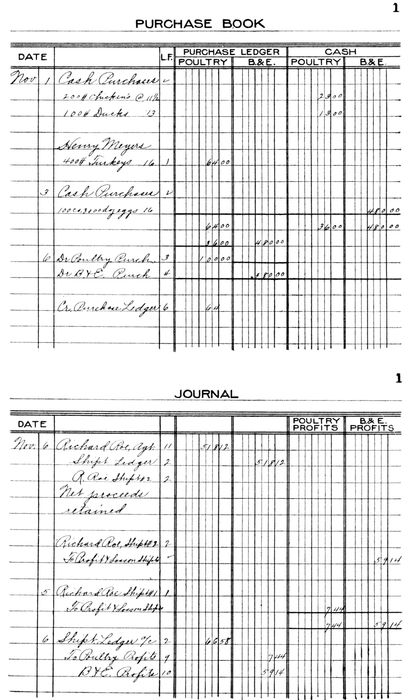
39. Purchase Book. This book is of the same form as used in other businesses, with as many columns as may be desired to separate purchases of different classes of produce.
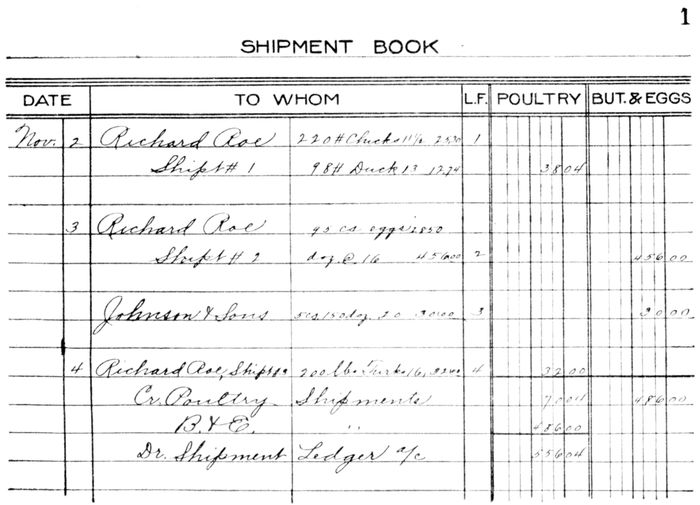
6440. Shipment Book. This is the book of original entry for shipments in which each shipment is recorded in detail, showing each item, with prices (usually at cost) extended. The book can be ruled with columns for segregating shipments of different classes of produce. The total of each shipment is posted to the debit of the individual shipment account in the shipment ledger. The footings of the columns are carried forward to the end of the month when they are posted to the credit of shipment accounts in the general ledger. These general ledger shipment accounts are opened for each class of produce for which a separate record is desired, and correspond to the sale account of a mercantile business.
At the end of the month the total of all shipments is posted to the debit of a controlling account in the general ledger known as shipment ledger account.
If more than one class of produce is shipped to an agent at the same time it is best to make invoices for each, treating them as independent shipments. Each package should bear a number or other mark by which it can be identified as belonging to a particular shipment.
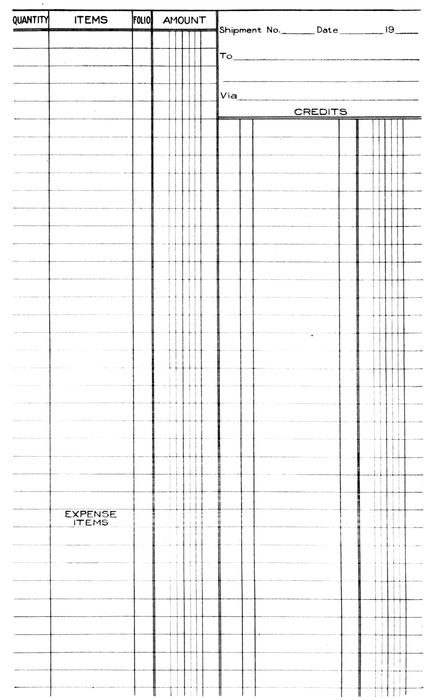
41. Shipment Ledger. An ordinary ledger can be used or a special form prepared. Since the debit side of the account will require much the greater amount of space, special forms are quite desirable. A convenient form is illustrated on page 55.
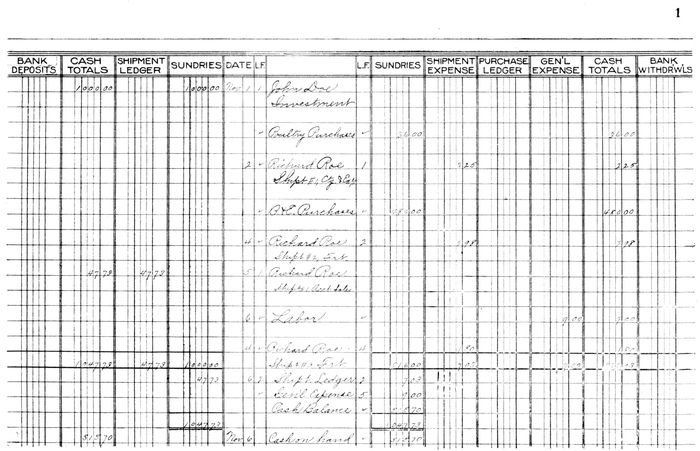
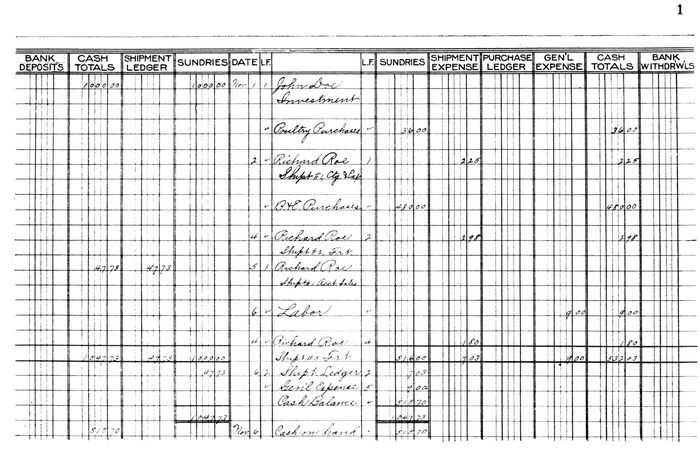
42. Cash Book. Tabular cash books with special arrangement of the column headings are used. The special features are the column on the credit side headed shipment expense, and the debit column headed shipment ledger. The shipment expense column is for the expenses paid on each shipment. Expenses are posted direct to the debit of the individual shipment accounts, and at the end of the month the total expense is posted to the debit of the shipment ledger controlling account. The shipment ledger column is for net proceeds remitted with account sales. The amounts are posted to the credit of shipment accounts, and the total is posted at the end of the month to the credit of shipment ledger controlling account.
The sundries column is for receipts other than remittances with account sales—as payments by agents who have not remitted with account sales.
65
Shipment Ledger for Commission Business
66
Cash Journal for Commission Business
6743. Shipment Ledger Account. This is the controlling account of the shipment ledger. It is charged with total shipments through the shipment book; with advance expenses through cash book or journal; credited with net proceeds through cash book or journal. It must also be charged with profits on shipments, or it will not represent the total balance of shipment ledger.
When net proceeds are credited, the individual shipment account should be charged, through the journal, with the net profit, which is credited to Profit and Loss on Shipments. A special credit column is provided in the journal for profits, or if a record of profits on each class of produce is desired, two or more columns are provided. Monthly totals are posted to the credit of profit and loss on shipment account, or to more than one such account—as profit on poultry, profit on butter and eggs, etc. The total of all profit columns, which represents debits to shipment accounts, is charged to shipment ledger account.
It is to be supposed that losses will be few, and when one is incurred the entries should be made through the journal. The amount will be charged to profit and loss on shipment account and credited to both the individual shipment account and shipment ledger account.
44. Journal. As already explained, the journal should be provided with extra columns for profits on each class of shipment.
When an agent transmits an account sales without a cash remittance, the transaction must be journalized to close the shipment account. When proceeds are to be charged to his account, the entry is:
Dr. Cr. Cr.
Richard Roe, Agt. $160.00
To Shipment Ledger
Richard Roe Shipment No. 1 $160.00
Richard Roe, Shipment No. 1 18.00
To Profit and Loss on Shipments $18.00
If a note to cover net proceeds is received, the entry is the same except that Bills Receivable is debited instead of Richard Roe, Agt.
When a loss is incurred the entry is:
Dr.
Profit and Loss on Shipments $18.00
To Shipment Ledger Account
Richard Roe Shipment No. 1 $18.00
and postings will be made direct to all accounts affected.
68
TREATMENT OF ACTUAL SALES
45. The shipper may sell a portion of his produce outright, and if a large share of his business is transacted in this manner, sales can be treated exactly the same as though he was not engaged in a commission business, with separate sales book and sales ledger.
Most shippers, however, will not find it necessary to segregate sales to this extent. Sales can be charged to shipment accounts in the shipment ledger, but will of course be charged at a profit, and credited to shipment account in general ledger. Payments on these accounts will be entered in the cash book as net proceeds.
SHIPPER'S TRADING ACCOUNT
46. The trading account of the shipper is made up somewhat differently than for a mercantile business where all sales are supposed to be entered at a profit.
If all his produce is sold through commission merchants, and the inventory of produce in stock exactly equals the difference between purchases and shipments, the account, profit and loss on shipments represents the trading profit. But this state of affairs seldom if ever exists. Either there will have been outright sales or a discrepancy will appear in the inventory. The latter is usually the case in a produce business, for some value will be lost owing to the perishable nature of the goods handled.
The trading account is charged with all purchases and inventory, if any, at beginning of the period, and credited with all shipments and inventory at end of period.
The trading account now exhibits the true trading profits with a complete segregation of profits from actual sales and commission sales. The inventory does not include outstanding shipments, these being treated as a separate item in the balance sheet.
TRADING a/c
To Purchases $10,000 00 By shipments $9,000 00
Profit on Sales 465 00 " Inventory 1,465 00
$10,465 00
By Profit on Sales $465 00
69
SAMPLE TRANSACTIONS
47. The following transactions, taken from the books of John Doe, shipper of poultry and butter and eggs, illustrate the books and accounts used.
—Nov. 1, 1908—
Commenced business with a
cash investment of $1,000.00
—1st—
Bought for cash
200# chickens @ .11½ 23.00
100# ducks @ .13 13.00
—1st—
Bought from
Henry Meyers
400# turkeys @ .16 64.00
—2nd—
Shipped to
Richard Roe, to be sold on my a/c
220# chickens @ .11½ 25.30
98# ducks @ .13 12.74
—2nd—
Ctg. and Exp. on above
paid in cash 2.25
—3rd—
Bought for cash
100 cs. eggs, 3,000 doz. @ .16 480.00
—3rd—
Shipped to
Richard Roe to be sold on my a/c
95 cs. eggs, 2,850 doz. @ .16 456.00
—3rd—
Sold to Johnson & Sons on a/c
5 cases eggs, 150 doz. @ .20 30.00
70 —4th—
Shipped to Richard Roe to be sold
on my a/c 200# turkeys @ .16 $32.00
—4th—
Paid freight on eggs to Roe 2.98
—4th—
Paid freight on turkeys to Roe 1.80
—5th—
Received from Richard Roe
Account Sales for Shipment No. 1
Net proceeds remitted in cash 47.73
—6th—
Received from Richard Roe
Account sales for shipment No. 2
Net proceeds retained by him 518.12
—6th—
Paid for labor
cash 9.00
Shipment Book
71
Columnar Purchase Book and Journal
72
Cash Journal for Commission Business
73
Shipper's Purchase and Shipment Ledger
74
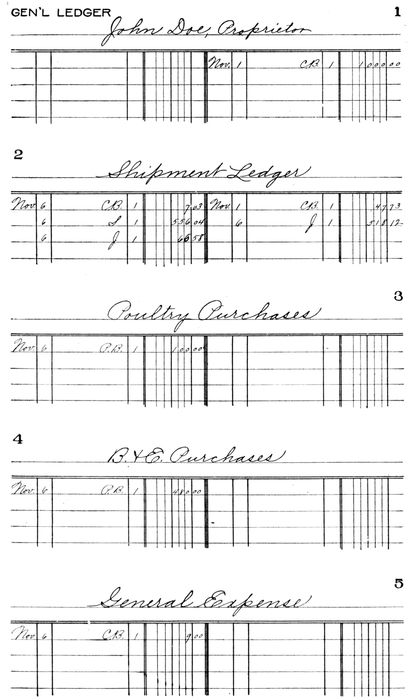
Shipper's General Ledger
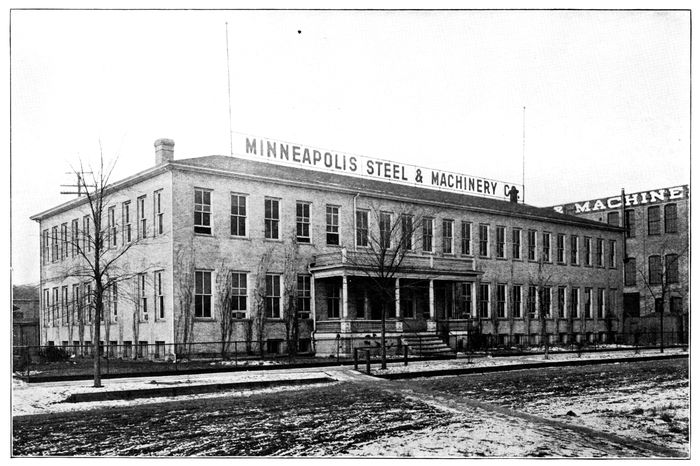
THE ADMINISTRATION BUILDING OF THE MINNEAPOLIS STEEL & MACHINERY CO., MINNEAPOLIS, MINN.
75
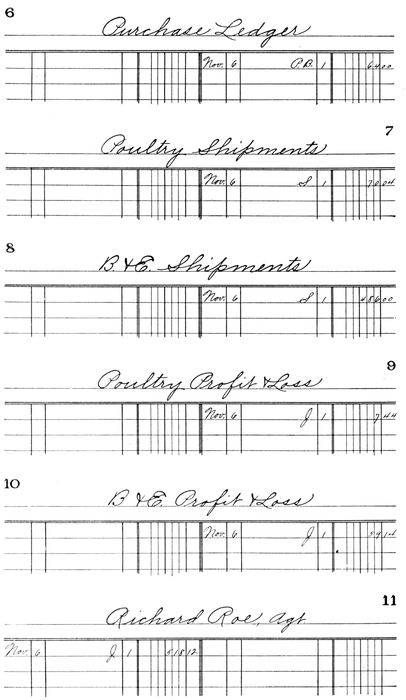
Shipper's General Ledger
76
EXERCISE
48. On a certain date a trial balance of the ledger of Henry Donnely, shipper of produce, stood as follows:
DEBITS
Purchases of apples $1,264.00
Purchases of potatoes 1,500.00
Shipment Ledger Account 736.00
Cash 450.00
CREDITS
Shipment Account—apples 1,200.00
Shipment Account—potatoes 1,200.00
Profit on Shipments—apples 250.00
Profit on Shipments—potatoes 350.00
Accounts Payable 950.00
During a subsequent period, his transactions were as follows:
Cash purchases of apples 1,000.00
Cash purchases of potatoes 1,000.00
Shipments of apples 900.00
Shipments of potatoes 1,100.00
Profits on apples 100.00
Profits on potatoes 200.00
Account Sales for which cash was received 1,800.00
Account sales charged to Agts. 600.00
Shipment Ledger Account decreased 100.00
Sundry expenses paid in cash 50.00
Inventory at end of period
Apples 210.00
Potatoes 190.00 400.00
Prepare trading and profit and loss accounts showing net profits or losses on both apples and potatoes for the entire period represented by the accounts.
77
COMMISSION MERCHANTS' BOOKS
49. The books required by a produce commission merchant are receiving book, cash book, consignment ledger, sales book, sales ledger, journal, and general ledger. If he buys produce to be sold on his own account, he also requires a purchase book and purchase ledger.
50. The Receiving Book. This is usually a rough blotter with ordinary day book ruling, though some merchants use special forms.
When a consignment is received it is given a lot number and entered in this book in the name of the shipper, but without extending the amounts. If any expenses have been incurred, an account is opened immediately in the consignment ledger in the name of the shipper.
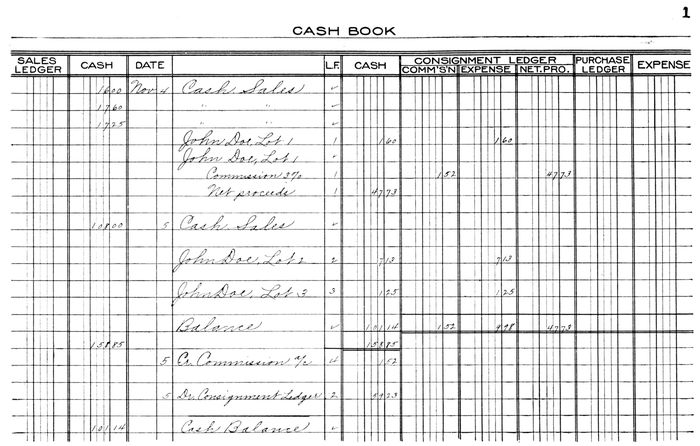
51. The Cash Book. On the credit side of the cash book, under the general heading consignment ledger, are three columns, headed net proceeds, expense, and commission. The commission column is a memorandum column only, the total being posted, at the end of the month, to the credit of commission account in the general ledger.
Net proceeds, expense, and commission on each consignment are posted as separate items to the debit of that particular consignment account. At the end of the month, the total of these three columns is posted to the debit of consignment ledger account in the general ledger.
52. Sales Book. The sales book is provided with special columns for sales and consignment sales. The sales column represents sales of the merchants' own goods, the totals being posted at the end of the month to the credit of sales account in the general ledger and to the debit of the sales ledger account.
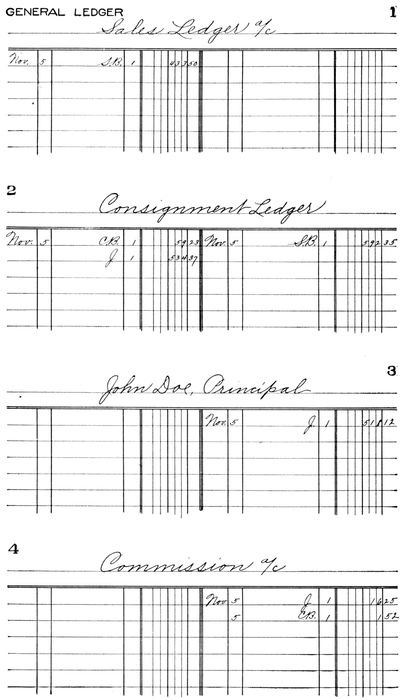
The consignment sales are listed by lot number and posted to the credit of the consignment accounts. As the lot numbers run consecutively in the receiving book, this furnishes an index to the consignment accounts. The totals of the consignment sales columns are posted to the credit of consignment ledger account, and the consignment ledger column is posted to the debit of sales ledger account.
53. Consignment Ledger. This ledger contains accounts with every consignment received. The accounts are charged with expenses, net proceeds, and commissions from the cash book, and credited with sales from the sales book. If a remittance is not sent with the Account Sales, the necessary entry is made in the journal, 78charging both consignment account and consignment ledger account and crediting the shipper as principal—or bills payable account when a note is sent.
54. Consignment Ledger Account. This is a controlling account which receives its debits and credits from the same sources as do the consignment accounts. Except in the case of journal entries, totals only are posted at the end of the month.
PURCHASE AND SALE OF OWN GOODS
55. When the commission merchant is also a wholesaler, the purchases and sales are treated on the books exactly as they would be if he was not a commission merchant. The books and accounts required are the same as those of any other wholesale merchant.
SAMPLE TRANSACTION
56. The following transactions include the shipments used in the last model set, but treated from the standpoint of the commission merchant.
—Nov. 3, 1908—
Received from John Doe to be
sold for his account:
220# chickens
98# ducks
Lot No. 1
—4th—
Received from John Doe to be
sold for his account
95 cs. eggs, 2,850 doz.
Lot No. 2.
—4th—
Sold for cash
100# chickens (Lot 1) @ .16 $16.00
—4th—
Sold to Sweet & Co. on a/c
110# chickens (Lot 1) @ .16 17.60
—4th—
Sold for cash
100# ducks (Lot 1) @ .17¼ 17.25
79 —4th—
Paid expense on lot #1 $1.60
—4th—
Rendered Account Sales, with
remittance for Lot #1, commission 3%
—5th—
Sold for cash
20 cs. eggs., 600 doz., @ .18 (Lot 2) 108.00
—5th—
Sold to Gaston & Co., 156 Hammond St.
20 cs. eggs., 600 doz., @ .20 (Lot 2) 120.00
—5th—
Sold to Francis & Gates, 948 37th St.
30 cs. eggs, 900 doz., @ .19 (Lot 2) 171.00
—5th—
Sold to H. B. Niles, 364 Fuller Ave.
25 cases eggs, 750 doz. @ .19 (Lot 2) 142.50
—5th—
Paid expense on Lot #2 7.13
—5th—
Rendered account sales for
Lot #2, commission 3%, crediting
amount to shippers' account.
—5th—
Received from John Doe to be
sold for his account
200# Turkeys
Lot #3
—5th—
Paid expense on Lot #3 1.25
80
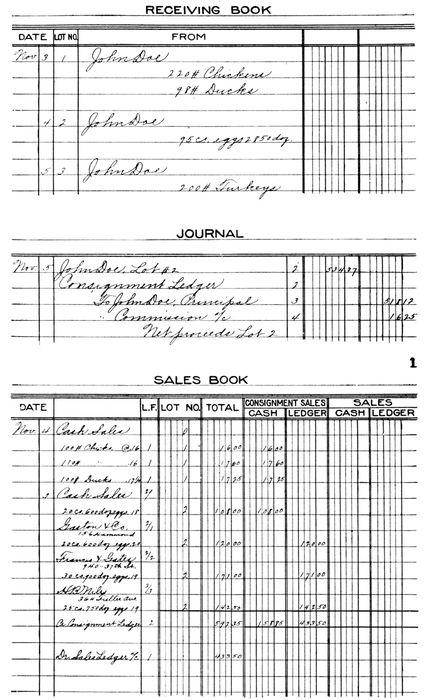
Commission Merchant's Receiving Book, Journal and Sales Book
81
Commission Merchant's Cash Journal
82
Commission Merchant's Consignment and Sales Ledgers
83
Commission Merchant's General Ledger
84
EXERCISE
57. During a certain period a commission merchant transacted the following business:
Purchased goods on his own account $3,000.00
Sold goods on commission 5,000.00
Sold his own goods 2,500.00
Commissions earned 150.00
Received cash for goods sold 6,250.00
Paid expenses on consignments 37.50
Rendered account sales with which cash was
remitted to cover net proceeds 2,712.50
Rendered account sales on which net proceeds
were credited to the account of principals 2,000.00
Paid cash on account of goods purchased 2,200.00
Paid cash for sundry expenses 75.00
Inventory of goods owned at the close of the period 800.00
Prepare trading and profit and loss accounts and balance sheet.
STORAGE
58. Storage, as here used, is the business of furnishing storage for merchandise on its way to market until such time as it is sold and delivered to the purchaser. The source of supply and customs of the trade in certain classes of merchandise render the question of storage an important one. This is particularly true of the grain trade. Large buyers of grain, located in important distributing centers which have become the principal grain markets owing to their manufacturing or transportation facilities, locate their buyers in the grain producing sections to buy grain from the producers. At these points are located small grain handling plants or elevators, where the grain is received from the farmers and shipped to the distributing centers.
Here, extensive storage facilities must be provided, that these shipments, aggregating enormous quantities of grain, may be held until the condition of the market is favorable for selling. If it were not for this custom of storage it would be necessary to market all of the grain—except the small quantities stored by the farmers—soon after harvest, which would result in lowering prices to all concerned, from the farmer up.
85These conditions have resulted in the organization of warehousing companies to provide storage for the owners. When grain, or other classes of merchandise, is received for storage a warehouse receipt is issued, and the merchandise will not be delivered without the presentation of the receipt. Warehouse receipts are negotiable and since they are evidence of the ownership of certain merchandise stored in a warehouse, bankers will loan money to the owner and accept the warehouse receipt as security.
Manufacturers and jobbers of certain products also find it necessary to store large quantities of their wares at distributing centers that they may promptly supply the trade. Another reason for this practice is a financial one. When a manufacturer exchanges his wares for a warehouse receipt, he can immediately borrow on its security, thus securing capital to carry on his business until the regular selling season for his particular product.
The merchandise broker and manufacturers' agent sometimes have their own warehouses and combine the business of buying and selling with that of storage and, if they possess sufficient capital, advance money to the manufacturer.
Perishable products handled by the produce commission merchant are also stored in cold storage warehouses, both to preserve them and to hold for more favorable market conditions.
STORAGE ACCOUNTS
59. Storage charges are usually based on a 30 day period, though sometimes for shorter periods, and any period less than a full month is charged for at the 30 day rate.
The storage is frequently charged for the exact time that goods are in the warehouse, that is, the amount is figured for each amount withdrawn. The following example demonstrates this, storage being charged on each quantity withdrawn at the rate of 10c per case per month.
Received Delivered Time Rate Amount
Nov. 15 600 cs. eggs Dec. 10 100 cs. 1 mo. 10c 10 00
Jan. 6 300 cs. 2 mo. 20c 60 00
Feb. 14 200 cs. 3 mo. 30c 60 00
Total 130 00
86This is known as simple storage.
Another method is to charge storage for the average time at a given rate per month of 30 days. This method is most commonly used when receipts and deliveries are frequent, and is called average storage. The following example demonstrates the method.
Date Receipts Deliveries Balance Time Quantity Stored For One Day
Nov. 15 600 cs. 600 cs. 15 da. 9,000 cs.
Nov. 30 200 " 800 " 10 da. 8,000 "
Dec. 10 100 cs. 700 " 27 da. 17,900 "
Jan. 6 300 " 400 " 39 da. 15,600 "
Feb. 14 200 " 200 " 10 da. 2,000 "
Feb. 24 200 " 000 "
800 800 30)52,500
Average for 1 mo. 1,750
1,750 cs. @ 10¢ $175.00 (Amt. of charges)
SPECIAL RECORDS REQUIRED
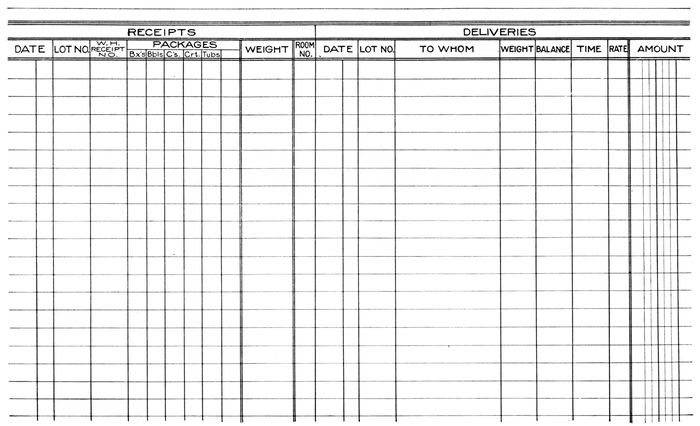
60. One of the most important records required is a storage record showing receipts and deliveries. A special form is necessary and should be adapted to the requirements of the particular class of storage business in which it is to be used.
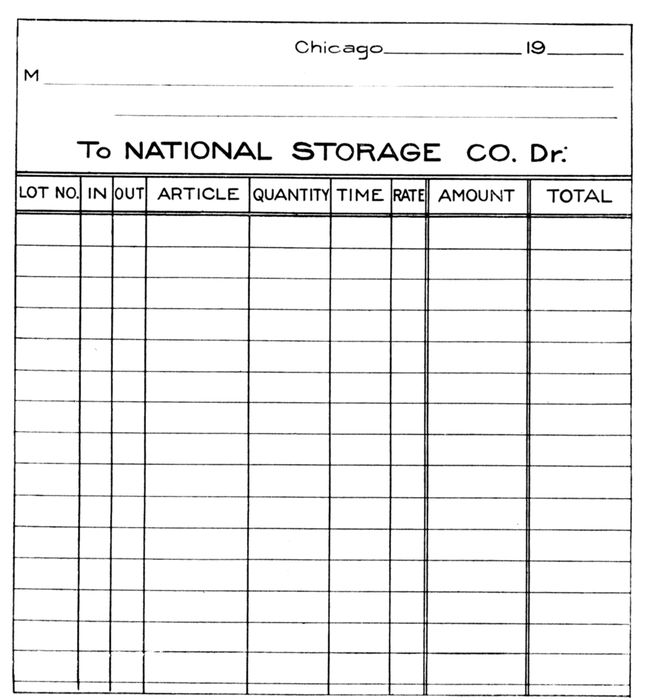
The form illustrated is typical in that it provides for a record of storage of any class of goods handled in packages. The storage charges are always shown so that a statement of the account can be made at any time. At the end of each month the storage charges extended during the month are debited, through the journal, to the personal accounts of the owners. The total of all such storage charges is credited to a storage account in the general ledger.
When there are frequent receipts and deliveries, the owner should be given a detailed statement showing all changes in quantities and storage charges. Such a statement should be a transcript of the storage record. The form illustrated answers the requirements of simple storage.
87
Storage Record
88
Statement of Storage Charges
90
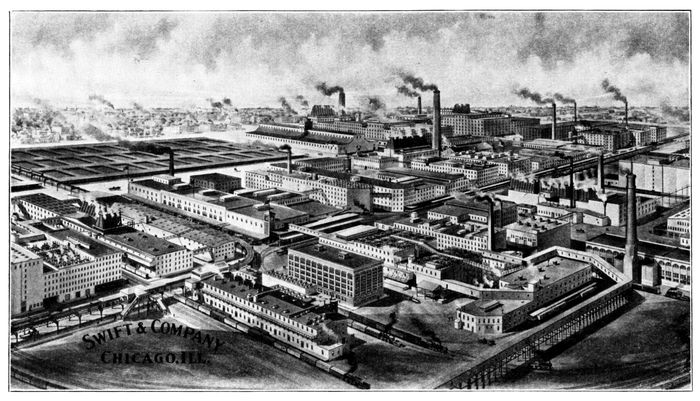
BIRD'S-EYE VIEW OF THE PLANT OF SWIFT & COMPANY, CHICAGO, ILL.
91