Volume 5 — TRUSTEES AND EXECUTORS' ACCOUNTS
Reading edition
1. From the accounting standpoint, business can be divided into two general classes: (a) Business conducted by the owner or a person appointed by him for the benefit of the owner; (b) Business that is the property of persons incapable of transacting business, necessitating the appointment, by the owners or other authority, of persons to transact business in place of the owner. It is with business of the latter class that we now have to deal.
In this class the owner or proprietor is supplanted by the administrator of the business. The generic term trustee applies to the administrator, who also takes more specific titles, depending upon the nature of the trust—as executor, administrator, assignee, guardian, receiver, etc. He is subject to the powers granted by the source of his appointment, and to the restrictions and requirements imposed by law.
A trustee—by whatever specific name designated—acting in his capacity as substitute for the owner, is the owner of the trust property as against the public. He is accountable to no one but the beneficiaries for whom he is acting as custodian. As owner of the estate, he can sue or be sued and perform many functions pertaining to the ordinary property owner. The beneficiary, by reason of his equity in the estate, can compel the trustee to carry out the provisions of his trust.
EXECUTOR'S ACCOUNTING
2. While an executor may keep his accounts in a manner chosen by himself, his accounting must conform to the legal requirements of the state in which the accounting is made. The form in which the accounting is to be made is not subject to rigid rules, but must conform to certain regulations. While requirements differ according to the jurisdiction, the regulations in general are as follows:
The preliminary accounting consists in filing an inventory of the personal estate of the deceased, showing both the nominal or 164face value of the assets and the amount they are expected to realize as stated by the appraisers. An executor usually files two accounts—an intermediate account, filed at some date prior to the final account, and a final account, showing the property in his hands subject to distribution by judicial decree. The intermediate account may be filed either voluntarily or by order of the court. The account must be accompanied by the following schedules:
SCHEDULE A
1. Statement of property contained in the inventory, which has been sold, with the manner of sale and amounts realized. 2. Statements of debts due the estate as scheduled in the inventory, which have been collected. 3. Statement of all interest and dividends received by the executor.
SCHEDULE B
1. Statement of debts due the estate that have not been collected or are uncollectible, with reasons. 2. Statement of personal property named in inventory that has not been sold, with reasons, and the appraised value of such property. 3. Statement of all property belonging to the estate that is lost through no fault of the executor, with the cause of loss and appraised valuation. 4. Statement that no other property than set forth in the inventory or schedules has come into the possession or the knowledge of the executor. 5. Statement that the increase or decrease in value of all assets of the deceased is allowed for or charged in Schedules A and B.
SCHEDULE C
1. Statement of all amounts expended by the executor for funeral and other necessary expenses, together with the receipts for, and objects of, such expenditures.
2. Statement of the date when the executor caused a notice for claimant to present claims against the estate to be published, together with order, notice, and proof of publication herewith filed, to which the executor refers as a part of his account.
165 SCHEDULE D
1. Statement of all claims of creditors allowed by executor or disputed by him, for which a judgment or decree has been rendered, with the names of the claimants, nature of claim, amount and date of judgment.
2. Statement of all money paid to creditors of the deceased, with names and time of payment.
SCHEDULE E
1. Statement of all money paid to legatees, widow, or next of kin, of the deceased.
SCHEDULE F
1. Statement of names of all persons entitled—as widow, legatee, and next of kin, of the deceased—to a share of his estate, with place of residence, degree of relationship, and statement as to which are minors, whether they have a general guardian, and if so, the name and place of residence to the best of the executor's knowledge, information, and belief.
SCHEDULE G
1. Statement of all other facts affecting the administration of said estate, executor's rights, and those of others interested.
These schedules provide all the material from which to make the account proper. In his account, the executor charges himself as follows:
With amount of inventory $_________
With amount of increase as per schedule A _________
With amount of income as per schedule A _________
_________
Total debits _________
He credits himself:
With amount of losses on sales as per schedule B $_________
With debts not collected as per schedule B _________
With articles mentioned in inventory lost, schedule B _________
With funeral expenses and other expenses, schedule C _________
166With money paid creditors, schedule D _________
With money paid to legatees, widow, or next of kin, schedule E _________
Total credits $_________
Balance _________
Add articles unsold _________
Add debts not collected _________
_________
Total to be distributed _________
FORM OF ACCOUNTS
3. The devising of forms of trust and executory accounts offers a wide scope for the application of accounting knowledge. Many intricate problems arise in the interpretation of details of the trust and in the apportionment of sums received, between capital and revenue. Broadly, these accounts are prepared in one of two forms: (a) An account of charge and discharge; (b) in the form of regular ledger accounts. As has been intimated, legal requirements are complied with by the first form, but the second form is preferable. When ledger accounts are kept on the double entry plan, the fullest information can be obtained about the condition of the trust at any time, and from these accounts, the account of charge and discharge or any form required by the court can be made for each period.
In preparing the accounts the exact relationship of the trustee to the estate (as the property in trust is called) must be kept in mind. As the owner of the property, he is a creditor of the estate (the business) just as the proprietor of the business is the creditor of that business. On the other hand, as custodian, he is a debtor, being in possession of the property of others.
In the ledger, property accounts are opened with the different classes of properties represented in the estate, which accounts are debited for the appraised value of the properties. These are known as custodian accounts.
A contra account representing the estate—sometimes called the capital—is opened under some such caption as Personal Estate Account. This account is credited with the combined values of all properties represented by the custodian accounts.
167When the assets are entered and posted, the ledger accounts will appear as follows:
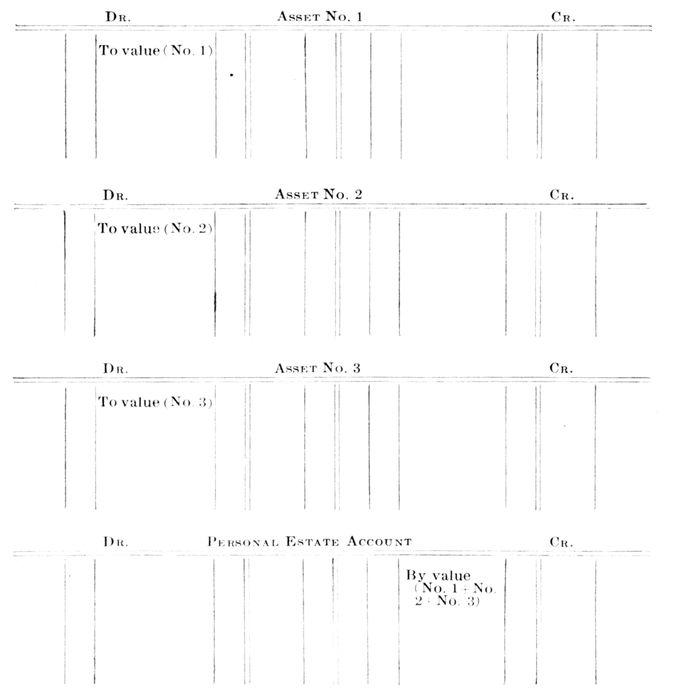
These asset accounts represent the value of the individual properties, while the personal estate account represents the combined values of all personal property of the estate (No. 1, No. 2, and No. 3). The personal estate is known as the corpus, distinguishing it from the real estate.
If the trustee, as the custodian, is called upon merely to distribute the estate to the beneficiaries, his accounting is a very simple problem. In many cases, however, he is called upon to take care of the income arising from the corpus or the real estate.
When he receives such income in the shape of cash, he debits 168himself as custodian through a cash account, and credits an income account under an appropriate title—as interest account, rent account, dividend account, etc. The account may represent the income from a specific property, or all income of a stated class. For example, rent account may represent the rents received from all properties, or there may be a separate rent account for each.
Distinguished from the income accounts, the trustee sometimes has accounts representing the sale of real estate, which must then be treated as personal property. When real estate is sold, cash is credited and an account, usually called Sale of Real Estate, is credited.
4. Classification of Accounts. A classification of the accounts of the executor naturally divides into: (a) Personal estate account; (b) asset accounts; and (c) distributive accounts. The personal estate account, as we have seen, is a controlling account which represents the total of all assets. It is also referred to as the capital account. It is, as well, a controlling account of the distributive accounts, and in the end exhibits a schedule of transactions in the order in which they occur.
The asset accounts, representing the different classes of properties or assets of the estate, correspond to the asset accounts of an ordinary business.
The distributive accounts may be likened to the revenue accounts of a business enterprise. These accounts are debited with all amounts distributed—as expense of administering the estate—and credited with all income or revenue other than that representing the conversion of the original estate into cash.
5. Executors' Commissions. While the commission allowed administrators and executors varies in different states, the amount specified by law in New York applies as a general rule. The commission allowed is 5% on the first thousand dollars received and disbursed, 2½% on the next ten thousand dollars, and 1% on all amounts above eleven thousand dollars.
If the value of the personal property is $100,000.00, or more, in excess of all debts, each executor is entitled to receive the commissions provided in case of a single executor; except that if there are more than three executors, the amount which the three would receive must be divided in proportion to the services rendered.
In cases where the will provides a specific remuneration, the 169executor is not entitled to a commission. He can, however, decline a legacy and in lieu thereof take the usual commission.
Commissions are not allowed on specific legacies, that is, where specific property, as household effects, automobiles, etc., are named. An annuity is a series of legacies and the commission is not allowed on its payment. However, when a beneficiary is given the use of a fund, the beneficiary is charged with the commission.
In all cases where administrators or trustees are responsible for the investment of the funds of an estate, they are entitled to receive commission on the income. The commission in all of these cases is at the regular rate, that is, 5% on the first thousand dollars received and paid out, etc.
EXAMPLES
1. Two trustees collect in one year an income of $36,000.00 for a beneficiary, the expense being $3,000.00. If each trustee receives an equal share, what commission will be paid to each, and what sum shall be paid to the beneficiary? Ans. Each trustee, $275.00; beneficiary, $3,275.00.
2. Executor X collects of the corpus of an estate $30,000.00, executor Y collects $40,000.00. Together they pay out $55,000.00. Commissions are to be divided in proportion to the amount collected by each. What commission will each receive and what is the net amount to be paid to the residuary legatee? Ans. Commissions: X, $381.43; Y, $508.57. Residuary legatee, $14,110.00.
3. Four trustees collect and pay out of an estate $350,000.00, the total debts of the estate being $135,000.00. What commission will each trustee receive? Ans. $2,767.50.
SAMPLE ACCOUNTS
6. Following are the transactions and accounts of David Brown, executor of the estate of Henry Snow, deceased. For keeping the accounts, the journal, cash book, and ledger are the books used.
June 1, 1908
Henry Snow died this day, naming David Brown executor.
—3—
Estate inventoried and appraised as follows:
Cash in bank $390.50
Mortgages 5,000.00
170R. R. stocks $5,000.00 appraised @ 112 $5,600.00
Household furniture 1,000.00
Debtors to the estate
Henry Alton $160.00
J. L. Lawrence 52.00
D. Pringle 75.00
F. D. Smith 84.50 371.50
Interest accrued on mortgages $5,000.00
—5 mo. @ 5% 104.16
Accrued dividends on stock estimated
at 3% semi-annual, payable July
1st—5 mo. accrued 137.50
12,603.66
—30—
Approved the following claims:
Dr. Knight bill 200.00
Funeral expenses—Undertaker 250.00
Henry Cole account 62.00
H. Dawson account 17.00
Probate expenses 100.00
—30—
Additional assets discovered
Geo. Smith owes the estate 50.00
July 1
Collected 6 mo. interest on mortgage
at 5% 250.00
—1—
Collected the following accounts:
Henry Alton 160.00
D. Pringle 75.00
—1—
Paid the following:
Dr. Knight 200.00
Funeral expenses 250.00
Henry Cole 62.00
H. Dawson 17.00
Probate expenses 100.00
—5—
Received dividend on R. R. stock
3½% semi-annual on $5,000.00 $175.00
—5—
Sold R. R. stock $5,000.00 @ 132 6,600.00
Sept. 1
Collected the following account:
J. L. Lawrence 52.00
—20—
Sold H. H. furniture 790.00
Depreciation on H. H. furniture 210.00
Nov. 1
Collected the following accounts:
F. D. Smith 84.50
Geo. Smith 50.00
Dec. 1
Collected 6 mo. interest on mortgage
$5,000.00 @ 5% 125.00
—1—
Sold mortgage 5,000.00
A GENERAL VIEW OF THE PLANT OF THE FOX TYPEWRITER COMPANY, GRAND RAPIDS, MICH.
172
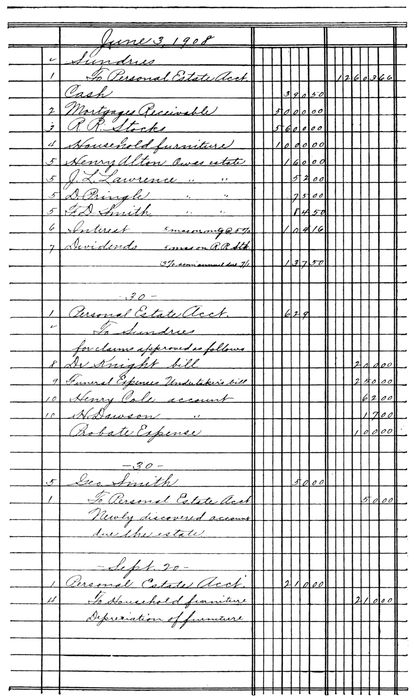
Executor's Journal
173
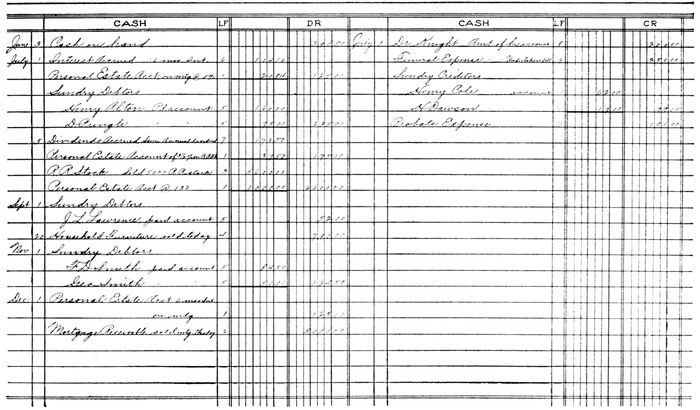
Executor's Account of Cash Receipts and Disbursements
174
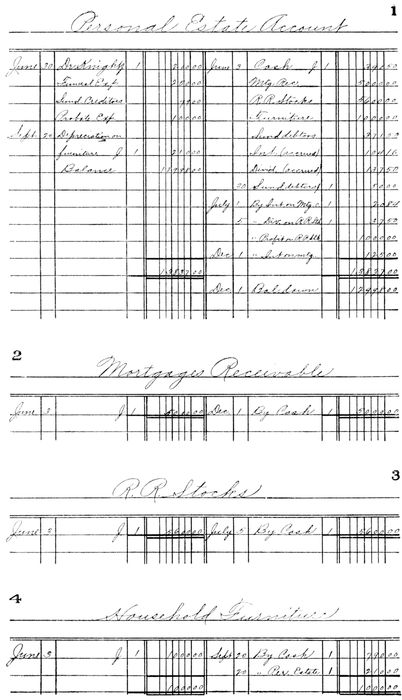
Classified Ledger Accounts of an Executor
175
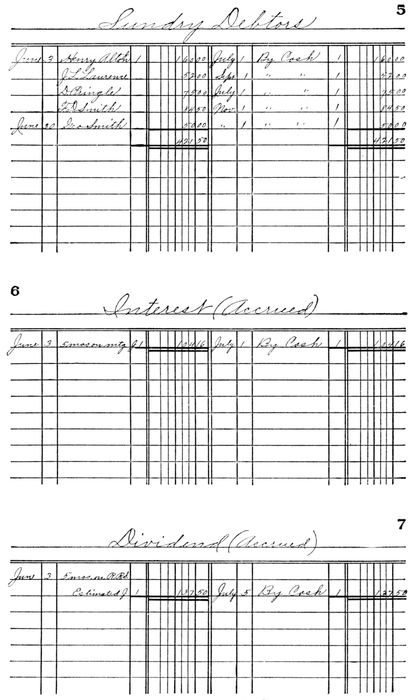
Classified Ledger Accounts of an Executor
176
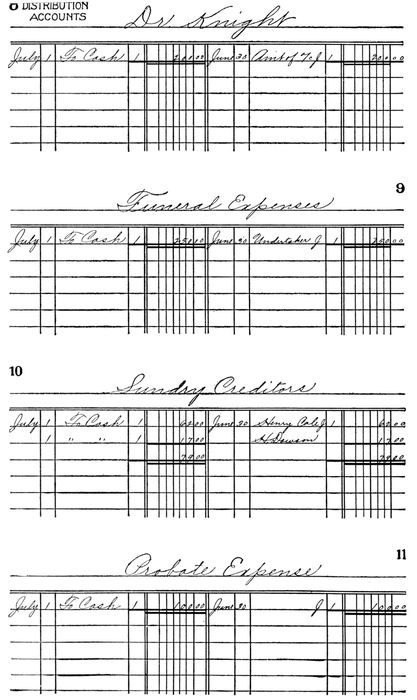
Classified Ledger Accounts of an Executor
177
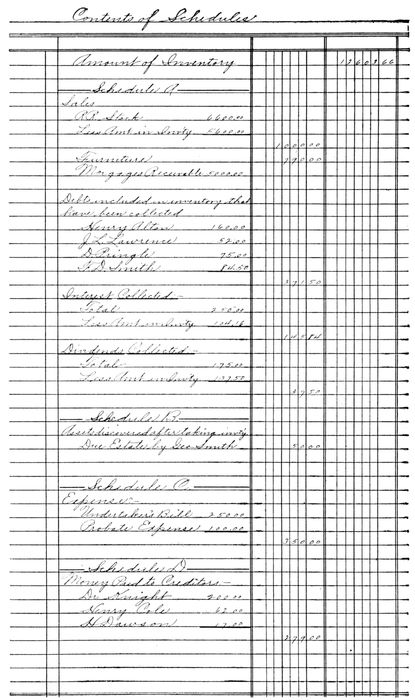
Schedule Filed by an Executor
178
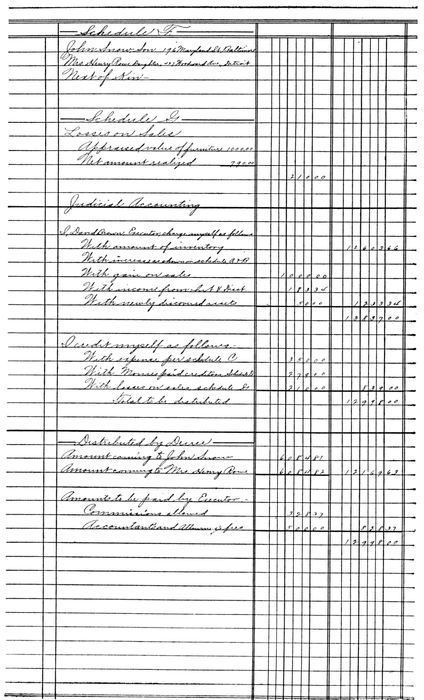
Schedule Filed by an Executor
179
EXERCISE
7. George Williams died on March 5th, bequeathing his entire property, after payment of all debts and funeral expenses, to the following beneficiaries: George Williams, Jr., one-fifth; John Williams, one-fifth; Fred Williams, one-fifth; Mary Williams, three-tenths; and George Robinson, one-tenth.
The inventory filed by his executors was as follows:
Stocks and bonds $4,000.00
Mortgages 6,000.00
Wearing apparel 100.00
Cash in bank 40.00
There are two executors, and their transactions are as follows:
Cash Receipts
Stocks and bonds sold 3,341.00
Mortgages realized 4,656.00
Wearing apparel sold 50.00
Dividends collected on stocks and bonds 1,800.00
Interest collected on mortgages 2,400.00
Interest received on deposits in bank 100.00
Real estate sold 1,000.00
Rents collected 720.00
Cash in bank at decease, withdrawn 40.00
14,107.00
Cash Disbursements
Funeral expenses 30.00
Expenses of probate 200.00
General legal expenses 400.00
Repairs to building 220.00
Stationery, postage, etc. 10.00
Accountant's fee 80.00
Debts of deceased 500.00
Taxes 800.00
Insurance 10.00
George Williams, Jr., on account of legacy 2,200.00
John Williams, on account of legacy 2,500.00
Fred Williams, on account of legacy 2,220.00
Mary Williams, on account of legacy 3,100.00
George Robinson, on account of legacy 960.00
13,230.00
=========
180The inventory at the date on which they wish to account is as follows:
Stocks and bonds $1,000.00
Mortgages 1,280.00
Cash in bank 877.00
Make up summary statement of the Executor's Accounts showing the balance due each legatee.
ACCOUNTS WITH TRUST PROVISIONS
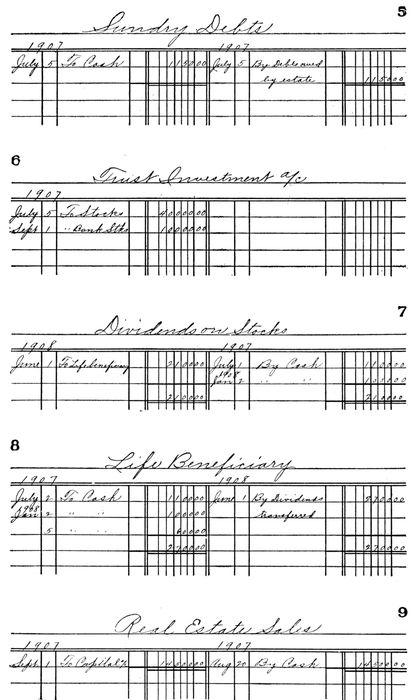
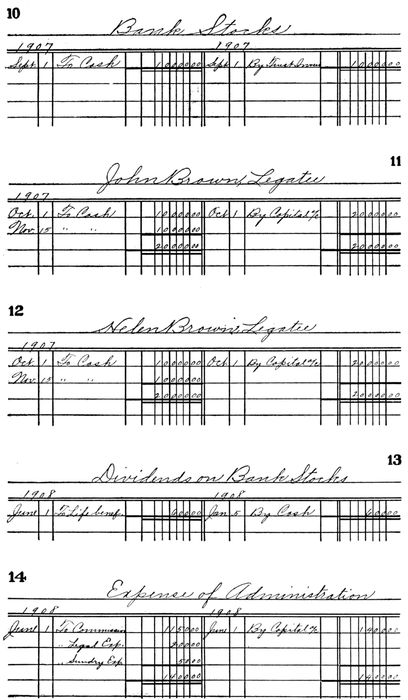
8. In the accounts shown in the preceding illustrations the entire estate is distributed by judicial decree. When all of the property has been distributed, the custodian accounts will have been closed into the personal estate account, which in turn is closed by the distribution of the estate. In many cases the will of the deceased provides that certain beneficiaries shall have a life interest in certain of the assets. Quite frequently the widow is given the income on certain investments which will revert to the estate at her death. This is illustrated in the following example of trust accounts:
Edward Brown died on June 15, 1907, leaving a will which elected that after payment of all just and lawful debts the following legacies should be made:
To his widow, that part of the real estate consisting of his residence, the household effects therein, and the income from $50,000.00 to be invested.
To his son and daughter, $20,000.00 each, and an equal share of the above $50,000.00 at his widow's death.
The inventory made up for the preliminary accounting was as follows:
Cash in house $200.00
Cash in bank 1,500.00
Household effects valued at 2,500.00
Stocks 40,000.00
Book accounts 20,000.00
Merchandise, fixtures, and stock in trade 25,000.00
The real estate consists of
The residence of the deceased, valued at 15,000.00
5 houses valued at 15,000.00
(to be sold according to will)
181
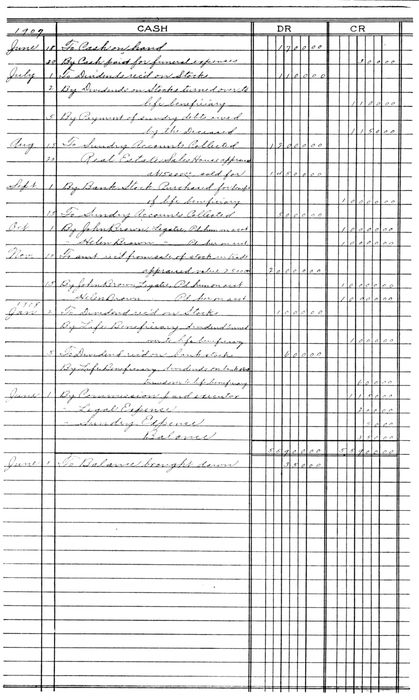
Executor's Accounts With Trust Provisions
182
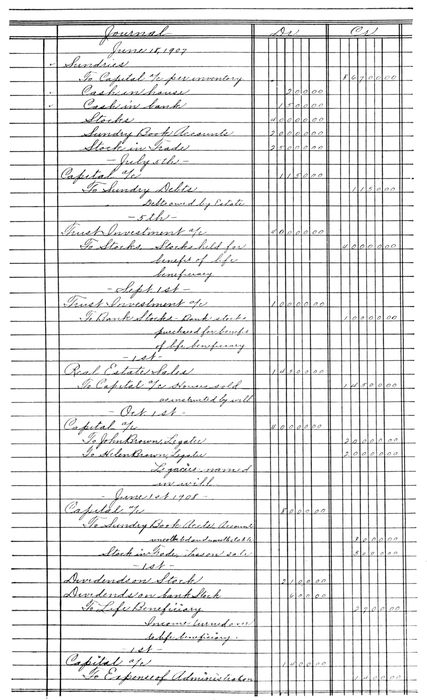
Executor's Accounts With Trust Provisions
183
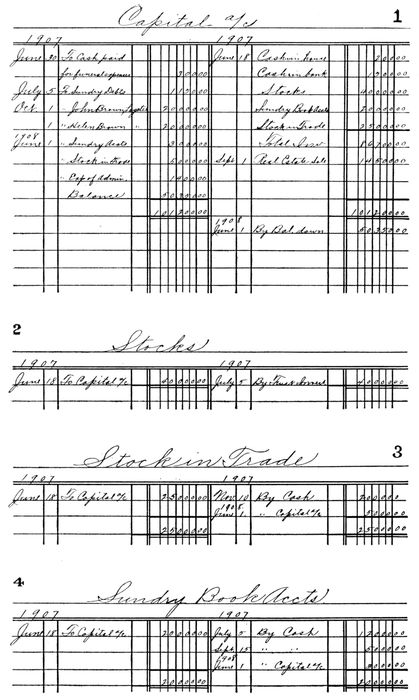
Executor's Accounts With Trust Provisions
184
Executor's Accounts With Trust Provisions
185
Executor's Accounts With Trust Provisions
186
Accounting of an Executor, in the Form of an Account of Charge and Discharge
A FACTORY CHEMICAL LABORATORY AT THE PLANT OF THE S. OBERMAYER CO., CINCINNATI, OHIO
187
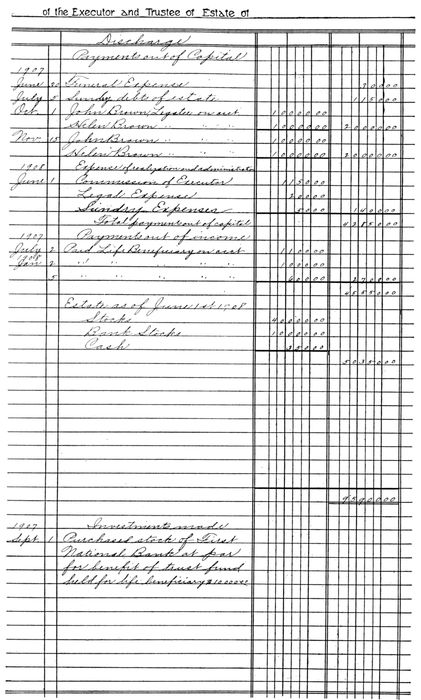
Accounting of an Executor, in the Form of an Account of Charge and Discharge
188
REALIZATION AND LIQUIDATION ACCOUNTS
9. A realization and liquidation account is an account showing the result of the liquidation of a business or an estate.
It is debited with the total assets as shown by the balance sheet or statement of affairs, and is credited with all liabilities to outside creditors. The account is subsequently credited with the amounts realized on assets, and debited with liabilities liquidated together with the expenses of realization and cost of liquidation.
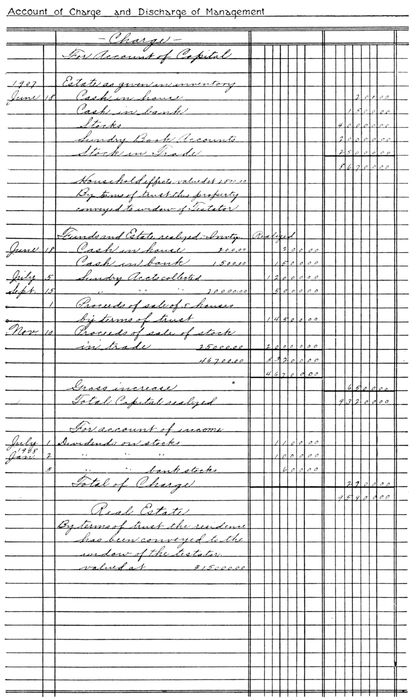
Realization and liquidation accounts are frequently prepared in the form of an account of charge and discharge as shown in the preceding pages for executor's accounts.
STATEMENT OF AFFAIRS
10. A statement of affairs is frequently confused with a balance sheet. This is because, like a balance sheet, a statement of affairs exhibits the resources and liabilities of a business. The difference lies in the fact that a statement of affairs is made up partly from information gained from the books and partly from information secured from other sources.
A statement of affairs is used chiefly in the preparation of a statement of the condition of an insolvent concern, or one whose affairs have been, for any reason, placed in charge of an Administrator. In a going business, all facts that have a bearing on its financial standing should be recorded on the books, when the statement will be made in the form of a balance sheet.
Statements of affairs of a going business are sometimes made when it is desired to make a showing for a special purpose, or at a date other than a regular closing date. When the books have been improperly kept, a statement of affairs, or statement of assets and liabilities, is necessary to get all of the facts properly recorded.
11. Statement of Affairs of a Bankrupt. A statement of affairs of a bankrupt is prepared on a somewhat different basis than a similar statement for a going concern. Such a statement is prepared for the benefit of creditors, and should be based on the probability of the creditors receiving their claims in whole or in part.
189
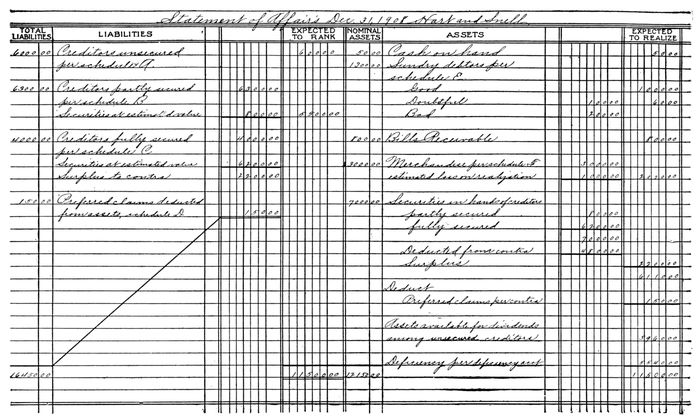
A Statement of Affairs of a Bankrupt
190On the left-hand side of the statement, the liabilities should be listed, showing whether they are actual, contingent, or provisional; which are preferable or ordinary, or secured partly or wholly by assets held by creditors of the concern as security for their claims. On the right, the assets of the concern should be shown. These should be classified as to whether they are free for distribution among the ordinary creditors or subject to special liability or claims and which must be liquidated before the assets can be released for distribution.
The assets may be listed on the basis of their value in a going concern, or on the basis of the prices they are estimated to bring at forced sale. The best practice is to list the assets to show, in one column, their nominal value, and in another column the amounts they are expected to realize. The statement is prepared for the express purpose of showing the probability of creditors—preferable, secured, partly secured, and ordinary—receiving their claims in full or being obliged to accept a dividend. In preparing such a statement, therefore, the investigation should be extended beyond the mere bookkeeping records. While the statement should be based on the properly balanced books of account, it must be supplemented by information from other sources.
The statement of liabilities should include, not only all of the liabilities shown on the books of the debtor, but all other enforcible claims, including contingent liabilities on account of the debtor's name being on commercial paper as an endorser.
Preferable claims for taxes, wages, and salaries which must be paid in full out of the assets of the estate, should be deducted from the assets in order to show the net value of the estate available for distribution among ordinary creditors. The details of such claims should be included among the liabilities, but without extending the amounts to the total column.
Claims of secured creditors also are entered on the liabilities side of the statement, but are not carried to the total column. Such claims are deducted from the assets forming the specific security held, the balance only being included among the assets available for distribution and carried to the total assets column.
Partly secured claims are entered among the liabilities, but the amount to which they are secured is deducted, and the balance, which must take the same chances of payment as other unsecured claims, is entered in the liabilities column. The corresponding assets are entered on the assets side but not extended.
191
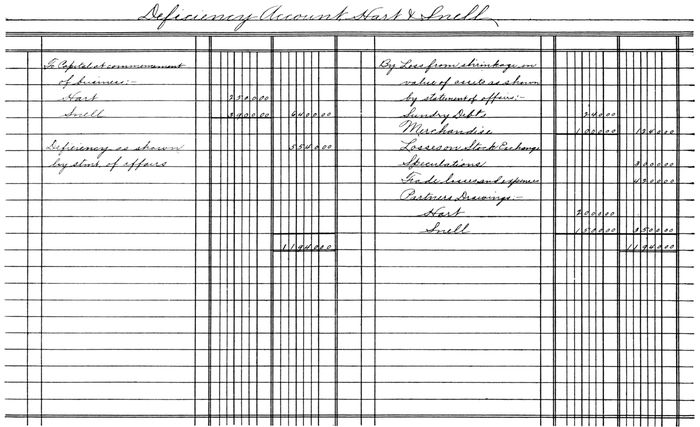
A Deficiency Account Which Shows the Causes of Loss
192These adjustments are necessary to show clearly the net assets that will be available for the ordinary creditors, and the total amount of claims to be satisfied out of these assets.
Every statement of affairs should also have appended to it schedules showing the fullest particulars of the different entries which appear in the statement. The names and addresses of all creditors should be given and the nature of the debt, whether a trading debt or for borrowed money, should be clearly shown. Full particulars of any security held should also be given.
It is much more difficult to ascertain the value of the assets of a bankrupt than the amount of the liabilities. While it is comparatively easy to get at the cost or book value of the assets, if the books have been properly kept, it is usually necessary to write off a considerable portion of this value to arrive at the amount likely to be realized on forced sale. It is usually advisable, therefore, to call in an appraiser, familiar with the line of business involved, to set the values of the assets on the basis of a going business and on forced sale.
By showing the book value of the assets and the values they are expected to realize, the probable deficiency as a result of the liquidation of the estate is readily seen. Book debts should be classified as good, doubtful, and bad. Good debts are extended at face value, doubtful debts at the amount they are expected to realize, while the bad debts are entered on the statement without extending any amounts.
Assets should be listed in the order of their availability, those most readily realized being placed first. At the bottom of the statement, in the form of a note, the dividend available for ordinary creditors, exclusive of expense of realization and liquidation, is shown.
A statement of affairs is shown, Page 27, which will make the explanation clear.
Every statement of affairs should, when possible, be accompanied by a deficiency account. The purpose of the deficiency account is to show, as far as may be, the cause of insolvency. This account is credited with the losses and shrinkage in the estate shown by the statement of affairs, the losses shown by the books, and the withdrawals of the owner or partners. It is debited with the capital at the last known date of solvency, all additions of capital, and all profits shown by the books. The balance is the net amount of the deficiency, and should agree with the amount shown by the statement of affairs. A deficiency account is shown in connection with the illustration of a statement of affairs.
STOCK EXCHANGE BUILDING, CHICAGO, ILL.
195