Volume 5 — BOOK INVENTORIES
Reading edition
18. To make the foregoing plan still more effective, perpetual inventories should be carried in the ledger. A perpetual or book 135inventory is an account showing the value of merchandise received, sold, and on hand. If an accurate account is kept of merchandise received and sold, the perpetual inventory will show the amount that should be in stock. To prove the accuracy of the account, it is necessary to take an actual inventory of the merchandise in stock, just as it is necessary to count the cash before we can know that the amount on hand agrees with the cash account.
A detailed perpetual inventory should be kept on cards or in a loose leaf book. A card or sheet is used for each article or class of material carried in stock. The sheets or cards should be arranged alphabetically according to the names of the articles. To make the system effective one person should have charge of these records and no goods should be taken from stock without an order or other proper record.
At the end of the month the receipts will be shown by the purchase accounts. The deliveries will be tabulated from the cards, and the necessary adjustments made on the ledger account. Adjustments should be made by journal entry debiting inventory accounts and crediting trading account for increase in inventory, and vice versâ for decrease in inventory.
Fig. 18 a. is a typical form of stock ledger sheet for a loose leaf book. The form should in all cases be made to suit the requirements of the business in which it is to be used.
Fig. 18 b. is a card form of stock ledger which gives more detailed information about the article in stock. On the top line is recorded the name of the article, size or kind, where kept, and date of verification of the record. The second line gives the unit and maximum and minimum limits. The unit represents the unit in which the article is bought—as pounds, tons, dozen, feet, yards, etc. It is customary to establish a minimum limit, below which the stock is not allowed to go before re-ordering, and a maximum limit of a quantity sufficient for the needs of the business. The record of receipts and disbursements includes a detailed record of cost, including freight and cartage, and columns for costs per unit. This makes it possible to calculate the value of the stock in hand without referring elsewhere for prices.
In some lines of business it is possible to ascertain the quantities sold, at the end of each month, from the sales records. This 136applies where an article is sold in but one grade or size, and necessitates keeping sales records which show sales of each article. An example is the coal business. For such a business a card like the one shown in Fig. 18 c. can be used to good advantage. This provides for a monthly record of purchases and sales.
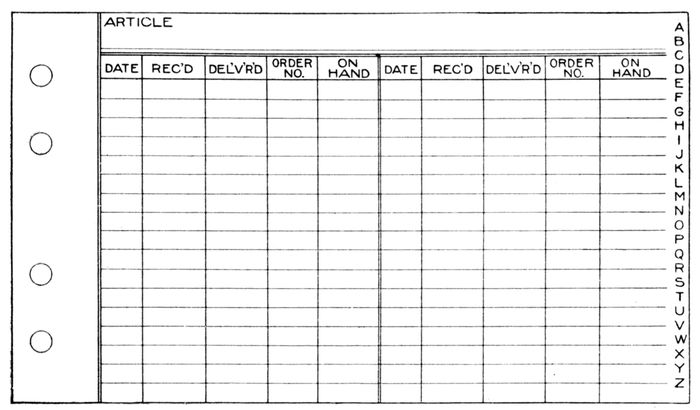
Fig. 18 a. Loose Leaf Stock Ledger
In this illustration the manner of indexing is shown. The cards are first arranged alphabetically under the names of the articles. If there is more than one size, the cards bearing the records of a certain article are filed in the order of their sizes. Indexed in this manner any card that may be desired is quickly found.
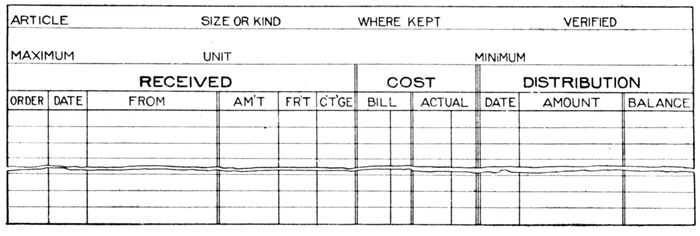
Fig. 18 b. Stock Ledger Card
137
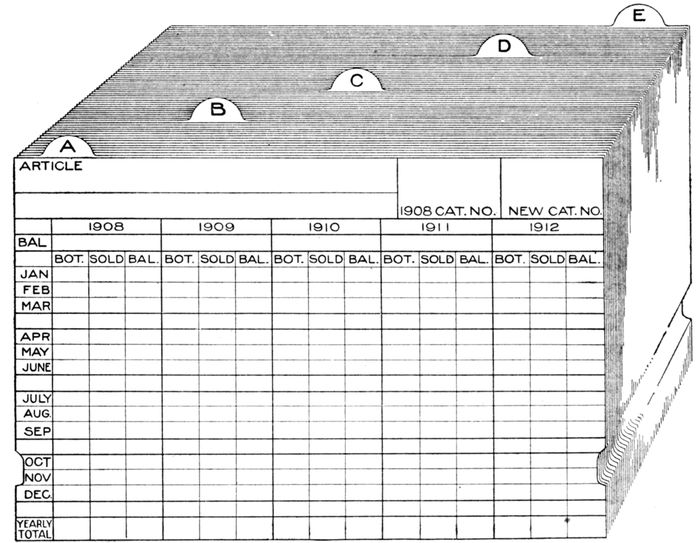
Fig. 18 c. Stock Ledger Card and Indexes
DEMONSTRATION OF PROOF WITHOUT A TRIAL BALANCE
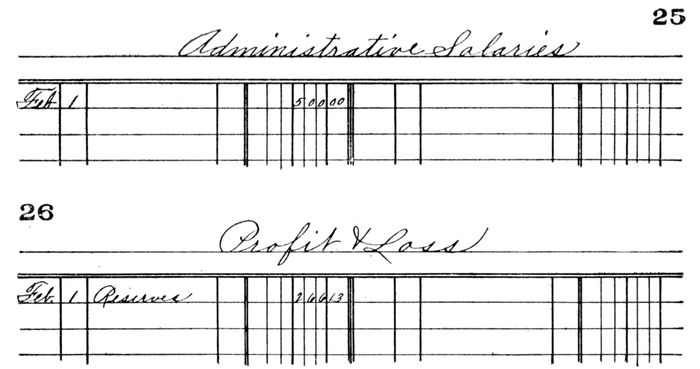
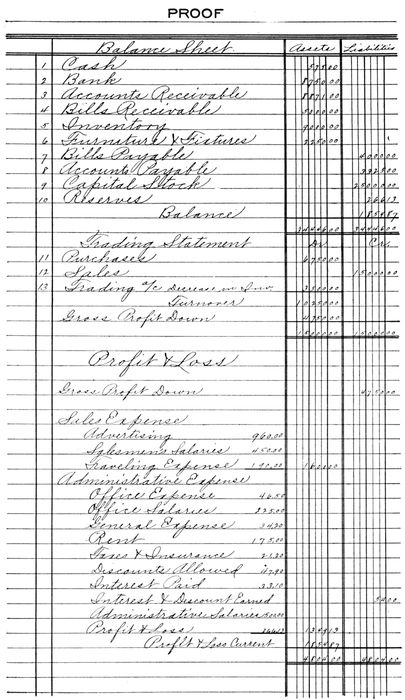
19. Taking the accounts in the following trial balance, a model ledger is illustrated which demonstrates the manner of proving the ledger without the aid of the conventional trial balance. It is assumed, of course, that a book inventory or stock ledger is kept, and in this demonstration the figures showing the change in inventory are used. Only the ledger is illustrated, it being expected that the student will understand the necessary journal adjusting entries.
TRIAL BALANCE
Cash in Office $575.00
Bank 8,750.00
Accounts Receivable 8,871.00
Bills Receivable 5,000.00
Inventory (Jan. 1) 12,500.00
Furniture and Fixtures 2,250.00
Bills Payable $4,000.00
Accounts Payable 3,325.00
138Capital Stock $25,000.00
Purchases $6,750.00
Sales 15,000.00
Advertising 960.00
Salesmen's Salaries 450.00
Traveling Expense 190.00
Office Expense 46.50
Office Salaries 225.00
General Expense 34.20
Rent 175.00
Taxes and Insurance 21.30
Discounts Allowed 47.90
Interest Paid 33.10
Interest and Discount Earned 54.00
Administrative Salaries 500.00
On Feb. 1st the inventory shows a decrease of $3,500.00. A reserve of 3% on accounts receivable is to be created to provide for uncollectible accounts. To make these adjustments the following journal entries will be required:
Trading a/c 3,500.00
To Inventory 3,500.00
Decrease in Inventory
A study of this entry will show that the result is the same if we make up the trading account by using purchases and adding or subtracting the decrease or increase in inventory, or if the preceding inventory is added and present inventory is deducted. The result in either case is the turnover and the above entry makes the necessary adjustment in the inventory account without closing the account through the trading account.
The entry for the reserve for uncollectible accounts is
Profit and Loss 266.13
To Reserves 266.13
Reserve of 3% to provide
for uncollectible accounts.
At the end of the next month this account will be adjusted by charging or crediting the amount necessary to maintain the total at the desired percentage of accounts receivable.
UNDERWOOD TYPEWRITERS USED IN MELBOURNE UNIVERSITY COMMERCIAL EXAMINATIONS
139
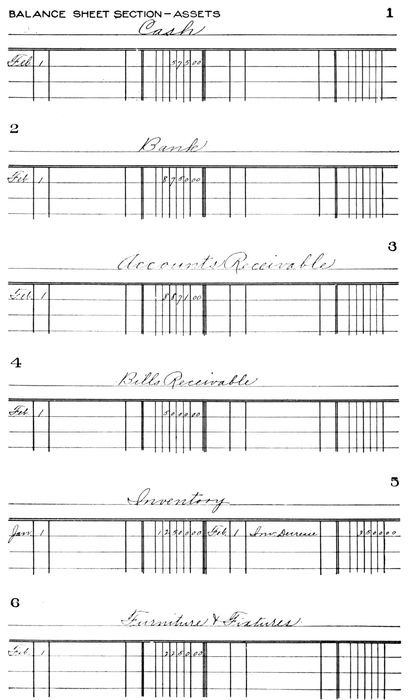
Ledger with Accounts Classified
140
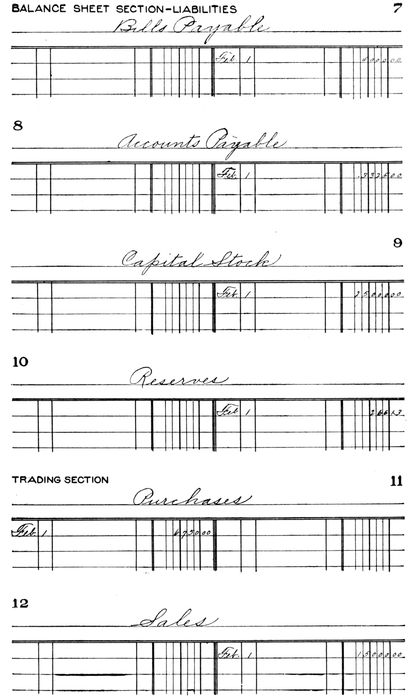
Ledger with Accounts Classified
141
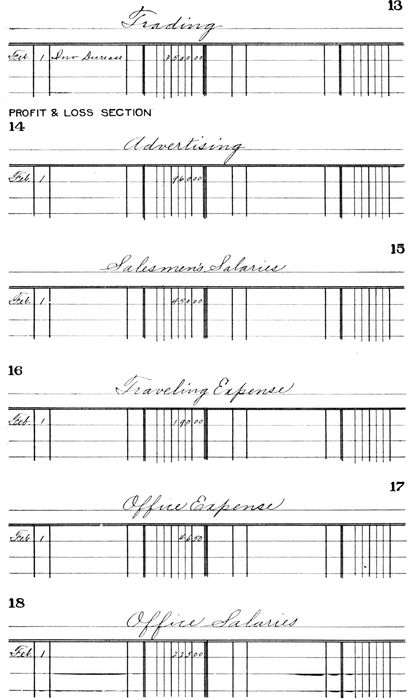
Ledger with Accounts Classified
142
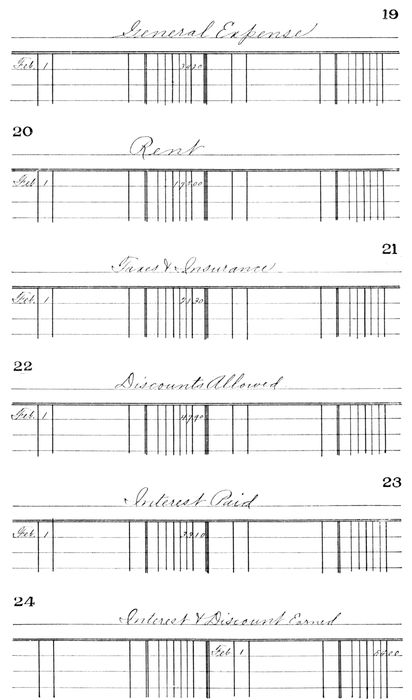
Ledger with Accounts Classified
143
Ledger with Accounts Classified
REVERSE OR SLIP POSTING
20. To feel absolutely sure that his work is correct is the ambition of every bookkeeper. The fear that an error will throw his books out of balance is always present, and is only dispelled when the ledger is proved at the end of the month.
Accountants, bookkeepers, and mathematicians have long searched for an infallible rule or method of checking which would detect an error as soon as it is made. No system could possibly prevent the making of an error, but if detected, an error is quickly corrected. Numerous formulas and checking systems, designed to detect errors in posting, have been put on the market from time to time. Each has been advertised as the only infallible system. All have been eagerly purchased, tried more or less faithfully, and, as a rule, speedily discarded.
Modern methods of bookkeeping have done more to aid in the detection of errors in posting than all of the checking systems combined. The sectionalization of accounts not only facilitates the detection of errors, but greatly minimizes the chances of their being made. As an illustration take a sales ledger which is subdivided into two or more parts, with special columns in cash book and sales book, and controlling accounts for each section. If the individual balances taken from the sales ledger do not agree with the controlling accounts, it is seen at a glance in which section the error has been made. Instead of a search through all postings to sales ledger accounts, it is only necessary to check postings to that particular section.
144
Ledger Proof Without a Trial Balance
145Errors in posting to nominal accounts are minimized by special columns in cash book, sales book, and purchase record, with one posting at the end of the month, in place of a posting for each item entered.
But still, errors are and always will be made in posting, and for the bookkeeper who has a large number of accounts to post and wishes to keep a constant check on his work, the reverse posting or slip posting system will give satisfactory results with little labor.
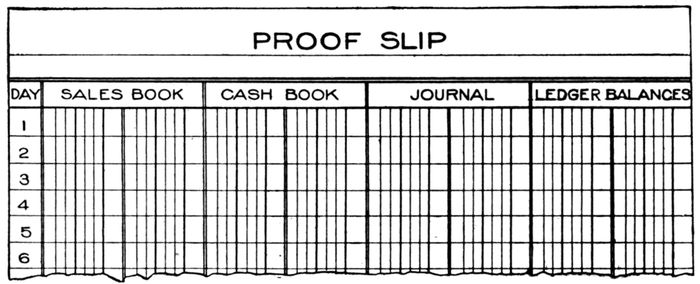
Fig. 19. Monthly Posting Proof Sheet
This system is very simple, and easily operated. It consists of the use of a slip of paper with debit and credit columns in which accounts posted to the ledger are entered. A separate slip is used for each book from which postings are made, and the items are posted to the slip from the ledger. The slip should be placed on the desk on the opposite side of the ledger from the book of entry.
If posting is from the sales book, the ledger should be placed to the right of the sales book and the slip to the right of the ledger. After the item is entered in the ledger it is posted to the slip. When the work is completed the slip is footed and compared with the footing of the sales book. If the footings agree, it is quite evident that the correct amounts have been posted to the ledger, for it is scarcely possible that an incorrect amount has been posted to the ledger and the correct amount entered on the slip.
A further daily proof may be had by inserting a blank slip of paper in the ledger wherever an item is posted. At the end of the day these ledger accounts are referred to, the amounts are drawn off, and total postings compared with the totals of the checking slips from the different books.
146When postings are not checked daily a form should be prepared to which daily totals will be carried. Columns are provided for each book from which posted, and these are footed at the end of the month and compared with the footings of the books. If the ledger does not balance a comparison of this proof slip with the column footings of the books will show in which book the error has been made. The form of the monthly proof slip is illustrated in Fig. 19.
SPECIAL ACCOUNTING FORMS
21. Bookkeeping, if it is to fulfil its mission, must furnish a complete record of the transactions of a business. The record must show, as well, the results of each transaction or class of transactions, with respect to their bearing on the business as a whole, or on specific sections or departments of that business. From a mere record of personal debits and credits, bookkeeping has grown into a detailed history of a business.
The principles of bookkeeping are the same regardless of the nature, size, or condition of a business. But different businesses require different kinds of information; vital facts in one business may be valueless in another. The success or failure of each depends upon certain elements which must be recorded in its history. It is the work of the bookkeeper to record these facts—to write the history of the business in language that will be understood by anyone who may read it.
Laying out the business history is the work of the accountant. He makes an analysis of those elements which bear on the success of the business, and determines what facts, when properly recorded, will furnish the clearest and most understandable history. And when he has determined what facts should be recorded he must plan how they are to be recorded—in what form they will present the most concise history of business transactions. His work should result in a system of bookkeeping that will present the most vitally important information, with a minimum expenditure of labor.
The increasing demand for more intelligible records—for facts—has stimulated the ingenuity of accountants in devising forms that will not only accommodate the records desired but will permit of their being made with the least labor. Special forms exactly suited to 147the records which they are to contain, are now made for every purpose. Labor-saving devices and methods have minimized the drudgery of bookkeeping.
The bookkeeper who would rise above mediocrity requires something besides the ability to record business transactions in the proper columns of books prepared for him. He must know how to devise forms and books, how to adapt correct principles to the building of a system of bookkeeping for any line of business. If certain facts assume importance, he must know how those facts can best be obtained and recorded.
To assist in familiarizing the student with the more modern methods, this section is devoted to illustrations and descriptions of special forms of books for various purposes. The student should devote careful study to these forms, for while they have been in the main devised to meet special conditions, the principles can be adapted to any line of business where similar conditions exist.
SPECIAL LEDGERS
22. Loose Leaf Ledgers. A loose leaf ledger is one in which the leaves are removable. Instead of the sheets being bound in solid book form, each leaf is a separate sheet ruled for one ledger account. The sheets are filed or bound in what is known as the binder, being securely held in place by a mechanical device. The binder can be locked so that only the person holding the key can insert or remove the sheets.
The loose leaf ledger is indexed either numerically or alphabetically. When the numerical method is used the sheets are numbered and placed in the binder in numerical order which gives the same arrangement as a bound book. A separate index is required with the numerical method. The alphabetical method of indexing necessitates the use of sheets on the edges of which are tabs or projections printed with the letters of the alphabet. These index sheets are placed in the binder in alphabetical order and the ledger sheets are placed between them. The alphabetical method is preferred by many as it makes the ledger self-indexing. Another method of indexing is a combination of the alphabetical and numerical. The alphabetical index sheet is used, and under it are filed all accounts of persons whose names begin with that letter. These sheets are numbered 148Account No. 1, No. 2, etc., and the names are written on the index sheet, followed by the account number. This practically divides the ledger into separate numerical ledgers for each letter of the alphabet.
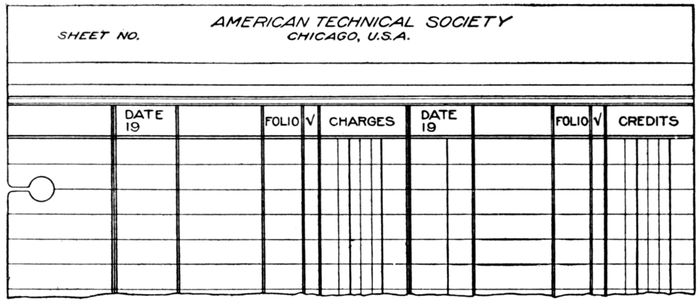
Fig. 20. Loose Leaf Ledger
Binders for loose leaf ledgers are made to hold from a few sheets up to one thousand or more. By proper arrangement of the indexes, more than one ledger can be accommodated in one binder. As an illustration, the general, purchase, and sales ledgers, each with its separate index, may all be in the same binder.
One of the chief advantages of the loose leaf ledger is that all "dead" matter can be removed. When a sheet becomes filled, it can be removed to another binder called a transfer binder, and a new sheet put in its place. Or if the account be permanently closed, it is transferred, leaving only live accounts in the ledger. When new accounts are to be opened, it is only necessary to insert additional sheets. There is no transferring of all accounts from one ledger to another as with bound books, for the loose leaf ledger is never filled. If the number of sheets increases beyond the capacity of the binder, the ledger can be divided by transferring a part of the sheets to a new binder.
The ruling of loose leaf ledger sheets is the same as in bound books, the forms usually being made to fit the business. A sheet with a conventional form of ruling is illustrated.
23. Card Ledgers. For certain classes of accounts, the card ledger is very desirable. It is well adapted for a sales ledger in a business having a large number of customers, and especially so if the 149nature of the business is such that the purchases of a customer are infrequent. In many businesses handling a single line of goods known as seasonable, sales are made in the spring and fall so that a customer purchases practically an entire year's supply in two orders.
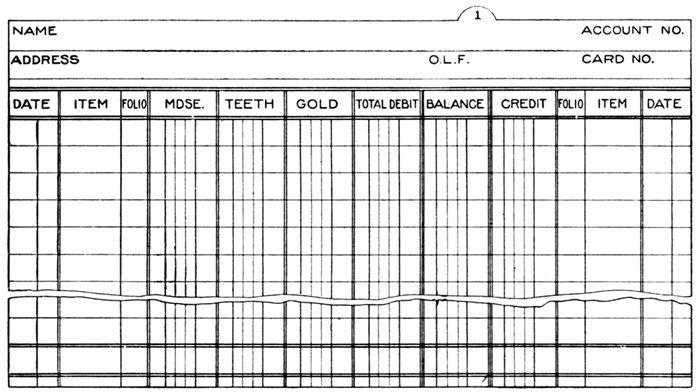
Fig. 21 a. Ledger Card for Dentists
The card ledger is largely used in banks for keeping accounts with depositors in the savings department. A card 5 inches x 8 inches in size gives room for forty items on each side, and for the average savings account will last more than two years.
Some advantages claimed for the card ledger are:
First: Dead records are eliminated, as filled cards and closed accounts are transferred to a separate file, leaving only open accounts in the current file.
Second: It can be expanded to any size, which makes it ideal for business with a large number of customers. The opening of a new account, or re-opening of a closed account, is accomplished by merely dropping a card in the right place.
Third: The labor of making trial balances is greatly reduced, as there are no closed accounts to refer to in the current file.
Fourth: Statements can be mailed much earlier as the cards can be distributed among several clerks who can be working on them at the same time.
Fifth: The ledger can be subdivided as desired by the use of proper index cards. When one drawer or tray is filled, a part of the 150cards can be taken out and placed in another tray without disturbing their arrangement.
There are two general plans of indexing the card ledger—alphabetical and numerical. The alphabetical method consists of a set of guide or index cards between which the cards are filed. This index may consist of one index for each letter of the alphabet, a smaller number with two or more letters on one index, or a much larger number subdividing the alphabet into as many parts as may be necessary. In planning an index for a card ledger, a safe rule to follow is to provide one index card for every ten ledger cards.
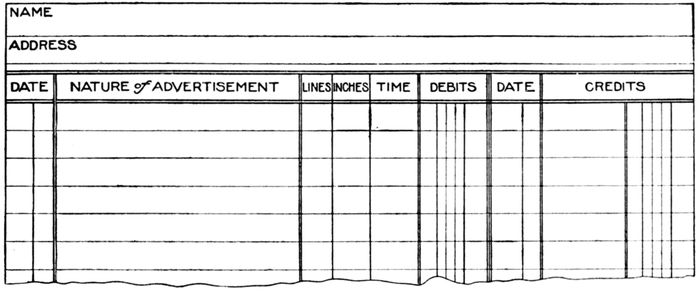
Fig. 21 b. Ledger Card for Publishers
A subdivision of the alphabetical index is the geographical or territorial. This divides the ledger by states and towns. Guide cards, printed with the names of the states, provide the main division; other guides, printed with names of towns, subdivide the state sections; and where necessary, alphabetical guides subdivide the names in the towns. If desired, the ledger may be divided into territorial sections, as East and West; or each section may include the territory covered by one salesman.
A numerical index divides the cards by tens and hundreds. Guide cards numbered by hundreds—100, 200, etc.—provide the main divisions. Between these are placed guides numbered 10, 20, 30, etc. to subdivide these sections by tens, and the ledger cards are filed in numerical order between these guides. To facilitate locating any number desired, the cards themselves are made with small projections numbered from 0 to 9 to represent the units. Each card bears one tab, and all tabs bearing the same unit are in the same 151relative position on the card; that is—0 is always at the extreme left, while 9 is ten positions to the right. When the cards are placed in numerical sequence, between the guides numbered by 10's, any number can be found instantly. To find number 2,987, we refer first to the main guide number 29, then to the guide numbered 8—in the section between 29 and 30—and then to the number 7 tab next following. As there are never more than one thousand cards in a tray, any number can be found more quickly than in a bound book. If a card is misplaced in filing, the unit tab will greatly assist in locating the missing card. Suppose card No. 964 is missing; a search through the row of No. 4 tabs will locate it, no matter where filed. With this system of filing, a separate index by name is required, and this also is made on cards. For a very large ledger the numerical system is more frequently adopted than the alphabetical.
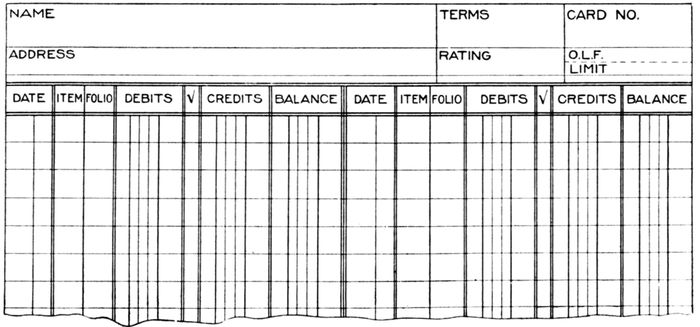
Fig. 21 c. Balance Form of Ledger Card
It is claimed that the numerical tab scheme affords one safeguard not found in an alphabetical system. A missing card is at once detected by the break in the row of tabs, but to make the safeguard of value it is necessary to leave the cards in the file even after accounts are closed.
There is no good reason why an alphabetical card ledger should not be as safe as the numerical. If it is desired to guard against the removal of one card and the substitution of another, the blank cards should be placed in the custody of one man, who will issue them to the bookkeeper as needed, first placing his initials on the card. In any event, the card ledger should be provided with a locking device 152which will prevent the removal of a card, except by the one who has the key.
These suggestions may be of assistance to the bookkeeper who is called upon to use a card ledger.
Never leave ledger cards lying on the desk. When you leave your work, put them back in the file, where they belong.
Before leaving the office, lock the ledger so that no one can remove a card in your absence.
If your superior asks you to see a certain ledger account, do not give him that one card. He may lose it. Give him the entire tray, with the cards securely locked. Should he insist on having that one card, ask him to give you a receipt for it.
Some special forms of ledger cards are illustrated. Fig. 21 a. is a form used by a dental supply house. The special feature of the form is a separate column for each different class of goods purchased by the customer. Fig. 21 b. is used by a publisher for advertising accounts. Fig. 21 c. is a conventional balance ledger form adapted for use in almost any line of business.
24. Tabular Ledger. This is a ledger in which the names are written down the side of the page, with debits, credits, and balances extending across the page. Columns are arranged to group entries during uniform periods, as a month, week, or day. A special feature of this style of ledger is that it can be more quickly balanced and proved than any other style. To prove this ledger add the balances at the end of the preceding period to the debit postings of the current period. This will equal the total of the credit postings added to the new balances, if the balances have been correctly extended. The postings to all of the accounts on a page—30 to 40—can be footed at one operation, saving much time.
Fig. 22 a. is a form of a tabular ledger used by banks, known as the Boston bank ledger. It is specially arranged to exhibit daily balances, as it is necessary that the depositor's ledger be balanced daily. This form can be used in a mercantile business, but as balances are not required daily, the form shown in Fig. 22 b. is better adapted to the purpose. These tabular forms of ledgers are not commonly used except in banks.
25. Balance Ledgers. Three forms of balance ledgers are illustrated, each one of which is specially adapted to some particular class of business.
153
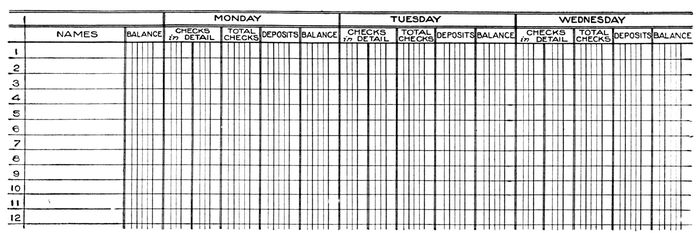
Fig. 22 a. Boston Bank Ledger
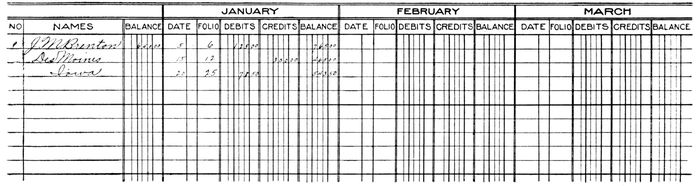
Fig. 22 b. Commercial Tabular Ledger
154The special feature of Fig. 23 a. is two credit columns—one for cash and one for merchandise returns. This form is favored in certain lines of business where merchandise returns are frequent. A special column serves to separate returns of merchandise sent out on approval, which in some businesses is an important item.
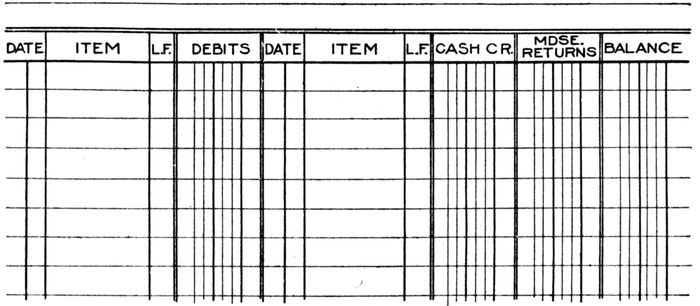
Fig. 23 a. Ledger with Special Credit Columns
Fig. 23 b. is provided with two balance columns, for debit and credit balances. This form saves time in taking trial balances, as it is seen at a glance whether the balance is a debit or a credit.
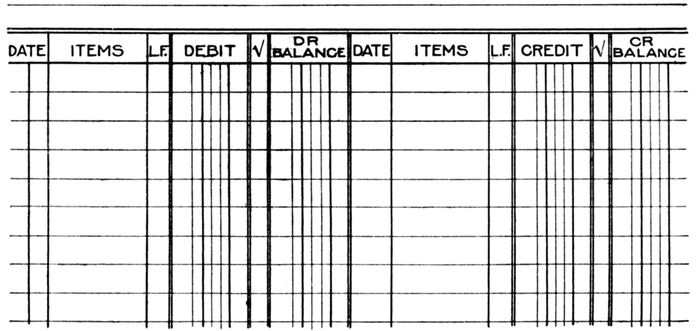
Fig. 23 b. Balance Ledger
The feature of Fig. 23 c. is several credit columns to one debit column. This form is largely used where sales are made subject to periodical payments. It is well adapted for installment accounts, rent accounts, insurance accounts, and similar classes. The number of credit columns can be extended indefinitely to meet existing conditions.
THE PRUDENTIAL BUILDING One of Buffalo's Best Office Buildings
155
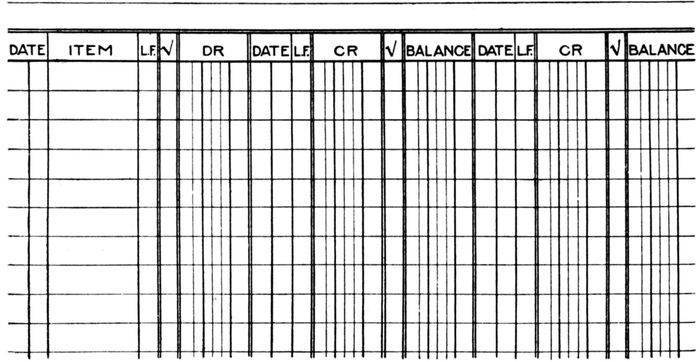
Fig. 23 c. Balance Ledger for Installment Accounts
CASH BOOKS
26. Since the almost universal adoption of special forms of sales books, purchase books, and check registers, the journal proper is only used for adjusting entries. The cash journal, which is a combination of cash book and journal, has taken the place of the two books. Some forms of this book have been illustrated earlier in this text, and a typical form is shown in Fig. 24 a. A study of this form will be found instructive as it suggests the many possibilities of segregating distinct classes of receipts and expenditures. Note the segregation of charges to manufacturing, selling, and administrative branches of the business. Under each branch the different kinds of expense might be shown with all their subdivisions by providing additional columns.
In fact, as we have already stated, there is no end to the possibilities of segregating different classes of transactions by means of the columnar principle in designing books of entry. But it may not be out of place to sound a note of warning against increasing the size of the pages of a book beyond a reasonable limit. While the saving of time is the important factor that influences the introduction of columnar books, there has grown up a tendency to go to such extremes that the unwieldy book defeats this very purpose.
156
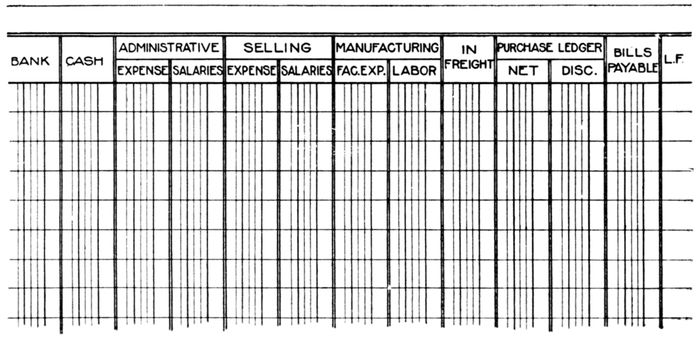
Fig. 24. Cash Journal—Left-Hand Page
While the "sundries" columns in the form shown render possible the making of any kind of adjusting entries in this cash journal, we recommend that it be reserved for cash transactions and that all adjusting entries be made in an ordinary journal. This will segregate cash transactions, just as sales and purchases are segregated, and render much easier an audit of the books. The journal of the ordinary type also affords abundant space for explanations which should be exceptionally complete for adjusting entries. Entries of this kind are frequently used to cover up fraud and they are sure to receive the careful attention of the auditor.
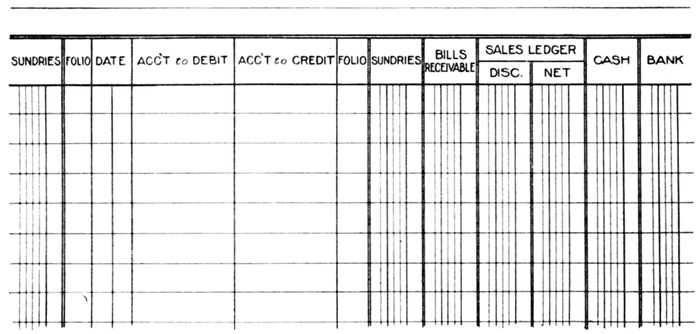
Fig. 24. Cash Journal—Right-Hand Page
157
TABULAR SALES BOOKS
27. In no department of a business are tabulated records of greater value than in the sales department, for only by studying the records of sales of different classes of goods or of different departments can a manager determine which departments of his business are most profitable. A tabular sales book makes it possible to record sales in detail with very little additional labor, resulting in greater economy of time in collecting valuable data.
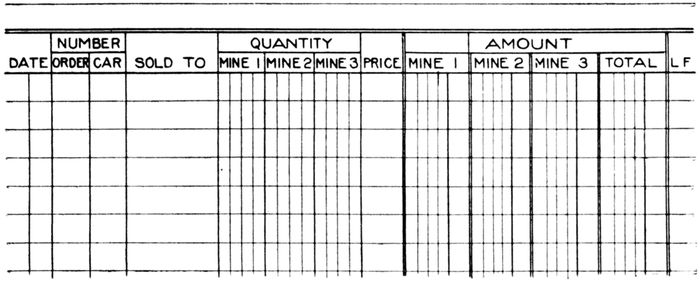
Fig. 25 a. Tabular Sales Book
In certain lines of business a record of quantities of different kinds of merchandise sold is of almost equal value to records of values. Examples are—wholesale coal business, in which records are kept of quantities and values of different grades and sizes or the product of different mines; lumber, in which sales are divided as to lumber, lath, shingles, sash, and doors; wholesale paper, in which some of the divisions are book, flats, bonds, cover, etc. A sales book designed for a business of this class is shown in Fig. 25 a. This is arranged for a record of sales in a coal business, segregating sales of the product of each of three mines.
There are businesses in which returns and allowances are so frequent as to constitute an important item in the record of transactions. Such cases demand special columns in either journal or sales book. Another condition occasionally met with is where purchases are frequently made from customers, resulting in accounts in both ledgers. This requires journal entries to adjust the accounts, but instead of making these in the regular journal, special columns can be provided for the purpose in the sales book. Fig. 25 b. illustrates a sales 158journal with columns for returns and allowances, and columns for purchase adjustments. The total of these adjustment columns are posted to the sales ledger controlling account.
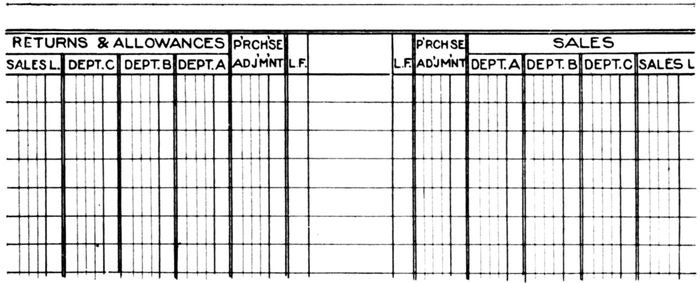
Fig. 25 b. Sales Journal with Adjustment Column
Sales recapitulations are of very great importance in department stores and similar businesses where it is desired to ascertain the total sales of each sales person as well as the result by departments. In Fig. 25 c. is shown a sales recapitulation sheet arranged for daily records of sales of each clerk and of each department. All sales tickets are lettered or numbered to indicate the clerk, and at the end of the day these tickets are tabulated by numbers. One of these recapitulation sheets is used for a month's record, and it can of course be designed to accommodate as many departments and clerks as there are in the establishment. Recapitulation sheets arranged on this plan are found very convenient in many lines other than department stores.
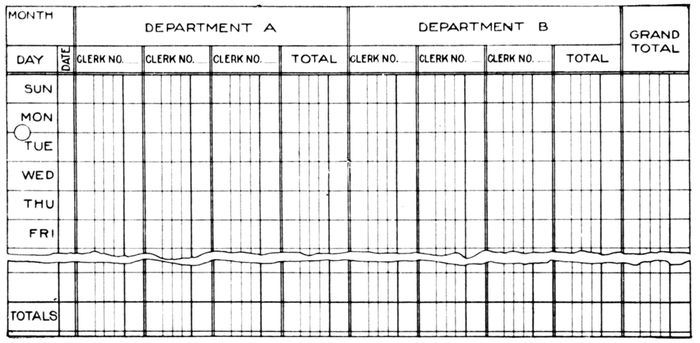
Fig. 25 c. Sales Recapitulation Sheet
159
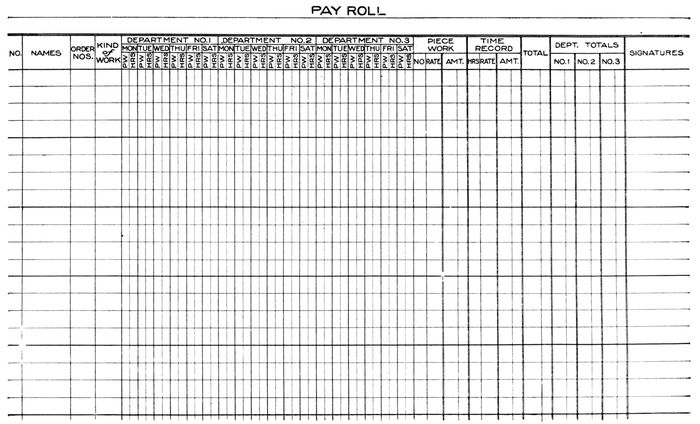
Fig. 26. Departmental Pay-Roll Record for Piece Work and Day Workers
160
PAY-ROLL RECORDS
28. The designing of pay-roll records to meet the special conditions in the great variety of manufacturing industries, offers a wide field for the ingenuity of the bookkeeper or accountant. Where all employes are paid a stated wage and their employment in one department is continuous, the problem is a simple one, resolving itself into a mere record of the number of hours worked each day, the rate, and the amount due. But this condition seldom exists.
In most industries more complex problems are encountered. The same employe may be called upon to work in more than one department during a pay-roll period, or he may do several different kinds of work in the same department. In either case the form for the record must be so constructed as to furnish complete information relative to the cost of the different classes of work. Elaborate systems for gathering records of time on each detail of the work are employed in most modern factories, and the pay-roll record or time book is arranged for a consolidation of these detailed records.
Fig. 26 illustrates a form used in one factory for a distribution of time records where men are employed on different kinds of work in different departments, and on both day wage and piece work plans. In this form provision is made for the record in each department, and each day's record is divided between time and piece work. Several lines are set aside for each employe, so that the record will be complete for each kind of work. At the extreme right, department totals are extended. These are quickly calculated for the reason that while an employe may do different kinds of work and in different departments the same operation is not performed in more than one department. To provide for records of more kinds of work this principle can be carried still farther by allowing more space for each employe, and in some cases a full sheet is assigned for each. In one factory the pay-roll book is loose leaf, one sheet being used for each employe. Each side of the sheet holds the record for two weeks, and by using both sides, it gives a complete record for four pay-roll periods.
29. Combined Pay-Roll and Check Register. Many industries pay their employes by means of checks instead of in currency. Special pay checks are used which merchants willingly cash as an accommodation to their customers. Whenever the check system of payments is adopted it is best to carry a special bank account for the purpose. When 161the amount of the pay-roll is determined, a check should be drawn on the regular bank account and deposited in a special fund against which the pay checks will be drawn.
Fig. 27 shows a form, designed for the use of a concern paying by check, which combines a check register with the pay-roll record. Since all checks drawn against this special fund are pay checks, this register gives a complete record of the special bank account.
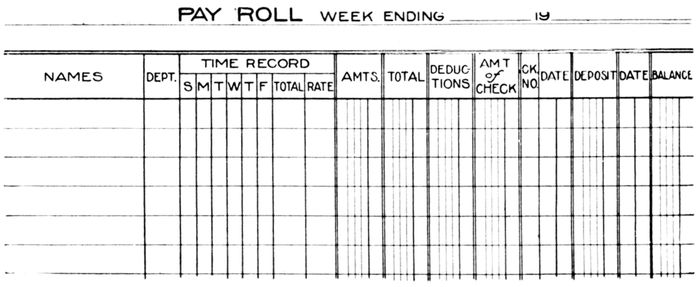
Fig. 27. Combined Pay-Roll and Check Register
162
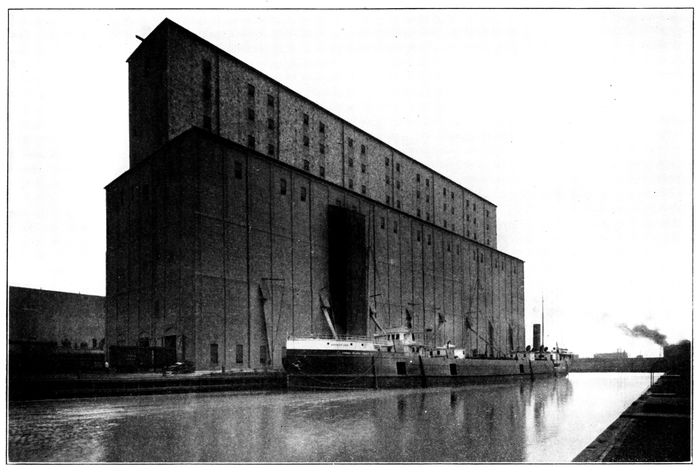
A TYPICAL GRAIN ELEVATOR IN CHICAGO HARBOR, WITH A MODERN FREIGHTER READY FOR LOADING
163