Volume 5 — SINGLE ENTRY BOOKKEEPING COMPARATIVE STATEMENTS[3]
Reading edition
SINGLE ENTRY BOOKKEEPING COMPARATIVE STATEMENTS[3]
SINGLE ENTRY BOOKKEEPING
1. To this point all of the discussions in this work have related to the double entry system of bookkeeping, and all demonstrations have been carried out according to that system. The reason for this is that double entry is the best and the only satisfactory method of bookkeeping; it is the only method that fulfils the important function of bookkeeping by furnishing a true record of the results of all business transactions.
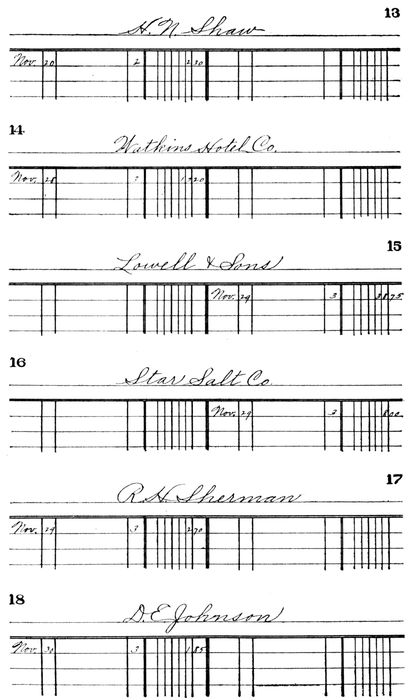
It might appear that instruction in keeping books by the single entry method has no place in a modern treatise on bookkeeping; and if our purpose were to teach single entry as a method to be used, this would be true.
Single entry bookkeeping is not recommended as a method to be used in any business.
The only reason for introducing single entry is to show the student how to change a set of books from the antiquated single entry to a modern double entry system. Though inadequate, single entry is still used to some extent. It is more commonly found in small retail establishments, but occasionally encountered in the offices of corporations and manufacturing enterprises. The bookkeeper who is called upon to fill a position where this method is used must know how to keep books by single entry, that he may more clearly demonstrate the advantages of the double entry method.
When the advantages of double entry are demonstrated, few employers will object to a change from single entry. In most offices where single entry is still used, the reasons which have prevented a change may be summed up as ignorance of the double entry method, or a fear that double entry will increase the work without a corresponding benefit. This latter idea is a misconception inherited 92from the days of the old time bookkeeper, who considered it necessary to laboriously journalize every transaction. While it may have possessed some merit at that time, it is no longer true. Modern ideas, improved forms of account books, labor saving devices, and short cuts without number have reduced the labor of bookkeeping to a minimum, and if any attempt at a proof of accuracy is made, double entry actually requires less labor than single entry.
2. Distinctive Features of Single Entry. The distinctive feature of single entry is that only personal accounts are kept. When goods are sold or purchased, records are made of the transactions as they affect the persons to whom sold or from whom purchased. The records do not show the increase or decrease of any specific form of assets, like merchandise, for no property accounts are kept. An account is usually kept with cash, but this approaches double entry, for when a person pays money to the business, cash is debited and the person credited; and when money is paid out, cash is credited and the person debited.
Sometimes, in a set of books otherwise kept by single entry, such accounts as merchandise, expense, and real estate are found, but when such accounts are introduced the books begin to take on double entry features.
3. Books Used. The principal books of a single entry set usually consist of day book or journal, cash book, and ledger. Both the day book and cash book are books of original entry, from which transactions are posted direct to the ledger. Auxiliary books used are order book, bill book, and check book.
The day book or journal is the familiar two-column form, the left-hand column being used for debits and right-hand column for credits.
The cash book has two columns on each page, and these columns are used to separate the items affecting personal accounts, which are to be posted, and all other items, none of which are posted. See illustration.
The ledger is the same form as used in the double entry method.
The order book is usually the regular two-column journal form. In retail businesses it is used as a principal book, transactions being posted from it to the ledger. Sometimes the first column is used for prices, the extensions being made only when the order is filled.
The bill book is quite essential in a single entry set for the reason 93that no Bills Receivable and Bills Payable accounts are kept in the ledger.
4. Rules for Debit and Credit. The rules for debit and credit are the same in single entry as in double entry, except that no debits and credits are recorded which do not effect persons or cash—when a cash account is kept. Briefly, these rules applying to single entry are:
Debit the person
When he receives anything of value;
When you pay him cash.
Credit the person
When you receive anything of value;
When he pays you cash.
Debit cash
When you receive it.
Credit cash
When you part with it.
5. Posting. There is no difference between posting to a single entry ledger and one kept by the double entry method. However, the only accounts posted are personal accounts, and the ledger shows merely how much money the business owes to persons and how much money persons owe the business. A single entry ledger does not show the amount of our notes outstanding, or the amount of other persons' notes held by us. This information can be found only in the bill book. The ledger does not show the value of merchandise purchased or sold, expenses of the business, nor the amount of our investments in land, buildings, or other forms of property.
6. Proprietor's Account. A proprietor's investment or capital account is kept in single entry just as it is in double entry. This may or may not include withdrawals. They may be recorded in a personal or private account, in which case the proprietor's account will exhibit the net investment in the business.
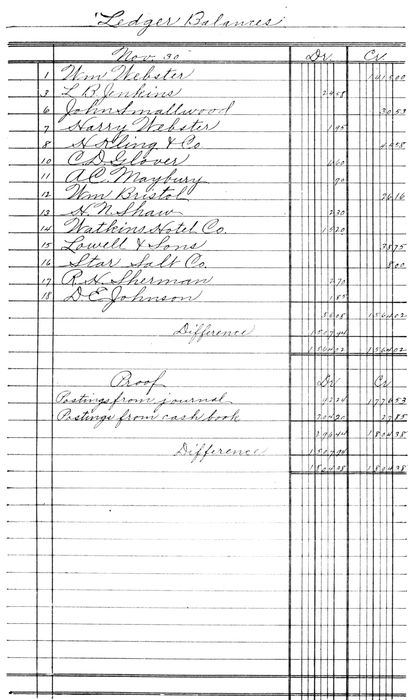
7. Proving the Work. Since but one side of each journal entry is posted, the two sides of the ledger will not agree as in double entry. Hence a trial balance is, strictly speaking, impossible. The only absolutely sure method of checking the accuracy of a single account in the ledger is to carefully check all postings; this is also true of double entry. But it is possible to prove that the correct totals have been posted in single entry, as it is in double entry. Since 94the ledger is never in balance as in double entry, the proof is not found by comparing the two sides of the ledger, but by comparing the difference between the two sides of the ledger, with the difference between debits and credits in the columns of books of original entry from which postings have been made. If the difference between debits and credits in the ledger agrees with the difference between debits and credits in the books of original entry, the work may be assumed to be correct.
To prove the work, first find the balances of all ledger accounts and enter the amounts in the debit and credit columns on journal paper—as for a trial balance. Foot and find the difference between the two columns. Next foot the order book, day book, cash book, or any other books from which posting is done, and list the totals which should be posted to debit and credit of ledger accounts. Foot and find the difference.
SAMPLE TRANSACTIONS
8. For the first demonstration of single entry bookkeeping, we have selected a small retail business, using transactions which have been used to illustrate a double entry set. This set is kept in the most simple manner possible, the books used being journal, cash book, and ledger.
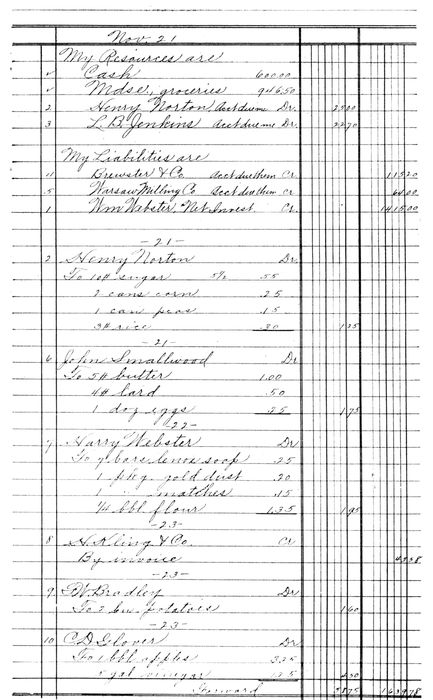
The business is opened by Wm. Webster on the 21st day of November, 190-. He is to conduct a retail grocery business and has rented a store from Wm. Bristol at a monthly rental of $30.00. His resources consist of cash, $600.00; a stock of groceries, $946.50; personal accounts due him as follows: Henry Norton $25.00, L. B. Jenkins $22.70. His liabilities consist of two accounts, as follows: Brewster & Co., $115.20; Warsaw Milling Co., $64.00. The opening entry recording the above, is made in the journal as in double entry, but only personal items are posted. Cash is transferred to the cash book.
CUTTING OFF DEPARTMENT IN THE PLANT OF THE UNION TWIST DRILL CO., ATHOL, MASS.
95
—Nov. 21—
Sold to Henry Norton on account
10# sugar 5½¢ $.55
2 cans corn .25
1 can peas .15
3# rice .30
1.25
—21—
Sold to John Smallwood on account
5# butter $1.00
4# lard .50
1 doz. eggs .25
1.75
—21—
Cash sales 14.10
—22—
Sold to Harry Webster on account
7 bars Lenox soap .25
1 pkg. gold dust .20
1 pkg. matches .15
¼ bbl. flour 1.35
1.95
—22—
Bought for cash
10 doz. eggs .21 2.10
—23—
Bought from H. Kling & Co. on account
244# hams .12½ 22.50
201# lard .07½ 15.08
45.58
—23—
Sold to F. W. Bradley on account
2 bu. potatoes 1.60
—23—
Sold to C. D. Glover on account
1 bbl. apples 3.25
5 gal. vinegar 1.25
4.50
—23—
Cash sales 13.20
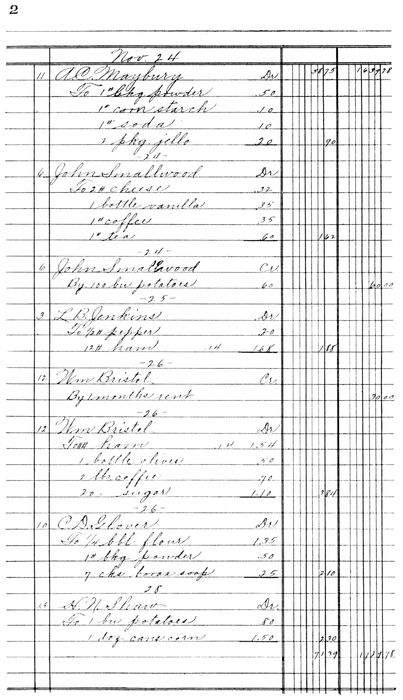
96—24—
Sold to A. C. Maybury on account
1# bkg. powder $.50
1# corn starch .10
1# soda .10
1 pkg. jello .20
.90
—24—
Sold to John Smallwood on account
2# cheese .32
1 bottle vanilla .35
1# coffee .35
1# tea .60
1.62
—24—
Bought from John Smallwood on account
100 bu. potato .60 60.00
—24—
Paid John Smallwood
Cash on account 25.00
—24—
Cash sales 15.00
—25—
Paid Brewster & Co.
Cash on account 115.20
—25—
Sold to L. B. Jenkins on account
½# pepper .20
12# ham .14 1.68
1.88
—25—
Received from Henry Norton
Cash 26.25
—25—
Cash sales 13.00
97—26—
Credited Wm. Bristol
for one month's rent $30.00
—26—
Sold to Wm. Bristol on account
11# ham .14 1.54
1 qt. bottle olives .50
2# coffee .70
20# sugar .05½ 1.10
3.84
—26—
Sold to C. D. Glover on account
¼ bbl. flour 1.35
1# bkg. powder .50
7 cks. borax soap .25
2.10
—26—
Paid cash for clerk hire 8.00
—26—
Cash sales 18.70
—28—
Sold to H. N. Shaw on account
1 bu. potatoes .80
1 doz. cans corn 1.50
2.30
—28—
Sold to Watkins Hotel Co. on account
10 bu. potatoes .75 7.50
50# lard .10 5.00
20# ham. .13½ 2.70
15.20
—28—
Cash sales 9.45
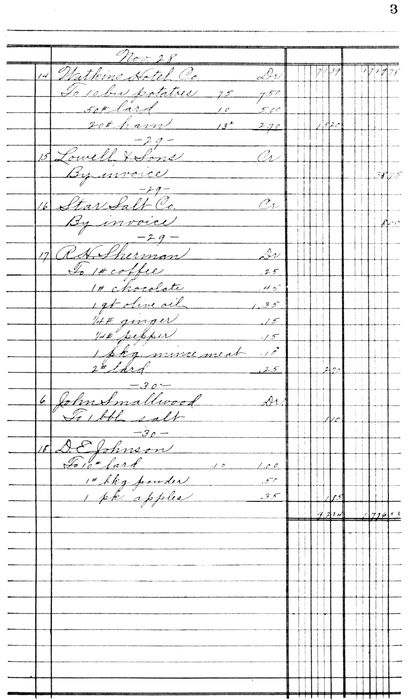
98—29—
Bought from Lowell & Sons on account
500# sugar .04¾ $23.75
50 gal. molasses .30 15.00
38.75
—29—
Bought from Star Salt Co. on account
10 bbls. salt .80 8.00
—29—
Sold to R. H. Sherman on account
1# coffee .25
1# chocolate .45
1 qt. olive oil 1.35
¼# ginger .15
¼# pepper .15
1 pkg. mince meat .10
2# lard .25
2.70
—29—
Cash sales 14.35
—30—
Received from F. W. Bradley on account
Cash 1.60
—30—
Paid Warsaw Milling Co. on account
Cash 64.00
—30—
Sold to John Smallwood on account
1 bbl. salt 1.10
—30—
Sold to D. E. Johnson on account
10# lard .10 1.00
1# bkg. powder .50
1 pk. apples .35
1.85
99—30—
Bought for cash
5 bu. apples 1.00 $5.00
—30—
Cash sales 17.90
At the close of business, Nov. 30, the ledger is proved, in accordance with the rules given in Art. 7. All open accounts in the ledger are listed on ordinary journal ruled paper and the balances extended to the debit and credit columns. These columns are footed, the total of the credit columns being $1,564.02, and of the debit column, $56.08. Subtracting the latter from the former, we find the difference to be $1,507.94. The total postings—debit and credit—from the journal and the cash book are then entered and added, the total debit postings being $296.44, and the total credit postings, $1,804.38. The former deducted from the latter leaves $1,564.02, which agrees with the difference in the ledger balances. This proves the correctness of the postings to the ledger, and takes the place of the trial balance used in the double entry method.
100
Single Entry Journal
101
Single Entry Journal
102
Single Entry Journal
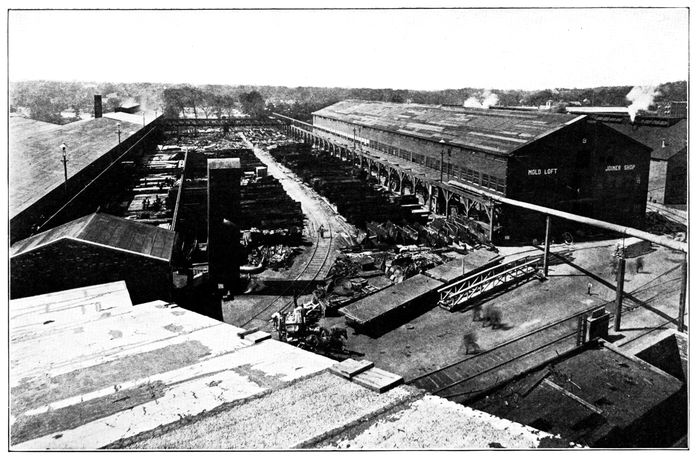
VIEW IN THE GROUNDS OF THE FORE RIVER SHIPBUILDING COMPANY, QUINCY, MASS. Showing the Facilities for Handling Material in the Plate Yard and a Typical Arrangement of the Shops. The Great Electric Crane Shown has a Span of 175 Feet, and Travels Over 1,000 Feet of Track. It is Said to be One of the Largest of Its Kind in the World.
103
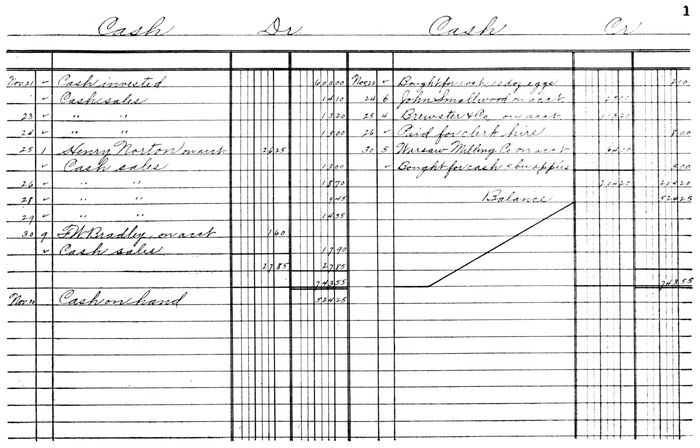
Single Entry Cash Book
104
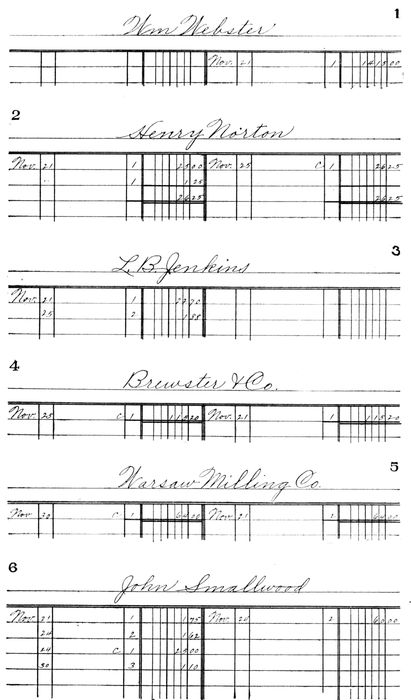
Single Entry Ledger
105
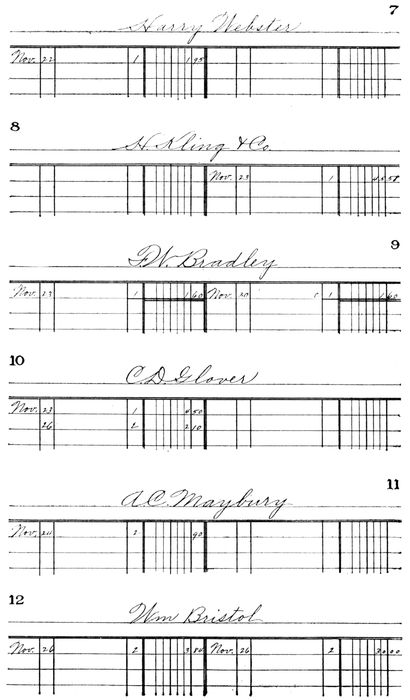
Single Entry Ledger
106
Single Entry Ledger
AUTOMATIC MACHINE TOOL ROOM, FOR THE MANUFACTURE OF PARTS FOR ROCK DRILLS, COAL MINING MACHINES, DIAMOND DRILLS, ETC., IN THE CLAREMONT, N. H., FACTORY OF THE SULLIVAN MACHINERY COMPANY
107
Proof of Single Entry Ledger
108
Single Entry Profit and Loss Statement
DETERMINING THE PROFIT
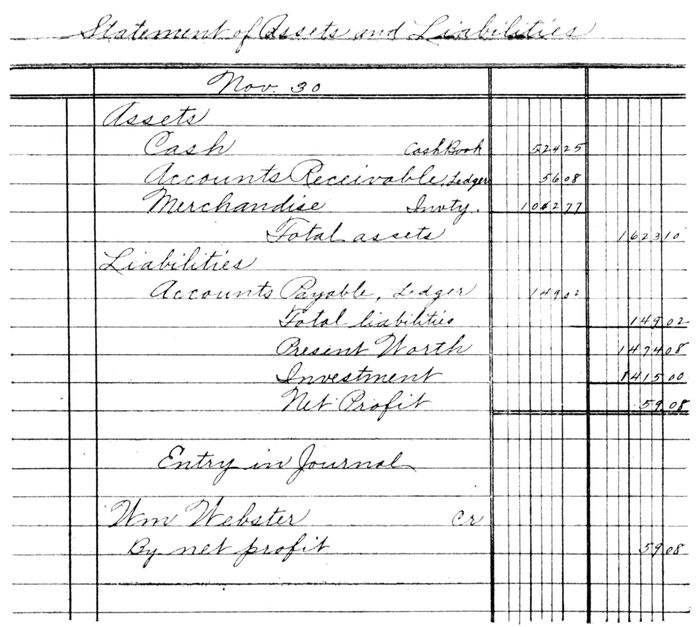
9. Having no nominal accounts, we cannot close through trading account into profit and loss, but must use another method to find the profit or loss for a given period. It will be necessary to first ascertain the present worth of the business. Therefore the first step will be to take an inventory, just as we would if closing a double entry ledger. Our inventory shows merchandise $1,042.77. Next, we will make a statement of assets and liabilities, following the same form as the balance sheet when the books are kept by double entry. This will give us the present worth.
From the present worth, we will deduct the capital investment (or the present worth at the time of making the last statement) which will show the profit for the period. If the present worth is less than the capital investment, the business shows a loss.
It will be noted that while this method shows net profits, it does not show how those profits were made. Having no accounts with purchases and sales, we can have no trading account to show gross 109profits, and without expense accounts there is no data from which to make up a detailed profit and loss statement. Herein is one of the shortcomings of the single entry method of bookkeeping.
CLOSING THE BOOKS
10. To close a single entry ledger, all that is necessary is to credit the proprietor's investment account, or any account representing capital, with the net gain, or debit the account with the net loss. Then rule the personal accounts and bring down the balances.
EXERCISE
On a certain date the assets and liabilities of David Henry are as follows:
Assets
Cash $450.00
Due from sundry debtors 75.20
Merchandise per inventory 762.50
Liabilities
Due sundry creditors 144.00
The following transactions are recorded:
Sales to sundry persons on account 44.71
Bought from sundry persons on account 337.54
Sold for cash 94.90
Received cash on account 62.00
Paid cash on account 132.50
Paid cash for rent 35.00
Paid cash for clerk hire 7.00
At the close of the period in which these transactions were recorded, the inventory of merchandise on hand was $987.75.
First. Open single entry books, entering these transactions in the journal and cash book.
Second. Post to ledger using the terms Debtor and Creditor to represent account of customers and those from whom goods were purchased.
Third. Prove the ledger.
Fourth. Make a statement of assets and liabilities.
Fifth. Has there been a gain or a loss, and how does it affect the account of the proprietor?
110
CHANGING TO DOUBLE ENTRY
11. How to change the method of keeping a set of books from single to double entry is an important question to the bookkeeper, for he may be called upon any time to do the work. When once understood, the change involves only very simple entries. The routine may be briefly described as follows:
First. Prepare a statement of assets and liabilities.
Second. Enter this statement in the journal and post to the ledger, debiting all accounts which represent assets and crediting all accounts which represent liabilities. Credit proprietor's account with the difference, which is the present worth.
If a new ledger is to be opened, new accounts will be opened for each form of asset or liability represented in the entry.
If the old ledger is to be used new accounts are to be opened with assets and liabilities not already represented by accounts in the ledger, and the net gain only will be credited to the proprietor's account. Check personal accounts, but do not post.
Third. Take a trial balance to see if the ledger is in balance, as it should be after posting these entries.
EXERCISE
Following the rules given, change the books of David Henry to double entry using the old ledger.
Show necessary journal entry and indicate what new accounts must be opened.
CHANGING PARTNERSHIP BOOKS TO DOUBLE ENTRY
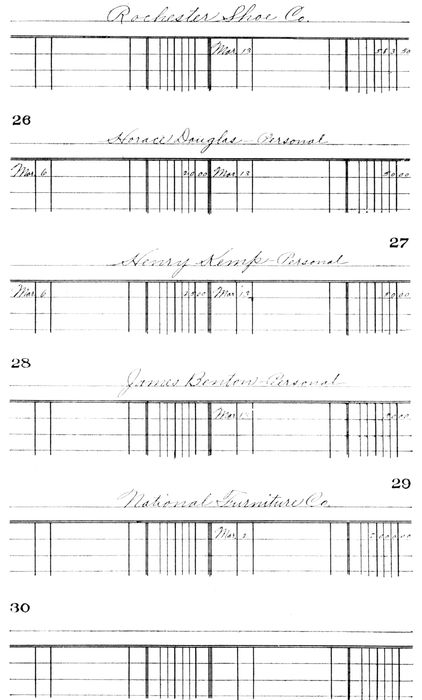
12. We will suppose that the ledger illustrated in the following model set (pages 23-27) represents the business of Benton, Douglas, and Kemp, and that the books have been kept by single entry.
They wish to adopt the double entry method and call you in to make the necessary changes in their books.
Your first step is to make a statement of the ledger accounts, including all except the capital accounts of the partners. This statement gives you the following information:
Personal Accounts, Debit Balances $189.25
Personal Accounts, Credit Balances 2,828.50
Cash in Bank 7,313.73
111You also balance the cash book and compare the balance with the cash in drawer, and find that the amount shown, $21.60, is correct.
In the meantime an inventory is being taken. When completed, the results shown are:
Merchandise $2,114.50
Furniture and Fixtures 2,000.00
The next step is to make a statement of assets and liabilities for the purpose of finding the present worth of the business.
STATEMENT OF ASSETS AND LIABILITIES
Assets
Cash in Bank (Ledger) $7,313.73
Cash in Office (Cash Book) 21.60
Personal Accounts (Ledger) 189.25
Merchandise (Inventory) 2,114.50
Furniture and Fixtures (Inventory) 2,000.00
Total Assets $11,639.08
Liabilities
Personal Accounts (Ledger) 2,828.50
Present Worth 8,810.58
The capital accounts of the partners show the original investment to have been $9,000.00, which is more than the present worth. Deducting the latter from the former will give the net loss.
Investment $9,000.00
Present Worth 8,810.58
Net Loss 189.42
The partnership agreement provides that profits and losses are to be shared equally, but contains no reference to the payment of interest on withdrawals, or allowance of interest on personal credits.
The statement of assets and liabilities is entered in the journal and accounts opened in the ledger with merchandise inventory and furniture and fixtures—the only items not already represented by ledger accounts. To complete the change and balance the ledger the following single entry is made in the journal and posted to partners' personal accounts.
112
James Benton Dr. $63.14
Horace Douglas Dr. 63.14
Henry Kemp Dr. 63.14
A trial balance will now show the ledger to be in balance.
You have followed the routine necessary to change the books of a partnership from single to double entry under the conditions given. A general rule to be followed is to ascertain the present worth, make the partnership adjustment as in double entry, and post as in changing books of a single proprietorship.
EXERCISE
The books of Lancaster, Jenkins, and Stubb have been kept by single entry, but they desire to change to double entry.
The partnership agreement provides that each partner shall share in the profits in proportion to his net investment. Separate accounts are kept with each partner to cover his investment and withdrawals.
The following is a statement of the ledger accounts as they appeared December 31st. The balances of partners' investment accounts are the same as when the last adjustment was made, no additional investments having been made during the present period.
STATEMENT OF LEDGER
Lancaster, Investment Credit Balance $2,000.00
Jenkins " " " 1,500.00
Stubb " " " 1,500.00
Personal Accounts " " 900.00
" " Debit " 2,200.00
Lancaster, Withdrawals " " 325.00
Jenkins " " " 250.00
Stubb " " " 175.00
Bank " " " 2,150.00
Cash in office 50.00
An inventory is taken and shows the value of merchandise in stock to be $1,850.00, fixtures $300.00.
First. Transfer debit balances of partners' withdrawal accounts to investment accounts.
Second. Show entries to make the partnership adjustment and to change books to double entry.
Third. Indicate by check (√) what accounts are to be posted, the old ledger being used.
113
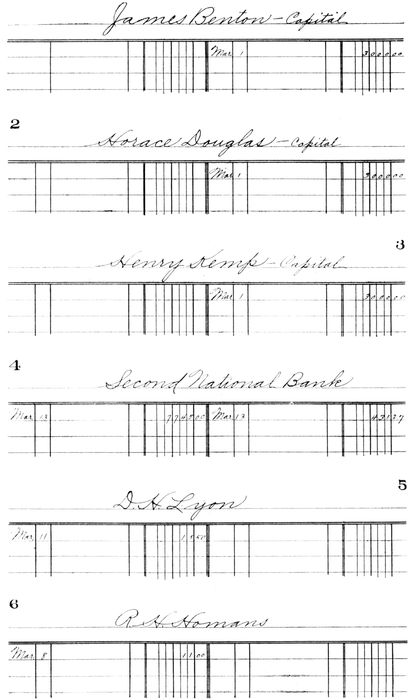
Single Entry Partnership Ledger
114
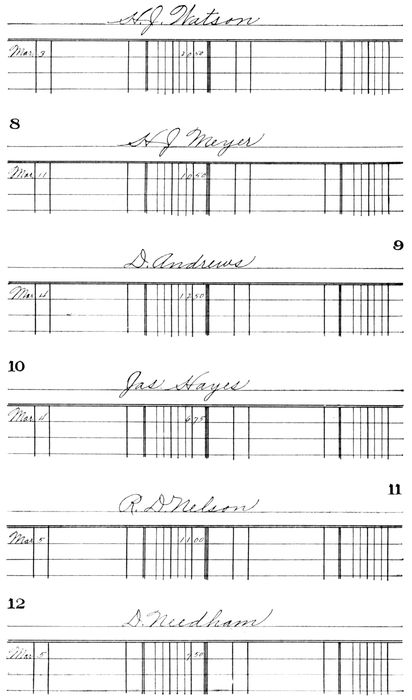
Single Entry Partnership Ledger
115
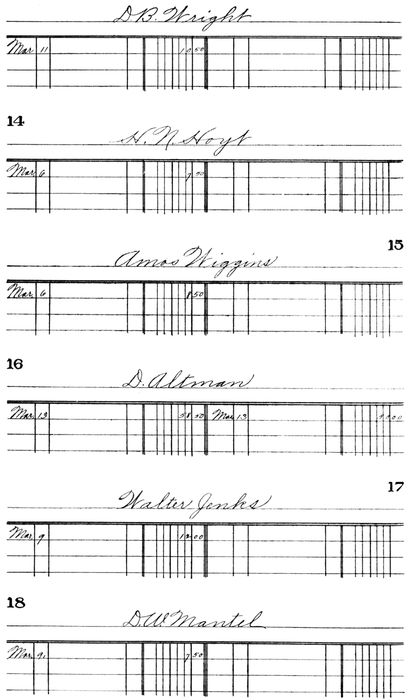
Single Entry Partnership Ledger
116
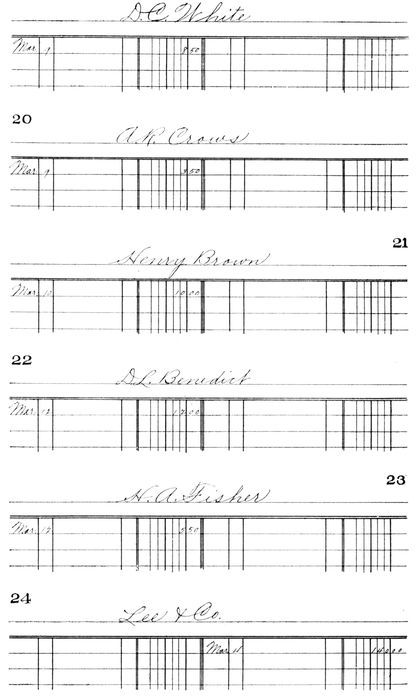
Single Entry Partnership Ledger
117
Single Entry Partnership Ledger
118
CHANGING CORPORATION BOOKS TO DOUBLE ENTRY
13. Corporation books are seldom kept by single entry, but such cases are not impossible to find. In Chicago, there is a manufacturing corporation which has been in business for more than twenty years and is doing a business of a quarter million dollars a year, whose books have been kept by single entry. Not until January 1909 was an accountant called in to change their books to a modern double entry system.
In the case cited a capital stock account was kept, and dividends were paid in cash. The routine followed by the accountant was to first take an inventory of machinery, material, supplies, goods in process, and manufactured goods. Then the land and buildings were appraised at their present value. Accounts had been kept with real estate and machinery, but repairs to buildings had been charged to real estate, thus showing a fictitious increase in value, and no depreciation had been charged against machinery. There was also a merchandise account which had been charged with all purchases and credited with all sales, so that it furnished no information of value.
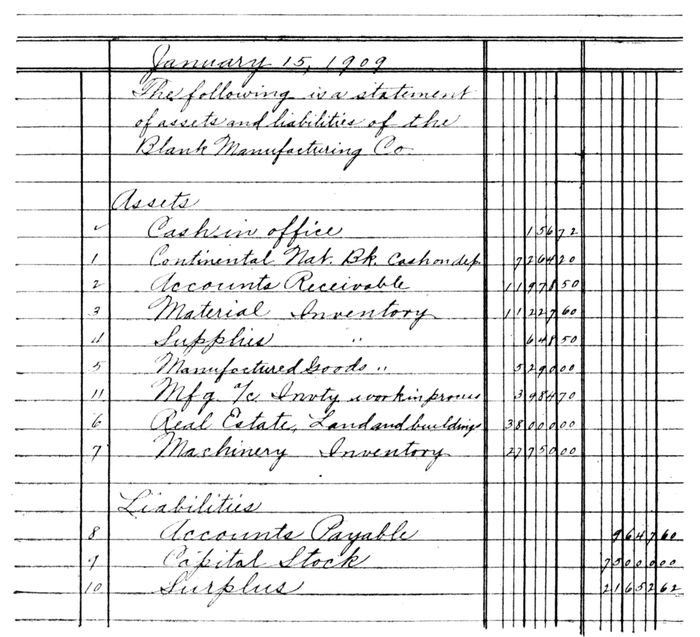
For these reasons only personal accounts, capital stock, bank account, and cash were taken from the books in making up a statement of assets and liabilities. In making this statement capital stock was included as a liability and the excess of assets over liabilities represented surplus.
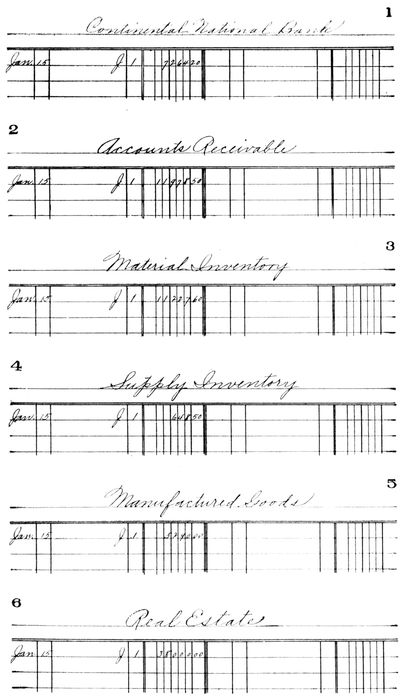
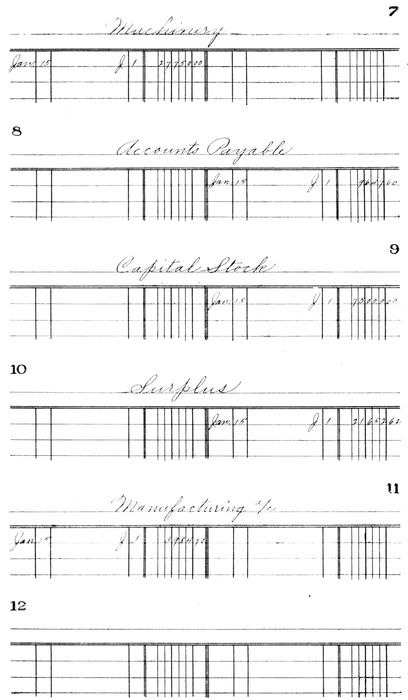
The statement was entered in the journal and accounts representing each item were opened in a new ledger. The balance was credited to surplus account and the books were in balance. Subsequently, the different expense accounts were opened as the transactions requiring their use arose.
Had the directors insisted, the accountant would have been obliged to enter real estate and machinery at the values shown in the old accounts, but an inventory of merchandise would have been necessary in any event.
A safe rule in changing the books of a corporation to double entry is to make a statement of assets and liabilities, including capital stock in liabilities. Then open the necessary accounts and credit the difference in the statement to surplus account.
119
Journal Entries to Change to Double Entry
In the case referred to the following facts were shown by the books:
Cash in Office $156.72
Cash in Bank 7,264.20
Accounts Receivable 11,978.50
Accounts Payable 9,647.60
Capital Stock 75,000.00
The inventories and appraisals resulted in the following valuations:
Real Estate (Land and Buildings) $38,000.00
Machinery 27,750.00
Material 11,227.60
Supplies 648.50
Goods in Process 3,984.70
Manufactured Goods 5,290.00
A cost system was desired by the management, consequently in opening new books it was necessary to provide for the needed accounts. The complete entries used to change these books from single to double entry are shown in the model journal illustrated, page 29.
120
Ledger After Changing to Double Entry
121
Ledger After Changing to Double Entry
122
EXERCISE
The books of the Star Coal Company, a corporation with a paid-up capital of $10,000.00, have been kept by single entry. The following facts are gathered from the books:
Cash in Bank $3,500.00
Personal Accounts Debit Balances 6,500.00
Cash in Office 200.00
Personal Accounts Credit Balances 2,500.00
An inventory results as follows:
Coal 3,750.00
Horses and Wagons 800.00
Furniture and Fixtures 300.00
Make necessary journal entries to change to double entry. Provide a reserve of 5% for uncollectible accounts, 10% for depreciation of horses and wagons, 10% for depreciation of furniture and fixtures. Declare a dividend of 10% and transfer balance of profits to surplus, making all journal entries to record these transactions.
TWO HEMISPHERICAL BOTTOMS FOR 100,000-GALLON ELEVATED TANKS RIVETED TOGETHER, SHOWING CLASS OF WORKMANSHIP NECESSARY ON WORK OF THIS CHARACTER Chicago Bridge & Iron Works, Chicago, Ill.
123
TRIAL BALANCES AND COMPARATIVE STATEMENTS
14. The construction of comparative statements is one of the most important duties of the bookkeeper. The ability to properly classify the accounts that make up trading and profit and loss statements, and balance sheets is a valuable asset to the bookkeeper who aims to advance to the highest position.
Statements of this kind, unless properly classified, are unintelligible to the average business man. A mere statement of the balances of the ledger accounts arranged without respect to their relationship, one to the other, may show that the ledger is in balance, but does not present information of special value to the manager of a business. What he wants—and expects—is a statement from which he can readily extract desired information; it must emphasize the salient points.
The classification of accounts has already been touched upon, but no harm will be done by placing still greater emphasis on the importance of this feature. For with the right classification of accounts in the ledger, the trial balance itself will supply some very interesting information, instead of being a mere list of balances. The following rules should be observed in the arrangement of accounts in the ledger.
All asset accounts should be assembled in the first section and grouped according to their classification; i. e., active, fixed, and passive or fictitious.
The liabilities should be divided into secured or funded, unsecured or floating, and capital; the latter includes any reserve accounts that may be maintained.
The expense accounts should follow and should be subdivided as to selling, general, and administrative.
The trading accounts should be grouped and divided into purchases, in-freight, and sales.
If a manufacturing business, the manufacturing accounts should be divided as to purchases, labor, and expenses.
The advantages of card and loose leaf ledgers are apparent in connection with the proper arrangement of accounts. They readily lend themselves to any desired classification, and new accounts as needed can be inserted at any point.
124For the purpose of showing some of the possibilities in the classification of accounts, we give a few examples of model trial balances.
TRIAL BALANCE
Assets
Cash $264.20
Bank 4,728.50
Accounts Receivable 6,270.00
Inventory (Jan. 1) 7,860.00
Real Estate 10,000.00
Furniture and Fixtures 5,000.00
Liabilities
Mortgage Payable $3,000.00
Bills Payable 5,000.00
Accounts Payable 6,120.00
Capital Stock 20,000.00
Profit and Loss
Advertising 475.00
Salesmen's Salaries 300.00
Traveling Expenses 189.70
General Expense 74.00
Interest and Discount 22.60
Building Maintenance 37.00
Taxes and Insurance 42.00
Salaries 525.00
Trading
Purchases 5,500.00
In-Freight and Cartage 96.20
Sales 7,219.00
41,361.60 41,361.60
If the accounts in this trial balance were listed without regard to the groups in which they belong, it would merely show that the ledger balances. In its present form, it gives at a glance much valuable information. Total expenses and expenses of each class are readily ascertained, sales are shown, and expenses can be compared with sales. With the exception that it does not show the changes in the 125account of the inventory, this trial balance exhibits the condition of the business.
Supposing that an inventory is taken, the following statements are quickly prepared.
BALANCE SHEET
Assets
Cash $264.20
Bank 4,728.50
Accounts Receivable 6,270.00
Inventory (Feb. 1) 7,995.00
Real Estate 10,000.00
Furniture and Fixtures 5,000.00
Liabilities
Mortgage Payable $3,000.00
Bills Payable 5,000.00
Accounts Payable 6,120.00
Capital Stock 20,000.00
Surplus 137.70
34,257.70 34,257.70
TRADING STATEMENT
Inventory (Jan. 1) 7,860.00
Purchases 5,500.00
In-Freight 96.20
13,456.20
Less Inventory (Feb. 1) 7,995.00
5,461.20
Sales 7,219.00
Gross Profit 1,757.80
7,219.00 7,219.00
PROFIT AND LOSS STATEMENT
Gross Profit $1,757.80
Advertising $475.00
Salesmen's Salaries 300.00
Traveling Expenses 189.70
General Expense 74.00
Interest and Discount 22.60
Building Maintenance 37.00
Taxes and Insurance 42.00
Salaries 525.00
Net Profits 137.70
1,780.40 1,780.40
126The facts that sales were $7,219.00, or that the expense for salesmen's salaries was $300.00 mean nothing in themselves. It is only when compared that they exhibit vital facts. If we find that last month's sales were $8,400.00 and salesmen's salaries the same as this month, we know at once that our present selling cost is proportionately higher than during the preceding period.
The following trial balance should be compared with the preceding and the difference in their values, in respect to the information given, carefully noted. The accounts in this trial balance are arranged in the order in which they were found in the ledger.
TRIAL BALANCE
Dr. Cr.
Capital Stock $30,000.00
Sales 45,411.40
Accounts Receivable $7,190.00
Accounts Payable 2,720.00
General Expense 727.00
Salesmen's Salaries 3,000.00
Salaries, General 3,600.00
Interest and Discount 126.70
Returns and Allowances 942.20
Inventory 9,687.00
Purchases 26,250.00
In-Freight $396.40
Bank 6,470.00
Traveling Expense 1,759.00
Taxes and Insurance 236.50
Real Estate 25,000.00
Fixtures 3,000.00
Surplus 10,000.00
88,258.10 88,258.10
127
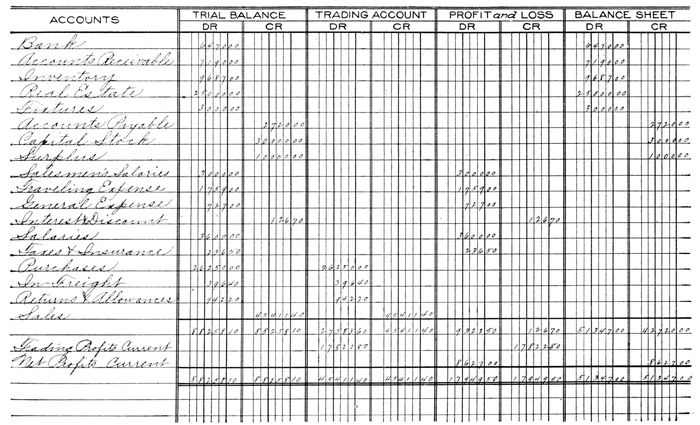
Fig. 15-a. Working Balance Sheet
128
WORKING BALANCE SHEET
15. A form much used by accountants combines the trial balance with the balance sheet, trading and profit and loss statements. The compilation of the information required for this form is greatly facilitated by a proper classification of accounts in the ledger. The form is known as a working balance sheet.
A working balance sheet is shown in Fig. 15 a. The figures used are taken from the last trial balance shown, and furnish a graphic illustration of the difference between proper and improper classification of accounts. It will be noticed that the first two columns constitute the trial balance. Following this are columns which classify the accounts under the headings of Trading, Profit and Loss, and Balance Sheet. The balance of each account is extended to its proper group.
At the bottom of the form, trading and net profits are extended as a memorandum only. Since no inventory has been taken these figures are not exact, but represent approximate results on the supposition that the inventory would be practically the same as when the last inventory was taken. Of course, if there was a noticeable change in the quantity of merchandise in stock, an estimate would be made and taken into consideration in making this statement of probable profits.
EXERCISE
From the following trial balance, prepare a working balance sheet showing actual gross and net profits.
129
TRIAL BALANCE
Bank $8,460.00
Capital Stock $25,000.00
Sales 11,201.00
Purchases 10,000.00
Returns and Allowances 400.00
Interest and Discount earned 260.00
General Expense 425.00
Salaries 360.00
Rent 300.00
Taxes and Insurance 37.60
Selling Expense 421.00
Inventory (Jan. 1st) 8,864.00
Fixtures 2,500.00
Accounts Receivable 5,680.00
Accounts Payable 1,274.00
Cash in Office 287.40
37,735.00 37,735.00
Inventory (Feb 1) 9,650.00
COMPARATIVE STATEMENTS
16. The trial balances shown in the preceding pages illustrate some of the advantages of properly classified accounts. The information gained can be made of still greater value by the construction of comparative statements; for, as has been stated, the chief value of many of the figures shown lies in the opportunity for comparisons. Statements which permit of comparison of items of a like nature from month to month furnish a valuable survey of the progress of the business.
The following is a trial balance taken from the books of a manufacturing business, and will be used as a basis for the construction of comparative statements.
TRIAL BALANCE
Dr. Cr.
Cash in Office $162.50
Bank 8,500.00
130Accounts Receivable 7,500.00
Bills Receivable 4,500.00
Inventory, Materials (Jan. 1) 9,500.00
Inventory, Manufactured Goods
(Jan. 1) 6,000.00
Real Estate 20,000.00
Machinery and Tools 17,500.00
Furniture and Fixtures 3,500.00
Bills Payable $7,000.00
Accounts Payable 5,000.00
Capital Stock 50,000.00
Surplus 10,000.00
Undivided Profits 900.00
Advertising 1,200.00
Salesmen's Salaries 1,000.00
Salesmen's Expenses 720.00
General Expense 430.00
Interest and Discount 97.50
Salaries Administrative 900.00
Factory Expense 850.00
Factory Labor 1,750.00
Repairs to Machinery 150.00
Depreciation 175.00
Taxes and Insurance 25.00
Material Purchases 4,600.00
In-Freight and Cartage 126.00
Sales 16,491.00
Returns and Allowances 400.00
89,488.50 89,488.50
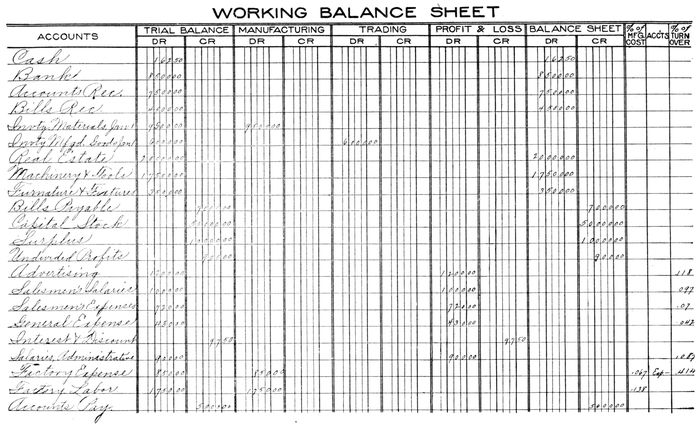
In Fig. 16 a. is shown a working balance sheet in which the accounts as found in the trial balance are segregated in the four groups, Manufacturing, Trading, Profit and Loss, and Balance Sheet. First, the trial balance is entered in the two columns at the left. Next, the manufacturing account is made up by extending the inventory of material at end of preceding period, the manufacturing expense accounts, material purchases and freight on same. This gives the 131total charges to manufacturing account, but not the month's expenditures, for the present inventory of material must be considered. An inventory shows the value of material in stock to be $4,550.00. Deducting this leaves $12,626.00, the total operating cost for the month. To find the cost of goods completed during the month an inventory is taken of work in process, the amount is deducted from the total operating cost and the result, $9,126.00, represents cost of goods manufactured.
The trading account is now made up, this $9,126.00 taking the place of purchases, and the gross profit is carried to profit and loss account.
The manufacturing, trading, and profit and loss accounts are now ready for analysis, which is made on a percentage basis. In the analysis of the manufacturing account, the total operating cost is used as a basis and the different items of manufacturing cost are figured on this basis. We find that the expense items are 23.3% and the material 76.7% of the total which furnishes a tangible basis for a comparison of the same items in other months. Having the percentage of each item, we can note the fluctuations from month to month, and know where to retrench if any item appears to be increasing too rapidly.
The basis of the analysis of the trading and profit and loss accounts is the turnover. Figuring on this basis, we find the total expenses, exclusive of manufacturing costs, to be 41% of the turnover, and the net profit, 20%. The gross profit is 60% of the turnover. Ordinarily the total expense and net profit would equal the gross profit, but in this case there is a capital profit of $97.50 from interest earned.
Sometimes these comparative percentages are figured on the gross sales, but the turnover is considered the proper basis, for it is less subject to marked fluctuations. The sales in one month may show abnormal profits, while in the next these profits may return to normal. If based on sales, the cost percentages would fluctuate accordingly, when in reality they may have remained stationary.
PROOF WITHOUT A TRIAL BALANCE
17. A comparison of the accounts in the last trial balance with the working balance sheet shows them to be arranged in the order in which they would appear in the balance sheet and profit and loss statements.
132
WORKING BALANCE SHEET
133
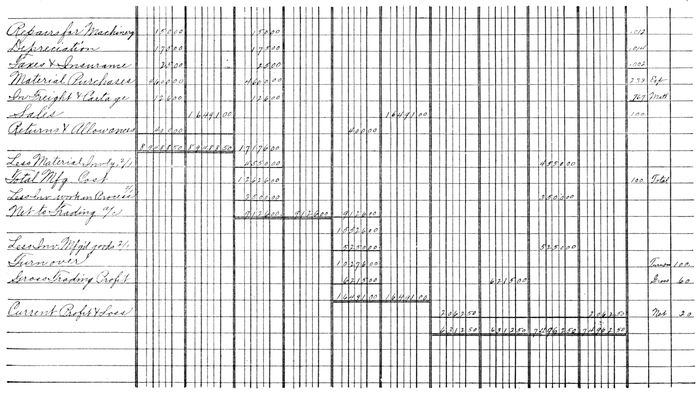
Fig. 16a. Working Balance Sheet for a Manufacturing Business
134It should be remembered that manufacturing and trading accounts are subdivisions of the profit and loss account, and that the profit and loss account is a statement of income and disbursements including differences in inventories.
If it is desired to show the actual condition of the business at the end of each month, the inventory must be added. There may be objections to actually closing the books each month, but the complete statement can be made by adding the current inventories as shown in the working balance sheet illustrated. The amounts of these inventories and the gross and net current profits are, in such cases, memoranda only. The inventories may be arbitrary estimates, and while the results shown may not be exact they will be found of value for purposes of comparison; and care in estimating inventories will greatly increase their value.
Reference to our working balance sheet shows that the profit and loss statements—with current inventories added—agrees with the balance sheet in one respect. The current profit exactly agrees with the difference between assets and liabilities as shown by the balance sheet.
To prove the ledger without the usual trial balance these rules should be followed:
First: Make up trading and profit and loss statements, taking balances direct from the ledger accounts, deducting current inventories.
Second: Make up balance sheet using current inventories in listing assets.
If the current profit and loss agrees with the difference between assets and liabilities the ledger may be assumed to be in balance. This is, in effect, a sectional trial balance, since the accounts in the trial balance are all represented in the two statements. The reliability of this proof is not affected by the fact that the inventories are arbitrary—and perhaps inaccurate—since the same amounts are used in both the balance sheet and profit and loss statement.