THE CREDIT ORGANIZATION
Reading edition
THE CREDIT MAN
Acknowledged specialists may be employed in every branch of an enterprise, the shrewdest brains may be engaged in buying, producing, and selling, but the final conservator of the business is the credit man; others may be profit makers, but he is the profit saver in every commercial organization.
He is on guard constantly—always on the lookout for the slightest sign of danger, ever ready to take prompt and vigorous action to avert disaster to his house or to lend a helping hand to a customer. His duties make him the most misunderstood man in the entire organization.
He is thorough, methodical, painstaking, a keen student of human nature, possessing faith in the inherent honesty of his fellow men. The insistent search for facts that he demands, may cause him to be regarded as an inquisitive busybody by the very customer whom he desires most to help; as a carping critic, by the salesman of his own house.
Through it all he remains faithful to his trust, watchful of the interests of his house, and has the satisfaction of knowing that in spite of his mistakes but a remarkably small part of his credits prove bad—that where his conservatism has lost hundreds in trade, it has prevented the loss of thousands.
On no man in the organization is there such tremendous pressure brought to bear to secure favors; on no man do the consequences of his own mistakes come back so surely. The credit man must be firm, and, while availing himself of every reliable source of information, he must stick to his decisions, for he is expected to collect from those to whom he has extended credit. Every other man has a loop-hole through which he may escape criticism; if a customer is lost because goods are unsatisfactory, it may be "up to" the salesman, the shipping clerk, the superintendent, a foreman, or even an obscure mechanic. The credit man has no one on whom he can place the blame; if a customer fails to pay, no reason short of an earthquake will relieve the credit man of the responsibility.
So much for the credit man. Now for a discussion of the work he is expected to do, the machinery of his office, and his methods of operation—for the writer disclaims any intention of attempting to teach the student how to become a credit man.
INFORMATION REQUIRED
The most important function of the credit man is the determining of the credit risk—the amount of credit that can safely be extended to each individual. When he consents to the delivery of goods to be paid for at a future date, he is loaning his firm's money.
Before credit is granted extreme care must be exercised in determining the ability of the purchaser to pay, or that he will be able to pay when the bill is due. After necessary precautions against assuming too great a risk have been taken, a further insurance against loss is included in the amount added to cost—a certain per cent of the profit is expected to offset the risk.
In determining the credit risk, different classes of information are necessary in different lines of business. While certain specific information about individual applicants for credit is necessary, the subject may be divided into two general classes—wholesale and retail. Under the head of wholesale, is included information about all business concerns, whether a single proprietor, a partnership, or a corporation. In a general way also, the same information is required in respect to these concerns by the banker, the manufacturer, the jobber, and the wholesaler. Under the head of retail, is included the transactions of a retailer with his customers, who may be regarded as individuals.
Leading authorities on the subject of credit place the factors which determine the credit risk in two classes—the man and the business. Under the first heading is considered the business morals of the debtor and his ability in, and familiarity with the business in which he is engaged. The second heading—the business—is considered from the financial standpoint, divided as to its assets and liabilities, and the profits or losses made in its operation.
But as to the relative importance of the two principal factors—the man and the business—authorities differ. In his valuable contribution to the literature of credits, Mr. E. St. Elmo Lewis takes the stand that the man—his character—should be considered secondary. To quote from Mr. Lewis' book:
If goods are the basis of all credit, character of the owner is and should be an after consideration. The very first question any credit man should ask, is, can he pay?
The question of a man's ability to pay is becoming of greater ease of solution.
The question of the intention or inclination to pay must always be shrouded in the nebulæ of psychological theory.
What is the applicant worth? is the crucial test. Then we shall test him by another. What sort of a man is he?
Do we buy a law suit when we sell him goods?
How much must we add for moral insurance against loss?
Character is of vital importance in small concerns; of vital importance in concerns doing a large business on small capital, and it becomes of less importance as we progress into the field of corporations.
In direct contrast to this contention are the views of Mr. Ernest Reckitt, as expressed in an address delivered before an organization of bank clerks. After naming the factors to be considered by the banker before extending credit, he said:
You will note that in enumerating these factors I place first, and purposely so, "The Man Himself," and I believe I am correct in stating that bankers are now placing more stress upon this point than ever before. The man of good character and intelligence, who is full of energy and perseverance, will not find it difficult to obtain a reasonable line of credit with his bankers, while the man who is deficient in those qualities, whatever his reputed wealth may be, will be looked upon with suspicion. It therefore behooves you to become students of human character as well as students of banking, if you are to fill the highest positions within your reach.
These comments may be out of the range proposed by this paper, but I feel I cannot leave this topic without giving you an illustration of the point I wish to emphasize, namely: That it is the character of the man, or men, in a business, which must be first considered before the banker makes a loan. Some time ago, in a certain city, there was a large corporation reputed to be very wealthy, whose balance-sheets were beautiful to behold. Their business being large, they were borrowers of some of the largest banking institutions of their city. Apparently without any warning the corporation was declared bankrupt and went into the hands of a receiver. Later, investigation showed that the balance-sheet was misleading; some people might have called it a worse name, for the assets had been overstated and the liabilities understated. I happened to be in that city at the time of this failure, and, meeting a director of one of the banks with whom I was well acquainted, I inquired if his bank had been caught. "No," said he, "they did try and open an account with us some time ago with the object of becoming borrowers, but we turned them down." I asked him what reasons he and his colleagues on the directorate had for such action at a time when this corporation was supposed to be so prosperous. "Well," said my friend, "some time ago it came to my knowledge that this corporation paid no water tax and that its personal property tax was a mere bagatelle to what it should have been, and I figured out that the officers of a corporation that would be guilty of petty bribery would not be good customers for our bank."
So it will be seen that a knowledge of the business morals of the men in your community and a high ideal, on your part, of what constitutes good business morals is a most essential quality in the make-up of a banker, and that it was these factors that enabled the bank of which my friend was a director to escape what otherwise would have been a bad debt.
Financial Statements. Without attempting to decide the relative importance of the two principal factors, it can safely be stated that one of the first steps to be taken by the credit man is to secure a financial statement from the applicant. And the character of the statement may serve as a guide in determining the character of the man with whom he has to deal.
Most business men are willing to comply with any reasonable request relative to their financial standing, when applying for credit. Until recently, the average man had objected to giving out such statements, except to his bankers, but with the more universal demands for such statements has come a change, and now a statement of some sort is almost always obtainable.
The form of statements used by banks differ somewhat from that used by manufacturers and jobbers, and, while it differs slightly as between banks, and also as to whether the borrower is an individual, a partnership, or a corporation, in general the statement required follows the lines of the form shown in Fig. 1. This statement is signed, in the name of the firm by a member, in the case of a partnership; and in the name of the company by one of its officers, in the case of a corporation. A statement in the same form gives all of the information of a financial nature required by the manufacturer or merchant.
Analysis of the Statement. Of equal importance with the statement is the ability to read it—to correctly interpret its real meaning. This calls for a careful analysis of the several items of which it is composed. To make a correct analysis means that the credit man must have a general knowledge of the business in which the one asking for credit is engaged. The banker must know, for example, whether the season is one in which more capital is likely to be needed in the trade of the borrower, or one in which he should be liquidating his indebtedness.
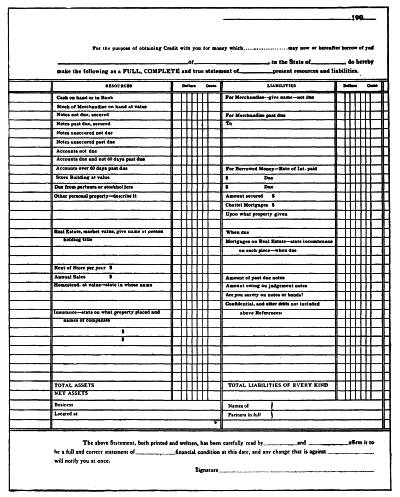
Fig. 1. Customer's Financial Statement
So important is this phase of the question that some of the larger banks have adopted the plan of assigning requests for loans in different businesses to different officers. One man will investigate real estate securities, one, applications from board of trade houses, another handles applications from packing houses, others look after the steel, building, jobbing, and manufacturing enterprises. Each man is a specialist, making a special study of conditions in the business to which he is assigned.
In making an analysis of a statement, each item must be taken up separately and considered with respect to its relationship to other items, and its bearing on the statement as a whole.
Cash on Hand. The cash on hand should be consistent with the needs of the business, and, if listed separately, the cash in office should never be a large sum. There is seldom any good reason why cash should not be deposited daily. The banker will find it necessary to carefully scrutinize the amount in bank, particularly if the borrower claims to deposit in no other bank.
Merchandise. This item is always a somewhat uncertain quantity; often an estimate pure and simple, and the debtor is unlikely to make his estimate too low. In the absence of provable figures, it is necessary for the credit man to apply his knowledge of the business. Is the stock larger than should be required? Is it too low to enable the debtor to keep pace with his competitors? Or, if a manufacturing business, how much is raw material and how much finished goods?
One of the important factors in making an analysis of this item is a knowledge of the accounting methods of the debtor. Does he keep stock records, or if not, is his stock well cared for and stored in a manner to permit of a reasonably accurate estimate? On the latter point, reports of the observation of salesmen, referred to later on, have an important bearing.
Bills Receivable. On the statement form shown, this item is divided as to notes, secured and unsecured, not due and past due. To state that the amount of bills receivable is so much is one thing, to state the amount not due, is quite another. Any considerable amount of unsecured and past due paper indicates lax methods in the debtor's own credit department.
Accounts Receivable. This item is divided as to accounts less than 60 days past due and accounts more than 60 days past due. These items require the same close scrutiny as bills receivable.
The two items—bills and accounts receivable—should bear a reasonably constant ratio to the amount of sales. Any unusual increase in the percentage of book debts to sales calls for careful scrutiny, and leads to one of three conclusions: that trade conditions are bad, that the credit department has been lax, or that the amount is overstated.
The first of these conclusions is supported or rejected by the credit man's knowledge of financial conditions in general, and of conditions in the particular trade of the debtor. During a financial panic, or in a season following crop failures, it is to be expected that book debts will be greater in amount than in ordinary times. In the event of the third conclusion, it is time for a careful investigation. As a rule, the investigation will be productive of best results if an examination of the books by a public accountant is included.
Due from Stockholders. This is an item which must be carefully studied. Who are the stockholders or partners who own the firm, and for what? What is their financial responsibility?
Sometimes, stockholders whose entire fortunes are invested in a corporation are found to be debtors to the same corporation for borrowed money.
Due for Merchandise. This item is divided as to accounts not due and past due. It should be carefully compared with the same item in statements furnished in the past. An increase may or may not be due to natural causes such as the requirements of the trade during a particular season.
Due for Borrowed Money. Any increase in this item should be offset by an increase in assets, or a decrease in other liabilities.
Liability as Surety. This is an item of more importance than is generally accorded to it. True, the liability is a contingent one, but many a man has been forced into bankruptcy by the failure of another, for whom he had become endorser.
Another item which should in the opinion of the writer appear among the liabilities, is discounted paper. When a man discounts the paper of a customer, received in the course of business, he assumes a liability for the amount, if not paid at maturity. True, the liability is contingent, but a liability nevertheless. The extent of the liability depends on the prosperity of his own customers and the care which he has exercised in accepting their paper.
Information for Retailers. The information available for the retailer is of a very different class. Here, the factor, the man himself, plays a more important part. The retailer is obliged to depend more largely on his personal knowledge and the general reputation of his customer.
The city retailer, for instance, needs to know where the man works, his salary, his reputation for paying others—his landlord, grocer, and butcher—and something about his personal habits and general reputation.
How long has he been in his present position? Does he make frequent changes? Does he own a home? What rent does he pay? Any other wage earner in the family?
These are some of the questions, the answers to which will assist in determining the credit risk.
The country retailer needs other information about his customers. As a rule, he can answer all of the questions asked by the city retailer in respect to his own customers. He is more intimately acquainted with his customers; he has a better opportunity to learn their characteristics and habits, than the city retailer. The country retailer has another advantage, in that a closer bond of friendship exists between him and his neighbor merchants. The interests of city merchants are no less common, but distances separating them make an interchange of views more difficult.
About his country customers—the farmers—the retailer requires still different information. Besides full information about the real estate owned, and mortgages given, he needs to know something about the man himself.
Does he market his crops early, or is he a speculator—always holding for possible higher prices? Is the farm well kept up? Are the implements properly housed, or left outside at the mercy of the elements? Does he keep his live stock in good condition, and how much does he feed for market? Is he thrifty or shiftless?
Only by personal contact can these things be learned. The country merchant who keeps in closest touch with his farmer customers—sympathizing with them in their misfortunes and rejoicing in their prosperity—is usually the most successful. As one country merchant puts it, he must act as a general advisor, and help them bear their very aches and pains.
SOURCES OF INFORMATION
The usual sources of credit information are the mercantile agencies, reports from local correspondents, reports from traveling salesmen, and merchants' associations or credit reporting agencies.
Mercantile Agencies. Of these sources, perhaps the best known and most widely used by manufacturers and jobbers, is the mercantile agency. The mercantile agency is the outgrowth of a necessity. About the year 1840, a few New York merchants formed an association for the interchange of credit information. Later, this became a business conducted by individuals who charged a small fee for written reports.
The business has grown to such proportions that a single agency requires about 200 offices, located in the principal cities throughout the world. In the territory of each office, which is presided over by a manager, correspondents are employed, and at certain seasons country reporters traverse every district, gathering data to be forwarded to the branch offices. Every court house in the United States has its paid correspondent, who promptly reports any action—as the filing of suits, recording of mortgages, or entering of judgments—that might affect the credit risk of any business man in the country.
Some idea of the magnitude of the business, and the task of gathering statistics, can be gained when it is considered that the books of a single agency contain the names and ratings of about 1,500,000 persons. About each of these individuals, the latest data collected by the reporters is on file in the various branch offices.
Delays in securing information is one of the most common complaints against the agency service, but the service is probably as prompt as can be expected. Suppose a request for a special report is received this morning. First, the information on file is copied, and proofread to guard against errors. This is sent to the subscriber, but if it is not of a recent date he is advised that further information will be forwarded. Or, there may be no data on file, in which event a reporter is assigned to the case. He may be obliged to make several calls before finding his man, and when found, the man may be reluctant about giving information. If real estate is listed, the real estate man must look up the title and mortgage records. Thus, two or three days may elapse before it is possible to furnish the report.
Some complaint is heard that reports furnished by the agencies are not sufficiently specific—which is probably true in many cases—but it is often quite difficult to obtain information on which positive statements can be based. On the whole, the service of the agencies is of very great value to the subscriber. As to its defects, the best way to overcome them is for the wholesaler to establish a credit organization of his own, to supplement the service of the agency.
Local Correspondents. If the matter is properly handled, much valuable information can be secured from local correspondents. The banker, or a local attorney, is in a position to make confidential reports on local merchants. In fact, the agencies secure much of their information from this very source.
But, in establishing local correspondents, the exercise of good judgment is necessary. The local attorney should not be expected to furnish information without pay, or to go into details that would not be asked of an agency charging $100.00 a year for the service.
An attorney has favored us with a blank sent out by one wholesale house, on which he is asked to make a complete report. Among other information requested, the blank calls for the value of merchandise, realty, cash, total worth, liabilities, and numerous references to his character, habits, etc. Following this statement is the question, "if not paid, can you collect?"
Here is a very complete statement, to compile which would require several hours' research, but without a single suggestion that the attorney will receive pay. And then he is asked if he can collect, after the house has exhausted all usual methods.
A certain other concern, when opening new territory, writes to a local attorney telling him they are entering the field; that they will require information from time to time, for which they expect to pay a reasonable fee; and ask if he is in a position to represent them in this capacity. At the same time the attorney is told that he will receive for collection any accounts on which such action may be necessary.
When a special report is desired, the blank shown in Fig. 2 is sent. The local correspondent is expected to give as full information as possible, for which he is paid promptly.
In this way, excellent results are secured. There is some question about the advisability of leaving the amount of the fee to the correspondent. A better plan is to have the fee to be paid for all ordinary reports decided in advance, extra compensation to be allowed in special cases. The average country attorney will furnish an intelligent report for two dollars—a low price for reliable information.
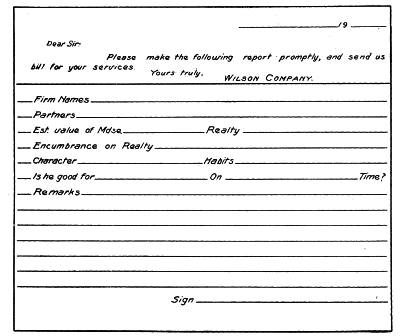
Fig. 2. Local Correspondents' Report Blank
Traveling Salesmen. Certain information about the business and general reputation of a customer can best be obtained through the salesmen of the house. They are the men who come in direct contact with the customers, acquiring an intimate knowledge of each.
The average salesman objects to making out lengthy reports, but if approached in the right spirit, will give the credit man the benefit of his observations. The salesman's judgment is scarcely to be relied upon in the matter of the financial standing of a customer—his anxiety to sell goods makes him too optimistic—but he is probably the best judge of the character and business ability of a man on whom he is calling regularly.
Frequently a spirit of antagonism to the credit department exists among the salesmen. This condition indicates a decided lack of that coöperation so necessary to the success of any business. The credit man who possesses tact can overcome this antagonism, if he will but drop his cold-blooded attitude and meet the salesmen on a friendly basis. If he will cultivate their friendship, the salesmen will respond with information of great value to him.
Naturally the information secured from a salesman differs from that received from other sources. About the class of information that can be expected is provided in the blank shown in Fig. 3. This can be printed on a standard size card.
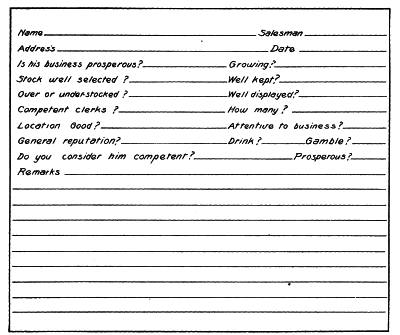
Fig. 3. Salesman's Customer's Report Blank
Retail Credit Reporting Agencies. In many cities, merchants have formed associations for the exchange of ledger experiences. Some of these associations have been very successful, but the chief difficulty has been in sustaining interest and in securing the necessary information. This lack of interest seems to be general in mutual associations—every man seems afraid that he will give more than he receives.
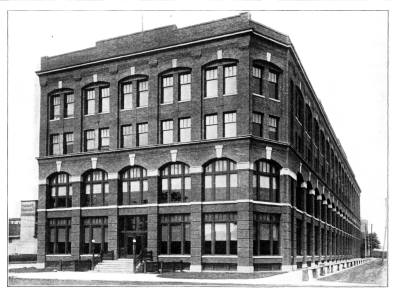
ADMINISTRATION BUILDING AT THE PLANT OF STUDEBAKER BROS. MANUFACTURING CO., SOUTH BEND, IND.
Out of the merchants' association has grown the retail credit reporting agency—the exchange of information being conducted as a private enterprise. The expression, exchange of information, is used advisedly, for the service of these agencies consists mostly of reports giving the experiences of other merchants. To quote from the prospectus of one of these concerns:
Our company does for the retailer what Bradstreet and Dun do for the wholesale dealer. We arrive at the result, however, in a different way. We give accurate information as to how people pay their bills, regardless of their financial standing.
This information we get from merchants and professional men by means of a thorough canvass of our entire territory. We visit all people doing business, whether our subscribers or not, and in this way secure the names of all consumers in business or private life.
We are thus able to tell the grocer how Mr. B. pays his butcher, his tailor, his hatter, his doctor, and every other trade or profession he deals with, and each of these in turn is furnished with the same kind of information from the grocer; thus we establish the exact credit standing of Mr. B. with the entire trade of the city.
Acting upon information thus furnished, every merchant or professional man in the city knows from the most reliable and trustworthy source to whom he can safely give credit and whom he should refuse.
For example, we here give a specimen rating with an explanation of the same.
"John Doe, carpenter, 187 Broad St., 5G 2F."
This rating indicates that five different merchants have found by experience that John Doe is a prompt paying credit customer, and two other merchants have found him somewhat slow, but regard him reliable and trustworthy.
Next example:
"John A. Doe, lawyer, 210 North Second St., 4D 3B."
This rating indicates that four different merchants have found him too slow in paying to be a desirable credit customer, and three other merchants have found him bad pay and unworthy of credit confidence.
Other sources of information, which come under the head of exchanges of ledger experiences, are the credit men's associations. These associations, through clearing houses, exchange information about their customers, thus supplying the wholesaler with the same class of information as described above for retailers.
One credit man relates the following incident, illustrating the value of the association clearing house. On one of the reports furnished by the clearing house, he noticed that another merchant had refused credit to one of his own customers. Investigation developed the fact that this particular customer's locality had suffered severely from the destruction of crops by a cyclone. Now it happened that this credit man's house was about to fill a large order from this very customer. The shipment was held up, and the credit man promptly wrote to the merchant expressing regret that his community had suffered so severely, and asking if his house could be of any assistance to him. In closing the letter, the suggestion was made that since collections were likely to be slow with the merchant, they would allow him to cut down his order.
The letter had the desired effect. Instead of turning him down the merchant was made to feel that he had friends in that house, and it is probable that he continued to be one of their valued customers.
RECORDING CREDIT INFORMATION
Scattered information is of little value. A credit man may avail himself of all sources of credit information, but unless he has it filed and recorded where he can put his hand on it, he will find it of little assistance in determining credit risks. He cannot "keep it in his head" and get the best results.
There are credit men who profess to rely largely on intuition, but the hard-headed man—the one who makes the fewest mistakes—relies on his facts and figures. He uses judgment, but first wants the facts marshaled in logical order.
Filing. The method of filing best adapted to the needs of a given concern depends on the size of the business, number of customers, method of collecting information, and the quantity of data kept on file. In a small business, depending almost entirely on the ratings of the mercantile agencies, with an occasional special report, no special filing system is necessary. The few reports received can be filed with the regular correspondence. But in a well-organized credit department, handling credit information about a large number of customers, the question of filing is of importance.
In the first place, all reports should be kept in one place; special agency reports, reports of traveling salesmen, local correspondents, and the credit clearing house, with financial statements furnished by the customer, should be filed together. This means that they should be separated from the general correspondence; if filed with the correspondence, they are sure to become scattered when the files are transferred.
Without question, the most satisfactory method of filing is to use the vertical file, with a folder for each customer. For the average business, an alphabetical index is most satisfactory, but for a very large business, with customers throughout the country, it is best to subdivide the file by states and towns, arranging the folders of customers in each town alphabetically.
Credit reports are not, as a rule, of sufficient bulk to require the large files and folders used for correspondence. A file of the same style, to accommodate folders about 7×9 inches in size, is more compact, and has been found very satisfactory for this purpose.
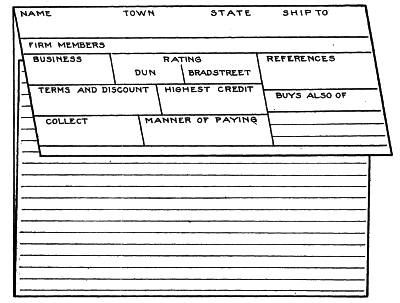
Fig. 4. Front of Credit Information Folder
A plain folder, such as is used for correspondence, will answer the purpose, or a special form may be substituted. An excellent example of the special folder is shown in Fig. 4.The special feature of this folder is that on the flap which folds over the front provision is made for a transcript of credit information. The back of this folder is printed as shown in Fig. 5. This form is used for a record of purchases, and covers a period of seven years.
Card Transcripts. For convenience, it is best to make a brief transcript of the credit information. This transcript should embody the essential facts which naturally influence the credit risk, and should be in such form that it can be referred to very readily.
As explained above, this transcript can be made on the credit information folder, but the more usual plan is to use a card. For each customer a card such as shown in Fig. 6. is used. The special feature of this card is that both the capital and credit ratings are listed. Such a card saves the time that would be required to refer to the agency books, and affords a comparison of the ratings given by the agencies on different dates. Both the book ratings and special reports are entered on this card.
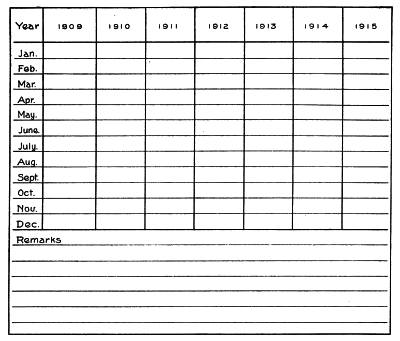
Fig. 5. Back of Credit Information Folder
A card which provides for reports, other than those furnished by the agencies, is shown in Fig. 7. A line for the folder number will be noted at the top, a numerical system of filing the folders being used. Although the numerical system is frequently found, it has no practical advantages, and the alphabetical system is to be preferred.
The form shown in Fig. 8 provides for more general information about the business—such information as would be gathered from the reports of salesmen and local correspondents. It will be noted, also, that the financial information refers more especially to the firm members. This card is used to supplement the books of the agencies.
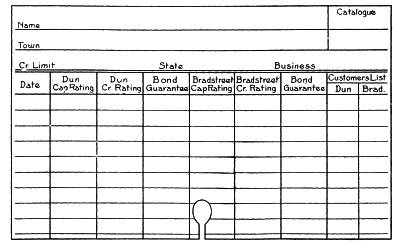
Fig. 6. Credit Agency Report Card
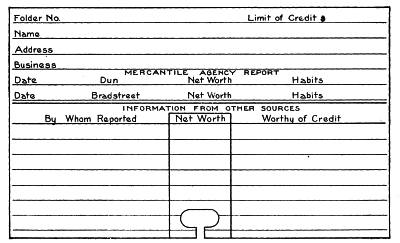
Fig. 7. General Credit Report Card
The card shown in Fig. 9 gives a complete history of reports asked and received, and of credits granted. This form is used in a business in which the purchases of a customer are infrequent, and involve considerable sums. The credit risk is considered each time an order is received.
The card shown in Fig. 10 is used by a retailer. As is usual in retail credits, the information provided for in this form refers to past experiences and the general reputation of the customer.
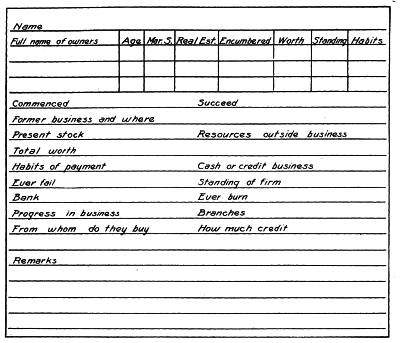
Fig. 8. General Credit Information Card
Like the folders used for filing credit statements and reports, credit cards should be indexed alphabetically, subdivided by states and towns when necessary. Filed in this manner, each card is accessible, and can be referred to quickly. An advantage of cards for this and many other purposes is that obsolete matter is quickly eliminated, and new names are added at will without disturbing the general arrangement of the records.
BRANCH HOUSE CREDITS
Many businesses are conducted through branch houses, each in charge of a local manager. Customers are supplied by the branches, and it is customary to have each branch house collect its own accounts. Weekly reports of the business transacted, including sales, collections, and stock on hand, are made by each branch to the home office. Duplicate accounts, made up from these reports, enable the home office to keep in as close touch with each account as though collections were made direct.
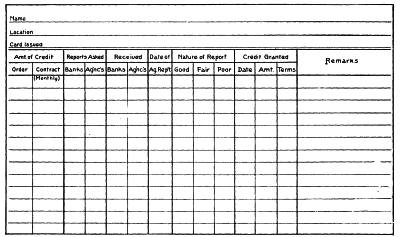
Fig. 9. Card Record of Reports Received and Credit Granted
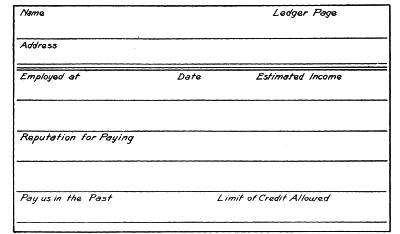
Fig. 10. Credit Card for Retailer's Use
Large concerns, operating many branches, have found by experience that it is best to pass on all local applications for credit at the home office. This work is handled by a division of the credit organization, known as the branch house credit department.
The forms shown and the system described herein were designed for the use of an oil company, and are very similar to those used by the large packing companies. When a dealer wishes to secure credit at a branch, the form shown in Fig. 11 is filled out in duplicate and signed by the local manager. The original is forwarded to the home office, while the duplicate is filed in the branch office, under the name of the applicant. Folders are used for this purpose.
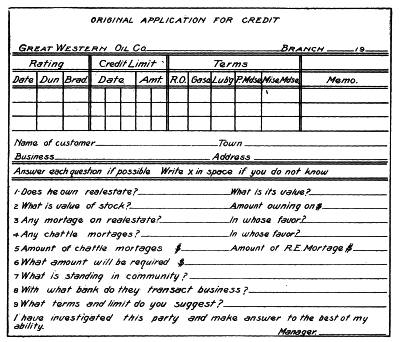
Fig. 11. Branch Office Credit Application
Only the lower half of this form is filled in at the branch office. The rating, credit limit, and terms are entered when a reply is received from the home office.
When the application is received at the home office, the files are consulted for any information that may have been received previously, reports are asked from the agencies, and the decision made. The decision is made known to the branch house on the form shown in Fig. 12.
This form is made in duplicate, both the original and copy being forwarded to the branch. The original is placed in the branch house files, together with the application for credit. Both the cashier and the manager of the branch sign the duplicate, as an acknowledgment that they understand the terms, and it is then forwarded to the home office.
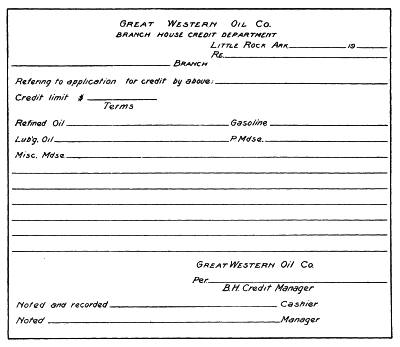
Fig. 12. Branch Office Credit Notice
In the home office, the original application and the statement of terms granted, signed by the branch manager, are filed together. A folder is used for each customer, filed alphabetically with subdivisons for states and towns. Every subsequent report and memorandum of credit information is filed in this folder.
When the report from a branch house shows an account to be past due, an inquiry blank, as shown in Fig. 13, is sent to the branch. This is in duplicate, the copy being retained at the branch house, and the original forwarded to the home office. In both offices, this report is eventually filed in the folder with other credit information.
A noticeable feature of this system is that all blanks are made in duplicate. This insures duplicate credit files in the home office and branches. It is, of course, necessary for each office to forward to the other any special data that may be received, from whatever source.
COLLECTIONS
The duties of the credit man are not ended when he has passed on the credit of a prospective customer; a very important duty follows, and that is to collect the accounts that he has placed on the books. He may assign the handling of collections to another, but the collection desk should be under the supervision of the credit man.
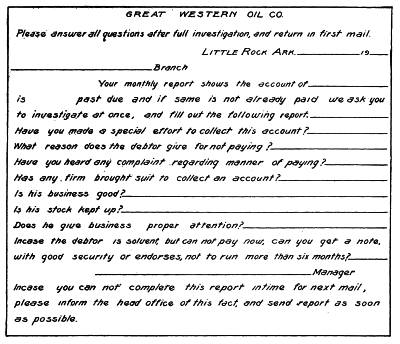
Fig. 13. Branch Office Credit Inquiry Blank
The handling of collections furnishes one of the most severe tests of the ability of the credit man; it calls for the exercise of a certain tact, not absolutely essential in any other work in business life. The successful collector must, first of all, be a good judge of character; he must be able to read character, and govern himself by what he learns of his customer's peculiarities. He must be a diplomat, with the happy faculty of smoothing out the rough spots, and satisfying the chronic kicker. While using judgment in granting special favors to the slow-pay customer, he must be able to differentiate between the temporarily embarrassed but able and honest debtor, and him who continually makes use of a hard-luck story to arouse sympathy and gain time; he must know when to be gently firm, and when to take vigorous action to save his house from loss.
One of the essential accomplishments of a good collector is the ability to write diplomatic letters. Collection correspondence is in a class by itself. The most valuable correspondent is said to be he who can write letters that sell goods. We have no fault to find with this statement, but prefer the way Mr. Cody puts it—"the ability to write letters that make people do things." The collection correspondent must be able to write letters that make people do things.
In a wholesale or manufacturing business, or any business that is not strictly local, practically all of the collections are made by mail, hence the subject of collection correspondence becomes of extreme importance. The extent to which letters are used is naturally governed by the ideas of the collector; by some they are used freely, by others as special appeals or duns only. One very successful credit man, who has handled the collections in one of the largest mercantile establishments in the country, gives it as his opinion that a letter should be sent with every request for payment—even with the monthly statement.
Except in unusual cases, specially dictated letters are not necessary; filled-in form letters answer every purpose—indeed it is claimed by many that carefully prepared form letters, designed to meet certain definite conditions, are superior to letters dictated in the ordinary rush of business. Forms can be prepared for different classes of customers, and to meet any of the contingencies likely to arise in the ordinary business. Form letters used for collection purposes should be exceptionally well printed, and great care must be used to secure ribbons that are an exact match for the body of the letter. There is nothing more calculated to make an unfavorable impression than a letter in which the date, name, and address fail by several shades to match the body.
The exact form of the letters must be varied to suit the particular business in which they are to be used; they will differ in manufacturing, wholesale, and retail lines, in a mail-order business, or for installment accounts. In a manufacturing business, for instance, a letter something like the following might be sent with the monthly statement.
Dear sir:
In accordance with our usual custom, we enclose a statement of your account as it appears on our books at this date. Will you kindly compare this with your records, and advise us of any discrepancies.
That we might be in a position to fill your orders promptly, we have kept our factory running on full time during the past few months, which has involved quite a heavy investment in material. We will, therefore, appreciate a check from you covering the amount shown to be due.
We will also appreciate a liberal order, which we can fill at once, as our stocks are unusually complete just now.
Very truly yours,
Such a letter leaves a very much better taste than please remit stamped on the statement, and yet it plainly asks for a remittance. There is something about the letter that savors of the personal appeal, and gives the debtor the feeling that a special accommodation is being asked, which he should make an effort to grant.
If the first letter fails to bring a response, it should be followed up. The second letter, following the first in about 10 days, might be as follows:
Dear sir:
A few days ago we sent you a statement of your account, showing a balance of $——, of which $—— is past due.
Not having heard from you, we assume that the account is correct, and that it will be satisfactory to you to have us draw on you on the 15th.
In the meantime we will be very pleased to fill your order for any of our goods that you may need.
Very truly yours,
A letter of this kind rarely fails to bring a goodly percentage of remittances. The mere suggestion of a draft often has the desired effect. The average merchant dislikes to have a draft presented; he feels that it has a tendency to injure his credit with the very man whom he may be obliged to ask for an accommodation—his banker. The polite request for an order acts as a sugar coating which covers the suggestion of a dun, and leaves the recipient in a pleasant frame of mind.
The second paragraph of the above letter does not contain a positive statement that a draft will be made, nevertheless, such a course is hinted at, and, unless a communication of some kind is received, the draft should invariably be made on the date specified. The customer should be taught that the collector means just what he says; any other course indicates a lack of sincerity, and gives the customer the feeling that these notices are not to be regarded seriously.
On the other hand, it is possible to go to the opposite extreme in the use of drafts. The writer has in mind a business man who had a habit of sending statements of all accounts the first of the month, without a letter, and following these with drafts about a week later. Many times these drafts were made before it was possible for a remittance in response to the statement to reach him, which caused hard feelings, and the loss of many customers. It is the custom of many firms to pay all bills on a certain day of the month—a fact which the observant collector quickly notes, and governs himself accordingly in the matter of sending drafts.
When a draft is returned, a letter should be written immediately; and in this letter a little sharper tone is justifiable. The following is a good sample of a letter to be used at this point:
Dear sir:
We are disappointed to find that you have allowed our draft to be returned unpaid, as we had counted on this amount to help in meeting our current obligations. While the amount of your indebtedness is not large, the aggregate of the many small accounts makes up the large amount outstanding on our books, and to not receive the amount when due, causes us considerable embarrassment.
As you know, our terms are strictly 30 days net. We must insist on receiving prompt payment when bills are due; our prices are figured on this basis, and our arrangements for meeting supply bills and pay-rolls are dependent on the prompt payment of bills by our customers.
Your total indebtedness to us is $——, of which $—— is several days past due. We would appreciate a remittance of the entire amount, but must insist on the immediate payment of the amount past due. Failing to receive either a remittance or your note, by the 23rd, we will again draw on you, and shall expect you to pay the draft when presented.
By the way, our Mr. Jackson reports that he has failed to secure an order from you on his last two trips. Now if you have any cause for dissatisfaction, we would like to have you tell us, as we are more than anxious to please you, and would certainly appreciate your future orders.
Very truly yours,
One point in this letter, to which special attention is called, is the absence of the word dishonor. Technically, when a draft is not paid it is dishonored, but the word has an ugly sound; the word unpaid is less harsh, yet conveys the desired meaning. While it is sometimes necessary to be quite emphatic, nothing is gained by adopting a tone calculated to arouse the antagonism of the debtor. The time-honored axiom that "More flies can be caught with sugar than with vinegar," is given a special force when considered in connection with collection letters.
Naturally, these letters must be varied to suit the business, the season, and general trade conditions. They are not submitted as models, to be used under all circumstances, but to impart an idea—the idea of tone, the sugar coating which is so essential in keeping the recipient in the right frame of mind. Politely request, ask plainly for what you want, firmly demand, but never threaten until you are prepared to carry out your threat. This is a safe rule to follow in handling collections.
COLLECTION SYSTEMS
In the successful handling of collections, a requisite is promptness. There must be a system that will insure bringing collections to notice at the right time. Without attempting to lay down specific systems for individual concerns, detailed descriptions of systems that have been found satisfactory in different businesses are given herein.
Duplicate Invoices. The tendency at the present time is to regard each invoice as a separate account, and to regard each as due at the end of the time specified—thirty, sixty, or ninety days. An exception is found in the accounts of city customers. A wholesale merchant may have customers in his own city who buy in small quantities, placing orders nearly every day. The usual rule is to regard these as monthly accounts, the account for one month being due the 15th of the following month. For out-of-town customers, however, the first plan is found more satisfactory.
A certain large manufacturer, whose business is world wide, treats each invoice as a separate account, and handles the collections in a very simple manner. All invoices are made in duplicate, the original going to the customer. From the duplicate, all entries are made on the books. If special terms are granted, these terms are stamped on the back of the duplicate invoice.
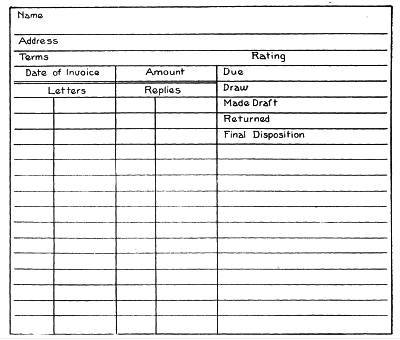
Fig. 14. Collection Card for Each Invoice]
When it has served the purpose in the accounting department, the duplicate invoice is returned to the collection desk. Here it is filed under the date on which it is due.
The file is a simple arrangement of pigeon holes. A case containing sixty pigeon holes, large enough to hold invoices laid flat, is used. These pigeon holes are divided into two sets of thirty each, one above the other, and each set is numbered from 1 to 30. This number provides for filing ahead sixty days, which is the longest credit term allowed.
In operating the filing system, the two sets of pigeon holes represent alternate months. During January, bills due in March are filed in the upper pigeon holes; in February, bills due in April are filed in the lower case. Each day the bills due are removed from the file for attention, leaving the pigeon hole empty for filing bills due sixty days ahead. On March 10th, for instance, bills are removed from the No. 10 pigeon hole of the upper case; the current day's bills, due May 10th, are then filed in the same pigeon hole.
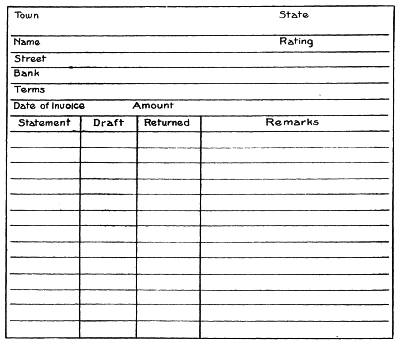
Fig. 15. Card Tickler for Collections
When bills come out for attention, they are referred to the accounting department to find if they have been paid. For those not paid, statements are prepared and returned with the bills to the collection desks. The usual letters are written, and all past due bills are held in a desk tickler, that they may be followed up from day to day by the collection clerk.
This system can be operated with the regular tickler file, but for a large number of bills the pigeon holes are more convenient. A modification is necessary, also, when the bill and charge system is used. In that case, an extra copy of the invoice should be made for the use of the collection clerk.
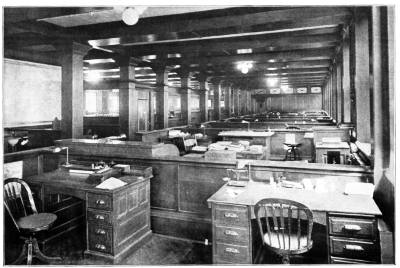
IN THE GENERAL OFFICES OF CORBIN CABINET LOCK COMPANY, NEW BRITAIN, CONN.
Card Tickler. A very convenient method, where it is not deemed advisable to use duplicate invoices, is to fill in a collection card for each invoice.
A card, printed similarly to the form shown in Fig. 14, is filed under the date on which the account is due. Each day, all cards filed under that date are removed for attention. The first step is to compare the cards with the ledger accounts. If the account has been paid, the card is destroyed; if not, a statement is sent and the card filed ahead to the next follow-up date. All letters written and all steps taken are noted on the card, so that in the end it presents a complete history of the efforts made to collect the account.
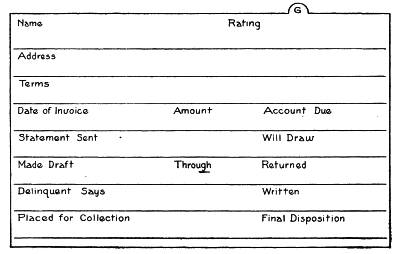
Fig. 16. Collection Card for Alphabetical Cross-Indexing
A slightly different form of card, which is used in the same manner, is shown in Fig. 15.
Cross-Indexing. The same objection exists in regard to the use of the tickler card for collections as for other follow-up purposes, which is the difficulty of finding the cards. Every time a card is removed from the file it is necessary to compare it with the ledger to find if the account has been paid.
To overcome the difficulty, a card with an alphabetical tab is used to good advantage. Such a card is shown in Fig. 16. It will be noted that this card bears a tab printed with the letter G. A card with this tab is used for every name that commences with G, and as all G tabs are in the same position on the card, they will be in direct line from front to back of the file.
The cards are filed by dates, but each day all remittances are sent to the collection desk, that the cards representing accounts that have been paid may be removed. All cards may be found by name, by referring to the lettered tabs, thus Brown's card will be found in the row of B tabs.
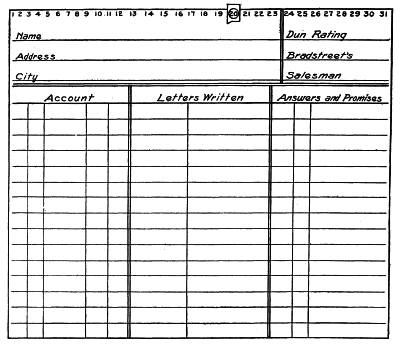
Fig. 17. Collection Card for Cross-Indexing by Date
Another method of cross-indexing the collection file is to have the numbers from 1 to 31, representing the days of the month, printed across the top of the card, as shown in Fig. 17. To indicate the due date a metal tab is placed over the proper number, a red tab being used for succeeding months and a black tab for the current month.
The cards are filed alphabetically by name, or subdivided by states and towns, so that any desired card can be found instantly. Each day all cards having tabs over that date are removed for attention. On the first of the month those bearing red tabs are referred to, and if due in the current month, black tabs are substituted.
Monthly Statements. In some houses, it is the practice to follow up collections on the basis of the monthly statement, instead of treating each invoice independently. When this is done the collection record must include a synopsis of the entire account. The card shown in Fig. 18 is used for following collections on such accounts. This form shows the date and amount of statements, with interest added, date and amount of drafts, and dates and amounts of payments. Other columns are provided for a record of letters, promises, extensions, etc.
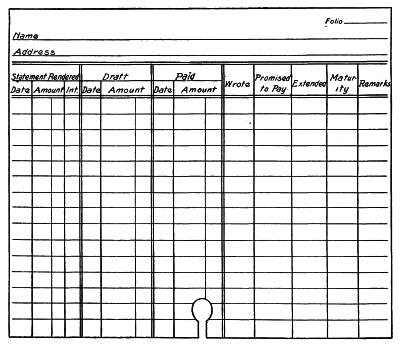
Fig. 18. Collection Card Showing Synopsis of Entire Account
This card is handled in exactly the same manner as it would be if used for a single invoice. While the card shown is used in a tickler, it would be improved by the addition of the numbers across the top, which would permit of alphabetical indexing.
Local Collections. Collections from local customers are usually made by collectors. In handling such collections, a system that will enable the office to keep track of the work of each collector is necessary.
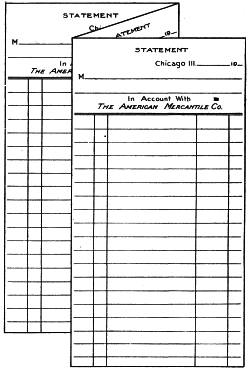
Fig. 19. Triplicate Statement for Collectors
One large mercantile concern has solved the problem by using the following system. This concern has a large number of customers who make frequent purchases. For convenience, the city is divided into four sections, one for each week in the month. Each section is divided into five parts, representing the days of the week from Monday to Friday, inclusive. One collector covers the entire city, calling on each customer once a month.
Arrangements are made with the customers in each section to pay their bills at a certain time each month—the bills of all customers in the first section are collectible during the first week in the month. Each customer knows, also, on what day of the week he is to expect the collector.
Statements are made Saturday morning for all accounts to be collected the following week. These statements are made in triplicate, as shown in Fig. 19. Two copies are given to the collector, who arranges them in a file according to his daily routes. One copy is kept in the office, filed by routes.
When the collector makes his call, he receipts one copy of the statement and delivers it to the customer. The second copy is kept by the collector and turned in with the collection. If the customer is not found, or if he fails to pay, both copies of the statement must be turned in by the collector.
Each morning the collector makes his report for the previous day. The cashier compares the collector's report with his copies of the statements, and, as the collector must turn in both of his copies when no payment has been made, a safe check is had on the collector. To make the check more positive, it is the custom of the cashier to mail a copy of the statement to those customers who have made no payments, or partial payments, requesting them to compare with their records and advise if any discrepancies are found. This makes it impossible for the collector to hold out collections without detection.
Collecting from the Ledger. In many houses having no organized credit department, the collections are handled by the bookkeeper. When this work is added to his many other duties, the bookkeeper is obliged to devise some scheme that will eliminate detail—he has no time to make additional records. His method is to follow up collections direct from the ledger.
But there must be some method of bringing the accounts to notice when they require attention—an automatic system. The most simple scheme is shown in Fig. 20. Across the end of the ledger sheet—which is loose-leaf—- numbers representing the days of the month are printed, and metal markers, or tabs, are attached over the due dates.
To represent different stages in the collection of the accounts, different colors are used. When a charge is posted to the ledger sheet, a black tab is placed over the date on which the bill falls due. When payments are posted the tabs are removed, provided the account is paid in full; otherwise it is moved forward to the next due date. After the day's remittances are posted, all sheets with black tabs over the current date are referred to, and statements made. At the same time, white tabs are substituted for the black.
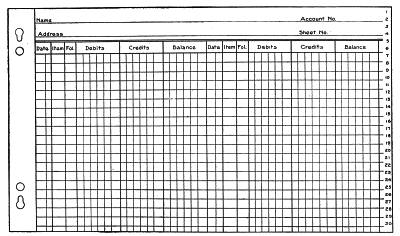
Fig. 20. Loose-Leaf Ledger Cross-Indexed for Due Dates
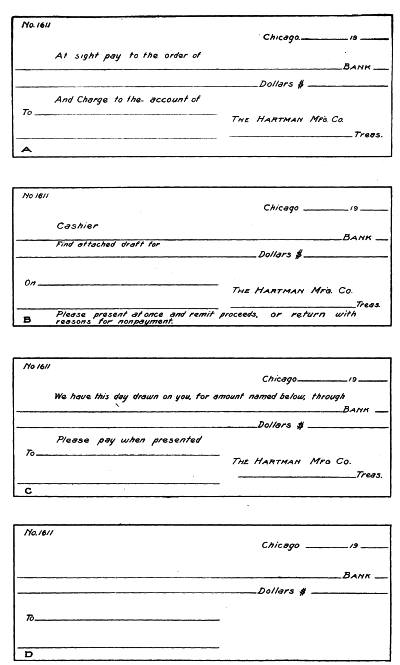
Fig. 21. Quadruplicate Draft Form which Includes Letters of Advice to Bank and Drawee
The next step is to make drafts for all accounts on which white tabs have appeared ten days, that is, on the 10th drafts are made for all accounts with white tabs over the 30th. Blue tabs are then substituted for white. If the draft is returned, a red tab is substituted. The red tabs indicate accounts past due, which are subject to such action as may be considered advisable. This ledger sheet, with the adjustable tabs, insures attention to collections, regardless of the method of filing.
Handling Drafts. When drafts are used extensively, considerable detail is involved in handling the records. Any method that will reduce this detail means a material reduction in the expense of conducting the work of the collection desk.
The usual method is to write the draft and register it in a draft record book. Then the necessary record is made on the collection card. A draft register is used that there may be a record showing the aggregate of drafts outstanding, and the number and amount in the hands of each bank—where drafts are sent direct, instead of through a local bank. The next step is to write a letter of advice to the bank. This method necessitates writing the names of the bank, the drawee, and the amount of the draft three times—on the draft, letter of advice, and draft register.
By the use of properly designed forms, this duplication can be avoided. Fig. 21 shows a set of forms designed for the purpose. A is the original draft, B is the letter of advice to the bank, C is a letter of advice to the drawee, and D is the office record. The draft, A, is attached to the letter of advice, B, and is detached by the bank. The four forms are so printed that the date, name of the bank, amount, and name and address of the drawee register perfectly. The blanks are properly spaced for use in a typewriter, and all copies are made with one writing.
Copies A and B are mailed to the bank, and C to the drawee. From copy D the record is made on the collection card, after which it is filed in a card tray, under the name of the bank. This keeps copies of all drafts sent to each bank together, and the total of all drafts outstanding is quickly obtained on an adding machine. When payments are made, or drafts are returned, these copies are removed from the files. Frequent reference to the file insures the necessary follow-up on banks that are slow in reporting.
Installment Collections. Probably the most difficult class of accounts to handle from a collection standpoint is installment accounts. Payments are quite irregular, both as to time and amount, and frequent changes of address make it difficult to keep track of debtors.
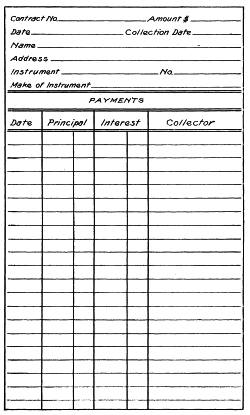
Fig. 22. Contract for Installment Sales
The collector of installment accounts must have the faculty of meeting and satisfying all sorts of people. He is obliged to listen to hard-luck tales without number, and while sympathizing with the customers, must be patiently persistent. If unable to collect the dollar due, he will accept a half-dollar to keep the account active. So long as he collects something, each time a payment is due, he is in a position to make the debtor feel the importance of the contract, but let one or two collection days go by without a payment, and the debtor has the upper hand. He then feels that he can stand-off the collector whenever he happens to have other uses for his money, a condition which becomes increasingly frequent.
An installment dealer will nurse an account to the limit, rather than take back the goods he has sold. Once he has collected the cost of the article, he will accept payments of almost any amount, but it will not do to let the debtor know how lenient he is prepared to be; at least a semblance of enforcing the contract must be kept up.
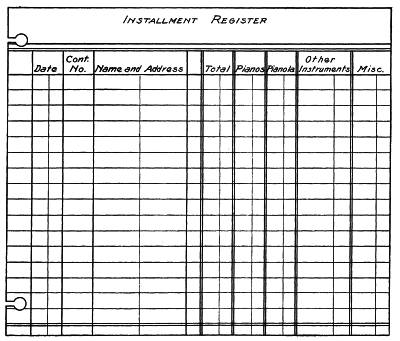
Fig. 23. Installment Contract Register]
The most familiar branch of the installment business is the sale of house furnishings and pianos. The sale of house furnishings on the installment plan is rapidly increasing, and probably more pianos are sold on this than any other plan. Furniture dealers who formerly sold only for cash or on approved credits, are finding profitable business among the better class of installment buyers.
Installment sales are made on contracts, or leases, which provide that title to the goods shall be held by the seller until all payments have been made, and that the right of possession shall be forfeited by the buyer if he fails to make any payment when due. When the contract is folded, the outside shows a form printed as in Fig. 22. This particular form is used by a musical instrument house.
At the head of the form is shown the contract number, amount, date of contract and collection date, name and address of the buyer, and the name, number, and make of instrument. Below is space for a record of payments, divided as to principal and interest, with the names of the collectors. When a sale is made, a contract is made in duplicate, the original remaining in possession of the seller and the duplicate being given to the purchaser.
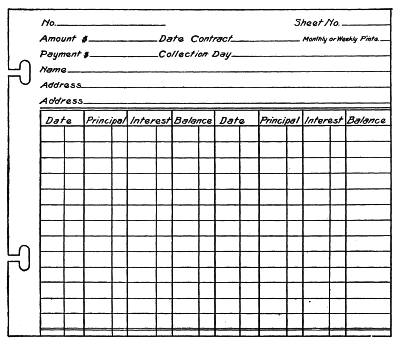
Fig. 24. Ledger for Installment Accounts
Installment Register. All contracts are registered in numerical order, in an installment register ruled as shown in Fig. 23. One line is used for each contract, the particulars recorded being the date and number of the contract, name and address of the buyer, and the amounts to be credited to the different sales accounts. It is not necessary to list the articles sold, as a complete list will be found in the contract.
The footings of the money columns are carried forward to the end of the month, when the totals are credited to the sales accounts in the general ledger. The footing of the total column, which is the total of all installment sales, is posted to the debit of an installment contract account in the general ledger. This is a controlling account of the installment ledger accounts.
Installment Ledger. Installment accounts necessitate a form of ledger differing from that used for ordinary accounts. The special requirement in such a ledger is space for recording a large number of payments. Fig. 24 shows a form of loose-leaf ledger sheet designed for installment accounts.
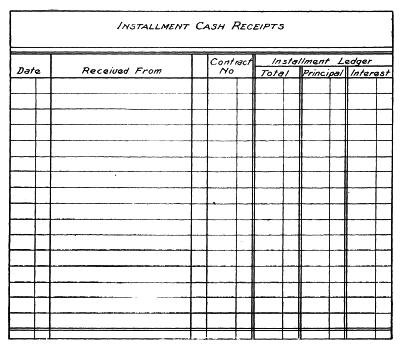
Fig. 25. Special Cash Receipt Book for Installment Collections
One of these ledger sheets is used for each installment contract. The particulars of the contract are recorded at the head of the ledger sheet, above the name and address. The particulars recorded are the number of the contract, the amount and date, amount of payments, collection day, and whether payments are to be made weekly or monthly. The body of the form is ruled for a record of payments and balances.
The ledger sheets are arranged in alphabetical order, about five-hundred sheets in each binder. Each alphabetical section is separately indexed to afford quick reference to all accounts. If the contract number only is known, reference is had to the installment register, where all contracts are recorded in numerical order.
Cash Receipts. For installment collections, it is well to provide a special cash receipt book. Such a form is shown in Fig. 25. This form is used exclusively for installment receipts, and payments are posted direct to the installment ledger. The total cash for the day is entered as one item in the general cash book.
Statement of Installment Ledger. From an accounting standpoint, installment accounts present certain difficulties not experienced in the handling of other classes of accounts receivable. There is always a question as to the real value of the accounts outstanding, a doubt as to the advisability of including the total balances in a statement of assets. A live account—one on which payments are being made regularly—is legitimately considered as good an asset as any other account receivable, but the value of the delinquent account—when payments are past due—is questionable, and if included in a balance sheet, the nature of the asset should be clearly stated.
That the actual condition of these accounts may be shown on the general ledger, it is the better practice to carry two accounts, representing live and delinquent accounts. Installment sales should be charged to an Installment Accounts Receivable account, and payments credited to the same account, which then becomes a general ledger controlling account of the live accounts in the installment ledger. Another account should be opened in the general ledger under some such caption as Installment Accounts Delinquent. When accounts become delinquent, they should be transferred by journal entry to this account. The journal entry would be:
Installment Accounts Delinquent
Installment Accounts Receivable
This transfer may be made daily, weekly, or monthly, but the period between transfers should never be longer than one month. Delinquent accounts may be indicated in the installment ledger by placing a metal tab of some distinctive color on the ledger sheet or card, or they may be segregated by transferring them to a special delinquent binder or file.
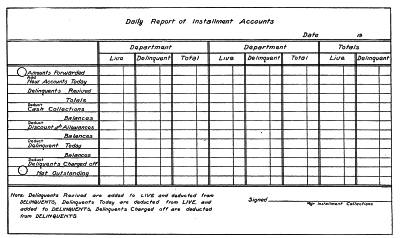
Fig. 26. Daily Report of Installment Accounts for the Credit Man
When a payment is received on a delinquent account, that account immediately becomes live, and the amount should be transferred by journal entry to Installment Accounts Receivable. The journal entry would be:
Installment Accounts Receivable
Installment Accounts Delinquent
Each day, the amount of accounts revived—delinquent accounts on which payments have been received—should be ascertained. If it is desired to save the labor of making journal entries daily, a memorandum of these amounts may be kept and a journal entry made at the end of the month.
When a delinquent account reaches the condition where it is considered worthless, the amount should be charged to profit and loss, by the journal entry:
Profit and Loss
Installment Accounts Delinquent
This should be done whenever the credit man carefully examines all delinquent accounts, which should be not less frequently than once a month. When payments are received on these accounts, they should be treated as revived accounts, with proper credit to profit and loss, if revived during the current fiscal period; but if, in the meantime, the books have been closed, they should be treated as new accounts.
It is quite necessary for the credit man to know every day how the installment accounts are running. That he may do this, a daily report, as shown in Fig. 26, should be made by the installment collection clerk. The report form should be in loose-leaf, and if the installment sales are divided by departments, the necessary number of columns to accommodate the departmental records may be provided.
The report is headed with the amounts of accounts outstanding, divided as to live and delinquent. New accounts opened and delinquents revived are added in the live column, and delinquents revived are deducted from the delinquent column. Cash collections, discounts and allowances, and delinquents today are deducted separately from the live accounts, and delinquents today added to the delinquent column. Then the delinquents charged to profit and loss are deducted from the delinquent column. The balances represent the net amount of outstanding accounts, and must agree with the two controlling accounts, Installment Accounts Receivable and Installment Accounts Delinquent.
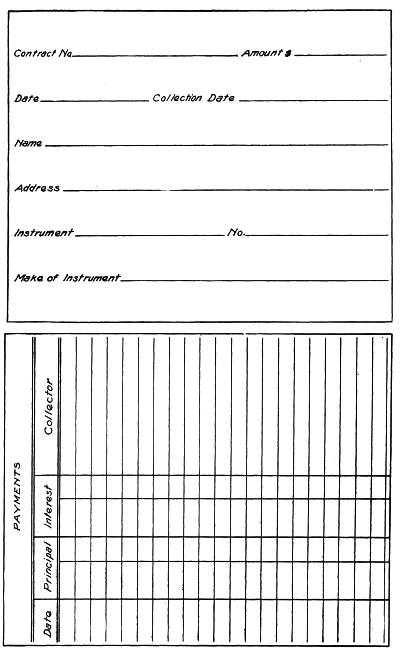
Fig. 27. Front and Back of Collector's Card
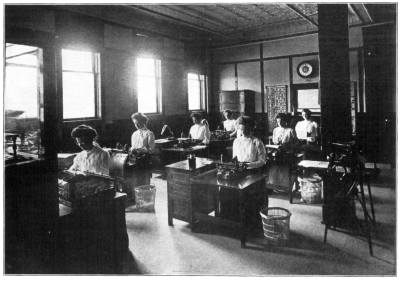
A CORNER IN THE STENOGRAPHIC DEPARTMENT Weis Manufacturing Co., Monroe, Mich.
Such a report enables the manager or credit man to keep in touch with the actual condition of installment accounts. As a rule, three copies should be made, one for the manager, one for the credit man, and one to be kept on file by the collection clerk.
Filing Contracts. Some houses follow the practice of allowing the collector to carry the original contracts, and in such cases the contracts are filed according to the dates on which payments are due. It is claimed that it is necessary for the collector to have the contract, as the customer is quite liable to lose the duplicate and may ask for particulars about the items purchased.
This plan is not advocated on account of the liability of loss of contracts. If it is desirable for the collector to carry the contract, a third copy should be made for that purpose. Original contracts should be kept in a fire-proof safe, and should be filed in numerical order. The most convenient file is a document file, in which contracts can be filed folded.
Collector's Card. The most convenient method of handling collections is to supply the collector with cards as shown in Fig. 27. On the face of this card is a record of particulars, similar to that shown on the outside of the contract, while the reverse is ruled for a record of payments.
Since all contracts call for payments on certain days of the week or month, it is very necessary that the collection cards be brought to notice on the collection days. A simple method of providing for this is to use a card file equipped with a set of thirty-one numbered guides to represent the days of the month, or a set of guides printed with the days of the week. The cards are filed back of the guides which represent the collection days.
It is customary to divide the city into sections, assigning a collector to each section, the number depending on the size of the city and the number of accounts. It is necessary to use as many files as there are collectors, with an office file added for those who prefer to pay at the office.
Every morning each collector is given the cards on his route, on which payments are due. On his return, he turns in all cards to the cashier with the amount collected. If a back call is necessary, the card is filed ahead a day or two.
The cards in the office file are placed on the cashier's desk each morning and payments are recorded as made. Those on which no payments are recorded are kept on the desk, and after a reasonable time are given to a collector to follow up.
When payments have been recorded in the cash book, all cards are again placed in the files under the next collection dates. They are then ready for the collectors.
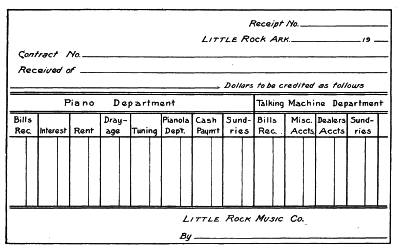
Fig. 28. Receipt for Installment Collections
Collector's Receipt. Some method is, of course, necessary for checking up the collectors, and to insure the turning in of all money collected. A very satisfactory plan has been devised by the cashier of a western music house, in the form of a duplicate receipt as shown in Fig. 28. These receipts are bound in book form and numbered in duplicate, the original being perforated.
The receipt is especially convenient for the customer, as it shows exactly how the payment is to be credited. For the same reason, it is equally convenient for the cashier. All of the numbered receipts must be accounted for; if one is spoiled, it must be turned in, which provides an effective check on the collector.
Mail-Order Installment Collections. An increasing volume of installment business is now done by mail. An established principle of the mail-order business is that customers must be given an opportunity to inspect the goods before they can be expected to make a binding contract for their purchases. Beginners in the mail-order field are quite likely to look on this as an impractical plan, fearing the loss of goods, but experience soon teaches them that it is the only plan on which the business can be successfully conducted.
When experienced mail-order men, with the courage to try out a new idea, experimented on the plan of allowing customers to return goods, they found that the more liberal the offer, the more business they did. This led to the giving of an absolute guaranty, offering to ship goods on approval with the privilege of return for any reason within certain time limits.
As the fear of loss of goods became less pronounced, it was argued that more liberal terms of payment could be granted with safety—if goods could be sold successfully on the installment plan to local customers, why not by mail? A trial proved the plan to be practical, and now many articles are sold by mail on the installment or easy payment plan. Goods are even shipped without an advance payment, either the goods or the first payment to be returned within a certain time limit.
In selling goods by mail on the installment plan, it is necessary to secure a binding order, in which the customer agrees to return the goods within a certain number of days, or make the payments as specified, with an agreement that title to the goods shall be held by the seller until all payments have been made according to contract. The contract must also give the seller the right to recall the goods whenever the customer shall fail to make a single payment as agreed.
The success of the mail-order installment business depends largely on the manner in which collections are handled. Not having the advantage of personal contact with the customer, the collector is obliged to depend on the knowledge of the man which he gains from references and the correspondence of the customer. But the shrewd collector soon learns to read his man from the general tone of the correspondence, and sometimes from the absence of communications from the debtor. When he has learned the character of the man, he can handle each account independently; until then, he is obliged to follow the same line of action in all cases, depending on the law of averages to prove the correctness of his theories.
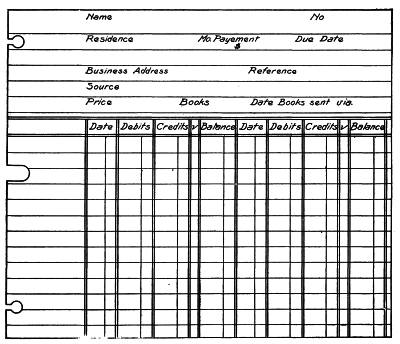
Fig. 29. Loose-Leaf Ledger for Mail-Order Collections
Too great emphasis cannot be placed on the importance of studying the character of the man. It is only by paying special attention to this point that the collector can learn to treat each account individually. In the first place, the class of goods sold largely governs the class of customers from a credit standpoint. The men who buy sets of business books are, as a rule, safe credit risks. Their training and environment have a tendency to teach them the importance of fulfilling an obligation; appreciating the necessity of maintaining their credit standing, they will make every effort to carry out the terms of the contract, or give a valid reason for asking an extension of time. Illustrating the opposite extreme is the class who will sign a contract for the purchase of a cheap musical instrument, at a high price, to gratify a desire to outdo a neighbor, without regard to their ability to make the payments as agreed. Such people trust to luck, and expect to pay in promises if they do not happen to have the money. For this reason, the percentage of profit that must be added to cover the cost of collection increases, as the quality of the goods and the standard of the credit risk decrease.
The Account. Accounts with mail-order installment buyers are handled in a similar manner to those of local buyers. All contracts should be numbered as received, and registered in numerical sequence. The form of register already shown answers the purpose very nicely.
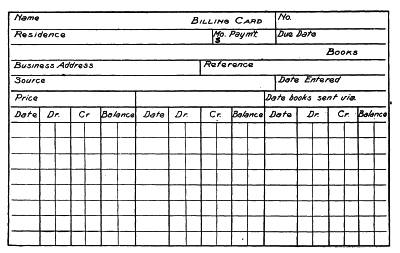
Fig. 30. Mail-Order Collection Card
After registering, the particulars of the contract should be entered in the ledger. A form of ledger sheet used by a publishing house is shown in Fig. 29. This is loose-leaf, and does not differ in form from the ordinary balance ledger, except in the particulars given at the head of the sheet. Here is shown the name and both residence and business address of the customer, number of contract, monthly payment and due date, references, source of order, price and name of books, and date of shipment. These sheets are filed in post binders, five-hundred sheets to the binder, and indexed alphabetically.
The next step is to enter the contract on a collection card. A satisfactory form is shown in Fig. 30. This is a card 4×6 inches in size, and is practically a duplicate of the ledger sheet. The card is filed in a chronological file under the due date—that is, if payments are due on the 24th of the month the card is filed under that date. Except when removed from the file for the use of the collector, or to enter payments, the card is always filed under the same date. If it becomes necessary to have an account brought to notice on other than the regular collection dates, a memo is made on a separate card and filed in a special tickler.
Should it become necessary to refer to a card on other than the regular collection dates, reference to the ledger—indexed alphabetically—gives the due date, by which it is quickly located. Sometimes, however, it is desirable to refer to all contracts in a given territory. To make this possible, a card file with indexes printed with the names of states and cities is provided. For each contract a plain 3-×5-inch index card is used, the name, address, and contract number only, being entered. This provides a complete set of indexes—alphabetical in the ledger; numerical in the register; by due dates in the collection file; geographical in the card file.
When a payment is received, it is entered in the cash book and posted to both the ledger and the collection card. Every card must be located at the time payments are entered in the ledger, or the customer will very likely receive notices after he has made the payment.
The Collection Follow-Up. The promptness of the follow-up on this class of collections is of the greatest importance—the debtor should not be given the excuse that he failed to receive a notice. Though not provided for in the contract, the debtor expects a notice of every payment due.
When the goods are shipped, a formal notice of shipment should be mailed, and if the first payment has not been made, it should be requested. In ten days, or after the approval time limit has expired, a second notice should be mailed, provided no payment has been received. This can be a formal notice, and should assume that the goods are entirely satisfactory, and at the same time calling attention to the fact that the first payment is past due. If this does not bring a remittance within ten days, it is well to send a draft notice. This notice should go into the conditions of the contract in some detail, and, without assuming a threatening attitude, it should assume that if payment is not received within five days it is the desire of the debtor that a draft be made. Either the notice or the draft will usually bring the first payment, or the return of the goods.
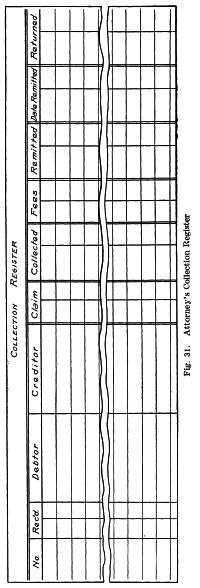
Fig. 31. Attorney's Collection Register
Each month, a formal statement showing the exact condition of the account should be mailed a few days before the due date. It is well, on this statement, to make an offer of a discount for cash to pay the account in full. A discount of 5% on an account that has several months to run will often be accepted, and is profitable to both parties. This statement should be followed in ten days by a second notice, also of a formal nature.
All notices up to this point may be printed, but further requests should be in the form of letters. Except when it has been found that an account should be handled in a special manner, form letters will be found most satisfactory. The letters should start out mild in tone increasing in insistence as the series is extended.
When persuasion fails, the debtor should be notified that the account is being placed in the hands of an attorney, or a collection agency. But before suit is actually started, it is well to investigate the probability of collecting a judgment. If a man is judgment proof, it is much better to take the necessary steps to secure the return of the goods. This is usually accomplished by requesting the express company to call on the debtor for the package.
Every debtor has his vulnerable point; if that point is reached, the money can be collected. The most successful collector is the one who finds that point in the largest number of cases.
Collections by Attorneys. The handling of collections constitutes an important part of the practice of many attorneys. It would naturally be supposed that attorneys handling collections for their clients would have an efficient system of records, but unfortunately this is not the rule. Except in offices handling a large number of claims the methods are very lax—there is an entire absence of a system that will reveal the exact status of every claim. And yet to install a system that will give just the information desired is very simple, and the operation requires less labor than to handle the claims in a haphazard way.
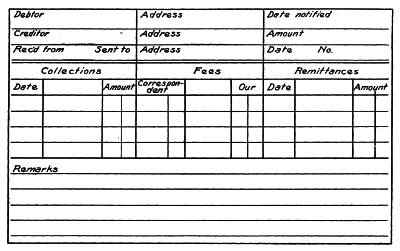
Fig. 32. Attorney's Collection Card
When a claim is received by an attorney, it should be given a number, and registered in numerical order. The register should be a book—either loose-leaf or bound—with headings for the date received, names of debtor and creditor, amount of claim, amount collected, fees, amount remitted, and date remitted or returned, as shown in Fig. 31. This is not intended as a complete history of the claim, but merely as a permanent record.
The papers in each claim should be placed in a folder. The old method was to use a manila jacket or document envelope, to be filed in a document file. The objectionable feature of this method is that the papers must be unfolded for reference. A better plan is to use a correspondence folder, such as is used in the vertical file, in which the papers can be kept flat.
Whatever style of folder is used, all papers should be fastened—either pasted, or by means of a paper fastener. On the outside of the folder should be written the names of debtor and creditor, and the number of the claim. The balance of the space on the folder can be used for recording special information about the claim from time to time. These claim folders should be filed numerically, according to claim numbers.
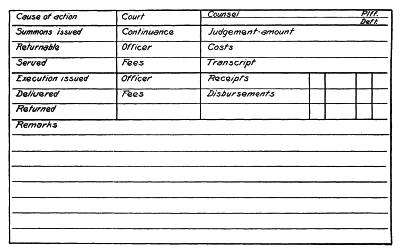
Fig. 33. Back of Attorney's Collection Card
For a convenient record for daily reference, giving a brief history of the claim, a card is found very satisfactory. The folders are somewhat bulky and inconvenient for quick reference, and, except in special cases, it is not necessary to refer to all of the papers. Brief notes, which can be made on a card, will answer every purpose.
A convenient record form is shown in Fig. 32, which is printed on a card 4×6 inches in size. This gives the particulars of the receipt of the claim, the amount, date, and number, with a record of collections, fees, and remittances. A card is made for each claim, and filed alphabetically under the name of the debtor. The reverse of the card is printed as shown in Fig. 33. This shows the different steps taken to enforce collection.
The card file provides an index to all debtors against whom claims are on file, while both the register and the file of folders provide numerical indexes. But it is the creditor who is the client of the attorney, and it is very necessary that he be in a position to refer to or report on all claims received from any client. This necessitates another index to creditors, which is provided for in the card form shown in Fig. 34.
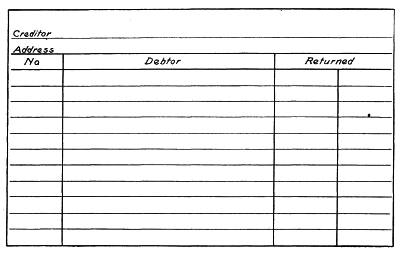
Fig. 34. Index to Creditors for Attorney
The card is headed with the name and address of the creditor, below which is a list of all claims filed by him. When a claim is returned—paid or unpaid—the date is entered on this card, so that the record shows only unpaid claims. These cards are filed alphabetically, under the names of the creditors.
A follow-up of the claims is provided by a plain index card on which is written the name of the debtor and number of the claim. This card is filed in a tickler, under the date on which it is desired to follow up the claim. This serves as a memorandum only, all records being made on the claim card or the folder.
A SCENE IN ONE OF CHICAGO'S BUSY FREIGHT YARDS, SHOWING AN OUTBOUND FREIGHT HOUSE