ADVERTISING AND SALES ORGANIZATION
Reading edition
INTRODUCTION
The purpose of this book is to teach neither the art of advertising nor the science of salesmanship, but rather to set forth some of the principles that must be applied in the organization of the advertising and sales department; in particular, to discuss the machinery of the department—its record-keeping systems.
Opinions differ as to the proper place in a business organization of advertising and sales—whether they should be handled by, and considered as, two separate and distinct departmental organizations, or one. Both plans have their champions.
Whether we call it an advertising or a sales department, the results sought—the reasons for the existence of the department—are the same. To sell goods is the aim of the organization, be its head an advertising manager or a sales manager.
Advertising has been defined to be printed salesmanship; yet there is a well-defined dividing line between the work of the advertising man and the salesman. The advertising man seeks to impress the name of the house and the name and quality of its product, on the public mind; to create interest; to arouse curiosity; to stimulate desire; to attract people to the store—in a mercantile business. The salesman seeks to turn that interest, curiosity, desire, into action—the action of purchase.
The advertising man introduces the possible customer; the salesman makes the sale. But in some businesses, the advertising man goes one step farther and actually makes the sale—as in advertising intended to secure direct orders, by mail. Also, the salesman, when the customer has been introduced, makes use of other forms of advertising, to further stimulate desire and assist in making the sale.
No matter at what angle the subject is viewed, it is seen that the advertising man and the salesman are very dependent on each other. We prefer, therefore, to consider the sales and advertising departments as of equal importance; both subordinate parts of the sales division but working in perfect harmony.
The salesman knows his goods, their strong and weak points, the classes of people to whom they will appeal. He should know, also, all about his competitor's goods, and in what respects they are excelled by his own. In short, he is the one who can give the best selling points to the advertising man.
The advertising man is expected to be a master of expression. The unpolished selling points of the salesman are worked over by the advertising man into clear, pointed, convincing English—printed salesmanship. His experience tells him how best to reach a given class; what methods of advertising are best suited for a particular class of goods.
When a selling campaign is contemplated, the plans should be worked out by the salesman and the advertising man. The two must work together and neither should undertake a new campaign, without first consulting the other.
The claim is sometimes made that the function of advertising is fulfilled when the inquiry has been received; that it is then a question of salesmanship—but where does advertising end and salesmanship begin? If sales are made by mail, the salesman supplements his salesmanship with catalogs, booklets, circulars, letters—all as surely advertising as salesmanship; in the store, he displays his goods attractively, which is a most effective form of advertising. And so, in the battle for business, victories are won by supplementing advertising with salesmanship, and salesmanship with advertising—combining the two for results.
Occasionally, a man is found who combines the creative ability of the advertising man with the executive ability of the sales manager. When such a man is found, it is safe to place him in charge of the sales division, giving him full control of both advertising and sales. He probably will require the services of a man to attend to the details of the advertising department, but such an arrangement makes the sales manager alone responsible.
Most large enterprises, however, require the services of one man to handle the advertising. For this reason the head of this department is referred to as the advertising manager, and the department as an advertising department.
SYSTEMS AND RECORDS
In addition to the technical knowledge of the printing art—type, engraving, and paper—and of advertising media, which the successful advertising manager requires, he should have the faculty of applying common-sense system in the handling of his work. An elaborate system, which oversteps legitimate bounds and enters the realm of red tape, is to be deplored, but the advertising man must have a system of records which will show at all times what he is doing, what results he is getting, exactly where he stands.
Any discussion of systems must be more or less theoretical, even when written by an experienced advertising man. The system that works perfectly in one office may fit in no other, therefore the systems described in this book are to be taken as examples of what other advertising men have adopted. From them the student will be able to devise a practical system for a particular enterprise. At the start, the system probably will be too complicated; experience alone will tell the advertising manager where to eliminate, where to simplify, where to add to make it fit.
Advertising Information. The advertising manager collects a vast amount of information for future use. Every time he picks up a newspaper or magazine his eye scans the pages for ideas, while mingling with the crowds or walking alone, he notes what would be to the unobserving but trifling incidents, all of which can be worked into copy. If he is systematic he clips and makes memoranda of all this information, preserving it for use when needed.
How to preserve it in such shape that it can be located quickly is something of a problem. Probably the oldest methods of preserving clippings and memoranda is to use a scrapbook, and paste in all clippings. The scrapbook, however, is never satisfactory for this purpose; it is not a flexible system.
Clippings should be so filed that any single clipping can be removed without disturbing the others. The vertical file is largely used as a receptacle for clippings, but is not entirely satisfactory unless envelopes take the place of folders. With folders, clippings are liable to be lost through the open ends.
An old and satisfactory method is to file clippings in envelopes. Unless the clippings are of large size—like entire pages from trade papers—it is not necessary to use envelopes of a size to fit a vertical file, A size that will fit one of the smaller files—about 7"×9"—will be found more satisfactory.
The most satisfactory method of indexing is by subject. An envelope is used for each subject about which clippings are to be made, all clippings and memoranda being filed in the proper subject envelope. The envelopes are indexed alphabetically, according to subjects, and a list of contents should be recorded on the outside of each envelope. A form of record is shown in Fig. 1, while Fig. 2 shows the manner of filing and indexing.
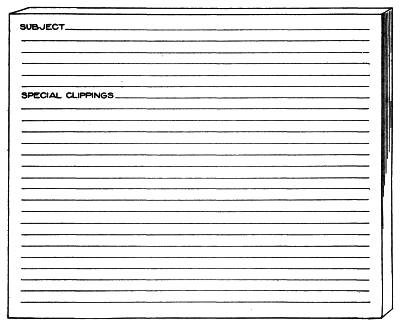
Fig. 1. Special Box Envelope for Clippings and Advertising Copy
Clippings are made use of by the advertising man chiefly in the preparation of copy, and are much more convenient to handle if filed in envelopes than when pasted in scrapbooks. Instead of an unwieldy book to handle, an envelope is taken from the file and the desired clipping selected.
Sometimes the work of the advertising man is of a nature which requires the preservation of catalogs, booklets, and all sorts of printed matter issued by competitors. When the accumulation of such matter is sufficient, it is best to install a complete catalog filing system, such as is used in the purchasing department.
Designs and Cuts. A class of valuable property which accumulates rapidly in an advertising department, consists of advertising designs and cuts. This property is not given the care deserved when its value is considered.
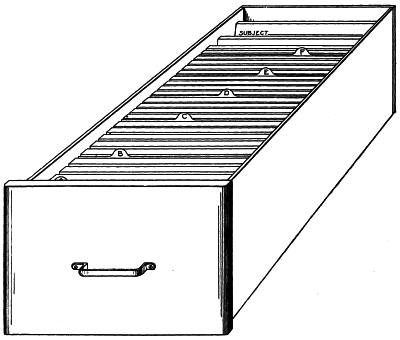
Fig. 2. File Drawer Showing How Clippings are Filed by Subject
Artists are paid for designs but too often after the engravings are made, they are stored in drawers, on shelves, or in any convenient place to get them out of the way. Little attempt is made to so file and index them that each can be quickly located.
An old design may be available for use at any time—an engraving of different size than the original, may be needed, or a slight alteration may produce a complete change in the design at much less cost than making a new one. Engravings are expensive and accumulate with amazing rapidity. Suppose a retailer does daily advertising and uses a new cut each day; at the end of one year he owns three hundred and sixty-five original engravings, and probably an equal number of electrotypes. Any of these may be available for use another time, either in newspapers, catalogs, or circulars.
The national advertiser, using magazines and trade papers, may accumulate a less number of engravings than the retailer, but owing to the class of engraving required and the number of duplicates needed, his investment is even greater.
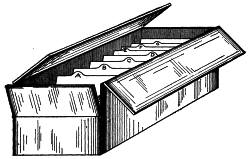
Fig. 3. Box File for Drawings and Photographs
The natural supposition would be that advertisers would give this property proper care, filing under correct classifications, indexed for ready reference. But experience proves the contrary. Every printing and publishing office that has been running five years has an accumulation of cuts belonging to advertisers, which represent an investment of thousands of dollars.
Occasionally an advertiser is found who knows exactly where each cut has been sent and calls for it when needed, but a big majority of these cuts are never called for and finally are sold by the printer for what they will bring, as old metal.
Now the property used by the advertising department should receive the same care as any other; a dollar invested in designs and engravings should be regarded as a dollar's worth. And if common sense be applied in devising a system, they can be cared for with as little trouble as any other property carried in stock.
A very satisfactory method of filing designs is to use a file constructed on the principle of the vertical file. Stock sizes of files are too small. Designs cannot be folded and the file should be large enough to take in the largest designs used. An elaborate file is not necessary; a box constructed along the lines of the one shown in Fig. 3, will answer the purpose. The chief requirements are to have the designs filed in one place, where they can be found, and to keep them clean. Any carpenter can build such a file, while any cabinet man will construct one of more elaborate design to match the furniture of the office.
Designs may be filed alphabetically by subjects, or numbered and filed numerically. As a rule, the alphabetical method will be found more satisfactory.
Engravings are best filed in a cut cabinet of the usual style. This is a cabinet of shallow drawers, just deep enough to hold type-high cuts. All engravings should be numbered and electrotypes stamped with the same numbers as the originals. The cuts can then be filed by numbers, and each drawer labeled to show the numbers of the cuts it contains.
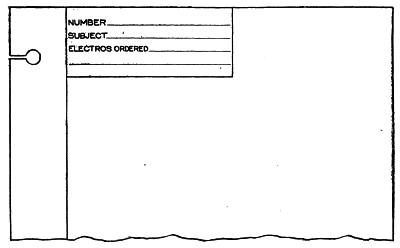
Fig. 4. Loose-leaf Scrap Book Sheet for Preserving Proofs of Engravings
Cuts should be numbered consecutively, and when an engraving is made in a new size it will take the next number, regardless of the fact that an engraving of the same design has already been made. For instance, if five sizes of engravings are made from one design, there will be five cut numbers. When the cut is numbered, it is a good plan to stamp the number on the back of the design; then reference to the design will show how many times it has been engraved and the numbers of the cuts.
Proofs of all engravings should be kept. These may be pasted in scrapbooks, but the books should be loose leaf. This makes it possible to eliminate all dead matter; when designs are of no further use, the sheets containing the proofs can be destroyed.
A sheet may contain proofs of one or of several cuts, depending on the size, but all proofs should be arranged in numerical sequence. The sheet should also show the cut number, the subject, and the date of ordering electrotypes, as shown in Fig. 4. Since the space required for proofs cannot be told in advance, it is more practical to substitute a rubber stamp impression for printing. By using a small stamp, this information can be stamped opposite each proof.
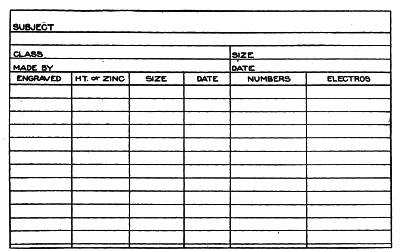
Fig. 5. Index Card for a Record of Designs and Engravings
Cut Indexes and Tracers. To complete the filing system for cuts and designs, an index is needed. Fig. 5 shows a convenient form of index and record card. This card is headed with the name or subject of the design, and is indexed under this subject. The data relative to the design includes the class—as photograph, wash drawing, or line drawing—the name of the artist, the size of the design, and the date made. Below this is a complete record of all original engravings and electrotypes made from the design, including their numbers.
On the back of the card is a record of the publications, catalogs, or circulars in which the design is used, with dates, as shown in Fig. 6.
If the name of the artist who made a certain design, or the names of publications in which it has been used, is wanted, reference to this card gives the desired information. This one card provides all information that is likely to be needed in reference to both designs and engravings.
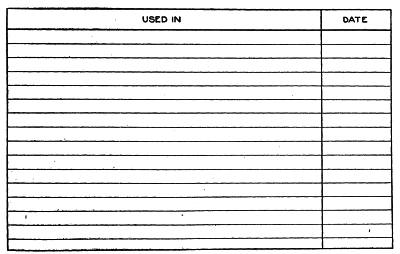
Fig. 6. Reverse of Index Card Showing Where Engravings are Used
The methods described provide for a complete record of designs and engravings, except in respect to cuts which have been sent out. A record of the cuts that are out, and where each has been sent, is of the utmost importance.
When a cut is sent out—to the printer, the publisher, or a customer—a receipt should be obtained. This may be on a post card printed as shown in Fig. 7. At the same time a record to be used as a tracer should be made. This should be on a form similar to the one shown in Fig. 8. These forms may be filed in a tickler under the date on which the cut should be returned, or alphabetically; but in either case a desk file should be used so that they can be referred to very readily. This file should be looked through frequently for it is very necessary to follow-up the cuts closely. If the cut is not expected to be returned, it is of course unnecessary to make this tracer record.
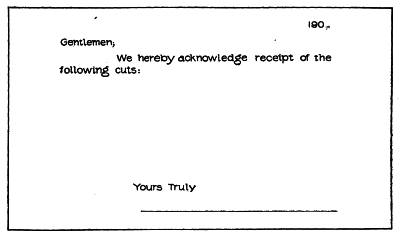
Fig. 7. Postal Card Receipt for Cuts
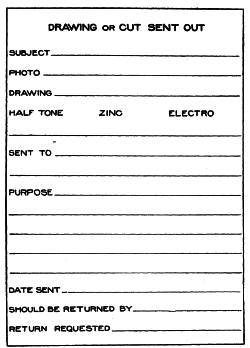
Fig. 8. Tracer Card for Drawings and Cuts
Copy Proofs. A complete file of proofs of all copy is a necessity in every advertising department. If requested to do so, any publisher will furnish several proofs of the ad, and at least three proofs should be kept on file. Every piece of copy and every circular or other printed matter should bear an identifying mark of some kind. This usually is a number.
These numbers should be registered consecutively either in a book or on cards, and opposite each number should be the title of the copy, booklet, or catalog. It is well to run different series of numbers for advertising copy and other literature. Numbers 1 to 5,000 might be used for copy, and 5,001 to 10,000 for printed matter. The same scheme can be used to good advantage for office blanks of all kinds, giving each a form number but using a third series of numbers.
Proofs of ads and copies of all printed matter and blanks should be filed alphabetically by subject or title. For proofs, the envelope scheme, as described for clippings, can be used. Envelopes of this size—7"×9"—will also accommodate copies of most circulars, blanks, and booklets, but if the sizes average larger a vertical file drawer, with large envelopes, can be used. The vertical file will also accommodate catalogs. These files being permanent, the expense of elaborate cabinets can be dispensed with by substituting the cheaper transfer files supplied by all manufacturers of such equipment.
Each time a piece of advertising copy is re-set in a different size, it should be given a new number. New numbers should also be given each circular, booklet, or blank when it is re-printed, provided there is the slightest change in the copy.
On each envelope, the copy number should be entered, and if the copy takes several numbers, all should be entered. Copy bearing the title "Your Chance" may be set in three sizes—full page, No. 640; half page, No. 641; and quarter page, No. 645; all proofs will be filed in one envelope and the three numbers will be entered on the outside.
The register of numbers and the file of proofs provide for the identification of any copy; if the title of any piece of copy is wanted, the number being known, reference to the register gives it; or if the title is known, reference to the file gives the number.
PRINTING ORDERS AND TRACERS
Great care is necessary in issuing and following up orders for printing; every detail must be watched closely if satisfactory results are to be secured. In the majority of offices the advertising manager, or a man under him, attends to all details of ordering printing. Large concerns find that it pays to employ an experienced man for this work alone. To a concern whose printing bills amount to several hundred dollars a month, a man who will give close attention to every detail of the work, from seeing that he gets the stock specified to checking bills for overcharges, can make his services worth a good salary.
In printing, as in everything else, the personality of the house should stand out—a typographical style should be established. This is accomplished much more quickly if every detail of the printing is in the hands of one man.
There are concerns in which publicity and sales work must be subdivided to such an extent that the sales manager has all printed matter prepared under his direct supervision; while the advertising manager is responsible for the preparation and placing of the copy. In one such concern, which has come under the writer's observation, copy for printing is turned over to a man entirely outside of the sales division. The theory is that the outside man will watch the interest of the house, in the matter of price, more closely than the man who prepares, and perhaps is to use, the copy.
This theory may have some foundation in certain quarters; probably there are some otherwise competent advertising men who are occasionally outwitted by the printer; but it is also true that the buyer of printing, who places his orders on the basis of price alone, frequently loses more in quality than he saves in cost. The man who is to use a booklet or folder is really the best judge of its worth—what he can afford to pay for the kind of work he wants; he knows best its possible value as a revenue producer. He should be competent to supervise the placing of the orders, but without exception all printing orders should be placed by the same man.
No matter by whom placed, the printing order should specify every detail; or if it is not on the order blank, there should be a specification sheet. The specifications would be something like those shown in the order form, Fig. 9.
This order should be made in triplicate. The original and duplicate will go to the printer, the duplicate to be signed and returned as an acknowledgment of the order, while the triplicate is filed in a tickler under the date when the acknowledgment should be received—usually the following day.
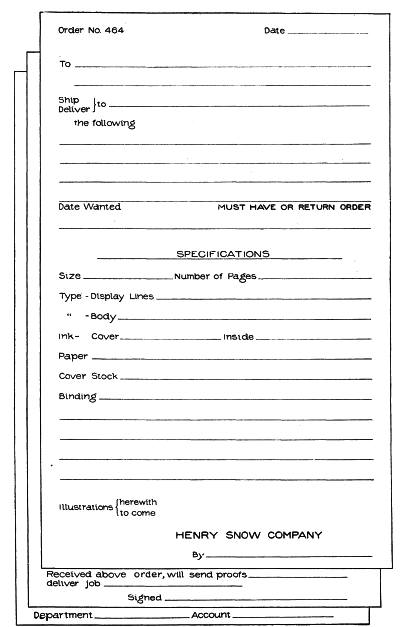
Fig. 9. Triplicate Form of Order for Printing
When the duplicate comes back from the printer it is placed in the tickler, under the date when proofs may be expected. At the same time the triplicate is removed from the tickler and placed in a loose-leaf binder, all copies being filed in numerical sequence. It will be noted that, at the bottom of the triplicate, the department or account to be charged is entered, this record being made when the order is placed.
When proofs are returned, the duplicate is moved ahead to the promised date of delivery. In this way the follow-up for orders is made practically automatic, all orders filed under any date being removed for attention on that day.
Little difficulty is experienced in getting printers to put the order number on the invoice, when requested to do so. The return of two or three invoices to a printer who neglects this will have the desired effect. With the numbers on the invoices it is a very simple matter to find the copy of the order, which will show just what was ordered and for what department.
Records of Printing. A record of all printed matter received and its disposition is quite as important as for any other class of property. Unless properly stored and correctly recorded, there is likely to be a great waste of stock. Many large concerns lose much more through waste in this direction than the salary of a competent stock clerk. Not all concerns will require a stock clerk for this purpose alone, but in every office the stock of printed matter should be placed in charge of one person—a clerk, perhaps, who has other duties. That person should be made responsible for the stock, just as the stores clerk is made responsible for the property in the factory storeroom.
When printing is received, it should be first checked against the order copy on file, and then put in the storeroom, or sent to the department where it is to be used if not to go into stock. In the storage of printing, a very necessary requirement is that it be kept clean, otherwise, in the case of matter carried in stock for a long period, there may be as much as a ten per cent loss through spoilage.
It is best to have all printing put up in packages of specified sizes, depending on the quantities used. The printer will usually make the size of his packages fit the needs of the customer, if requested to do so. On the outside of each package, the name and quantity of the contents should be recorded. When possible a sample should be attached.
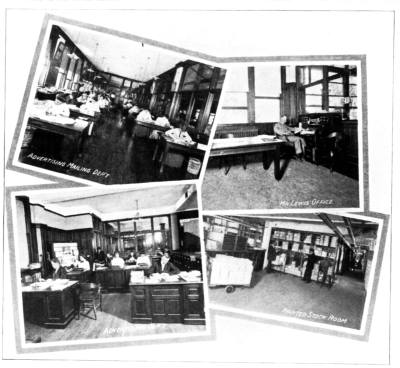
OFFICES OF THE ADVERTISING DEPARTMENT, BURROUGHS ADDING MACHINE COMPANY, DETROIT, MICH.
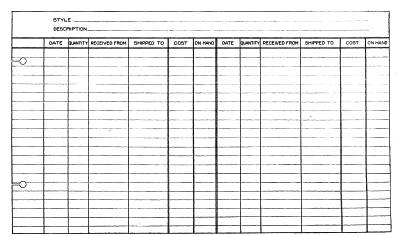
Fig. 10. Perpetual Stock Record for Printing, Showing its Disposition
An extensive advertiser will require a good-sized room for the storage of printing, while for some concerns a small cabinet will answer the purpose. In storing, the packages should be arranged according to name, maintaining the alphabetical order so far as possible. A numerical arrangement, by form numbers, is sometimes recommended, but any filing scheme which makes it necessary to refer to a supplementary index to find a number before the article itself can be located is not favored.
A low stock limit should be set for every piece of printing that is used regularly and likely to be re-ordered. One of the most simple methods of handling this is to make one package of the quantity set, so arranging the stock that it will be the last package reached. On the outside a label is pasted—or a rubber stamp can be used—printed as follows:
This package must not be opened without first notifying the office. Failure to observe this rule will be considered sufficient cause for instant dismissal.
After the storage plan has been arranged then comes the question of stock records. A simple record which will show quantities received, issued, and on hand is needed. The form shown in Fig. 10 is used by a manufacturer who supplies dealers, who are his customers, with catalogs, booklets, and other forms of printing. The same form is adapted for use by a concern selling through branches or agencies, while for another business, the form would be modified, eliminating records of shipments.
This form is printed on a sheet punched for a loose-leaf binder. A sheet is used for each catalog, folder, booklet, circular, mailing card, or other piece of printing, the name being written at the top of the sheet. The sheets are filed in alphabetical order, indexed with suitably tabbed index sheets.
When printing is received and the order checked, the name and description is entered at the head of one of these sheets—except in the case of a re-order, when a sheet will be found in the binder. The date, quantity, from whom received, and the cost are next recorded in the proper columns. If it is a new piece of printed matter, the quantity received is also entered in the on hand column; if a reprint, the quantity is added to the stock on hand and the total extended.
For printing that is to be sent to a dealer, an order is entered on the form shown in Fig. 11. This gives detailed instructions for shipping, with the quantity and description of the matter to be sent. The order is made in duplicate. The original goes to the shipping clerk, while the duplicate, on a blank sheet, is kept in the office as a follow-up on the shipping clerk.
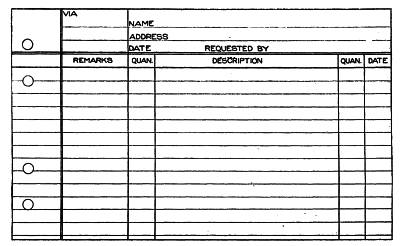
Fig. 11. Shipping Order for Printing to be Sent to a Dealer
As shipments are made, the shipping clerk enters in the columns provided for that purpose, the quantity sent and the date. When the entire order is filled, it is returned to the office. Every day the duplicates are examined and inquiry is made of the shipping clerk regarding any orders for which the originals have not been returned. When the original is received, the duplicate is destroyed.
Shipments are next entered on the stock sheets, while the original orders are filed in a binder, alphabetically by dealers names. Reference to this file shows exactly what advertising matter has been sent each dealer.
PERIODICAL ADVERTISING
When the question of periodical advertising is taken up, the most important of all publicity fields is entered. From the country weekly, through the entire list of city dailies, scientific and literary weeklies and monthlies, popular magazines, class magazines, and trade papers for every vocation, religious papers, and reviews, periodicals can be selected which will reach any class or cover any territory. With the thousands of publications to select from, the advertising manager needs to know which ones will best reach the people he wants to reach; what papers have the largest circulations; which are most popular among a given class or in a certain territory. He must be posted on rates and discounts, that he may cover his territory economically. And added to this, he must have a perfect checking system, that he may know to a certainty what returns each and every publication is bringing him. Such a system may show him, for example, that the magazine with a circulation of a million and an advertising rate of $5.00 a line, brings orders at a less cost than another in which he is paying but $2.00 a line—or vice versâ. Perhaps the cost in both is within the amount he is prepared to pay, but he must know what it costs, that he may know where to increase and where to curtail the appropriations.
Rate Cards. Supposing the business to have been just started, or one that has done no advertising—and this is the most satisfactory premise from which to work, in laying out a general system for the department—among the first duties of the advertising manager will be to secure information about mediums, and the chief source of information will be the publications themselves, as they will respond promptly to requests for rate cards.
If the advertising manager gets rate cards from a hundred publications, he will find probably forty or fifty different shapes, sizes, and styles. Several spasmodic attempts have been made to induce publishers to adopt a uniform size for rate cards, with but little success. In the effort to produce something striking, the convenience of the advertiser is very likely to be overlooked. One publisher will use a 3"×5" card—the most convenient size; another, in order to better display the artistic ideas of his own copy department, uses a card 6"×9"; a book of rules is issued by another; the result is a miscellaneous collection that does not fit any size of file made.
To insure uniformity in their files, advertising agencies have been obliged to design rate sheets or cards which they send to the publisher to be filled in. Some large advertisers now follow the same plan, requesting publishers to enter rates on special forms.
But whether or not he uses a special form, every advertiser should have his own file of rate cards—even if the information is written on a blank card. The special information needed is shown in Fig. 12. This can be on a card, or if preferred, a sheet to be filed in a loose-lea binder can be used. The cards or sheets should be indexed alphabetically, under the names of the publications.
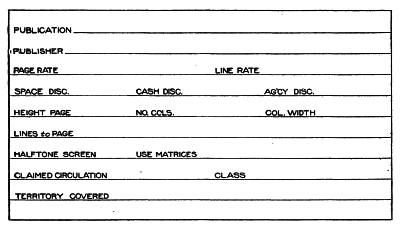
Fig. 12. Index Card for a Record of Advertising Rates
If full and satisfactory information is not obtained from the publishers, it is well to supplement it with information from an advertising agency. The successful agency, through observation on behalf of a number of clients, usually has more dependable information about a given publication than can be obtained by any one advertiser.
All sources of information should be made use of; if the article advertised is sold to the trade, much valuable information can be secured from local dealers. In planning a daily paper campaign for a certain commodity, a letter was sent to each dealer contiguous to each city asking what morning and evening papers had the largest sale in his town; at what hour each was received; and the general trend of local political sentiment. This brought a gratifying response, and helped in the selection of papers which covered, not only the cities, but the small towns. Another advertiser secured some very satisfactory reports from his traveling salesmen, relative to the value of local papers in which he contemplated advertising.
Advertising Contracts. Contracts for advertising are usually made once a year, in advance. Most publishers of magazines and newspapers grant certain space discounts, based on the space used within one year, and in many cases, to secure these discounts, contracts must be made in advance. Some trade paper publishers allow space discounts, others maintain flat rates, all of which must be considered in making contracts.
Practically all magazines, most newspapers, and some trade papers, allow special discounts or commissions to advertising agencies—though in the case of newspapers, in many cities, this discount applies only to foreign advertising, or that originating outside of the city of publication.
An increasing number of advertisers are placing contracts for space through the agencies, and relying largely on the advice of the agency in the selection of mediums. Since the business of the largest and most successful advertisers is placed through the agencies, it would seem to be a safe rule to follow. But because an agency handles the orders, the shrewd advertising manager will not relax in his watchfulness of his employer's interests. He will maintain just as complete a rate file, and watch the bills as closely as though dealing direct with publishers.
The experienced advertiser plans his campaigns well in advance, making annual appropriations for all advertising. This enables the advertising manager to select mediums, determine the amount to be used in each class, and prepare suitable copy for the different publications.
This question of the preparation of copy for series of ads applies especially to national campaigns and local advertising of a general publicity nature. The advertising manager of a department store is obliged to prepare newspaper copy daily, and at best can plan his copy not more than two or three days in advance. In a national campaign in which advertising is for direct returns, copy must be tried out and its character changed frequently. This does not mean that, in any case, the same copy should be run indefinitely; it should be changed in practically every issue. While following the general style adopted for the house, there should be something new in every issue—something that will attract and cause the reader to look for the ad each month.
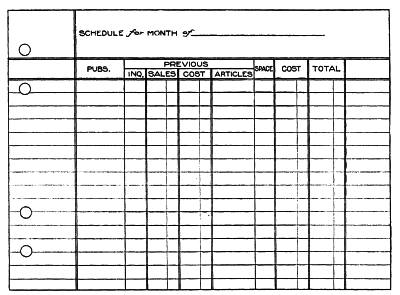
Fig. 13. Schedule of Monthly Insertions in Periodicals
When the amount of the appropriation has been decided, a schedule of the mediums to be used should be made. This schedule should include the space to be used in each publication. Indeed, the schedule of mediums and space that it is desired to use, often determines the appropriation. For a general publicity campaign, this schedule can be made absolute, but when the advertising is for direct returns, it should be elastic. Mediums which do not pay after a fair trial, should be dropped, and there should be room in the schedule for mediums not at first included. Changed conditions may make it advisable to add a medium which previously has been unprofitable.
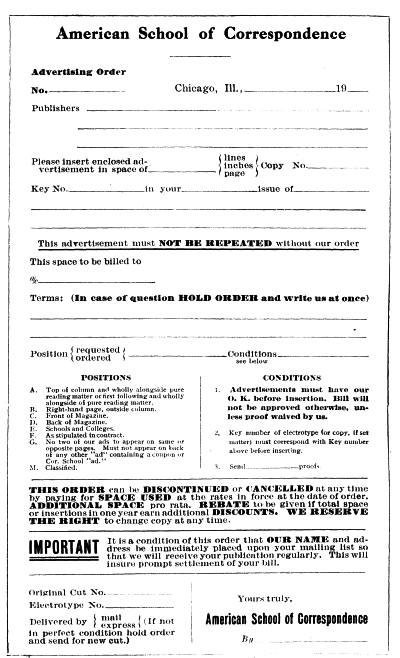
Fig. 14. Order Blank Used for Ordering Insertions of Advertising Copy
The advertiser who advertises for direct inquiries or orders, usually finds it necessary to revise his schedule monthly, basing each schedule on previous results. That he may act intelligently, he must have an exact record of past results. A convenient form for the monthly schedule is shown in Fig. 13, which is printed on a sheet punched for filing in a loose-leaf binder.
Previous results from each publication on each class of goods is shown in respect to inquires, amount of sales, and cost of the advertising. In the three columns at the right of the space for each ad, cost of each, and total cost are shown.
Separate sheets are used for popular magazines, trade papers, and newspapers. When copy has been sent, the sheets are placed in a loose-leaf binder, the full schedule for each month being in one place where it can be readily referred to.
Orders for Insertion. When an agency is employed, the agency usually sends copy and orders for insertion to the publisher; though some advertisers prefer to send copy direct, leaving the agency to send orders for insertion. It usually happens, too, that some orders are sent direct instead of through the agency. One large advertiser follows the practice of sending orders direct to those publishers who do not allow agency commissions, all others going through the agency.
If orders are to be sent direct, a special advertising order blank should be provided. This order should specify to the last detail the conditions of the order. A blank, which is self-explanatory, is shown in Fig. 14. The order is made in duplicate and the copy is filed under the name of the publication.
Checking Returns. A necessity to the advertising department is an efficient system of checking and recording returns from advertising. Without a checking system on which he can depend, the advertising manager is spending his employer's money blindly—he does not know what he is getting for it.
The first requirement in devising a system is a method of keying ads, that inquiries or orders may be identified and credited to the proper mediums. Keying systems there are without number—to describe all of them would require a book the size of this one—but those most commonly used are adaptations in one form or another, of the idea of changing the address.
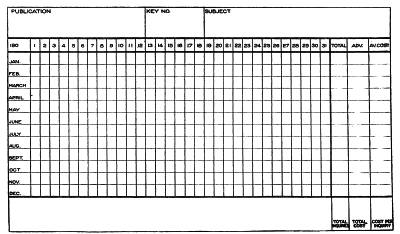
Fig. 15. Card Used for a Record of Inquiries from a Given Publication
One of the oldest methods is to use a department number or letter in the address, changing the number in each publication in which the ad appears—the address in one would be Dept. A; in another, Dept. B. This method is used successfully by some advertisers, but it has its objections. Most people realize that no concern is so large that an inquiry will not reach the proper department. If, for example, an inquiry in response to a beef extract ad, addressed to Swift & Co., failed to reach the beef extract department, it would indicate a very lax system of handling correspondence.
Changing street numbers, room numbers, or postoffice box numbers, is another common method of keying. This can be operated successfully by notifying the local postal authorities that all mail is to be delivered at one number, regardless of the address.
An adaptation of the number key, which can be used to advantage for a small number of publications, is a combination of numbers representing publications and dates. First, the publications are numbered, these numbers being used as the first part of the address. To the publication number is added the number of the month or week of publication. To illustrate:
Suppose that the Technical World is No. 5 on the list and the ad is run in October. The key number would be 510—5 standing for the publication and 10 for the month. All replies with that address would be credited to the Technical World for October.
In using this system it is necessary to use some figure—usually 0—for a repeater to avoid confusion; No. 112 might mean publication No. 1, month No. 12, or publication No. 11, month No. 2. By adding a naught after the publication No., confusion is avoided—1102 would mean No. 11, 2nd month, 10012 would indicate No. 10, 12th month. The system can be further varied by using N., S., E., and W., or by substituting Ave. for St. or vice versâ.
When readers are requested to ask for catalogs or other printed matter, the numbers by which these are known to the reader can be used for the key—as bulletin A, bulletin B, etc.
For either direct inquiries or orders one of the most popular and satisfactory keying systems is to use a coupon, indicating the publication and month in the coupon—T W 11 printed in small type in the coupon would mean Technical World for November.
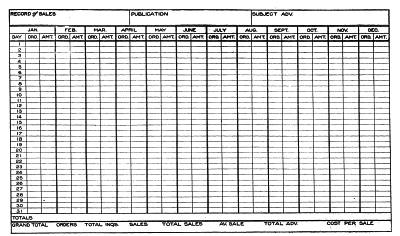
Fig. 16. Reverse of Checking Card Used for a Record of Sales
A coupon to be filled in offers the reader a convenient means of answering the ad, and this has a tendency to induce a larger number of replies. Few people will fail to use the coupon or the address given. A certain very large advertiser, who uses the coupon, states that less than one per cent of his replies are without means of identification; either the coupon is used or the name of the magazine is mentioned.
To make their checking systems as nearly perfect as possible, some advertisers write to all readers who fail to use the key, requesting them to state where the ad was seen. Some enclose a postal for the reply, others enclose a printed slip, on which the magazines used are listed, to be checked and returned.
A reasonable expense is justified to find out where replies do come from, for it is as much to the advertiser's interest to continue the use of all profitable mediums as to drop the unprofitable ones. Many of the most successful advertisers, however, consider it safe to distribute unidentified replies pro rata, basing the distribution on the number of keyed replies—that is, if 30 per cent of all keyed replies can be traced to the Technical World, that magazine will be credited with 30 per cent of all unidentified replies.
When the mail is opened all replies should be sorted by key numbers, inquiries and orders separated. Then the total number of inquiries, and number and amount of orders from each publication should be ascertained and credited.
For recording credits a form, similar to the one shown in Fig. 15, should be used. This may be on a card or in loose leaf. A card is used for each ad, in each publication—that is, if there are seven insertions in the Technical World in one year, seven record cards will be used—one for each insertion. These cards or sheets are to be filed under the names of the publications.
On the back of the card the form shown in Fig. 16, is printed. This provides for a daily record of sales resulting from the inquiries recorded on the face, or from the ad if it calls for direct orders. These forms supply all necessary data for a complete statistical record for each publication. Too much time would be required to look through all of these cards every time information is desired about a given publication; a more condensed record of total results should be provided.
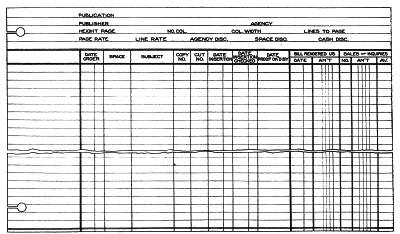
Fig. 17. Combined Record of Insertions, Costs, and Sales
All of the information of practical value can be combined with a record of insertions on the form shown in Fig. 17, using a sheet for each publication. The record includes the date of order, space, subject, copy No., cut No., dates of insertion, checking, and proofreading, the date and amount of bill, and the number, amount, and average cost of sales. The record of sales should be entered monthly from the detail record.
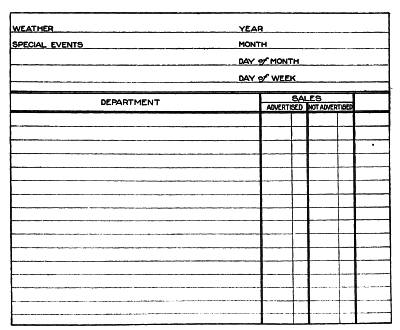
Fig. 18. Daily Record of Sales of Advertised Goods in a Retail Store
These sheets are filed in a loose-leaf binder, indexed alphabetically under the names of the publications. One sheet will accommodate the full yearly schedule for a monthly or weekly publication.
Retail Advertising Returns. To check returns from retail advertising is quite a different problem from checking returns from keyed ads in monthly magazines. There are no keys, and no mail inquiries to be traced. But a record of general results is very desirable, and it is possible to obtain records which will, at least, indicate the increase in sales due to advertising.
Results of retail advertising must be measured by comparison; if a department store advertises handkerchiefs as a leader for Tuesday, all handkerchief sales for that day would not be due to the advertising, but it is legitimate to credit advertising with any increase over normal sales. If correct sales records are kept, it will be possible to tell the exact amount of handkerchief sales for that and every other day in the year.
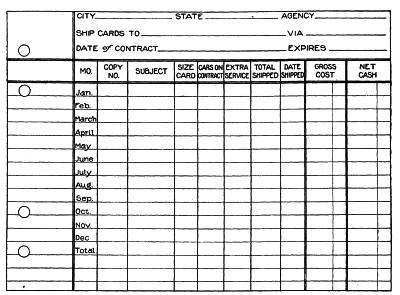
Fig. 19. Detailed Record of the Shipment of Street Car Cards
A close check on returns can also be obtained by requiring each sales person to put a distinguishing mark of some kind on sales for advertised articles. Proofs of the day's ads, showing the articles advertised in the department, should be mounted on cards and hung in each department, that the sales person may know when advertised goods are sold. If made large enough, the card can be ruled for a tally of sales, and each sale of advertised goods tallied.
A CORNER IN THE SALES ROOM AT THE CLINTON ST., CHICAGO, PLANT OF THE WESTERN ELECTRIC COMPANY
There should be an office record showing the results of advertising for each department. In comparing these records sales alone cannot be used, for the weather, and unusual events calculated to increase the crowds in town, must be considered. To-day's sales of an advertised article, with unfavorable weather conditions, probably will not equal the sales of the same article one year ago, which was circus day. If daily records, similar to that provided in the form shown in Fig. 18, are kept, they will soon become very valuable to the advertising department of any retail store.
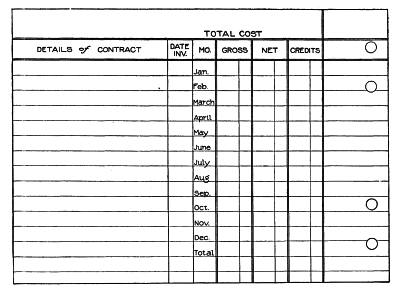
Fig. 20. Record of Street Car Contract and Net Costs
STREET CAR ADVERTISING
Street car advertising is of a general publicity nature. It is intended, not to secure direct orders, but to influence sales by keeping the name of a commodity before the public. It is local in its effects, influencing sales only in the cities in which the cards are used.
Street car advertising is now controlled by a small number of agencies, who own the space in the cars in the different cities throughout the country. Through one of these agencies, contracts can be made for space in street cars in any city in the country.
The rate for street car advertising is based primarily on population, the circulation consisting of the number of passengers carried. When the advertiser buys space, he pays for having his card appear in a specified number of cars, for a stated period. As a rule, the rate is for monthly periods, with special discounts on yearly contracts, and cards are changed each month. On certain contracts the agency will include extra service, without additional cost, by running cards in a number of extra cars, which are put on during the rush hours.
If desired, the agency will design the copy and print the cards, making an additional charge for the service. Many street car advertisers prefer, however, to furnish their own cards. This is probably the better plan for advertisers who maintain efficient copy departments.
Although this book is not intended to teach the technical details of the art of preparing copy, it may not be out of place to suggest that copy for street car cards is in a class by itself. Experienced advertisers have found that to use wordy arguments on a street car card is a mistake. The card must catch the eye, for it is expected to arrest the attention but a moment at best. A picture that tells the story at a glance, large type, and plenty of color seem to meet with most favor.
The special records required for street car advertising are simple, consisting of records of contracts. A form for such a record is shown in Fig. 19. This can be on a card or loose leaf. The form is headed with the name of the city and instructions for shipping. Below the heading, is a monthly record of the copy No., subject of the ad, size of cards, and other necessary data including the gross and net cost. On the reverse, Fig. 20, is a detailed record of the contract, and a record of total costs. These sheets are filed in a binder or in a card tray, indexed by cities.
OUTDOOR ADVERTISING
Outdoor advertising is the term used to describe all such forms of publicity as bill boards, signs, painted or printed posters, etc. This is strictly general publicity advertising.
Like street car advertising, outdoor advertising is thoroughly organized, and the sale of space is practically controlled by a few companies. Local bill posters, who control the boards, or stands, as they are technically known, have their own national organization which standardizes the practices of the business, regulates rates, and insures the advertiser against paying for service that he does not receive.
Rates for this class of advertising are based on population and the relative desirability of the location. In a city of 500,000 population, a stand which 150,000 people pass daily is worth more than one in another section of the city, which is seen but by 50,000 people.
The advertiser pays for his space on the basis of the number of stands used, size of posters or signs, relative number of down town or preferred position stands, and length of service. Rates are figured for periods of one week, two weeks, one month, and longer.
The records of outdoor advertising are very similar to those of street car advertising. By changing the column headings of Fig. 19 from cars to stands, the form shown answers every requirement.
No outdoor or street car advertising campaign of national scope should be undertaken until provision has been made to take care of the business. The trade must be covered first; when the ad appears on the boards the goods must be on the dealers' shelves.
Indeed, this is a most important factor in any publicity campaign intended to create a demand for goods sold through the retailer. Every possible preparation must be made in advance to secure a wide distribution so that the consumer attracted by the ad will find it easy to buy the goods. Making known the name of an article in a locality where it is not carried in stock, or without telling the consumer where it can be bought, can result in little advantage to the manufacturer.
WHERE ADVERTISING AND SALESMANSHIP MEET
A very effective method of producing sales—most largely used in campaigns intended to secure direct orders, by mail—is the use of circulars, booklets, and form letters. This literature is advertising, but to use it to secure the best results requires the application of a certain amount of salesmanship. The advertising man may prepare an attractive piece of printed matter, well-written and containing convincing arguments, but unless judiciously used, the time and study put into its preparation is wasted.
A large quantity of such literature, distributed indiscriminately, would probably bring some business, but the best results are obtainable only when its use is concentrated; when it is confined to a particular class and followed up in a systematic manner. Knowing his goods and the class of people who use them, the salesman is naturally the best judge of where and when to use those forms of advertising which he turns into salesmanship by mail. The discussion of systems of record and methods of use of this form of literature is taken up under the head of the sales department.
SALES DEPARTMENT
The sales department proper is in charge of a sales manager, who has immediate authority over his subordinates and is responsible for the results secured by his department. No position in the business organization carries with it greater responsibilities, for on the sales manager rests the burden of marketing the goods at a profit.
Without entering into a discussion of the science of salesmanship, the writer takes the liberty of suggesting some necessary qualifications of a sales manager.
He must be thoroughly imbued with the importance of his work and have an abiding faith in his ability to get the very best results out of his department. He must be enthusiastic and capable of imparting his enthusiasm to others.
He must know the goods, be they pianos or investment bonds. He must believe in his goods and his house. Unless he feels that his house is the best on earth and offers goods second to none, he cannot produce the full measure of results of which he is capable.
He must know the goods of his competitor and what methods his competitors are using. He must be willing to abandon his own pet schemes when they fail to produce, or to adopt a new plan, even though originated by another.
He must be a close student of human nature with the capacity for judging men. He must be a salesman in every sense else he is in no position to judge the qualifications of those in his employ.
On the other hand, the sales manager should be given full control of his department, until he proves to be incompetent. While other members of the organization will be consulted before a new campaign is launched, when the plans have been approved he should be permitted to try them out without interference. Assuming that he is a competent man in the first place, he will be the first to detect the weak points and set about to find a way to strengthen them.
Many a sales manager has had his usefulness impaired by the interference of others before he has had an opportunity to give a selling plan a fair trial. Selling campaigns have been discontinued before the turning point was reached, because someone higher in authority lacked faith; when they would have proved successful, if carried out as originally planned.
This is not an argument for a stubborn adherence to plans, regardless of consequence—any sales committee is liable to make errors—but before the campaign is launched the extent to which it shall be tried out should be decided. If the sales manager is given an appropriation of $500.00, or $5,000.00, for a trial, he can work intelligently, but if told to go ahead, and then ordered to stop before his campaign is well under way, he should not be charged with a failure.
Another thing that the sales manager should control is the question of salaries paid to the salesmen. We maintain that the amount of salary paid to a salesman is of no moment provided he is a profitable man. A $10,000.00 man who sells goods at a cost of 10% is more profitable than the $5,000.00 man who sells at 10%, or even 9%, because of the greater volumes of his business. The management should gauge the sales department by net costs, not by the amount of individual salaries.
BRANCHES OF SALES DEPARTMENT
The sales department is logically divided into two branches—mail order and personal salesmanship. The mail order branch is that part of the organization which has to do with the promotion of sales by mail. The personal salesmanship branch is the division which makes sales by personal contact with the customer.
The work of the mail order branch is conducted by correspondents—letter salesmen—assisted by clerks to look after the routine of the department.
The personal salesmanship branch is conducted, primarily, by salesmen who visit the customers and personally sell goods. In many lines, the personal salesmanship branch is supplemented by agencies, who come in direct contact with the customer.
There are businesses in which the dealers, who carry the goods in stock, are assisted by both the mail order and personal salesmanship branches in making the sale to the customer. An example is the piano business in which inquiries are referred to dealers, the dealer and prospective customer followed up by mail, and the traveling salesman sent to assist the dealer to close the sale.
THE MAIL ORDER BRANCH
When the mail order branch is spoken of it does not refer necessarily to an exclusive mail order business, but the term is used to identify the department in any concern which uses the mails to promote sales. While there are many exclusive mail order houses, employing no personal salesmen, there are practically no exclusively personal salesmanship houses. There may be no effort to secure direct orders in this manner, but the mails are used to influence sales. Extensive circularizing campaigns are conducted for the purpose of making known to the consumer the merits of certain commodities, which are sold only through dealers. In the sense here used, such campaigns are within the province of the mail order branch.
Form Letters. An important factor in the conduct of the mail order branch, is the use of form letters. In a campaign intended to secure direct orders, the form letter takes the place of the personal salesman.
The form letter presupposes a uniformity of conditions. It is written to appeal to certain desires of the recipient; its arguments are based on the supposition that the same desire exists in the minds of all to whom it is sent, and that the same arguments will cause its readers, as a class, to yield to those desires.
The result of a form letter campaign depends on the extent to which the letter fulfills its mission in adapting itself to the conditions of the class to which it is sent—its adaptability to the mentality and environment of its readers. The same argument will not appeal to the mechanic, farmer, merchant, and banker.
The failure of most form letter campaigns can be traced to one of two causes—failure to adapt the letter to existing conditions, or lack of judgment in selecting a list for a trial. The goods offered may be used by plumbers and lawyers, but the same letter should not be expected to pull with both classes. Like the selling talk of the personal salesman, the letter should be changed for each class.
Other conditions, also, must be studied. Iowa may have harvested a bumper crop, while Kansas suffers from a drought; mills in the Pittsburg district may be running overtime, while Buffalo is in the midst of local labor disturbances. All of these local conditions influence the results of the letter campaign.
As to lists used for trials, the more usual mistake is in the use of too small a list. Some sales managers, who have mailing lists of from 25,000 to 100,000 names, profess to try out a letter with a list of 300 to 500 names. A list of this size is not sufficient to give an actual test of the pulling power of any letter. Some of the most successful letter salesmen give it from their experience that the very smallest list from which a safe test can be made is 1,000 names.
Keying Form Letters. It is just as necessary to key form letters as to key magazine ads. The key makes it possible to trace results. The question of keying is most important when a series of letters is used—which is true in most campaigns—for it then becomes necessary to check the returns from each letter in the series. When one letter only is sent to a given list, the replies received from that list can be safely credited to the letter.
There are several methods of keying form letters, among which are the following: the reader may be requested to address his reply to a certain department; he may be offered a sample or some novelty; or the letter may be written in the first person singular so that replies will naturally be addressed to the writer.
The writer confesses to a preference for the last named method. The average mail order buyer likes to feel that he is receiving personal attention—that there is someone in the house to whom he can write, instead of addressing the house. A personal touch can be put into the letter signed by an individual that is impossible in a letter signed in the name of the house.
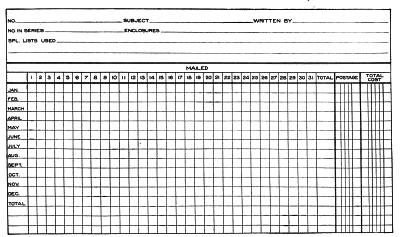
Fig. 21. Detailed Record of Form Letters Mailed
There are those who contend that only the name of the house should be used, that the name of an individual should never be signed to a letter, and who have printed on their letter heads the phrase: "Address all communications to the company, not to individuals."
While it is perfectly proper to use every legitimate means to keep the name of the house before the public, there is a good deal of senseless fear that the prestige of the house will be usurped by the individual. In some quarters this fear has resulted in the adoption of ridiculously extreme rules and regulations. One incident in the personal experience of the writer will serve to illustrate the point. Having occasion to request a favor from a certain manufacturer—a favor which would be granted, if at all, by the advertising manager—and knowing the advertising manager personally, he addressed the request to him, using his title in connection with the name of the firm. Somewhat surprising was the following letter, received a few days later:
Dear Sir:
We have your favor of the 12th, addressed to our Mr.————, and your request will receive the attention of the proper individual.
Our method of handling correspondence is such that, to insure proper attention, all communications should be addressed to the company. We request that you observe this rule in the future.
Yours truly,
No more reason for the fear that the house will be injured by the personality of one of its correspondents can be seen, than that the personality of the salesman will have greater weight with customers than the reputation of the house. If the personality of an employe—be he a personal salesman or a correspondent—is worth anything in a business way, the benefit accrues to the house that employs him.
There is one other objection to the use of the name of the writer of the letter, and it comes from the United States Statute making it a criminal offense to open mail addressed to another. But this objection can be easily overcome; any employe whose name is used will sign an order authorizing the opening of letters addressed in his name, unless marked personal.
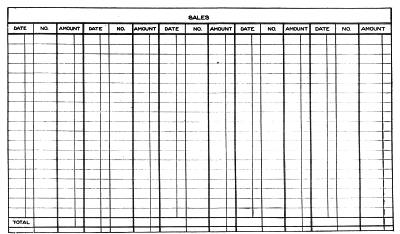
Fig. 22. Record of Sales Resulting from Form Letters
Form Letter Records. A copy of each form letter written should be kept permanently. The copies should be filed in a manner that will make it easy to refer to them. For this purpose an arch file or binder is most satisfactory. The letters themselves may be punched for the file, or the loose-leaf scrapbook idea can be adopted, pasting several letters on one leaf.
Each letter should be given a number for the purpose of identification, whether or not it appears on the letter itself. The copies should be arranged in the file in numerical order, but where there are several departments or divisions using form letters, they should be divided by departmental indexes.
It is also well to keep a second copy of the letter with a sample of the enclosures, as the enclosures may have an important bearing on the results. These copies may be preserved in the manner suggested for filing copies of ads and printed matter.
When a form letter is written, a record form, as shown in Fig. 21, should be started. This may be on a card or loose leaf; the latter is preferred on account of the larger space for the record. The heading shows the No. of the letter, the subject, name of the writer, its No. in the series to which it belongs—first, second, or third—the enclosures, and the names of any special lists used. The body of the form provides for a record of letters mailed during the year, with a monthly record of total costs.
The sheets are arranged in the order of letter Nos., in a card file or a loose-leaf binder.
The reverse of this record form is ruled, as shown in Fig. 22, to provide a record of sales resulting from the use of the letter. Sales can be entered daily or weekly, but the daily record is recommended.
The methods of obtaining the details for these records is described later.
Follow-up Systems. A necessary and very important factor in the success of a business transacted through the mails, is the follow-up system. And in a business in which sales are made by personal salesmen, the follow-up is used for certain purposes, and is as important as though used to secure orders.
To follow-up is to keep after, to keep in touch with, and to keep a certain subject before certain individuals. Whether used to secure orders or make collections, the idea of the follow-up is the same, though it is better known as a system for promoting sales.
The follow-up arises from the same necessity that compels the personal salesman to call on a prospective customer more than once—often many times—before the first order is secured, and continue to call to hold his trade. The follow-up simply makes use of letters and other literature to take the place of the personal salesman.
Mechanically, the follow-up system is a system or method that insures the sending of the right literature at the right time. Letters—both form and special—catalogs, booklets, folders, circulars, and mailing cards are all used in the process of following up the prospective purchaser; the automatic method of showing when each piece of literature in the series should be sent, is the follow-up system itself.
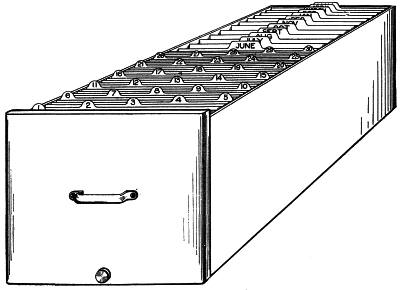
Fig. 23. Vertical File Drawer Equipped as a Tickler
Tickler Method. The simplest method of handling the follow-up system is to use a tickler in which to file memoranda or correspondence by dates. A tickler consists of a file equipped with a set of indexes numbered from 1 to 31 to represent the days of the month, and 12 indexes printed with the name of the month. The monthly indexes are arranged in order, and the daily indexes are placed in front of the monthly indexes in numerical sequence. The file may be a vertical correspondence file, a card tray, or a flat desk file.
In using the tickler for a correspondence follow-up, letters are filed back of the index representing the day on which the subject is to receive attention. Each day the letters filed behind that day's index are removed, and after receiving attention, are filed ahead to the next follow-up date.
If it is desired to have a letter come up for attention in another than the current month, the day of the month is noted on the letter, and it is placed back of the monthly index. On the first of the month, the index for the previous month is placed at the back of the file, which brings the current month's index to the front. All papers that have been filed back of the monthly index are then distributed by dates. A correspondence file drawer, equipped as a tickler, is shown in Fig. 23.
For a small amount of correspondence, the use of the tickler is very satisfactory, and it is also used to excellent advantage for keeping track of the many matters that require attention at a future date. A tickler should be included in the equipment of every office, no matter what the line of business.
Card Follow-up. For most extensive follow-up systems, the card index is used, for the reason that a card is easy to handle, occupies but little space, and can be adapted to any classification desired. A card is used for each prospective customer, or name on the list to be followed up, and should bear the name and address and a brief history of the efforts made to secure an order, or accomplish the object of the follow-up.
In operating a follow-up system—especially if the object is to sell goods—the correspondent should have before him a history of the efforts previously made to secure an order. He should know what letters and other literature have been mailed just as the personal salesman knows what arguments he has used. When form letters have been used it is not necessary to have copies of the letters in each case, but they should be identified by their numbers, or otherwise. Records of these letters, by date and number, can be made on a card, so that the card itself will give the correspondent a complete history of the case. The correspondence—letters from the prospective customer and copies of special letters to him—can then be filed in the regular way, and is accessible at all times.
The oldest method of operating the card follow-up is to use the tickler index in a card file. The follow-up is operated in exactly the same manner as described for the correspondence file tickler, except that the cards are filed ahead instead of the original correspondence.
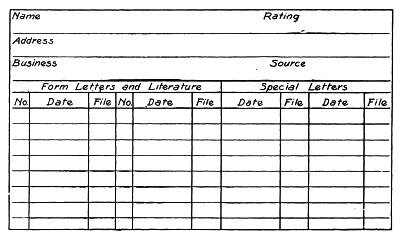
Fig. 24. Card Used for Follow-up
A typical follow-up card is shown in Fig. 24. At the head of the card is the name and address of the prospective customer, followed by the credit rating, the business, and the source from which the name was obtained—whether from advertising, a special list, or from a traveling salesman. The body of the card is ruled for a record of letters mailed, form and special letters separated. When a letter is sent the No. and date—if a form letter—is entered, and in the file column is noted the number of days the card is to be filed ahead—as 10 days or 30 days. If at the time specified, the next form letter in the series is to be sent, provided no response has been received, the No. should be noted on the next blank line in the No. column, so that the letter can be sent by a clerk, without consulting the salesman.
When the cards come from the file, those on which no form letter is indicated for the next follow-up should be referred to the correspondent. If he considers a special letter advisable, he should have all previous correspondence attached to the card, that he may know just what has been done to land the customer.
Cross-Indexing the Chronological File. One of the disadvantages of the tickler or chronological index, described above, for a follow-up is the difficulty of locating a card, when the date under which it is filed is unknown. A letter may be written on June 10, and the card filed ahead to June 25; on June 16 a reply may be received which makes it necessary to find the follow-up card, but to do this it is necessary to look through all of the cards filed between June 16 and June 25. If the card is not found, the chances are that on the 25th a regular follow-up form letter, which will make the system appear ridiculous, will be sent.
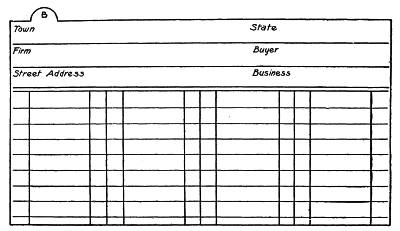
Fig. 25. Follow-up Card with Alphabetical Tab
To so file the cards that any one can be found by name, without interference with the automatic features of the follow-up system, is an important consideration. This can be accomplished by the use of a card like the one shown in Fig. 25. It will be noted that this card bears a small tab or projection, on which is printed the letter B. These tabs are cut 1/20 of the width of the card and are in twenty positions across the card. This allows for twenty subdivisions of the alphabet, the A tab being in the first position, B in the second, etc.
In filling in a card, one bearing the letter corresponding with the first letter in the name of the correspondent is selected—a B card for Brown, an S card for Smith. Now since B is always printed on a tab in the second position, and this tab is always the same distance from the end of the card, when the cards are filed, all B tabs will be in a straight line from front to back of the drawer.
No matter under what date it is filed, if Brown's card is wanted it will be found by looking through the row of B tabs in the second position from the left. Regardless of the number, all tabs printed with the same letter are found in one row, making it possible to file cards by date and cross-index by name.
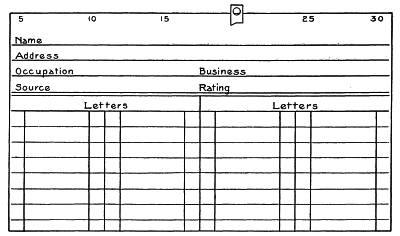
Fig. 26. Follow-up Card with Movable Tab to Show Dates
Cross-Indexing the Alphabetical File. An improvement over the cross-index of the tickler, described above, is the method of cross-indexing an alphabetical file in a manner to insure a follow-up on a specified date. A card without tabs, as shown in Fig. 26, is used. Across the top of the card is printed a series of numbers representing the days of the month. This may include all of the numbers, from 1 to 31, or the month may be divided into five day periods.
In connection with this card a metal tab, which can be attached at will, is used. One of these tabs is placed over the number which represents the date on which it is to be followed up. The card is then filed, indexed by name.
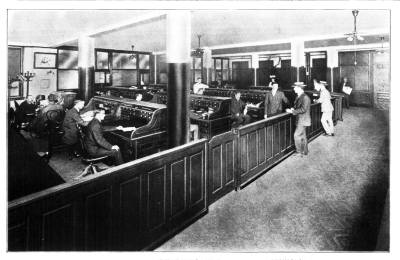
THE SALES DEPARTMENT IN THE NEW YORK OFFICES OF J. WALTER THOMPSON COMPANY
The numbers being printed in the same position on every card, all tabs placed over the same number will be in a direct line in the file. The cards to be removed for the follow-up on a certain date are those bearing tabs over the number representing that date. On June 20, for illustration, all cards with tabs over No. 20 are taken from the file. When letters have been written, the tabs are moved to the next follow-up date, and the cards returned to the file.
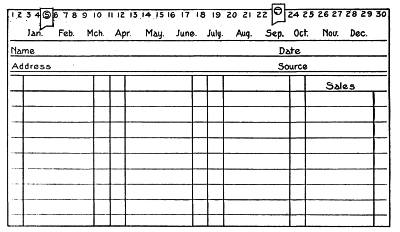
Fig. 27. Card for Combined Daily and Monthly Follow-up
This method of cross-indexing with movable tabs permits of the filing of the cards in any manner desired, with the knowledge that the follow-up date will be surely indicated. The tab method is also used for a combination of daily and monthly index. On the card shown in Fig. 27, the names of the month are printed under the date. For a follow-up in a later month a colored tab is used to represent the monthly index, while a black tab represents the day of the month. To illustrate, we will suppose that the card is placed in the file on Oct. 5 and the next follow-up date is Nov. 10; a black tab is placed over No. 10, and a red tab over No. 2. The card will not be disturbed on Oct. 10, as the red tab indicates that it is to be removed in a later month, but on Nov. 1, the red tab is removed from the card, and the black tab will bring it to notice on Nov. 10.
Lists of Customers. Every concern whether it secures business through the mails, by means of personal salesmen, or both, should have a list of its customers properly classified and arranged for easy reference. This should be something more than a list of names and addresses; certain essential facts about each customer—such as his business, the name of the buyer, the credit rating, and amount of purchases—should be recorded.
All of this information can be placed at the head of the ledger sheet, but it never should be necessary for another department to consult the records of the accounting department for information needed daily. The information given by the customers' list is of most value to the sales department and should be kept in that department.
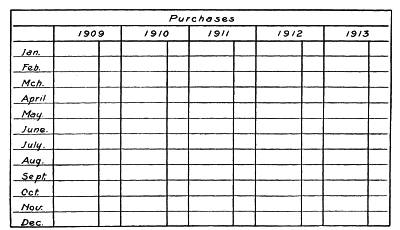
Fig. 28. Monthly Record of Purchases of a Customer
For customers' lists, cards are most largely used, and are most satisfactory. Cards are readily classified, new names can be added at will, and old names are removed without disturbing the balance of the list or the general arrangement of the cards.
The follow-up card can be used as a customer's card, but should be moved from the follow-up to a separate file; or a new card can be made when a prospect becomes a customer.
On the back of the customer's card a form similar to Fig. 28 should be printed. This is intended for a record of the purchases of the customer and provides for a monthly record, covering a period of five years. The amount of purchases is entered monthly from the ledger. In a business in which the purchases of each customer are infrequent, each order should be entered with the date, in place of the monthly summary.
Classification of List. The value of a list of customers is greatly enhanced by a careful classification of the names. Lists of those engaged in the different trades and professions can be bought, but no list is so valuable as one made up of the names of those who have answered your advertisements, or with whom you have done business.
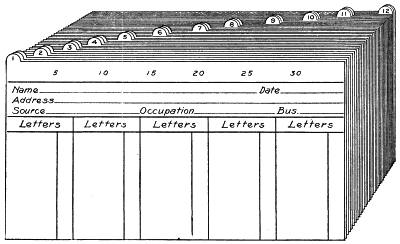
Fig. 29. Card File for a Classified Customers' List
Most houses sell goods to those in different trades or occupations. A manufacturer may sell different lines, or the same line, to jobbers, retailers, and consumers; a mail order concern may sell to farmers, mechanics, and small retailers; a retailer may sell to men and women. To sell each different line to a different class of people, requires different arguments—a new line of selling talk must be used in each case. While the personal salesman has an opportunity to size up his prospect, and make his argument fit the individual, the letter salesman must fit his argument to a class. To drive home the right argument, he must be sure of the class to which his prospect belongs. He cannot hope to form the personal acquaintance of his prospects, but must rely on a proper classification.
The classes into which a list of customers and prospects should be divided depends on the nature of the business and the class of goods sold. It might be manufacturers in different lines, the different professions, retailers in several lines, or all of these combined into one list.
With a card list, any classification is easily provided. If the number of classes is small—not exceeding seven or eight—the classes can be indicated by the color of the card, a white card being used for one class, blue for another, etc.
For a more extensive classification, cards with numbered tabs, as in Fig. 29, are used. It will be noted that there are twelve of these tabs, and that they are numbered from left to right. In the follow-up systems, from which this illustration is taken, each number represents a certain line of business.
Suppose that No. 1 represents manufacturers; if all manufacturers on the list are to be circularized, only those names recorded on cards with the No. 1 tab are addressed. Now if the business is one dealing in specialties, it may be that the specialty to be sold will depend on the position held by the prospect—a sales manager will be more interested in a book on sales methods than in one on factory methods. To further classify the list, colors are used.
In the system referred to, eight colors are used. Seven of these represent occupations of prospective customers, while the eighth is used for customers. A manager or executive officer is represented by a blue card, a sales manager by a white card, etc. When a prospect becomes a customer, the card is removed from the follow-up file, the amount of the sale is entered on the back, and it is placed in another file reserved for customers. At the same time a red card is placed in the follow-up file for use in further circularizing. The tab on the customer's card shows his business, but the occupation is not so important since he is already acquainted with the house and its goods. A more familiar tone can be adopted in letters to a customer, than to a prospect.
A complete classification, such as provided in this system, is of immense value to a letter salesman. Suppose he wishes to address all executives—the blue card is used; if he wants to reach customers who are manufacturers, red cards with No. 1 tabs are the ones used. He can make his letter fit a particular class and be sure of the class.
Classification of Sales. There are certain lines of business in which a second order for the same article is seldom received from any customer. An example is the music business. The chances of selling a customer a second piano are remote, but the fact that he has purchased a piano is a sure indication that he will be interested in certain classes of music. Book publishing is another example. A man who buys a book on advertising, or commercial law, or auditing is quite likely to be a buyer of other books on the same or kindred subjects.
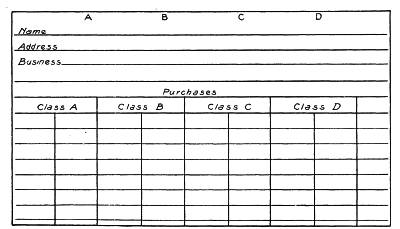
Fig. 30. Card for a Classified Record of Purchases
In a business conducted through the mail, a classified sales list that shows at a glance what classes of goods have been sold to each customer furnishes an excellent guide for further circularizing. On such records it is not necessary to show the amounts of purchases—the class is the important item.
Fig. 30 shows a card used for a record of this kind. The goods are divided into four classes, indicated by the letters at the head of the columns. When the first sale is made, the name and address are entered on one of these cards, and the date indicated in the proper column. A movable tab is placed on the upper edge of the card, over the letter that indicates the class, and the card is filed. As subsequent purchases are made the dates are entered, and if the purchase includes another class of goods, another tab is placed on the card. In time, one card may bear four tabs, indicating that the customer has bought goods in all four classes.
When new goods are received, they can be brought to the notice of those customers whose purchases indicate that they are most likely to be interested, without disturbing the other cards.
Indexing Customers' Cards. The best manner of indexing customers' and prospects' cards depends on the size of the list. A list of a few hundred names is best indexed alphabetically. A large list should be indexed geographically—according to location.
The geographical index consists of index cards printed with the names of the states, and sets of indexes bearing the names of the cities and towns in the different states. The state indexes are arranged in alphabetical order, and back of these the town indexes are filed alphabetically. The cards are filed back of the town indexes, these also being arranged alphabetically. When the number of names in a city is large, the cards are further subdivided by alphabetical indexes. In states where the list is small, an alphabetical index can be substituted for the town index, the letters representing towns; names of customers in Alton would be filed back of the A index, those in Springfield, back of the S index.
An advantage of the geographical index is that a definite territory can be covered by the letter salesman, or the personal salesman can go over the list and find out the condition of the trade in his own territory.
PERSONAL SALESMANSHIP DIVISION
Though the volume of business secured through the medium of the mails is increasing at a rapid rate, the bulk of the business of the country is done by personal salesmen.
Leaving out of the discussion the question of retail salesmanship, the personal salesmanship plan—the employment of traveling salesmen—is the least expensive method of selling goods at wholesale. To sell certain low-priced specialties to consumers, the mail order plan is sometimes best, for the reason that it is necessary to reach a large number of possible buyers to find a few actual buyers. This can be done at less expense by letters than by traveling salesmen.
More is being learned about how to use the mails to promote business—how to make the follow-up system an assistant to the salesmen. The manufacturer whose goods are sold to the trade, by salesmen, is learning how to build up his own business by assisting the dealer to sell his goods. He advertises to interest the consumer, he follows up the consumer and the dealer, and in the end assists his own salesman to sell more goods.
Much good literature has been written on the subject of salesmanship, plenty of advice about being systematic in his work has been given the traveling man, but very little has been written on the subject of making sales records and reports of assistance to both the house and the salesman. Some suggestions on this phase of the question are made in this discussion.
Routing Salesmen. How to route his salesmen to the best advantage is one of the important problems of the sales manager. He must first decide how often the territory should be covered, then the extent of the territory he will attempt to work, and the number of men required. When this has been done, the territory of each man must be laid out, and a route which will enable him to cover the territory with the smallest mileage, must be selected. The territory should not be larger than a man can cover in a specified time, but large enough to require all of his time.
Map and Tack System. To know just where each man is at all times—to be able to locate Smith or Brown instantly, every day—is very necessary. Perhaps the best method of doing this is by the use of what is known as the map and tack system.
State maps, printed in colors, are fastened in the bottoms of shallow drawers, a drawer for each state. Sharp pointed tacks, with heads covered with silk in a great variety of colors, are used for various classifications, and colored silk cords are used to indicate routes and territory boundaries.
To each salesman is assigned a specific color, by which he is always known. Tacks with heads of the proper colors are placed in the map at the towns on his territory. A cord is then strung from tack to tack in the order in which he will cover the territory. When the salesman leaves a town the cord is removed from that tack, coiled up, and placed over the tack at the next town. The tack at the end of the cord always shows the present location of the salesman. Fig. 31 illustrates a map with cords—represented by the heavy lines—indicating salesmen's routes.
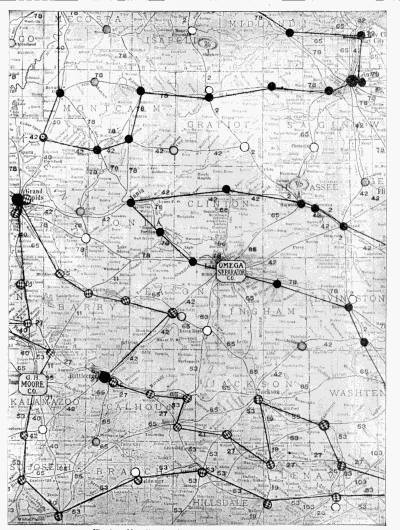
Fig. 31. Map Showing Operation of Map and Tack System Courtesy Browne-Morse Company
Other tacks, with heads of a different color or coiled wire heads for holding labels, are used to indicate special facts—as, competition strong, customer ready to buy, claim to be adjusted, or collections to be made. These are placed at the side of the salesman's tacks and are a reminder to write to him, about the special matter, at that town. If an inquiry is received or a good prospect developed, in some small town not regularly visited by any salesman, a special tack is placed in the map at that point. A cord of special color is then strung from this tack to the nearest stopping point on any salesman's route. This is a reminder to write the salesman instructing him to make a special trip to this point outside of his regular territory.
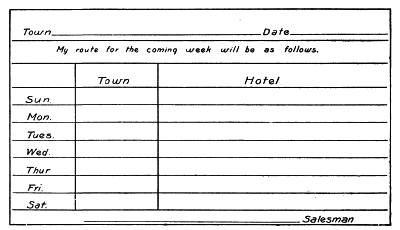
Fig. 32. Traveler's Route Card
Route Cards. It is not always advisable to attempt to lay out the entire route of a salesman in advance, neither is it always possible for him to make the towns in the time calculated. It is wise, therefore, to require the salesman to keep the house constantly advised about his stopping places. When the route is a long one, a route card, as shown in Fig. 32, should be mailed to the house weekly. The card should be 3×5 inches in size, to fit the standard size card drawer. Route cards of all salesmen, whether there are five or fifty, can then be kept in a card tray in the manager's desk.
Reports of Calls. The successful sales manager of the modern type is learning to get more and more business from his territory; he is not satisfied to show a large volume of business in a large territory, unless he feels that he has secured all of the business possible from every town. If Baker sells two dealers in Peoria, well and good; but why did he fail to sell the other five dealers in the same line? And it is not in a fault-finding spirit that he asks why; if he knew why, perhaps he and the salesman could together work out a plan that would solve the difficulty and secure from one to five new customers.
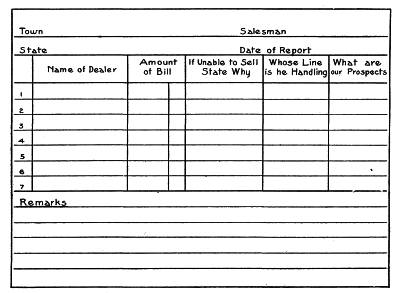
Fig. 33. Salesman's Report of Calls in Each Town
The salesman knows better than anyone else why he has failed to sell certain dealers; he is the man who becomes familiar with the actual conditions in each town—what competitors' goods are most popular, reasons for local business depression such as crop failures or labor disturbances, and any causes for dissatisfaction with the goods or business methods of his own house. Possibly the sales manager is not in a position to change conditions, but certainly, he cannot solve the difficulties unless he knows what they are. The salesman should, therefore, assume that there is at least a chance that he will receive assistance by keeping the house posted on every detail that might affect his trade.
The only way in which practical results can be secured is for the salesman to make a report on every call made, in every town on his route. A form of report card is shown in Fig. 33. This is intended for a brief report of calls in one town. Space is provided for reports of seven calls, but if there is a larger number of dealers, more than one card is used. On the back of the card, a full line is allowed to each dealer for remarks.
The salesman is instructed to mail one of these cards, in an envelope specially provided for the purpose, from each town on his route. When received, the sales manager examines them, makes his notations, and files them according to salesmen's routes. When the salesman is next in the house the sales manager goes over the cards with him, and they discuss each case individually.
Forms of report cards differ, naturally, according to the business. In some lines more specific information is needed in each case to enable the sales manager to judge intelligently the chances for future business. Fig. 34 represents a card used in one business for a specific report on each call made. The form shown in Fig. 35 provides for a brief report including suggestions regarding the date of the next call.
Follow-up of Dealers and Salesmen. In the modern advertising campaigns of manufacturers in many lines, an effort is made to secure inquiries from consumers, though the goods are sold through dealers only. The inquiry is usually secured by a promise of a free sample, a handsome catalog, or other piece of printed matter.
These inquiries should always be referred to the nearest dealer, and in answering the inquiry, the name and address of the dealer should be given. In addition to the inquiries received from advertising, manufacturers in certain lines invite dealers to send them the names of good prospects. One of the large paint manufacturers asks the dealer to send two lists—one of people who are talking of painting their buildings, one of people whose buildings need painting. The manufacturer of a widely advertised washing machine asks for the names of all possible buyers to whom the dealer has talked washing machines, without making a sale.
The object of all this is to enable the manufacturer to assist the dealer to sell more goods of his manufacture. Sometimes the margin of profit to the manufacturer is such that he can afford to maintain an extensive follow-up on the names, and even send one of his salesmen to assist the dealer to close the sale.
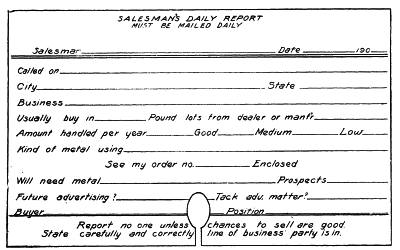
Fig. 34. Specific Report on Individual Calls
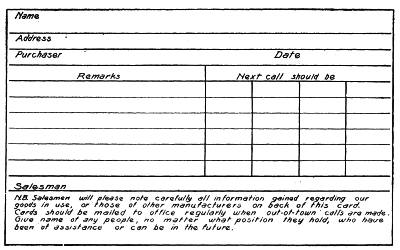
Fig. 35. Salesman's Report of Call and Follow-up
The manufacturers of one of the popular pianos has secured excellent results from the operation of such a system. In this system, the card shown in Fig. 36 is used to follow-up both the inquirer and the dealer. It will be noted that columns are provided for a record of the postage on every letter or piece of printed matter mailed. The prospect receives a letter once a month, while once in two months a letter is written to the dealer asking for a report.
With the first letter to the prospect, a postal card acknowledgment form is enclosed. On the postal, space is provided for names, which the prospect is asked to fill in with names of friends who might be interested in pianos. By this simple expedient, an original inquiry is often added to with a half-dozen new names.
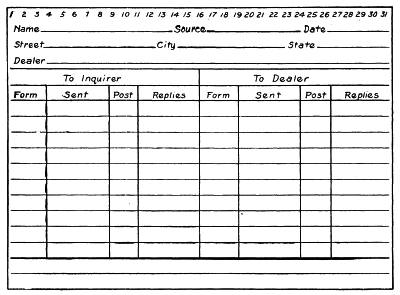
Fig. 36. Card Used for Follow-up of Dealer and Inquirer
With the first letter to the prospect, there is also enclosed a formal letter of introduction to the dealer. This letter, which is addressed to the dealer, reads as follows:
The bearer of this letter wishes to inspect our pianos. We shall esteem it a favor if you will kindly explain the merits of these instruments and give—— ——an opportunity to thoroughly examine them.
Respectfully,
At the time of referring the inquiry to the dealer, the blank shown in Fig. 37 is filled in and mailed to the salesman in whose territory the dealer is located. The lower half of the blank is for the salesman's report to the house.
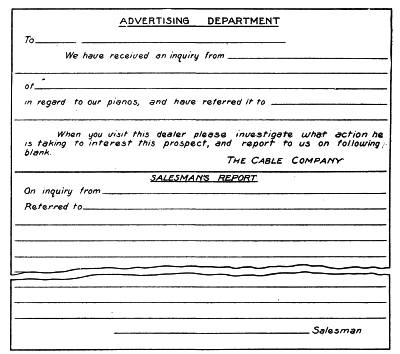
Fig. 37. Notice of Inquiry Sent to Salesman, with Blank for His Report
Salesman's Expense Accounts. Detailed expense accounts should be mailed to the house weekly. A conveniently arranged form, with columns, for regular expense items such as hotel, R. R. fare, livery, etc., will greatly assist the salesman in making up his accounts. Such a form is shown in Fig. 38. This is a card 3"×5" in size, punched to fit a small ring binder small enough to be carried in the pocket. Both sides of the card are used, providing for a record of expenses covering a period of one week.
SALES RECORDS
Regardless of the nature of the business, whether sales are made through the mail, by traveling salesmen, or resident agents, summaries of sales from day to day, supply much valuable information to the sales manager. Sales summaries which show the amount of sales each day and month, are the working charts of the sales manager.
It should be remembered that these statistics are chiefly valuable for comparative purposes, but to insure comparisons of value, the statistics must be compiled in proper form. It should be possible to compare, not alone total sales, but the sales of each man in different periods, the sales of one man with those of another, the sales in different territories, the sales of different departments, the sales by mail with those of personal salesmen.
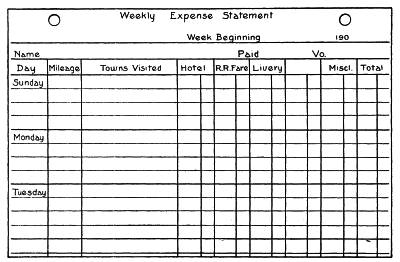
Fig. 38. Traveler's Weekly Statement of Expenses
Daily Sales Records. The daily record of sales should show the sales of each department, the source of the sales, and the proportion of cash and credit sales. These should also be divided as to wholesale and retail.
A convenient form is shown in Fig. 39. This is a sheet punched for a loose-leaf book, and there should be as many copies as there are men in the organization who are directly interested. Besides the sales manager, the general manager, the advertising manager, and the comptroller are all directly interested. By using carbon paper as many copies as needed can be made at one writing.
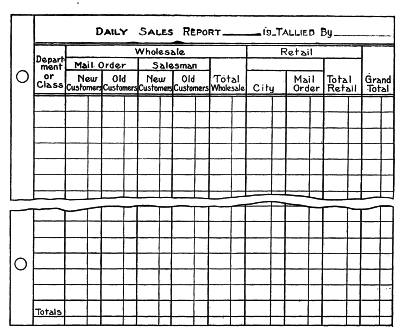
Fig. 39. Daily Tabulation of Sales by Departments
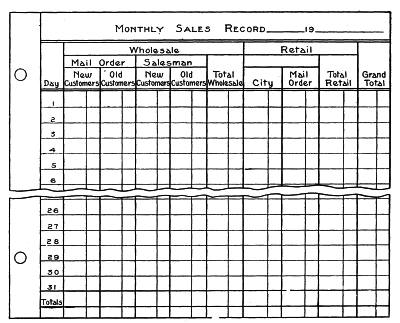
Fig. 40. Monthly Recapitulation of Daily Sales Reports
EXECUTIVE BUILDING OF THE LEWIS PUBLISHING CO., UNIVERSITY CITY, ST. LOUIS, MO.
Monthly Sales Records. Fig. 40 represents a sales sheet arranged for a monthly summary, the statistics being obtained from the daily records. The monthly summary follows the same lines as the daily record, except that sales are not divided by departments.
Where the business is divided into several departments one of these monthly summary sheets can be used for each department.
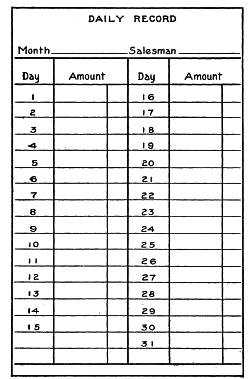
Fig. 41. Daily and Monthly Record of a Salesman
These daily and monthly summaries provide for a comparison of wholesale with retail, mail order with personal salesmen, and departments. If there is a gain in one department and a loss in another, or a fluctuation in total sales, these summaries point out the source, showing where greater efforts are needed and where praise is deserved.
Salesmen's Records. While the sale summaries described afford many valuable comparisons, they do not provide a classification that will indicate the value of each salesman. There should be a record showing the volume of business of each man. The form shown in Fig. 41 shows a card used for a daily and monthly record of one salesman. The form might be elaborated to show cost of goods, salary, expenses, gross and net profits; but the tabulating of this information is more properly the work of the statistical department.
These cards should be filed alphabetically by name of the salesman, and divided according to states. They will then show the sales of each man and in each territory.