INTRODUCTION.
Reading edition
It may well be doubted whether, in all the range of Science, there is any field so fascinating to the explorer—so rich in hidden treasures—so fruitful in delightful surprises—as that of Pure Mathematics. The charm lies chiefly, I think, in the absolute certainty of its results: for that is what, beyond almost all mental treasures, the human intellect craves for. Let us only be sure of something! More light, more light! Ἐν δὲ φάει, καὶ ὀλέσσον. 'And, if our fate be death, give light and let us die!' This is the cry that, through all the ages, is going up from perplexed Humanity, and Science has little else to offer, that will really meet the demands of its votaries, than the conclusions of Pure Mathematics. Most other Sciences are in a state of constant flux—the precious truths of one generation being smiled at as paradoxes by the second generation, and contemptuously swept away as childish nonsense by the third. If you would see a specimen of the rapidity of this process of decomposition, take Biology for a sample: quote, to any distinguished Biologist you happen to meet, some book published thirty years ago, and observe his pitying smile!
But neither thirty years, nor thirty centuries, affect the clearness, or the charm, of Geometrical truths. Such a theorem as 'the square of the hypotenuse of a right-angled triangle is equal to the sum of the squares of the sides' is as dazzlingly beautiful now as it was in the day when Pythagoras first discovered it, and celebrated its advent, it is said, by sacrificing a hecatomb of oxen—a method of doing honour to Science that has always seemed to me slightly exaggerated and uncalled-for. One can imagine oneself, even in these degenerate days, marking the epoch of some brilliant scientific discovery by inviting a convivial friend or two, to join one in a beefsteak and a bottle of wine. But a hecatomb of oxen! It would produce a quite inconvenient supply of beef.
Now this field of Mathematical research, with all its wealth of hidden treasure, is all too apt to yield nothing to our research: for it is haunted by certain ignes fatui—delusive phantoms, that float before us, and seem so fair, and are all but in our grasp, so nearly that it never seems to need more than one step further, and the prize shall be ours! Alas for him who has been turned aside from real research by one of these spectres—who has found a music in its mocking laughter—and who wastes his life and energy in the desperate chase!
One of these—the chief one, I think—is the old old problem of 'Squaring the Circle,' which has certainly wasted many a human life. Whether it has actually driven any one mad, I know not—most of its victims were, I fancy, partly crazed before they entered on the quest—but it clearly has the power of demolishing such slender reasoning powers as they may ever have chanced to possess.
With two of these misguided visionaries I have myself corresponded.
The first who addressed me filled me with a great ambition—to do a feat I had never yet heard of as accomplished by man, namely, to convince a 'Circle-Squarer' of his error! The value my friend had selected for '' was not an original one—being 3·2: but the enormous error, beginning as early as the first decimal place, tempted one with the idea that it could be easily demonstrated to be an error. I should think more than a score of letters were interchanged before I became sadly convinced that I had no chance. What man could still hope on, after receiving such a rebuff as the following? "You persuade yourself," so my friend wrote, "that you have made your circumscribed polygon equal to the circle, which you know cannot be, and have thereby pushed the quadrant beyond 90°, valuing the circumference at 360°." I meekly begged to be referred to the actual words in which I had advanced this startling assertion: but I never succeeded in getting the quotation verified.
My second 'Circle-Squarer' went to work in quite another fashion. His object was not so much to obtain an arithmetical value for ',' as to construct a geometrical straight Line which, given the radius, should exhibit to the eye the actual length of the circumference. His diagram was a most imposing one—Triangles and Parallels were interlaced in bewildering profusion—and it used up no less than 23 letters of the alphabet. Some of the Lines had arithmetical values assigned to them: and there was one value, '1·8879020478639098461 &c.', which for a long time baffled all my endeavours to guess how in the world he had invented it. Of course one might have taken exception to such a construction at the very outset, and have said "I will admit the possibility of constructing a Line, which shall bear to the unit-line any arithmetical ratio you like, so long as you express it as an exact decimal: but what can I do with your '&c.'?" But his was not the kind of mind to which the geometrical construction of an '&c.' presents any difficulty. At length, after many failures, I chanced on the discovery that this portentous number was of the decimal part of '.' After this it was no wonder, considering that, in the course of construction, he had taken of this Line, and afterwards divided by 10, that the resulting Line, added to 3 times the unit-Line, was triumphantly proved to represent ''! I ventured to ask if this was the way he had obtained the long decimal quoted above, namely, by multiplying the decimal part of '' by , and received the courteous reply "your suggestion is perfectly correct"!
Another ignis fatuus—though not numbering so many victims as the 'Quadrature of the Circle'—is 'the Trisection of an Angle' (that is, its trisection by Euclid's machinery).
And yet another ignis fatuus—the one with which the following treatise is concerned—is the attempt to dispense with Euclid's celebrated 12th Axiom.
I may as well state briefly what the feat actually is, which Mathematicians have been vainly trying, since Euclid's day, to perform.
In I. 27, 28, he proves (so far, without invoking the aid of any doubtful Axiom) that "two Lines, which are equally inclined to a certain transversal (whether by making a pair of alternate angles equal, or an exterior equal to its interior opposite angle, or two interior, on the same side of the transversal, together equal to two right angles), will never meet."
Next, in logical order, comes his 12th Axiom, viz. that "two Lines, which are unequally inclined to a certain transversal (he only names the case where they make two interior angles together less than two right angles, but he might fairly have included the others), will meet." This Axiom, as I hope to prove in Appendix III, is only partially, and not universally, true.
Next, in I. 29, he proves (with the aid of this Axiom, of which it is what De Morgan calls the 'contranominal') the partially-true Theorem that "two Lines, which never meet, are equally inclined to any transversal."
And from this, in I. 32, he proves that "the three angles of a Triangle are together equal to two right angles."
These are only specimens of a set of Theorems which can be proved when once Axiom 12 is granted (e.g. there are several about 'equidistantial Lines,' which Euclid has altogether ignored): but they are all so connected as to follow easily from these.
Now the great difficulty, which besets this subject, is that Euclid's Axiom (this, I think, is universally admitted) is not axiomatic—the intellect has not yet occurred, among that species of Vertebrates which may be defined as 'bimanous bipeds,' which accepts it as a genuine Axiom—and the great question to be answered is "can a better Axiom be found?"
In Appendix IV, I will mention some of the substitutes that have been suggested, and will give some account of the 'outlook' in the direction of the new Axiom I have chanced on. In this place it will suffice, first, to explain what the task is that the long-desiderated Axiom has to perform, and secondly, to state the grounds on which I claim acceptance for my Axiom.
First, then, what is 'the coming Axiom' expected to do for us?
It will be convenient to divide the whole class, of Theorems needing proof, into two sub-classes—one including those which are universally true: the other those which are only partially true—the error, if any, being infinitesimal when compared with the Magnitudes with which the Theorem is concerned.
Euc. I. 32 is a specimen of the one kind, and Euc. I. 29 of the other.
In proving the latter class, no substitute for Euclid's Axiom has yet been suggested, that I know of, which does not suffer from the same defect as Euclid's Axiom—the being only partially, and not universally, true—and which does not, if we attempt to modify the language so as to remedy this defect, in some way lead us into the bewildering region of Infinities and Infinitesimals.
But the former class can, as I believe, be more easily proved. This is what I attempt in the following treatise—which owes its inspiration to a sudden thought (it occurred to me some two months ago) that it might be possible to prove Euc. I. 32 without getting mixed up with those spectral Infinities.
Moreover, it is quite possible to bring into this class all that is valuable in Euc. I. 29. Regarding the 'separateness' of the Lines merely as a link between Props. 27, 28, and 29, we may combine the three into one grand Theorem, thus:—"Two Lines, which are equally inclined to a certain transversal, are so to every transversal." This Theorem, as well as Euc. I. 32, I prove in the following treatise. But the feat of proving them, without assuming any new Axiom at all, is at present beyond my grasp. Like the goblin 'Puck,' it has led me "up and down, up and down," through many a wakeful night: but always, just as I thought I had it, some unforeseen fallacy was sure to trip me up, and the tricksy sprite would "leap out, laughing ho, ho, ho!"
And now, to come to the real gist of this over-long Preface—however, nobody ever reads a Preface, so really it does not matter—am I not right in thinking that, on mere inspection of this diagram, any sane intellect will be ready to grant that "in any Circle, the inscribed Tetragon is greater than any one of the Segments that lie outside it"?
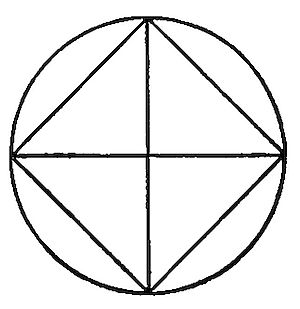
I shall be told, no doubt, that this is too bizarre and unprecedented an Axiom—that it is an appeal to the eye, and not to the reason. That it is somewhat bizarre I am willing to admit—and am by no means sure that this is not rather a merit than a defect. But, as to its being an appeal to the eye, what is "two straight Lines cannot enclose a space" but an appeal to the eye? What is "all right angles are equal" but an appeal to the eye?
In all Axioms, where an appeal is made to the eye on a question of magnitude, we shall find, I think, that the whole region of certainty and probability may be roughly mapped out into three districts—an out-lying district of certainty in one direction, a similar one of certainty in the opposite direction, and a middle district of probability—the boundaries being shadowy and liable to be shifted hither and thither according to the fancies or prejudices of each individual mind.
Permit me to illustrate this by an example taken from ordinary life.
You enter a room, where there is a book-case containing (say) five shelves, and your eye wanders carelessly along a shelf, making a rough estimate of the number of books in it. Now shut your eyes, and try to guess how many books there are altogether. Your hasty reckoning of one shelf gave a total (say) of 19 or 20, you are not sure which: so you feel safe in saying "I think there are about a hundred." "Are you certain," I ask, "that there are more than fifty?" "Quite certain," you reply. "And also certain that there are less than a hundred and fifty?" "Quite certain," you repeat. Here, then, are the three districts. The numbers up to 50 are certainly too small; the numbers over 150 are certainly too great; the intermediate numbers contain some doubtful ones—the most doubtful being very near 100—and this doubt shades off into certainty as we approach either of the out-lying districts. You would not risk five shillings on the chance of the true number being under 100, or on the chance of its being over 100, but you would feel quite at your ease, if told that you would forfeit a thousand pounds, in case the number turned out to be under 50, or over 150.
Another objection, that has already been raised to my Axiom, and so will probably be raised again, and which I may as well meet here by anticipation, is that, on the supposition of Euclid I. 32 not being true, it may be proved that this relationship of magnitude, between the Tetragon and the Segment, changes as the Circle increases, until, with an infinitely great Circle, the Tetragon may actually be proved to be less than the Segment! This phenomenon, however, does not appal me so much as might be expected: for I have often observed it to occur that, when Theorem logically leads to Theorem , then, on the supposition of Theorem not being true, it may be proved that Theorem also is not true. (The second sequence is, in fact, what De Morgan calls the 'contranominal' of the first.) Hence this objection, if worth anything, proves too much: to dispute the validity of an argument, on the ground that, if it were valid, its contranominal would also be valid, is to upset the whole edifice of Logic itself: and, if you tell me, on such grounds as these, that I cannot prove what I assert, I may fairly retort upon you, that you cannot prove anything at all! You have destroyed the only machinery available for the purpose, and must henceforth dispense with all Logical methods, and console yourself with the cynical American adage "There's nothing true: and there's nothing new: and it don't signify!"
To return to our Tetragon. It really contains the area of the Segment a little over 7 times. Hence anybody, I should suppose, would be ready to say "I am certain it contains the Segment more than twice: and I am equally certain it does not contain it twelve times." In guessing the actual number, observers would greatly differ: some might guess 4, others 10: but all would agree in putting it above 2. And now see how modest is the demand of my Axiom! Merely that you will find room in the Tetragon for one single Segment! If that is not a matter of certainty, is anything certain in this world of ours?
I have yet one more arrow in my quiver: let me shoot it, and have done. If the gentle reader feels any the smallest demur to granting me that once this Tetragon is greater than the Segment lying below it, will he grant me that twice it will suffice? Or four times it? Or eight times it? He may go on doubling as long as he likes, and, so long as he keeps among finite numbers, he will have granted me all I need for a logical proof (which will be found in Appendix I) of Euc. I. 32. Surely he will not need to go into the Infinities? And may I add, in conclusion, that, if any gentle Reader be found, who thinks it just possible to squeeze 512 of these Tetragons into the Segment, but is willing to allow that no amount of skilful packing will dispose of 1024 of them—it will give me real satisfaction to be supplied with that gentle Reader's name and address?
C. L. D.
Ch. Ch., Oxford. July, 1888.