Part 1 — APPENDIX II.
Reading edition
Is Euclid's Axiom true?
§ 1.
Infinite and Finite Magnitudes.
The answer I propose to give to this alarming question is that, though true for Finite Magnitudes—the sense in which, as I believe, Euclid meant it to be taken—it is not universally true.
Will the gentle Reader be so kind as to join me in contemplating, for a few minutes, the Infinite Space which surrounds our tiny planet? We believe—those of us, at least, who answer fully to the ancient definition of Man, 'animal rationale'—that it is infinite. And that, not because we profess to have grasped the conception of Infinity, but because the contrary hypothesis contradicts Reason: and what contradicts Reason we feel ourselves authorised to deny. Both conceptions—that Space has a limit, and that it has none—are beyond our Reason: but the former is also against our Reason: for we may fairly say "When we have reached the limit, what then? What do we come to? There must be either Something, or Nothing. If Something, it is full Space, 'plenum': if Nothing, it is empty Space, 'vacuum.' That there should be neither of these is a logical impossibility. Such an hypothesis would be—in the words of Master Constable Dogberry—'most tolerable and not to be endured.'"
I propose to show, by certain considerations which begin with Infinite Space, but will speedily condescend to Finite Magnitudes, that it is possible for two homogeneous Magnitudes to be so related to each other that no multiple of the lesser will exceed the greater. (It is of course assumed that a 'multiple' of a Magnitude is the result produced by the use of a 'multiplier,' and that a 'multiplier' is a nameable—and therefore a finite—number.)
"Yet surely," the gentle Reader will protest, "Euclid has assumed the exact contrary of this? Does he not, in Book X, Prop. 1, tacitly assume the Axiom that the lesser of two Magnitudes may be so multiplied as to exceed the greater?"
Gentle Reader, he does! But my contention is that, in so doing, he excludes from his view both Infinities and Infinitesimals, and is contemplating Finite Magnitudes only.
For consider Euclid's Definitions of the word 'Ratio' and of the phrase 'to have a Ratio to.' (Book V. Def. 3, 4.)
(3) λόγος ἐστὶ δύο μεγεθῶν ὁμογενῶν ἡ κατὰ πηλικότητα πρὸς ἄλληλα ποιὰ σχέσις.
(4) λόγον ἔχειν πρὸς ἄλληλα μεγέθη λέγεται, ἅ δύναται πολλαπλασιαζόμενα ἀλλήλων ὑπερέχειν.
Quite literally, these are:—
(3) "Ratio is a certain relationship, as to size, of two homogeneous Magnitudes, each to the other."
(4) "Magnitudes, which can, (on) being multiplied, exceed each the other, are said to have a Ratio, each to the other."
But they become more intelligible when less literally translated:—
(3) "Ratio is a certain relationship, as to size, borne, by a Magnitude, to another Magnitude homogeneous with it."
(4) "A Magnitude is said 'to bear a Ratio to' another Magnitude, homogeneous with it, when either of them, that is not greater than the other, can be made so by multiplication."
Some translators introduce the word 'mutual' into No. (3), and tell us that Ratio is 'a mutual relation of two Magnitudes': but this seems to me incorrect, as seeming to imply that the Ratio, borne by to , is identical with that borne by to . But, if were 3-4ths of , would not be 3-4ths, but 4-3ds, of : and the Ratio '4-3ds,' though of the same nature as the Ratio '3-4ths,' is not identical with it.
Now it seems to me clear that Euclid does not mean to imply that any two homogeneous Magnitudes bear 'Ratios' to each other: for in No. (4) he gives us a test, by which to know in what cases two such Magnitudes do, and in what cases they do not, bear 'Ratios' to each other. This test would be wholly superfluous if it were true, of any two homogeneous Magnitudes, that one could be said 'to bear a Ratio to' the other.
What cases then, does Euclid mean to exclude by this test? My answer is "all cases in which one of the Magnitudes is infinitely greater than the other." Take, as an example, these two Magnitudes—a Cubic Inch, and Infinite Space. It is not possible, by multiplying a Cubic Inch by any finite number, however great, to make it exceed, or even equal, Infinite Space: hence Euclid's test fails in this case, and Euclid would, no doubt, decline to say that either of these Magnitudes, though they are strictly homogeneous, bears a 'Ratio' to the other.
My conclusion, then, is that, in Book X. Prop. 1, Euclid is limiting his view to the case of two homogeneous Magnitudes which are such that neither of them is infinitely greater than the other: nay, more—for such a limitation would not exclude the case of two Infinities of the same order—that he is contemplating Finite Magnitudes only.
§ 2.
Infinitesimal Lines and Strips.
We have already seen that, in the case of two homogeneous Magnitudes, one Finite and the other Infinite, no multiple of the lesser will exceed the greater: and I now propose to show that it is possible for the same thing to happen in the case of two homogeneous Magnitudes, neither of them being Infinite.
Let us imagine an Infinite Plane, placed upright, and facing us—as if we were standing in front of a wall, which extended to infinity, upwards, downwards, to the right-hand, and to the left. If we divide this Plane by a single horizontal straight Line, extended to infinity to the right-hand and to the left, we get half of the whole Plane above the Line, and half below it, wherever we choose to place the Line. This may be deduced from the logical principle that we have no reason for believing either to be greater than the other; or we may adopt M. Bertrand's Axiom, "Two spaces, whether finite or infinite, are equal, when one can be placed upon the other so that any point whatsoever of either coincides with a point of the other"—a condition which seems, theoretically, readily attainable, by making one portion of the Plane revolve round the boundary-line, as a hinge, till it coincides with the other portion. Each portion is, of course, an Infinity of the same order as the whole Plane.
Now let us imagine two such infinite horizontal straight Lines, 'separational' from each other (i. e. never intersecting), placed at a finite distance apart, and therefore having between them a Strip, finite in width, infinite in length, and therefore infinite in area.
Now it clearly is not possible, by multiplying this Infinite Strip by any finite number, however great, to make it exceed, or even equal, the whole Infinite-Plane. Here again, then, Euclid's test fails, and neither of these Magnitudes, though they are homogeneous can be said to have a 'Ratio' to the other. In fact, the Infinite-Strip is an Infinity of a lower order than the Infinite-Plane.
Comparing this Strip with a single square-inch, you will, I fancy, be willing to grant at once that no multiple of the latter can possibly reach—much less exceed—the former. We have, in fact, established the existence of three kinds of Area, viz. Finite Areas (e.g. a square inch), Infinities of the first order (e.g. the Infinite-Strip we have been considering), and Infinities of the second order (e.g. the upper half of the whole Infinite-Plane).
Now let us go a step further. Let the two sides of this Strip be supposed to gradually approach each other—still maintaining their 'separational' character—and let us consider the effect of this process on the intervening area.
When the width of the Strip has been reduced to half-an-inch, you will grant, I suppose, that the area is exactly half what it was at first—since two such Strips, laid side by side, evidently make up the original Strip. And so, by reducing the width to a quarter-inch, &c., we obtain a number of different areas, all Infinite alike, and yet having finite ratios to one another: in fact, so long as the width continues to be a finite fraction (i. e. a fraction with a finite numerator and denominator) of an inch, the area continues to be an Infinity of the same order as the original Strip. (It seems obvious that Infinities of the same order have finite ratios to one another, and that any one of them can be so multiplied, by a finite number, as to exceed any other.)
But this narrowing process may be continued until the two Lines absolutely coincide: and what then becomes of the area? It cannot be denied that it is then Zero.
Now I have ventured (see p. 2) to lay it down, as an Axiom, that, when a Magnitude varies continuously, and has changed from a certain value to a certain other value, it must have passed through every intermediate value. And what intermediate values do we find between an Infinite Area and Zero? Surely every Finite Area, that can be named, lies between them? The Reader can, if he likes, part company with me at this point: but to my Reason it seems absolutely clear—first, that the Strip does diminish continuously, and not 'per saltum'; and secondly, that its area has, at some time or other during the process, every conceivable finite value. At one time, for instance, it contains a square-mile: and, rather later in its career, it is reduced to a single square-inch.
Let us contemplate it in this last-named condition. Its length? As Infinite, clearly, as it was at first. Its Area? One square-inch, undoubtedly. And what is its width?
Can you, oh gentle Reader, find any reasonable answer to this question, except the following? "Its width is infinitely small—having, in fact, exactly the same relation to a linear inch which that linear inch has to an infinite Line."
If this be so (and I see no way out of it), we have found two Magnitudes, both linear, neither of them infinite, and yet such that no finite multiple of the lesser can possibly exceed the greater. They are, in fact, not of the same order; one of them being Finite, and the other an Infinitesimal of the first order.
But is not the gentle Reader saying to himself, all this time, "I cannot believe in the existence of a Strip, Infinite in length, and yet Finite in Area! No doubt, if such a Strip could exist, its width must be what you call 'Infinitesimal'; since a Finite width must give an Infinite area. But I don't believe in the existence of an Infinitesimal width! My belief is that, if you make the edges of the Infinite-Strip gradually approach till they coincide, its width will continue Finite till the last moment, and will then suddenly become Zero; and that its area will continue an Infinity of the first order till the last moment, and will then suddenly become Zero."
Very good. My gentle Reader has formulated his views, very clearly and definitely. Permit me now to offer to his consideration a Strip, which I will prove to be at once Infinite in length and Finite in area.
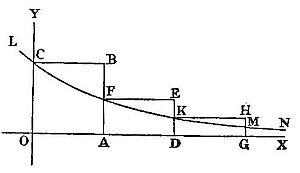
Let , , be rectangular Axes of Reference; and let us trace the Curve , where = unit-line. Hence, when , ; when , ; when , ; when , ; and so on. Hence the Curve is . Also, however large becomes, can never be Zero; i. e. the Strip, intercepted between the Curve and the -Axis, and bounded at the left-hand end by , is Infinite in length. And now let us estimate its area. Its first portion, , is less than the rectangle ; its second portion is less than ; and so on. Hence its area is less than ; i. e., is less than + &c. for ever; therefore, a fortiori, it is less than 2.
Now an area, which is less than '2' is surely Finite? Does the gentle Reader see any escape from admitting this? And, if he admits this, does he still maintain that the width of this Infinite-Strip (which obviously dwindles, as you go along the Strip, but never becomes Zero) never ceases to be Finite? Yet surely a Strip, Infinite in length, and nowhere less than Finite in width, must be Infinite in area?
In brief, I place before my gentle Reader that savouriest of Logical dishes, a Trilemma! Either he must assert that a Strip, Infinite in length, and nowhere less than Finite in width, is only Finite in area; or he must assert that the length of this Strip is Finite, i.e. he must assert that the Curve meets the x-Axis; or else he must admit that its width ceases to be Finite without becoming Zero, i.e. he must admit that its width becomes Infinitesimal! Let him take his choice, and help himself. 'May good digestion wait on appetite, And health on both!'
Now let us cut off, from the infinitely-long Strip named in p. 45, whose area is a square-inch, a piece just an inch long. What will its area be? It is evident that no finite multiple of this short Strip can ever make up the infinitely-long Strip; that is, no finite multiple of its area can make up a square-inch. Hence its area must be an Infinitesimal of the first order.
But this Infinitesimal area, inconceivably small as it is, is nevertheless greater than Zero. Hence our continuously-diminishing Strip is bound, before reaching Zero, to pass through this singularly unassuming value. And, at that moment, what will be its width? Its length will be Infinite, as usual: its area will be an Infinitesimal of the first order: but its width cannot be an Infinitesimal of the same order as the previous width; for that would yield a finite area, as we have seen. What else, then, can it be but an Infinitesimal of the second order? A Line of such stupendous brevity that no finite multiple of it can even make up an Infinitesimal of the first order. Evidently we might repeat this process ad libitum, and so get Infinitesimals of the third order, the fourth order, and so on.
To sum up our results, so far. We see that a Line may be either Finite, or may extend to an Infinity of the first order, or may dwindle to an Infinitesimal of the first, second, or any order we choose: and that an Area may be either Finite, or may extend to an Infinity of the first order (an Infinite-Strip), or of the second order (e.g. the whole Infinite-Plane), or may dwindle to an Infinitesimal of any order we choose.
Now we may reasonably expect to find that all, that has been here said, is equally applicable to any kind of Magnitude that is capable of continuous increase and decrease. Let us consider, then, whether it is possible to have Infinitesimal Angles of the various orders.
§ 3.
Infinitesimal Angles and Sectors.
For this purpose, let us return to our upright Infinite-Plane, and, taking some Point at random as a centre, let us imagine two Lines radiating from it (say at an angle of 45°), and both of them extended to infinity, and therefore having between them a Sector, finite in angular magnitude, infinite in length, and therefore infinite in area.
I named 45° as my specimen-angle, because it is the one single angle, other than a right angle, with which Society is acquainted. Enquire of some chatty traveller, who is relating his experiences of an Alpine Pass, what slope it was that he had to climb. "The ground sloped at an angle of forty-five," he is sure to reply. Nay, I once met a gentleman who, on hearing it mentioned that the 'dip' of a certain river-bed was, in one place, "one in forty-five," cautiously remarked "I suppose that means an angle of forty-five degrees?" Imagine a river sloping at that angle! And then imagine the labour of rowing up it, and the headlong, wild delight of rowing down it! But this is a digression.
Now it clearly is possible, this time, by multiplying this Infinite-Sector by a certain finite number, namely '8,' to make it equal to the whole Infinite-Plane. Hence this Infinite-Sector is an Infinity of the same order as the whole Infinite-Plane; i.e. it is of the second order.
Now let us suppose that the two sides of this Infinite Sector gradually approach each other until they coincide. It cannot be denied that the area then becomes Zero. It has dwindled then, from an Infinity of the second order (when its angular magnitude was finite), down to absolute Zero. And there seems no room to doubt that it has done this continuously, and not 'per saltum.' What values, then, has it gone through on the way? Can we reasonably doubt that it has gone through, first, all Infinities of the first order (during which process its angular magnitude would be an Infinitesimal of the first order), secondly, all Finite values (its angular magnitude being an Infinitesimal of the second order), thirdly, all Infinitesimals of the first order (its angular magnitude being an Infinitesimal of the third order), and so on—the angular magnitude being always two degrees ahead of the area, in this long and fatiguing competition in the Dwindling-Race.
§ 4.
Pairs of Lines.
We are now in a position to examine the phenomena of intersection, or non-intersection, with regard to a Pair of Lines, by imagining one of them to revolve about a fixed Point.
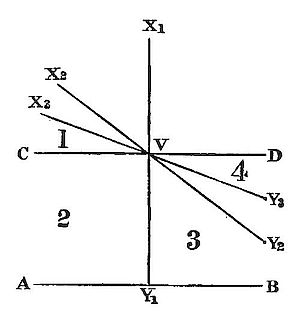
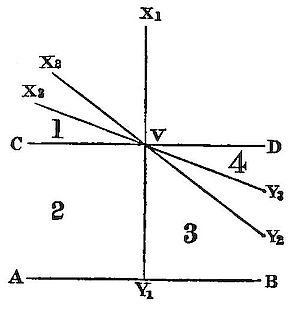
Let be one of the 2 Lines: and let be, at first at right angles to it: and let it then revolve, about , so as to take the successive positions , , , its final position being at right angles to its first position, and therefore parallel to .
Let us further suppose that the angle, contained between and the upper part of the revolving Line, dwindles, from a right angle, through all possible finite lesser values, while its upper edge revolves from , to ; that, the moment the upper edge goes below , this angle becomes an Infinitesimal of the first degree, and so dwindles, through all such values, while its upper edge revolves from to ; that, the moment the upper edge goes below , this angle becomes an Infinitesimal of the second degree; and so on.
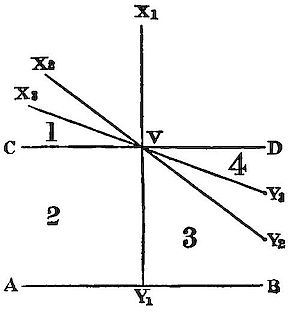
Now let us suppose all the Lines in the diagram to extend to infinity both ways: and let us call the Infinite-Sector, lying between -produced and the upper part of the revolving-Line, 'No. 1'; the semi-Infinite-Strip (I mean, by 'semi-Infinite,' that it is terminated at one end), lying between the Lines -produced and -produced, and bounded at the right-hand end by , 'No. 2'; the surface, lying between the Line -produced and the lower part of the revolving-Line, and bounded at the left-hand end by , (which will be a Triangle, so long as -produced and the lower part of the revolving-Line continue to intersect, and will become a semi-Infinite-Strip when they cease to intersect,) 'No. 3'; and, with regard to the Infinite-Sector lying between the Line -produced and the lower part of the revolving-Line, let us call that portion of it, which lies above -produced (which portion will be a semi-Infinite-Strip, so long as -produced and the lower part of the revolving-Line continue to intersect, and will become the whole Infinite-Sector if they should cease to intersect before the revolving-Line reaches the position ), 'No. 4'; and that portion of it, which lies below -produced (which portion will cease to exist as soon as these Lines cease to intersect) 'No. 5.'
Let us now investigate the changes, in the areas of these 5 surfaces, caused by the changes in the position of the revolving-Line.
First as to No. 1. This is clearly, throughout its history, an Infinite-Sector, whose vertical-angle is at first a right angle, and ultimately Zero. Also its area is at first one-quarter of the whole Infinite-Plane, and ultimately Zero. Also, so long as the upper part of the revolving-Line ranges between and , the area continues to be an Infinity of the second order; and, as the revolving-Line crosses the position , the area changes, from a very small (!) Infinity of the second order, to a very large Infinity of the first order. Similarly, as the revolving-Line crosses the position , the area changes, from a very small Infinity of the first order, to a very large Finite value.
A little further on, it will of course become an Infinitesimal of the first order; and so on, through the other orders, till it finally reaches the value Zero.
Next, as to No. 2. This is clearly, throughout its history, one-half of the Infinite-Strip lying between and , and is therefore an Infinity of the first order. Its area is a constant quantity, being unaffected by the revolving-Line.
Next, as to Nos. 4, 5. (I take these next, because they will help us to investigate the properties of No. 3.) It is evident that, so long as No. 5 continues to exist, the two together constitute—and that, when No. 5 has ceased to exist, No. 4 by itself constitutes—an Infinite-Sector, which is the exact counterpart of No. 1—the two having what Euclid calls 'opposite vertical angles.' Hence, while the lower part of the revolving-Line ranges between and , the area of No. 4 continues to be an Infinity of the second order, and entirely declines to be 'cribb'd, cabin'd, and confined' within such narrow limits as our Infinite-Strip! Hence the revolving-Line continues, all this time, to intersect -produced. (N.B. Here we have a proof of the truth of Euclid's Axiom, when amended, as I have done at p. 28, by inserting the words 'the defect being a finite angle.')
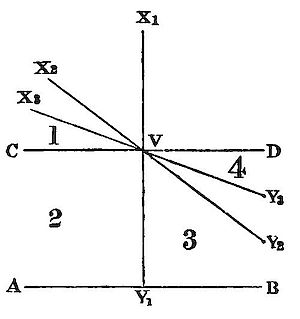
Let us now, reserving for future consideration the phenomena of the period while the upper part of the revolving-Line is crossing from to , suppose it to have passed , so that the angle, which it makes with , has become an Infinitesimal of the second order. Will its lower part continue to intersect -produced? It may easily be shown, by a reductio ad absurdum, that it will not: for, if it did, Nos. 1, 2, 3 would then make up an Infinite Sector, whose vertical angle would be an Infinitesimal of the second order, and whose area would therefore be finite. But the area of No. 2 is always an Infinity of the first order. Which is absurd. Hence, after the upper part of the revolving-Line has passed , its lower part does not intersect -produced.
We have now to answer a far more puzzling question, namely, what happens while the upper part of the revolving-Line is crossing from to ? Does its lower part intersect -produced, all the while? Or does it fall clear of it, all the while? Or does it at first intersect it, and afterwards cease to do so?
First, suppose it to intersect -produced. In this case No. 3 is clearly a closed Triangle, whose vertical-angle is an Infinitesimal of the first order. This looks as if its area must also be an Infinitesimal of the first order: but this, we know, cannot be, since it contains within it the finite area possessed by No. 3 while the upper part of the revolving-Line was passing from to . Hence its area must be, at least, finite. The only way I can see out of this difficulty is to assume that the sides of this Triangle have become infinite; i.e. that the revolving-Line intersects -produced at an infinite distance.
Next, suppose it to fall clear of -produced. In this case No. 3 is a semi-Infinite-Strip, but we cannot be certain that its area is, like such Strips when of a uniform width, infinite; for its width dwindles so much towards the right-hand that it may possibly be, in the early part of the period, finite. I see no way of settling this question; but, luckily, it is not relevant to the question of intersection.
My own inclination is to believe that, during this second period of revolution, the lower part of the revolving-Line at first intersects -produced, at an infinite distance, and then ceases to intersect it.
After the revolving-Line has once ceased to intersect -produced, No. 4 is of course equal to No. 1. That is to say, the surface, lying between the whole revolving-Line and , is, from that moment until the revolving-Line coincides with , of a constant area, since it is the sum-total of Nos. 1, 2, 3, which is equal to the sum-total of Nos. 2, 3, 4, i.e. to the whole Infinite-Strip. And this will continue true, while No. 1 and No. 4 dwindle down, through all finite and infinitesimal values, till they finally reach Zero.
The results we have arrived at will perhaps be more easily understood by examining the following Table of values. The symbols used in it are as follows:—
Symbols. Meanings.
a right angle.
a large finite magnitude
a small " "
a large Infinitesimal of 1st order.
" " 2nd "
a large Infinity of 1st order.
area of the semi-Infinite-Strip No. 2.
[an Infinity of 1st order.]
area of one-fourth of the Infinite-Plane.
[an Infinity of 2nd order.]
Position of upper part of revolving- Line. Vertical angle of Space No. 1. Areas of Spaces.
No. 1. No. 2. No. 3. No. 4. No. 5.
Zero
" "
" "
" ? ? ?
"
" does not
" " exist
" " "
" " "
&c. &c. " " &c. "
Zero. Zero. " " Zero. "
The sum of the whole matter appears to be this. If a Pair of Lines make, with a certain transversal, two interior angles on the same side of it together less than two right angles, then, so long as the defect is finite, there is no doubt that the Lines intersect: also, if the theory be true, that the area of an Infinite-Sector, whose vertical-angle is finite, and whose area is therefore undoubtedly an Infinity of the second order, passes, as its vertical angle dwindles to Zero, through infinite values of the first order, and then through finite values, its vertical angle meanwhile passing through infinitesimal values of the first and second order—if all this be true, it follows that, when the 'defect from two right angles' becomes an Infinitesimal of the first order, the Lines may possibly intersect, but can only do so at an infinite distance; and that, when the defect has become an Infinitesimal of the second order, the Lines have ceased to intersect.
The theory, here discussed, may be bewildering; but it is at least consistent with itself: and it seems to me to be quite as credible as the theory that 'Infinitesimals' are mythical, and that a Finite Magnitude, dwindling down to Zero, continues Finite to its last gasp.
Another process—a negative one—has occurred to me, for disproving the absolute truth of Euclid's Axiom. It is a very simple process, and has the great recommendation of not requiring any belief in the existence of Infinitesimals.
On an upright Infinite-Plane let us suppose 2 horizontal Infinite-Lines, having a common perpendicular, and therefore of course never intersecting. Let us call them 'No. 1' and 'No. 2,' No. 1 being above No. 2: and let us suppose the common perpendicular to be an inch long, so that the 2 Lines are the edges of an Infinite-Strip, whose uniform width is an inch.
Now let us suppose Line No. 1 to begin to revolve about the upper end of the common perpendicular. The believer in the absolute truth of Euclid's Axiom is bound to believe that, in the very act of beginning to revolve, it also begins to intersect No. 2: he cannot allow the one process any such start of the other as might enable him to say "No. 1 has begun to revolve, but has not yet begun to intersect No. 2": such a state of things must be, in his view, absolutely impossible. 'And what's impossible ca'n't be, And never never comes to pass!'
Very good. The actual process of beginning to intersect No. 2 is a deep mystery, no doubt: but that the thing happens is quite undeniable. We are able to say "Now it isn't intersecting No. 2—and now it is!" So, though we cannot conceive how it managed to begin, it has certainly done it.
Now let us suppose another horizontal Line, 'No. 3,' lying an inch below No. 2. The believer in Euclid's Axiom is bound to assert, as to No. 3, exactly what he asserted as to No. 2. Has he, then, any logical escape from the conclusion that the revolving Line begins to intersect Nos. 2 and 3 together? I see none, myself. And yet how can it get at No. 3, without first going through No. 2? Any point on No. 1 (I am careful not to say 'every': I know how gleefully the logical Reader would swoop down upon me with the crushing sarcasm "What does 'every' mean, when there is no limit to the number of points?": but 'any' is a safe epithet) is amenable to the simple rule of "First come, first served. Cross No. 2 first: and afterwards (not by any means simultaneously) you have our gracious permission to cross No. 3." Now, what is true of any point on the Infinite-Line No. 1 is surely true of that Infinite-Line itself? To say "No. 1 intersects No. 3" is tantamount to saying "A certain point of No. 1 has reached No. 3." And how did that Point get below No. 2?
Of two things, one. Either some point of No. 1 has crossed Nos. 2 and 3 at the same moment: or else no point of No. 1 has crossed No. 3 until after it had crossed No. 2. That is a logical Dilemma. Which of its two horns does the Reader prefer?
The choice of the first horn involves the Reader's acceptance of ubiquitous points! In the event of his choosing the second horn, he seems logically bound to admit it as a possible state of things, that No. 1 should have begun to revolve, and yet should not have begun to intersect No. 3—which is a surrender of his belief in the universal truth of Euclid's Axiom.
My final answer, then, to the question "Is Euclid's Axiom true?" is as follows:—
"If the defect, from the sum of two right angles, be finite, the Lines certainly meet: if it be an Infinitesimal of the first order, they may meet, or not, according to circumstances: if it be an Infinitesimal of the second, third, or any higher order, they certainly do not meet."
The question, with which this Appendix is headed, was sufficiently startling: but a more startling one remains to be answered. "If Euclid's Axiom be not universally true, what becomes of all the Propositions which he has made to depend upon it, such as I. 29? Has he done no more than prove them to be partially true?"
To this disheartening question I will give as re-assuring an answer as the case seems to admit of. It must be admitted that Euc. I. 29 requires—if we would make it strictly true—the same limitation as the Axiom: it should run as follows:—"Two Lines, which do not meet, make, with all transversals, angles which are equal so far as finite differences are concerned" (i. e. angles so nearly equal that the difference, if any, is infinitesimal). And of course Euc. I. 32, as proved from Euc. 1. 29, would need a similar qualification. It seems to me very doubtful whether Euclid ever noticed this defect in his Axiom. If he did, it is possible that he may have thought fit to ignore it, on the ground that, when Finite Magnitudes differ only by an Infinitesimal, they are, for all practical purposes, equal.
But I feel bound to admit that, for the purpose of proving Euc. I. 32 to be, as it really is, universally true, neither Euclid's Axiom, nor any other that deals with intersection of Lines, will suffice: and that some Axiom, not involving that principle, must be substituted for it.
Let me say in conclusion that, though I assert the absolute truth of Euclid's Axiom—with the limiting clause I have introduced, 'the defect being a finite angle'—it still remains, in my opinion, a 'disputable' Axiom; i.e. it is not properly admissible as an Axiom, but ought to be, if possible, proved as a Theorem.