A NEW THEORY OF PARALLELS. Book I.
Reading edition
Certain universally-true Propositions, provable from genuine Axioms.
Definitions.
1.
The sum of the angles of a Triangle is called its 'amount.'
2.
Any angular magnitude is called a 'possible amount,' if there be a Triangle whose 'amount' is equal to it: but, if there be no such Triangle, it is called an 'impossible amount.'
3.
If any such angular magnitude vary continuously: whenever it changes from a 'possible amount' to an 'impossible amount,' it is said to pass from a 'possible region,' to an 'impossible region': and vice versâ.
4.
If there be two fixed angular magnitudes such that the varying magnitude, while it continues between them, is always a 'possible amount,' but becomes an 'impossible amount' when it passes beyond them: they are called the 'superior limit,' and the 'inferior limit,' of the 'possible region' which lies between them.
Axioms.
1.
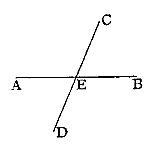
If a Magnitude change from one value to another; and if, in doing so, it vary continuously; and if a certain value, intermediate to its first and last values, be selected: the Magnitude must, at some moment during the process of change, have that selected value.
2.
If two or more Magnitudes be such that, whenever any one of them varies, it varies continuously: then, whenever their sum varies, it varies continuously.
3.
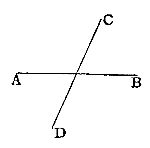
If , , be two Lines intersecting at ; and if be turned about , remaining stationary: each of the angles at varies continuously.
4.
If , , be two intersecting Lines; and if be turned about , remaining stationary: then, so long as the Lines continue to intersect, each of the 4 angles at the Point of intersection varies continuously.
Propositions.
PROP. I. Theorem.
If a Pair of Lines make, with a certain transversal, either (1) a pair of alternate angles equal, or (2) an exterior angle equal to its interior opposite angle on the same side of the transversal, or (3) a pair of interior angles on the same side of the transversal supplementary: they will make, with that transversal, (4), each pair of alternate angles equal, and (5) each of the four exterior angles equal to its interior opposite angle on the same side of the transversal, and (6) each pair of interior angles on the same side of the transversal supplementary.
This Proposition is easily deduced from Euc. I. 13, 15.
Definitions (continued).
5.
Such a Pair of Lines may be said to be 'equally inclined' to that transversal.
PROP. II. Theorem.
If two isosceles Triangles have equal bases but unequal sides: that Triangle, which has the greater sides, has the greater area.
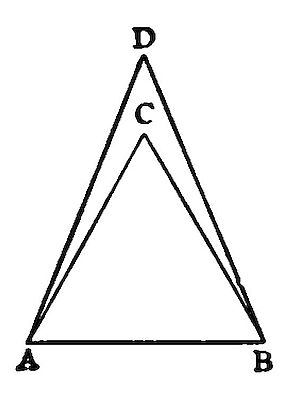
Let the Triangles be set on the same base, and call them , . And let , , be respectively greater than , .
Now cannot fall within the Triangle , or upon either of its sides; for then , would be less than , ;
[Euc. I. 21.
neither can it fall on ; for then , would be equal to , ;
neither can intersect , nor intersect ; for, in either case, if were joined, there would be two Triangles, on the same base , having their coterminous sides equal; which is impossible;
[Euc. I. 7.
, fall outside the Triangle ;
Triangle is greater than Triangle .
Therefore, if two isosceles Triangles &c.
Q.E.D.
PROP. III. Problem.
Given a certain angle; and given that any isosceles Triangle, whose vertical angle is not-greater than the given angle, has its base not-greater than either of its sides: to describe, on a given base, an isosceles Triangle having each base-angle equal to the given angle.
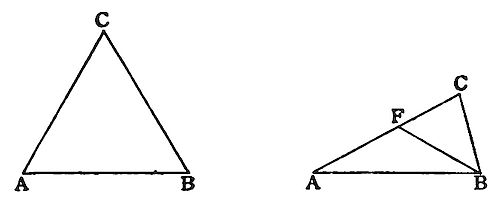
Let be given base.
At , in Line , make angle equal to given angle, making ; and join .
Then, by hypothesis, is not-greater than : i. e. it is either equal to it, or less than it.
First let be equal to . (Fig. 1.)
Then Triangle is equilateral: i. e. it is an isosceles Triangle, on given base , and having each base-angle equal to given angle.
Q.E.F.
Secondly, let be less than . (Fig. 2.)
Then angle is less than angle .
[Euc. I. 18.
At make angle equal to angle .
[Euc. I. 23.
Then Triangle is isosceles, and is on given base , and has each base-angle equal to given angle.
Q.E.F.
Corollary.
The isosceles Triangle, so described, has its vertical angle not-less than either of its base-angles.
For, in Fig. 1, ;
.
Q.E.D.
Again, in Fig. 2, ;
.
But angle is greater than angle ;
[Euc. I. 16.
and angle is less than angle ;
.
Q.E.D.
PROP. IV. Theorem.
Either all Triangles have the same 'amount'; or else, if , be two 'possible amounts,' that is, 'amounts' belonging to existing Triangles, then any 'amount,' intermediate to and , is also 'possible.'
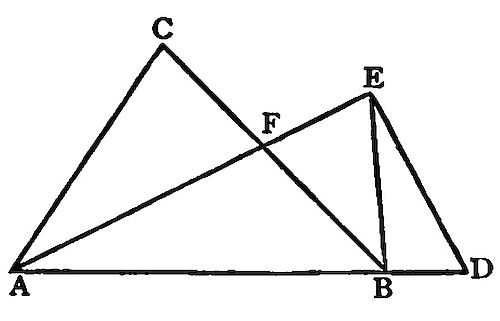
If all Triangles have the same amount, the Proposition is true. If not, let , be two Triangles whose amounts are different. Call their 'amounts' ', .' And let the two Triangles be placed so as to have a common vertex at , and their bases in the same straight Line.
Now Triangle may be converted into Triangle by making the point, where intersects , move from to , remaining stationary.
And, during this process, the angle at will vary continuously,
[Ax. 4.
and the angle, at the point where the revolving Line intersects , will vary continuously;
[Ax. 5.
the sum of these angles will, if it vary at all, vary continuously.
[Ax. 3.
Similarly, Triangle may be converted, first, into Triangle , by making the point, where intersects , move from to , remaining stationary, and then into Triangle , by making the point, where intersects , move from to , remaining stationary.
And, during the whole process, the 'amount' of the changing Triangle will, if it vary at all, vary continuously.
Hence, in changing from the value to the value , it must pass through all intermediate 'amounts': i. e. all intermediate 'amounts' are 'possible.'
[Ax. 2.
Therefore either all Triangles have &c.
Q.E.D.
Corollaries.
1.
Among angular magnitudes there is one, and only one, 'possible region.'
2.
This 'possible region' either consists of one single angular magnitude, such that it, and it alone, is a 'possible amount'; or it consists of a continuous series of angular magnitudes, lying between 2 'limits,' which 2 limits are such that any magnitude, lying between them, is a 'possible amount,' and any magnitude, lying outside them, is an 'impossible amount.'
PROP. V. Theorem.
The angles of any Triangle are together less than three right angles.
Let a right angle be represented by '.'
Now any 2 of the angles of a Triangle are together less than ;
[Euc. I. 17.
, adding together the 3 pairs which may be taken, the 3 angles of a Triangle, taken twice over, are together less than ;
, taken once only, they are together less than .
Therefore the angles of any Triangle &c.
Q.E.D.
PROP. VI. Theorem.
There is a Triangle whose angles are together not-greater than two right angles.
If we deny this, we must assert that any 'amount' is greater than .
Let this be our First Hypothesis.
Now any 'amount' is less than .
[Prop. 5.
Hence the 'possible region' lies below ; i. e. it has a 'superior limit.'
Now let a 'possible amount' be selected, more than half-way from to the 'superior limit' of this region; and call it '.' Then it is evident that will lie above this limit, and will therefore be an 'impossible amount.'
Now any Triangle, whose 'amount' is , must be either obtuse-angled, or right-angled, or acute-angled.
Hence we must assert that there is either an obtuse-angled Triangle, or a right-angled Triangle, or an acute-angled Triangle, whose 'amount' is .
Let these be our Second, our Third, and our Fourth Hypotheses.
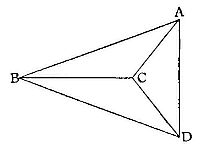
Call the Triangle '.'
First, let it be obtuse-angled; and let be the obtuse angle.
At Point , in Line , make angle equal to angle , making equal to ; and join and .
Then Triangle is equal, in all respects, to Triangle ;
[Euc. I. 4.
its 'amount' = ;
also 'amount' of Triangle is, by our First Hypothesis, greater than ;
'amounts' of the 3 Triangles are together greater than .
But these make up 'amount' of Triangle , plus angles about , which = ;
[Euc. I. 13. Cor.
'amount' of Triangle , plus , is greater than ;
this 'amount,' alone, is greater than ; which is absurd, since the latter lies above the 'superior limit,' and is therefore an 'impossible amount.'
Hence our Second Hypothesis is false; i.e. no obtuse-angled Triangle can have the amount .
Secondly, let it be right-angled; and let be the right angle.
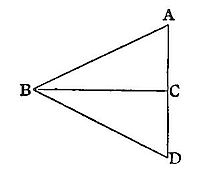
At Point , in Line , make angle equal to angle , i. e. equal to ; and make ; and join .
Then , , are in one straight Line.
[Euc. I. 14.
Also Triangle is equal, in all respects, to Triangle ;
[Euc. I. 4.
its 'amount' = ;
'amounts' of the 2 Triangles together = .
But these make up 'amount' of Triangle , plus angles at , which = ;
'amount' of Triangle , plus ;
this 'amount,' alone, = ; which is absurd.
Hence our Third Hypothesis is false; i.e. no right-angled Triangle can have the amount .
Thirdly, let it be acute-angled.
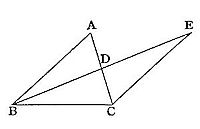
Bisect at ; join , and produce it to , making ; and join .
Now angles , , are equal, being vertical;
[Euc. I. 15.
Triangles , , are equal in all respects;
[Euc. I. 4.
angle = angle ; and angle = angle ;
'amount' of Triangle = that of Triangle .
Again, angle = angle ;
angles , together = angle ;
they are together less than ;
angle is, by our First Hypothesis, greater than ;
i. e. Triangle is obtuse-angled;
its 'amount' cannot be ;
'amount' of Triangle cannot be .
Hence our Fourth Hypothesis is false; i.e. no acute-angled Triangle can have the 'amount' .
Hence, no Triangle can have this amount.
Hence our First Hypothesis, that any 'amount' is greater than , is false.
Therefore there is a Triangle &c.
Q.E.D.
Corollary.
The 'possible region' does not lie wholly above two right angles.