Part 1 — APPENDIX IV.
Reading edition
How the Question stands to-day.
I will first enumerate certain Theorems connected with Pairs of Lines.
I will then notice three other methods which have been suggested for superseding Euclid's Axiom.
And, in conclusion, I will indicate what seem to me the most hopeful directions for future efforts at exploring this fascinating, but very obscure, region of mathematical research.
§ 1.
Certain universally-true Theorems, provable from genuine Axioms (i. e. from Axioms whose self-evident character is indisputable).
(1) A Pair of Lines, which are equally inclined to a certain transversal, are non-intersectional (i. e. never intersect, however far produced). [Euc. I. 27, 28.]
(2) [contranominal of (1)] A Pair of intersectional Lines (i. e. which either intersect or would do so if produced) are unequally inclined to any transversal. [Euc. I. 16, 17.]
(3) A Pair of Lines, such that two Points on one of them are on the same side of, and equidistant from, the other, are non-intersectional.
(4) [contranominal of (3)] A Pair of intersectional Lines are non-equidistantial (i. e. are such that any two Points on either of them, which are on the same side of the other, are non-equidistant from it, that which is further from the Point of intersection being also further from the other Line).
(5) If there be a Triangle whose angles are together equal to two right angles: the angles of any Triangle are together equal to two right angles.
(6) There is a Triangle whose angles are together not-greater than two right angles.
§ 2.
Certain universally-true Theorems, not provable from genuine Axioms, but provable if any one of them be accepted as an Axiom.
[N.B. These will be hereafter referred to as the 'Nine Quasi-Axioms,' their self-evident character being disputable.]
(1) Through a given Point, outside a given Line, a Line may be drawn, such that the Pair shall be equally inclined to any transversal.
(2) A Pair of Lines, which are equally inclined to a certain transversal, are so to any transversal. [Deducible from Euc. I. 27, 28, 29.]
(3) [contranominal of (2)] A pair of Lines, which are unequally inclined to a certain transversal, are so to any transversal.
(4) If a Point move so as to be at a constant distance from a given Line, its path shall be a straight Line.
*(5) Through a given Point, outside a given Line, a Line may be drawn equidistantial from the given Line (i. e. such that any two Points on it shall be equidistant from the given Line).
(6) A Pair of Lines, such that two Points on one of them are on the same side of, and equidistant from, the other, are equidistantial (i. e. are such that any two Points on either of them are equidistant from the other).
(7) [contranominal of (6)] A Pair of Lines, such that two Points on one of them are non-equidistant from the other, are non-equidistantial (i. e. are such that any two Points on either of them, which are on the same side of the other, are non-equidistant from the other).
*(8) A Line cannot recede from and then approach another; nor can it approach and then recede from another while on the same side of it.
*(9) In any Circle, the inscribed equilateral Tetragon is greater than any one of the Segments which lie outside it.
If any one of these 9 Theorems be granted as an Axiom, the rest can be proved from it. But only 3 of them, so far as I know, have been used as Axioms—No. 5 by Clavius, No. 8 by Dr. R. Simson, and No. 9 by myself. Clavius' Axiom requires us to assure ourselves that it will continue true when the Lines are produced without limit; and the strain on the imagination, caused by the effort of following them into Infinite Space, is one to be, if possible, avoided. Dr. R. Simson's Axiom gains a certain plausibility from the fact that, for intersecting Lines, it admits of actual proof (see § 1. (4)): where, however, the Lines are not known to intersect, it is an appeal to the eye, of very doubtful force.
§ 3.
Certain universally-true Theorems, not provable from genuine Axioms, but provable if any one of the 'Nine Quasi-Axioms,' given in § 2, be accepted.
(1) There is a finite angular magnitude such that the angles of any Triangle are together not-less than it.
(2) There is a Triangle whose angles are together not-less than two right angles.
(3) There is a Triangle whose angles are together equal to two right angles.
(4) The angles of any Triangle are together equal to two right angles. [Euc. I. 32.]
§ 4.
Certain partially-true Theorems, not provable from any universally-true Axioms, whether genuine or 'quasi,' but provable if any one of themselves be accepted as an Axiom.
[N.B. By 'partially-true' is meant 'true for finite magnitudes.' They become universally-true, if 'magnitude' be taken to mean 'finite magnitude'; 'equal' to mean 'not differing by a finite difference'; 'unequal' to mean 'differing by a finite difference'; 'multiplied' to mean 'multiplied by a finite number'; and 'intersectional' to mean 'intersectional at a finite angle.'
These Theorems will be hereafter referred to as the 'Nine Pseudo-Axioms,' the name being chosen to indicate that they are not even universally true—far less self-evident.]
(1) The lesser of two homogeneous Magnitudes may be so multiplied as to exceed the greater.
(2) A Pair of Lines, which are unequally inclined to a certain transversal, are intersectional. [Euclid's Axiom.]
(3) [contranominal of (2)] A Pair of non-intersectional Lines are equally inclined to any transversal. [Euc. I. 29.]
(4) A Pair of Lines, such that two Points on one of them are non-equidistant from the other, are intersectional.
(5) [contranominal of (4)] A Pair of non-intersectional Lines are equidistantial.
(6) On either of two intersectional Lines a Point may be found, whose distance from the other Line shall exceed any assigned length.
(7) On either of two intersectional Lines a Point may be found, such that the distance, from its projection on the other Line to the point of intersection of the two Lines, shall exceed any assigned length.
(8) A Pair of intersectional Lines cannot be, both of them, non-intersectional with a third Line.
(9) [contranominal of (8)] A Pair of Lines, which are, both of them, non-intersectional with a third Line, are non-intersectional.
Six of these have been used as Axioms, viz. (2), which is Euclid's celebrated Axiom; (4), by T. Simpson; (6), by Proclus; (7), by Franceschini; (8), by Ludlam, Playfair, &c.; (1), by Legendre, in the 12th Volume of the 'Memoirs of the Institute,' being his "latest attempt" (I quote from De Morgan's article on Parallels in Knight's Cyclopædia) "at the solution of the problem." He only succeeds, however, in proving Prop. 6 at p. 10 of this book, and in proving that Prop. 8, at p. 26, follows logically from Prop. 4, at p. 22. In order to prove Euc. I. 32, he introduces the principle of Limits and Vanishing Quantities, which takes us at once into the region of Infinities and Infinitesimals. But a greater success than this has, I understand, rewarded some recent investigations made by Professor J. Cook Wilson, of Oriel College, Oxford, who has deduced Euclid's 12th Axiom from No. (1) of this Section.
In all these systems, however, including Euclid's, the deductions, from the proposed Axiom, labour under the same defect as the Axiom itself, that is, they are only partially, and not universally, true.
§ 5.
Other methods of treatment.
Three other methods of treating this subject call for notice.
Playfair and (more recently) Wilson have tried to deduce the properties of Parallels (and thence Euc. I. 32) from the idea of sameness of direction, as predicated of two non-coincidental Lines (i. e. which do not lie in one and the same straight Line).
The foundation-stones of this Theory—without which it has no raison d'être whatever—are the two Axioms, which must necessarily be somewhere assumed, whether expressly or tacitly, first, that it is possible for non-coincident Lines to have 'the same direction'; and secondly, that Lines, which have the same direction, make equal angles with all transversals.
Before discussing the first of these two Axioms, permit me to remind the Reader that the question before us is not "is it true?" but "is it axiomatic?", that is, 'does the average human intellect accept it as true, without proof?' It is a question in Mental Physiology rather than in Geometry. The 47th Proposition of Euclid is quite as true as the Axiom 'things that are equal to the same are equal to one another'; but the average human intellect, while accepting the latter without proof, does most certainly demand a good deal of proof before it will accept the former. Intellectual beings may conceivably exist, to whom Euc. I. 47 is axiomatic; but our books are not written for them.
Now there is one preliminary step, that is absolutely indispensable before the human intellect can accept any Axiom whatever: and that is, it must attach some meaning to it. We cannot, rationally, either assent to, or deny, any Proposition the words of which convey to us no idea.
We have, then, two questions to answer: first, "what idea is conveyed to the average human intellect by the phrase 'in the same direction,' when applied to non-coincident Lines?", secondly, "in accepting the Axiom, that 'Lines, which have the same direction, make equal angles with all transversals,' to what other assertions are we committing ourselves?"
If we contemplate a fixed Point in a Plane, and imagine one or more Lines passing through it, it is not difficult to grasp the following ideas—that the 'direction' of any such Line is that property of it which determines its position, now that one Point in it is already fixed—that any two such Lines form 4 angles, whose common vertex is the fixed Point—that, if one of those 4 angles be zero, the 2 Lines coincide; if not, they intersect—that, in the first case, they have the same direction, in the second, different directions—and that the difference of the directions of such Lines is measured by the angle between them.
But these ideas are of little use to us, when confronted with a given Line and a given Point outside it, and when told to imagine a new Line drawn, through the given Point, and 'in the same direction' as the given Line, the 2 Lines having no common Point. For the directions of the Lines are no longer directly comparable. There is no use in asking "do they contain a zero-angle?" when they contain no angle whatever. An angle cannot exist without a vertex: and where is the vertex?
What idea, then, is conveyed to the mind by the phrase "these Lines have the same direction"? If they were finite Lines, and the question concerned sameness of length, the process, of grasping this idea, would be a very simple one. We could either imagine one of the 2 Lines laid upon the other, and then apply the Axiom 'magnitudes which coincide are equal': or we could imagine a movable third Line, first applied to one of the 2 Lines and ascertained to have 'the same length' with it, and then carried across the intervening space and applied to the other Line; and, on finding it to have 'the same length' with that also, we should pronounce the 2 Lines to have 'the same length,' in full confidence that our movable Line had preserved its length unchanged during the journey.
Can we, then, use a similar process in grasping the idea of sameness of direction? That is, can we imagine a movable third Line, first applied to one of the 2 Lines and ascertained to have 'the same direction' with it, and then carried across the intervening space and applied to the second Line, to see if it has 'the same direction' with it also? But this process would convey to the mind no idea of 'sameness of direction,' unless we had some guarantee that the movable Line had preserved its direction unchanged during the journey. The only process, for securing this, that presents itself to my mind, is to imagine a transversal, cutting the 2 Lines, and thus bridging over the intervening space, and then to imagine the movable Line shifted along it, so as always to cut it at a constant angle.
I have thought this matter out very carefully, and I feel convinced that this is the mental process by which we grasp the idea of 'sameness of direction,' when predicated of Lines that have no common Point, and therefore cannot be said to contain a zero-angle.
Now this 'constant angle' is of course the angle at which the transversal cuts the first Line. Hence, the mental picture of a Line moving away from another, and yet maintaining 'sameness of direction' with it, is the picture of its so moving as that a certain transversal shall cut the two Lines at the same angle. And this is my answer to our first question, namely, "what idea is conveyed to the average human intellect by the phrase 'in the same direction,' when applied to non-coincident Lines?"
If this be granted, our second question, "in accepting the Axiom that 'Lines, which have the same direction, make equal angles with all transversals,' to what other assertions are we committing ourselves?", must be answered "we are consciously committing ourselves to the assertion that Lines, which are equally inclined to a certain transversal, are so to any transversal."
We see, then, that, if this be so, the advocates of the Direction-Theory have not escaped the necessity of assuming, as axiomatic, the second Theorem enunciated in § 2. (See p. 63.)
I must ask the Reader's pardon for this long digression: but the fallacy, which (as I believe) lies at the root of the Direction-Theory, is a very subtle one, and has cost me a great many hours of hard thinking to un-earth it.
Yet another process has been invented—quite fascinating in its brevity and its elegance—which, though involving the same fallacy as the Direction-Theory, proves Euc. I. 32 without even mentioning the dangerous word 'Direction.'
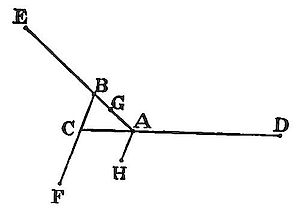
We are told to take any Triangle ; to produce to ; to make part of , viz. , revolve, about , into the position ; then to make part of this Line, viz. , revolve, about , into the position ; and lastly to make part of this Line, viz. , revolve, about , till it lies along , of which it originally formed a part. We are then assured that it must have revolved through 4 right angles: from which it easily follows that the interior angles of the Triangle are together equal to 2 right angles.
The disproof of this fallacy is almost as brief and elegant as the fallacy itself. We first quote the general principle that we cannot reasonably be told to make a Line fulfil two conditions, either of which is enough by itself to fix its position: e.g. given 3 Points, , , , we cannot reasonably be told to draw a Line, from , which shall pass through and : we can make it pass through , but it must then take its chance of passing through ; and vice versâ.
Now let us suppose that, while one part of , viz. , revolves into the position , another little bit of it, viz. , revolves, through an equal angle, into the position ; and that, while revolves into the position of lying along , revolves—and here comes the fallacy. You must not say "revolves, through an equal angle, into the position of lying along ," for this would be to make fulfil two conditions at once. If you say that the one condition involves the other, you are virtually asserting that the Lines , are equally inclined to —and this in consequence of having been so drawn that these same Lines are equally inclined to . That is, you are asserting § 2. (2). (See p. 63.)
One other proof—a very beautiful one, though largely dealing with Infinities and Infinitesimals—may here be mentioned, that of M. Bertrand. It rests on the principle that an infinite Sector (with a vertical angle which has a finite ratio to a right angle) is an Infinity of the same order as an infinite Plane, whereas an infinite Strip (i. e. the area contained between 2 'separational' Lines) is an Infinity of a lower order. Hence he concludes that no such Sector, however small its vertical angle, will lie wholly between 2 such 'separational' Lines, however far apart: hence, if a Line intersect one of 2 'separational' Lines, it must, if produced, intersect the other. He thus proves the Theorem numbered (8) in § 4: but his results are, of course, only partially, and not absolutely, true.
As a rather interesting example of the ease with which an unwary explorer may tumble into a pit-fall, I may refer to a "Note on Euclid's 12th Axiom" by a Mr. W. Hanna, which will be found at p. 27 of Vol. XIII of "Mathematical Questions" reprinted from the "Educational Times." Mr. Hanna takes two Lines, situated as in Euclid's Axiom, and drops a perpendicular, from a point on one, upon the other: from the foot of this he drops a second perpendicular back upon the first line: and so on, backwards and forwards, till the diagram slightly resembles the side of a laced-up boot. He then easily proves that these perpendiculars continually decrease in length. From this he infers that "the perpendicular will ultimately become less than any assignable line"! The fallacy is really too obvious to be worth pointing out.
Another writer in the "Educational Times" (Mr. J. Walmsley, B.A.: his article will be found at p. 103 of Vol. XVII of the Reprint) has fallen into a rather less obvious trap. He endeavours to prove that "any straight line, perpendicular to one of two parallel straight lines, will meet the other." (This, if it could be proved without assuming any disputable Axiom, would indeed be a splendid success! Mr. J. Walmsley has hardly realised, as yet, the fearful difficulty of persuading two Lines, under any conceivable circumstances, to do such a thing as "meet." Whether, at the outset of geometrical discovery, Lines were not properly introduced to each other—or whether some mischief-making Point has been insinuating that one of them went and intersected another when it was looking the other way—certain it is, that Lines will do almost anything you like to propose, rather than "meet" one another!) Mr. Walmsley assumes, as axiomatic, that when one Line lies between two others (whatever "between" may mean), those two others lie on opposite sides of it. Now let Mr. Walmsley (or any other champion of his theory) draw three Lines diverging from a Point at equal angles (of 120° each), and thus dividing the infinite Plane into three equal Sectors. In each of these Sectors let him draw a branch of a Hyperbola, having the sides of the Sector as its Asymptotes. Now, each of these Hyperbolæ lies (in a way) "between" the other two: and yet no two can be said to lie on opposite sides of the other one! "But," says Mr. Walmsley (or the champion aforesaid) "these are Curves, not straight Lines!" Most true: but how are you to know that straight Lines will not behave just like Hyperbolæ, if only they are put far enough apart? Produce those three radiating Lines, that we began with, until each is a million miles long (paper, pen, and ink, provided regardless of expense): then, across their extremities, draw three Lines perpendicular to them. Why shouldn't these three Lines (of course shunning a "meeting," as all Lines do) perpetually face inwards, so that no one of them ever commits the discourtesy of turning its back upon either of the other two? "It cannot be," say Messrs. Walmsley and Co.: "these Lines must intersect, if produced far enough." What? In consequence of their relative situation? That relative situation being, for each pair of them, that they make with a certain transversal two interior angles together less than two right angles? In assuming this, I very much fear that Messrs. Walmsley and Co. are performing the not-wholly-unprecedented feat of assuming Euclid's 12th Axiom!
§ 6.
The Outlook.
In conclusion let me address myself to the young and eager explorer who, Alpine-staff in hand, and duly furnished with all the necessaries for his perilous quest—pick-axe, theodolite, paper-collars, Brown's Sticking-Plaster, Jones's Cough-Pills, and Robinson's Insect-Powder, "the only known remedy for Phlebitis"—is preparing to sally forth, to do or die!
To him let me address myself, as being, perchance, an older and a more experienced traveller—one who has wandered much, and pondered long, and who can best describe himself in the words of a lady well-known in the literary world (I am glad to have this opportunity of recording them, as they have never been printed. They were written "for music," for which purpose, I imagine, the amount of sense required is not excessive).
"I have wandered, I have pondered, I have squandered Many a boon: In the sadness, In the gladness, In the madness Of the moon. "Seek thy pillow By the billow, Where the willow Doth not weep: Few will wonder Who lies under, Hearing thunder, Fast asleep!"
Poetry like this speaks for itself: vain were it to hope that any poor words of mine could serve to illuminate, or even elucidate, its almost ethereal beauty!
To what point of the compass, then, should this young and eager explorer be advised to direct his steps?
I think his best chance—and that only a slender one—is to find some elementary proof for my Axiom, or for one of the many Theorems which will serve the same purpose, a few of which I will enumerate. In the first place, any Polygon will do, and any ratio, between it and the out-lying Segment, so long as it is a finite ratio. What I want it for is to prove that there is some isosceles Triangle, with a definite vertical angle (i. e. some named fraction of a right angle), whose base is less than one of its sides. And that, again, is wanted in order to prove it possible to draw, on a given base, an isosceles Triangle, whose base-angles shall have some nameable value. And that, again, is wanted in order to prove that there is some finite minimum value for the sum of the angles of a Triangle. And that, again, is wanted in order to prove Prop. 3, at p. 19. So, if any one of these propositions could be either assumed as an Axiom or proved as a Theorem, it would suffice for the proof of Euc. I. 32 and Co.
If, for example, you will grant me, as an Axiom, that there is some finite minimum value for the sum of the angles of a Triangle, no matter how small you make it, all is easy at once: grant me, for instance, that no Triangle can possibly have the sum of its angles less than a millionth of a right angle, and I am happy!
Finally, I am inclined to believe that, if ever Euc. I. 32 is proved without a new Axiom, it will be by some new and ampler definition of the Right Line—some definition which shall connote that peculiar and mysterious property, which it must somehow possess, which causes Euc. I. 32 to be true. Try that track, my gentle Reader! It is not much trodden as yet. And may success attend your search!
THE END.
[TURN OVER.