Book II.
Reading edition
Certain universally-true Propositions, not provable from genuine Axioms, but provable if the following Axiom be accepted.
[N.B. This Axiom cannot claim to be more than a 'Quasi-Axiom,' i. e. one whose self-evident character is disputable.]
Axioms.
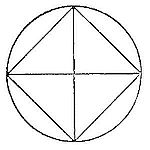
1.
In any Circle, the inscribed equilateral Tetragon is greater than any one of the Segments which lie outside it.
Note.—If, in any Circle, 2 Diameters be drawn at right angles to each other, and their extremities joined, the joining Lines will, by Euc. I. 4 be equal to each other. Hence the Figure, thus formed, will be an inscribed equilateral Tetragon. (It will also be equiangular; but that is of no importance for our present purpose.)
PROP. I. Theorem.
An isosceles Triangle, whose vertical angle is one-eighth of a right angle, has its base less than either of its sides.
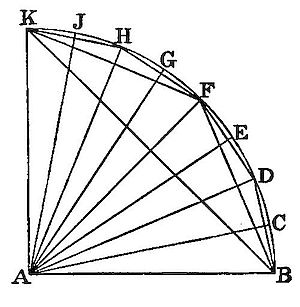
Let be an isosceles Triangle, whose vertical angle at is one-eighth of a right angle.
It shall be proved that is less than .
If we deny this, we must assert that is not-less than .
Let this be our Hypothesis.
Construct 7 more Triangles , &c., equal to . With centre , and distance , describe quadrant passing through , , &c. (See Note.) And join , , , , , , .
Note.—The Reader is requested to imagine chords drawn to the arcs , , &c.
Then Triangle is one-fourth of an equilateral Tetragon inscribed in the Circle.
Hence, 4 times this Triangle is greater than Segment .
[II. Ax. 1.
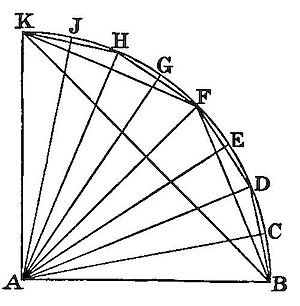
Because angle is greater than angle , and that angle is less than angle ;
angle is greater than angle ;
is greater than .
[Euc. I. 19.
Similarly, is greater than .
Hence, on our Hypothesis, and are both of them greater than .
Also, is greater than ;
Triangle is greater than Triangle ;
[I. Prop. 2.
to each of these add Triangle ;
Figure is greater than twice Triangle .
Again, is greater than ;
Triangle is greater than Triangle ;
[I. Prop. 2.
Triangles , are together greater than Figure ;
to each of these add Figure ;
Figure is greater than twice Figure , i.e. greater than 4 times Triangle .
Again, is not-less than ;
Triangle is not-less than Triangle ;
[I. Prop. 2.
Triangles , , , are together not-less than Figure ; i.e. they are together greater than 4 times Triangle ;
, a fortiori, Segment is greater than 4 times Triangle .
But this is absurd, since it has been already proved less than 4 times this Triangle.
Hence our Hypothesis, that is not-less than , is false; i.e. is less than .
Therefore an isosceles Triangle &c.
Q.E.D.
Corollary.
Hence, by Book I, Prop. III, it is possible to describe, on a given base, an isosceles Triangle having each base-angle equal to one-eighth of a right angle.
PROP. II. Theorem.
The angles of any Triangle are together not-less than one-eighth of a right angle.
Let one-eighth of a right angle be represented by '.'
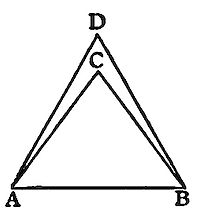
Let be a Triangle; it shall be proved that its 'amount' is not-less than .
If we deny this, we must assert that its 'amount' is less than .
Let this be our Hypothesis.
Hence each of its angles is less than .
On describe an isosceles Triangle having each base-angle equal to ;
[II. Prop. 1. Cor.
hence , , must lie within this Triangle;
i.e. Triangle must lie within it;
angle is less than angle ;
[Euc. I. 21.
i.e. less than ;
but angle is not-less than angle ;
[I. Prop. 3. Cor.
i.e. not-less than ; which is absurd.
Hence our Hypothesis, that 'amount' of Triangle is less than , is false; i.e. it is not less than .
Therefore the angles of any Triangle &c.
Q.E.D.
Corollary.
The 'possible region' does not extend below one-eighth of a right angle.
PROP. III. Theorem.
There is a Triangle whose angles are together not-less than two right angles.
If we deny this, we must assert that any 'amount' is less than .
Let this be our First Hypothesis.
It shall be proved that, if we assert this, we must also assert that any 'amount' is not-less-than , where '' represents one-eighth of a right angle.
If we deny this, we must assert that there is an 'amount' less than .
Let this be our Second Hypothesis.
Now we know that the 'possible region' does not extend below ;
[II. Prop. 2. Cor.
i.e. it has an 'inferior limit.'
Let a 'possible amount' be selected, more than half-way from to this 'inferior limit,' and call it '.' Then it is evident that will lie below the 'inferior limit,' and will therefore be an 'impossible amount.'
Let a Triangle be taken, whose 'amount' is ;
any one of its angles, which is not-greater than either of the others, is not-greater than ; i.e. is less than .
Call this angle '.'
Now one, at least, of the remaining angles must be acute.
[Euc. I. 17.
Call this ''; and call the third angle .
Let 2 such Triangles, and , be taken; and let them be so placed that their -vertices coincide and their -sides lie in one straight line; and join .
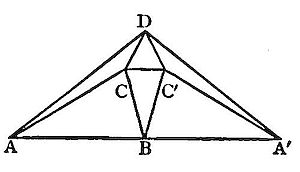
On describe an isosceles Triangle , having each base-angle equal to .
[II. Prop. 1. Cor.
Now each of the angles , , is less than .
Lines , , will fall within angles , ;
i.e. Figure will fall within Triangle .
Join , DC′.
Now 'amounts' of Triangles , , together = , and those of the other 4 Triangles are, by our First Hypothesis, together less than ;
'amounts' of all 6 Triangles are together less than ;
but these make up 'amount' of Triangle , plus angles at , , , which together = ;
'amount' of Triangle , plus , is less than .
Now we know that is not-greater than ;
, adding these inequalities, 'amount' of Triangle , plus , is less than ;
this 'amount,' alone, is less than ; which is absurd, since the latter lies below the 'inferior limit,' and is therefore an 'impossible amount';
one of our two Hypotheses must be false;
i.e. either there is an 'amount' not-less than , or else any 'amount' is not-less than .
Suppose we maintain our First Hypothesis: then we must abandon our Second; i.e. we must admit that any 'amount' is not-less than .
It shall be proved that, in this case, we must also admit that any 'amount' is not-less than .
For, if we deny this, we must assert that there is an 'amount' less than .
Let this be our Third Hypothesis.
Then, in the above proof, and may be replaced by and , and a similar absurdity will follow.
Hence either our First or our Third Hypothesis must be false;
i.e. either there is an 'amount' not-less than , or else any amount is not-less than .
A similar proof will hold for ; and then for .
Hence, either there is an 'amount' not-less than , or else any amount is not-less than .
But .
Hence the second clause of this alternative contains the first.
Hence the first clause must be true.
That is, there is a Triangle &c.
Q.E.D.
Corollary.
The 'possible region' does not lie wholly below two right angles.
PROP. IV. Theorem.
There is a Triangle whose angles are together equal to two right angles.
For the 'possible region' does not lie wholly above ;
[I. Prop. 6. Cor.
neither does it lie wholly below ;
[II. Prop. 3. Cor.
it includes .
[I. 4. Cor. 2.
That is, there is a Triangle &c.
Q.E.D.
PROP. V. Theorem.
There is a quadrilateral Figure which is 'rectangular,' that is, which has all its angles right angles.
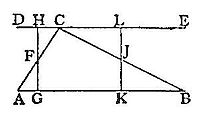
Let be a Triangle whose 'amount' = .
[II. Prop. 4.
At make angle equal to angle , and angle equal to angle ;
hence angles , , , together = ;
, , are in a straight Line.
[Euc. I. 14.
Bisect at ; from draw perpendicular to ; from cut off equal to ; and join .
, in Triangles , , , , are respectively equal to , , and angle to angle , [Euc. I. 4.
the Triangles are equal in all respects;
angle is a right angle;
and angle ;
angles , , together = angles , ; i. e. together = ;
, are in a straight line;
[Euc. I. 14.
is a common perpendicular to Lines , .
Similarly, by bisecting at , it may be proved that is a common perpendicular.
Hence Figure is rectangular.
Therefore there is a quadrilateral Figure &c.
Q.E.D.
Definition.
A rectangular quadrilateral Figure may be called a 'Rectangle.'
PROP. VI. Theorem.
The opposite sides of a Rectangle are equal.
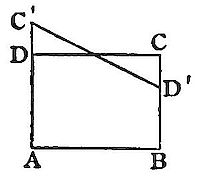
Let be a Rectangle; and let it be reversed so that , , may change places.
Then will lie along , and along .
Now, if were not equal to , , , would not change places, but would take new positions, as ;
hence exterior angle would be greater than interior opposite angle ;
[Euc. I. 18.
but they are also equal, being right angles; which is absurd;
.
Similarly it may be proved that .
Therefore the opposite sides &c.
Q.E.D.
PROP. VII. Theorem.
There is a Pair of Lines, each of which is 'equidistant' from the other, that is, is such that all Points on it are equally distant from the other Line.
Let be a Rectangle; and let a vertical Line be supposed, first to coincide with , and then to move along , continuing always at right angles to it, till it reaches some intermediate position .
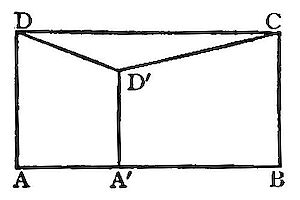
Now, if its top be not now on , it must have either dropped below it or risen above it.
First, let it be supposed to have dropped below it: and join , .
Then, if the Figure be reversed, and applied to the same base, it is evident that and will exchange places;
angle , i.e. it is less than ;
Similarly angle is less than ;
but angle is less than .
angles at are together less than ; which is absurd;
[Euc. I. 13. Cor.
top of vertical Line has not dropped below .
Similarly it may be proved that it has not risen above .
Hence it moves along ; i. e. it describes a straight Line, and will evidently continue to do so, however far the vertical Line move, either way, along .
Therefore there is a Pair of Lines &c.
Q.E.D.
Corollaries.
1.
If a Pair of Lines have a common perpendicular: each of them is equidistant from the other.
Corollary 2.
It is possible to form a Rectangle of any given width and height.
For, in the above Pair of horizontal equidistant Lines, 2 common perpendiculars may be drawn, at a given width apart; and the Figure, so formed, will be a Rectangle; and its sides will be a Pair of vertical equidistant Lines, which may be treated in the same way.
PROP. VIII. Theorem.
The angles of any Triangle are together equal to two right angles.
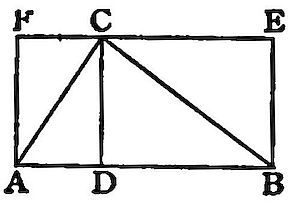
Let be a Triangle, so placed that each base-angle is acute; from draw perpendicular to ; and make Rectangles , .
[II. Prop. 7. Cor. 2.
has its opposite sides equal,
[II. Prop. 6.
, in Triangles , , the sides of the one are respectively equal to the sides of the other;
;
[Euc. I. 8.
Similarly angle ;
the angles of the Triangle together = the angles , , ; i. e. together = .
Therefore the angles of any Triangle &c.
Q.E.D.
PROP. IX. Theorem.
A Pair of Lines, which are equally inclined to a certain transversal, are so to any transversal.
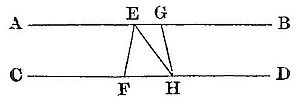
Let , , be equally inclined to transversal ; and let be any other transversal.
Join .
Now 'amounts' of Triangles , , together = .
[II. Prop. 8.
But these make up angles of Figure ;
angles of Figure together = ;
but angles , together = ;
[I. Prop. 1.
angles , , together = ;
, , are equally inclined to .
[I. Prop. 1.
Therefore a Pair of Lines &c.
Q.E.D.
Axioms (continued).
2.
If two homogeneous magnitudes be both of them finite: the lesser may be so multiplied, by a finite number, as to exceed the greater.
PROP. X. Theorem.
If a Pair of Lines make, with a certain transversal, two interior angles, on the same side of it, which are together less than two right angles, the defect being a finite angle: these Lines are intersectional on that side of the transversal.
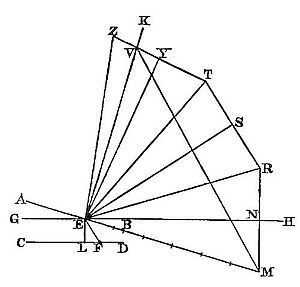
Let , make with the interior angles , together less than .
Make angle equal to angle ; produce to ; from draw at right angles to , and at right angles to .
Hence is also at right angles to ;
[II. Prop. 9.
i. e. , have a common perpendicular;
each is equidistant from the other;
[II. Prop. 7, Cor. 1.
also = the common distance between them.
Now angle is the defect, from , of the sum of the 2 interior angles , ;
hence, by hypothesis, it is finite;
it may be so multiplied, by a finite number, as to exceed angle .
[II. Ax. 2.
Call this finite number '.'
In , produced if necessary, take -times ; from draw at right angles to ; turn Triangle about into position ; then, about , into position , and so on, till there are such Triangles altogether; and let its final position be .
Then angle is -times angle ; i. e. it is greater than angle .
Let cut broken-Line at ; and join .
Then is greater than , which is greater than , which is greater than ;
[Euc. I. 20, 17, 19.
is greater than ;
but is the same fraction of which is of ;
is greater than ; i. e. the distance of , from , is greater than the common distance between and .
, are intersectional towards , .
Therefore, if a Pair of Lines &c.
Q.E.D.