Part 1 — APPENDIX I.
Reading edition
Containing an alternative Axiom, which may be substituted for Axiom 1 at p. 14.
Definition.
The Segment, cut off, from any Sector of a Circle, by its Chord, may be called its 'outer Segment'; and the Triangle, contained by its Chord and its two Radii, may be called its 'central Triangle.' And, if its Arc be bisected and the point of bisection joined to the ends of its Chord, the isosceles Triangle, so formed, may be called its 'inscribed isosceles Triangle.'
PROPOSITIONS. PROP. A. Theorem.
If, in any Sector of a Circle, its Chord be not-less than its Radius: then, in a Sector whose vertical angle is twice as great, its outer Segment is greater than its central Triangle.
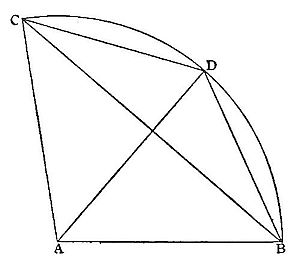
Let be a Sector whose Chord is not-less than its Radius . Make angle equal to angle ; and join , .
Then vertical angle of Sector is twice as great as that of Sector .
It shall be proved that its outer Segment is greater than its central Triangle .
Because is not-less than ;
Triangle is not-less than Triangle ;
[I. Prop. 2.
, a fortiori, Segment is greater than Triangle .
Hence if, in any Sector &c.
Q.E.D.
PROP. B. Theorem.
If, in any Sector of a Circle, each of the equal Sides of its inscribed isosceles Triangle be not-less than its Radius; and if its outer Segment be greater than a certain multiple of its central Triangle: then, in a Sector, whose vertical angle is twice as great, its outer Segment is greater than twice that multiple of its central Triangle.
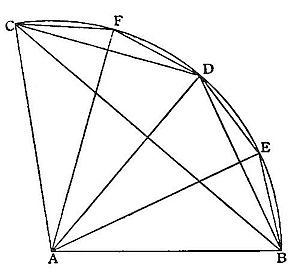
Let be a Sector such that each of the equal sides of its inscribed isosceles Triangle is not-less than its Radius , and such that its outer Segment is greater than times its central Triangle . Make angle equal to angle ; bisect angles , by Lines , ; and join , , , .
Then vertical angle of Sector is twice as great as that of Sector .
It shall be proved that its outer Segment is greater than times its central Triangle .
Because angle is greater than angle , and that angle is less than angle ;
angle is greater than angle ;
is greater than ;
[Euc. I. 25.
but is not-less than ;
is greater than ;
Triangle is greater than Triangle ;
[I. Prop. 2.
to each of these add Triangle ;
Figure is greater than twice Triangle .
Again, Segment is given to be greater than times Triangle ;
Segments , are together greater than times Figure ; i. e. are together greater than times Triangle ;
, a fortiori, Segment is greater than times Triangle .
Hence if, in any Sector &c.
Q.E.D.
Axiom.
[An alternative Axiom, to be substituted for Axiom 1, at p. 14, if the Reader feel any difficulty in granting that Axiom. In this case, certain portions of the foregoing Propositions will also need to be replaced by new matter, which is hereto appended.]
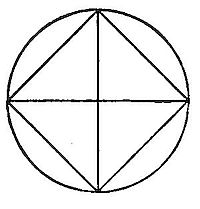
In every Circle, the inscribed equilateral tetragon, multiplied by ('' being a certain selected finite number), is greater than any one of the Segments which lie outside it.
Note.—The reader can assign to '' any finite value which he finds large enough to induce him to accept this Axiom. For example, if he be willing to grant that 1024 times the Tetragon is greater than the Segment, he can assign to it the value '10.'
PROP. C. Theorem.
[To be substituted for Prop. I, at p. 15.]
An isosceles Triangle, whose vertical angle is of a right angle, has its base less than either of its sides.
Let of a right angle be represented by '.'
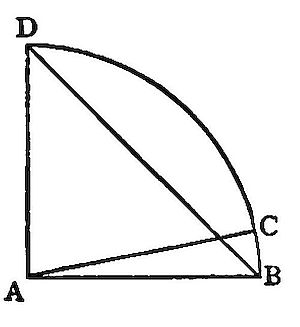
Let be an isosceles Triangle, whose vertical angle at is .
It shall be proved that is less than .
Draw at right angles to , and, with centre , and distance , describe Quadrant. (See Note.) And join .
Then Triangle is one-fourth of an equilateral Tetragon inscribed in the Circle.
Hence times this Triangle is greater than Segment .
[Alternative Axiom.
Now, if we deny that is less than , we must assert that is not-less than .
Let this be our Hypothesis.
Note.—The Reader is requested to imagine a chord drawn to the arc .
Hence it may be proved, as in Book II, Prop. I, that any Chord, drawn from to any Point on the Arc , is greater than , and therefore not-less than .
Now, on our Hypothesis, is a Sector whose Chord is not-less than its Radius;
, in a Sector whose vertical angle is , its outer Segment is greater than its central Triangle;
[Prop. A.
i.e., in a Sector whose vertical angle is , each of the equal sides of its inscribed isosceles Triangle is not-less than its Radius, and its outer Segment is greater than once its central Triangle;
, in a Sector, whose vertical angle is , its outer Segment is greater than twice its central Triangle;
[Prop. B.
, similarly, in a Sector, whose vertical angle is , its outer Segment is greater than 4 times its central Triangle;
and so on;
, ultimately, in a Sector, whose vertical angle is , its outer Segment is greater than times its central Triangle;
but ;
, in Sector , Segment is greater than times Triangle .
But this is absurd, since it has been already proved less than times this Triangle.
Hence our Hypothesis, that is not-less than , is false; i. e. is less than .
Therefore an isosceles Triangle &c.
Q.E.D.
Corollary to Prop. C.
Hence, by Book I, Prop. III, it is possible to describe, on a given base, an isosceles Triangle having each base-angle equal to of a right angle.
[N.B. If the Reader be willing to grant, as axiomatic, that 1024 times the Tetragon is greater than the Segment, he must now admit, as logically proved, that an isosceles Triangle, whose vertical angle is of a right angle, has its base less than either of its sides. If such a Triangle were actually drawn, having each side 140 yards long, its base would be found to be less than an inch!]
PROP. D. Theorem.
[To be substituted for Prop. II, at p. 18.]
The angles of any Triangle are together not-less than of a right angle.
[The proof of Prop. II will serve here, without any change, except the substitution of '' for ''.]
[N.B. If the Reader be willing to grant, as axiomatic, that 1024 times the Tetragon is greater than the Segment, he must now admit, as logically proved, that the angles of any Triangle are together not-less than of a right angle.]
PROP. E. Theorem.
[To be substituted for Prop. III, at p. 19.]
There is a Triangle whose angles are together not-less than two right angles.
[The proof of Prop. III will serve here, without any change, except the substitution of '' for ',' and '' for 'one-eighth,' down to the words 'A similar proof &c.' at foot of p. 21; for which the following is to be substituted.]
A similar proof will hold for , , and so on; and ultimately for .
Hence, either there is an 'amount' not-less than , or else every 'amount' is not-less than .
But .
Hence the second clause of this alternative contains the first.
Hence the first clause must be true.
That is, there is a Triangle &c.
Q.E.D.