CONVERSATION XV. OPTICS—continued. ON THE ANGLE OF VISION, AND THE REFLECTION OF MIRRORS.
Reading edition
ANGLE OF VISION. REFLECTION OF PLAIN MIRRORS. REFLECTION OF CONVEX MIRRORS. REFLECTION OF CONCAVE MIRRORS.
CAROLINE.
Well, Mrs. B., I am very impatient to hear what further proofs you have to offer, in support of your theory. You must allow, that it was rather provoking to dismiss us as you did at our last meeting.
Mrs. B. You press so hard upon me with your objections, that you must give me time to recruit my forces.
Can you tell me, Caroline, why objects at a distance, appear smaller than they really are?
Caroline. I know no other reason than their distance.
Mrs. B. It is a fact, that distance causes objects to appear smaller, but to state the fact, is not to give the reason. We must refer again to the camera obscura, to account for this circumstance; and you will find, that the different apparent dimensions of objects at different distances, proceed from our seeing, not the objects themselves, but merely their image on the retina. Fig. 1, plate 17, represents a row of trees, as viewed in the camera obscura. I have expressed the direction of the rays, from the objects to the image, by lines. Now, observe, the ray which comes from the top of the nearest tree, and that which comes from the foot of the same tree, meet at the aperture, forming an angle of about twenty-five degrees; the angle under which we see any object, is called, the visual angle, or, angle of vision. These rays cross each other at the aperture, forming equal angles on each side of it, and represent the tree inverted in the camera obscura. The degrees of the image, are considerably smaller than those of the object, but the proportions are perfectly preserved.
Plate xvii.
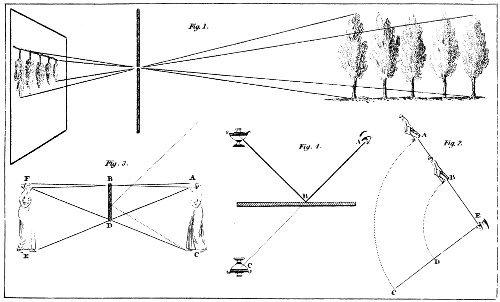
Now, let us notice the upper and lower ray, from the most distant tree; they form an angle of not more than twelve or fifteen degrees, and an image of proportional dimensions. Thus, two objects of the same size, as the two trees of the avenue, form figures of different sizes in the camera obscura, according to their distance; or, in other words, according to the angle of vision under which they are seen. Do you understand this?
Caroline. Perfectly.
Mrs. B. Then you have only to suppose, that the representation in the camera obscura, is similar to that on the retina.
Now, since objects of the same magnitudes, appear to be of different dimensions, when at different distances from us, let me ask you which it is, that you see; the real objects, which, we know, do not vary in size, or the images, which, we know, do vary, according to the angle of vision under which we see them?
Caroline. I must confess, that reason is in favour of the latter. But does that chair, at the further end of the room, form an image on my retina, much smaller than this which is close to me? they appear exactly of the same size.
Mrs. B. Our senses are imperfect, but the experience we acquire by the sense of touch, corrects the illusions of our sight, with regard to objects within our reach. You are so perfectly convinced, of the real size of objects, which you can handle, that you do not attend to the apparent difference.
Does that house appear to you much smaller, than when you are close to it?
Caroline. No, because it is very near us.
Mrs. B. And yet you can see the whole of it, through one of the windows of this room. The image of the house on your retina must, therefore, be smaller than that of the window through which you see it. It is your knowledge of the real magnitude of the house which prevents your attending to its apparent size. If you were accustomed to draw from nature, you would be fully aware of this difference.
Emily. And pray, what is the reason that, when we look up an avenue, the trees not only appear smaller as they are more distant, but seem gradually to approach each other, till they meet in a point?
Mrs. B. Not only the trees, but the road which separates the two rows, forms a smaller visual angle, in proportion as it is more distant from us; therefore, the width of the road gradually diminishes, as well as the size of the trees, till at length the road apparently terminates in a point, at which the trees seem to meet.
Emily. I am very glad to understand this, for I have lately begun to learn perspective, which appeared to me a very dry study; but now that I am acquainted with some of the principles on which it is founded, I shall find it much more interesting.
Caroline. In drawing a view from nature, it seems that we do not copy the real objects, but the image they form on the retina of our eyes?
Mrs. B. Certainly. In sculpture, we copy nature as she really exists; in painting, we represent her, as she appears to us.
We must now conclude the observations that remain to be made, on the angle of vision.
If the rays, proceeding from the extremities of an object, with an ordinary degree of illumination, do not enter the eye under an angle of more than two seconds, which is the 1-1800th part of a degree, it is invisible. There are, consequently, two cases in which objects may be invisible; if they are either so small, or so distant, as to form an angle of less than two seconds of a degree.
In like manner, if the velocity of a body does not exceed 20 degrees in an hour, its motion is imperceptible.
Caroline. A very rapid motion may then be imperceptible, provided the distance of the moving body, is sufficiently great.
Mrs. B. Undoubtedly; for the greater its distance, the smaller will be the angle, under which its motion will appear to the eye. It is for this reason, that the motion of the celestial bodies is invisible, although inconceivably rapid.
Emily. I am surprised, that so great a velocity as 20 degrees an hour, should be invisible.
Mrs. B. The real velocity depends upon the space comprehended in each degree, and upon the time, in which the moving body, passes over that space. But we can only know the extent of this space, by knowing the distance of the moving body, from its centre of motion; for supposing two men to set off at the same moment from A and B, (fig. 2.) to walk each to the end of their respective lines, C and D; if they perform their walk in the same space of time, they must have proceeded at a very different rate; and yet to an eye situated at E, they will appear to have moved with equal velocity, because they will both have gone through an equal number of degrees, though over a very unequal length of ground. The number of degrees over which a body moves in a given time, is called its angular velocity; two bodies, you see, may have the same angular, or apparent velocity, whilst their real velocities may differ almost infinitely. Sight is an extremely useful sense, no doubt, but it cannot always be relied on, it deceives us both in regard to the size and the distance of objects; indeed, our senses would be very liable to lead us into error, if experience did not set us right.
Emily. Between the two, I think that we contrive to acquire a tolerably accurate idea of objects.
Mrs. B. At least sufficiently so, for the general purposes of life. To convince you how requisite experience is, to correct the errors of sight, I shall relate to you, the case of a young man, who was blind from his infancy, and who recovered his sight at the age of fourteen, by the operation of couching. At first, he had no idea, either of the size, or distance of objects, but imagined that every thing he saw touched his eyes; and it was not, till after having repeatedly felt them, and walked from one object to another, that he acquired an idea of their respective dimensions, their relative situations, and their distances.
Caroline. The idea that objects touched his eyes, is, however, not so absurd, as it at first appears; for if we consider that we see only the image of objects, this image actually touches our eyes.
Mrs. B. That is, doubtless, the reason of the opinion he formed, before the sense of touch had corrected his judgment.
Caroline. But since an image must be formed on the retina of each of our eyes, why do we not see objects double?
Mrs. B. The action of the rays, on the optic nerve of each eye, is so perfectly similar, that they produce but a single sensation; the mind, therefore, receives the same idea, from the retina of both eyes, and conceives the object to be single.
Caroline. This is difficult to comprehend, and I should think, can be but conjectural.
Mrs. B. I can easily convince you, that you have a distinct image of an object formed on the retina of each eye. Look through the window, with both eyes open, at some object exactly opposite to one of the upright bars of the sash.
Caroline. I now see a tree, the body of which, appears to be in a line exactly opposite to one of the bars.
Mrs. B. If you now shut your right eye, and look with the left, it will appear to the left of the bar; then by closing the left eye, and looking with the other, it will appear to the right of the bar.
Caroline. That is true, indeed!
Mrs. B. There are, evidently, two representations of the tree in different situations, which must be owing to an image of it being formed on each eye; if the action of the rays, therefore, on each retina, were not so perfectly similar as to produce but one sensation, we should see double; and we find that to be the case with some persons, who are afflicted with a disease in one eye, which prevents the rays of light from affecting it in the same manner as the other.
Emily. Pray, Mrs. B., when we see the image of an object in a looking-glass, why is it not inverted, as in the camera obscura, and on the retina of the eye?
Mrs. B. Because the rays do not enter the mirror by a small aperture, and cross each other, as they do at the orifice of a camera obscura, or the pupil of the eye.
When you view yourself in a mirror, the rays from your eyes fall perpendicularly upon it, and are reflected in the same line; the image is, therefore, described behind the glass, and is situated in the same manner as the object before it.
Emily. Yes, I see that it is; but the looking-glass is not nearly so tall as I am, how is it, therefore, that I can see the whole of my figure in it?
Mrs. B. It is not necessary that the mirror should be more than half your height, in order that you may see the whole of your person in it, (fig. 3.) The ray of light A B, from your eye, which falls perpendicularly on the mirror B D, will be reflected back, in the same line; but the ray from your feet, will fall obliquely on the mirror, for it must ascend in order to reach it; it will, therefore, be reflected in the line A D: and since we view objects in the direction of the reflected rays, which reach the eye, and since the image appears at the same distance, behind the mirror, that the object is before it, we must continue the line A D to E, and the line C D to F, at the termination of which, the image will be represented.
Plate xviii.
Emily. Then I do not understand why I should not see the whole of my person in a much smaller mirror, for a ray of light from my feet would always reach it, though more obliquely.
Mrs. B. True; but the more obliquely the ray falls on the mirror, the more obliquely it will be reflected; the ray would, therefore, be reflected above your head, and you could not see it. This is shown by the dotted line (fig. 3.)
Now stand a little to the right of the mirror, so that the rays of light from your figure may fall obliquely on it——
Emily. There is no image formed of me in the glass now.
Mrs. B. I beg your pardon, there is; but you cannot see it, because the incident rays, falling obliquely on the mirror, will be reflected obliquely, in the opposite direction; the angles of incidence, and reflection, being equal. Caroline, place yourself in the direction of the reflected rays, and tell me whether you do not see Emily's image in the glass?
Caroline. Let me consider.—In order to look in the direction of the reflected rays, I must place myself as much to the left of the glass, as Emily stands to the right of it.—Now I see her image, not straight before me, however, but before her; and it appears at the same distance behind the glass, that she is in front of it.
Mrs. B. You must recollect, that we always see objects in the direction of the last rays, which reach our eyes. Figure 4 represents an eye, looking at the image of a vase, reflected by a mirror; it must see it in the direction of the ray A B, as that is the ray which brings the image to the eye; prolong the ray to C, and in that spot will the image appear.
Caroline. I do not understand why a looking-glass reflects the rays of light; for glass is a transparent body, which should transmit them!
Mrs. B. It is not the glass that reflects the rays which form the image you behold, but the silvering behind it; this silvering is a compound of mercury and tin, which forms a brilliant metallic coating. The glass acts chiefly as a transparent case, through which the rays find an easy passage, to, and from, the quicksilver.
Caroline. Why then should not mirrors be made simply of mercury?
Mrs. B. Because mercury is a fluid. By amalgamating it with tinfoil, it becomes of the consistence of paste, attaches itself to the glass, and forms, in fact, a metallic mirror, which would be much more perfect without its glass cover, for the purest glass is never perfectly transparent; some of the rays, therefore, are lost during their passage through it, by being either absorbed, or irregularly reflected.
This imperfection of glass mirrors, has introduced the use of metallic mirrors, for optical purposes.
Emily. But since all opaque bodies reflect the rays of light, I do not understand why they are not all mirrors.
Caroline. A curious idea indeed, sister; it would be very gratifying to see oneself in every object at which one looked.
Mrs. B. It is very true that all opaque objects reflect light; but the surface of bodies, in general, is so rough and uneven, that the reflection from them is extremely irregular, and prevents the rays from forming an image on the retina. This, you will be able to understand better, when I shall explain to you the nature of vision, and the structure of the eye.
You may easily conceive the variety of directions in which rays would be reflected by a nutmeg-grater, on account of the inequality of its surface, and the number of holes with which it is pierced. All solid bodies more or less resemble the nutmeg-grater, in these respects; and it is only those which are susceptible of receiving a polish, that can be made to reflect the rays with regularity. As hard bodies are of the closest texture, the least porous, and capable of taking the highest polish, they make the best mirrors; none, therefore, are so well calculated for this purpose, as metals.
Caroline. But the property of regular reflection, is not confined to this class of bodies; for I have often seen myself, in a highly polished mahogany table.
Mrs. B. Certainly; but as that substance is less durable, and its reflection less perfect, than that of metals, I believe it would seldom be chosen, for the purpose of a mirror.
There are three kinds of mirrors used in optics; the plain, or flat, which are the common mirrors we have just mentioned; convex mirrors, and concave mirrors. The reflection of the two latter, is very different from that of the former. The plain mirror, we have seen, does not alter the direction of the reflected rays, and forms an image behind the glass, exactly similar to the object before it. A convex mirror has the peculiar property of making the reflected rays diverge, by which means it diminishes the image; and a concave mirror makes the rays converge, and under certain circumstances, magnifies the image.
Emily. We have a convex mirror in the drawing-room, which forms a beautiful miniature picture of the objects in the room; and I have often amused myself with looking at my magnified face in a concave mirror. But I hope you will explain to us, why the one enlarges, while the other diminishes the objects it reflects.
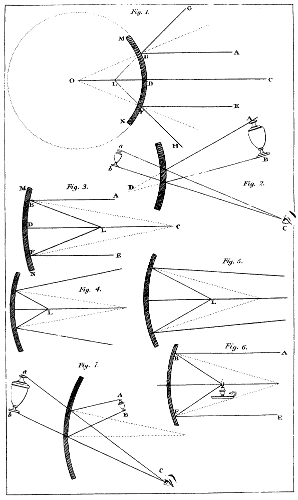
Mrs. B. Let us begin by examining the reflection of a convex mirror. This is formed of a portion of the exterior surface of a sphere. When several parallel rays fall upon it, that ray only which, if prolonged, would pass through the centre or axis of the mirror, is perpendicular to it. In order to avoid confusion, I have, in fig. 1, plate 18, drawn only three parallel lines, A B, C D, E F, to represent rays falling on the convex mirror, M N; the middle ray, you will observe, is perpendicular to the mirror, the others fall on it, obliquely.
Caroline. As the three rays are parallel, why are they not all perpendicular to the mirror?
Mrs. B. They would be so to a flat mirror; but as this is spherical, no ray can fall perpendicularly upon it which is not directed towards the centre of the sphere.
Emily. Just as a weight falls perpendicularly to the earth, when gravity attracts it towards the centre.
Mrs. B. In order, therefore, that rays may fall perpendicularly to the mirror at B and F, the rays must be in the direction of the dotted lines, which, you may observe, meet at the centre O of the sphere, of which the mirror forms a portion.
Now, can you tell me in what direction the three rays, A B, C D, E F, will be reflected?
Emily. Yes, I think so: the middle ray, falling perpendicularly on the mirror, will be reflected in the same line: the two outer rays falling obliquely, will be reflected obliquely to G and H; for the dotted lines you have drawn are perpendiculars, which divide the angles of incidence and reflection, of those two rays.
Mrs. B. Extremely well, Emily: and since we see objects in the direction of the reflected ray, we shall see the image L, which is the point at which the reflected rays, if continued through the mirror, would unite and form an image. This point is equally distant, from the surface and centre of the sphere, and is called the imaginary focus of the mirror.
Caroline. Pray, what is the meaning of focus?
Mrs. B. A point at which converging rays, unite. And it is in this case, called an imaginary focus; because the rays do not really unite at that point, but only appear to do so: for the rays do not pass through the mirror, since they are reflected by it.
Emily. I do not yet understand why an object appears smaller, when viewed in a convex mirror.
Mrs. B. It is owing to the divergence of the reflected rays. You have seen that a convex mirror, by reflection, converts parallel rays into divergent rays; rays that fall upon the mirror divergent, are rendered still more so by reflection, and convergent rays are reflected either parallel, or less convergent. If then, an object be placed before any part of a convex mirror, as the vase A B, fig. 2, for instance, the two rays from its extremities, falling convergent on the mirror, will be reflected less convergent, and will not come to a focus, till they arrive at C; then an eye placed in the direction of the reflected rays, will see the image formed in (or rather behind) the mirror, at a b.
Caroline. But the reflected rays, do not appear to me to converge less than the incident rays. I should have supposed that, on the contrary, they converged more, since they meet in a point.
Mrs. B. They would unite sooner than they actually do, if they were not less convergent than the incident rays: for observe, that if the incident rays, instead of being reflected by the mirror, continued their course in their original direction, they would come to a focus at D, which is considerably nearer to the mirror than at C; the image, is, therefore, seen under a smaller angle than the object; and the more distant the latter is from the mirror, the smaller is the image reflected by it.
You will now easily understand the nature of the reflection of concave mirrors. These are formed of a portion of the internal surface of a hollow sphere, and their peculiar property is to converge the rays of light.
Can you discover, Caroline, in what direction the three parallel rays, A B, C D, E F, are reflected, which fall on the concave mirror, M N, (fig. 3.)?
Caroline. I believe I can. The middle ray is sent back in the same line, in which it arrives, that being the direction of the axis of the mirror; and the two others will be reflected obliquely, as they fall obliquely on the mirror. I must now draw two dotted lines perpendicular to their points of incidence, which will divide their angles of incidence and reflection; and in order that those angles may be equal, the two oblique rays must be reflected to L, where they will unite with the middle ray.
Mrs. B. Very well explained. Thus you see, that when any number of parallel rays fall on a concave mirror, they are all reflected to a focus: for in proportion as the rays are more distant from the axis of the mirror, they fall more obliquely upon it, and are more obliquely reflected; in consequence of which they come to a focus in the direction of the axis of the mirror, at a point equally distant from the centre, and the surface, of the sphere; and this point is not an imaginary focus, as happens with the convex mirror, but is the true focus at which the rays unite.
Emily. Can a mirror form more than one focus, by reflecting rays?
Mrs. B. Yes. If rays fall convergent on a concave mirror, (fig. 4,) they are sooner brought to a focus, L, than parallel rays; their focus is, therefore, nearer to the mirror M N. Divergent rays are brought to a more distant focus than parallel rays, as in figure 5, where the focus is at L; but what is called the true focus of mirrors, either convex or concave, is that of parallel rays, and is equally distant from the centre, and the surface of the spherical mirror.
I shall now show you the real reflection of rays of light, by a metallic concave mirror. This is one made of polished tin, which I expose to the sun, and as it shines bright, we shall be able to collect the rays into a very brilliant focus. I hold a piece of paper where I imagine the focus to be situated; you may see by the vivid spot of light on the paper, how much the rays converge: but it is not yet exactly in the focus; as I approach the paper to that point, observe how the brightness of the spot of light increases, while its size diminishes.
Caroline. That must be occasioned by the rays approaching closer together. I think you hold the paper just in the focus now, the light is so small and dazzling—Oh, Mrs. B., the paper has taken fire!
Mrs. B. The rays of light cannot be concentrated, without, at the same time, accumulating a proportional quantity of heat: hence concave mirrors have obtained the name of burning mirrors.
Emily. I have often heard of the surprising effects of burning mirrors, and I am quite delighted to understand their nature.
Caroline. It cannot be the true focus of the mirror, at which the rays of the sun unite, for as they proceed from so large a body, they cannot fall upon the mirror parallel to each other.
Mrs. B. Strictly speaking, they certainly do not. But when rays, come from such an immense distance as the sun, they may be considered as parallel: their point of union is, therefore, the true focus of the mirror, and there the image of the object is represented.
Now that I have removed the mirror out of the influence of the sun's rays, if I place a burning taper in the focus, how will its light be reflected? (Fig. 6.)
Caroline. That, I confess, I cannot say.
Mrs. B. The ray which falls in the direction of the axis of the mirror, is reflected back in the same line; but let us draw two other rays from the focus, falling on the mirror at B and F; the dotted lines are perpendicular to those points, and the two rays will, therefore, be reflected to A and E.
Caroline. Oh, now I understand it clearly. The rays which proceed from a light placed in the focus of a concave mirror fall divergent upon it, and are reflected, parallel. It is exactly the reverse of the former experiment, in which the sun's rays fell parallel on the mirror, and were reflected to a focus.
Mrs. B. Yes: when the incident rays are parallel, the reflected rays converge to a focus; when, on the contrary, the incident rays proceed from the focus, they are reflected parallel. This is an important law of optics, and since you are now acquainted with the principles on which it is founded, I hope that you will not forget it.
Caroline. I am sure that we shall not. But, Mrs. B., you said that the image was formed in the focus of a concave mirror; yet I have frequently seen glass concave mirrors, where the object has been represented within the mirror, in the same manner as in a convex mirror.
Mrs. B. That is the case only, when the object is placed between the mirror and its focus; the image then appears magnified behind the mirror, or, as you would say, within it.
Caroline. I do not understand why the image should be larger than the object.
Mrs. B. This results from the convergent property of the concave mirror. If an object, A B, (fig. 7.) be placed between the mirror and its focus, the rays from its extremities fall divergent on the mirror, and on being reflected, become less divergent, as if they proceeded from C: to an eye placed in that situation, the image will appear magnified behind the mirror at a b, since it is seen under a larger angle than the object.
You now, I hope, understand the reflection of light by opaque bodies. At our next meeting, we shall enter upon another property of light, no less interesting, and which is called refraction.
Questions