CONVERSATION V. CONTINUED. ON THE MECHANICAL POWERS.
Reading edition
OF THE PULLEY. OF THE WHEEL AND AXLE. OF THE INCLINED PLANE. OF THE WEDGE. OF THE SCREW.
MRS. B.
The pulley is the second mechanical power we are to examine. You both, I suppose, have seen a pulley?
Caroline. Yes, frequently: it is a circular, and flat piece of wood or metal, with a string which runs in a groove round it: by means of which, a weight may be pulled up; thus pulleys are used for drawing up curtains.
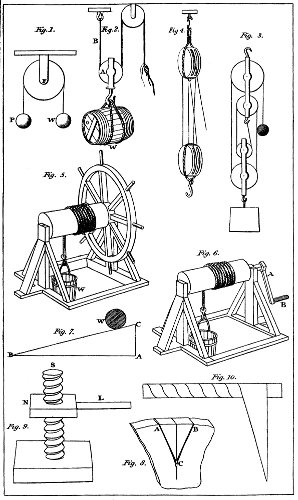
Mrs. B. Yes; but in that instance the pulleys are fixed; that is, they retain their places, and merely turn round on their axis; these do not increase the power to raise the weights, as you will perceive by this figure. (plate 5. fig. 1.) Observe that the fixed pulley is on the same principle as the lever of a pair of scales, in which the fulcrum F being in the centre of gravity, the power P and the weight W, are equally distant from it, and no advantage is gained.
Emily. Certainly; if P represents the power employed to raise the weight W, the power must be greater than the weight in order to move it. But of what use then is a fixed pulley in mechanics?
Mrs. B. Although it does not increase the power, it is frequently useful for altering its direction. A single fixed pulley enables us to draw a curtain up, by pulling the string connected with it downwards; and we should be at a loss to accomplish this simple operation without its assistance.
Caroline. There would certainly be some difficulty in ascending to the head of the curtain, in order to draw it up. Indeed I now recollect having seen workmen raise weights to a considerable height by means of a fixed pulley, which saved them the trouble of going up themselves.
Mrs. B. The next figure represents a pulley which is not fixed; (fig. 2.) and thus situated, you will perceive that it affords us mechanical assistance.
A is a moveable pulley; that is, one which is attached to the weight to be raised, and which consequently moves up or down with it. There is also a fixed pulley D, which is only of use to change the direction of the power P. Now it is evident that the velocity of the power, will be double that of the weight W; for if the rope be pulled at P, until the pulley A ascends with the weight to the fixed pulley D, then both parts of the rope, C and B, must pass over the fixed pulley, and consequently the hand at P, will have descended through a space equal to those two parts; but the weight will have ascended only one half of that distance.
Caroline. That I understand: if P drew the string but one inch, the weight would be raised only half an inch, because it would shorten the strings B and C half an inch each, and consequently the pulley with the weight attached to it, can be raised only half an inch.
Emily. But I do not yet understand the advantage of moveable pulleys; they seem to me to increase rather than diminish the difficulty of raising weights, since you must draw the string double the length that you raise the weight; whilst with a single pulley, or without any pulley, the weight is raised as much as the string is shortened.
Mrs. B. The advantage of a moveable pulley consists in dividing the difficulty; we must, it is true, draw twice the length of the string, but then only half the strength is required that would be necessary to raise the weight without the assistance of a moveable pulley.
Emily. So that the difficulty is overcome in the same manner as it would be, by dividing the weight into two equal parts, and raising them successively.
Mrs. B. Exactly. You must observe, that with a moveable pulley the velocity of the power, is double that of the weight; since the power P (fig. 2.) moves two inches whilst the weight W moves one inch; therefore the power need not be more than half the weight, to make their momentums equal.
Caroline. Pulleys act then on the same principle as the lever; the deficiency of weight in the power, being compensated by its superior velocity, so as to make their momentums equal.
Mrs. B. You will find, that all gain of power in mechanics is founded on the same principle.
Emily. But may it not be objected to pulleys, that a longer time is required to raise a weight by their aid, than without it? for what you gain in power, you lose in time.
Mrs. B. That, my dear, is the fundamental law in mechanics: it is the case with the lever, as well as the pulley; and you will find it to be so with all the other mechanical powers.
Caroline. I do not see any advantage in the mechanical powers then, if what we gain by them in one way, is lost in another.
Mrs. B. Since we are not able to increase our natural strength is not any instrument of obvious utility, by means of which we may reduce the resistance or weight of any body, to the level of that strength? This the mechanical powers enable us to accomplish. It is true, as you observe, that it requires a sacrifice of time to attain this end, but you must be sensible how very advantageously it is exchanged for power. If one man by his natural strength could raise one hundred pounds only, it would require five such men to raise five hundred pounds; and if one man performs this by the help of a suitable engine, there is then no actual loss of time; as he does the work of five men, although he is five times as long in its accomplishment.
You can now understand, that the greater the number of moveable pulleys connected by a string, the more easily the weight is raised; as the difficulty is divided amongst the number of strings, or rather of parts into which the string is divided, by the pulleys. Two, or more pulleys thus connected, form what is called a tackle, or system of pulleys. (fig. 3.) You may have seen them suspended from cranes to raise goods into warehouses.
Emily. When there are two moveable pulleys, as in the figure you have shown to us, (fig. 3.) there must also be two fixed pulleys, for the purpose of changing the direction of the string, and then the weight is supported by four strings, and of course, each must bear only one fourth part of the weight.
Mrs. B. You are perfectly correct, and the rule for estimating the power gained by a system of pulleys, is to count the number of strings by which the weight is supported; or, which amounts to the same thing, to multiply the number of moveable pulleys by two.
In shipping, the advantages of both an increase of power, and a change of direction, by means of pulleys, are of essential importance: for the sails are raised up the masts by the sailors on deck, from the change of direction which the pulley effects, and the labour is facilitated by the mechanical power of a combination of pulleys.
Plate v.
Emily. But the pulleys on ship-board do not appear to me to be united in the manner you have shown us.
Mrs. B. They are, I believe, generally connected as described in figure 4, both for nautical, and a variety of other purposes; but in whatever manner pulleys are connected by a single string, the mechanical power is the same.
The third mechanical power, is the wheel and axle. Let us suppose (plate 5. fig. 5) the weight W, to be a bucket of water in a well, which we raise by winding round the axle the rope, to which it is attached; if this be done without a wheel to turn the axle, no mechanical assistance is received. The axle without a wheel is as impotent as a single fixed pulley, or a lever, whose fulcrum is in the centre: but add the wheel to the axle, and you will immediately find the bucket is raised with much less difficulty. The velocity of the circumference of the wheel is as much greater than that of the axle, as it is further from the centre of motion; for the wheel describes a great circle in the same space of time that the axle describes a small one, therefore the power is increased in the same proportion as the circumference of the wheel is greater than that of the axle. If the velocity of the wheel is twelve times greater than that of the axle, a power twelve times less than the weight of the bucket, would balance it; and a small increase would raise it.
Emily. The axle acts the part of the shorter arm of the lever, the wheel that of the longer arm.
Caroline. In raising water, there is commonly, I believe, instead of a wheel attached to the axle, only a crooked handle, which answers the purpose of winding the rope round the axle, and thus raising the bucket.
Mrs. B. In this manner (fig. 6;) now if you observe the dotted circle which the handle describes in winding up the rope, you will perceive that the branch of the handle A, which is united to the axle, represents the spoke of a wheel, and answers the purpose of an entire wheel; the other branch B affords no mechanical aid, merely serving as a handle to turn the wheel.
Wheels are a very essential part of most machines; they are employed in various ways; but, when fixed to the axle, their mechanical power is always the same: that is, as the circumference of the wheel exceeds that of the axle, so much will the energy of the power be increased.
Caroline. Then the larger the wheel, in proportion to the axle, the greater must be its effect?
Mrs. B. Certainly. If you have ever seen any considerable mills or manufactures, you must have admired the immense wheel, the revolution of which puts the whole of the machinery into motion; and though so great an effect is produced by it, a horse or two has sufficient power to turn it; sometimes a stream of water is used for that purpose, but of late years, a steam-engine has been found both the most powerful and the most convenient mode of turning the wheel.
Caroline. Do not the vanes of a windmill represent a wheel, Mrs. B.?
Mrs. B. Yes; and in this instance we have the advantage of a gratuitous force, the wind, to turn the wheel. One of the great benefits resulting from the use of machinery is, that it gives us a sort of empire over the powers of nature, and enables us to make them perform the labour which would otherwise fall to the lot of man. When a current of wind, a stream of water, or the expansive force of steam, performs our task, we have only to superintend and regulate their operations.
The fourth mechanical power is the inclined plane; this is generally nothing more than a plank placed in a sloping direction, which is frequently used to facilitate the raising of weights, to a small height, such as the rolling of hogsheads or barrels into a warehouse. It is not difficult to understand, that a weight may much more easily be rolled up a slope than it can be raised the same height perpendicularly. But in this, as well as the other mechanical powers, the facility is purchased by a loss of time (fig. 7;) for the weight, instead of moving directly from A to C, must move from B to C, and as the length of the plane is to its height, so much is the resistance of the weight diminished.
Emily. Yes; for the resistance, instead of being confined to the short line A C, is spread over the long line B C.
Mrs. B. The wedge, which is the next mechanical power, is usually viewed as composed of two inclined planes (fig. 8:) you may have seen wood-cutters use it to cleave wood. The resistance consists in the cohesive attraction of the wood, or any other body which the wedge is employed to separate; the advantage gained by this power is differently estimated by philosophers; but one thing is certain, its power is increased, in proportion to the decrease of its thickness, compared with its length. The wedge is a very powerful instrument, but it is always driven forward by blows from a hammer, or some other body having considerable momentum.
Emily. The wedge, then, is rather a compound than a distinct mechanical power, since it is not propelled by simple pressure, or weight, like the other powers.
Mrs. B. It is so. All cutting instruments are constructed upon the principle of the inclined plane, or the wedge: those that have but one edge sloped, like the chisel, may be referred to the inclined plane; whilst the axe, the hatchet, and the knife, (when used to split asunder) are used as wedges.
Caroline. But a knife cuts best when it is drawn across the substance it is to divide. We use it thus in cutting meat, we do not chop it to pieces.
Mrs. B. The reason of this is, that the edge of a knife is really a very fine saw, and therefore acts best when used like that instrument.
The screw, which is the last mechanical power, is more complicated than the others. You will see by this figure, (fig. 9.) that it is composed of two parts, the screw and the nut. The screw S is a cylinder, with a spiral protuberance coiled round it, called the thread; the nut N is perforated to receive the screw, and the inside of the nut has a spiral groove, made to fit the spiral thread of the screw.
Caroline. It is just like this little box, the lid of which screws on the box as you have described; but what is this handle L which projects from the nut?
Mrs. B. It is a lever, which is attached to the nut, without which the screw is never used as a mechanical power. The power of the screw, complicated as it appears, is referable to one of the most simple of the mechanical powers; which of them do you think it is?
Caroline. In appearance, it most resembles the wheel and axle.
Mrs. B. The lever, it is true, has the effect of a wheel, as it is the means by which you turn the nut, or sometimes the screw, round; but the lever is not considered as composing a part of the screw, though it is true, that it is necessarily attached to it.
Emily. The spiral thread of the screw resembles, I think, an inclined plane: it is a sort of slope, by means of which the nut ascends more easily than it would do if raised perpendicularly; and it serves to support it when at rest.
Mrs. B. Very well: if you cut a slip of paper in the form of an inclined plane, and wind it round your pencil, which will represent the cylinder, you will find that it makes a spiral line, corresponding to the spiral protuberance of the screw. (Fig. 10.)
Emily. Very true; the nut then ascends an inclined plane, but ascends it in a spiral, instead of a straight line: the closer the threads of the screw, the more easy the ascent: it is like having shallow, instead of steep steps to ascend.
Mrs. B. Yes; excepting that the nut takes no steps, as it gradually winds up or down; then observe, that the closer the threads of the screw, the less is its ascent in turning round, and the greater is its power; so that we return to the old principle,—what is saved in power is lost in time.
Emily. Cannot the power of the screw be increased also, by lengthening the lever attached to the nut?
Mrs. B. Certainly. The screw, with the addition of the lever, forms a very powerful machine, employed either for compression or to raise heavy weights. It is used by book-binders, to press the leaves of books together; it is used also in cider and wine presses, in coining, and for a variety of other purposes.
Emily. Pray, Mrs. B., by what rule do you estimate the power of the screw?
Mrs. B. By measuring the circumference of the circle, which the end of the lever would form in one whole revolution, and comparing this with the distance from the centre of one thread of the screw, to that of its next contiguous turn; for whilst the lever travels that whole distance, the screw rises or falls only through the distance from one coil to another.
Caroline. I think that I have sometimes seen the lever attached to the screw, and not to the nut, as it is represented in the figure.
Mrs. B. This is frequently done, but it does not in any degree affect the power of the instrument.
All machines are composed of one or more of these six mechanical powers we have examined; I have but one more remark to make to you relative to them, which is, that friction in a considerable degree diminishes their force: allowance must therefore always be made for it, in the construction of machinery.
Caroline. By friction, do you mean one part of the machine rubbing against another part contiguous to it?
Mrs. B. Yes; friction is the resistance which bodies meet with in rubbing against each other; there is no such thing as perfect smoothness or evenness in nature; polished metals, though they wear that appearance more than most other bodies, are far from really possessing it; and their inequalities may frequently be perceived through a good magnifying glass. When, therefore, the surfaces of the two bodies come in contact, the prominent parts of the one, will often fall into the hollow parts of the other, and occasion more or less resistance to motion.
Caroline. But if a machine is made of polished metal, as a watch for instance, the friction must be very trifling?
Mrs. B. In proportion as the surfaces of bodies are well polished, the friction is doubtless diminished; but it is always considerable, and it is usually computed to destroy one-third of the power of a machine. Oil or grease is used to lessen friction: it acts as a polish, by filling up the cavities of the rubbing surfaces, and thus making them slide more easily over each other.
Caroline. Is it for this reason that wheels are greased, and the locks and hinges of doors oiled?
Mrs. B. Yes; in these instances the contact of the rubbing surfaces is so close, and they are so constantly in use, that they require to be frequently oiled, or a considerable degree of friction is produced.
There are two kinds of friction; the first is occasioned by the rubbing of the surfaces of bodies against each other, the second, by the rolling of a circular body; as that of a carriage wheel upon the ground: the friction resulting from the first is much the most considerable, for great force is required to enable the sliding body to overcome the resistance which the asperities of the surfaces in contact oppose to its motion, and it must be either lifted over, or break through them; whilst, in the second kind of friction, the rough parts roll over each other with comparative facility; hence it is, that wheels are often used for the sole purpose of diminishing the resistance from friction.
Emily. This is one of the advantages of carriage wheels, is it not?
Mrs. B. Yes; and the larger the circumference of the wheel the more readily it can overcome any considerable obstacles, such as stones, or inequalities in the road. When, in descending a steep hill, we fasten one of the wheels, we decrease the velocity of the carriage, by increasing the friction.
Caroline. That is to say, by converting the rolling friction into the rubbing friction. And when you had casters put to the legs of the table, in order to move it more easily, you changed the rubbing into the rolling friction.
Mrs. B. There is another circumstance which we have already noticed, as diminishing the motion of bodies, and which greatly affects the power of machines. This is the resistance of the medium, in which a machine is worked. All fluids, whether elastic like air, or non-elastic like water and other liquids, are called mediums; and their resistance is proportioned to their density; for the more matter a body contains, the greater the resistance it will oppose to the motion of another body striking against it.
Emily. It would then be much more difficult to work a machine under water than in the air?
Mrs. B. Certainly, if a machine could be worked in vacuo, and without friction, it would not be impeded, but this is unattainable; a considerable reduction of power must therefore be allowed for, from friction and the resistance of the medium.
We shall here conclude our observations on the mechanical powers. At our next meeting I shall endeavour to give you an explanation of the motion of the heavenly bodies.
Questions