CONVERSATION IX. ON THE MOON.
Reading edition
OF THE MOON'S MOTION. PHASES OF THE MOON. ECLIPSES OF THE MOON. ECLIPSES OF JUPITER'S MOONS. OF LATITUDE AND LONGITUDE. OF THE TRANSITS OF THE INFERIOR PLANETS. OF THE TIDES.
MRS. B.
We shall, to-day, confine our attention to the moon, which offers many interesting phenomena.
The moon revolves round the earth in the space of about twenty-nine days and a half; in an orbit, the plane of which is inclined upwards of five degrees to that of the earth; she accompanies us in our revolution round the sun.
Emily. Her motion then must be of a complicated nature; for as the earth is not stationary, but advances in her orbit, whilst the moon goes round her, the moon, in passing round the sun, must proceed in a sort of scolloped circle.
Mrs. B. That is true; and there are also other circumstances which interfere with the simplicity, and regularity of the moon's motion, but which are too intricate for you to understand at present.
The moon always presents the same face to us, by which it is evident that she turns but once upon her axis, while she performs a revolution round the earth; so that the inhabitants of the moon have but one day, and one night, in the course of a lunar month.
Caroline. We afford them, however, the advantage of a magnificent moon to enlighten their long nights.
Mrs. B. That advantage is put partial; for since we always see the same hemisphere of the moon, the inhabitants of that hemisphere alone, can perceive us.
Caroline. One half of the moon then enjoys our light, while the other half has constantly nights of darkness. If there are any astronomers in those regions, they would doubtless be tempted to visit the other hemisphere, in order to behold so grand a luminary as we must appear to them. But, pray, do they see the earth under all the changes, which the moon exhibits to us?
Mrs. B. Exactly so. These changes are called the phases of the moon, and require some explanation. In fig. 2, plate 11, let us say, that S represents the sun, E the earth, and A B C D E F G H, the moon, in different parts of her orbit. When the moon is at A, her dark side being turned towards the earth, we shall not see her as at a; but her disappearance is of very short duration, and as she advances in her orbit, we perceive her under the form of a new moon: when she has gone through one eighth of her orbit at B, one quarter of her enlightened hemisphere will be turned towards the earth, and she will then appear horned as at b; when she has performed one quarter of her orbit, she shows us one half of her enlightened side, as at c, and this is called her first quarter; at d she is said to be gibbous, and at e the whole of the enlightened side appears to us, and the moon is at full. As she proceeds in her orbit, she becomes again gibbous, and her enlightened hemisphere turns gradually away from us, until she arrives at G, which is her third quarter; proceeding thence she completes her orbit and disappears, and then again resumes her form of a new moon, and passes successively, through the same changes.
When the moon is new, she is said to be in conjunction with the sun, as they are then both in the same direction from the earth; at the time of full moon, she is said to be in opposition, because she and the sun, are at opposite sides of the earth; at the time of her first and third quarters, she is said to be in her quadratures, because she is then one-fourth of a circle, or 90°, from her conjunction, or the period of new moon.
Emily. Are not the eclipses of the sun produced by the moon passing between the sun and the earth?
Mrs. B. Yes; when the moon passes between the sun and the earth, she intercepts his rays, or, in other words, casts a shadow on the earth, then the sun is eclipsed, and daylight gives place to darkness, while the moon's shadow is passing over us.
When, on the contrary, the earth is between the sun and the moon, it is we who intercept the sun's rays, and cast a shadow on the moon; she is then said to be eclipsed, and disappears from our view.
Emily. But as the moon goes round the earth every month, she must be, once during that time, between the earth and the sun; and the earth must likewise be once between the sun and the moon, and yet we have not a solar and a lunar eclipse every month?
Mrs. B. I have already informed you, that the orbits of the earth and moon are not in the same plane, but cross or intersect each other; and the moon generally passes either above or below that of the earth, when she is in conjunction with the sun, and does not therefore intercept its rays, and produce an eclipse; for this can take place only when the moon is in, or near her nodes, which is the name given to those two points in which her orbit crosses that of the earth; eclipses cannot happen at any other time, because it is then only, that they are both in a right line with the sun.
Emily. And a partial eclipse of the moon takes place, I suppose, when, in passing by the earth, she is not sufficiently above or below the shadow, to escape it entirely?
Mrs. B. Yes, one edge of her disk then dips into the shadow, and is eclipsed; but as the earth is larger than the moon, when eclipses happen precisely at the nodes, they are not only total, but last for upwards of three hours.
Plate xii.
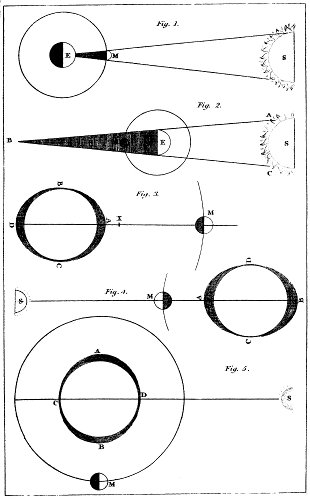
A total eclipse of the sun rarely occurs, and when it happens, the total darkness is confined to one particular part of the earth, the diameter of the shadow not exceeding 180 miles; evidently showing that the moon is smaller than the sun, since she cannot entirely hide it from the earth. In fig. 1, plate 12, you will find a solar eclipse described; S is the sun, M the moon, and E the earth; and the moon's shadow, you see, is not large enough to cover the earth. The lunar eclipses, on the contrary, are visible from every part of the earth, where the moon is above the horizon; and we discover, by the length of time which the moon is passing through the earth's shadow, that it would be sufficient to eclipse her totally, were she many times her actual size; it follows, therefore, that the earth is much larger than the moon.
In fig. 2, S represents the sun, which pours forth rays of light in straight lines, in every direction. E is the earth, and M the moon. Now a ray of light coming from one extremity of the sun's disk, in the direction A B, will meet another, coming from the opposite extremity, in the direction C B; the shadow of the earth cannot therefore extend beyond B; as the sun is larger than the earth, the shadow of the latter is conical, or in the figure of a sugar loaf; it gradually diminishes, and is much smaller than the earth where the moon passes through it, and yet we find the moon to be, not only totally eclipsed, but to remain for a considerable length of time in darkness, and hence we are enabled to ascertain its real dimensions.
Emily. When the moon eclipses the sun to us, we must be eclipsed to the moon?
Mrs. B. Certainly; for if the moon intercepts the sun's rays, and casts a shadow on us, we must necessarily disappear to the moon, but only partially, as in fig. 1.
Caroline. There must be a great number of eclipses in the distant planets, which have so many moons?
Mrs. B. Yes, few days pass without an eclipse taking place; for among the number of satellites, one or the other of them are continually passing either between their primary and the sun; or between the planet, and each other. Astronomers are so well acquainted with the motion of the planets, and their satellites, that they have calculated not only the eclipses of our moon, but those of Jupiter, with such perfect accuracy, that it has afforded a means of ascertaining the longitude.
Caroline. But is it not very easy to find both the latitude and longitude of any place by a map or globe?
Mrs. B. If you know where you are situated, there is no difficulty in ascertaining the latitude or longitude of the place, by referring to a map; but supposing that you had been a length of time at sea, interrupted in your course by storms, a map would afford you very little assistance in discovering where you were.
Caroline. Under such circumstances, I confess I should be equally at a loss to discover either latitude, or longitude.
Mrs. B. The latitude is usually found by taking the altitude of the sun at mid-day; that is to say, the number of degrees that it is elevated above the horizon, for the sun appears more elevated as we approach the equator, and less as we recede from it.
Caroline. But unless you can see the sun, how can you take its altitude?
Mrs. B. When it is too cloudy to see the sun, the latitude is sometimes found at night, by the polar star; the north pole of the earth, points constantly towards one particular part of the heavens, in which a star is situated, called the Polar star: this star is visible on clear nights, from every part of the northern hemisphere; the altitude of the polar star, is therefore the same number of degrees, as that of the pole; the latitude may also be determined by observations made on any of the fixed stars: the situation therefore of a vessel at sea, with regard to north and south, is easily ascertained. The difficulty is, respecting east and west, that is to say, its longitude. As we have no eastern poles from which we can reckon our distance, some particular spot, or line, must be fixed upon for that purpose. The English, reckon from the meridian of Greenwich, where the royal observatory is situated; in French maps, you will find that the longitude is reckoned from the meridian of Paris.
The rotation of the earth on its axis in 24 hours from west to east, occasions, you know, an apparent motion of the sun and stars in a contrary direction, and the sun appears to go round the earth in the space of 24 hours, passing over fifteen degrees, or a twenty-fourth part of the earth's circumference every hour; therefore, when it is twelve o'clock in London, it is one o'clock in any place situated fifteen degrees to the east of London, as the sun must have passed the meridian of that place, an hour before he reaches that of London. For the same reason it is eleven o'clock in any place situated fifteen degrees to the west of London, as the sun will not come to that meridian till an hour later.
If then the captain of a vessel at sea, could know precisely what was the hour at London, he could, by looking at his watch, and comparing it with the hour at the spot in which he was, ascertain the longitude.
Emily. But if he had not altered his watch, since he sailed from London, it would indicate the hour it then was in London.
Mrs. B. True; but in order to know the hour of the day at the spot in which he is, the captain of a vessel regulates his watch by the sun when it reaches the meridian.
Emily. Then if he had two watches, he might keep one regulated daily, and leave the other unaltered; the former would indicate the hour of the place in which he was situated, and the latter the hour at London; and by comparing them together, he would be able to calculate his longitude.
Mrs. B. You have discovered, Emily, a mode of finding the longitude, which I have the pleasure to tell you, is universally adopted: watches of a superior construction, called chronometers, or time-keepers, are used for this purpose, and are now made with such accuracy, as not to vary more than four or five seconds in a whole year; but the best watches are liable to imperfections, and should the time-keeper go too fast or too slow, there would be no means of ascertaining the error; implicit reliance, cannot consequently be placed upon them.
Recourse, therefore, is sometimes had to the eclipses of Jupiter's satellites. A table is made, of the precise time at which the several moons are eclipsed to a spectator at London; when they appear eclipsed to a spectator in any other spot, he may, by consulting the table, know what is the hour at London; for the eclipse is visible at the same moment, from whatever place on the earth it is seen. He has then only to look at his watch, which he regulates by the sun, and which therefore points out the hour of the place in which he is, and by observing the difference of time there, and at London, he may immediately determine his longitude.
Let us suppose, that a certain moon of Jupiter is always eclipsed at six o'clock in the evening; and that a man at sea consults his watch, and finds that it is ten o'clock at night, where he is situated, at the moment the eclipse takes place, what will be his longitude?
Emily. That is four hours later than in London: four times fifteen degrees, make 60; he would, therefore, be sixty degrees east of London, for the sun must have passed his meridian before it reaches that of London.
Mrs. B. For this reason the hour is always later than in London, when the place is east longitude, and earlier when it is west longitude. Thus the longitude can be ascertained whenever the eclipses of Jupiter's moons are visible.
Caroline. But do not the primary planets, sometimes eclipse the sun from each other, as they pass round in their orbits?
Mrs. B. They must of course sometimes pass between each other and the sun, but as their shadows never reach each other, they hide so little of his light, that the term eclipse is not in this case used; this phenomenon is called a transit. The primary planets do not any of them revolve in the same plane, and the times of their revolution round the sun is considerable, it therefore but rarely happens that they are at the same time, in conjunction with the sun, and in their nodes. It is evident also, that a planet must be inferior (that is within the orbit of another) in order to its apparently passing over the disk of the sun. Mercury, and Venus, have sometimes passed in a right line between us, and the sun, but being at so great a distance from us, their shadows did not extend so far as the earth; no darkness was therefore produced on any part of our globe; but the planet appeared like a small black spot, passing across the sun's disk.
It was by the last transit of Venus, that astronomers were enabled to calculate, with some degree of accuracy, the distance of the earth from the sun, and the dimensions of the latter.
Emily. I have heard that the tides are affected by the moon, but I cannot conceive what influence it can have on them.
Mrs. B. They are produced by the moon's attraction, which draws up the waters of that part of the ocean over which the moon passes, so as to cause it to stand considerably higher than the surrounding parts.
Caroline. Does attraction act on water more powerfully than on land? I should have thought it would have been just the contrary, for land is certainly a more dense body than water?
Mrs B. Tides do not arise from water being more strongly attracted than land, for this certainly is not the case; but the cohesion of fluids, being much less than that of solid bodies, they more easily yield to the power of gravity; in consequence of which, the waters immediately below the moon, are drawn up by it, producing a full tide, or what is commonly called, high water, at the spot where it happens. So far, the theory of the tides is not difficult to understand.
Caroline. On the contrary, nothing can be more simple; the waters, in order to rise up under the moon, must draw the waters from the opposite side of the globe, and occasion ebb-tide, or low water, in those parts.
Mrs. B. You draw your conclusion rather too hastily, my dear; for according to your theory, we should have full tide only once in about twenty-four hours, that is, every time that we were below the moon, while we find that in this time we have two tides, and that it is high water with us, and with our antipodes, at the same time.
Caroline. Yet it must be impossible for the moon to attract the sea in opposite parts of the globe, and in opposite directions, at the same time.
Mrs. B. This opposite tide, is rather more difficult to explain, than that which is immediately beneath the moon; with a little attention, however, I hope I shall be able to make you understand the explanation which has been given of it, by astronomers. It must be confessed, however, that the theory upon this subject, is attended with some difficulties. You recollect that the earth and the moon mutually attract each other, but do you suppose that every part of the earth is equally attracted by the moon?
Emily. Certainly not; you have taught us that the force of attraction decreases, with the increase of distance, and therefore that part of the earth which is farthest from the moon, must be attracted less powerfully, than that to which she is nearest.
Mrs. B. This fact will aid us in the explanation which I am about to give to you.
In order to render the question more simple, let us suppose the earth to be every where covered by the ocean, as represented in (fig. 3. pl. 12.) M is the moon, A B C D the earth. Now the waters on the surface of the earth, about A, being more strongly attracted than any other part, will be elevated: the attraction of the moon at B and C being less, and at D least of all. The high tide at A, is accounted for from the direct attraction of the moon; to produce this the waters are drawn from B and C, where it will consequently be low water. At D, the attraction of the moon being considerably decreased, the waters are left relatively high, which height is increased, by the centrifugal force of the earth being greater at D than at A, in consequence of its greater distance from the common centre of gravity X, between the earth and the moon.
Emily. The tide A, then, is produced by the moon's attraction, and the tide D, is produced by the centrifugal force, and increased by the feebleness of the moon's attraction, in those parts.
Caroline. And when it is high water at A and D, it is low water at B and C: now I think I comprehend the nature of the tides, though I confess it is not quite so easy as I at first thought.
But, Mrs. B., why does not the sun produce tides, as well as the moon; for its attraction is greater than that of the moon?
Mrs. B. It would be at an equal distance, but our vicinity to the moon, makes her influence more powerful. The sun has, however, a considerable effect on the tides, and increases or diminishes them as it acts in conjunction with, or in opposition to the moon.
Emily. I do not quite understand that.
Mrs. B. The moon is a month in going round the earth; twice during that time, therefore, at full and at change, she is in the same direction as the sun; both, then act in conjunction on the earth, and produce very great tides, called spring tides, as represented in fig. 4, at A and B; but when the moon is at the intermediate parts of her orbit, that is in her quadratures, the sun, instead of affording assistance, weakens her power, by acting in opposition to it; and smaller tides are produced, called neap tides, as represented at M, in fig. 5.
Emily. I have often observed the difference of these tides, when I have been at the sea side.
But since attraction is mutual between the moon and the earth, we must produce tides in the moon; and these must be more considerable in proportion as our planet is larger. And yet the moon does not appear of an oval form.
Mrs. B. You must recollect, that in order to render the explanation of the tides clearer, we suppose the whole surface of the earth to be covered with the ocean; but that is not really the case, either with the earth or the moon, and the land which intersects the water, destroys the regularity of the effect. Thus, in flowing up rivers, in passing round points of land, and into bays and inlets, the water is obstructed, and high water must happen much later, than would otherwise be the case.
Caroline. True; we may, however, be certain that whenever it is high water, the moon is immediately over our heads.
Mrs. B. Not so either; for as a similar effect is produced on that part of the globe immediately beneath the moon, and on that part most distant from it, it cannot be over the heads of the inhabitants of both those situations, at the same time. Besides, as the orbit of the moon is very nearly parallel to that of the earth, she is never vertical, but to the inhabitants of the torrid zone.
Caroline. In the torrid zone, then, I hope you will grant that the moon is immediately over, or opposite the spots where it is high water?
Mrs. B. I cannot even admit that; for the ocean naturally partaking of the earth's motion, in its rotation from west to east, the moon, in forming a tide, has to contend against the eastern motion of the waves. All matter, you know, by its inertia, makes some resistance to a change of state; the waters, therefore, do not readily yield to the attraction of the moon, and the effect of her influence is not complete, till three hours after she has passed the meridian, where it is full tide.
When a body is impelled by any force, its motion may continue, after the impelling force ceases to act: this is the case with all projectiles. A stone thrown from the hand, continues its motion for a length of time, proportioned to the force given to it: there is a perfect analogy between this effect, and the continued rise of the water, after the moon has passed the meridian at any particular place.
Emily. Pray what is the reason that the tide is three-quarters of an hour later every day?
Mrs. B. Because it is twenty-four hours and three-quarters before the same meridian, on our globe, returns beneath the moon. The earth revolves on its axis in about twenty-four hours; if the moon were stationary, therefore, the same part of our globe would, every twenty-four hours, return beneath the moon; but as during our daily revolution, the moon advances in her orbit, the earth must make more than a complete rotation, in order to bring the same meridian opposite the moon: we are three-quarters of an hour in overtaking her. The tides, therefore, are retarded, for the same reason that the moon rises later by three-quarters of an hour, every day.
We have now, I think, concluded the observations I had to make to you on the subject of astronomy; at our next interview, I shall attempt to explain to you the elements of hydrostatics.
Questions