CONVERSATION VII. OF THE PLANETS.
Reading edition
OF THE SATELLITES OR MOONS. GRAVITY DIMINISHES AS THE SQUARE OF THE DISTANCE. OF THE SOLAR SYSTEM. OF COMETS. CONSTELLATIONS, SIGNS OF THE ZODIAC. OF COPERNICUS, NEWTON, &c.
MRS. B.
The planets are distinguished into primary and secondary. Those which revolve immediately about the sun are called primary. Many of these are attended in their course by smaller planets, which, revolve round them: these are called secondary planets, satellites, or moons. Such is our moon which accompanies the earth, and is carried with it round the sun.
Emily. How then can you reconcile the motion of the secondary planets to the laws of gravitation; for the sun is much larger than any of the primary planets; and is not the power of gravity proportional to the quantity of matter?
Caroline. Perhaps the sun, though much larger, may be less dense than the planets. Fire you know, is very light, and it may contain but little matter, though of great magnitude.
Mrs. B. We do not know of what kind of matter the sun is made; but we may be certain, that since it is the general centre of attraction of our system of planets, it must be the body which contains the greatest quantity of matter in that system.
You must recollect, that the force of attraction is not only proportional to the quantity of matter, but to the degree of proximity of the attractive body: this power is weakened by being diffused, and diminishes as the distance increases.
Emily. Then if a planet was to lose one-half of its quantity of matter, it would lose one half of its attractive power; and the same effect would be produced by removing it to twice its former distance from the sun; that I understand.
Mrs. B. Not so perfectly as you imagine. You are correct as respects the diminution in size, because the attractive force is in the same proportion as the quantity of matter; but were you to remove a planet to double its former distance, it would retain but one-fourth part of its gravitating force; for attraction decreases not in proportion to the simple increase of the distance, but as the squares of the distances increase.
Caroline. I do not exactly comprehend what is meant by the squares, in this case, although I know very well what is in general intended by a square.
Mrs. B. By the square of a number we mean the product of a number, multiplied by itself; thus two, multiplied by two, is four, which is therefore the square of two; in like manner the square of three, is nine, because three multiplied by three, gives that product.
Emily. Then if one planet is three times more distant from the sun than another, it will be attracted with but one-ninth part of the force; and if at four times the distance, with but one-sixteenth, sixteen being the square of four?
Mrs. B. You are correct; the rule is, that the attractive force is in the inverse proportion of the square of the distance. And it is easily demonstrated by the mathematics, that the same is the case with every power that emanates from a centre; as for example, the light from the sun, or from any other luminous body, decreases in its intensity at the same rate.
Caroline. Then the more distant planets, move much slower in their orbits; for their projectile force must be proportioned to that of attraction? But I do not see how this accounts for the motion of the secondary, round the primary planets, in preference to moving round the sun?
Emily. Is it not because the vicinity of the primary planets, renders their attraction stronger than that of the sun?
Mrs. B. Exactly so. But since the attraction between bodies is mutual, the primary planets are also attracted by the satellites which revolve round them. The moon attracts the earth, as well as the earth the moon; but as the latter is the smaller body, her attraction is proportionally less; therefore, neither the earth revolves round the moon, nor the moon round the earth; but they both revolve round a point, which is their common centre of gravity, and which is as much nearer to the earth than to the moon, as the gravity of the former exceeds that of the latter.
Emily. Yes, I recollect your saying, that if two bodies were fastened together by a wire or bar, their common centre of gravity would be in the middle of the bar, provided the bodies were of equal weight; and if they differed in weight, it would be nearer the larger body. If then, the earth and moon had no projectile force which prevented their mutual attraction from bringing them together, they would meet at their common centre of gravity.
Caroline. The earth then has a great variety of motion, it revolves round the sun, round its own axis, and round the point towards which the moon attracts it.
Mrs. B. Just so; and this is the case with every planet which is attended by satellites. The complicated effect of this variety of motions, produces certain irregularities, which, however, it is not necessary to notice at present, excepting to observe that they eventually correct each other, so that no permanent derangement exists.
The planets act on the sun, in the same manner as they are themselves acted on by their satellites; for attraction, you must remember, is always mutual; but the gravity of the planets (even when taken collectively) is so trifling compared with that of the sun, that were they all placed on the same side of that luminary, they would not cause him to move so much as one-half of his diameter towards them, and the common centre of gravity, would still remain within the body of the sun. The planets do not, therefore, revolve round the centre of the sun, but round a point at a small distance from its centre, about which the sun also revolves.
Emily. I thought the sun had no motion?
Mrs. B. You were mistaken; for besides that round the common centre of gravity, which I have just mentioned, which is indeed very inconsiderable, he revolves on his axis in about 25 days; this motion is ascertained by observing certain spots which disappear, and reappear regularly at stated times.
Plate vii.
Caroline. A planet has frequently been pointed out to me in the heavens; but I could not perceive that its motion differed from that of the fixed stars, which only appear to move.
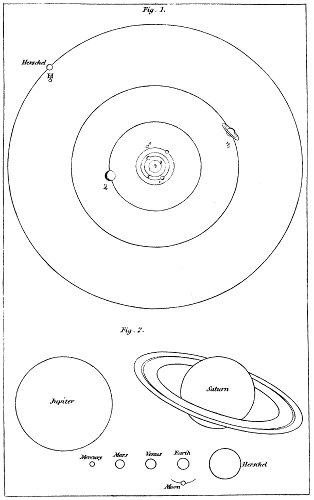
Mrs. B. The great distance of the planets, renders their apparent motion so slow, that the eye is not sensible of their progress in their orbits, unless we watch them for some considerable length of time: but if you notice the nearness of a planet to any particular fixed star, you may in a few nights perceive that it has changed its distance from it, whilst the stars themselves always retain their relative situations. The most accurate idea I can give you of the situation and motion of the planets in their orbits, will be by the examination of this diagram, (plate 7. fig. 1.) representing the solar system, in which you will find every planet, with its orbit delineated.
Emily. But the orbits here are all circular, and you said that they were elliptical. The planets appear too, to be moving round the centre of the sun; whilst you told us that they moved round a point at a little distance from thence.
Mrs. B. The orbits of the planets are so nearly circular, and the common centre of gravity of the solar system, so near the centre of the sun, that these deviations are too small to be represented. The dimensions of the planets, in their proportion to each other, you will find delineated in fig. 2.
Mercury is the planet nearest the sun; his orbit is consequently contained within ours; his vicinity to the sun, prevents our frequently seeing him, so that very accurate observations cannot be made upon Mercury. He performs his revolution round the sun in about 87 days, which is consequently the length of his year. The time of his rotation on his axis is not known; his distance from the sun is computed to be 37 millions of miles, and his diameter 3180 miles. The heat of this planet is supposed to be so great, that water cannot exist there but in a state of vapour, and that even quicksilver would be made to boil.
Caroline. Oh, what a dreadful climate!
Mrs. B. Though we could not live there, it may be perfectly adapted to other beings, destined to inhabit it; or he who created it may have so modified the heat, by provisions of which we are ignorant, as to make it habitable even by ourselves.
Venus, the next in the order of planets, is 68 millions of miles from the sun: she revolves about her axis in 23 hours and 21 minutes, and goes round the sun in 244 days, 17 hours. The orbit of Venus is also within ours; during nearly one-half of her course in it, we see her before sun-rise, and she is then called the morning star; in the other part of her orbit she rises later than the sun.
Caroline. In that case we cannot see her, for she must rise in the day time?
Mrs. B. True; but when she rises later than the sun, she also sets later; so that we perceive her approaching the horizon after sun-set: she is then called Hesperus, or the evening star. Do you recollect those beautiful lines of Milton?
Now came still evening on, and twilight gray Had in her sober livery all things clad; Silence accompanied; for beast and bird, They to their grassy couch, these to their nests Were slunk, all but the wakeful nightingale; She all night long her amorous descant sung; Silence was pleas'd; now glowed the firmament With living sapphires. Hesperus that led The starry host, rode brightest, till the moon Rising in clouded majesty, at length Apparent queen unveil'd her peerless light, And o'er the dark her silver mantle threw.
The planet next to Venus is the Earth, of which we shall soon speak at full length. At present I shall only observe that we are 95 millions of miles distant from the sun, that we perform our annual revolution in 365 days 5 hours and 49 minutes; and are attended in our course by a single moon.
Next follows Mars. He can never come between us and the sun, like Mercury and Venus; his motion is, however, very perceptible, as he may be traced to different situations in the heavens; his distance from the sun is 144 millions of miles; he turns round his axis in 24 hours and 39 minutes; and he performs his annual revolution, in about 687 of our days: his diameter is 4120 miles. Then follow four very small planets, Juno, Ceres, Pallas and Vesta, which have been recently discovered, but whose dimensions, and distances from the sun, have not been very accurately ascertained. They are generally called asteroids.
Jupiter is next in order: this is the largest of all the planets. He is about 490 millions of miles from the sun, and completes his annual period in nearly 12 of our years. He turns round his axis in about ten hours. He is above 1200 times as big as our earth; his diameter is 86,000 miles. The respective proportions of the planets cannot, therefore, you see, be conveniently delineated in a diagram. He is attended by four moons.
The next planet is Saturn, whose distance from the sun, is about 900 millions of miles; his diurnal rotation is performed in 10 hours and a quarter: his annual revolution is nearly 30 of our years. His diameter is 79,000 miles. This planet is surrounded by a luminous ring, the nature of which, astronomers are much at a loss to conjecture: he has seven moons. Lastly, we observe the planet Herschel, discovered by Dr. Herschel, by whom it was named the Georgium Sidus, and which is attended by six moons.
Caroline. How charming it must be in the distant planets, to see several moons shining at the same time; I think I should like to be an inhabitant of Jupiter or Saturn.
Mrs. B. Not long I believe. Consider what extreme cold must prevail in a planet, situated as Saturn is, at nearly ten times the distance at which we are from the sun. Then his numerous moons are far from making so splendid an appearance as ours; for they can reflect only the light which they receive from the sun; and both light, and heat, decrease in the same ratio or proportion to the distances, as gravity. Can you tell me now how much more light we enjoy than Saturn?
Caroline. The square of ten is a hundred; therefore, Saturn has a hundred times less—or to answer your question exactly, we have a hundred times more light and heat, than Saturn—this certainly does not increase my wish to become one of the poor wretches who inhabit that planet.
Mrs. B. May not the inhabitants of Mercury, with equal plausibility, pity us for the insupportable coldness of our situation; and those of Jupiter and Saturn for our intolerable heat? The Almighty power which created these planets, and placed them in their several orbits, has no doubt peopled them with beings, whose bodies are adapted to the various temperatures and elements, in which they are situated. If we judge from the analogy of our own earth, or from that of the great and universal beneficence of Providence, we must conclude this to be the case.
Caroline. Are not comets, in some respects similar to planets?
Mrs. B. Yes, they are; for by the reappearance of some of them, at stated times, they are known to revolve round the sun; but in orbits so extremely eccentric, that they disappear for a great number of years. If they are inhabited, it must be by a species of beings very different, not only from the inhabitants of this, but from those of any of the other planets, as they must experience the greatest vicissitudes of heat and cold; one part of their orbit being so near the sun, that their heat, when there, is computed to be greater than that of red-hot iron; in this part of its orbit, the comet emits a luminous vapour, called the tail, which it gradually loses as it recedes from the sun; and the comet itself totally disappears from our sight, in the more distant parts of its orbit, which extends considerably beyond that of the furthest planet.
The number of comets belonging to our system cannot be ascertained, as some of them are several centuries before they make their reappearance. The number that are known by their regular reappearance is, I believe, only three, although their whole number is very considerable.
Emily. Pray, Mrs. B., what are the constellations?
Mrs. B. They are the fixed stars; which the ancients, in order to recognise them, formed into groups, and gave the names of the figures, which you find delineated on the celestial globe. In order to show their proper situations in the heavens, they should be painted on the internal surface of a hollow sphere, from the centre of which you should view them; you would then behold them as they appear to be situated in the heavens. The twelve constellations, called the signs of the zodiac, are those which are so situated, that the earth, in its annual revolution, passes directly between them, and the sun. Their names are Aries, Taurus, Gemini, Cancer, Leo, Virgo, Libra, Scorpio, Sagittarius, Capricornus, Aquarius, Pisces; the whole occupying a complete circle, or broad belt, in the heavens, called the zodiac. (plate 8. fig. 1.) Hence, a right line drawn from the earth, and passing through the sun, would reach one of these constellations, and the sun is said to be in that constellation at which the line terminates: thus, when the earth is at A, the sun would appear to be in the constellation or sign Aries; when the earth is at B, the sun would appear in Cancer; when the earth was at C, the sun would be in Libra; and when the earth was at D, the sun would be in Capricorn. You are aware that it is the real motion of the earth in its orbit, which gives to the sun this apparent motion through the signs. This circle, in which the sun thus appears to move, and which passes through the middle of the zodiac, is called the ecliptic.
Caroline. But many of the stars in these constellations appear beyond the zodiac.
Plate viii.
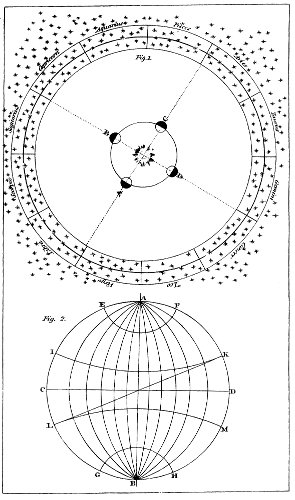
Mrs. B. We have no means of ascertaining the distance of the fixed stars. When, therefore, they are said to be in the zodiac, it is merely implied that they are situated in that direction, and that they shine upon us through that portion of the heavens, which we call the zodiac.
Emily. But are not those large bright stars, which are called stars of the first magnitude, nearer to us, than those small ones which we can scarcely discern?
Mrs. B. It may be so; or the difference of size and brilliancy of the stars may proceed from their difference of dimensions; this is a point which astronomers are not enabled to determine. Considering them as suns, I see no reason why different suns should not vary in dimensions, as well as the planets belonging to them.
Emily. What a wonderful and beautiful system this is, and how astonishing to think that every fixed star may probably be attended by a similar train of planets!
Caroline. You will accuse me of being very incredulous, but I cannot help still entertaining some doubts, and fearing that there is more beauty than truth in this system. It certainly may be so; but there does not appear to me to be sufficient evidence to prove it. It seems so plain and obvious that the earth is motionless, and that the sun and stars revolve round it;—your solar system, you must allow, is directly in opposition to the evidence of our senses.
Mrs. B. Our senses so often mislead us, that we should not place implicit reliance upon them.
Caroline. On what then can we rely, for do we not receive all our ideas through the medium of our senses?
Mrs. B. It is true that they are our primary source of knowledge; but the mind has the power of reflecting, judging, and deciding upon the ideas received by the organs of sense. This faculty, which we call reason, has frequently proved to us, that our senses are liable to err. If you have ever sailed on the water, with a very steady breeze, you must have seen the houses, trees, and every object on the shore move, while you were sailing.
Caroline. I remember thinking so, when I was very young; but I now know that their motion is only apparent. It is true that my reason, in this case, corrects the error of my sight.
Mrs. B. It teaches you, that the apparent motion of the objects on shore, proceeds from your being yourself moving, and that you are not sensible of your own motion, because you meet with no resistance. It is only when some obstacle impedes our motion, that we are conscious of moving; and if you were to close your eyes when you were sailing on calm water, with a steady wind, you would not perceive that you moved, for you could not feel it, and you could see it only by observing the change of place of the objects on shore. So it is with the motion of the earth: every thing on its surface, and the air that surrounds it, accompanies it in its revolution; it meets with no resistance: therefore, like the crew of a vessel sailing with a fair wind, in a calm sea, we are insensible of our motion.
Caroline. But the principal reason why the crew of a vessel in a calm sea do not perceive their motion, is, because they move exceedingly slow, while the earth, you say, revolves with great velocity.
Mrs. B. It is not because they move slowly, but because they move steadily, and meet with no irregular resistances, that the crew of a vessel do not perceive their motion; for they would be equally insensible to it, with the strongest wind, provided it were steady, that they sailed with it, and that it did not agitate the water; but this last condition, you know, is not possible, for the wind will always produce waves which offer more or less resistance to the vessel, and then the motion becomes sensible, because it is unequal.
Caroline. But, granting this, the crew of a vessel have a proof of their motion, which the inhabitants of the earth cannot have,—the apparent motion of the objects on shore, or their having passed from one place to another.
Mrs. B. Have we not a similar proof of the earth's motion, in the apparent motion of the sun and stars? Imagine the earth to be sailing round its axis, and successively passing by every star, which, like the objects on land, we suppose to be moving instead of ourselves. I have heard it observed by an ærial traveller in a balloon, that the earth appears to sink beneath the balloon, instead of the balloon rising above the earth.
It is a law which we discover throughout nature, and worthy of its great Author, that all its purposes are accomplished by the most simple means; and what reason have we to suppose this law infringed, in order that we may remain at rest, while the sun and stars move round us; their regular motions, which are explained by the laws of attraction, on the first supposition, would be unintelligible on the last, and the order and harmony of the universe be destroyed. Think what an immense circuit the sun and stars would make daily, were their apparent motions, real. We know many of them, to be bodies more considerable than our earth; for our eyes vainly endeavour to persuade us, that they are little brilliants sparkling in the heavens; while science teaches us that they are immense spheres, whose apparent dimensions are diminished by distance. Why then should these enormous globes daily traverse such a prodigious space, merely to prevent the necessity of our earth's revolving on its axis?
Caroline. I think I must now be convinced. But you will, I hope, allow me a little time to familiarise to myself, an idea so different from that which I have been accustomed to entertain. And pray, at what rate do we move?
Mrs. B. The motion produced by the revolution of the earth on its axis, is about seventeen miles a minute, to an inhabitant on the equator.
Emily. But does not every part of the earth move with the same velocity?
Mrs. B. A moment's reflection would convince you of the contrary: a person at the equator must move quicker than one situated near the poles, since they both perform a revolution in 24 hours.
Emily. True, the equator is farthest from the axis of motion. But in the earth's revolution round the sun, every part must move with equal velocity?
Mrs. B. Yes, about a thousand miles a minute.
Caroline. How astonishing!—and that it should be possible for us to be insensible of such a rapid motion. You would not tell me this sooner, Mrs. B., for fear of increasing my incredulity.
Before the time of Newton, was not the earth supposed to be in the centre of the system, and the sun, moon, and stars to revolve round it?
Mrs. B. This was the system of Ptolemy, in ancient times; but as long ago as the beginning of the sixteenth century it was generally discarded, and the solar system, such as I have shown you, was established by the celebrated astronomer Copernicus, and is hence called the Copernican system. But the theory of gravitation, the source from which this beautiful and harmonious arrangement flows, we owe to the powerful genius of Newton, who lived at a much later period, and who demonstrated its truth.
Emily. It appears, indeed, far less difficult to trace by observation the motion of the planets, than to divine by what power they are impelled and guided. I wonder how the idea of gravitation could first have occurred to sir Isaac Newton?
Mrs. B. It is said to have been occasioned by a circumstance from which one should little have expected so grand a theory to have arisen.
During the prevalence of the plague in the year 1665, Newton retired into the country to avoid the contagion: when sitting one day in an orchard, he observed an apple fall from a tree, and was led to consider what could be the cause which brought it to the ground.
Caroline. If I dared to confess it, Mrs. B., I should say that such an inquiry indicated rather a deficiency than a superiority of intellect. I do not understand how any one can wonder at what is so natural and so common.
Mrs. B. It is the mark of superior genius to find matter for wonder, observation, and research, in circumstances which, to the ordinary mind, appear trivial, because they are common; and with which they are satisfied, because they are natural; without reflecting that nature is our grand field of observation, that within it, is contained our whole store of knowledge; in a word, that to study the works of nature, is to learn to appreciate and admire the wisdom of God. Thus, it was the simple circumstance of the fall of an apple, which led to the discovery of the laws upon which the Copernican system is founded; and whatever credit this system had obtained before, it now rests upon a basis from which it cannot be shaken.
Emily. This was a most fortunate apple, and more worthy to be commemorated than all those that have been sung by the poets. The apple of discord for which the goddesses contended; the golden apples by which Atalanta won the race; nay, even the apple which William Tell shot from the head of his son, cannot be compared to this!
Questions