CONVERSATION VIII. ON THE EARTH.
Reading edition
OF THE TERRESTRIAL GLOBE. OF THE FIGURE OF THE EARTH. OF THE PENDULUM. OF THE VARIATION OF THE SEASONS, AND OF THE LENGTH OF DAYS AND NIGHTS. OF THE CAUSES OF THE HEAT OF SUMMER. OF SOLAR, SIDERIAL, AND EQUAL OR MEAN TIME.
MRS. B.
As the earth is the planet in which we are the most particularly interested, it is my intention this morning, to explain to you the effects resulting from its annual, and diurnal motions; but for this purpose, it will be necessary to make you acquainted with the terrestrial globe: you have not either of you, I conclude, learnt the use of the globes?
Caroline. No; I once indeed, learnt by heart, the names of the lines marked on the globe, but as I was informed they were only imaginary divisions, they did not appear to me worthy of much attention, and were soon forgotten.
Mrs. B. You supposed, then, that astronomers had been at the trouble of inventing a number of lines, to little purpose. It will be impossible for me to explain to you the particular effects of the earth's motion, without your having acquired a knowledge of these lines: in plate 8. fig. 2. you will find them all delineated: and you must learn them perfectly, if you wish to make any proficiency in astronomy.
Caroline. I was taught them at so early an age, that I could not understand their meaning; and I have often heard you say, that the only use of words, was to convey ideas.
Mrs. B. A knowledge of these lines, would have conveyed some idea of the manner in which they were designed to divide the globe into parts; although the use of these divisions, might at that time, have been too difficult for you to understand. Childhood is the season, when impressions on the memory are most strongly and most easily made: it is the period at which a large stock of terms should be treasured up, the precise application of which we may learn when the understanding is more developed. It is, I think, a very mistaken notion, that children should be taught such things only, as they can perfectly understand. Had you been early made acquainted with the terms which relate to figure and motion, how much it would have facilitated your progress in natural philosophy. I have been obliged to confine myself to the most common and familiar expressions, in explaining the laws of nature; although I am convinced that appropriate and scientific terms, might have conveyed more precise and accurate ideas, had you been prepared to understand them.
Emily. You may depend upon our carefully learning the names of these lines, Mrs. B.; but before we commit them to memory, will you have the goodness to explain them to us?
Mrs. B. Most willingly. This figure of a globe, or sphere, represents the earth; the line which passes through its centre, and on which it turns, is called its axis, and the two extremities of the axis A and B, are the poles, distinguished by the names of the north and the south pole. The circle C D, which divides the globe into two equal parts between the poles, and equally distant from them, is called the equator, or equinoctial line; that part of the globe to the north of the equator, is the northern hemisphere; that part to the south of the equator, the southern hemisphere. The small circle E F, which surrounds the north pole, is called the arctic circle; that G H, which surrounds the south pole, the antarctic circle; these are also called polar circles. There are two circles, intermediate between the polar circles and the equator; that to the north I K, called the tropic of Cancer; that to the south, L M, called the tropic of Capricorn. Lastly, this circle, L K, which divides the globe into two equal parts, crossing the equator and extending northward as far as the tropic of Cancer, and southward as far as the tropic of Capricorn, is called the ecliptic. The delineation of the ecliptic on the terrestrial globe is not without danger of conveying false ideas; for the ecliptic (as I have before said) is an imaginary circle in the heavens, passing through the middle of the zodiac, and situated in the plane of the earth's orbit.
Caroline. I do not understand the meaning of the plane of the earth's orbit.
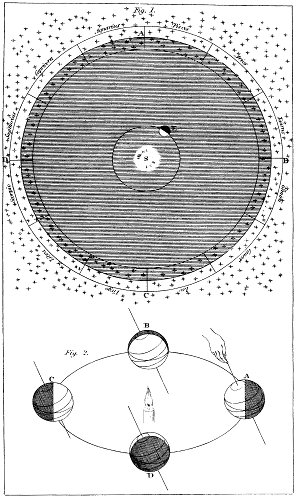
Mrs. B. A plane, is an even flat surface. Were you to bend a piece of wire, so as to form a hoop, you might then stretch a piece of cloth, or paper over it, like the head of a drum; this would form a flat surface, which might be called the plane of the hoop. Now the orbit of the earth, is an imaginary circle, surrounding the sun, and you can readily imagine a plane extending from one side of this circle to the other, filling up its whole area: such a plane would pass through the centre of the sun, dividing it into hemispheres. You may then imagine this plane extended beyond the limits of the earth's orbit, on every side, until it reached those fixed stars which form the signs of the zodiac; passing through the middle of these signs, it would give you the place of that imaginary circle in the heavens, call the ecliptic; which is the sun's apparent path. Let fig. 1. plate 9, represent such a plane, S the sun, E the earth with its orbit, and A B C D the ecliptic passing through the middle of the zodiac.
Plate ix.
Emily. If the ecliptic relates only to the heavens, why is it described upon the terrestrial globe?
Mrs. B. It is convenient for the demonstration of a variety of problems in the use of the globes; and besides, the obliquity of this circle to the equator is rendered more conspicuous by its being described on the same globe; and the obliquity of the ecliptic shows how much the earth's axis is inclined to the plane of its orbit. But to return to fig. 2. plate 8.
The spaces between the several parallel circles on the terrestrial globe are called zones: that which is comprehended between the tropics is distinguished by the name of the torrid zone; the spaces which extend from the tropics to the polar circles, the north and south temperate zones; and the spaces contained within the polar circles, the frigid zones. By the term zone is meant a belt, or girdle, the frigid zones, however, are not belts, but circles, extending 231/2 degrees from their centres, the poles.
The several lines which, you observe to be drawn from one pole to the other, cutting the equator at right angles, are called meridians; the number of these is unlimited, as a line passing through any place, directly to the poles, is called the meridian of that place. When any one of these meridians is exactly opposite to the sun, it is mid-day, or twelve o'clock in the day, at all the places situated any where on that meridian; and, at the places situated on the opposite meridian, it is consequently midnight.
Emily. To places situated equally distant from these two meridians, it must then be six o'clock.
Mrs. B. Yes; if they are to the east of the sun's meridian it is six o'clock in the afternoon, because they will have previously passed the sun; if to the west, it is six o'clock in the morning, and that meridian will be proceeding towards the sun.
Those circles which divide the globe into two equal parts, such as the equator and the ecliptic, are called greater circles; to distinguish them from those which divide it into two unequal parts, as the tropics, and polar circles, which are called lesser circles. All circles, you know, are imagined to be divided into 360 equal parts, called degrees, and degrees are again divided into 60 equal parts, called minutes. The diameter of a circle is a right line drawn across it, and passing through its centre; were you, for instance, to measure across this round table, that would give you its diameter; but were you to measure all round the edge of it, you would then obtain its circumference.
Now Emily, you may tell me exactly how many degrees are contained in a meridian?
Emily. A meridian, reaching from one pole to the other, is half a circle, and must therefore contain 180 degrees.
Mrs. B. Very well; and what number of degrees are there from the equator to one of the poles?
Caroline. The equator being equally distant from either pole, that distance must be half of a meridian, or a quarter of the circumference of a circle, and contain 90 degrees.
Mrs. B. Besides the usual division of circles into degrees, the ecliptic is divided into twelve equal parts, called signs, which bear the name of the constellations through which this circle passes in the heavens. The degrees measured on the meridians from the equator, either towards the north, or towards the south, are called degrees of latitude, of which there may be 90; those measured from east to west, either on the equator, or any of the lesser circles, are called degrees of longitude, of which there may be 180; these lesser circles are also called parallels of latitude. Of these parallels there may be any number; a circle drawn from east to west, at any distance from the equator, will always be parallel to it, and is therefore called a parallel of latitude.
Emily. The degrees of longitude must then vary in length, according to the dimensions of the circle on which they are reckoned; those, for instance, at the polar circles, will be considerably smaller than those at the equator?
Mrs. B. Certainly; since the degrees of circles of different dimensions do not vary in number, they must necessarily vary in length. The degrees of latitude, you may observe, never vary in length; for the meridians on which they are reckoned are all of the same dimensions.
Emily. And of what length is a degree of latitude?
Mrs. B. Sixty geographical miles, which is equal to 691/2 English statute miles; or about one-sixth more than a common mile.
Emily. The degrees of longitude at the equator, must then be of the same dimensions, with a degree of latitude.
Mrs. B. They would, were the earth a perfect sphere; but it is not exactly such, being somewhat protuberant about the equator, and flattened towards the poles. This form proceeds from the superior action of the centrifugal power at the equator, and as this enlarges the circle, it must, in the same proportion, increase the length of the degrees of longitude measured on it.
Caroline. I thought I had understood the centrifugal force perfectly, but I do not comprehend its effects in this instance.
Mrs. B. You know that the revolution of the earth on its axis, must give to every particle a tendency to fly off from the centre, that this tendency is stronger, or weaker, in proportion to the velocity with which the particle moves; now a particle situated near to one of the poles, makes one rotation in the same space of time as a particle at the equator; the latter, therefore, having a much larger circle to describe, travels proportionally faster, consequently the centrifugal force is much stronger at the equator than in the polar regions: it gradually decreases as you leave the equator and approach the poles, at which points the centrifugal force, entirely ceases. Supposing, therefore, the earth to have been originally in a fluid state, the particles in the torrid zone would recede much farther from the centre than those in the frigid zones; thus the polar regions would become flattened, and those about the equator elevated.
As a large portion of the earth is covered with water, the Creator gave to it the form, denominated an oblate spheroid, otherwise the polar regions would have been without water, and those about the equator, would have been buried several miles below the surface of the ocean.
Caroline. I did not consider that the particles in the neighbourhood of the equator, move with greater velocity than those about the poles; this was the reason I could not understand you.
Mrs. B. You must be careful to remember, that those parts of a body which are farthest from the centre of motion, must move with the greatest velocity: the axis of the earth is the centre of its diurnal motion, and the equatorial regions the parts most distant from the axis.
Caroline. My head then moves faster than my feet; and upon the summit of a mountain, we are carried round quicker than in a valley?
Mrs. B. Certainly; your head is more distant from the centre of motion than your feet; the mountain-top than the valley; and the more distant any part of a body is from the centre of motion, the larger is the circle it will describe, and the greater therefore must be its velocity.
Emily. I have been reflecting, that if the earth is not a perfect circle——
Mrs. B. A sphere you mean, my dear: a circle is a round line, every part of which is equally distant from the centre; a sphere or globe is a round body, the surface of which is every where equally distant from the centre.
Emily. If, then, the earth is not a perfect sphere, but prominent at the equator, and depressed at the poles, would not a body weigh heavier at the equator than at the poles? For the earth being thicker at the equator, the attraction of gravity perpendicularly downwards must be stronger.
Mrs. B. Your reasoning has some plausibility, but I am sorry to be obliged to add, that it is quite erroneous; for the nearer any part of the surface of a body is to the centre of attraction, the more strongly it is attracted; because it is then nearest to the whole mass of attracting matter. In regard to its effects, you might consider the whole power of gravity, as placed at the centre of attraction.
Emily. But were you to penetrate deep into the earth, would gravity increase as you approached the centre?
Mrs. B. Certainly not; I am referring only to any situation on the surface of the earth. Were you to penetrate into the interior, the attraction of the parts above you, would counteract that of the parts beneath you, and consequently diminish the power of gravity in proportion as you approach the centre; and if you reached that point, being equally attracted by the parts all around you, the effects of gravity would cease, and you would be without weight.
Emily. Bodies, then, should weigh less at the equator than at the poles, since they are more distant from the centre of gravity in the former than in the latter situation?
Mrs. B. And this is really the case; but the difference of weight would be scarcely sensible, were it not augmented by another circumstance.
Caroline. And what is this singular circumstance, which seems to disturb the laws of nature?
Mrs. B. One that you are well acquainted with, as conducing more to the preservation than the destruction of order,—the centrifugal force. This we have just observed to be strongest at the equator; and as it tends to drive bodies from the centre, it is necessarily opposed to, and must lessen the power of gravity, which attracts them towards the centre. We accordingly find that bodies weigh lightest at the equator, where the centrifugal force is greatest; and heaviest at the poles, where this power is least: the weight being diminished at the equator, by both the causes mentioned.
Caroline. Has the experiment been made in these different situations?
Mrs. B. Louis XIV. of France, sent philosophers both to the equator, and to Lapland, for this purpose: the severity of the climate, and obstruction from the ice, have hitherto rendered every attempt to reach the pole abortive; but the difference of gravity at the equator, and in Lapland is very perceptible.
Caroline. Yet I do not comprehend how the difference of weight could be ascertained, for if the body under trial decreased in weight, the weight which was opposed to it in the opposite scale must have diminished in the same proportion. For instance, if a pound of sugar did not weigh so heavy at the equator as at the poles, the leaden pound which served to weigh it, would not be so heavy either; therefore they would still balance each other, and the different force of gravity could not be ascertained by this means.
Mrs. B. Your observation is perfectly just: the difference of gravity in bodies situated at the poles, and at the equator, cannot be ascertained by weighing them; a pendulum was therefore used for that purpose.
Caroline. What, the pendulum of a clock? how could that answer the purpose?
Mrs. B. A pendulum consists of a line, or rod, to one end of which a weight is attached, and by the other end it is suspended to a fixed point, about which it is made to vibrate. When not in motion, a pendulum, obeying the general law of attraction, hangs like a plumb line, perpendicular to the surface of the earth, but if you raise the pendulum, gravity will bring it back to its perpendicular position. It will, however, not remain stationary there, for the momentum it has acquired during its descent, will impel it onwards, and if unobstructed, it will rise on the opposite side to an equal height; from thence it is brought back by gravity, and is again forced upwards, by the impulse of its momentum.
Caroline. If so, the motion of a pendulum would be perpetual, and I thought you said, that there was no perpetual motion on the earth.
Mrs. B. The motion of a pendulum is opposed by the resistance of the air in which it vibrates, and by the friction of the part by which it is suspended: were it possible to remove these obstacles, the motion of a pendulum would be perpetual, and its vibrations perfectly regular; each being of equal distance, and performed in equal times.
Emily. That is the natural result of the uniformity of the power which produces these vibrations, for the force of gravity being always the same, the velocity of the pendulum must consequently be uniform.
Caroline. No, Emily, you are mistaken; the force is not every where the same, and therefore the effect will not be so either. I have discovered it, Mrs. B.; since the force of gravity is less at the equator than at the poles, the vibrations of the pendulum will be slower at the former place than at the latter.
Mrs. B. You are perfectly right, Caroline; it was by this means that the difference of gravity was discovered, and the true figure of the earth ascertained.
Emily. But how do they contrive to regulate their time in the equatorial and polar regions? for, since in our part of the earth the pendulum of a clock vibrates exactly once in a second, if it vibrates faster at the poles, and slower at the equator, the inhabitants must regulate their clocks in a manner different from us.
Mrs. B. The only alteration required is to lengthen the pendulum in one case, and to shorten it in the other; for the velocity of the vibrations of a pendulum depends on its length; and when it is said that a pendulum vibrates quicker at the pole than at the equator, it is supposed to be of the same length. A pendulum which vibrates seconds in this latitude is about 391/7 inches long. In order to vibrate at the equator in the same space of time, it must be somewhat shorter; and at the poles, it must be proportionally lengthened.
The vibrations of a pendulum, resemble the descent of a body on an inclined plane, and are produced by the same cause; now you must recollect, that the greater the perpendicular height of such a plane, in proportion to its length, the more rapid will be the descent of the body; a short pendulum ascends to a greater height than a larger one, in vibrating a given distance, and of course its descent must be more rapid.
I shall now, I think, be able to explain to you the cause of the variation of the seasons, and the difference in the length of the days and nights in those seasons; both effects resulting from the same cause.
In moving round the sun, the axis of the earth is not perpendicular to the plane of its orbit. Supposing this round table to represent the plane of the earth's orbit, and this little globe, the earth; through this I have passed a wire, representing its axis and poles. In moving round the table, I do not hold the wire perpendicular to it, but obliquely.
Emily. Yes, I understand, the earth does not go round the sun in an upright position, its axis is slanting or oblique; and, it of course, forms an angle with a line drawn perpendicular to the plane of the earth's orbit.
Mrs. B. All the lines, which you learnt in your last lesson, are delineated on this little globe; you must consider the ecliptic as representing the plane of the earth's orbit; and the equator, which crosses the ecliptic in two places, then shows the degree of obliquity of the axis of the earth; which amounts to 231/2 degrees, very nearly. The points in which the ecliptic intersects the equator, are called the equinoctial points.
But I believe I shall render the effects of the obliquity of the earth's axis clearer to you, by the revolution of the little globe round a candle, which shall represent the sun. (Plate IX. fig. 2.)
As I now hold it, at A, you see it in the situation in which it is in the midst of summer, or what is called the summer solstice, which is on the 21st of June.
Emily. You hold the wire awry, I suppose, in order to show that the axis of the earth is not upright?
Mrs. B. Yes; in summer, the north pole is inclined towards the sun. In this season, therefore, the northern hemisphere enjoys much more of his rays than the southern. The sun, you see, now shines over the whole of the north frigid zone, and notwithstanding the earth's diurnal revolution, which I imitate by twirling the ball on the wire, it will continue to shine upon it as long as it remains in this situation, whilst the south frigid zone is at the same time completely in darkness.
Caroline. That is very strange; I never before heard that there was constant day or night in any part of the world! How much happier the inhabitants of the north frigid zone must be than those of the southern; the first enjoy uninterrupted day, while the last are involved in perpetual darkness.
Mrs. B. You judge with too much precipitation; examine a little further, and you will find, that the two frigid zones share an equal fate.
We shall now make the earth set off from its position in the summer solstice, and carry it round the sun; observe that the pole is always inclined in the same direction, and points to the same spot in the heavens. There is a fixed star situated near that spot, which is hence called the north polar star. Now let us stop the earth at B, and examine it in its present situation; it has gone through one quarter of its orbit, and is arrived at that point at which the ecliptic cuts, or crosses, the equator, and which is called the autumnal equinox.
Emily. The sun now shines from one pole to the other, just as it would constantly do, if the axis of the earth were perpendicular to its orbit.
Mrs. B. Because the inclination of the axis is now neither towards the sun, nor in the contrary direction; at this period of the year, the days and nights are equal in every part of the earth. But the next step she takes in her orbit, you see, involves the north pole in darkness, whilst it illumines that of the south; this change was gradually preparing as I moved the earth from summer to autumn; the arctic circle, which was at first entirely illumined, began to have short nights, which increased as the earth approached the autumnal equinox; and the instant it passed that point, the long night of the north pole commences, and the south pole begins to enjoy the light of the sun. We shall now make the earth proceed in its orbit, and you may observe that as it advances, the days shorten and the nights lengthen, throughout the northern hemisphere, until it arrives at the winter solstice, on the 21st of December, when the north frigid zone is entirely in darkness, and the southern has uninterrupted daylight.
Plate x.
Caroline. Then, after all, the sun which I thought so partial, confers his favours equally on all.
Mrs. B. Not so either: the inhabitants of the torrid zone have much more heat than we have, as the sun's rays fall perpendicularly twice in the course of a year, on every place within the tropics, while they shine more or less obliquely on the rest of the world, and almost horizontally at the poles; for during their long day of six months, the sun moves round their horizon without either rising or setting; the only observable difference, is that it is more elevated by a few degrees at mid-day, than at midnight.
Emily. To a person placed in the temperate zone, in the situation in which we are in England, the sun will shine neither so obliquely as it does on the poles, nor vertically as at the equator; but its rays will fall upon him more obliquely in autumn, and winter, than in summer.
Caroline. And therefore, the inhabitants of the temperate zones, will not have merely one day, and one night, in the year, as happens at the poles, nor will they have equal days, and equal nights, as at the equator; but their days and nights will vary in length, at different times of the year, according as their respective poles incline towards, or from the sun, and the difference will be greater in proportion to their distance from the equator.
Mrs. B. We shall now follow the earth through the other half of her orbit, and you will observe, that now exactly the same changes take place in the southern hemisphere, as those we have just remarked in the northern. Day commences at the south pole, when night sets in at the north pole; and in every other part of the southern hemisphere the days are longer than the nights, while, on the contrary, our nights are longer than our days. When the earth arrives at the vernal equinox, D, where the ecliptic again cuts the equator, on the 21st of March, she is situated, with respect to the sun, exactly in the same position, as in the autumnal equinox; and the only difference with respect to the earth, is, that it is now autumn in the southern hemisphere, whilst it is spring with us.
Caroline. Then the days and nights are again every where equal.
Mrs. B. Yes, for the half of the globe which is enlightened, extends exactly from one pole to the other, the sun has just risen to the north pole, and is just setting to the south pole; but in every other part of the globe, the day and night is of twelve hours length; hence the word equinox, which is derived from the Latin, meaning equal night.
As our summer advances, the days lengthen in the northern hemisphere, and shorten in the southern, till the earth reaches the summer solstice, when the north frigid zone is entirely illumined, and the southern is in complete darkness; and we have now brought the earth again to the spot from whence we first accompanied her.
Emily. This is indeed a most satisfactory explanation of the cause of the different lengths of our days and nights, and of the variation of the seasons; and the more I learn, the more I admire the simplicity of means by which such wonderful effects are produced.
Mrs. B. I know not which is most worthy of our admiration, the causes, or the effects of the earth's revolution round the sun. The mind can find no object of contemplation more sublime, than the course of this magnificent globe, impelled by the combined powers of projection and attraction, to roll in one invariable course, around the source of light and heat: and what can be more delightful than the beneficent effects of this vivifying power on its attendant planet. It is at once the grand principle which animates and fecundates nature.
Emily. There is one circumstance in which this little ivory globe appears to me to differ from the earth; it is not quite dark on that side of it which is turned from the candle, as is the case with the earth when neither moon nor stars are visible.
Mrs. B. This is owing to the light of the candle, being reflected by the walls of the room, on every part of the globe, consequently that side of the globe, on which the candle does not directly shine, is not in total darkness. Now the skies have no walls to reflect the sun's light on that side of our earth which is in darkness.
Caroline. I beg your pardon, Mrs. B., I think that the moon, and stars, answer the purpose of walls in reflecting the sun's light to us in the night.
Mrs. B. Very well, Caroline; that is to say, the moon and planets; for the fixed stars, you know, shine by their own light.
Emily. You say, that the superior heat of the equatorial parts of the earth, arises from the rays falling perpendicularly on those regions, whilst they fall obliquely on these more northern regions; now I do not understand why perpendicular rays should afford more heat than oblique rays.
Caroline. You need only hold your hand perpendicularly over the candle, and then hold it sideways obliquely, to be sensible of the difference.
Emily. I do not doubt the fact, but I wish to have it explained.
Mrs. B. You are quite right; if Caroline had not been satisfied with ascertaining the fact, without understanding it, she would not have brought forward the candle as an illustration; the reason why you feel so much more heat if you hold your hand perpendicularly over the candle, than if you hold it sideways, is because a stream of heated vapour constantly ascends from the candle, or any other burning body, which being lighter than the air of the room, does not spread laterally but rises perpendicularly, and this led you to suppose that the rays were hotter in the latter direction. Had you reflected, you would have discovered that rays issuing from the candle sideways, are no less perpendicular to your hand when held opposite to them, than the rays which ascend when your hand is held over them.
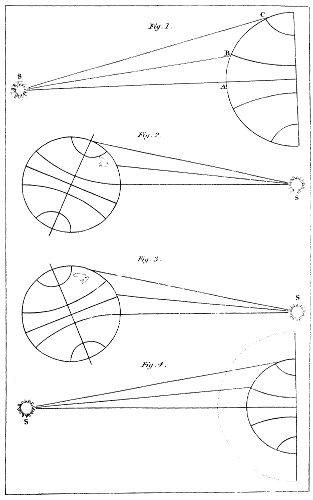
The reason why the sun's rays afford less heat when in an oblique direction, than when perpendicular, is because fewer of them fall upon an equal portion of the earth; this will be understood better by referring to plate 10. fig. 1, which represents two equal portions of the sun's rays, shining upon different parts of the earth. Here it is evident, that the same quantity of rays fall on the space A B, as fall on the space B C; and as A B is less than B C, the heat and light will be much stronger in the former than in the latter; A B, you see, represents the equatorial regions, where the sun shines perpendicularly; and B C, the temperate and frozen climates, where his rays fall more obliquely.
Emily. This accounts not only for the greater heat of the equatorial regions, but for the greater heat of our summers, as the sun shines less obliquely in summer than in winter.
Mrs. B. This you will see exemplified in figure 2, in which the earth is represented, as it is situated on the 21st of June, and England receives less oblique, and consequently a greater number of rays, than at any other season; and figure 3, shows the situation of England on the 21st of December, when the rays of the sun fall most obliquely upon her. But there is also another reason why oblique rays give less heat, than perpendicular rays; which is, that they have a greater portion of the atmosphere to traverse; and though it is true, that the atmosphere is itself a transparent body, freely admitting the passage of the sun's rays, yet it is always loaded more or less with dense and foggy vapour, which the rays of the sun cannot easily penetrate; therefore, the greater the quantity of atmosphere the sun's rays have to pass through in their way to the earth, the less heat they will retain when they reach it. This will be better understood, by referring to fig. 4. The dotted line round the earth, describes the extent of the atmosphere, and the lines which proceed from the sun to the earth, the passage of two equal portions of the sun's rays, to the equatorial and polar regions; the latter you see, from its greater obliquity, passes through a greater extent of atmosphere.
Caroline. And this, no doubt, is the reason why the sun, in the morning and in the evening, gives so much less heat, than at mid-day.
Mrs. B. The diminution of heat, morning and evening, is certainly owing to the greater obliquity of the sun's rays; and they are also affected by the other, both the cause, which I have just explained to you; the difficulty of passing through a foggy atmosphere is perhaps more particularly applicable to them, as mist and vapours are prevalent about the time of sunrise and sunset. But the diminished obliquity of the sun's rays, is not the sole cause of the heat of summer; the length of the days greatly conduces to it; for the longer the sun is above the horizon, the more heat he will communicate to the earth.
Caroline. Both the longest days, and the most perpendicular rays, are on the 21st of June; and yet the greatest heat prevails in July and August.
Mrs. B. Those parts of the earth which are once heated, retain the heat for some length of time, and the additional heat they receive, occasions an elevation of temperature, although the days begin to shorten, and the sun's rays to fall more obliquely. For the same reason, we have generally more heat at three o'clock in the afternoon, than at twelve, when the sun is on the meridian.
Emily. And pray, have the other planets the same vicissitudes of seasons, as the earth?
Mrs. B. Some of them more, some less, according as their axes deviate more or less from the perpendicular, to the plane of their orbits. The axis of Jupiter, is nearly perpendicular to the plane of his orbit; the axes of Mars, and of Saturn, are each, inclined at angles of about sixty degrees; whilst the axis of Venus is believed to be elevated only fifteen or twenty degrees above her orbit; the vicissitudes of her seasons must therefore be considerably greater than ours. For further particulars respecting the planets, I shall refer you to Bonnycastle's Introduction to Astronomy.
I have but one more observation to make to you, relative to the earth's motion; which is, that although we have but 365 days and nights in the year, she performs 366 complete revolutions on her axis, during that time.
Caroline. How is that possible? for every complete revolution must bring the same place back to the sun. It is now just twelve o'clock, the sun is, therefore, on our meridian; in twenty-four hours will it not have returned to our meridian again, and will not the earth have made a complete rotation on its axis?
Mrs. B. If the earth had no progressive motion in its orbit whilst it revolves on its axis, this would be the case; but as it advances almost a degree westward in its orbit, in the same time that it completes a revolution eastward on its axis, it must revolve nearly one degree more in order to bring the same meridian back to the sun.
Caroline. Oh, yes! it will require as much more of a second revolution to bring the same meridian back to the sun, as is equal to the space the earth has advanced in her orbit; that is, nearly a degree; this difference is, however, very little.
Mrs. B. These small daily portions of rotation, are each equal to the three hundred and sixty-fifth part of a circle, which at the end of the year amounts to one complete rotation.
Emily. That is extremely curious. If the earth then, had no other than its diurnal motion, we should have 366 days in the year.
Mrs. B. We should have 366 days in the same period of time that we now have 365; but if we did not revolve round the sun, we should have no natural means of computing years.
You will be surprised to hear, that if time is calculated by the stars instead of the sun, the irregularity which we have just noticed does not occur, and that one complete rotation of the earth on its axis, brings the same meridian back to any fixed star.
Emily. That seems quite unaccountable; for the earth advances in her orbit with regard to the fixed stars, the same as with regard to the sun.
Mrs. B. True, but then the distance of the fixed stars is so immense, that our solar system is in comparison to it but a spot, and the whole extent of the earth's orbit but a point; therefore, whether the earth remain stationary, or whether it revolved in its orbit during its rotation on its axis, no sensible difference would be produced with regard to the fixed stars. One complete revolution brings the same meridian back to the same fixed star; hence the fixed stars appear to go round the earth in a shorter time than the sun by three minutes fifty-six seconds of time.
Caroline. These three minutes fifty-six seconds is the time which the earth takes to perform the additional three hundred and sixty-fifth part of the circle, in order to bring the same meridian back to the sun.
Mrs. B. Precisely. Hence the stars gain every day three minutes fifty-six seconds on the sun, which makes them rise that portion of time earlier every day.
When time is calculated by the stars it is called sidereal time; when by the sun, solar, or apparent time.
Caroline. Then a sidereal day is three minutes fifty-six seconds shorter, than a solar day of twenty-four hours.
Mrs. B. I must also explain to you what is meant by a sidereal year.
The common year, called the solar or tropical year, containing 365 days, five hours, forty-eight minutes and fifty-two seconds, is measured from the time the sun sets out from one of the equinoxes, or solstices, till it returns to the same again; but this year is completed, before the earth has finished one entire revolution in its orbit.
Emily. I thought that the earth performed one complete revolution in its orbit, every year; what is the reason of this variation?
Mrs. B. It is owing to the spheroidal figure of the earth. The elevation about the equator produces much the same effect as if a similar mass of matter, collected in the form of a moon, revolved round the equator. When this moon acted on the earth, in conjunction with, or in opposition to the sun, variations in the earth's motion would be occasioned, and these variations produce what is called the precession of the equinoxes.
Plate xi.
Emily. What does that mean? I thought the equinoctial points, were fixed points in the heavens, in which the equator cuts the ecliptic.
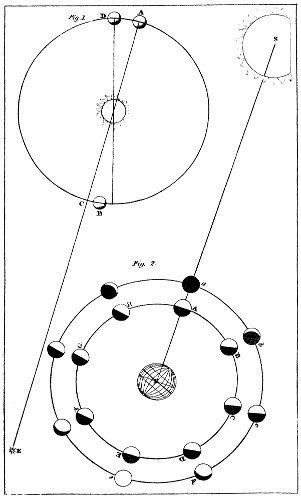
Mrs. B. These points are not quite fixed, but have an apparently retrograde motion, among the signs of the zodiac; that is to say, instead of being at every revolution in the same place, they move backwards. Thus if the vernal equinox is at A, (fig. 1. plate XI.) the autumnal one, will be at B, instead of C, and the following vernal equinox, at D, instead of at A, as would be the case if the equinoxes were stationary, at opposite points of the earth's orbit.
Caroline. So that when the earth moves from one equinox to the other, though it takes half a year to perform the journey, it has not travelled through half its orbit.
Mrs. B. And, consequently, when it returns again to the first equinox, it has not completed the whole of its orbit. In order to ascertain when the earth has performed an entire revolution in its orbit, we must observe when the sun returns in conjunction with any fixed star; and this is called a sidereal year. Supposing a fixed star situated at E, (fig. 1. plate XI.) the sun would not appear in conjunction with it, till the earth had returned to A, when it would have completed its orbit.
Emily. And how much longer is the sidereal, than the solar year?
Mrs. B. Only twenty minutes; so that the variation of the equinoctial points is very inconsiderable. I have given them a greater extent in the figure, in order to render them sensible.
In regard to time, I must further add, that the earth's diurnal motion on an inclined axis, together with its annual revolution in an elliptic orbit, occasions so much complication in its motion, as to produce many irregularities; therefore the true time cannot be measured by the apparent place of the sun. A perfectly correct clock, would in some parts of the year be before the sun, and in other parts after it. There are but four periods in which the sun and a perfect clock would agree, which is the 15th of April, the 16th of June, the 23d of August, and the 24th of December.
Emily. And is there any considerable difference between solar time, and true time?
Mrs. B. The greatest difference amounts to between fifteen and sixteen minutes. Tables of equation are constructed for the purpose of pointing out, and correcting these differences between solar time and equal or mean time, which is the denomination given by astronomers, to true time.
Questions