CONVERSATION V. ON THE MECHANICAL POWERS.
Reading edition
OF THE POWER OF MACHINES. OF THE LEVER IN GENERAL. OF THE LEVER OF THE FIRST KIND, HAVING THE FULCRUM BETWEEN THE POWER AND THE WEIGHT. OF THE LEVER OF THE SECOND KIND, HAVING THE WEIGHT BETWEEN THE POWER AND THE FULCRUM. OF THE LEVER OF THE THIRD KIND, HAVING THE POWER BETWEEN THE FULCRUM AND THE WEIGHT.
MRS. B.
We may now proceed to examine the mechanical powers; they are six in number: The lever, the pulley, the wheel and axle, the inclined plane, the wedge and the screw; one or more of which enters into the composition of every machine.
A mechanical power is an instrument by which the effect of a given force is increased, whilst the force remains the same.
In order to understand the power of a machine, there are four things to be considered. 1st. The power that acts: this consists in the effort of men or horses, of weights, springs, steam, &c.
2dly. The resistance which is to be overcome by the power: this is generally a weight to be moved. The power must always be superior to the resistance, otherwise the machine could not be put in motion.
Caroline. If for instance the resistance of a carriage was greater than the strength of the horses employed to draw it, they would not be able to make it move.
Mrs. B. 3dly. We are to consider the support or prop, or as it is termed in mechanics, the fulcrum; this you may recollect is the point upon which the body turns when in motion; and lastly, the respective velocities of the power, and of the resistance.
Emily. That must in general depend upon their respective distances from the fulcrum, or from the axis of motion; as we observed in the motion of the vanes of the windmill.
Mrs. B. We shall now examine the power of the lever. The lever is an inflexible rod or bar, moveable about a fulcrum, and having forces applied to two or more points on it. For instance, the steel rod to which these scales are suspended is a lever, and the point in which it is supported, the fulcrum, or centre of motion; now, can you tell me why the two scales are in equilibrium?
Caroline. Being both empty, and of the same weight, they balance each other.
Emily. Or, more correctly speaking, because the centre of gravity common to both, is supported.
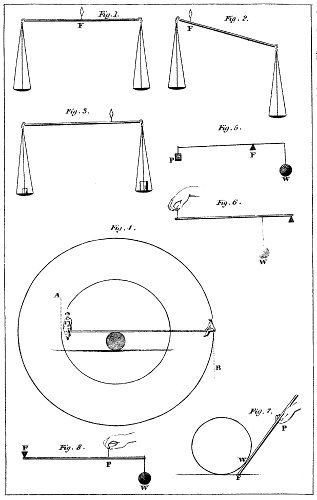
Mrs. B. Very well; and where is the centre of gravity of this pair of scales? (fig. 1. plate 4.)
Emily. You have told us that when two bodies of equal weight were fastened together, the centre of gravity was in the middle of the line that connected them; the centre of gravity of the scales must therefore be supported by the fulcrum F of the lever which unites the two scales, and which is the centre of motion.
Caroline. But if the scales contained different weights, the centre of gravity would no longer be in the fulcrum of the lever, but remove towards that scale which contained the heaviest weight; and since that point would no longer be supported, the heavy scale would descend, and out-weigh the other.
Mrs. B. True; but tell me, can you imagine any mode by which bodies of different weights can be made to balance each other, either in a pair of scales, or simply suspended to the extremities of the lever? for the scales are not an essential part of the machine; they have no mechanical power, and are used merely for the convenience of containing the substance to be weighed.
Caroline. What! make a light body balance a heavy one? I cannot conceive that possible.
Mrs. B. The fulcrum of this pair of scales (fig. 2.) is moveable, you see; I can take it off the beam, and fasten it on again in another part; this part is now become the fulcrum, but it is no longer in the centre of the lever.
Caroline. And the scales are no longer true; for that which hangs on the longest side of the lever descends.
Mrs. B. The two parts of the lever divided by the fulcrum, are called its arms; you should therefore say the longest arm, not the longest side of the lever.
Your observation is true that the balance is now destroyed; but it will answer the purpose of enabling you to comprehend the power of a lever, when the fulcrum is not in the centre.
Emily. This would be an excellent contrivance for those who cheat in the weight of their goods; by making the fulcrum a little on one side, and placing the goods in the scale which is suspended to the longest arm of the lever, they would appear to weigh more than they do in reality.
Mrs. B. You do not consider how easily the fraud would be detected; for on the scales being emptied they would not hang in equilibrium. If indeed the scale on the shorter arm was made heavier, so as to balance that on the longer, they would appear to be true, whilst they were really false.
Emily. True; I did not think of that circumstance. But I do not understand why the longest arm of the lever should not be in equilibrium with the other?
Caroline. It is because the momentum in the longest, is greater than in the shortest arm; the centre of gravity, therefore, is no longer supported.
Mrs. B. You are right, the fulcrum is no longer in the centre of gravity; but if we can contrive to make the fulcrum in its present situation become the centre of gravity, the scales will again balance each other; for you recollect that the centre of gravity is that point about which every part of the body is in equilibrium.
Emily. It has just occurred to me how this may be accomplished; put a great weight into the scale suspended to the shortest arm of the lever, and a smaller one into that suspended to the longest arm. Yes, I have discovered it—look Mrs. B., the scale on the shortest arm will carry 3 lbs., and that on the longest arm only one, to restore the balance. (fig. 3.)
Mrs. B. You see, therefore, that it is not so impracticable as you imagined, to make a heavy body balance a light one; and this is in fact the means by which you observed that an imposition in the weight of goods might be effected, as a weight of ten or twelve ounces, might thus be made to balance a pound of goods. If you measure both arms of the lever, you will find that the length of the longer arm, is three times that of the shorter; and that to produce an equilibrium, the weights must bear the same proportion to each other, and that the greater weight, must be on the shorter arm. Let us now take off the scales, that we may consider the lever simply; and in this state you see that the fulcrum is no longer the centre of gravity, because it has been removed from the middle of the lever; but it is, and must ever be, the centre of motion, as it is the only point which remains at rest, while the other parts move about it.
Plate iv.
Caroline. The arms of the lever being different in length, it now exactly resembles the steelyards, with which articles are so frequently weighed.
Mrs. B. It may in fact be considered as a pair of steelyards, by which the same power enables us to ascertain the weight of different articles, by simply increasing the distance of the power from the fulcrum; you know that the farther a body is from the axis of motion, the greater is its velocity.
Caroline. That I remember, and understand perfectly.
Mrs. B. You comprehend then, that the extremity of the longest arm of a lever, must move with greater velocity than that of the shortest arm, and that its momentum is greater in proportion.
Emily. No doubt, because it is farthest from the centre of motion. And pray, Mrs. B., when my brothers play at see-saw, is not the plank on which they ride, a kind of lever?
Mrs. B. Certainly; the log of wood which supports it from the ground is the fulcrum, and those who ride, represent the power and the resistance at the ends of the lever. And have you not observed that when those who ride are of equal weight, the plank must be supported in the middle, to make the two arms equal; whilst if the persons differ in weight, the plank must be drawn a little farther over the prop, to make the arms unequal, and the lightest person, who may be supposed to represent the power, must be placed at the extremity of the longest arm.
Caroline. That is always the case when I ride on a plank with my youngest brother; I have observed also that the lightest person has the best ride, as he moves both further and quicker; and I now understand that it is because he is more distant from the centre of motion.
Mrs. B. The greater velocity with which your little brother moves, renders his momentum equal to yours.
Caroline. Yes; I have the most weight, he the greatest velocity; so that upon the whole our momentums are equal. But you said, Mrs. B., that the power should be greater than the resistance, to put the machine in motion; how then can the plank move if the momentums of the persons who ride are equal?
Mrs. B. Because each person at his descent touches and pushes against the ground with his feet; the reaction of which gives him an impulse which produces the motion; this spring is requisite to destroy the equilibrium of the power and the resistance, otherwise the plank would not move. Did you ever observe that a lever describes the arc of a circle in its motion?
Emily. No; it appears to me to rise and descend perpendicularly; at least I always thought so.
Mrs. B. I believe I must make a sketch of you and your brother riding on a plank, in order to convince you of your error. (fig. 4. plate 4.) You may now observe that a lever can move only round the fulcrum, since that is the centre of motion; it would be impossible for you to rise perpendicularly, to the point A; or for your brother to descend in a straight line, to the point B; you must in rising, and he in descending, describe arcs of your respective circles. This drawing shows you also how much superior his velocity must be to yours; for if you could swing quite round, you would each complete your respective circles, in the same time.
Caroline. My brother's circle being much the largest, he must undoubtedly move the quickest.
Mrs. B. Now tell me, do you think that your brother could raise you as easily without the aid of a lever?
Caroline. Oh no, he could not lift me off the ground.
Mrs. B. Then I think you require no further proof of the power of a lever, since you see what it enables your brother to perform.
Caroline. I now understand what you meant by saying, that in mechanics, velocity is opposed to weight, for it is my brother's velocity which overcomes my weight.
Mrs. B. You may easily imagine, what enormous weights may be raised by levers of this description, for the longer, when compared with the other, that arm is to which the power is applied, the greater will be the effect produced by it; because the greater is the velocity of the power compared to that of the weight.
Levers are of three kinds; in the first the fulcrum is between the power and the weight.
Caroline. This kind then comprehends the several levers you have described.
Mrs. B. Yes, when in levers of the first kind, the fulcrum is equally distant from the power and the weight, as in the balance, there will be an equilibrium, when the power and the weight are equal to each other; it is not then a mechanical power, for nothing can in this case be gained by velocity; the two arms of the lever being equal, the velocity of their extremities must be so likewise. The balance is therefore of no assistance as a mechanical power, although it is extremely useful in estimating the respective weights of bodies.
But when (fig. 5.) the fulcrum F of a lever is not equally distant from the power and the weight, and the power P acts at the extremity of the longest arm, it may be less than the weight W; its deficiency being compensated by its superior velocity, as we observed in the see-saw.
Emily. Then when we want to lift a great weight, we must fasten it to the shortest arm of a lever, and apply our strength to the longest arm?
Mrs. B. If the case will admit of your putting the end of the lever under the resisting body, no fastening will be required; as you will perceive, when a nail is drawn by means of a hammer, which, though bent, is a lever of the first kind; the handle being the longest arm, the point on which it rests, the fulcrum, and the distance from that to the part which holds the nail, the short arm. But let me hear, Caroline, whether you can explain the action of this instrument, which is composed of two levers united in one common fulcrum.
Caroline. A pair of scissors!
Mrs. B. You are surprised; but if you examine their construction, you will discover that it is the power of the lever, that assists us in cutting with scissors.
Caroline. Yes; I now perceive that the point at which the two levers are screwed together, is the fulcrum; the power of the fingers is applied to the handles, and the article to be cut, is the resistance; therefore, the longer the handles, and the shorter the points of the scissors, the more easily you cut with them.
Emily. That I have often observed, for when I cut paste-board or any hard substance, I always make use of that part of the scissors nearest the screw or rivet, and I now understand why it increases the power of cutting; but I confess that I never should have discovered scissors to have been double levers; and pray are not snuffers levers of a similar description?
Mrs. B. Yes, and most kinds of pincers; the great power of which consists in the great relative length of the handles.
Did you ever notice the swingle-tree of a carriage to which the horses are attached when drawing?
Emily. O yes; this is a lever of the first kind, but the fulcrum being in the middle, the horses should draw with equal power, whatever may be their strength.
Mrs. B. That is generally the case, but it is evident that by making one arm longer than the other, it might be adapted to horses of unequal strength.
Caroline. And of what nature are the other two kinds of levers?
Mrs. B. In levers of the second kind, the weight, instead of being at one end, is situated between the power and the fulcrum, (fig. 6.)
Caroline. The weight and the fulcrum have here changed places; and what advantage is gained by this kind of lever?
Mrs. B. In moving it, the velocity of the power must necessarily be greater than that of the weight, as it is more distant from the centre of the motion. Have you ever seen your brother move a snow-ball by means of a strong stick, when it became too heavy for him to move without assistance?
Caroline. Oh yes; and this was a lever of the second kind, (fig. 7.) the end of the stick, which he thrusts under the ball, and which rests on the ground, becomes the fulcrum; the ball is the weight to be moved, and the power his hands, applied to the other end of the lever. In this instance there is a great difference in the length of the arms of the lever; for the weight is almost close to the fulcrum.
Mrs. B. And the advantage gained is proportional to this difference. The most common example that we have of levers of the second kind, is in the doors of our apartments.
Emily. The hinges represent the fulcrum, our hands the power applied to the other end of the lever; but where is the weight to be moved?
Mrs. B. The door is the weight, which in this example occupies the whole of the space between the power and the fulcrum. Nut crackers are double levers of this kind: the hinge is the fulcrum, the nut the resistance, and the hands the power.
In levers of the third kind (fig. 8.) the fulcrum is again at one extremity, the weight or resistance at the other, and the power is applied between the fulcrum and the resistance.
Emily. The fulcrum, the weight, or the power, then, each in its turn, occupies some part of the lever between its extremities. But in this third kind of lever, the weight being farther than the power from the centre of motion, the difficulty of raising it seems increased rather than diminished.
Mrs. B. That is very true; a lever of this kind is therefore never used, unless absolutely necessary, as is the case in raising a ladder in order to place it against a wall; the man who raises it cannot place his hands on the upper part of the ladder, the power, therefore, is necessarily placed much nearer to the fulcrum than to the weight.
Caroline. Yes, the hands are the power, the ground the fulcrum, and the upper part of the ladder the weight.
Mrs. B. Nature employs this kind of lever in the structure of the human frame. In lifting a weight with the hand, the lower part of the arm becomes a lever of the third kind; the elbow is the fulcrum, the muscles of the fleshy part of the arm, the power; and as these are nearer to the elbow than to the hand, it is necessary that their power should exceed the weight to be raised.
Emily. Is it not surprising that nature should have furnished us with such disadvantageous levers?
Mrs. B. The disadvantage, in respect to power, is more than counterbalanced by the convenience resulting from this structure of the arm; and it is that no doubt which is best adapted to enable it to perform its various functions.
There is one rule which applies to every lever, which is this: In order to produce an equilibrium, the power must bear the same proportion to the weight, as the length of the shorter arm does to that of the longer; as was shown by Emily with the weights of 1 lb. and of 3 lb. Fig. 3. plate 4.
We have dwelt so long on the lever, that we must reserve the examination of the other mechanical powers, to our next interview.
Questions