WHY MAMMY DELPHY'S BABY WAS NAMED GRIEF.
Reading edition
Mammy Delphy was sitting out under the vines that climbed over the kitchen gallery, picking a chicken for dinner, and singing. And such singing! Some of the words ran this way:
"Aldo you sees me go 'long so, I has my trials here below, Sometimes I'se up, sometimes I'se down, Sometimes I'se lebel wid de groun; Oh, git out, Satan Hallalu!"
And these words sound queer to you as you read them, perhaps, but they did not sound queer when Mammy Delphy was singing them. I don't believe that a song out of heaven could be sweeter than this and other songs like it that dear old Mammy sings, twist in her voice that makes you choke up about the throat, if you are a boy, and sob right out if you are a girl. And it makes you, somehow, remember, in hearing it, all the sweet, sad little stories that your mother has told you about your little baby sister who died before you were born; or, if you have stood in a darkened room, holding fast to some tender and loving hand, and looked at a face that was dear to you lying upon its coffin pillow, you think of that strange and sad time. And with these thoughts come, as you listen, other thoughts of flying angels and shining crowns, and wide-opened gates of pearl. A sweetness mixed with pain—that is, the feeling which Mammy Delphy's singing brings to you, though you could not describe it, perhaps, if you tried—at least that's the feeling it brings to me.
"I'll take my shoes from off'n my feet, And walk into de golden street, Glory, Hallalu!"
sang Mammy. Sam and Jim and Joe came filing in. They had been—well, where hadn't they been! They had been down to the Bayou, which ran a good quarter of a mile back of the place, "fishin for mott of sweet-gum trees, where they had stuck up the cuffs and bosoms of their shirts with gum and torn their trousers in climbing a persimmon tree to peep into a bird's-nest. And they were rushing across the yard in chase of a horned-frog when they caught sight of Mammy Delphy under the kitchen shed.
"Let's go and get Mammy Delphy to give us some meat and go a crawfishin', boys," suggested Sam.
"And I'm hungry, for one," added Joe.
Accordingly they filed in, as I said, and stood for a moment listening to Mammy Delphy's song.
"Give us somethin' to eat, Mammy, please," said Jim.
"An' some craw-fish bait and a piece of string," put in the other two in a breath.
"I ain't a gwine to do it, chillun," replied Mammy Delphy, giving them a gentle push with her elbow, for they were leaning coaxingly against her shoulders, "I ain't a gwine to do it. Yer ma's got comp'ny for dinner and dat sassy Marthy-Ann done tuk herself to 'Mancipation-Day, an' Jin, she totin of Mis' May's no time to wase on yer. Go'long!" And as she spoke Mammy arose, chicken in hand, and went into the kitchen to get whatever the boys wanted, as they were perfectly aware she would, from the beginning.
"Lawd o' mussy! Jest look at dat lazy nigger! Grief!" she exclaimed as she entered, "Grief, yer lazy good-for-nuthin' nigger, is yer gwine ter let dem sweet-taters burn clar up?"
And seizing the collar of a negro man who sat nodding by the stove, she gave him a sound shaking. He opened his eyes, grinned and got up slowly, looking a little sheepish as he did so. At that moment the woolly head of Jin, the baby's little black nurse, was poked in at the door.
"Daddy," she cried, "Miss May say as how she want you to come an' tie up her Malcasum rose, whar dem boys is done pull down."
And Jin bestowed a withering look upon the culprits, who were already digging their fingers into the remnants of a meat-pie, and disappeared, followed by her father.
"Mammy Delphy," said Joe, when they were out under the vines again and Mammy had recommenced her work, "what made you name Uncle Grief, Grief? That's a mighty funny name, ain't it, boys?"
is a curus name like; me'n de ole man—he dead an' gone, chillun, long fo' you was born;—me'n de ole man 'sulted long time 'bout dat chile's name an' he war goin' on six months old fo' we name him at all."
"Well, how did you happen to call him Grief?" insisted Joe.
"Yes, honey, yes. 'Twar a long time ago, chile, when Mas' Will—dat's yer pa (she nodded towards Joe) war a little fellow, heap littler'n you, heap littler, an' Mas' Charley—dat's yer pappy (to the other two) war a baby. I war nussen him long o' Grief an' Grief warn't name yet. Miss May—dat's yer all's Gramma whar died las' year—she use to come out to de back steps an' watch dem two babies nussen', Grief an' Mas' Charley bof at de same time in my lap; an' Mas' Will an' Jerry—dat's my little boy what war jes' 'bout his age—a-playing in de back-yard, an' sometime she laugh an' cry all at de same time an' she say: 'We is all one fam'ly, Delphy!' she say. Law's, chillun, dem was times! You don't know nuthin' 'bout dem times. Disher house was full up all de time wid comp'ny; gran' comp'ny, what dress all de time in silk an' go walkin' 'bout under de trees an' ridin' 'bout over de prairie dey was all burnt up, time o' de war—an' sakes, honey! de hosses an' de cayages an' de niggers an' disher big plantation, all shinin' wid corn an' cotton! Dem was times!" And Mammy's old eyes lighted up as she went back to her youth and the glory of her family, for she still speaks with pride of her "fam'ly."
"But Grief, Mammy?" said Jim.
"Yes, honey, yes. Yer pappy and Grief war babies, an' Grief warn't named, an' Mas' Will an' Jerry was little boys, littler'n you. 'N one day Miss May, she come to the back do' an' call me. I was sittin' in disher very place dat day, nussin dem two babies, an' my mammy (she de cook), gittin' dinner in de kitchen. 'Delphy,' Miss May say, 'Delphy, does you know whar Will an' Jerry is? Dey ain't been seen sence breakfast dis mornin'.
"YER PAPPY AN' GRIEF WAR BABIES, AN' GRIEF WARN'T NAMED."
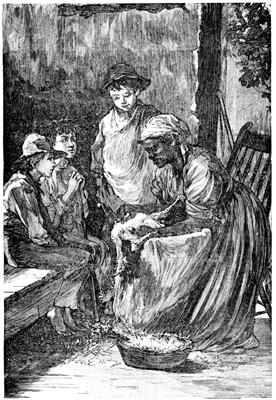
"I felt curus-like dat minit, an' I jump up an' run all over de place lookin' for dem boys. 'Rectly all de house gals an' everybody—Mas' and Mis' an' everybody—commence to hunt for dem chillun. We look everywhere—in de hay-top, in de cotton everywhere. Den I saw Miss May—dat's yer granma, turn white-like, an' she say, 'Oh Delphy, oh James'—dat's yer grandpa—'de ole well in de field! de ole well in de field!'
"Over in de bayou-field—it done full up now, ole Mas' had a well dug to water de hosses out in. It war kivered up wid some bodes.
"I don't 'zactly 'member 'bout goin' over to de field, but when I got dar wid dem two babies in my arms an' stood 'long side o' Miss May—"
Mammy Delphy spoke more and more slowly. She had stopped picking the chicken, and great tears were rolling down her cheeks. The boys stood stricken and silent.
—"Stood 'long side o' Miss May, fus thing I hear war Jerry sayin' weak-like an' way down in de well: 'Don't you cry, Mas' Will! Hol' on to my neck, Mas' Will! Hol' tight, Mas' Will! I kin hol' you up. Don't you be feerd Mas' Will, I kin hol' you up! Don't you be feerd Mas' Will; I kin hol' you up!'
"Ole Mas' lean over de well an' look in. Mas' Will he warn't as high as Jerry, an' Jerry he war standin in de water up to his neck an'
"'We'll get Jerry next time,' says ole Mas'. An' Jerry help Mas' Will fix de rope roun' him an' dey pull him up out'n de water. He done fainted when dey got him out, an' he tuk de fever, an' dat chile war sick mos' six months, an' all de time he had de fever, he say: 'Take Jerry too, pappy, take Jerry too!' And when he come to hisself, he say right off:
"'Where's Jerry? I want Jerry.'"
Mammy Delphy stopped.
"And where was Jerry, mammy?" cried the boys, breathless.
"'Where war Jerry?' Ole Mas' let down de rope an' say right loud: 'Ketch holt, Jerry my boy!' But Jerry couldn't ketch holt, chillen. Jerry war dead."
"Oh mammy!"
"Yes, chillun, yes. Dey rub him an' rub him, an' do everything to fotch him to life. But, my Jerry war dead. An' when me'n de ole man come home from de funeral—dey buried him in de white folks' buryin'-groun,' long side o' Miss May's little gal what died—an' put a tombstone at de head—when we Grief.' An' we name him Grief."
Mammy Delphy wiped her eyes and resumed her work. Then, looking up to the blue sky which shone between the vines, she began singing again:
"Call me in de mornin' Lord, Or call me in de night, I'se always ready Lord, Glory Hallalu!"
And the boys, subdued and silent, and for a moment forgetful of horned-frogs and crawfish, went away softly, as if leaving a grave.