BROTHERS FOR SALE.
Reading edition
Molly was six years old; a plump, roly-poly little girl with long, crimpy golden hair and great blue eyes. She had ever so many brothers; Fred, a year older than herself, and who went to the Kindergarten with her, was her favorite. Molly was very fond of swinging on the front-yard gate; a forbidden pleasure, by the way. This is the preface to my story about Molly.
One windy, sunny day the little girl was "riding to Boston" on the front gate; she had swung out and let the wind blow her back again a half dozen times, and she was happy as a captain on the high seas, enjoying the swaying, dizzy motion.
Every little girl—and many a boy—has swung on a gate, standing tip-toe on the lower bar, leaning the chin on the upper bar; and as the gate swayed outward, watched the brick pavement rush under
In some such position, with some such thoughts. I suppose, was our Molly when a strange cry reached her ears.
"Dot a plenty," said Molly as the gate swung plump against the oddest great man.
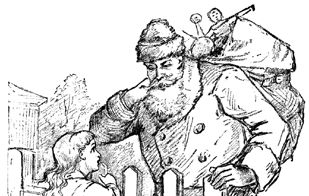
He was very tall, wore a huge fur cap, and great coat that reached from his chin to his ankles. The pockets were evidently so full that they bulged out on all sides, and his red belt was stuck full of every odd toy imaginable.
He had besides, an enormous pack on his back.
Molly's eyes, always wholly devoted to the business of seeing, observed all this.
But she only remarked, "What makes your face so rusty?"
Perhaps he didn't hear her; anyway he repeated his cry, "Brothers for sale? Got any brothers for sale?" and was moving on when Molly's piping voice screamed after him, "Tell yer yes; dot a plenty!"
This time he stood still.
"Dot one, two, free—many's ten I fink. Tommy, he's naughty, calls my rag dolly a meal-bag—I'll sell him. He's a drefful wicked boy; he snaps beans at the teacher and gets a whipping every single day."
"I'll take him," said the big man. "How much shall I pay you—what shall I give you for him?"
"A han'kercher with some perfoomery on it."
"Any more brothers for sale, little girl? I'm in want of some boys?"
"Yes, sir! You can have Johnny, he tears up my dolls and mamma lets him wear my bestest sash—and the baby, he gets the coli'c and screams—and Harry, he won't bring in the wood for mamma, and he eats up my candy and has cookies for supper and I don't, and—"
"I'll take 'em all," grunted the big man.
"I'll sell Harry for a doll with truly hair and a black silk and ear-rings and some choc'late ca'mels," said she with the air of an old trader.
"What luck!" he laughed; and diving into another pocket, he brought forth a handful of candy and filled Molly's apron pockets, then taking off his great cap he shook down a lovely doll, with truly hair indeed, long and curly, dressed in a black silk with train and pull-back just like mamma's.
"And what'll you sell Jonathan for?"
"Johnny, you mean—you can have him for a kitten sir."
"And the baby—he wouldn't be worth much to me—"
"Well, he is to me—but I'll sell him for a red cardinal sash and a little sister 'bout as big as Tilly White."
"Whew!" he exclaimed, "you most take my breath away! but here's the sash—a beauty, too—I don't happen to have any little sisters with me," feeling of the outside of his pockets, peering into his pack, and even taking off the great cap and shaking it as if a little girl might be folded up in that. "No, really I haven't a little sister about me, but don't you cry; I'll bring one round to-morrow—and now I must be picking up these brothers—where are they?"
"Baby Willie is in the back-yard in his carriage and Johnny and Harry are playing fooneral with him," said she, gravely.
"But that wasn't all; don't cheat me, little girl!" frowned the big freckled-faced man.
"No! I wasn't going to—Tommy—he's in the yard round the corner there with the big boys—he's 'leven—he's my greatest brother—he's a drefful
The great man darted forward, seized three-year-old Johnny and Harry in his arms, stuffed one head-first, the other legs-first, into the monstrous pack.
The one that went in head-first had his fat legs left dangling; the one that went in legs-first, his head sticking out.
The baby went into one of his deep pockets where his screams were stifled.
This was the work of a second and the man hurried out of sight, saying cheerily over his shoulder to Molly, "I'll bring round the little sister to-morrow."
Molly had so many things to take her attention that she had no time to be conscience-smitten.
There was her odorous handkerchief; her sash, which she hung over her arm; her pockets full of candy; under one arm the wonderful doll; under the other, the live kitten.
But in a half hour the doll had ceased to charm; she couldn't tie the sash herself; the "perfoomery" had evaporated; the kitten had scratched her hand because Molly had picked her up by the tail; only a few chocolate caramels were left, and, I suspect that all seemed as "vanity of vanities" to
SHE COULDN'T SPARE FREDDIE.
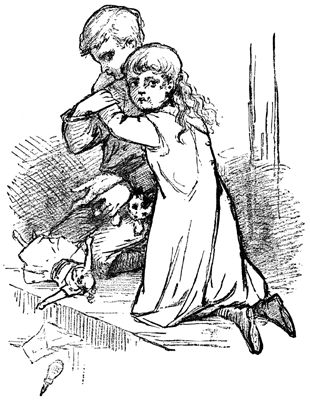
Somehow the "choc'late ca'amels" tasted sweeter boolicious, Freddie?"
She hadn't time to tell Freddie how she came possessed of all her treasures, for there again appeared at the gate the same great man, with his cry, "Brother for sale!"
"No, no!" screamed Molly, throwing her two fat arms round Fred, at the same time crying, "Run away Freddie, quick! run away."
Now considering that Fred had the doll and the kitten in his lap, and his sister's arms around his neck, it wasn't strange that the little fellow didn't run.
"I'll give you ten dollars for this boy," said the great man, unwinding Molly's arms, and picking fat Fred up, and thrusting him like a roll of cotton batting under his arm.
Molly screamed and—and—well—she woke.
She hadn't been swinging on the gate at all; there wasn't any horrid, rusty-faced man standing by her; she had been asleep in school and dreaming.
But she couldn't believe it; and with all Miss Winche's kind coaxing, she wouldn't lift her face from her desk, and would only sob, "I want my Freddie! I want my Freddie!"
The funniest part of it was, the child hadn't been asleep five minutes. She had been idly listening to sail" dropped into a nap.
By the way, perhaps I should not omit to mention that before she went to school that morning she had declared to her mother that boys were bothers; no wonder! baby Willie, at breakfast, had punched his little fist down into her mug, spilled the milk, and sent the mug crashing on the floor. Johnny had taken the orange out of her sacque pocket, and she had to let him have it because he was "a little fellow," and Harry and Tommy had carried all the cookies to school in their pockets.
But now—after the dream, Molly hugged the baby; and she said confidentially to mamma, "Isn't he sweet?—I don't think boys are a bother, do you, mamma?"
And a little later, while rocking her old rag-doll, "mamma," said she, "I won't ever swing on the front-gate again ever—ever—ever in my life."