THE LEGEND OF THE SALT SEA.
Reading edition
Once upon a time there lived by the great sea two brothers, named Klaus and Körg; the elder inheriting the rich estates of his ancestors; the younger a woodchopper, and so poor that it was ofttimes a difficult task for him to provide bread for his wife and little children.
Hard as life often seems it may be even harder; and so bitterly realized Körg when, nigh on to one merry Christmas-tide, an accident deprived him of his strong right hand, thereby cutting off forever his slender means of livelihood. There was but one resource, and, with crushed spirit Körg betook himself to his elder brother to crave some mercy for his starving babes.
Klaus was a harsh man, with love only for his yellow gold. He frowned impatiently when Körg interrupted his selfish dreams, and, for answer to his pitiful story, threw him a loaf of bread and a pudding, bidding him begone and be satisfied. And Körg went forth with a heavy heart, his faint hope dead.
"You seem in trouble, friend," he ejaculated, with a chuckle. "Something twists in your world, I trow."
Körg was not slow to recognize a geist; his knees shook, and he dared not utter a word. The elf looked down upon him half displeased, yet chuckling merrily withal.
"You have nothing to fear from me," he continued, sweetly. "I am the guardian of the honest poor. This night I come to reveal to you a secret, which, rightly used, will bestow upon you riches, life-lasting and unlimited."
Körg, bewildered, could not yet yield simple faith. He clutched desperately his bread and pudding. He found no joyful words.
The little man frowned scathingly on the gift of
THE WONDER-MILL GRINDS.
"It is always thus, friend, with the money elves; they deal niggardly, even at the full. But, care not, since this meagre chip will prove to you a barter for
THE GEIST.
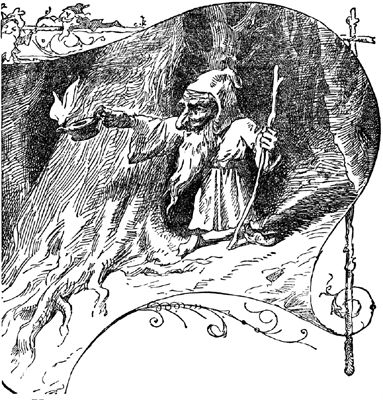
He paused at the base of a hillock, shaped like a horseshoe—a spot which Körg knew well—a place of rocks, reefs, and general ill-report.
"The time is favorable," muttered the little man, wonder-mill, and sacrifice your treasures only in its exchange. I will await you here."
A spell immediately enwrapped the senses of Körg. Calm and fearless, he descended into the deep, floating dreamily downward to the glittering caves from whence, exactly as the elf had depicted, swarmed forth troops of mermen and mermaids, with eyes and arms voraciously extended towards the bread and the pudding he held tightly clutched to his breast. But Körg, spurred on by the elf, resisted them all, nor parted with a single crumb till the wonder-mill lay safe in his embrace. The little man stood waiting on the brink.
"I dedicate this to the honest poor," he said, softly. "Yes, Körg, it is yours. Ask of it what you will, and it shall never fail you—gold, silver, hundreds of loaves and puddings. But—" and here the little man paused, a shudder quivered through his frame, and he continued, solemnly—"remember, that by no hand but yours can it be controlled. Guard it carefully, for the day you part with it your portion shall be ashes, and mine annihilation."
Rahel sat at home with the children, weeping. She knew well the heart of her brother Klaus, and how vain would be Körg's last effort to save them from starvation. A step sounded on the path without. Rahel and the babes stopped to listen. It was not dull and heavy as they had expected, but blithe as the jingle of sleigh-bells, and, in a second, Körg burst in upon them, dimpling all over with merry laughter. Rahel regarded him, amazed.
"You bring no bread to our starving babes, and yet you laugh," she said. "Oh, Körg! Körg! trouble has made you mad!"
Still chuckling he slipped the wonder-mill from beneath his coat and said, softly:
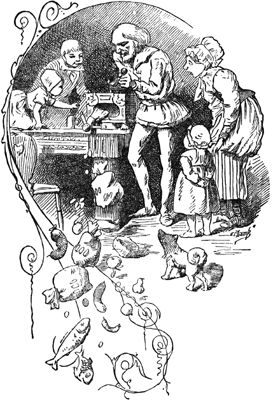
"Hush, Rahel! A geist has been with me to-night. I have brought endless fortune from the depths of the sea." And, plump in the eyes of his astonished wife, he began turning out loaves and puddings with such a gusto that the room was soon filled, and Rahel fain to implore him to cease his elfish work.
From that night, just as the little man had said, riches unlimited came to the house of Körg. No treasure too great for the mill to produce; and, though the woodchopper strove hard at secrecy, its fame spread far and wide from the mountains back geist:
"The day you part with it your portion shall be ashes, and mine annihilation."
One day, after the space of a year, there came to the woodchopper's door a captain from far-off lands.
"I am here," he said, "to see the famous wonder-mill that blesses the house of Körg."
There was a simplicity about the old tar that completely dismantled Körg. With less than ordinary caution he brought forth the mill, and displayed it, in all its phases, before his astonished guest.
"It is a clever trickster," finally he quoth. "I wonder if it could grind so common a thing as salt."
Körg chuckled contemptuously, and speedily spurted right and left such a briny shower as made the old tar blink spasmodically and walk hurriedly away.
But, alas! that night Körg missed the mill from his side; and when, pale and shivering, he sought the golden treasures hid 'neath the floor, he found only an ashy heap, heard only the mournful words:
geists have ceased to reign."
Far out on the blue bosom of the sea the jolly captain rode, shouting uproariously over the treasure he had secured.
"Precious wonder-mill," he sang, "I will try thee in all thy ways. First salt for savor, then ducks for food, and gold to the end of my days." And he started the tiny wheels, and clapped his hands frantically at its ready compliance to his will.
Forth poured the sparkling, crusty grain in one buzzing maze of whiteness. Thick gathered the milky drifts from bow to stern. Still shouted the captain his savage joy till—a-sudden he paused, gazed as if spell-bound on the mill's mad work, with a cry of terror sprang forward and grasped the check. But, in vain. There was no surcease to its labor. Higher and higher up lifted the mighty salt banks, and, in a twinkling, both destroyed and destroyer sank helpless into the depths of the sea.
And, down amid the green sea-weeds, the wonder-mill still stands, pouring forth salt the whole day long—no hand to check its raging; for the mermen and mermaids are all dead, and the geists have ceased to reign.
And this is why the sea-water is salt.