SUGAR RIVER.
Reading edition
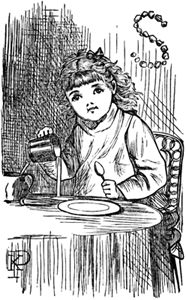
ugar River!" The little cup-bearing hand stood transfixed halfway from table to lip. The silver cup tilted part way over in sheer astonishment. Drip, drip, drip, dripped the contents down into Tot's scrap of ruffled and embroidered lap.
"Bless me! Look at that child!" cried Tot's papa. And Tot was looked at and hustled away, and the little silver mug tried to drown itself in a yellow stream of sunshine flowing across the table; and, failing in that, tried to sparkle just as Tot's eyes had sparkled, and failed in that, too. For that was O, very bright—nothing was brighter than Tot's eyes.
jump!"
O, what happy state to sit enthroned upon a big boy-uncle's knee, and listen, listen, listen, with eyes like the dog's in the fairy story—"as big as the great round tower at Copenhagen"—more or less!
"What shall I tell you? Aladdin? Puss in Boots? Cin—"
"Soogar Wiver" interrupted Tot, promptly.
"Soogar Wiver? Why, what a little pitcher for ears! What do you know about Soogar Wiver?"
"Oo said," said Tot, with decision, "that oo went fisin' in Soogar Wiver."
"Why, so I did," said the boy, reflectively.
"Is it vewy sweet?" asked Tot.
"Sweet?" echoed the boy, taking his wicked cue and with a prolonged drawing in of the lips. "I should say so! Why, its bed is solid sugar, with as many grades of sugar grains for sand as one finds in a grocer shop."
"Do wivers do to bed dus 'ike 'ittle dirls?" demanded Tot, whose young existence was embittered by that seemingly needless ceremony.
"You see," said the boy, with the air of communi
"I sood 'ike to see Soogar Wiver," said Tot.
"Wouldn't you!" And Will, fairly launched, tossed all conscientious scruples overboard, and steered boldly out into the deep waters of wildest imagination. "You just would! Why, as I said, the river bed is solid sugar. Think how nice to be able to turn over and take a gnaw at your bed-post when you feel hungry! The pebbles are sugar plums, the bigger stones are broken sugar loaves, and the rocks, why, the rocks are made out of rock candy, of course."
Tot sighed, blissfully.
"It is the jolliest place to go fishing. You just lie down on a rock, nibble it occasionally, chew up a few pebbles, take a bite at a stone, and if you are thirsty—as, of course, you would be—there is a whole river of eau sucré—that is what the French call sweetened water—running right by, enough to supply all France. And, all the time, you are haul
Tot still gazed up into the remorseless boy's face in unblinking confidence. And, indeed, from one who, for the last two weeks, together with Tot, had been on the most familiar footing with giants, ogres, and hop-o-my-thumbs, and held the most sympathizing relations towards enchanted princesses and conquering knights, an account of a "Soogar Wiver," was not to be regarded as startling. As for Will's conscience—well, his mission with Tot was to amuse, not instruct—if Tot was amused the whole end and aim of his efforts was attained.
"We tried having dories made of the same material of those candy marbles that nothing but time and long-enduring patience will ever make an end of. But the fellows had such a habit, as they floated down the stream, of eating up the oars, we had to give it up—"
"Will," said Tot's mamma, at the open door, "are
Tot descended from her throne, slowly and unwillingly, and, going obediently away, never knew about the beautiful river fairy just then springing to life, like Minerva in the brain of Jove, in Will's fancy, purposely to make Tot's acquaintance.
With glistening wonder in her eyes, in robe of trailing, snowy, sun-shot mist, with water lilies dropping from her hair, and the cave—Will could have provided for her such a cave, the water tinkling and trickling from the walls hung with silver spray, stalactites of purest barley sugar glittering, pillars of creamiest cream candy shimmering; and, to crown all and above all, the fairy would have had a daily diet of cream cakes and caramels.
But, before all this splendor of material could be built up into words, the builder had departed, the river fairy had melted back and away into her native mist, and Tot never knew.
That night, Will tossed Tot flying once more into the air, rescued once more his fresh collar from her crumpling embrace, kissed her once more, good-by this time, and was off and away on the cars to school. No more stories. No more fairies. No more anything. Only a wonderful river winding and
One morning, all in the gray and quiet, Tot had a queer dream. She thought some one said, with a funny little catch in the voice: "Wake up, little Tot, mamma's treasure," and some one held her so tightly she could hardly breathe. And she opened her eyes and shut them again, quite dazzled; but she thought she saw papa and mamma standing beside her bed, and the room was all on fire it was so bright to two, poor, sleepy, baby eyes, and papa's voice seemed to say, a great way off:
"Poor, little, sleepy Tot."
It was such a queer dream, but not half so queer as what followed; for, after a while, she woke up and went right on dreaming just the same. That was very strange. How could it be anything else than a dream, to be taken up by gaslight and dressed all in her little street coat and hat before breakfast, to be made to drink milk and eat when she wasn't hungry, to be petted and cried over and half crushed in mamma's arms, to be taken by papa out into the cool, clear dawning, with the sky just beginning to flush like a sea shell and a waking bird or two to twitter
After the sun had climbed up a little way into the sky, grown blue and bluer, Tot began to accept the situation a little, and lay very still in papa's arms (the fresh morning breeze tapping her cheek and lifting her long crimped hair with cool, gentle fingers), watching the fences running away like mad, the trees gliding gracefully by in long endless procession, little white cottages and funny little hovels, and pretty little villages hopping suddenly in and then as suddenly out of the scene, a glimpse into shady depths of woods, a glint of a blue, nestling, lily-pad-speckled pond, an emerald gleam of peaceful meadows, a sight at a snowy tethered goat, of dappled grazing cows, a roll and rush and roar through riven, dripping rocks.
Papa told his little girl all about it. How little children in the town where Tot lived were very sick of a dangerous disease—diptheria. And how, coming home last evening from business and learning of several fresh cases, he had become alarmed for his darling and consulted mamma, and had succeeded in
"And, there," said papa, after they had ridden all the long forenoon, "there's Sugar River, Tot, where I used to fish when I was a boy!"
"O!" cried Tot, and then, immediately, with a roll and a pitch, they came to a little white farmhouse and stopped again, and Tot was at grandmamma's.
Tot didn't like being kissed quite so much all at a time, if it was by a grandmamma. The chickens, though, were fascinating, and as for some plushy round balls of yellow fuzz, rolling about—little ducks just hatched—Tot had never seen anything at all to compare with them. But there was a dreadful and discordant procession of big ducks that struck terror to Tot's soul, and it was very still and lonely when the night and dark crept on. The crickets and the frogs did their best, but they only made it stiller and lonelier; and the hills gleamed against the sky, and Tot missed her mamma. But yet, Tot was very sleepy, and the next she knew it was morning and she was at grandma's, where Uncle Will lived, and Uncle Will was coming pretty soon, and,
Once or twice, during the next few days, Tot asked—preserving that singular reticence regarding her illusions, so common to children—to be taken to Sugar River; but grandpapa was busy haying, and grandmamma said:
"Will will come pretty soon and he will take you."
"When is pwetty soon!" asked Tot, in hopeless tones.
One afternoon grandmamma gave Tot and Susie (that was the name of Tot's little playmate) each a fat hot jumble, and left them playing happily in the yard while she went back to her sewing. Susie was seven, so very safe company for little four-year-old Tot. After a while over ran Susie's brother, to summon her home to go with her mother to the village.
Tot stood at the gate, looking down the long road. Sturdy maples threw curving, interlacing boughs across, through which the sun-light filtered and flickered. How cool and shady it was! Tot all at once felt the little sunny yard grow hot and stupid,
ON THE WAY TO SUGAR RIVER.
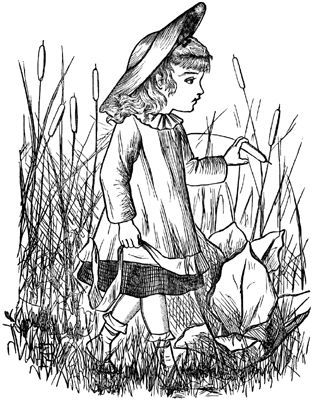
Step by step, a little and a little further on the tiny white figure glanced. A sense of happy freedom possessed the little girl. A cloud of golden butterflies beckoned on before. Here a dark thread of water crept down over the hills and splashed musically into the great stone trough. All the way an invisible brooklet gurgled and kept her company. Only one bird seemed to sing at a time—first one, then another. Wasn't it charming? And at the end of it all must be—Tot could see it now in fancy—the fluttering blue ribbon uncurling between sunny sloping banks—Sugar River—fast asleep under the summer sun, on its glittering bed of rock candy. O, rapture! Tot's mouth watered for its sugary delights.
On and on and on, with the brook and the butterflies and the welcoming bird. On, till the maples
Tot's small feet trudged on, steadily. Just a little further on—Tot was sure—and then—But how long the road grew, how deep the dust lay, how tired the little feet were getting, little feet that can trudge about all day long in play, yet drag so wearily over long straight roads.
"I sood fink I would tum to Soogar Wiver pwetty soon," she sighed.
At last she came to where some cross-roads met, and looking down one she saw the cool green shade again. Not maples this time, but close and clustering shrubbery.
She left the brook gurgling "go-oo-oo-d-by," and the butterflies waving adieu with their golden wings, and went on alone. How sweet and still it was here! The tall grass drooped over two brown beaten paths that horses feet had worn, and a tender green light lay over all. But where was the sweet river hiding? Another meeting of cross roads. Tot looked this way, that. Ah, there it was over the road! Over the meadow. Gleaming, gliding, Sugar River, at last.
Through she got, with much squeezing and rending. Tot eyed her torn pinafore, ruefully.
"I wis' 'ittle dirl's aprons wouldn't teep tearing on every single fing."
"'Pears to me," doubtfully, putting one little foot down on the soft marshy ground, "it is wather wet."
Rather wet? Yes, Totchen, very wet. Too wet for such little little feet as yours. And see, little one, the sun is getting lower. Crawl back through the fence and run home. The sleepy murmuring river has nothing but trouble for you.
But Tot stumbled on over the marshy ground.
"I don't 'ike to go down so far," sighed Tot, drawing a little drenched boot up from a treacherous bog. "And my new boots is detting all wet."
But Tot had a Spartan soul; and at last, beside the wonderful stream, on the beautiful shore she stood, and—poor, poor little Tot! The little pinafore torn, the pretty, trim boots soaked and soiled, all Tot's little body dragged and weary; yet, it isn't that that makes me say "poor little Tot!" It is to see her standing there at the goal of her childish
Up and down she walks, searching for sweetmeat pebbles and sugary stones, and when she finds none—the water running high and close to the grassy ground—she stoops and, dipping her little fingers, she lifts them, wet and dripping, to her longing lips.
"It isn't vewy sweet," she said.
Poor little Tot! Down the stream she came to a ford, and the shallow water had left stones and pebbles bare. Big and little, and half size; white and yellow, and brown and gray.
Here was richness at last. All in a minute Tot's little, nibbling, crunching teeth went on edge on a perverse, grating pebble that sternly refused to be nibbled or crunched. Another and another and another she tried.
"Pwobably," she thought, "they has to be cwacked dus 'ike nuts." And she proceeded to crack, not the stones, but her own little, eager, blundering fingers, instead. O stony, stony-hearted stones and pebbly-hearted pebbles! Tot's cup of bitterness seemed to flow over. She stood up, sobbing. A sudden sense of desolation oppressed her.
wis' I hadn't tum!" she sobbed.
Her only thought, now, was to get home. But, first, what do you think she did? She filled her bit of a pocket full of pebbles for grandmamma to crack; then the little weary feet stumbled back again over the weary way.
"My feet's is detting so heavy," she sighed, "and I fink I's detting tired."
Tot was crying piteously now, and no one heard. All alone, mamma's baby, who had never been alone before in all her short cherished life. All alone with the croaking frogs and lonesome crickets. Hark! what was that? A roll of wheels and the clatter of a horse's hoofs.
"Whoa!" called out a boy's shrill voice. Down to the ground dropped the owner of the voice. "What is the matter, little girl?"
"I'se been to Soogar Wiver, and I don't know how to det home aden, I'se so vewy tired, and I toodn't cwack the candy, and I want to see dwandma," and Tot's words ended in a wail of inarticulate woe.
"Where do you live?" asked the boy.
"A dwate, dwate ways off," answered Tot.
"What is your name?"
"Lindsay? O, I know! All you've got to do is to jump into this wagon and have a nice ride, and, presently, we'll be there."
And presently, in the gloaming, they stopped before grandpapa's house, and the boy, lifting out Tot in his arms, carried her to the door and bade her good-by, and, jumping into his wagon, rattled away. Empty and silent stood the little house, like the dwelling of the Three Talking Bears, and little Tot might have been Silver Hair herself.
"Dwandma, dwandma!" she called. But no grandmamma replied.
"Perhaps she has dus dorn out a minute," thought she. "I'll det up on dis lounge and tover dis shawl over me, and s'prise her when she tums back."
Something else besides the shawl covered Tot's eyes. Down over the blue orbs drifted the snowy lids. Tired little Tot.
Where was dwandma and the rest all this time? In trouble and confusion. Calling and searching, searching and calling: "Tot, Tot, Tot, little Tot! Where are you?" Grandpapa and grandmamma, and Uncle Will and Tot's mamma.
At last, on the road running beside the river, they had found the fragment of dotted cambric, held fast why. And then Tot's mamma had thrown up her two hands, and darted towards a little string of coral beads and picked it up. And, as they stood there, the river's murmur seemed like the murmur of the river of death, and the white fog, beginning to rise, like the folds of a little child's shroud; and Tot's mamma threw up her hands again and fell among all the unfeeling stones and pebbles.
Will ran all the way home and went straight to the barn and harnessed the horse, and then went into the house and into the sitting-room and snatched a shawl from the lounge, and—"Jerusalem Crickets!" was all he had breath enough left to say. Tot had surprised somebody, indeed.
Down by the river, in the dusk and the river damp, as they waited, came Will, striding along with what looked like a bundle of old shawls upon his shoulder; and presently, parting the folds like the calyx of a flower, Tot's rosy face blossomed out.
It was wonderful how quickly mamma recovered; and it was more wonderful still how ever Tot escaped sudden death, then and there, from suffocation. But, bless you! You need not worry, it was larks to Tot.
What a triumphal procession home it was. Tot, in her little night-dress sat in her mother's lap, and told her adventures; and Will sat in the darkest corner and said not a word, but resolved that no story more fabulous than that of George Washington and his hatchet should ever again pass his lips. His lip quivered, as much as a boy's lip is ever allowed, when Tot said:
"And I brought home a whole pottet full to cwack."
"Never mind, to-night. Wait till to-morrow," said mamma.
Tot went obediently to sleep, and woke in the morning to find beside her pillow, such lots of candy—her Sugar River candy she thought, all cracked and ready to eat.
"It tastes dus 'ike any tandy," said Tot.
They didn't tell her then, the illusion was so dear to her childish heart. But, when she was a little