SURPRISED.
Reading edition
I.
"Mitz" began to cry piteously. "Mieu—mieu—mi-e-e," he cried, and all little Hannah's trotting only made him worse. At that moment "Mitz" was wrapped in a pillow-case, while his head was buried in Hannah's little shawl. His ears were pulled down, and his promising tail was all in a heap, and his resplendent moustache was crushed. Therefore was it a wonder that Mitz howled most dolefully? It is not necessary to say that Mitz was a kitten.
Mitz's mother was sitting in a corner of the fire-place, with tail neatly curled about her paws. Three of Mitz's brothers and sisters were lost somewhere in the shadow about her, and two others the children had put to bed.
It was a queer old room in an old German house; a room large and dim, with two great windows full of
"Mieu, mieu!" cried Mitz, trying to claw something under the pillow case. "Mieu, mieu!" chimed in Mitz's sisters, while little Hannah trotted desperately, and the doll's cradle was rocked as if by a small tempest.
HE WOULDN'T EAT HIS BREAD AND MILK.
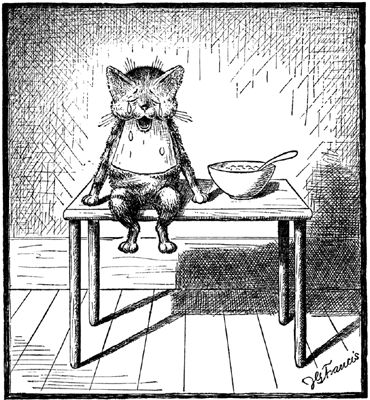
"It's no use," said little Hannah, in great perplexity; "all people's children arn't always bad! Mitz—you wicked Mitz!" And she shook that badly-behaved child. "He's been crying ever since we began to
Out of the hearth crept Hannah, with Mitz hugged
"Max, how you frightened me!" cried Hannah; then, "oh, Maxy, what's the matter?" Mitz was forgotten; he gave a leap, shawl and pillow-case, and before Hannah could prevent, had crept out of his bandages and was standing a free cat, with arched back and a defiant tail. By this time Mrs. Liseke had come out of the fire-place with her two youngest in her arms. She was elegantly dressed in a bed-sheet, which trailed behind her and was gracefully tied under her chin. Mitz's mother followed, stretching all-fours luxuriously.
No, Max wouldn't tell. He plunged two black hands in his breeches' pockets and made up faces and danced a wild war dance, while Mitz and family fled into various corners.
"No," little Hannah said, wisely. "He likes cookies." Coaxingly: "Maxy dear, won't you tell?"
"No, you bet I won't! you're nothing but girls."
"Is it a surprise, Max?" Hannah suggested, anxiously.
"Won't tell yer," contemplating his brass-tipped toes.
"Maxy, I'll give you a big cookey if you'll tell."
"You nasty thing, I don't want a cookey."
"Maxy: two? three—four—five—six—there! now you'll tell?"
"Give 'em first," said this practical boy, apparently conquered.
Six noble cookies were counted into his hand.
"Now I won't tell yer at all. It's a surprise! Father said I wasn't to tell," he cried, scornfully, with his mouth full.
"Oh, Haneke, papa's going to surprise us! Now I know what it is!" Liseke whispered excitedly "It is a piano, and perhaps—perhaps a stool. Try and find out from Max."
"Maxy, dear," Hannah said, imploringly, "is it covered with plush?"
"Why, how do you know?" Max cried, unguardedly, as he was finishing his sixth cookey.
"Does it make a noise if, well, say, if you bang on it?" Hannah cried, with a beating heart.
"Why—why—yes," Max acknowledged, wrathfully, with a futile kick at Mitz's mother, who was purring about his legs. "There, you mean thing, you're always trying to find out something! Just you wait till I tell yer anything more!" he cried, and slam-banged himself out of the room, with his bosom full of suppressed injuries.
"He was mad because we guessed," Liseke cried, joyfully.
"A piano!" Hannah gasped, as the door went to with a crash.
"A stool," Liseke added; then, "Let's tell mamma!"
That dear, gentle mother, sitting by the dim window trying to mend by the last flicker of daylight! She looked up lovingly as the door flew open.
"Mamma," gasped Hannah, "papa's got a surprise for us."
"Max said so," chimed in the other. "We've guessed, mother dear."
"It's a piano."
"And—and a stool."
MAX KNOWS OF A SURPRISE.
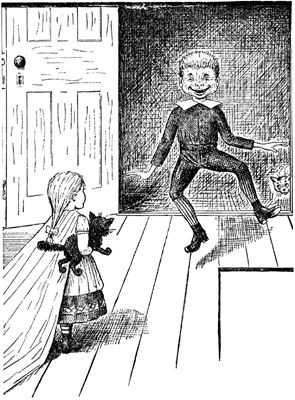
"O, dear children, surely papa wouldn't buy you a piano. He can not afford it," and two kind hands were stretched out to the children.
"Oh, yes it is," the two cried hopefully.
"You know, mamma, papa's always promised us a surprise, and he's never done it yet!" Hannah cried, and laid her round cheek against the delicate, pale face.
There was no use arguing; the children were convinced. They were sure of the piano.
"There, mamma, didn't we tell you so," they cried, as Max came in, mysterious and exasperating.
"Father says the surprise will be ready for you to-morrow afternoon at three o'clock in the sitting room," he cried, and was gone, leaving a momentary vision of a bright patch in the seat of his breeches.
"Poor child," thought the little mother, regretfully; "he is all in rags—I wish I had some money!" with a patient sigh.
"There, mamma, we told you so! It'll stand by the window in the corner of the sitting-room," two excited voices cried, and the next moment the sitting-room was invaded by two small figures who looked at the empty corner by the window with delicious
In another room the little mother looked at her husband wistfully. "Karl," she began, timidly, "have you really prepared a surprise for the children? You won't disappoint them?"
"Betty, don't say a word! Wait! Did I ever disappoint you?"
Betty turned away with a half-suppressed sigh, while papa Karl strode up and down the room grandly, virtuously, with a good deal of injured innocence in his face.
II.
The great day had come. Hannah and Liseke hadn't slept a wink all night.
Mitz and family had come purring into the room in the early morning, as usual, but had been shamefully neglected. All six sat in a row by the bedside, watching indignantly the two heads peeping out from the feathers.
"To-day!" Hannah sighed rapturously.
How they got into their clothes, they never knew.
As for eating! why, they couldn't touch the delicious rolls, the glasses of milk, even that delicious preserve, "Apfel-kraut."
Who could believe that a September day would be so long? Or that the old clock in the hall would go so ridiculously slow? There was a quiet jocularity in the motion of its long pendulum, as if it were laughing bitterly that anyone could be in a hurry. "Ha! ha! ha!" ticked the clock.
"Oh, dear!" Hannah said with a sigh, "will it never be three?"
How they kept their ears open to hear a crowd of men come stumbling up the stone steps with the weight of the piano!
"Perhaps it is already here," Liseke said, faintly.
"Perhaps it's coming," Hannah suggested, hopefully.
"One—two—three—," the clock struck.
"Come, mamma!" the children cried; and so they opened the sitting-room door with trembling hands.
Nobody there; nothing there. Mamma sat down in a corner and began knitting, while the children looked out of the window into the narrow street to see a wagon drive up to the house.
"Oh, Max, Max, where's the surprise?" the children implored.
"Why, don't you see!" Max cried, mightily injured, and turning himself about disclosed his small person arrayed in a new velveteen suit brilliant with brass buttons.
"Oh—dear—dear," sobbed little Hannah with the tears rolling down, "we thought it was a piano!'
"Did I say it was a piano?" Max howled.
"You said it—it—was—was—covered with pl—plush," Liseke sobbed.
"Well, isn't it?"
"And—and you said it 'ud make a noise if one b—banged on it," Hannah cried, piteously.
"Well, see if it don't!" Max shrieked, when papa Karl's hand came down upon him with such superb effect there was no doubting the truth of the assertion.
"Ungrateful children, you are never satisfied," papa Karl cried majestically. "No matter what I do for you, you're always ungrateful—"
THE SHAMEFULLY NEGLECTED SIX.
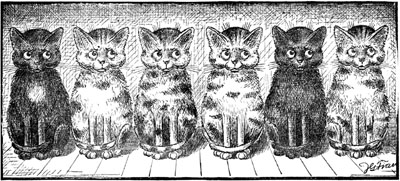
"But Karl," mamma Betty interrupted, with quiet decision, in the midst of a storm of sobs, "you can't
"And it's so tight I can't breathe," Max cried, goaded to frenzy by the general grief.
"Ingrates!" gasped papa Karl, and strode up and down the room, while Liseke sobbed her grief out on mamma's shoulder, and Max hid his face in her lap, and Hannah was bravely trying to dry her brown eyes.
"Karl, they are children," mamma Betty said: softly patting Max's head; then lifting it up gently; "Max, go to the confectioners." Max sprang to his feet as a war-horse at the sound of a trumpet.
"Here are ten groschens;"—mamma Betty took them out of her scanty purse with something of a sigh;—"buy as much cake and whatever you like. Liseke tell Marie to make a pitcher of chocolate instantly. My little Hannah, you may set the table."
"Oh, mamma, may I put on the pretty china cups and saucers?" Hannah pleaded, as Max and Liseke bounded out of the room.
"Yes, but be careful, my dear."
"Chocolate!" said papa Karl with some scorn, "bribing them for the sake of peace."
They were children, she said. Had papa Karl forgotten that he, too, had once been a child?
There was a pattering of feet down the entry, and three tear-stained faces looked timidly in.
"The chocolate is on the table," Hannah said bravely, with only one tiny sob. Then the door closed and the little feet patted down the corridor.
"Come Karl, and drink a cup of chocolate. You need it as much as the children, for you were disappointed also. You thought to give them a pleasure, you mistaken man," mamma Betty said with a little smile.
"I really meant to," said Karl, quite softened.
Mamma Betty was just opening the door, when she suddenly paused.
"Karl," she said quite seriously, "will you promise me one thing?"
"Yes, my dear."
"Never surprise us again; surprises always end in disappointments."
"Well, Betty I promise," papa Karl said hurriedly, and he kept his word. So years after, when papa Karl's purse was a good deal fuller, and a piano did make its appearance, it was welcomed solemnly, as something long and rapturously expected.