APRIL FOOLS AND OTHER FOOLS.
Reading edition
he custom of playing a joke upon one's neighbor upon the First of April is of very ancient origin, dating so far back in the past that we are unable to tell just when or with what nation it had its birth.
There was a time, very many years ago, when the year began on the twenty-fifth of March. Then, as now, New Years' was a great feast of the Church; and as the First of April was what was termed the octave—that is, the eighth day after the commencement of the feast—it has been thought that the feast which terminated upon that day closed in April-fooling. In support of this theory we find that the Catholic Church, at one time in its early history, observed an annual feast called "The Feast of the Ass." The day upon
Among the Hindoos there is a feast which is still observed, called the "Huli," which, continuing several days, terminates on the thirty-first of March. One of the distinctive features of this feast is, that every one endeavors to send his neighbor upon some errand to some imaginary person, or to persons whom he knows are not at home; and then all enjoy a good laugh at the disappointment of the messenger. The observance of this custom by this peculiar people seems to indicate that it had a very early origin among mankind. In fact, it is not impossible that the manner in which the day is observed by us may have been suggested by some pagan custom. But whatever or whenever its origin may have been, we find it so widely prevalent over the earth, and with so very near a coincidence of day, as to be proof of its great antiquity.


The observance of April Fools' Day is a very popular one in France, and we find traces of it there at a much earlier period than we do in England. It is related that Francis, Duke of Lorraine, and his wife, having been confined at Nantes as prisoners,
poisson d'Avril. Upon a certain occasion a French lady stole a watch from a friend on the First of April. The theft having been discovered, and the lady accused of having taken the watch, she endeavored to pass off the affair as un poisson d'Avril.
Having denied that the watch was in her possession, her rooms were searched, and the missing article found upon a chimney-piece. When shown the watch the thief coolly replied: "Yes; I think I have made the messenger a fine poisson d'Avril."
However, the magistrate ordered that she be confined in prison until the First of April following, "comme un poisson d' Avril."
In England, the custom of April-fooling is practiced very much as it is in the United States. "A knowing boy will despatch a younger brother to see a public statue descend from its pedestal at a particular appointed hour. A crew of giggling servant-maids will get hold of some simple swain, and send him to a bookseller's shop for the 'History of Eve's strap-oil,' in which last case the messenger secures a hearty application of the strap to his shoulders, and is sent home in a state of bewilderment as to what the affair means. The urchins in the street make a sport of calling to some passing beau to look to his coat-skirts; when he either finds them with a
FIRST OF APRIL DANGER.
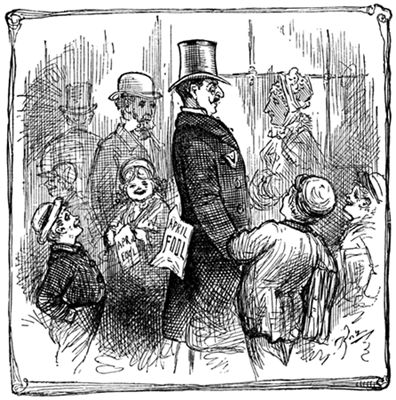
It has been said that "what compound is to simple addition, so is Scotch to English April-fooling." The people living in Scotland are not content with making a neighbor believe some single piece of absurdity, but practice jokes upon him ad infinitum. Having found some unsuspecting person, the individual playing the joke sends him away with a letter to some friend residing two or three miles off, for the professed purpose of asking for some useful information, or requesting a loan of some article, while in reality the letter contains only the words:
"This is the first day of April, Hunt the gowk another mile."
The person to whom the letter is sent at once catches the idea of the person sending it, and informs the carrier with a very grave face that he is unable to grant his friend the favor asked, but if he will take a second note to Mr. So-and-so, he will get what was wanted. The obliging, yet unsuspecting carrier receives the note, and trudges off to the person designated, only to be treated by him in the same manner; and so he goes from one to another, until some one, taking pity on him, gives him a gentle hint of the trick that has been practiced upon him. A
Sometimes the First of April has been employed by persons wishing to perpetrate an extensive joke upon society. Among those which have come to our knowledge the most remarkable one occurred in the city of London in 1860. Towards the close of March a large number of persons received through the post-office a card upon which the following was printed:
"TOWER OF LONDON.
admit the bearer and friend
to view the
annual ceremony of washing the white lions,
on
Sunday, April 1st, 1860.
Admitted only at the White Gate.
It is particularly requested that no gratuities be given to the wardens or their assistants."
In the United States the greater part of the attention which is paid to April Fools' Day comes from children. In cities, especially, it is made much of by the "street Arabs," who watch every opportunity to play some trick upon every countryman whom they chance to see. Although we may laugh at jokes which are played upon All-Fools' Day, yet the greater part of them are unjust and improper, and it would be much better were they left undone.
While speaking of April fools we are reminded of the Wise Fools of Gotham, and are constrained to tell our young readers about them in this connection. Gotham is a village in Nottinghamshire, in England. At one time, when King John and his retinue were marching towards the village, the people learned that he intended to pass through Gotham meadow. Now
DROWNING THE EEL.
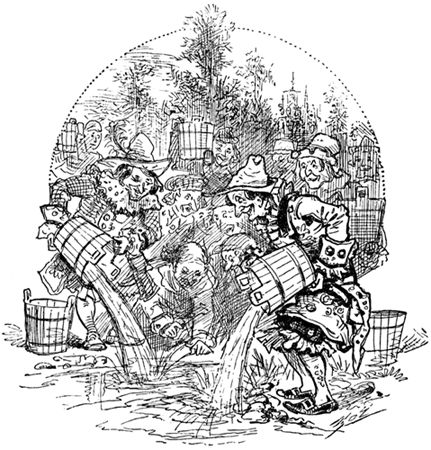
This they resolved not to do, and therefore devised a plan which caused the king to pass another way. When the king learned what had been done he was
There is another class of Fools which deserve pretended fool. The former was dressed in "a parti-colored dress, including a cowl, which ended in a cock's-head, and was winged with a couple
SAVING THE SHINGLES.

On the other hand, the Jester selected his clothes not only with a view to their grotesqueness but also with an eye to their richness. While the real fool "haunted the kitchen and scullery, messing almost with the dogs, and liable, when malapert, to a whipping," the pretended fool was comparatively a companion to the sovereign who engaged his services. Berdic, the Jester of the Court of William the Conqueror, for instance, was considered of so great importance that three towns and five carucates were conferred upon him.