Chapter V
Reading edition
JU, KUAN, AND KO WARES
Ju yao

THOUGH no authenticated example of Ju ware is known in Europe, it is impossible to ignore a factory whose productions were unanimously acclaimed by Chinese writers as the cream of the Sung wares. Its place of origin, Ju Chou, in the province of Honan, lies in the very district which was celebrated in a previous reign for the Ch´ai pottery, and it is probable that the Ju factories continued the traditions of this mysterious ware. Nothing, however, is known of them until they received the Imperial command to supply a ch´ing (blue or green) porcelain to take the place of the white Ting Chou porcelain which had fallen into temporary disfavour on account of certain blemishes. This event, which took place towards the end of the Northern Sung period (960–1127 A. D.), implies that whatever had been their past history, the Ju Chou factories were at this period pre–eminent for the beauty of their ch´ing porcelain. It would appear from the Ch´ing po tsa chih,[95] which was written in 1193, that the Ju Chou potters were set to work in the "forbidden precincts of the Palace," and that selected pieces only were offered for Imperial use, the rejected specimens being offered for sale. Even at the end of the twelfth century we are assured that it was very difficult to obtain examples of the ware.
From the various accounts on which we have to depend for our conception of the ware, it is clear that the body was of a dark colour.[96] The glaze was thick and of a colour variously described as "approaching the blue of the sky after rain" (i.e. like the Ch´ai ware), pale blue or green,[97] and "egg white"[98] which seems to imply a white ware with a faint greenish tinge. The author of the Ch'ing pi tsang,[99] a work of considerable repute published in 1595, gives a first–hand description of the ware: "Ju yao I have seen. Its colour is 'egg white' and its glaze is lustrous and thick like massed lard. In the glaze appear faint 'palm eye' markings like crabs' claws.[100] Specimens with sesamum designs (lit. flowers), finely and minutely engraved on the bottom, are genuine. As compared with Kuan yao in material and make, it is more rich and unctuous (tzŭ jun)." Two mysterious peculiarities have been attributed to the Ju ware, viz. that powdered cornaline was mixed with the glaze, and that a row of nail heads was sometimes found under the base. The first has been taken as merely an imaginative explanation of the lustre of the glaze, but it is certain that some kind of pulverised quartz–like stone was used in the composition of later glazes, such as the "ruby red" (see vol. ii., p. 123). The second, which has been seriously interpreted to mean that actual metal nails were found protruding from the glaze (a physical impossibility, as the metal would inevitably have melted in the kiln), is probably due to a misunderstanding of a difficult Chinese phrase, chêng ting,[101] which may mean "engraved with a point" or "cut nails." The former seems to satisfy the requirements of the case, though it would be possible to render the sentence, "having sesamum flowers on the bottom and fine small nails," referring to the little projections often found on the bottom of dishes which have been supported in the kiln on pointed rests or "spurs."
In the list of porcelains made at the Imperial potteries about the year 1730[102] we read of imitations of Ju ware from specimens sent down from the Imperial collections. These imitations had in one case an uncrackled glaze on a copper–coloured body, and in the other a glaze with crackle like fish roe; and we may fairly infer that the originals had the same peculiarities. A reputed specimen[103] of modern Ju glaze[104] has a pale greyish green tint, with just a suspicion of blue, and would answer fairly well to the description tan ch´ing or fên ch´ing.
But probably our safest clue to the appearance of Ju ware is to be found in the important passage already mentioned,[105] in which a Sung writer describes the Corean wares as in general appearance like the old pi–sê ware of Yüeh Chou and the new Ju Chou ware. The typical Corean wares of this time are not uncommon, and their glaze—a soft grey green or greenish grey, with a more or less obvious tinge of blue—would satisfy the Chinese phrases, tan ch´ing and fên ch´ing, and in the bluer specimens might, by a stretch of poetic phrase, even be likened to the sky after rain. The "egg white," however, must have been a somewhat paler tint if the expression can be taken in any literal sense.
From the foregoing considerations we may conclude that the Ju porcelain was a beautiful ware of celadon type, varying in tint from a very pale green to a bluish green.
Though it is nowhere definitely stated how long the Ju Chou factories retained their supremacy, it is tolerably clear from Hsü Ching's reference in 1125, or very soon after, to the "modern porcelain of Ju Chou," that they came into prominence towards the end of the Northern Sung period, perhaps in the last half of the eleventh century; and as we have no further information about them, we may perhaps infer that they sank into obscurity when the Sung emperors were driven from the North of China by the invading Tartars in 1127. In any case, the Ju ware seems to have become as extinct as the Ch´ai by the end of the Ming dynasty. Hsiang Yüan–p´ien, late in the sixteenth century, states that "Ju yao vessels are disappearing. The very few which exist are almost all dishes, cups, and the like, and many of these are damaged and imperfect."[106] A few years later another writer[107] declares that the Ch´ai and Ju porcelains had ceased to exist.
It is not to be supposed that Ju Chou had the monopoly of the particular kind of ch´ing ware in which its factories excelled. A number of other and not distant potteries were engaged in a similar manufacture, though with less conspicuous success. We read,[108] for instance, that "it was made in the districts of T´ang, Têng, and Yao on the north of the (Yellow) River, though the productions of Ju Chou were the best."
It has been already remarked that we possess no authenticated example of Ju porcelain. Doubtless there are many pieces which are tentatively assigned to Ju Chou by hopeful owners. But it must be confessed that the few which have hitherto been published as such are singularly unfortunate choices. Dr. B. Laufer, for instance, in his excellent work on jade,[109] incidentally figures two vases for divining rods of a well–known form, of which he hazards the remark "that both have presumably been made in the kilns of Ju–chou."
Dr. Laufer does not claim to have made a particular study of Chinese ceramics apart from the Han pottery, but if these pieces are Ju yao, then Ju yao, so far from having been extinct for some centuries, is a comparatively common ware. Another instance is the "funeral vase," now in the Victoria and Albert Museum, published[110] by its former owner, Dr. Bushell, as a specimen of Ju ware, mainly, I suppose, on the strength of the description, "Kuan Yin vase of Ju Yao," engraved on the stand by the Chinese collector[111] through whose hands it had previously passed. This form of certificate is always open to doubt, and had it really been a specimen of undoubted Ju yao, it is most improbable that the Chinese would have allowed it at that time to pass into foreign hands.
But a glance at the piece itself is sufficient to dispel all illusions on that point. So far from excelling other Sung wares, this piece is decidedly inferior in every detail to the most ordinary Sung specimens. It has a coarse, sandy, greyish buff body and impure greyish green tinge, such as appears on some of the early funeral wares which make no pretence to finished workmanship. The ornament consists of applied reliefs perfunctorily moulded, and though its archæological interest is considerable, and, like almost all Chinese wares, it possesses a certain charm, any attempt to place it on a high artistic plane can only end in a reductio ad absurdum.
Many other examples of this ware have since arrived in Europe, and they all belong to the same type. Some, however, appear to be later than the others, having reliefs of white porcelain instead of the usual pottery. They are always described as "funeral vases" by the Chinese, and it is exceedingly probable that the description is correct. The subjects of the reliefs are always of a hieratic kind, including such figures as the dragon of the East, the tiger of the West, the tortoise of the North, and the red bird of the South, the sun disc, and a ring of indistinguishable figures, perhaps Buddhist deities. There is no reason why such a type of sepulchral vase may not have been in use for many centuries, and if the porcelain reliefs in one specimen suggest a date no earlier than the Ming dynasty, the glaze in another has strong analogies to some of the rougher T´ang wares. The majority of these vases are of coarse, rough make; others are superior in finish and of comparatively attractive form. A good example, belonging to Mr. R.H. Benson, is shown on Plate 14. It is of dense grey stoneware, with opaque greenish grey glaze, with a balustrade supported by four figures on the shoulder, and a dragon and a figure on a tiger (perhaps representing the mythical Fêng Kan), besides some small figures with indistinct attributes on the neck. The height is 20 inches.
It is, of course, possible that some of these represent the coarser makes of the T´ang, Têng, and Yao districts (see p. 55), and that the attribution of the Bushell vase by Liu Yen–t´ing may refer to a lower quality of Ju yao which included these wares, or may be even the wares made at Ju Chou before or after its period of Imperial patronage.[112]
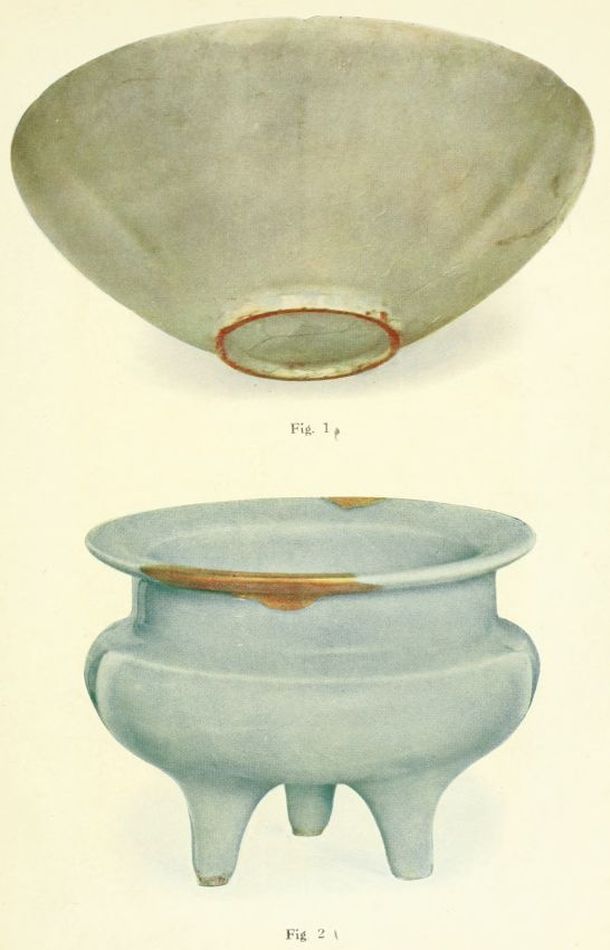
My own conception of the Ju yao is most nearly realised by the lovely but sadly damaged bowl in the Alexander Collection lately in the Loan Court at the Victoria and Albert Museum. Its peculiar form is difficult to reproduce by photographic means, but Fig. 1 of Plate 16 gives a fair idea of it. The colour is precisely that of the most beautiful bluish green Corean bowls, but the usual Corean finish and the sand marks on the base are absent, and the glaze is broken by a large, irregular crackle. Surely this cannot be far removed from the "secret colour" of the Yüeh ware and the fên ch´ing of the Ju?
PLATE 16.
Sung Wares
Fig. 1.—Bowl with six–lobed sides; thin porcellanous ware, burnt brown at the foot–rim, with bluish green celadon glaze irregularly crackled. Alexander Collection. Diameter 9 1/2 inches.
Fig. 2.—Tripod Incense Burner. White porcelain, burnt pale red under the feet. P Lung–ch´üan celadon ware. This kind of celadon is known as kinuta. seiji in Japan, where it is highly prized. Eumorfopoulos Collection. Height 4 1/8 inches.
Another specimen of reputed Ju ware is an exquisite peach–shaped brush–washer or cup in the Eumorfopoulos Collection (Plate 15, Fig. 1). It has a dark–coloured body and a beautiful smooth glaze of pale greenish grey tint, and whatever its origin, it is certainly a refined and beautiful example of the potter's art.
Kuan yao

This ware is only second in importance to the Ju yao, and its exact nature is scarcely less speculative. The name, which means "official" or "Imperial" ware, seems to have been first applied to the porcelains made for Imperial use at the Northern Sung capital, the modern K´ai–fêng Fu, in Honan. The factory was established at the command of the Emperor Hui Tsung in the Chêng Ho period (1111–1117), according to the earliest[113] or in the preceding Ta Kuan period (1107–1110), according to a later[114] account. Its career, however, was interrupted by the flight of the Sung Court south of the Yangtze in 1127, though it is probable that a number of the potters followed the Court. At any rate, the traditions of the original factory were continued at the new capital, Hang Chou, by an official named Shao Ch´êng–shang, who set up kilns in the Imperial precincts, in the department called Hsiu net ssŭ. Another writer locates this factory under the Phœnix Hill. Shortly afterwards a new pottery was started "below the suburban altar" at Hang Chou, which copied the forms of the older Kuan ware, but without equalling its quality. We have then no fewer than three different makes all included in the name of Kuan yao, all following one tradition but differing, as we shall see, in material and quality.
The first is the K´ai–fêng Fu variety. The earlier writers in the Cho kêng lu and Ko ku yao lun make no attempt to differentiate[115] this porcelain from the later Kuan yao, but we find in a sixteenth–century collection of miscellanies, the Liu ch´ing jih cha, the following scrap of information: that "specimens (of the K´ai–fêng ware) with streaky colour, white on the upper part and thin as paper, were inferior to Ju ware"; and the more modern T´ao lu informs us that the K´ai–fêng Kuan ware was made of fine unctuous material with thin body, the colour of the glaze being ch´ing (blue or green) with a tinge of pale red (fên hung) and of varying depth of tone. It is further stated that in the Ta Kuan period moon white or clair de lune (yüeh pai), pale green or blue (fên ch´ing) and deep green (ta lü) glazes were esteemed, whereas in the Chêng Ho period only the ch´ing colour in varying depth of tone was used. Moreover, the glaze had "crab's claw crackle," and the vessels had a "red–brown mouth and iron foot." The latter phrase (explained below) is not consistent with the account in the Liu ch´ing jih cha, "white on the upper part," which certainly implies a light–coloured clay, but I confess that I have little confidence in the subtle distinctions of the T´ao lu in this passage. They are mere assertions, without any reasons given, and it is not difficult to find a source from which they may in part, at least, have been derived, and which in itself guarantees no such differentiation.[116] It is likely enough that the K´ai–fêng ware differed in body from the red ware of Hang Chou, but it is not likely to have differed very greatly in other respects, seeing that the southern variety continued the traditions of the northern, and that the earliest authorities do not trouble to distinguish the two wares at all.
Another critic,[117] discussing Kuan ware as a whole, makes its characteristics practically the same as those of the Ko ware, to which we shall come next, and states that "in regard to colour, in both cases the pale ch´ing (fên ch´ing) specimens are the best, the 'pale white' (tan pai[118]) are second, while those with ash–coloured (hui sê) glaze are very inferior." From the same writer we gather that artificial staining of the crackle was employed on both Kuan and Ko wares, for he speaks of "ice–crackle with lines red as eel's blood" and "plum–blossom[119] crackle with ink–coloured lines," besides an inferior type of crackle with fine lines which did not suggest any particular pattern.
The Hang Chou Kuan ware, variously described as Kuan yao, Hsiu nei ssŭ yao, Nei yao, and Shao yao from the locality of the factory and the name of its manager, is described in both the Cho kêng lu and the Ko ku yao lun. In the former it was said to be a ch´ing ware, "finely levigated clay[120] is the rule, and it is of very exquisite make; the coloured glaze is translucent[121]; it is the delight of the age."[122] The latter,[123] which makes no mention of an earlier Kuan ware, gives the following description of the Nei yao: "The material is fine and unctuous, the colour ch´ing with a flush of pale red (tai fên hung) and of varying intensity. Specimens with crab's–claw crackle, brown mouth, and iron foot, and of good colour rank with Ju yao. There are, besides, specimens with a black body which are called wu ni yao. All the imitations which are made at Lung–ch´üan are without crackle."
Further information is given in the Po wu yao lan, viz. that the clay used at the factory below the Phœnix Hill at Hang Chou for making Kuan yao was of reddish brown (tzŭ) colour, and that this explains the phenomenon of the "brown mouth and iron foot"[124]; for "the brown mouth is due to the fact that the vessel's mouth points upwards and the glaze flows downwards and is thinner at the mouth than on the rest of the body, so that the brown colour (of the clay) is disclosed at the mouth." The iron foot is, of course, the raw edge of the clay which appears at the foot rim. As this peculiarity is not noted in the Cho kêng lu, we are at liberty to infer that it was not a constant feature of the Kuan wares, and that some of them, as already hinted in the quotation from the Liu ch´ing jih cha, had a whitish body.
Of the third Kuan yao made "below the suburban altar" at a slightly later date, we know nothing except that it followed the style of the older wares, but with inferior results.
Though we do not pretend to attach much weight to the illustrations in Hsiang's Album, the descriptions in the accompanying text cannot be ignored. They include ten specimens of Kuan yao,[125] five of which are explained as fên ch´ing (pale blue or green). Of the rest one is "pale ch´ing clear and lustrous like a sapphire blue jewel,"[126] evidently with a decidedly blue tinge; another is "kingfisher, blue as the clear blue sky,"[127] recalling the Ch´ai "blue of the sky after rain "; another is "sky blue" (t´ien ch´ing); another "onion green" (ch´ing ts´ung), the colour of onion sprouts; and another is "egg green" (luan ch´ing), which recalls and perhaps explains the luan pai (egg white) of the Ju yao.
PLATE 17
Two examples of Sung wares of the Chün or Kuan factories.
Fig. 1.—Bowl with lavender glaze, lightly crackled. O. Raphael Collection. Height 4 1/2 inches.
Fig. 2.—Vase with smooth lavender grey glaze suffused with purple. Eumorfopoulos Collection. Height 3 3/4 inches.
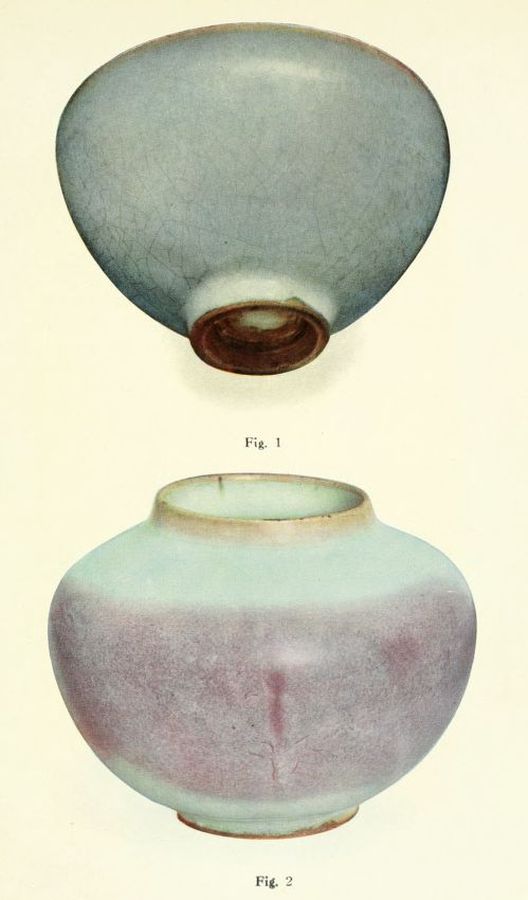
Among the various Sung and Yüan wares with more or less opalescent glazes which have reached Europe in recent years, it is possible to differentiate a considerable group whose characteristics seem to point to the Kuan yao. Their body is usually of fine grain, whitish colour and porcellanous texture, but assuming a rusty brownish tint in the exposed parts. It is, in fact, very much finer than the Yüan wares, usually so called, and all but the choicest wares of Chün type (see ch. ix.). The glaze, too, though generally opalescent, shows marked differences from that of the Chün and Yüan pieces. It is smooth and even instead of being lumpy and irregular, and it ends close up to the foot rim in a comparatively regular line instead of ending short of the base in a thick roll or in heavy drops. And the base instead of being quite bare or covered with a brown glaze, has a patch of the surface glaze underneath. The colours of this glaze show wide variations from a deep brownish green, which suggest the ta lü, to pale dove grey (fên ch´ing) and pale lavender blue tints, which approximate to the Chinese t´ien ch´ing or sky blue, though perhaps not so closely as does the so–called "old turquoise." Some of these glazes, especially the pale lavender and dove greys, are broken by passages of red or crimson, which in turn shade off into green and brown tints. Although the expression tai fên hung in the Ko ku yao lun[128] has already been rendered in its most natural sense, "with a tinge of red," we should perhaps mention a possible alternative which might make it refer to these very passages of red colour; and the fact that they sometimes assume fantastic shapes will explain why the Chinese saw in them "butterflies, birds, fish, unicorns, and leopards."[129] On the other hand, it is clear that these passages of red are not always accidental, for they sometimes take symmetrical forms, and it is quite possible that even the bird and fish forms may have been roughly designed in the colouring medium.
Plate 17 will serve to illustrate this group of possible Kuan wares. Another example is a dish in the British Museum which has a whitish porcellanous body and a slightly crackled pale lavender grey glaze of singular beauty. Other specimens in the same collection include a small tea bowl with misty grey glaze of the fên ch´ing type, smooth and uncrackled, and a body which appears deep reddish brown at the foot; and a small bottle–shaped vase, with lobed body of melon shape, which, though of doubtful antiquity, answers closely to the Chinese descriptions. It has a dark–coloured but well levigated body, deep brown at the foot, and showing a brown tinge where the glaze has run thin at the lip, and the colour is a pale bluish grey with rosy tinges where the body colour is able to penetrate the semi–translucent glaze. Another doubtful specimen, with very similar characteristics, was figured by me in the Burlington Magazine some years ago.[130]
Since the genuine Sung specimens were sent to the Imperial factories to be closely copied (about 1730), it might be supposed that the relatively modern imitations would supply some clue to the original types. There are one or two examples of eighteenth–century copies of Kuan ware in the British Museum on which the glaze is definitely lavender blue in tint, with a crackle which in one case is wide and emphasised by blackened lines, and in the other of a finer mesh.[131] The natural tendency, however, of modern imitative wares is to exaggerate some characteristic which this or that potter might imagine to be specially important, and as it is impossible to say in many cases exactly when the piece in question was made, we cannot be sure how far the potters in each case may have strayed from the original type.[132] No doubt in time these imitations would become a mere convention. It should be said in passing that the modern copies have a white porcelain body, and to obtain the appearance of "brown mouth and iron foot" the potters had recourse to the expedient of colouring the parts concerned with brown ferruginous clay.
The Cho kêng lu[133] refers to three minor wares which were regarded as inferior to Kuan ware, and later writers have assumed that they belonged to the same category. These are the Hsü wares, Yü–hang wares, and wu–ni wares. The first[134] is so little known that its identity has been lost in variant readings, such as Hsün in later writers, which is very near in appearance to tung , a common form used for the Tung ware (see p. 82); and we can safely leave it until some clearer information is forthcoming. The second, according to the T´ao lu,[135] was a Sung ware made at Yü–hang Hsien, in the prefecture of Hang Chou. "Its colour was like Kuan porcelain without its crackle, its lustre (jung), and its unctuous richness (jun)." The wu–ni ware is dark–bodied earthenware, which is discussed on p. 133.


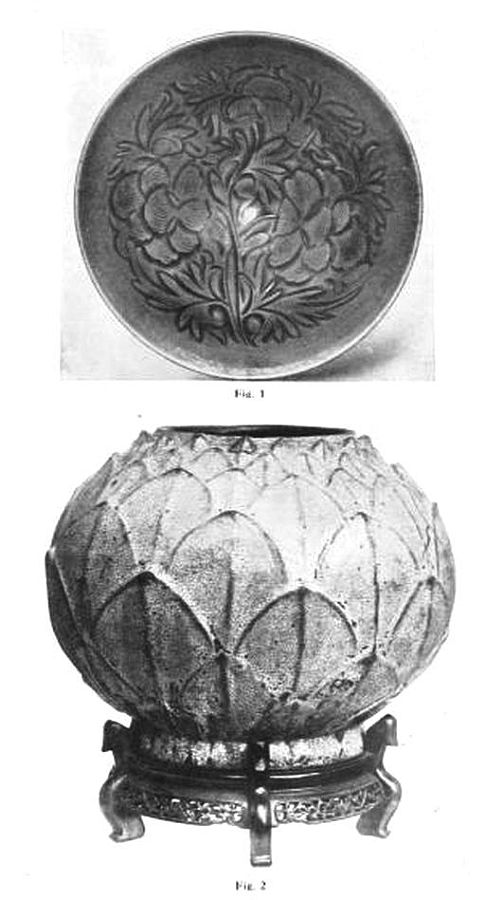
Plate 18.—Sung dynasty.
Fig. 1.—Bowl with engraved peony design under a brownish green celadon glaze. Northern Chinese. Diameter 7 3/4 inches. Eumorfopoulos Collection.
Fig. 2.—Vase moulded in form of a lotus flower, dark grey stoneware, burnt reddish brown, milky grey glaze, closely crackled. Height 7 inches. Freer Collection.
Ko yao

Ko yao (the elder brother's ware), or Ko ko yao, as it is sometimes called with the first character repeated, is unanimously ranked by Chinese writers with the Ju and Kuan wares. According to the traditional accounts, it was first made by the elder of the two brothers Chang , who were potters of Lung–ch´üan Hsien in the Ch´u–chou Fu, province of Chekiang, each having a separate factory in the Liu–t´ien district. Most of the Chinese authorities are content to give the date of these brothers as some time in the Sung dynasty, but one account[136] narrows the period down to the Southern Sung (1127–1279 A. D.). Professor Hirth takes the rationalistic view that the story of the brothers is a myth embodying the fact that there were two distinct types of ware made in the Lung–ch´üan district. Be this as it may, the Ko yao is of considerable interest to us as forming a link between the obscure Ju and Kuan wares and the well–known Lung–ch´üan celadon, approaching the latter in its grass green and sea green varieties and the former in its most highly prized specimens of bluish green or grey tones.

Of its close resemblance to the Kuan ware there can be no doubt, for two highly reputable Chinese writers[137] describe the two wares simultaneously and under one heading, enumerating their various colours in order of merit as fên ch´ing, tan pai, and hui sê (see p. 60), besides mentioning the several kinds of crackle which appeared in the glaze. The only distinctions which the author of the Ch´ing pi ts´ang draws between the two wares are that (1) the Kuan yao crackle is of the "crab's claw"[138] type, while that of the Ko is like fish–roe,[139] and (2) the Ko glaze is somewhat less beautiful than the Kuan. With regard to the crackle, other writers assert that short cracks are characteristic of the Ko yao, and one author uses the picturesque phrase, "crackle of a hundred dangers."[140]
Accidental splashes of contrasting colour, which sometimes assumed fantastic forms, were common to the Ko and Kuan wares, as mentioned on p. 65, and the author of the Po wu yao lan explains these as "originating in the colour of the glaze and forming on its outer surface," and as "due to the fire's magic transmutation."
Another account of the ware given in the Ko ku yao lun depicts it as of deep or pale ch´ing colour, with brown mouth and iron foot, and adds that when the colour was good it was classed with Tung[141] ware. The same passage further informs us that a great quantity of the ware "recently made at the end of the Yüan dynasty" was coarse and dry in body and inferior in colour, a statement to which we shall return presently.
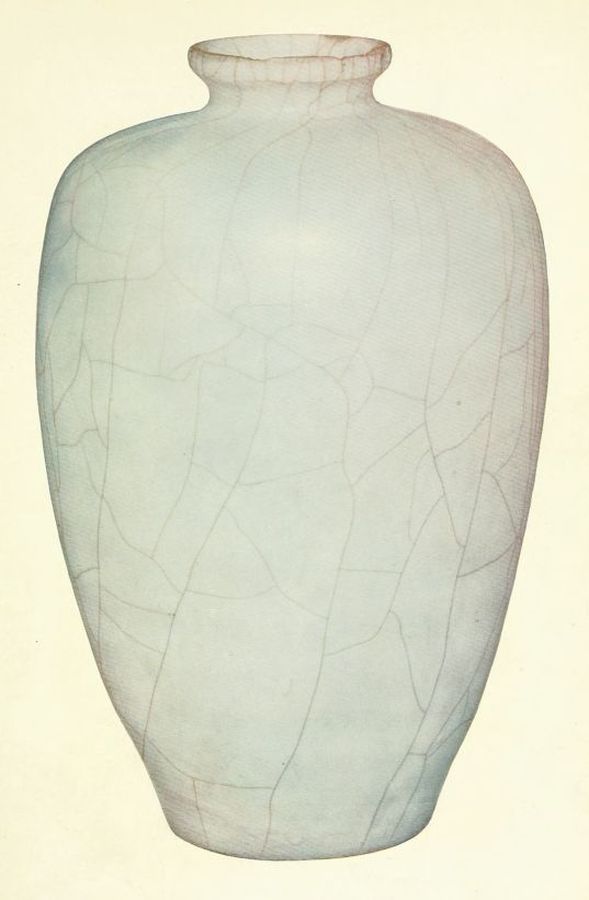
PLATE 19.
Vase of close–grained, dark reddish brown stoneware with thick, smooth glaze, boldly crackled. Ko ware of the Sung dynasty.
Height 10 5/8 inches. Eumorfopoulos Collection.
Other descriptive references to Ko yao include a verse on a Ko ink palette belonging to Ku Liu,[142] which was "green (lü) as the waves in spring"; the eighteenth–century list of Imperial wares[143] which mention "Ko glazes on an iron body," of two kinds, viz. millet–coloured and pale green[144] (or blue), both stated to have been copied from ancient specimens sent down from the palace; and a single specimen in Hsiang's Album, which is given as fên ch´ing.
In these various descriptions it is possible to recognise a celadon green ware, green as the waves of spring, while the familiar stone grey and buff crackled wares, which range from greyish white to pale grey green and greenish yellow, seem to be indicated in the expressions mi sê, fên ch´ing, tan pai, and hui sê. The modern versions of the latter class, which are fairly common, are usually known even to–day as Ko yao, the expression in potter's language being practically synonymous with "crackled wares."[145] Other ancient factories where similar wares were made are Hsiang–hu and Chi Chou.[146]
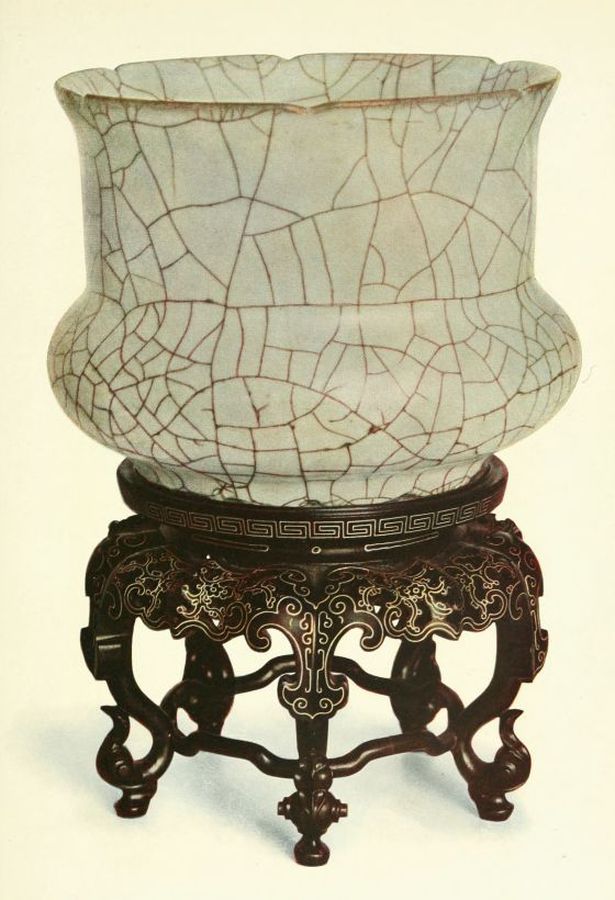
As for the finer Ko wares, which appear to have been indistinguishable from the Kuan, we may look for them in the group described on p. 65, and in such beautiful pieces as that illustrated on Plate 19, a vase of fine oval form with delicate grey glaze of faint bluish tone boldly crackled. The solid quality of the glaze of this last specimen and the texture of the surface, which is smooth but lustrous, suggest some natural substance such as the shell of an egg or a smooth polished stone rather than an artificial material. The colour perhaps more truly answers the description "egg white" (luan pai) than any other Sung glaze which I have seen. Plate 20 illustrates another choice example but with a yellower tone of glaze; and a large square vase in the Freer Collection[147] with thick, misty grey glaze showing a faint tinge of red, which recall the sê ch´ing tai fên hung of the Kuan ware, was shown in the New York exhibition of 1914. All these three specimens have a dark reddish brown body of fine close grain, and their glaze is very thick and unctuous with a tendency to contract into thick wax–like drops under the base.
From certain passages in the Chinese works it appears that a revival of the Ko yao took place in the Yüan dynasty, if indeed the manufacture had not been continuous. The Ko ku yao lun, for instance, under the heading of Ko yao, states that the "ware recently made at the end of the Yüan dynasty was coarse and dry in body and inferior in colour." In the Po wu yao lan[148] we read that "certain Ko wares made in private factories took their clay from the Phœnix Hill" (at Hang Chou, where the Kuan potteries were located), and the T´ao lu[149] definitely states that clay was brought from Hang Chou for this later Ko ware. Add to these the remark in the Ko ku yao lun on the subject of Kuan ware[150]—"all the imitations which are made at Lung–ch´üan are without crackle"—and it is clear that the Lung–ch´üan potters in the fourteenth century were busy copying both the Kuan and Ko wares, and that to obtain a closer resemblance to the former they actually sent to Hang Chou for the red clay which would produce the "brown mouth and iron foot." The alleged absence of crackle would indicate a departure from the original Ko methods, but we are at liberty to doubt the universal application of such sweeping statements, and I ventured to suggest[151] that a remarkable bowl in the British Museum was a Yüan example of Ko ware, because, in spite of its Ko crackle, it corresponds so closely to the other points in the descriptions of this make. In any case, there is little doubt that it belongs to an early period of manufacture.
PLATE 20.
Deep Bowl of reddish brown stoneware with thick, boldly crackled glaze. Ko ware of the Sung dynasty.
Height (without stand) 4 inches. Eumorfopoulos Collection.
The following extract from a work entitled Pi chuang so yü,[152] which would be still more interesting if we knew its date, serves to illustrate some of the difficulties the Chinese collector had to face in the past: "Ancient examples of Ko yao of the Sung period have survived, though for a long time past genuine and counterfeit have been confused together. Among men there are very many who seek for the genuine Sung, but refined and beautiful specimens are exceedingly few.... Ts´ao Chiung, a man of high birth, secured an incense burner, in height about two inches and in width proportionate. The cover was beautiful jade carved with a pattern of sea waves of Tung ch´ing[153] colour, with a handle in form of a crane, a genuine piece, and exceedingly beautiful. It came to the ears of the eunuch Mai, governor of the district, and he put Chiung in prison and subjected him to the inquisition. His son had no choice but to offer the vessel as a gift. Later the powerful hand of the superintendent of the Board of Rites seized it. In the Chêng Tê period (1522–66) it was stolen, and, coming to the district below Wu, it became the property of Chang Hsin–fu of Tien–shan, Shanghai, who sold it for 200 ounces of gold. After that it came again into the hands of a connoisseur, and the Imperial authorities in the end did not succeed in recovering it. This was a genuine antique Ko vessel."