Chapter XI
Reading edition
PORCELAIN AND ITS BEGINNINGS
THE reader will have noticed that the word porcelain, which was avoided in the discussion of the earlier periods, has insensibly crept into the chapters which deal with the Sung wares. It was no longer right or proper that it should be excluded, and it is high time that our attitude on the interesting question of its origin was defined. Unfortunately, that attitude is still—and must necessarily remain—one of doubt and uncertainty, but we can at least clear away some of the existing misapprehensions on the subject.
The myth which carried back the manufacture of porcelain some eighteen centuries before our era has been definitely discredited, and the snuff bottles supposed to have been found in ancient Egyptian tombs which gave rise to the idea are now known to be of quite modern make. The more modest computation which placed the invention in the Han dynasty (206 B. C. to 220 A. D.) might have been almost as lightly dismissed had not Dr. Bushell, after disposing of the theory in his Oriental Ceramic Art[292] in 1899, seen fit to reverse his decision in later publications.[293]
The reasons given for this later attitude are on the surface so convincing that it is necessary to consider them in detail and to examine the authorities on which they are based. Bushell's statement runs as follows: "It is generally agreed that porcelain was first made in China, but authorities differ widely in fixing a date for its invention. The Chinese attribute its invention to the Han dynasty, when a new character tz'ŭ was coined to designate, presumably, a new substance. The official memoir on 'Porcelain Administration' in the topography of Fou–liang, the first edition of which was published in 1270, says that according to local tradition the ceramic works at Hsin–p'ing (an old name of Fou–liang) were founded in the time of the Han dynasty, and had been in constant operation ever since. This is confirmed by T'ang Ying, the celebrated superintendent of the Imperial potteries, appointed in 1728, who states in his autobiography that the result of his researches shows that porcelain was first made during the Han dynasty at Ch'ang–nan (Ching–tê Chên), in the district of Fou–liang."
From this and the passages immediately following it is clear that Bushell at that time leant strongly to the Han theory, which he had previously discarded, for three reasons, which we shall now examine. The first rests on the character tz'ŭ. Whether the character tz'ŭ was coined to designate a new substance in the Han dynasty is by no means certain. It undoubtedly appears in the Han dictionary, the Shuo Wên, but with the meagre definition "pottery ware,"[294] and without any further indication of its nature. The second is based on a passage in the Annals of Fou–liang, which on examination proves to contain only the general word t'ao (ware) and not the character tz'ŭ at all. The actual passage runs: "The manufacture of pottery (t'ao) at Hsin–p'ing began in the Han dynasty. Speaking generally, this pottery was strong, heavy, and coarse, being fashioned of rich clay with moisture added, after methods handed down from the ancients." The third invokes the authority of T'ang Ying, but on reference to the autobiography of this distinguished ceramist in the Chiang hsi t'ung chih, we again find reference only to t'ao and not to tz'ŭ, viz. "It (t'ao) is not the growth of one day. Research shows that it began in the Han dynasty and was transmitted through succeeding generations. Its place (of manufacture) changed (from time to time), but it flourished at Ch'ang–nan." One obvious place for T'ang's research would be the Annals of Fou–liang, and I shrewdly suspect that his conclusions were based on the very passage quoted above, of which his words give a clear echo. But in any case, neither passage has any bearing on the origin of porcelain unless we assume that t'ao is the same as tz'ŭ, and that both words definitely mean porcelain, an assumption which is not only quite unwarranted but in any case begs the whole question.
The Chinese words used at the present day for porcelain are tz'ŭ, t'ao, and yao, all of considerable antiquity, though their forms have undergone various changes and their meaning has been modified from time to time to keep pace with the evolution of the ware. The word tz'ŭ , as we have seen, was defined in the Han dictionary as merely "pottery ware." Its modern definition is a hard, fine–grained variety of t'ao, and if we add to this the quality of resonance—i.e. of emitting a musical note when struck—we have all the requirements of porcelain according to the Chinese definition. The synonym , containing the radical shih (a stone), which is also pronounced tz'ŭ, has come in the last two centuries to be used interchangeably with the older word , in spite of the protests of eighteenth–century purists.[295]


The word t'ao is a term even more comprehensive than our word "china." In the Han dictionary it appeared in the form t'ao or yao (previously pronounced fou), composed of fou (earthenware) and the radical pao (to wrap), and its meaning was kiln, and by extension the products of the kiln. At that time the word in its modern form was only used as a proper name.


The third character yao (the Japanese yaki) is precisely synonymous with t'ao, meaning first a kiln and then wares of any kind. In its form it occurs in the Han dictionary; another form is , which, according to a Sung writer,[296] dates from the T'ang period, and a third form is current in modern dictionaries.


In short, the Chinese terms are all of a general and comprehensive kind, capable of embracing pottery, stoneware, and porcelain impartially, and there is no single Chinese word which corresponds to our precise term "porcelain." Under these circumstances it is clear that no theory on the origin of porcelain can be based merely on the occurrence of any of these words in early Chinese texts. Still less can any such theory be constructed from the very promiscuous use of the word "porcelain" in European translations, and it is a thousand pities that both Julien and Bushell were not more discriminating in this matter, or that they did not always (as Julien sometimes and Professor Hirth usually did) give the Chinese character in parentheses when any reasonable doubt could exist. Had this been done we should have been spared misleading references to "two porcelain cups of the Han dynasty,"[297] and such loose writing[298] as "In the Wei dynasty (221–264 A. D.) which succeeded the Han we read of a glazed celadon ware made at Lo Yang for the use of the palace, and in the Chin dynasty (265–419) we have the first mention of blue porcelain produced at Wên–chou, in the province of Chehkiang, the progenitor of the sky–blue glazes tinted with cobalt, which afterwards became so famous." The "glazed celadon," needless to say, is purely conjectural, pottery (t'ao) vessels being all that is specified in the passage on which the statement is obviously based; and the "blue porcelain" is evidently no other than the p'iao tz'ŭ (mentioned by the poet P'an Yo and discussed on p. 16), which is better rendered "green ware."[299]
The same kind of criticism applies to all the other references in early writers until we reach the Sui dynasty (581–617 A. D.). In the annals of this period there is a much discussed passage in which it is stated that the art of making a substance known as liu–li[300] had been lost in China, and that the workmen did not dare to experiment, but that one Ho Ch'ou , a connoisseur in pictures and antiquities, succeeded in making it with green ware (lü tz'ŭ), and that his imitations were not distinguishable from the original substance.

To understand the full import of this passage it is necessary to explain the nature of liu–li, and this is fortunately made quite clear by the author of the T'ao shuo in a commentary so interesting that I give it in full:
"I find that liu–li comes from the countries of Huang–chih, Ssŭ–t'iao and Jih–nan.[301] That produced in Ta–ch'in (the eastern provinces of the Roman Empire) is in ten colours—pink, white, black, yellow, blue, green, deep purple, deep blue (or green), red, and brown. Liu–li was originally a natural substance.[302] Yen Shih–ku,[303] commenting in the Annals of the Han Dynasty, says, 'At the present time they commonly use molten stones, adding a number of chemicals and then pouring the substance (into moulds) and forming it; but it is unsubstantial, brittle, and not a successful casting.' In the Northern Wei dynasty, in the reign of T'ai Wu (424–451 A. D.), a man of the Ta Yüeh–chih[304] who came to trade at the capital, said he could make liu–li by melting stones. Eventually he collected the ore and made it (liu–li), and the finished article surpassed the original in its brilliance and colour. The method has been handed down to the present day, and it was probably only an accidental intermission which occurred in the Sui dynasty. But the Chinese castings are brittle in substance, and when hot wine is poured into them they fly to pieces in the hand. What a pity the Yüeh–chih method has been handed down instead of Ch'ou's!"
The allusions to melting stones, casting, etc., in this passage leave no doubt that the liu–li, as made in China, was a kind of glass, imitating a natural stone.[305] It is, in fact, usually translated in the dictionaries as "opaque glass," and in connection with pottery it has the sense of glaze—e.g. liu li wa "glazed pottery."
We can now return to Ho Ch'ou, who "took green ware and made liu–li."[306] It has been thought that what he made must have been a kind of porcelain, but there is no indication of any such achievement, for though it is possible to make an artificial porcelain with glass as a constituent, the converse is not true: you cannot make glass out of either pottery or porcelain. The most probable explanation of the passage seems to be that Ho Ch´ou (who was apparently not a potter) experimented at some pottery with the materials used in glazing the green ware, and found that he could make a very good glass (liu–li) with the potter's green glaze, and perhaps other ingredients, a result which is in no way surprising, seeing that the softer ceramic glazes have a very close affinity to glass. But no further inferences can be drawn from this passage, and it is not even clear that Ho Ch´ou made a ceramic ware at all. All we are told is that he made liu–li. I have rather laboured this negative point, because Professor Zimmermann has published a declaration of belief that Ho Ch´ou was the discoverer of porcelain.[307] Apart from the obvious criticism which the writer himself anticipates, that such an epoch–making discovery would hardly have escaped the notice of Ho Ch´ou's biographer, Professor Zimmermann opens his case with a fundamental error, for which he has to thank Dr. Bushell. It is true that he only names Julien as the source of his information, but his version of the story of Ho Ch´ou is taken verbatim from Bushell's Oriental Ceramic Art,[308] where the crucial passage is unfortunately rendered "but he (Ho Ch´ou) succeeded in making vessels of green porcelain which could not be distinguished from true glass." This mistranslation puts an entirely different complexion on the passage, and goes a long way to justify Professor Zimmermann's inferences that Ch´ou made a glassy ware of the nature of porcelain. It is an instructive instance of the pitfalls which beset the student of Chinese subjects, especially when he has to rely on other people's translations.
Strange to say, a similar mistranslation occurs in Dr. Hirth's short but excellent treatise on Ancient Chinese Porcelain,[309] in a passage which is nevertheless of great importance to our quest. It has been the custom with Chinese compilers of reference works to incorporate the material of previous editions, adding their own commentaries and any further information which happened to have reached them, and to this we are indebted for the preservation of many passages from ancient writers which would otherwise be extremely difficult of access. Thus Hirth found embalmed in the Sung Pharmacopœia two early references to the material pai o which he shows to be without doubt the kaolinic earth used in the manufacture of porcelain, and which, like many other strange materials, entered into Chinese medicinal prescriptions. The first mention of this substance is taken from the writings of T´ao Yin–chü, who died in 536 A. D., to the effect that the pai o, besides being used in medicines, was employed at that time for painting pictures; and Hirth argues that so celebrated a writer on scientific subjects as T´ao Yin–chü could not have failed to note it if the pai o had been in general use for ceramic purposes as well. This is followed by a quotation from the T´ang Pharmacopœia (compiled about 650 A. D.): "It (pai o) is now used for painter's work, and rarely enters into medicinal prescriptions; during recent generations it has been prepared from white ware[310] (tz´ŭ)." By rendering the last sentence "during recent generations it has been used to make white porcelain," Hirth invested the passage with a greater interest than it actually possesses. But even when stripped of this fictitious importance, it constitutes the first literary evidence we have of the use of kaolin by Chinese potters. This is followed by another quotation from the T´ang Pharmacopœia recommending for medicinal purposes a powder prepared from the white ware of Ting Chou.[311]

Whether we are to understand that the Chinese pharmacist ground up broken pieces of Ting ware or merely made use of the refined and purified clay obtained at the potteries, matters little. Neither proceeding would be without parallel in Europe in far later times than the T´ang period. But the specific reference to white Ting ware at this early date is most interesting in view of the fact that Ting Chou was celebrated in the Sung dynasty for a white ware which is undoubtedly a kind of porcelain.
The presence of a kaolin–like material in a dark–coloured ware, probably of the third century, which was disclosed by the analysis made by Mr. Nicholls in Chicago, has already been recorded (p. 15). We have no means of ascertaining what length of time elapsed before a white material of this nature was evolved, but it was clearly in existence in the beginning of the sixth century. Possibly it was not porcelain according to the strict European definition, but there is every reason to suppose that it was a hard white ware, such as the Chinese would not hesitate to include in their porcelain category. Such a ware appears on some of the funeral vases which may safely be referred to the early T´ang period (see p. 26), and in default of other evidence I think we can say that porcelain in the Chinese sense already existed at the end of the Sui dynasty.[312]
Though this period happens to coincide with the lifetime of Ho Ch´ou, neither his name nor any other has been associated with the event by the Chinese, and it is highly probable that porcelain only came into being by a process of evolution from pottery and stoneware, the critical moment arriving with the discovery of deposits of kaolinic earth. As a mere speculation, I would suggest that the deposits were those at Han tan, the modern Tz´ŭ Chou, which supplied material for the Ting Chou potters.[313] It is, at any rate, significant that the new name, which we are led to suppose was derived from the tz´ŭ stone,[314] was given to that place in the Sui dynasty.
Numerous literary references from this time onwards have already been quoted which are highly suggestive of porcelain. The "false jade vessels" of T´ao Yü in the early years of the seventh century; the eighth–century tea bowls of Yu Chou and Hsing Chou which were compared respectively to jade and ice, to silver and snow, the former being green and the latter white. The twelve cups used for musical chimes by Kuo Tao–yüan; the white bowls immortalised by the poet Tu "of ware (tz´ŭ) baked at Ta–yi, light but strong, which gives out a note like jade when struck."
The quality of translucency which in Europe[315] is regarded as distinctive of porcelain is never emphasised in Chinese descriptions. I can find no mention of it in any of the earlier writings,[316] and the first unmistakable literary evidence of its existence[317] comes from a foreign source. The Arab traveller, Soleyman, who describes his experiences in China in the ninth century, states that "they had a fine clay (ghādar) from which bowls were made, and in the transparency of the vessels the light of the water was visible; and they were (made of) fine clay."[318] This statement practically proves the existence of translucent porcelain in the T´ang dynasty, and we confidently await the arrival of specimens from Chinese excavations. Some of the export porcelains of the time have been actually unearthed at Samarra on the Euphrates by Professor Sarre,[319] of the Kaiser Friederik Museum, Berlin, and they include (1) bowls of gummy white porcelain with unglazed gritty base; (2) greenish white ware; (3) yellowish white with small crackle; and (4) a pure white porcelain with relief designs, such as birds and fishes, under the glaze. Other pottery found on that site included mottled ware of typical T´ang type, and a creamy white of the Tz´ŭ Chou type with brown spots.[320]
From considerations of form and the general character of the ware, I am inclined to regard three specimens in Plates 44 and 45 as belonging to the T´ang period. Fig. 1 of Plate 44 has a thin ivory white glaze running in gummy drops and clouded with pinkish buff staining outside and with a reddish discoloration within. Fig. 2 of the same Plate is remarkable in many ways. It is so thin as to seem to consist of little else but glaze, and is consequently almost as translucent as glass. The colour of the glaze is pearly white powdered with tiny specks, and the crackle is clearly marked. The base is flat and discloses a dry white body of fine grain. But its most conspicuous feature is the arresting beauty of its outline, which recalls some choice specimen of Græco–Roman glass, and displays a classic feeling frequently observed in T´ang pottery and in the Corean wares which owe so much to T´ang models.
Fig. 2, Plate 45, shows the celebrated phœnix ewer belonging to Mr. Eumorfopoulos which has proved so difficult to classify.[321] It is a white porcellanous ware translucent in the thinner parts, and the glaze is of light greenish grey with a tendency to blue in places. The form and ornament show strong analogies with specimens of T´ang pottery. The neck, for instance, may be compared with Fig. 2 of Plate 14; the phœnix head and the foliate mouth with Fig. 1 of Plate 9, and the carved ornament on the body with Fig. 3 of Plate 14.
Among the Sung wares many of the white Ting specimens are found to be translucent in their thinner parts, and these may be fairly regarded as porcelain proper. A considerable number of other white porcelains have come over of late under the description of Sung wares, and many of them are certainly early enough in form and style to belong to that period. They are true hard porcelain, translucent, and of a creamy white colour. Being for the most part without decoration, they can only be judged by their forms, and in view of the conservative habits of the Chinese, it would be rash to assert too emphatically their Sung origin. Yüan and even early Ming dates are suggested by the more cautious critics; but the possibility of a Sung origin having been established, I am inclined to give the evidence of form its full weight.
There are, besides these, other well–defined types of translucent porcelain which may confidently be attributed to a period as early as the Sung, but here the possibility—nay, probability—of a Corean origin has to be considered. It is certain that many of them have been found in Corean tombs; the provenance of the rest is doubtful. One type is a delicious smooth white porcelain with glaze of faintly bluish tinge, highly translucent, and worked very thin at the edges. The base of the vessels (usually small shallow bowls or saucers) is unglazed, and shows a soft–looking sugary body of close texture, rather earthy than glassy, and slightly browned by the fire. They have, in fact, almost the appearance of a "soft–paste" porcelain like that of Chelsea. These are so different from any known Chinese type that I strongly incline to a Corean origin for them. Another type is of hard but translucent ware with glaze of distinctly bluish tinge. A bowl in the British Museum is a good example of this. Of the usual conical form, it has a plain outside, and the inside is decorated with an incised design of not very clear meaning, but apparently a close foliage ground with highly formalised figures of boys. If this interpretation is correct, it is a conventional rendering of the well–known pattern of boys in foliage, Chinese in origin, but frequently used by the Corean potters. The design ends in Corean fashion, about an inch below the rim, leaving a plain band above it. The glaze is a faint bluish colour all over, and is powdered with specks, a fault in the firing; the base is almost entirely unglazed, and the biscuit, where exposed, has turned reddish brown. The style of this piece is strongly Corean. The same peculiarities in the base are shared by another type of small bowl, usually decorated inside with a sketchy design in combed lines. Some of these are creamy white; others are bluish white with a decided blue tinge in the well of the bowl where the glaze has formed thickly.[322] Another group, which is also said to be represented among the Corean tomb wares, is practically indistinguishable from the creamy white Ting Chou porcelain.
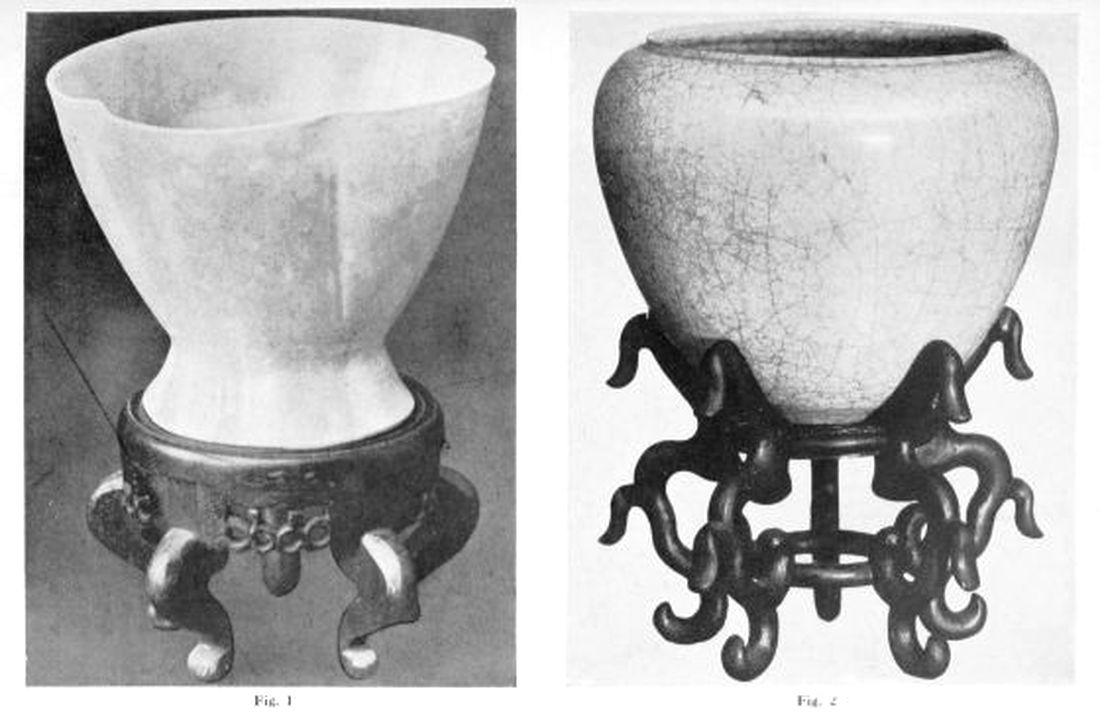
Plate 44.—Early Translucent Porcelain, probably T´ang dynasty.
Fig. 1.—Cinquefoil Cup with ivory glaze clouded with pinkish buff stains. Diameter 3 3/4 inches. Breuer Collection.
Fig. 2.—Vase of white, soft–looking ware, very thin and translucent with pearly white, crackled glaze powdered with brown specks. Height 3 1/8 inches. Peters Collection.
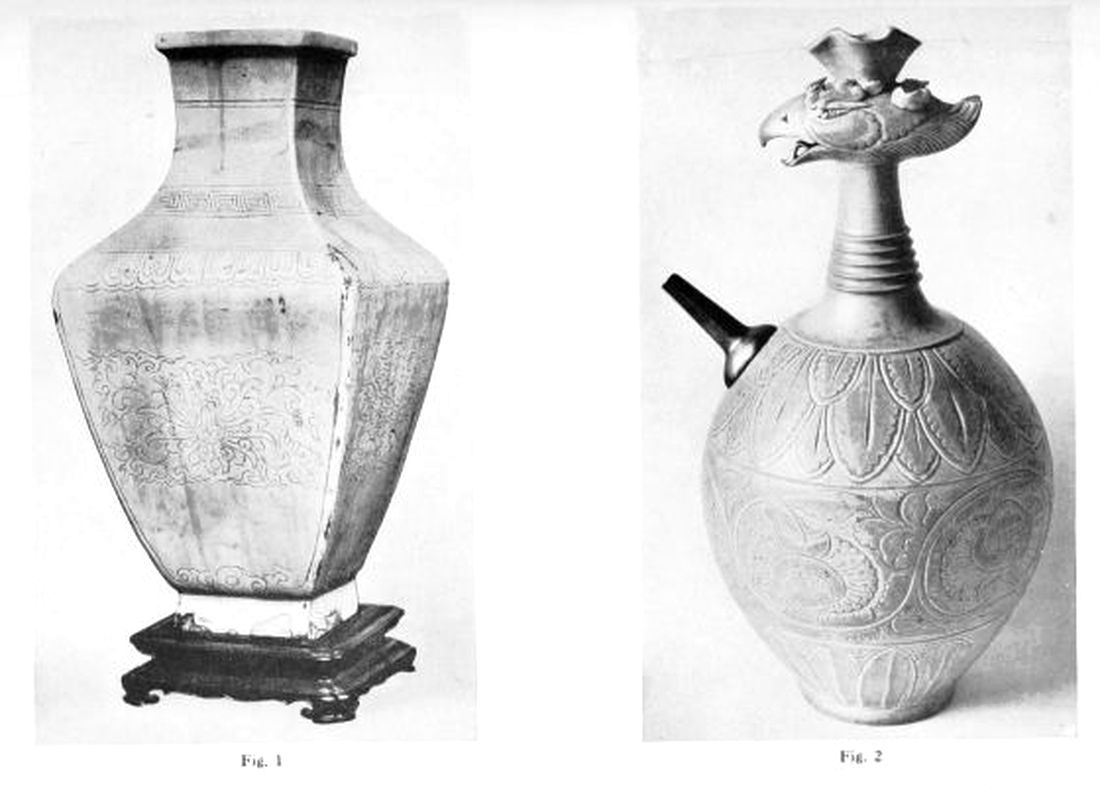
Plate 45.—T´ang and Sung Wares.
Fig. 1.—Square Vase with engraved lotus scrolls and formal borders. T´u–ting ware, Sung dynasty. Height 20 inches. Peters Collection.
Fig. 2.—Ewer with phœnix head, slightly translucent porcelain with light greenish grey glaze with tinges of blue in the thicker parts; carved designs. Probably T´ang dynasty. Height 15 1/4 inches. Eumorfopoulos Collection.
The whole question of these interesting porcelains is complicated by the fact that the Coreans were admittedly indebted to the Ting Chou potters for many of their designs;[323] and by the fact that while close intercourse between China and Corea existed the Coreans may well have imported Chinese wares and deposited some of them in the tombs. An authentic find of these porcelains in a Chinese tomb would give important evidence on this point, but so far there is no evidence of their being found in China beyond the statement of traders, and it is quite certain that they have been found in Corean tombs. It may be added that the Japanese class them as hakugorai or white Corean ware, and stoutly support their Corean origin.