Chapter XVI
Reading edition
MISCELLANEOUS POTTERIES
IN addition to the factories which have received individual notice, there are numerous others which are only names to us; and, on the other hand, there is a host of nameless wares which have reached Europe at various times and through divers channels, and are now awaiting classification with very little chance of being definitely located. A consideration, however, suggested by the Chinese Commercial Guide[409] may help towards the grouping of these miscellaneous wares. We are told that the charges for freight forbid the wares to be carried far in the ordinary way of internal trade, and that manufactures of pottery are numerous, supplying the local needs. Now the number of ports open to foreign trade in China is limited, and in the past the sea trade was of far smaller volume, and was concentrated in a few of the southern coast towns. Consequently, in dealing with pottery which we may assume to have been brought by the export trade to Europe, it will be necessary for general purposes to take account only of the factories in the neighbourhood of the seaports in question. These will be found to be almost entirely in the southern half of China.
Thus, starting from the south and following the coast line, we come first to the potteries which supplied Pak–hoi and Canton, and we may assume that Hongkong and Kowloon would be supplied from the neighbourhood of Canton. These have already been discussed, and we can pass on to Swatow, which would draw supplies from the Ch´ao–chou Fu potteries. This neighbourhood furnished an exhibit to the Paris Exhibition of 1878, consisting of "tea jars, tobacco jars, braziers and pots, lamps, tiles, flower pots, fruit jars, spoons, vases of various sorts, figures, dishes, cups and saucers, and spittoons."
PLATE 52
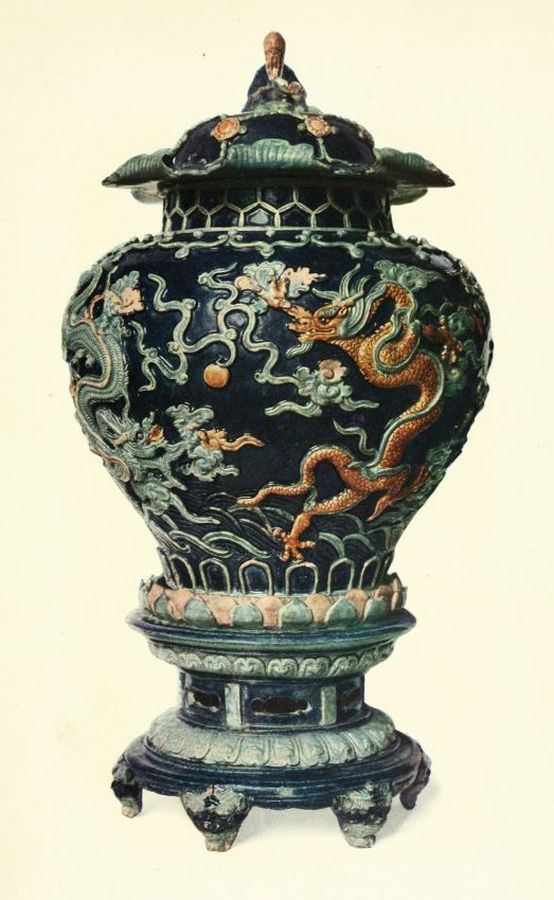
Wine Jar with Cover and Stand. Fine stoneware with ornament in relief glazed green and yellow in a deep violet blue ground. Four–clawed dragons ascending and descending among cloud–scrolls in pursuit of flaming pearls; band of sea–waves below and formal borders including a ju–i pattern on the shoulder. Cover with foliate edges and jewel pattern, surmounted by a seated figure of Shou Lao, God of Longevity. About 1500 A. D.
Height 22 1/2 inches. Grandidier Collection, Louvre.
At the same exhibition, Amoy, to which we come next, was represented by "dishes, rice bowls, wine cups, saucers and spoons, preserve jars, wine bottles, etc., in common porcelain," besides tiles of various kinds, which implies the manufacture of pottery as well. These wares, we are informed in the catalogue, are largely exported to Saigon, Siam, Manilla, etc.; a statement confirmed by the Chinese Commercial Guide,[410] which adds India, the Archipelago, and the southern provinces. This is interesting in view of the quantities of coarse china, blue and white[411] and coloured, which is brought from these parts by collectors who take its crude appearance as evidence of age. The factories are located at Pa–kwoh, a village near Shih–ma, which lies between Amoy and Chang–chou Fu. Tung–an Hsien in the same neighbourhood is also named as a pottery centre.
There are several important factories within easy reach of Shanghai. Those at Yi–hsing have been discussed at some length, but there is another large centre of the industry on the east side of the Lake T´ai–hu opposite to Yi–hsing. This is Su Chou , which, according to the catalogue of the Paris Exhibition, was still celebrated for its pottery in 1878. But the reputation of Su Chou does not rest on its modern achievements. Its name occurs frequently in the pottery section of the great encyclopædia (compiled by order of the Emperor K´ang Hsi) as one of the prominent pottery centres in the Ming dynasty. Tiles for the palaces and temples of Nanking were made there, and vases and wine vessels for the Imperial Court. The nature of these last can be guessed from a hint given in one passage of the encyclopædia[412]: "At Su Chou iron rust (hsiu) and other materials are used for the yellow wares. For the vessels with dragon and phœnix destined for Imperial use, a resinous substance[413] and cobalt blue[414] are used."

In the Hsüan Tê period (1426–1435), Su Chou was noted for the manufacture of artistic pots for holding fighting crickets. In reference to these we are informed in the T´ao shuo (see Bushell, op. cit., p. 140) that "those fabricated at Su Chou by the two makers named Lu and Tsou were beautifully moulded, and artistically carved and engraved, and the pots made by the Elder and the Younger Hsiu , two daughters of Tsou, were the finest of all. At this time fighting crickets was a favourite pastime, and hundreds and thousands of cash were staked upon the event, so that they did not grudge spending large sums upon the pots, which were decorated in this elaborate way, and consequently far surpassed the ordinary porcelain of the period."


The large and important potteries at Po–shan Hsien in the Ch´ing–chou Fu, in Shantung, were represented only by a small exhibit at the Paris Exhibition of 1878, consisting of "a bottle of glazed pottery, three tea jars in red ware, ten specimens of glazed pottery, a brazier in terra cotta, and seven crucibles." Laufer tells us that these potteries date back to Sung times, and have preserved the old traditions of manufacture. The district is also noted for its glass, enamels and glazing materials, but it is situated inland, and not conveniently near any of the treaty ports.

In the early days of the European trading companies, pottery, as distinct from porcelain, does not seem to have received much attention from the merchants, and we may fairly assume that most of the earthenwares which reached Europe before the last century hailed from the neighbourhood of Canton or from Yi–hsing and the Shanghai district. But long before the first European vessels reached the coasts of China, Arab and Chinese merchantmen had carried cargoes of pottery and coarse porcelain to the Philippines, the East Indian Archipelago, the Malay Peninsula, Siam, Ceylon, and India. The Arabs had a trading station in Canton in the eighth century, and Chinese junks sailed from Canton and the Fukien ports in the Sung, Yüan, and Ming dynasties. A Chinese account of the sea trade in the twelfth and thirteenth centuries may be read in the work of Chao Ju–kua,[415] and it will be found from this book and from Marco Polo's accounts that Ch´üan–chou Fu on the Fukien coast was a busy centre of foreign trade in the Sung and Yüan periods. Hirth[416] has traced the probable route by which the Lung–ch´üan celadons reached this port for shipment, and doubtless the other wares, including coarse white porcelain, stonewares and pottery, which are found in the Philippines and Borneo (to name only two of many localities) were largely supplied from the Fukien potteries. Many of these wares are of undoubted antiquity, and some of the types are unknown in China to–day. They may have been made solely for export, but in any case their disappearance in China is quite intelligible. For even in the eighth century the merchants were forbidden[417] to export "precious and rare articles," and most of these trade goods are of coarse make and unlikely to be preserved by the Chinese at home.
On the other hand, the natives of the Philippines and the Dyaks of Borneo have preserved these old potteries with scrupulous care. The various types of jars have been christened with special names[418] alluding to their form or decoration; they have been credited with supernatural powers; and numerous legends have grown endowing them with life and movement, power of speech, and influences malevolent or benign.
A good collection of these pots would be of considerable interest, but the value attached to them by their native owners is out of all proportion to their intrinsic worth, and makes them difficult to procure. An important series, however, of the Philippine jars has been formed by the Field Museum at Chicago, and they are described with full illustration in one of the excellent publications of that institution.[419] Among other things we are told that "every wild tribe encountered by the writer in the interior of Luzon, Palawan, and Mindanao possesses these jars, which enter intimately into the life of the people. Among many the price paid by the bridegroom for his bride is wholly or in part in jars. When a Tinguian youth is to take his bride, he goes to her house at night, carrying with him a Chinese jar which he presents to his father–in–law. The liquor served at ceremonies and festivals is sometimes contained in these jars, while small porcelain dishes contain the food offered to the spirits."[420]
A general similarity in form is noticeable in the Philippine jars, an ovoid body more or less elongated being common to all, while the neck varies a little in its height and width. A series of loop handles or pierced masks on the shoulder, to hold a cord for suspension, is a constant feature. The older types, which are said to date back to a period ranging from the thirteenth to the fifteenth century, are frequently decorated with one or two large dragons coiling round the sides, and either modelled in low relief or incised in the body. Others are quite plain, and the glazes include black, brown, dark green, and a brownish yellow of varying depth. A later group, not older than the end of the Ming dynasty, is without ornament, but coated with single–colour or variegated glazes of the Canton and Yi–hsing types—e.g. speckled blue with green flecks, green with blue streaks and lines, blue and green mottled and crackled, light bluish green—the glaze often ending short of the base in an even line, which is, perhaps, characteristic of Yi–hsing.
The British Museum has a small series from Borneo, which includes, among the older types of pottery, a jar with black–brown glaze and bands of cloud design and stiff leaves deeply incised, and an ovoid jar with many loop handles on the shoulders, two dragons in relief, and a ground of incised wave pattern all covered with a yellowish brown glaze which ends in a regularly waved line some way short of the–base. Of later make is a jar with translucent purplish brown glaze, and four circular panels with figure ornament in low relief glazed green, a type described by the Japanese as "Old Kochi."[421] There are, besides, a jar with roughly painted blue dragon designs under a crackled white glaze, the ware being a coarse porcellanous stoneware; another with enamel colours in addition to the underglaze blue including the rose pink which is not older than the eighteenth century; and another type with rough stoneware or earthen body covered with a crackled, greyish white enamel of putty–like surface on which enamel colours are coarsely painted. The typical jar which the island natives so highly prize is of the ovoid form with a number of loop handles on the shoulder and dragons in relief.[422] An unusually ornate example is shown on Plate 49. It has a cloudy green crackled glaze with dragons of both the ordinary and the archaic kind, besides storks and a bat in low relief, and there are touches of dark blue and yellow, white and brown in the glaze. It is probably of Canton make and not older than the seventeenth century. In modern times jars are made in Borneo itself by the Chinese in the coast towns.
PLATE 53
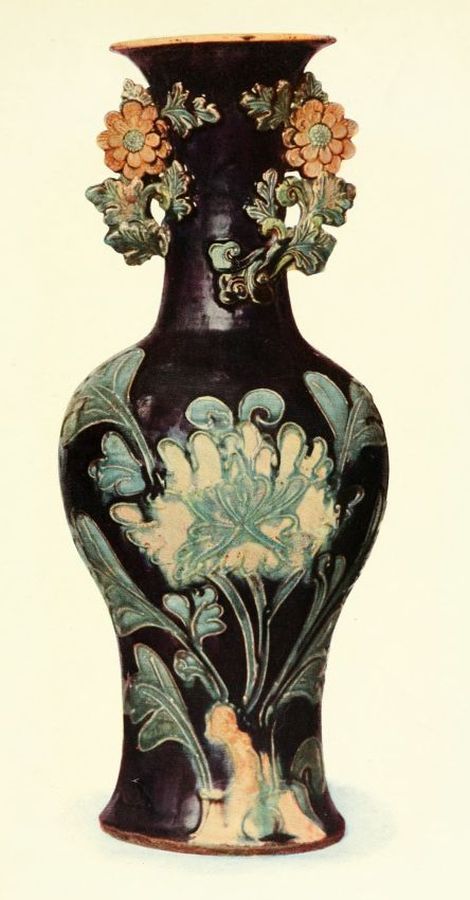
Vase with chrysanthemum handles: buff stoneware with chrysanthemum design outlined in low relief and coloured with turquoise, green and pale yellow glazes in a dark purple ground. About 1500 A. D.
Height 19 1/2 inches. Eumorfopoulos Collection.
A certain amount of Chinese pottery found its way, like the celadon porcelains in early times, by the caravan routes into Turkestan, India, Persia, and Western Asia. Such wares would be more naturally drawn from the potteries in Honan, Chihli, and the north–western provinces, and it is not surprising that the fragment found by Sir Aurel Stein in the buried cities of Turkestan should have included the brown painted wares of Tz´ŭ Chou.
But the greatest difficulties in classification are presented by the miscellaneous pottery which collectors have picked up from time to time in China, or antique dealers have sent over to supply the demand created by the increasing interest taken in Chinese pottery by Western amateurs. These come, as a rule, without any hint as to their place of origin, and in most cases it is quite impossible to locate them. There are, however, certain well–defined groups which come together naturally.
One of these is represented by the Tradescant jar in the Ashmolean Museum, Oxford. It was exhibited at the Burlington Fine Arts Club in 1910, and described in the catalogue[423] as "Jar with globular body, short neck, and wide mouth; five loop handles; stoneware covered with a bright green glaze; the ornament consists of floral scrolls in yellow with touches of brown and is in low relief; round the base a formal design. Height, 12 inches." A similar jar is shown on Plate 56, and in the Goff collection in the Brighton Museum is another of the same make, but with the design incised with a point instead of applied in relief. The Tradescant Collection was given to Elias Ashmole in 1659 by John Tradescant. It was formed by the father of the donor, who died in 1627, so that at the lowest computation the antiquity of these wares is fixed in the late Ming period. Another group is represented by Plate 58, Fig. 2. Its characteristics are a comparatively thin buff earthenware body, soft enough to powder under the knife, and a sparing use of brownish yellow, bright turquoise, green[424] and aubergine glazes of the usual crackled type applied direct to the body. The specimens are generally vases or incense burners of curious and archaic forms, with ornament moulded in low relief, the whole bearing the unmistakable signs of a ware which has been pressed in a mould. The inside and bottom of the incense burners are usually unglazed. The colours, as a rule, are pleasing and soft, and it is the common practice to label them indiscriminately Ming. As nothing definite is known of their place of origin, this chronology can only be based on their archaistic appearance, or on the fact that they have the usual "on biscuit" glazes, which seems to be the accepted signal for a Ming attribution. Needless to say, the use of this method of colouring survived the demise of the last Ming emperor, and it is improbable that wares which must be comparatively common in China (judging from the handsome way in which the quite recently created demand for them has been answered) should have a minimum antiquity of two hundred and seventy years.
The fact is that dating of these glazed potteries is as difficult as that of the cognate glazed tiles, and it is as unreasonable to exclude a Ch´ing origin as it would be to exclude a Ming. The balance of probabilities, at any rate, is in favour of the bulk of them being no older than the eighteenth century.
PLATE 54
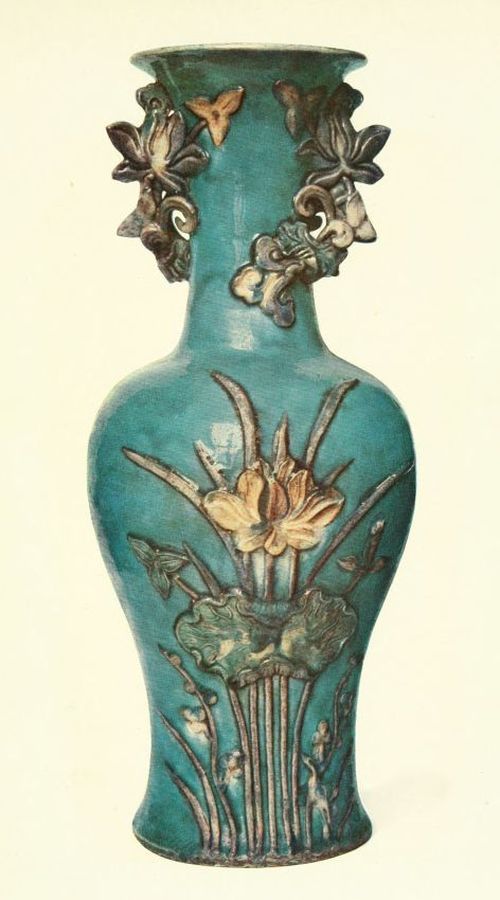
Vase with lotus handles: buff stoneware with lotus design modelled in low relief and coloured with aubergine, green and pale yellow glazes in a deep turquoise ground. About 1500 A. D.
Height 18 inches. Grandidier Collection, Louvre.
A third group is also consistently labelled Ming, but with better reason, though even here a little more elasticity in the dating is advisable. It has an exact parallel in porcelains of undoubted Ming origin, viz. those represented by Plate 61, etc., which usually take the form of jars and vases with designs outlined in fillets of clay, or channelled or even pierced à jour. The spaces between the outlines are filled with coloured glazes which are fired, in the case of porcelain, in the cooler parts of the biscuit kiln. These are the glazes de demi–grand feu, according to the French definition, and they consist of turquoise and aubergine purple or violet and green (the three colours or san ts´ai, all minutely crackled), supplemented by a white formed by slip and a thin brownish yellow. Occasionally the purple is so deep as to appear almost black; and the details of the designs are often etched in the paste with a fine point. Precisely similar wares are found with an earthenware body; and they are, no doubt, contemporary with the analogous porcelains, though how long the traditions of this type of ware continued has never been precisely determined. The porcelain on which washes of turquoise and aubergine glaze are combined is a development of this type, and this has certainly survived to comparatively modern times. Reticulated ornament was used on the three–colour pottery vases no less than on the porcelain (Plate 55); and besides the covered wine jars and vases there are figures and grotto pieces of similar style both in pottery and porcelain, many of which must date from Ming times.
Plate 53 illustrates a beautiful vase in the Eumorfopoulos Collection which belongs to a cognate group. It has a buff stoneware body, the ornament is outlined in relief, and the glazes which fill the outlines are very similar to those of our main group, though some of the colours are more transparent and glassy and wanting in the solidity of the latter. The chrysanthemum handles are a frequent feature of the vases of this class, of which a notable instance is in the Salting Collection. Plate 54 illustrates another vase of similar kind, but with lotus handles, lotus designs, and a fine turquoise ground. Of the same type, but less rare, are certain wide–mouthed jars, bowls, and flower pots with bold floral designs, lotuses, etc., outlined in fillets of clay and filled with the same kinds of glaze, the background now turquoise and now aubergine (Plate 58, Fig. 1). The base is usually washed over with a thin purplish brown. These several types were copied in the Japanese Kishiu pottery in the nineteenth century, and though the copies are rarely difficult to distinguish by the eye alone the Japanese glazes (particularly the aubergine) will be found on handling to have a peculiar moist and rather sticky surface. Though no doubt of Ming origin, it is extremely probable that the manufacture of the Chinese bowls and flower pots of this class continued into the last dynasty.
Fig. 2 of Plate 56 exemplifies another kind of pottery with fine white body like pipeclay, and usually with sharply moulded designs in antique bronze style and in the bronze forms of beakers and four–legged incense burners. The glaze is usually leaf green, but it often breaks out into a frothy grey scum, such as is seen on some of the Canton and Yi–hsing glazed pottery. It is a common practice to label these wares as T´ang, but I am inclined to place them in a much more recent period (seventeenth or eighteenth century), and to locate them among the miscellaneous Kuangtung wares, pending further information on the subject.
There are other specimens with a somewhat similar white and relatively soft body material, not glazed but stained with a brownish black dressing of clay, and somewhat recalling bronze. These are usually vases of elegant, well–moulded form, such as Plate 56, Fig. 3, and they are often marked Nan hsiang t´ang.[425] They are, no doubt, of relatively modern make.
Though it would be easy to suggest many possible places of origin for these wares, such speculation can be of no real value without far more definite evidence than we possess at present. Still, it may serve some useful purpose in the future, if not at once, if we add one or two more records, however meagre, to the existing lists of Chinese potteries. The section of the T´u shu, which is devoted to T´ao kung (the pottery industry), mentions the following factories as of some importance in the Ming dynasty. In the province of Honan, in addition to the well–known potteries of Chün Chou and Ju Chou, we read that there was a factory in the Ju–ning Fu at the village of Ts´ai , which was intermittently active in the first half of the fifteenth century.[426]

From another passage we learn that in the valleys of Ching[427] and the hills of Shu (or Szech´uan) there are black and yellow clays suitable for pottery; that the potters had their kilns in holes in the mountains; and that they used the yellow clay for the body of the ware and overlaid it with the black, making jars, drug pots, cauldrons, pots, dishes, bowls, sacrificial vessels, and the like. They also made one kind of ware which resembled that of Chün Chou.

Specimens of modern pottery in the Field Museum, Chicago, include ornamental wares such as pomegranate–shaped water pots, etc., covered with an oily green glaze recalling some of the Sung types. The body is apparently dark coloured, and shows brown at the edges where the glaze is thin. This ware is made at Ch´êng–tu in Szech´uan.
The geographical annals of the province of Shensi are quoted[428] with reference to potteries in the T´ung–chou Fu as follows: "The inhabitants of Lei–hsiang and Pai–shui[429] are good potters, and the porcelains (tz´ŭ ch´i) which they make are of surpassingly clever workmanship. These are what are commonly called lei kung ch´i (vessels of the Lord of Thunder). Some say that the potteries of Hsiang only began to be active when the original wares had ceased to be made. The village of Lei–hsiang is east of Shên Hsien, and it is the place of the temple of the Hsiang family. The inhabitants of the place sometimes dig up castaway Hsiang wares. Their shape and style are archaic; the colour of the ware is green (lü), deep and dark, but brilliant. One kind has slight ornament in raised clay, but if the hand is passed over it, the surface feels smooth and without perceptible relief or indentation.[430] When compared with the Hsüan,[431] Ko and other wares, it may be said to surpass them." The description in the last part seems to apply to the older wares which preceded those made in the district at the time of writing.
The modern potteries at Yo Chou in Shensi are represented in the Field Museum, Chicago, by a black–painted ware in Tz´ŭ Chou style, by a greyish white ware with sketchy blue designs, and by a black slag–like earthenware which is extremely light to handle. It is also suggested that a well known type of pottery, painted with free floral designs in black and white on a creamy glaze which is stained a pinkish brown colour, is an earlier product of the same potteries.
The potteries at Ch´ü–yang Hsien in the Chên–ting Fu, in Chihli, are mentioned[432] in the administrative records of the Ming dynasty in the Hsüan Tê period, and again under the dates 1553 and 1563, as supplying wine jars and vases for the Court. This place is only a few miles east of Ting Chou, which was celebrated for its white wares in the Sung period, and these references carry the record of the industry in that district to the last part of the Ming dynasty. Unfortunately, nothing is said of the nature of the wares made at this time for the Court.

Reference is made elsewhere (p. 202) to the potteries at Wu–ch´ing Hsien, in the Peking district. Possibly these are the potteries described, by Bushell[433] as still active in modern times. "The ordinary glaze," he remarks, "is a reddish brown of marked iridescence, shining with an infinity of metallic specks, an effective background to the moulded decoration which covers the surface. The designs are generally of hieratic character."
The "sun–stone" glazes made at the Rookwood Potteries (Cincinnati, Ohio, U.S.A.) and on the Lancastrian wares[434] are of this kind, the infinity of metallic specks being due to "super–saturation" of the glaze with iron oxide. A specimen of this modern Peking ware may be seen in the British Museum.
The tile works at Liu–li–chü, near Peking, date back to the Yüan dynasty, and their modern productions as represented in the Field Museum include a pottery with incised designs filled in with yellow, green, and dark aubergine glazes, not unlike in style to the Japanese Sanuki ware. Another type has forms taken from bronzes and is distinguished by a shining green glaze.
In the province of Shantung, besides the tile works at Lin–ch´ing,[435] the important, potteries at Yen–shên Chên in the Ch´ing–chou Fu are noticed[436] as follows: "The inhabitants have inherited from their ancestors the art of making good pottery. The usual wares are cisterns (kang), jars (ying), cauldrons (fu), and such–like pottery (fou), made without flaw. The profit to the people is not less than that made at Ching–tê Chên on the right bank of the Yangtze." Yen–shên Chên is quite close to Po–shan Hsien, and no doubt the industry at the two places is intimately connected. The latter, which is noted to this day for its manufactures of pottery and glass, has already been mentioned[437] more than once.

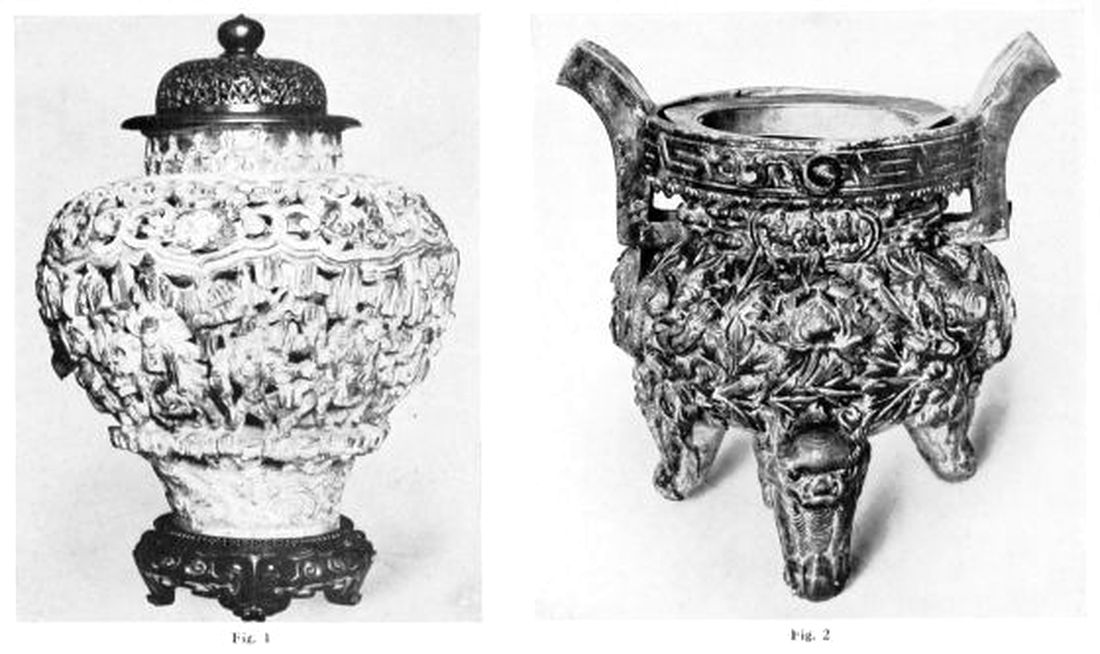
Plate 55.—Ming Pottery with dull san ts´ai glazes.
Fig. 1.—Wine Jar with pierced outer casing, horsemen and attendants, rocky background. Fifteenth century. Total height 19 1/2 inches. Eumorfopoulos Collection. Fig. 2.—Tripod Incense Vase, dragons and peony designs and a panel of horsemen. Dated 1529 A. D. Height 22 inches. Messel Collection.
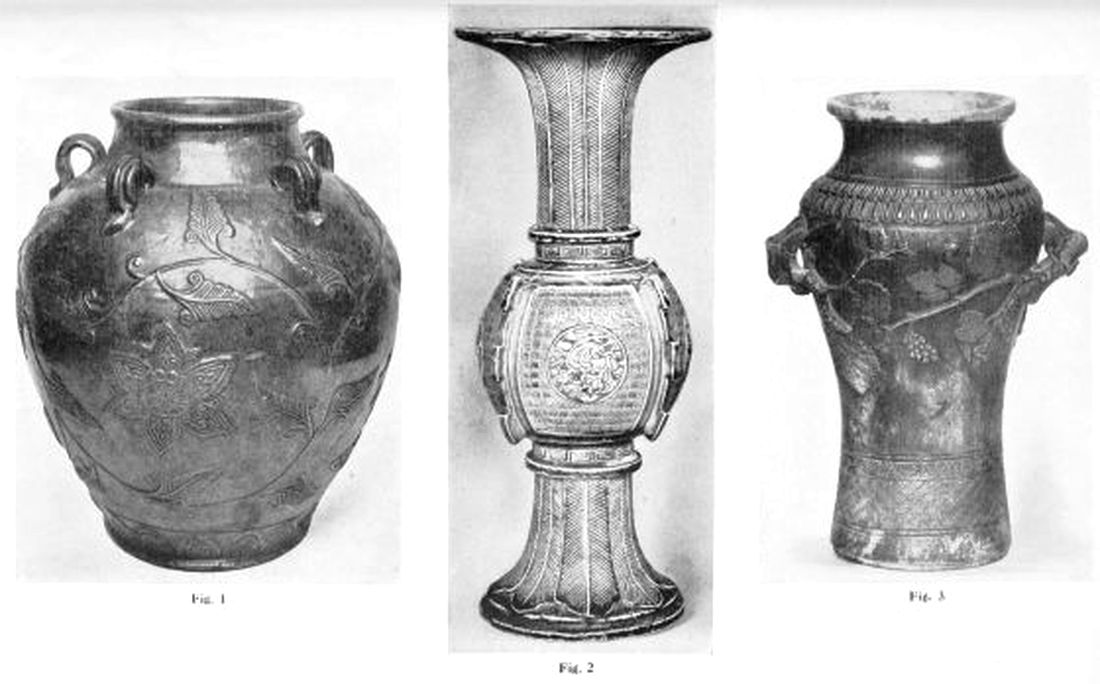
Plate 56.—Miscellaneous Pottery.
Fig. 1—Jar with dull green glaze and formal lotus scroll in relief touched with yellow and brown glazes. About 1600. Height 12 inches. Guff Collection. Fig. 2—Beaker of bronze form, soft whitish body and dull green glaze. (?) Seventeenth century. Height 16 1/2 inches. Eumorfopoulos Collection. Fig. 3.—vase of light buff ware with dull black dressing, vine reliefs. Mark, Nan hsiang t´ang (see p. 219). Eighteenth century. Height 11 1/2 inches. Eumorfopoulos Collection.
At Yi–chên in the Yang–chou Fu, in Kiangsu, there were factories which supplied wine jars, etc., to the palace at Nanking in the early years of the Ming dynasty; and in the seventh year of Chia Ching (1528) supplies of similar vessels were sent from Ning–kuo Fu in the south–west of Anhui.[438] The latter place is mentioned elsewhere[439] under its earlier name of Hsüan Chou as producing a thin white ware made of "plastic clay" in the Yüan and Ming periods. A verse of Wang Shih–chêng (1526–1593) speaks of the "snow white porcelain of Hsüan Chou."[440] The T´ao lu enumerates factories which began in the Ming dynasty and continued to the nineteenth century, and apparently produced an inferior type of porcelain, and probably pottery as well. They were located at Huai–ch´ing Fu , I–yang Hsien , Têng–fêng Hsien , and Shan Chou in Honan; at Yi Hsien and Tsou Hsien in Yen–chou Fu in Shantung; in the Lung Shang district in Shensi, and at Hêng–fêng in Kiangsi. The last–mentioned factory was established by a man named Ch´ü Chih–kao from Ch´u–chou Fu in the early Ming period. In the Chia Ching period (1522–1566) it was transferred to the I–yang district to a place called Ma–k´êng, not many miles south of Ching–tê Chên. Both the Lung–shang and Ma–k´êng wares are described as very coarse.


The value of pottery for architectural purposes was recognised in China from the earliest times. Unglazed bricks and tiles of Han and pre–Han periods are preserved by Chinese collectors, particularly when they happen, as is often the case, to have inscriptions in old seal characters, or other ornament. The familiar Chinese roof tile is a long convex object like a horizontal section of a tube, and those intended for the border are ornamented at one end with a disc, usually stamped with a dragon or other design in sunk relief. Here and there, on the apex of the roof or at the corners, are ornamental tiles carrying figures of deities, heroes, mythical creatures or birds, modelled in the round and usually with great force and skill. Besides these, architectural mouldings and antefixal ornaments in pottery are commonly used on temples and pavilions of an ornamental kind.
The use of tiles—and, no doubt, of other architectural embellishments in pottery—was encouraged by government enactments at various times. In the T´ang dynasty (618–906 A. D.),[441] in the districts south and west of the Yangtze, under the inspectorship of a man named Tan , the inhabitants were ordered to use tiles on their houses in place of wood in order to lessen the risk of fire; kilns were erected to provide the tiles, and those who were too poor to carry out the alterations by themselves received State help. A somewhat similar but more important edict was issued in the twenty–seventh year of Hung Wu[442] (1394), that bricks and tiles should be used in all the buildings in the capital, which was then Nanking, and that kilns should be set up every year on the Chü–pao shan for their manufacture. It was not long after this that the famous "porcelain pagoda" was erected at Nanking,[443] the lower part of which was faced with white porcelain bricks, the remaining storeys with pottery with coloured glazes.

Tile factories existed in all parts of China to supply local needs, and the few singled out for mention in the T´u Shu[444] were perhaps of more than usual importance in the Ming dynasty. They are Lin–ch´ing in the extreme west of Shantung; Su Chou in Kiangsu, on the east side of the lake T´ai–hu, and facing the potteries of Yi–hsing, which supplied tiles for the palaces and temples of Nanking; the neighbouring Ch´ang–chou Chên, and Yi–chên and Kua Chou in the Yang–chou Fu of the same province; Wu–Ch´ing Hsien , in the district of Peking, where the potters asked for permission to make tiles for public use in 1574.


The tile works at Liu–li–chü (mentioned on p. 200) date from the Yüan dynasty. They are also situated in the neighbourhood of Peking, but whether in the Wu–ch´ing Hsien or not, I have failed to discover.
When Peking became the capital of the Ch´ing emperors, no doubt the tile factories at Wu–ch´ing Hsien assumed still greater importance; and according to the catalogue of the exhibition in Paris in 1878,[445] the neighbourhood of Amoy was then celebrated for its bricks and tiles. This branch of the potter's industry is represented by a small collection of bricks, tiles, mouldings, and antefixal ornaments in the British Museum. It includes unglazed bricks from the Great Wall of China, which may date from 220 B. C., a few Han bricks and tile–ends with moulded ornament; white porcelain bricks and coloured pottery tiles and mouldings from the Nanking pagoda; and tiles from the Ming tombs near Nanking, which were built in 1400 A. D., and like the pagoda destroyed in the T´aip´ing rebellion in 1853. The Nanking tiles and mouldings are of hard buff pottery with translucent glazes of green and yellow colour, minutely crackled, additional colours being formed with red and creamy white slips. The tile–ends are ornamented with dragon medallions.
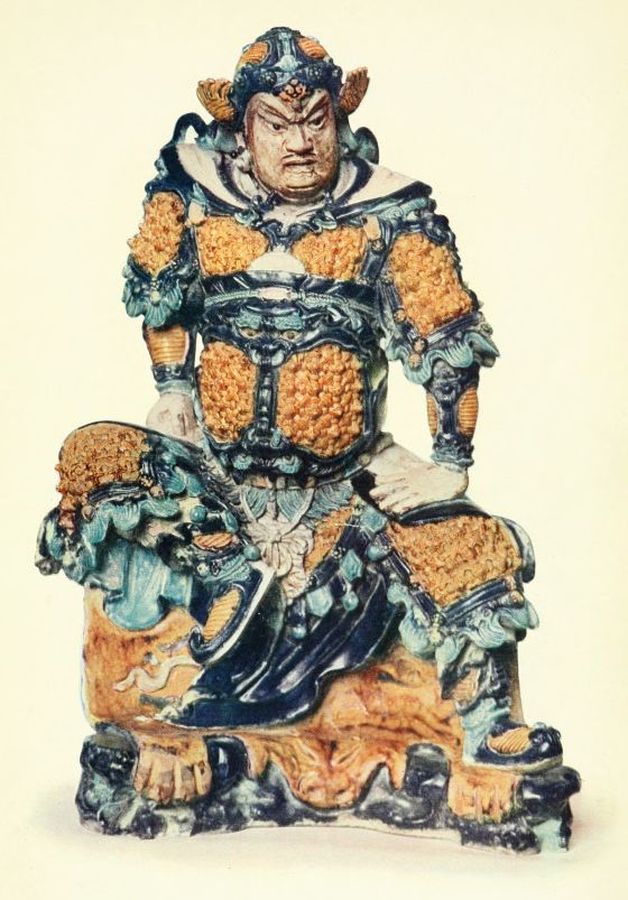
PLATE 57
Seated figure of Kuan Yü, the war–god of China, a deified warrior. Reddish buff pottery with blue, yellow and turquoise glazes, and a colourless glaze on the white parts. Sixteenth century.
Height 20 3/8 inches. Eumorfopoulos Collection.
Other architectural pottery in the same collection came from the Imperial pleasure grounds at Peking, which were wrecked in 1860. These include tiles and antefixal ornaments from the pavilions and temples in the Yüan Ming Yüan and from the Summer Palace, and a few blue–glazed tiles from the Temple of Heaven. Numerous tiles with relief figures and pottery figures from niches were picked up in the ruins of the temples and pavilions in the Imperial grounds after their capture in 1860; and many of the mouldings were found to display strong European influences, due, no doubt, to the designs of the Jesuits Attiret and Castiglione, who assisted the Emperor Ch´ien Lung in erecting some of the buildings. Some of these are in the British Museum besides antefixes in the form of yellow dragon heads from the Winter Palace at Peking and from the celebrated Temple of Kin–shan, or Golden Island, in the Yangtze; and a tile from the Huang–ssŭ, the Great Lama temple, built by K´ang Hsi in 1647. The tile in question is evidently part of a restoration, for it bears the date corresponding to 1770.
The ordinary tiles and mouldings are not likely to be extensively collected by private individuals, but many of the ridge tiles, with figures of deities, horsemen, lions, ch´i–lin, and phœnixes, have found their way into collections to which their spirited modelling has served as a passport. The glazes on these are often richly coloured, and include yellow, green, violet purple, aubergine and purplish black, and occasionally high–fired glazes with flambé or variegated colours. By accident or design, the figures are not infrequently detached from their tiles and mounted on wooden stands. The pottery figures from niches in the walls of temples and public buildings are often finely modelled and richly glazed, and, needless to say, they find a welcome in Western collections (Plate 58).
It is a common but illogical practice to assign all these figures in architectural pottery to the Ming dynasty; illogical, because so many of them have been brought from the Imperial buildings at Peking which are known to have been mostly erected in the K´ang Hsi and Ch´ien Lung period. On the other hand, nothing is more difficult to date than this type of glazed pottery, in which the ware, the colours, and the decorative traditions seem to have continued almost unchanged from the early Ming times to the present day. The tiles from the Nanking pagoda and from the eighteenth–century buildings at Peking are practically interchangeable.
Nor must we forget that the potters who made the architectural pottery often turned their hands and materials to the manufacture of vases and figures and other ceramic ornaments for domestic use, and even imposing altar sets for the temples. An important example of this work is seen in Fig. 2 of Plate 55, a large incense vase[446] of traditional form (from an altar set) with bowl–shaped body, wide mouth, two upstanding handles, and three feet with lion masks. It is ornamented with a peony scroll and two dragons in high relief, and is made of pottery with a dull turquoise green glaze. An inscription on the handles proclaims the fact that it was "dedicated by the chieftain Kuo Hsin–shê; made in the eighth year of Chia Ching," i.e. 1529. In more recent times the tile works near Peking have turned their attention to the manufacture of vases and bowls with rich soft monochrome glazes, yellow, green, turquoise and aubergine in the manner of the similarly coloured porcelains which are highly prized, and, as Bushell tells us, "the soft excipient (i.e. the pottery body) seems to impart an added softness" to the glazes. "The fact that yellow clay," he continues, "used often to be mixed with the porcelain earth in the old fabrics to enhance the brilliancy of the glaze colours, gives a certain vraisemblance to the fraudulent reproductions which I have seen sold for as many dollars as they would cost in cents to produce." It is unlikely that the issue of these by–products of the tile factories is confined to the neighbourhood of Peking. Among the miscellaneous potteries I should add that Ka–shan,[447] in Chekiang, is reputed to have been noted in the seventeenth and eighteenth centuries for a fine porcellanous stoneware with opaque, camellia–leaf green glaze minutely crackled.
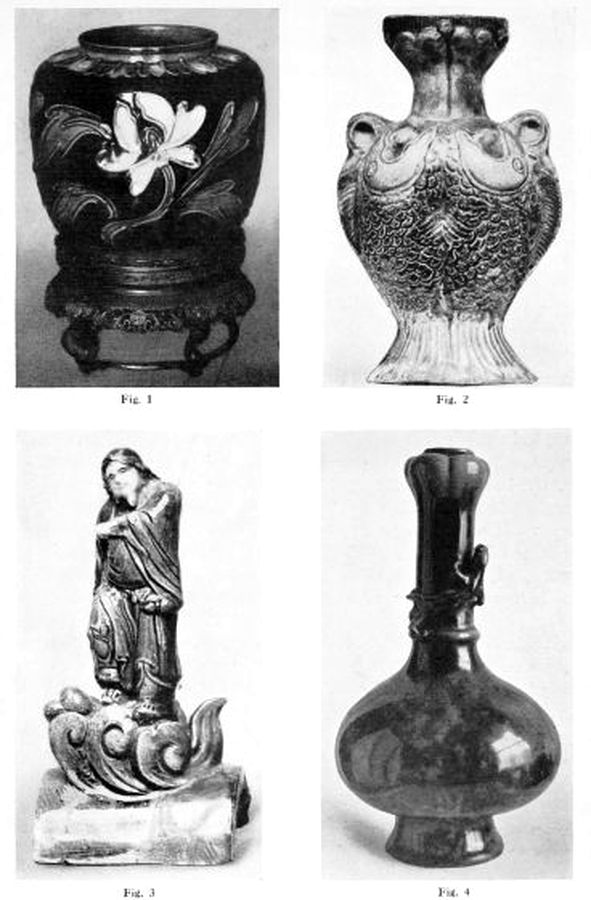
Plate 58.—Miscellaneous Pottery.
Fig. 1.—Jar with lotus design in green, yellow and turquoise glazes in an aubergine ground. About 1600. Height 6 1/2 inches. Hippisley Collection. Fig. 2.—Vase of double fish form, buff ware with turquoise, yellow and aubergine glazes. (?) Seventeenth century. Height 5 3/4 inches. British Museum. Fig. 3.—Roof–tile with figure of Bodhidharma, deep green and creamy white glazes. Sixteenth century. Height 10 7/8 inches. Benson Collection. Fig. 4.—Bottle with archaic dragon (ch´ih lung) on neck, variegated glaze of lavender, blue and green clouded with purple and brown. (?) Eighteenth century Yi–hsing ware. Height 10 inches. Peters Collection.