Chapter XIII
Reading edition
THE YÜAN DYNASTY, 1280–1367 A.D.

THE Yüan dynasty, which lasted from 1280 to 1367, was established by Kublai Khan, grandson of the great Mongol conqueror, Genghis Khan. The Mongols completely subjugated China, and though their rule was comparatively brief, it had a disastrous effect on the artistic development of the country. The Mongol governors whose services to the reigning house had been rewarded by all the lucrative posts, made full use of their opportunities to enrich themselves by extortion and oppression. Trade and industry were convenient subjects for their exactions, and these consequently languished. The ceramic industry was among the sufferers, and many of the old potteries were closed down in this troubled period. The potteries at Ching–tê Chên, which had gradually risen to a position of great importance in the Sung dynasty, suffered for this eminence by being brought under the immediate care of a Mongol commissioner, and much of their trade passed into the hands of manufacturers in Kiangsi and Fukien.[340] The earliest account[341] which we have of the industry in this important centre, written at the beginning of the fourteenth century, ends with a bitter cry against the depredations of the governors and the subordinate officials, who were banded together to rob the people, and against whom no redress could be obtained. Dr. Bushell published a translation of the chief part of it in Oriental Ceramic Art,[342] and apart from the sorrowful picture which it draws it gives a good idea of the productions of the district in the Yüan dynasty. A short notice in the T´ao lu gives a slightly different impression, and leads us to suppose that the heavy hand of the Mongol officials was felt chiefly at the Imperial potteries, while the private factories were comparatively flourishing and even supplied some of the wares required by the Court.
We learn from the Memoirs of Chiang that a variety of porcelains were made to meet the tastes of the different regions of Southern China. The market in Northern China does not seem as yet to have been studied. Thus, while the kilns at Hu–t´ien,[343] on the river bank opposite to Ching–tê Chên, supplied a brownish yellow[344] ware which was popular in the province of Chêkiang, the greenish white[345] porcelain of Ching–tê Chên found a profitable market in Hunan and Hupeh, Szechuan, and Kuangtung. The inhabitants of Kiangsu and Anhui seem to have been less critical, for the inferior wares known as "yellow stuff" (huang liao), which did not sell in Kiangsi, Kiangnan, Kuangtung, Fukien, and Chêkiang, was foisted on them.
The finest porcelain was made of the stone (shih) from Chin–kêng, while stone and earth from other neighbouring sites were used for mixing in the inferior wares and for making seggars[346] and moulds. The glaze was made of "glaze earth" from Ling–pei mixed with the ashes of brushwood from the Yu–shan hills which had been burnt with lime and persimmon wood. I mention these technical details because their similarity with the description of the manufacture in the eighteenth century show that the method of porcelain making at both periods was essentially the same. The decoration was effected by stamping or pressing in moulds, by painting or by carving[347]; and the ware was fired either upright or inverted.
Some idea of the forms and ornament of these wares may be gathered from another passage which would be far more illuminating if the fanciful names used were less difficult to understand. Bushell has boldly translated them according to his ideas, and I quote his renderings in inverted commas and in the pious hope that they may be correct, giving at the same time the original characters.
There were bowls (wan), with high feet and with fish and water ornament; platters (t´ieh) with "glazes shaded in different tones,"[348] sea eyes, and snow flowers[349]; dishes (p´an) of the horse hoof and betel–nut kinds, the latter suggesting a brownish red colour; large bowls (yü) with lotus ornament (or shaped like a lotus flower), or of "square form with indented corners"[350]; bowls and platters (wan t´ieh) with painted decoration,[351] with silver designs,[352] with "fluted sides,"[353] and with "encircling strings."[354] Such wares as these had a profitable market in Chêkiang, Kiangnan, Kiangsi and Fukien.
There were besides incense burners of many forms, most of which were modelled after bronzes, e.g. those shaped like the fabulous beast i, "which eats tigers and can go five hundred li at a bound"[355]; those like the bronze incense burners on three or four feet (ting), like the cups used in the ancestral temple (i), like the large iron cauldrons (li). Others had elephant legs, and others were shaped like incense caskets or barrels. The vase forms include the goblet (ku),[356] the gall–bladder (tan), the wine pot (hu) with spout and handle, the Buddhist washing vessel (ching), the gardenia (chih tzŭ), the lotus leaf (ho yeh), the gourd (hu lu), musical pipes (lü kuan), vessels with ring–and–mask handles shou huan,[357] and glass (liu li) forms.
The Ko ku yao lun, which was written about sixty years later than the publication of the Memoirs of Chiang, supplements this information in a short paragraph on "Old Jao Chou wares." "Of the Yüan wares," it says,[358] "those with small foot and moulded ornament (yin hua), and the specimens inscribed inside with the characters shu fu[359] are highly valued. The recently made wares with large foot and plain white (su) glaze are wanting in brilliancy (jun). There are also green (ch´ing) wares and those with enamelled (wu sê)[360] ornament, and they are very common. Of the modern (i.e. beginning of the Ming dynasty) wares good specimens with white colour and lustrous material are very highly valued. There are besides dark green[361] wares with gilt ornament. They are chiefly wine pots and wine cups, which are very lovely."
The T´ao lu has a paragraph on the shu fu wares which reflects (not always very clearly) these earlier accounts, adding that "this is the ware made in the private (min) factories and supplied to the palace; the material had to be fine, white and unctuous clay, and thin specimens were preferred.... Inside them were written the characters shu fu as a mark. At the time the private factories also issued imitations of these wares; but of the porcelains destined for the Emperor ten out of a thousand, one out of a hundred, only were selected. The private factories were unable to achieve uniform success." The author has inserted the gilt and enamelled,[362] and a large number of the other wares mentioned in the Memoirs of Chiang and the Ko ku yao lun in that irresponsible fashion which makes much of the Chinese ceramic literature exceedingly difficult to handle. Indeed, one is tempted to ask what was his authority for the statement that the "private factories" made the shu fu ware, in spite of the very circumstantial tone of the passage.
It is clear that the best of the Yüan wares made at Ching–tê Chên was plain white or white with engraved and moulded designs; and in this connection it is interesting to find an example of shu fu porcelain described and illustrated in Hsiang's Album.[363] It is a small, bottle–shaped vase with bulbous mouth, engraved with a dragon and cloud design, and stated to be marked with the characters shu fu under the base. We are told that in colour, form, and design it was copied from a specimen of the Northern Ting ware, and that the shu fu ware, itself copied from Ting Chou originals, served as a model for the fine white engraved porcelains of the Yung Lo and Hsüan Tê periods of the Ming dynasty. It stood, in short, midway between the soft, opaque–looking, creamy white Sung ware and the thin, hard, and highly translucent Ming porcelain, such as the white Yung Lo bowl in the Franks Collection (see Plate 59). Just such an intermediate position as this is held by a bowl[364] in the British Museum with white, translucent body, soft–looking glaze of faint creamy tinge and engraved design of phœnixes and peony plants in Sung style. It has, moreover, a raw mouth rim which shows that it was fired inverted, and as there is no shu fu mark it may well have been one of the copies of the Palace types which the T´ao lu informs us were made at the private factories.
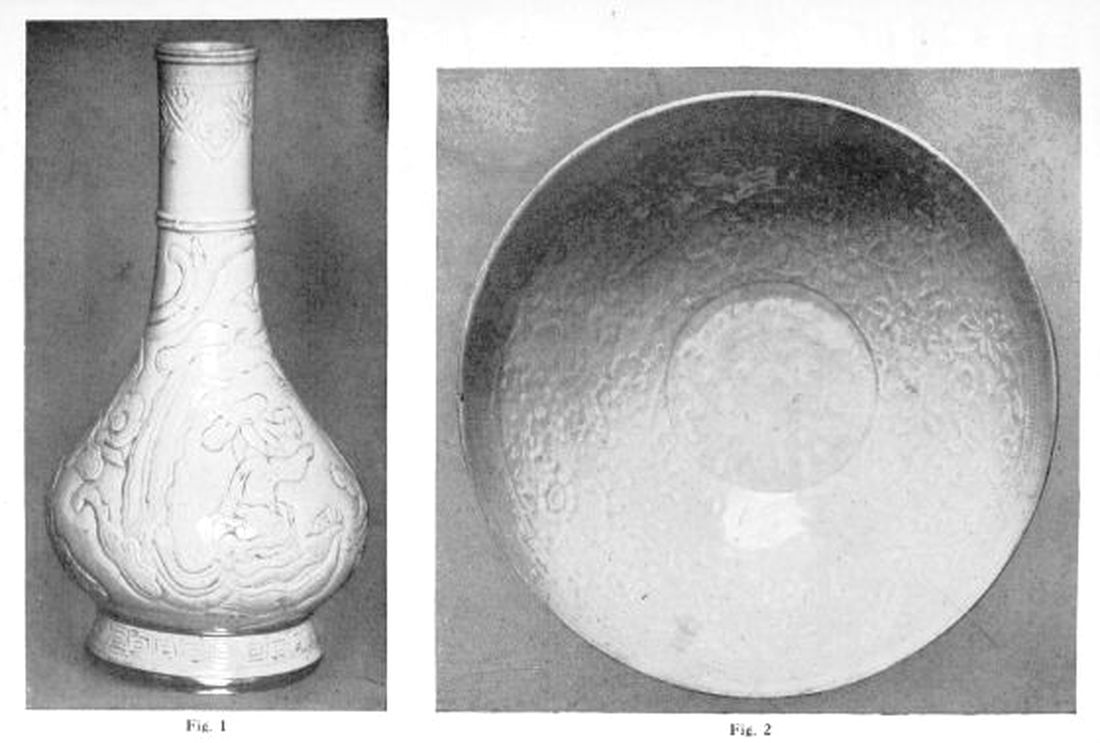
Plate 46.—Ting Ware and Yüan Porcelain.
Fig.1.—Bottle with carved reliefs of archaic dragons and ling chih funguses. Fèn ting ware, said to be Sung dynasty. Height 8 3/4 inches.
Fig. 2.—Bowl with moulded floral designs in low relief, unglazed rim. Translucent porcelain, probably Yüan dynasty. Diameter 8 inches. Eumorfopoulos Collection.
It is always difficult to determine the age of plain white wares, but among the archaic specimens of translucent porcelain with creamy white glaze and rough finish at the base which have come from China in recent years under the varying descriptions of Sung, Yüan and early Ming, there are, no doubt, several examples of the Yüan wares of Ching–tê Chên (see Plate 46, Fig. 2).
The mention, in the Memoirs of Chiang and the Ko ku yao lun, of painted decoration, enamelled ornament, silvering, and gilding, though apparently but crudely used and little appreciated, is nevertheless of great interest from the historical standpoint.
The potteries at Hu–t´ien which are mentioned in the Memoirs of Chiang (see p. 160) were only separated from Ching–tê Chên by the width of the river. They are described in the T´ao lu[365] as active at the beginning of the Yüan dynasty and producing a ware which, though of coarse grain, had "a considerable amount of antique elegance," and appealed to the taste of the inhabitants of the Chêkiang. The clay was hard and tough, and the colour of the ware brownish yellow[366] as a rule, but even when of a "watery white" tone it was tinged with the same brown colour. At the end of the eighteenth century all trace of the factories had disappeared, though the village still existed[367] and the old wares were still to be found.
Brinkley, who seems to have met with examples of the ware in Japan, describes it as follows[368]: "The pâte is thick and dense, without any of the delicacy of porcelain, and the glaze is muddy yellow.... The surface of the pieces is generally relieved by deeply incised designs of somewhat archaic character, figure subjects being most common. Some examples are preserved in Japanese collections, where they are known as Ningyo–de (figure subject variety) in allusion to the nature of the incised designs." In spite of its apparent roughness it was thought worthy of imitation at Ching–tê Chên in the Ming dynasty.[369]
Among the causes to which was attributed the lack of prosperity at Ching–tê Chên in the Yüan period, the Memoirs of Chiang includes (1) the uncertainty of the season on which the opening of the factory partly depended, (2) the intolerable taxation and the exactions of officials, and (3) the competition of the potteries at Lin–ch´uan, Nan–fêng Hsien, and Chien–yang, all of which, as Bushell indicates, lay on the trade route between Ching–tê Chên and south–eastern coast towns.
Of these we learn in the T´ao lu that Lin–ch´uan[370] in the Fu–chou Fu in Kiangsi (not far south of Ching–tê Chên) made a ware of fine clay and thin substance, the colour of which was mostly white with a slight yellowish tinge, and that some of the pieces were coarsely ornamented, though we are not informed how the ornament was applied. The same authority informs us that Nang–fêng Hsien[371] in the Chien–yang Fu (also in Kiangsi) made a ware of refined clay but somewhat thick substance, which was, as a rule, decorated with blue designs (ch´ing hua), though some had the colour of the t´u ting ware, i.e. the coarser and yellower variety of Ting Chou porcelain.
From this passage it appears that "blue and white" may be added to the types of ware made in the Yüan period.
The third factory, at Chien–yang in Fukien, has already been discussed at some length. It was chiefly celebrated for the dark–coloured wares (wu–ni yao) and the "hare's fur" and "partridge" tea bowls.[372]
These names by no means exhaust the list of factories which were active in the Yüan period. Others have been incidentally mentioned elsewhere under the headings of Yüan–tz´ŭ, P´êng ware, Hsin Ting ware, etc.[373]
The Ko ku yao lun enumerates certain pottery forms which, it asserts, were not in use before the Yüan period. As usual, the Chinese descriptions are exceedingly difficult to visualise, and in many cases are open to several interpretations, and are not easy to reconcile with established facts. However, I quote the passage as it stands: "Men of old when they drank tea used p'ieh[374] (? bowls with curved sides), which were easy to drain and did not retain the sediment. For drinking wine they used cups (chan); they had not yet tried cups with handles (pa chan[375]), and in old times they had no ch'üan p'an.[376] The Ting ware ch'üan p'an which one sees nowadays are the brush washers (hsi) of olden times. The men of old used 'decoction vases' for pouring wine, and did not use ewers (hu p'ing) or bowls with contracted lip or tea cups (ch'a chung) or dishes with rims.[377] These were all forms used by the Mongols. The men of China only began to use them in the Yüan dynasty. They never appear in old Ting or Kuan wares."[378]