Chapter XVII
Reading edition
MARKS ON CHINESE POTTERY AND PORCELAIN
THE custom of placing on works of art the name of the maker, the date of manufacture, or some sign or symbol indicating the intention with which they were made, dates back in China at least as far as the Han dynasty. Such marks occur on pottery and porcelain rarely at first, but with a frequency which increases in proportion as we draw nearer to modern times. They are incised or stamped in the soft body of the ware, or painted under the glaze (usually in blue) or over it in enamel colours or gold; and they are generally placed on the base of the ware, though there are fairly numerous instances in which the mark is written along the mouth rim or in some other more or less conspicuous position.
The earliest marks, as far as I am aware, are incised, and those on the Han, T´ang, and Sung potteries, not to mention the intermediate dynasties, should be scrutinised with the greatest care to make sure whether the incisions were made before the pottery was baked or afterwards. There should be no difficulty in determining this point, for the lines cut with a sharp instrument in the fired ware are necessarily harder and less free than those incised in the soft clay, and the edges of the incisions will present obvious differences in the two cases. Unfortunately the early date–marks which I have seen up to the present have almost all been cut after the firing. It does not necessarily follow that such inscriptions are modern additions. Indeed in many cases they are in a style which is clearly old. But their value as evidence is very small, for it is impossible to prove the exact time of their carving; and at best we can only regard them as representing the opinion of some former owner as to the date of the vessel in question. At their worst, they are deliberate frauds added by modern vendors with intent to deceive.
Incised or stamped marks have always been common on pottery, but porcelain is usually marked by painting with a brush, and for this purpose underglaze blue is the commonest medium, red and other on–glaze colours being used chiefly on the relatively modern wares decorated in famille rose enamels. Similarly the ordinary script is usual in marks, and seal characters are quite exceptional on porcelain earlier than the eighteenth century.
It is not safe to take the older date–marks on porcelain at their face value. The Chinese with their proverbial veneration for antiquity habitually placed the date–marks of the classical reigns on their porcelain whether decorated in the style of the period mentioned or not. Already in the sixteenth century the Hsüan Tê and Ch'êng Hua marks were used in this way, and in the K'ang Hsi period the names of these two classic reigns were used more frequently than that of the K'ang Hsi period itself. In fact the Hsüan Tê and Ch'êng Hua are on the whole the most familiar marks of all, though the actual wares of these two periods are among the rarest. The date–marks of the other Ming Emperors are less frequently plagiarised, except upon the deliberate imitations of the wares of the time, such as those made at the Imperial factory in the Yung Chêng period, which we may be sure were carefully marked with the appropriate nien hao. Moreover, the Japanese, who have expended much ingenuity on reproducing Ming wares, have made free with Ming date–marks, especially those of Chia Ching and Wan Li.
In the year 1677 the potters at Ching–tê Chên were forbidden by an order of the district prefect[448] to inscribe the period–name of the Emperor or any sacred writing on their porcelain, lest the names should be profaned in the breaking of the ware. It is certain that this prohibition was not effective for long; but probably the current date–mark was suppressed for a time at least, and it is quite likely that we should trace to this interval the custom of putting symbols or conventional marks inside the double ring which was usually occupied by the nien hao, a common practice in the K'ang Hsi period. In many cases, too, the rings were left empty; but it is a mistake to regard this as an infallible sign of K'ang Hsi manufacture, for it is a thing which might happen at any time through negligence, the rings being made by one person and the marks written by another. There are, besides, well authenticated instances of the empty double ring on Wan Li porcelain,[449] and on post K'ang Hsi wares. It was, however, such a frequent occurrence on the K'ang Hsi wares that the modern imitators make a common practice of leaving the rings blank on their copies of the K'ang Hsi blue and white. It is not clear whether the prefect's prohibition applied to the names of Ming emperors, but probably it did not, as it is unlikely that the adherents of the reigning dynasty would be sensitive about the titles of the house which they had exterminated. In any case, Ming marks, especially those of the fifteenth century, are very common on the K'ang Hsi porcelain, and the K'ang Hsi mark itself is comparatively rare except on the specimens which must belong to the later years of the reign.
En revanche, the K'ang Hsi mark is freely used on quite modern wares, that period being now regarded as classical; so that we are confronted with the paradox that if a specimen of fine quality[450] is marked Ch'êng Hua, it may generally be assumed that it was made in the K'ang Hsi period, while the bulk of the pieces which bear the K'ang Hsi mark are of modern date.
The Yung Chêng and Ch'ien Lung porcelains are highly esteemed to–day, and consequently the marks of these periods are considered worthy of a place on modern imitations; but on the whole the bulk of the specimens bearing these marks will be found to belong to the period indicated, and the imitations are generally so coarse as to be unmistakable. The temptation to borrow the reign marks of the subsequent periods is so slight that we may safely accept the later marks as correct indications of date.
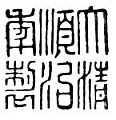
Marks written in enamel colours and even in gold become increasingly common on the famille rose porcelains from the Yung Chêng period onwards, the red mark being more familiar on the modern wares than the blue; and seal characters frequently replace the ordinary script in the reign marks of the Yung Chêng and subsequent periods. Date marks in seal form before the eighteenth century are very unusual, and should be regarded with suspicion.
It will be seen from the foregoing notes that Chinese date marks must be treated with great caution. In fact it is safer to regard them merely as secondary evidence, first basing one's judgment on the paste and glaze, the style of decoration and the quality of the colours. The one exception to this declaration of unfaith is the marks on the Imperial porcelain. These would naturally be correct and reliable, except where deliberate imitations of the older wares were undertaken; and then, no doubt, the mark of the period imitated would be used to make the illusion complete. The Imperial marks were the work of calligraphers who were selected for the purpose, and the writing is careful and in good style. In fact a well–written mark is almost as certain a sign of Imperial ware as the five–clawed dragon itself.[451]
At the private factories the marks were often carelessly, even illegibly, written, and probably little trouble was taken with this part of the decoration except on the choicer specimens. On a large proportion of the private wares the mark was omitted altogether.
The marks on Chinese pottery and porcelain may be conveniently grouped under the following headings:—
(1) Date marks.
(2) Hall marks.
(3) Potters' names and factory marks.
(4) Marks of dedication, felicitation, commendation, etc.
(1) Date marks.
The date marks conform to the two Chinese systems of chronology, (a) the cyclical and (b) the reign names of the Emperors.
(a) The system by which the years are divided into cycles of sixty, each year of the cycle having a name, carries back Chinese chronology to the year 2637 B. C., from which the first cycle is dated. We are at present in the 76th cycle.
The year names are composed of two characters, the first being one of the Ten Stems, and the second one of the Twelve Branches; and as the stems and the branches are taken in strict rotation, it is clear that the combinations will not be exhausted until sixty have been formed, that number being the least common multiple of ten and twelve.
The Ten Stems Shih kan are as follows:—

1 chia corresponding to the element mu = wood.


2 i

3 ping corresponding to the element huo = fire.


4 ting

5 wu or mou corresponding to the element t´u = earth.


6 chi

7 kêng corresponding to the element chin = metal.


8 hsin

9 jên corresponding to the element shui = water.


10 kuei

The Twelve Branches shih êrh chih, which correspond to the twelve animals of the zodiac, and through them to the twelve divisions of the day are as follows:—

Appertaining to the sign of the Corresponding to
1 tzŭ rat Aries 11–1 a.m. N.

2 ch´ou ox Taurus 1–3 a.m. N.N.E. 3/4E.

3 yin tiger Gemini 3–5 a.m. E.N.E. 3/4N.

4 mao hare Cancer 5–7 a.m. E.

5 ch´ên dragon Leo 7–9 a.m. E.S.E. 3/4S.

6 ssŭ serpent Virgo 9–11 a.m. S.S.E. 3/4E.

7 wu horse Libra 11 a.m.–1 p.m. S.

8 wei sheep Scorpio 1–3 a.m. S.S.W. 3/4W.

9 shên monkey Sagittarius 3–5 a.m. W.S.W. 3/4W.

10 yu cock Capricornus 5–7 a.m. W.

11 hsü dog Aquarius 7–9 a.m. W.N.W. 3/4N.

12 hai boar Pisces 9–11 a.m. N.N.W. 3/4W.

The table of cycles subsequent to the Christian era,[452] i.e. cycles 45–76, dating from 4–1928 A. D., will be useful in calculating the year of the cyclical dates with the help of the accompanying table of numerals:—
(a) (b) (c)
1 i or



2 êrh "



3 san "



4 ssŭ


5 wu


6 liu


7 ch´i


8 pa


9 chiu


10 shih or



(a) is the normal form; (b) is commonly used for accounts; (c) is used on drafts, pawntickets, etc.
TABLE OF CYCLICAL DATES FROM A.D. 4
CYCLE BEGINNING
Cyclical Signs 4 64
304 364 124 184 244
604 664 424 484 544
904 964 724 784 844
1204 1264 1024 1084 1144
1504 1564 1324 1384 1444
1804 1864 1624 1684 1744
04 64 24 84 44

05 65 25 85 45

06 66 26 86 46

07 67 27 87 47

08 68 28 88 48

09 69 29 89 49

10 70 30 90 50

11 71 31 91 51

12 72 32 92 52

13 73 33 93 53

14 74 34 94 54

15 75 35 95 55

16 76 36 96 56

17 77 37 97 57

18 78 38 98 58

19 79 39 99 59

20 80 40 100 60

21 81 41 101 61

22 82 42 102 62

23 83 43 103 63

24 84 44 104 64

25 85 45 105 65

26 86 46 106 66

27 87 47 107 67

28 88 48 108 68

29 89 49 109 69

30 90 50 110 70

31 91 51 111 71

32 92 52 112 72

33 93 53 113 73

34 94 54 14 74

35 95 55 15 75

36 96 56 16 76

37 97 57 17 77

38 98 58 18 78

39 99 59 19 79

40 100 60 20 80

41 101 61 21 81

42 102 62 22 82

43 103 63 23 83

44 104 64 24 84

45 105 65 25 85

46 106 66 26 86

47 107 67 27 87

48 108 68 28 88

49 109 69 29 89

50 110 70 30 90

51 111 71 31 91

52 112 72 32 92

53 113 73 33 93

54 114 74 34 94

55 115 75 35 95

56 116 76 36 96

57 117 77 37 97

58 118 78 38 98

59 119 79 39 99

60 120 80 40 100

61 121 81 41 101

62 122 82 42 102

63 123 83 43 103

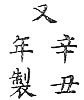
It will be seen that cyclical dates without any indication of the particular cycle intended are merely tantalising. On the other hand when the reign is specified as well, the combination gives the most precise form of date. But unfortunately there are many cases in which the reign name is absent, and we can only judge the cycle by the style of the ware, a calculation which is always open to dispute. It is not often that the cycle is so clearly indicated by an indirect method as in the oft–quoted mark yu hsin ch´ou nien chih = made in the hsin ch´ou year recurring (yu).This can only be 1721, when the hsin ch´ou year actually recurred in the (sixty–first year of) reign of K´ang Hsi.[453]
(b) The more usual form of date mark is that which gives the reign name of an Emperor. On ascending the throne the Emperor discarded his family name and assumed a title by which his reign was thenceforth known. This is the name which appears in the date marks, and it is known as the nien (period) hao (name). After his death the Emperor received another title, the miao hao, or name under which he was canonised; but though reference might be made to him in history under his miao hao, it is obvious that the posthumous name cannot occur on contemporary date marks.
In reckoning the date of an Emperor's reign it was not usual to include officially the year in which his predecessor had died, but to date the reign from the first day of the year following. Thus, though K´ang Hsi became Emperor in 1661, his reign is dated officially from 1662.
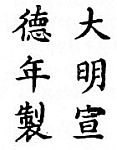
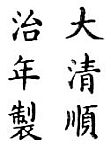
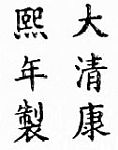
The Imperial date mark is usually written in six characters beginning with the name of the dynasty and ending with the words nien chih (made in the period): the nien hao coming in the middle:—
1 2 3 4 5 6 e.g. Ta ming ch´êng hua nien chih = made (chih)
4
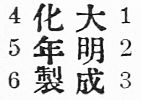
in the Ch´êng Hua period (nien) of the great Ming (dynasty).
Occasionally the word nien is replaced by yü (Imperial), yü chih meaning made by Imperial command; and in place of chih we sometimes find the word tsao or more rarely tso both of which have the same meaning "made."


The six characters may be written in two lines of three, or in three lines of two, or again in one long line read from right to left; and for reasons of space, and sometimes for no apparent reason, the first two characters are omitted, e.g. . The omission of the nien hao is rare except on a few Japanese copies of Chinese porcelain, e.g. ta ming nien chih = made in the great Ming dynasty.


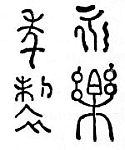
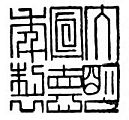
As already mentioned, the seal forms of the mark were frequently employed from the eighteenth century onwards (see p. 209). An archaic form of seal character occurs in the Yung Lo mark which is given below.
The use of the nien hao on the Imperial wares made at Ching–tê Chên was made obligatory by a command issued in the Ching–tê period (1004–1007), when the name of the town was altered to Ching–tê Chên.
Ming Dynasty
HUNG WU, 1368–1398.
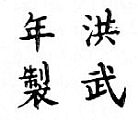
Same in seal characters.
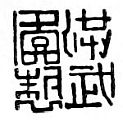
YUNG LO, 1403–1424.
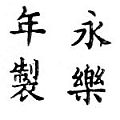
Same in archaic characters.
HSÜAN TÊ, 1426–1435.
Same in seal characters.
CH´ÊNG HUA, 1465–1487.
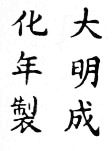
Same in seal characters (the first two omitted).
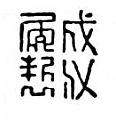
HUNG CHIH, 1488–1505.
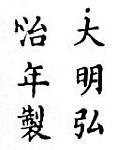
CHÊNG TÊ, 1506–1521.
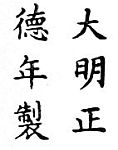
CHIA CHING, 1522–1566.
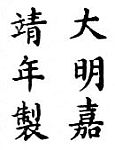
LUNG CH´ING, 1567–1572.
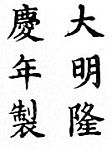
WAN LI, 1573–1619.
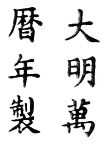
T´IEN CH´I, 1621–1627.
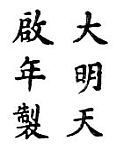
CH´UNG CHÊNG, 1628–1643.
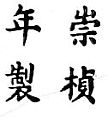
Ch´ing Dynasty.
SHUN CHIH, 1644–1661.
Same in seal characters.
K´ANG HSI, 1662–1722.
Same in seal characters.
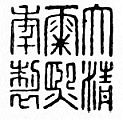
YUNG CHÊNG, 1723–1735.
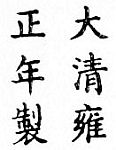
Same in seal characters.
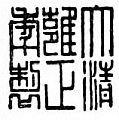
CH´IEN LUNG, 1736–1795.
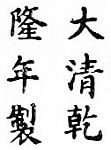
Same in seal characters.
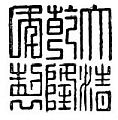
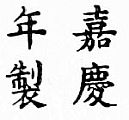
CHIA CH´ING, 1796–1820.
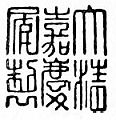
Same in seal characters.
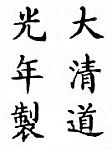
TAO KUANG, 1821–1850.
Same in seal characters.
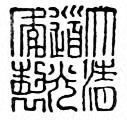
HSIEN FÊNG, 1851–1861.
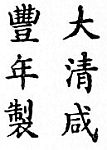
Same in seal characters.
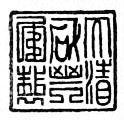
T´UNG CHIH, 1862–1874.
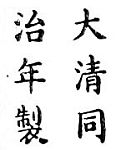
Same in seal characters.
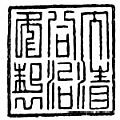
KUANG HSÜ, 1875–1909.
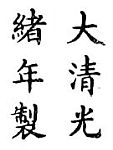
Same in seal characters.
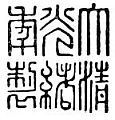
(2) Hall marks.
The "hall mark," which is of frequent occurrence on both porcelain and pottery, is so called because it includes the word t´ang (hall) or some equivalent such as chai (a study), t´ing (a pavilion), hsien or hsüan (a porch, balcony or pavilion), kuan (a residence or hostelry), fang (a room or house), chü (a dwelling). The word t´ang as explained in Giles's Dictionary is "a hall: especially a hall of justice or court; the ancestral hall; an official title." T´ang ming is "the family hall name—a fancy name usually consisting of two characters followed by t´ang (e.g. wu tê t´ang chin = Chin of the military valour hall), and referring to some event in family history. It is generally inscribed in one of the principal rooms of the house, and is used in deeds, on graves, boundary stones, etc."


The hall mark, then, may contain the studio name of the maker or of the recipient of the ware, or it may have reference literally to the building for which the ware was intended. The last interpretation can be generally applied to the marks referring to halls or pavilions in the precincts of the Imperial palace. Again, the hall may be the shop of a dealer who ordered the goods. But in the absence of prepositions, it is not always—not often, I should perhaps say—possible to determine which of these alternatives is implied in any particular hallmark; e.g. Lin yü t´ang chih may mean "made in the Abundant–Jade Hall," or "for" the same, or by a man whose studio name was Lin–yü t´ang.

As to the antiquity of hall marks, it was not considered anachronistic to cut one on a Han granary urn which is now in the British Museum; but unfortunately as the cutting was done after the ware was baked it is now impossible to say at what period it was executed. A Sung example is quoted in the Ni ku lu (written in the middle of the sixteenth century) as inscribed on a Ting Chou vase in the handwriting of the Mi family, viz., jên ho kuan (Hotel of Benevolence and Harmony). A similar mark similarly placed is jên ts´un t´ang (Hall of Benevolence), on a Tz´ŭ Chou jar in the Eumorfopoulos Collection.


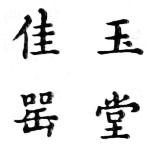
Hall marks on Ming porcelain are rare. There is, however, one which occurs fairly often on late Ming porcelains of various kinds, including pieces decorated in blue and blue and white, underglaze red, blue and enamel colours, pierced designs and slip. This is yü t´ang chia ch´i, "beautiful vessel for the Jade Hall."

It is improbable that the yü t´ang was a factory name, as the specimens so marked have little homogeneity. Giles's Dictionary tells us that yü t´ang is a name for the Han Lin College at Peking, which was so called in memory of Chou Chih–lin of the Sung dynasty, upon whom the Emperor bestowed these two characters in admiration of his qualities. From this we might infer that the wares so marked were made for the Han Lin; but why, one asks, in that case should the examples in our collections be so many and so evidently of the same period? On the whole I prefer to regard the mark as of general (and complimentary) significance, i.e. "beautiful vessel for the home of pure worth," like another mark much affected on late Ming porcelain fu kuei chia ch´i ("fine vessel for the rich and honourable!").
Hall marks are very frequent on the porcelains of the Ch´ing dynasty, and enough are given below to illustrate their various forms. Many of them are no doubt hall names of makers and decorators, and as such belong to the category of artists' signatures.
Special interest attaches to those hall marks which have been identified as referring to pavilions in the precincts of the Imperial palace. We are told by Bushell[454] that the "fashion of inscribing upon porcelain made for the Imperial palace the name of the particular pavilion for which it was intended seems to have begun in the reign of Yung Chêng," and observation shows that these hall marks only become frequent on the later porcelains. In fact most of the examples with which I am acquainted are nearer in style to the Tao Kuang than to the Yung Chêng wares, and the majority of the hall marks written in red on the glaze will be found to be of early nineteenth century date.
HALL MARKS
Yü t´ang chia ch´i = fine vessel for the jade hall (late Ming).
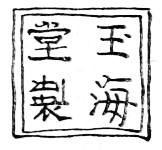
Yü hai t´ang chih = made for the Yü–hai (jade sea) hall (about 1700).
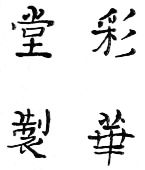
Ts´ai hua t´ang chih = made for the hall of bright painting (nineteenth century).
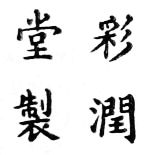
Ts´ai jun t´ang chih = made for the hall of bright colours (nineteenth century).
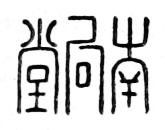
Nan hsiang t´ang = south aspect hall (on eighteenth century pottery).
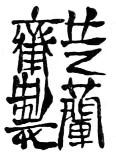
Chih lan chai chih = made for the epidendrum hall (seventeenth century).
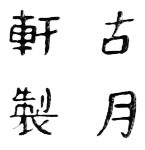
Ku yüeh hsüan chih = made by Ku–yüeh–hsüan. (See Vol. ii., p. 215.)
Yu ch´ai = quiet pavilion—a studio name of a painter.
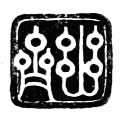
Wan shih chü = myriad rocks retreat; studio name of a painter.
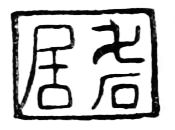
Chu shih chü = red rocks retreat; studio name of a painter.
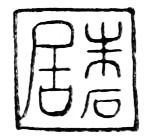
PALACE HALL MARKS
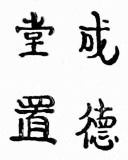
Ch´êng tê t´ang chih = ordered for the Ch´êng–tê (complete virtue) hall.
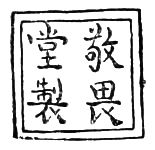
Ching wei t´ang chih = made for the Ching–wei (reverent awe) hall.
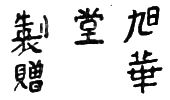
Hsü hua t´ang chih tsêng = made for the Hsü–hua hall, for presentation.
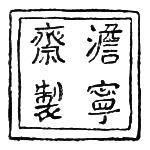
Tan ning chai chih = made for the Tan–ning (peace and tranquillity) pavilion.
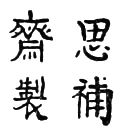
Ssŭ pu chai chih = made for the Ssŭ–pu pavilion (i.e. pavilion for meditation for the correction of faults).
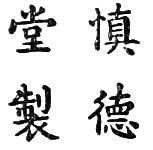
Shên tê t´ang chih = made for the Shên–tê (cultivation of virtue) hall. (See Vol. ii., p. 264.)
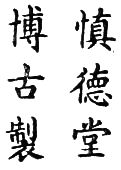
Shên tê t´ang po ku chih = antique made for the Shên–tê hall.
(3) Potters' names, etc.
Marks which include potters' names (apart from the uncertain hall marks) are rare on Chinese porcelain though frequent enough on pottery. But it will be remembered that at Ching–tê Chên at any rate the porcelain passed through so many hands that the individuality of the work was lost, and consequently a personal mark would be, as a rule, misleading. The question of signatures in the field of the decoration has been discussed[455] with the conclusion that they belong rather to the artists who painted the original copied by the pot–painters than to the pot–painter himself.
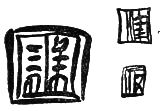
Perhaps we should include here a fairly common type of mark, usually in the form of a small seal of a conventional and quite illegible character, which goes by the name of "shop marks." But it is not clear whether they refer to the maker or the firm who ordered the porcelain.
POTTERS' MARKS
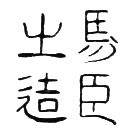
Ma chên shih tsao = made by ma ch´ên–shih (on a T´ang vase).
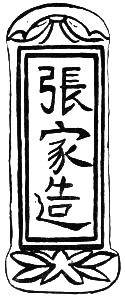
Chang chia tsao = made by the Chang family (on Tz´ŭ Chou ware). (See Vol. i., p. 105.)
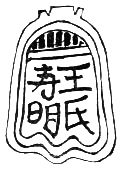
Wang shih ch´ih ming = Mr. Wang Ch´ih–ming (on Tz´ŭ–Chou ware).
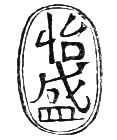
I shêng = harmonious prosperity. Perhaps a potter's name (on Kuangtung ware).
MARKS ON KUANGTUNG WARE
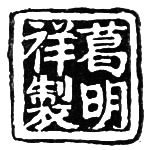
Ko ming–hsiang chih = made by Ko Ming–hsiang (eighteenth century).
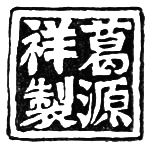
Ko yüan hsiang chih = made by Ko Yüan–hsiang (eighteenth century).
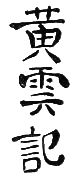
Huang yün chi = mark of Huang–yün (nineteenth century).
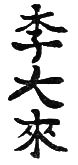
Li Ta–lai = potter's name.
Hou–ch´ang = potter's name.
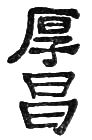
POTTERS' MARKS—continued.
Yi hsing tzŭ sha = brown earth (lit. sand) of Yi–hsing.
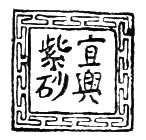
Ming–yüan = a late Ming potter at Yi–hsing.
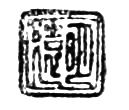
Hui mêng–chên = name of a late Ming potter at Yi–hsing, copied on modern wares.
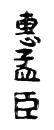
Ch´ên Ming Yüan chih = made by Ch´ên Ming–Yüan, Yi–hsing.
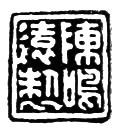
Yü lan pi chih = secretly made by Yü–lan; Yi–hsing (nineteenth century).
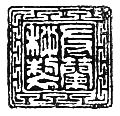
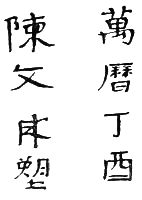
Wan li ting yu ch´ên wên ching su = Ch´ên Wên–ching modelled it in the ting–yu year of Wan Li (i.e. 1597).
MARKS ON FUKIEN WHITE PORCELAIN
Chao–chin = a potter's name.
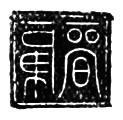
Chung t´un shih = Chung–t´un family.
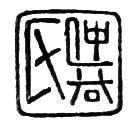
(?) Li–chih = a potter's name.
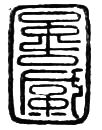
Shan jên ch´ên–wei = the hermit Ch´ên–wei.
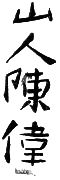
Lai–kuan = potter's name.
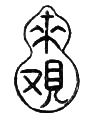
Chao tsung ho yin = seal of Ho Chao–tsung.
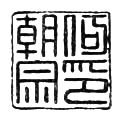
POTTERS' NAMES, ETC.
Chiang ming kao tsao = made by Chiang Ming–kao (about 1700).
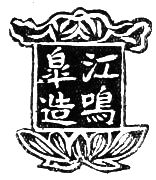
Ch´ên kuo chih tsao = made by Ch´ên Kuo–chih (about 1700).
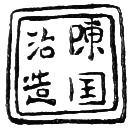
Tao kuang ting wei wên lang shan chih = made by Wên Lang–shan in the ting–wei year of Tao Kuang (i.e. 1847).
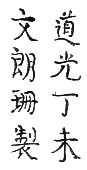
Yü fêng yang lin = Yang Lin of Yü–fêng. (See Vol. ii., p. 212.)
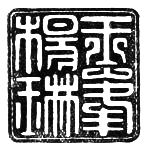
(?) Trader's mark on export porcelain. (See Vol. ii., p. 136.)
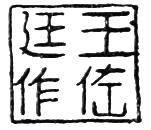
Wang tso t´ing tso = made by Wang Tso–t´ing (early nineteenth century).
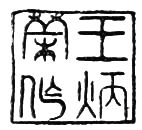
Wang ping jung tso = made by Wan Ping–jung (early nineteenth century).
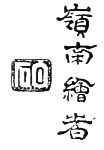
Ling nan hui chê = Ling–nan (Canton) painting. Seal of Pai–shih (white rock). (See Vol. ii., p. 211.)
Fu fan chih tsao = made on the borders of Fukien. (See Vol. ii., p. 108.)
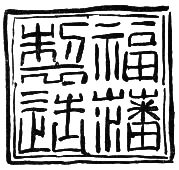
Three examples of "shop marks."
(4) Marks of dedication, felicitation, etc.
In many cases the place of a date mark, hall mark, or potter's name is taken by a word or phrase commending or describing the ware or invoking a benediction on the possessor. Such marks may be conveniently subdivided into marks of (a) dedication, (b) felicitation, (c) commendation; to which may be added (d) symbols used as marks.
(a) Marks of dedication indicating the destination or intention of the ware contain the name of a place or person or some word suggesting the use to which the vessel was dedicated. This group naturally overlaps that of the hall marks, there being no essential difference between a palace hall mark and such a mark as Shu fu (Imperial palace) which was inscribed on the Imperial porcelain of the Yüan dynasty.

A few marks of dedication are mentioned in the Po wu yao lan[456] e.g. t´an (altar) on the altar cups of the Hsüan Tê period; ch´a (tea), chiu (wine), tsao t´ang (decoction of jujubes), and chiang t´ang (decoction of ginger), which were inscribed inside the altar cups of the Chia Ching period, besides chin lu (golden seal), ta chiao (great sacrifice), and t´an yung (altar use), which were written beneath them; all indicating the offerings and the altars for which the cups were destined.


Dedications to temples, institutions, and even to individuals, often of considerable length, also occur not infrequently.
(b) Marks of felicitation include good wishes such as ch´ang ming fu kuei (long life, riches and honour), wan fu yu t´ung (may infinite happiness embrace all your affairs), both of which have been noted on Ming porcelain; words of good omen such as fu, lu, shou, separately or together, chi (good luck), ch´ing (prosperity), etc.


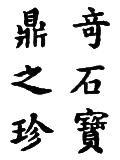
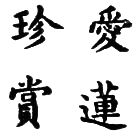
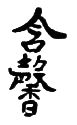
(c) Marks of commendation are also frequent, especially in the K´ang Hsi period and on blue and white porcelain. They allude to the beauty of the ware, comparing it with jade or gold or gems, or to the subject of the decoration; and they vary in length from a single character such as yü (jade) to a sentence like ch´i shih pao ting chih chên (a gem among precious vessels of rare stone).

(d) A sacred symbol or emblematic ornament often replaces the mark on K´ang Hsi porcelain; but as these will be found among the symbols, etc., described in vol. ii., ch. xvii., there is no need to discuss them any further. The most frequently used are the pa pao (Eight Precious Things), and the pa chi hsiang (the Eight Buddhist Emblems of Happy Augury).
MARKS OF FELICITATION, ETC.
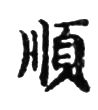
Shun = harmony.
Lu = prosperity.
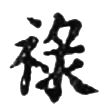
Shou = longevity (seal form).
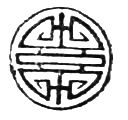
The same, with the Swastika interwoven.
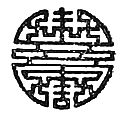
The "spider" mark, a fanciful form of shou.
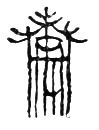
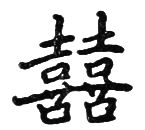
hsi (joy) repeated = double joy, a wedding symbol.
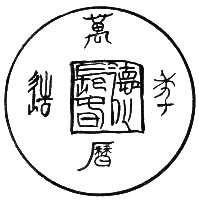
tê hua ch'ang ch'un = virtue culture and enduring spring; enclosed by Wan li nien tsao = made in the Wan Li period (1573–1619).
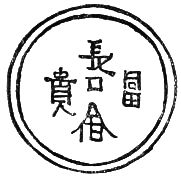
Mark resembling a "cash" or coin inscribed ch'ang ming fu kuei = long life, riches, and honours!
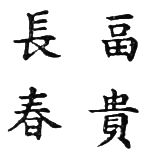
fu kuei ch'ang ch'un = riches, honours, and enduring spring!
Wan fu yu t'ung = a myriad happinesses embrace all (your affairs)!
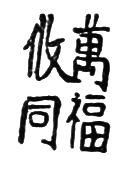
Kung ming fu kuei Hung fu ch'i t'ien = a famous name, riches and honours, vast happiness equalling heaven!
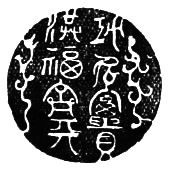
t'ien t'i yi chia ch'un = spring time for the whole family of heaven and earth.
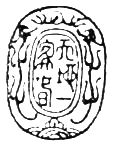
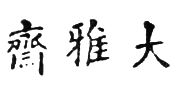
ta ya chai = pavilion of grand culture. The Empress dowager's mark.
MARKS OF COMMENDATION
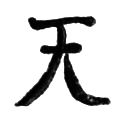
t´ien = heaven.
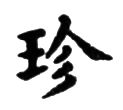
Chên = a gem.
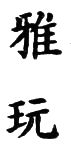
Ya wan = elegant trinket.
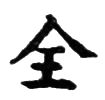
Ch´üan = complete.
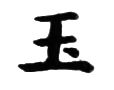
Yü = jade.
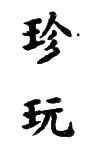
Chên wan = precious trinket.
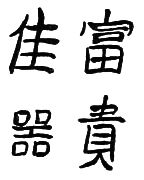
fu kuei chia ch´i = fine vessel for the rich and honourable.
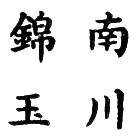
Nan ch´uan chin yü = embroidered jade of Nan–ch´uan (i.e. Ching–tê Chên).
Ch´i shih pao ting chih chên = a gem among precious vessels of rare stone.
Ai lien chên shang = precious reward of the lover of the lotus.
han hsing = to contain fragrance.
For other marks on porcelain and pottery see Marks on Pottery and Porcelain, by W. Burton and R.L. Hobson, and The New Chaffers.
MISCELLANEOUS MARKS AND SYMBOLS
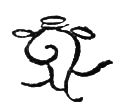
Conch–shell.
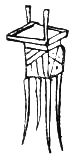
Incense–burner (ting).

ju–i head.
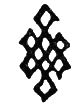
Knot (chang).
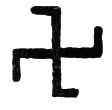
Swastika (wan).
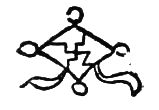
Swastika in a lozenge symbol.
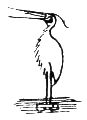
Stork (on a late Ming blue and white dish).
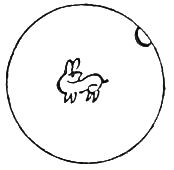
The moon hare.
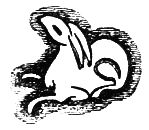
The moon hare.
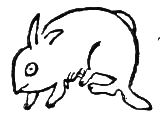
The moon hare.
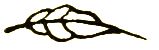
Artemisia leaf.
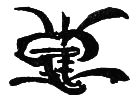
Fungus (ling–chih).
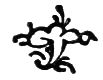
Fungus (ling–chih).
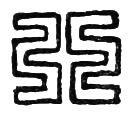
Fu (one of the twelve ornaments on ancient embroidery).
END OF VOL. I.
PRINTED BY CASSELL & COMPANY, LIMITED, LA BELLE SAUVAGE, LONDON, E.C. F 15.115