TOYS FROM THE STREETS.
Reading edition
Who does not know the Street Toy-man? 'All made to work! Here you are, sir, a real motor-car for a penny! The wonderful jumping frog!'
Cheapside and Ludgate Hill, and many less busy parts of London, ring with such cries for a month before Christmas. All the year round the hawkers are standing patiently on the curbstone with their wonderful penn'orths; but it is at Christmas-time that they do most business. Some children are fortunate enough to be taken by their parents to see the streets at Christmas-time, and sometimes they are allowed to buy some of the pretty things for themselves. But there are many others not so fortunate, who can only look on wistfully, and others again who are not rich enough or, perhaps, too ill even to go and look at the sights. Poor men and women, who cannot really afford even a penny, find in the hawkers' wares the cheapest market, and many a bare, cold home is brightened at Christmas by one or two of the little toys that cost so little, but bring so much happiness.
Toys from the Streets.
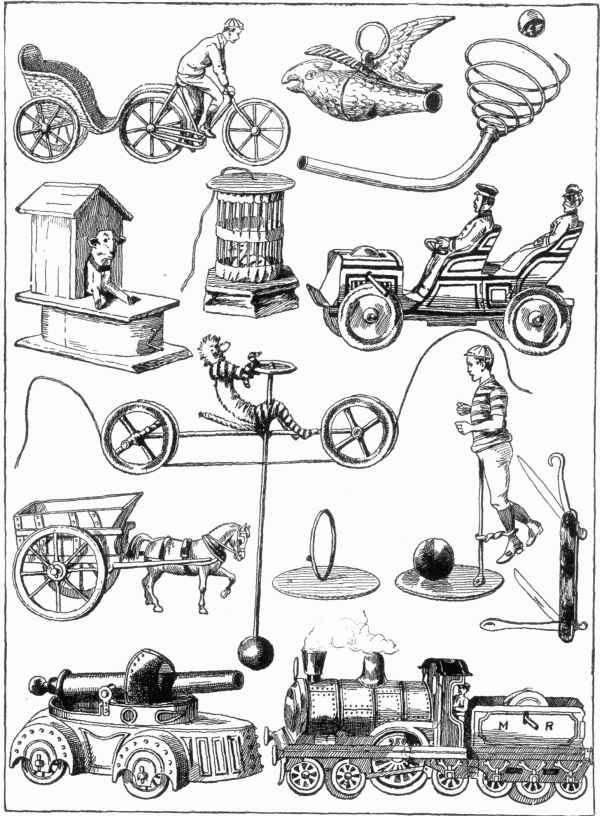
These toys have a wonderful history of their own. Do you know that when you have one of them in your hand, you may be holding what has come thousands of miles over sea and land from the hands of other children in distant countries? Whole families make a living by manufacturing these toys. The material—wood, paper, tinsel, wire, or what not—is given out at the factory, and the worker takes it home. There every one is busy; one cutting out pieces of paper of a given shape, one whittling pieces of wood to fit together, one gumming up the various parts, till the whole toy is finished and added to a growing pile. Nearly every civilised country has such workers—Austria, Germany, France, America, Japan, and England; and the toys in the end travel mile after mile in great ships and trains, to be sold in the streets for such a little sum!
Now think how some of these are made. Most of those which require gumming or fitting together are the work of man's hands alone. The birdcage and dog musical-box in the illustration are of this kind. In the inside of the box under the dog is a little cogged wheel, which, when the handle is turned, rubs against pieces of metal and produces the musical sounds. The bird's song, or rather, croak, is caused by air rushing through a sort of parchment tissue when the floor of the cage is compressed. The train, carman, cart, and trailer are made almost entirely by means of moulds, though some parts have to be fitted together by hand. First of all, a model is made in wax or clay, or some other substance, then a cast is taken of it in plaster of Paris, then a double mould (in two pieces) is made from the plaster cast, and into these moulds liquid metal—an alloy mainly composed of lead—is run, and left to cool. All these five toys have wheels that move. They are electro-gilt—that is, the gilding is fixed on them by means of a bath through which an electric current passes.
The other toys in the illustration are made mainly by hand, though parts have to be cast in moulds or cut by machinery. The monkey bicyclist is hand-made; his body is composed of wool and wire. The weight hanging down under the string keeps him perfectly balanced, and as the string is raised or lowered he runs up and down more easily than a good many human bicyclists.
(Continued on page 389.)