ANIMAL MAKESHIFTS.
Reading edition
True Anecdotes.
V.—FRIENDS IN NEED.
The goodwill shown by one animal to another in time of need is an example to us all. Very lowly creatures are able to understand, and are ready to help each other like brothers, with no other motive than their comrade's need, and no other reward than the power to relieve it.
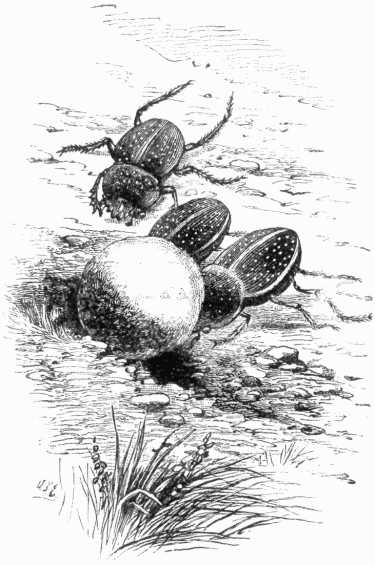
There is a kind of beetle which makes a ball or pellet of manure, in the middle of which it places its egg. This it rolls towards a hole previously dug, and drops it in. One of these beetles was seen painfully toiling to roll its little ball out of a cart-rut, into which it had tumbled; he was trying with all his tiny might, but all in vain. After pushing it up the side a great many times, the ball rolling back again, he went off to a manure-heap close by, and came back with two other beetles, his neighbours. All three set to work shoulder to shoulder, and between them shoved the ball out of the rut. Having done as they would be done by, the assistants then returned to their own business.
Sir Frederick Doyle, while watching some wasps eating plums on his trees, knocked one down without killing it. The wasp fell into a large spider's web below. To his surprise a fellow-wasp instantly flew down to the rescue. He poised himself close to the spider's web, whirling his wings till they looked like glittering rainbows, so fast that their shape could not be seen. This was to prevent them from being caught in the sticky web, and all the time he was striking deft and rapid blows at the threads that held his friend fast. At length he cut him out, but the poor rescued insect fell down to die upon the ground. The observer adds: 'I was so much struck with this proof of a heart as well as a brain in the case of wasps that I not only spared the "V.C." wasp who rescued his friend, but also the rest of the troop, and left the plums to their fate.'
The weasel, that terrible foe to rabbits and rats, is not famous for good temper, yet a pretty tale is told of one of them. A gentleman was riding home, when his horse trod on a weasel, which was unable to get out of the way in time. The poor little animal's spine seemed to be hurt, and it could not move its hind legs. Presently another weasel came out of the hedge by the roadside, and went up to the injured one. After carefully inspecting it, the second weasel picked up the first and carried it to the side of the road, out of the way of the traffic, where he gently laid it down.
"All three set to work shoulder to shoulder."
Wild elephants seem unable to bear the sight of suffering friends without an attempt to save them, and in particular the wild herds of these noble beasts love and protect their leaders. When pressed by hunters, they place him in the midst and crowd in front of him, eager to save his life at the expense of their own. Professor Romanes gives an instance of a fine 'tusker' which, when badly wounded, was promptly surrounded by his companions. They supported him between their shoulders, and actually succeeded in covering his retreat to the forest.
Birds are very generous towards each other in these ways, particularly such as live in communities together. If one rook of a colony gets into trouble, all the rest are worried about him directly. A great mob of rooks, living in trees near the river Irwell, were seen chasing each other playfully on the wing, dancing idly with joy and pleasure at the coming spring, when one of them accidentally knocked against another, and fell into the river below. In an instant a chorus of distress was raised; the birds hovered over their friend, as he struggled in the water, with cries of sorrow and alarm, and seemed to be giving him advice in some fashion of their own. At any rate, urged by their voices, he sprang into the air, and by one strong effort managed to reach a point of rock. The shouts of joy at his safety echoed far and wide.
"The robin came back with a worm."
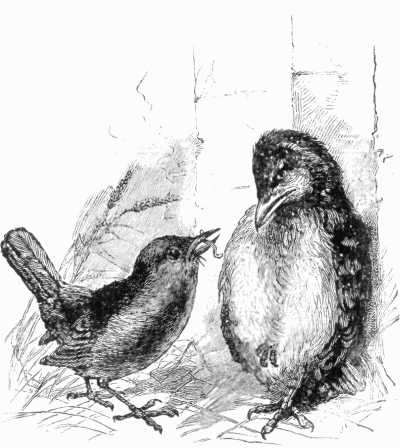
Much tenderness is shown by grown-up birds to helpless orphans in need of their aid. A redbreast was mentioned lately in Science Gossip as doing a deed of kindness towards a young starling one bitterly cold morning. The starling had left the nest, and was sitting frightened and shivering in a cellar, whither it had crept, too weak and hungry to fly. In vain kindly human hands offered it bread; it refused all food, till a little hungry robin came down on his daily visit to the house and spied the baby-bird, sitting on one leg, calling his absent mother. Off he went, and soon came darting back with a worm, which was gratefully accepted. When the beggar-bird had been fed, both flew away. Seagulls have been seen assisting a wounded comrade over the wave, and a crane, seeing one of its fellows shot, placed itself under the sufferer in such a way as to prevent his falling to the ground; then, weighted as he was, he bore him away beyond gun-shot.
In sickness, too, not only monkeys, dogs, cats, and the higher animals, but the lowest also, as well as birds, show good feeling. On a salt lake in Utah lived an old and completely blind pelican, which was very fat, 'and must,' says Darwin, 'have been well fed for a long while by his companions.' Crows feed their blind friends, and so do rats, and a case is on record of a barn-door cock who did the same thing. These and similar facts, which could be multiplied by thousands, prove how beautiful a spirit is that which our great Creator breathed into even the humblest of His creatures, and how worthy, for His sake, they are of our reverence and regard.
Edith Carrington.